Nuclear reactors on the sea floor – Russia’s costly problem

Lifting Russia’s accident reactors from the Arctic seafloor will cost nearly €300 million, https://thebarentsobserver.com/en/ecology/2020/03/lifting-russias-accident-reactors-arctic-seafloor-will-cost-nearly-eu300-millionExperts are discussing the framework for safe lifting of dumped reactors from four submarines and uranium fuel from one icebreaker reactor in the Kara Sea, in addition to one sunken nuclear submarine in the Barents Sea. By Thomas Nilsen 8 Mar, 20,
Russian and European experts agree that the dumped Soviet-era nuclear reactors in the Kara Sea can’t stay on the seafloor forever.
The Soviet Union used the waters east of Novaya Zemlya to dump accidental reactors, spent nuclear fuel and solid radioactive waste from both the navy and the fleet of nuclear-powered civilian icebreakers.
About 17,000 objects were dumped in the period from the late 1960s to the late 1980s.
Most of the objects are metal containers with low- and medium level radioactive waste. The challenge today, though, are the reactors with high-level waste and spent uranium fuel, objects that will pose a serious threat to the marine environment for tens of thousands of years if nothing is done to secure them.
According to the Institute for Safe Development of Nuclear Energy, part of Russia’s Academy of Science, the most urgent measures should be taken to secure six objects that contain more than 90% of all the radioactivity.
It is the information site for Russia’s submarine decommissioning program that informs about the plans.
The reactors from the submarines K-11, K-19 and K-140, plus the entire submarine K-27 and spent uranium fuel from one of the old reactors of the Lenin-icebreakers have to be lifted and secured.
Also, the submarine K-159 that sank north of Murmansk while being towed for decommissioning in 2003 have to be lifted from the seafloor, the experts conclude.
Special priority should be given to the two submarines K-27 in the Kara Sea and K-159 in the Barents Sea.
The study report made for Rosatom and the European Commission has evaluated the costs of lifting all six objects, bringing them safely to a yard for decommissioning and securing the reactors for long-term storage.
The estimated price-tag for all six will €278 millions, of which the K-159 is the most expensive with a cost of €57,5 millions. Unlike the submarines and reactors that are dumped in relatively shallow waters in the Kara Sea, the K-159 is at about 200 meters depth, and thus will be more difficult to lift.
Lifting the K-27, transporting to a shipyard for decommissioning and long-term storage in Saida Bay will come at a price of €47,7 millions the report reads.
The work can be done over an eight years period, according to the expert.
But, as the expert-group underlines, the €278 millions funding does not exist in any Russian Federal budgets today.
Government advisers warn Britain against costly new nuclear reactors

 Times 7th March 2020, Net Zero Report. Plans for nuclear plants in Britain face fresh uncertainty after government advisers warned against backing costly new reactors. The nuclear industry wants the government to commit to a funding system to back the construction of reactors, including EDF’s proposed Sizewell plant in Suffolk.
However, the National Infrastructure Commission, set up in 2015 to provide impartial advice to the government, reiterated concerns in a report about backing more nuclear plants. It noted that there had been cost reductions in renewable power technologies such as wind and solar over the past ten years, but “costs of building and running nuclear power stations have not
fallen consistently, even in countries that have built fleets of similar reactors”. Given the potential for other non-intermittent technologies to complement renewables, it said that this “weakened the case for committing to a new fleet of nuclear power stations”.
https://www.thetimes.co.uk/article/advisers-raise-doubts-over-new-nuclear-plants-8hd85cr6d
Belgian nuclear plants now could shut down earlier than planned
 Court ruling could close Doel nuclear reactors earlier, Friday, 06 March 2020 A ruling by the Constitutional Court could mean the nuclear power stations Doel 1 and Doel 2 have to close down earlier than the government planned. Brussels Times, Court ruling could close Doel nuclear reactors earlier, Friday, 06 March 2020 A ruling by the Constitutional Court could mean the nuclear power stations Doel 1 and Doel 2 have to close down earlier than the government planned. Brussels Times, The Court this week struck down a law passed in 2015 which extended the lifetime of the reactors by ten years. The case was brought by two environmental organisations, Bond Beter Leefmilieu (BBL) and Inter-Environnement Wallonie. The two reactors came into service in 1975, and should have closed in 2015. But to fill the requirements of the electricity industry at the time, a law was passed extending the lifetime of the reactors for ten years. However, the Court ruled, that law is unconstitutional, as it required an environmental assessment report be carried out, which never happened. That effectively suspends the 2015 law, but the court said it would allow it to remain in force until the end of 2022. The government must now organise the lengthy procedure to take place of commissioning an environmental assessment report and the public enquiry procedure that goes with it. It must then pass a new law through the various stages in parliament. If that is not completed by the end of 2022, the two reactors will have to close down then, three years earlier than planned. To make matters more complicated still, the government also needs to enter into talks with the Dutch authorities, since Doel – an abandoned village on the estuary of the Scheldt river in the municipality of Beveren in East Flanders – is a stone’s throw from the border with the Netherlands…….. https://www.brusselstimes.com/all-news/belgium-all-news/98803/court-ruling-could-close-doel-nuclear-reactors-earlier-environmental-report-constitutional-court/ |
|
Worker at Hinkley Point nuclear station has now developed coronavirus COVID-19
Nuclear and other toxic wastes dumped in Beaufort’s Dyke, which lies between Scotland and Northern Ireland
The National 4th March 2020, FOR decades, Scotland has been used by the Ministry of Defence to dump
everything from nuclear waste to unwanted munitions. For example,
Beaufort’s Dyke, which lies between Scotland and Northern Ireland, is
packed with laboratory waste, chemical munitions and artillery rockets. The
decision by the MoD to use it as a dumping ground has effectively ruled out
any possibilty of using that crossing for a Scotland to Northern Ireland
bridge (if ever such a thing was viable in the first place).
https://www.thenational.scot/news/18280377.uk-used-scotland-nuclear-dumping-ground-decades/
We can now see the full horror of nuclear plans for Bradwell B
|
BANNG 4th March 2020, Bradwell B to use Cooling Towers. At last we can see the full horror of what is proposed for Bradwell B! The pre-application for planning permission public consultation documents have just been published by the Chinese developer.
TV 4th March 2020, People in Bradwell-on-Sea in Essex will get to have their say on plans for a new nuclear power station from today. A 12 week public consultation is starting on proposals for Bradwell B – a twin reactor on the same site as a power station which stopped operating in 2002. The consultation will include fifteen exhibition events across Essex which will give local residents the chance to review the proposals. |
|
Protesters call for Capenhurst Urenco nuclear plant to be closed down
|
Protesters call for Capenhurst nuclear plant to be closed down https://www.cheshire-live.co.uk/news/chester-cheshire-news/protesters-call-capenhurst-nuclear-plant-17873816 Demonstration held as Urenco celebrated its 50th birthday By
David HolmesChief reporter 6 MAR 2020
Urenco’s nuclear plant at Capenhurst this week celebrated 50 years since the government-owned international company was founded . But outside protesters lamented the damage to human health and the environment caused by disasters like Chernobyl in Ukraine and Fukushima in Japan. Close Capenhurst campaigners argued the sector was unsafe from uranium mining to nuclear power production and the transportation and storage of highly radioactive waste.
Concerns have been raised about the Urenco plant itself which enriches uranium for use as fuel in nuclear reactors with the depleted uranium – a low level radioactive and toxic byproduct of the process – stored on site. Marianne Birkby, an anti-nuclear campaigner from Cumbria, speaking at the small demonstration outside the plant, said: “The start of the nuclear fuel cycle is here and where it ends up is Sellafield in Cumbria and every day, virtually, there’s nuclear waste transported on the roads, rail, sea and nobody wants the waste. “It’s all very well for Urenco to say ‘enriching the future’ and how fantastic it all is but nobody wants nuclear waste at the end of the day. And nuclear waste is the product of nuclear power.” Japanese campaigner Kaori Mikata-Pralat read out a statement on behalf of a group pursuing legal action against the Tokyo Electric Power Company over the 2011 Fukushima disaster when a tsunami swamped the plant leading to the release of radioactive contamination. Explaining that Fukushima had alerted her to the dangers, she told CheshireLive: “I wasn’t quite aware of the scale of the problem of this nuclear industry.” She has met victims of nuclear accidents, adding: “What they want is this tragedy should not be repeated any where in the world. Fukushima people suffered a lot.” Kaori said the ocean had also been poisoned. Even nuclear power stations functioning normally affected the eco-system as sea and river water was used to cool the reactors with the hot water put back, harming fish and plant life. Pointing at the sun, fellow protester Philip Gilligan said: “That nuclear power station up there is supplying the energy. It’s the only nuclear power station we want. So the energy coming to earth could easily be used with zero carbon output and zero nuclear. The problem is we need a bomb. And it’s hidden in statements like ‘energy as cheap as water’ which was current when Sellafield went critical in the ‘70s.” Urenco highlights the alleged green credentials of nuclear because there are no CO2 emissions during energy generation but the protesters claim the carbon footprint is ‘enormous’ after taking into account uranium mining, transport and the manufacture of thousands of tons of concrete for the installations. But what of the job losses if plants like Capenhurst, which employs 550 people, were closed? The campaigners argue the Government should reskill the workforce to produce renewable technology like solar panels. |
France starts a series of nuclear power shutdowns
|
France begins winding down its reliance on nuclear powerFrance began shutting down its oldest nuclear plant last month after 43 years of operation, the first in a series of closures the government has proposed though the the country won’t altogether abandon its reliance on nuclear power. Bellona March 4, 2020 by Charles Digges
France began shutting down its oldest nuclear plant last month after 43 years of operation, the first in a series of closures the government has proposed though the the country won’t altogether abandon its reliance on nuclear power. Yet the closure of the two reactors at the Fessenheim plant along the Rhine River on France’s border with Switzerland and Germany, is part of a broad energy strategy to rely more on renewable energy sources. That strategy would see French dependence on nuclear energy from supplying three-quarters of its electricity to about half by 2035. The shutdown has also been a key goal of anti-nuclear campaigners since the Fukushima disaster in 2011. Experts have noted that the reactors at Fessenheim, brought online in 1977, fall far short of even those reactors at Fukushima, with some warning that seismic and flooding risks in the Alsace region have been underestimated. Prime Minister Edouard Philippe says the plant’s second reactor will be shut down in June 30 – though it will be several months before both reactors go cold and their used fuel can start to be removed. Another dozen reactors that will soon exceed their 40-year age limit must close by 2035 to meet the phase-down target. The plan also sees France closing its remaining coal plants, and moving to renewables like solar and wind to close the energy gap and help fight climate change. But at the same time, state-owned energy giant EDF is racing to get its first next-generation reactor running at the Flamanville plant in 2022– already 10 years behind schedule – and more may be in the pipeline. France’s history with nuclear power runs deep. The country runs 58 nuclear power plants, which sprang up largely as a response to the oil crisis in the 1970s. Those were built on the foundation of the CEA atomic energy commission, which was established in the wake of World War II in an effort to reestablish the nation’s sovereignty. Activists like Charlotte Mijeon, who is the spokesperson for the anti-nuclear group Sortir du nucléaire, told Voice of America news the Fessenheim closure is welcome news, but contended it doesn’t go far enough. “The government is closing one nuclear power plant, but it should not make us forget that the rest of the nuclear fleet is aging,” she told the agency. She also pointed to the huge subsidies nuclear power receives from the government, which they say makes it difficult for renewable power to compete……… France’s long insistence on using nuclear power has irritated Germany and Switzerland, which, as minority shareholders in Fessenheim, have long urged its shutdown. Germany also has plans of its own to phase out its nuclear power plants completely, a task it says it will finish by 2022. Polls among the French show growing resistance to nuclear power, with one survey taken in 2018 showing 53 percent of the population against the technology. https://bellona.org/news/nuclear-issues/2020-03-france-begins-winding-down-its-reliance-on-nuclear-power |
|
Russia’s Poseidon thermonuclear torpedo being tested
Russia’s New Nuclear Torpedo Is A Threat To More Than Just America’s Aircraft CarriersBut its coastal cities as well. National Interest. by Michael Peck, 4 Mar 20, Key point: Or is this just more hype? You make the call. Russia has begun underwater tests of its Poseidon thermonuclear torpedo.
The Poseidon is an 80-foot-long nuclear-powered submersible robot that is essentially an underwater ICBM. It is designed to travel autonomously across thousands of miles, detonate outside an enemy coastal city, and destroy it by generating a tsunami.
“In the sea area protected from a potential enemy’s reconnaissance means, the underwater trials of the nuclear propulsion unit of the Poseidon drone are underway,” an unnamed Russian defense official told the TASS news agency.
The source also said the “the reactor is installed in the hull of the operating drone but the tests are being held as part of experimental design work rather than full-fledged sea trials at this stage.”
TASS also reports the Poseidon, — the name was chosen in a Web contest held by Russia’s Ministry of Defense – will be armed with a 2-megaton warhead. That’s more than enough to destroy a city. But that leaves the question of why Russia would choose to nuke an American city with an underwater drone – even one that allegedly travels 100 miles an hour – when an ICBM can do the job in 30 minutes.
Russia suggests the Poseidon is a retaliatory weapon that would revenge a U.S. first strike even if American missile defenses were capable of stopping hundreds of Russian ICBMs. But even in the unlikely event that the U.S. could intercept 500 or more Russian ballistic missiles, a delivery system that could take days or weeks to reach its target seems hardly an efficient deterrent.
TASS also reports the Poseidon, — the name was chosen in a Web contest held by Russia’s Ministry of Defense – will be armed with a 2-megaton warhead. That’s more than enough to destroy a city. But that leaves the question of why Russia would choose to nuke an American city with an underwater drone – even one that allegedly travels 100 miles an hour – when an ICBM can do the job in 30 minutes.
Russia suggests the Poseidon is a retaliatory weapon that would revenge a U.S. first strike even if American missile defenses were capable of stopping hundreds of Russian ICBMs. But even in the unlikely event that the U.S. could intercept 500 or more Russian ballistic missiles, a delivery system that could take days or weeks to reach its target seems hardly an efficient deterrent…..
The puzzle is why a giant robot submarine would be needed to detonate a nuclear warhead near a U.S. aircraft carrier ….. https://nationalinterest.org/blog/buzz/russias-new-nuclear-torpedo-threat-more-just-americas-aircraft-carriers-129207
Nuclear power project Bradwell B public consultation to go live this week
Nuclear power project Bradwell B public consultation to go live this week, Maldon Standard , 4 Mar 20, By Pape Gueye @PMGueye “……… Proposals for Bradwell B were unveiled today as the first stage of consultation gets under way.
The consultation will run for 12 weeks until May 27, with exhibitions taking place at 15 venues across Essex…..
The proposals for Bradwell B will be developed over several years before the project submits an application to the UK Planning Inspectorate.
The final decision whether to grant permission will be taken by the Secretary of State.
A group campaigning against Bradwell B is urging residents to attend the EDF energy and Chinese General Nuclear stage one consultation events and make their views known.
Blackwater Against New Nuclear Group (BANNG) has been campaigning against the power station plan.
A spokesman said: “Any support will be gratefully welcome, ranging from just turning up to spending the whole time at a venue demonstrating your concern.”
The first consultation takes place tomorrow at Steeple Village Hall from 2pm until 8pm.
To see the other consultation dates, visit banng.info. https://www.maldonandburnhamstandard.co.uk/news/18280459.nuclear-power-project-bradwell-b-public-consultation-go-live-week/
Visit bradwellb.co.uk.
Poland’s nuclear power development with USA to cost $15.56 billion
|
Poland faces $15 bln nuclear power bill over 20 years – minister , https://www.reuters.com/article/poland-energy-nuclear/poland-faces-15-bln-nuclear-power-bill-over-20-years-minister-idUSL8N2AX3G7 RUDA SLASKA, Poland, March 4 (Reuters) – Poland will have to spend 60 billion zlotys ($15.56 billion) on its planned nuclear power plants over the next 20 years, the Polish minister responsible for energy infrastructure Piotr Naimski said on Wednesday.Poland generates most of its electricity from carbon-intensive coal and is the only EU state that has not pledged to achieve climate neutrality in 2050.
But facing pressure from the European Union to reduce emissions, it has planned to build 6-9 gigawatts (GW) of nuclear generation by 2040. “This will require spending 60 billion zlotys. These are huge amounts but our state can afford it,” Naimski told a conference in Silesia, a coal region in south of Poland. Poland hopes to cooperate with the United States on its nuclear energy project. Also French President Emmanuel Macron said last month that France supports Poland’s transition away from coal by using nuclear technology to produce electricity. ($1 = 3.8564 zlotys) (Reporting by Wojciech Zurawski; writing by Agnieszka Barteczko; editing by Barbara Lewis) |
|
Veterans groups not happy -France wants to abolish the National Commission for Monitoring the Consequences of Nuclear Tests.
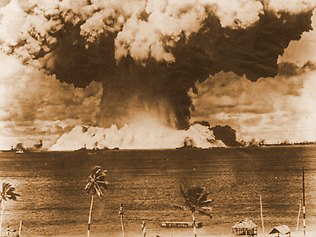 Dismay over plans to scrap French nuclear monitoring commission, https://www.rnz.co.nz/international/pacific-news/410780/dismay-over-plans-to-scrap-french-nuclear-monitoring-commission 2 March 2020 Nuclear test veterans groups in French Polynesia have reacted with dismay at reports that Paris wants to abolish the National Commission for Monitoring the Consequences of Nuclear Tests.
Last week, the French publication Canard Enchaine reported that as part of administrative changes and cost-cutting measures, dozens of commissions would be disestablished.
The commission is the body bringing together state authorities, representatives of the French Polynesian government and veterans associations to work on the list of radiation-induced illnesses deemed to be relevant for compensation.
The head of the group Moruroa e tatou Hiro Tefaarere has told the broadcaster La Premiere the move was inadmissible yet not surprising for the Macron government.
He said the French president on one hand described colonialism as a crime against humanity and on the other everything was suppressed which would recognise the consequences of the tests.
France carried out more than 190 nuclear weapons tests in the Pacific and until 2010 maintained that they were clean and posed no threat to human health.
Kazakhstan local residents may be stuck with costs of decommissioning nuclear reactor
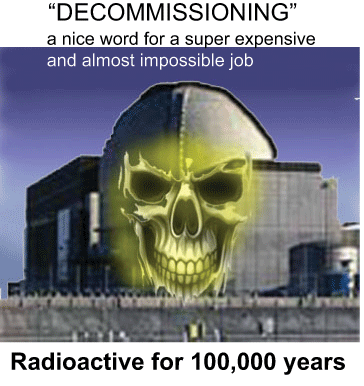 Local residents pay for decommissioning of Kazakhstan’s BN-350 reactor https://www.neimagazine.com/news/newslocal-residents-pay-for-decommissioning-of-kazakhstans-bn-350-reactor-7796914 27 February 2020 During a public hearing of the feasibility study on the environmental impact of decommissioning of the BN-350 fast reactor in Kazakhstan, Bulat Zhumakanov, representative of regional utility MAEK-Kazatomprom, said residents Aktau in Mangystau province, where the reactor is sited, will continue to pay for its maintenance.The BN-350, a sodium-cooled industrial fast neutron reactor, was physically launched in 1972, and was connected to the Mangystau power system in 1973. In 1998, it was closed down and formally began decommissioning the following year. Local residents pay for decommissioning of Kazakhstan’s BN-350 reactor https://www.neimagazine.com/news/newslocal-residents-pay-for-decommissioning-of-kazakhstans-bn-350-reactor-7796914 27 February 2020 During a public hearing of the feasibility study on the environmental impact of decommissioning of the BN-350 fast reactor in Kazakhstan, Bulat Zhumakanov, representative of regional utility MAEK-Kazatomprom, said residents Aktau in Mangystau province, where the reactor is sited, will continue to pay for its maintenance.The BN-350, a sodium-cooled industrial fast neutron reactor, was physically launched in 1972, and was connected to the Mangystau power system in 1973. In 1998, it was closed down and formally began decommissioning the following year.
MAEK-Kazatomprom has supplied Mangystau region of Kazakhstan with electricity, heat and water since 1967. It is responsible for three gas and oil power plants with total installed capacity 1330MWe, a desalination plant and for decommissioning the BN-350 reactor. According to representatives of the development company, METR, preliminary information, puts the total cost of decommissioning the BN-350 at KZT125 billion ($330m) excluding inflation. Zhumakanov said this year Kazakhstani Wealth Fund Samruk-Kazyna has allocated KZT1.2 billion for the maintenance of the reactor. However, funds will still be taken from local residents through the electricity tariff for repair work. An application has been made to the federal budget, but whether money will be allocated from the republican budget in future “remains open”, he said. The tariff has been in place for 20 years and residents have been pressing the government to provide the necessary funding. Decommissioning of the BN-350 reactor is planned in three stages:
From 1999 to 2016, with the financial support of the US government, nuclear fuel was removed, primary circuit sodium was treated to remove from caesium radionuclides, a project was implemented to process the used fuel, to passivate sodium residues in the first circuit, and other work. The decommissioning process must be continued and cannot be delayed, said representatives of MAEK-Kazatomprom. The tanks in which radioactive waste is stored have been in operation since 1972, and need upgrading. Some 3000 cubic metres of liquid radioactive waste, mainly sodium and caesium-137, which has a half-life of 30 years, are stored at MAEK-Kazatomprom. |
|
Sweden now faces years of nuclear reactor shutdowns and waste disposal problems
Sweden prepares for a decade of nuclear decommissioning, NS Energy, By Kristina Gillin 27 Feb 2020 ,
Sweden is preparing to dismantle and demolish six large power reactors on three sites over the coming years.
By the end of 2020, half of Sweden’s nuclear reactors will have been permanently shut down for decommissioning. The six large reactors are expected to undergo nuclear decommissioning in Sweden over the next decade.
Besides these, the Ågesta prototype reactor, a combined heat and power plant is about to commence dismantling.
Nuclear decommissioning at Sweden’s Barsebäck nuclear power plant
The twin units at Barsebäck, a few miles across the straight from Denmark, ceased to generate power in 1999 and 2005, respectively.
After shutdown, all spent fuel was removed and shipped to Sweden’s central interim storage facility (Clab) in Oskarshamn. Major decontamination of systems was also done early. However, dismantling had to wait, due to a lack of facilities for storage or disposal of decommissioning waste………
Funding and nuclear waste disposal in Sweden
Owners of nuclear power plants in Sweden have a statutory duty to dispose of their wastes. They are also required to set aside funding for waste management and nuclear decommissioning in Sweden. The funding is held in the Nuclear Waste Fund, a segregated Swedish government fund.
To fulfil the obligations, they jointly own the Swedish Nuclear Fuel and Waste Management Co (SKB). SKB’s scope covers disposal of most radioactive waste streams, interim storage of spent fuel and transportation between the various sites.
SKB is also responsible for compiling cost estimates for decommissioning and waste management every three years.
This to ensure that payments into the Nuclear Waste Fund are sufficient to cover future costs.
According to the 2019 estimates, the total cost of waste disposal, spent fuel storage and decommissioning is approximately SEK 147 billion (around €14 billion). Of this, about SEK 53 billion (around €5 billion) has been spent to date.
These figures include most of SKB’s scope but exclude the costs of near-surface disposal facilities for very low-level waste at Oskarshamn, Ringhals and Forsmark.
The majority of low- and intermediate-level waste from all Swedish reactors will be disposed of in SFR, a shallow geological repository for short-lived waste on the Forsmark nuclear site.
SFR has been in operation since 1988 but is currently licensed for operational waste only. To accommodate decommissioning waste, SKB plans to expand SFR’s capacity from 63,000 to 180,000 m3. An application for the expansion was submitted in 2014.
Pending regulatory approvals, construction of the new rock vaults will take place from 2023 to 2029. https://www.nsenergybusiness.com/news/nuclear-decommissioning-sweden/?fbclid=IwAR1me9D6hKLIPYP8Hp9tRS7Fgt6ksTbZ9t0Gvpo8IHCHgjIkeBqRnDgO79
Radioactive wastes into River Clyde could have devastating effects on community and wildlife
 Row over MoD River Clyde nuclear waste dump plans Row over MoD River Clyde nuclear waste dump plans
By Herald Scotland Online 1 Mar 20, Scotland’s national environment watchdog has denied claims the Ministry of Defence (MoD) is planning to increase discharges of radioactive waste into the River Clyde.Under the plans, liquid waste from reactors which power Royal Navy submarines at the Faslane and Coulport nuclear bases would be drained into the Gare Loch via a new pipeline.
Campaigners warned the rising discharges could have a devastating effect on surrounding wildlife and communities after a report by investigative journalism platform The Ferret stated emissions of one byproduct, cobalt-60, could rise by more than 50 times. …….. The Ferret reported the discharge of cobalt-60 would rise to 23.4 million units of radioactivity annually – around 52 times the current level. It added emissions of a second substance, known as tritium, would increase by 30 times to around 175,000 units, or ‘megabecquerels’, every year…….. SEPA’s public consultation is open until 13th Match and we welcome all responses. All responses will be reviewed in detail to ensure we continue to safeguard the environment and human health.” The bases are due to receive at least five more submarines in the coming years, including an ageing Trafalgar vessel and three new Astute submersible. The Ferret said a 50-strong group of Nuclear-Free Local Authorities (NFLA) had objected to the discharges. NFLA Scotland convener, Glasgow SNP councillor Feargal Dalton told The Ferret: “NFLA is particularly concerned about the considerable uncertainties in modelling doses and an under-appreciation of the effects of tritium”. “There are effective alternatives to nuclear powered submarines, as pioneered by the likes of Japan, and the Ministry of Defence should make a serious attempt to look at them.” https://www.heraldscotland.com/news/18272691.mod-planning-dump-50-times-nuclear-waste-river-clyde/ |
|
1 This Month

1 June Webinar – The High Cost of Nuclear Power – Register



of the week– Nuclear Reactor Information Task Force
To see nuclear-related stories in greater depth and intensity – go to https://nuclearinformation.wordpress.com
-
Archives
- May 2026 (235)
- April 2026 (356)
- March 2026 (251)
- February 2026 (268)
- January 2026 (308)
- December 2025 (358)
- November 2025 (359)
- October 2025 (376)
- September 2025 (257)
- August 2025 (319)
- July 2025 (230)
- June 2025 (348)
-
Categories
- 1
- 1 NUCLEAR ISSUES
- business and costs
- climate change
- culture and arts
- ENERGY
- environment
- health
- history
- indigenous issues
- Legal
- marketing of nuclear
- media
- opposition to nuclear
- PERSONAL STORIES
- politics
- politics international
- Religion and ethics
- safety
- secrets,lies and civil liberties
- spinbuster
- technology
- Uranium
- wastes
- weapons and war
- Women
- 2 WORLD
- ACTION
- AFRICA
- Atrocities
- AUSTRALIA
- Christina's notes
- Christina's themes
- culture and arts
- Events
- Fuk 2022
- Fuk 2023
- Fukushima 2017
- Fukushima 2018
- fukushima 2019
- Fukushima 2020
- Fukushima 2021
- general
- global warming
- Humour (God we need it)
- Nuclear
- RARE EARTHS
- Reference
- resources – print
- Resources -audiovicual
- Weekly Newsletter
- World
- World Nuclear
- YouTube
-
RSS
Entries RSS
Comments RSS
 nuclear-news