True cost of nuclear waste disposal facility £15bn higher than recent Treasury figures

MP says ministers ignore long-term waste costs of nuclear power
“Government ministers are very happy to talk about the so-called benefits of nuclear power without reference to its long-term impacts and the eye-wateringly large amounts of money associated with storage and security of nuclear waste, which is in the tens of billions of pounds just to create the GDF,” he said.
23 Oct, 2025 New Civil Engineer, By Tom Pashby
The true cost of an underground facility for long-term storage of nuclear waste has been revealed to be up to £68.7bn – £15bn more than the sum listed in the National Infrastructure and Service Transformation Authority’s (Nista’s) recent annual report.
A Geological Disposal Facility (GDF) represents a monumental undertaking, consisting of an engineered vault placed between 200m and 1km underground, covering an area of approximately 1km2 on the surface. This facility is designed to safely contain nuclear waste while allowing it to decay over thousands of years, thereby reducing its radioactivity and associated hazards.
Nuclear Waste Services (NWS) is responsible for the GDF project and declares that this method offers the most secure solution for managing the UK’s nuclear waste, aimed at relieving future generations of the burden of storage. NWS is part of the Nuclear Decommissioning Authority (NDA), which is itself an executive non-departmental public body, sponsored by the Department for Energy Security and Net Zero (DESNZ).
Nista is a unit of HM Treasury and published its NISTA Annual Report 2024 to 2025 in August 2025, where it described the GDF project as ‘Red’, meaning the projects appears to be “unachievable”, and as having a whole life cost of from £20bn to £53.3bn.
However, Nista’s Infrastructure Pipeline lists the GDF’s CapEx (capital expenditure) range for new infrastructure in 2024/2025 prices as being from £26.2bn to £68.7bn, with the top end being slightly over £15bn higher than the figure published in the annual report.
A government source explained to NCE that the discrepancy is because the figures published in Nista’s annual report are based on 2017/2018 prices, meaning the effects of long-term inflation were not accounted for.
Criticism was previously levied at High Speed 2 (HS2) because of its use of historic pricing figures to reduce the impact of inflation on budget projects and make the total cost of the project appear to be lower than it would end up being.
Parliamentarians told NCE that ministers should face up to the long-term legacy costs associated with the nuclear industry.
Current GDF pricing only provided by Nista to ensure consistency with pipeline
A government source told NCE that the difference in the two ranges for whole-life costs for the GDF is a factor of the price basis for each quoted figure.
They said that the NDA provided Nista with data in 2017/18 prices with the total range of £20bn-53.3bn, which was reflected in the Nista annual report.
The same data for this project was converted to 2024/25 prices for the Nista Infrastructure Pipeline, to ensure consistency with the rest of the data in the set, the source said. This is reflected in the higher figure of £26.1bn-£68.7bn.
NWS did not provide any comment.
MP says ministers ignore long-term waste costs of nuclear power
SNP spokesperson for energy security and net zero, transport, and science, innovation and technology, Graham Leadbitter MP, told NCE that ministers ignore the long term legacy of nuclear power when promoting projects.
“Government ministers are very happy to talk about the so-called benefits of nuclear power without reference to its long-term impacts and the eye-wateringly large amounts of money associated with storage and security of nuclear waste, which is in the tens of billions of pounds just to create the GDF,” he said.
He added that the waste would have to be managed for 1,000’s of years, and the money budgeted for nuclear waste management would be better spent on “more valuable infrastructure projects … that would support high-quality employment, investment in skills and vastly improved public services.”
Government must ‘face up to the legacy’ of nuclear – peer
Liberal Democrat Lords spokesperson for energy and climate change Earl Russell told NCE: “If this Government truly want to see a renaissance in nuclear power, it must finally face up to the legacy it leaves behind.”
Russell reiterated the fact that Nista described the GDF as “unachievable” and added: “The government must have a credible, long-term strategy for managing the waste new nuclear projects will produce.”……………………………………………………………………… https://www.newcivilengineer.com/latest/true-cost-of-nuclear-waste-disposal-facility-15bn-higher-than-recent-treasury-figures-23-10-2025/
Parliamentary Committee calls for clear direction on Oldbury and Wylfa, and a “one-stop shop” to finally overcome excessive cost and delays in deployment of nuclear energy
House of Commons Energy Security and Net Zero Committee, 24 October 2025
In a report today the Commons Energy Security and Net Zero Committee says new planning guidance for building Britain’s future nuclear energy generation brings a welcome ‘presumption of consent’ for low-carbon generation across a range of nuclear technologies.
But the UK’s move into unprecedented territory of private development of new nuclear sites creates new challenges. The Committee is concerned that the “exhaustive” drafting of the criteria in EN‑7, intended to introduce the flexibility to consider a wide range of factors towards approval, may in fact just duplicate issues also addressed by specialist regulators and create more uncertainty, delay and cost.
It concludes that new policy statement EN-7 “fails to present a truly joined-up approach across planning, safety, and environmental regulation” and so risks undermining its own purpose: to provide a definitive and coherent framework for decision-making. Commercial developers, facing a front-loaded application system and potential review both by multiple regulators and in Court, may be driven to “gold plate” applications with excessive detail. ……………………………………………………………………………… https://committees.parliament.uk/committee/664/energy-security-and-net-zero-committee/news/209808/committee-calls-for-clear-direction-on-oldbury-and-wylfa-and-a-onestop-shop-to-finally-overcome-excessive-cost-and-delays-in-deployment-of-nuclear-energy/
European leaders are unable to inflict a strategic defeat on Russia yet unwilling to face the political consequences of peace in Ukraine
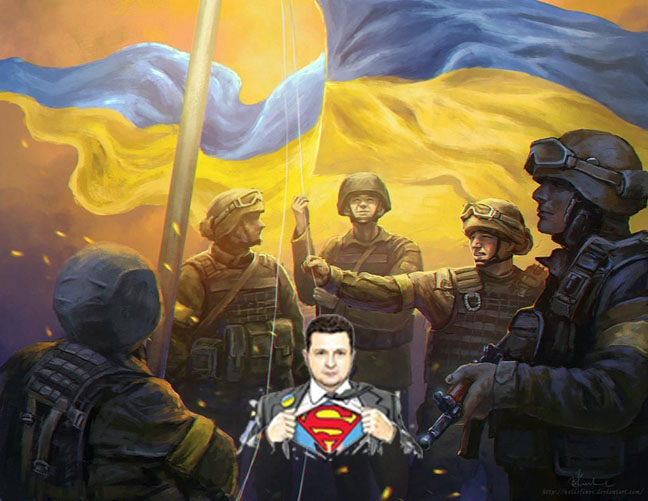
The war in Ukraine is now entirely dependent on the ability of European states to pay for it at a cost of at least $50bn per year
a strong likelihood……….. that three years from now Ukraine would have to settle for a peace that was even more disadvantageous to it than that which is available now
Ian Proud, Oct 22, 2025, https://thepeacemonger.substack.com/p/european-leaders-are-unable-to-inflict?utm_source=post-email-title&publication_id=3221990&post_id=176818542&utm_campaign=email-post-title&isFreemail=true&r=1ise1&triedRedirect=true&utm_medium=email
President Trump’s latest about face on dialogue with Russia doesn’t change the fundamental predicament Europe finds itself in: unable to inflict a strategic defeat on Russia but unwilling to face the political consequences of ending the war in Ukraine.
The Budapest Summit between Trump and Putin is now off, it seems. European leaders and Zelensky have clearly sold the US President on the idea of entering a ceasefire along the current line of contact. Yet, caught between a rock and a hard place, European leaders continue to deny the obvious realities of the dire situation in Ukraine, which will only worsen over time. I see no evidence of any willingness to change course, despite the obvious political hazard they face and the increasingly grim forecast for Europe and for Ukraine should they continue to push an unwinnable war.
The war in Ukraine is now entirely dependent on the ability of European states to pay for it at a cost of at least $50bn per year, on the basis of Ukraine’s latest budget estimate for the 2026 fiscal year. Ukraine itself is bankrupt and has no access to other sources of external capital, beyond that provided by the governments sponsoring the ongoing war.
That then brings the conversation back to the creation of a so-called ‘reconstruction loan’ underwritten by $140bn of the Russian foreign exchange assets currently frozen in Belgium. The term ‘reconstruction loan’ is itself disingenuous, on the basis that any expropriated Russian assets would not be used for reconstruction, but rather to fund the Ukrainian war effort. Indeed. Chancellor Merz of Germany recently suggested that the fund could allow Ukraine to keep fighting for another three years.
The most likely scenario, in the terrible eventuality that war in Ukraine did continue for another three years is that the Russian armed forces would almost certainly swallow up the whole of the Donbass region – comprising Donetsk and Luhansk oblasts. This – Ukraine’s departure from the Donbas – appears to be the basis of President Putin’s conditions for ending the war now, together with a Ukrainian declaration of neutrality and giving up any NATO aspirations. More likely, the Russian Armed forces might also capture additional swathes of land in Zaporizhia and Kherson oblasts, and also in Dnipropetrovsk, where they have made recent incursions.
So, there is a strong likelihood, at the currently slow pace of the war effort in which Russia claims small pieces of land on a weekly basis, that three years from now Ukraine would have to settle for a peace that was even more disadvantageous to it than that which is available now, having lost more land, together with potentially hundreds of thousands of troops killed or injured.
Logically, European policymakers would be able to look into the future to see this grim predicament with clear eyes and encourage Zelensky to settle for peace now.
But European policy is driven by two key considerations. Firstly, an emotional belief that an extended war might so weaken Russia that President Putin was forced to settle on unfavourable terms. The idea of a strategic defeat of Russia – which is often spoken by European politicians – however, doesn’t bear serious scrutiny.
Russia doesn’t face the same considerable social and financial challenges that Ukraine faces. Its population is much larger and a wider conscription of men into the Armed forces has not been needed – Russia can recruit sufficient new soldiers to fight and, indeed, has increased the size of its army since 2022. Ukraine continues to resort to forced mobilisation of men over the age of 25, often using extreme tactics that involve busifying young men against their will from the streets.
Critically, Russia could likely continue to prosecute the war on the current slow tempo for an extended period of time without the need for a wider mobilisation of young men, which may prove politically unpopular for President Putin domestically. Yet, the longer the war continues, Ukraine will come under increasing pressure, including from western allies, to deepen its mobilisation to capture young men below the age of 25 to shore up its heavily depleted armed forces on the front line.
There has been considerable resistance to this so far within Ukraine. Mobilising young men above the age of 22 would prove unpopular for President Zelensky but it would also worsen Ukraine’s already catastrophic demographic challenge: 40% of the working age population has already been lost, either through migration or through death on the front line and that number will continue to go south, the longer the war carries on.
Russia’s financial position is considerably stronger than Ukraine’s. It has very low levels of debt at around 15% of GDP and maintains a healthy current account surplus, despite a narrowing of the balance in the second quarter of 2025. Even if Europe expropriates its frozen assets, Russia still has a generous and growing stock of foreign exchange reserves to draw upon, which recently topped $700bn for the first time.
Russia’s military industrial complex continues to outperform western suppliers in the production of military equipment and munitions. In the currently unlikely event that Russia started to fall into the red in terms of its trade – what commentators in the west refer to as destroying Russia’s war economy – it would still have considerable scope to borrow from non-western lenders, given the strength of its links with the developing world, aided by the emergence of BRICS.
Ukraine is functionally bankrupt because it is unable to borrow from western capital markets, on account of its decision to pause all debt payments. With debt expected to reach 110% in 2025, even before consideration of any loan backed by frozen Russian assets, it depends entirely on handouts from the west. Ukraine’s trade balance has continued to worsen throughout the war, reinforcing its dependence on capital injections from the west to keep its foreign exchange reserves in the black.
So while the determination of Ukraine to fight is unquestionable, the emotional belief in the west that this will overcome the enormous social and economic challenges the country faces in an extended attritional war with Russia is wildly misplaced.
So, let’s look at the rational explanation for Europe’s continued willingness to prolong the fight in Ukraine. The uncomfortable truth is that Europe’s political leaders have boxed themselves into this position because of a hard boiled determination not to concede to Russia’s demands in any peace negotiations. Indeed, there is a steadfast and immovable objection to talking to Russia at all, which has been growing since 2014.
However, across much of Europe, the political arithmetic is turning against the pro-war establishment with nationalist, anti-war parties gaining ground in Central Europe, Germany, France, Britain and even in Poland. And despite so far fruitless overtures made by President Trump towards negotiation with President Putin, Trumpophobia provides another brake on the European political establishment shifting its position.
So, changing course now and entering into direct negotiations with Russia would have potentially catastrophic consequences, politically, for European leaders, which they must surely be aware of. A full 180 degree change in diplomatic course by Europe would require an acceptance that the war against Russia was unwinnable, and that Russia’s underlying concerns – namely Ukrainian neutrality – would finally have to be accepted as a political reality.
On this basis, European politicians would face the prospect of explaining to their increasingly sceptical voters that their strategy of defeating Russia had failed, having spent four years of war saying at all times that it would eventually succeed. And that would lead potentially to internationalist governments falling across Europe starting in two years when Poland and France will again go to the polls, and in 2029 when the British and German governments will face the voters.
There are deeper issues too. An end of war would accelerate the process of admitting Ukraine into the European Union with potentially disastrous consequences for the whole financial basis of Europe. The European Commission will face the prospect of accepting that a two-tier Europe is inevitable, admitting Ukraine as a member without the financial benefits received by existing member states; for probably understandable reasons, this would cause widespread resentment within Ukraine itself, having sacrificed so much blood to become European, precipitating widespread internal dissent and possibly conflict in a disgruntled country with an army of almost one million. Alternatively, the European Commission would need to redraw its budget and face huge resistance from existing Member States, who would lose billions of Euros each year in subsidies to Ukraine. And the truth is that it will in all likelihood be unable to do so.
Caught between hoping for a strategic defeat of Russia which any rational observer can see is unlikely, and accepting the failure of their policy, causing a widespread loss of power and huge economic and political turmoil, Europe’s leaders are choosing to keep calm and carry on. If they had any sense, the likes of Von der Leyen, Merz, Starmer or Macron would change tack and pin their hopes on explaining away their failure before the political tide in Europe evicts them all from power. But I see no signs of them having the political acumen to do that. So we will continue to sit and wait, while storm clouds grow ever darker over Europe.
Ukraine Says It Struck a Chemical Plant Inside Russia With British-Provided Storm Shadow Missiles

The Ukrainian military requires US targeting data to fire Storm Shadow missiles
by Dave DeCamp | October 21, 2025, https://news.antiwar.com/2025/10/21/ukraine-says-it-struck-a-chemical-plant-inside-russia-with-british-provided-storm-shadow-missile/
Ukraine’s military said on Tuesday that it used British-provided Storm Shadow missiles to strike a chemical plant inside Russia’s Bryansk Oblast, signaling the US is again supporting Ukrainian missile strikes on Russian territory.
“A massive combined missile-and-air strike was carried out, including with air-launched Storm Shadow missiles that penetrated Russia’s air defence system,” the General Staff of Ukraine’s Armed Forces said in a statement, according to Reuters. So far, the attack hasn’t been confirmed by Russia.
Storm Shadows are produced jointly by the UK and France and have a range of about 150 miles. Ukraine first began firing them into Russia last year, along with US-provided ATACMS missiles, which can hit targets up to 190 miles away.
In August, The Wall Street Journal reported that the Trump administration was not allowing Ukraine to fire ATACMS into Russia, a policy that also applied to Storm Shadows, since the Ukrainian military requires US targeting data to fire the British missiles. But another report from the outlet this month said that President Trump reversed the policy and signed off on providing Ukraine with intelligence for long-range missile strikes on Russian territory.
The Financial Times has also reported that the Trump administration has been providing intelligence for long-range drone attacks on Russian energy infrastructure since July.
US-backed missile and drone attacks on Russian territory always risk a major escalation from Moscow. When President Biden first gave Ukraine the green light to fire ATACMS and Storm Shadows into Russia, Moscow responded by altering its nuclear doctrine to lower the threshold for the use of nuclear weapons.
EU and Ukraine to offer Trump ‘peace plan’ with no territorial concessions – Bloomberg
Rt.22 Oct 25, https://www.rt.com/news/626782-bloomberg-european-peace-proposal-ukraine/
Kiev’s European backers are planning to advance a condition Moscow has firmly rejected.
Ukraine and its European backers are finalizing a 12-point peace plan that would rule out territorial concessions to Russia, Bloomberg reported on Tuesday, citing people familiar with the matter.
The proposal would reportedly establish a “peace board” chaired by US President Donald Trump to oversee its implementation. European officials could travel to the US this week to present the roadmap to Trump, Bloomberg reported.
According to the outlet, the plan includes a ceasefire along the current front lines, a prisoner swap, as well as “security guarantees” and fast-tracked EU accession for Ukraine. Russia and Ukraine would negotiate “the governance of occupied territories,” but neither Ukraine nor its European backers would recognize Russia’s new borders, Bloomberg cited its sources as saying.
Russia has listed recognition of its new borders as one of the crucial conditions for a lasting peace. Moscow has also demanded that Ukraine withdraw troops from parts of Russian territory it controls, halt mobilization, and stop receiving military aid from abroad.
Multiple US media outlets reported that Trump urged Ukrainian leader Vladimir Zelensky to cede land to Russia during their meeting at the White House on Friday. The US president later noted that Russian troops already control nearly all of the Donbass region claimed by Ukraine. Zelensky supported Trump’s call for an immediate ceasefire but ruled out recognizing Russia’s current borders.
UK Government planning for nuclear power in Scotland in anticipation of a Labour 2026 victory
A senior UK Government minister also says Scottish
independence would be a win for Vladimir Putin. The UK government could
soon start submitting planning applications for new nuclear power stations
in Scotland in anticipation of a Labour administration at Holyrood. A
senior government source said ministers do not want Scotland “to be left
behind” and suggested potential sites including Torness in East Lothian
were being actively considered.
A senior government source said that civil
nuclear companies see Scotland as “off limits” because of the SNP’s
stance on nuclear energy. However, they said: “The reality is planning
law is devolved and so that requires a change of government in Holyrood
next May to translate these possibilities but we are planning practical
changes on the ground because we don’t want Scotland to be left behind.”
Scottish Labour has high hopes of winning the 2026 Scottish Parliament
election and its leader Anas Sarwar has repeatedly lauded the benefits of
nuclear power. However the party has slipped back in the polls and is now
several percentage points behind the SNP, who are the current favourites to
win on polling day.
Scotsman 22nd Oct 2025, https://www.scotsman.com/news/politics/uk-government-planning-for-nuclear-power-in-scotland-in-anticipation-of-a-labour-2026-victory-5369530
A Genuinely Just Transition: Kill Off Sizewell C – Shaft Reform UK
the insanity of Labour’s nuclear obsession
Jonathon Porritt. 23 Oct 25,
https://jonathonporritt.com/just-transition-uk-sizewell-c-reform/
I’ve been more than a little mean about Ed Miliband in my last two blogs – which is somewhat ungenerous given that he would appear to be the last sensible, caring person standing in this misbegotten Labour Government.
So, let me big him up for a bit!
Last Saturday, he gave what is probably his most important speech since becoming Secretary of State at DESNZ – on what (in my opinion) is probably the single most important policy area within the sprawling DESNZ portfolio: the green economy, skills, energy efficiency, retrofit etc.
He was unveiling details of the Government’s latest scheme to create an extra 400,000 ‘green jobs’ over the course of the next few years. Thirty one skilled trades have been identified as priority areas, with HVAC (heating and ventilation engineers) and plumbing at the top of the list, with carpenters, electricians and welders next in line.
The Government won’t just be targeting those particular skills, but those who they hope will end up in the new jobs: school leavers, NEETS, veterans, ex-offenders – and those exiting the once safe embrace of fossil fuel jobs (the package includes a designated fund of £20 million to upskill workers from the oil and gas industries). Miliband indicated that any companies benefiting from Government money will have to demonstrate the contribution they can make to those goals.
There wasn’t anything like enough in the speech about ramping up the current retrofitting programmes to reduce still chronic levels of fuel poverty here in the UK, let alone about opportunities to support energy efficiency schemes across the economy – including the highly effective SALIX scheme which is allocated a miserly £32 million a year.
As we all need to keep reminding people, overall energy consumption here in the UK has actually declined by a massive 28% over the last 20 years – one of the reasons why our greenhouse gas emissions have declined by 40% during that time. As the indefatigable Andrew Warren points out:
“There is no good reason why this trend should not continue. There are still approaching nine million homes on the gas network running gas-guzzling boilers, and many of these could readily switch to electric heating. There are still some fifteen million homes with grossly inadequate insulation. And still a majority without energy efficient glazing”.
So let’s hope we hear more about these critical areas in the future. But for the time being, let’s celebrate what looks like Labour’s most substantive attempt yet to set about a genuinely ‘just transition’ away from fossil fuels.
And that’s why Keir Starmer and Rachel Reeves should go on backing Ed Miliband every step of this politically contested way! The two of them still seem to have not the first idea of how to combat the surging success of Reform UK in the polls – other than to claim (pretty idiotically) that they will deliver Nigel Farage’s agenda in a rather nicer and less aggressive way.
By contrast, Miliband gets the true threat from Reform to Labour. His interview on Sunday with Laura Kunzberg was splendidly combative, providing Labour with its strongest strapline yet: that Reform UK “is waging war on jobs”.
“Obviously, this is a massive fight with Reform. Reformers say they will wage war on clean energy. Well, that’s waging war on these jobs….. it’s all part of its attempt at a culture war, but I actually think they’re out of tune with the British people because I think people recognise that we need the jobs from clean energy”.
If I wasn’t somewhat suspicious of the whole idea of ‘eco-populism’, I’d say this is a very clear signal of Miliband taking the fight directly to the climate-denying neanderthals in both Reform and Badenoch’s Tory party – and, in the process, reminding Zack Polanski, the Green Party’s new leader, that he shouldn’t expect to command this territory unchallenged!
Which is precisely why my blog yesterday – about the insanity of Labour’s nuclear obsession – highlighted the scale of the challenge Ed Miliband faces. This whole ‘green economy’ commitment has been allocated £880 million in the DESNZ budget – 50% of what Sizewell C will get in direct subsidy! And that’s before we all start paying through the nose for Sizewell C on our electricity bills. It’s abundantly clear that this newly unveiled strategy is going to need a whole lot more backing than that.
Which is why Miliband has a very strong signal to send to Rachel Reeves: kill off Sizewell C – shaft Reform.
Russia to Raise Cold War Nuclear Submarines From Arctic—What’s Hiding on the Seabed?
Ivan Khomenko, Oct 20, 2025 , https://united24media.com/latest-news/russia-to-raise-cold-war-nuclear-submarines-from-arctic-whats-hiding-on-the-seabed-12644
Russia plans to begin preparations in 2026 for raising two Soviet-era nuclear submarines that sank in Arctic waters, according to RBC on October 18. The recovery work itself is scheduled to start in 2027.
As RBC reported, the draft federal budget for 2026 and the planned period of 2027–2028 includes allocations for rehabilitating Arctic sea areas contaminated by sunken or submerged radiation-hazardous objects.
These activities are part of Russia’s state program Development of the Atomic Energy and Industrial Complex.
According to the explanatory note cited by RBC, the section titled “Safe Handling of Federal Radioactive Waste and Decommissioning of Nuclear and Radiation-Hazardous Legacy Facilities” earmarks 10.5 billion rubles for 2026, 10.7 billion for 2027, and 10.6 billion for 2028.
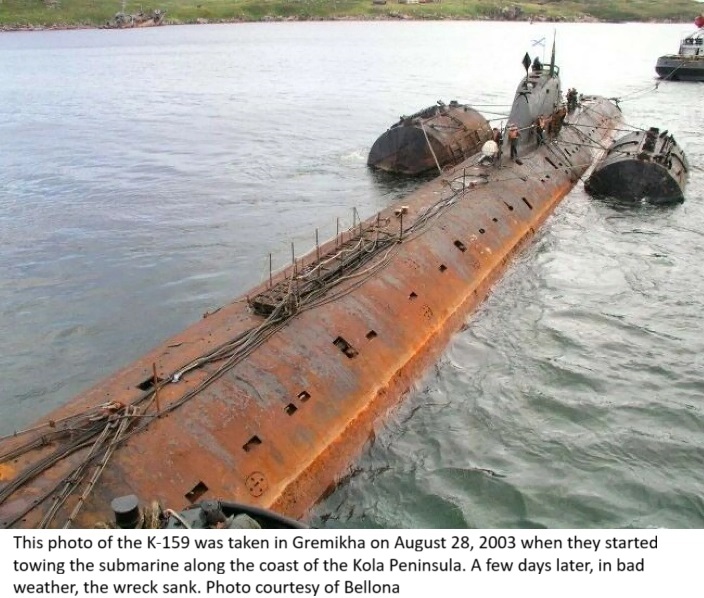
The project reportedly focuses on two of the seven sunken Soviet nuclear submarines—K-27 and K-159.
K-27, introduced in 1963, was an experimental submarine equipped with liquid-metal cooled reactors using a lead-bismuth alloy. In 1968, during its third voyage, a reactor accident exposed more than 140 crew members to radiation, killing nine.
The vessel was scuttled in the Kara Sea in 1981 and now lies at a depth of about 75 meters.
K-159 entered service the same year as K-27 and remained operational until 1989. It sank in 2003 in the Barents Sea while being towed for dismantling near Kildin Island, resulting in the deaths of nine crew members. The wreck rests at approximately 250 meters.
Plans to lift these submarines have been discussed for more than a decade but were repeatedly postponed due to the lack of specialized equipment, qualified personnel, and safety concerns. In 2021, Rosatom estimated that raising the vessels would cost around 24.4 billion rubles.
The renewed inclusion of the project in Russia’s 2026 budget marks the first concrete step since 2012 toward removing the radioactive wrecks from the Arctic seabed, though the exact reasons for the timing remain unclear, RBC noted.
Earlier in October, Russia’s Novorossiysk submarine—armed with Kalibr cruise missiles—was forced to abandon its Mediterranean mission and return to Saint Petersburg after a fuel leak disabled its underwater capability.
The incident highlighted Russia’s growing naval limitations following the loss of its Syrian logistics hub in Tartus and Turkey’s blockade of the Bosphorus Strait.
Trump rejects Zelensky on Tomahawks, but Washington’s war lobby refuses to “lose”

By rejecting Tomahawk missiles for Ukraine, Trump once again disappoints Zelensky. To negotiate with Putin, will he also defy the Beltway?
Aaron Maté, Oct 21, 2025
Ukrainian president Volodymyr Zelensky was hoping to leave the White House on Friday with a commitment for long-range US Tomahawk missiles that can strike Russia. Instead, Zelensky once again found himself on the losing end of his strained relationship with President Trump. After musing about providing Tomahawks and even declaring that Ukraine was positioned to recapture all of its territory, Trump rejected Zelensky’s request and urged him to cede the Donbas region to Moscow.
“[Trump] said Putin will destroy you if you don’t agree now,” a source told the Washington Post. “It was pretty much like ‘no, look guys, you can’t possibly win back any territory. … There is nothing we can do to save you. You should try to give diplomacy another chance.’” According to a European official, Trump is now “saying the U.S. needs Tomahawks, and doesn’t want to escalate.”
Trump’s renewed aversion to escalation followed a phone call with Russian President Vladimir Putin, who initiated the conversation to lobby against Zelensky’s request. Putin likely conveyed a stark warning. For Ukraine to fire Tomahawks at Russia, the US military would have to do the job inside Ukrainian territory. And because the Tomahawks are technically nuclear-capable, Russia, by its own military doctrine and the logic of basic deterrence, would have to fire back beyond Ukraine. Given the abundance of US military assets near its borders, Russia would have no shortage of targets……………………………………………………………….(Subscribers only) https://www.aaronmate.net/p/trump-rejects-zelensky-on-tomahawks?utm_source=substack&utm_medium=email
Moscow puts money on the table to raise nuclear subs from Arctic seabed
Both the K-27 and the K-159 represent ticking radioactive time-bombs for the Arctic marine environment.
The Government’s draft budget for 2026, and the planned budget for 2027-2028, include funding to lift the K-27 and K-159, two wrecked submarines that are resting on the seabed in the Barents Sea and Kara Sea.
Thomas Nilsen, 20 October 2025 –https://www.thebarentsobserver.com/news/moscow-puts-money-on-the-table-to-raise-nuclear-subs-from-arctic-seabed/439056
It is the state nuclear corporation Rosatom that told news outlet RBK about the plans to finally do something about the ticking radioactive time-bombs.
“The draft federal budget for 2026 and the 2027-2028 planning period includes funding for the rehabilitation of Arctic seas from sunken and dumped radiation-hazardous objects, beginning in 2027. Preparations for the planned work will begin in 2026,” the press service of Rosatom said.
An explanatory note to Rosatom’s budget post for disposal of nuclear and radiation-hazardous nuclear legacy sites details how 30 billion rubles for the three-year period are earmarked for planning and lifting of the Cold War era submarines left on the Arctic seabed.
The K-27 and the K-159 are the most urgent to raise and bring to shore for safe scrapping.
While the K-27 was dumped on purpose in 1982 in the Stepovoy Bay on the Kara Sea side of Novaya Zemlya, the sinking of the K-159 in the Barents Sea was an accident.
Lifting a nuclear submarine from the seabed is nothing new. It is difficult, but doable.
In 2002, the Dutch salvage company Mammoet managed to raise the ill-fated Kursk submarine from the Barents Sea. A special barge was built with wires attached underneath. The wreck of the Kursk was safely brought in and placed in a floating dock where the decommissioning took place.
Aleksandr Nikitin, a nuclear safety expert with the Bellona Foundation in Oslo, said to the Barents Observer that it is too early to conclude that the lifting actually will happen, or whether this is a preliminary plan that needs to be developed before concluding.
“As far as I understand, there’s no concrete plan,” Nikitin said.
Before Russia’s full-scale war against Ukraine, Aleksandr Nikitin was member of Rosatom’s Public Chamber, a body that worked with non-governmental organisations to foster transparency and civic engagement on nuclear safety related issues in Russia.
Nikitin believes there still is infrastructure on the Kola Peninsula to deal with the two submarines if they are lifted from the seabed.
“Rosatom is currently trying not to destroy what the French built in Gremikha, hoping to dismantle the K-27 there if it’s raised. This is a special facility where this nuclear submarine with a liquid metal coolant reactor can be dismantled,” he explained.
“As for the K-159, it could be dismantled, for example, at Nerpa.”
Nerpa is a shipyard north of Murmansk that decommissioned several Cold War submarines at the time when Russia maintained cooperation with European partners, including Norway.
Ticking radioactive time-bombs
Both the K-27 and the K-159 represent ticking radioactive time-bombs for the Arctic marine environment.
The K-159 is a November-class submarine that sank in late August 2003 while being towed in bad weather from the closed naval base of Gremikha on the eastern shores of the Kola Peninsula towards the Nerpa shipyard north of Murmansk.
Researchers have since then monitored the wreck, fearing leakages of radioactivity from the two old nuclear reactors onboard could contaminate the important fishing grounds in the Barents Sea. A joint Norwegian-Russian expedition examined the site in 2014 and concluded that no leakage has so far occurred from the reactors to the surrounding marine environment.
However, the bad shape of the hull could eventually lead to radionuclides leaking out.
The two onboard reactors contain about 800 kilograms of spent nuclear fuel, with an estimated 5,3 GBq of radionuclides.
A modelling study by the Norwegian Institute of Marine Research said that a pulse discharge of the entire Cesium-137 inventory from the two reactors could increase concentrations in cod in the eastern part of the Barents Sea up to 100 times current levels for a two-year period after the discharge. While a Cs-137 increase of 100 times in cod sounds dramatic, the levels would still be below international guidelines. But that increase could still make it difficult to market the affected fish.
The K-27, the other submarine that it is urgent to lift, was on purpose dumped in the Kara Sea in 1982. In September 2021, divers from the Centre for Underwater Research of the Russian Geographical Society conducted a survey of the submarine’s hull. Metal pieces were cut free, the thickness of the hull was measured, along with other inspections of the submarine that has been corroding on the seabed for more than 40 years.
In aditionl to the K-27 and K-159, there are also the other dumped reactors in the Kara Sea, including from the K-11, K-19 and K-140, as well as spent nuclear fuel from an older reactor serving the icebreaker Lenin.
In Soviet times, thousands of containers with solid radioactive waste from both the civilian icebreaker fleet and the military Navy were dumped at different locations in the Kara Sea.
Trump-Zelensky meeting was ‘bad’ – Axios.
18 Oct, 2025 , https://www.rt.com/news/626650-trump-zelensky-meeting-bad/
The Ukrainian leader left Washington without promises on Tomahawk missiles, the outlet’s sources say
Friday’s White House meeting between US President Donald Trump and Vladimir Zelensky was “tense,” with the Ukrainian leader failing to secure deliveries of long-range Tomahawk missiles, Axios has reported, citing sources.
Trump told Zelensky he does not plan to provide Tomahawks “at least for now,” according to two people briefed on the meeting. The talks lasted around two and a half hours and were described by one source as “not easy,” and by another as “bad.” At times, the discussion “got a bit emotional,” the outlet said.
”Nobody shouted, but Trump was tough,” one source told Axios. The session ended abruptly when Trump reportedly said, “I think we’re done. Let’s see what happens next week,” possibly referring to upcoming Russia-US talks.
Speaking to reporters afterwards, Zelensky declined to answer questions about Tomahawk deliveries, only saying the US “does not want escalation.”
Trump said “it’s not easy” for Washington to provide the missiles because it needs to maintain its own supplies for the nation’s own defense. He also acknowledged that allowing Kiev to conduct strikes deep into Russia could lead to an escalation.
Moscow has warned against supplying the missiles to Ukraine, arguing they would “not change the situation on the battlefield” but would “severely undermine the prospects of a peaceful settlement” and harm Russia-US relations.
Zelensky has sought Tomahawks – which have a maximum range of 2,500km (1,550 miles) – for weeks, insisting that Ukraine would only use them against military targets to increase pressure on Russia and move toward a peace deal. However, the Ukrainian leader has threatened Russia with blackouts in border regions and Moscow. Russian officials also suggested that Kiev is plotting to use the missiles for “terrorist attacks.”
The Trump-Zelensky meeting followed a phone call between Trump and Putin, after which both sides signaled plans for a summit in Budapest, Hungary, in the near future.
Livret A: Will part of French savings soon be used to finance nuclear power?
Traditionally, the money in the Livret A savings account is intended to support social housing and local public infrastructure.
This announcement comes as the government seeks to diversify funding sources for a nuclear program estimated at colossal sums
Le Monde De L’Energie 13th Oct 2025
This is a historic turning point for French public savings. The Caisse des Dépôts et Consignations (CDC) has confirmed that a portion of the funds from the Livret A savings account could be used to finance the construction of new EPR nuclear reactors. This unprecedented move symbolizes the rapprochement between public finance, industrial strategy, and national energy sovereignty.
An unprecedented agreement between the State, EDF and the Caisse des Dépôts
Traditionally, the money in the Livret A savings account is intended to support social housing and local public infrastructure. But on Thursday, October 10, CDC CEO Olivier Sichel announced a major development: “We have reached an agreement with Bercy and EDF on using the Savings Fund.” This statement, made to the Association of Economic and Financial Journalists, marks the first official confirmation of the Livret A’s involvement in financing the French nuclear program.
This shift, both energy-related and financial, is part of the government’s desire to revive civil nuclear power. The state plans to build six new EPR reactors by 2038, at a total cost estimated at less than €100 billion, according to estimates by former Energy Minister Marc Ferracci.
A crucial step: the Brussels agreement
Before the transaction can become a reality, one key step remains: European approval. “The French government will present its proposal to Brussels to obtain approval for the overall financial model,” Olivier Sichel explained. The stakes are as much legal as they are political: the European Commission will have to verify that this financing scheme does not violate competition or state aid rules.
The Brussels agreement will make it possible to secure access to part of the Savings Fund, funded by French savings, while guaranteeing that investments remain safe and profitable for depositors.
A treasure of 400 billion euros at the nation’s disposal
The Caisse des Dépôts currently manages approximately €400 billion in regulated savings, collected in particular through the Livret A (Livret A), the Livret de développement durable et solidaire (LDDS) (Sustainable and Solidarity Savings Account), and the Livret d’épargne populaire (LEP) (People’s Savings Account). Just over half of these funds are already allocated to long-term loans to finance social housing or regional policies.
The remainder, invested in financial assets, could now contribute to financing the country’s energy infrastructure, including new nuclear reactors. “Nuclear power is obviously part of our energy sovereignty,” explained Olivier Sichel, adding that this direction aims to strengthen France’s capacity to produce stable, carbon-free electricity.
This announcement comes as the government seeks to diversify funding sources for a nuclear program estimated at colossal sums, in a context of constrained budgets and strong tension on the energy markets…………………………………..
this development is already raising questions. Some social housing stakeholders fear that this shift will reduce the funds available for their projects. ………….
Asked about financial risks, Olivier Sichel also warned of the tensions threatening global markets, particularly in the technology sector. “The colossal investments in artificial intelligence are drawing parallels with the internet bubble of the late 1990s,” he warned, urging caution.
A major turning point for public investment policy
By linking popular savings to the country’s energy strategy, the government and the Caisse des Dépôts are redefining the role of the Livret A savings account in the French economy. This investment, held by more than 55 million French people, is becoming not only a social financing tool, but also a pillar of industrial and energy recovery.
If Brussels gives the green light, France will usher in a new era: one in which every euro placed in a Livret A savings account could, indirectly, contribute to fueling the nation’s future nuclear reactors. …… https://www.lemondedelenergie.com/livret-une-partie-de-lepargne-des-francais-bientot-mobilisee-pour-financer-le-nucleaire/2025/10/13/
Slouching Towards Peace
“Zelensky has been given a Russian ultimatum via Trump. Accept Russia terms or face total destruction.” —SiriusReport on “X”
James Howard Kunstler, Oct 20, 2025, https://www.kunstler.com/p/slouching-towards-peace
Well, “No Kings” came and went. Inflatable animal costumes did a brisk business for one week. The old Boomers got a social space to act out their nostalgic re-visit to the Age of Aquarius. They resisted. . . something. (Mainly authority of any kind, a retarded adolescent fantasy.) And now it’s back to Rachel Maddow for further instructions. The Republic slogs on, albeit with a shut-down government.
Did you forget about Ukraine? Yes, a war is still going on there and it’s a weeping lesion on Western Civ, possibly leading to fatal sepsis. US neocons set the stage in 2014 with the Maidan color revolution as a wedge to wreck and then loot Russia. Then, for eight years, Ukraine harassed the Donbas with US-supplied missiles and artillery. Russia had enough of that in 2022 and ventured in to stop it. For “Joe Biden,” the war was a nice smokescreen to cover his long-running grift operations in Ukraine. The Euro club stupidly came along for the ride.
It was all a tragic and feckless waste. Mr. Trump wants to stop it, but Western Civ as a whole is in such a state of florid strategic disorder that he’s had to pretend the US supports Ukraine. Mr. Zelensky could not possibly carry on this mischief without US weapons and loads of US taxpayer cash. Still, the Russians advance implacably on-the-ground. They are going to “win” this war eventually — meaning, the US and Europe will lose — and everybody knows it.
It would be nice if France, Germany, and the UK were still stable, thriving, rational nations, but they are not. They have entered an arc of collapse, largely due to their own stupendously bad choices, and their leadership is insane. Macron, Merz, Starmer. . . these are the Three Stooges of our time, and Europe’s collapse has degenerated to morbid, masochistic slapstick as their factories shutter and the Jihadis go about raping their wives and daughters. Do you think that’s not happening?
Mr. Trump surely realizes he has to cut the US loose from this evil clown-show. That they are our NATO allies complicates things, yet, really, the Euro gang is impotent and NATO has become an irrelevant anachronism. They have no effective military mojo. Their economies are imploding. They have surrendered their culture to a savage cult. Their populations are demoralized, emasculated, in thrall to the menopausal viragos in their councils and ministries. They know full-well that Ukraine lies in Russia’s sphere-of-influence — a centuries-long reality — and that it is none of their business. Yet, Macron, Merz, and Starmer keep pushing the fantasy that Russia seeks to invade them, and so they must strike at Russia before that happens . . . all pure delusion.
You can suppose that Mr. Putin wants a negotiated peace rather than continuing the long grind on-the-ground, with all its casualties and expenditures. Such a negotiated peace really amounts to the US ceasing to support Zelensky’s war effort. Of course, such is the insanity of US political life, that many in our government pretend that we have a stake in Ukraine, and must retain some control of it.
Mr. Trump must know this is insane and is against the interests of the USA. He knows that Ukraine is historically in Russia’s sphere of influence — as Venezuela is in ours — and that the best outcome of this mess would be for Ukraine to return to its prior status as a harmless frontier between Russia and western Europe — as it had been since 1945 — looking to its humble business of growing wheat for export. We do not need Ukraine to be anybody’s problem, despite the insane yearnings of the neocons, the weapons manufacturers, and the reckless globalists of the EU, to make it everyone’s problem.
Hence, Mr. Trump’s dilemma: how to dissociate from this losing proposition and come out looking like a winner, saving Europe from becoming a smoldering ashtray, stanching the flow of US taxpayers’ money and US-made weapons into this black hole, and forging friendly relations with a Russia that is decades beyond being our ideological enemy? America and Russia’s interests are geopolitically aligned, though no one in the arena is willing to admit it. Russia has much more to worry about with China right at Siberia’s doorstep than with the USA, just as the USA has much more to worry about with China as it weaponizes A-I, moves into outer space, and casts a covetous eye on the resources of the USA, Australia, Africa, and its next-door-neighbor, Russia.
These are the matters that Presidents Trump and Putin must be touching on in those long, two-and-a-half-hour phone confabs they hold. Meanwhile, Mr. Trump must put on a vaudeville show for his US adversaries about maybe giving tomahawk missiles to Ukraine. . . no, maybe not doing that. . . and the rest of the song and dance to make it appear that we are kinda-sorta still on Ukraine’s side when the truth is we are not so much at all.
And so, the two presidents head for Budapest where — if the intel spooks of Euroland don’t try to bump them off there — they might come to the necessary agreement that the war will end because the US no longer supports it, not even the pretense of supporting it. President Viktor Orban of Hungary, who Mr. Trump respects, will be on hand for moral support. Expect some tough-talking mummery from DJT, just to throw the MSNBC lunatics off-balance. Rogue idiots such as Senators Blumenthal and Schiff will fume that “Trump lost Ukraine,” but the 50-plus percent of Americans who are not-insane will understand what actually happened.
Pay attention to the nuclear threat on our doorsteps

THOSE who fear for the future of our planet understandably focus on global
heating, biodiversity loss, autonomous weapons and an unsustainable and
unequal economic system. But there remains far too little attention to the
nuclear threat on our doorsteps.
That threat of nuclear conflagration has
edged a little closer this past week, highlighting both the dangerous
fiction of “deterrence” as a guarantor of security and how preparing
for war to protect peace can head rapidly in the wrong direction.
There has been little in the mainstream media over the past few days on the nuclear strike training taking place over European skies – which still includes Scotland, despite our lack of a seat around any of the tables that
influence or decide these things.
The National 18th Oct 2025,
https://www.thenational.scot/politics/25552853.pay-attention-nuclear-threat-doorsteps/
It is now antisemitic to object to Israeli football hooligans causing violence in your city
Laura and Normal Island News, Oct 18, 2025, https://www.normalisland.co.uk/p/it-is-now-antisemitic-to-object-to?utm_source=post-email-title&publication_id=1407757&post_id=176482013&utm_campaign=email-post-title&isFreemail=false&r=ln98x&triedRedirect=true&utm_medium=email
Aston Villa football club caused outrage when it banned Maccabi Tel Aviv fans from an upcoming UEFA Europa League match. The pathetic excuse was that West Midlands police had intelligence that Maccabi Tel Aviv fans were planning violence. Aston Villa took that intelligence seriously, just because Maccabi Tel Aviv fans had been violent at other European football matches.
In previous incidents, local authorities sensibly lied to protect Israeli fans, and pretended local fans caused the violence, disregarding camera footage and eye witnesses. News outlets such as Sky News were quick to apologise for their initial reporting and correct the narrative. This saved them from getting the same treatment as journalists in Gaza.
I’m proud to say I’m one of the few journalists who has consistently stuck to the officially authorised version of the truth, which is as follows:
In Amsterdam, Maccabi Tel Aviv fans were innocently chanting words such as “There are no schools in Gaza because there are no children left” and the all-time classic, “Death to Arabs”. Obviously, only a racist would object to such chants.
Video footage shows Maccabi Tel Aviv fans carrying chains, and terrorising train passengers, and threatening journalists, and beating up random members of the public who had nothing to do with the football match. Outrageously, some local people attempted to defend themselves against these fans.
As we all know, it’s antisemitic for anyone to defend themselves against Israelis, whether they be Palestinians, or local football fans, or random people who did not know what the fuck was going on.
When Israel attacks your people, the only non-antisemitic response is to throw your people under a bus and blame them for being attacked. However, Aston Villa decided to ignore that principle, provoking outcry from all the politicians who are owned by Israel.
The UK’s most prominent genocide supporters, such as Michael Gove, suggested the ban of Maccabi Tel Aviv fans meant “no Jews allowed”. Please understand, it is not antisemitic to conflate Jews with Israel when Zionists do it.
Reassuringly, Sir Keir Starmer was instructed to say the ban was the “wrong decision.” The prime minister tweeted: “We will not tolerate antisemitism on our streets. The role of the police is to ensure all football fans can enjoy the game, without fear of violence or intimidation.”
Just so we’re clear, Starmer meant that Israeli football fans can enjoy the game. He doesn’t give a fuck if you’re the victim of violence and intimidation.
Thankfully, Home Secretary Shabana Mahmoud has stepped in and demanded Maccabi Tel Aviv fans be allowed into the game. She has promised additional police patrols so Maccabi Tel Aviv fans can chant “death to Arabs” and beat up Aston Villa fans without retaliation. She will take full responsibility for any violence by blaming Aston Villa fans who act in self-defence.
The home secretary has confirmed that any Aston Villa fans who defend themselves will be extradited to Israel where they will get the Greta Thunberg treatment. She has demanded the chair and board of Aston Villa resign for trying to protect their fans. She has requested that Aston Villa be banned from all UEFA tournaments, and insisted we should boycott, and divest from, the city of Birmingham.
If Birmingham fails to straighten up its act, Mahmoud will not rule out airstrikes against Villa Park x
1 This Month

22 June – Virtual Event –Climate Change: New Data, New Debate

Monday, June 22, 2026 2:30 p.m. – 3:15 p.m. CT
YouTube. Register here

Protect Sazan Island from the Trump family! https://secure.avaaz.org/campaign/en/protect_sazan_island_from_the_trump_family_loc/?bqFCVab&v=174511&cl=22707147157&_checksum=5e9dde668860e8231c33699735e16a1fbf22ab2cb01da50c999fe8732b9775ef&utm_source=email&utm_medium=blast_email&utm_campaign=174511
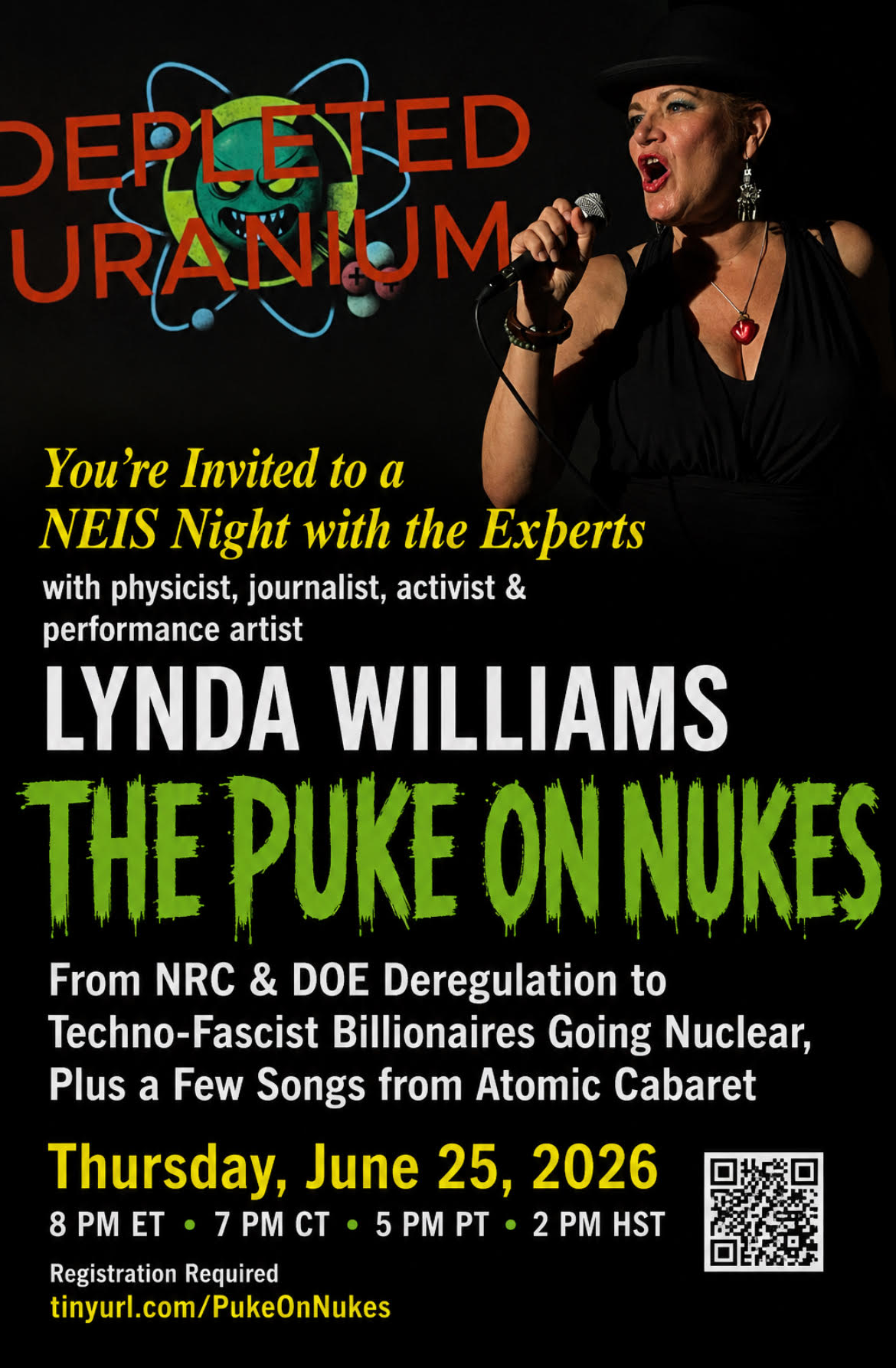
25 June- THE PUKE ON NUKES
Thursday, June 25, 2026
7pm Central Time (8pm ET, 6pm MT, 5pm PT) UTC – 5
From NRC & DOE Deregulation to Techno-Fascist Billionaires Going Nuclear, Plus a Few Songs from Atomic Cabaret REGISTER
26 June – Radiation Trainwreck at the NRC / Join the Protect Better Campaign – https://us02web.zoom.us/meeting/register/4ZlZ5_qLSHGiLSCg8FF6Bg#/registration


Cuba Is Not a Failed State – It Is a Besieged State
PETITION: “Global Appeal to Endorse Palestinian Right of Return of Refugees”
To see nuclear-related stories in greater depth and intensity – go to https://nuclearinformation.wordpress.com
-
Archives
- June 2026 (202)
- May 2026 (306)
- April 2026 (356)
- March 2026 (251)
- February 2026 (268)
- January 2026 (308)
- December 2025 (358)
- November 2025 (359)
- October 2025 (376)
- September 2025 (257)
- August 2025 (319)
- July 2025 (230)
-
Categories
- 1
- 1 NUCLEAR ISSUES
- business and costs
- climate change
- culture and arts
- ENERGY
- environment
- health
- history
- indigenous issues
- Legal
- marketing of nuclear
- media
- opposition to nuclear
- PERSONAL STORIES
- politics
- politics international
- Religion and ethics
- safety
- secrets,lies and civil liberties
- spinbuster
- technology
- Uranium
- wastes
- weapons and war
- Women
- 2 WORLD
- ACTION
- AFRICA
- Atrocities
- AUSTRALIA
- Christina's notes
- Christina's themes
- culture and arts
- Events
- Fuk 2022
- Fuk 2023
- Fukushima 2017
- Fukushima 2018
- fukushima 2019
- Fukushima 2020
- Fukushima 2021
- general
- global warming
- Humour (God we need it)
- Nuclear
- RARE EARTHS
- Reference
- resources – print
- Resources -audiovicual
- Weekly Newsletter
- World
- World Nuclear
- YouTube
-
RSS
Entries RSS
Comments RSS
 nuclear-news