NATO has outlived its purpose – Jeffrey Sachs

The military bloc should have been dissolved after the collapse of the Soviet Union, the US economist has argued
2 Sep, 2025 , https://www.rt.com/russia/623964-sachs-nato-outlived-purpose/
NATO has outlived its purpose and should have been dissolved decades ago, prominent American economist and Columbia University professor Jeffrey Sachs believes.
Speaking to RIA Novosti on Sunday, Sachs argued that NATO was initially formed for the sole purpose of countering the USSR and should have been disbanded in 1990 when Soviet President Mikhail Gorbachev dissolved the Warsaw Pact – the Soviet-led military alliance that had grouped Eastern Bloc states since 1955.
“NATO was a treaty to defend against the Soviet Union, which doesn’t exist. So in this sense NATO definitely outlived its role. It became instead a mechanism of US power expansion, which is not what NATO should be,” Sachs told the news agency.
He further argued that NATO’s eastward expansion since 1990 has been “wholly unjustified and contrary to Western promises,” referring to assurances given by US officials after the dissolution of the USSR that the bloc would not move closer to Russia’s borders.
Sachs stressed that the organization’s enlargement has had no legitimate security rationale and instead deepened divisions on the European continent.
Russia has repeatedly condemned NATO’s expansion and has described the bloc as a tool for confronting Moscow which destabilizes Europe by fueling tensions. Moscow has pointed to NATO’s attempts to bring Kiev into the bloc as one of the root causes of the Ukraine conflict.
Sachs also noted that Washington still believes it runs the world, a view he described as outdated and dangerous. He said that this delusion is a “source of danger” as the world has become multipolar and new “centers of power” have emerged.
His comments came ahead of the upcoming Eastern Economic Forum, which is set to take place in Vladivostok from September 3 to 6. The economist is scheduled to participate in a session dedicated to the UN’s development agenda beyond 2030, alongside discussions on international cooperation in a changing world order.
Sizewell C Funded Decommissioning Programme: Contingent Liability (Public on the hook)
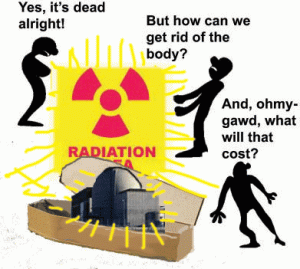
I am pleased to have laid a departmental minute describing the contingent
liabilities arising from the signing of the funded decommissioning
programme and Government support package for Sizewell C. The funded
decommissioning programme at Sizewell C will be funded via the regulated
asset base. The regulated asset base contains a series of protections that
aim to minimise the risk that public funds will be required to meet
decommissioning costs.
However, in certain remote circumstances whereby all
the protections afforded by Sizewell C’s economic licence fall away or a
shortfall in the fund materialises, public funds could be used to
contribute towards decommissioning costs and this liability would
crystalise. Based on best estimates by the Government Actuary Department,
the maximum potential exposure from the liability is £12 billion—in 2022
terms. This has been estimated on a worse-case scenario whereby the
Government were required to meet the full costs of decommissioning the
Sizewell C power plant.
Hansard 1st Sept 2025, https://hansard.parliament.uk/commons/2025-09-01/debates/25090137000015/SizewellCFundedDecommissioningProgrammeContingentLiability
A Folly Too Far?

In 2020 the cost was set at £20bn. but the ultimate cost by 2040, when it might begin operating, could well be north of £40bn. By 2040 it will be too late to make any impression on Net Zero and, if it ever gets finished, Sizewell C will be an expensive and inflexible white elephant cranking out power that is not needed but which will impede the development of the array of renewable systems.
2 September 2025, https://www.banng.info/news/regional-life/folly-too-far/
Andrew Blowers tackles this question in the BANNG column for July 2025
On a fine summer’s day, in early June, Varrie and I travelled to Suffolk to show BANNG’s support for the Outrage Rally against Sizewell C. There were around 300 people assembled on the dunes to protest against the outrageous project and to commemorate the life of one of the great environmental and anti-nuclear campaigners, Pete Wilkinson, who had died in January. There were speeches from his two daughters, Amy and Emily and from Jonathon Porritt, the veteran campaigner who drew attention to the scene before us – the invisible power of the wind and sea on the one hand and the unseen threat of radioactivity posed by the hulk of Sizewell A and the operating Sizewell B on the other.
The protesters marched along the sandy beach to the site of Sizewell C where we tied yellow ribbons to the perimeter security fence in tribute to the outrage and courage that Pete had displayed through his life, successfully campaigning against mining in the Antarctic, dumping of radioactive waste in the Atlantic and stopping up the Sellafield outflow pipe into the Irish Sea. Beyond the fence could be seen the removal of ancient woodland, construction of roads and destruction of countryside and wildlife bordering the precious RSPB Minsmere Reserve in preparation for construction. And the subsequent construction of a huge and dangerous complex of reactors, turbines and long-term, highly radioactive waste stores on a precarious coast was terrifying to imagine.
There was a sense of an unequal struggle, a local community fighting together against an uncompromising government and powerful and well-resourced industry. While the mood was defiant there was an underlying sense of impending defeat.
And, sure enough, three days later came the long-anticipated announcement that Sizewell C was to go ahead, backed by £14.2bn. subsidy for the first four years of construction and up-front payments loaded onto consumer bills. A Final Investment Decision has not been taken, awaiting the commitment of private investors to match the public investment. If private investors do not come forward then either the project must be ditched (too embarrassing for the government) or we (taxpayers and consumers) are in hock for the total cost.
The Sizewell project is the type of big investment that encourages government ministers to don hard hats and suitably logoed high-vis jackets to proclaim a new golden age of clean energy. They haughtily dismiss the ‘blockers’ – we who strive to defend precious communities and landscapes and prevent the financial incontinence that inevitably flows from such complex and uncertain projects.
So, as the Sizewell protesters say, Sizewell C could become Suffolk’s HS2: half-built and unfinished because of finance.
EDF’s Heysham 1 and Hartlepool nuclear plants to operate for further 12 months
New Civil Engineer, 02 Sep, 2025 By Tom Pashby
The operational lives of the Heysham 1 and Hartlepool nuclear power plants have been extended by 12 months by their operator EDF………………
Hartlepool, Heysham 1, Heysham 2 and Torness all underwent reviews by EDF in December 2024 to assess how long they can continue to generate electricity. Heysham 1 and Hartlepool were scheduled to stop producing power in March 2027.
At the time, an EDF spokesperson explained to NCE that the best-case scenario for the Heysham 1 and Hartlepool power stations was that they could justify a one-year extension. However, that was caveated with a need to await the outcomes of “important inspection and safety case milestones”, which were due to be completed in 2025.
Those milestones have now passed and the results were positive for the power stations. When EDF’s executive and licensee boards met yesterday, 1 September, they gave approval to extend the lives of the nuclear stations, so Heysham 1 and Hartlepool will now likely operate through to at least March 2028.
A statement from EDF on 2 September said: “Heysham 2 and Torness, which are both scheduled to generate until March 2030, were not in scope for this review after a two-year extension was granted last year.”
EDF still hopes to see all four AGRs continue producing electricity for as long as possible, so it can be expected to conduct further reviews down the line, but these reviews do not have set dates for completion, the spokesperson told NCE……………………………………………………………………………………………………………………………
AGRs now well past their sell-by date’ – anti-nuclear campaigner
Nuclear Free Local Authorities secretary Richard Outram told NCE that the extension of the plants’ operating lives raises concerns about the possibility of graphite cracking.
“The EDF announcement is unsurprising. Although company bosses may crow a lot about the preservation of local jobs, the NFLAs suspect this is actually about the preservation of EDF’s bottom line,” he said.
“Given the parlous state of the French parent company’s finances, the intermittent output of the domestic fleet, and the vast overspend on Hinkley Point C, EDF has a clear incentive to keep open for as long as possible any nuclear plant in the portfolio which actually operates and generates profits.
“The NFLAs have previously expressed our concerns with the Office for Nuclear Regulation that these ageing AGRs are now well past their sell-by date, with graphite cracking being a real worry, as seen recently at the sister AGR plant at Torness.
“We shall continue to monitor the situation and ask challenging questions of regulators and the industry because public safety and environmental harm must never be compromised in favour of company profit.”………………………………………………. https://www.newcivilengineer.com/latest/edfs-heysham-1-and-hartlepool-nuclear-plants-to-operate-for-further-12-months-02-09-2025/
Iran accuses Europe of surrendering nuclear deal to Trump’s veto
Foreign ministry official says US will be dictating what happens once UN-wide sanctions are reimposed.
Patrick Wintour in Tehran, 2 Sept 25, https://www.theguardian.com/world/2025/sep/01/iran-accuses-europe-surrendering-nuclear-deal-trump-veto
Europe is on the verge of abandoning its role as a mediator between the US and Iran and instead handing the Iran nuclear file over to Donald Trump’s veto, Iran’s foreign ministry spokesperson has said in an interview with the Guardian in Tehran.
Esmail Baghaei said that as soon as UN-wide sanctions were reimposed at Europe’s demand in less than 30 days’ time, the US would regain its security council veto over what happens next, including the continuance of sanctions.
“The Europeans are doing what Trump dictated to them,” he said. “The Europeans’ role is going to be diminished. If you go back to the European foreign policy leaders in the history of the nuclear deal, Javier Solana, Cathy Ashton, Federica Mogherini, Josep Borrell, they all tried to liaise between Iran and the US.
“They tried to prove they were credible negotiating partners. But now the Europeans have decided to be the proxy of the US and Israel. It is absolutely irresponsible of them to hand over that role to the US.”
He highlighted the claim by Friedrich Merz, the German chancellor, that Israel was doing “the dirty work … for all of us” by attacking Iran’s nuclear sites in June. “In a way, all of the European countries condoned what Israel did, and very likely provided information to the Israeli regime,” Baghaei said.
His remarks may be designed to put pressure on European capitals to distance themselves from the US and tone down the conditions they have set before they will agree to defer UN sanctions.
Baghaei also said the Iranian government was not constitutionally able to block Iran’s withdrawal from the nuclear non-proliferation treaty (NPT) if the Iranian parliament went ahead and passed a law withdrawing from it in response to the European reimposition of UN sanctions. Withdrawal from the treaty was the prerogative of parliament, he said.
The number of MPs backing an NPT withdrawal bill is due to be revealed on Tuesday but MPs said the measure was likely to be rushed through parliament with overwhelming support. Withdrawal from the NPT would mean the UN loses all rights to oversee Iran’s nuclear programme and would inevitably raise US concerns about whether Iran will build a nuclear bomb covertly or overtly.
The powerful factions in the parliament seem convinced that Iran has the firepower to inflict heavy damage on Israel in the event of a second western attack.
We are prepared because this is a matter of our dignity and sovereignty,” Baghaei said. “I think you in the UK had your blitz spirit when attacked by Nazi Germany. We have the same spirit because we knew this war imposed on us in the middle of negotiations was so unjust.”
The three European signatories to the original nuclear deal – France Germany and the UK – notified the UN last Thursday that they intended to use their right to reimpose UN-wide sanctions at the end of September unless Iran met three conditions: a return of UN weapons inspectors to the bombed Iranian nuclear sites, the handover of details of the whereabouts of its 400kg stockpile of highly enriched uranium, and agreement to open talks with America on the future of its nuclear programme.
Europe says there is still room for diplomacy in the coming four weeks to reach an agreement on these conditions. Baghaei described the European conditions as “a sign they are not serious and they do not have good faith”.
He said: “There is an extreme trust deficit between the UN weapons inspectors from IAEA and Iran. There is a real concern that the information gathered at the sites by the IAEA would end up being passed on to Israel.
“It has been a real concern especially after the highly politicised approach of the IAEA. We cannot ignore the fact that previous IAEA reports were abused by America and Israel to craft the resolution to the IAEA board which claimed that Iran was not in compliance with its obligations.” He said that resolution was used as a pretext for the Israeli attack on Iran in June.
He conceded that Iran’s room for diplomatic manoeuvre at the UN in the next month was limited because of the public mood in Iran.
“The fact is our public is outraged because of the unlawful attacks on our facilities and as a government we have to be accountable to our people and to our parliament,” he said.
“The western media goes on about our cooperation with the IAEA and stockpiles, but the western public has to remember the outrageous [acts] committed by Israel and the US. They torpedoed the diplomatic process, they attacked the rule of international law because our facilities have been under inspection 24 hours a day for throughout the past three decades.”
Iranian officials insist that the aim remains to reach a compromise in the next month that will allow the weapons inspectors to return. Iranian diplomats have given assurances to the IAEA that the stockpiles have not been moved. They also insist they are willing to speak to the Americans, but repeated messages sent to Washington have not been met with any response so far.
Baghaei said Iran was willing to reduce the purity level to which it enriched uranium back to 3.67%, the level set in the old nuclear deal, so long as an overall agreement was reached that preserves Iran’s right to enrich uranium domestically.
He questioned why the US was so intent on removing Iran’s right to enrich if, as Trump claimed, Iran’s ability to undertake such enrichment had been already destroyed by the joint US-Israeli attacks.
The lunacy of Britain’s Sizewell C nuclear project

Tom Burke:
All of these problems have been pointed out to the Government
very often, by many energy experts for several years. Even so this only
tells you part of the lunacy of this project. Britain’s electricity
consumers will start paying for Sizewell C now and will go on doing so
without receiving any electricity from it for the next 12-15 years.
They are in effect compulsory investors. However, unlike the private sector
investors in the project they will not receive a handsome double digit
returned on their forced capital investment. Instead they will then be
forced, as the Bloomberg diagram shows, to pay about three times as much
for Sizewell C’s electricity than would otherwise be available to them from
other sources as cheaper electricity will be forced off the grid in order
to preferentially take that from Sizewell C. It is truly said that those
whom the Gods destroy they first make mad.
FT 27th Aug 2025,
https://www.ft.com/content/ee89bce2-a3e9-48ed-82eb-85916eb24777#comments-anchor
What will happen if the Ukrainian Armed Forces attempt to strike the Kursk Nuclear Power Plant?
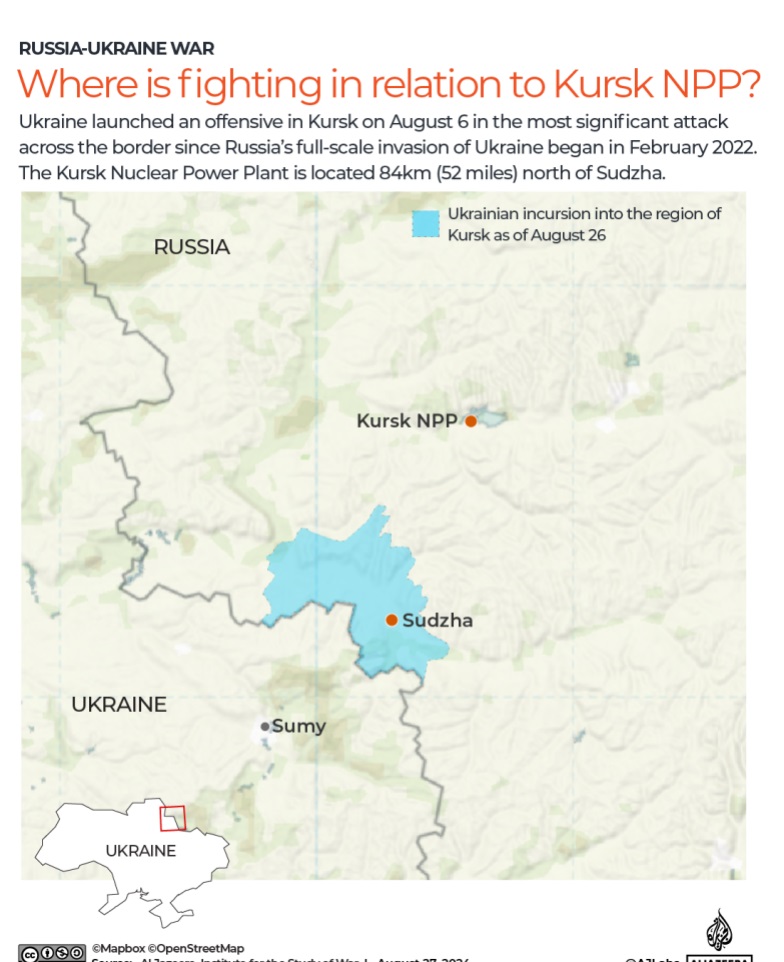
A drone of the Ukrainian Armed Forces was shot down near the Kursk Nuclear Power Plant. Metro learned what such an attack would entail if it hit the station
On Thursday, Kursk Region Governor Alexey Smirnov reported the destruction of a Ukrainian drone 5 kilometers from the Kursk Nuclear Power Plant. According to official information, the Ukrainian Armed Forces attempted to hit the nuclear power plant, but the drone was destroyed on approach.
As Andrey Ozharovsky, an engineer-physicist and expert on the Radioactive Waste Safety program, told Metro , the Kursk NPP is extremely vulnerable to external influences.
— The Kursk nuclear power plant has a serious feature that makes it extremely vulnerable to a military or terrorist attack. These are RBMK-100 reactors of the Chernobyl type. At this station, as at the Ukrainian one, there is no protective shell for the reactors. That is, the “cap” that usually covers the reactor itself at nuclear power plants and thus protects it from external influences, — the expert explained.
He noted that due to such a technical solution, any shelling poses a very serious danger to the station. According to the scientist, it is especially dangerous that the reactors at the Kursk NPP are located in non-specialized buildings.
“Of course, these Chernobyl-type reactors have been modernized and a literal repeat of Chernobyl is impossible. But in the event of a shelling at the station, a graphite fire and the release of a huge amount of radioactive substances into the environment with contamination of territories hundreds of kilometers away from the reactor cannot be ruled out,” the nuclear physicist emphasized.
He added that the recent attack by the Ukrainian Armed Forces could have been not on the station, but on another facility in Kurchatov.
East Lothian Council calls for a study into new nuclear at Torness
EAST Lothian Council will ask the UK Government to carry out a study into
the possibility of creating a new nuclear power station at Torness. The
Council will ask the UK Government to fund the study. The Tories and Labour
supported the motion; SNP and Greens opposed it.
Musselburgh Courier 28th Aug 2025, https://www.pressreader.com/uk/musselburgh-courier-SAXC/20250828/281548002004589
An Elbit-Bain Consortium is Nightmare Fuel: the UK Government Must Not Award £2bn Contract to These Corporate Horrors
Why are Israel’s largest arms firm and a company mired in a corruption scandal even being considered for training British troops?
ANDREW FEINSTEIN, PAUL HOLDEN and JACK CINAMON, DECLASSIFIED UK.
28 August 2025
Britain’s Ministry of Defence might imminently award a 15 year contract, worth £2.5bn, to a consortium headed by the British subsidiary of the Israeli arms firm Elbit Systems and including the US management consultancy firm, Bain and Company.
If successful, Elbit’s consortium would be responsible for training as many as 60,000 members of the UK military.
The consortium seems well-placed to win the contract; it is, in fact, one of only two shortlisted and preferred bidders.
The Ministry of Defence has already given the consortium a £2m contract so that it can develop its proposals further.
This is unacceptable. And it is frankly unbelievable that this consortium is even in the running considering its track record.
Elbit Systems UK is the fully-owned subsidiary of Elbit Systems Limited. Elbit Systems Limited is headquartered in Tel Aviv and is listed on both the Israeli and US stock exchanges.
Elbit is one of the two largest Israeli weapons manufacturers and is central to the IDF’s operations, providing 85% of its drones. Elbit International is also a major contributor to the F-35 fighter jet program, bragging that it plays a ‘critical role’ in the ‘success of the world’s most advanced fighter jet.’
In July 2025, Francesca Albanese, the UN Special Rapporteur for the Occupied Palestine Territories, published an excoriating report setting out corporate complicity in Israel’s “plausibly” genocidal conduct in Gaza – for which she was subsequently sanctioned by Donald Trump.
Her report is clear that Elbit forms a central part of Israel’s military-industrial complex, which has become “the economic backbone of [Israel].”
“Elbit has cooperated closely on Israeli military operations, embedding key staff in the Ministry of Defence,” Albanese points out, further noting that Elbit provides “a critical domestic supply of weaponry.”
Bain
But we’re also deeply concerned about Elbit’s partner, Bain and Company. Bain and Company (not to be confused with the mega hedge fund Bain Capital, which confirmed to us that it is not involved in the Elbit consortium) is a US-based management consultancy firm. …………………………………………………………………….. https://www.declassifieduk.org/labour-must-not-award-elbit-a-2-billion-military-deal/
Assessment of Asse storage chamber conditions begins
Tuesday, 19 August 2025, https://www.world-nuclear-news.org/articles/assessment-of-asse-storage-chamber-conditions-begins
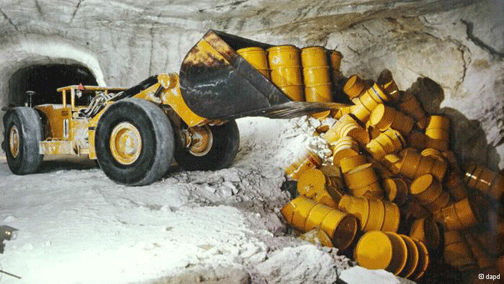
An exploratory borehole is providing the first indications of the condition of the stored drums containing radioactive waste within Storage Chamber 12 at the former Asse II salt mine in the district of Wolfenbüttel, Lower Saxony, Germany.
Between 1967 and 1978, thousands of barrels of mostly low-level radioactive waste were emplaced in a total of 13 former mining chambers at the Asse II mine on behalf of the federal government. However, the facility has proven unstable and retrieval of the waste has been legally mandated since 2013.
Germany’s Federal Company for Radioactive Waste Disposal (BGE) has announced it “made significant progress” in its preparations for the retrieval of radioactive waste from the Asse II mine at the beginning of August.
“Through a tennis ball-sized hole, we were able to take a look into Storage Chamber 12 for the first time in decades,” said Iris Graffunder, Chair of the Management Board of BGE. “Our first impression is that at least the visible barrels are in good condition. Now we will find out the exact composition of the chamber atmosphere and measure the activity levels in the chamber. For this, we need more space and will have to expand the borehole.”
Storage Chamber 12 contains 7,464 containers, including 6,747 drums and 717 so-called ‘lost concrete shields’ (drums encased in concrete). The containers were stacked horizontally. Storage took place in 1973 and 1974. The eventual formation of a sump containing contaminated solution in the access area to this storage chamber led, among other things, to the Asse II mine being placed under nuclear law in 2009.
Storage Chamber 12 is one of the highest radon emitters in the Asse II mine. At the end of May 2024, miners began the targeted drilling into the chamber under the highest radiation protection standards. At a depth of 750 metres, a borehole about 117 metres long was drilled to access the chamber. On 6 August, radiation protection measurements during drilling showed elevated radon levels, indicating that the chamber had been reached.
A planned gas measurement will reveal the composition of the chamber atmosphere and the factors that influence it. Further geological exploration is also underway. Preliminary investigations revealed that the chamber ceiling was deeper than expected. The first images from the chamber confirm these radar and magnetic measurements. A planned 3D scan is intended to provide a more complete picture of the emplacement chamber.
All of the measured values obtained will be utilised in the further planning of retrieval and in future licensing procedures. Among other things, they will allow BGE to determine which recovery technologies can be used in Storage Chamber 12.
BGE – a federally owned company within the remit of the Federal Environment Ministry – took over responsibility as operator of the Asse II mine and the Konrad and Morsleben repositories from the Federal Office for Radiation Protection in April 2017. It is also tasked with searching for a repository site to dispose of the high-level radioactive waste generated in Germany on the basis of the Site Selection Act that came into force in May 2017.
According to current planning, retrieval of the radioactive waste stored in Asse II is scheduled to begin in 2033. Currently, costs of about EUR4.7 billion (USD5.5 billion) are expected until retrieval begins, including the costs of keeping the mine open and implementing the emergency planning precautions. The costs for retrieval, interim storage, and final disposal after 2033 have not been taken into account.
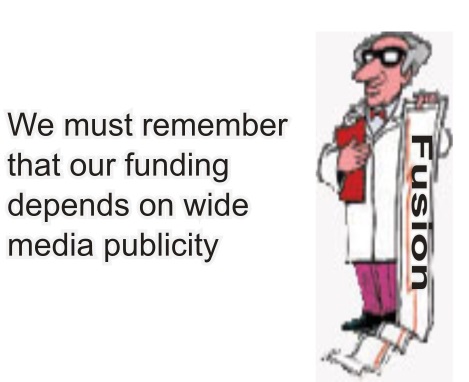
On fusion liability, Energy Minister completely sidelines the issue.
NFLA 27th Aug 2025
NFLA Secretary Richard Outram is disappointed that the new Energy Minister has completely missed the point that taxpayers should not be on the hook for unlimited liabilities to the nuclear fusion industry ‘resulting from incidents involving nuclear matter or emissions of ionising radiation arising from fusion activities relating to the STEP programme’.
On July 21, Climate Minister Kerry McCarthy issued a Departmental Minute to Parliament indicating that the Government will assume these liabilities for STEP (the Spherical Tokamak for Energy Production) project, the fusion experimental plant being built on a former power station site in West Burton with taxpayer money.
Richard wrote to his MP, Debbie Abrahams protesting that ‘As a citizen, I do not want my future taxes in hoc to a private company whose insurance risk for its nuclear activities would reside 100% with the future taxpayer. The procedure is certainly experimental; it may also be risky’. He asked that a request be placed with the Minister ‘with a full published risk analysis for STEP’ prior to a Parliamentary debate and vote.
In response, Ms Abrahams advised Richard that she had written to ‘the Department for Energy Security and Net Zero to make further enquiries about the STEP programme and make representations about your concerns’.
Ms McCarthy has now written back with a standard response in which she waxes lyrical about the supposed benefits that will be delivered through nuclear fusion, yet this is a technology described in the minister’s response as ‘nascent’, a euphemism for currently non-functioning.
The Minister makes a summary assessment that the risk presented by fusion is low, yet concedes ‘there is no private insurance market to provide cover to UKIFS (UK Industrial Fusion Limited) or their industry partners for liabilities in the unlikely event that radiological material or radiation is released from STEP outside of permit conditions‘.
This could suggest that the private sector might not want to insure any emerging nuclear fusion market because of the risk it presents, and if this is the case His Majesty’s Government might ultimately also have to indemnify nuclear fusion operators other than STEP in the future.
The Ministerial Direction effectively saddles the British taxpayer with responsibility to indemnify UKIFS ‘for an unlimited amount of money, for an unlimited time’.
And there is ambiguity in the timescale as some sources suggest STEP will be operational by 2040, whilst the Minister’s statement of 21 July says ‘by the 2040s’. This could mean 2049.
Finally, Richard was gratified to hear that the Minister’s letter was made in response to ‘a number of constituents’ suggesting some level of public disquiet with the Government’s decision………………………………………………………………………………………………………………………. https://www.nuclearpolicy.info/news/on-fusion-liability-energy-minister-completely-sidelines-the-issue/
The nuclear fusion delusion -Government proposals re Nuclear Fusion Siting Policy

Twelve months after a consultation on a proposed new siting policy for
nuclear fusion concluded in July 2024, the Department for Energy Security
and Net Zero finally published the government’s response to the
submissions received. This new policy (EN-8) mirrors that under development
for nuclear fission (EN-7). Consequently, the NFLAs submitted a response to
both consultations which shared many similarities.
It is clear from the
flavour of the government response that the new Climate Minister Kerry
McCarthy MP has like her predecessors been drinking from the fusion ‘Kool
Aid’, continuing to believe that fusion technology will be deployable on
time and at scale to provide a remedy to climate change.
NFLA 26th Aug 2025, https://www.nuclearpolicy.info/wp/wp-content/uploads/2025/08/A438-NB324-Govt-proposals-over-nuclear-fusion-siting-policy-Aug-2025.pdf
Is the UK’s giant new nuclear power station “unbuildable”?

The design of the UK’s latest nuclear power station is “terrifying”,
“phenomenally complex” and “almost unbuildable”, according to Henri
Proglio, a former head of EDF, the French state-owned utility behind the
project.
One month after the final green light for Sizewell C, 1,700
workers are on site in Suffolk, on the UK’s east coast, preparing the
sandy marshland for two enormous reactors that will eventually generate
enough electricity for 6mn homes. The plant will be a replica of the
European Pressurised Reactor (EPR) design that is running four to six years
late and 2.5 times over budget at Hinkley Point C in Somerset, which has
had problems wherever it has been built, in France, Finland and China.
But unlike at Hinkley, where EDF was responsible for spiralling costs and took
a hit of nearly €13bn after running late and over budget, the UK
government and bill payers are on the hook for Sizewell. The state will
provide £36.5bn of debt to fund the estimated £38bn price tag and be
responsible if costs go beyond £47bn
“Being able to build an EPR in the
timeframe, with the planned costs? I don’t think so,” Proglio, a critic
of the design, told the Financial Times. “The EPR is a machine that is
phenomenally complex to build, with more rebar than concrete, it is
terrifying . . . it’s almost unbuildable. As long as the design has
not changed, the difficulty of building will not have changed either.”
FT 27th Aug 2025,
https://www.ft.com/content/ee89bce2-a3e9-48ed-82eb-85916eb24777
Government allocates £154m for plutonium disposal.

Jason Arunn Murugesu, BBC News, North East and Cumbria, 28 Aug 25, https://www.bbc.com/news/articles/czjmzdj7l7wo
More than £150m will be spent by the government to investigate how best to dispose of the 140 tonnes of radioactive plutonium it currently stores at a nuclear plant.
Sellafield in Cumbria holds the world’s largest stockpile of the hazardous material.
Earlier this year, the government announced the material would not be reused and instead would be made ready for permanent disposal deep underground and put “beyond reach”.
The Department for Energy Security and Net Zero (DESNZ) said the money would be used to “test and prove” two technologies currently being explored to “immobilise” the highly radioactive material.
Plutonium has been kept at Sellafield for decades and successive governments have kept it to leave open the option to recycle it into new nuclear fuel.
Storing it in its current form is expensive and difficult as it frequently needs to be repackaged because radiation damages storage containers.
In January the government said the safest, most economically viable solution was to “immobilise” its entire plutonium stockpile.
DESNZ said it would spend £154m over five years to allow the Nuclear Decommissioning Authority to build specialist lab facilities at Sellafield which would be used to test two emerging immobilisation technologies – Disposal Mox and Hot Isostatic Pressing.
Dr Lewis Blackburn from the University of Sheffield said the two methods involved converting the plutonium into a “mechanically and chemically stable ceramic material” which could then be disposed of.
Mid Copeland and South Copeland in Cumbria are the only two sites in the UK currently being considered by the government to host a nuclear waste disposal site.
It follows a possible site in Lincolnshire earmarked by the government body Nuclear Waste Services pulling out in June.
OUR NUCLEAR WORLD: PICK YOUR TARGET
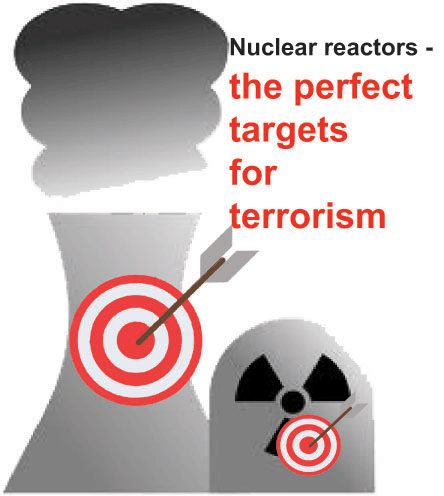
Why use your own nuclear weapons (with all the risks of escalation that this entails) when you can just take out your enemy’s nuclear power stations or nuclear waste facilities?
Jonathon Porritt 27th Aug 2025
I’ve reluctantly come to the conclusion that the only way the nuclear industry’s hype-machine is going to be stopped in its tracks is a Russian cyber-attack on the nine nuclear reactors still operating here in the UK, causing them all to close down and leading to the grid temporarily collapsing. That should do it.
I jest – sort of. But nothing else has worked. In just the last few weeks:
1 The Treasury’s financial modelling for the new power station at Sizewell C (seen by the Financial Times) gives a range of roughly £80 billion to £100 billion, far higher than the official estimate of £47 billion from the Department of Net Zero and Energy Security – which in itself was already nearly double the original cost of £20 billion!
2 The Treasury recently described the Government’s proposals for a new Geological Disposal Facility to deal with the 700,000 cubic metres of spent nuclear fuel as ‘unachievable’. This is a truly extraordinary development – confirming that the UK still has NO idea what to do about its legacy nuclear waste, let alone the waste that will be produced by any new reactors. Yet this got hardly a mention in the media.
3 The Government confirmed that it will be splurging a further £17 billion of taxpayers’ money between now and 2030 on Sizewell C, Small Modular Reactors and fusion energy – even as it continues to ignore the scourge of chronic poverty here in the UK, with 4.5 million children living in poverty – the highest number ever recorded.
On top of which, the industry’s hype-machine is now being turbocharged by the even more powerful hype-machine of AI. Never forget that the nuclear industry is supremely well-equipped to leap onto any and every boondoggle coming down the track – the Bitcoin/Crypto boom a decade ago (which never quite happened), and then green hydrogen. With every hard-to-abate sector queueing up for its share of vanishingly small volumes of green hydrogen, the Knights of Nuclear were up into their saddles just as fast as enough hobby horses could be corralled together to claim that it is only nuclear power that can provide the electricity required.
And now it’s AI. We’ve all read the growth projections for AI-enabled markets – from billions of dollars today to trillions tomorrow. I won’t weary you with the extrapolated increases in electricity consumption for all the new data centres that this entails – but it’s going to be a lot. On a par with the electricity consumption of small countries. New data centres are being built right now, ever bigger, already gobbling up more and more electricity. Nor will I invite you to ask why this AI boom must not – ever, on any terms – be subjected to much deeper scrutiny as to the balance of costs and benefits that will emerge. AI represents the apogee of latter-day technological determinism: if it can be done, then it must and will be done. So suck it up.
I’m not making light of this. The AI-driven nuclear boom in the USA is for real. Donald Trump is getting rid of most regulatory oversight of the nuclear industry, to speed things up, and stock prices of all the publicly traded nuclear companies are up by huge percentages. And it doesn’t seem to matter what kind of nuclear we’re talking about: 40-year-old decommissioned reactors to be given a new lease of life; plans for new big reactors, even in blue states like New York, being fast-tracked; Big Tech applying for construction permits for Small Modular Reactors that are still on the drawing board; and more than $500 billion apparently raised for new fusion reactors – seriously!
It’s not (yet) quite so insane here in the UK, but the signals are worrying. Strenuous efforts are being made by Ministers to force the Office for Nuclear Regulation to fast track any old nuclear proposal. Sweetheart deals with the private sector are being sorted out – regardless of the costs to taxpayers. Rational, evidence-based decision-making is a long-gone memory.
What exactly lies behind this mania? In the timeless words of Sherlock Holmes: ”once you have eliminated the impossible, whatever remains, no matter how improbable, must be the truth”.
So, let’s try that out for size in the context of nuclear power. It would surely be completely impossible for any responsible government pursuing a Net Zero energy strategy to prioritise nuclear power over all other options, given that:
- Large-scale nuclear reactors are now by far the most expensive option (on a Levelised Cost of Energy basis). UK Government figures in July this year showed new nuclear at £109 per MWh, offshore wind at £44MWh, large-scale solar at £41MWh and onshore wind at £38MWh.
- Small Modular Reactors (SMRs) don’t yet exist, but all experts agree their electricity will be even more expensive than that of large reactors – precisely because they can’t achieve the same economies of scale.
- The contribution of both big and small new reactors to a Net Zero electricity system in the UK will be literally ZERO before 2035 at the very earliest.
- Both big and small reactors will continue to produce significant levels of nuclear waste, adding to a waste crisis to which (as already mentioned) we have no long-term solution.
- ALL nuclear facilities pose a significant security risk, both from the point of view of cybersecurity (more later) and the very real possibility of physical attacks through ‘hostile third parties’.
Which brings us to the extraordinarily improbable truth of it: these days, nuclear power has little to do with electricity generation, and a whole lot more to do with the maintenance of the UK’s nuclear weapons capability……………………………………………………………………
It took a while for the UK Government to catch up, but in its latest Nuclear Roadmap it no longer beats around the bush. There are multiple references to the synergies between nuclear power and nuclear weapons: “this Government will proactively look for opportunities to align delivery of the civil and nuclear defence enterprises….it acknowledges the crucial importance of the nuclear industry to our national security, both in terms of energy supply and the defence nuclear enterprise”, and so on.
Big corporations are loving the fact that this is now out in the open. Bechtel, Babcock and Wilcox, AECOM, Rolls Royce – they’ve all spent decades feeding at the trough of either overt or hidden cross-subsidies between nuclear power and nuclear weapons. Rolls-Royce has been one of the most outspoken advocates for Small Modular Reactors, arguing their importance back in 2017 “to relieve the Ministry of Defence of the burden of retaining the skills and capability”………………………………………………………………….
As nuclear nations double down on nuclear power, it’s blindingly obvious that they are ramping up serious threats to national security. Nowhere is this clearer than with the drive to develop SMRs. Most designs currently on the drawing board (that are not light water reactors) will be using as their fuel high-assay, low-enriched uranium – or HALEU, to use the jargon. When it’s first extracted from the earth, uranium concentrations are usually around 1% of the total volume of the ore. HALEU fuel has to be enriched up to around 19% – just below the 20% threshold for the kind of highly-enriched uranium judged to be viable for the manufacture of nuclear bombs. And almost all HALEU fuel comes from Russia!
Beyond that, every nuclear facility (old and new) becomes a target for hostile third parties. Welcome back to the inconceivably scary world of nuclear cyberwarfare. Despite the highest grade of propaganda promoted by the Ministry of Defence – that all nuclear facilities are ‘bomb-proof’ (I kid you not!) – most cyber-experts grudgingly acknowledge that this is just bullshit when it comes to cyber-defence.
And we have no finer example of that than Sellafield, one of the most hazardous nuclear waste and decommissioning sites in the world, sprawling across 2 square miles on the Cumbrian coast. Back in December 2023, a Guardian exclusive revealed that Sellafield had been hacked into ‘by cyber groups closely linked to Russia and China’ since 2015 – despite years of cover-ups by senior staff. “The full extent of any data loss and any continuing risks to systems was made harder to quantify by Sellafield’s failure to alert nuclear regulators for several years”. The denials didn’t last long. The Guardian’s painstaking research over 18 months had got Sellafield bang to rights. In October 2024, it was fined £400,000 by the Office For Nuclear Regulation after it pleaded guilty to criminal charges over years of cyber-security breaches. Astonishingly, the ONR also found that 75% of its computer servers were vulnerable to cyber-attack.
…………………..Why use your own nuclear weapons (with all the risks of escalation that this entails) when you can just take out your enemy’s nuclear power stations or nuclear waste facilities?
…………………… https://jonathonporritt.com/uk-nuclear-policy-risks/
1 This Month

petition to oppose the rapid increase of space-military industry threatening Jeju Island and the region.
[Petition by April 19th (KST)] Stop the joint military-Hanwha Systems-Jeju Provincial Government Sea Launch!

Chernobyl: The Lost Tapes – A good documentary on Chernobyl on SBS available On Demand for the next 3 weeks– https://www.sbs.com.au/ondemand/tv-program/chernobyl-the-lost-tapes/2352741955560

of the week–London Campaign for Nuclear Disarmament


Tell the Ukrainian Government to Drop Prosecution of Peace Activist Yurii Sheliazhenko
To see nuclear-related stories in greater depth and intensity – go to https://nuclearinformation.wordpress.com
-
Archives
- April 2026 (194)
- March 2026 (251)
- February 2026 (268)
- January 2026 (308)
- December 2025 (358)
- November 2025 (359)
- October 2025 (376)
- September 2025 (257)
- August 2025 (319)
- July 2025 (230)
- June 2025 (348)
- May 2025 (261)
-
Categories
- 1
- 1 NUCLEAR ISSUES
- business and costs
- climate change
- culture and arts
- ENERGY
- environment
- health
- history
- indigenous issues
- Legal
- marketing of nuclear
- media
- opposition to nuclear
- PERSONAL STORIES
- politics
- politics international
- Religion and ethics
- safety
- secrets,lies and civil liberties
- spinbuster
- technology
- Uranium
- wastes
- weapons and war
- Women
- 2 WORLD
- ACTION
- AFRICA
- Atrocities
- AUSTRALIA
- Christina's notes
- Christina's themes
- culture and arts
- Events
- Fuk 2022
- Fuk 2023
- Fukushima 2017
- Fukushima 2018
- fukushima 2019
- Fukushima 2020
- Fukushima 2021
- general
- global warming
- Humour (God we need it)
- Nuclear
- RARE EARTHS
- Reference
- resources – print
- Resources -audiovicual
- Weekly Newsletter
- World
- World Nuclear
- YouTube
-
RSS
Entries RSS
Comments RSS
 nuclear-news