UKRAINIAN NEOFASCISM – War Time Developments: Part 1 ‘Azov’ and Part 2 ‘Right Sector’
by Gordonhahn, September 5, 2025
Neo-fascism and ultranationalism may not have been the most powerful element in Ukraine or even among Ukrainian nationalists before the NATO-Russia Ukrainian War, but they are almost certainly so now, and they are becoming increasingly powerful military-politically, culturally, and ideologically.
Ukraine’s neofascists have never been satisfied with the Maidan revolt, despite their pivotal role in overthrowing the previous oligarch-dominated order, which the Maidan revolt only replaced in part. They have always looked tot he future and completion of the ‚nationalist revolution‘, as they call it. A few years ago, Dmitro Yarosh, founder and then leader or “coordinator’ of Ukraine’s neofascist Right Sector (RS) and later advisor to now fired Ukrainian Armed Forces Commander, Gen. Valerii Zaluzhnyi, who is now Kiev’s ambassador to the UK, promised there would be a ‘second phase of the nationalist revolution’ of which the February 2014 Maidan revolt was supposedly but the first.
The second phase is to sweep away the liberal and oligarchic remnants of the pre-Maidan democratic order brought into the Maidan regime, in Yarosh’s view. Yarosh recently repeated his call for the completion of the neofascist revolution on his Facebook page: “As it turned out, during the Dignity Revolution and the Russian-Ukrainian War, Ukrainian nationalists became the main factor in the Ukrainian national-liberation struggle in the 21st century… I am a Ukrainian Nationalist – sounds proud both in Ukraine and across the world. The next power after the War for Independence should be nationalist. Otherwise, we will once again be led down an unbreakable cycle of national humiliation, corruption, degeneracy, moral degradation, economic decline, inferiority and defeat… Therefore, after the War for Independence, the wise, courageous and noble should rule in Ukraine. Glory to the Nation!”
Similar views are held by Ukraine’s many other ultra-nationalist and neo-fascist groups and their leaders, and they have been waiting for the moment to complete their revolution. The catastrophe of the war, its outcome, and consequences are bringing their dream ever closer to reality. These factors alone could assist the neo-fascist’s rise to power, even if only temporarily.
There once was a time when the West acknowledged Ukraine’s neofascist threat to republican rule, even as it helped armed, trained, and equipeed the neofascists‘ cocoons, the siloviki –, i.e. the Ukrainian military, SBU, and HRU. The de facto NATO think tank, the Atlantic Council, at the time noted:
Since the beginning of 2018, C14 and other far-right groups such as the Azov-affiliated National Militia, Right Sector, Karpatska Sich, and others have attacked Roma groups several times, as well as anti-fascist demonstrations, city councilmeetings, an event hosted by Amnesty International, art exhibitions, LGBT events, and environmental activists. On March 8, violent groups launched attacks against International Women’s Day marchers in cities across Ukraine. In only a few of these cases did police do anything to prevent the attacks, and in some they even arrested peaceful demonstrators rather than the actual perpetrators.
“International human rights groups have sounded the alarm. After the March 8 attacks, Amnesty International warned that “Ukraine is sinking into a chaos of uncontrolled violence posed by radical groups and their total impunity. Practically no one in the country can feel safe under these conditions.”[1]
Below I look at the political and cultural role neofascist groups have been playing in Ukraine, particularly since the beginning of the NATO-Russia Ukrainian War. In this Part 1, I begin with the most powerful and influential neofascist structure, Azov. No other neofascist or other fporm of Ukrainian group has seen its power and influence in the state and society be so enhanced over the last decade and certainly since the beginning of the beginning oft he NATO-Russia Ukrsainian War. Indeed, Azov’s leader, Andriy Biletskiy could very well be Ukraine’s next president and become so in the not too distant future.
Part 1: Azov
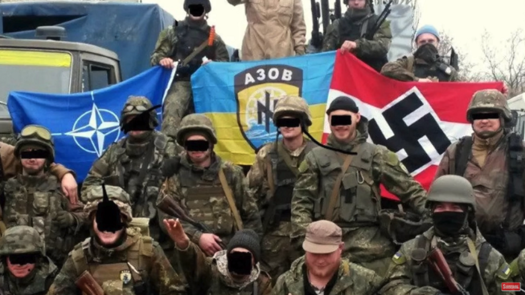
The Azov Battalion emerged from the Nazi-inspired Social-National Assembly (SNA) founded by Andriy Biletskiy, now commander of the Ukrainian army’s 3rd Separate Assault Battalion ‘Azov’. Azov’s rise along with its politics and ideology have much in common with Adolph Hitler’s Waffen SS.[2] Prior to running the SNA, Biletskiy led the equally ultra-nationalist ‘Patriots of Ukraine,’ the military wing of the Ukrainian National Army, self-procliamed successor to the Nazi-allied outfir of the same name during World War II. The ‘Patriots were infamous their beatings of immigrants. In a 2010 interview Biletskiy described his organization as nationalist “storm troopers.[3][4] A year later Biletskiy was in prison, after his organization—already renamed the SNA—had been involved in a series of shootouts and mass brawls.
The SNA’s, Azov’s, and Biletskiy’s ideology is an extremist brand of Ukrainian neofascism melded with international white supremacism. The SNA program emphasizes the concept of “nationocracy,” which was later incorporated into the RS program and propaganda courses. The SNA in power would ban all political parties, organizations, associations and ideological groups, so the ethnic Ukrainian elite holds full power: “Political power is wholly owned by the Ukrainian nation through its most talented, idealistic and altruistic national representatives who are able to ensure proper development of the nation and its competitiveness.” “Supreme power (executive, legislative and judicial) of the Ukrainian state will be in the hands of the head of state, who is personally responsible to the nation’s own blood and property.” Capitalism is to be “dismantled” and democracy is to be “eliminated.” All actions that fail “to comply with obligations to the nation and the state will entail the restriction of civil rights or deprivation of citizenship … The ultimate goal of Ukrainian foreign policy is world domination.”[5]
In 2007, Azov’s ideology is reflected in its leaders statements. Top leader, commander Biletskiy, castigated a government decision to introduce fines for racist remarks, noting: “So why the ‘Negro-love’ on a legislative level? They want to break everyone who has risen to defend themselves, their family, their right to be masters of their own land! They want to destroy the Nation’s biological resistance to everything alien and do to us what happened to Old Europe, where the immigrant hordes are a nightmare for the French, Germans and Belgians, where cities are ‘blackening’ fast and crime and the drug trade are invading even the remotest corners.”[6] Biletskiy has also said: “The historic mission of our nation in this critical moment is to lead the White Races of the world in a final crusade for their survival. A crusade against the Semite-led Untermenschen.”[7] In 2017, Biletskiy gathered his men in order to express Azov’s support for former Bosnian Serb military officer and convicted war criminal, Ratko Mladić, running directly counter to Western policy. Mladic was held responsible by a Western-sponsored war tribunal at the Hague for war crimes during the Yugoslav civil wars in the 1990s, including the Srebrenica massacre. Biletsky declared Mladić a “patriot of Serbia” and refers to the Iinternational Criminal Tribunal for Yugoslavia in the Hague as a “Zionist tribunal.”[8] More recently, in May 2025 Biletskiy claimed that Hungary, Poland, and Romania are waiting for Ukraine’s collapse so they can annex their former territories that became part of Ukraine under Sdtalin in the wake of the USSR’s victory over fascism: “They are not preparing for war. They are preparing to take their own scraps in the event of a global defeat of Ukraine,” he asserted.[9]`
On the basis of Azov, Biletskiy founded the National Corps with an affiliated paramilitary organization ‘National Teams.’ One of the points of Biletskiy’s foreign policy vision and of National Corps’ program is the creation of a union of countries called the ‘Intermarium’, which would include, among others, Ukraine and Poland – an idea also propagated by many Western apologists and supporters of Ukrainian neofascism. However, Poles, as victims of the OUN’s and UPA’s massacres 80 years ago in Volyn and elsewhere, do not shy away from noting Azov’s neofascism. They point out that Azov members eagerly use Nazi symbols, including the „Dirlewanger“ of the 36th SS Grenadier Division, which massacred Poles in Warsaw’s Wola during the Warsaw Uprising.[10] And, as noted above, Biletskiy recently accused Poland, along with Hungary and Rumania, with having designs on Ukrainian territory……………………………………………………………………………………….
The NATO-Russia Ukrainian War is strengthening Azov’s hand in Ukraine’s army, politics, and culture. In the course of the war, the Azov Battalion was incoroprated into the army, becoming the Ukrainian army’s 3rd Separate Assault Brigade, while retaining a brigade in the National Guard (the 12th National Guard Brigade), into which it was originally incorporated. Azov also has another military unit, known as ‚Kraken‘, under the control of Ukrainian Military Intelligence (GRU) and its director, the CIA-trained Kyrylo Budanov. Kraken has been involved in a series of war crimes, including the execution of captured Russian soldiers. This year,the 3rd Assault Brigade ‚Azov‘ was upgraded further to become the Third Army Corps ‚Azov‘.[18]Thousands of new soldiers will be integrated into Azov, and a special training school for sergeants established for it will inevitably indoctrinate recruits with ultra-nationalist ideology. Azov 3rd Assaualt Corps‘ founding ceremony, replete neo-Nazi pagan-like symbolism, was held near Kyiv and attended by Biletskiy and his fellow commanders. Participants offered “The Prayer for Ukraine,” a hymn borrowed from the neofascist, antisemitic OUN, whiuch enthusiastically collaborated with the Hitler’s Nazis in the Holocaust and ethnic cleansing of Poles during World War II.[19] The new commander of Azov’s 3rd Assault Brigade, Yaroslav Levenets, appointed in April-May, recently met Zelensky in an awards ceremony. He allegedly helped to organize the 2017 killing of Denis Voronenkov, a former member of the Russian parliament. As of December 2021, Levenets was still wanted in Ukraine.[20] Aside from the army’s and therefore Azov’s growing role in Ukrainian society as a result of the war, Azov maintains a youth organization called ‘Centuriya’, which networks Azov across Ukrainian society in schools, children’s camps, and sports clubs.
According to Havryshko, Azov benefits from „enormous media presence“ and university support in Ukraine and uses „celebrity journalists and media experts to create a glamorous image of their units.“[21] Indeed, Biletskiy, other leaders and members appear frequently on mainstream television and other media. Ukrainian and foreign media propagate Azov’s units as „true patriots“ and “elite brigades,” respectively, whereas in the West before the war there was significant reporting on Azov‘s and other Ukrainian groups‘ neofascist political orientation and ideology. …………………
With this media and academic network, Azov is able to insinuate neofascism into every knook and cranny of Ukrainian society. For example, it has been at the forefront of a campaign to slander and threaten the life of a leading scholar of historical and contemporary Ukrainian neofascism, Professor Marta Havryshko of Clark University in Massachusetts, running her out oft he country. As a result of the campaign Havryshko was fired from her position in the Kripyakevich Institute for Ukrainian Studies for her research on various aspects of this subject inculding the violence committed by the WW II-era Ukrainian fascist organizations OUN and UPA allied with Nazi Germany, contemporary Ukrainian glorification of Ukraine‘s Waffen-SS division “Galicia”, and her rejection of ultra-nationalist driven history policies. ………………………………………………………………………………………………………………………………………………………….. https://gordonhahn.com/2025/09/05/ukrainian-neofascism-war-time-developments-part-1-azov-and-part-2-right-sector/
Russia is ready to discuss nuclear fuel at Ukraine’s Zaporizhzhia with US – RIA

By Reuters, September 5, 2025, https://www.reuters.com/world/russia-is-ready-discuss-nuclear-fuel-ukraines-zaporizhzhia-with-us-ria-2025-09-05/
VLADIVOSTOK, Russia, Sept 5 (Reuters) – The head of Russia’s State Atomic Energy Corporation Rosatom Alexei Likhachev said on Friday the company was ready to discuss with the U.S.’s Westinghouse the issue of nuclear fuel at Ukraine’s Zaporizhzhia nuclear power plant, RIA news agency reported.
In June, Russia asked the U.N. nuclear watchdog to mediate between Moscow and Washington to resolve the question of what to do with U.S. nuclear fuel stored at the Ukrainian power plant controlled by Russian forces.
Westinghouse and U.S. energy officials had previously raised intellectual property concerns with Russia in connection with the fuel issue, according to Likhachev.
Reporting by Vladimir Soldatkin and Olesya Astakhova; Editing by Christopher Cushing
£154m plan hatched to move UK’s 140-tonne cache of powdered plutonium from nuclear reactor waste at Sellafield.

Britain could finally solve the problem of
what to do with its radioactive waste by converting it into ceramic
pellets, The Telegraph can reveal. Government scientists want to store the
radioactive plutonium, which is a national security risk because it can be
used to make nuclear weapons, in an underground nuclear graveyard. The
UK’s cache of 140 tonnes of powdered plutonium from nuclear reactor waste
is currently under armed guard at Sellafield in Cumbria.
Telegraph 28th Aug 2025 https://www.telegraph.co.uk/news/2025/08/28/britain-solution-radioactive-waste-problem-cumbria/
Small reactors: cash flow alert for Newcleo, Europe’s largest nuclear start-up.
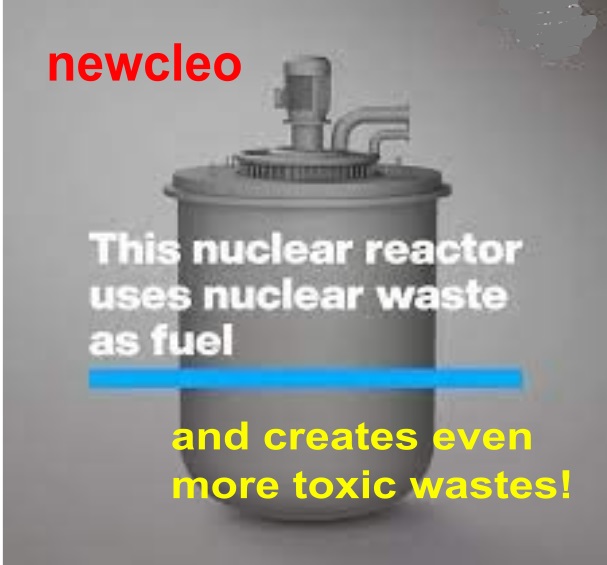
The company, which employs a thousand people, is burning through
too much cash. Its continued existence could be threatened without a new
round of financing.
But both private and public stakeholders remain
cautious. While waiting for fresh money, Newcleo is scaling back. Without a
new capital increase in the next twelve months, the company’s continued
existence is threatened, the Italian press reported in early August. The
articles, notably published in the business daily Il Sole 24 Ore , are
based on the findings of an audit of Newcleo’s 2024 accounts conducted by
KPMG, which La Tribune has seen.
The startup has notably abandoned its
ambitions in the United Kingdom, leading to the elimination of 150
positions. It also intends to reduce its engineering contracts with
external service providers.
La Tribune 29th Aug 2025, https://www.latribune.fr/climat/energie-environnement/petits-reacteurs-alerte-sur-la-tresorerie-de-newcleo-plus-grosse-start-up-europeenne-du-nucleaire-1031500.html
Rolls-Royce denies report of IPO ( Initial Public Offering) plans for small nuclear reactor unit
By Reuters, August 31, 2025
Aug 30 (Reuters) – Rolls-Royce Holdings (RR.L), opens new tab on Saturday denied a report it was exploring an initial public offering for its small nuclear reactor unit.
The Financial Times, citing people familiar with the situation, reported on Saturday the company was considering an IPO as well as other funding options. It said talks with investment houses and banks were at an early stage.
“Rolls-Royce SMR is not planning for, or in the process of launching, an initial public offering,” a spokesperson for the unit said in an emailed statement to Reuters.
In June, the Rolls-Royce SMR unit was selected to build Britain’s first Small Modular Reactors as part of its plan to speed up the decarbonisation of the power network from the mid-2030s. The unit, majority-owned by the British engineering firm, plans to build three reactors.
The British government pledged 2.5 billion pounds ($3.4 billion) for the SMR programme over the next four years, aiming to launch one of Europe’s first small-scale nuclear industries…. https://www.reuters.com/business/energy/rolls-royce-denies-report-ipo-plans-small-nuclear-reactor-unit-2025-08-30/
Rolls-Royce explores small nuclear reactor unit funding options including IPO (Initial Public Offering) .

An Initial Public Offering (IPO) is the process where a private company sells its shares to the public for the first time, thereby becoming a public company listed on a stock exchange. (The process involves significant costs, ongoing reporting requirements, a loss of some control, and increased exposure to litigation)
The consortium led by the UK engineer is in talks to finalise a
contract with the government later this year. Rolls-Royce has held
exploratory talks with advisers over financing options for its small
nuclear business, including an initial public offering, amid growing
investor excitement about the nascent technology.
The FTSE 100 engineer was
selected to build Britain’s first fleet of small modular reactors in June
as part of a plan by the Labour government to make the UK a world leader in
the technology. The Rolls-Royce-led SMR consortium is in talks to finalise
a contract with the government later this year.
The talks with investment
houses and banks focused on future funding requirements of the business,
according to two people familiar with the situation. “There is a live
debate within the shareholder base,” said one of the people, noting that
a listing at a high valuation would generate significant funding. Other
members of the consortium include CEZ Group, the Czech utility, which holds
a 20 per cent stake as part of a wider partnership with Rolls-Royce, the
Qatar Investment Authority and BNF Resources.
There were “different
views” among shareholders, the person added. Discussions were at an early
stage, with the Rolls-Royce board not in a rush to make any decision, said
the other person. The UK government would be eager to ensure that any
listing occurred in London, which has suffered a marked slowdown in
flotations in recent years, they added. The government has said it will
pledge £2.5bn to small modular reactors during this three-year spending
review period, helping to develop Rolls-Royce’s technology as well as
develop sites for the reactors.
FT 30th Aug 2025,
https://www.ft.com/content/234b4c2e-5e1a-46ba-82fd-472e271a289f
Why are saltmarshes such effective carbon sinks?
The invisible yet lethal threat of radioactive pollution is an ever-present risk to the Blackwater. Even a small leakage of nuclear material from the decommissioned Bradwell reactor cores or radioactive waste stores could negatively affect the role that the estuary’s marshlands play in trapping carbon, known as carbon sequestration. In short, radioactive leakage may erode the amount of carbon that can be sequestered in future. This risk alone should be enough to deter any further development of new nuclear power at the Bradwell site.
2 September 2025
David Humphreys explains the role of saltmarshes in the struggle against our heating climate in the August 2025 column for Regional Life
The saltmarshes and mudflats of the Blackwater Estuary are an important yet fragile environment rich in birds, flora, invertebrates, fish and oysters. But saltmarshes are also highly effective in storing carbon, thereby acting as carbon sinks with a vital role to play in tackling increases to the global temperature.
Like all forms of plant life, the vegetation that thrives in marshlands absorbs carbon from the atmosphere through photosynthesis to create food for the plants.
Carbon sinks may release their carbon back into the atmosphere in two ways. First, combustion generates carbon dioxide emissions, for example during forest fires. Second, carbon dioxide is realised when living organisms respire. Respiration is how life forms, including plants, obtain energy. If plants are in an oxygen-rich (aerobic) environment they create more carbon dioxide when breathing than if their environment is lacking in oxygen (anaerobic).
Why are saltmarshes such effective carbon sinks?
2 September 2025
David Humphreys explains the role of saltmarshes in the struggle against our heating climate in the August 2025 column for Regional Life
The saltmarshes and mudflats of the Blackwater Estuary are an important yet fragile environment rich in birds, flora, invertebrates, fish and oysters. But saltmarshes are also highly effective in storing carbon, thereby acting as carbon sinks with a vital role to play in tackling increases to the global temperature.

Like all forms of plant life, the vegetation that thrives in marshlands absorbs carbon from the atmosphere through photosynthesis to create food for the plants.
Carbon sinks may release their carbon back into the atmosphere in two ways. First, combustion generates carbon dioxide emissions, for example during forest fires. Second, carbon dioxide is realised when living organisms respire. Respiration is how life forms, including plants, obtain energy. If plants are in an oxygen-rich (aerobic) environment they create more carbon dioxide when breathing than if their environment is lacking in oxygen (anaerobic).
And here’s why saltmarshes are such effective sinks: they are anaerobic, so plants breathe without oxygen. Anaerobic respiration generates less energy than aerobic respiration and produces less carbon dioxide. This enables carbon stocks to build up. Coastal marshlands also receive a constant influx of tide-borne sediment, which buries organic matter in sediment layers, a further factor that enables carbon to accumulate. The result is that coastal marshlands are more effective at carbon storage per hectare than any other ecosystem, including tropical forests.
The Blackwater Estuary forms part of a broader category of carbon sink known as ‘blue carbon’. This is carbon that has been captured and stored by living coastal ecosystems such as saltmarshes, mangrove forests and seagrass beds. Blue carbon ecosystems also provide other environmental services such as protection against sea-level rise and storm surges. Given the global sea-level increases projected for this century, the importance of blue carbon ecosystems cannot be overstated, both for coastal protection and trapping carbon.
The saltmarshes of Essex, then, are a vital asset in the fight against global heating. At the same time, they are threatened by the impacts of climate change, in particular coastal retreat from sea-level rise.
Marshland ecosystems are also at the mercy of pollution, which can reduce their carbon storage capacity. The invisible yet lethal threat of radioactive pollution is an ever-present risk to the Blackwater. Even a small leakage of nuclear material from the decommissioned Bradwell reactor cores or radioactive waste stores could negatively affect the role that the estuary’s marshlands play in trapping carbon, known as carbon sequestration. In short, radioactive leakage may erode the amount of carbon that can be sequestered in future. This risk alone should be enough to deter any further development of new nuclear power at the Bradwell site.
This is a further reason to ‘BANNG the drum’ against new nuclear at Bradwell and to resist further nuclear power construction in the United Kingdom.
David Humphreys is Emeritus Professor of Environmental Policy at the Open University.
NFLAs join nuclear test appeal to French and Algerian Governments
On the UN International Day against Nuclear Tests (29 August), the
UK/Ireland Nuclear Free Local Authorities have joined French, Algerian and
global partners in appealing to the French and Algerian Governments for
justice for the victims of French nuclear tests in North Africa.
NFLA 29th Aug 2025 https://www.nuclearpolicy.info/news/nflas-join-nuclear-test-appeal-to-french-and-algerian-governments/
Extra funding revealed to fuel nuclear fusion energy training and research

The UK Atomic Energy Authority (UKAEA), University of York and University
of Edinburgh, will invest £7.8m over the next five years to advance fusion
energy research and post-graduate training. The funding will be distributed
through UKAEA’s Fusion Opportunities in Skills, Training, Education and
Research (FOSTER) Programme, which aims to develop the next generation of
fusion energy specialists. This investment is intended to create new
opportunities across collaborating universities for students to access
level Seven (master’s degree) qualifications in fusion and relevant
fields, supporting the FOSTER Programme’s mission to build a diverse
fusion skills ecosystem.
Business Desk 3rd Sept 2025, https://www.thebusinessdesk.com/yorkshire/news/2143485-extra-funding-revealed-to-fuel-nuclear-fusion-energy-training-and-research
Memorial unveiled at former RAF airbase threatened by nuke waste dump
NFLA Secretary Richard Outram was proud recently to participate in a
ceremony (31 August) at which a new memorial was unveiled to honour the
service of the many personnel once based at a Second World War RAF airbase
which may become the preferred site for a nuclear waste dump. The timing is
particularly poignant for, whilst once RAF Millom fought off an attack by a
Luftwaffe bomber, the former airfield now faces a graver threat from nearer
home. At the end of January, Nuclear Waste Services designated that part of
the airfield not occupied by His Majesty’s Prison Haverigg as its primary
Area of Focus in the South Copeland GDF Search Area. This could be the
future location for a surface facility that would receive nuclear waste
shipments as part of the plan to establish a Geological Disposal Facility.
NFLA 2nd Sept 2025,
https://www.nuclearpolicy.info/news/memorial-unveiled-at-former-raf-airbase-threatened-by-nuke-waste-dump/
War spending is ever greater

“The military personnel sent to Ukraine would be military personnel from countries that are mostly NATO members. And it is precisely NATO’s expansion in Ukraine that has been one of the main causes of the current conflict.”
Manlio Dinucci, Voltairenet.org, Sat, 30 Aug 2025, https://www.sott.net/article/501617-War-spending-is-ever-greaterhttps://www.sott.net/article/501617-War-spending-is-ever-greater
As US military spending in Ukraine declines, European spending increases. Although it appears that these weapons will be manufactured in the European Union and no longer across the Atlantic,they will inevitably be destroyed in Ukraine.
The war continues to spread to the heart of Europe because it is fundamentally fueled by the very strategy that caused it to explode. After the summit with Vladimir Putin in Alaska, Donald Trump said that, if an agreement were reached between Russia and Ukraine, the United Stateswould not send troops to Ukrainebut, as a “security guarantee,” would provide Kiev with air and intelligence support. Troops, however, would be sent to Ukraine by some European countries.
The US Joint Chiefs of Staff reports that, to finalize this plan, US General Dan Caine summoned the chiefs of staff of Finland, France, Germany, Italy, the United Kingdom, and Ukraine to the Pentagon. The Kremlin reaffirms that it does not accept this plan. Russian presidential spokesman Dmitry Peskov declared:
“The military personnel sent to Ukraine would be military personnel from countries that are mostly NATO members. And it is precisely NATO’s expansion in Ukraine that has been one of the main causes of the current conflict.”
Immediately after, NATO Secretary General Mark Ruttewas dispatched to Kyiv, where, in a press conference with President Volodymyr Zelensky, he stated:
“Our support for Ukraine is unconditional and continues to grow, including through a flow of lethal US weapons to Ukraine financed by European NATO Allies and Canada. So far, three arms packages, each worth $500 million, have been delivered. The first paid for by the Netherlands; the second by Denmark, Norway, and Sweden; and the third by Germany. More packages will follow.
“Allies support the Ukrainian defense industry, investing in ways that not only strengthen your security, but also your economy. We are working with NATO Command Germany to ensure that your armed forces have what they need today and in the future.”
Immediately after, Canada purchased a fourth “package” of US weapons, bringing the total to $2 billion, which went into the coffers of the largest US war industries.
At the same time, the European Union has allocated €4.05 billion for Ukraine: €3.05 billion from the Ukraine Fund and €1 billion from the “reinvestment of income from Russian fixed assets.“ The EU and its member states have spent a total of €168.9 billion on Ukraine since February 2022. And Ursula Von der Leyen guarantees that “Europe will stand by Ukraine for every single day of the war and for every single day after the war.” These enormous war expenses, made up of public money, are paid directly and indirectly by European citizens through taxes and cuts in social spending.
The latest data released by NATO show that the 32 member countries — as required by the United States — have met the goal of allocating 2 percent of GDP to military spending. In 2014 — the year the Obama administration, with Biden as vice president, carried out the coup in Ukraine that launched the war against Russia — the United States accounted for 73 percent of NATO military spending, compared to Europe’s 27 percent. By 2025, the United States’ share will have fallen to 60 percent, while Europe’s will have risen to 40 percent. As the Trump administration demands — NATO military spending will rise to 3.5 percent and then to 5 percent of GDP, Europe’s share will continue to rise.
Based on the official documentation published by NATO at the end of August 2025, Italian military spending in 2025 will amount to more than 45 billion euros (45,315 billion euros): an average of more than 124 million euros per day. To get an idea of the priorities, just think that this sum deposited in one day for the war is roughly equivalent to the 130 million euros allocated by the Government in 2025 for the “First Home Guarantee Fund”, an important program that allows young people who request it to have a facilitated loan for their purchase.
China’s SCO Summit Highlights West’s Growing Ideological Isolation, + Zelensky’s Desperate Gambit

On the Ukrainian-political front, it’s obligatory to note that Trump’s two-week deadline has now expired. He had threatened some kind of consequences for Russia, and predictably there aren’t any, though he has now hinted that he has “learned something very interesting” about the war that he will reveal in the next few days—likely another made-up deflection to buy himself time.
Simplicius, Sep 03, 2025
Last week Zelensky made the curious decision to open up the borders to Ukraine’s 18-22 year old males. The decision was met with both approval and disgust in different quarters of the country:
“We say:” Those who are not in the army, you are 18-22, you can leave the country, no one is holding you, you are cool guys.” And we go back to the army, we say: “You are slaves. Listen to what you will do and when, how much you will fight in this army, ” said the deputy of the Kiev City Council, an officer of the Armed Forces of Ukraine Alexander Pogrebissky in an interview with a Ukrainian TV channel.
The bigger question is why did Zelensky “liberate” such a vital age group at a time when manpower is at critical lows on the front? Astute observers have noted it wasn’t simple coincidence that the decision came mere weeks after the NABU investigations and decision reversal. More importantly, it came weeks after Ukraine’s youth took to the streets in protest against Zelensky, in what appeared at times to be a new Maidan in the making.
The natural conclusion, then, is that Zelensky was forced to loosen the check valve on society, letting off some pressure from himself and allowing the most dissenting and anti-war 18-22 year-olds to flee the country so that they’re not able to form up a rebellious vanguard to create a political headache for Zelensky.
Even Le Monde leaned toward this natural angle:
The timing of the new regulation is not insignificant. It comes just over a month after the Ukrainian government tried to strip two anti-corruption agencies of their independence, on July 22. Thousands of young people protested in several Ukrainian cities for days, until the presidency backtracked and passed a law restoring the agencies’ autonomy.
The fact that Zelensky himself raised the issue of allowing 18- to 22-year-olds to leave the country, on August 12 during a youth forum, was a strong political signal. “I think the president was trying to make amends with the younger generation by granting them some benefits,” said Sovsun. MP Bohdan Yaremenko, a member of Zelensky’s party, shares this view: “There will probably be more similar actions in the future to reach out to young people.”
It’s interesting that the 18-22 cohort was chosen, whereas 23-24 year olds are still prohibited from leaving given that they’re on the cusp of the critical age of 25 to which mobilization was lowered.
Across Ukraine, there are growing signs of the lack of young males. This photo [on original] was posted by a professor at a Kiev university, reportedly showing a class overflowing with young females:
NO BOYS – NO MEN:
Andrey Dlyhach, a lecturer at the Faculty of Economics of Taras Shevchenko National University of Kyiv, published a photo of the first-year students, showing that the overwhelming majority of the students are girls.
“You wanted to say something else with this photo, but what I see there are the consequences of 3 years of closed borders for men aged 18+,” comments economist Gleb Vyshlinsky on the photo.
Other people reportedly chimed in in the comments, posting photos of similar gender disparities in their own schools across Ukraine.
There are other possible deductions to make about Zelensky’s sly decision. We can hypothesize on the following:
- Zelensky sees the negotiations and peace track as being definitive such that he does not expect the war to last and does not see the need for the eventual tapping of the 18-22 cohort.
- The political danger to Zelensky was so great—more so than even we know of—that he needed a boost to his image in order to restore some semblance of control. This also has to do with the quiet initiations of Zaluzhny’s political campaign—this could be Zelensky’s attempt to win back favor with society to increase his poll numbers and fortify himself against potential challengers.
- Ukraine’s ‘recruitment problems’ are not as bad as we were led to believe, and its authorities are confident they can sustain military manpower regeneration even without the 18-22 cohort.
More than likely, Zelensky weighed the options and viewed the tradeoff as favorable. Crunching the numbers, his team likely concluded it was worth the long term risk to manpower in order to secure the short term political viability of Zelensky’s rule.
On the Ukrainian-political front, it’s obligatory to note that Trump’s two-week deadline has now expired. He had threatened some kind of consequences for Russia, and predictably there aren’t any, though he has now hinted that he has “learned something very interesting” about the war that he will reveal in the next few days—likely another made-up deflection to buy himself time.
Trump “seems to have run out of ideas regarding the advancement of the peace process” in Ukraine, as his latest two-week deadline has expired, and the meeting between Putin and Zelensky that he wanted has not taken place, writes The Times newspaper.
In reality, Putin is presently hitting his stride as celebrated guest in Beijing where the Global South power-players are convening to showcase just how little the wretched ‘Western world’ matters anymore:
In the grand ebb and flow of the Ukrainian negotiations cycle, we’re in a kind of waning phase, with no real initiatives or urgency at the moment as all involved parties have essentially gotten fatigued from the same old copy-pasted carousel of banality and deadend options……………………………………………………………………………
two clashing systems of ideologies: one that elevates war and domination—what Xi called hegemonism in his earlier SCO speech—to the status of national religion, while the other seeks to unite the world in mutual development, and most importantly, shared respect……………………….. https://simplicius76.substack.com/p/chinas-sco-summit-highlights-wests?utm_source=post-email-title&publication_id=1351274&post_id=172310012&utm_campaign=email-post-title&isFreemail=true&r=rq5yc&triedRedirect=true&utm_medium=email
“We gave for France… now that’s enough”: La Hague residents reject Orano’s nuclear pools project
by Marie du Mesnil-Adelée, 08/31/2025, https://france3-regions.franceinfo.fr/normandie/manche/cherbourg-cotentin/on-a-donne-pour-la-france-maintenant-ca-suffit-des-habitants-de-la-hague-rejettent-le-projet-des-piscines-nucleaires-d-orano-3205250.html
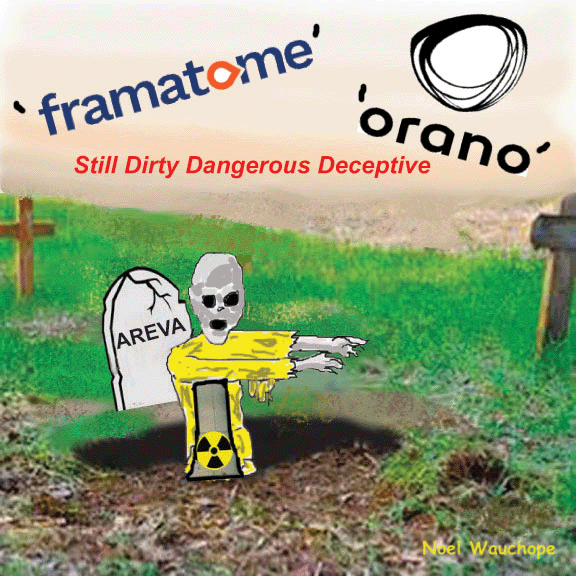
“It’s never too late to say: we don’t want it.” Gathered at a public meeting, residents of La Hague spoke out against the “Downstream of the Future” project at the Orano site. A project that includes the installation of three new nuclear pools for storing spent fuel.
An extraordinary nuclear project in La Hague
An extraordinary nuclear project at La Hague, presented by Orano as “the largest industrial project in the world”, costing several tens of billions of euros, “Downstream of the Future” (that’s its name), plans the construction of three new nuclear pools for storing spent fuel and also new workshops and factories on the La Hague site by 2040-2050.
How is this project received by residents?
How is this project being received by residents? In his documentary “Encore de l’énergie” broadcast on Thursday, September 4 on France 3 Normandie and france.tv, Laurent Pannier filmed a public meeting.
Yannick Rousselet, a nuclear expert for Greenpeace, spoke: ” There was no consultation . We would like to debate the appropriateness, the justification of something like this. Today is good. We have given for France, for the nuclear industry and that’s enough. Let’s stop, let’s move on. We want our future to be shaped differently. I think it’s never too late to say we don’t want it.”
A resident adds: “I find it a bit easy for Orano to be able to do whatever they want in terms of construction, however they want, while all the residents of La Hague, as soon as they want to have a window transformed, put in a veranda, do anything, they can’t do anything.”
And a third:
“Today we only have 4 or 5 small hectares of moorland left. It’s more than a relic now, it’s become a symbol. People are saying to us: well, since there’s more than that left, we’re going to remove it and I think that’s a real shame.”
The words are powerful. But the room is far from full… Here, as elsewhere, nuclear power divides. And
those who oppose it are a minority.
Anti-nuclear activists of yesterday and today
In April 2006, the city of Cherbourg held its largest demonstration since the Liberation. Twenty years after Chernobyl, 30,000 activists gathered to protest the proposed construction of a new reactor in Flamanville, the EPR.
Yet, fifteen years later, despite construction delays, despite the additional costs, despite the Fukushima disaster, distrust of nuclear energy has virtually disappeared. Environmental movements are divided between pro- and anti-nuclear supporters. And the announcement of the revival of nuclear power in France, particularly in Normandy, has been generally welcomed by the population.
Laurent Pannier’s new documentary explores this reversal. What happened to the former activists? Is there a new generation? In the face of climate change, is nuclear power a necessary evil?
“Encore de l’énergie” by Laurent Pannier, a documentary to watch this Thursday, September 4 at 10:55 p.m. on France 3 Normandie and on france.tv , for one month.
Government ‘replanning’ £53.3bn geological disposal facility project
“Successful delivery of the project appears to be unachievable. “There are major issues with project definition, schedule, budget, quality and/or benefits delivery, which at this stage do not appear to be manageable or resolvable.”
02 Sep, 2025 By Tom Pashby
Government ‘replanning’ £53.3bn geological disposal facility project.
Construction of a UK geological disposal facility (GDF) for long-term
nuclear waste disposal is being “replanned” after recent revelations
about its cost and deliverability, according to the government.
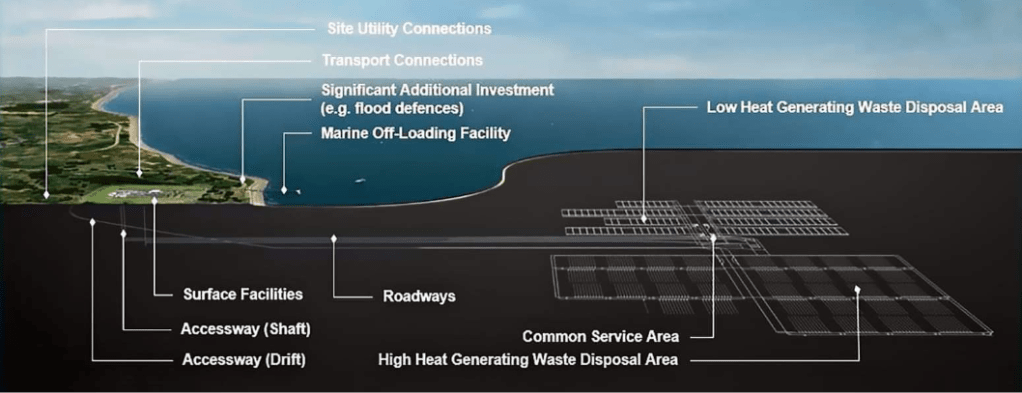
A GDF represents a monumental undertaking, consisting of an engineered vault placed between 200m and 1km underground, covering an area of approximately 1km2 on the surface. This facility is designed to safely contain nuclear waste while allowing it to decay over thousands of years, thereby reducing its radioactivity and associated hazards.
The National Infrastructure and
Service Transformation Authority (Nista), a Treasury unit, assessed the GDF
in its Nista Annual Report 2024-2025 and gave it a Red rating in Delivery
Confidence Assessment. This means: “Successful delivery of the project
appears to be unachievable. “There are major issues with project
definition, schedule, budget, quality and/or benefits delivery, which at
this stage do not appear to be manageable or resolvable. The project may
need re-scoping and/or its overall viability reassessed.” In addition,
the Nista annual report lists the “whole life cost” of the GDF as
£20bn as a mid-range assessment and £53.3bn as a high-end assessment.
Government says GDF project facing ‘replanning’ by NDA, but remains
necessary
New Civil Engineer 2nd Sept 2025, https://www.newcivilengineer.com/latest/government-replanning-53-3bn-geological-disposal-facility-project-02-09-2025/
The final furlong: EDF announces further lifetime extension for aging AGR reactors

Britain’s aging Advanced Gas Cooled reactors may, like exhausted
racehorses, be on their last legs, but operator EDF Energy is clearly
intent on keeping them running for as long as possible.
The company
announced yesterday a twelve month extension in operations at their Heysham
1 and Hartlepool AGR plants until March 2028, citing the retention of jobs
and a desire to contribute to the UK achieving net zero and energy security
– but the NFLAs suspect a more pressing motivation.
In a comment to
industry media, NFLA Secretary Richard Outram said: ‘The EDF announcement
is unsurprising. Although company bosses may crow a lot about the
preservation of local jobs, the NFLAs suspect this is about the
preservation of EDF’s bottom line. ‘Given the parlous state of the
French parent company’s finances, the intermittent output of the domestic
fleet, and the vast overspend on Hinkley Point C, EDF have a clear
incentive to keep open for as long as possible any nuclear plant in their
portfolio which operates and generates profits.’
Dr Ian Fairlie, an
independent consultant on radioactivity in the environment and a former
advisor to the UK Government and European Parliament, is also sceptical as
to EDF’s motives: “The real reason why French parent company
Électricité de France wants to prolong the lives of their obsolete,
past-it, reactors is financial.
NFLA 3rd Sept 2025, https://www.nuclearpolicy.info/news/the-final-furlong-edf-announces-further-lifetime-extension-for-aging-agr-reactors/
1 This Month

petition to oppose the rapid increase of space-military industry threatening Jeju Island and the region.
[Petition by April 19th (KST)] Stop the joint military-Hanwha Systems-Jeju Provincial Government Sea Launch!

Chernobyl: The Lost Tapes – A good documentary on Chernobyl on SBS available On Demand for the next 3 weeks– https://www.sbs.com.au/ondemand/tv-program/chernobyl-the-lost-tapes/2352741955560

of the week–London Campaign for Nuclear Disarmament


Tell the Ukrainian Government to Drop Prosecution of Peace Activist Yurii Sheliazhenko
To see nuclear-related stories in greater depth and intensity – go to https://nuclearinformation.wordpress.com
-
Archives
- April 2026 (194)
- March 2026 (251)
- February 2026 (268)
- January 2026 (308)
- December 2025 (358)
- November 2025 (359)
- October 2025 (376)
- September 2025 (257)
- August 2025 (319)
- July 2025 (230)
- June 2025 (348)
- May 2025 (261)
-
Categories
- 1
- 1 NUCLEAR ISSUES
- business and costs
- climate change
- culture and arts
- ENERGY
- environment
- health
- history
- indigenous issues
- Legal
- marketing of nuclear
- media
- opposition to nuclear
- PERSONAL STORIES
- politics
- politics international
- Religion and ethics
- safety
- secrets,lies and civil liberties
- spinbuster
- technology
- Uranium
- wastes
- weapons and war
- Women
- 2 WORLD
- ACTION
- AFRICA
- Atrocities
- AUSTRALIA
- Christina's notes
- Christina's themes
- culture and arts
- Events
- Fuk 2022
- Fuk 2023
- Fukushima 2017
- Fukushima 2018
- fukushima 2019
- Fukushima 2020
- Fukushima 2021
- general
- global warming
- Humour (God we need it)
- Nuclear
- RARE EARTHS
- Reference
- resources – print
- Resources -audiovicual
- Weekly Newsletter
- World
- World Nuclear
- YouTube
-
RSS
Entries RSS
Comments RSS
 nuclear-news