No room at the dump: NFLA fears Johnson’s nuclear ambitions will lead to need for second unwanted underground facility
Like the standing joke about buses turning up late and in pairs, the
Nuclear Free Local Authorities fear that Boris Johnson’s commitment to
treble Britain’s nuclear generating capacity by 2050 will create so much
new toxic nuclear waste that the government will want to build a second
underground nuclear dump in the next two decades.
A large, and much maligned, element in last week’s UK Energy Security Strategy was the
pledge to build up to eight new large nuclear power stations over the next
three decades, generating 24 gigawatts of electricity, and the UK could run
out of room to store the resultant radioactive waste if the Prime
Minister’s plan becomes reality.
Professor Claire Corkhill is Chair in
Nuclear Material Degradation and EPSRC Early Career Research Fellow and
Reader at the University of Sheffield, and a member of the Committee on
Radioactive waste Management (CORWM) which advises the government.
Professor Corkhill has publicly commented that existing plans for the dump
will only provide sufficient capacity to take the legacy waste from 70
years of operations and waste from up to 16 gigawatts of nuclear new build,
and has expressed concern about ‘rushing to expand nuclear power until
the implementation of radioactive waste policy [i.e. the GDF] has
progressed further’.
NFLA 13th April 2022
Carelessness of Russian soldiers around Chernobyl – shows danger of nuclear sites in wartime
As we learn more about the negligence of Russian generals who ignored
warnings that the radioactive forest surrounding Chornobyl was a hazardous
staging ground for their assault on Kyiv, environmental historian Kate
Brown flags an ill-recognized reality: humanity is ill prepared for what
happens when nuclear facilities are held hostage during war.
Known as the
“Red Forest”—its pine trees turned red from radiation exposure after
a reactor at Chornobyl melted down in April 1986—the area where Russian
soldiers bulldozed and dug trenches and bunkers is the most contaminated
region of the Chornobyl Exclusion Zone, which is itself “one of the most
toxic places on Earth,” writes the New York Times.
But Russian generals did not seem troubled by the fact that their troops were digging and
bunking down in earthworks that may have had radiation levels 1,000 times
above ambient.
Energy Mix 12th April 2022
Ukraine MoD Asserts No Evidence That Russia Will Deploy Nuclear Weapons Amid War
The spokesperson of the Ukrainian Defence Ministry, Oleksandr Motuzianyk stated that Ukraine perceives no indicators that Russia will deploy nuclear weapons.
Written By Rohit Ranjan Republic World, 15th April, 2022
Spain outraged as massive US nuclear-powered submarine arrives in Gibraltar
SPAIN has launched an official complaint against the arrival of a US nuclear-powered submarine in Gibraltar.
By ALESSANDRA SCOTTO DI SANTOLO, Apr 14, 2022 The arrival of a USS Georgia submarine in the port of Gibraltar has sparked a diplomatic row between Spain and the US. The Spanish Foreign Ministry has confirmed that it has lodged an official protest with the US.
The Spanish authorities wanted the submarine to anchor at the Rota naval base instead, where the US Georgia had already been based in August 2020.
The reasons and the duration for the stopover of the submarine remain unknown.
Since the port of Gibraltar was ceded by Spain to the United Kingdom in 1713, the Spanish government actually lacks the authority to prevent such moves. The British Overseas Territory has been at the centre of a bitter row between the UK and EU after Brexit, as access to Gibraltar was not included in the trade agreement. Under an EU proposal, Spain would gain control over the country’s external border……………………https://www.express.co.uk/news/uk/1596057/spain-news-Gibraltar-uss-Georgia-submarine-nuclear-uk-latest
Dr Richard Dixon: Scottish and UK governments are on a collision course over nuclear energy and oil.
The UK Government’s new energy strategy
makes no sense at all and puts Westminster on collision course with
Holyrood. In early March, Boris Johnson said he would produce, as a matter
of urgency, a plan to respond to the twin challenges of war in Ukraine and
the cost-of-living crisis.
Four weeks later, we finally have the British
Energy Security Strategy and it does pretty much the opposite of what’s
needed. Supposedly this is because the PM and Chancellor could not agree on
key measures. The result is a strategy that convinces no-one. Even the
right-wing press have roundly lambasted it.
The first thing you are taught
in any class about energy is that using less is much better than producing
it differently. Yet, there is nothing at all in the strategy on the
quickest, cheapest and most obvious way to save energy and reduce bills –
improving the energy efficiency of people’s homes.
The last thing youwould do if you want to change our energy system quickly and at an
affordable cost is invest in new nuclear reactors, yet that is exactly what
the government plans to do, egged on by Labour’s new enthusiasm.
The cover of the strategy shows the construction site at Hinkley Point C,
originally proposed in the mid-1980s, subject of a two-and-a-half year
public inquiry and with construction now running ten years late and many
times over budget. The world’s most expensive power plant is perhaps not
the cleverest example to use.
The plan suggests eight new nuclear reactors.
In 2010, the Conservative-Lib Dem coalition government planned to build
eight new reactors in the next decade … 12 years later the two reactors
at Hinkley are the only ones actually under construction and they might
possibly producing electricity in 2027 with a price tag of £23 billion.
There will be a new round of applications for oil and gas production in the
autumn, given a green gloss by the complete con that is the Climate
Compatibility Checklist. The Cambo oilfield might be back on the table. The
government says it is reviewing the science on fracking, and Ineos has
already kindly offered to start drilling.
The Scottish Government is due to
publish a set of energy scenarios before the summer and a draft Energy
Strategy in the autumn. There will be plenty of energy efficiency and
renewables but no new nuclear and no fracking. Apart from offshore wind,
the UK and Scottish plans on energy are pretty much the opposite of each
other. Sparks will fly.
Scotsman 14th April 2022
Touring exhibition celebrates 40 years on Wales county councils Nuclear Free Zones
A TOURING exhibition is to visit Llandudno next week to celebrate 40 years
since all eight of the (then) county councils of Wales declared themselves
“Nuclear Free Zones”. This was marked on February 23, 1982 by the Clwyd
“Nuclear Free Wales” Declaration. CND Cymru (supported by North Wales
Quakers) are marking the campaigns which led to that signing with a touring
exhibition at 12 centres around Wales, including Llandudno (known as
“Nuclear Free Wales @40”).
North Wales Pioneer 14th April 2022
Nuclear and gas in EU taxonomy slammed as ‘greenwashing’.
Nuclear and gas in EU taxonomy slammed as ‘greenwashing’,
- The controversial decision to include gas and nuclear in the EU’s taxonomy was the outcome of a lengthy and highly-politicised process EU Observer By ELENA SÁNCHEZ NICOLÁS BRUSSELS, 14 Apr 22, Russia’s invasion of Ukraine, and EU plans to reduce its reliance on Russian fossil-fuel imports, have raised more questions over the fate of the European Commission’s controversial taxonomy proposal.
EU member states were already split over the role of gas and nuclear in the energy transition and, thus, in green finance — even before the war in Ukraine……….
Critics say the proposal undermines the credibility of the EU taxonomy as a science-based investment tool, gives credence to claims of greenwashing, creates confusion in financial markets, and will cause major delays in the much-needed transition away from fossil fuels.
The taxonomy does not ban outright investment in activities not included in the guidelines — but it is designed to steer investments away from companies and investors which falsely claim to be environmentally sustainable.
‘Gold standard’ gone
Experts have warned that including natural gas (with a higher threshold than the one recommended by experts) and nuclear power in the EU’s sustainable finance rules may lead to further greenwashing in financial markets.
University College Dublin professor Andreas Hoepner, who has been one of those leading academic opposition on the taxonomy, describes it as probably “the biggest greenwash ever.”
The proposal, he said, ignores rigorous scientific analysis and weakens the credibility of the whole EU sustainable finance agenda. And it may even lead to an increase in emissions incompatible with the Fit-for-55 package and the EU’s climate targets.
The rules were meant to create common standards for classifying taxonomy-aligned economic activities as environmentally sustainable.
But Laurence Tubiana, one of the key architects of the 2015 Paris Agreement, has warned that investors may go elsewhere to seek more “more reliable science-based criteria” to classify their investments.
“The whole idea of creating a ‘gold standard’ is gone” with gas and nuclear power included in the EU taxonomy, Dutch MEP Bas Eickhout told EUobserver in an interview.
With the credibility of the whole taxonomy hanging by a thread, Eickhout warned of the impact on green bonds, given that funds raised from these bonds could be used for gas and nuclear projects. The transition towards net-zero emissions will require massive investment, but not enough money is currently going into projects delivering climate neutrality, he said.
“If we now lower the standard in order to mobilise the money, then we are still fooling ourselves,” he said, because the taxonomy must be “a credible standard” to fulfil its goal…………………..
“The EU should rapidly transition away from fossil fuels, fossil-fuel investments and subsidies to deliver climate stability,” added Ursula Woodburn from the UK’s cross-sector group of business leaders, CLG Europe,
The decision to include gas and nuclear in the taxonomy was slammed as the outcome of a both lengthy and highly-politicised process.
But the European Commission has also come under fire for looking at this tool purely through a domestic prism — despite its impact beyond EU borders. https://euobserver.com/war-peace-green-economy/154585
French presidential election – Macron and LePen have differing pro-nuclear policies – but in both cases, very costly.
 | |||
French presidential election: Future of nuclear power and EDF down to voters, Euractiv By Nelly Moussu | EURACTIV.fr | translated by Anne-Sophie Gayet, 13 Apr 2022
Both Emmanuel Macron and Marine Le Pen, the candidates that qualified for the second round of the French presidential election, support the revival of nuclear energy. However, they differ in their ambitions, strategies and modus operandi. EURACTIV France reports.
EDF, the French multinational electric utility company, is looking to diversify its energy sources – in particular, focusing its core business on nuclear power. This progress has so far been hampered, however, by a number of difficulties that have challenged the energy giant’s finances: the shutdown of reactors for maintenance and the obligation to lower its prices, as mandated by the state.
With Macron and Le Pen’s pro-nuclear energy programmes, the company is likely to face increased financial pressure, presented with high investment costs for maintenance and the building of reactors.
Two pro-nuclear politicians
Presenting his electoral programme in Belfort on February 10, Macron outlined his plan to build six new nuclear reactors of the EPR 2 type, examine eight other projects, and extend existing plants. “I am asking EDF to study the conditions of extension beyond 50 years, in conjunction with the nuclear safety authority”, Macron said.
An “inter-ministerial programme directorate dedicated to new nuclear power” would be set up to “ensure the management, coordinate administrative procedures, and ensure that the costs and deadlines of the projects are respected”, he continued.
Macron also announced a new regulation for nuclear electricity, replacing the Regulated Access to Historic Nuclear Electricity (Accès Régulé à l’Electricité Nucléaire Historique, ARENH). This system, which allows all energy suppliers to purchase electricity from EDF under conditions set by the State, will expire in 2025.
………. Le Pen has broad nuclear ambitions too. In her plan, named ‘Marie Curie’, the candidate announced that she wanted to extend the life of existing power plants to 60 years, reopen the Fessenheim plant (which was closed in 2020), build five pairs of EPRs by 2031 and five pairs of EPR 2s by 2036.
However, these forecasts are not necessarily credible, said Nicolas Goldberg, an energy expert at Terra Nova. In a note published by the Terra Nova think tank on Monday (April 11), he emphasised that Le Pen’s announcements “are contradictory to what the nuclear industry advocates: according to independent audits carried out on behalf of the State, deciding today on a nuclear revival would mean that at best a first pair of EPRs could be available between 2035 and 2037 […]. It should also be remembered that the industry itself has expressed some doubts about its ability to build more than 14 EPRs by 2050.”
Towards a nationalisation of EDF?
To implement their nuclear projects, Macron and Le Pen would rely on EDF, 84% of which is currently owned by the state.
………………..“The state will take its responsibilities to secure EDF’s financial situation and its financing capacity in the short and medium-term, as much as to allow it to pursue its strategy of profitable development within the framework of the energy transition”, Macron announced in February during his speech in Belfort.
Some have interpreted this statement as an open door to nationalisation. “Emmanuel Macron knows very well that in order to have a cheap nuclear power, public funding is required”, Goldberg said. By nationalising, EDF’s borrowing rates would not be the same; nor would the sharing of risks……………..
“For Emmanuel Macron, I feel that it is complicated,” Goldberg said. “There is, at the same time, the will to keep an integrated group, to give public financing for nuclear power, and to remain in the European markets”. Nationalisation is uncertain on Macron’s side, and it could be only partial.
Nationalisation is less of an uncertainty for Le Pen, Goldberg said. “It’s a nationalisation no matter what it costs,” the expert says. However, the candidate has not given any details on this issue in her programme. Contacted by EURACTIV on this for more details, her campaign team did not respond…….. https://www.euractiv.com/section/energy/news/french-presidential-election-future-of-nuclear-power-and-edf-down-to-voters/
UK to get ”special weapons”storage sites for USA nuclear weapons, – making a pre-emptive strike easier.

Daryl Kimball, the executive director of the Arms Control Association, said the upgrade of the UK storage facilities is “an early sign that the US and Nato are preparing to engage in a protracted and maybe heightened standoff with Putin’s Russia”.
UK military vaults upgraded to store new US nuclear weapons https://www.theguardian.com/world/2022/apr/12/uk-military-vaults-upgraded-to-store-new-us-nuclear-weapons
A US 2023 budget request shows the UK is one of several European countries where investment is under way at ‘special weapons’ storage sites Julian Borger in Washington and Dan Sabbagh, Wed 13 Apr 2022
Military bunkers in the UK are being upgraded so they can be used to store US nuclear weapons again after 14 years of standing empty, according to US defence budget documents.
In the Biden administration’s 2023 defence budget request, the UK was added to the list of countries where infrastructure investment is under way at “special weapons” storage sites, alongside Belgium, Germany, Italy, the Netherlands and Turkey – all countries where the US stores an estimated 100 B61 nuclear bombs.
Hans Kristensen, the director of the nuclear information project at the Federation of American Scientists (FAS), who first reported on the budget item, said he believed the British site being upgraded is the US airbase at RAF Lakenheath, 100 km north-east of London.
The US withdrew its B61 munitions from Lakenheath in 2008, marking the end of more than half a century of maintaining a US nuclear stockpile in the UK. At the time of the withdrawal, the gravity bombs were widely seen as militarily obsolete and hopes were higher for further disarmament by the nuclear weapons powers.
That optimism has since been dashed, against the backdrop of Vladimir Putin’s invasion of Ukraine, his regime’s nuclear threats against Nato, and extensive nuclear weapon modernisation programmes pursued by both the US and Russia. As part of the US plan, the B61 has been given a new lease of life with a guidance system, the B61-12 variant, due to go into full production in May.
The 2023 budget request says that Nato “is wrapping up a 13-year, $384m infrastructure investment program at storage sites in Belgium, Germany, Italy, the Netherlands, the UK, and Turkey to upgrade security measures, communication systems, and facilities”.
In the 1990s, RAF Lakenheath had 33 underground storage vaults, where 110 B61 bombs were stored, according to the FAS. Since their withdrawal the vaults have been mothballed. Kristensen said he believes the vaults are now being upgraded so the new B61-12 bombs can be stored there, if needed.
The Biden administration has been careful not to make any moves that might be seen as escalatory in the nuclear arena in response to Putin’s announcement he would put Russia’s nuclear forces on higher alert a few days after his invasion of Ukraine. The US has cancelled scheduled tests of its intercontinental ballistic missiles, for example.
For the same reason, Kristensen said he doubted the Biden administration is planning to increase the US nuclear stockpile in Europe. When the new B61-12 bombs are delivered, expected next year, they will replace older models already there. Instead, he thought the Lakenheath upgrade is intended to provided more flexibility to move the nuclear weapons around Europe.
“One of the things they have talked about is protecting the deterrent against Russia’s improved cruise missiles capabilities,” Kristensen said. “So they could be trying to beef up the readiness of more sites without them necessarily receiving nukes, so that they have the options to move things around in a contingency if they need to.”
Britain has become keen to take a more assertive role when it comes to its own nuclear deterrent, and last year announced it would increase its own stockpile of Trident nuclear warheads by 40% to 260, the first such increase since the end of the cold war. Whitehall sources say the UK has “a clearer appreciation” of its role as a nuclear weapons state in a renewed era of state competition with Russia and China.
The UK Ministry of Defence did not comment on the upgrade mentioned in the US budget. One British official said: “We won’t provide anything on this as it relates to the storage of nuclear weapons.” But the news comes just four months after the arrival in Lakenheath of the first of a new generation of nuclear-capable US combat aircraft, the F-35A Lightning II, the first such deployment in Europe.
Daryl Kimball, the executive director of the Arms Control Association, said the upgrade of the UK storage facilities is “an early sign that the US and Nato are preparing to engage in a protracted and maybe heightened standoff with Putin’s Russia”.
“The administration should provide some clarity about the military necessity and goals of possibly bringing nuclear weapons back to the UK,” Kimball added.
The developments in Europe are part of a broader retreat from arms control. The Biden administration’s nuclear posture review, which has been sent to Congress but not yet declassified, is reported not to contain the changes the president pledged during his campaign.
In 2020, he said he would formally declare the sole purpose of nuclear weapons to be deterrence of a nuclear attack against the United States or its allies. But the review leaves open the option of using nuclear arms to respond to non-nuclear threats as well.
The nuclear disarmament group CND said the “quiet announcement” by the US amounted to more militarisation at a time of growing risk and would add to the risks faced by the British public. Kate Hudson, the general secretary of CND, said she feared it could lead to US warheads being redeployed in the UK. “Nuclear weapons don’t make us safe – they make us a target,” she added.
Able Archer: The NATO exercise that almost went nuclear
Able Archer: The NATO exercise that almost went nuclear.
Able Archer was a 1983 NATO military exercise that nearly triggered war with the Soviet Union
Able Archer was an annual NATO military exercise that involved thousands of military personnel and equipment. The goal of the exercise was to simulate an escalation in a conflict between NATO countries and the USSR, culminating in a co-ordinated nuclear attack.
Live Science, By Callum McKelvie , 13 Apr 22,
In 1983, the annual exercise almost triggered the outbreak of war between NATO and the Soviet Union, when miscommunication led the Soviet government to believe the West was in fact mounting an invasion.
Able Archer, was an annual NATO exercise and the culmination the culmination of the Autumn Forger maneuvers that involved 100,000 personnel, some 16,000 of which were flown in from the United States according to The Atomic Heritage Foundation. The exercise was designed to end with a simulated nuclear strike following a theoretical Warsaw Pact invasion of Western Europe.
Although the Soviet Union was aware that the annual event was due to take place, in 1983 Able Archer differed in many ways from previous exercises.
First, there were large periods of radio silence, as well as encrypted messages among the NATO forces.
Second, the imaginary forces were moved to high alert and there were even reports of fake missiles being taxied out of hangers with dummy warheads.
Finally, senior officials were involved with even President Ronald Reagan himself scheduled to participate, although in reality he dropped out, according to the BBC. In the buildup to the 1983 Able Archer exercise the Warsaw Pact countries had become increasingly paranoid about the potential of a U.S. nuclear attack.
In 1981 Ronald Reagan became the 40th President of the United States and quickly proved himself aggressive in his approach towards the USSR. In March 1983, just a few short months before Able Archer, Reagan referred to the Soviet Union as an “evil empire”, according to Voices of Democracy and announced his intent to build the “Star Wars” space-based anti-missile program, according to the Atomic Heritage Foundation.
That same year, the U.S. deployed Pershing II Nuclear Missiles at their bases in West Germany, able to reach a Soviet target in less than 10 minutes, according to Missile Threat.
As a result of the this threat and the fear of a nuclear strike, the KGB created Project RYaN, which stood for “Raketno-Yadernoe Napadenie” — translated meaning “Nuclear Missile Attack” — according to the Wilson Center.
“The Soviet Intelligence community was still traumatized by its failure to anticipate the German attack in 1941 and was determined not to be taken by surprise again,” Colonel Robert E Hamilton wrote in his article “Able Archer At 35: Lessons from the 1983 War Scare“.
As well as using traditional intelligence methods, including human agents, RYaN also utilized computers in a bid to monitor indicators from both NATO and the United States that a nuclear attack was imminent.
On Sept. 26, the Soviet Early Warning Satellite System registered a warning that five American minuteman missiles were on their way to Russian soil, according to Stanford University. The warning was revealed to be a false alarm.
“1983 was a supremely dangerous year in which a series of events seriously raised the temperature between East and West,” historian Taylor Downing told All About History Magazine “Most obvious here was the shooting down of a Korean civilian airliner, flight KAL 007, by a Soviet fighter plane after it had strayed off course by about 350 miles and ended up crossing Soviet airspace above a sensitive military area.
“Reagan could not believe this was a case of mistaken identity, a tragic accident that caused the death of 269 innocent people, ” Downing continued. “He called the Soviet Union “a terrorist state” that showed no regard for human life. I argue that at this point the Cold War nearly went hot as some in Washington demanded a military retaliation against the Soviet Union.”
As tensions between the two sides began to rise, so did the danger of a possible nuclear conflict. According to the strategy of Mutually Assured Destruction, if this occurred then both sides would annihilate each other.
“When situations are this tense it is always possible that one side will misinterpret what the other side is doing,” Downing said. “In the end, the safety of all nuclear systems is reliant upon the human factor — it is a politician or military leader who finally has to respond to threats perceived or real and press the nuclear button. So, no matter how sophisticated the failsafe systems are, it is down to a person to make the final decision — and all humans are fallible.”
When the Able Archer exercise began on Nov. 7, 1983, the Soviet response was unprecedented………………………………………….
In 1990 the President’s Foreign Advisory Board crafted a top secret report entitled “The Soviet War Scare” which makes clear the threat posed by Able Archer, stating that the US “may have inadvertently placed our relations with the Soviet Union on a hair trigger.”……………. https://www.livescience.com/able-archer
Former U.S. Secretary of Defense Gates says it’s most unlikely that Russia would use chemical weapons in Ukraine
Gates says chances of Russia using chemical or nuclear weapons ‘pretty low’, The Hill, 13 Apr 22
………………………………….. Gates said there are also no military reasons for Putin to use targeted nuclear weapons in Ukraine.
“Again, what’s the military value of it? It’s really more of a terror weapon, at this point and the consequences of crossing that threshold are, I think, pretty consequential,” he said, also noting the geographical risk of such weapons.
“The winds there blow from the west. So radiation from the use of a tactical nuclear weapons in eastern Ukraine is going to end up in Russia,” Gates said……… https://thehill.com/policy/international/3266833-gates-says-chances-of-russia-using-chemical-or-nuclear-weapons-pretty-low/
Rolls Royce shares dive as JP Morgan warns that small nuclear reactors will not be profitable

The new markets business of Rolls-Royce, focusing on electrical power for
small aircraft and taxpayer-backed small modular nuclear reactors, could be
lossmaking into the 2030s, a broker has warned, pushing the engineering
group’s share price lower.
Rolls-Royce announced changes to its reporting
structure at its full-year results in February, including the creation of
its new markets unit, which is pursuing opportunities from the transition
to net zero.
In an equity research note to clients yesterday, JP Morgan
Cazenove said the venture “offers good long-term sales potential but
there is no guarantee of good profits”. Rolls-Royce secured £490 million
of funding last year, including about £50 million provided by the company
and £210 million from the government, to help to support investment in the
design of the small modular reactors (SMRs). JP Morgan said demand could
“grow strongly as countries seek to cut emissions and increase ‘energy
security’.
But SMRs need to compete with other energy sources and we see
a high risk of the first SMRs being well over budget.”
Times 13th April 2022
Rolls-Royce dives as JP Morgan casts doubt on its plans for mini nuclear
power stations and electric planes.
This is Money 12th April 2022
Anti- Bradwell B campaigners slam Government’s boost for nuclear – ”never likely to see the light of day!”
Bradwell B campaigners slam Government’s boost for nuclear, Maldon Standard BY JESSICA DAY-PARKERTRAINEE REPORTER, CAMPAIGNERS against a new nuclear power station in the Dengie say the Government’s big boost for new nuclear is “unachievable, delusionary and irrelevant”.
The Government launched its British Energy Security Strategy which signifies a significant acceleration of nuclear energy, as well as renewables.
It sets out plans to boost nuclear power to three times its present capacity to produce 25 per cent of the UK’s electricity by the middle of the century.
Prime Minister Boris Johnson said the strategy will reduce dependence on power sources “exposed to volatile international prices” and increase energy self-sufficiency with cheaper bills.
However, Prof Andy Blowers, Blackwater Against New Nuclear Group’s (BANNG) chair, said: “This policy of nuclear expansion should be dismissed as unachievable, delusionary and irrelevant.
“And there is little prospect of Bradwell being among the sites where new nuclear power stations are likely to be built.”
BANNG argues nuclear power does not provide the answer to energy security for a number of reasons…………………
Prof Blowers added: “Despite the hype, the new nuclear boost is unlikely to get off the ground.
“And, Bradwell B or any other nuclear project is never likely to see the light of day on a wholly unsuitable site. The local communities have made their voices heard and helped to see off the Chinese developer. They are hardly likely to welcome a successor.” https://www.maldonandburnhamstandard.co.uk/news/20064213.bradwell-b-campaigners-slam-governments-boost-nuclear/
France working out how to save debt-laden nuclear company EDF
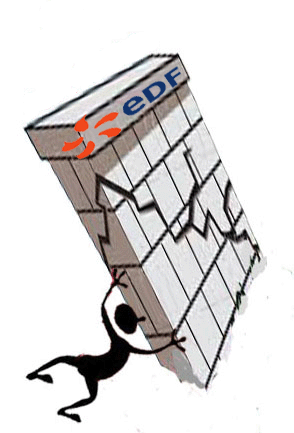
France is considering restructuring plans for debt-laden power firm EDF
(EDF.PA) that include full nationalisation followed by the sale of its
renewables business to focus on nuclear energy, BFM Business reported,
citing unidentified sources.
The website said the government was working
with investment bank Goldman Sachs on several restructuring scenarios. The
sale of the renewables business could fetch 15 billion euros ($16 billion),
it cited unidentified bankers as saying, adding that could help finance the
building of six next-generation EPR nuclear reactors.
Reuters 13th April 2022
Nuclear Free Local Authorities deplore UK govt’s super-costly new nuclear energy strategy, and its rejection of energy conservation measures
THE NUCLEAR FREE LOCAL AUTHORITIES organisation (NFLA) says it is
“incredulous” that Prime Minister Boris Johnson and the UK Government
remains wedded to a new Energy Security Strategy that will rely in large
part upon the development of 24 GW of new nuclear generation capacity to
power Britain.
A plan involving mass investment in renewables and a
reduction in electricity demand through retrofitting the nation’s homes
with insulation would have been far cheaper and quicker to deliver, it
says.
In response to the government’s commitment to build the equivalent
of eight new large nuclear power stations by 2050, NFLA National Chair,
Councillor David Blackburn, said: “It defies common sense that the
current government is turning to a technology that is too slow to install,
too costly to build, remains risky to operate and vulnerable to military
and terrorist attack, and leaves a toxic legacy of radioactive waste that
has to be safely stored for 100,000 years.”
Ekklesia 13th April 2022
1 This Month


of the week– Nuclear Reactor Information Task Force

14 May – online event From Bombs to Data Centres: the Face of Nuclear Colonialism
To see nuclear-related stories in greater depth and intensity – go to https://nuclearinformation.wordpress.com
-
Archives
- May 2026 (173)
- April 2026 (356)
- March 2026 (251)
- February 2026 (268)
- January 2026 (308)
- December 2025 (358)
- November 2025 (359)
- October 2025 (376)
- September 2025 (257)
- August 2025 (319)
- July 2025 (230)
- June 2025 (348)
-
Categories
- 1
- 1 NUCLEAR ISSUES
- business and costs
- climate change
- culture and arts
- ENERGY
- environment
- health
- history
- indigenous issues
- Legal
- marketing of nuclear
- media
- opposition to nuclear
- PERSONAL STORIES
- politics
- politics international
- Religion and ethics
- safety
- secrets,lies and civil liberties
- spinbuster
- technology
- Uranium
- wastes
- weapons and war
- Women
- 2 WORLD
- ACTION
- AFRICA
- Atrocities
- AUSTRALIA
- Christina's notes
- Christina's themes
- culture and arts
- Events
- Fuk 2022
- Fuk 2023
- Fukushima 2017
- Fukushima 2018
- fukushima 2019
- Fukushima 2020
- Fukushima 2021
- general
- global warming
- Humour (God we need it)
- Nuclear
- RARE EARTHS
- Reference
- resources – print
- Resources -audiovicual
- Weekly Newsletter
- World
- World Nuclear
- YouTube
-
RSS
Entries RSS
Comments RSS
 nuclear-news