Constant cheap renewable power to Britain – the Sahara wind and solar cables

Within five years, the world’s longest undersea cable will link Devon to
a vast territory of solar panels in the Sahara Desert, supplying
electricity directly into Britain’s grid at a fraction of today’s power
prices. A second cable will land two years later in 2029.
Together they will provide 3.6 gigawatts (GW) of constant baseload power, equivalent to
two Hinkley-sized nuclear reactors. The difference is that we will be able
to afford it.
That, at least, is the plan. The £16bn Xlinks Morocco-UK
Power Project – chaired by former Tesco chief Sir Dave Lewis – has an
elegant feature. It combines wind and solar in perfect geographic
circumstances to make near-constant power for 20 hours a day.
Trade winds on the coast of North Africa raise the average “capacity factor” of
onshore wind turbines to 54pc. A desert convection effect creates a regular
wind current in the early evenings and smooths the handover from solar to
wind. “It picks up every afternoon just as the sun is setting,” said
Simon Morrish, the project’s chief executive.
This overcomes the curse of intermittency, with lithium batteries in the desert to cover the remaining
gaps. Xlinks will be a park of 580 square miles at Guelmim Oued Noun on the
28th parallel south of Agadir, picked because it is at the top of the
global horizontal irradiance index. The yield is three times higher than in
the UK. The sun shines for 10 hours a day in winter. “The space is
unlimited. We could in theory put up 500 of these projects in Morocco,”
he said. The consortium is already planning a second hub to power Benelux.
It could multiply the scale several times over for the UK, constrained only
by the safe limits of energy security.
Telegraph 20th April 2022
Ukraine can fight Russia ‘for 10 years’ claims Zelensky.

Ukraine can fight Russia ‘for 10 years’ claims Zelensky, as neo-Nazi led military suffers heavy losses & demands West supply ever more arms https://www.sott.net/article/466849-Ukraine-can-fight-Russia-for-10-years-claims-Zelensky-as-neo-Nazi-led-military-suffers-heavy-losses-demands-West-supply-ever-more-armsRT, Sun, 17 Apr 2022
Ukraine is not prepared to give up territory and is ready, if necessary, to fight Russia “for 10 years,” President Volodymyr Zelensky has claimed. He also appeared to acknowledge that the current conflict effectively began in 2014, when Kiev first launched an operation to re-take the breakaway Donbass.
In an interview with CNN, Zelensky said that for Ukraine “the battle for Donbass is very important” for a number of reasons, adding that it could affect “the course of the whole war.” He stressed, however, that a diplomatic solution to the conflict is preferable.
“We cannot give up our territory, but we must find some kind of dialogue with Russia,” Zelensky said, adding that talks will not be conducted “on the basis of the Russian ultimatum.”
Zelensky said dialogue is needed to prevent more deaths, though he claimed his country “can fight the Russian Federation for ten years.”
He said the Ukrainian forces in Donbass are some of “the best military” the country has. “It is a large grouping. And Russia wants to encircle them and destroy them,” Zelensky claimed, adding that he was talking about “44,000 professional military men who survived a great war from the beginning of 2014.”
“This is why it is very important for us to preserve that part of our army.”
Asked by the CNN presenter if Ukraine will be victorious in the conflict, Zelensky said, “Yes, of course.”
Russia attacked the neighboring state in late February, following Ukraine’s failure to implement the terms of the Minsk agreements, first signed in 2014, and Moscow’s eventual recognition of the Donbass republics of Donetsk and Lugansk. The German and French brokered protocols were designed to give the breakaway regions special status within the Ukrainian state.
The Kremlin has since demanded that Ukraine officially declare itself a neutral country that will never join the US-led NATO military bloc. Kiev insists the Russian offensive was completely unprovoked and has denied claims it was planning to retake the two republics by force.
RT comments:
It seems that Russia agrees Donbass is important, that’s why it focused on liberating Donbass, and it did so by luring the US-proxy army in Ukraine away to Kiev.
Maybe it’s possibly, technically, true; [ country “can fight the Russian Federation for ten years.”] although the economies of the West would probably have bankrupted themselves by then, even if they were able to recruit ever more cannon fodder from their terrorist armies elsewhere, and these terrorists wouldn’t be fighting on the territory that Russia has already taken control over; it’s also not clear that the multipolar alliance would tolerate a decade of attacks without serious retaliation.
It remains to be seen what’s left of the Ukraine as we know it in 10 weeks, never mind 10 years. Zelensky’s acting experience has certainly fooled a great many people into thinking otherwise, but the facts on the ground, such as the heavy losses of Ukraine’s military bases, troops, territory, and its endless begging for more money and arms, reflect a proxy army in dire straits: Ukraine is smashed, this is how it will be repaired
Russia warns of nuclear weapons in Baltic if Sweden and Finland join NATO
 | |||
Russia warns of nuclear weapons in Baltic if Sweden and Finland join Nato,
Lithuania plays down threat, claiming Russians already have such weapons in Baltic exclave of Kaliningrad Guardian, Jon Henley and Julian Borger 15 Apr 2022
Moscow has said it will be forced to strengthen its defences in the Baltic if Finland and Sweden join Nato, including by deploying nuclear weapons, as the war in Ukraine entered its seventh week and the country braced for a major attack in the east.
However, the Lithuanian defence minister, Arvydas Anušauskas, claimed on Thursday that Russia already had nuclear weapons stored in its Baltic exclave of Kaliningrad, which borders Lithuania and Poland. That claim has not been independently verified, but the Federation of American Scientists (FAS) reported in 2018 that nuclear weapon storage bunkers in Kaliningrad had been upgraded.
The Russian former president Dmitry Medvedev, a senior member of Russia’s security council, said on Thursday that all its forces in the region would be bolstered if the two Nordic countries joined the US-led alliance.
Medvedev’s threat is the latest of many instances of nuclear sabre-rattling from the Kremlin aimed at deterring western military intervention on behalf of Ukraine.
“We’re obviously very concerned,” said the CIA director, William Burns. “Given the potential desperation of President Putin and the Russian leadership, given the setbacks that they’ve faced so far militarily, none of us can take lightly the threat posed by a potential resort to tactical nuclear weapons or low-yield nuclear weapons.”
But Burns added: “While we’ve seen some rhetorical posturing on the part of the Kremlin, moving to higher nuclear alert levels, so far we haven’t seen a lot of practical evidence of the kind of deployments or military dispositions that we would reinforce that concern.”
Finland and Sweden are deliberating over whether to abandon decades of military non-alignment and join Nato, with the two Nordic countries’ leaders saying Russia’s onslaught on Ukraine has changed Europe’s “whole security landscape”.
Their accession to the alliance would more than double Russia’s land border with Nato members, Medvedev said. “Naturally, we will have to reinforce these borders” by bolstering ground, air and naval defences in the region, he said.
Medvedev, a close ally of Vladimir Putin, explicitly raised the nuclear threat, saying Finnish and Swedish Nato membership would mean there could be “no more talk of any nuclear-free status for the Baltic – the balance must be restored”.
Russia had “not taken such measures and was not going to”, he said. “But if our hand is forced, well … take note it wasn’t us who proposed this.”
Russia borders the Baltic states of Estonia and Latvia, and the Russian exclave of Kaliningrad is sandwiched between Poland and Lithuania.
Russia’s deputy foreign minister, Alexander Grushko, said Moscow would take the security and defence measures that it would deem necessary if Sweden and Finland join Nato, adding that the move would seriously worsen the military situation and lead to “the most undesirable consequences”.,,………………….. https://www.theguardian.com/world/2022/apr/14/russia-says-it-will-reinforce-borders-if-sweden-and-finland-join-nato
Our news analyses of the Ukraine war come from politicians, not from genuine military intelligence
Military Situation in Ukraine: An Update by Jacques Baud The Postil
Mon, 11 Apr 2022

This allows us to deduce that the American and European political leaders deliberately pushed the Ukraine into a conflict that they knew was lost in advance — for the sole purpose of dealing a political blow to Russia.
“…………………The Conduct of Battle.
As for the course of operations, the analyses presented in our media come most often from politicians or so-called military experts, who relay Ukrainian propaganda.
Let’s be clear. A war, whatever else it is, is drama. The problem here is that our strategists in neckties are clearly trying to overdramatize the situation in order to exclude any negotiated solution. This development, however, is prompting some Western military personnel to speak out and offer a more nuanced judgment. Thus, in Newsweek, an analyst from the Defense Intelligence Agency (DIA), the American equivalent of the Direction du Renseignement Militaire (DRM) in France, noted that “in 24 days of conflict, Russia has carried out some 1,400 strikes and launched nearly 1,000 missiles (by way of comparison, the United States carried out more strikes and launched more missiles on the first day of the Iraq war in 2003).”
While the West likes to “soften up” the battlefield with intensive and prolonged strikes, before sending in ground-troops, the Russians prefer a less destructive, but more troop-intensive approach. On France 5, the journalist Mélanie Tarvant presented the death of Russian generals on the battlefield as proof of the destabilization of the Russian army. But this is a profound misunderstanding of the traditions and modes of operation of the Russian army. Whereas in the West, commanders tend to lead from the rear, their Russian counterparts tend to lead from the front — in the West they say, “Forward!” In Russia, they say, “Follow me!” This explains the high losses in the upper echelons of command, already observed in Afghanistan — but it also tells of the much more rigorous selection of staff-personnel than in the West.
Furthermore, the DIA analyst noted that “the vast majority of the airstrikes are over the battlefield, with Russian aircraft providing ‘close air support’ to ground forces. The remainder — less than 20 percent, according to U.S. experts — has been aimed at military airfields, barracks and supporting depots.” Thus, the phrase “indiscriminate bombing [that] is devastating cities and killing everyone” echoed by the Western media seems to contradict the U.S. intelligence expert, who said, “If we merely convince ourselves that Russia is bombing indiscriminately, or [that] it is failing to inflict more harm because its personnel are not up to the task or because it is technically inept, then we are not seeing the real conflict.”
In fact, Russian operations differ fundamentally from the Western concept of the same. The West’s obsession with having no fatalities in their own forces leads them to operations that are primarily in the form of very lethal air strikes. Ground troops only intervene when everything has been destroyed. This is why, in Afghanistan or in the Sahel, Westerners killed more civilians than terrorists did. This is why Western countries engaged in Afghanistan, the Middle East and North Africa no longer publish the number of civilian casualties caused by their strikes. In fact, Europeans engaged in regions that only marginally affect their national security, such as the Estonians in the Sahel, go there just to “get their feet wet.”
In the Ukraine, the situation is very different. One only has to look at a map of linguistic zones to see that the Russian coalition operates almost exclusively in the Russian-speaking zone; thus, among populations that are generally favorable to it. This also explains the statements of a US Air Force officer: “I know that the news keeps repeating that Putin is targeting civilians, but there is no evidence that Russia is intentionally doing so.”
Conversely, it is for the same reason — but in a different way — that the Ukraine has deployed its ultra-nationalist paramilitary fighters in major cities, such as Mariupol or Kharkov — without emotional or cultural ties to the local population, these militias can fight even at the cost of heavy civilian casualties. The atrocities that are currently being uncovered remain hidden by the French-speaking media, for fear of losing support for the Ukraine, as noted by media close to the Republicans in the United States.
After “decapitation” strikes in the first minutes of the offensive, the Russian operational strategy was to bypass the urban centers, and to envelop the Ukrainian army, “pinned down” by the forces of the Donbass republics. It is important to remember that the “decapitation” is not intended to annihilate the general staff or the government (as our “experts” tend to understand it), but to sunder the leadership structures so as to prevent the coordinated maneuver of forces. On the contrary, the aim is to preserve the leadership structures themselves in order to be able to negotiate a way out of the crisis.
On March 25, 2022, after having sealed the cauldron of Kramatorsk which denied any possibility of retreat to the Ukrainians and having taken most of the cities of Kharkov and Marioupol, Russia has practically fulfilled its objectives — all that remains is to concentrate its efforts on reducing the pockets of resistance. Thus, contrary to what the Western press has claimed, this is not a reorientation or a resizing of its offensive, but the methodical implementation of the objectives announced on February 24.
The Role of the Volunteers
A particularly disturbing aspect of this conflict is the attitude of European governments that allow or encourage their citizens to go and fight in the Ukraine. Volodymyr Zelensky’s call to join the International Legion for the Territorial Defense of Ukraine, which he recently created, has been greeted with enthusiasm by European countries.
Encouraged by the media that present a routed Russian army, many of these young people head off, imagining they are going — literally — on a hunting trip. However, once there, disillusionment is high. Testimonies show that these “amateurs” often end up as “cannon fodder,” without having any real impact on the outcome of the conflict. The experience of recent conflicts shows that the arrival of foreign fighters brings nothing to a conflict, except to increase its duration and lethality.
Moreover, the arrival of several hundred Islamist fighters from the Idlib region, an area under the control and protection of the Western coalition in Syria (and also the area in which two Islamic State leaders were killed by the Americans) should arouse our concern. Indeed, the weapons we are very liberally supplying to the Ukraine are already partly in the hands of criminal individuals and organizations and are already beginning to pose a security problem for the authorities in Kiev. Not to mention the fact that the weapons that are being touted as effective against Russian aircraft could eventually threaten our military and civilian aircraft.
The volunteer proudly presented by the RTBF on the 7:30 p.m. news of March 8, 2022 was an admirer of the “Corps Franc Wallonie,” Belgian volunteers who served the Third Reich; and he illustrates the type of people attracted to the Ukraine. In the end, we will have to ask ourselves, who gained the most — [in this case] Belgium or the Ukraine?
Distributing weapons indiscriminately could well make the EU — volens nolens — a supporter of extremism and even international terrorism. The result — we are adding misery to misery, in order to satisfy the European elites more than the Ukraine itself.
Three Points Deserve to be Highlighted by Way of Conclusion
1. Western Intelligence, Ignored by Policymakers
Military documents found in Ukrainian headquarters in the south of the country confirm that the Ukraine was preparing to attack the Donbass; and that the firing observed by OSCE observers as early as February 16 heralded an imminent outbreak in days or weeks.
Here, some introspection is necessary for the West — either its intelligence services did not see what was happening and they are thus very bad, or the political decision-makers chose not to listen to them. We know that Russian intelligence services have far superior analytical capabilities than their Western counterparts. We also know that the American and German intelligence services had very well understood the situation, since the end of 2021, and knew that the Ukraine was preparing to attack the Donbass.
This allows us to deduce that the American and European political leaders deliberately pushed the Ukraine into a conflict that they knew was lost in advance — for the sole purpose of dealing a political blow to Russia.
The reason Zelensky did not deploy his forces to the Russian border, and repeatedly stated that his large neighbor would not attack him, was presumably because he thought he was relying on Western deterrence. This is what he told CNN on March 20th — he was clearly told that the Ukraine would not be part of NATO, but that publicly they would say the opposite. The Ukraine was thus instrumentalized to affect Russia. The objective was the closure of the North Stream 2 gas pipeline, announced on February 8th, by Joe Biden, during the visit of Olaf Scholz; and which was followed by a barrage of sanctions.
2. Broken Diplomacy
Clearly, since the end of 2021, no effort has been made by the West to reactivate the Minsk agreements, as evidenced by the reports of visits and telephone conversations, notably between Emmanuel Macron and Vladimir Putin. However, France, as guarantor of the Minsk Agreements, and as a permanent member of the United Nations Security Council, has not respected its commitments, which has led to the situation that the Ukraine is experiencing today. There is even a feeling that the West has sought to add fuel to the fire since 2014.
Thus, Vladimir Putin’s placing of nuclear forces on alert on February 27 was presented by our media and politicians as an irrational act or blackmail. What is forgotten is that it followed the thinly veiled threat made by Jean-Yves Le Drian, three days earlier, that NATO could use nuclear weapons. It is very likely that Putin did not take this “threat” seriously, but wanted to push Western countries — and France in particular — to abandon the use of excessive language.
3. The Vulnerability of Europeans to Manipulation is Increasing
Today, the perception propagated by our media is that the Russian offensive has broken down; that Vladimir Putin is crazy, irrational and therefore ready to do anything to break the deadlock in which he supposedly finds himself. In this totally emotional context, the question asked by Republican Senator Marco Rubio during Victoria Nuland’s hearing before Congress was strange, to say the least: “If there is a biological or chemical weapon incident or attack inside the Ukraine, is there any doubt in your mind that 100% it would be the Russians behind it?” Naturally, she answered that there is no doubt. Yet there is absolutely no indication that the Russians are using such weapons. Besides, the Russians finished destroying their stockpiles in 2017, while the Americans have not yet destroyed theirs.
Perhaps this means nothing. But in the current atmosphere, all the conditions are now met for an incident to happen that would push the West to become more involved, in some form, in the Ukrainian conflict (a “false-flag” incident).
Europe’s reliance on Russian nuclear supplies isn’t ending with the war

In the relevant Council Regulation of 15 March 2022, civil nuclear-related activities were excluded from the definition of the energy sector and are therefore, quite explicitly, not covered by the prohibition on investments in the Russian energy sector.
The only difference is that while this dependence on gas has been widely discussed, the same cannot be said of the nuclear industry. And yet the EU member states have no intention of ending this nuclear dependence.
Putin’s uranium self-enrichment — Beyond Nuclear International How dependent is Europe on the Russian nuclear sector?
The below is the second half of the Öko-Institut blog entry — “Energy policy in times of the Ukraine war: Nuclear power instead of natural gas?” — looking at Europe’s reliance on the Russian nuclear sector. Read the full blog article.
By Anke Herold, Dr Roman Mendelevitch and Dr Christoph Pistner, 17Apr 22,
Europe is heavily dependent on Russia for nuclear energy as well, perhaps to an even greater extent than for gas. The main sources of uranium imports into the EU in 2020 were Russia (20%), Niger (also 20%), Kazakhstan (19%), Canada (18%), Australia (13%) and Namibia (8%). Just 0.5% of the uranium used in the EU comes from the EU itself.
However, this apparent diversity of sources is deceptive. Russia has a close relationship with Kazakhstan, while the mines in Niger belong to Chinese state-owned companies, as do two of the three largest uranium mines in Namibia. The third Namibian mine is largely Chinese-owned.
In other words, in 2020, only 21% of uranium imports into Europe were supplied by firms that are not owned by totalitarian regimes. It follows that here too, Europe has placed itself in a position of high import dependence.
Around 25% of uranium enrichment and some processes in fuel rod fabrication for the EU take place in Russia. Many Russian-designed reactors source their fuel rods largely from the Russian company TVEL – now part of Rosatom – on the basis of long-term supply contracts that run for 10 years or more.
There are Russian-designed nuclear reactors in Bulgaria, the Czech Republic, Finland, Hungary and Slovakia. The 16 older pressurised water reactors, type WWER-440, are totally dependent on TVEL for fuel rod fabrication. These older reactors can be found in Bulgaria, Slovakia, the Czech Republic and Hungary.
Even the Euratom Supply Agency itself identifies this dependence as a significant vulnerability factor. The operators are dependent on imports of Russian technology.
The Western European nuclear power plants are also far from being independent. The French company Areva collaborates with TVEL in order to supply fuel rods for seven reactors in Western Europe, including the Loviisa nuclear power plant in Finland.
As recently as December 2021, the French nuclear company Framatome signed a new strategic cooperation agreement on the development of fuel fabrication and instrumentation and control (I&C) technologies.
The Russian fuel rod manufacturer TVEL was also keen to enter into fuel rod production at the factory in Lingen, Germany, which currently belongs to the French company ANF. Lingen supplies fuel rods to British, French and Belgian nuclear power plants. The German Federal Cartel Office approved the venture in March 2021, whereupon the Federal Economics Ministry conducted an open-ended review until the end of January 2022.
On the day of the Russian invasion of Ukraine, the Ministry announced that the Rosatom subsidiary TVEL had withdrawn its application. In Germany, the Rosatom Group also owns a subsidiary, NUKEM Technologies, which specialises in the decommissioning of nuclear facilities, decontamination, waste management and radiation protection. In Germany, it plans and constructs storage facilities for radioactive waste and is involved in decommissioning the Neckarwestheim and Philippsburg nuclear power plants.
So Putin manoeuvred the European nuclear industry into a position of dependence on Russia long ago, and he himself earns income from the decommissioning of the German nuclear power plants.
The only difference is that while this dependence on gas has been widely discussed, the same cannot be said of the nuclear industry. And yet the EU member states have no intention of ending this nuclear dependence.
In the relevant Council Regulation of 15 March 2022, civil nuclear-related activities were excluded from the definition of the energy sector and are therefore, quite explicitly, not covered by the prohibition on investments in the Russian energy sector.
Although practically 100% of the EU’s uranium is imported, as is most of the fuel rod supply, the EU classes nuclear energy as “domestic” production because fuel rods can easily be stockpiled.
Here, we see a similar Orwellian use of language as in the EU Taxonomy, which describes nuclear energy as a technology which does not cause significant harm to the environment.
As the Süddeutsche Zeitung reported on 18 March 2022, even the EU’s flight ban on Russian aircraft was lifted for a delivery of nuclear fuel into Slovakia.
So our conclusion on this topic is that as regards nuclear energy too, the dependence on Russia must be drastically reduced. Supply security with no dependence on totalitarian regimes requires a substantial reduction in nuclear energy use in Europe. Read the full blog.
Military Situation in Ukraine: An Update by Jacques Baud
The vagueness maintained in the West about the situation of the Ukrainian forces, has other effects. First, it maintains the illusion of a possible Ukrainian victory. Thus, instead of encouraging a negotiation process, the West seeks to prolong the war. This is why the European Union and some of its member countries have sent weapons and are encouraging the civilian population and volunteers of all kinds to go and fight, often without training and without any real command structure — with deadly consequences.
You don’t win a war with bias — you lose it. And that’s what is happening. Thus, the Russian coalition was never “on the run” or “stopped” by heroic resistance — it simply did not attack where it was expected. We did not want to listen to what Vladimir Putin had explained to us very clearly. This is why the West has thus become — volens nolens — the main architect of the Ukrainian defeat that is taking shape. Paradoxically, it is probably because of our self-proclaimed “experts” and recreational strategists on our television sets that the Ukraine is in this situation today.
Jacques Baud, The Postil, Mon, 11 Apr 2022 The Operational Situation
As of March 25, 2022, our analysis of the situation confirms the observations and conclusions made in mid-March.
The offensive launched on February 24 is articulated in two lines of effort, in accordance with Russian operational doctrine:
1) A main effort directed toward the south of the country, in the Donbass region, and along the Azov Sea coast. As the doctrine states, the main objectives are — the neutralization of the Ukrainian armed forces (the objective of “demilitarization”), and the neutralization of ultra-nationalist, paramilitary militias in the cities of Kharkov and Mariupol (the objective of “denazification“). This primary push is being led by a coalition of forces: through Kharkov and Crimea are Russian forces from the Southern Military District; in the center are militia forces from the Donetsk and Lugansk republics; the Chechen National Guard is contributing with engagement in the urban area of Mariupol;
2) A secondary effort on Kiev, aimed at “pinning down” Ukrainian (and Western) forces, so as to prevent them from carrying out operations against the main thrust or even taking Russian coalition forces from the rear.
This offensive follows, to the letter, the objectives defined by Vladimir Putin on February 24. But, listening only to their own bias, Western “experts” and politicians have gotten it into their heads that Russia’s objective is to take over the Ukraine and overthrow its government. Applying a very Western logic, they see Kiev as the “center of gravity” (Schwerpunkt) of Ukrainian forces. According to Clausewitz, the “center of gravity” is the element from which a belligerent derives his strength and ability to act, and is therefore the primary objective of an adversary’s strategy. This is why Westerners have systematically tried to take control of capitals in the wars they have fought. Trained and advised by NATO experts, the Ukrainian General Staff has, predictably enough, applied the same logic, focusing on strengthening the defense of Kiev and its surroundings, while leaving its troops helpless in the Donbass, along the axis of the main Russian effort.
If one had listened carefully to Vladimir Putin, one would have realized that the strategic objective of the Russian coalition is not to take over the Ukraine, but to remove any threat to the Russian-speaking population of the Donbass. According to this general objective, the “real” center of gravity that the Russian coalition is trying to target is the bulk of the Ukrainian armed forces massed in the south-southeast of the country (since the end of 2021), and not Kiev.
Russian Success or Failure?
Convinced that the Russian offensive is aimed at Kiev, Western experts have quite logically concluded that (a) the Russians are stalling, and that (b) their offensive is doomed to failure because they will not be able to hold the country in the long term. The generals who have followed each other on French TV seem to have forgotten what even a second lieutenant comprehends well: “Know your enemy!” — not as one would like him to be, but as he is. With generals like that, we don’t need an enemy anymore.
…………………………………………. Ukrainian forces are never indicated on our maps, as this would show that they were not deployed on the Russian border in February 2022, but were regrouped in the south of the country, in preparation for their offensive, the initial phase of which began on February 16th. This confirms that Russia was only reacting to a situation initiated by the West, by way of the Ukraine, as we shall see. At present, it is these forces that are encircled in the Kramatorsk cauldron and are being methodically fragmented and neutralized, little by little, in an incremental way, by the Russian coalition.
The vagueness maintained in the West about the situation of the Ukrainian forces, has other effects. First, it maintains the illusion of a possible Ukrainian victory. Thus, instead of encouraging a negotiation process, the West seeks to prolong the war. This is why the European Union and some of its member countries have sent weapons and are encouraging the civilian population and volunteers of all kinds to go and fight, often without training and without any real command structure — with deadly consequences.
We know that in a conflict, each party tends to inform in order to give a favorable image of its actions. However, the image we have of the situation and of the Ukrainian forces is based exclusively on data provided by Kiev. It masks the profound deficiencies of the Ukrainian leadership, even though it was trained and advised by NATO military.
Thus, military logic would have the forces caught in the Kramatorsk cauldron withdraw to a line at the Dnieper, for example, in order to regroup and conduct a counteroffensive. But they were forbidden to withdraw by President Zelensky. Even back in 2014 and 2015, a close examination of the operations showed that the Ukrainians were applying “Western-style” schemes, totally unsuited to the circumstances, and in the face of a more imaginative, more flexible opponent who possessed lighter leadership structures. It is the same phenomenon today.
In the end, the partial view of the battlefield given to us by our media has made it impossible for the West to help the Ukrainian general staff make the right decisions. And it has led the West to believe that the obvious strategic objective is Kiev; that “demilitarization” is aimed at the Ukraine’s membership in NATO; and that “denazification” is aimed at toppling Zelensky. This legend was fueled by Vladimir Putin’s appeal to the Ukrainian military to disobey, which was interpreted (with great imagination and bias) as a call to overthrow the government. However, this appeal was aimed at the Ukrainian forces deployed in the Donbass to surrender without fighting. The Western interpretation caused the Ukrainian government to misjudge Russian objectives and misuse its potential of winning.
You don’t win a war with bias — you lose it. And that’s what is happening. Thus, the Russian coalition was never “on the run” or “stopped” by heroic resistance — it simply did not attack where it was expected. We did not want to listen to what Vladimir Putin had explained to us very clearly. This is why the West has thus become — volens nolens — the main architect of the Ukrainian defeat that is taking shape. Paradoxically, it is probably because of our self-proclaimed “experts” and recreational strategists on our television sets that the Ukraine is in this situation today. …………………….https://www.sott.net/article/466805-Military-Situation-in-Ukraine-An-Update-by-Jacques-Baud
…
Russia’s ‘broken arrow’: Fears that NUCLEAR MISSILES sank with Putin’s flagship Moskva
Russia’s ‘broken arrow’: Fears that NUCLEAR MISSILES sank with Putin’s flagship Moskva amid claims that 452 of the 510 crew have drowned and top admiral has been arrested after cruiser was ‘hit by Ukrainian missile’ , Daily Mail By WILL STEWART and CHRIS PLEASANCE and CHRIS JEWERS FOR MAILONLINE 16 April 2022
Moskva, the flagship of Russia’s Black Sea fleet, has been confirmed to have sunk near port of Sevastopol
Experts and analysts are now warning that the warship may have been carrying two nuclear warheads They are calling for an urgent probe into ‘broken arrow’ incident – military slang for an accident with nukes
Meanwhile questions remain over the fate of Moskva’s 510-strong crew, most of whom are unaccounted forIlya Ponomarev, a politician exiled from Russia, said as many as 452 members of the crew could have died
The Moskva, a Soviet-era guided missile cruiser, sank near the port of Sevastopol on Thursday after Ukraine said it hit the ship with two cruise missiles. Today, Mykhailo Samus, director of a Lviv-based military think-tank; Andriy Klymenko, editor of Black Sea News; and Ukrainian newspaper Defence Express all warned that the Moskva could have been carrying two nuclear warheads designed to be fitted to its P-1000 ‘carrier killer’ missiles.
If true, the loss of the warheads into the Black Sea could spark a ‘Broken Arrow’ incident – American military slang for potentially lethal accidents involving nuclear weapons.
‘On board the Moskva could be nuclear warheads – two units,’ Samus said, while Klymenko called on other Black Sea nations – Turkey, Romania, Georgia, and Bulgaria – to insist on an explanation. ‘Where are these warheads? Where were they when the ammunition exploded,’ he asked.
Meanwhile Ilya Ponomarev, a politician exiled from Russia for opposing Putin’s 2014 annexation of Crimea, said just 58 of the 510-strong crew have since been accounted for – raising the prospect that 452 men went down with the ship in what would be a bitter loss for Vladimir Putin’s already beleaguered army.
The figure, while unconfirmed, is consistent with losses suffered on exploding warships. During the Russian Navy’s infamous defeat at the Battle of Tsushima against Japan, an explosion on board the Borodino – slightly smaller than the Moskva – saw all-but one of her 855 crew killed.
Russia claims all the Moskva’s sailors were ‘successfully evacuated’ but video taken in Sevastopol overnight shows dozens of cars purportedly belonging to the sailors still parked in the port – suggesting their owners had not returned to collect them……………….. https://www.dailymail.co.uk/news/article-10721351/Ukraine-war-Fears-Moskva-warship-carrying-nuclear-weapons-sank.html
Zelensky gives his vision of peace deal with Russia
Had ‘the collective West’ not interfered, this ‘war’ might have ended weeks ago, lives saved, deals signed. But that is not how the utilization of a patsy works.
https://www.sott.net/article/466833-Zelensky-gives-his-vision-of-peace-deal-with-Russia 17 Apr 22,
RT A peace agreement with Russia might consist of two separate documents that would cover the two key issues – security guarantees for Kiev and its future relations with Moscow, Ukrainian President Volodymyr Zelensky said on Saturday.
Speaking to Ukrainian media, Zelensky explained that Moscow would like to have one comprehensive document that would address all the issues. However, because the security guarantees involve other countries, two documents could be a solution. According to the Ukrainian leader:
“A peace treaty with Russia can consist of two different documents. One of them should concern security guarantees for Ukraine, the other to directly address its relations with the Russian Federation.”
He explained that a document covering security guarantees could be signed by those countries “who are ready for these security guarantees,” while another document could cover future relations between Ukraine and Russia.
Zelensky claimed that the UK, US, Italy and Turkey have shown a willingness to provide security guarantees for Ukraine, but there has been no final answer from any of them. A previous list of potential guarantors also included Germany, France, Poland and Israel. Zelensky continued:
“Moscow would like to have one agreement that addresses all the issues. However, not all see themselves at the same table with Russia. For them, security guarantees for Ukraine are one issue, and agreements with Russia are another.”
Despite the apparent progress achieved in the negotiations between Moscow and Kiev in Istanbul in late March, earlier this week Russian President Vladimir Putin said that the peace talks had “returned to a deadlock.” He explained that Ukraine has refused to fulfill one of Russia’s key requests: to recognize Crimea as Russian and the Donbass republics as independent.
Putin’s remarks followed an announcement by Foreign Minister Sergey Lavrov that Kiev had submitted new written proposals that deviated from what was offered during the in-person talks. The new proposal, according to Lavrov, fails to mention that the security guarantees Kiev wants to obtain do not cover Crimea.
Obtaining security guarantees from world powers has been named by Kiev as a key condition for agreeing to a neutral status and abandoning its ambition to join NATO.
Russia attacked the neighboring state in late February, following Ukraine’s failure to implement the terms of the Minsk agreements, first signed in 2014, and Moscow’s eventual recognition of the Donbass republics of Donetsk and Lugansk. The German and French brokered protocols were designed to give the breakaway regions special status within the Ukrainian state.
The Kremlin has since demanded that Ukraine officially declare itself a neutral country that will never join the US-led NATO military bloc. Kiev insists the Russian offensive was completely unprovoked and has denied claims it was planning to retake the two republics by force.
Moscow has warned Western countries against “pumping up” Ukraine with weapons, saying that these actions were exacerbating the conflict.
Comment: The potential ‘two-part’ agreements indicate Ukraine is incidental in this power play, otherwise the forces d’jour would accept a deal between Russia and Ukraine and step aside.
Meanwhile, conflict threatens to break off talks:
Ukrainian President Volodymyr Zelenskiy has threatened to break off talks with Moscow should Russian forces wipe out the remaining Ukrainian soldiers trapped in Mariupol as Moscow claimed it had taken control of the besieged and battered port city after a weeks-long battle.
The Russian Defense Ministry on April 16 said it had cleared the Mariupol urban area of Ukrainian troops and had trapped a few remaining fighters in the Azovstal steel plant.
A Russian Defense Ministry spokesman was quoted by Russia’s RIA Novosti news agency as saying that Ukrainian forces have lost a total of 4,000 troops during the long fight for the city. Casualty figures from both sides have proved impossible to independently confirm.
Ukraine has not commented on the latest Russian claims but in recent days has indicated the situation in Mariupol was desperate, with deaths mounting among the trapped civilian population and many experts predicting the city would soon fall to the Russians.
In an interview published earlier on April 16 with Ukrayinska Pravda, Zelenskiy warned Russia against committing atrocities against Ukrainian soldiers in the city.
“The elimination of our troops, of our men [in Mariupol] will put an end to any negotiations. That will bring an impasse as we don’t negotiate on either our territories or our people. The situation is very difficult [in Mariupol]. Our soldiers are blocked, the wounded are blocked. There is a humanitarian crisis…. Nevertheless, the guys are defending themselves.”
Kyiv Mayor Vitaliy Klitschko said at least one person was killed and several others wounded in early morning attacks.
“For those Kyivites who left and are already thinking of heading back to return to the capital, I ask you to refrain from this and stay in safer places.”
In his nightly address to the nation, Zelenskiy said:
“The success of our military on the battlefield has been really significant. Historically significant. But it’s still not enough to clear our land from the invading forces. The sanctions against Russia are very serious, economically painful. But it is not enough to starve Russia’s military machine. We need to promote stronger, more destructive sanctions. This will determine how long this war will last.”
Meanwhile, the United States and its Western allies continued to pile pressure on Moscow over its campaign. The German government said on April 15 that it plans to release more than 1 billion euros in military aid for Ukraine. The move comes amid criticism from Ukraine and some EU partners such as Poland and the Baltic states that Germany has not done enough to send armaments to Kyiv.
The UN refugee agency said as of April 16 that 4,836,445 million Ukrainians had left the country since the Russian invasion — up by 40,200 from the previous day’s total.
Had ‘the collective West’ not interfered, this ‘war’ might have ended weeks ago, lives saved, deals signed. But that is not how the utilization of a patsy works.
Recent history sheds light on the Ukraine situation . Part Three- Denazification
Retired Swiss Military-Intelligence Officer. Is it possible to actually know what has been and is going on in Ukraine?
Jacques Baud, The Unz Review 02 Apr 2022
”………………………………………………………………….. Denazification

In cities like Kharkov, Mariupol and Odessa, the Ukrainian defense is provided by the paramilitary militias. They know that the objective of “denazification” is aimed primarily at them. For an attacker in an urbanized area, civilians are a problem. This is why Russia is seeking to create humanitarian corridors to empty cities of civilians and leave only the militias, to fight them more easily.
Conversely, these militias seek to keep civilians in the cities from evacuating in order to dissuade the Russian army from fighting there. This is why they are reluctant to implement these corridors and do everything to ensure that Russian efforts are unsuccessful — they use the civilian population as “human shields.” Videos showing civilians trying to leave Mariupol and beaten up by fighters of the Azov regiment are of course carefully censored by the Western media.
On Facebook, the Azov group was considered in the same category as the Islamic State [ISIS] and subject to the platform’s “policy on dangerous individuals and organizations.” It was therefore forbidden to glorify its activities, and “posts” that were favorable to it were systematically banned. But on February 24, Facebook changed its policy and allowed posts favorable to the militia. In the same spirit, in March, the platform authorized, in the former Eastern countries, calls for the murder of Russian soldiers and leaders. So much for the values that inspire our leaders.
Our media propagate a romantic image of popular resistance by the Ukrainian people. It is this image that led the European Union to finance the distribution of arms to the civilian population. In my capacity as head of peacekeeping at the UN, I worked on the issue of civilian protection. We found that violence against civilians occurred in very specific contexts. In particular, when weapons are abundant and there are no command structures.
These command structures are the essence of armies: their function is to channel the use of force towards an objective. By arming citizens in a haphazard manner, as is currently the case, the EU is turning them into combatants, with the consequential effect of making them potential targets. Moreover, without command, without operational goals, the distribution of arms leads inevitably to settling of scores, banditry and actions that are more deadly than effective. War becomes a matter of emotions. Force becomes violence. This is what happened in Tawarga (Libya) from 11 to 13 August 2011, where 30,000 black Africans were massacred with weapons parachuted (illegally) by France. By the way, the British Royal Institute for Strategic Studies (RUSI) does not see any added value in these arms deliveries.
Moreover, by delivering arms to a country at war, one exposes oneself to being considered a belligerent. The Russian strikes of March 13, 2022, against the Mykolayev air base follow Russian warnings that arms shipments would be treated as hostile targets.
The EU is repeating the disastrous experience of the Third Reich in the final hours of the Battle of Berlin.War must be left to the military and when one side has lost, it must be admitted. And if there is to be resistance, it must be led and structured. But we are doing exactly the opposite — we are pushing citizens to go and fight, and at the same time, Facebook authorizes calls for the murder of Russian soldiers and leaders. So much for the values that inspire us.
Some intelligence services see this irresponsible decision as a way to use the Ukrainian population as cannon fodder to fight Vladimir Putin’s Russia. It would have been better to engage in negotiations and thus obtain guarantees for the civilian population than to add fuel to the fire. It is easy to be combative with the blood of others.
4. The Maternity Hospital At Mariupol
It is important to understand beforehand that it is not the Ukrainian army that is defending Mariupol, but the Azov militia, composed of foreign mercenaries.
In its March 7, 2022 summary of the situation, the Russian UN mission in New York stated that “Residents report that Ukrainian armed forces expelled staff from the Mariupol city birth hospital No. 1 and set up a firing post inside the facility.” On March 8, the independent Russian media Lenta.ru, publishedthe testimony of civilians from Mariupol who told that the maternity hospital was taken over by the militia of the Azov regiment, and who drove out the civilian occupants by threatening them with their weapons. They confirmed the statements of the Russian ambassador a few hours earlier.
The hospital in Mariupol occupies a dominant position, perfectly suited for the installation of anti-tank weapons and for observation. On 9 March, Russian forces struck the building. According to CNN, 17 people were wounded, but the images do not show any casualties in the building and there is no evidence that the victims mentioned are related to this strike. There is talk of children, but in reality, there is nothing. This does not prevent the leaders of the EU from seeing this as a war crime. And this allows Zelensky to call for a no-fly zone over Ukraine.
In reality, we do not know exactly what happened. But the sequence of events tends to confirm that Russian forces struck a position of the Azov regiment and that the maternity ward was then free of civilians.
The problem is that the paramilitary militias that defend the cities are encouraged by the international community not to respect the rules of war. It seems that the Ukrainians have replayed the scenario of the Kuwait City maternity hospital in 1990, which was totally staged by the firm Hill & Knowlton for $10.7 million in order to convince the United Nations Security Council to intervene in Iraq for Operation Desert Shield/Storm.
Western politicians have accepted civilian strikes in the Donbass for eight years without adopting any sanctions against the Ukrainian government. We have long since entered a dynamic where Western politicians have agreed to sacrifice international law towards their goal of weakening Russia………………. more https://www.sott.net/article/466340-Retired-Swiss-Military-Intelligence-Officer-Is-it-Possible-to-Actually-Know-What-Has-Been-And-is-Going-on-in-Ukraine
Recent history sheds light on the Ukraine situation . Part Two Outbreak of war.
Retired Swiss Military-Intelligence Officer. Is it possible to actually know what has been and is going on in Ukraine?
Jacques Baud, The Unz Review, 04 Apr 2022
Part Two: The War
As a former head of analysis of Warsaw Pact forces in the Swiss strategic intelligence service, I observe with sadness — but not astonishment — that our services are no longer able to understand the military situation in Ukraine. The self-proclaimed “experts” who parade on our TV screens tirelessly relay the same information modulated by the claim that Russia — and Vladimir Putin — is irrational. Let’s take a step back.
1. The Outbreak Of War
Since November 2021, the Americans have been constantly threatening a Russian invasion of Ukraine. However, the Ukrainians at first did not seem to agree. Why not?
We have to go back to March 24, 2021. On that day, Volodymyr Zelensky issued a decree for the recapture of the Crimea, and began to deploy his forces to the south of the country. At the same time, several NATO exercises were conducted between the Black Sea and the Baltic Sea, accompanied by a significant increase in reconnaissance flights along the Russian border. Russia then conducted several exercises to test the operational readiness of its troops and to show that it was following the evolution of the situation.
Things calmed down until October-November with the end of the ZAPAD 21 exercises, whose troop movements were interpreted as a reinforcement for an offensive against Ukraine. However, even the Ukrainian authorities refuted the idea of Russian preparations for a war, and Oleksiy Reznikov, Ukrainian Minister of Defense, states that there had been no change on its border since the spring.
In violation of the Minsk Agreements, Ukraine was conducting air operations in Donbass using drones, including at least one strike against a fuel depot in Donetsk in October 2021. The American press noted this, but not the Europeans; and no one condemned these violations.
In February 2022, events came to a head. On February 7, during his visit to Moscow, Emmanuel Macron reaffirmed to Vladimir Putin his commitment to the Minsk Agreements, a commitment he would repeat after his meeting with Volodymyr Zelensky the next day. But on February 11, in Berlin, after nine hours of work, the meeting of political advisors to the leaders of the “Normandy format” ended without any concrete result: the Ukrainians still refused to apply the Minsk Agreements, apparently under pressure from the United States. Vladimir Putin noted that Macron had made empty promises and that the West was not ready to enforce the agreements, the same opposition to a settlement it had exhibited for eight years.
Ukrainian preparations in the contact zone continued. The Russian Parliament became alarmed; and on February 15 it asked Vladimir Putin to recognize the independence of the Republics, which he initially refused to do.
On 17 February, President Joe Biden announced that Russia would attack Ukraine in the next few days. How did he know this? It is a mystery. But since the 16th, the artillery shelling of the population of Donbass had increased dramatically, as the daily reports of the OSCE observers show. Naturally, neither the media, nor the European Union, nor NATO, nor any Western government reacted or intervened. It would be said later that this was Russian disinformation. In fact, it seems that the European Union and some countries have deliberately kept silent about the massacre of the Donbass population, knowing that this would provoke a Russian intervention.
At the same time, there were reports of sabotage in the Donbass. On 18 January, Donbass fighters intercepted saboteurs, who spoke Polish and were equipped with Western equipment and who were seeking to create chemical incidents in Gorlivka. They could have been CIA mercenaries, led or “advised” by Americans and composed of Ukrainian or European fighters, to carry out sabotage actions in the Donbass Republics.
In fact, as early as February 16, Joe Biden knew that the Ukrainians had begun intense shelling the civilian population of Donbass, forcing Vladimir Putin to make a difficult choice: to help Donbass militarily and create an international problem, or to stand by and watch the Russian-speaking people of Donbass being crushed.
If he decided to intervene, Putin could invoke the international obligation of “Responsibility To Protect” (R2P). But he knew that whatever its nature or scale, the intervention would trigger a storm of sanctions. Therefore, whether Russian intervention were limited to the Donbass or went further to put pressure on the West over the status of the Ukraine, the price to pay would be the same. This is what he explained in his speech on February 21. On that day, he agreed to the request of the Duma and recognized the independence of the two Donbass Republics and, at the same time, he signed friendship and assistance treaties with them.
The Ukrainian artillery bombardment of the Donbass population continued, and, on 23 February, the two Republics asked for military assistance from Russia. On 24 February, Vladimir Putin invoked Article 51 of the United Nations Charter, which provides for mutual military assistance in the framework of a defensive alliance.
In order to make the Russian intervention seem totally illegal in the eyes of the public, Western powers deliberately hid the fact that the war actually started on February 16. The Ukrainian army was preparing to attack the Donbass as early as 2021, as some Russian and European intelligence services were well aware.
In his speech of February 24, Vladimir Putin stated the two objectives of his operation: “demilitarize” and “denazify” the Ukraine. So, it was not a question of taking over Ukraine, nor even, presumably, of occupying it; and certainly not of destroying it.
From then on, our knowledge of the course of the operation is limited: the Russians have excellent security for their operations (OPSEC) and the details of their planning are not known. But fairly quickly, the course of the operation allows us to understand how the strategic objectives were translated on the operational level.
Demilitarization:
- ground destruction of Ukrainian aviation, air defense systems and reconnaissance assets;
- neutralization of command and intelligence structures (C3I), as well as the main logistical routes in the depth of the territory;
- encirclement of the bulk of the Ukrainian army massed in the southeast of the country.
- destruction or neutralization of volunteer battalions operating in the cities of Odessa, Kharkov, and Mariupol, as well as in various facilities in the territory.
Denazification:
2. Demilitarization
The Russian offensive was carried out in a very “classic” manner. Initially — as the Israelis had done in 1967 — with the destruction on the ground of the air force in the very first hours. Then, we witnessed a simultaneous progression along several axes according to the principle of “flowing water”: advance everywhere where resistance was weak and leave the cities (very demanding in terms of troops) for later. In the north, the Chernobyl power plant was occupied immediately to prevent acts of sabotage. The images of Ukrainian and Russian soldiers guarding the plant togetherare of course not shown.
The idea that Russia is trying to take over Kiev, the capital, to eliminate Zelensky, comes typically from the West. But Vladimir Putin never intended to shoot or topple Zelensky. Instead, Russia seeks to keep him in power by pushing him to negotiate, by surrounding Kiev. The Russians want to obtain the neutrality of Ukraine.
Many Western commentators were surprised that the Russians continued to seek a negotiated solution while conducting military operations. The explanation lies in the Russian strategic outlook since the Soviet era. For the West, war begins when politics ends. However, the Russian approach follows a Clausewitzian inspiration: war is the continuity of politics and one can move fluidly from one to the other, even during combat. This allows one to create pressure on the adversary and push him to negotiate.
From an operational point of view, the Russian offensive was an example of previous military action and planning: in six days, the Russians seized a territory as large as the United Kingdom, with a speed of advance greater than what the Wehrmacht had achieved in 1940.
The bulk of the Ukrainian army was deployed in the south of the country in preparation for a major operation against the Donbass. This is why Russian forces were able to encircle it from the beginning of March in the “cauldron” between Slavyansk, Kramatorsk and Severodonetsk, with a thrust from the East through Kharkov and another from the South from Crimea. Troops from the Donetsk (DPR) and Lugansk (LPR) Republics are complementing the Russian forces with a push from the East.
At this stage, Russian forces are slowly tightening the noose, but are no longer under any time pressure or schedule. Their demilitarization goal is all but achieved and the remaining Ukrainian forces no longer have an operational and strategic command structure.
The “slowdown” that our “experts” attribute to poor logistics is only the consequence of having achieved their objectives. Russia does not want to engage in an occupation of the entire Ukrainian territory. In fact, it appears that Russia is trying to limit its advance to the linguistic border of the country…………………………… more https://www.sott.net/article/466340-Retired-Swiss-Military-Intelligence-Officer-Is-it-Possible-to-Actually-Know-What-Has-Been-And-is-Going-on-in-Ukraine
Recent history sheds light on the Ukraine situation . Part One
Retired Swiss Military-Intelligence Officer. Is it possible to actually know what has been and is going on in Ukraine?
The integration of these paramilitary forces into the Ukrainian National Guard was not at all accompanied by a “denazification,” as some claim.
Among the many examples, that of the Azov Regiment’s insignia is instructive.
Jacques Baud
The Unz Review 02 Apr 2022 I Just recently I came across perhaps the clearest and most reasonable account of what has been going on in Ukraine. Its importance comes due to the fact that its author, Jacques Baud, a retired colonel in the Swiss intelligence service, was variously a highly placed, major participant in NATO training operations in Ukraine. Over the years, he also had extensive dealings with his Russian counterparts. His long essay first appeared (in French) at the respected Centre Français de Recherche sur le Renseignement. A literal translation appeared at The Postil (April 1, 2022). I have gone back to the original French and edited the article down some and rendered it, I hope, in more idiomatic English. I do not think in editing it I have damaged Baud’s fascinating account. For in a real sense, what he has done is “to let the cat out of the bag.” — Boyd D. Cathay
Part One: The Road To War
For years, from Mali to Afghanistan, I have worked for peace and risked my life for it. It is therefore not a question of justifying war, but of understanding what led us to it.
Let’s try to examine the roots of the Ukrainian conflict. It starts with those who for the last eight years have been talking about “separatists” or “independentists” from Donbass. This is a misnomer. The referendums conducted by the two self-proclaimed Republics of Donetsk and Lugansk in May 2014, were not referendums of “independence” (независимость), as some unscrupulous journalists have claimed, but referendums of “self-determination” or “autonomy” (самостоятельность). The qualifier “pro-Russian” suggests that Russia was a party to the conflict, which was not the case, and the term “Russian speakers” would have been more honest. Moreover, these referendums were conducted against the advice of Vladimir Putin.
In fact, these Republics were not seeking to separate from Ukraine, but to have a status of autonomy, guaranteeing them the use of the Russian language as an official language — because the first legislative act of the new government resulting from the American-sponsored overthrow of [the democratically-elected] President Yanukovych, was the abolition, on February 23, 2014, of the Kivalov-Kolesnichenko law of 2012 that made Russian an official language in Ukraine. A bit like if German putschists decided that French and Italian would no longer be official languages in Switzerland.
This decision caused a storm in the Russian-speaking population. The result was fierce repression against the Russian-speaking regions (Odessa, Dnepropetrovsk, Kharkov, Lugansk and Donetsk) which was carried out beginning in February 2014 and led to a militarization of the situation and some horrific massacres of the Russian population (in Odessa and Mariupol, the most notable).
At this stage, too rigid and engrossed in a doctrinaire approach to operations, the Ukrainian general staff subdued the enemy but without managing to actually prevail. The war waged by the autonomists consisted in highly mobile operations conducted with light means. With a more flexible and less doctrinaire approach, the rebels were able to exploit the inertia of Ukrainian forces to repeatedly “trap” them.
In 2014, when I was at NATO, I was responsible for the fight against the proliferation of small arms, and we were trying to detect Russian arms deliveries to the rebels, to see if Moscow was involved. The information we received then came almost entirely from Polish intelligence services and did not “fit” with the information coming from the OSCE [Organization for Security and Co-operation in Europe] — and despite rather crude allegations, there were no deliveries of weapons and military equipment from Russia.
The rebels were armed thanks to the defection of Russian-speaking Ukrainian units that went over to the rebel side. As Ukrainian failures continued, tank, artillery and anti-aircraft battalions swelled the ranks of the autonomists. This is what pushed the Ukrainians to commit to the Minsk Agreements.
But just after signing the Minsk 1 Agreements, the Ukrainian President Petro Poroshenko launched a massive “anti-terrorist operation” (ATO/Антитерористична операція) against the Donbass. Poorly advised by NATO officers, the Ukrainians suffered a crushing defeat in Debaltsevo, which forced them to engage in the Minsk 2 Agreements.
It is essential to recall here that Minsk 1 (September 2014) and Minsk 2 (February 2015) Agreements did not provide for the separation or independence of the Republics, but their autonomy within the framework of Ukraine. Those who have read the Agreements (there are very few who actually have) will note that it is written that the status of the Republics was to be negotiated between Kiev and the representatives of the Republics, for an internal solution within Ukraine.
That is why, since 2014, Russia has systematically demanded the implementation of the Minsk Agreements while refusing to be a party to the negotiations, because it was an internal matter of Ukraine. On the other side, the West — led by France — systematically tried to replace Minsk Agreements with the “Normandy format,” which put Russians and Ukrainians face-to-face. However, let us remember that there were never any Russian troops in the Donbass before 23-24 February 2022. Moreover, OSCE observers have never observed the slightest trace of Russian units operating in the Donbass before then. For example, the U.S. intelligence map published by the Washington Post on December 3, 2021 does not show Russian troops in the Donbass.
n October 2015, Vasyl Hrytsak, director of the Ukrainian Security Service (SBU), confessed that only 56 Russian fighters had been observed in the Donbass. This was exactly comparable to the Swiss who went to fight in Bosnia on weekends, in the 1990s, or the French who go to fight in Ukraine today.
The Ukrainian army was then in a deplorable state. In October 2018, after four years of war, the chief Ukrainian military prosecutor, Anatoly Matios, stated that Ukraine had lost 2,700 men in the Donbass: 891 from illnesses, 318 from road accidents, 177 from other accidents, 175 from poisonings (alcohol, drugs), 172 from careless handling of weapons, 101 from breaches of security regulations, 228 from murders and 615 from suicides.
In fact, the Ukrainian army was undermined by the corruption of its cadres and no longer enjoyed the support of the population. According to a British Home Office report, in the March/April 2014 recall of reservists, 70 percent did not show up for the first session, 80 percent for the second, 90 percent for the third, and 95 percent for the fourth. In October/November 2017, 70% of conscripts did not show up for the “Fall 2017” recall campaign. This is not counting suicides and desertions (often over to the autonomists), which reached up to 30 percent of the workforce in the ATO area. Young Ukrainians refused to go and fight in the Donbass and preferred emigration, which also explains, at least partially, the demographic deficit of the country.
The Ukrainian Ministry of Defense then turned to NATO to help make its armed forces more “attractive.” Having already worked on similar projects within the framework of the United Nations, I was asked by NATO to participate in a program to restore the image of the Ukrainian armed forces. But this is a long-term process and the Ukrainians wanted to move quickly.
So, to compensate for the lack of soldiers, the Ukrainian government resorted to paramilitary militias. In 2020, they constituted about 40 percent of the Ukrainian forces and numbered about 102,000 men, according to Reuters. They were armed, financed and trained by the United States, Great Britain, Canada and France. There were more than 19 nationalities.
These militias had been operating in the Donbass since 2014, with Western support. Even if one can argue about the term “Nazi,” the fact remains that these militias are violent, convey a nauseating ideology and are virulently anti-Semitic…[and] are composed of fanatical and brutal individuals. The best known of these is the Azov Regiment, whose emblem is reminiscent of the 2nd SS Das Reich Panzer Division, which is revered in the Ukraine for liberating Kharkov from the Soviets in 1943, before carrying out the 1944 Oradour-sur-Glane massacre in France.
The characterization of the Ukrainian paramilitaries as “Nazis” or “neo-Nazis” is considered Russian propaganda. But that’s not the view of the Times of Israel, or the West Point Academy’s Center for Counterterrorism. In 2014, Newsweek magazine seemed to associate them more with… the Islamic State. Take your pick!
So, the West supported and continued to arm militias that have been guilty of numerous crimes against civilian populations since 2014: rape, torture and massacres…
The integration of these paramilitary forces into the Ukrainian National Guard was not at all accompanied by a “denazification,” as some claim.
Among the many examples, that of the Azov Regiment’s insignia is instructive: see above
In 2022, very schematically, the Ukrainian armed forces fighting the Russian offensive were organized as:
- The Army, subordinated to the Ministry of Defense. It is organized into 3 army corps and composed of maneuver formations (tanks, heavy artillery, missiles, etc.).
- The National Guard, which depends on the Ministry of the Interior and is organized into 5 territorial commands.
The National Guard is therefore a territorial defense force that is not part of the Ukrainian army. It includes paramilitary militias, called “volunteer battalions” (добровольчі батальйоні), also known by the evocative name of “reprisal battalions,” and composed of infantry. Primarily trained for urban combat, they now defend cities such as Kharkov, Mariupol, Odessa, Kiev, etc……. more https://www.sott.net/article/466340-Retired-Swiss-Military-Intelligence-Officer-Is-it-Possible-to-Actually-Know-What-Has-Been-And-is-Going-on-in-Ukraine
Nuclear power stations UK: the new and existing sites at threat of flooding from 2030 amid rising sea levels
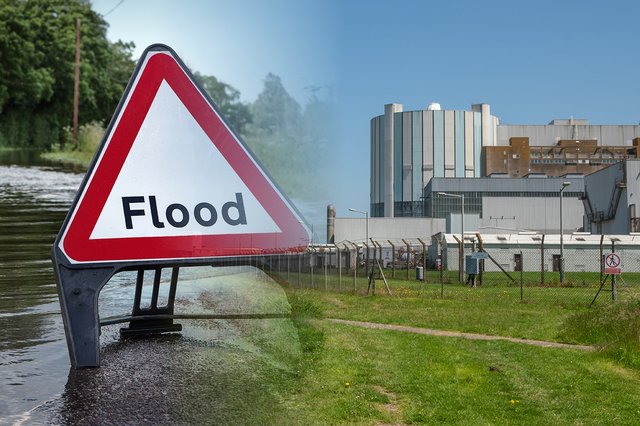
NationalWorld investigates how safe the locations of both the current and proposed nuclear power stations are amid rising sea levels https://www.nationalworld.com/news/environment/nuclear-power-stations-uk-new-existing-sites-threat-flooding-2030-sea-levels-3655640
By Isabella Boneham,, 15th April 2022 All of the current and proposed locations of nuclear power stations in the UK will be at “significant risk” of being flooded from 2030 due to extreme weather events becoming more frequent, a Greenpeace chief scientist told NationalWorld.
UK seas have risen by over 16.5cm since 1901, bringing into question the safety, security and viability of nuclear power stations on Britain’s coastlines. However, in the Government’s latest energy strategy, Boris Johnson ramped up the drive for nuclear energy, proposing plans to build eight new stations with one being approved each year until 2030.
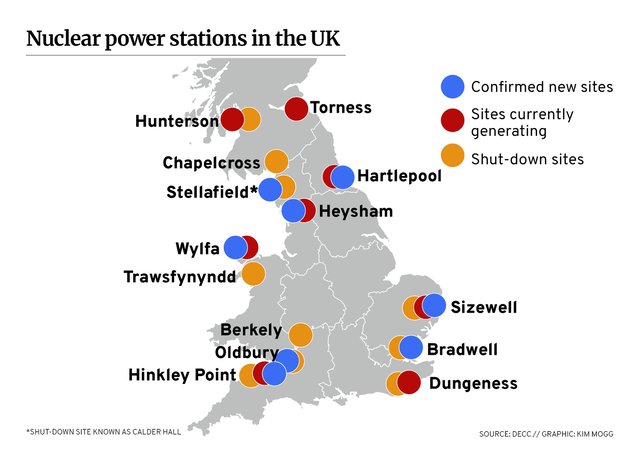
Where are the current and proposed locations of nuclear power stations in the UK?
There are eight nuclear power stations currently generating in the UK
- Hunterston, a coastal area in Ayrshire, Scotland
- Torness, east coast of Scotland
- Hartlepool, located in County Durham
- Heysham, located in Lancashire
- Sizewell, located on the Suffolk coast
- Dungeness, on the coast of Kent
- Hinkley Point, located in Somerset
- Wylfa, on the island of Anglesey in Wales
- In June 2011, eight sites across Britain were chosen as locations for new nuclear stations.
- In the Government’s new energy strategy, announced on 7 April 2022, Boris Johnson confirmed plans for these eight sites:
- Bradwell B is a proposed new nuclear power station at Bradwell-on-Sea in Essex and is currently in the public consultation stages.
- Hartlepool in County Durham was confirmed as a ‘designated nuclear site’ in the Government’s 7 April energy strategy. The town’s existing EDF nuclear power station is due to cease production in 2024.
- Heysham in Lancashire was named in the UK government’s new major energy strategy.
The Government has backed the construction of Hinkley C in Somerset, which will be the largest nuclear station in Britain – it is set to open by the end of 2026.- Oldbury in south Gloucestershire was mentioned as a candidate for a new nuclear reactor site.
- Moorside nuclear power station is proposed for a site near Sellafield in Cumbria – it has received full business case approval from the government.
- There are proposals for a nuclear plant on the coastline of Suffolk called Sizewell C, with ministers throwing in £100m investment to EDF Energy’s £20bn nuclear power station.
- Small Modular Reactors will form a key part of the nuclear project pipeline, with both Trawsfynydd and Wylfa tipped as sites.
- How will rising sea levels affect UK nuclear power stations?
- All of the locations of current and proposed nuclear power stations are deemed to be unsafe.A new interactive tool that looks at flooding risk to coastal regions has revealed the severity of the rising sea level threat to the location of nuclear power stations.
The searchable map from Climate Central, a non-profit organisation focused on climate science, shows the expected rise of sea levels and what areas of the UK are most at risk from flooding.By 2030, based on the current pollution trajectory, it is clear that the locations of current and proposed stations are at threat from rising sea levels.
- The coastlines of these areas, where nuclear stations are located, are at threat of floods from 2030 onwards.These maps identify places that require deeper investigation of risk and are based on global-scale datasets for tides in addition to sea level rise projections.
- Dr Paul Dorfman, Chair of the Nuclear Consulting Group, an independent institute providing expert research and analysis of nuclear issues, told NationalWorld that current and proposed nuclear power stations will be vulnerable to flooding due to rising sea levels and more frequent and severe storms.
How big is the climate threat?
The UK’s sea level has risen by over 16.5cm since 1901, according to the state of the UK Climate Report 2020 published last year by the Met Office.
It also found that 2020 was the third warmest year, fifth wettest and eight sunniest on record.
No other year has fallen in the top 10 for all three variables for the UK
- It also marked the eighth warmest year for UK near-coastal sea-surface temperature in a series from 1870.Parts of the UK will be at risk of being flooded in 2030 due to rising sea levels and warming temperatures.
- Areas at risk of being flooded in 2030 are Portsmouth, East Riding of Yorkshire, Arun (West Sussex), London boroughs on either side of the Thames including Canary Wharf and Fulham, Chichester (West Sussex), Weston-Super-Mare, Cardiff, Great Yarmouth (Norfolk), and West Berkshire (Berkshire) and Worthing (West Sussex), according to Climate Central’s interactive tool.
- Dr Scott Kulp, a senior scientist at Climate Central and lead author of the study, said that these maps show the “potential of climate change to reshape cities, economies, coastlines, and entire global regions within our lifetimes.”
- He added: “As the tideline rises higher than the ground people call home, nations will increasingly confront questions about whether, how much, and how long coastal defences can protect them.”Over 1.3 million residential and commercial addresses in Britain will be at risk of flooding by 2050, intelligence provider Gamma has said.
- What has the government said?
- A spokesperson from the Government’s Department for Business, Energy, and Industrial Strategy, said: “Site licence holders in the civil nuclear industry are required to meet robust standards, overseen by independent regulators, including ensuring that sites have the necessary defences in place to protect them against the effects of climate change, such as flooding, rises in sea levels, coastal erosion and drought.”
The spokesperson added: “The Office for Nuclear Regulation and environmental regulators would not allow a nuclear power station to be developed on a site, or to operate, if they judged that it was not safe to do so.”
Reclaim the Word “Clean” from the Nuclear Industry
PETITION https://you.38degrees.org.uk/petitions/clean-energy-technology-park-is-a-nuclear-nightmare
King Midas turned everthing he touched into gold. This is what the most toxic industry would have us believe nuclear power is …”clean” and “green” and puppy dogs tails. The dark heart of this industry resides in another heartland. That of Nannashire near Preston where the UK’s Nuclear Fuel Manufacturing site hunkers down like a well camouflaged toxic toad between the well known, vigorously and sucessfully opposed fracking sites of Preston New Road and Roseacre. Unlike fracking, Nuclear has co-opted so many ordinary folk with its unprecedented PR machine and largesse to good causes (using public money). And now it has even co-opted the English language with the naming of the “Clean Energy Technology Park” even while it gears up to rip up uranium from far flung countries and manufacture ever more nuclear fuel. There is no “away” for nuclear wastes apart from the Midas curse of turning all life on this fragile biosphere to a nuclear wasteland. How can we fight the “Clean Energy Technology Park” when even language has been twisted so out of shape for the nuclear cause…
What absolute idiot does not want “Clean Energy”?
Its CLEAN ENERGY Why are you Opposing it??
The first step to resistance is to reclaim the world “CLEAN” from the nuclear industry. Join us and sign the petition which will be handed in on the anniversary of the ongoing Chernobyl disaster – 26th April. https://you.38degrees.org.uk/petitions/clean-energy-technology-park-is-a-nuclear-nightmare
To: Trading Standards, Lancashire County Council. “CLEAN” ENERGY TECHNOLOGY PARK IS A NUCLEAR NIGHTMARE We the undersigned call for the the word “clean” to be removed from the UK’s Nuclear Fuel Manufacturing plant which the industry has re-named the Clean Energy Technology Park. We call for Removal of the word “CLEAN” from the CLEAN ENERGY TECHNOLOGY PARK to be replaced with the accurate description of “NUCLEAR”.
To describe Nuclear energy as “clean” is fraudulent and the claim amounts to a mass marketing scam perpetrated on the British public.
Why is this important?
“Clean” Energy Security? The raw material for nuclear is uranium which can be found in in the UK in the Orkneys but which our government buys from, for example Kazakhstan where it is largely mined by leaching out the uranium from the rock using massive amounts of fresh water and chemicals
. “Clean” Carbon footprint? Nuclear is at least the third highest carbon emitter after coal-fired plants and natural gas. As uranium becomes more scarce more energy and chemicals are needed to get the uranium out of the ground. The Nuclear Decommissioning Authority have calculated their carbon footprint for 2019/20 as 1,046,950 tonnes of carbon dioxide equivalent (CO2e). This does not include operation of nuclear reactors or include the building of Hinkley Point C with the biggest pour of concrete in the UK ever. The nuclear and fossil fuel industry are mutually intertwined. The biggest gas plant being constructed in the UK right now is at Sellafield, home to 80 percent of the UK’s existing nuclear waste which needs to be kept cool. The heating effect of discharges to the atmosphere and sea and also the use of water as a coolant for reactors and nuclear wastes are all contributing to ocean temperature rise and climate change. An honest description of Nuclear would be : Radioactive Fossil Fuel by proxy
“Clean” Radioactive Emissions Radioactive emissions occur at every stage of the nuclear fuel cycle from the mining of uranium to enrichment, to fuel manufacture, to operation of the reactors, to the “disposal” of nuclear wastes. These emissions occur both routinely and accidentally and have already resulted in large swathes of the world’s land and oceans becoming irreversibly polluted with man-made radioactive isotopes.
“Clean” and Healthy? Radiation can damage the DNA in our cells. High doses of radiation can cause Acute Radiation Syndrome or Cutaneous Radiation Injuries. There is no such thing as a “safe dose” of radiation
The “Clean Energy Technology Park” just 3.9 miles from the centre of Preston is planning an incinerator to burn intermediate level radioactive wastes from across Europe. This would result in daily plumes of chemical and radio-toxic airborne fine particle emissions blowing accross Preston City Centre. We call for the word “Clean” to be replaced by – Nuclear – at the
“Clean Energy Technology Park”.
.
Fears sunken Russian warship Moskva was carrying nuclear weapons
There are fears that sunken Russian warship The Moskva was carrying nuclear weapons that could now cause a “broken arrow” incident. news.com.au
Megan Palin, April 16, 2022 There are fears that sunken Russian warship The Moskva that is now believed to be resting at the bottom of the Black Sea was carrying nuclear weapons.
Maksym Marchenko, the governor of the Odesa region, said Ukraine struck the ship with two Neptune missiles and caused “serious damage” on Thursday.
The Russian Defence Ministry denied there had been an attack by Ukraine on the ship, which would normally have about 500 sailors aboard, and said the heavily damaged Moskva sank in a storm under tow after being gutted by fire.
Speaking at the Pentagon on Friday, a senior US defense official said the Moskva warship was hit by two Ukrainian Neptune missiles, prompting its sinking.
In a chilling revelation, sources say it’s likely that several nuclear missiles are on the sunken vessel, and there is now real concern that could lead to a nuclear accident – otherwise known as a “broken arrow” incident in American military slang.
Mykhailo Samus, director of a Lviv-based military think-tank; Andriy Klymenko, editor of Black Sea News; and Ukrainian newspaper Defence Express all warned today that the Moskva was designed to carry warheads which could fit in the nose of its supersonic P-1000 “Vulkan” missiles – designed to take out American aircraft carriers.
“On board the Moskva could be nuclear warheads – two units,’ Samus said, while Klymenko called on other Black Sea nations – Turkey, Romania, Georgia, and Bulgaria – to insist on an explanation. Where are these warheads? Where were they when the ammunition exploded,” he asked.
This is HUGE. Russia’s defense ministry admits Moskva, their flagship in Black Sea fleet, slava class cruiser, has SUNK! It was key to intelligence & air defenses for the Russian ships. IMO this is on the level big as stopping Russians from taking Kyiv. https://t.co/3SifeskeHzpic.twitter.com/EmNR4L0Vgy— John Spencer (@SpencerGuard) April 14, 2022
BlackSeaNews editor-in-chief Andriy Klymenko called for an urgent international probe into whether the Moskva was carrying nuclear weapons.
“Friends and experts say that there are two nuclear warheads for cruise missiles on board the Moskva,” he said………….. https://www.news.com.au/world/europe/fears-sunken-russian-warship-moskva-was-carrying-nuclear-weapons/news-story/959170261e82bd43b5eb3c37fabf8dcd
| |||
Ukrainian blogger gets 15 years gaol for saying that Zelensky govt takes orders from other governments
https://www.lindipendente.online/2022/04/05/ucraina-blogger-arrestato-perche-critica-zelensky-rischia-15-anni-di-carcere/?fbclid=IwAR0XFoa_HVePLpr3DYMhXT2PH-d0juJG-3gBHSrVqovgqqc_rCyYB0kA_70 Mike Mapes 15 Apr 22,
Ukrainian blogger Gleb Lyashenko has been sentenced for “betrayal” to 15 years in prison after writing on a post:
“Zelensky was wrong. It has been years that the Russia has been asking us for a reasonable agreement, that is to stay out of the Nato. But there was no change of course. This is why our government takes orders from others, who use us Ukrainians for their purposes. The result was this absurd war. “
Since yesterday Ukraine also has its Assange and Snowden.
“All wars start with lies. But all wars can be stopped by the truth!”
1 This Month

of the week– Nuclear Reactor Information Task Force
14 May – online event From Bombs to Data Centres: the Face of Nuclear Colonialism
To see nuclear-related stories in greater depth and intensity – go to https://nuclearinformation.wordpress.com
-
Archives
- May 2026 (173)
- April 2026 (356)
- March 2026 (251)
- February 2026 (268)
- January 2026 (308)
- December 2025 (358)
- November 2025 (359)
- October 2025 (376)
- September 2025 (257)
- August 2025 (319)
- July 2025 (230)
- June 2025 (348)
-
Categories
- 1
- 1 NUCLEAR ISSUES
- business and costs
- climate change
- culture and arts
- ENERGY
- environment
- health
- history
- indigenous issues
- Legal
- marketing of nuclear
- media
- opposition to nuclear
- PERSONAL STORIES
- politics
- politics international
- Religion and ethics
- safety
- secrets,lies and civil liberties
- spinbuster
- technology
- Uranium
- wastes
- weapons and war
- Women
- 2 WORLD
- ACTION
- AFRICA
- Atrocities
- AUSTRALIA
- Christina's notes
- Christina's themes
- culture and arts
- Events
- Fuk 2022
- Fuk 2023
- Fukushima 2017
- Fukushima 2018
- fukushima 2019
- Fukushima 2020
- Fukushima 2021
- general
- global warming
- Humour (God we need it)
- Nuclear
- RARE EARTHS
- Reference
- resources – print
- Resources -audiovicual
- Weekly Newsletter
- World
- World Nuclear
- YouTube
-
RSS
Entries RSS
Comments RSS
 nuclear-news