France working out how to save debt-laden nuclear company EDF
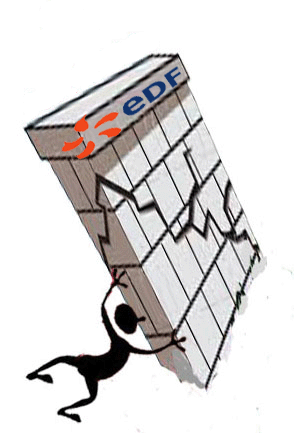
France is considering restructuring plans for debt-laden power firm EDF
(EDF.PA) that include full nationalisation followed by the sale of its
renewables business to focus on nuclear energy, BFM Business reported,
citing unidentified sources.
The website said the government was working
with investment bank Goldman Sachs on several restructuring scenarios. The
sale of the renewables business could fetch 15 billion euros ($16 billion),
it cited unidentified bankers as saying, adding that could help finance the
building of six next-generation EPR nuclear reactors.
Reuters 13th April 2022
Nuclear Free Local Authorities deplore UK govt’s super-costly new nuclear energy strategy, and its rejection of energy conservation measures
THE NUCLEAR FREE LOCAL AUTHORITIES organisation (NFLA) says it is
“incredulous” that Prime Minister Boris Johnson and the UK Government
remains wedded to a new Energy Security Strategy that will rely in large
part upon the development of 24 GW of new nuclear generation capacity to
power Britain.
A plan involving mass investment in renewables and a
reduction in electricity demand through retrofitting the nation’s homes
with insulation would have been far cheaper and quicker to deliver, it
says.
In response to the government’s commitment to build the equivalent
of eight new large nuclear power stations by 2050, NFLA National Chair,
Councillor David Blackburn, said: “It defies common sense that the
current government is turning to a technology that is too slow to install,
too costly to build, remains risky to operate and vulnerable to military
and terrorist attack, and leaves a toxic legacy of radioactive waste that
has to be safely stored for 100,000 years.”
Ekklesia 13th April 2022
Russian soldiers received ‘shocking amount’ of nuclear exposure at Chernobyl site – some may have less than a year to live.
Ukraine says Russian soldiers stole potentially deadly radioactive substances from Chernobyl,
more – https://www.abc.net.au/news/2022-04-11/russians-stole-radioactive-substance-chernobyl/100981372
Russian forces who occupied the Chernobyl nuclear plant stole potentially deadly radioactive substances from research laboratories, Ukraine’s State Agency for Managing the Exclusion Zone says.
Key points:
- Ukraine recently took back control of the Chernobyl site
- Ukraine’s energy minister says some Russia soldiers have less than a year to live
- Chernobyl plant staff have just been rotated for the second time since Russian forces seized the facilities
Moscow’s troops seized the defunct power plant on the first day of their invasion of Ukraine on February 24. They occupied the highly radioactive zone for over a month, before retreating on March 31.
The agency said on Facebook that Russian soldiers pillaged two laboratories in the area.
It said the Russians entered a storage area of the Ecocentre research base and stole 133 highly radioactive substances.
Even a small part of this activity is deadly if handled unprofessionally,” the agency said.
‘Shocking’ amount of nuclear exposure
Earlier this week, Ukraine’s energy minister German Gulashchenko said Russian soldiers exposed themselves to a “shocking” amount of nuclear radiation, saying some of them may have less than a year to live.
“They dug bare soil contaminated with radiation, collected radioactive sand in bags for fortification, breathed this dust,” Mr Gulashchenko said on Facebook on Friday after visiting the exclusion zone.
“After a month of such exposure, they have a maximum of one year of life. More precisely, not life but a slow death from diseases. “Every Russian soldier will bring a piece of Chernobyl home. Dead or alive.”
He said Russian military equipment was also contaminated.
“The ignorance of Russian soldiers is shocking.”
The Chernobyl power station was the site of the world’s worst nuclear disaster in 1986.
Situation ‘far from normal’
The International Atomic Energy Agency said Ukraine had been able to rotate staff at the decommissioned Chernobyl nuclear plant for only the second time since Russian forces seized the facility early in the war.
They had to be transported to and from the site by water, with the Pripyat River being the only way for people living in the city of Slavutych to currently reach the plant.
The nuclear agency said the situation around Chernobyl, site of a 1986 nuclear disaster, “remained far from normal” after Russians departed at the end of March.
Ukrainian officials told the agency on Sunday that laboratories for radiation monitoring at the site were destroyed and instruments damaged or stolen.
The automated transmission of radiation monitoring data has been disabled.
UK’s energy strategy ”cowardly and incoherent” – solar and onshore wind are the practical options
Michael Grubb: The writer is professor of energy and climate change at
University College London and was former senior adviser to energy regulator
Ofgem.
The UK energy strategy is both cowardly and incoherent. The defining
feature of the UK energy strategy is its incoherence. It does not know what
problem it is trying to solve – and thus it does not solve any. By
failing to boost energy efficiency and kicking the only possible short-term
supply option – that of cheap onshore wind – into the long grass, it
most certainly will not help those struggling with energy bills in the
coming winters.
Offshore wind is the great success story of the past decade
and capacity has grown sharply in recent years. The strategy increases the
offshore target for 2030 from 40GW to 50GW. That’s very ambitious but
possible. But offshore wind involves big and complex kit from only a few
suppliers, it usually takes three to five years from bid to completion, and
the pace of expansion could stress supply chains and drive up costs. If it
were all concentrated in the North Sea, there would be immense challenges
for the grid – both in transmission and in managing the peaks and
troughs. Wind is best when distributed more widely.
The most cowardly failure concerns onshore wind. It is not only our cheapest energy resource
– it typically costs about a third to a quarter of what people will soon
be paying for their electricity – but it is, with solar, the only one
that could make a dent in the short term. The strategy outlines a plan for
nuclear to 2050, kicked off with one new plant to be funded before the next
general election. If it takes an energy crisis to actually make a decision,
so be it, but it will not help solve the crisis.
Nuclear is not only slow
and expensive, it would need to be flexible to ramp up and down with the
swings of demand, wind and solar. This further undermines the economics.
Launching a 30-year plan for nuclear also raises the question – why
can’t the government set out even a coherent 30-month plan for energy
efficiency?
FT 10th April 2022
https://www.ft.com/content/3fe73617-5f8f-4b70-8856-ca53e2ec92b3
No community in the UK has agreed to host a nuclear waste facility
Under normal conditions, generating nuclear power produces hazardous
radioactive waste. This needs to be safely managed and stored for hundreds
of years.
However, a House of Lords paper from October 2021 said the issue
of nuclear waste remains “unresolved in the UK”. It is currently stored in
temporary facilities that are not designed for the permanent storage of
“high-level” radioactive waste.
The Government’s preferred solution is
“geological disposal” – placing waste deep in a rock formation that would
prevent radioactivity from escaping. However, no community has agreed to
host such a facility.
National World 8th April 2022
Johnson’s ‘nuclear fantasy’ will not reduce rising fuel bills or rising temperatures- UK’s Nuclear Free Local Authorities
Johnson’s ‘nuclear fantasy’ will not reduce rising fuel bills or rising temperatures
The Nuclear Free Local Authorities are ‘incredulous’ that Prime Minister Boris Johnson and the UK Government remains wedded to a new Energy Security Strategy that will rely in large part upon the development of 24 GW of new nuclear generation capacity to power Britain, when a plan involving mass investment in renewables and a reduction in electricity demand through retrofitting the nation’s homes with insulation would have been far cheaper and quicker to deliver.
In response to the government’s commitment to build the equivalent of eight new large nuclear power stations by 2050, NFLA National Chair, Councillor David Blackburn said:
The Nuclear Free Local Authorities are ‘incredulous’ that Prime Minister Boris Johnson and the UK Government remains wedded to a new Energy Security Strategy that will rely in large part upon the development of 24 GW of new nuclear generation capacity to power Britain, when a plan involving mass investment in renewables and a reduction in electricity demand through retrofitting the nation’s homes with insulation would have been far cheaper and quicker to deliver.
“It defies common sense that the current government is turning to a technology that is too slow to install, too costly to build, remains risky to operate and vulnerable to military and terrorist attack, and leaves a toxic legacy of radioactive waste that has to be safely stored for 100,000 years.”
“In the past, we were told that nuclear-generated electricity would be too cheap to meter customers for. The reality is very different. The plan means building eight power plants the size of Hinkley Point C within 30 years. Hinkley Point C is already costing £23 billion and is years behind schedule, with operator EDF about to announce a further hike in the cost and a further delay in delivery.”
“Nuclear power projects are notorious for being delivered way behind schedule and massively over cost. British taxpayers will end up being saddled with this extra cost as the government has just passed the Nuclear Energy (Financing) Act making them liable for the charges.”
All of the plants will rely on a massive subsidy from the British taxpayer and ultimately the taxpayer will also pick up the bill for decommissioning the new plants at their end of their operating lives and for managing and storing the resultant radioactive waste for tens of thousands of years.
In addition to increasing energy bills and being delivered far too late to make a favourable impact in the fight against climate change, Boris Johnson’s ‘big bet’ on nuclear will not improve the nation’s energy independence.
Added Councillor Blackburn: “Nuclear power plants rely on uranium all of which is sourced overseas, with Russia being a major supplier to the world market, and most of the plants will be reliant on foreign reactor designs, one with a dubious safety record, and built and run by foreign-owned operators.
“EDF Energy, the main player, is a company owned by the French state, and newer players to the market are American owned, including one involving billionaire entrepreneur, Elon Musk. The only UK business, Rolls Royce, which is developing the so-called Small Modular Reactor, is backed by French private money and funding from a Qatari sovereignty fund.
“The NFLA cannot see how nuclear in any way promotes Britain’s energy independence.”
The NFLA is therefore bitterly disappointed that the new strategy did not instead commit to a national programme of retrofitting insulation to Britain’s homes and to providing further funding to support domestic electricity micro-generation, both of which would have reduced energy demand and reduced customers’ fuel bills, as well as to a far greater investment in a range of renewables to generate power, particularly onshore wind projects and tidal power which remain largely neglected despite their huge potential and public support.
“We advocate an emergency national programme of retrofitting homes with insulation to reduce heating bills and energy demand, and to improve public health; a greater emphasis of new and existing homes generating their own power for domestic use; and a huge public investment in a range of renewable technologies to provide domestically-generated, reliable, sustainable electricity. This can be done much more quickly and much more cheaply than continuing to indulge in this nuclear fantasy,” concluded Councillor Blackburn.
In response to the government’s commitment to build the equivalent of eight new large nuclear power stations by 2050, NFLA National Chair, Councillor David Blackburn said:
Nuclear energy a useless distraction for UK – Green Party MP Caroline Lucas
Green Party MP Caroline Lucas has slammed the Tory government and accused
them of being “held hostage” by right wing backbench MPs on wind power.
She made the comments on the BBC’s Sunday Morning show following the
publication of the government’s Energy Security Strategy earlier this
week.
In an interview with Sophie Raworth, Lucas was scathing about the
government’s strategy. She branded the strategy’s focus on nuclear
energy a “distraction from what this energy strategy should have been
about, which is to have put energy efficiency and energy saving right at
its heart,” and said that nuclear is “simply not a solution that can be
fast enough to get us out of the energy crisis that we face right now.”
Instead of expanding nuclear, Lucas called for “a massive expansion –
for example – of onshore wind, which was completely lacking in the
government’s strategy this week. That’s quite extraordinary, given that
it’s the cheapest form of energy, that it has massive popularity in the
country.” She continued by accusing the government of being “held
hostage” by backbench MPs on onshore wind. Lucas said, “basically
we’ve got a government held hostage by a handful of its backbenchers who
don’t think wind farms are sightly. Well, that is not the way we should
be designing our energy policy in this country.”
Bright Green 10th April 2022
Planning advises rejected Wylfa as unsuitable for nuclear development. No wonder Boris Johnson wants to ”cut red tape”
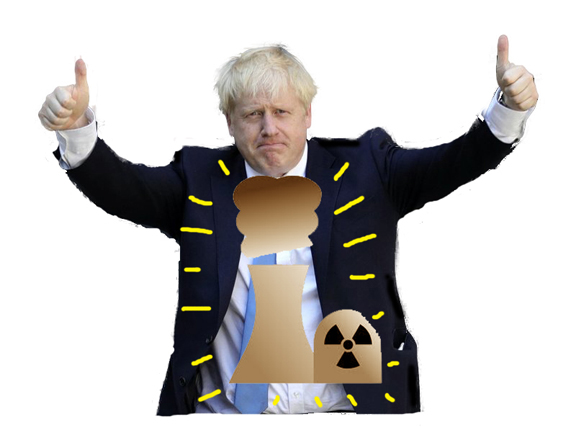
| I would argue that we do not need new nuclear power at all. It is costly, dangerous, slow and unsuitable as an adjunct to renewables. We certainly don’t need it in Wales. In 2021, planning inspectors advised that the Wylfa Newydd development (What might the UK energy strategy contain and how feasible are options? 6 April) should be rejected due to its impact on the local economy, housing stock, local ecology, nature conservation and the Welsh language. Yet still politicians say it’s the best place for a new nuclear power station. No wonder Boris Johnson wantsto cut the “red tape” of the planning process. He cannot be allowed to. Guardian 10th April 2022 https://www.theguardian.com/environment/2022/apr/10/uk-energy-strategys-nuclear-dangers-and-glaring-omissions |
Not all trade with Russia is stopped – Finland’s still getting nuclear power project built by Russia.
Rosatom subsidiary will proceed with Finnish nuclear project, By Anne Kauranen, HELSINKI, April 11 22 (Reuters) – Russia’s state-owned nuclear power supplier Rosatom and its Finnish unit RAOS Project will proceed with a planned nuclear plant in Finland, RAOS said on Monday, despite uncertainty over government permits since Russia’s invasion of Ukraine. … (subscribers only)
Reporting by Anne Kauranen; Editing by David Goodman and David Holmes https://www.reuters.com/business/energy/rosatom-subsidiary-will-proceed-with-finnish-nuclear-project-2022-04-11/
Sizewell nuclear project: planning process drags on: thousands of objectors, yet tax-payer funding already promised!
Letter: Your article (PM to put nuclear power at heart of UK’s energy
strategy, 6 April) refers to Sizewell C as one of the major projects that
has “already been through some form of planning”. The planning process
is still going on, and thousands of interested parties have objected.
Six months of Planning Inspectorate meetings exposed the mistakes of trying to
build two gigantic reactors in the middle of an area of outstanding natural
beauty and site of special scientific interest, pushed against the Minsmere
nature reserve, on an eroding coastline, and with no available water for
construction or operation, among other problems.
This hasn’t stopped Kwasi Kwarteng promising millions in taxpayer funding for Sizewell C when
the planning process has not been completed and while he refuses to meet
the community to hear alternative views.
Guardian 10th April 2022
Emmanuel Macron Gets Nuclear Energy All Wrong

The price of nuclear generation today is inordinate: a rip-off in terms of value, to put it bluntly. Indeed, while safety concerns drive up the cost of nuclear plant insurance, the price of renewables is predicted to sink further, by as much as 50 percent or more by 2030. ……No nuclear reactors anywhere are built without enormous government support, and France will be no different: The bill for the French taxpayers will start at $57 billion, according to the New York Times.
The single greatest barrier to the so-called nuclear renaissance is nuclear power itself and its inability to deliver affordable power on time and on budget.
Nuclear power won’t help France meet its climate goals on budget or on time.
https://foreignpolicy.com/2022/03/22/macron-france-nuclear-energy-climate-renewables/ By Paul Hockenos, a Berlin-based journalist. 22 Mar 22, At year’s end, Germany will shutter its last three nuclear plants; Belgium will follow suit by 2025. France, on the other hand, is committed to remaining Europe’s last stronghold of nuclear energy. At the center of French President Emmanuel Macron’s re-election platform is his plan to construct as many as 14 new-generation reactors and a fleet of smaller nuclear plants, supposedly to bolster the country’s climate protection strategy.
France’s bet on nuclear energy, however, is an egregious miscalculation that will severely inhibit its decarbonization efforts. At a critical juncture in the battle against climate change, diverting any finances and losing time with nuclear power, which has been in decline worldwide for decades, will only set back the country’s climate efforts, perhaps dooming its chances to go carbon neutral by 2050. Indeed, this Hail Mary pass, taken out of desperation as France has fallen woefully behind on its climate targets, will most probably come to naught anyway as the era of nuclear power wanes further no matter France’s declarations.
The simple explanation: Fully fledged renewables are faster, cheaper, and lower risk than nuclear power.
Despite the flurry of media hype around new nuclear energy and loose talk of a “nuclear renaissance,” in recent years, the arguments against nuclear power have grown demonstrably stronger.
Critics’ original concern with nuclear power, namely its safety, remains levelheaded and paramount. The two most catastrophic meltdowns—namely in 1986 at Ukraine’s Chernobyl nuclear power plant and in 2011 at Japan’s Fukushima site—are well known and had horrific repercussions that haunt those regions today. But these mega disasters are only the blockbusters.
According to the International Atomic Energy Agency, there have been 33 serious incidents at nuclear power stations worldwide since 1952—two in France, and six of them in the United States. Currently, a fifth of France’s geriatric nuclear generation is shut down because of safety issues—the older reactors get, the higher the risk of an accident—exacerbating an acute energy crunch there. So much for the 24/7 reliability of nuclear power.

And then there’s the now 80-year-old conundrum of how and where to dispose of radioactive waste. To date, no secure repositories are in operation anywhere in the world for the spent fuel, which remains toxic for hundreds of thousands of years. Experts estimate that more than 250,000 metric tons of radioactive waste—over 14,000 metric tons in France and 90,000 metric tons in the United States—is currently in temporary storage near nuclear power plants and military production facilities worldwide.
In France and elsewhere, there’s broad agreement that for security and health reasons, highly radioactive material can’t simply be lodged interminably at interim sites. But France’s wish to one day entomb its toxic refuse 500 meters below the Earth’s surface and 186 miles east of Paris is still on hold as locals refuse to accept the presence of a long-term nuclear repository near their homes. The story is the same just about everywhere: No one wants to raise families near a nuclear waste dump.
But these days, there are other arguments against nuclear energy that are arguably even more averse to a nuclear revival than the issues of safety and nuclear waste.
Nuclear power plants have actually pulled off one of the most remarkable feats of recent technological history: Where virtually all other technologies have gotten cheaper over time as they have developed and matured, nuclear power has actually become more expensive. Indeed, it has grown dauntingly costly compared with renewables: at least four times as costly as utility-scale solar and onshore wind power. While the cost of solar and wind energy generation, as well as battery storage, plummets by the year—in 2020 alone, onshore wind costs declined by 13 percent and those of utility-scale solar photovoltaics by 7 percent—the bill for new nuclear sites climbs upward.
The price of nuclear generation today is inordinate: a rip-off in terms of value, to put it bluntly. Indeed, while safety concerns drive up the cost of nuclear plant insurance, the price of renewables is predicted to sink further, by as much as 50 percent or more by 2030. This price trend is one reason why in 2020 total investment in new renewable electricity surpassed $300 billion, 17 times global investment in nuclear power, according to the World Nuclear Industry Status Report. No nuclear reactors anywhere are built without enormous government support, and France will be no different: The bill for the French taxpayers will start at $57 billion, according to the New York Times.
This yawning price differential means renewables generate many more times the electricity per dollar invested than does nuclear—and thus decreases emissions by a greater factor.
The single greatest barrier to the so-called nuclear renaissance is nuclear power itself and its inability to deliver affordable power on time and on budget. If Europe’s current headline nuclear projects are a measure—marred for decades now by massive cost overruns and protracted delays—France’s hopes to have its first new reactor up and running by 2035 are illusory. In Flamanville in northwest France, the French energy firm EDF is struggling to finish a reactor that is a full decade behind schedule and now roughly four times above cost projections. The Olkiluoto 3 reactors in Finland, also many times over budget, have been delayed again and again since the early 2000s.
Indeed, not one reactor conceived since 2000 in the European Union has generated even a kilowatt of energy. The Olkiluoto 3 plant may begin commercial activities this year. As for the new, smaller, presumably cheaper nuclear reactors envisioned by billionaire Bill Gates among others, not one is in operation anywhere in the world.
In a widely circulated Jan. 25 letter penned by four former top nuclear energy regulators in France, the United States, Germany, and the United Kingdom, the authors excoriated the viability of relying on nuclear energy to beat climate change: Nuclear energy, they argue, “is just not part of any feasible strategy that could counter climate change. To make a relevant contribution to global power generation, up to more than ten thousand new reactors would be required, depending on reactor design.”
The fact is that nuclear power is simply too cumbersome to really play a meaningful role in tackling climate change—in France or elsewhere. We don’t have that kind of time. Indeed, there is no way countries can meet their 2030 decarbonization goals agreed to at the Paris Agreement by embarking now on nuclear power programs.
In stark contrast, renewable energy is a sprinter: Farms can be licensed, financed, and deployed much faster because they’re smaller, less capital intensive, more quickly approved, and easier to build. Depending on the country, vast utility-scale solar fields and onshore wind farms can materialize in just a handful of years. Last year, China brought to life about 50 gigawatts of solar capacity—that’s as much electricity generation as 10 nuclear reactors. Even the average nine-year schedule of offshore wind parks is still much, much shorter than nuclear’s erratic, extended timelines.
In Europe and elsewhere, building out nuclear power will greatly hamper the effort to curb climate change, not help it. “The more urgent climate change is, the more we must invest judiciously, not indiscriminately,” writes sustainability expert Amory Lovins, “to buy cheap, fast, sure options instead of costly, slow, speculative ones.”
In the end, the evidence speaks conclusively for ramping down fossil fuels and nuclear energy as fast as possible while embarking on an all-out expansion of sustainable renewables: wind, solar, biomass, geothermal, hydroelectric, and tidal/wave energy. Modern gas works will back up this clean energy model until green hydrogen can take over. Ever better energy storage, smart grids, energy conservation, and digital management will make this model of the future work.
Germany and Belgium—like Austria, Italy, and nine other EU countries—are looking the facts straight in the eye. By swearing off nuclear energy and fossil fuels at the same time, these countries will have the best chance at making a net-zero energy system functional by 2050, at the latest. https://foreignpolicy.com/2022/03/22/macron-france-nuclear-energy-climate-renewables/
Paul Hockenos is a Berlin-based journalist. His recent book is Berlin Calling: A Story of Anarchy, Music, the Wall and the Birth of the New Berlin (The New Press).
Macron under Putin’s thumb as Russia could CRIPPLE France’s nuclear industry, as it controls uranium supply.

Macron under Putin’s thumb as Russia could CRIPPLE France’s nuclear
industry. The recent reports of atrocities committed by Russian forces in
Bucha have finally pushed the EU into considering a ban on Russian fossil
fuels.
Oil and gas exports make up a large portion of Russia’s economy
and EU is heavily dependent on gas supplies from Moscow, making up 40
percent of its imports. The EU imported a staggering €48.5billion
(£38billion) of crude oil in 2021, and €22.5billion (£19billion) of
petroleum oils other than crude.
But even as EU leaders meet to discuss an immediate ban on Russian coal, experts have warned that aside from fossil fuels, Russia could also manipulate the EU’s energy through its control
of the global uranium supplies.
Speaking to Express.co.uk, Dr Paul Dorfman,
an associate fellow at the University of Sussex’s Science Policy Research
Unit (SPRU) and chair of the Nuclear Consulting Group said: “In terms of
energy security, Russian controlled uranium – basically reactors run on
uranium, includes both Russia and corporations in Kazakhstan, which are
Russian controlled.
Express 9th April 2022
Boris goes all out for UK nuclear
‘I do not think we should be building any new nuclear reactors until we have a geological disposal facility available.’ That applies to all scales of nuclear, SMRs as well as big plants, they all produce wastes.
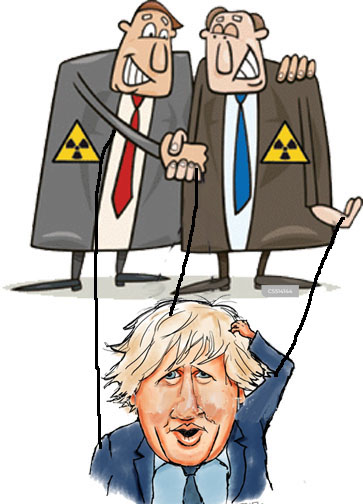
https://renewextraweekly.blogspot.com/2022/04/boris-goes-all-out-for-uk-nuclear.html Under the heading ‘Boris Johnson’s fixation on nuclear is a threat to Britain’s energy supply’, Times chief leader writer Simon Nixon said ‘Boris Johnson’s plans to build at least six or seven new nuclear power stations is the wrong strategy for meeting the government’s need to ensure the UK’s energy security, lower public bills and achieve its net-zero target. Britain’s track record on building nuclear power stations is almost as dire as its record in building garden bridges’.
Nevertheless, despite negative views like this, Boris ploughed on. Indeed he managed to turn this criticism around, asking ‘why have the French got 56 nuclear reactors and we’ve got barely six?.’ He said we needed ‘big ticket’ nuclear solutions and also looked to having Small Modular Reactors (SMRs) before 2030. Not everyone is convinced that SMR’s can deliver, but Johnson’s confidence in them may have been the result of a meeting with Last Energy, a US nuclear promoter backed by Elon Musk, which is pushing a simple fast-track mini PWR, at 20 MW, far smaller than the 470 MW Rolls Royce system. There was talk of 100s of units being deployed across the UK. Last Energy’s business credo ‘Innovate on the delivery model, not the reactor’, may have appealed to Boris.
However, on the renewables side, while he was still keen on offshore wind (‘Energy companies tell me they can get an offshore wind turbine upright and generating in less than 24 hours’), the prospects for on-shore wind, which had begun to look more promising, seem to have taken a hit in favour of more nuclear- on shore wind once again getting some Tory ‘eyesore’ backlash, despite it actually attracting 80% public support. The expansion of the ECO energy saving scheme was also hit, despite energy efficiency arguably being the cheapest option of all.
So when the new energy security strategy finally emerged it was not surprising that there was a commitment to 24 GW of nuclear by 2050, no new targets for on shore wind and very little on the energy savings side, just a £30m ‘heat pump investment accelerator competition’. But at least a 50 GW offshore wind target by 2030 was confirmed, with up to 5GW of it being floating systems, coupled with a doubling of the low-carbon hydrogen target to 10GW by 2030, with at least half being green hydrogen. However, on shore wind will only get limited support: communities can volunteer for a project (although they could have anyway) and possibly get cheaper power, but with no significant changes in planning rules. There will though be some PV planning rule changes to help solar expand- with an up to a five-fold increase in deployment expected by 2035. If achieved that would be a massive 70GW, although no target was specified.
Apart from the lamentable lack of support for on-shore wind and, even more provocatively, for energy saving, the nuclear expansion was the most controversial part. The strategy report says ‘a new government body, Great British Nuclear, will be set up immediately to bring forward new projects, backed by substantial funding, and we will launch the [already announced] £120 million Future Nuclear Enabling Fund this month. We will work to progress a series of projects as soon as possible this decade, including Wylfa site in Anglesey. This could mean delivering up to eight reactors, equivalent to one reactor a year instead of one a decade, accelerating nuclear in Britain’.
Why nuclear?
It’s hard to see why Johnson thinks a big nuclear push is needed, or a good idea- apart from catching up with France! A bit more credibly, the strategy report stresses the importance of energy independence, but the nuclear programme has of late been mostly based on imported (French) technology and expertise- as well as funding from overseas. It now looks as if he will no longer rely on China for any of this, but the new RAB funding scheme will allow nuclear plant developers like EDF to put a surcharge on UK power consumers bills to raise the necessary capital for construction in advance of any power being supplied. That may be independence of a kind, but the profits do still go abroad
And it will be a decade or more before any of the proposed new nuclear plants (at Sizewell and elsewhere) are running- assuming all goes well. So we will get hit with the costs now, or at least soon, but not get the benefits until far in the future. So much for helping to cut costs for hard pressed consumers
The energy independence idea is also not as urgent as it might appear. The UK does not import significant amounts of Russian gas, unlike Germany (and Austria), where admittedly things could get bad unless urgent action is taken. But they are doing that, Germany backing renewables even more strongly, and both still being opposed to nuclear. That choice has been reinforced by the war in Ukraine which has illustrated just how risky it can be to have nuclear plants in conflict zones. The possibility of terrorist drone attacks apart, the UK may not (yet) face risks like that, but its coastal plants will increasingly face risks from climate change driven sea level rises and storm surges.
One of the other key problems for nuclear has also been pointed up in response to the UK expansion plan – waste storage being a key one. Claire Corkhill, a professor of nuclear material degradation at the University of Sheffield said ‘I do not think we should be building any new nuclear reactors until we have a geological disposal facility available.’ That applies to all scales of nuclear, SMRs as well as big plants, they all produce wastes.
Overall, it does seem odd to be pushing nuclear so hard. For example, if it was really about an energy gap, it would be easy for renewables to fill it. RenewableUK says the UK could end its dependence on gas and replace it with renewable energy within the next 5 years – if the limit imposed on the amount of onshore wind was removed and budgets raised for deployment. Energy saving could do that too. If it was really about jobs, then, as the UKERC has recently pointed out, renewable energy can create at least 2 times more jobs than nuclear, while investment in energy saving can create 5 times as many. If it was really about variable renewables and grid balancing, well the last thing we need is more large inflexible nuclear plants. And if it was really about costs and consumer bills, then why go for nuclear, the most expensive option. If that sort of money was available, why not go for tidal lagoons and tidal current turbines?
However, all is not entirely lost. The 50 GW by 2030 offshore wind target is a significant one, as is the hoped for 5-fold by 2035 PV solar expansion – putting the 24 GW by 2050 nuclear target into some sort of perspective. But we don’t really need it. And judging by the gross completion problems with the EPRs in France and Finland, and the problems with China’s version of it, the UK’s new 8 plant nuclear plan, with its ‘one reactor per year’ average installation target, seems very unlikely to be realised.
All in all, the offshore wind and solar parts aside, not much of a viable security plan, and a bit thin in any case, with lots of targets but very little detail. Indeed, the Times leader (8/4/22) said ‘the number 8 appears to have been plucked out of the air’ and overall it was ‘little more than a glorified press release’, with the lack of effective commitment to energy saving making it ‘a cop out’. While Greenpeace said ‘the urgency of the climate crisis needed an urgent response. Sadly, the government’s energy security plan didn’t deliver.’ Not a lot of support then across the political spectrum.
Switzerland plans to bury spent nuclear fuel deep underground in clay
Straits Times SAINT-URSANNE, SWITZERLAND (AFP) 10 Apr 22, – Storing radioactive waste above ground is a risky business, but the Swiss think they have found the solution: Burying spent nuclear fuel deep underground in clay.
The Mont Terri international laboratory was built to study the effects of burying radioactive waste in clay which sits 300m below the surface near Saint-Ursanne in the northwestern Jura region.
The underground laboratory stretches across 1.2km of tunnels.
Niches along the way, each around 5m high, are filled with various storage simulations, containing small quantities of radioactive material monitored by thousands of sensors.
More than 170 experiments have been carried out to simulate the different phases of the process – positioning the waste, sealing off the tunnels, surveillance – and to reproduce every imaginable physical and chemical effect.
According to experts, it takes 200,000 years for the radioactivity in the most toxic waste to return to natural levels……..
Three prospective sites in the northeast, near the German border, have been identified to receive such radioactive waste.
Switzerland’s nuclear plant operators are expected to choose their preferred option in September.
The Swiss government is not due to make the final decision until 2029, but that is unlikely to be the last word as the issue would probably go to a referendum under Switzerland’s famous direct democracy system.
Despite the drawn-out process, environmental campaigners Greenpeace say Switzerland is moving too fast.
“There are a myriad of technical questions that have not been resolved,” Mr Florian Kasser, in charge of nuclear issues for the environmental activist group, told AFP.
For starters, he said, it remains to be seen if the systems in place can “guarantee there will be no radioactive leakage in 100, 1,000 or 100,000 years”.
“We are putting the cart before the horse, because with numerous questions still unresolved, we are already looking for sites” to host the storage facilities, he said.
Mr Kasser said Switzerland also needed to consider how it will signal where there sites are to ensure they are not forgotten, and that people many centuries from now remain aware of the dangers.
Swiss nuclear power plants have been pumping out radioactive waste for more than half a century.
Until now, it has been handled by the National Cooperative for the Disposal of Radioactive Waste, or NAGRA, founded in 1972 by the plant operators in conjunction with the state.
For now, the waste is being stored in an “intermediary depot” in Wurenlingen, some 15km from the German border.
Switzerland hopes to join an elite club of countries closing in on deep geological storage……………….
Following the 2011 nuclear accident at the Fukushima power station in Japan, Switzerland decided to phase out nuclear power gradually: Its reactors can continue for as long as they remain safe.
A projected 83,000 cubic metres of radioactive waste, including some high activity waste, will have to be buried.
This volume corresponds to a 60-year operating life of the Beznau, Gosgen and Leibstadt nuclear power plants, and the 47 years that Muhleberg was in operation before closing in 2019.
Filling in the underground nuclear waste tombs should begin by 2060…….
The monitoring period will span several decades before the site is sealed some time in the 22nd century. https://www.straitstimes.com/world/europe/switzerland-plans-to-bury-spent-nuclear-fuel-deep-underground-in-clay
UK government incoherent and inconsistent on energy crisis, and has no solution to the accumulating nuclear wastes
| Does the new government energy strategy tackle the immediate energy crisis? This is the third document in six months that the government has produced, and all that has happened is that they have become less coherent, and less and less connected to what actually matters to most people. What the Prime Minister seems to believe is that we want expensive nuclear ‘jam’ tomorrow, and that we are not that bothered about cheap energy efficiency ‘bread’ today. I think that this is rather like the Chancellors recent Spring Budget, in that it is simply not hearing, or paying attention, to what is actually happening in the country, and what matters to people who have got to live with the immediate crisis of their energy bills. And the way that the government can deal with that right now is to start spending money on energy efficiency, money by the way that the government promised in its manifesto and hasn’t actually delivered. In 2012, we were insulating about 2.5 million houses per year, now we are down to about 20 thousand. If we had carried on at that rate, we would be saving people money right now as this crisis has occurred. So, this is a real failure of the government to be consistent in doing the things that really matter to most people. Why would we want to use nuclear when there are much better options already available? This is the third big government announcement on energy policy in 6 months, and all you have got is if you were an investor why would you invest in whatever the current flavour of the month is for the government? You would wait to see what happens when things settle down. Government incoherence and inconsistency is really slowing down out whole response. The endless announcements, with no real delivery, is really slowing down our ability to deal with climate change. People are right to be terrified by the conclusions of the IPCCC report, they really are very scary indeed. There is a future bill for nuclear waste, which grows. The Nuclear Decommissioning Authority is responsiblefor dealing with nuclear waste in this country, it now spends several billions per year of public money in order to deal with the waste that we have already got. So, it is quite right to question why the government is even thinking about piling on more nuclear waste to be dealt with, when we can’t even deal with the waste that we already have now. We don’t know what to do with the high-level waste, that is the most dangerous waste, not because of its volume but because of its radioactivity. We don’t have a solution for that yet, despite 50 years of trying to find one. Tom Burke 7th April 202 2http://tomburke.co.uk/2022/04/07/does-the-new-government-energy-strategy-tackle-the-immediate-energy-crisis/ |
1 This Month


of the week– Nuclear Reactor Information Task Force

14 May – online event From Bombs to Data Centres: the Face of Nuclear Colonialism
To see nuclear-related stories in greater depth and intensity – go to https://nuclearinformation.wordpress.com
-
Archives
- May 2026 (180)
- April 2026 (356)
- March 2026 (251)
- February 2026 (268)
- January 2026 (308)
- December 2025 (358)
- November 2025 (359)
- October 2025 (376)
- September 2025 (257)
- August 2025 (319)
- July 2025 (230)
- June 2025 (348)
-
Categories
- 1
- 1 NUCLEAR ISSUES
- business and costs
- climate change
- culture and arts
- ENERGY
- environment
- health
- history
- indigenous issues
- Legal
- marketing of nuclear
- media
- opposition to nuclear
- PERSONAL STORIES
- politics
- politics international
- Religion and ethics
- safety
- secrets,lies and civil liberties
- spinbuster
- technology
- Uranium
- wastes
- weapons and war
- Women
- 2 WORLD
- ACTION
- AFRICA
- Atrocities
- AUSTRALIA
- Christina's notes
- Christina's themes
- culture and arts
- Events
- Fuk 2022
- Fuk 2023
- Fukushima 2017
- Fukushima 2018
- fukushima 2019
- Fukushima 2020
- Fukushima 2021
- general
- global warming
- Humour (God we need it)
- Nuclear
- RARE EARTHS
- Reference
- resources – print
- Resources -audiovicual
- Weekly Newsletter
- World
- World Nuclear
- YouTube
-
RSS
Entries RSS
Comments RSS
 nuclear-news