Nuclear Free Local Authorities (NFLA) join the call for UK to join the nuclear ban Treaty Summit
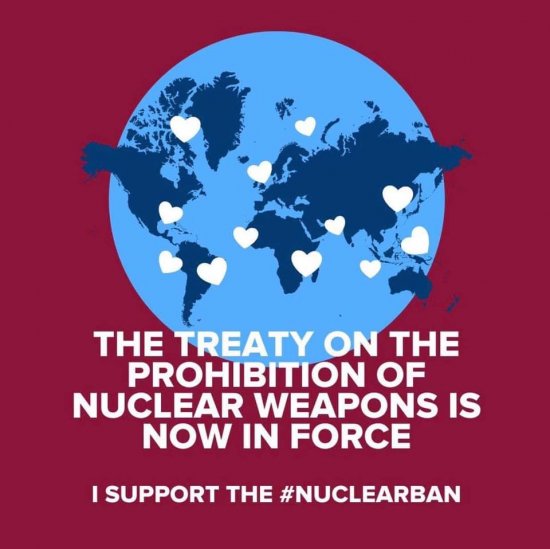
| The Nuclear Free Local Authorities have joined with campaign groups opposed to nuclear weapons in calling on the British Foreign Secretary to ensure that the UK is represented at the forthcoming nuclear treaty ban conference to be held later this month in Vienna. Sixty-one member states of the United Nations have so far signed and ratified the UN Treaty on the Prohibition of Nuclear Weapons, the first international law to prohibit the manufacture, stockpiling, transfer and use of nuclear weapons which entered force in January 2021. A further twenty-five states have signed the Treaty in readiness to ratify it. These member states will meet at the UN in Vienna between 21 – 23 June to discuss the progress so far in creating a nuclear weapons free world, and, in light of the recent conflict in Ukraine, the next best steps to get there. None of the world’s nuclear weapons states have so far engaged with the treaty, and the UK has steadfastly refused to recognise it, despite five of the states, including the UK, making a commitment as signatories to the Nuclear Non-Proliferation Treaty to work in ‘good faith’ to achieve global nuclear disarmament at the earliest possible date. Britain made this commitment as one of the first signatories to the NPT in 1968. NFLA 8th June 2022 https://www.nuclearpolicy.info/news/nuclear-free-local-authorities-join-call-for-uk-to-attend-nuclear-ban-summit/ |
EDF delays the scheduled maintenance shutdowns of 7 French nuclear reactors.

| EDF has pushed back scheduled shutdowns for next winter of seven French reactors and plans to delay an eighth, Remit data showed on Wednesday. These changes concern the shutdowns of the Bugey 5 (880 MW), Cattenom 2 (1,300 MW), Cruas 4 (915 MW), Golfech 2 (1,310 MW), Gravelines 1 (910 MW), Nogent 2 (1,310 MW) reactors. ) and Paluel 1 (1,330 MW). The delays vary from several weeks to about a month. The company also plans to push back for two weeks, until February 25, the scheduled shutdown of its St Alban 1 reactor (1.3 GW). EDF gave no explanation for these measures. They come amid fears of a shortage of electricity supply in France next winter, due to a record drop in nuclear generation. The public nuclear electric company was forced to unexpectedly shut down several reactors for checks and repairs following the discovery of corrosion on important safety circuits at the end of last year. Last month, EDF revised the dates of thirteen scheduled reactor outages, citing corrosion-related checks and repairs. Montel 8th June 2022, https://www.montelnews.com/fr/news/1326472/edf-retarde-les-arrts-hivernaux-de-7-racteurs-franais |
Nuclear Free Local Authorities oppose Nuclear Waste Authorities’ seismic testing in the Irish Sea
| On World Oceans Day (8 June), the Nuclear Free Local Authorities have joined environmental and anti-nuclear campaigners in opposing proposals to carry out seismic testing in the Irish Sea as part of plans to develop an offshore, undersea nuclear waste dump. A joint letter, whose signatories include renowned environmentalist Jonathan Porritt, has been sent to the head of the Marine Management Organisation opposing an exemption to the requirement to obtain a Marine Licence which has been claimed by Nuclear Waste Services to enable them to plough ahead with their summer plans to carry testing in the waters off West Cumbria. The NWS, an operating division of the Nuclear Decommissioning Authority, is responsible for finding a site for a so-called Geological Disposal Facility, either below ground or beneath the seabed. This nuclear waste dump will be filled with the toxic radioactive waste that is the legacy of Britain’s seven decades of the civil nuclear power production; much of it will remain radioactive for many tens of thousands of years. Three search areas in Cumbria, falling within the local authority areas of Allerdale and Copeland and offshore up to 22kms, are under consideration. Seismic testing will enable NWS to determine if the geology beneath the bed of the Irish Sea is suitable to host a repository for the nuclear waste. This involves firing blasts of sound from air guns below the waves every 10 seconds for four weeks or longer. This sound penetrates under the ocean floor to help scientists discover more about the suitability of the geology to store nuclear waste. Seismic testing can seriously impair the health of marine life, which in the Irish Sea includes whales, dolphins, porpoises, and seals, but some scientific reports also suggest that even tiny shellfish and plankton can be adversely impacted, hazarding the whole marine ecosystem. NFLA 8th June 2022, https://www.nuclearpolicy.info/news/nuclear-free-local-authorities-oppose-seismic-testing-on-world-oceans-day/ |
Ukraine bars IAEA nuclear regulator from visiting Russian-occupied power plant !

The International Atomic Energy Agency wants to ensure that the Zaporizhzhia nuclear power plant is safe. Politico, BY LOUISE GUILLOT, June 7, 2022
Energoatom, Ukraine’s nuclear power plant operator, on Monday denounced a request by the global nuclear watchdog to visit the Russian-occupied Zaporizhzhia nuclear power plant.
The Ukrainian operator accused Rafael Mariano Grossi, head of the International Atomic Energy Agency, of “lying” and warned that the visit was a way of legitimizing Russia’s occupation of Europe’s largest nuclear plant — which is operated by Ukrainian staff but has been under the control of Russian troops since March.
“The Ukrainian side did not invite Grossi to visit ZNPP [Zaporizhzhia Nuclear Power Plant] and had previously denied him such a visit, emphasizing that a visit to the power plant will be possible only when our country regains control over it,” Energoatom said in a Telegram post.
Rosatom Director General Alexey Likhachev said in March that the Russian state-owned nuclear operator had no intention of taking operational control of Zaporizhzhia.
Grossi said Monday that he was “actively working” on sending an expert mission to the plant “sooner or later but better sooner.” Grossi has been working on setting up such a trip for months, but has so far been unsuccessful in getting Ukraine and Russia to agree on the details.
Dmitry Peskov, Russian President Vladimir Putin’s spokesperson, said last month that the IAEA was in touch with both Russian and Ukrainian authorities about a possible visit, Russian state-controlled press agency Interfax reported………………………..
Grossi also said Monday that Ukraine told his agency it has “lost control over” nuclear material at Zaporizhzhia and that data communication on nuclear safeguards with the plant has broken down. Nuclear safeguards mechanisms are essential to ensure that nuclear facilities are not misused and nuclear material not diverted from peaceful uses.
“The urgent need for us to be there is clear to all,” he said. “Logistics and other such considerations must not prevent it. We must find a solution to the hurdles preventing progress at Zaporizhzhia NPP.”………………
The IAEA declined to comment on Energoatom’s allegations. https://www.politico.eu/article/ukraine-nuclear-regulator-visit-russia-power-plant/
The War Situation Has Developed Not Necessarily to Ukraine’s or the West’s Advantage But They Plan to Negotiate When They’ve Turned Things Around a Bit

naked capitalism, by Yves Smith,
ust because Russia has been slow and methodical about grinding up Ukraine’s army and materiel in Donbass does not mean that there’s reason to think Ukraine can turn its losses around with generous applications of Western funding, weapons, and hopium. And on the economic war front, even though Russia has taken a hit, it seems to be making surprisingly solid progress in adjusting, while conditions in the US and Europe look to be worsening, and at an accelerating rate.
Admittedly, the press, presumably reflecting the readings of military experts, has greatly reduced coverage of the conflict now that even generous applications of porcine maquillage can no longer hide that things are going from bad to worse for Ukraine. A very long established contact forwarded this message from a former senior US military official:
Just in from an Army Colonel in the building:
“Spoke to someone today who said that the Ukie basic training is 10 days and then off to the front. 65% casualty rates. At least double or more the losses of the Russians but you don’t hear anything about it.”
Recall that Scott Ritter, early on in his many detailed analysis, said that if one side was consistently inflicting casualties at a higher rate than the other, even at a ratio of say 1:1.2, the side with the lower losses would prevail.
Recall also that Ukraine has not made a single significant offensive since the war began. The most it has been able to achieve are small tactical gains that don’t amount to anything over time.
……………………………….. Truth be told, Western officials and the media are increasingly acknowledging that Ukraine can’t win this war, and therefore the two sides need to negotiate a peace. But to invoke a saying I heard in Venezuela, “They have changed their minds, but they have not changed their hearts.” The US and NATO have consumed so much Ukraine Kool-Aide that they are light-year away from what a realistic settlement would have to include. And that’s because they still can’t admit to themselves that Russia is wining, and at this rate, will have taken Odessa before Zelensky will even be willing to cede Donbass. For instance, look at this key statement from Joe Biden’s New York Times op-ed earlier this week:
We have moved quickly to send Ukraine a significant amount of weaponry and ammunition so it can fight on the battlefield and be in the strongest possible position at the negotiating table
Why should Ukraine keep fighting and losing more men and suffering more damage? Why not sue for peace now? Biden’s unstated assumption is that if the US pumps enough air into the leaking Ukraine balloon, it will be in a better position than it is now. That can come about only by taking territory back or by inflicting huge losses on the Russian side. In what universe is that a likely outcome?
There are also complicating factors on the Russian side. One is that the Russian population regards Putin as too dovish and would much rather have the Ukraine matter be as settled as it can be via this war. That argues for taking more territory, certainly the entire Black Sea coast, probably Kharkiv and perhaps even securing the Dneiper save perhaps hard by Kiev.
A second matter is that many of the “liberated” or expecting to be liberated territories seem to want to join Russia, and not be independent friendlies or part of a Novorossiya (this may be realism as well as romanticism; they are too small to go it alone). One reason for this expectation is that at least some members of the Donbass militias are continuing to fight for the Russian cause in neighboring oblasts, here Kherson.
Recall that Putin was not happy when the two breakaway republics declared independence in 2014, and he had to push them in the Minsk Accord negotiations to accept staying in Ukraine,……………………………………………..
the Guardian get credit for admitting that Russia is winning the economic war – and Putin is no closer to withdrawing troops. However, economic editor Larry Elliott’s contains a lot of hand wringing and falsehoods, like the claim that Putin “weaponized” food. But notice that his closing section calls only for “a deal” not a rollback of sanctions. And it’s the sanctions that are hurting the collective West:
If proof were needed that sanctions are not working, then President Joe Biden’s decision to supply Ukraine with advanced rocket systems provides it. The hope is that modern military technology from the US will achieve what energy bans and the seizure of Russian assets have so far failed to do: force Putin to withdraw his troops.
Complete defeat for Putin on the battlefield is one way the war could end, although as things stand that doesn’t appear all that likely. There are other possible outcomes. One is that the economic blockade eventually works, with ever-tougher sanctions forcing Russia to back down. Another is a negotiated settlement.
Putin is not going to surrender unconditionally, and the potential for severe collateral damage from the economic war is obvious: falling living standards in developed countries; famine, food riots and a debt crisis in the developing world.
The atrocities committed by Russian troops mean compromising with the Kremlin is currently hard to swallow, but economic reality suggests only one thing: sooner or later a deal will be struck.
Perhaps Elliott didn’t want to stick his neck out too far by saying ending at least some of the sanctions would be necessary. But the failure to call for that means that politicians with no skin in the game like Ursuala von der Leyen will continue trying to escalate. It doesn’t matter that it isn’t working. These officials have convinced themselves that eyepoking the evil Putin will bring down Russia. They need to heed the oracle’s warning to to Croesus: that if he attacked the Persians, he would destroy a great empire. That empire was his own. https://www.nakedcapitalism.com/2022/06/the-war-situation-has-developed-not-necessarily-to-ukraine-or-the-wests-advantage-but-they-plan-to-negotiate-when-theyve-turned-things-around-a-bit.html
Ukraine staging battle scenes for propaganda – Russia
Russia, https://www.rt.com/russia/556544-staged-footage-action-ukraine/ 7 June 22, The propaganda footage was allegedly sponsored by the British government, The Russian Defense Ministry released on Friday what it claimed to be staged combat scenes filmed on behalf of the Ukrainian government and paid for by the British government. The two short clips appear to be raw footage of what looks like a war movie.
The filming of the videos took place on May 28 in the town of Meshkovka in Ukraine’s Nikolaev Region, the ministry said. A train station of the same name is located on the outskirts of the provincial capital in the south of the country.
One of the videos shows two armored vehicles facing the camera. At the command of a woman, who appears to be the film director, the backdoor of the closest vehicle opens, and a group of armed men in uniform wearing red armbands starts pouring out. Several others rise from the grass around the second vehicle in the distance and start moving forward, their weapons raised.
The second clip is a shootout scene, with a group of armed uniformed men retreating through rubble while firing back at an unseen enemy. Pyrotechnics appear to simulate enemy fire. At one point, a professional-looking film crew comes into view.
Germany rules out nuclear power as an option during the energy crisis.
German Leader Rules Out Nuclear Option to Fill Energy Gaps
German Chancellor Olaf Scholz says his government remains committed to phasing out nuclear power despite concerns about rising energy prices and possible future shortages due to Russia’s war in Ukraine.
By Associated Press, June 8, 2022, BERLIN (AP) — German Chancellor Olaf Scholz said Wednesday that his government remains committed to phasing out nuclear power despite concerns about rising energy prices and possible future shortages due to Russia’s war in Ukraine.
Germany shut down half of its six nuclear plants in December and the remaining three are due to cease production at the end of this year as part of the country’s long-running plan to phase out conventional power plants in favor of renewable energy……………….
“We also know that building new nuclear power plants makes little sense,” he said at a news conference with foreign correspondents in Berlin.
“If someone decides to do so now they would have to spend 12-18 billion euros on each nuclear power plants and it wouldn’t open until 2037 or 2038,” said Scholz. “And besides, the fuel rods are generally imported from Russia. As such one should think about what one does.”
“That’s why the government, all the governing parties unanimously, are counting on (…) the massive expansion of renewable energy,” he added…………..
“The goal of completing the phaseout of coal in Germany ideally by 2030, and the climate targets, remain in place,” Government spokeswoman Christiane Hoffmann said. https://www.usnews.com/news/business/articles/2022-06-08/germany-to-keep-more-coal-plants-on-hand-in-case-of-gas-cuts
Ukraine slams planned IAEA mission to Russian-occupied nuclear plant
Reutershttps://www.reuters.com/world/europe/ukraine-slams-planned-iaea-mission-russian-occupied-nuclear-plant-2022-06-07/
June 7 (Reuters) – Ukraine’s state nuclear company Energoatom on Tuesday criticised an IAEA plan to send a delegation to a Russian-occupied nuclear plant in southern Ukraine, saying it “did not invite” such a visit.
“We consider this message from the head of the IAEA as another attempt to get to the (power plant) by any means in order to legitimise the presence of occupiers there and essentially condone all their actions,” Energoatom wrote on the Telegram messaging app.
On Monday, IAEA head Raphael Grossi said the organisation was working on sending an international mission of experts to the Russian-held nuclear power plant at Zaporizhzhia in Ukraine, Europe’s largest. nL1N2XT0LV]
 | |||
|
| |||
| to me |
| |||
|
New film shows the anguish and destruction of the Chernobyl nuclear disaster
| A new documentary contains “lost tapes” of the Chornobyl disaster that have never been seen before, showing the horrific destruction and anguish that occurred during and after the worst nuclear incident in history. In a new trailer for the Sky Original documentary, Chernobyl: The Lost Tapes, HBO released small snippets of footage of the heroic workers that fought to contain the fallout and of the thousands of residents evacuating the area, including the voices of locals that the documentary claims were “silenced” following the disaster. IFL 6th June 2022https://www.iflscience.com/editors-blog/lost-tapes-of-chernobyl-reveal-the-devastating-impact-of-the-worst-nuclear-disaster/ |
The unpalatable truth in Ukraine

“When you have eliminated the impossible, whatever remains, however improbable unpalatable, must be the truth.”
And when this final scenario comes to pass, who will have won the war in Ukraine?
Well, it won’t be Ukraine.
The Hill. BY ANDREW LATHAM, OPINION CONTRIBUTOR – 06/02/22 ”…………………………………… “When you have eliminated the impossible, whatever remains, however improbable, must be the truth.” – Sherlock Holmes – Sir Arthur Conan Doyle
And the truth is, once we have eliminated all the impossible scenarios, the least improbable outcome of the war in Ukraine is a Russian victory.
Note that I did not say such an outcome would be desirable. Russia’s inevitable victory is anything but. Nor did I say it would be total. The outcome of this war is going to fall far short of the Kremlin’s initial hopes and expectations. Nor, finally, did I say it would be without significant cost. Any conceivable Russian victory now will entail such a loss of blood and treasure that it will have to be judged Pyrrhic at best.
But it will be a victory nonetheless — and we in the West had better come to grips with that hard truth.
Let’s begin by eliminating the impossible.
The first unrealistic endgame is the reduction of Ukraine to a vassal state of the Russian empire. This would entail the kind of operation initially envisioned by the Kremlin: a quick decapitating military strike, the installation of a pro-Moscow regime in Kyiv and either the formal incorporation of Ukraine into the Russian Federation or its informal incorporation into a Russian sphere of influence (like Belarus).
While perhaps the initial objective of Russia’s “special military operation,” this outcome is now obviously an impossibility. ………………………………….
The second impossible scenario is the total defeat of the Russian military and the restoration of Ukraine to its pre-2014 borders. In this scenario, the Ukrainian military, having blunted the initial Russian offensive, launches a successful counter-offensive that ultimately drives the Russians not only out of the territories they captured in 2022 but out of the Donbas and Crimea as well. The resulting political dispensation would be an independent Ukraine restored to its internationally recognized borders and free to join NATO and/or associate with the European Union (EU) as it saw fit.
While advocated by many within and beyond Ukraine, this outcome is simply impossible. …………………………..
Indeed, there is no reason to believe that they will even be displaced from much of the territory they have seized along the coast of the Sea of Azov……………… despite the willful delusions of some and the idealistic hopes others, this outcome is simply impossible.
The third and final impossible scenario is a limited Ukrainian victory that would reverse all or most of the Russian gains since Feb. 24, 2022. In this scenario, while the Donbas and Crimea remain in Russian hands, all the territory captured by Russia since its recent re-invasion would be liberated by Ukrainian forces and restored to Ukrainian control.
While once viewed as a realistic outcome, by now it should be obvious that this is impossible. Just as Ukraine lacks the ability to liberate all its pre-2014 territory, it also lacks the ability to liberate the recently conquered territory in the Donbas or along the Azov coast. Unlike in the north of Ukraine, these territories are central to Russian interests in Ukraine and, as such, Russia simply will not withdraw from them as it withdrew from Kyiv earlier in the war. Nor will Ukrainian forces – themselves, it should be noted, suffering terrible attrition all along the battle front and growing weaker with each passing day – be strong enough to compel them to do so. No, like the previous two scenarios, this one is simply an impossibility.
And that leaves only one other conceivable outcome: a fragmented and partly dismembered Ukraine, neither fully part of the West nor entirely within the Russian sphere of influence. A Ukraine fragmented in that the whole of the Donbas and perhaps other territories will be left beyond Kyiv’s control; partly dismembered in that Crimea will remain part of Russia (at least in Russian eyes); and not fully part of the West in that it will not be free to join NATO or even to have a meaningful partnership with the EU. Simply put, this outcome is not only not impossible, it’s not even improbable.
And when this final scenario comes to pass, who will have won the war in Ukraine?
Well, it won’t be Ukraine. While such an outcome will satisfy the basic existential goals of Kyiv, it will be a far cry from the more maximalist ambitions expressed both before and after Feb. 24. No, when this scenario inevitably comes to pass, it will clearly be a defeat for Kyiv.
Similarly, such an outcome will not satisfy the maximalist ambitions of those in Moscow who thought that their initial thunder run would resolve the Ukraine issue once and for all. But it will satisfy the Kremlin’s most basic and fundamental geopolitical desideratum: a neutralized Ukraine beyond both the geopolitical ambit of NATO and the geoeconomic orbit of the EU. It will also “restore” Crimea to its rightful place in Russia. And finally, it will demonstrate that interfering in Russia’s natural sphere of influence is unwise. In these ways, when the impossible has been eliminated, the resulting outcome will clearly be a victory for Moscow.
………………..when it comes to thinking about the possible outcomes of the war in Ukraine, perhaps it ought to read something more like: “When you have eliminated the impossible, whatever remains, however improbable unpalatable, must be the truth.”
Andrew Latham is a professor of international relations at Macalester College in Saint Paul, Minn., and a non-resident fellow at Defense Priorities in Washington, D.C. Follow him on Twitter @aalatham. https://thehill.com/opinion/international/3509458-the-unpalatable-truth-in-ukraine/
The need for a negotiated settlement to end the Ukraine war – Western allies discuss this

senior Western officials — including US President Joe Biden — are emphasizing anew that even with advanced western weaponry, Ukraine’s prospects for peace will ultimately rest on diplomacy.
Western allies meeting regularly to game out potential framework for Ukraine ceasefire as war hits 100th day. By Natasha Bertrand, Katie Bo Lillis, Barbara Starr and Jeremy Herb, CNN, June 3, 2022,Washington (CNN)Staring down the prospect of an extended stalemate in Ukraine, the US and its allies are placing a renewed emphasis on the need for a negotiated settlement to end the war as the conflict grinds into its 100th day with no clear victory in sight for either side.
US officials have in recent weeks been meeting regularly with their British and European counterparts to discuss potential frameworks for a ceasefire and for ending the war through a negotiated settlement, multiple sources familiar with the talks told CNN. Among the topics has been a four-point framework proposed by Italy late last month. That framework involves Ukraine committing to neutrality with regard to NATO in exchange for some security guarantees, and negotiations between Ukraine and Russia on the future of Crimea and the Donbas region.
Ukraine is not directly involved in those discussions, despite the US commitment to “nothing about Ukraine without Ukraine.” US and Ukrainian officials said the US has not been pressuring Ukraine to commit to a certain plan or directly pushing them to sit down with the Russians.
Still, there is some confusion about what kind of framework the US would consider appropriate to bring to the Ukrainians for further discussion.
US Ambassador to the UN Linda Thomas Greenfield told reporters earlier this week that the Italian framework is “one of those initiatives that we certainly would love to see bring a conclusion to this horrific war and the horrific attacks on the Ukrainian people.” But two US officials told CNN that the US actually does not support the Italian proposal.
In any case, US and western officials tell CNN that there is a growing concern that if the Russians and Ukrainians don’t get back to the table and work out a deal, the war will drag on — potentially for years.
Subtle language shift
It’s not clear whether these discussions will translate into eventual settlement talks. The Biden administration still sees no real prospect for any diplomatic breakthroughs or ceasefires anytime soon and two NATO officials said that the western alliance sees little appetite to negotiate on the Ukrainian side — in part because Russia’s brutal bombing campaign and myriad human rights violations have destroyed public support for any concession to Russia.
Moscow has also showed little interest in serious talks, officials say. Right now, Ukraine remains focused on ensuring a decisive military victory in the east and the south in order to put themselves in a superior negotiating position, these sources said.
“We can propose all the plans we want, but unlikely Kyiv will go for anything that cedes territory at the moment,” according to one official.
The concern that the conflict could grind on indefinitely — with mounting costs — has been reflected in the subtle shift in language and messaging by US officials over the past several weeks.
In April, the US’ stated goal was for Russia to “fail,” a National Security Council spokesperson said at the time, and for the Russian military to be significantly “weakened” in the long term, as Defense Secretary Lloyd Austin proclaimed — comments that reflected optimism that Ukraine might be able to defeat Russia decisively on the battlefield after successfully defending Kyiv.
But as an effective stalemate has taken hold on the battlefield, with Russia making incremental gains in the east and Ukraine saying it is increasingly outgunned and outmanned, senior Western officials — including US President Joe Biden — are emphasizing anew that even with advanced western weaponry, Ukraine’s prospects for peace will ultimately rest on diplomacy.
“As President Volodymyr Zelensky of Ukraine has said, ultimately this war ‘will only definitively end through diplomacy,'” Biden wrote in a New York Times op-ed on Tuesday. “Every negotiation reflects the facts on the ground. We have moved quickly to send Ukraine a significant amount of weaponry and ammunition so it can fight on the battlefield and be in the strongest possible position at the negotiating table.”
The hope, officials said, is that the US can support Ukraine long enough to see it through to a peaceful settlement rather than a full capitulation……………………..
As the US looks to maintain its military and financial support for Ukraine and isolate Russia for as long as it takes to get to a peace agreement, a key strategy will be keeping the NATO alliance unified. But already, sources say, there are cracks appearing in NATO — Turkey is refusing to allow Sweden and Finland to move forward with joining the bloc, and diplomats had to carve out an exception for Hungary as part of Europe’s recent oil embargo against Russia.
There’s also the challenge of maintaining domestic support for funding Ukraine’s war. There’s been growing opposition among Donald Trump-aligned Republicans with each assistance vote that Congress has taken, one Democratic lawmaker noted. He added that there are concerns over how willing Congress will be in the future to fund a protracted conflict……………..https://edition.cnn.com/2022/06/03/politics/ukraine-100-days-western-allies-regular-meetings-potential-ceasefire/index.html
Arms sent to Ukraine will end up in criminal hands, says Interpol chief
Jürgen Stock urges members to cooperate on arms tracing as weapons will flood hidden economy when war ends,
Guardian, Kim Willsher, Thu 2 Jun 2022
Weapons sent to Ukraine after Russia’s invasion in February will end up in the global hidden economy and in the hands of criminals, the head of Interpol has said.
Jürgen Stock says once the conflict ends, a wave of guns and heavy arms will flood the international market and he urged Interpol’s member states, especially those supplying weapons, to cooperate on arms tracing.
“Once the guns fall silent [in Ukraine], the illegal weapons will come. We know this from many other theatres of conflict. The criminals are even now, as we speak, focusing on them,” Stock said.
“Criminal groups try to exploit these chaotic situations and the availability of weapons, even those used by the military and including heavy weapons. These will be available on the criminal market and will create a challenge. No country or region can deal with it in isolation because these groups operate at a global level.”
He added: “We can expect an influx of weapons in Europe and beyond. We should be alarmed and we have to expect these weapons to be trafficked not only to neighbouring countries but to other continents.”
He said Interpol urged members to use its database to help “track and trace” the weapons. “We are in contact with member countries to encourage them to use these tools. Criminals are interested in all kinds of weapons … basically any weapons that can be carried might be used for criminal purposes.”
Ukraine’s western allies have sent shipments of high-end military weapons to Ukraine since the Russian invasion more than three months ago. On Tuesday, the American president, Joe Biden, announced the US would supply Kyiv with advanced missile systems and munitions. After the US pulled out of Afghanistan in 2021, following 20 years of war, huge amounts of often highly sophisticated military equipment was left behind and fell into the hands of the Taliban.
Stock, the secretary general of the international policing organisation who was speaking to the Anglo-American Press Association in Paris, said the conflict in Ukraine had also led to a rise in large-scale fertiliser theft and an increase in counterfeit agrochemicals. There was also a huge rise in fuel theft. “These products have become more valuable,” he said……………………………………. https://www.theguardian.com/world/2022/jun/02/ukraine-weapons-end-up-criminal-hands-says-interpol-chief-jurgen-stock
Much hyping for France’s NUWARD small modular reactor (SMR) design: construction to start in 2030 (but will it be a lemon?)

France’s NUWARD SMR Will Be Test Case for European Early Joint Nuclear Regulatory Review, Power, 5 June 22. The French Nuclear Safety Authority (ASN), the Czech State Office for Nuclear Safety (SUJB), and Finland’s Radiation and Nuclear Safety Authority (STUK) have picked France’s NUWARD small modular reactor (SMR) design as a test case for an early joint regulatory review for SMRs. The development marks a notable step by European regulators to align practices in a bid to harmonize licensing and regulation for SMRs in the region.
EDF, an entity that is majority held by the French government, on June 2 announced the reactor design will be the subject of the review, which “will be based on the current set of national regulations from each country, the highest international safety objectives and reference levels, and up-to-date knowledge and relevant good practice.”
The technical discussions and collaborative efforts associated with the review will both help ASN, STUK, and SUJB “increase their respective knowledge of each other’s regulatory practices at the European level,” as well as “improve NUWARD’s ability to anticipate the challenges of international licensing and meet future market needs,” it said.
A European Frontrunner
NUWARD, which is still currently in the conceptual design phase, may be a frontrunner in the deployment of SMRs in Europe. It was unveiled in 2019 by EDF, France’s Alternative Energies and Atomic Energy Commission (CEA), French defense contractor Naval Group, and TechnicAtome, a designer of naval propulsion nuclear reactors and an operator of nuclear defense facilities. The consortium in May tasked Belgian engineering firm Tractabel with completing—by October 2022—conceptual design studies for parts of the conventional island (turbine hall), the balance of plant (water intake and servicing system), and the 3D modeling of the buildings that will house those systems.
Launched as a design that derives from the “best-in-class French technologies” and “more than 50 years of experience in pressurized water reactor (PWR) design, development, construction, and operation,” the design proposes a 340-MWe power plant configured with twin 170-MWe modules. NUWARD is based on an integrated PWR design with full integration of the main components within the reactor pressure vessel, including the control rod drive mechanisms, compact steam generators, and pressurizer, CEA says.
As “the most compact reactor in the world,” the design is well-suited for power generation, including replacing coal and gas-fired generation, as well as for electrification of medium-sized cities and isolated industrial sites, CEA says. According to Tractabel, the next phase of the NUWARD project—the basic design completion—is slated to begin in 2023. Construction of a reference plant is expected to start in 2030.
Crucial to SMR Deployment: Harmonization of Regulations
On Thursday, EDF noted that while SMR technology innovation is important, deployment of SMRs, which will be integral to the energy transition toward carbon neutrality, will require “a serial production process and a clear regulatory framework.” Harmonization of regulations and requirements in Europe and elsewhere will be “an essential element to support aspirations of standardization of design, in-factory series production and limited design adaptations to country-specific requirements,” it said.
Several efforts to encourage collaboration on SMR licensing and regulatory alignment are already underway in Europe. These include the European SMR Partnership led by FORATOM, the Brussels-based trade association for the nuclear energy industry in Europe, and the Sustainable Nuclear Energy Technology Platform (SNETP), as well as the Nuclear Harmonisation and Standardisation Initiative (NHSI), which the International Atomic Energy Agency launched in March.
The European Union is separately spearheading the ELSMOR project, which aims to enhance the European capability to assess and develop the innovative light water reactor (LWR) SMR concepts and their safety features, as well as sharing that information with policymakers and regulators.
SMRs Part of Future Plans for France, Czech Republic, Finland
Participation of the three countries—France, the Czech Republic, and Finland—is noteworthy for their near-term plans to expand generation portfolios with new nuclear. French President Emmanuel Macron on Feb. 10 said France will build six new nuclear reactors and will consider building eight more. Macron also notably said $1.1 billion would be made available through the France 2030 re-industrialization plan for the NUWARD SMR project.
In the Czech Republic, which has six existing nuclear reactors that generate about a third of its power, energy giant ČEZ has designated a site at the Temelín Nuclear Power Plant as a potential site for an SMR. ČEZ has signed a memorandum of understanding on SMRs with NuScale, and it also has cooperation agreements with GE Hitachi, Rolls-Royce, EDF, Korea Hydro and Nuclear Power, and Holtec.
Finland has five operating reactors, and it is in the process of starting up Olkiluoto 3, a 1.6-GW EPR (EDF’s next-generation nuclear reactor), whose construction began in 2005. Two others were planned: Olkiluoto 4 and Hanhikivi 1. Early in May, however, Finnish-led consortium Fennovoima said it had scrapped an engineering, procurement, and construction contract for Russia’s state-owned Rosatom to build the 1.2-GW Hanhikivi 1, citing delays and increased risks due to the war in Ukraine. On May 24, Fennovoima withdrew the Hanhikivi 1 nuclear power plant construction license application.
The VTT Technical Research Centre of Finland is actively developing an SMR intended for district heating. While Finland now mostly relies on coal for district heat, it has pledged to phase out coal by 2029. VTT, notably, coordinates with the ELSMOR project for European SMR licensing practices. In addition, VTT says it is leading a work package related to the new McSAFER project, which is developing next-generation calculation tools for the modeling of SMR physics.
—Sonal Patel is a POWER senior associate editor (@sonalcpatel, @POWERmagazine).
Spain and Portugal stand out from the European Union, in slashing energy bills because of their high renewable energy use
Spain and Portugal have broken ranks with the EU to allow themselves the
space to slash their energy bills by 40 per cent. The move is being allowed
because both southern European countries have a large amount of renewable
energy and aren’t as reliant on fossil fuels as the rest of the Continent.
MSM 31st May 2022
New documentary shows Soviet disinformation over the true horror of the Chernobyl nuclear meltdown
On April 26, 1986, the core of the No. 4 reactor in the Chernobyl Nuclear
Power Plant near Pripyat melted down, causing a nuclear accident that
released airborne radioactive contamination for about nine days in what is
still classified as the worst nuclear disaster in history, both in cost and
casualties.
Stories around the Chernobyl disaster have been told time and
time again, most notably in the critically-acclaimed HBO limited series
“Chernobyl.”
Now, HBO is returning with yet another Chernobyl project, but
this time without the dramatization. As part of HBO Documentary films,
Emmy-winning filmmaker James Jones (“Mosul”) is debuting his film
“Chernobyl: The Lost Tapes.” Thirty-six years after the initial disaster,
“Chernobyl: The Lost Tapes” presents recently uncovered archival footage
and recorded interviews with those who were present during the disaster and
subsequent fall out, as a means to show the reality of just how horrific
the Chernobyl disaster actually was, and the deplorable lengths the Soviet
government went in an attempt to cover up what really happened.
It’s estimated that over 200,000 people died as a result of the Chernobyl
disaster, but the official Soviet count lists it only as 31. The Soviet’s
mishandling of the crisis utilized misinformation and distortion tactics
still used today, led citizens to greatly distrust authorities, and
contributed to the end of the Soviet Union. According to the official press
release, “Chernobyl: The Lost Tapes” is the “full, unvarnished true story
of what happened in one of the least understood tragedies of the twentieth
century.”
Slash Film 3rd June 2022
1 This Month


of the week– Nuclear Reactor Information Task Force

14 May – online event From Bombs to Data Centres: the Face of Nuclear Colonialism
To see nuclear-related stories in greater depth and intensity – go to https://nuclearinformation.wordpress.com
-
Archives
- May 2026 (163)
- April 2026 (356)
- March 2026 (251)
- February 2026 (268)
- January 2026 (308)
- December 2025 (358)
- November 2025 (359)
- October 2025 (376)
- September 2025 (257)
- August 2025 (319)
- July 2025 (230)
- June 2025 (348)
-
Categories
- 1
- 1 NUCLEAR ISSUES
- business and costs
- climate change
- culture and arts
- ENERGY
- environment
- health
- history
- indigenous issues
- Legal
- marketing of nuclear
- media
- opposition to nuclear
- PERSONAL STORIES
- politics
- politics international
- Religion and ethics
- safety
- secrets,lies and civil liberties
- spinbuster
- technology
- Uranium
- wastes
- weapons and war
- Women
- 2 WORLD
- ACTION
- AFRICA
- Atrocities
- AUSTRALIA
- Christina's notes
- Christina's themes
- culture and arts
- Events
- Fuk 2022
- Fuk 2023
- Fukushima 2017
- Fukushima 2018
- fukushima 2019
- Fukushima 2020
- Fukushima 2021
- general
- global warming
- Humour (God we need it)
- Nuclear
- RARE EARTHS
- Reference
- resources – print
- Resources -audiovicual
- Weekly Newsletter
- World
- World Nuclear
- YouTube
-
RSS
Entries RSS
Comments RSS
 nuclear-news