U.N. report on crimes, human rights violations in Ukraine-Russia war includes abuses done by the Ukrainian side
 | |||
|
UN OHCHR report on human rights violations in Ukraine-Russia war reminds us of the ugly, inhumane nature of warfare. The relevance for Westerners is the documentation of Ukrainian crimes, incl torture, disappearances, abuse of POWs, corpse desecration &c
US nukes in UK ‘would provoke Putin and put Britons on front line in any nuclear war’
THE RETURN of US nukes to the UK would be “insanely provocative” and put Britons on the front line of a nuclear war, it has been claimed.
https://www.express.co.uk/news/uk/1636941/vladimir-putin-russia-us-nuclear-weapons-lakenheath-return-latest By JON KING. Jul 9, 2022 US Government budget papers revealed earlier this year that vaults at RAF Lakenheath in Suffolk are being upgraded so they can store B61-12 nuclear bombs. The air base received the latest nuclear capable fighter jet, the F-35A, in December with 48 expected to be stationed there.
Hans Kristensen, Director of the Nuclear Information Project at the Federation of American Scientists, spotted the US Department of Defense had added the UK to a list of NATO nuclear weapons storage locations.
RAF Lakenheath has been home to US nuclear weapons in the past and has been undergoing upgrade work amounting to £600million, most of which is paid for by US taxpayers.
The Ministry of Defence (MoD), however, has neither confirmed nor denied that US nuclear weapons are in Britain or going to come to UK shores.
CND General Secretary Kate Hudson, commenting on US nuclear weapons coming to Britain, told Express.co.uk: “We should be very worried by this. Allowing the US to bring these weapons back to Britain is a very dangerous development.
“It would be insanely provocative. It would put us even more on the front line in any nuclear exchange. To have new, US [nuclear weapons] here when there’s a considerable possibility of a war between NATO, the US, and Russia – it is very, very dangerous.
“We hope the US will pull back from any actual deployment.”
An MOD spokesperson said: “It is NATO and UK policy to neither confirm nor deny the presence of nuclear weapons at a given location.”
It comes at a time of heightened tensions between Russia and the West with Russian President Vladimir Putin having put his country’s nuclear deterrent on alert at the beginning of the war in Ukraine.
Russia’s foreign ministry said last month Moscow would supply ally Belarus with missile systems capable of carrying nuclear weapons.
Former Russian President Dmitry Medvedev told the United States on Wednesday (July 6) attempts by the West to punish a nuclear power such as Russia for the war in Ukraine risked endangering humanity.
Commenting before Boris Johnson announced he was stepping down as leader of the Conservative Party, Ms Hudson accused the PM of being a “vociferous advocate” of escalating the war against Russia and putting Britain in a “very dangerous” position.
She continued: “If that continues, it is likely we will have a nuclear exchange. It is pretty impossible to imagine Britain would not be at the front of that exchange, knocking out Lakenheath and Faslane.”
France’s parliament could block Macron’s plan to nationalise EDF
French parliament could block EDF reform – analyst. French government
plans to reform utility EDF face being blocked in parliament due to
bolstered opposition from far right and left-wing parties, an analyst said
this week. “You’re going to have a lot of potential blockages with the EDF
reform,” said Phuc-Vinh Nguyen of the Jacques Delors Institute think tank.
“It is one of the major issues of the five-year term, which will have a
major impact on the revival of nuclear power, renewables and energy policy.
Without an agreement, your hands are tied.” French president Emmanuel
Macron’s ruling Renaissance party lost its absolute majority in the lower
house in parliamentary elections in June. This was due to major gains by
the Eurosceptic far right party, RN, now the leading opposition group in
the National Assembly and the left-wing Nupes party, which opposes
Macron’s plan to build new nuclear reactors.
Montel News 8th July 2022
https://www.montelnews.com/news/1334284/french-parliament-could-block-edf-reform–analyst
Nationalisation of French energy giant EDF means it is unlikely to spearhead future nuclear power projects in UK, according to top industry insider
By FRANCESCA WASHTELL, FINANCIAL MAIL ON SUNDAY,
The nationalisation of French energy giant EDF means it is unlikely to spearhead future nuclear power projects in the UK, according to a top industry insider.
The Hinkley Point C developer will instead focus investment on reactors in France, the source said.
French Prime Minister Elisabeth Borne announced last week that the state would buy the 16 per cent of shares in EDF it does not already own.
EDF, one of Britain’s big household energy suppliers, will continue work on Hinkley in Somerset, as well as Sizewell C in Suffolk, which is still being approved by the UK Government.
But the source said EDF would now shift its focus to France as it battles the energy crisis sweeping Europe, adding: ‘The odds of it putting money into another UK plant are incredibly small.
‘This has been a long time coming because being fully nationalised means it can put more money into French projects without having to worry about state aid.’ ……………………………… https://www.thisismoney.co.uk/money/markets/article-10998301/Nationalised-EDF-wont-build-new-nuclear-sites-UK.html
France’s government working out how to take full control of indebted nuclear company EDF
Banks line up for French state buyout of EDF. The French government is
working with Goldman Sachs and Société Générale as it explores taking
full control of utility EDF, with a tender offer to minority shareholders
the preferred option, according to people familiar with the matter. The
government announced this week it would take back the 16 per cent of EDF it
does not already own, saying the move would bolster the energy group’s
finances as it prepares for more investment in expensive nuclear reactors
and allow France to gain even greater control on its electricity production
as Europe is rocked by an energy crisis. The government has yet to detail
how it will take full ownership of the indebted company. A public offer to
EDF shareholders, rather than trying to push a nationalization bill through
parliament, appears to be the quickest and most feasible plan, according to
three people familiar with the matter.
FT 8th July 2022
https://www.ft.com/content/96336649-eff5-44af-850b-8996d4bde19c
EDF’s nuclear security shortfalls
EDF under scrutiny for nuclear security ‘shortfalls’. Hinkley Point C
developer placed under enhanced monitoring over threat of digital attacks.
Nuclear regulators have stepped up their monitoring of French power giant
EDF amid concerns about cyber security. The UK’s Office for Nuclear
Regulation (ONR) has put the company under “enhanced attention” after
finding “shortfalls” in its cyber security plans, The Telegraph can
reveal.
French state-owned EDF owns and runs the UK’s nuclear power
fleet. It is also building the UK’s first new nuclear power station in a
generation, Hinkley Point C in Somerset, with its minority Chinese partner
CGN.
Cyber security is of heightened concern nationally amid Russia’s war
on Ukraine. Russia has been blamed for cyber attacks which disrupted
windfarms in Europe on the eve of its invasion and security officials have
called on British organisations to bolster their defences.
In a blog post
last week, Dr Marsha Quallo-Wright, deputy director for Private Sector
Critical National Infrastructure at the National Cyber Security Centre,
said “now is not the time for complacency” despite no significant cyber
attacks on UK organisations since Russia’s invasion.
The ONR has stepped
up monitoring of EDF following a string of routine inspections over the
past 12 months, during which it said it “identified shortfalls in
governance, risk and compliance and certain technical controls”. EDF said
the shortfalls related to cyber security. A spokesman added: “EDF works
in very close partnership with the National Cyber Security Centre and some
joint studies with them identified some areas for improvement, such as in
risk awareness. “We are constantly striving to improve security and work
with various bodies, including the ONR, to achieve this. The cyber threat
is a constantly evolving area and we want to stay ahead of the threat.”
Telegraph 9th July 2022
https://www.telegraph.co.uk/business/2022/07/09/edf-scrutiny-nuclear-security-shortfalls/
Fears environment bills could be sidelined in Tory leadership race
Greg Clark is now being given the task of deciding on the proposed
Whitehaven coalmine in Cumbria but has not worked in the department for
years. On Thursday the government also announced it was postponing for a
second time a decision on whether to approve the £20bn Sizewell C nuclear
power plant in Suffolk. The treasury, with its new chancellor, Nadhim
Zahawi, is to decide whether to go ahead with a windfall tax on oil and gas
companies. A decision on this is due next week, and while it is a popular
measure with voters it is unknown whether Zahawi will press ahead with it,
and whether he will remove the loophole that would provide tax relief for
new oil and gas. There could also be a wait of some time for a government
response to the fracking review. The British Geological Survey has given
its report on the safety and feasibility of fracking to the Department for
Business, Energy and Industrial Strategy (BEIS), but the results will not
be seen until the government responds to it, with BEIS sources saying they
do not know when that will be. BEIS will also have to deal with the cost of
living and energy crises, with insulation measures and direct support for
the poorest households the most urgent priority. The energy security bill
is also coming, with an opportunity to overhaul the energy market so the
low cost of renewable electricity feeds through to consumers. Greenpeace
UK’s policy director, Doug Parr, said: “No matter how dire things may
seem in Westminster right now, when it comes to the climate crisis things
risk getting much worse without immediate action. However, delays to
decisions on whether or not to backtrack on coal and build a new mine, or
waste untold time and money on a new nuclear power station that will only
distract from genuine energy solutions, could be taken as positive, if they
were set to be given the green light as rumours suggest. “This
parliamentary reset must deliver a new prime minister that will take bolder
action on climate and nature. They must invest in real solutions like
cheap, clean, homegrown renewables and fixing the vast number of cold,
damp, energy-wasting homes. If not, we may lose even more time and find
ourselves in a far worse position than we already are.”
Guardian 9th July 2022
Ukraine Reform Conference – name changed to Ukraine Recovery Conference – to hide the reality of Ukraine’s endemic corruption.

Ukraine’s endemic corruption problems are suddenly forgotten as hungry Western investors smell ‘reconstruction’ profits,
The flagship “Ukraine Reform Conference” is suddenly rebranded to suit current needs. Rt. rachelmarsden.com 6 July 22,
Rachel Marsden is a columnist, political strategist, and host of independently produced talk-shows in French and English.
The annual Ukraine Reform Conference has, since 2017, brought together Western officials and their local ‘civil society’ foot soldiers to discuss ways that Ukraine can reduce its rampant corruption. But this year, before getting underway this week in Lugano, Switzerland, it underwent a name change to the Ukraine Recovery Conference.
Perhaps drawing attention to the existence of the country’s endemic corruption isn’t convenient for those looking to avoid heavy criminal penalties set up to explicitly prevent investment that fuels corruption?
Simply changing the marketing of the conference does nothing to alter the reality. If anything, it’s counterproductive for Ukraine itself and serves to enable and perpetuate serious systemic problems that prevent the country from progressing.
“The authorities are delaying the fulfillment of many important anti-corruption promises,” according to Andrey Borovik, executive director of the Ukraine office of Transparency International, an organization funded by Western governments and multinationals. As for Ukrainian President Volodymyr Zelensky, “corruption just doesn’t seem to worry Mr. Zelensky much – at least when those implicated are close to him,” claimed Kyiv Independent (another Western funded outfit) editor Olga Rudenko in a guest piece for the New York Times in February, right before the Russian military operation started.
Not exactly the kind of guy you’d want overseeing massive investment projects, one would think.
These days, tackling corruption is taking a rhetorical backseat to the Western push to frame Ukraine as just your typical European country. “For the last two years, we have been discussing large European values, mostly a theoretical debate,” Slovenian Prime Minister Janez Jansa has said. “Then, suddenly, we realised that those fundamental European values actually exist. And that they are threatened. And that Europeans are defending them. With their lives. In Ukraine.”
Despite acknowledging that Ukraine would have to enact “a number of important reforms,” EU Commission President Ursula von der Leyen said that “Ukraine has clearly shown commitment to live up to European values and standards. And embarked, before the war, on its way towards the EU.” In reality, the only thing that has actually changed is that Western officials saw an opening to exploit current public sympathy, if not ignorance, to gain acceptance for an idea that normally would be a much tougher sell to the average EU citizen. That is, the notion that Ukraine would be a net benefit to the bloc rather than an Achilles heel rife with problems that has no business being included in a zone that allows for free movement of people and goods among member states.
…………….. the head of Interpol, Jurgen Stock, has warned EU nations in particular that “the wide availability of weapons during the current conflict will lead to the proliferation of illicit weapons in the post-conflict phase.”
Neglecting to place Ukraine’s corruption problem uncompromisingly front and center in order to better peddle the premature public narrative of the need for investment under the guise of ‘reconstruction’ represents a threat to the EU – and one that Western officials are only too happy to facilitate, apparently. One has to wonder why that is.
It’s hardly a secret that Western nations have historically leveraged foreign aid to gain economic and political footholds within other countries, either through state-backed programs, civil society funding, or corporate opportunities. But there’s also another catch. Current Western laws such as the Foreign Corrupt Practices Act (FCPA) in the US, the UK Bribery Act, or the Loi Sapin II in France all create an obligation for any entity or individual investing in foreign countries to ensure a corruption-free transaction. If Western investment in Ukrainian reconstruction ends up in the wrong hands, then board members, employees, and managers could all end up facing criminal charges with penalties of prison.
………………………. Western entities have an economic interest in portraying Ukraine as a safe place to invest. Otherwise, they’re easy pickings for the authorities of other foreign countries who might choose to use corrupt investment dealings in Ukraine as a means of taking a competitor off the playing field.
…………………… to get the green light, and to convince the average taxpayer to accept funding the risk, everyone has to make the venture sound benevolent – hence the Marshall Plan comparisons – and reduce any references to corruption to a minor detail. https://www.rt.com/russia/558414-anti-corruption-ukraine-reform-conference
—
Is nuclear sustainable? Read the label
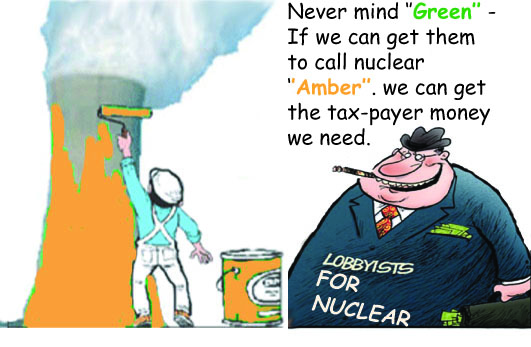
[Ed. For a while they tried calling nuclear ”amber”, but that didn’t work – they’ve settle for ”sort of green”]
By DEBRA KAHN , 07/08/2022, https://www.politico.com/newsletters/the-long-game/2022/07/08/is-nuclear-sustainable-read-the-label-00044684
SHADES OF GREEN — The European Union broadened its definition of sustainable energy this week to include things not everyone agrees on — and triggered a fight.
The vote to include natural gas and nuclear power in the list of activities the EU is trying to encourage private investors to support was billed as a “pragmatic approach.” It’s also backed by Ukrainian officials, who say it should help reduce reliance on Russian gas.
But it’s getting major pushback — from scientists, sustainable investor groups and the European Commission’s own finance advisers, who argue the rules will divert money from truly green projects to prop up legacy industries and allow emissions to rise further, as POLITICO’s America Hernandez reports.
Under the new rules, countries heavily reliant on coal and oil for electricity will be able to replace them with less-polluting gas-fired power through 2030 and advertise the switch as sustainable to investors, as long as the plants switch to a clean-burning fuel like hydrogen by 2035 and respect a 20-year cap on greenhouse gas emissions.
Existing nuclear plants, which produce CO2-free electricity, will also get to be called climate-friendly if operators draw up safety plans showing where their radioactive waste will be permanently stored by 2050 and switch to so-called accident-tolerant fuels by 2025.
Activist investor groups are warning that watering down the sustainable designation will backfire.
“Calling gas sustainable, even as a ‘transition’ fuel, will not convince climate-change conscious investors, and it will make the taxonomy lose its usefulness as a tool to orient capital flows towards sustainable economic activities,” said Thierry Philipponnat, chief economist at watchdog group Finance Watch.
The United Nations’ Principles for Responsible Investment, which represents more than 5,000 investors managing €167 trillion ($169 trillion right now — great time to go to Europe) in sustainable assets, warned that blindly trusting the EU’s green labels “could prompt fragmentation across the market and lead to potential greenwashing.”
NUCLEAR RENAISSANCE PT. II — U.S. environmentalists were similarly dismayed this week by Pacific Gas & Electric’s announcement that it will try to keep California’s remaining nuclear plant open past its planned retirement.
A PG&E spokesperson told the San Diego Union-Tribune that the utility plans to apply for an Energy Department grant aimed at helping keep nuclear plants open. Diablo Canyon accounts for almost 9 percent of the state’s electricity generation, and officials are worried about reliability this summer and in years to come.
The move follows support from Gov. Gavin Newsom and lawmakers in last week’s state budget to fund agency power purchases from Diablo Canyon and natural gas plants when supplies run low. It’s an about-face from 2016, when environmentalists and labor unions representing plant workers came to a state-approved agreement to shut down the plant starting in 2024.
(NB: Diablo would have stayed open had California decided to let nuclear count toward its green electricity requirements in 2015.)
“Instead of propping up outmoded nuclear plants, Newsom should instead be providing more resources and funding to deploy renewable energy infrastructure across California,” Sierra Club California director Brandon Dawson said in a statement.
Austria, Luxembourg and green groups have already said they’ll sue the European Commission over its new rules. California environmentalists may also try suing to enforce the closure agreement, the SDUT reports.
Nationalising EDF is no cure-all for France’s nuclear industry troubles
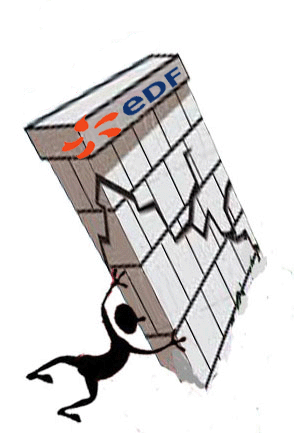
The French state has said it will fully nationalise EDF, the debt-laden utility that runs the nation’s nuclear power plants and which the government has so far struggled to restructure. It has not said whether it
will buy out minority shareholders on the market or take control by law.
But however it is nationalised, it doesn’t guarantee a fix for EDF’s mountain of debt or its corroding reactors and it won’t reduce the cost of shielding consumers from sky-high energy prices.
Analysts say the government’s main goal may be to secure a freehand in running a business that has a roughly 80% share of the French electricity market, once it is delisted and the state no longer has to answer to any other shareholders.
About half of EDF’s 56 nuclear reactors in France are now offline, in part due to corrosion issues. EDF has repeatedly cut its planned nuclear output for 2022, just as Europe scrambles to find alternative energy sources as Russian gas supplies dwindle.
As well as problems with old reactors, it is also running years late and billions of euros above budget in building a new-generation of reactors in France and Britain, raising questions about whether it has to fix fundamental design faults. Furthermore, EDF has been hobbled by a regulated tariff system, known as Arenh, forcing it to sell 100 terawatt/hours (TWh) of nuclear generation to power retailers and large
consumers at 42 euros/MWh, which is well below market levels.
Reuters 7th Aug 2022
Sizewell C – just the latest nuclear scam
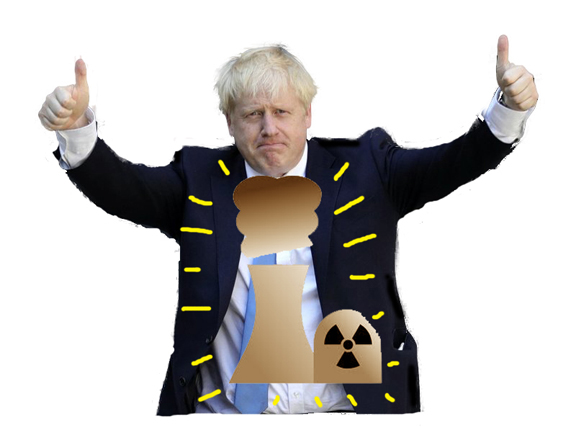
Whatever chaos unfolds between today (Thursday) and tomorrow, Boris
Johnson is apparently still planning to confirm his Government’s
commitment to a new nuclear power station at Sizewell tomorrow.
As we all know, Johnson’s default political tactic is to lie, regardless of which
particular issue or crisis he’s having to address. For those who’ve
made something of a labour of love tracking Johnsonian mendacity, watch out
for this latest nuclear nonsense tomorrow – it’s absolutely guaranteed
to be brimful of outright lies, half-truths, omissions and rhetorical
boosterism of the kind that has made him (probably!) the least trustworthy
politician in the world apart from Vladimir Putin.
On this occasion, that’s simply because this whole ‘nuclear renaissance’ story is one
great big scam from start to finish. If I could count the ways,
anticipating the lying drivel that will be emerging from the BEIS press
release.
Jonathon Porritt 7th July 2022
http://www.jonathonporritt.com/sizewell-c-just-the-latest-nuclear-scam/
Ukraine has sold two French-donated 155mm Caesar howitzers to Russia
PANAGYURISHTE ($1=1.88 Bulgarian Levs) — French and Ukrainian [from Donbas] sources claim that in the hands of the Russian army, and more precisely in the production workshops of the Russian manufacturer Uralvagonzavod, there are two 155mm self-propelled howitzers Caesar, donated by France to Ukraine, as military aid against the Russian invasion on February 24 this year.
On June 20, French lawyer Régis de Castelnau wrote on his official Twitter account: “Another success of Macron: 2 French Caesar guns were intercepted intact by the Russians. They are currently in the Uralvagonzavod factory in the Urals for study and possible reverse engineering. Thank you Macron, we are paying”.
A few days later, on June 23rd, the Russian company [Uralvagonzavod] responded to the French lawyer, through its official Telegram profile and citing Régis de Castelnau’s tweet, writing: “Hello, Mr. Regis. Please convey our thanks to President Macron for the donation of the self-propelled guns. This material is of course not tip-top… not like our MSTA-S! But nevertheless, it will be useful. Send more – we’ll take them down.”
Ukrainian sources from Donbas claim that they are also aware of this case, but not from the French lawyer or the Russian plant, but from French military sources, emphasizing that the online publication Donbas Insider does not cite who exactly the French military sources are.
France’s General Staff has denied reports of a French Caesar self-propelled howitzer being captured by Russian forces in Ukraine. “This information is false,” said the General Staff of France. “We categorically deny it. We’ve discussed this with our Ukrainian partners.” According to the Armed Forces of Ukraine, no evidence was provided to support the claim.
The news of captured weapons would not surprise anyone in wartime. We have witnessed the Ukrainian and Russian military capturing various enemy weapon systems. But the same “unidentified” French sources claim, according to a Donbas Insider, that the two Caesar self-propelled howitzers were sold, through an intermediary, by Ukrainians to Russians. The price, which is being discussed in tight circles, is $120,000 each. BulgarianMilitary.com recalls that the unit value of a Caesar self-propelled howitzer varies around the amount of 7 million euros.
A political analyst at BulgarianMilitary.com says that the possibility that the two howitzers were sold to Moscow is evident in the tone and ending of French lawyer and politician Régis de Castelnau’s words. “It is very clear to him [the French lawyer] that during the war, in addition to prisoners of war, the adversaries acquire different foreign equipment. This is war, some die, others abandon their positions out of fear, and others profit from the war. The end of the comment “Thank you Macron, we are paying’ suggests that Régis de Castelnau believes that the two howitzers were not abandoned and therefore captured, but sold. The irony is too strong in this particular case to ignore this fact”, says Dr. Sebastian Levi, correspondent, and analyst of BulgarianMilitary.com for the Middle East region.
Levy also says that he believes the two self-propelled howitzers were resold with the help of an intermediary, a military dealer. Levy, however, has no evidence for his claims but refers to his league reasoning.
However, sales are a fact
The feeling that corrupt Ukrainian servicemen are involved in the illegal arms trade to extract maximum profit is not from now, and it is not only about this case.
On June 2, BulgarianMilitary.com revealed the sale of at least one FGM-148 Javelin anti-tank guided missile system on the dark web for $30,000. The seller is unclear, but according to the information posted on the darknet, the location [where the system will be shipped or picked up from] is Kyiv, the capital of Ukraine.
“Ukrops are selling Javelins on the darknet. The command of the Armed Forces of Ukraine resells equipment and weapons supplied by NATO to the Middle East and North Africa. Anyone with a TOR browser can buy this ATGM in the online store,” writes the pro-Russian Telegram channel ABS News.
Interpol knows
Interpol knows the illegal sale of arms by Ukrainians to Russians. The German online edition Overton-Magazin writes that concerns can be seen in the statements of Jürgen Stock, Secretary-General of Interpol, “who fears that the weapons will be handed over to criminal organizations. However, this is happening with the complicity of Western governments, which are not willing to put in place safeguards and vetting mechanisms for the use of these weapons. In fact, even the US intelligence services do not know where the weapons delivered to Ukraine are going.”
According to the German publication, a part of the weapons delivered to Ukraine were actually seized, but another part was resold by Ukrainian holdings, which are in the hands of Russian businessmen. Overton-Magazin even points to a specific case that should be investigated for illegal trade, and that is the downed Ukrainian helicopters that tried to evacuate Ukrainian soldiers from Mariupol. The investigation so far indicates that the helicopters were shot down by American Stinger anti-aircraft missiles donated by the Americans.
Here’s what the German publication Overton-Magazin wrote: “The Western narrative of the prophesied defeat of Russia and the victorious resistance of Ukraine is the main argument for promoting the deployment of weapons. It gives the impression that all that is needed is the ‘last little push’, to achieve victory. The reality, however, is not so romantic.”
………………………. And finally, let’s mention the most important fact that is known, but no one dares to talk about it: in order for such a sale to be carried out, the presence of strong corruption is necessary, especially among the military command and the lower officer ranks of the Ukrainian army. https://bulgarianmilitary.com/2022/07/05/ukraine-has-sold-two-french-donated-155mm-caesar-howitzers-to-russia/
Why would anybody invest in Sizewell C nuclear plant? – An unlikely proposition?
Why would anybody invest in Sizewell C nuclear plant? – An unlikely
proposition? The Government has tasked Barclays Bank with finding investors
for the proposed Sizewell C (SZC) plant.
Reports surfaced in the Mail on
Sunday that Centrica is planning on taking a stake in the company. Perhaps
the fact that the report emerged in the Mail on Sunday rather than the
Financial Times is a sign that the decision is still subject to vagaries.
This report has me scratching my head so hard it hurts!
Why would Centrica,
which in 2016 abandoned plans to invest in Hinkley C partly because of
‘the lengthening time frame for a return on the capital invested in a
project of this scale‘ now opt for an investment in SZC? After all the
doubt about return on investments in SZC may be viewed as, if anything,
even more threadbare, to that of Hinkley C.
100% Renewables 7th July 2022
With EDF’s parlous finances and France nationalising EDF – decision on Britain’s planned Sizewell C nuclear station has been delayed

A decision on a new nuclear power station at Sizewell in Suffolk has been
delayed again by the government. French energy company EDF wants to build
Sizewell C, a £20 billion two-reactor nuclear plant, next to Sizewell B. A
decision on Sizewell C was expected today (7 July), but it has been pushed
back to 20 July at the latest. Paul Scully MP said: “I have decided to set
a new deadline of no later than 20 July 2022 for deciding this application.
This is to ensure there is sufficient time to allow the Secretary of State
to consider the proposal.”
On Wednesday, the French government announced
the state was taking full control of EDF, in a drive to boost its domestic
nuclear expansion.
Reacting to the delay, Alison Downes, of campaign group
Stop Sizewell C, said it would have been farcical if a decision on Sizewell
C had been made today, following the news from Paris. She added: “We also
hope that announcements of EDF’s re-nationalisation have given ministers
pause, especially when EDF’s parlous finances are at least in part down to
their disastrous track record at building the type of reactors proposed for
Sizewell C.”
ITV 7th July 2022
Rolls Royce lacking investment for its planned small nuclear reactors
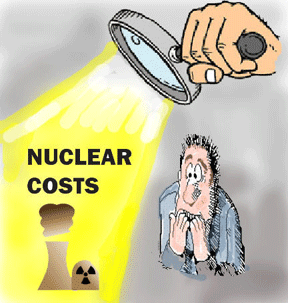
Nuclear: Rolls-Royce lacking investment for its SMRs. The manufacturer
presented its short-list of British sites to launch the manufacture of its
small modular reactors. But the technology is far from ready.
L’Opinion 6th July 2022
https://www.lopinion.fr/international/nucleaire-rolls-royce-en-manque-dinvestissement-pour-ses-smr
1 This Month


of the week– Nuclear Reactor Information Task Force

14 May – online event From Bombs to Data Centres: the Face of Nuclear Colonialism
To see nuclear-related stories in greater depth and intensity – go to https://nuclearinformation.wordpress.com
-
Archives
- May 2026 (156)
- April 2026 (356)
- March 2026 (251)
- February 2026 (268)
- January 2026 (308)
- December 2025 (358)
- November 2025 (359)
- October 2025 (376)
- September 2025 (257)
- August 2025 (319)
- July 2025 (230)
- June 2025 (348)
-
Categories
- 1
- 1 NUCLEAR ISSUES
- business and costs
- climate change
- culture and arts
- ENERGY
- environment
- health
- history
- indigenous issues
- Legal
- marketing of nuclear
- media
- opposition to nuclear
- PERSONAL STORIES
- politics
- politics international
- Religion and ethics
- safety
- secrets,lies and civil liberties
- spinbuster
- technology
- Uranium
- wastes
- weapons and war
- Women
- 2 WORLD
- ACTION
- AFRICA
- Atrocities
- AUSTRALIA
- Christina's notes
- Christina's themes
- culture and arts
- Events
- Fuk 2022
- Fuk 2023
- Fukushima 2017
- Fukushima 2018
- fukushima 2019
- Fukushima 2020
- Fukushima 2021
- general
- global warming
- Humour (God we need it)
- Nuclear
- RARE EARTHS
- Reference
- resources – print
- Resources -audiovicual
- Weekly Newsletter
- World
- World Nuclear
- YouTube
-
RSS
Entries RSS
Comments RSS
 nuclear-news