Taking up Hilda’s Torch: Robert Green’s account of his contribution to the 1988/9 Hinkley C Inquiry.
4th February 2023 http://stophinkley.org/nuclear-new-build/taking-up-hildas-torch-robert-greens-account-of-his-contribution-to-the-1988-9-hinkley-c-inquiry/
This is an interesting insight both into the Inquiry and the background to nuclear power in the UK. The information and comments are as relevant today as they were all those years ago. TakingUpHildasTorch.
Hilda Murrell (born in 1906) was a British rose grower, naturalist, diarist and campaigner against nuclear power and nuclear weapons. She was murdered in 1984 in disputed circumstances.
Having predicted the 1973 oil crisis, Murrell became increasingly concerned by the hazards posed by nuclear energy and weapons. She began to research this highly technical field and in 1978 wrote a paper entitled “What Price Nuclear Power?” in which she challenged the economics of the civil nuclear industry. After the 1979 US accident at Three Mile Island, she turned her attention to safety aspects and homed in on the problem of radioactive waste, the disposal of which she concluded was the industry’s Achilles’ heel.
In 1982 the Department of the Environment published a white paper on the British Government’s policy on radioactive waste management. Murrell, now in her late 70s, wrote a critique of it which she developed into her submission “An Ordinary Citizen’s View of Radioactive Waste Management” to the first formal planning inquiry into a nuclear power plant in Britain, the Sizewell B Pressurised Water Reactor in Suffolk.
She was scheduled to present her paper at the Sizewell B Inquiry, but on 21 March 1984 her home in Shrewsbury was burgled and a small amount of cash was taken. She was then abducted in her own car. Though the vehicle was soon reported abandoned in a country lane five miles outside Shrewsbury, the Police took another three days to find her body in a copse across a field from her car. Who killed her – and why – has been the subject of books and films. The conviction in 2005 of a man for her abduction and murder failed to answer many of the questions surrounding her death.
The reasons for this enduring enquiry are exposed at length in ‘A Thorn In Their Side’, a book published in 2012. The author is Hilda’s nephew, Robert Green, with whom she had a close relationship and who was a commander in naval intelligence during the Falklands war. He has followed and chronicled the case meticulously.
Was this just a random, bungled burglary by a lone 16-year-old – as the police would have it – or was it an operation involving several individuals on behalf of a government agency, namely the security services? Read more: The Guardian March 2012 https://www.theguardian.com/law/2012/mar/20/who-killed-hilda-murrell
Also see:
- The Hilda Murrell website: https://hildamurrell.org/home/
- Hilda Murrell – Wikipedia: https://en.wikipedia.org/wiki/Hilda_Murrell
- Taking Up Hilda’s Torch TakingUpHildasTorch
One Year After Russia Annexed Crimea, Locals Preferred Moscow To Kiev
Kenneth Rapoza, Senior Contributor, Mar 20, 2015, https://www.forbes.com/sites/kenrapoza/2015/03/20/one-year-after-russia-annexed-crimea-locals-prefer-moscow-to-kiev/?sh=6b884a88510d
The U.S and European Union may want to save Crimeans from themselves. But the Crimeans are happy right where they are.
One year after the annexation of the Ukrainian peninsula in the Black Sea, poll after poll shows that the locals there — be they Ukrainians, ethnic Russians or Tatars are mostly all in agreement: life with Russia is better than life with Ukraine.
Little has changed over the last 12 months. Despite huge efforts on the part of Kiev, Brussels, Washington and the Organization for Security and Cooperation in Europe, the bulk of humanity living on the Black Sea peninsula believe the referendum to secede from Ukraine was legit. At some point, the West will have to recognize Crimea’s right to self rule. Unless we are all to believe that the locals polled by Gallup and GfK were done so with FSB bogey men standing by with guns in their hands.
In June 2014, a Gallup poll with the Broadcasting Board of Governors asked Crimeans if the results in the March 16, 2014 referendum to secede reflected the views of the people. A total of 82.8% of Crimeans said yes. When broken down by ethnicity, 93.6% of ethnic Russians said they believed the vote to secede was legitimate, while 68.4% of Ukrainians felt so. Moreover, when asked if joining Russia will ultimately make life better for them and their family, 73.9% said yes while 5.5% said No.
In February 2015, a poll by German polling firm GfK revealed that attitudes have not changed. When asked “Do you endorse Russia’s annexation of Crimea?”, a total of 82% of the respondents answered “yes, definitely,” and another 11% answered “yes, for the most part.” Only 2% said they didn’t know, and another 2% said no. Three percent did not specify their position.
With two studies out of the way, both Western-based, it seems without question that the vast majority of Crimeans do not feel they were duped into voting for annexation, and that life with Russia will be better for them and their families than life with Ukraine. A year ago this week, 83% of Crimeans went to the polling stations and almost 97% expressed support for reunification with their former Soviet parent. The majority of people living on the peninsula are ethnic Russians.
The U.S. made a big deal about the rights of ethnic minorities there known as the Tatars, which account for around 10% of the population. Of the 4% total that said they did not endorse Russia’s annexation, the vast majority — 55% — said that they feel that way because they believe it should have been allowed by Kiev in accordance with international law. Another 24% said the referendum vote was “held under pressure”, which means political or military threats to vote and vote in favor.
The GfK survey also asked if the Ukrainian media have given Crimea a fair assessment. Only 1% said that the Ukrainian media “provides entirely truthful information” and only 4% said it was “more often truthful than deceitful.”
For now, the Gallup and GfK polls show a deeply divided Ukraine. The division of political allegiances ultimately threatens Ukraine’s territorial integrity. Only 19% in the east and 26.8% in the southeast think Ukraine should join the European Union, while 84.2% in the west believe Ukraine is a natural fit with the E.U.. Nearly 60% in the north agree that E.U. is the place to be, and just under half in the center part of the country want E.U. integration.
NATO integration is even less supported in the southeast and east, and a little over a third in the center and north agree that Ukraine should join the Western military powers. In the west, that number rises to 53%.
Those numbers also coincide with Ukraine’s trust or distrust with Washington. The pro-integration west, north and center portions of Ukraine all view the U.S. role in the crisis as mostly positive. Well under a third say so in the east and southeast, and almost no one, including the Tatars, believe so in Crimea, GfK poll data suggests.
Interestingly enough, despite Russia’s involvement in the separatist movement in eastern Ukraine, only 35.7% of people polled there said they viewed Russia’s involvement as mostly positive while 71.3% of Crimeans were more in line with Russia’s world view, according to the year old poll from Gallup.
This week, the State Department’s press secretary Jen Psaki said sanctions on Russia will continue until Crimea is returned to Ukraine. Both the State Department and Treasury Department did not clarify whether that was an actual policy statement, nor whether that included the sectoral sanctions which were applied in a third round of sanctions last July following the downing of Malaysian flight MH17 over east Ukraine.
Budget cuts have left UK’s military’s stores bare: General says Britain would run out of ammo in a day if it fought Russia. Britain buying ammo from South Asia to support Ukraine.
- General Sir Richard Barrons said years of cuts have left cupboards almost bare
- Meanwhile, Ben Wallace said military spending may have to rise for two decades
Daily Mail, By KATHERINE LAWTON 3 Feb 23,
Britain’s ammo stocks would run out in a day if it fought Russia – as a top former General said years of cuts have left military’s stores bare.
The warning from General Sir Richard Barrons comes a day after Defence Secretary Ben Wallace said the UK’s forces have been ‘hollowed out’, adding that military spending may have to rise for two decades, owing to global threats.
According to The Sun, Britain is buying ammo from South Asia to support Ukraine.
Dr Jack Watling, at military think tank Rusi, said Ukraine had been firing around 6,000 shells a day, but we rely on imported explosives for tank and artillery shells.
Our ammo plants, run by defence contractor BAE, would take a year to make a day’s shells for Ukraine, sources said.
Meanwhile, it was also revealed that Britain has no working heavy artillery guns after giving all serviceable AS90 self-propelled items to Ukraine.
General Barrons said the Army requires £3 billion more a year to rejoin Nato’s top tier.
In his column for The Sun, he wrote: ‘This is truly shocking. But it is true. And we must fix it.
‘The UK spends more on defence than any EU ally and our brave Armed Forces have long been one of Britain’s most influential levers around the world.
‘Yet for decades they have been hollowed out by spending cuts.’
…………………………… Mr Wallace also responded to urgent calls from former Prime Minister Boris Johnson to send fighter jets to Ukraine.
‘I’m open to examining all systems, not just jets. But these things don’t always happen overnight,’ he added.
Of Ukraine’s fighters he said: ‘Even if tomorrow we announced we were going to put them in fast jets, that would take months.
‘You’re suddenly having to learn to pilot a fast jet, so there is no magic wand.’
Prime Minister Rishi Sunak and Mr Wallace want to send a squadron of tanks to the country, which could arrive by the end of next month.
The MoD said it was boosting ammo stockpiles to ‘more than pre-invasion levels’ with an extra £560 million from the Treasury.
Defence chiefs have pledged all 30 working AS90s to Kyiv and are now urgently seeking K9 Thunders and Archer guns to replenish their stocks, it was recently reported. ……….
https://www.dailymail.co.uk/news/article-11708161/Britain-run-ammo-day-fought-Russia-Cuts-left-militarys-stores-bare.html
West Blocked Ukraine Peace Deal, Says Former Israeli PM
BY NOAH CARL, 5 FEBRUARY 2023, https://dailysceptic.org/2023/02/05/west-blocked-ukraine-peace-deal-says-former-israeli-pm/
Last September, Fiona Hill and Angela Stent wrote this in Foreign Affairs: “According to multiple former senior U.S. officials, in April 2022, Russian and Ukrainian negotiators appeared to have tentatively agreed on the outlines of a negotiated interim settlement.”
In the end, of course, no such settlement was agreed. Which may be, at least in part, because Boris Johnson advised Zelensky not to sign it during his “surprise visit” to Kiev in early April.
As you may recall, one of Zelensky’s “close associates” told Ukrainska Pravda that Johnson was an “obstacle” to negotiations because he’d brought two simple messages: “Putin is a war criminal, he should be suppressed, not negotiated with. And secondly, if you are ready to sign any agreements on guarantees with him, then we are not. We can with you, but not with him, he will still abandon everyone.”
According to Roman Romanyuk, writing in Ukrainska Pravda:
Behind this visit and Johnson’s words lies much more than a simple reluctance to engage in agreements with Russia. The collective West, which back in February suggested that Zelenskyi surrender and run away, now felt that Putin is actually not as all-powerful as they imagined him to be. Moreover, right now there was a chance to “press him”. And the West wants to use it.
It should be noted that Romanyuk disagrees that Johnson’s visit was the main reason the deal fell through. In his view, concerns that “Ukrainian society might not accept such a deal” loomed larger. Others interpret the evidence differently.
Putin himself has claimed the West scuttled negotiations, noting in his September 21st speech that “after certain compromises were coordinated, Kiev was actually ordered to wreck all these agreements”.
Now, the former Israeli PM Naftali Bennett has lent credence to this view, claiming that the West “blocked” a draft peace deal between Russia and Ukraine. The revelation came in a long interview (in Hebrew) posted on Bennett’s YouTube channel.
Bennett’s words cannot be dismissed as mere speculation, given that he played a central role mediating between the two sides, after a request from Zelensky at the war’s outset.
In the interview, Bennett states that he believed Israel’s national interest would be served by a policy of neutrality, which is why he accepted the request to mediate. Toward this end, he sought to understand the interests of both sides.
“Putin’s perception,” he says, “was wait, when the wall came down, we reached an agreement with NATO that they wouldn’t expand … why are you introducing Ukraine into NATO?” Later in the interview, he states that “the war broke out because of the demand to join NATO”.
After a sequence of phone calls with the two leaders, Bennett flew to Moscow on March 7th. (Meanwhile, Russian and Ukrainian negotiators were holding talks at Gomel in Belarus.)
He says that Putin then “made two big concessions”. He promised not to “take out” Zelensky, and he “renounced disarmament of Ukraine”. The same day, Zelensky also “made a big concession” – he “relinquished joining NATO”. Describing these as “huge steps on each side”, Bennett’s impression was that “both sides very much want a ceasefire”.
According to the former Prime Minister, Putin was “very pragmatic”, and “so was Zelensky”. As an example of Putin’s pragmatism, he mentions that Putin “totally understood Zelensky’s political constraints”. Asked whether Putin is “gung ho to fight at all costs”, Bennett replies “no” because “he has goals to achieve”.
Regarding the various Western leaders involved, he says that “Boris Johnson adopted the aggressive line”, whereas “Macron and Scholz were more pragmatic”, and “Biden was both”.
Then we get to the most interesting part. “I think there was a legitimate decision by the West,” Bennett explains, “to keep striking Putin”, to take the “more aggressive approach”. “So they blocked it?” the interviewer asks. “Yes. They blocked it.”
Bennet’s account obviously comports closely with Romanyuk’s observation that the West felt there was a chance to “press” Putin.
One reason to be sceptical is that, insofar as Bennett’s mediation efforts ultimately failed, he has an incentive to blame outside forces (in this case, the West). For now, we can’t be sure exactly what happened. But the revelations are striking, consistent as they are with the earlier report in Ukrainska Pravda – down to the detail of Johnson being particularly hawkish.
Nuclear too expensive and not needed — Beyond Nuclear International

Detailed research shows mistake in pursuing nuclear power
Nuclear too expensive and not needed — Beyond Nuclear International
Energy scientists show obsolescence of nuclear power in an all-renewable future
From Claverton Energy Group
Sizewell C is much more expensive and slower to build than proven and reliable alternative low carbon solutions says an energy think tank that examined nuclear projects in the United Kingdom. Even the unfinished twin reactors at Hinkley C can’t compete with renewables.
Baseload generators such as nuclear power plants are not needed in an all-renewable future and their use will almost certainly increase overall costs to consumers says an elite Claverton Energy Group of experts. Professor Mark Barrett, from University College London (UCL), who has modeled the comparative costs of nuclear and renewable power, using hour-by-hour wind and solar data with 35 years of weather data, said:
“Nuclear power is more expensive and slower to build than renewables, particularly offshore wind. 7 GW of wind will generate about 40% more electricity than Hinkley at about 30-50% of the cost per kWh and will be built in half the time. Neither wind nor nuclear plants operate all the time, so both will need backup. Modeling shows the total cost of renewable generation to be less than nuclear and to be just as able to provide continuous power even with wind and solar droughts.”
This detailed modeling of the entire heat, power and transport system in the UK, has been carried out by a number of top-flight university researchers and shows that:
Continue readingThe logic behind the terror: Why does Ukraine keep attacking civilian areas in Donetsk?
Rockets have hit peaceful neighborhoods once again. Why does Kiev continue its policy, if not purely out of hate?
By Vladislav Ugolny, a Russian journalist based in Donetsk 4 Feb 23 https://www.rt.com/russia/570954-logic-behind-ukrainian-terrorism/
At least ten rockets hit central areas of Donetsk on Saturday morning, damaging three residential buildings, a local Russian official has reported in his Telegram channel.
One of the projectiles fired by Ukrainian forces hit an apartment building in the Kievsky district. While rescuers continue to search for survivors under the rubble, preliminary information suggests that there were three people in one of the apartments.
There was no information on casualties at the time of writing, but the absence of victims would be unusual; indeed, Ukrainian shelling of the capital of the Donetsk People’s Republic intensified weeks before the Russian attack in February 2022, and has taken a heavy toll ever since.
The suffering of Donbass residents
According to the human rights commissioner of the DPR, Daria Morozova, at least 1,091 civilians were killed and another 3,533 were recorded as injured last year as a result of combat operations. The figures do not include places such as Mariupol, where the full scale of the tragedy has yet to be assessed.
The 4,624 people mentioned above were victims of regular artillery strikes on urban areas of Donetsk and Gorlovka.
When Donetsk residents are asked why the Ukrainian Armed Forces continue to attack civilians, people usually have no explanation other than the desire of the Ukrainian government and military to destroy Donbass and its people. This is supported by a massive campaign to dehumanize local residents and a number of hateful statements by Ukrainian politicians. “We will kill them with nuclear weapons,” warned former Prime Minister Yulia Timoshenko, while ex-president Pyotr Poroshenko has vowed: “Our children will go to school, while their children will go sit in basements. That’s how we will win this war.”
Ukrainian forces continue to bomb Donbass despite the shortage of shells experienced by both sides of the conflict. However, while Russia can solve this issue by activating its military-industrial complex, Ukraine is entirely dependent on foreign supplies.
It should make a lot more sense for Ukraine to use scarce ammunition on military targets rather than on peaceful residential areas. Even if a lot of the time, Kiev’s forces misfire. A typical example is a Ukrainian shell landing in the frozen Kalmius River that divides Donetsk.
How Ukraine explains the attacks
Whenever Ukrainian artillery hits a civilian object – for example, a flower market – or kills civilians, officials in Kiev deny it. Unofficial voices resort to false claims that no such thing ever happened. Over the past eight years, the latter have come up with several memes allegedly proving that the Ukrainian Army wasn’t involved – with explanations such as “the air conditioner exploded.” Even if Ukrainian forces manage to hit a military facility, such as a warehouse, they usually deny involvement, claiming that “someone smoked in the wrong place” and that the explosion wasn’t related to the conflict. Thus, an information environment is created that denies the fact that Kiev attacks cities.
The Ukrainian side claims the attacks on civilians are “self-inflicted” – implying that the Russian Army attacks cities under its control, supposedly to blame Ukrainian forces and demonize them in the eyes of the population, as well as for propaganda purposes. This kind of post-truth has given rise to a whole area of fact-checking, where journalists collaborate with open-source intelligence to calculate the trajectory of the strikes.
For Donbass residents, all this is extremely painful. Discussions of terrorist attacks on civilian infrastructure often end in profanities. According to Donbass locals, Ukrainians keep on attacking Donetsk simply because they can. Meanwhile, people are just trying to survive and are waiting for the front to move away from the area. Other details don’t concern them.
However, this is a distorted view of the situation; there is every reason to believe that the regular shelling of cities in Donbass is part of Ukrainian strategy and follows military logic. Perhaps Kiev’s “hybrid war” era military doctrine has adopted terrorist methods. So, how do these attacks on the civilian population help Ukraine?
Psychological pressure
Let’s take a clear example. In June 2022, the units of the first corps of the People’s Militia of the DPR were dislodged from their permanent locations because of the battle for Lisichansk – they had to storm a huge section of the front from Popasnaya to Verkhnekamenka, moving from south to north. The Russian Armed Forces then lacked personnel and had to use troops from Donetsk. Ukraine intensified strikes on the city to force the leadership to return the units back to their locations.
A similar thing is happening now. Some areas are under pressure – in particular, the fighters of the Wagner Group are pressing in Soledar and Artyomovsk (known in Ukraine as Bakhmut). They are advancing backed by the artillery of the Russian Armed Forces. Ukrainians use civilian strikes to provoke politicians, hoping that they will influence the military and interfere with the army’s plans. In June, this plan failed and the Ukrainians, taking advantage of the lack of counter-battery fire in the Donetsk region, committed a number of atrocities.
Commenting on the situation in a private conversation, one fighter explained why the army didn’t take the bait: “Normally, no military man – from simple soldier to general – suffers if the enemy attacks the city. This sounds harsh, but it’s better for the enemy to attack the city than the army’s manpower. This would be the usual military logic, but there is one key detail: 95% of our corps are made up of local residents who are worried about their cities. So, after completing the mission in Lisichansk, our soldiers were very angry when they got back to Donetsk.”
This is all very close to home for fighters from Donbass. In the case of a fast-paced conflict without a stable front line, such attacks would have motivated the soldiers, by enraging them. Perhaps this explains the near-complete silence of the Ukrainian artillery in the first month of the Russian military campaign. In those days, when the front line was mobile, it was better not to further motivate the enemy.
However, in positional warfare, fighters are conscious of a permanent threat to their relatives and other civilians in their hometowns. Motivated warriors who identify themselves as “defenders” feel as if they don’t have enough strength to break through. This acts to discourage. Concern for those who are not on the front line returns the soldier to his other life, behind the front lines, and distracts him from battle. By itself, this does not break morale, but soldiers are also affected by constant adrenaline swings, a risk of death or injury to themselves or their brothers in arms, the cold and damp conditions, the monotony of their work (for example, a good soldier digs more often than shoots), and numerous other factors.
Russia doesn’t have a strong memory of World War I – it has been replaced by that of World War II. However, the current fighting resembles the trench warfare of the early 20th century. With the possibility to adjust and fine-tune firing using Chinese drones and the chance to search the internet for how to repair military equipment. The rest of it – mud, trenches, the frozen front line – is like World War I, including politicians demanding a large-scale and ambitious offensive.
Why can’t the strikes be stopped?
At the end of July 2022, such an event began in the Donetsk region. Its main goal was to free the city from artillery strikes. The Donetsk corps were successful for several days, but then became stuck in positional battles. By the end of January, six months into the operation, the army had barely advanced 10km (6 miles).
The fighters were unable to break through the pre-established line of defense, and the forces only managed to wedge and slowly push through the three lines of fortifications near the villages of Vodianoye and Opitnoe, north of Donetsk airport. However, the fighters cannot give up on storming these fortifications – the strikes on Donetsk and Makeyevka must end for good.
As a result, there have been signs of an emerging contradiction. On the one hand, military leaders who are interested in achieving military goals and saving manpower, and on the other, politicians who express the interests of the civilian population and want to put a swift end to the artillery terror. Politicians want the public to like them. They don’t want to deal with the consequences of hostilities, hoping for things to return to normal so they can receive funding to restore the affected regions. As a result, they view the situation quite differently from the military.
Through manipulation, propaganda and informational and psychological influence, Ukrainians have made cunning use of the differences between civilian and military interests. This comes down to a grotesque choice between “killing the army in Avdeevka” and “allowing the Ukrainian Armed Forces to wipe Donetsk off the face of the Earth.” If politicians push the army to force the assault, the latter will make more mistakes, which will reduce their power. This, in turn, favors Kiev.
Perhaps seeking rational reasons behind the artillery strikes in Donbass is pointless – maybe it’s just the manifestation of rage on behalf of Ukrainian nationalists. However, if we ask ourselves “who benefits from this,” there is a creeping suspicion that terrorizing the population with NATO ammunition is a strategy initiated by Ukraine’s top military leadership. Firstly, these attacks tie up the forces of the Russian Army and distract it from concentrating on other areas. Secondly, they negatively affect the combat spirit of the fighters from Donbass. And finally, they allow political factors to intervene in military strategy, dealing a serious blow to its quality.
Ukraine planning for two $5 billion Westinghouse AP 1000 reactors, part of USA marketing a fleet of new nuclear reactors to Ukraine!

Ukraine’s Cabinet of Ministers has greenlighted the preliminary phases
of building two $5 billion Westinghouse AP 1000 reactors at the Kmelnitsky
nuclear power plant once the Russian invasion ends, the embattled
country’s energy officials have said, according to World Nuclear News.
The cabinet-level approval builds on the deal Kyiv and Westinghouse signed
in June that outlined plans for the US-based nuclear corporation to
construct a total of nine new reactors in Ukraine, as well as supply all
nuclear fuel burned in the country’s 15 Soviet-built reactors.
Bellona 3rd Feb 2023
Ukraine greenlights first steps on new nuclear reactor builds
France tries to label nuclear as “renewable” in push to the EU for nuclear-produced hydrogen
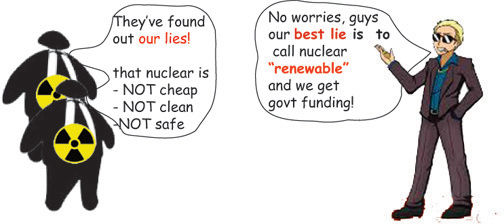
France leads push for EU to boost nuclear-produced hydrogen
By Kate Abnett 4 Feb 23, BRUSSELS, Feb 3 (Reuters) – France is leading a campaign for the European Union to recognise low-carbon hydrogen produced from nuclear power in its renewable energy rules, but some member states oppose the idea for fear of undermining efforts to quickly scale up wind and solar.
Ministers from France, Poland, the Czech Republic and six other EU countries wrote to the European Commission this week urging it to open up EU renewable energy targets to include hydrogen produced from nuclear energy.
EU countries and lawmakers have been preparing for negotiations next week on the law, which will guide the pace of Europe’s renewable energy expansion this decade.
EU Parliament’s lead negotiator has asked for next week’s talks to be delayed because the European Commission has still not published rules to define “renewable” hydrogen more clearly, which were scheduled for late last year, EU officials said on Friday……………
The nine countries’ letter, seen by Reuters, said the EU should include nuclear energy – which is low-carbon, but not renewable. https://www.reuters.com/business/energy/france-leads-push-eu-boost-nuclear-produced-hydrogen-2023-02-03/
France approves study on extending nuclear reactors’ life.
https://www.reuters.com/world/europe/french-presidency-green-light-looking-into-extending-lifespan-existing-nuclear-2023-02-03/
PARIS, Feb 3 (Reuters) – France has approved looking into the possibility of extending the lifespan of nuclear reactors to 60 years and beyond if safety rules allow it, the French Presidency said.
The Presidency announced the move in a statement after President Emmanuel Macron, who has announced plans to build at least six new reactors by 2050, on Friday chaired the first of a series of meetings on nuclear policy.
France historically has relied on nuclear power for around 70% of its energy, although the share is likely to have fallen last year as the nuclear fleet suffered repeated outages.
A public debate about the six new EPR2 nuclear reactors is set for the end of February.
The commissioning schedule for the new reactors will be established by a bill that will determine the speed of the procedures near the existing nuclear sites and the operation of the existing facilities, the statement said.
The bill is expected to reduce delays in administrative procedure and allow for progress on the construction sites.
The statement also announced plans for the construction of the first pilot of a small advanced nuclear reactor by the 2030s.
The extension of the plants will also require the launch of an examination of the issue of the fuel cycle, including the waste management, the statement said.
Several studies are set to be launched on the matter and presented at the next meeting of the nuclear council in June 2023, the statement said. The presentation of the studies is expected to be followed with a debate in Parliament on the development of energy and climate laws.
France what to do as nuclear waste site risks saturation point?
Should saturation happen, France’s reactors would have nowhere to place their spent fuel and would have to shut down
France seeks strategy as nuclear waste site risks saturation point
Reuters, By Benjamin Mallet 3 Feb 23
- Summary
- Macron to chair Council on Nuclear Policy on Friday
- Macron has announced plan for at least six new nuclear reactors
- EDF working on extra refrigerated pool
- France also considering plan to bury waste in clay
LA HAGUE, France, Feb 3 (Reuters) – At a nuclear waste site in Normandy, robotic arms guided by technicians behind a protective shield manoeuvre a pipe that will turn radioactive chemicals into glass as France seeks to make safe the byproducts of its growing reliance on atomic power.
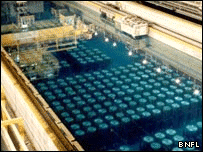
The fuel-cooling pools in La Hague, on the country’s northwestern tip, could be full by the end of the decade and state-owned Orano, which runs them, says the government needs to outline a long-term strategy to modernise its ageing facilities no later than 2025.

While more nuclear energy can help France and other countries to reduce planet-warming emissions, environmental campaigners say it replaces one problem with another.
To seek solutions, President Emmanuel Macron, who has announced plans to build at least six new reactors by 2050, on Friday chairs the first of a series of meetings on nuclear policy that will discuss investments and waste recycling.
“We can’t have a responsible nuclear policy without taking into account the handling of used fuel and waste. It’s a subject we can’t sweep under the rug,” a government adviser told Reuters, speaking on condition of anonymity…….
La Hague is the country’s sole site able to process and partially recycle used nuclear fuel.
France historically has relied on nuclear power for around 70% of its energy, although the share is likely to have fallen last year as the nuclear fleet suffered repeated outages.
Since the launch of the site at La Hague in 1976, it has treated nearly 40,000 tonnes of radioactive material and recycled some into nuclear fuel that can be re-used. The waste that cannot be recycled is mixed with hardening slices of glass and buried for short-term storage underground.
But its four existing cooling pools for spent fuel rods and recycled fuel that has been reused risk saturation by 2030, according to French power giant EDF (EDF.PA), which runs France’s 56-strong fleet of reactors, the world’s second biggest after the United States.
Should saturation happen, France’s reactors would have nowhere to place their spent fuel and would have to shut down – a worst-case scenario that led France’s Court of Audit to designate La Hague as “an important vulnerability point” in 2019.
COOL POOLS AND DEEP CLAY
EDF is hurrying to build an extra refrigerated pool at La Hague, at a cost of 1.25 billion euros ($1.37 billion), to store spent nuclear fuel – a first step before the waste can be treated – but that will not be ready until 2034 at the earliest.
Meanwhile, France’s national agency for managing nuclear waste last month requested approval for a project to store permanently high-level radioactive waste.
The plan, called Cigéo, would involve placing the waste 500 metres (1,640 ft) below ground in a clay formation in eastern France.
Construction is expected in 2027 if it gets approval. Among those opposed to it are residents of the nearby village of Bure and anti-nuclear campaigners
………… Orano, for which EDF accounts for 95% of its recycling business, says it needs clear direction from the government no later than 2025, to give it time to plan the necessary investments.
The costs are likely to be high. Just keeping up with current operations at La Hague costs nearly 300 million euros a year.
Options EDF and Orano are considering include finding a way to recycle the used fuel more than once, but critics say the recycling itself creates more radioactive waste and is not a long-term solution. For now, the backup plan is to fit more fuel containers into the existing pools.
After being cooled in a pool for about seven years, used nuclear fuel is separated into non-recyclable leftovers that are turned into glass (4% of the material), plutonium (1%) to create a new nuclear fuel called MOX, on which around 40% of France’s reactors can run, and reprocessed uranium (95%).
Options EDF and Orano are considering include finding a way to recycle the used fuel more than once, but critics say the recycling itself creates more radioactive waste and is not a long-term solution. For now, the backup plan is to fit more fuel containers into the existing pools.
After being cooled in a pool for about seven years, used nuclear fuel is separated into non-recyclable leftovers that are turned into glass (4% of the material), plutonium (1%) to create a new nuclear fuel called MOX, on which around 40% of France’s reactors can run, and reprocessed uranium (95%).
The uranium in the past was sent to Russia for re-enrichment and return for use in some EDF reactors, but EDF stopped doing that in 2013 as it was too costly.
In spite of the war in Ukraine, which has made many in the West avoid doing business with Russia, EDF is expected to resume sending uranium to Russia this year as the only country able to process it. It declined to confirm to Reuters it would do so.
The facility at La Hague, with its 1980s-era buildings and Star Wars-style control rooms, has its limitations.
“If we had to process MOX fuel in large quantities, the facility today isn’t adapted for it,” Varin said. “For multi-cycle recycling, the technology is not the same, so the modernisation or replacement of installations” would require “significant” investments, he said.
($1 = 0.9098 euros) https://www.reuters.com/business/environment/france-seeks-strategy-nuclear-waste-site-risks-saturation-point-2023-02-03/
Belgium looks to extend lives of oldest nuclear reactors.
DW. 3 Feb 23,
The Belgian government is assessing whether to extend the life of three nuclear reactors that had been due to close in 2025, citing a need to “reduce risks in the energy supply” in lieu of the war in Ukraine.
…………………………… Operational since 1975, the three reactors were initially set to be decommissioned in 2015 but had their lifetime extended until 2025 after Belgium held a review of its phase-out plan.
A delayed phase-out
Belgium has two nuclear plants, operated by French utility company Engie, with five reactors still working.
Belgium first decided on its nuclear phase-out in 2003 and it was scheduled to be completed by 2025. However, it decided last year to keep the newest plants open until 2035.
Belgium took one nuclear reactor, Tihange 2, off its power grid after 40 years on Tuesday evening as part of the country’s planned nuclear phase-out. The winding down of nuclear power began with the closure of a reactor at Doel, near the Belgian port city of Antwerp in September.
Those two reactors were known for repeated safety issues, having been shut down on previous occasions after the discovery of cracks in reactor pressure vessels. The Belgian government had considered keeping those two reactors online because of energy concerns.
……………. The German government and the German city of Aachen, which lies near the Belgian border have repeatedly called for the reactors to be decommissioned in the past.
In 2019, the European Court of Justice found that Belgium infringed European Union law by failing to carry out the required environmental assessments before prolonging the life of Doel 1 and 2 nuclear reactors…….. https://www.dw.com/en/belgium-looks-to-extend-lives-of-oldest-nuclear-reactors/a-64606438
Ukraine’s Tank Problem – a “game changer” – REALLY?
It is impossible to see how the provision of such weapons, against a larger enemy with no evident sign of capitulation and determined to maintain the fight in the field, however slapdash and ailing, will be a “gamechanger”. That word ought to be scrapped from any credible analysis, but we see it used repeatedly in the tabloid certitude of final victory.
Australian Independent Media February 1, 2023: Dr Binoy Kampmark https://theaimn.com/ukraines-tank-problem/
It seems to be a case of little provision for so much supposed effect. The debates, the squabbles, the to-and-fro about supplying Ukraine with tanks from Western arsenals has served to confirm one thing: this is an ever-broadening war between the West against Russia with Ukraine an experimental proxy convinced it will win through. Efforts to limit the deepening conflict continue to be seen as the quailing sentiments of appeasers, the wobbly types who find democracy a less than lovable thing.
So far, promises have been made to ship the US M1A2 Abrams, Germany’s Leopard 2 and the UK’s Challenger. Others have alluded to doing the same thing – including France regarding its Leclerc tanks – but tardiness fills the ranks, and logistics will make the provision of such weapons a long affair. Re-export licenses will have to be issued, notably regarding the Leopard 2; training Ukrainian tank crews will also need to be undertaken.
All in all, the picture is not as rosy as those in Kyiv think, despite the confident assessment from Ukraine’s Deputy Foreign Minister, Andriy Melnyk that his country’s defence forces would have access to “at least a hundred tanks” within three months.
The US tanks are, for the most part, still grounded in their country of origin, with their deployment potentially delayed for months, if not years. Pentagon deputy spokesperson Sabrina Singh was frank in admitting that, “We just don’t have these tanks available in excess in our US stocks, which is why it is going to take months to transfer these M1A2 Abrams to Ukraine.” Singh, it should also be remembered, expressed the department’s view earlier this month that the tank was hardly suitable for Ukrainian needs, given how its jet turbine engine hungers for JP-8 jet fuel, unlike the diesel engine used by the Leopard and Challenger counterparts.
The engine is also rather tricky to maintain for crews, leaving it susceptible to blowing in the event of error. No less an authority than the Pentagon press secretary US Air Force brigadier general Pat Ryder, admitted that the M-1 “is a complex weapons system that is challenging to maintain, as we’ve talked about. That was true yesterday; it’s true today; it will be true in the future.”
There is also a backlog of orders for the tank. The Lima facility in Ohio, operated by General Dynamics, is the only facility that assembles the Abrams. It can produce a mere 12 tanks per month and must fulfill orders to supply 250 A2 tanks for Poland starting in 2025 to replace the same number of Soviet-era T-72 tanks Warsaw supplied to Kyiv last year. Taiwan also put in an order for 108 M1A2 tanks in 2019. Even getting to work on the 31 units promised by the Biden administration for Ukraine looks to be ambitious.
The wrangling over supplying Ukraine with tanks has been an at times acrimonious affair. This is hardly surprising. European states have their own specific readings, however dark or cautious, about how to approach the supply issue. The magic number being sought by Kyiv is 300. After initial resistance, German Chancellor Olaf Scholz gave in to his peers, both in his coalition outside, to send a company of Leopard 2 tanks and permit countries with the same tanks in their inventories to supply them to Kyiv. A fortnight of aggressive chatter at a number of venues, including Ramstein Air Base, pressing the flesh and breathing down various necks, saw a change of heart and, it has to be said, weak will on the part of the Chancellor.
It is impossible to see how the provision of such weapons, against a larger enemy with no evident sign of capitulation and determined to maintain the fight in the field, however slapdash and ailing, will be a “gamechanger”. That word ought to be scrapped from any credible analysis, but we see it used repeatedly in the tabloid certitude of final victory.
There is Ed Arnold of the Royal United Services Institute, who is confident that this tank transfer “will make a real difference.” But even Arnold attaches a few caveats, noting that much will depend on how Ukraine uses them. “Do they put them straight into the fight as soon as they’re available? Or do they integrate them into larger formations, train and rehearse those larger formations, and spend a bit more time integrating them into the way that they fight to then potentially use in the summer?”
Whatever the answer to such questions, this is a war that will yield no victors and will, in guaranteed fashion, make a mockery of victory. And the only cruel reality here, short of needless oblivion through imbecilic error of judgment, is to get the warring parties to the table to reach an agreement that is bound to cause despair as much as relief. It might, as unpalatable as it seems, require Ukraine to surrender a portion of devastated earth in the east. The unthinkable will have to be entertained.
Nuclear must not be part of Cromartry Firth freeport vision
YOUR VIEWS: ‘Nuclear should not be part of freeport vision’. A reader and
campaigner reacts to news that small nuclear reactors could be built in the
north. The Courier carried comments from Global director Steve Chisholm
that small modular nuclear reactors could be built in the Cromartry Firth
after the award of green freeport status for the area.
Nuclear should not be part of freeport vision I refer to the article headed “Nuclear Reactor
is in the freeport mix “(Inverness Courier, January 20) and was very
surprised that this proposal has now emerged. HANT (Highlands Against
Nuclear Transport) has raised concerns since 2013 about many safety
concerns related to the transport of nuclear waste by rail from Georgemas
Junction (near Dounreay) to Barrow and on to the Sellafield Nuclear plant.
There have been a number of incidents of concern related to both rail and
sea transport.
Inverness Courier 31st Jan 2023
Top UK pension funds refuse to invest in Sizewell C nuclear plan, despite government enticements.

‘Whatever the funding model, Sizewell C is highly controversial. It carries multiple risks, of time and cost overruns, reputation and technical problems.
‘If the Government is forced to peddle it to foreign investors, it will make its justification in terms of ‘energy sovereignty’ even more of a joke.’
‘If the Government is forced to peddle it to foreign investors, it will make its justification in terms of ‘energy sovereignty’ even more of a joke.’
Blow to Government’s infrastructure drive as two top UK pension funds snub Sizewell C nuclear plant plan
By FRANCESCA WASHTELL FOR THE DAILY MAIL, 1 February 2023
Efforts to attract investment in British infrastructure were hit after two of the UK’s biggest pension funds turned their backs on Sizewell C.
Ministers are tearing up old EU red tape that Chancellor Jeremy Hunt says will unlock £100billion in possible funding for major projects.
The most important of these is the £20billion Sizewell C nuclear power plant in Suffolk, which is being developed by the Government and EDF but will need billions of private funding.
The Government has spent years trying to woo pension groups and institutional investors by introducing a new funding model that allows them to receive dividends during the construction process.
It is expected to go a step further by classifying nuclear as a green energy source in an upcoming eco-friendly financing strategy, which would make it easier for companies to win support to invest in power plants.
But an industry source said Sizewell C would still not be an appropriate investment for ‘typical big-name UK pension schemes’, as they see the risk of cost over-runs and delays being too high.
So far, other potential backers such as Nest and Legal & General have said they do not intend to fund the project.
But British Gas owner Centrica is thought to be considering taking a stake, while FTSE 100 savings and retirement firm Phoenix Group has said it is keen to back nuclear.
The source added that funding was more likely to come from North America and the Middle East, with Emirati sovereign wealth fund Mubadala already said to be in the mix.
Alison Downes, the head of campaign group Stop Sizewell C, said: ‘Whatever the funding model, Sizewell C is highly controversial. It carries multiple risks, of time and cost overruns, reputation and technical problems.
‘If the Government is forced to peddle it to foreign investors, it will make its justification in terms of ‘energy sovereignty’ even more of a joke.’
1 This Month

of the week– Nuclear Reactor Information Task Force

14 May – online event From Bombs to Data Centres: the Face of Nuclear Colonialism
To see nuclear-related stories in greater depth and intensity – go to https://nuclearinformation.wordpress.com
-
Archives
- May 2026 (116)
- April 2026 (356)
- March 2026 (251)
- February 2026 (268)
- January 2026 (308)
- December 2025 (358)
- November 2025 (359)
- October 2025 (376)
- September 2025 (257)
- August 2025 (319)
- July 2025 (230)
- June 2025 (348)
-
Categories
- 1
- 1 NUCLEAR ISSUES
- business and costs
- climate change
- culture and arts
- ENERGY
- environment
- health
- history
- indigenous issues
- Legal
- marketing of nuclear
- media
- opposition to nuclear
- PERSONAL STORIES
- politics
- politics international
- Religion and ethics
- safety
- secrets,lies and civil liberties
- spinbuster
- technology
- Uranium
- wastes
- weapons and war
- Women
- 2 WORLD
- ACTION
- AFRICA
- Atrocities
- AUSTRALIA
- Christina's notes
- Christina's themes
- culture and arts
- Events
- Fuk 2022
- Fuk 2023
- Fukushima 2017
- Fukushima 2018
- fukushima 2019
- Fukushima 2020
- Fukushima 2021
- general
- global warming
- Humour (God we need it)
- Nuclear
- RARE EARTHS
- Reference
- resources – print
- Resources -audiovicual
- Weekly Newsletter
- World
- World Nuclear
- YouTube
-
RSS
Entries RSS
Comments RSS
 nuclear-news