Spain’s Energy Ministry has again denied Berkeley Energia permission to build a uranium mine near Salamanca. In making the ruling, the ministry referred to a statement from its previous rejection, which said the Nuclear Safety Council had expressed concerns over “poor reliability and high uncertainty of the safety analyses of the radioactive site.” Full Story: Reuters (2/7) https://www.reuters.com/markets/commodities/spain-sticks-with-decision-block-berkeleys-uranium-mine-2023-02-07/
When studying today’s daily AFU troop losses and considering Ukraine’s recent presidential order, according to which even underage children at 16-17 aged can be called for armed service, the overall military situation of Ukraine appears to be catastrophic. Anyway, the situation is totally opposite to the picture the western MSM is propagating “Ukraine is winning … Ukraine is winning”. No doubt, Ukraine has already lost the war and by the same token, the NATO as well.
The US ending its financial, humanitarian and particularly military support promptly would cause Ukraine to completely collapse and RAND cites several reasons, why doing so would be sensible, not least because a Ukrainian victory is regarded as both “improbable” and “unlikely,” due to Russian “resolve,” and its military mobilization having “rectified the manpower deficit that enabled Ukraine’s success in the Kharkiv counteroffensive.”
Great Power Relations, February 7, 2023 | Seppo Niemi
Basically, great power competition and the fight for hegemonic control between America on the one side and Russia and China on the other, is being fought on two fronts.
The one is Ukraine war with enlarging NATO engagement, the other front is financial with America facing a coordinated attack by Russia and China on its dollar hegemony. The Russians are planning a replacement trade settlement currency, which could unleash a flood of foreign-owned dollars onto the foreign exchange markets. In fact, the second front encases also the third front, the formation of global alliances. Ultimately, there is a competition of new world order and fight for global power (world hegemon).
All these topics have been analysed in various articles on this website and will be analysed also in the future but this article focuses again on military side of this subject, because there is, as the title indicates, endgame currently going. Some fundamental factors are now emerging for further analysis.
Frontline news
The Biden administration as well as Pentagon know that Ukraine’s army is not able to hold the current defense line in its east part. The big fear is that the Ukrainian army will totally collapse and run away, when the frontline is breached in Ugledar, Bakhmut, Seversk and Krasny-Liman.
Russia’s winter offensive is going in full speed but in another way than western “experts” assumed. No “Big Arrows” so far but slowly accelerating pressure along the whole frontline and when break-points emerge, they will be utilized immediately throwing more reserves in those places from back-areas. Due to autumn mobilizations and very low KIA-rate, Russia has plenty of trained reserves available.
The reason for this kind of warfare is the fact that western spy satellites follow the ground situation 24/7 covering the whole theatre of operations. Russia fully knows and understands that and therefore hide their military operations to the latest possible point, thus holding a surprise moment. However, 1-2 massive, “Big Arrow” Russian offensives are probable during February-April period.
A new wave of activity is expected for the Russian side during February. The recent changes in the command of the operation appear to have been carefully planned in order to elevate the combat to a new level and several of Moscow’s strategic objectives may soon be achieved, radically changing the course of the conflict. Valery Gerasimov, Chief of the General Staff of the Russian Armed Forces, was promoted to the position of Commander of the Joint Forces of the Russian Federation in the Special Military Operation Zone. Gerasimov’s arrival to power seems to have been a move towards the final stage of the special military operation.
Obviously, a major offensive (Big Arrow) is being prepared for February with the probable aims: 1) Reaching the borders of the regions recently reintegrated into the Russian Federation, pacifying the new oblasts. 2) capturing Nikolaev, Odessa, as well as the entire Black Sea coast, reaching Transnistria. 3) seizing/blocking Kiev, forcing a political capitulation of the Zelensky regime until early March.
The territory of Belarus will become the main springboard for the upcoming strike. In parallel to Belarus, Zaporozhye and Lugansk are also key zones for the Russian strategy. It is expected that massive attacks will come from these regions during the offensive, destroying enemy units in a short period of time which will allow a rapid Russian advance on the battlefield, reaching the zones listed in the above-mentioned objectives. For the offensive to be successful, Russian forces will focus on blocking all enemy’s supply lines. The main route of arrival of supplies to Ukraine is the border with Poland, where there is the transit of NATO’s ammunition and military equipment.
Some days ago, Washington announced preparing a new package of military aid worth $2.2 billion that is expected to include longer-range rockets for the first time. Soon thereafter, in a televised interview, Sergei Lavrov said an important principle of policy: “We’re now seeking to push back Ukrainian army artillery to a distance that will not pose a threat to our territories. The greater the range of the weapons supplied to the Kiev regime, the more we will have to push them back from territories which are part of our country.”
Russian Ministry of Defense (RMOD) statistics since February 24, 2022 up to December 31, 2022. Ukrainian losses: 355 aircraft, 199 helicopters, 2779 UAV, 7350 tanks and armoured vehicles, 4713 artillery & MLRS systems (as well as 7859 units of special military equipment)………….
Late January 2023, the well-informed American Col.(ret.) Doug Macgregor put the numbers of dead on the Ukrainian side (video) at 122,000 killed plus 35,000 missed in action (presumed dead). The number of dead Russians (including Wagner forces and Donbas militia) is at 16,000 to 25,000 with 20 to 40,000 additionally wounded. The numbers are in good consistency with those figures of Mossad.
When studying today’s daily AFU troop losses and considering Ukraine’s recent presidential order, according to which even underage children at 16-17 aged can be called for armed service, the overall military situation of Ukraine appears to be catastrophic. Anyway, the situation is totally opposite to the picture the western MSM is propagating “Ukraine is winning … Ukraine is winning”. No doubt, Ukraine has already lost the war and by the same token, the NATO as well.
Statistics of January 2023 [graph on original]
Please, note that just in January 2023, Russia has destroyed more than 300 AFU tanks and armoured vehicles, nearly three times more than what the West has promised to deliver to Ukraine over next half of year and all those western tanks are old models with old technology.
NATO tank deliveries – Leopard hunting begins
Promises of tank deliveries by models and countries: Leopard 2 totalling about 50 (Germany, Poland, others), Abrams M1 up to 31 (the US) and Challenger 2 up to 14 (the UK); totalling approx. 100 tanks. None of those models, now in delivery plan, are in production or are produced in last 15-20 years.
Germany has issued a permit to export Leopard 1 main battle tanksto Ukraine, on February 3. Berlin had approved German arms-maker Rheinmetall’s plans to sell 88 of the older Leopards to Kyiv, once these are repaired, for a total cost of more than €100 million. The Leopard 1, which first entered service in the 1960s, is the forerunner of the more advanced Leopard 2. The tank is armed with a 105 mm Royal Ordnance L7A3 L/52 rifled gun.
The big problem is and will be, how to obtain the required 105 mm ammunition for the Leopard 1 tanks. The tank features moderate armor, only effective against low caliber autocannons and heavy machine guns. This makes it vulnerable to most, if not all second and third generation anti-tank weapons.
These decisions regarding western tank deliveries to Ukraine disclose that all possible old scrapping equipment has been dug up now.
Modern tank warfare
Technological innovations have made main battle tanks (MBT) more survivable but anti-tank weapons have become even more effective outstripping MBT’s protective capabilities…………………………………………..
Western optics, media hype
Western MSM debated in “hothead” mood about the deliveries of tanks to Ukraine, suddenly dozens of “tank experts” came to public and demanded vociferously “express delivery of Leopards”.
When considering the matter in light of the analytical background, stated above, it appears once again how “mass hysteria” or “herd stupidity” is a rapidly contagious disease. In addition, it easily causes an anti-action, which is already happened on the frontlines. Leopard hunting begins.
Russia’s state tech corporation Rostec has already warned that existing Russian anti-tank missiles and shells are more than capable of destroying Western-made tanks, specifically the German Leopard 2. Pro-Russian military Telegram channels are already sharing posters pointing out the weak points of Challenger 2, Abrams and Leopard 2 tanks………………….
The RAND Corporation, a highly influential American security think tank funded directly by the Pentagon, has published a landmark report stating that prolonging the proxy war is actively harming the US and its allies and warning Washington that it should avoid “a protracted conflict” in Ukraine. The war, Report says, represents “the most significant interstate conflict in decades, and its evolution will have major consequences” for Washington, which includes US “interests” being actively harmed. “The costs and risks of a long war in Ukraine are significant and outweigh the possible benefits of such a trajectory for the United States.”
The US ending its financial, humanitarian and particularly military support promptly would cause Ukraine to completely collapse and RAND cites several reasons, why doing so would be sensible, not least because a Ukrainian victory is regarded as both “improbable” and “unlikely,” due to Russian “resolve,” and its military mobilization having “rectified the manpower deficit that enabled Ukraine’s success in the Kharkiv counteroffensive.”
It is so funny that the top Pentagon thinkers just say publicly these facts, while the entire US mainstream media, which also represents the US government, is out there saying the precise opposite. They are still literally saying that Russia is losing and Ukraine winning as their colleagues in the UK and elsewhere in Europe. The US media is just not even mentioning this RAND report at all.
What makes the RAND Report on Ukraine so significant, is not the quality of the analysis but the fact that the US’s most prestigious national security think-tank has taken an opposite position on the war than the Washington political elite and their globalist allies. This is a very big deal.
Keep in mind, wars end when a critical split emerges between ruling elites that eventually leads to a change in policy. RAND report represents just such a split. It indicates that powerful elites have broken, one part thinks the current policy is hurting the United States. This shift is going to gain momentum until it triggers a more-assertive demand for negotiations. Thus, the RAND report is the first step towards ending the war.
Biden administration has told repeatedly that the US will support Ukraine “for as long as it takes.” The United States should not undermine its own interests to pursue the unachievable dream of expelling Russia from Ukraine. The US plan to reshape Europe and the global balance of power by degrading Russia is turning out to fail badly and backfiring worse. Rational members of the foreign policy establishment should evaluate Ukraine’s prospects for success and weigh them against the growing likelihood that the conflict could unexpectedly spiral out-of-control.
The RAND report seems to represent the views of the Pentagon and the US Military establishment, who believe the United States is racing headlong towards a direct conflagration with Russia. In other words, the report may be the first ideological broadsides against the neocons, who run the State Department and the White House. It appears now this split between “War Department” and “State Department” will become more visible in the days ahead.
RAND report is just the first in a long line of falling dominoes. As Ukraine’s battlefield losses mount, the flaws in Washington’s strategy will become more apparent and will be more sharply criticized. American people will question the wisdom of economic sanctions that hurt US closest allies while helping Russia. Why the United States is following a policy that has precipitated a strong move away from the dollar and US debt? Why the US deliberately sabotaged a peace deal in March 2022, when the probability of a Ukrainian victory is near zero. The Rand report seems to anticipate all these questions as well as the “shift in mood” they will generate. This is why the authors are pushing for negotiations and a swift end to the conflict.
Peace talks … or not
There have been some peace talks between the US and Russia in last couple of months. William Burns, the CIA’s director was to meet his opposite Russian intelligence chief Naryshkin in Ankara in November 2022. This back-channel meeting was to explore compromises before America finds itself to sacrifice the Ukrainian population in a proxy war……………………………….
Militarily, the consensus of western expert opinion within the US and allied countries has changed from Russia’s losing the war in 2022 (Russian forces pulled back from Kharkiv and Kherson), to the Ukrainian forces losing the war, while NATO runs out of weapons and ammunition to send there and yet Russia unrelentingly continues to supply new weaponry and ammunition and slowly to take new ground in Ukraine. This war of attrition is going very badly now against the West (the US and its foreign allies, especially the ones in Europe: EU and NATO).
Economically, expert opinion in the west is increasingly saying their sanctions that were meant to strangle Russia’s economy have been by now a massive failure, which has probably been doing more damage to America’s European allies than to Russia. If this turns out to be true also in the mid-term (highly likely), then the entire belief-system that has been standing behind the West’s anti-Russia sanctions is going to collapse.
In addition, being deeply disappointed with all agreements with the West, Russia’s distrust on any deal with the west is huge. Thus, it is highly likely that the war will go to the bitter end, to the unconditional surrender of Ukraine.
EU – Ukraine summit in conjunction with EU – NATO declaration
European public attention was on Ukraine as the EU’s top officials visit Kyiv for a historic summit, February 2-3, the first to be held in an active war zone. Kyiv wants to join the bloc within two years but Ukraine got cold shoulder on rapid EU entry……………………..
By this summit, once again, the EU publicly and officially engaged closely and tightly with the destiny of Ukraine. Similar engagement was made with the NATO by “Joint Declaration on EU-NATO Cooperation, 10 January 2023”.
From this on, the destinies of the EU, the NATO and Ukraine have been combined and tied so closely that one part collapsing will make a domino effect to the rest.
Final look over the situation
As to the NATO, it is a good reason to take a look at the real and practical track record: military operations in Iraq, Libya, Afghanistan, which all ended in total defeat, debacle and turmoil.
Afghanistan and Ukraine are almost the same size in terms of land mass and the US/NATO failed to defeat a bunch of Afghani goat herders, who had no air power or artillery. The US and NATO poured billions of dollars into Afghanistan and failed to vanquish the Taliban, who easily took control of Kabul in August 2021, causing NATO troops to escape in total disarray.
In Ukraine, NATO is continuing its disarmament mission, more and more heavy weapons and other military material are poured in the black hole of Ukraine; Russia destroys them and NATO’s warehouse alert limits show red. Military material is simply finished in Europe and there is no military-industrial capacity to produce required quantities in next few years.
War fighting is a messy, complicated, resource intensive activity. “War is dirty business” as a British General said in Falkland operation. The conflict in Ukraine is exposing NATO as an impotent anachronism. If/when Russia wins militarily in Ukraine, the “raison d’etre” for NATO will be in question, in fact it disappears. Why any country is interested in applying the membership in such impotent alliance with such a failure track record?
If the reader can set aside emotion and consider the current situation unfolding in Ukraine, the evidence shows that Kiev’s army (AFU) is moving backwards on all frontlines. Without support from the United States and NATO, Ukraine does not have the manpower, munitions, tanks, artillery, air craft, financial resources and industrial capability to stop Russia. Even with more Western support flowing in, Ukraine will still lack the manpower to block the Russian advance.
Western analysts and MSM are downplaying the Russian offense in the Donbass along the Ukrainian defensive line that stretches from Bakhmut to Seversk in the north and to Ugledar in the south as some sort of sideshow with no strategic importance. That is nonsense. As said above, Russian winter offensive is underway on multiple fronts and Ukraine is paying a heavy toll. https://greatpowerrelations.com/endgame-is-going-in-ukraine-crisis/
Rt.com 8 Feb 23, More than 10 million volumes have been pulled from the shelves, a senior Rada MP has said.
Ukraine has removed millions of copies of Russian-language books from its public libraries, Yevgeniya Kravchuk, a senior member of the country’s parliament, the Verkhovna Rada, said on Monday.
She stated that the Culture Ministry had provided recommendations on what titles should be taken off the shelves.
This move was provoked by an initiative declared by the Ukrainian government to “overcome the consequences of Russification,” which in practice means purging schools of certain literature, renaming streets, and dismantling monuments to Russian historical figures……………….
Ukraine has a sizable Russian-speaking minority, and many Ukrainian speakers are fluent in Russian.
In June, the Ukrainian Education Ministry proposed removing more than 40 books by Russian and Soviet authors from the curriculum. The list included the works of such renowned classical writers as Leo Tolstoy, Fyodor Dostoevsky, and Alexander Pushkin, as well as Boris Pasternak and Mikhail Sholokhov, both of whom won the Nobel Prize for literature. Ukrainian Culture Minister Aleksander Tkachenko urged the world in December to “boycott” Russian culture, arguing that Moscow has been using it for propaganda………………….. https://www.rt.com/russia/571099-ukraine-purges-russian-books/
Christina’s note: The mad monk rides again. Madder than ever. As he’s an enthusiastic promoter of the nuclear industry, it is puzzling that Abbott is still a climate denialist.
Nowdays, the nuclear industry pushes their lie that nuclear beats global heating. So a good nuclear zealot should believe in climate change.
Abbott says ‘we need more genuine science and less groupthink’ in announcing position at Global Warming Policy Foundation
The former Australian prime minister Tony Abbott has joined the board of a UK-based thinktank that has been highly critical of climate science and action on global heating.
Since its launch in 2009, the Global Warming Policy Foundation has become known for its consistent attacks on climate science, the risks of global heating and – more recently – policies to reach net zero greenhouse gas emissions.
Abbott said he was pleased to join the foundation “because it’s consistently injected a note of realism into the climate debate”………………
Dr Jerome Booth, the foundation’s chairman, said Abbott brings “a global perspective and policy insight at the very highest level” and he would help the group “to foster a culture of debate, respect and scrutiny in policy areas that are currently dominated by intolerance, high emotions, moral reasoning and confusion”.
Abbott is currently an adviser to the UK government’s Board of Trade. His name was raised last month as a possible replacement for the late senator Jim Molan in the upper house.
During his prime ministership between 2013 and 2015, Abbott drove to dismantle much of the country’s public policy architecture on climate change, successfully repealing a legislated price on carbon, defunding the independent Climate Commission but failing to dismantle the Climate Change Authority and the Australian Renewable Energy Agency.
In 2017, he flew to London to deliver the GWPF’s annual lecture, where he suggested natural factors could be to blame for global warming, that CO2 was a trace gas and hinted at a global conspiracy to tamper with temperature data to make global heating seem worse.
The foundation is seen as influential among some conservatives. Conservative MP Steve Baker resigned as a GWPF trustee when he became minister for Northern Ireland.
A group of Conservative MPs and peers – several with links to the foundation – have formed the Net Zero Scrutiny Group, which has used the GWPF’s work as part of its advocacy.
The GWPF’s non-charitable arm – the Global Warming Policy Forum – runs a project called Net Zero Watch, which claims to scrutinise climate and decarbonisation policies.
Four Australian climate sceptics sit on the GWPF academic advisory board, including mining industry figure Prof Ian Plimer and controversial marine scientist Dr Peter Ridd of the Institute of Public Affairs, an Australian thinktank known to promote climate science denial.
Last year three MPs – one each from Labor, the Greens and the Liberal Democrats – joined with a not-for-profit campaign group to complain to the UK’s Charity Commission.
Former US President George W. Bush Snr may have famously said that ‘the human being and fish can coexist peacefully’, but the UK/Ireland Nuclear Free Local Authorities believe that EDF Energy’s plan to scrap the commitment to install acoustic fish deterrents at its new Hinkley Point C plant will end that peaceful co-existence with billions of fish being endangered.
Responding to a public consultation launched recently by the Environment Agency seeking views on a proposal by French nuclear power developer EDF Energy to scrap the deterrent mechanism at Hinkley, Councillor David Blackburn, Chair of the NFLA English Forum called it an ‘enormous tragedy’.
A plant like Hinkley Point C ‘hoovers up’ millions of gallons of water daily to cool its reactors, discharging the heated water back out to sea. Unfortunately, with the intake of the water will come the fish, and although EDF is proposing to install some mechanisms to prevent the ingress of fish and marine life into the plant, it has consistently made plain its opposition to the installation of acoustic fish deterrents.
Councillor Blackburn is, like local campaigners, concerned that without Acoustic Fish Deterrents, alongside other measures for marine life preservation, millions of fish will be killed every day, and the group Stop Hinkley, which is opposed to the construction of the plant, has estimated that up to 11 billion fish could die through operations there over the course of its expected 60-year lifespan.
Myanmar signs new nuclear energy agreement with Russia. The Intergovernmental Agreement on cooperation in the use of nuclear energy for peaceful purposes will see the two countries working together on the use of nuclear technology in a number of areas, including training of a workforce for building and running a small modular reactor.
“Based on the information available as of December 31, 2022, the United States cannot certify the Russian Federation to be in compliance with the terms of the New START Treaty.”
This finding was not unexpected. In August 2022, in response to a US treaty notification expressing an intent to conduct an inspection, Russia invoked an infrequently used treaty clause “temporarily exempting” all of its facilities from inspection. At the time, Russia attempted to justify its actions by citing “incomplete” work regarding Covid-19 inspection protocols and perceived “unilateral advantages” created by US sanctions; however, the State Department’s report assesses that this is “false:”
Contrary to Russia’s claim that Russian inspectors cannot travel to the United States to conduct inspections, Russian inspectors can in fact travel to the United States via commercial flights or authorized inspection airplanes. There are no impediments arising from U.S. sanctions that would prevent Russia’s full exercise of its inspection rights under the Treaty. The United States has been extremely clear with the Russian Federation on this point.”
Instead, the report suggests that the primary reason for suspending inspections “centered on Russian grievances regarding U.S. and other countries’ measures imposed on Russia in response to its unprovoked, full-scale invasion of Ukraine.”
Echoing the findings of the report, on February 1st, Cara Abercrombie, deputy assistant to the president and coordinator for defense policy and arms control for the White House National Security Council, stated in a briefing at the Arms Control Association that the United States had done everything in its power to remove pandemic- and sanctions-related limitations for Russian inspectors, and that “[t]here are absolutely no barriers, as far as we’re concerned, to facilitating Russian inspections.”
Nonetheless, Russia has still not rescinded its exemption and also indefinitely postponed a scheduled meeting of the Bilateral Consultative Commission in November. In a similar vein, this is believed to be tied to US support for Ukraine, as indicated by Deputy Foreign Minister Sergei Ryabkov who said that arms control “has been held hostage by the U.S. line of inflicting strategic defeat on Russia,” and that Russia was “ready for such a scenario” if New START expired without a replacement.
These two actions, according to the United States, constitute a state of “noncompliance” with specific clauses of New START. It is crucial to note, however, the distinction between findings of “noncompliance” (serious, yet informal assessments, often with a clear path to reestablishing compliance), “violation” (requiring a formal determination), and “material breach” (where a violation rises to the level of contravening the object or purpose of the treaty).
It is also important to note that the United States’ findings of Russian noncompliance are not related to the actual number of deployed Russian warheads and launchers. While the report notes that the lack of inspections means that “the United States has less confidence in the accuracy of Russia’s declarations,” the report is careful to note that “While this is a serious concern, it is not a determination of noncompliance.” The report also assesses that “Russia was likely under the New START warhead limit at the end of 2022” and that Russia’s noncompliance does not threaten the national security interests of the United States.
The high stakes of failure: worst-case force projections after New START’s expiry
Both the US and Russia have meticulously planned their respective nuclear modernization programs based on the assumption that neither country will exceed the force levels currently dictated by New START. Without a deal after 2026, that assumption immediately disappears; both sides would likely default to mutual distrust amid fewer verifiable data points, and our discourse would be dominated by worst case thinking about how both countries’ arsenals would grow in the future……………………………………………………….
Cameco Corp. said it agreed to terms with SE NNEGC Energoatom, the Ukrainian state-owned nuclear energy utility, to provide natural uranium hexafluoride, or UF(6), through 2035.
“Key commercial terms, such as pricing mechanism, volume and tenor, have been agreed to, but the contract is subject to finalization, which is anticipated in the first quarter of 2023,” Cameco said.
The deal, which runs from 2024 to 2035, will see all deliveries in the form of UF(6). “The contract will contain a required degree of flexibility, given present circumstances in Ukraine,” Cameco said.
The agreement will see Cameco supply 100% of Energoatom’s UF(6) requirements for the nine nuclear reactors at the Rivne, Khmelnytskyy and South Ukraine nuclear power plants. The deal also has an option for Cameco to supply six reactors at the Zaporizhzhya nuclear power plant, which is currently under Russian control, should it return to Energoatom’s operation, the companies said.
On February 16, 2022, a full week before Putin sent combat troops into Ukraine, the Ukrainian Army began the heavy bombardment of the area (in east Ukraine) occupied by mainly ethnic Russians. Officials from the Observer Mission of the Organization for Security and Co-operation in Europe (OSCE) were located in the vicinity at the time and kept a record of the shelling as it took place. What the OSCE discovered was that the bombardment dramatically intensified as the week went on until it reached a peak on February 19, when a total of 2,026 artillery strikes were recorded. Keep in mind, the Ukrainian Army was, in fact, shelling civilian areas along the Line of Contact that were occupied by other Ukrainians.
We want to emphasize that the officials from the OSCE were operating in their professional capacity gathering first-hand evidence of shelling in the area. What their data shows is that Ukrainian Forces were bombing and killing their own people.This has all been documented and has not been challenged.
So, the question we must all ask ourselves is this: Is the bombardment and slaughter of one’s own people an ‘act of war’?
We think it is.And if we are right, then we must logically assume that the war began before the Russian invasion (which was launched a full week later) We must also assume that Russia’s alleged “unprovoked aggression” was not unprovoked at all but was the appropriate humanitarian response to the deliberate killing of civilians. In order to argue that the Russian invasion was ‘not provoked’, we would have to say that firing over 4,000 artillery shells into towns and neighborhoods where women and children live, is not a provocation? Who will defend that point of view?
No one, because it’s absurd. The killing of civilians in the Donbas was a clear provocation, a provocation that was aimed at goading Russia into a war. And –as we said earlier– the OSCE had monitors on the ground who provided full documentation of the shelling as it took place, which is as close to ironclad, eyewitness testimony as you’re going to get.
This, of course, is a major break with the “official narrative” which identifies Russia as the perpetrator of hostilities. But, as we’ve shown, that simply isn’t the case. The official narrative is wrong. Even so, it might not surprise you to know that most of the mainstream media completely omitted any coverage of the OSCE’s fact-finding activities in east Ukraine. The one exception to was Reuters that published a deliberately opaque account published on February 18 titled “Russia voices alarm over sharp increase of Donbass shelling”. Here’s an excerpt:
Russian Foreign Minister Sergei Lavrov voiced alarm on Friday over a sharp increase in shelling in eastern Ukraine and accused the OSCE special monitoring mission of glossing over what he said were Ukrainian violations of the peace process….
Washington and its allies have raised fears that the upsurge in violence in the Donbass could form part of a Russian pretext to invade Ukraine. Tensions are already high over a Russian military buildup to the north, east and south of Ukraine.
“We are very concerned by the reports of recent days – yesterday and the day before there was a sharp increase in shelling using weapons that are prohibited under the Minsk agreements,” Lavrov said, referring to peace accords aimed at ending the conflict. “So far we are seeing the special monitoring mission is doing its best to smooth over all questions that point to the blame of Ukraine’s armed forces,” he told a news conference.
Ukraine’s military on Friday denied violating the Minsk peace process and accused Moscow of waging an information war to say that Kyiv was shelling civilians, allegations it said were lies and designed to provoke it.” (Russia voices alarm over sharp increase of Donbass shelling, Reuters)
Notice the clever way that Reuters frames its coverage so that the claims of the Ukrainian military are given as much credibility as the claims of the Russian Foreign Minister. What Reuters fails to point out is that the OSCE’s report verifies Lavrov’s version of events while disproving the claims of the Ukrainians. It is the job of a journalist to make the distinction between fact and fiction but, once again, we see how agenda-driven news is not meant to inform but to mislead.
The point we are trying to make is simple: The war in Ukraine was not launched by a tyrannical Russian leader (Putin) bent on rebuilding the Soviet Empire. That narrative is a fraud that was cobbled together by neocon spin-meisters trying to build public support for a war with Russia. The facts I am presenting here can be identified on a map where the actual explosions took place and were then recorded by officials whose job was to fulfill that very task. Can you see the difference between the two? In one case, the storyline rests on speculation, conjecture and psychobabble; while in the other, the storyline is linked to actual events that took place on the ground and were catalogued by trained professionals in the field. In which version of events do you have more confidence?
Bottom line: Russia did not start the war in Ukraine. That is a fake narrative. The responsibility lies with the Ukrainian Army and their leaders in Kiev.
And here’s something else that is typically excluded in the media’s selective coverage. Before Putin sent his tanks across the border into Ukraine, he invoked United Nations Article 51 which provides a legal justification for military intervention. Of course, the United States has done this numerous times to provide a fig leaf of legitimacy to its numerous military interventions. But, in this case, you can see where the so-called Responsibility To Protect (R2P) could actually be justified, after all, by most estimates, the Ukrainian army has killed over 14,000 ethnic Russians since the US-backed coup 8 years ago. If ever there was a situation in which a defensive military operation could be justified, this was it. But that still doesn’t fully explain why Putin invoked UN Article 51. For that, we turn to former weapons inspector Scott Ritter, who explained it like this:
“Russian President Vladimir Putin, citing Article 51 as his authority, ordered what he called a “special military operation”…. under Article 51, there can be no doubt as to the legitimacy of Russia’s contention that the Russian-speaking population of the Donbass had been subjected to a brutal eight-year-long bombardment that had killed thousands of people.… Moreover, Russia claims to have documentary proof that the Ukrainian Army was preparing for a massive military incursion into the Donbass which was pre-empted by the Russian-led “special military operation.” [OSCE figures show an increase of government shelling of the area in the days before Russia moved in.]
..The bottom line is that Russia has set forth a cognizable claim under the doctrine of anticipatory collective self-defense, devised originally by the U.S. and NATO, as it applies to Article 51 which is predicated on fact, not fiction.
While it might be in vogue for people, organizations, and governments in the West to embrace the knee-jerk conclusion that Russia’s military intervention constitutes a wanton violation of the United Nations Charter and, as such, constitutes an illegal war of aggression, the uncomfortable truth is that, of all the claims made regarding the legality of pre-emption under Article 51 of the United Nations Charter, Russia’s justification for invading Ukraine is on solid legal ground.” (“Russia, Ukraine & the Law of War: Crime of Aggression”, Consortium News)
Here’s a bit more background from an article by foreign policy analyst Danial Kovalik:
“One must begin this discussion by accepting the fact that there was already a war happening in Ukraine for the eight years preceding the Russian military incursion in February 2022. And, this war by the government in Kiev… claimed the lives of around 14,000 people, many of them children, and displaced around 1.5 million more … The government in Kiev, and especially its neo-Nazi battalions, carried out attacks against these peoples … precisely because of their ethnicity. ..
While the UN Charter prohibits unilateral acts of war, it also provides, in Article 51, that “nothing in the present Charter shall impair the inherent right of individual or collective self-defense… ” And this right of self-defense has been interpreted to permit countries to respond, not only to actual armed attacks, but also to the threat of imminent attack.
In light of the above, it is my assessment.. that Russia had a right to act in its own self-defense by intervening in Ukraine, which had become a proxy of the US and NATO for an assault – not only on Russian ethnics within Ukraine – but also upon Russia itself.” (“Why Russia’s intervention in Ukraine is legal under international law”, RT)
So, has anyone in the western media reported on the fact that Putin invoked UN Article 51 before he launched the Special Military Operation?
No, they haven’t, because to do so, would be an admission that Putin’s military operation complies with international law. Instead, the media continues to spread the fiction that ‘Hitler-Putin is trying to rebuild the Soviet empire’, a claim for which there is not a scintilla of evidence. Keep in mind, Putin’s operation does not involve the toppling of a foreign government to install a Moscow-backed stooge, or the arming and training a foreign military that will be used as proxies to fight a geopolitical rival, or the stuffing a country with state-of-the-art weaponry to achieve his own narrow strategic objectives, or perpetrating terrorist acts of industrial sabotage (Nord-Stream 2) to prevent the economic integration of Asia and Europe. No, Putin hasn’t engaged in any of these things. But Washington certainly has, because Washington isn’t constrained by international law. In Washington’s eyes, international law is merely an inconvenience that is dismissively shrugged off whenever unilateral action is required. But Putin is not nearly as cavalier about such matters, in fact, he has a long history of playing by the rules because he believes the rules help to strengthen everyone’s security. And, he’s right; they do.
And that’s why he invoked Article 51 before he sent the troops to help the people in the Donbas. He felt he had a moral obligation to lend them his assistance but wanted his actions to comply with international law. We think he achieved both.
Here’s something else you will never see in the western media. You’ll never see the actual text of Putin’s security demands that were made a full 2 months before the war broke out. And, the reason you won’t see them, is because his demands were legitimate, reasonable and necessary. All Putin wanted was basic assurances that NATO was not planning to put its bases, armies and missile sites on Russia’s border. In other words, he was doing the same thing that all responsible leaders do to defend the safety and security of their own people.
Here are a few critical excerpts from the text of Putin’s proposal to the US and NATO: [on original]………………………….
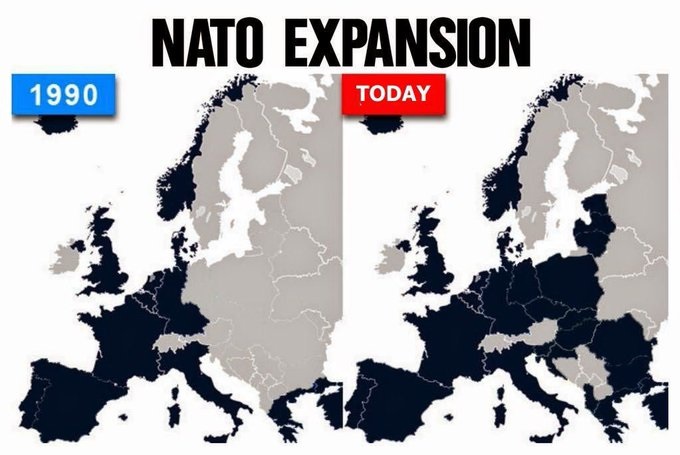
It doesn’t take a genius to figure out what Putin was worried about. He was worried about NATO expansion and, in particular, the emergence of a hostile military alliance backed by Washington-groomed Nazis occupying territory on his western flank. Was that unreasonable of him? Should he have embraced these US-backed Russophobes and allowed them to place their missiles on his border? Would that have been the prudent thing to do?
So, what can we deduce from Putin’s list of demands?
First, we can deduce that he is not trying to reconstruct the Soviet empire as the MSM relentlessly insists. The list focuses exclusively on security-related demands, nothing else.
Second, it proves that the war could have easily been avoided had Zelensky simply maintained the status quo and formally announced that Ukraine would remain neutral. In fact, Zelensky actually agreed to neutrality in negotiations with Moscow in March, but Washington prevented the Ukrainian president from going through with the deal which means that the Biden administration is largely responsible for the ongoing conflict. (RT published an article today stating clearly that an agreement had been reached between Russia and Ukraine in March but the deal was intentionally scuttled by the US and UK. Washington wanted a war.)
Third, it shows that Putin is a reasonable leader whose demands should have been eagerly accepted. Was it unreasonable of Putin to ask that “The Parties shall refrain from deploying their armed forces and… military alliances.. in the areas where such deployment could be perceived by the other Party as a threat to its national security”? Was it unreasonable for him the ask that “The Parties shall eliminate all existing infrastructure for deployment of nuclear weapons outside their national territories”?
Where exactly are the “unreasonable demands” that Putin supposedly made?
There aren’t any. Putin made no demands that the US wouldn’t have made if ‘the shoe was on the other foot.’
Forth, it proves that the war is not a struggle for Ukrainian liberation or democracy. That’s hogwash. It is a war that is aimed at “weakening” Russia and eventually removing Putin from power. Those are the overriding goals. What that means is that Ukrainian soldiers are not dying for their country, they are dying for an elitist dream to expand NATO, crush Russia, encircle China, and extend US hegemony for another century. Ukraine is merely the battlefield on which the Great Power struggle is being fought.
There are number points we are trying to make in this article:
Who started the war? Answer– Ukraine started the war
Was the Russian invasion a violation of international law? Answer– No, the Russian invasion should be approved under United Nations Article 51
Could the war have been avoided if Ukraine declared neutrality and met Putin’s reasonable demands? Answer– Yes, the war could have been avoided
The last point deals with the Minsk Treaty and how the dishonesty of western leaders is going to effect the final settlement in Ukraine. I am convinced that neither Washington nor the NATO allies have any idea of how severely international relations have been decimated by the Minsk betrayal. In a world where legally binding agreements can be breezily discarded in the name of political expediency, the only way to settle disputes is through brute force. Did anyone in Germany, France or Washington think about this before they acted? (But, first, some background on Minsk.)
The aim of the Minsk agreement was to end the fighting between the Ukrainian army and ethnic Russians in the Donbas region of Ukraine. It was the responsibility of the four participants in the treaty– Germany, France, Russia and Ukraine– to ensure that both sides followed the terms of the deal. But in December, former German Chancellor Angela Merkel said in an interview with a German magazine, that there was never any intention of implementing the deal, instead, the plan was to use the time to make Ukraine stronger in order to prepare for a war with Russia. So, clearly, from the very beginning, the United States intended to provoke a war with Russia.
On September 5, 2014, Germany, France, Ukraine and Russia all signed Minsk, but the treaty failed and the fighting resumed. On February 12, 2015, Minsk 2 was signed, but that failed, as well. Please, watch this short segment on You Tube by Amit Sengupta who gives a brief rundown of Minsk and its implications: (I transcribed the piece myself and any mistakes are mine.) …………………. [Transcription on original]
There’s no way to overstate the importance of the Minsk betrayal or the impact it’s going to have on the final settlement in Ukraine. When trust is lost, nations can only ensure their security through brute force. What that means is that Russia must expand its perimeter as far as is necessary to ensure that it will remain beyond the enemy’s range of fire. (Putin, Lavrov and Medvedev have already indicated that they plan to do just that.) Second, the new perimeter must be permanently fortified with combat troops and lethal weaponry that are kept on hairtrigger alert. When treaties become vehicles for political opportunism, then nations must accept a permanent state of war. This is the world that Merkel, Hollande, Poroshenko and the US created by opting to use ‘the cornerstone of international relations’ (Treaties) to advance their own narrow warmongering objectives.
We just wonder if anyone in Washington realizes whet the fu** they’ve done?
Russia Loses World’s Largest Nuclear Submarine, NewsWeek, BY BRENDAN COLE ON 2/6/23
The Russian Navy has confirmed it has decommissioned its nuclear-powered strategic submarine Dmitry Donskoy, which formed part of Moscow’s formidable Cold War weapon system.
There had been speculation for months about the fate of the submarine, which had been launched in 1980 and whose NATO reporting name was Typhoon.
In 2021, Russia’s state news agency Tass reported that the vessel would stay in service until 2026.
It was the first of six Akula-class Northern Fleet submarines laid down at the Sevmash shipyard in Severodvinsk on the White Sea which were commissioned in the 1980s.
At 574 feet long, Dmitry Donskoy‘s status as the world’s largest submarine was overtaken by the 608-feet-long Belgorod nuclear submarine, which was commissioned in July 2022. Dmitry Donskoy had a displacement of around 53,000 tons and was modernized and re-equipped in 2002 with the “Bulava” missile.
While it was reported in July 2022 that the vessel had been terminated, no official confirmation was expected until the end of the year. The vessel’s last reported activity was in the sea trials of SSN Krasnoyarsk in September 2022.
On Monday, Vladimir Maltsev, head of the Russian Movement for Navy Support, told TASS that the vessel had been “decommissioned” and would “await utilization at a naval base in Severodvinsk together with two other units of this project.”
The class was the backbone of the Soviet Union’s second-strike nuclear deterrent, with 20 massive R-39 “Rif” SLBMs (submarine-launched ballistic missile) having up to 200 warheads in total. The Drive described it as the “most deadly single weapon system” Russia had designed in the Cold War. Newsweek has contacted the Russian defense ministry for comment.
ANTI-nuclear campaigners have estimated 11 billion fish off the West Somerset coastline could be killed during the operating life of the new Hinkley Point C nuclear power station.
The Stop Hinkley group said the slaughter would arise if EDF was allowed to ‘wriggle out’ of planning conditions which required acoustic fish deterrents (AFDs) to be fitted to water intake heads.
EDF has to date refused to fit the AFDs and is consulting the Environment Agency (EA) with a view to trying to have the condition dropped.
Stop Hinkley spokeswoman Katy Attwater said the 11 billion figure was calculated over the 60-year lifespan of Hinkley C.
She said affected common fish species would include river lamprey, twaite shad, sprat, herring and the common goby, while rarer species which would be killed included salmon, cod, anchovy, John dory, crucian carp, silver bream, and sea lamprey.
Ms Attwater said the fish migrated from the Bristol Channel to nine main rivers, the Ely, Taff, Rhymney, Ebbw, Usk, Wye, Severn, Avon, and Parrett.
She said particularly hard hit would be the elver migration from the Atlantic, with eels being sucked into the Hinkley intakes and only comparatively few making it to the Somerset Levels and other rivers, which would be their homes for the next 20 years before their return journey past the intake heads to travel back to their Sargasso Sea breeding grounds.
Ms Attwater said EDF’s request three years ago to not have to install the AFDs was rejected by the Environment Agency, a public inquiry, and DEFRA Secretary George Eustice.
“Yet, EDF are still trying to wriggle out of it and waste all the time, money, and effort spent by the EA, the Severn Estuary interest groups, and DEFRA to defend one of the most important breeding grounds for British fish,” she said.
The estuary is a site of Special Scientific Interest (SSSI) and a Special Area of Conservation(SAC) and has been given an internationally important Ramsar site designation………………………………………….
US Attorney General Merrick Garland announced on Friday the first transfer of assets, confiscated as part of anti-Russia sanctions, to Ukraine to pay for the country’s reconstruction.
The measure affects $5.4 million expropriated from Russian businessman Konstantin Malofeyev on charges of sanctions evasion, according to the top official.
“With my authorization today, forfeited funds will next be transferred to the State Department to support the people of Ukraine,” Garland said, adding that the funds were confiscated following an indictment against Malofeyev, issued last April.
Earlier this week, a federal court in New York allowed prosecutors to confiscate $5.4 million belonging to Malofeyev, paving the way for the funds to be used to help rebuild Ukraine.
In June, millions were seized from a US bank account belonging to Malofeyev, against whom the US Treasury Department announced sanctions in April “for having acted or purported to act for or on behalf of, directly or indirectly” the Russian government.
The businessman, who owns Russian Orthodox Christian channel Tsargrad TV, has been on the US sanctions list since 2014. Malofeyev previously claimed that he had no holdings in the West since then.
In December, US President Joe Biden signed legislation allowing the Department of Justice to transfer some forfeited assets to the State Department to aid Ukraine. US law restricts how the government can use such assets.
Poland eyes boost for nuclear energy in EU power market reform, Nasdaq February 06, 2023 — by Kate Abnett for Reuters
Poland has urged the European Union to use upcoming reforms to Europe’s electricity market to do more to support investments in nuclear energy, according to a document seen by Reuters.
The European Union is set to propose a power market upgrade next month, to attempt to avoid a repeat of last year when cuts to Russian gas supply sent European power prices soaring, since gas plants often set overall electricity prices in the current EU system.
“We must ensure a positive regulatory environment for investing in all zero- and low emission technologies. This is especially important for nuclear power projects,” Poland said in a paper shared with EU policymakers, adding that nuclear projects typically require high upfront investments.
The call from Warsaw comes as countries are squaring off over the role for nuclear energy in other EU policies. Negotiations this week on new EU renewable energy targets were cancelled amid a disagreement over whether to expand the targets to include hydrogen produced with nuclear power. https://www.nasdaq.com/articles/poland-eyes-boost-for-nuclear-energy-in-eu-power-market-reform
It is up to the government in Kiev to decide how to use new rockets being delivered for the US-supplied HIMARS launchers, the Pentagon said on Friday. The statement is a confirmation that the latest batch of munitions the American taxpayers are funding will include Ground Launched Small Diameter Bombs (GLSDB).
The Boeing-manufactured munitions consist of a rocket motor mated with an airplane bomb, with an estimated range of up to 150 kilometers. While Friday’s announcement listed “additional ammunition” for the HIMARS and “precision-guided rockets,” Brigadier-General Patrick Ryder told reporters that this indeed included the GLSDB, confirming the information leaked to Reuters earlier this week.
Ryder also confirmed that the US won’t stand in the way of Ukrainians using the missiles to strike deep inside Russia.
“When it comes to Ukrainian plans on operations, clearly that is their decision. They are in the lead for those,” he said on Friday. “So, I’m not going to talk about or speculate about potential future operations, but again, all along, we’ve been working with them to provide them with capabilities that will enable them to be effective on the battlefield.”
The GLDSB are produced by Boeing in cooperation with Sweden’s Saab AB, and combine the GBU-39 small-diameter bomb with the M26 rocket motor. It was unclear how many of the munitions the Pentagon intended to send, or whether they would come from the US military stockpile or need to be freshly produced.
Reuters claimed to have seen a Boeing document saying the first deliveries could be “as early as spring 2023.” Meanwhile, Bloomberg cited unnamed officials who said the timeline could be as long as nine months, depending on when the US Air Force issues the contract. Bloomberg also reported the GLSDB order would account for $200 million of the $1.75 billion in the Ukraine Security Assistance Initiative funding, referring to contracts for weapons and ammunition not coming out of the Pentagon stockpile.
Whenever the missiles actually arrive, Russia has already hinted at how it will respond. On Wednesday, President Vladimir Putin tasked the military with “eliminating any possibility” of Ukrainian artillery strikes on Russian territory. Foreign Minister Sergey Lavrov said in an interview on Thursday that Moscow will “push back” the Ukrainian troops to a range at which they will not be a threat.
“The longer range the weapons supplied to the Kiev regime have, the further the troops will need to be moved,” Lavrov said.
Ukraine has used the US-supplied HIMARS launchers against both military targets and civilians in Donbass, Kherson and Zaporozhye. Kiev has repeatedly asked for the MGM-140 Army Tactical Missile System (ATACMS) rockets, which have a range of some 300 kilometers.
Moscow has repeatedly warned Washington that providing heavy weapons to Ukraine risks crossing Russia’s “red lines” and involving the US and NATO in the conflict directly. The US and its allies insist they are not parties to the hostilities, but continue to arm Kiev. By the Pentagon’s own admission, the US has committed $32 billion in military aid to Ukraine.






 nuclear-news