A mess of different Small Nuclear Reactor Designs in UK.
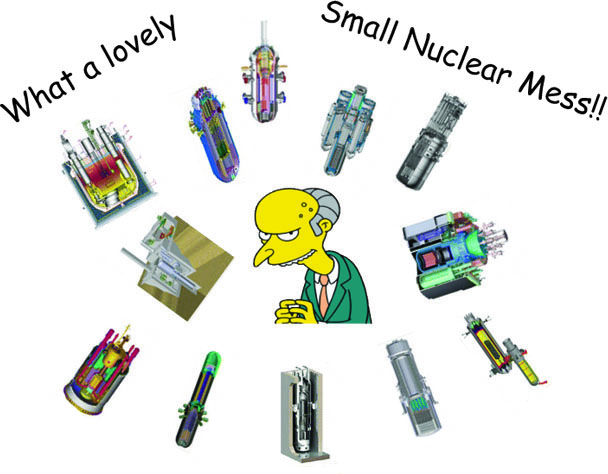
By the time SMRs might be deployable in significant numbers, realistically after 2035, it will be too late for them to contribute to reducing greenhouse gas emissions. The risk is that, as in all the previous failed nuclear revivals, the fruitless pursuit of SMRs will divert resources away from options that are cheaper, at least as effective, much less risky, and better able to contribute to energy security and environmental goals.
No2 Nuclear Power SAFE ENERGY E-JOURNAL No.97, April 2023
More designs of Small Modular Reactors (SMRs) are beginning to emerge which could rival the Rolls Royce design, so the government has decided to launch its competition to gather further evidence before any firm deals are struck. According to ONR a number of companies have, in recent months, applied to the Department for Business, Energy and Industrial Strategy (BEIS) for entry into Generic Design Assessment (GDA) process. BEIS is assessing those applications before deciding whether or not to ask ONR to start the GDA process. The plan is for the government to eventually award £1bn in co-funding to the winning SMR design. This money would help the company get through the GDA process.
At least six new SMR designs have applied to BEIS to be entered into the Generic Design Assessment (GDA) process. As well as Rolls Royce’s SMR, which has already entered the process. (1) The applicants are proposing to build a range of technologies including fast reactors and high temperature reactors which were built as prototypes in the 1950s and 1960s – but successive attempts to build demonstration plants have been short-lived failures. It is hard to see why these technologies should now succeed given their poor record.
The main claim for SMRs over their predecessors is that being smaller, they can be made in factories as modules using cheaper production line techniques, rather than one-off component fabrication methods being used at Hinkley Point C. Any savings made from factory-built modules will have to compensate for the scale economies lost. A 1,600MW reactor is likely to be much cheaper than 10 reactors of 160MW. And it will be expensive to test the claim that production line techniques will compensate for lost scale economies. By the time SMRs might be deployable in significant numbers, realistically after 2035, it will be too late for them to contribute to reducing greenhouse gas emissions. The risk is that, as in all the previous failed nuclear revivals, the fruitless pursuit of SMRs will divert resources away from options that are cheaper, at least as effective, much less risky, and better able to contribute to energy security and environmental goals. (2)
The six designs are:
- GE Hitachi (GEH) submitted an application for its BWRX-300 boiling water reactor in December.
- 2. The US firm Holtec has submitted its SMR-160 design, a 160MWe pressurised water reactor developed in collaboration with Mitsubishi Electric of Japan and Hyundai
- 3. US firm X-Energy, working with Cavendish Nuclear, wants to deploy its high-temperature gas reactor in the UK.
- 4. UK-Italian start-up Newcleo has submitted it lead-cooled fast reactor design. The company says it’s in discussions with the NDA about using Sellafield plutonium and depleted uranium. (3) The Company says it has raised £900m to further its plans which include the establishment of a first Mixed Plutonium-Uranium Oxides (MOX) production plant in France, with another plant to follow later in the UK. (4)
- 5. UK Atomics – a subsidiary of Denmark’s Copenhagen Atomics – says it has submitted a Generic Design Assessment (GDA) entry application for its small and modular thorium molten salt reactor. (5)
- 6. GMET, a Cumbrian engineering group which last year acquired established nuclear supplier TSP Engineering, said it is developing a small reactor called NuCell for production at TSP’s Workington facility. (6)
The list makes no mention of an application by NuScale, which has already expressed an interest in building at Trawsfynydd. (7) According to the Telegraph, NuScale’s reactor has received design approval from the US’s Nuclear Regulatory Commission (NRC) putting it ahead of the competition. (8) However, it was NuScale’s 50 MWe design which was approved by the NRC. That is no longer being pursued by the company. It is applying for a new approval for its 77 MWe design. Although NuScale claimed that the new design was so close to the original that the second approval would be simple, that is turning out not to be the case, as the NRC made clear in its recent letter. (9)
No mention either of the Last Energy micro reactor. The Company has signed a $19 billion deal to supply 34 x 20 MW nuclear reactors to Poland and the UK. These SMRs will be about 2.4 times the cost per MWh of the very expensive Hinkley facility. (10)
Mark Foy, Chief Executive and Chief Nuclear Inspector, Office for Nuclear Regulation, told the House of Commons Science and Technology Committee in January that he was assuming that ONR will be asked to undertake a number of GDAs for some of the SMR technologies that are currently being considered by BEIS. “Our assessment is that if BEIS determines that two or three technologies need to go through generic design assessment, that work will be done in the next four years, or thereabouts”. (11)
Prof Steve Thomas, Greenwich University, has critically assessed the current enthusiasm for Small Modular Reactors in the UK and elsewhere. He concludes:
“The risk is not so much that large numbers of SMRs will be built, they won’t be. The risk is that, as in all the previous failed nuclear revivals, the fruitless pursuit of SMRs will divert resources away from options that are cheaper, at least as effective, much less risky, and better able to contribute to energy security and environmental goals. Given the climate emergency we now face, surely it is time to finally turn our backs on this failing technology?” (12)
‘Green’ Freeports
Meanwhile, the Inverness Courier reports that the Cromarty Firth and Inverness green freeport hopes to fabricate parts for SMRs and then transport them to the construction site wherever that might be. (13) Highlands Against Nuclear Power (formerly Highlands Against Nuclear Transport) says nuclear should not be part of the Cromarty freeport vision. (14)
The Scottish NFLA convenor, Councillor Paul Leinster wrote to Scottish Government Net Zero Minister Michael Matheson asking him to reject nuclear power at Scotland’s two new Green Freeports and instead make them a hub for renewable technologies to produce power for the nation. (15) Unfortunately, the Minister replied saying he will not be opposed to a nuclear manufacturing facility in a supposed Green Freeport. (16)
Forth Green Freeport has said they have no plans for nuclear power generation at its sites – including Rosyth – after campaigners raised concerns. “The Forth Green Freeport vision for Rosyth is centred around a new freight terminal, offshore renewable manufacturing and green power generating capacity,” said the spokesperson. “The FGF will also enable the development of largescale advanced manufacturing, skills and innovation onsite, alongside a proposed new rail freight connection. This vision and the associated economic and community benefits will boost Fife and the wider region. There are no plans for nuclear power generation on FGF sites.” However, it’s possible FGF is answering the wrong question which is about manufacturing parts for SMRs, not nuclear generation. (17)
There were reports that the Ineos-run facility at Grangemouth was interested in building a Rolls Royce SMR, (18) but the Scottish Government said it would block such a move, (19) Energy Minister, Michael Matheson responded to a letter from Scottish NFLA chair, Councillor Paul Leinster, saying Scottish ministers “remain committed” to their “long-standing government policy to withhold support for any new nuclear power stations to be built in Scotland” and officials have been advised by Ineos that “Small Modular Reactors do not currently form part of their net zero road map for Grangemouth”. (20) The Scottish Tories attacked the Scottish Government for its stance describing it as anti-business. (21 https://www.no2nuclearpower.org.uk/wp/wp-content/uploads/2023/04/SafeEnergy_No97.pdf
What’s happening with Great British Nuclear? Not Much.
No2 Nuclear Power SAFE ENERGY E-JOURNAL No.97, April 2023.
Last November, the UK Government was all set to announce proposals to set up a new body called Great British Nuclear (GBN), to develop a network of small modular reactors (SMRs), as well as promote new large reactors. GBN would be responsible for getting planning permission and doing the preparation work on designated sites. However, the announcement was delayed because of a row over funding with Treasury officials arguing there is no money to pay for it. (1)
Then on 30th March, there was a further announcement, as part of the Government’s so called Green Day, when its revised Energy Strategy was launched. The strategy reiterated the pledge to set up “Great British Nuclear”, which will begin recruiting staff “shortly” and will be based “in or around” Greater Manchester. But there was still no new money announced. The body will run a competition for small modular reactor (SMR) designs, starting with “market engagement” in April 2023 and a selection process in summer. It will have “an ambition to assess and decide on the leading technologies by autumn”. The government will publish a nuclear “roadmap” later this year. (2)
Energy Security Secretary, Grant Shapps wants “to deliver wholesale UK electricity prices that rank amongst the cheapest in Europe”, (3) with GBN providing up to a quarter of our electricity –24GW by 2050, up from the previous target of 16GW. (Hinkley Point C should be 3.2GW). (4) Somehow, Shapps thinks Small Modular Reactors will help with that. But it is far from clear that SMR production line techniques will compensate for lost scale economies of building large reactors. (5)
The American SMR design from NuScale Power is the canary in the SMR market –already far more expensive and taking much longer to build than renewable and storage resources. (6)
Funding to establish GBN doesn’t mean funding for new reactors. The Times reported that a deal on funding was unlikely to materialise for at least another 12 months. (7) The perpetual launch of Great British Nuclear won’t get us anywhere near 24GW; £210 million lobbed at Rolls-Royce SMRs, and a £700 million injection into the planning for Suffolk’s Sizewell C, a nuke that’ll cost £30 billion-plus, is small beer. (8) Rolls-Royce’s nuclear power business has frozen hiring, (9) and Tom Samson, head of its SMR division is leaving the Company. (10) Rolls says its SMR programme will run out of cash by
the end of 2024, but it hopes to receive UK regulatory approval by about August 2024. (11)
Andrew Bowie, the Tory MP for West Aberdeenshire and Kincardine has become the UK’s first ever nuclear energy minister. The SNP’s Westminster energy spokesman Alan Brown said: “Andrew Bowie must be taking up one of the most pointless ministerial positions in the UK government. If the Tories think they will bring down energy bills by building nuclear power stations that won’t be ready for years to come then they are more delusional than we thought.” (12)
The Scottish Government condemned the GBN launch. The new Cabinet Secretary for Energy Neil Gray said: “The launch of GBN does not change the Scottish Government’s opposition to the building of new nuclear fission power stations in Scotland. Given that new nuclear power will take years, if not decades, to become operational, will be expensive, and will generate further radioactive waste, we do not believe it to be a sustainable solution to our net zero energy requirements.” (13) Anas Sarwar
has condemned the Scottish Government’s nuclear stance as ‘short-sighted’ and ‘unambitious’. (14)
On 15th March, Jeremy Hunt, announced that nuclear power will be classified as “environmentally sustainable” in UK’s green taxonomy, “giving it access to the same investment incentives as renewable energy.” He stated that “because the wind doesn’t always blow and the sun doesn’t always shine, we will need another critical source of cheap and reliable energy. And that is nuclear.” (15) It’s unclear whether the reclassification will help in the hunt for co-investors alongside EDF and government in Sizewell C.
Ministers were forced to publish the raft of revised policies, contained in 40 documents and nearly 3,000 pages, after a court ruled last year that the existing strategy for reaching net zero emissions was unlawful because it provided insufficient detail on how the target would be met. But it has admitted the revised plans will only deliver 92% of the goal to cut emissions by 68% by 2030,compared with 1990. The Green Alliance think tanks says even that 92% is a very generous reading. (16) https://www.no2nuclearpower.org.uk/wp/wp-content/uploads/2023/04/SafeEnergy_No97.pdf
Now the UK government is saying they need costly large nuclear reactors as well as small ones

No2 Nuclear Power SAFE ENERGY E-JOURNAL No.97, April 2023
Simon Bowen, the Industry Adviser at Great British Nuclear (GBN) told the House of Commons Science & Technology Committee he thinks the UK will need two more large reactors after Hinkley and Sizewell as well as SMRs and Advanced Modular Reactors (AMRs). (1)
Graham Stuart, Minister of State at the Department for Energy Security and Net Zero, told the same Committee that Government policy is to seek UP TO 24GW of nuclear by 2050. He continues:
“I would love it if storage to deal with the intermittent renewables became cheaper, more effective and better for long-term storage and the like. I am not saying that we will definitely have 25% of our electricity from nuclear. That is our ambition; that is our thinking; but as technology, prices and the economics develop, we want tensions between these technologies to deliver it. However, what I can say is that we are absolutely committed to nuclear as a significant share of our electricity because we need that baseload and are committed to driving it forward.”
In January, Bechtel and Westinghouse told the Welsh Affairs Select Committee they are hoping to have an AP1000 nuclear station up and running on Anglesey by 2035. The Development Consent Order process takes 4 years and it takes around 6 years to build. The companies see it as the role of GBN to acquire the site from Hitachi. The Companies are confident they will be able to address the biodiversity and Welsh language issues which led to the Horizon application being rejected by the Planning Inspector. (3) The two companies have been in talks with government since 2020. (4) The two AP1000s being built in the US State of Georgia at Vogtle were originally expected to cost $14 billion, but this has now jumped to $34 billion. (5) The first reactor has only just reached initial criticality – construction started in 2009 and was meant to be complete in 2016. (6) The Nation Cymru website asks whether Wales should be involved with Great British Nuclear at all. (7) https://www.no2nuclearpower.org.uk/wp/wp-content/uploads/2023/04/SafeEnergy_No97.pdf
Record high water levels threaten dam near Zaporizhzhia nuclear plant.
Dam water threat near Ukraine nuclear plant: Russia By David Ljunggren, May 5 2023 https://www.canberratimes.com.au/story/8184463/dam-water-threat-near-ukraine-nuclear-plant-russia/
Record high water levels could overwhelm a major dam in southern Ukraine and damage parts of the Russian-controlled Zaporizhzhia nuclear power station, a Russian official has told Tass agency.
Renat Karchaa, an adviser to the general director of nuclear energy firm Rosenergoatom, said if the Nova Kakhovka dam did rupture, the power cable line for the Zaporizhzhia plant’s pumping stations would be flooded.
“This (would create) functional problems for the operation of the plant and risks for nuclear safety,” he told Tass.
Last November, after Russian forces withdrew from the nearby southern Ukrainian city of Kherson, satellite imagery showed significant new damage to the dam.
Both sides have accused each other of planning to breach the dam using explosives, which would flood much of the area downstream and would likely cause major destruction around Kherson.
Karchaa’s comments represent a significant contrast from those made in late March by Ukrainian officials, who said they feared the Zaporizhzhia facility could face a shortage of water to cool reactors by late summer because Russian forces had let water out of a reservoir that supplied the plant.
Russian troops took over the plant as they invaded parts of Ukraine last year.
It is at the centre of a nuclear security crisis due to near-constant shelling in its vicinity which Kyiv and Moscow blame on each other.
The Asse nuclear waste interim storage facility continues to cause controversy.
www.nuclearwastewatch.ca Germany, By David Sadler May 4, 2023
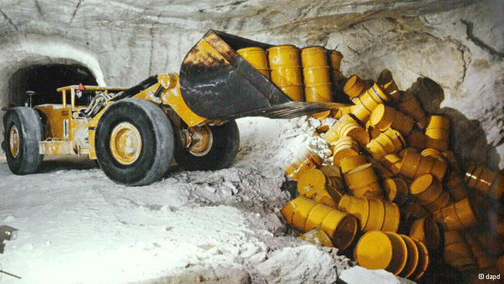
What to do with thousands of barrels of nuclear waste as long as there is no repository? This question concerns the federal government and the residents of Asse. The former mine is dilapidated and needs to be cleared. Environment Minister Lemke got an idea on site.
In the dispute over the Asse site in Lower Saxony as an interim storage facility for nuclear waste, the fronts remain hardened. The former salt dome is dilapidated and should be cleared in about ten years. Around 126,000 barrels of low- and medium-level radioactive nuclear waste are currently stored there. As long as there is no repository in Germany, they have to be stored temporarily. The plans of the responsible Federal Agency for Disposal (BGE) to look for a site near the Asse are met with resistance.
When Federal Environment Minister Steffi Lemke visited the site, several citizens’ initiatives called for the Green politician to give her authority. Lemke must instruct the BGE as the operator to finally arrange for the site comparison for an interim storage facility requested by environmental groups and residents, explained the Asse II coordination group. For years, the BGE has acted against the interests of people and the environment in the area around the dilapidated salt dome.
BGE wants intermediate transports avoid
“We say that the interim storage facility has to be close to where we collect and treat the waste,” replied BGE Managing Director Stefan Studt. It is important to avoid intermediate transports. From the point of view of the operating company, the location is suitable and, above all, can be approved, which Studt described as a “relevant standard”.
Lemke: conditions “absolutely unacceptable”
Environment Minister Lemke does not see a quick solution either. “I don’t have an alternative interim storage facility in my luggage,” she told the representatives of the citizens’ initiatives. But you have to ensure that this nuclear waste is taken out and stored as responsibly as possible – until it can go to a repository. “We will certainly continue this discussion,” she said. The nuclear waste in the former Asse mine was stored under conditions that were “absolutely unacceptable”.
Therefore, the German Bundestag decided to salvage the radioactive waste from the Asse as quickly as possible. A retrieval of the waste is planned and should start around 2033. The plan has long been the subject of strong criticism in the affected region and recently even led to a critical monitoring process ended became.
A challenge arises with the search for safe disposal of the nuclear waste.Problems due to the lack of a repository
“I’m really happy that we shut down the last three nuclear power plants in Germany on April 15 and were thus able to prevent even more highly radioactive waste from accumulating,” said the Greens politician. “I can tell you that this is not a matter of course, but that it has kept me busy in recent months.” In some cases, continued operation was demanded with great carelessness and the problems with the non-existent repository were completely ignored.
There is currently more than 120,000 cubic meters of low- and intermediate-level radioactive waste in interim storage facilities throughout Germany. The garbage is, for example, parts of plants that have been contaminated, protective clothing, tools and equipment from nuclear power plants. According to the Federal Office for the Safety of Nuclear Waste Management (BASE), this only accounts for one percent of the activity, but accounts for 95 percent of the total volume of radioactive waste.
In an even slower scenario, a repository could even not be found until 2068.billion cost after nuclear phase-out
Then there are the costs: A commission has estimated the total costs for decommissioning and dismantling of the reactors as well as the transport and storage of the waste at 48.8 billion euros. As a result, a fund was set up into which the operators of the nuclear power plants had to pay. The interim and final storage is to be paid for with this amount – however, it is still uncertain whether the sum will be sufficient.
Critics and some experts see the camps as a security risk. With the former iron ore mine Schacht Konrad in Salzgitter, a repository for low-level and intermediate-level radioactive waste has been identified, which is scheduled to go into operation in 2027. The search for a repository for high-level radioactive waste has so far been unsuccessful.
UK government to take 50% stake in Sizewell C nuclear project, amid legal challenge, soaring costs, and pension funds pulling out.
No2 Nuclear Power SAFE ENERGY E-JOURNAL No.97, April 2023
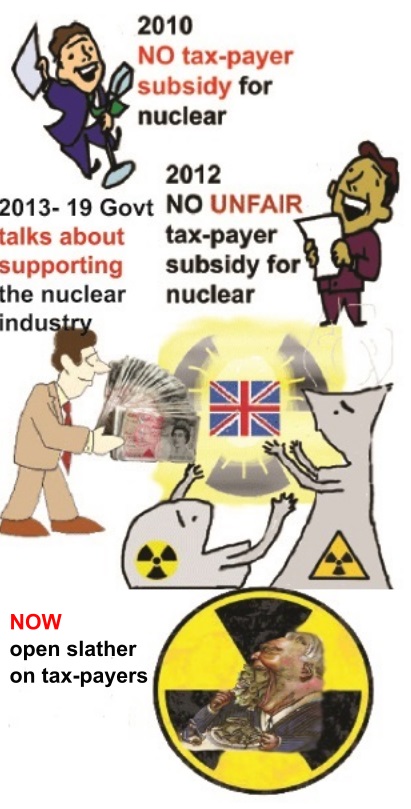
In December, the Government announced, yet again, that Sizewell C will go ahead, and that it would invest nearly £700m to end China’s controversial involvement. Ministers said the move would mean the UK Government taking a 50% stake in the project’s development. (1) However, the announcement was no more than the long-anticipated buying out of China General Nuclear from the project and funds to allow the development of the project to the point of a Final Investment Decision (FID). (2) Business Secretary Grant Shapps has refused to provide a figure for the cost of buying out China’s stake.
It reaffirmed its commitment again at the launch of the ‘Powering Up Britain’ strategy. It says it will bring Sizewell C to the point of a final investment decision this year. In his spring budget announced earlier this month, chancellor Jeremy Hunt confirmed the Government would be investing £700million in Sizewell C. (3)
Campaigners launched a legal challenge against Sizewell C in the High Court on Wednesday 22nd and Thursday 23rd March. (4) Together Against Sizewell C argues that the environmental impacts of securing a permanent water supply of two million litres per day were never assessed. As a result, the government cannot guarantee the date the nuclear plant will open, which means it has no way of knowing for sure that the plant’s contribution to climate change is enough to override the environmental harm it will cause. TASC also says no alternatives to nuclear power, including renewables, were considered when the Secretary of State for Energy, then Kwasi Kwarteng, gave the go ahead. He rejected the recommendation of the Examining Authority which ruled in February 2022 that unless the outstanding water supply strategy could be resolved and sufficient information provided to enable the Secretary of State to carry out his obligations under the Habitats Regulations, there was no case for a development consent order. The result of the hearing should be known between the 23rd April and the 7th May.
Sizewell Funding Efforts to attract investment into Sizewell C have taken a setback after two of the UK’s biggest pension funds turned their backs on the project. The BT Pension Scheme and NatWest – have told campaign group Stop Sizewell C and the Daily Mail they do not intend to back the project. (5) However, the UAE’s wealth fund – Mubadala – may invest. (6)
With Hinkley Point C now forecast to cost £33 billion and Sizewell C as much as £30 billion, Grant Shapps insists “private sector capital and investment” will ride to the rescue. He points to the Middle East. “I was recently in the Gulf states and was really struck by the money available for investment,” he says. “What they want to know is that we’ve got a platform, Great British Nuclear, and that we’re up for it — we’ve got the technology.” (7)
The Flamanville EPR is another six months late and 500 million euros more expensive. (8) Regular electricity production at Finland’s new Olkiluoto 3 nuclear reactor has been postponed again to 29th March. (9) Nuclear Engineering International summarises where the world’s EPRs have got to. (10) https://www.no2nuclearpower.org.uk/wp/wp-content/uploads/2023/04/SafeEnergy_No97.pdf
UK government’s proposals on radioactive substances : -all of its 7 “consultation questions” should be vigourously opposed.

Nuclear Waste Consultation, No2 Nuclear Power SAFE ENERGY E-JOURNAL No.97, April 2023
The UK and devolved governments have launched a consultation on proposals to update and consolidate policies on managing radioactive substances and nuclear decommissioning into a single UK-wide policy framework. (1) The new document will basically replace existing policy which dates back to a 1995 document commonly known as Command 2919. The proposals focus on 3 areas: managing solid radioactive waste; updating the policy for nuclear decommissioning; managing nuclear materials and spent nuclear fuel. Proposals include leaving lower-level waste behind on decommissioned sites; disposing intermediate level waste in near surface facilities and, most shockingly, reintroducing reprocessing.
In a draft response, I argue that the consultation has its priorities the wrong way round. In Part 1 there is far more emphasis placed on cost-effectiveness and removing burdens from industry, whereas protecting public health appears to be relegated to a second-class objective. Even here the emphasis is on meeting safety and environmental regulations rather than maximising public health protection, with no recognition of the uncertainties involved in radiation protection.
There needs to be a new emphasis on openness, transparency and public consultation as plans for decommissioning and waste management are developed, so that the public is fully aware of the intended destination of each waste stream, radioactive discharges expected from each proposed method of waste management and the dose implications of each proposed action. The public should also be given access to independent advice.
The document says: Government “must strive to keep the creation of radioactive waste to a minimum,” which given that the latest UK Energy Security Strategy proposes increasing the target for new nuclear power stations from 16GW to 24GW is nothing short of misleading.
The proposals would embed the so-called Nuclear Waste Hierarchy into Government Policy. In our view the Hierarchy promotes methods of radioactive waste management which are basically ways of diluting and dispersing radioactive waste around the environment, ultimately discharging radioactive substances into our estuaries, seas and atmosphere whilst masquerading as the environmentally friendly sounding ‘waste hierarchy’. Diverting increasing quantities of radioactive waste to landfill, metal recycling and incineration plants is a policy of dilute and disperse rather than one of concentrate and contain. This is ‘waste management on the cheap’. Waste management techniques should be based on environmental principles, particularly the principle that hazardous waste should be concentrated and contained in isolation from the environment.
The document also proposes a new policy framework for near surface disposal facilities for some types of intermediate level waste in England and Wales. It should be noted that while these near surface facilities might resemble Scottish near surface facilities, in Scotland waste could be retrieved if something went wrong, but in England and Wales retrieval is not planned for.
The new policy also proposes the promotion of on-site disposal on nuclear and former nuclear sites with the rider “where it is safe to do so”. This is to “help drive earlier and more cost-effective nuclear decommissioning and management of radioactive waste without compromising safety and security.”
Finally, the consultation says “New and advanced reprocessing technologies, with integrated waste management, may be developed in the future which support advanced nuclear reactor systems. The UK Government is continuing to support the advanced nuclear sector through investments in research facilities and programmes.”
The Consultation Document asks 7 “Do you agree” questions. The answer to all seven should be “No”. https://www.no2nuclearpower.org.uk/wp/wp-content/uploads/2023/04/SafeEnergy_No97.pdf
Reply to UK government’s nuclear dump consultation – STOP Undersea Nuclear Dump NOW!
Radiation Free Lakeland have just put together a reply to the Government’s consultation on the nuclear dump plans. You don’t have to write a long reply to all their (loaded) questions. The main thing is to say that the GDF and Near Surface plans are too dangerous and that the Government should think again. Please do use the below for inspiration for your own replies to the consultation which can be found here https://www.gov.uk/government/consultations/managing-radioactive-substances-and-nuclear-decommissioning
Your reply does not need to be long – even a sentence or two explaining why the Government should halt GDF plans would be good – Email your reply to the consultation here: RSNDPolConsult@beis.gov.uk
Managing radioactive substances and nuclear decommissioning
Consultation by: Department for Energy Security and Net Zero
1 March 2023 Notes from Radiation Free Lakeland sent by email to:RSNDPolConsult@beis.gov.uk 3rd May 2023
Radiation Free Lakeland are a volunteer civil society group who formed in 2008 as a response to the Managing Radioactive Waste Safely’s (now RWM/NWS) ‘steps to Geological Disposal’ which were halted by Cumbria County Council in 2013.. RaFL’s focus is nuclear safety.
Introduction: RaFL do not recognise the validity of this consultation for the following reasons:
a) TIMING – It is taking place at a time when the most expedient ( proximity to Sellafield ) target area for nuclear waste disposal is undergoing the upheaval of Local Government Organisation.
b) CRONYISM – The NDA and Nuclear Waste Services are being advised on “Investigation Techniques,” “Construction” and “Costings for Scenarios” including “co-location” of a GDF and NSD by the CEO of West Cumbria Mining. Mark Kirkbride’s coal mine, now approved by Government, lies directly between the target areas of Mid Copeland and Allerdale.
c) SAFE ENOUGH – The public are being misled over escalating radiation risks by the use of ALARP (As Low As Reasonably Practicable), the Waste Hierarchy and Best Available Techniques to recycle, incinerate and dispose of radioactive wastes by increasingly novel routes from recycling radioactive scrap metal to burial of high level wastes in sub-sea geology.
Consultation: Part I UK policy proposals for managing radioactive substances and nuclear decommissioning
- 1. Do you agree with the proposal to require the application of a risk-informed approach as a decision-making framework for the management of all solid radioactive waste?
NO. The public are being misled into answering Yes to this question – who would disagree with a “risk informed approach?” But what the consultation fails to reveal (or even refer to as far as we can see) is that the industry uses a device called ALARP which was instigated following a court case in 1949. A coal mine employee had been killed by a rock fall that might have been prevented if the tunnel roof had been shored up by the operator the UK National Coal Board (NCB). The appeal court’s decision was that the NCB did not have to take every possible physical measure to eliminate risk; it only had to provide protection where it was required.
This judgement enabled business owners to defend themselves from successful legal action by showing that they had taken all “reasonably practicable” measures to ensure safe operation, and that therefore risks were “As Low As Reasonably Practicable” or ALARP. The nuclear industry has taken this principle and used it to apply to radiation protection for the public – the consultation does not make any mention of ALARP but does mention its facilitator “Best Available Technique” which aims to provide “value for money” ie the cheapest option measured against human life.
If risk is either impossible or hugely expensive to reduce the industry chooses to do what is “reasonably practicable” to manage it and label the process “ALARP”. The obvious alternative is that the process would have to shut down. The ALARP principle for fatality risk is effectively set at 1 in 10,000 per annum for members of the public and 1 in 1000 per annum for nuclear workplace risks. Even by this optimistic industry standard the public risk from radioactive emissions is twice that of a fatality by car accident (one in approx 20,000 according to some statistics) and in a reverse lottery many times greater than that of winning the National Lottery – the difference being that the public can choose to avoid the fatal traffic accident or winning lottery ticket. This equates to thousands of ALARP deaths every year due to radioactive emissions even by the industry’s own optimistic standard.
An example of this is the decommissioning of Sellafield’s Pile 1 and 2. A new landfill area called Calder Landfill Extension Segregated Area Disposals (CLESA) for nuclear waste dumping was created to dispose of wastes from the demolition. “This Best Available Techniques (BAT) justification demonstrates that the environmental permit for CLESA should be varied to allow it to accept radioactive waste material with higher levels of tritium..” Despite the Environment Agency previously pointing out in 2014 “ it is doubtful whether the location of the LLWR site (at nearby Drigg) would be chosen for a new facility for near-surface radioactive waste disposal if the choice were being made now. It would not be in accordance with current national and international siting practice for new facilities.” Despite knowing that radioactive wastes that will still be dangerous to the public in many decades to come will sooner or later end up scattered along the beach and in the sea the Environment Agency have acquiesced to Sellafield’s ‘necessity’ for a newly enlarged landfill just metres from the Irish Sea containing radioactive rubble using ALARP and BAT to justify the industry’s ‘need’. Coinciding with ALARP and BAT is the fact that in recent years the Environment Agency once fully autonomous from Government (and the nuclear industry) have been systematically declawed with massively reduced funding over recent years to become less of a watch dog than a lap dog.
Image the Calder Landfill is Expanding next to the Irish Sea in order to dump decommissioning wastes from Piles 1and 2 along with radioactively contaminated animal carcasses etc https://consult.environment-agency.gov.uk/cumbria-and-lancashire/sellafield-rsa-major-permit-review/supporting_documents/10.%20MARP003_CLESA%20PCRSA%20Updated%20Report%206.12.17.pdf-1
- 2. Do you agree that application of the waste hierarchy should be an explicit policy requirement for the management of all solid radioactive waste where practicable?
NO. Radiation Free Lakeland have previously warned that the application of the “waste hierarchy” has opened up novel routes to the environment with increasing radioactive risks to the public. Examples:…………………………………………………………………………………………..
- 3. Do you agree with the proposed amendment to current policies on geological disposal to allow disposal of Intermediate Level Waste in near surface facilities?
No. The NIREX inquiry of 1997 rejected the deep disposal of Intermediate Level Wastes. Nirex’s aim was “to prevent radioactive material from coming into contact with groundwater in which it could dissolve, because this is the principal route by which radioactive material could be transported from a repository through the overlying rock to the surface where it could affect humans.” The Nirex inquiry concluded that this aim could not be achieved with deep disposal of ILW. Roll on 20 years and this fact is airbrushed out with the plan for Near Surface Disposal which would mean that Intermediate Level radioactive wastes would reach groundwater and the surface far sooner than the rejected NIREX plan for deep disposal………………………………………………………………
- 4. Do you agree with the proposed policy framework for the development of near surface disposal facilities by the NDA for the disposal of less hazardous ILW?
No. See answer above. “less hazardous” does not mean safe to “dispose” by shallow grave.
- 5. Do you agree that the policy of the UK Government and devolved administrations should promote the use of on-site disposal of radioactively contaminated waste from the decommissioning of nuclear sites, subject to environmental permits?
No. See 3. and 4. Waste cannot be “disposed” unless radioactivity has reduced to background levels. Radioactive waste should be retrievable, monitorable and able to be repackaged/shielded giving future generations the ability to protect themselves.
- 6. Are there any further improvements that we might consider in relation to the proposed update of the nuclear decommissioning and clean-up policy?
Yes – see 3. 4. And 5. In addition the first step is to stop the process of generating more nuclear wastes.
- 7. Do you agree with our proposed updates to the policy statement on the management of spent fuel?
No. See 6. Reprocessing spent fuel should be banned completely. Reprocessing generates ever more waste streams to be discharged to the environment and increases the volume of nuclear wastes dangerous to all life forms by at least 160 times. Sellafield’s reprocessing wastes are found in the Arctic but much of the waste has settled on the Irish Sea bed to be resuspended with the tides and activities such as borehole drilling and subsidence from sub-sea mining.
- 8. Do you agree with our proposed policy statement on the management of uranium?
No. Uranium should not be ‘re-used.’ Uses of uranium include military use which should be banned as it is effectively a chemical weapon. Depleted uranium is used for tank armour, armour, armour piercing bullets and aircraft weights. Depleted uranium is both a toxic chemical and radiation health hazard when inside the body.
- 8. Do you agree with our proposed policy statement on the management of uranium?
No. Uranium should not be ‘re-used.’ Uses of uranium include military use which should be banned as it is effectively a chemical weapon. Depleted uranium is used for tank armour, armour, armour piercing bullets and aircraft weights. Depleted uranium is both a toxic chemical and radiation health hazard when inside the body
……………………………………………………………………………. https://mariannewildart.wordpress.com/2023/05/03/tell-uk-government-stop-undersea-nuclear-dump-now/
France’s government postpones its nuclear safety reform indefinitely.
The merger of ASN and IRSN will not be examined by a joint committee during the
examination of the nuclear acceleration law on May 4th. The OPECST is
invited to discuss the future of this controversial merger. Game over for
the nuclear safety reform project. Announced by the government at the
beginning of February, the merger of the Nuclear Safety Authority, in
charge of civil nuclear safety, and the Institute for Radiation Protection
and Nuclear Safety (IRSN), in charge of nuclear safety expertise “is
withdrawn,” said the office of Energy Minister Agnès Pannier Runacher on
Friday.
Les Echos 28th April 2023
What happens to the UK’s nuclear waste?
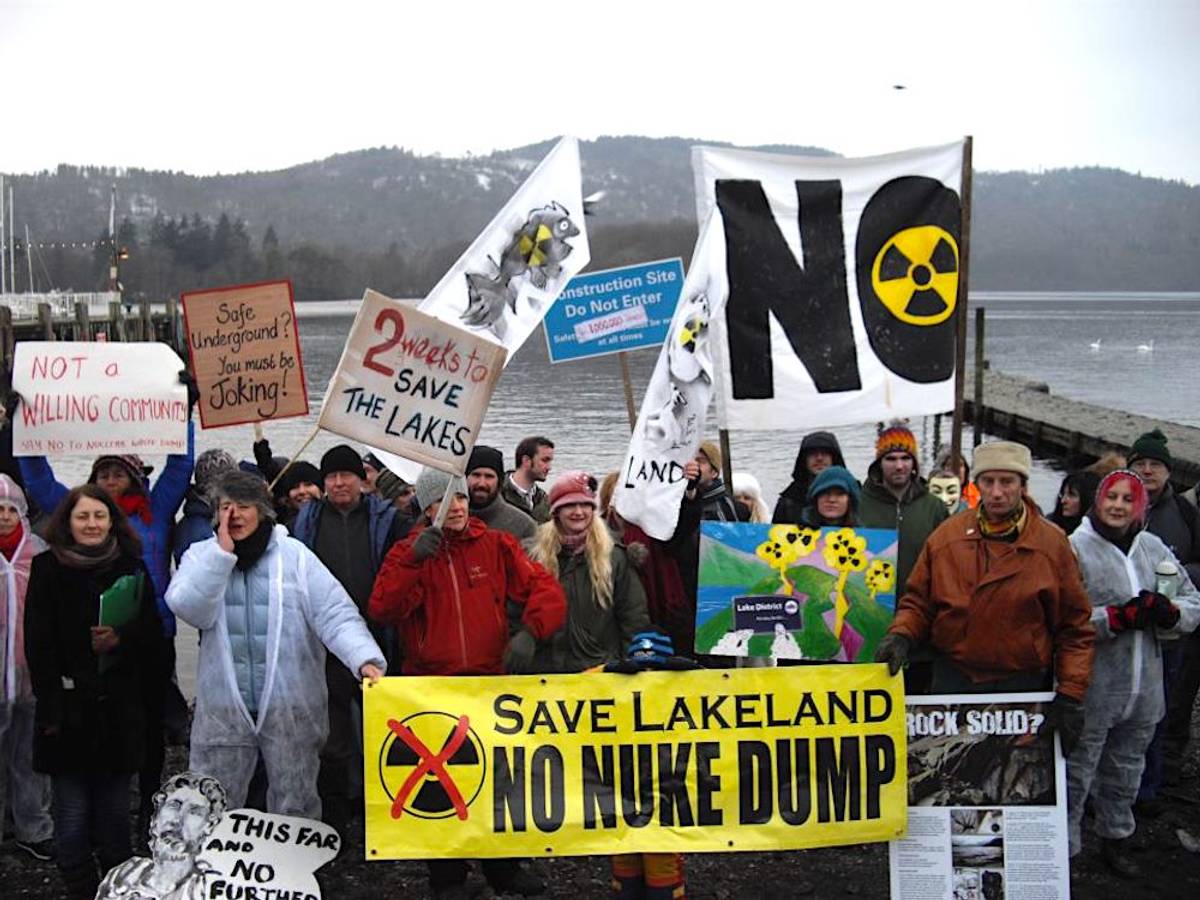
Elly Foster. 2nd May 2023 https://ecohustler.com/technology/what-happens-to-the-uks-nuclear-waste
What are the plans for disposing of the UK’s nuclear waste?
Let’s not talk about it!
Nuclear reactors have existed in the UK since 1956, 67 years. In all this time no single government nor the industry itself has come up with a decent plan for getting rid of the dangerous waste. I have been a science teacher for many years and in the curriculum on electricity generation, students are always taught the advantages and disadvantages of nuclear power. They are simply taught that it is expensive to dispose of the waste. What they are not taught is how it is being stockpiled in places like Sellafield and how open concrete ponds of water filled with dangerous waste exist right next to the Irish Sea.
We have all seen what happened in Japan when Fukushima was affected by an earthquake. But this is the UK and we don’t suffer earthquakes here, or do we? Listening to our Government, to the Labour Party, to the Liberal Democrats and to Plaid Cymru, nuclear power is the way to get us out of the climate emergency hole. Of course what they really want to promise voters is that they can carry on consuming electricity with abandon. They like to argue that nuclear power is clean. What they mean is that it produces no CO2 as a by-product of the reaction process, but they fail to tell you how much CO2 is emitted in the construction of the power station, the transport and the decommissioning. They like you to think that only nuclear power can provide a baseload so that we can ‘keep our lights on’. They don’t tell you that it is possible to generate enough electricity if we were to drastically cut our unnecessary consumption and use our grid in a smart way.
And they never talk about the waste issue
We need to have a close look at the plans for nuclear waste dumping. In the industry’s parlance this is called a Geological Disposal Facility. The name says it all. Find some geologically stable rocks and dispose of the waste for millennia. A previous government asked all communities politely who would be prepared to have such a facility on their doorstep. Naturally not many communities came forward willingly, one in Lincolnshire and one which is the subject of this article.
It’s not that the local people were shouting hoorah, no; it’s more that their local council chiefs shouted JOBS and COMMUNITY BENEFIT. And it is seen as a community with a nuclear ‘heritage’, hence it is the obvious choice. Certain local people immediately started campaigning against this idea as they understood the reality on the ground, or rather under the ground. They knew that in fact the geology in their area is not that stable at all.
Coal consipracy?
It gets worse. The community I am describing is in West Cumbria. Many of you will know of plans to open a new coal mine there. We have heard the arguments that it is for coking coal and that we need it for the steel industry or otherwise we’ll have to import it, stated to be the unsustainable option. The pro’s love to pull this sustainability argument out of the hat; they think they sound so green.
Now, did you know that the CEO of West Cumbria Mining is none other than the same guy the Government has appointed to be its chief advisor on dumping nuclear waste? Something stinks, doesn’t it? His name is Mark Kirkbride. The two areas in Cumbria assigned for the nuclear waste dump are absolutely adjacent to the proposed under the sea coal mine. And this is a deep coal mine, prone to worse earthquakes than fracking. I have checked major news outlets for linking the new coal mine approval with nuclear waste dumping but cannot find one item.
Harm to marine animals
It gets worse still. In 2006 an organisation I was involved with called Save Our Sea (SOS) was set up to stop drilling for oil and gas in Cardigan Bay. The companies involved couldn’t just start drilling, and they couldn’t just start carrying out seismic testing to see if there was any oil or gas. An environmental assessment had to be done. They needed to know if there are animals affected by this. In Cardigan Bay there is a resident population of bottlenose dolphins and there are harbour porpoises, common dolphins and other migratory cetaceans.
What makes Cardigan Bay so different from the Cumbrian Coast? Just recently a stretch of this Cumbrian coastline has been designated a Marine Conservation Zone. So there must be plenty to protect. And in any case, migrating species swim all over the Irish Sea. But for some unfathomable reason, no environmental assessment has been carried out and apparently is not needed. Says who? Answer: the Nuclear Waste Services, Radioactive Waste Management (this is the body with Mark Kirkbride as its key advisor) and the Nuclear Decommissioning Authority.
Local people didn’t get a say but they did find lots of dead harbour porpoises, seals and hundreds of jellyfish. The seismic testing itself delivered blasts every 5 seconds, 24 hours a day, for 20 days. The dump pit in the Irish Sea they hope to create would be 25km2. Last year the seismic testing was carried out near Copeland, centred on Seascale, this year they are planning to do the same at Allerdale.
It’s up to us all to stop this madness
Please read the following links and help stop these plans. Demand an answer from your MP if they are in favour of nuclear power as to how they think the waste should be disposed of, and demand that they find out why no environmental assessment or public consultation needs to be carried out before any seismic testing can take place. Also demand to know why a person like Mark Kirkbride can be both CEO of a coal mine and advise on nuclear dump sites next to his coal mine. Then sign the petition and share it with your friends. We must stand by the campaigners of West Cumbria who are a seriously good bunch of activists and defeat plans for nuclear dumping and for coal mining.
Useful links
The dangers of nuclear escalation have not receded
Putin would use a tactical weapon if pushed
1ai news, 3rd May, Keir A. Lieber Keir Lieber is the Director of the Center for Security Studies and Security Studies Program, and Professor in the School of Foreign Service and Department of Government at Georgetown University.
Since the Cuban missile crisis, the idea of all-out nuclear war in Europe has been almost unthinkable. And many Western commentators have dismissed Putin’s recent threats of nuclear blackmail as scare tactics. But we should not be so confident in our assessment argues nuclear expert Keir Lieber. If the West doesn’t tone down it’s rhetoric of a decisive military victory against Russia, we could be heading for catastrophe in Europe.
Many analysts believe that the danger of Russian nuclear weapons use against Ukraine or NATO has receded. Occasional escalatory threats by Russian President Vladimir Putin have been largely dismissed as scare tactics by Western officials, who remain confident that nuclear deterrence will hold under most plausible circumstances.
Such confidence is misguided. Both strategic logic and international history suggest that Putin is likely to use nuclear weapons if he faces the prospect of a devastating defeat in the Ukraine war or a future conflict with NATO. Specifically, if Putin perceives an existential threat to his regime, then he will be compelled to prevent that outcome – even if it requires taking risky escalatory steps, including the use of tactical nuclear weapons on the battlefield. Nuclear weapons are the ultimate tools of last resort; any rational leader would consider using them if his or her regime or life were on the line.
Of course, Russia’s poor military performance in Ukraine makes a future direct attack by Russia on a NATO country seem unlikely. But that same conventional military weakness explains the danger of Russian nuclear escalation in both the current war in Ukraine and any conflict with NATO, if one were to occur.
The brutal fate of leaders like Saddam Hussein and Muammar Gaddafi, who lost wars to superior adversaries without having a nuclear option, looms large…………………………………………………………………………………………………
Both strategic logic and international history suggest that Putin is likely to use nuclear weapons if he faces the prospect of a devastating defeat in the Ukraine war
The only wise response to Putin’s nuclear use in Ukraine would be to negotiate some kind of resolution in which all parties could declare Potemkin victories. If that is the path we are heading down, the United States and its allies should dial-down any rhetoric about achieving decisive victory and, instead, find a solution before nuclear weapons are used.……………. https://iai.tv/articles/the-dangers-of-nuclear-escalation-have-not-receded-keir-lieber-auid-2470
DEPLETED URANIUM: COURTS ACCEPT CANCER RISK DENIED BY ARMY
400 Italian soldiers who were exposed to DU in the Balkans had since died from cancer, and another 8,000 were suffering from the disease. They interviewed the lawyer at the centre of the litigation, Angelo Tartaglia, who urged Britain to “think about the risks and the consequences” of supplying Ukraine with DU shells.
Tartaglia said: “There’s the possibility that both Ukrainian and Russian military officials might fall ill but most importantly pollution caused by military activities could cause irreversible damage to the environment which means that civilians too would be at risk”.
An Italian Parliamentary commission into the issue found “shocking” levels of exposure among Italian veterans and said it had “helped sow deaths and illnesses”.
Courts across Europe have ruled that depleted uranium can cause cancer among troops. Yet the British army insists it is safe to supply Ukraine with the toxic tank shells.
PHIL MILLER, 2 MAY 2023
More than 300 Italian veterans who developed cancer after being exposed to depleted uranium ammunition have won court cases against Italy’s military. Some of the cases were brought by their bereaved relatives.
The judgments have mounted in recent years, with Italian courts repeatedly finding a link between cancer and service in the Balkans where such weapons were fired.
Although Italy does not have depleted uranium weapons in its own arsenal, Italian police and soldiers were deployed to Bosnia and Kosovo where NATO allies fired the controversial ammunition in the 1990s.
Depleted uranium (DU) is a chemically toxic and radioactive heavy metal produced as waste from nuclear power plants. Britain uses it to make armour-piercing tank shells, which are now being supplied to Ukraine.
Scientific debate continues about DU’s long-term risks to human health and the environment in post-conflict zones. British ministers insist it is low risk, and that there is only “some potential heavy metal contamination localised around the impact zone.”
But in the Balkans and Iraq, many believe it has caused cancer. That view was shared in 2009 by a coroner in England, who held an inquest into the death of Stuart Dyson, a British army veteran.

Dyson cleaned tanks during the Gulf war in 1991 and later developed a rare cancer, passing away in 2008. An inquest jury found it was “more likely than not” that depleted uranium had caused his death.
The Ministry of Defence rejected the ruling and refused to pay his widow a pension for those who die from service. By contrast, the widow of Captain Henri Friconneau, a French gendarme who served in Kosovo, was granted a service pension when he later died from cancer.
An appeal court in Rennes ruled in 2019 that Friconneau’s death was due to his exposure to DU dust. France’s interior ministry accepted the judgment and added his name to a monument for those who died on operations in Kosovo.
When in Rome
But it is in Italy where the highest number of veterans have won compensation. One family received a 1.3m euros pay out in 2015 after the court of appeal in Rome found “with unequivocal certainty” a link between exposure to depleted uranium dust and cancer.
The Il Fatto newspaper said the judgement went further than previous rulings, as it recognised a causal link beyond just the balance of probabilities.
A more recent ruling in 2018 seen by Declassified found the court could not “rule out the possibility that a soldier who served” in the Balkans “would have been exposed to genotoxic pollutants, thus increasing the likelihood of illness.”
An Italian Parliamentary commission into the issue found “shocking” levels of exposure among Italian veterans and said it had “helped sow deaths and illnesses”.
Last month, Euronews reported that 400 Italian soldiers who were exposed to DU in the Balkans had since died from cancer, and another 8,000 were suffering from the disease. They interviewed the lawyer at the centre of the litigation, Angelo Tartaglia, who urged Britain to “think about the risks and the consequences” of supplying Ukraine with DU shells.
Tartaglia said: “There’s the possibility that both Ukrainian and Russian military officials might fall ill but most importantly pollution caused by military activities could cause irreversible damage to the environment which means that civilians too would be at risk”………………………………………………………………. more https://declassifieduk.org/depleted-uranium-courts-accept-cancer-risk-denied-by-army/
France and Russia have “a win-win partnership” on the nuclear industry

France to Work With Russia on Hungarian Nuclear Project Despite EU Criticism
France’s energy transition ministry has permitted Framatome, a nuclear energy subsidiary of Électricité de France (EDF), to contribute to the construction of two reactors at the Hungarian Paks-2 nuclear power plant alongside Russian state-run nuclear bigwig Rosatom, according to a report by French news outlet Le Monde on April 27.
………… The said project has been contentious among some EU members, owing to the bloc’s sanctions against Russia.
…………………………. Last month, Hungarian Foreign Minister Péter Szijjártó disclosed that Hungary might increase the contributions of Framatome in the project, after encountering roadblocks with Germany’s Siemens Energy, in the context of Ukraine-linked sanctions and Germany’s reduction of nuclear power as an energy source. Both companies had been contracted to provide control systems for new reactors at Paks-2 as part of a French-German consortium.
“Since the German government is blocking for political reasons the contractual participation of Siemens Energy, we wish to rely more on the French,” said Szijjártó ……………………………………..
Unveiled in 2014 under an agreement between Hungary and Russia, the Paks-2 project aimed to construct two new nuclear reactors by Rosatom and a Russian state loan to bankroll most of the project……..
In wake of the Russo-Ukraine conflict, anti-Russian observers and policymakers saw Framatome’s participation in the setting up of two nuclear reactors in Hungary led by the Russian state-owned group Rosatom as an ill-advised move.
……. , “to date, European sanctions [against Russia] do not target the nuclear industry,” the French ministry said.
………………………… The EU and Ukraine have been mounting pressure on France to fully sever relations with Russia’s atomic sector amid rounds of sanctions against Moscow, ramping up scrutiny of France’s links with Rosatom.
Collaboration with Rosatom has been a hot-button issue among France and other EU countries dependent on Russia for nuclear fuel. While 2022 saw the suspension of a great deal of commercial cooperation, some French state-controlled companies continue to maintain some ties with Rosatom.
…………………………………… Rosatom called the Franco-Russian alliance “a win-win partnership” that is “a driver of development both in the field of nuclear energy and scientific projects.”
……. French companies provide technology to Rosatom whenever the Russian behemoth constructs a nuclear plant abroad, with Rosatom usually spending up to €1 billion per project, encompassing command and control systems from Framatome, Faudon revealed.
……….. Apart from France, the United States also purchased $830 million of enriched uranium from Russia last year. Reactors in Bulgaria, the Czech Republic, Finland, Slovakia, and Hungary obtain fuel from Russia as well…………………………………….more https://thenewamerican.com/france-to-work-with-russia-on-hungarian-nuclear-project-despite-eu-criticism/
The age of small modular nuclear?

the CEO of Rolls Royce described it as “a Lego kit of parts” for building a nuclear reactor. So it’s not actually an Small Modular Reactor , but why not call it one if you can tap government funding by pretending it is?
BY AGREENERLIFEAGREENERWORLD ON By Jeremy Williams
There was something of a non-sequitur from Britain’s Chancellor Jeremy Hunt recently. “We don’t want to see high bills like this again,” he said of the country’s current energy costs. “It’s time for a clean energy reset. That is why we are fully committing to nuclear power in the UK, backing a new generation of small modular reactors.”
If I was hoping to bring down energy bills, then nuclear isn’t the first place I’d look. The cost of Hinkley Point C, Britain’s first new nuclear power plant in decades, was originally priced at £16 billion. That made it the most expensive building in the world, and that was before costs began to spiral upwards. The latest estimate is that it will cost £32 billion. So it really doesn’t make much sense for Jeremy Hunt to be promising lower bills with nuclear power.
But maybe it’s not about megaprojects like Hinkley. Maybe, as Hunt suggests, the future lies in the much-vaunted Small Modular Reactors (SMRs). A number of agencies are looking for smaller reactors that can be standardised and therefore built quickly and cheaply – cheap being relative in the world of nuclear. It ought to be cheaper to install a chain of SMRs than to build one massive and bespoke power station.
The theory is that if they are small and they are modular, then SMRs would be closer to a manufactured product than a construction project. That would mean economies of scale, and potentially prompt the kind of decline in costs that we’ve seen in solar or in battery technologies.
But SMRs have been discussed for years. How close are we to seeing them as part of a low-carbon electricity grid?
Let’s start with who is working on the idea. A recent overview of the sector from the OECD includes this map of various projects. It’s not exhaustive, but it shows the major players.

Most of the action is in the US, with other projects in China, Britain, France, Russia and a handful of others. Some of these are private enterprises, particularly the American ones. Elsewhere a lot of the work is coming from state-owned nuclear companies such as EDF in France, or Argentina’s CNEA. Anyone who has invested in nuclear power and research in the past is likely to have an SMR project on a drawing board somewhere.
Is anyone actually building them? Sort of, but only China and Russia have working SMRs so far – a demonstration plant in China, and Russia’s pioneering floating nuclear power station, the Akademik Lomonosov. I wouldn’t consider either of those to be good examples of what SMRs are supposed to be, but they’re the ones that get mentioned. Construction on further plants is underway in both countries, along with Argentina. As the OECD notes, “there are currently no SMRs licensed to operate outside of China or Russia.” Everywhere else, SMRs are in various phases of research, design and planning.
This doesn’t tell us much about how long it’s going to take to bring SMRs into the energy mix. That’s because the big obstacle in nuclear power isn’t technology, but regulation. It’s incredibly difficult and slow to bring a new nuclear technology to market, and rightly so, given its dangers. Licensing a new nuclear design in the US takes five years and costs a billion dollars – and that’s before you even apply to build anything. That’s just to confirm that the design is safe.
Things move incredibly slowly in the nuclear world. The concepts for the European Pressurised Reactor that’s being built at Hinkley Point – and which is considered a new design, were being done in the mid-nineties. So of the long list of companies with concepts for SMRs, how many of those will ever get built, and in how many decades? From a climate change perspective, speed matters. We don’t want to accelerate nuclear power at the expense of safety, but at the moment it is going to take too long to bring any of these new reactors online.

Here in the UK, there is one firm that is synonymous with SMRs, and that’s Rolls Royce. Any article on the subject in the UK will mention Rolls Royce and often illustrate the article with a glossy picture of their proposed design – as I’ve done above. What’s odd about this is that Rolls Royce’s design isn’t a small modular reactor. It’s being called that because it’s a buzzword, but it’s 470Mw in capacity. That’s smaller than Hinkley Point C at 3,300Mw, but it’s a whole lot larger than what is generally called an SMR.
Neither does it use modular reactors to achieve its larger power output. What Rolls Royce is doing is using modular construction techniques to build a traditional reactor a bit quicker. On Michael Liebriech’s Cleaning Up podcast, the CEO of Rolls Royce described it as “a Lego kit of parts” for building a nuclear reactor. So it’s not actually an SMR, but why not call it one if you can tap government funding by pretending it is?
Looking at where we are at the moment, I expect there will be a new generation of smaller nuclear power stations at some point in the future. I expect China will do it first, and that the economies of scale will happen there. If it ever reaches the UK, it will be a few years away.
A more urgent question is whether or not a new generation of nuclear power will happen in time to make a difference to climate change. That looks far less certain.
First published in The Earthbound Report.
UK courts Bahrain and the United Arab Emirates for investments to salvage the nuclear dream
Gulf states poised to bail Britain out of energy crisis
Bahrain and the UAE courted by energy secretary Grant Shapps for fresh nuclear investment
By Rachel Millard, 30 April 2023
Gulf states are poised to help bankroll Britain’s efforts to build new
nuclear power stations to keep the lights on, the energy security secretary
has indicated. Grant Shapps visited the region in January and said he
remains “in constant contact” with investors in the region who are
“very interested” in the nuclear sector. Countries such as the UAE and
Bahrain have built up vast sovereign wealth funds which are now pushing
into clean energy amid global efforts to cut fossil fuel use.
Jeremy Hunt, the chancellor, met with the UAE’s Mubadala, a sovereign investment firm,
in February, and has abandoned plans to toughen tax rules for sovereign
wealth funds. Mr Shapps said: “I was in the Gulf states [this year] and
I’m in constant contact with our friends and colleagues over there. “They
have already been investing massive amounts in renewable energy – and
they’re very interested in nuclear power as well. The scale of their
ambitions are pretty big – watch this space.”
Ministers are trying to drum up investment for EDF’s planned £20bn power plant in Suffolk as well as other nuclear projects as part of a push on the carbon-free [?] power
source. Legal & General, Britain’s biggest money manager with £1.3 trillion
of assets, has said it is focused on supporting other “viable, and
cost-effective” {?] clean [?] energy solutions.
French state energy giant EDF
owns Britain’s nuclear fleet but will need outside investors to build its
planned Sizewell C project in Suffolk. The Government and EDF have pushed
China’s CGN out of the project amid concern about China’s involvement in
critical national infrastructure.
Telegraph 30th April 2023
1 This Month

of the week– Nuclear Reactor Information Task Force

14 May – online event From Bombs to Data Centres: the Face of Nuclear Colonialism
To see nuclear-related stories in greater depth and intensity – go to https://nuclearinformation.wordpress.com
-
Archives
- May 2026 (102)
- April 2026 (356)
- March 2026 (251)
- February 2026 (268)
- January 2026 (308)
- December 2025 (358)
- November 2025 (359)
- October 2025 (376)
- September 2025 (257)
- August 2025 (319)
- July 2025 (230)
- June 2025 (348)
-
Categories
- 1
- 1 NUCLEAR ISSUES
- business and costs
- climate change
- culture and arts
- ENERGY
- environment
- health
- history
- indigenous issues
- Legal
- marketing of nuclear
- media
- opposition to nuclear
- PERSONAL STORIES
- politics
- politics international
- Religion and ethics
- safety
- secrets,lies and civil liberties
- spinbuster
- technology
- Uranium
- wastes
- weapons and war
- Women
- 2 WORLD
- ACTION
- AFRICA
- Atrocities
- AUSTRALIA
- Christina's notes
- Christina's themes
- culture and arts
- Events
- Fuk 2022
- Fuk 2023
- Fukushima 2017
- Fukushima 2018
- fukushima 2019
- Fukushima 2020
- Fukushima 2021
- general
- global warming
- Humour (God we need it)
- Nuclear
- RARE EARTHS
- Reference
- resources – print
- Resources -audiovicual
- Weekly Newsletter
- World
- World Nuclear
- YouTube
-
RSS
Entries RSS
Comments RSS
 nuclear-news