Zaporizhzhya Nuclear Power Plant: a Catastrophe Waiting to Happen
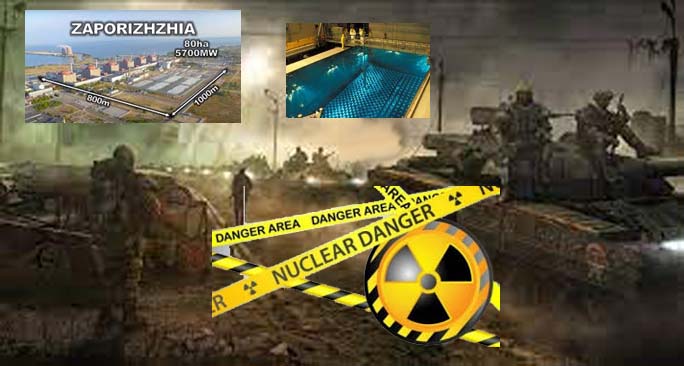
BY CAROL WOLMAN CounterPunch 1 May 23
A meltdown at Zaporizhzhya Nuclear Power Plant grows more likely with every passing day. With a meltdown, radioactive water from the plant would flow into the Dnieper River, which empties into the Black Sea, and thence to the Mediterranean. See below for map. The consequences would be catastrophic for Europe, North Africa, and the Middle East. Clearly this is an international problem. It calls out for an international solution.
Perhaps it is time to send in UN Peacekeeping Forces.
ZNPP has been at risk for a Fukushima-type meltdown since the Russians occupied the plant in March 2022. It sits on the front line of the war, the south side of the Dnieper River. The Russians quickly occupied the south side early in their invasion; the Ukrainians still occupy the north side.
The International Atomic Energy Agency was able to establish a presence at ZNPP after months of lobbying by its Director- General Mariano Grossi. He has personally visited twice and gets daily updates from the IAEA personnel on site. His latest report can be found here.
Grossi has been trying for almost a year to negotiate a safety zone around ZNPP. After his visit to the plant on 3/29/23, Grossi stressed that the increasing combat makes it urgent to find a way to prevent a potentially catastrophic nuclear accident.
He complains that he is not getting support from the UN, and even from his own agency. The EU issued a statement a few months ago but is not keeping the pressure on. Given the potential for catastrophe, it is astounding that more attention is not being given to the need to support Grossi’s efforts.
Instead, the media publishes reassuring articles about how many safety features ZNPP has.
Safety features are useless if the cooling water stops circulating around the nuclear material. The reactors have been shut down, so the pumps need an external power source.
The main power lines cross the Dnieper to the Ukraine energy grid on the north side of the river. The back up lines connect to conventionally fired plants in Ukrainian territory. They are right on the front line, and mortar fire from either side can cut them.
Since the invasion, all the external power lines to the plant- 4 major lines and 2-4 backup lines- have been cut simultaneously at least SIX times, forcing the pumps to rely on emergency diesel generators. As Grossi says ““Each time we are rolling a dice…And if we allow this to continue time after time, then one day our luck will run out.”
Without the constant circulation of cooling water, the nuclear fuel would overheat, resulting in a chain reaction and meltdown. This is what happened at Fukushima Daiichi 1:
; the earthquake and tsunami cut off the power and the pumps stopped working. A huge discharge of radioactive water into the vast Pacific Ocean continued for several years, until an ice wall was built around the damaged reactors.
Within three years after the Fukushima disaster, there were massive die-offs throughout the Pacific. Mollusks in particular suffered, and the result went up the food chain, so that sea mammals were starving and mutated. The sea bird population was decimated.
A meltdown at ZNPP would release large amounts of radioactive water into a much smaller body of water than the Pacific Ocean. The Dnieper River empties into the Black Sea and eventually into the Mediterranean. All the countries which border the Mediterranean would be affected. The consequences are unthinkable.
The circulation of cooling water could fail for another reason. It cycles through a holding pond nearby. Because of the constant influx of warm water from the reactors, still hot even in shutdown mode, the pond is prone to algae growth, which could clog the intake valves and stop the water flow. It is stocked with tropical fish, which eat the algae and keep the water clear.
The cooling pond is at risk. Global warming may cause the pond to overheat this summer, killing the scavenging fish…………………………………………………
Clearly this is an international problem. The danger of a meltdown at ZNPP is real; the consequences would be catastrophic for Europe, North Africa, and the Middle East…………………………………………………………….. https://www.counterpunch.org/2023/05/01/znpp-a-catastrophe-waiting-to-happen/
REGAN Vest: Inside Denmark’s secret nuclear bunker
BBC 1 May 23,
A top-secret atomic bunker has opened to the public in Denmark. Built to withstand a nuclear attack, it’s now an astonishing subterranean museum that sheds light on Cold War paranoia.
Hidden in northern Jutland’s Rold Forest, some 400km north-west of Copenhagen, is the sprawling bunker complex of Koldrigsmuseet REGAN Vest (The Cold War Museum REGAN West). Secretly built in the 1960s at the height of Cold War tensions, this is where the Danish government and even the queen would have been evacuated if nuclear war broke out.
The plan was to run the country from inside this shelter, 60m below ground, and its very existence was kept hushed for decades until it was finally revealed in 2012. After years of preparations, it opened to the public for the first time in February 2023 as a museum. Only 50,000 visitors are permitted annually, and access has been limited to small groups of 10 on 90-minute guided tours that explore 2km of the labyrinthine bunker system. It’s an eye-opening journey into the heart of a Cold War-era time capsule…………………………………………………………………………………………………………………..
The resulting nuclear-proof bunker was a staggering 5,500sq m behemoth, shaped like two large, connected rings, each with an upper and lower floor, and more than 230 rooms that would house around 350 personnel. Mostly these would be ministers and civil servants, part of a slimmed down administration tasked with running the nation’s affairs during the darkest of times, plus a few medical staff, several journalists and a priest……………………………………………. more https://www.bbc.com/travel/article/20230501-regan-vest-inside-denmarks-secret-nuclear-bunker
UK underlines commitment to NATO nuclear capability and a £3 billion funding uplift for the nuclear enterprise
UKDJ, By Tom Dunlop 1 May 23
Defence Minister Baroness Goldie recently hosted members of the North Atlantic Council and NATO Military Committee at His Majesty’s Naval Base (HMNB) Clyde, emphasising the UK’s commitment to NATO’s nuclear deterrence.
This comes as the UK government announced a £3 billion funding uplift for the nuclear enterprise in the Spring Budget.
………………………….. Defence Secretary Ben Wallace commented, “We have declared our nuclear deterrent to the defence of NATO for over 60 years, and our commitment to the security of the NATO Alliance is absolute. The UK’s round-the-clock nuclear deterrent is more crucial than ever, as the ultimate guarantee of our collective security.” https://ukdefencejournal.org.uk/uk-underlines-commitment-to-nato-nuclear-capability/
The long and dirty legacy of nuclear power

The trouble is that nuclear-power adherents are now seriously contemplating for future generations a ghastly rerun of the decommissioning nightmare. Small-to-medium-sized reactors, such as envisaged for Trawsfynydd and Wylfa, are the smart way forward, they chorus. Once more, the probably insoluble decommissioning and nuclear waste-management problem is being blanked out.
https://www.cambrian-news.co.uk/opinion/the-long-and-dirty-legacy-of-nuclear-power-610039By Patrick O’Brien Sunday 30th April 2023
In the normal course of events, you’d know when you were financing a dodgy venture. It’s hard to imagine your money being ploughed into an enterprise doomed from the start and being ignorant of the fact.
So how many of us knew we’re bankrolling an outfit with a boat in the Irish Sea embarked on a mission guaranteed to be a very bad idea all round?
The craft in question operates with a simple instruction: to blast off underwater seismic guns – to the certain detriment of dolphins and porpoises – as part of a madcap exercise to find a subterranean cemetery for large amounts of lethal radioactive waste from Cumbria’s Sellafield nuclear site.

I refer to pollutants that, for the last 70 years, have contaminated seas off vast coastal areas of Wales and Ireland, and parts of England, with radioactive substances that take, literally, tens of thousands of years to decay.
Let me introduce Nuclear Waste Services, an entirely taxpayer-funded public body under the wing of the UK government, which is engaging marine geological surveyors to comb the seabed for an out-of-sight-out-of-mind repository for the terrifying remnants of a dangerous and long discredited system of energy-generation.
Yes, the UK is looking for a storage site for the world’s biggest stockpile of untreated nuclear waste, including 100 tonnes of plutonium.
Currently the search centres on the seabed off Cumbria. The nearby notorious Sellafield nuclear complex having, since 1952, openly discharged substantial quantities of liquid and solid radioactive waste into the Irish Sea, a disreputable industry’s servants are now embarked on a final fling, dressed up, naturally, as a service to the UK population.
Thus Chris Eldred, a Nuclear Waste Services senior manager, expounding on the benefit of the gorgeously clinically named geological disposal facilities (GDFs) his company has set its heart on.
GDFs, he vouchsafes, “will protect future generations from the risks of keeping hazardous radioactive waste in surface stores for thousands of years.” Thank goodness, therefore, that we have the sea at our unfettered disposal, there to hide away nuclear power’s abiding torment – what to do with the reverberating remnants of a spent technology that will never in thousands of years be stilled.
To help us with this vital work”, Mr Eldred says, “we will undertake surveys to provide a better understanding of the deep geology beyond the coast, while doing everything we can to minimise any environmental impact.”
In his apparent innocence, you wonder whether he has in mind earplugs for dolphins and porpoises, which are observed to be disorientated, distraught and damaged by the monstrous decibels of seismic guns. These theoretically protected animals, let it be remembered, are in all probability some of those we marvel at off the Ceredigion coast.
Not that the UK government or Nuclear Waste Services or anyone else has checked with us, the funders of this desperate exploration.
Not that they have seen fit, either, to mention that sea-borne radioactive waste, pumped for seven decades into the sea at Sellafield, has been detected off coasts of Wales, as well as hundreds of miles further south and west of the Cumbria nuclear site.
We’re talking here about insoluble radionuclides, such as highly dangerous plutonium-239, which has a half life of, truly, 24,110 years and can attach to particles in the sea, there to be transported over long distances and timescales and ultimately deposited into fine sediments. such as estuarine and coastal mudflats and salt-marshes. Since the early 1950s, this stuff has floated unhindered down from Sellafield off Wales’s west coast, ending up as far away as the Bristol Channel and the southern North Sea.
Sellafield’s tentacles have even reached inland Wales. In the late 1980s, the then Dyfed County Council commissioned a study of radioactivity in the county which found Caesium-137 – proved to have come from Sellafield sea discharges – in pasture grass seven miles inland from the Cardigan Bay coast. Radiocaesium, which has a 30-year half-life, can increase the risk for cancer.
The size of the current nuclear power-station decommissioning conundrum is mind-boggling. Even the UK government admits the seabed dump site it seeks for the world’s largest stockpile of untreated nuclear waste would need to keep its terrible debris “safe and secure over the hundreds of thousands of years it will take for the radioactivity to naturally decay”.
Meanwhile, councils signed up to the Nuclear Free Local Authorities grouping, including Ceredigion’s and Gwynedd’s, believe the pretty well obvious: no matter how effective the marine storage barriers, some radioactivity would eventually leak to the surface of the sea. They prefer the idea of a “near surface, near site storage of waste” to allow for monitoring and management.
Trying to show willing, they’re seizing on a least-worst option, which is nevertheless woefully inadequate.
The trouble is that nuclear-power adherents are now seriously contemplating for future generations a ghastly rerun of the decommissioning nightmare. Small-to-medium-sized reactors, such as envisaged for Trawsfynydd and Wylfa, are the smart way forward, they chorus. Once more, the probably insoluble decommissioning and nuclear waste-management problem is being blanked out.
All that’s left is for the realists among us to resolve, very firmly, that we will never allow a return to the insanity of a 1950s future.
Why did Russians dig trenches in radioactive Chernobyl woods?

Even Ukrainians who stayed after the nuclear disaster tried to warn their
enemies. On February 24, 2022, the first day of the invasion of Ukraine,
the Russians crossed into the area from Belarus. They stayed for five
weeks, camping out for part of that time in some of the most contaminated
land around the site of the worst nuclear accident in history.
They dug defensive positions in the Red Forest, within a six-mile radius of reactor
No 4, where they lived, ate and slept for a fortnight. Nobody can
understand why.
“Don’t try to find logic,” said Oksana Pyshna, 30, a
tour guide turned employee of the state ministry responsible for the
exclusion zone, who showed us around. “It’s stupid.” The place is
called the Red Forest because that’s the colour the trees went after the
disaster as the cloud of poison spread through Ukraine, Belarus, Russia, on
to the Baltics and Scandinavia.
In 1986 and the years after, teams of men
dug up the topsoil and buried it: under the surface it is far more
poisonous. Carving trenches there was a terrible idea, said Pyshna.
“It’s the most dangerous territory in the special zone, because under
the ground we have nuclear waste.”
Perhaps the Russians felt safer there
because they knew the Ukrainians wouldn’t shell the area around the
nuclear plant. Perhaps the beauty of the woods blinded them to the danger.
Catfish throng the reactor’s cooling channel, deer shy through the silver
birches when visitors pass. There are, apparently, bears in the forests;
wolves too, wild ponies. In the autumn, the trees hang heavy with the most
perfect apples, green and pink.
But their pips can hold radioactive
isotopes: caesium-137 or strontium-90. Some Russian soldiers stationed in
the forest got radiation sickness, diplomats have confirmed. Kicking up the
dust or walking on the moss can contaminate you. Digging is much worse. The
few dozen locals – average age, 86 – who remained here after the
disaster have become unspeakably blasé about the risks of nuclear
radiation. Even they were shocked.
Times 29th April 2023
https://www.thetimes.co.uk/article/ukraine-chernobyl-nuclear-putin-russia-invasion-rgjzskfvq
“We won’t be scapegoats!” — French opposition to nuclear waste dumping

“This land is our land.” French goats bleat against nuclear fuel pool threat
“We won’t be scapegoats!” — Beyond Nuclear International
Contrary to popular propaganda, nuclear reprocessing is not recycling. This has never been more evident than in the current crisis at La Hague, where the irradiated fuel pools are now full to capacity. Part of the reason is the country’s insistence on producing mixed-oxide reactor fuel from the plutonium and uranium separated at La Hague. So much of it has proven defective, that is has been returned to La Hague, filling up the fuel pools.
opposing French plans to extend the licenses of current reactors and to build new ones with, as they point out, absolutely no consideration of what will happen to the radioactive waste.
A new tongue-in-cheek rebellion has risen in France, but the cause is deadly serious
By Linda Pentz Gunter, https://beyondnuclearinternational.org/2023/04/30/we-wont-be-scapegoats/
In France, civil disobedience and defiance of authority — and authoritarianism — is in the national DNA. We have seen it most recently in the demonstrations against the raising of the retirement age, and against proposed agricultural reservoirs known as mega-basins. Before that it was the “yellow vests”, angered at a rise in fuel prices. Further back came the Resistance during World War II, and even further back, of course, the Revolution of 1789.
The French anti-nuclear movement is no exception and has engaged in protests that deliver considerable numbers and abundant creativity — and sometimes a lot of useful tractors as well.
It’s no surprise then to learn that such continued defiance has now spread: to goats.
Before continuing, it’s necessary to explain what a ZAD is. In French, it stands for Zone À Défendre (zone to defend.) ZADs are usually occupations or blocades created by citizens protecting something they deem precious from development or destruction. There are scores of ZADs across France, deemed illegal by French authorities. ZADs have sometimes won, most notably at Notre-Dame-des-Landes, where an unpopular airport project was stopped.
But raids on ZADs can sometimes turn violent, and authorities can over-react as they did in February 2018 at Bure, when 500 gendarmes went in to remove just 15 anti-nuclear activists occupying and attempting to protect the forested site targeted to become the country’s high-level radioactive waste dump.
Dressed in riot gear, the gendarmes used bulldozers, trucks, helicopters, drones and chainsaws to confront the occupiers, self-described “owls” who had been living in tree houses and lookout towers for the past 18 months.
Now, activists around the La Hague nuclear reprocessing site on the northern Cherbourg peninsula, have redefined the ZAD acronym to stand for Zone À Déchets (Waste Zone), and specifically radioactive waste.
Contrary to popular propaganda, nuclear reprocessing is not recycling. This has never been more evident than in the current crisis at La Hague, where the irradiated fuel pools are now full to capacity. Part of the reason is the country’s insistence on producing mixed-oxide reactor fuel from the plutonium and uranium separated at La Hague. So much of it has proven defective, that is has been returned to La Hague, filling up the fuel pools.
A slowdown in reprocessing due to technical failures has also hastened the overcrowding of La Hague’s four spent fuel pools with excess irradiated fuel rods. These pools risk saturation by 2030 and the French safety authority has criticized La Hague owner, Orano’s suggestion that it could pack the pools more densely as this raises safety risks.
The owner of the French nuclear fleet, EDF, is responsible for managing the waste fuel their reactors produce. Its solution to the overcrowding at La Hague is to build a new fuel pool at the site, at a cost of $1.37 billion.
And that has locals up in arms — and hooves.
Normandy, the province in which La Hague is located, is strongly agricultural. Cows — and dairy products — abound. As do goats. While those still domesticated produce cheese, there is also a significant and famous wild goat population, known as les chèvres des fossés, that ranges freely on the coastal cliffs.
Accordingly, a new La Hague opposition group, Piscine Nucléaire Stop (Stop the Nuclear Fuel Pool), found a way to communicate the threat a new fuel would pose to agriculture and the environment by recruiting some goats to their cause.
In an amusing action that was posted on Facebook and was covered in the press, the activists placed an array of artistic — and realistic — cut-out goats at an intersection in the town of Jobourg, one of the communities that would be affected by the health and environmental risks of a new nuclear fuel pool. The town gives its name to the famous wild Jobourg goats and has erected a statue in their honor.
Then the goats put out their own statement. It read:
“We nanny and billy goats of Jobourg, claim our right to decide the fate of our land, and affirm today our opposition to the EDF spent fuel storage pool project.
Continue readingFoiled Escape: UC Global, the CIA and Julian Assange

Even better will be the abandoning of the entire proceeding, the reversal of the extradition order made in June 2022 by then Home Secretary Priti Patel, and a finding by the UK authorities that the case against Assange is monstrously political, compromised from the start and emptied of legal principle.
April 30, 2023, Dr Binoy Kampmark https://theaimn.com/foiled-escape-uc-global-the-cia-and-julian-assange/
However described, the shabby treatment of Julian Assange never ceases to startle. While he continues to suffer in Belmarsh prison awaiting the torments of an interminable legal process, more material is coming out showing the way he was spied upon while staying at the Ecuadorian embassy in London. Of late, the Spanish daily El País has been keeping up its exemplary coverage on the subject, notably on the conduct of the Spanish-based security firm, UC Global SL.
There is a twist in the latest smidgens of information on the alleged bad conduct by that particular company. As luck would have it, UC Global was commissioned by Rommy Vallejo, the chief of Ecuador’s now defunct national intelligence secretariat, SENAIN, to give the London embassy premises a security and technological touch-up.
Vallejo may have sought their services, but seemed blissfully ignorant that he had granted the fox access to the chicken coop. This access involved the installation of hidden microphones throughout the embassy by UC Global at the direction of its owner, David Morales. Morales, it seems, was updating the US Central Intelligence Agency with information about Assange’s meetings with his legal team throughout.
Much of this was revealed in the trial against Assange conducted at the Central Criminal Court in 2020, though the presiding Judge Vanessa Baraitser seemed oddly unmoved by the revelations, as she was by chatter among US intelligence operatives to engineer an abduction or assassination of the WikiLeaks founder.
The link between UC Global and the CIA was the fruit of work between Morales and one of his most notable clients, the casino company, Las Vegas Sands. Morales was responsible for supplying the owner of the company, the late billionaire magnate and Republican donor Sheldon Adelson, with personal security. In the merry-go-round of this field, one of those on Adelson’s personal security detail was a former CIA officer.
On December 20, 2017, Michelle Wallemacq, the head of operations at UC Global, penned a note to two technicians responsible for monitoring security at the embassy. “Be on the lookout tomorrow to see what you can get… and make it work.” The request was related to a scheduled meeting between Assange and Vallejo. The theme of the discussion: to get the Australian publisher out of the embassy, grant him Ecuadorian citizenship and furnish him with a diplomatic passport. This had a heroic, even quixotic quality to it: the grant of a diplomatic passport would not have necessarily passed muster; and the chances of Assange being arrested could hardly be discounted.
Eleven months prior to Morales passing on the tip that scuttled Assange’s escape plans, Morales was already chasing up his staff from one of Adelson’s properties, The Venetian Resort in Las Vegas. One technician received the following: “Do you have status reports on the embassy’s computer systems, and networks? I need an inventory of systems and equipment, the guest’s [Assange] phones, and the number of networks.” He also warned his technicians to be wary “that we may be monitored, so everything confidential should be encrypted… Everything is related to the UK subject… The people in control are our friends in the USA.”
On June 12, 2017, Morales, enroute to Washington, DC, requested his contact to activate a File Transfer Protocol server and web portal from their Spanish headquarters. The portal in question: the Ecuadorian Embassy in London. Material began being collected on Assange’s guests, eclectic and of all stripes: journalists, doctors, lawyers, diplomats. Mobile phone data was also hoovered up. After his Washington stop, Morales popped into Las Vegas Sands, where he met his eager “American friends” to reveal the information so far gathered about Assange.
Over this time, it becomes clear, in Morales’s own words, that “he had gone over to the dark side” and that “they were working in the Champions League”. Emails sent on September 8 speak of offering “our information collection and analysis capability to the American client.” Discussions with a UC Global technician focus on gathering information from the microphones in the embassy. “The guest [Assange] has three rooms and uses two quite frequently… We would have all the audio from there except in one room.”
On September 21, it was clear to Morales that they had gotten sufficiently mired in the business of spying on Assange to be wary of any potential surveillance from SENAIN. “I would like my whereabouts to be kept confidential, especially my trips to the USA.” Instructions are distributed to gather data on the embassy’s Wi-Fi network, photos of the interior and furnishings of the embassy, and any data on Assange’s primary visitors, notably any members of his legal team.
The recording of one meeting would prove critical to upending plans to get Assange out of the embassy. Present Assange, his lawyer, now wife Stella Morris, Ecuadorian consul Fidel Narváez and Vallejo. The date for the getaway was slated for December 25, with the plan that Assange leave via one of the ambassador’s cars which would make its way through the Eurotunnel to Switzerland or some designated destination on the continent. “It’s very late,” wrote one of the technicians a few hours after the meeting’s conclusion to Morales. “Because it’s so big, I put the file in a shared Dropbox folder. Someone with experience in audio can make it more intelligible.” While Vallejo could be heard fairly clearly, the voices of Assange and Morris were “very muffled”.
Within a matter of hours, Morales had relayed the material to those “American friends” of his, greasing the wheels for proceedings that would culminate in Assange’s expulsion in 2019 and the indictment listing 18 charges, 17 of which are drawn from the Espionage Act of 1917. The plan to leave the embassy was never executed.
There are two significant events that also transpired before Vallejo’s visit to Assange. The first involved an advisor to the Ecuadorian Foreign Minister who is said to have had information about the plan regarding Assange’s escape. He was assaulted by a number of hooded men at Quito Airport on his return from the United States.
On December 17, 2017, it was time for hooded assailants to turn their attention to the Madrid law offices of Baltasar Garzón and Aitor Martínez. Their target: a computer server. The timing was ominous; both lawyers had just returned from meeting Assange in the London embassy. The intruders proved untraceable by the Spanish police, despite leaving prints.
In hindsight, it does seem remarkable that Vallejo and SENAIN remained ignorant of the rotten apples in UC Global. As things stand, Morales is facing a formal complaint filed by Assange in the Spanish National Court. He is also facing an investigation for alleged breaches of privacy, the violation of attorney-client confidentiality, misappropriation, bribery and money laundering. The presiding magistrate on the case, Santiago Pedraz, has requested the US House Permanent Select Committee on Intelligence to press the CIA in supplying information about the embassy spying.
Even better will be the abandoning of the entire proceeding, the reversal of the extradition order made in June 2022 by then Home Secretary Priti Patel, and a finding by the UK authorities that the case against Assange is monstrously political, compromised from the start and emptied of legal principle.
Russian troops ‘went FISHING in the nuclear reactor cooling channel at Chernobyl’ and are now suffering from radiation sickness
- Russian troops spent a fortnight in the vicinity of the radioactive nuclear reactor
- Some 37 years ago it exploded and spilled reactor core into the environment
Daily Mail, By CHRISTIAN OLIVER , 30 April 2023[excellent photos]
Putin‘s men were struck down with radiation sickness after they camped in a forest near Chernobyl‘s nuclear disaster amid their infiltration of Ukraine last year.
Ukrainians living in Chernobyl have told of how they warned their Russian enemies of the dangers despite last year’s invasion, with soldiers even fishing in the nuclear reactor’s cooling chamber.
The Russian soldiers spent around a fortnight in the vicinity of the radioactive nuclear reactor in March last year, which 37 years ago exploded and spilled reactor core into the environment.
Ukrainians have told how the Russian men crossed from Belarus and dug defensive positions in the nearby ‘Red Forest’, named after the colour the trees turned after the nuclear disaster.
Some suggested that the Russians chose the area as they knew they would not come under attack from Ukrainian shelling.
Speaking to The Sunday Times, Oksana Pyshna, 30, an official responsible for the exclusion zone, said ‘don’t try to find logic’ regarding the upheaval of radioactive soil by Putin’s men in Chernobyl’s nearby forest.
Russian soldiers are said to have spent two weeks with six mile vicinity of the radioactive reactor No 4, where they slept, ate, and drank.
‘It’s the most dangerous territory in the special zone, because under the ground we have nuclear waste.’
Some suggested that Russian troops made their base there as they knew Ukrainian forces would not attack the area as they knew the catastophic dangers around the nuclear plant.
The Russians are also said to have fished in the reactor’s cooling chamber, catching the catfish that swim in the destroyed nuclear base.
But others were struck down with radiation sickness from simply being in the area, walking around, and kicking up the dust………………………………………………………….. more https://www.dailymail.co.uk/news/article-12030417/Invading-Russian-troops-radiation-sickness-camped-Chernobyl-forest.html
Hinkley fish deterrent farce makes mockery of Environment Agency and Minister

In a humiliating climbdown, the Environment Agency now recommend that EDF Energy be excused from installing an acoustic fish deterrent at Hinkley Point C nuclear power plant, and they have had the cheek to ask for the public’s endorsement of the Agency’s inexplicable volte face in a further consultation.
The UK/Ireland Nuclear Free Local Authorities for one will not be giving it.
NFLA England Forum Chair Councillor David Blackburn said: “After a late hour supper of humble lamprey pie, senior executives at the Environment Agency appear to have shown themselves to have less spine than jellyfish. The requirement to install a deterrent was first made after representations from the public and campaign groups, including the NFLA; a detailed analysis of the impact of the plant on fish stocks and pain-staking deliberations; and the personal intercession of the Secretary of State George Eustice to ensure that it became part of the permitting conditions.
“This new recommendation makes a mockery of the Environment Agency inspection team and the Secretary of State who previously had the courage to stand up to nuclear interests. It also represents a massive slap in the face with a wet kipper for public consultation, because what is the point responding again and again to consultations and presenting to inquiries demonstrating conclusively the validity of your case when senior civil servants simply cave into any clamour from EDF Energy?”
Nonetheless, the NFLA, in a last-ditch effort, will be joining local campaigners by responding robustly to oppose this proposal – for the sake of the fish.
Councillor Blackburn added: “It looks like someone at EDF Energy is following the adage of Robert the Bruce ‘to try, try, try again’ as clearly the company remains determined to pressurise the Environment Agency to recuse it from installing an acoustic fish deterrent at Hinkley Point C to save time and money, for this is a project well behind schedule and massively over budget. French shareholders will be happy, but the fish will not.
“The Severn Estuary is one of the most important fish habitats in the UK, and the fear is that millions of fish will die every day once this plant finally becomes operational as they are sucked to their deaths along with the cooling water.
“We would urge members of the public, elected members and local groups opposed to this plan to respond to the Environment Agency consultation before 25 May 2023. This is your last chance to save the fish!”
Details of the latest Environment Agency consultation can be found at:
https://www.gov.uk/government/consultations/hinkley-point-c-water-discharge-activity-permit-variation
Sensitive files on nuclear submarine found in English pub restroom
kk/kb 30.04.2023 British services have launched an investigation into the alleged finding of Royal Navy documents marked “official sensitive” in a Wetherspoons pub restroom in Barrow-in-Furness, England, media reported. The files reportedly concerned HMS Anson, the most recent of the navy’s cutting-edge nuclear-powered submarines.
According to “The Sun” daily, the files showed the inner workings of the torpedo-loaded vessel, including key details regarding its hydraulics, which control torpedo hatches.
They were reportedly found with a Royal Navy lanyard from the new GBP 1.3 bn (USD 1.63 bn) submarine……………………………… https://tvpworld.com/69544839/sensitive-files-on-nuclear-submarine-found-in-english-pub-restroom
Largest ever Arctic Challenge NATO fighter aircraft exercise begins in Northern Europe
30 May 2023, By The Brussels Times with Belga
Vast exercises involving around 150 fighter jets from Western countries, began on Monday in Finland, Sweden and Norway, the Finnish air force announced.
Participating countries include the United States, the United Kingdom, Belgium and France,
The manoeuvres are due to last nearly two weeks, according to Finland, a brand new member of NATO, which is leading the ‘Arctic Challenge’ operation……………….. more https://www.brusselstimes.com/527325/major-nato-fighter-aircraft-exercises-begin-in-northern-europe
Free Julian Assange, member of our organisations – European Federation of Journalists
https://europeanjournalists.org/blog/2023/04/27/free-julian-assange-member-of-our-organisations/ Our Italian FNSI affiliates were visited today in Rome by Julian Assange‘s wife, Stella Morris. The Italian journalists’ union, at the initiative of its Campania branch, presented Julian Assange with an FNSI membership card. The European Federation of Journalists (EFJ) passed on the initiative to its affiliates in Europe: 18 of them decided to follow the Italian example and grant Julian Assange membership (or honorary membership) of their organisations. The EFJ and its affiliates once again call on the UK authorities to release Julian Assange.
Here is the joint appeal delivered to Stella Morris in Rome this morning:
We, the undersigned European unions and associations of journalists, join the International Federation of Journalists (IFJ) in calling on the US government to drop all charges against Julian Assange and allow him to return home to his wife and children.
We are gravely concerned about the impact of Assange’s continued detention on media freedom and the rights of all journalists globally. We urge European governments to actively work to secure Julian Assange’s release.
To show our solidarity, we declare Julian Assange a full member, an honorary member or a free member of our organisations.
Signed:
- Maja Sever, EFJ President and TUCJ President, Croatia
- Fabrizio Cappella, SUGC-FNSI Secretary, Italy
- Satik Seyranyan, UJA President, Armenia
- Borka Rudić, BHJA General Secretary, Bosnia & Herzegovina
- Hrvoje Zovko, HND President, Croatia
- Emmanuel Poupard, SNJ First General Secretary, France
- Emmanuel Vire, General secretary SNJ-CGT, France
- Tina Groll, dju in ver.di President, Germany
- Maria Antoniadou, JUADN President, Greece
- Laszlo M. Lengyel, HPU Executive President, Hungary
- Pavle Belovski, SSNM President, North Macedonia
- Luís Filipe Simões, SJ President, Portugal
- Darko Šper, GS Kum President, Serbia
- Dragana Čabarkapa, Sinos President, Serbia
- Zeljko Bodrozic, IJAS President, Serbia
- Petra Lesjak Tušek, DNS President, Slovenia
- Miguel Angel Noceda, FAPE President, Spain
- Urs Thalmann, impressum Director, Switzerland
- Tim Dawson, NUJ, United Kingdom
Will The EU Sanction Russia’s Nuclear Industry? (I don’t think France will agree to this)

ED. I can’t see France agreeing to anything that would limit the nuclear industry!!
“France to participate in Russian Rosatom’s Hungary nuclear power plant project.” – https://www.lemonde.fr/international/article/2023/04/27/hongrie-la-france-prete-a-participer-au-projet-de-centrale-nucleaire-du-russe-rosatom_6171229_3210.html
By Felicity Bradstock – Apr 28, 2023, Oilprice.com
- One Russian industry that has avoided EU sanctions to date is its nuclear energy sector.
- Rosatom is a major exporter of nuclear fuel and technology.
- Despite uncertainty over how to impose sanctions on Russian nuclear energy without harming the interests of several European countries, Brussels is working on a plan.
In February 2022, the EU imposed sanctions on Russia in response to the Russian invasion of Ukraine. The sanctions at this point included restrictive measures (individual sanctions), economic sanctions, and visa measures. The sanctions aimed to disrupt the country’s economy to prevent Russia from continuing its conflict with Ukraine. Throughout the year, the EU and other parts of the world increased the number and types of sanctions on Russia as they decreased their reliance on Russian energy.
…………………… one area that the EU has avoided sanctioning, to date, is Russian nuclear power. This is largely because of the significant role Russia’s state-owned nuclear energy monopoly, Rosatom, plays in global nuclear power. Paul Dorfman, chair of Nuclear Consulting Group, explained that the problem is a “Russian doll’s worth of interlocking dependencies.” Firstly, Rosatom is a major exporter of nuclear fuel, providing the U.S. with 14 percent of its uranium in 2021. Meanwhile, utilities across Europe purchased around a fifth of their uranium from Rosatom, and they have been unable to diversify their uranium sources since cutting other energy ties with Russia. Rosatom also provided 28 percent of the U.S.’s enrichment services in 2021.”
Further, Rosatom is not just limited to Russia, holding ownership of several nuclear plants around the world. By the end of 2021, one in five nuclear plants worldwide was either in Russia or was Russian-built. Rosatom has repeatedly stepped in to help finance nuclear plants in countries that want to expand their nuclear power sectors but don’t have the money to do so. Many of these plants fall under a build-own-operate model, relying on Rosatom for their operation.
Certain EU states have, therefore, opposed sanctions on Russian nuclear power as they continue to rely on Rosatom for their energy security. For example. Hungary sources around 40 percent of its electricity from nuclear power and has a long-term financing deal with Rosatom to build two new nuclear reactors. In February this year, the European Commission (EC) scrapped plans for sanctions on Russia’s nuclear energy industry, citing opposition from some member states. The EU had considered imposing sanctions on individual employees of Rosatom and other companies on the list but has not acted on this idea so far. …………………………………….
Swedish reactor shutdowns nearly double Finland’s electricity price overnight
Swedish reactor shutdowns nearly double Finland’s electricity price
overnight. A short circuit encountered during maintenance near Stockholm
forced the closure of two nuclear reactors in Forsmark, Sweden.
YLE 27th April 2023
Russia fixing power line from Zaporizhzhia nuclear plant to land it controls, IAEA says
VIENNA, April 28 (Reuters) https://www.reuters.com/world/europe/russia-fixing-power-line-zaporizhzhia-nuclear-plant-land-it-controls-iaea-says-2023-04-28/– Russia has informed the U.N. nuclear watchdog that equipment spotted at Ukraine’s Zaporizhzhia nuclear power plant, which Russia controls, will be used to fix a power transmission line that leads to Russian-held territory, the watchdog said on Friday.
The planned restoration of the downed power line could heighten Ukrainian fears that Russia is preparing to connect Zaporizhzhia, Europe’s largest nuclear power plant, to the power grid of territory that it controls.
A small number of International Atomic Energy Agency officials are present at the Zaporizhzhia nuclear power plant (ZNPP), which is operated by Ukrainian staff working under the orders of Russian forces and the Russian nuclear company Rosatom.
“The (IAEA) Team observed, and following questions were subsequently informed, that a large piece of equipment being transported into the turbine hall of Unit 3 was a transformer to replace the damaged ‘Kakhovka’ node in the ZNPP open switchyard,” the IAEA said in a statement.
“The Kakhovka line is one of the four 750 kV (kilovolt) lines that were operational before the military conflict. This line is linked to the currently Russian-controlled electrical grid, to the south of the ZNPP site,” it added.
Only one of those four power lines is currently working and is the only source of external power to the plant, which it needs to keep cooling the fuel in its six reactors even though they are shut down. Failing to cool that fuel could lead to a potentially catastrophic nuclear meltdown.
The IAEA said it also had not had access to the switchyard at a nearby thermal power plant (TPP) that can supply backup power to Zaporizhzhia. The IAEA last visited that switchyard in December, when damage from shelling was observed.
“Two weeks ago the team was informed that access would be granted in the coming days. It is important that ISAMZ (the IAEA Support and Assistance Mission to Zaporizhzhia) gets the necessary access to the ZTPP open switchyard given the implications on nuclear safety and security at ZNPP.”
1 This Month

of the week– Nuclear Reactor Information Task Force

14 May – online event From Bombs to Data Centres: the Face of Nuclear Colonialism
To see nuclear-related stories in greater depth and intensity – go to https://nuclearinformation.wordpress.com
-
Archives
- May 2026 (102)
- April 2026 (356)
- March 2026 (251)
- February 2026 (268)
- January 2026 (308)
- December 2025 (358)
- November 2025 (359)
- October 2025 (376)
- September 2025 (257)
- August 2025 (319)
- July 2025 (230)
- June 2025 (348)
-
Categories
- 1
- 1 NUCLEAR ISSUES
- business and costs
- climate change
- culture and arts
- ENERGY
- environment
- health
- history
- indigenous issues
- Legal
- marketing of nuclear
- media
- opposition to nuclear
- PERSONAL STORIES
- politics
- politics international
- Religion and ethics
- safety
- secrets,lies and civil liberties
- spinbuster
- technology
- Uranium
- wastes
- weapons and war
- Women
- 2 WORLD
- ACTION
- AFRICA
- Atrocities
- AUSTRALIA
- Christina's notes
- Christina's themes
- culture and arts
- Events
- Fuk 2022
- Fuk 2023
- Fukushima 2017
- Fukushima 2018
- fukushima 2019
- Fukushima 2020
- Fukushima 2021
- general
- global warming
- Humour (God we need it)
- Nuclear
- RARE EARTHS
- Reference
- resources – print
- Resources -audiovicual
- Weekly Newsletter
- World
- World Nuclear
- YouTube
-
RSS
Entries RSS
Comments RSS
 nuclear-news