Sowing Seeds of Plunder: A Lose-Lose Situation in Ukraine
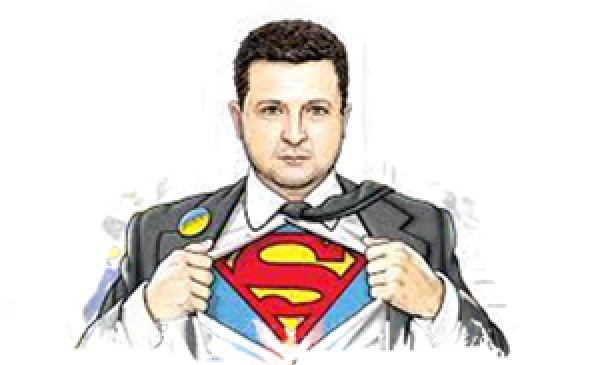
President Zelenskyy put the land reform into law in 2020 against the will of the vast majority of the population who feared it would exacerbate corruption and reinforce control by powerful interests in the agricultural sector.
The largest landholders are a mix of Ukrainian oligarchs and foreign interests — mostly European and North American as well as the sovereign fund of Saudi Arabia.
Ed note: The irony of it! Ukrainians hold the hated memory of Soviet Russia starving Ukraine, as it sent their grain to Russia. Now we have the Western world helping themselves to Ukraine’s agriculture – with increasing farming for export, – pushing out the livelihood’s of Ukrainian small farmers. Zelensky – seen as a hero/saviour for now – – but how will this clown be remembered?
y Colin Todhunter, 10 May 23 https://www.globalresearch.ca/sowing-seeds-plunder-lose-lose-situation-ukraine/5818851
It’s a lose-lose situation for Ukrainians. While they are dying to defend their land, financial institutions are insidiously supporting the consolidation of farmland by oligarchs and Western financial interests.
So says Frédéric Mousseau, Policy Director of the Oakland Institute, an independent think tank.
Depending on which sources to believe, between 100,000 and 300,000 Ukrainian soldiers (possibly more) have died during the conflict with Russia. That figure, of course, does not include civilian casualties.
The mainstream narrative in the West is that Russia grabbed Crimea and then invaded Ukraine. Russia is portrayed as the outright aggressor which wants to restore its control over large swathes of Europe.
The expansion of NATO towards the east, the US-backed coup in 2014 – followed by eight years of the shelling of the ethnic Russian eastern parts of the country by the regime in Kyiv resulting in around 14,000 deaths – led up to the military intervention by Russia, which regards the expansionism and militarism as an existential threat.
It is not the purpose of this article to explore these issues. Much has already been written on this elsewhere. But billions of dollars’ worth of military hardware has been sent to Ukraine by the NATO countries and hundreds of thousands of young Ukrainians have died.
They died in the belief that they were protecting their nation – their land. A land that is among the most fertile in the world.
Professor Olena Borodina of the National Academy of Sciences of Ukraine says:
“Today, thousands of rural boys and girls, farmers, are fighting and dying in the war. They have lost everything. The processes of free land sale and purchase are increasingly liberalised and advertised. This really threatens the rights of Ukrainians to their land, for which they give their lives.”
Borodina is quoted in the February 2023 report by the Oakland Institute War and Theft: The Takeover of Ukraine’s Agricultural Land, which reveals how oligarchs and financial interests are expanding control over Ukraine’s agricultural land with help and financing from Western financial institutions.
Aid provided to Ukraine in recent years has been tied to a drastic structural adjustment programme requiring the creation of a land market through a law that leads to greater concentration of land in the hands of powerful interests. The programme also includes austerity measures, cuts in social safety nets and the privatisation of key sectors of the economy.
Frédéric Mousseau, co-author of the report, says:
“Despite being at the centre of news cycle and international policy, little attention has gone to the core of the conflict — who controls the agricultural land in the country known as the breadbasket of Europe. [The] Answer to this question is paramount to understanding the major stakes in the war.”
The report shows the total amount of land controlled by oligarchs, corrupt individuals and large agribusinesses is over nine million hectares — exceeding 28% of Ukraine’s arable land (the rest is used by over eight million Ukrainian farmers).
Amidst Chaos of War, a New Report Exposes the Stealth Take-over of Ukrainian Agricultural Land
The largest landholders are a mix of Ukrainian oligarchs and foreign interests — mostly European and North American as well as the sovereign fund of Saudi Arabia. A number of large US pension funds, foundations and university endowments are also invested in Ukrainian land through NCH Capital – a US-based private equity fund, which is the fifth largest landholder in the country.
President Zelenskyy put the land reform into law in 2020 against the will of the vast majority of the population who feared it would exacerbate corruption and reinforce control by powerful interests in the agricultural sector.
The Oakland Institute notes that, while large landholders are securing massive financing from Western financial institutions, Ukrainian farmers — essential for ensuring domestic food supply — receive virtually no support. With the land market in place, amid high economic stress and war, this difference of treatment will lead to more land consolidation by large agribusinesses.
All but one of the ten largest landholding firms are registered overseas, mainly in tax havens such as Cyprus or Luxembourg. The report identifies many prominent investors, including Vanguard Group, Kopernik Global Investors, BNP Asset Management Holding, Goldman Sachs-owned NN Investment Partners Holdings, and Norges Bank Investment Management, which manages Norway’s sovereign wealth fund.
Most of the agribusiness firms are substantially indebted to Western financial institutions, in particular the European Bank for Reconstruction and Development, the European Investment Bank, and the International Finance Corporation – the private sector arm of the World Bank.
Together, these institutions have been major lenders to Ukrainian agribusinesses, with close to US$1.7 billion lent to just six of Ukraine’s largest landholding firms in recent years. Other key lenders are a mix of mainly European and North American financial institutions, both public and private.
The report notes that this gives creditors financial stakes in the operation of the agribusinesses and confers significant leverage over them. Meanwhile, Ukrainian farmers have had to operate with limited amounts of land and financing, and many are now on the verge of poverty.
International financial institutions are in effect subsidising the concentration of land and a destructive industrial model of agriculture based on the intensive use of synthetic inputs, fossil fuels and large-scale monocropping.
Much of what is happening in Ukraine is part of a wider trend: private equity funds being injected into agriculture throughout the world and used to lease or buy up farms on the cheap and aggregate them into large-scale, industrial grain and soybean concerns. These funds use pension funds, sovereign wealth funds, endowment funds and investments from governments, banks, insurance companies and high net worth individuals (see the 2020 report ‘Barbarians at the Barn‘ by Grain.org).
Financialising agriculture this way shifts power to people with no connection to farming. In the words of BlackRock’s Larry Fink: “Go long agriculture and water and go to the beach.”
Funds tend to invest for between 10 and 15 years, resulting in good returns for investors but can leave a trail of long-term environmental and social devastation and serve to undermine local and regional food insecurity.
By contrast, according to the Oakland Institute, small-scale farmers in Ukraine demonstrate resilience and enormous potential for leading the expansion of a different production model based on agroecology and producing healthy food. Whereas large agribusinesses are geared towards export markets, it is Ukraine’s small and medium-sized farmers who guarantee the country’s food security.
This is underlined by the State Statistics Service of Ukraine in its report ‘Main agricultural characteristics of households in rural areas in 2011’, which showed that smallholder farmers in Ukraine operate 16% of agricultural land, but provide 55% of agricultural output, including 97% of potatoes, 97% of honey, 88% of vegetables, 83% of fruits and berries and 80% of milk.
In June 2020, the IMF approved an 18-month, strings-attached $5 billion loan programme with Ukraine. Also that year, the World Bank incorporated measures relating to the sale of public agricultural land as conditions in a $350 million Development Policy Loan (COVID ‘relief package’) to Ukraine. This included a required ‘prior action’ to “enable the sale of agricultural land and the use of land as collateral.”
According to the Oakland Institute:
“Ukraine is now the world’s third-largest debtor to the International Monetary Fund and its crippling debt burden will likely result in additional pressure from its creditors, bondholders and international financial institutions on how post-war reconstruction – estimated to cost US$750 billion – should happen.”
Financial institutions are leveraging Ukraine’s crippling debt to drive further privatisation and liberalisation – backing the country into a corner to make it an offer it can’t refuse.
Since the war began, the Ukrainian flag has been raised outside parliament buildings in the West and iconic landmarks have been lit up in its colours. An image bite used to conjure up feelings of solidarity and support for that nation while serving to distract from the harsh machinations of geopolitics and modern-day economic plunder that is unhindered by national borders and has scant regard for the plight of ordinary citizens.
Zaporizhzhia nuclear plant facing ‘catastrophic’ staff shortage amid Russian evacuation
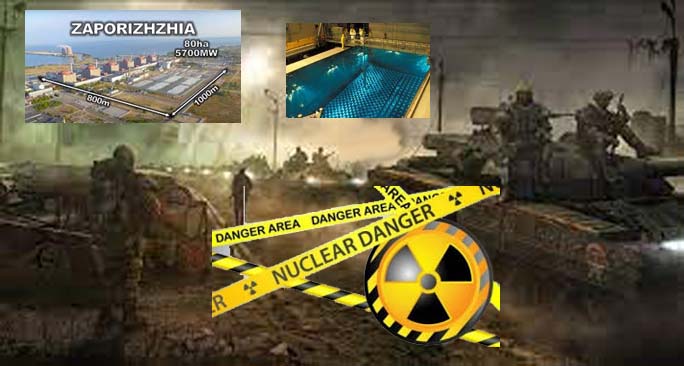
Russia plans to relocate thousands of staff from nuclear plant, atomic energy company claims, warning of ‘catastrophic lack of qualified personnel’
Associated Press, 11 May 23
Russia plans to relocate about 2,700 Ukrainian staff from Europe’s largest nuclear plant, Ukraine’s atomic energy company has claimed, warning of a potential “catastrophic lack of qualified personnel” at the Zaporizhzhia facility in Russian-occupied southern Ukraine.
Workers who signed employment contracts with Russia’s nuclear agency Rosatom following Moscow’s capture of the Zaporizhzhia plant early in the war are set to be taken to Russia along with their families, Energoatom said in a Telegram post on Wednesday.
The company did not specify whether the employees would be forcibly moved out of the plant, nor was it immediately possible to verify Energoatom’s claims about Moscow’s plan.
Removing staff would “exacerbate the already extremely urgent issue” of staff shortages, Energoatom said.
The Moscow-installed governor of the region ordered civilian evacuations from the area last Saturday, including from the nearby city of Enerhodar where most plant workers live. The full scope of the evacuation order was not clear.
Russian forces seized the Zaporizhzhia plant days after Russian president, Vladimir Putin, ordered the invasion of Ukraine in February 2022. Russian occupiers left the Ukrainian staff in place to keep the plant running but the exact number of workers currently at the plant is not known.
Fighting near the plant has fuelled fears of a potential catastrophic incident like the one at Chornobyl, in northern Ukraine, where a reactor exploded in 1986 and contaminated a vast area in the world’s worst nuclear accident.
Zaporizhzhia is one of the 10 biggest nuclear plants in the world. While its six reactors have been shut down for months, it still needs power and qualified staff to operate crucial cooling systems and other safety features…………………. more https://www.theguardian.com/world/2023/may/11/zaporizhzhia-nuclear-plant-facing-catastrophic-staff-shortage-amid-russian-evacuation
Profitable industry in trying to clean up dead nuclear reactors
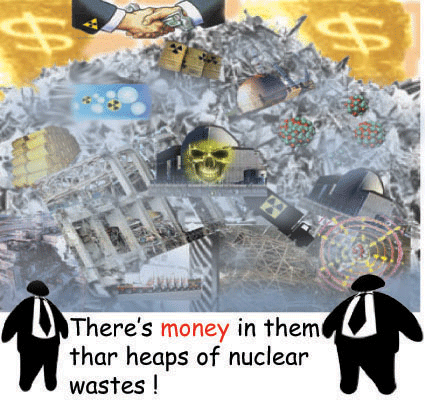
Magnox is ready to start a major decommissioning project to clean-up and
demolish four ‘blower house’ superstructures that surround Berkeley
site’s two reactor buildings. Altrad has bagged a £31m contract for the
design, asbestos removal, deplant, demolition and construction works in and
around the blower houses.
The firm will also be supported by Veolia KDC
Decommissioning Services, NSG Environmental, OBR Construction, Mammoet, and
Cavendish Nuclear. Ross McAllister, Magnox programme delivery director
said: “This is one of the largest decommissioning projects that Berkeley
site has seen for several years.
“It was originally planned for the
2070’s so it is fantastic to bring that forward by five decades in our aim
to deliver our mission better, faster and even safer. “The blower houses
circulated gas through the reactors to transfer heat into 310 tonne boilers
to create steam to turn the turbines and generate electricity. The last of
the 15 gigantic metal boilers was transported to Sweden for cleaning,
smelting and recycling in 2013. “The buildings will be emptied of the
residual metallic low-level waste and undergo a full asbestos clean before
being demolished.
Construction Enquirer 10th May 2023
Prevent, protect, consult – the NFLA (Nuclear Free Local Authorities)’ three priorities for UK radioactive waste policy

The UK Government has its priorities ‘all wrong’ in its proposals for the future management of radioactive substances and nuclear decommissioning, so says the UK/Ireland Nuclear Free Local Authorities in its response to the Department for Energy Security and Net Zero’s consultation on its proposals for the future management of radioactive substances and nuclear decommissioning.
Instead of an emphasis on cutting costs and reducing the burdens on the nuclear industry as DESNZ would like, the NFLA believes that government and the nuclear industry should do everything necessary for the protection of human health and safeguarding our natural environment – whatever the cost.
To the NFLA, government policy and industry practice should focus upon three main tenets:
- Preventing the creation of more radioactive waste, by not building any more nuclear power plants, by closing and decommissioning existing ones as quickly as possible, and by not revisiting mad-cap schemes that have failed before, like repurposing plutonium as reactor fuel, which creates yet more waste and risks nuclear weapons proliferation;
- Protecting the public and the natural environment, by ‘concentrating and containing’ existing waste on or near the surface on the sites where it was created or is currently stored and having a policy of active ongoing management, with the facility of retrieval if waste is stored below ground. This is opposed to government policy which for high-level waste is focused upon transportation by rail to a Geological Disposal Facility into which the waste would be deposited and forgotten about and for lower-level wastes is one of ‘dilute and disperse’, which involves incineration releasing radiation into the atmosphere or dumping into municipal waste tips or discharging it into rivers or oceans.
- Consulting the public, over the storage and treatment of radioactive waste, and its transportation if this should continue, and also educating the public on the radiological risks attached to these activities; all too often consultation is tokenistic, not inclusive and not open, with the nuclear industry still conducting much of its business behind closed doors.
The author of our response was Pete Roche, the NFLA Policy Advisor (Scotland). Pete has over fifty years of environmental and anti-nuclear campaigning experience, having first been involved in protests against the construction of the Torness Nuclear Power Station in the 1970s.
The NFLA’s full response can be read at the end of this media release [on original]; it amounts to a resounding ‘No’.
The DESNZ consultation is still open for public comments until 24 May 2023.
The consultation papers can be found at https://www.gov.uk/government/consultations/managing-radioactive-substances-and-nuclear-decommissioning
For more information, please contact NFLA Secretary Richard Outram by email on richard.outram@manchester.gov.uk or mobile 07583097793
The success of the Zelensky regime coming unstuck?
Zelensky regime’s fate is sealed Indian Punchline BY M. K. BHADRAKUMAR
The West’s cryptic or mocking remarks doubting the Kremlin statement on the failed Ukrainian attempt to assassinate President Vladimir Putin do not detract from the fact that Moscow has no reason on earth to fabricate such a grave allegation that has prompted the scaling down of its Victory Day celebrations on May 9, which is a triumphal moment in all of Russian history, especially now when it is fighting off the recrudescence of Nazi ideology on Europe’s political landscape single-handedly all over again.
The alacrity with which the US Secretary of State Antony Blinken debunked the Kremlin allegation, perhaps, gives the game away. It is in the neocon DNA to duck in such defining moments. That said, predictably, Blinken also distanced the Biden administration from the Kremlin attack.
Earlier, the chairman of Joints Chiefs of Staff General Marks Milley also did a similar thing in an interview with the Foreign Affairs magazine disowning in advance any responsibility for the upcoming Ukrainian “counteroffensive”. This is the Biden Administration’s new refrain — hear no evil, speak no evil. No more talk, either, of backing Kiev all the way “no matter what it takes” — as Biden used to say ad nauseam.
The heart of the matter is that Kiev’s much touted “counteroffensive” is struggling amidst widespread western prognosis that it is destined to be a damp squib. Actually, the salience of the Foreign Affairs podcast this week with Gen. Milley was also his diffidence about the outcome. Milley refused to be categorical that Kiev would even launch its “counteroffensive”!
There is a huge dilemma today as the entire western narrative of a Russian defeat stands exposed as a pack of lies, and alongside, the myth of Kiev’s military prowess to take on the far superior military might of a superpower has evaporated. The Ukrainian military is being ground to the dust systematically. In reality, Ukraine has become an open wound that is fast turning gangrene, and little time is left to cauterise the wound.
However, Kiev regime is ridden with factionalism. There are powerful cliques who are averse to peace talks with Russia short of capitulation by Moscow and instead want an escalation so that the Western powers remain committed. And even after Boris Johnson’s exit, they have supporters in the West.
The militant clique ensconced in the power structure in Kiev could well have been the perpetrators of this dangerous act of provocation directed against the Kremlin with an ulterior agenda to trigger a Russian retaliation.
From Blinken’s vacuous remark, it seems the neocons in the Biden Administration led by Victoria Nuland are in no mood to rein in the mavericks in Kiev, either. As for Europe, it has lost its voice too.
This will probably show up in history books as a historic failure of European leadership and at its core lies the paradox that it is not France but the German government that has aligned itself closer with the US in the Ukraine war and risking an intra-European “epoch of confrontation.”
Even otherwise, these are fateful times, with the political middle ground already shrinking in France and Italy and is much weakened in Germany itself in the wake of the pandemic, the war, and inflation. Importantly, this is only partly an economic story, as the decline of the centre and the de-industrialisation in Europe are closely related and the social fabric that supported the centre has come unstuck.
……………………………………….. The considered Kremlin reaction is available from the remarks by the Russian Ambassador to the US, Anatoly Antonov:
“How would Americans react if a drone hit the White House, the Capitol or the Pentagon? The answer is obvious for any politician as well as for an average citizen: the punishment will be harsh and inevitable.” ………………………………………… more https://www.indianpunchline.com/zelensky-regimes-fate-is-sealed/
Ukraine war: ‘Mad panic’ as Russia evacuates town near Zaporizhzhia plant
BBC 8 May 23
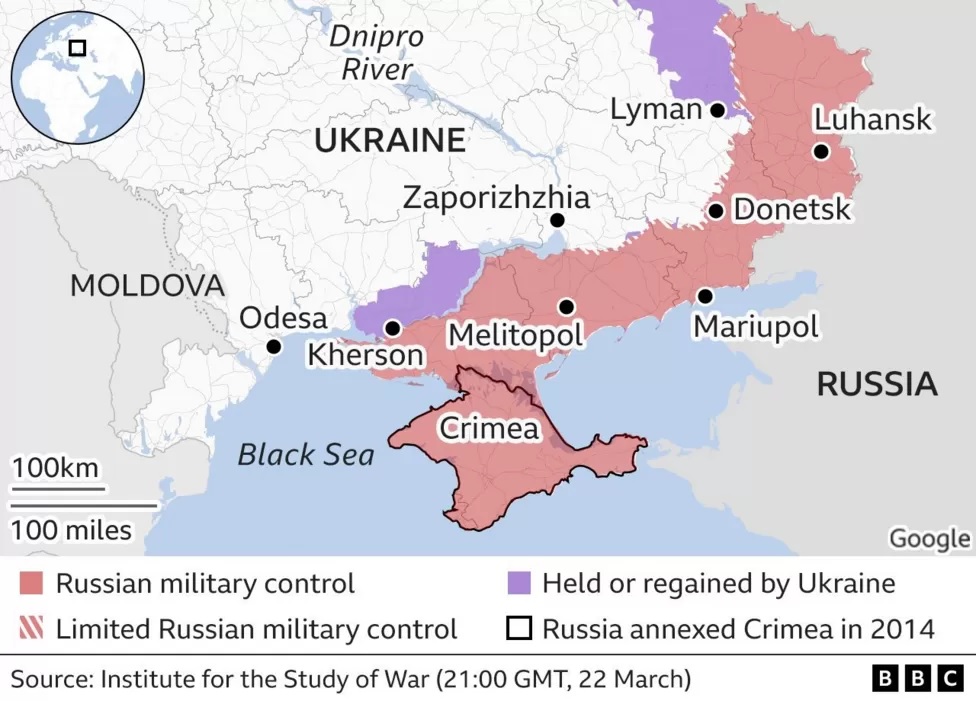
Russia has sparked a “mad panic” as it evacuates a town near the contested Zaporizhzhia nuclear power plant, a Ukrainian official says.
Russia has told people to leave 18 settlements in the Zaporizhzhia region, including Enerhodar near the plant, ahead of Kyiv’s anticipated offensive.
The Ukrainian mayor of Melitopol, Ivan Fedorov, said there were five-hour waits as thousands of cars left.
The UN’s nuclear watchdog warned a “severe nuclear accident” could occur.
Speaking to the BBC’s Newshour programme Rafael Grossi – the director of the International Atomic Energy Agency (IAEA) – said the evacuation of residents near the nuclear facility indicated the possibility of heavy fighting between Russian and Ukrainian forces around the plant.
Although its reactors were not producing electricity they were still loaded with nuclear material, he said.
Mr Grossi added that he had had to travel through a minefield when he visited the plant a few weeks ago.
Earlier, the IAEA warned in a statement that situation at the Zaporizhzhia facility was “becoming increasingly unpredictable and potentially dangerous”.
Operating staff were still at the site but there was “deep concern about the increasingly tense, stressful, and challenging conditions for personnel and their families”.
It said IAEA experts at the plant had “received information that the announced evacuation of residents from the nearby town of Enerhodar – where most plant staff live – has started”.
On Friday, the Russian-installed regional head Yevgeny Balitsky said that “in the past few days, the enemy has stepped up shelling of settlements close to the front line”.
“I have therefore made a decision to evacuate first of all children and parents, elderly people, disabled people and hospital patients,” he wrote on social media. .
The IAEA has issued warnings previously about safety at the plant – which Russia captured in the opening days of its invasion last year – after shelling caused temporary power cuts.
In March the IAEA warned the plant was running on diesel generators to keep vital cooling systems going, after damage to power lines.
Since Russia launched its invasion in February 2022 the number of staff at the plant has declined, the IAEA says, “but site management has stated that it has remained sufficient for the safe operation of the plant”.
Russian forces occupy much of the Zaporizhzhia region but not the regional capital Zaporizhzhia, which lies just north-east of Enerhodar across the Dnipro reservoir.
On Sunday, the Ukrainian general staff said civilians were being evacuated to the cities of Berdyansk and Prymorsk, further inside Russian-held territory……………………….. https://www.bbc.com/news/world-europe-65515443
Whitewashing history. Estonia to issue fines for celebrating WW2 victory over Nazis
Rt.com 8 May 23
The Estonian police have warned citizens against displaying any Russian or Soviet flags or symbols, or playing “aggressive music”
Carrying a Soviet flag or sporting any other symbol deemed offensive by the authorities could cost Estonians dearly on Victory Day, the local police have warned. Any gatherings that could be interpreted as “supportive of aggression,” which Tallinn says Russia is waging against Ukraine, are also outlawed.
Speaking to the media outlet Postimees on Thursday, Elena Miroshnichenko, a lieutenant colonel of the Police and Border Protection Department in the Pyhja prefecture, said that while people are allowed to lay flowers at graves and WWII memorials on May 9, they should not have on them “any symbols and shouldn’t listen to aggressive music on their cellphones.”
The official reminded the public that any rallies featuring Russian or Soviet flags, or those of Russia’s Donbass republics, are strictly prohibited. Also off limits are any flags or placards emblazoned with the Latin letters Z and V, which have come to symbolize Russia’s military campaign against Ukraine.
Miroshnichenko stressed that the police are not going to “engage in any dialogue with anyone” found in breach of the rules. Violators can expect to be fined to the tune of up to €1,200 euros ($1,345) or even face prison time………………….
Late last month, authorities in another former Soviet republic, Moldova, warned the public against displaying St. George’s ribbons, which have become a symbol of May 9 celebrations in Russia over the past two decades.
Moldovan Prime Minister Dorin Recean emphasized that individuals running afoul of the ban will face fines.
The country’s parliament outlawed the ribbon along with the letters ‘Z’ and ‘V’ last year as promoting “Russian aggression.”
Earlier last month, Moldova’s Constitutional Court issued a ruling that some opposition politicians construed as a lifting of the ban. The judges, however, were quick to clarify that this was not the case.
According to the Moldovan media, more than 300 people were fined for wearing the ribbon last year. https://www.rt.com/news/575916-eu-nation-police-fine-victory-day/
Bristol solar farm connects directly to the grid.
A solar farm near Bristol has become the UK’s first to connect directly to
the national grid, opening a way to unblocking bottlenecks in renewable
energy schemes.
To date, the hundreds of solar farms and 1.2 million homes
with rooftop solar panels have been connected to the electricity grid’s
equivalent of A-roads, called distribution networks. However, the 50MW
Larks Green solar farm, capable of powering 17,000 homes, has instead been
connected to the transmission network, the motorways of the electricity
system.
Solar power is the cheapest electricity technology in many
countries and the fastest-growing electricity source globally. Solar
industry figures said that years-long delays were normal to enable projects
to start producing clean electricity. Some developers are routinely being
told they will have to wait until the 2030s, and in one case a company was
told it would have to wait until 2037. Ministers recently promised to
introduce reforms to speed up connections, but are yet to provide details.
On Thursday a cross-party group of MPs wrote to the government telling it
to work with energy networks, including National Grid ESO, to “unblock
the pipeline of delays”. “There is potential for solar energy to have a
bright future in the UK, but a dark cloud of delays for the industry
hinders the ability to meet its full potential,” said Philip Dunne,
chairman of the environmental audit committee.
Times 4th May 2023
https://www.thetimes.co.uk/article/first-solar-farm-connects-directly-to-national-grid-6nx7qjx5s
Protest against investment in Sizewell C nuclear power station.
Campaigners unfurled banners reading ‘Aviva, back renewables not Sizewell
C’ outside Norwich City’s Carrow Road football ground on Thursday.
Protestors from Stop Sizewell C gathered outside an insurer’s Annual
General Meeting (AGM) to vent concerns the firm was planning to invest in
the new Sizewell C nuclear power station.
East Anglian Daily Times 5th May 2023
https://www.eadt.co.uk/news/23501909.suffolk-sizewell-c-protestors-gather-norwich-city-fc/
Opposition to Sizewell C nuclear was a factor in Green Party success in East Suffolk
The conservatives in East Suffolk were swept out of power in a Green wave
as the Green Party gained 11 seats in the local elections. In total, the
Tories lost 24 seats as their number declined from 39 to just 15 seats,
leaving the council with no overall majority.
Meanwhile the Greens moved on to 16 seats, while there were also gains for Labour, who moved on to 12 seats, an increase of five, while the Liberal Democrats also saw a rise of
eight seats to leave them with 11. Southwold councillor David Beavan, who
represents the Liberal Democrats, said meetings would be held between the
Greens, Liberal Democrats and Labour next week to discuss forming a
coalition to run the council.
He believed voters had rejected the Tories
over issues such as Sizewell C and plans to route electricity cables from
offshore wind farms through the Suffolk and Essex countryside instead of
the Thames Estuary. A number of high profile Conservative candidates lost
their seats, including former district council leader Ray Herring, who led
for 20 years, but lost his Rendlesham and Orford seat to the Greens’ Tim
Wilson.
East Anglian Daily Times 5th May 2023
https://www.eadt.co.uk/news/23504329.tories-very-disappointed-greens-sweep-east-suffolk/
Murder by Proxy
Meet the Ukrainian children killed by US/NATO funding and weapons
Deborah L. Armstrong 6 May 23 https://medium.com/@deborahlarmstrong/murder-by-proxy-291ceb5754b
ince 2014, 130 children have been killed in Eastern Ukraine by what was once their own government, which is now and has been funded by the United States since the US-backed Maidan coup tore the country in two. But that is only the most recent “official” number released by the Russian Federation. By now, the death toll is certainly higher, as the current conflict rages on and children continue to be killed by NATO weapons supplied to Ukraine.
These children, who grew up in Ukraine, come from Russian-speaking families and identify as Russian. The followers of Stepan Bandera, a Ukrainian Nazi collaborator and mass murderer who is now a “Hero of Ukraine,” believe that Russians, often referred to with the ethnic slur, “Moskals,” are sub-humans who need to be “sent to purgatory.” If you are unfamiliar with the history of the region, and Ukraine’s role in World War II, you can read all about it here and here.
These children, who grew up in Ukraine, come from Russian-speaking families and identify as Russian. The followers of Stepan Bandera, a Ukrainian Nazi collaborator and mass murderer who is now a “Hero of Ukraine,” believe that Russians, often referred to with the ethnic slur, “Moskals,” are sub-humans who need to be “sent to purgatory.” If you are unfamiliar with the history of the region, and Ukraine’s role in World War II, you can read all about it here and here.
Since Maidan, the neo-Nazis have been continuously bombarding the Donbass, where the majority of Russian-speakers (referred to as “Russian separatists” in Western press) live. Civilian infrastructure, such as markets, hospitals and schools, are routinely targeted as are the civilians themselves. It was these attacks on the Russian-speaking population, and plans for a major Ukrainian offensive against the Donbass, which prompted Putin to announce Russia’s Special Military Operation (SMO) in February, 2022.
A good friend of mine, who goes by the name Volje Voljevich, has been compiling an album of children killed in the Donbass. He painstakingly wrote up short summaries about 40 of the children, and the circumstances of their deaths. Many of them are memorialized at the Alley of Angels in Donetsk, where grieving family members bring flowers and stuffed toys. Here are just a few of their faces and their stories, thanks to Volje. [on original]………………….
About the author:
Deborah Armstrong currently writes about geopolitics with an emphasis on Russia. She previously worked in local TV news in the United States where she won two regional Emmy Awards. In the early 1990’s, Deborah lived in the Soviet Union during its final days and worked as a television consultant at Leningrad Television. You can support Deborah’s writing at Paypal or Patreon, or donate via Substack.
·
Chart of the day: Germany produces 40GW of solar for first time
Germany has passed through the 40GW mark for solar production for the first
time. The new benchmark was reached at 12.30pm local time on May 4. It
shows that solar output was more than six times bigger than any other
source at the time, and accounted for nearly two thirds of the total
64.6GW, of which around 1.3GW was being exported to other countries. Brown
coal generation was the second biggest at that time, followed by biomass
and onshore wind.
Renew Economy 5th May 2023
Disaster Fears After Explosives Found Inside Zaporizhzhia Nuclear Plant
NewsWeek, BY BRENDAN COLE ON 5/4/23
Observers from the United Nations nuclear energy watchdog have found explosives inside Zaporizhzhia Nuclear Power Plant, Ukrainian media has reported.
A small team from the International Atomic Energy Agency (IAEA) is at the nuclear plant, which is Europe’s biggest and was seized by Moscow early in its invasion of Ukraine.
Operated by Ukrainian staff working under Russian forces and the Russian nuclear company Rosatom, the hostilities at the site, in which both sides accused the other of shelling, have sparked international alarm at what might happen if the reactors were impacted.
Observers from the United Nations nuclear energy watchdog have found explosives inside Zaporizhzhia Nuclear Power Plant, Ukrainian media has reported.
A small team from the International Atomic Energy Agency (IAEA) is at the nuclear plant, which is Europe’s biggest and was seized by Moscow early in its invasion of Ukraine.
Operated by Ukrainian staff working under Russian forces and the Russian nuclear company Rosatom, the hostilities at the site, in which both sides accused the other of shelling, have sparked international alarm at what might happen if the reactors were impacted.
……………………………… Mark Nelson, an adviser on nuclear energy, said that the sites’ reactors were close together but have independent safety features. “Even the Chernobyl blast at Reactor 4 in 1986 did not prevent Reactor 3 from continuing to run and indeed sharing a turbine building until 2000,” he said. https://www.newsweek.com/russia-ukraine-nuclear-zaporizhzhia-iaea-explosives-1798382
This week, Ukraine’s nuclear operator Energoatom said that Russian-installed managers at the plant were trying to leave the site in south-eastern Ukraine over concerns about Kyiv’s anticipated counteroffensive.
Newsweek has emailed Energoatom and the Russian defense ministry for comment.
Russia ‘very unlikely’ to use nuclear weapons, US intel chief
By Phil Stewart and Idrees Ali
WASHINGTON, May 4 (Reuters) – Russia is very unlikely to use its nuclear weapons, the top U.S. intelligence official said on Thursday, despite past saber-rattling from the Kremlin and the heavy casualties that eMoscow is enduring in its invasion of Ukraine.
“It’s very unlikely, is our current assessment,” Director of National Intelligence Avril Haines told the Senate Armed Services Committee.
Nuclear tensions between Russia and the United States have increased since the start of the conflict with Ukraine with Putin repeatedly warning that Russia is ready to use its nuclear arsenal if necessary to defend its “territorial integrity.”
In February, Putin announced Russia was suspending its participation in the New START treaty, the last remaining nuclear arms pact with the United States, which limits the number of strategic warheads each side can deploy.
Haines did not elaborate on the U.S. intelligence community assessment.
U.S. officials for months have said they have not seen signs Russia was preparing to employ nuclear weapons but also cautioned that they were staying vigilant.
…………………………………… Last week the Kremlin played down the idea that Russia might be preparing to carry out a nuclear weapons test, saying all nuclear states were abiding by a moratorium on the testing of nuclear weapons. https://www.reuters.com/world/europe/russia-very-unlikely-use-nuclear-weapons-us-intel-chief-2023-05-04/
A KINGLY PROPOSAL: LETTER FROM JULIAN ASSANGE TO KING CHARLES III
JULIAN ASSANGE, 5 MAY 2023 https://www.theguardian.com/world/2023/may/06/port-kembla-rally-to-demand-nsw-site-be-ruled-out-as-aukus-nuclear-submarine-base
To His Majesty King Charles III,
On the coronation of my liege, I thought it only fitting to extend a heartfelt invitation to you to commemorate this momentous occasion by visiting your very own kingdom within a kingdom: His Majesty’s Prison Belmarsh.
You will no doubt recall the wise words of a renowned playwright: “The quality of mercy is not strained. It droppeth as the gentle rain from heaven upon the place beneath.”
Ah, but what would that bard know of mercy faced with the reckoning at the dawn of your historic reign? After all, one can truly know the measure of a society by how it treats its prisoners, and your kingdom has surely excelled in that regard.
Your Majesty’s Prison Belmarsh is located at the prestigious address of One Western Way, London, just a short foxhunt from the Old Royal Naval College in Greenwich. How delightful it must be to have such an esteemed establishment bear your name.
“One can truly know the measure of a society by how it treats its prisoners”
It is here that 687 of your loyal subjects are held, supporting the United Kingdom’s record as the nation with the largest prison population in Western Europe. As your noble government has recently declared, your kingdom is currently undergoing “the biggest expansion of prison places in over a century”, with its ambitious projections showing an increase of the prison population from 82,000 to 106,000 within the next four years. Quite the legacy, indeed.
As a political prisoner, held at Your Majesty’s pleasure on behalf of an embarrassed foreign sovereign, I am honoured to reside within the walls of this world class institution. Truly, your kingdom knows no bounds.
During your visit, you will have the opportunity to feast upon the culinary delights prepared for your loyal subjects on a generous budget of two pounds per day. Savour the blended tuna heads and the ubiquitous reconstituted forms that are purportedly made from chicken. And worry not, for unlike lesser institutions such as Alcatraz or San Quentin, there is no communal dining in a mess hall. At Belmarsh, prisoners dine alone in their cells, ensuring the utmost intimacy with their meal.
Beyond the gustatory pleasures, I can assure you that Belmarsh provides ample educational opportunities for your subjects. As Proverbs 22:6 has it: “Train up a child in the way he should go: and when he is old, he will not depart from it.” Observe the shuffling queues at the medicine hatch, where inmates gather their prescriptions, not for daily use, but for the horizon-expanding experience of a “big day out”—all at once.
You will also have the opportunity to pay your respects to my late friend Manoel Santos, a gay man facing deportation to Bolsonaro’s Brazil, who took his own life just eight yards from my cell using a crude rope fashioned from his bedsheets. His exquisite tenor voice now silenced forever.
Venture further into the depths of Belmarsh and you will find the most isolated place within its walls: Healthcare, or “Hellcare” as its inhabitants lovingly call it. Here, you will marvel at sensible rules designed for everyone’s safety, such as the prohibition of chess, whilst permitting the far less dangerous game of checkers.
Deep within Hellcare lies the most gloriously uplifting place in all of Belmarsh, nay, the whole of the United Kingdom: the sublimely named Belmarsh End of Life Suite. Listen closely, and you may hear the prisoners’ cries of “Brother, I’m going to die in here”, a testament to the quality of both life and death within your prison.
But fear not, for there is beauty to be found within these walls. Feast your eyes upon the picturesque crows nesting in the razor wire and the hundreds of hungry rats that call Belmarsh home. And if you come in the spring, you may even catch a glimpse of the ducklings laid by wayward mallards within the prison grounds. But don’t delay, for the ravenous rats ensure their lives are fleeting.
I implore you, King Charles, to visit His Majesty’s Prison Belmarsh, for it is an honour befitting a king. As you embark upon your reign, may you always remember the words of the King James Bible: “Blessed are the merciful, for they shall obtain mercy” (Matthew 5:7). And may mercy be the guiding light of your kingdom, both within and without the walls of Belmarsh.
Your most devoted subject,
Julian Assange A9379AY
1 This Month

of the week– Nuclear Reactor Information Task Force

14 May – online event From Bombs to Data Centres: the Face of Nuclear Colonialism
To see nuclear-related stories in greater depth and intensity – go to https://nuclearinformation.wordpress.com
-
Archives
- May 2026 (102)
- April 2026 (356)
- March 2026 (251)
- February 2026 (268)
- January 2026 (308)
- December 2025 (358)
- November 2025 (359)
- October 2025 (376)
- September 2025 (257)
- August 2025 (319)
- July 2025 (230)
- June 2025 (348)
-
Categories
- 1
- 1 NUCLEAR ISSUES
- business and costs
- climate change
- culture and arts
- ENERGY
- environment
- health
- history
- indigenous issues
- Legal
- marketing of nuclear
- media
- opposition to nuclear
- PERSONAL STORIES
- politics
- politics international
- Religion and ethics
- safety
- secrets,lies and civil liberties
- spinbuster
- technology
- Uranium
- wastes
- weapons and war
- Women
- 2 WORLD
- ACTION
- AFRICA
- Atrocities
- AUSTRALIA
- Christina's notes
- Christina's themes
- culture and arts
- Events
- Fuk 2022
- Fuk 2023
- Fukushima 2017
- Fukushima 2018
- fukushima 2019
- Fukushima 2020
- Fukushima 2021
- general
- global warming
- Humour (God we need it)
- Nuclear
- RARE EARTHS
- Reference
- resources – print
- Resources -audiovicual
- Weekly Newsletter
- World
- World Nuclear
- YouTube
-
RSS
Entries RSS
Comments RSS
 nuclear-news