Sizewell C signs multi-billion euro deal with nuclear reactor business Framatome
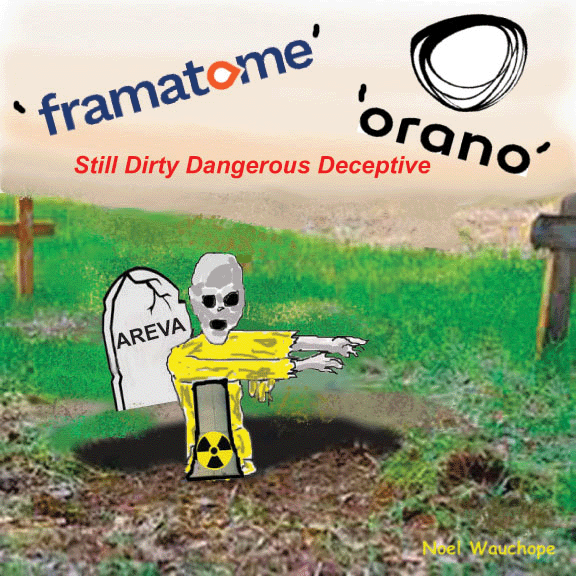
COMMENT. Apart from the fact that there seems to be negligible support for investment in this nuclear project , the UK government is here dealing with Framatome, which is not only the renamed failed company Areva, but has iself a worrying history of corrosion and sub-standard fuels – https://nuclear-news.net/?s=Framatome
By Shannon Eustace, BBC News, Suffolk, 19 Apr 24
A company that specialises in nuclear plant equipment has signed a multi-billion Euro deal with Sizewell C.
The nuclear power plant, partly funded by the French energy company EDF, is earmarked for land between Aldeburgh and Southwold in Suffolk.
Framatome has been awarded several contracts which will see them deliver two nuclear heat production systems……………………
The planned plant will be a near-replica of Hinkley Point C in Somerset, which Framatome has also worked on, and is expected to cost about £20bn, and take nine years to build.
Mr Fontana continued: “This project will benefit from the valuable experience garnered from Hinkley Point C and our teams are determined to make it a success.”
However, Alison Downes, from the Stop Sizewell C campaign group, wanted to know how the newly-signed contract would be funded.
“How can Sizewell C sign contracts for multi-billions of Euros when there is no evidence it has that kind of money, and a Final Investment Decision has not been made?” she said.
“The capital raise is ongoing and may still fail, and by its own account, EDF reached its financing cap for Sizewell C at the end of 2023, so the only money going in to the project at this point is from taxpayers.
“What secret promises has our government made? Have Ministers guaranteed that taxpayers will foot the bill for Sizewell C regardless of the cost, value for money, or any third party investment?” https://www.bbc.co.uk/news/uk-england-suffolk-68849170
Should we use nuclear energy?
Is nuclear energy the answer to the climate crisis or just a false solution? Here we separate fact from fiction and explore this controversial topic.
18 Apr 2024 , https://friendsoftheearth.uk/climate/should-we-use-nuclear-energy
What’s nuclear energy and is it renewable?
First off, a bit of science. Nuclear power uses nuclear reactions to generate electricity. Currently, this is mostly done through nuclear fission, where uranium and plutonium atoms are split in reactors to release large amounts of energy. The resulting heat is used to create steam, which turns turbines to generate electricity.
Nuclear energy doesn’t release greenhouse gases, making it a source of low-carbon energy. It’s often considered to be clean and sustainable, but is it renewable? Well, it’s not classified as such by the UK, and we’d argue that an energy source that creates a difficult and currently unsolved waste problem can’t be described as renewable.
What’s the problem with nuclear waste?
Nuclear power produces radioactive waste that’s dangerous for people and wildlife and lasts for thousands of years. If it isn’t disposed of or managed properly, the risks include contaminated groundwater and radiation exposure, which can have long-term implications for our health.
And nuclear waste management is a big problem. Decades after the first nuclear power station opened in the UK, safe storage for waste is still decades away at best, if ever. For example, Sellafield in Cumbria, the largest nuclear waste facility in Europe, currently has a worsening radioactive leak that could risk public safety. Plus, any new nuclear energy increases the amount of radioactive waste we have to deal with.
Is nuclear energy cheap?
In short, no. Nuclear is costly, especially in the UK, where new nuclear power would be more expensive than anywhere else in the world, according to a 2015 report. This is due to a number of factors, including the UK’s nuclear financing arrangements.
According to a 2017 review by Manchester University’s Tyndall Centre, the world’s leading climate energy and research institute, “claims that nuclear power is cheaper than other low-carbon options (including carbon capture and storage and wind) are unlikely to be borne out in reality”. And since the Centre’s review, the price of renewables has continued to fall quickly, making them much cheaper than nuclear energy.
Should nuclear energy replace fossil fuels?
To tackle the climate crisis, we need to urgently ditch fossil fuels like coal, oil and gas and replace them with clean, green alternatives. Nuclear energy is certainly less damaging for the environment than fossil fuels. But renewable energy, combined with energy efficiency and energy storage, is a faster and more cost-effective solution.
Alongside the higher costs outlined above, nuclear energy is also slower to build. For example, the Hinkley C plant being built in Somerset was announced in 2010 but may not start operating until 2027 at the earliest. By contrast, onshore wind and solar farms can take as little as 1 year to set up.
[Nuclear is] unlikely to make a relevant contribution to necessary climate change mitigation needed by the 2030s due to nuclear’s impracticably lengthy development and construction timelines, and the overwhelming construction costs of the very great volume of reactors that would be needed to make a difference.
Dr. Gregory Jaczko et al., Nuclear Consulting Group
It may be that better, more efficient forms of nuclear energy are developed in the future, but even so it’s unlikely we’d need this power. We believe it’s possible to transition from fossil fuels to renewable energy without resorting to nuclear. Renewable energy, as well as energy efficiency and storage, should be the focus of our efforts going forwards.
How can we solve the climate crisis without nuclear energy?
One word: renewables. The UK is blessed with huge resources of renewable energy such as wind, tidal and solar. These could provide all the energy we need, and then some.
Now, the UK will need more electricity than it currently consumes as we switch our transport and heating across from fossil fuels. But our research shows that if properly developed, onshore wind and solar farms alone could produce more than 2.5 times the electricity currently consumed by homes. And that’s not including the significant potential for offshore renewables. The UK not only has the resources to easily meet its own energy needs, but it could also become a green energy superpower exporting clean electricity to other countries.
Some argue that nuclear is better because it’s reliable, whereas wind and solar are dependent on the weather. Firstly, renewables are more consistent than they’re often given credit for. For example, solar panels work whenever it’s daylight, not just when the sun shines. But in instances where there are gaps, good energy storage and a mix of different types of renewables can ensure a continuous supply.
As we transition to a greener, fairer society, it’s important that no-one’s left behind. This includes those with jobs in the fossil fuel and nuclear industries. Green technologies, skills and services are creating ample opportunities for green jobs, allowing people to retrain in new sectors such as renewable installation.
Our verdict
In short, nuclear energy is a slow and costly solution to the climate crisis, and one that creates harmful waste we have no answer for. Rather than pursuing nuclear power, we need to invest in renewable energy, energy efficiency and energy storage for people and planet
Swiss ruling could pave way for more climate activist cases.
The decision that Switzerland had failed in its duty to mitigate climate change raises
questions about the Strasbourg court overstepping the mark. Victory for a
group of Swiss women who challenged their government’s inaction over
climate change will encourage activists “to try their luck”, one City
law firm partner warns.
The European Court of Human Rights last week ruled
for the first time that signatory states to the convention are obliged to
protect their citizens from the effects of the evolving “climate
crisis”. The judges said that the Swiss government had failed to comply
with its duties to mitigate climate change, and that violated the right to
respect for private and family life.
Times 18th April 2024
EDF wants public views on plans for Hinkley Point B decommissioning
By John Thorne Wednesday 17th April 2024
ENERGY firm EDF is carrying out a public consultation on its plans for the
decommissioning of Hinkley Point B nuclear power station, a process which
will continue into the 22nd century. The two Hinkley B reactors were shut
down in August, 2022, after 46 years of electricity generation, but will
not be able to be removed until about 2107. EDF has since been removing the
used fuel from the reactors in preparation for the station’s
decommissioning phase, which will involve dismantling and demolishing plant
and buildings on the site. More than half of the spent fuel stringers have
been removed from the first reactor and sent on in flasks for storage in
Sellafield, Cumbria.
West Somerset Free Press 17th April 2024
No more Russian language on air in three months – Kiev

COMMENT: It is a sad thing to see the Western world, supposed bastion of freedom, individual rights, “multiculture”…. complacently agreeing with the cultural repression that is going on in Ukraine.
Ukraine has long been a bilingual country, and also a country which valued the very good parts of its Russian heritage.
It’s one thing to trash and destroy Ukrainian cultural history, like the memory of Catherine the Great – who promoted public health and education, especially for women, and who established Kiev as a centre of the arts.
Even worse is the frenzied nationalism that punishes the quite large minority of Russian-only speakers across Ukraine, and especially in the Donbass area.
Thu, 18 Apr 2024 , https://www.sott.net/article/490743-No-more-Russian-language-on-air-in-three-months-Kiev
Ukraine’s goal of eradicating bilingual media content has almost been achieved, the government has claimed
Ukraine’s ban on using the Russian language in the media will take full effect three months from now, Kiev’s state language protection commissioner, Taras Kremin, has said.
Since gaining independence, Ukraine has been a bilingual nation, with most citizens able to speak or understand both Russian and Ukrainian. After the US-backed coup in Kiev in 2014, the new nationalist authorities adopted policies aimed at suppressing the Russian language, on the grounds of national unity and security.
The restrictions include a requirement for national media to predominantly use Ukrainian in broadcasts. The permitted share of content in Russian has declined from 40% in 2016 to an almost complete ban, which will come into force in July – the deadline that Kremin referred to in his statement on Wednesday.
“Today national television channels practice bilingual Ukrainian-Russian programming, in which participants use the Russian language without a translation or subtitles,” he said. “Starting on July 17, this practice will end. There will be more Ukrainian language!”
The push by Ukrainian nationalist leaders to impose the state language on Russian-speakers living in the east of the country was a major reason for locals’ rejection of the post-coup authorities. One of the first acts of those who seized power in Kiev was to abolish a law adopted in 2012, which gave the Russian language official regional status.
The new authorities have been adopting laws to eradicate Russian from all spheres of public life, including education, entertainment, and even services provided by private businesses.
In an interview last year, Kremin denied that some Ukrainian citizens could be called Russian-speaking, describing the term was “a marker introduced by Russian ideology,” and declared that “everyone in the country must have a command of the Ukrainian language.”
In contrast, this week the leader of another post-Soviet nation, Kazakhstan, rejected the notion that one language spoken by his people should be favored over others.
“Young people now are fluent in the state [Kazakh] language, in Russian language, in English and other languages, and that is good,” President Kassym-Jomart Tokayev said on Tuesday. “It’s ridiculous to ramp up hysterics over a language, let alone fight against one, as they did in some other states. We all see what they have now as a result.”
The Kazakh leader did not specify which other nations he was referring to.
Comment: The current policies of the Ukrainian government is what the collective west with few exceptions support. If voters in Western countries have difficulties finding out what their governments are about, keep the example of Ukraine in mind. if their government supports them, they might themselves not be far behind in how far they would be willing to go given the chance.
22 Nov, 2023 15:22
‘There are no Russian-speaking Ukrainians’ – Kiev
There is no such thing as a Russian-speaking Ukrainian citizen, Kiev’s state language protection commissioner, Taras Kremin, has declared. In recent years, the country has introduced a frenzy of measures to sever historical and cultural ties with Russia, as it scrambles to strengthen the status of its own language despite accusations of prejudice against national minorities.
In an interview aired by the Ukrainian branch of the US state-run Radio Free Europe/Radio Liberty (RFE/RL), Kremin rejected the suggestion that some Ukrainians could be called “Russophones,” describing the term as “a marker introduced by the Russian ideology.”
“We are all Ukrainian citizens… Ukrainian is the dominant language in all spheres of public life. Regardless of whether it is national communities or foreigners, everyone in the country must have a command of the Ukrainian language,” the ombudsman insisted.
Earlier this year, Kremin stated that Ukrainians who speak Russian should not be referred to as “Russian-speaking,” claiming that the term had been used for decades by “Russian propaganda” to promote internal divisions in Ukraine. Citing a 2021 Constitutional Court ruling, he also insisted there were only Ukrainian citizens who had been “Russianized.”
According to a March 2022 poll by the Sociological Group Rating, about 20% of Ukrainians considered Russian to be their native language. A Social Monitoring survey in 2021 suggested that more than 50% of Ukrainians were willing to read books and watch movies in Russian.
Ukrainian authorities embarked on a campaign to push Russian out of all areas of life immediately after the 2014 Western-backed Maidan coup. The measures sparked widespread public outrage and were among the key reasons behind the hostilities in Donbass.
In 2018, the Ukrainian Constitutional Court overturned a 2012 law granting regional status to the Russian language, while at the same time Kiev adopted initiatives seeking to curb its use in education, mass media, business, and culture.
Russia has repeatedly denounced Ukraine’s language policies. President Vladimir Putin said that Moscow’s military operation against its neighbor was partly to protect people who consider themselves part of Russian culture.
On Monday, the speaker of the Ukrainian parliament, Ruslan Stefanchuk, went as far as to deny the existence of Russian ethnic minorities, arguing that they had no special rights. The statement sparked outrage in Moscow, with Foreign Ministry spokeswoman Maria Zakharova saying the remarks came from “the Nazis of the 21st century.”
4 Apr, 2024 20:19
Zelensky’s comedy partner slams campaign against Russian language
Boris Shefir co-founded the Kvartal 95 (District 95) comedy studio in 2003 with Zelensky and a group of their school friends. Most of these comedians and producers – including Shefir’s brother, Sergey – followed Zelensky into politics, taking prime positions in his administration after he was elected president of Ukraine in 2019.
Shefir was not among them.Speaking to the Ukrainian branch of the US government-funded Radio Free Europe/Radio Liberty (RFE/RL) outlet on Thursday, he said that he has had “no relationship” with Zelensky since the conflict with Russia began in 2022.
“For two years, I have not called or talked to him,” Shefir said. “He is working with other people now. He does not communicate with me, does not call me. My calls remain unanswered.”
“Well, you see, I speak Russian,” he explained. “I love the Russian language, Russian culture…I can’t watch Pushkin’s monuments being destroyed in my country.”
Nuclear expert fears flooded radioactive dump sites in Siberia can threaten Arctic Ocean
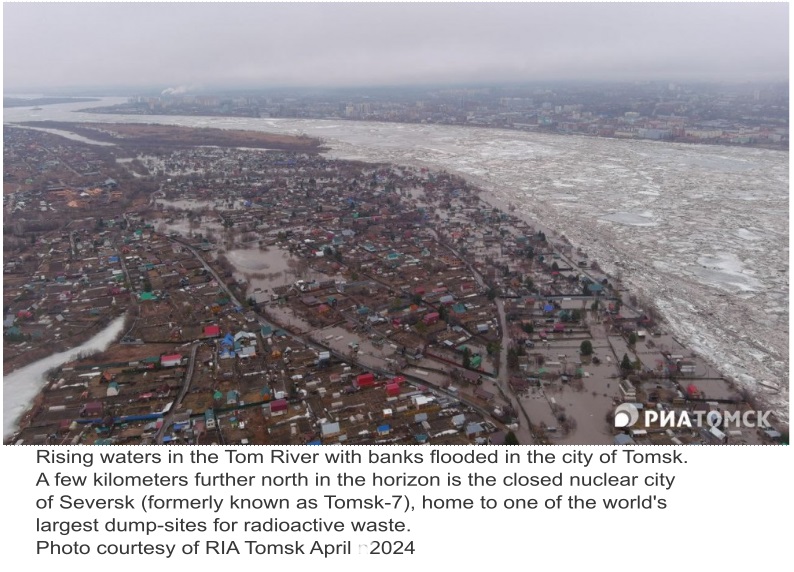
Floodwaters in Tomsk region threatens to submerge the river banks in Seversk where highly radioactive liquid waste from the Soviet Union’s nuclear weapons program for decades were injected into two unprotected underground reservoirs.
Water level on Monday continues to rise in the Tom River in Western Siberia.
The record floods are among the worst ever in the region and local emergency services help in evacuation of people living near tributaries of the Ob river system, including Tobol, Irtysh and Tom rivers.
Thousands of houses and tens of thousands of people live in the emergency zones, according to Kremlin information platform RIA Novosti. High snow falls in winter combined with swiftly rising spring temperatures and heavy rains are the reasons for the current extreme flood, Reuters reports.
Drone photos by RIA Tomsk shows how the swelling Tom River is inundating villages on the westside river banks. According to NEXTA news channel, water in Tom River has risen by nearly a meter over the day.
On the east side, a short 15 kilometers north of the city of Tomsk, is the closed city of Seversk. Until 1992, the secret city was code-named Tomsk-7 and was home to one of three production facilities for weapons-grade plutonium for the Soviet Union’s nuclear weapons program.
“There ain’t one single public message that Rosatom is monitoring the situation, that they have the situation under control,” says Aleksandr Nikitin, an exile nuclear safety expert working for the environmental foundation Bellona.
Nikitin was until the all-out war against Ukraine a member of Rosatom’s Public Council. The Council involved civic organizations and scientists in Russia and was aimed at raising public awareness of Rosatom’s core operations
“It’s surprising that there aren’t even simple statements like we have everything under control,” Nikitin adds.
According to the World Nuclear Association, the Siberian Chemical Combine in Seversk had five plutonium production reactors, an uranium enrichment plant and a processing plant for plutonium warheads. Although shut down, enormous amount of nuclear waste is still on site.
Most challenging are the liquid radioactive waste, both on the surface and pumped down in deep-well injections. The nuclear dump is likely Russia’s largest, by IAEA estimated to be 70 million cubic meters.
Widespread contamination in an area up to 28 kilometers came after a concrete cover blew off a reaction vessel at the plutonium extraction facility in 1993. The International Atomic Energy Agency (IAEA) listed it as a major radiological accident.
In 2000, a joint U.S.-Russian study found dangerous levels of radioactivity flowing into Russia’s Tom River from the Siberian Nuclear Combine.
Critics crumbled
Local environmentalists in Tomsk filed a lawsuit against the company in the late 1990s in an attempt to revoke a dumping permit for highly radioactive liquid waste down under. They feared for the city’s drinking water.
In Putin’s Russia, critical voices are gone. Environmental groups like Greenpeace, World Wide Fund for Nature, and Bellona are all listed as undesirable by law.
TV2 in Tomsk, known for its independent journalism and free debate since the early years after the breakup of the Soviet Union, got its broadcast shut down in 2014. After the start of the full-scale war in 2022, the reporters closed their YouTube producing newsroom and left Russia.
Aleksandr Nikitin is worried radioactivity could leak out to the river system under the current flood, but that information will not come before it is too late.
“Putin doesn’t give a fuck about these floods and other shitty lives of people in Russia.., he has a war and geopolitical goals of fighting the damned West,” Nikitin says.
For Rosatom, he adds, the logic is simple: “.. if you say that everything is under control, and then something happens, then you will have to answer for it.”
Nikitin says Rosatom is sure that in any case it will not bear any responsibility.
“Rosatom is today Putin’s “favorite child,” he explains.
It was Lavrenty Beria, director of Joseph Stalin’s secret police, who lead the establishment of the first plutonium production facilities east of the Ural mountains in the late 1940ties, early 1950ties. KGB and the Soviet nuclear establishment walked hand-in-hand for decades. What nowadays is Ulitsa Pervomayskaya (May 1st Street) in Seversk, was previously named Ulitsa Beria.
Arctic Ocean
A major concern for Aleksandr Nikitin and Bellona is that no one can exclude that leakages from a possible overflowed radioactive waste site could reach the Arctic Ocean.
Tom River is a tributary of the Ob which flows out in the Ob Bay and Kara Sea above the Arctic Circle.
During the years 1948-56, liquid radioactive waste from the Mayak reprocessing plant north of Chelyabinsk was discharged directly into the nearby river Techa which is connected to the river system Iset, Tobol, Irtysh and Ob. Especially Strontium-90, but also other isotopes, were carried by the water more than 2,000 kilometers downstream and measured in the Kara Sea, first time in 1951.
A joint Norwegian-Russian expedition to the Kara Sea in 1994 found traces of the same radionuclides, although in lower levels.
“Everything is now possible,” says Aleksandr Nikitin when seeing the photos of the flooded riverbanks of the Tom River.
“It all depends on the scale of leakages.”
“I’m sure the Siberian Chemical Combine sit quietly and wait. Hoping for it all to go over,” Nikitin says to the Barents Observer.
The climate crisis and nuclear weapons

It seems we haven’t the money to save the planet, but we can stump up any amount to fund nuclear death
NORTH EAST BYLINES, by Caroline Westgate, 15-04-2024
A massive and accelerating crisis faces all of us on Planet Earth: the climate is warming, and we will rapidly reach a point where the damage to our ecosystem will be irreversible. Dismayed by the political inertia which fails to address this emergency, increasing numbers of people are resorting to protest through nonviolent direct action.
International conferences regularly agree on aims but fail to implement action with the urgency and on the scale needed to challenge the hegemony of Big Oil. We are told that the money simply isn’t there.
But here in the UK there is one hugely costly project which, if it were cancelled, would release an income-stream which could be directed to the electorate’s real priorities: the climate crisis, the NHS, education and transport. I’m talking about Trident.
Nuclear weapons
I was five years old when America’s atomic bombs destroyed Hiroshima and Nagasaki. Those events ended WW2 but triggered the Cold War. When the Soviet Union, the UK, France and China acquired their own nuclear arsenals, the Cold War settled into a 35-year stalemate of Mutually Assured Destruction (appropriately dubbed MAD), in which it was assumed that a nuclear exchange would be prevented by a ‘balance of terror’.
But in the 1980s, NATO strategists dropped the MAD policy, because advances in military technology gave them the confidence that they could fight and win a nuclear war: their new nuclear-armed Cruise missiles could launch pre-emptive strikes, capable of destroying the Soviets’ nuclear weapons in their silos.
Ordinary people rapidly realised that this development posed an existential threat to millions of civilians on both sides of the Iron Curtain: we had all been conscripted as front-line troops, expendable pawns in NATO’s nuclear game. A re-energised peace movement vociferously opposed Cruise missiles when they arrived on British soil: they were totally under American control, but they made the UK a target.
Embrace the Base at Greenham Common
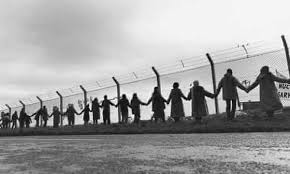
Greenham Common in Berkshire was one of the Cruise sites. In the summer of 1981, a small group of women from South Wales established a peace camp there. During the first winter of their protest they struggled to get any support or publicity. In conditions of great hardship, they kept the camp going. Their protest grew amid evictions, arrests, imprisonments, and physical attacks. One woman was killed. All of this was accompanied by often viciously mendacious press coverage.
In December 1982, I was one of 30,000 women who responded to an unsigned chain letter, inviting us to ‘Embrace the Base’. We joined hands and encircled Greenham’s 9-mile perimeter fence. We decorated it with objects of significance to us, transforming it into a nine mile work of art.
‘Embrace the Base’ was a high-profile event, but small-scale protests were frequently staged with daring, creativity and humour, either by the women who lived at the camp or by autonomous groups of women who travelled to Berkshire to carry out some anarchic plot of their own devising.
In September 1985, with a group of women from the North East, I made the 300-odd mile journey to Greenham again.
My group had hatched a plan to enter the base to access a small outbuilding on which they were going to paint anti-nuclear slogans, and I was there to support them. By that stage it was ludicrously easy to get through the fence because hundreds of women with bolt cutters had reduced it to shreds. The army kept patching it up, but their efforts were futile. The women from my group walked on to the base, slapped a lot of blue gloss paint on the wall of the outbuilding, then stood quietly, dripping brushes in hand, waiting to be arrested. A group of policemen duly arrived and handcuffed them. To my surprise, I was also arrested, even though I was outside the fence and hadn’t actually done anything wrong. We were all charged with criminal damage and summonsed to appear at Newbury Magistrates’ Court a few weeks later.
From the dock, I made a stirring speech to justify protesting at the base. It cut no ice whatsoever. I was found guilty of criminal damage and ordered to pay a fine and costs, which amounted to £67.75p. I refused to pay. The magistrates, who had seen it all before, wearily referred my case to my local court in Hexham. I knew that the length of time to be spent inside would be calculated pro rata from the amount of the fine I’d refused to pay. It worked out at less than a week in prison, which I felt confident I could cope with.
However, time wore on and nobody arrived to take me away. It was getting perilously near Christmas, when I really didn’t want to be away from my family. I enquired of the clerk to Hexham’s Magistrates when the law would come for me. He said:
“They don’t put people like you in prison. It’s much too expensive. We will contact your employer and put an Attachment of Earnings order on your salary.” I realised that my gesture of defiance would pointless if the only person who knew about it would be the wages clerk at County Hall. Since I was going to have to pay anyway, I decided to turn it into a stunt by making the payment on a novelty cheque……………………………………………………………………………………..
The carbon footprint of the UK military
All this is good for a laugh, but what it says about our priorities is far from funny. It is high time we looked at this issue from the perspective of the climate catastrophe, factoring-in what the military contributes to the UK’s carbon footprint. Dr Stuart Parkinson, of Scientists for Global Responsibility, calculates that the annual carbon footprint of the UK military is roughly equivalent to the carbon emissions of six million average cars. Trident must account for a sizeable proportion of that. Of course, the government omits all mention of those figures when it claims we are progressing nicely towards net zero.
The cost of Trident

We also need to challenge why we spend such colossal amounts of money on Trident, when there are so many urgent rival claims on the public purse. The arguments against the possession of nuclear weapons are as valid now as they were when I wrote my novelty cheque nearly forty years ago.
- the moral objection to threatening the deaths of countless numbers of people.
- nuclear weapons make their possessors a target.
- early-warning systems make it more likely that nuclear war will be triggered by accident.
- nuclear war will be followed by nuclear winter, causing ecocide and wrecking forever any chance of addressing climate change.
But let’s focus on the cost of Trident, which falls on the UK at a time when serious investment in public services is urgently needed on a huge scale. The figures bandied about are quoted not in millions but in billions. The difference between those two quantities is so vast it is hard to grasp, so try this analogy: a million seconds would last for about eleven days, but a billion seconds would last for 31 and a half years.
The Nuclear Information Service calculates the cost of Trident as £172 billion (including its new warheads and its running costs over its projected lifetime). That is a stupendous amount of money to lavish on maintaining the fiction that the UK is a world-class power. Neither the Tories nor Labour dares to question that expenditure. By contrast, Labour’s new idea for a Green Investment Fund (a mere £28 billion) was recently cancelled as unaffordable.
Apparently, we haven’t the money to save the planet, but we can stump up any amount to fund nuclear death.
Why are our priorities so badly skewed? https://northeastbylines.co.uk/the-climate-crisis-and-nuclear-weapons/
No Russian heavy weapons at Zaporozhye plant – IAEA boss
https://www.rt.com/russia/596018-no-heavy-russian-arms-zaporozhye/—16 Apr 24
Europe’s largest nuclear power plant was attacked by drones last week
Russia has not stationed heavy weapons at Zaporozhye Nuclear Power Plant, International Atomic Energy Agency (IAEA) Director General Rafael Grossi told reporters on Monday.
Moscow and Kiev have accused each other of shelling Europe’s largest nuclear plant, which sits close to the front line. Ukraine and its Western backers have also accused Moscow of using the facility as cover for its troops.
“There is no heavy weaponry there,” Grossi told reporters, after a UN Security Council meeting dedicated to the renewed strikes on the plant.
Although there are Russian “armored vehicles and some security presence at the plant,” IAEA monitors did not see any prohibited weapons, such as multiple rocket launchers, tanks, and artillery, Grossi explained.
He added that the IAEA does not have the mandate to determine which side has been attacking the facility, and argued that “indisputable evidence” is needed to establish who is responsible.
Addressing the Security Council, Grossi confirmed that Europe’s largest nuclear power plant was struck on April 7, which was the first direct attack on the site since November 2022. Inspectors have determined that the apex of the containment dome of the Unit 6 reactor building was hit, he added. “Whilst the damage to the structure is superficial, the attack sets a very dangerous precedent of the successful targeting of the reactor containment,” Grossi stressed, warning that “these reckless attacks must cease immediately.”
Russian UN Ambassador Vassily Nebenzia told the Security Council that Ukrainian forces have been “systematically” targeting the plant and surrounding areas. The Russian army has been “spotting and intercepting up to 100 drones per week,” Nebenzia added, insisting that Moscow has never placed heavy weapons at the facility or used the plant to stage attacks on Ukraine.
Officials in Kiev have denied striking the nuclear plant. “The position of Ukraine is clear and unequivocal: we are not conducting any military activities or provocations against nuclear sites,” Andrey Yusov, spokesman for Ukraine’s military intelligence, told national TV this month. Andrey Kovalenko, the head of the state-run Center for Countering Disinformation, has accused Moscow of spreading false information and “manipulating the IAEA.”
The agency said in its report this week that all of the facility’s six reactors are currently in cold shutdown. According to the plant’s management, only one reactor had been working since 2022 in order to keep the site operational. IAEA inspectors were deployed to monitor the facility in September 2022.
Survey by East Lindsay District Councillor and Guardians of the East Coast (GOTEC) say ‘85% don’t want nuclear dump’

A new survey by a Theddlethorpe campaign group has shown that after years of the campaign, public opinion remains the same – it’s still a ‘no’ to a nuclear waste dump.
Lincolnshire World, By The Newsroom, 16th Apr 2024,
Travis Hesketh, East Lindsey District Councillor for the Withern and Theddlethorpe Ward, joined forces with the Guardians of the East Coast to host public consultation events during March to gather public opinion on Nuclear Waste Services plans to store nuclear waste at Theddlethorpe Gas Terminal.
As well as asking residents of Theddlethorpe and Sutton on Sea in person and online, village hall events were also held in Carlton, Reston, Mablethorpe, Maltby le Marsh, and Withern.
The results showed that of the 1,008 registered votes, 85 percent of respondents did not want the GDF – the same result found in 2022’s survey – while 7.7 percent were undecided, and the remaining 7.7 percent were for a GDF.
In a statement within the results, Ken Smith, chairman of the GOTEC, said: “After a three year project, the view of the community remains the same – this community does not want a GDF. It is not a willing community.
“There is no change of opinion taking place despite NWS lobbying. It is reasonable therefore to conclude that there is no prospect of gaining community support for the GDF.”………………………………………………….. https://www.lincolnshireworld.com/news/environment/survey-by-eldc-councillor-and-gotec-say-85-dont-want-nuclear-dump-4592761
Labour and nuclear weapons: a turbulent ideological history
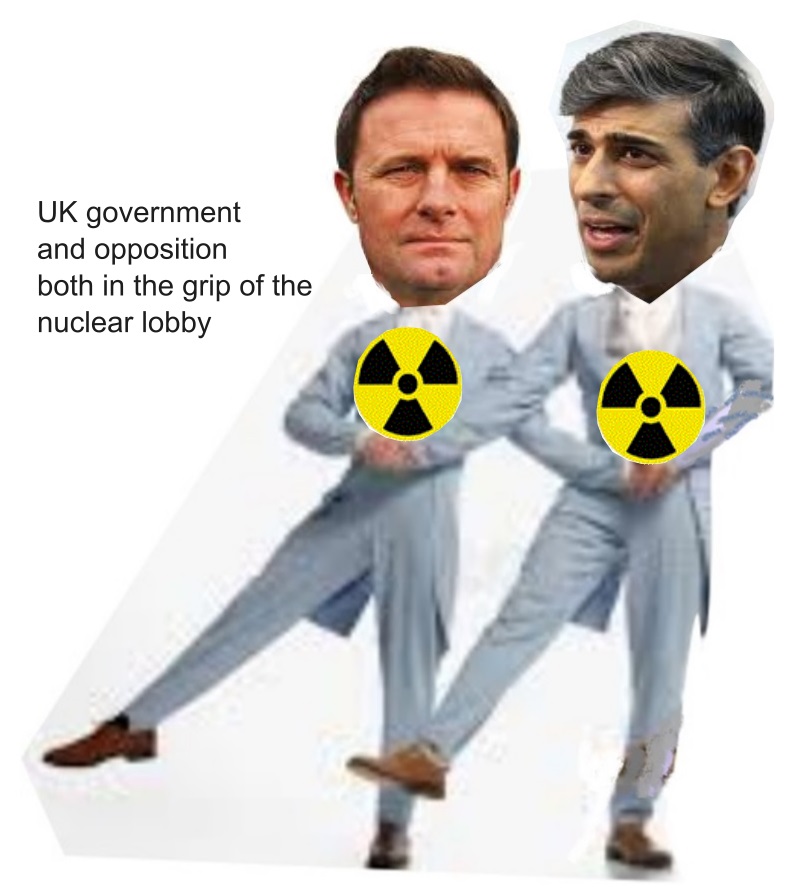
BY CHAS NEWKEY-BURDEN, THE WEEK UK, 15 Apr 24
From the 1940s to Keir Starmer, the party leadership has zigzagged in and out of love with the bomb
“We’ve got to have this thing over here, whatever it costs,” Labour’s then foreign secretary Ernest Bevin reportedly said in the 1940s, and “we’ve got to have the bloody Union Jack on top of it”.
That “thing” was the atomic bomb, but since being acquired by the UK, nuclear weapons have been a “divisive issue” within Labour, said the BBC.
Anti-nuke ‘fixture’
Michael Foot, who became Labour leader in 1980, was a founder member of the Campaign for Nuclear Disarmament (CND) and “a fixture at anti-nuclear demonstrations”, said socialist magazine Tribune.
When Neil Kinnock took over as leader in 1983, the party’s policy, which he supported, was unilateral nuclear disarmament and the removal of all US nuclear weapons and bases from British soil. But this policy was only supported by a minority of the British public, and Labour lost the 1987 general election.
By 1989, Kinnock had convinced the party to drop these policies, but “many” on the Labour left remain “vehemently opposed” to that decision, said the BBC.
Previously ‘unthinkable’
As a young MP, Tony Blair was a member of CND, but he was never strongly in favour of unilateral disarmament, and as party leader, he was on board with the party’s pro-nuclear policy……………………………………………
A ‘nuclear-free world’
Like Foot and Blair, Jeremy Corbyn was also a CND member, rising up to be vice-president of the campaign group before he became party leader in 2015. Corbyn told BBC Radio 4’s “Today” programme that if he became prime minister, he would instruct the UK’s defence chiefs never to use the Trident nuclear weapons system.
“I am opposed to the use of nuclear weapons,” he said. “I am opposed to the holding of nuclear weapons. I want to see a nuclear-free world. I believe it is possible.”……………………
‘Unshakeable’
Corbyn’s successor, Keir Starmer, has moved the party back to a staunchly pro-nuclear policy. In an article in the Daily Mail last week, he said that his commitment to the UK’s nuclear weapons was “unshakeable” and “absolute”……………………
Asked by ITV News if he would be willing to push the nuclear button as PM if Britain were under attack, Starmer said that “deterrence only works if there is a preparedness to use it”. https://theweek.com/defence/labour-nuclear-weapons-history
Two days of strikes planned at Dounreay nuclear power complex
Workers at the Dounreay nuclear power complex have voted to go on strike
next month. The Prospect union said its members would walk out on 1 and 2
May followed by a work to rule. Workers from Unite and the GMB had
previously voted in favour of industrial action after rejecting a 4.5%
offer backdated to April 2023. Dounreay’s operator, Nuclear Restoration
Services (NRS), has said previously it was disappointed by the result of
the votes. The site employs about 1,200 people.
BBC 15th April 2024
Theberton faces nightmare Sizewell C roadworks disruption
Fed-up villagers living along a B-road near Leiston have been left upset,
sleep-deprived and out of pocket after weeks of roadworks for Sizewell C. A
night-time operation to resurface the B1122 through Theberton and towards
Middleton between March 18 and April 10 left residents at the end of their
tether. Middleton Parish Councillor Charles Macdowell – who lives along the
road – said his house was shaking as they planed the surface of the road
and the noise kept him and his wife awake at night.
East Anglian Daily Times 15th April 2024
https://www.eadt.co.uk/news/24252702.theberton-faces-nightmare-sizewell-c-roadworks-disruption
MPs flag UK’s HM Revenue & Custom’s £1.4bn active contracts with Fujitsu

accounting WEB, by Tom Herbert, 10 Feb 24
A committee of MPs has published new data showing that HMRC holds eight active contracts with Fujitsu with a combined value of £1.4bn, all of which were awarded after a High Court verdict that ruled the developer’s software was responsible for misreported losses during the Post Office scandal.
Data from the Treasury Committee shows public organisations have held more than £3.4bn worth of contracts with Fujitsu since 2019 – the year a High Court ruling determined that there were defects in the developer’s Horizon software. Just over £2bn worth of contracts were agreed before the judge’s ruling and continued into the period following 2019, while around £1.4 bn was awarded after 2019.
Fujitsu’s Horizon software is at the heart of one of the biggest miscarriages of justice in British legal history, where 900 Post Office subpostmasters were prosecuted based on faulty evidence provided by the system, and backed up by court testimonies from Fujitsu experts.
Despite the court ruling, and evidence that the company and its staff were complicit in covering up the scandal, Fujitsu continued to be listed as a preferred government supplier until 2022 when it was removed (but continued to win contracts through the regular procurement process). Following the public outcry generated by the ITV drama Mr Bates vs the Post Office, Fujitsu wrote to the government in January 2024 to confirm it would no longer tender for business.
HMRC’s active contracts
At the time of writing, HMRC holds eight active contracts with Fujitsu with a combined value of £1.39bn – the largest in terms of both value and number. Financial services watchdog the FCA maintains six contracts worth more than £9m. ………………………………………………….
Government tech programmes ‘hobbled’
While the figures may generate plenty of noise from politicians and frustration from taxpayers, they are unlikely to result in meaningful change in the near future.
There are few ‘strategic technology suppliers’ able to take on the complexity and scale of many of the projects undertaken by government departments – as underlined by the award of a £485m contract to Fujitsu for the Northern Irish Education Authority in December 2023, which received just one tender from the Japanese software house.
Critics have also pointed to a lack of technical and commercial skills in government to deal with the challenges – leaving them poorly positioned when it comes to digital transformation or re-procurement.
In a report last year, Public Accounts Committee Chair Meg Hillier said the government’s technology programmes are “hobbled by staff shortages, and a lack of support, accountability and focus from the top.
“The government talks of its ambitions for digital transformation and efficiency, while actively cutting the very roles which could help achieve them,” she added.
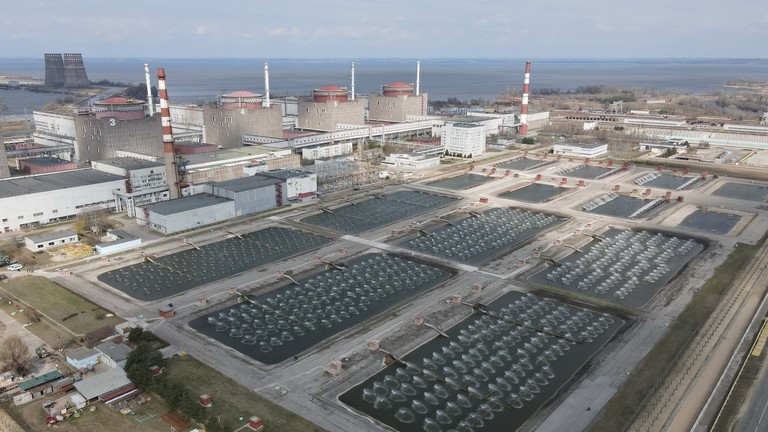
Attacks on Ukraine’s nuclear plant put world at risk, IAEA warns
By Euronews with AP, 16/04/2024
https://www.euronews.com/2024/04/16/attacks-on-ukraines-nuclear-plant-put-world-at-risk-iaea-warns
“We’re getting dangerously close to a nuclear accident,” IAEA Director General Rafael Mariano Grossi said following multiple attacks against the Zaporizhzhia Nuclear Power Plant in Ukraine.
The head of the International Atomic Energy Agency said attacks against Europe’s largest nuclear power plant have put the world “dangerously close to a nuclear accident”.
Without attributing blame, IAEA Director General Rafael Mariano Grossi said his agency has been able to confirm three attacks against the Zaporizhzhia Nuclear Power Plant since 7 April.
“These reckless attacks must cease immediately,” he told the Security Council on Monday. “Though, fortunately, they have not led to a radiological incident this time, they significantly increase the risk … where nuclear safety is already compromised.”
The remote-controlled nature of the drones that have attacked the plant means that it is not possible to determine who launched them, Grossi told reporters after the meeting.
“In order to say something like that, we must have proof,” he said. “These attacks have been performed with a multitude of drones”.
Zaporizhzhia sits in Russian-controlled territory in southeastern Ukraine and has six nuclear reactors.
Fears of a nuclear catastrophe have been at the forefront since Russian troops occupied the plant shortly after invading in February 2022. Continued fighting between Russian and Ukrainian forces – as well as the tense supply situation at the plant – have raised the risk of a disaster.
Ukraine and its allies on Monday blamed Russia for dangers at the site. Russia, for its part, said Ukraine was to blame for the attacks.
“The IAEA’s report does not pinpoint which side is behind the attacks,” Russia’s UN Ambassador Vassily Nebenzia said. “We know full well who it is.”
New Hinkley nuclear power plant expected to kill 46 tonnes of fish a year.

EDF building £50m nature reserve near Hinkley Point to compensate for loss of life
Jonathan Leake, 16 April 2024
A nature reserve is to be flooded by the developer of the Hinkley Point C nuclear plant at a cost of £50m to compensate for the death of fish in its cooling pipes…
An 840 acre swathe of land along the Parrett
estuary in Somerset will be transformed into salt marsh as a habitat for
marine life to replace fish sucked in by the new power station’s cooling
ducts. The area affected – part of the Somerset levels, where Saxon king
Alfred the Great is said to have hidden from the Vikings – includes
farmers’ fields used for grazing, as well as a nature reserve.
EDF, the French company building Hinkley Point, will create a new nature reserve
nearby to replace the land being lost. The overall changes are expected to
cost it £50m. The massive water intakes used to suck water from the
Bristol Channel to cool Hinkley Point C’s reactors are expected to kill
up to 46 tonnes of fish a year when the plant opens in 2031.
EDF also explored installing an acoustic fish deterrent, effectively a loud noise to
ward away animals, but concluded this would cause more harm than it
prevented. Chris Fayers, the company’s head of environment at Hinkley,
said: “An acoustic fish deterrent would use 280 speakers to make noise
louder than a jumbo jet 24-hours a day for 60 years with unknown impacts on
other species like porpoises, seals, whales. “It offers a very
small potential benefit to protected fish species and would also risk the
safety of divers in the fast-flowing tides of the Bristol Channel. New
natural habitat is a better solution.”
EDF said it was working with
Natural England, the Environment Agency, and other conservation
bodies to develop the new natural habitats. It plans to take out
compulsory purchase orders to acquire the land and then destroy its
protective dykes so that saltwater can flood in, according to planning
documents.
Dozens of farmers around Pawlett Hams, north of Bridgwater in
Somerset, have been told their grazing land is likely to become salt marsh.
One said: “It’s an existential threat to farmers’ livelihoods.” EDF
has told local people: “We are proposing to create 340 hectares of salt
marsh habitat. Will Barnard, chair of the Pawlett Parish Council, who also
works as an environmental land manager on some of the affected land, said
no-one was happy with the scheme.
Telegraph 16th April 2024
1 This Month

4 May -West Suburban Peace Coalition to discuss Iran war at May Educational Forum
Monday, May 4, 7:00 – 8:00 PM Central Standard Time
Title: : How Trump’s Narrative Tries to Shape the Reality of the War on Iran.
Contact Walt Zlotow, zlotow@hotmail.com 630 442 3045 for further information
14 May – online event From Bombs to Data Centres: the Face of Nuclear Colonialism
To see nuclear-related stories in greater depth and intensity – go to https://nuclearinformation.wordpress.com
-
Archives
- May 2026 (37)
- April 2026 (356)
- March 2026 (251)
- February 2026 (268)
- January 2026 (308)
- December 2025 (358)
- November 2025 (359)
- October 2025 (376)
- September 2025 (257)
- August 2025 (319)
- July 2025 (230)
- June 2025 (348)
-
Categories
- 1
- 1 NUCLEAR ISSUES
- business and costs
- climate change
- culture and arts
- ENERGY
- environment
- health
- history
- indigenous issues
- Legal
- marketing of nuclear
- media
- opposition to nuclear
- PERSONAL STORIES
- politics
- politics international
- Religion and ethics
- safety
- secrets,lies and civil liberties
- spinbuster
- technology
- Uranium
- wastes
- weapons and war
- Women
- 2 WORLD
- ACTION
- AFRICA
- Atrocities
- AUSTRALIA
- Christina's notes
- Christina's themes
- culture and arts
- Events
- Fuk 2022
- Fuk 2023
- Fukushima 2017
- Fukushima 2018
- fukushima 2019
- Fukushima 2020
- Fukushima 2021
- general
- global warming
- Humour (God we need it)
- Nuclear
- RARE EARTHS
- Reference
- resources – print
- Resources -audiovicual
- Weekly Newsletter
- World
- World Nuclear
- YouTube
-
RSS
Entries RSS
Comments RSS
 nuclear-news