Chernobyl campaigner Adi Roche warns of global nuclear threat as power plant attacked in Ukraine
Irish Examiner , 26 Apr 24
The world must face the stark reality of a looming global nuclear threat following fresh drone strikes near the Zaporizhzhia power plant in Ukraine, Chernobyl campaigner Adi Roche has warned.
“It is a nightmare scenario,” Ms Roche said on the eve of UN Chernobyl remembrance day on Friday which recalls the horror of the 1986 nuclear disaster.
But that tragedy could pale into insignificance if Zaporizhzhia in southern Ukraine, Europe’s largest nuclear power plant, is damaged by or as a result of Russia’s invasion of Ukraine, she said.
“We have never had a situation in any war where something like this has happened. This war has changed the face of warfare,” she said.
“Putin is weaponising nuclear power facilities.
“The world was shocked by the scale of Chernobyl’s impact but I don’t think we even have a model for what might happen if there’s an incident at Zaporizhzhia.
“We are looking down the barrel of loaded gun and one of these days, our luck is going to run out.”
Drone strikes
Drone strikes were reported near the plant again on April 7 in what was the first direct military action against the plant since November 2022, when Russia assumed control of the facility.
International Atomic Energy Agency (IAEA) inspectors deployed to monitor the site reported three drone impacts, none of which damaged critical nuclear safety or security systems.
But Russia has recently announced plans to restart the plant, greatly increasing the danger of a nuclear accident………………………….. https://www.irishexaminer.com/news/munster/arid-41381947.html
Scottish National Party and UK Government in row over cost of nuclear dumping grounds
The SNP has claimed that Scotland could be saddled with a bill of over £22 billion as part of Westminster’s cleanup of nuclear dumping grounds.
By Andrew Quinn, Westminster Reporter, 23 Apr 24, https://www.dailyrecord.co.uk/news/politics/snp-uk-government-row-over-32644089
A row has broken out between the SNP and the UK Government over how much Scotland will pay on radioactive waste.
The SNP has claimed that Scotland could be saddled with a bill of over £22 billion as part of Westminster’s cleanup of nuclear dumping grounds.
But the UK Government has said that the figure is actually much lower.
Radioactive waste is an issue which is devolved to the Scottish Parliament.
The party said this would mean Scotland could be made to pay £22,618,000,000 in total as it contributes 8.6 per cent of the UK’s tax revenue.
This would work out to £22,000,000 every year for a century.
But the UK Government has dismissed these claims, saying that the Nuclear Decommissioning Authority’s annual statement from last year put future costs at £124bn across the UK.
It also said that calculating the amount that Scotland would pay by its tax share was wrong.
Scotland has three nuclear power stations which are currently being decommissioned. England and Wales have 14 sites.
SNP MP Martin Docherty-Hughes said the money should be spent on public services.
He said: “Westminster’s obsession with nuclear energy and weapons neither benefits nor helps ordinary Scots, and yet they’re expected to fork out tens of millions every year for a century to pay for the cleanup of radioactive materials.
“While the Tories have lined up funding for the cleanup of material that shouldn’t have been used anyway, public services have been decimated, and a cost of living crisis that has seen energy bills go through the roof has hammered households.
“Conventional military spending has been recklessly slashed as global tensions rise, with the Tories instead focussing obscene amounts of cash on disposing of nuclear materials from weapons of mass destruction we should never, and will never, use.
“And in prioritising expensive nuclear energy they’ve even refused to support efforts to save jobs and future proof Scotland’s already established and thriving energy sector by matching the SNP Scottish Government’s £500 million funding for a Just Transition.
“The list of projects and causes Scotland’s £22 billion could be better spent on is endless, but as ever Westminster’s spending priorities are askew and based around making Scotland pay for things Scots neither want nor need.
“Hospitals, doctors, nurses, teachers, police officers, members of the armed forces – none of this is a priority for Westminster who’d rather spend billions on unnecessary nuclear projects. Scotland could do far better with independence and focus spending on areas that would actually benefit the people who live and work here. Only a vote for the SNP can secure representatives who will fight Scotland’s corner and stand up for our unique needs and interests.”
The UK Government was approached for comment
Scotland could be hit ‘with £22bn nuclear clean-up bill’.
SCOTLAND could be saddled with a bill of more than £22 billion as part of
Westminster’s clean up of nuclear dumping grounds over the next century,
the SNP have said. Official estimates published by the UK Government last
November estimated total clean-up costs for sites which contained disposed
nuclear material from weapons programmes and energy generation could come
to £263bn over the next 100 years.
This means Scotland, which contributes
8.6% of the UK’s tax revenue, could be made to pay £22,618,000,000 in
total, working out to £22m every year for a century. The SNP’s defence
spokesperson Martin Docherty-Hughes criticised how conventional military
spending had been “recklessly slashed” while the Tories focus cash on
disposing nuclear materials from weapons of mass destruction.
The National 23rd April 2024
https://www.thenational.scot/news/24272520.scotland-hit-with-22bn-nuclear-clean-up-bill
Former Sellafield consultant claims the nuclear complex tampered with evidence
Whistleblower Alison McDermott claims former employer Sellafield tampered with metadata in letters used in evidence during an employment tribunal.
Tommy Greene, Bill Goodwin, Computer Weekly, 22 Apr 24
A former consultant at Sellafield has claimed that metadata in letters used against her in a tribunal hearing by the nuclear facility has been interfered with.
A tribunal has heard that three letters produced by managers at the vast nuclear complex and submitted as evidence in the employment dispute were “fabricated” and “tampered with”.
Alison McDermott lost a whistleblowing claim against the Cumbrian nuclear facility and is now fighting a demand to pay £40,000 costs.
The former Sellafield consultant said the metadata for one of the three letters was “wiped” by legal representatives for Sellafield.
She formally withdrew the allegations in her first employment tribunal claim against the nuclear complex.
The 2021 tribunal judgment determined that the letters were not “fabrications”.
“These letters are not fabrications, as had previously been asserted by the Claimant,” it found.
However, the ex-contractor raised her claims about the letters’ production and of alleged tampering during last week’s tribunal when defending herself from allegations she had acted “unreasonably” in the legal action with Sellafield and a regulatory body.
Sellafield maintains that McDermott’s allegations are “untrue”.
McDermott, a human resources (HR) consultant, signed a two-day-a-week contract with Sellafield worth £1,500 per day and was tasked in 2018 with looking at an employee’s sexual harassment allegations.
But within days of submitting a report that found the HR team was viewed as “broken and dysfunctional” by some staff, her contract was ended.
She has contested cost awards as a litigant-in-person during a one-day hearing in Leeds.
Summarising her arguments, tribunal judge Stuart Robertson said McDermott had suggested that the three letters used against her by Sellafield during the employment case over the termination of her contract were “fabricated and not genuine”.
Deshpal Panesar KC, who represented Sellafield at the tribunal, accused McDermott of “making baseless claims of the most damaging sort – representing an existential threat to the careers of multiple public servants”.
Panesar said McDermott had accused Sellafield and its regulatory body, the Nuclear Decommissioning Authority (NDA), of “illicit conduct, fabrication of evidence and false representations” when making her case.
McDermott sought to challenge cost awards made against her, amounting to £40,000, in a previous tribunal decision.
The employment tribunal claim she brought against Sellafield in 2021 was unsuccessful. But an appeal judge found aspects of her case “troubling” and she was subsequently recognised as a whistleblower under UK employment law.
Robertson, a new tribunal judge, is now considering whether McDermott’s claims and conduct have been “unreasonable”.
McDermott claims she suffered a number of detriments when her contract was terminated. She has since spoken out publicly against Sellafield, branding its workplace culture as “toxic”.
Sellafield and the NDA have contested the claims robustly, initially arguing McDermott’s work was ended for “financial reasons” and later as a result of her “poor” performance.
Suspicious of the letters
The three letters have been a central point of contention in McDermott’s court battle.
The Information Commissioner’s Office ruled in early 2021 that Sellafield had acted unlawfully, having broken data laws and committed security breaches for, among other things, failing to supply McDermott with the letters after she had made a data subject access request.
Sellafield subsequently used the critical letters against McDermott in the employment tribunal case she brought over the termination of her contract.
McDermott told Thursday’s tribunal that the letters had caused her “significant detriment”………………………………………………………………………………………………………………………………………… more https://www.computerweekly.com/news/366581793/Former-Sellafield-consultant-claims-the-nuclear-complex-tampered-with-evidence
Problems delay OL3 reactor restart by 6 days
Olkiluoto 3 was taken offline at the beginning of last month for annual maintenance.
The outage of Olkiluoto 3, Finland’s newest nuclear reactor which is
currently offline for maintenance, is being extended by six days due to
technical problems, operator Teollisuuden Voima (TVO) announced on Sunday.
The facility was shut down for its first round of annual maintenance on 2
March, according to the firm, which added that around 1,100 professionals
were involved in the effort. The firm’s other two reactors, Olkiluoto 1 and
2, were generating electricity at normal levels of approximately 1,780MW,
the company said. Maintenance on OL3 is now scheduled to be completed on 4
May.
The reactor was put into service just over a year ago, following
construction delays of 14 years. The scheduled break was originally due to
end on 8 April.
YLE News 21st April 2024
Price tag for Poland’s first nuclear plant may reach $37bn

Global Construction Review, David Rogers, 22.04.24
Poland first nuclear power plant could cost as much as $37bn, according to Jan Chadam, the acting head of Polskie Elektrownie Jadrowe (PEJ), the agency set up by the government to oversee its nuclear plans.
According to finance news agency PAP, Chadam told the 39th Europower conference in Warsaw: “We don’t have the final value of this project, but one can imagine that it will probably be around PLN150bn [$37bn].”
The plant is due to be built by US engineers Westinghouse and Bechtel. It will be sited in Pomerania on the Baltic Coast, with work beginning in 2026 and completing in 2033. Two additional units are expected to follow within the next three years.
However, Chadam said schedule was unlikely to be met, which he said added to the uncertainty over the cost.
In 2020, when the plan to build a fleet of nuclear power stations was first outlined, the price for the multiple units was tentatively put at $40bn.
The details of the finance are still being worked out. PEJ is seeking assistance from financial advisers on ways to attract investors.
Chadam added that Poland was also counting on the participation of the US’ Export-Import Bank, which supports US export projects…………………. https://www.globalconstructionreview.com/price-tag-for-polands-first-nuclear-plant-may-reach-37bn/
Where are France’s nuclear reactors and what is planned for more?
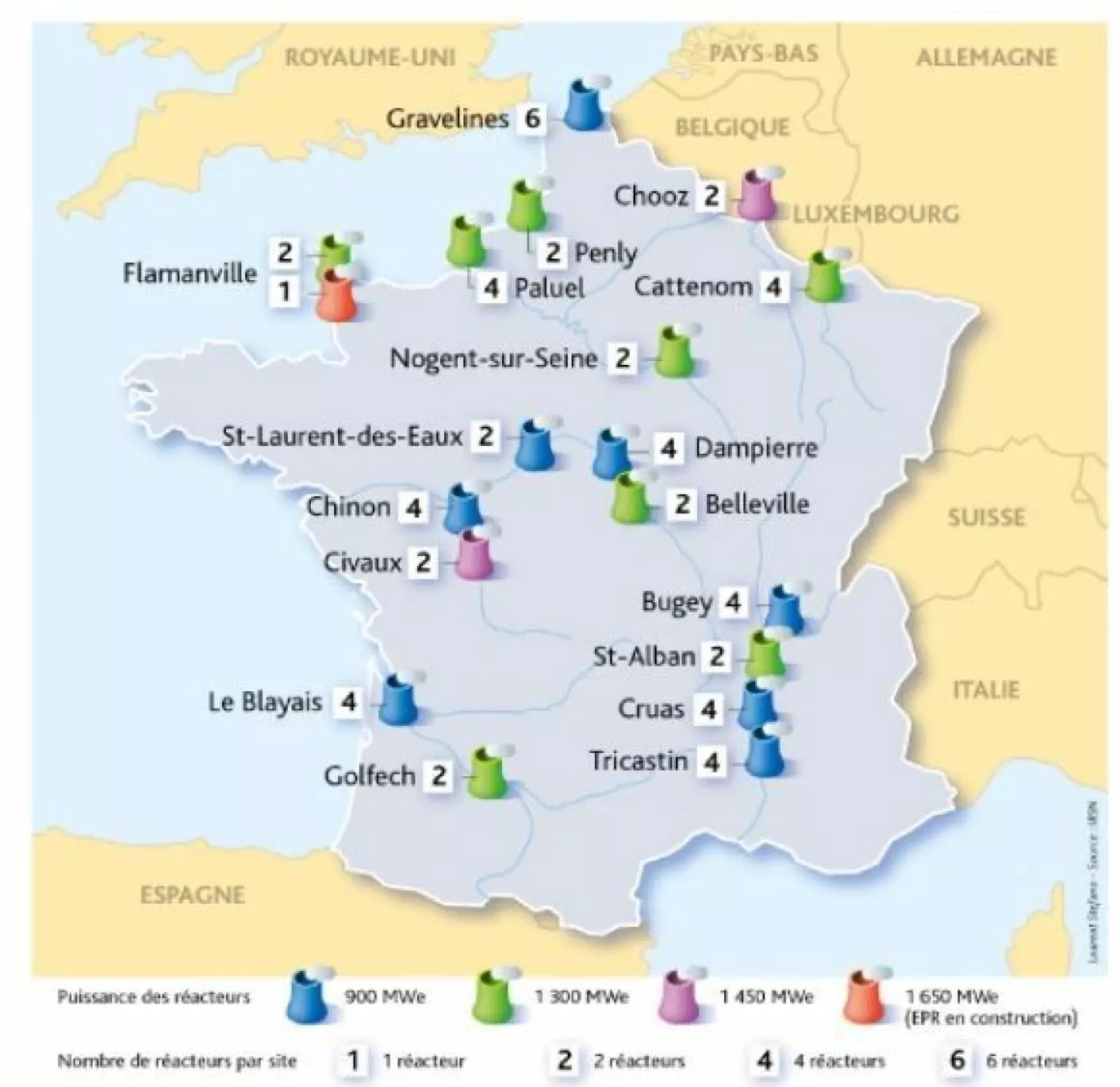
the six new sites will by no means triple French production, particularly since the older plants will increasingly be closed for repair and maintenance.
President Macron wants to triple atomic energy production by 2050
Richard Henshell, Saturday 20 April 2024
France is the third biggest producer of nuclear energy in the world and hopes to triple production by 2050. We look at where the country’s nuclear sites are and at President Macron’s plans for more.
Nuclear power represents up to 70% of the electricity produced in France at 282 Terawatt-hours (TWh), behind only China (395TWh) and the US (772TWh) and far ahead of the UK (42TWh).
However, many of its plants are approaching the end of their life-cycle. The majority of France’s 56 reactors date from the 1980s, and only two have been built since the year 2000.
In order to meet the requirements of the 2015 Paris Climate Accords, President Macron announced his plans to reinvest in France’s ageing nuclear plants during last year’s COP28 climate meeting in Dubai.
“Nuclear energy is back,” said Mr Macron (in English), adding that it was time to recognise the “essential role that nuclear energy can play in efforts to reach zero carbon dioxide emissions on a global level”.
“We will triple our capacity to produce nuclear energy between 2020 and 2050,” he said.
France’s 56 reactors are shared between 19 sites. Another reactor is scheduled to power up at Flamanville this summer, bringing the total to 57 reactors.
There are also plans to construct six new reactors at three existing plants:
- Two at Penly (Seine-Maritime) for 2035
- Two at Gravelines (Nord) for 2038
- Two at Le Bugey (Ain) for 2042
Construction is scheduled to start in summer 2024 on first of these new reactors in Penly, which like the others, will use the powerful new EPR-2 design. The estimated total cost for the six reactors is around €67.4 billion.
However, the six new sites will by no means triple French production, particularly since the older plants will increasingly be closed for repair and maintenance.
Indeed, in December 2021, the discovery of cracks in the emergency cooling systems of France’s four newest reactors led to them being shut down for over a year
Regardless, Mr Macron announced in February 2022 that France’s older plants could conceivably operate far into the future – beyond their 60th year or until they are no longer capable of producing electricity, or no longer safe.
Polish president: Poland ready to deploy allied nuclear weapons on its territory

by Chris York andThe Kyiv Independent, April 22, 2024
Poland is ready and willing to allow NATO allies to deploy nuclear weapons on its territory, Polish President Andrzej Duda said in an interview published on April 22.
Speaking to Fakt, Duda highlighted how Russia has already taken similar steps with its own allies, having transferred tactical nuclear weapons to Belarus last year.
The president said the topic of placing U.S. nuclear weapons in Poland “has been a topic of Polish-American talks for some time.”
“If our allies decide to deploy nuclear weapons as part of nuclear sharing also on our territory to strengthen the security of NATO‘s eastern flank, we are ready for it,” he said.
“We are an ally in the North Atlantic Alliance, and we also have obligations in this respect, i.e., we simply implement a common policy.”……………………. https://kyivindependent.com/poland-nuclear-weapons-duda/
Russia-Ukraine war: EU ministers fail to pledge Patriot systems to Ukraine at key meeting – as it happened
Yohannes Lowe and Sammy Gecsoyler, 23 Apr 24 https://www.theguardian.com/world/live/2024/apr/22/russia-ukraine-war-live-zelenskiy-chasiv-yar?filterKeyEvents=false&page=with%3Ablock-66261a918f08839e09ac8c8b
Russia says new US aid to Ukraine will not change situation on battlefield
A new US package of military aid to Ukraine will not change the situation on the frontlines, where Russia has the upper hand, the Kremlin said.
“The Russian armed forces are improving their positions at the front … The money allocated and the weapons that will be supplied will not change this dynamic,” Kremlin spokesperson Dmitry Peskov told reporters.
“They will lead to new victims on the Ukrainian side. More Ukrainians will die, Ukraine will suffer greater losses.”
In the Ukraine bill, of the $60.7bn, a total of about $23bn would be used by the US to replenish its military stockpiles, opening the door to future US military transfers to Ukraine.
Another $14bn would go to the Ukraine Security Assistance Initiative, in which the Pentagon buys advanced new weapon systems for the Ukrainian military directly from US defence contractors.
Ukrainian President Volodymyr Zelenskiy on Sunday urged Washington to quickly turn the bill into law and proceed with the actual transfer of weapons, saying long-range arms and air defence systems were top priorities.
“I think this support will really strengthen the armed forces of Ukraine and we will have a chance for victory,” Zelenskiy said.
Russia said the American defence industry will be the real beneficiary of the package.
“We also recognise that most of this money will remain in the United States. The United States will become richer and will receive additional dividends by providing assistance to Ukraine. For (President Vladimir) Putin, this was expected,” Peskov said.
Poland: We’re ready to host nuclear weapons, (and work with Trump )
Polish President Andrzej Duda said atomic sharing has been a topic of Warsaw-Washington talks.
Politico, APRIL 22, 2024 , BY CLAUDIA CHIAPPA
Polish President Andrzej Duda said Poland is “ready” to host nuclear weapons on its territory if NATO decides to reinforce its eastern flank.
“Russia is increasingly militarizing the Königsberg oblast (Kaliningrad). Recently, it has been relocating its nuclear weapons to Belarus,” Duda said in an interview published Monday by Polish outlet Fakt.
“If our allies decide to deploy nuclear weapons as part of nuclear sharing on our territory as well, in order to strengthen the security of NATO’s eastern flank, we are ready for it,” he added.
………………………………………………………….. Duda, who recently traveled to New York and met Republican 2024 candidate Donald Trump, spoke fondly of the former president, saying that the two have “a lot of common topics.”
“He is a politician with whom I directly cooperated with the United States for four years when he was the president of the United States,” Duda said. “I want to emphasize very strongly that we have been friends since then. I really like talking to him, because he is an extremely interesting personality and has a lot of experience, both political and business.” https://www.politico.eu/article/poland-ready-host-nuclear-weapons-andrzej-duda-nato/
Europe baked in ‘extreme heat stress’ pushing temperatures to record highs
Scorching weather has baked Europe in more days of “extreme heat
stress” than its scientists have ever seen. Heat-trapping pollutants that
clog the atmosphere helped push temperatures in Europe last year to the
highest or second-highest levels ever recorded, according to the EU’s
Earth-watching service Copernicus and the World Meteorological Organization
(WMO).
Europeans are suffering with unprecedented heat during the day and
are stressed by uncomfortable warmth at night. The death rate from hot
weather has risen 30% in Europe in two decades, the joint State of the
Climate report from the two organisations found. “The cost of climate
action may seem high,” said WMO secretary-general Celeste Saulo, “but
the cost of inaction is much higher”.
The report found that temperatures
across Europe were above average for 11 months of 2023, including the
warmest September since records began. The hot and dry weather fuelled
large fires that ravaged villages and spewed smoke that choked far-off
cities. The blazes that firefighters battled were particularly fierce in
drought-stricken southern countries such as Portugal, Spain and Italy.
Guardian 22nd April 2024
Paul Dorfman: “In Ukraine or the Middle East, the risk of a nuclear accident is real”

Nuclear safety . For nuclear safety expert Paul Dorfman, a military attack on a nuclear power plant would be disastrous, both humanly and environmentally.
Comments collected by Baptiste Gauthey, 04/21/2024
Two conflicts, and the same fear. On April 15, the Director General of the International Atomic Energy Agency (IAEA), Rafael Grossi, sounded the alarm about threats posed to infrastructure by the war in Ukraine and tensions in the Middle East nuclear power plants in these regions. “We are getting dangerously close to a nuclear accident [in Zaporizhia, a Ukrainian power plant ],” he even declared on the sidelines of the UN Security Council.
Paul Dorfman, chairman of the Nuclear Consulting Group and a member of the Irish government’s Environmental Protection Agency’s radiation protection advisory committee, says these concerns are entirely justified. According to him, a military attack on a nuclear power plant would lead to catastrophic consequences. To the point, even, of calling into question the development of civil nuclear power in the world? Interview.
In your opinion, is there a risk that the conflict in Ukraine could trigger a nuclear accident?
Paul Dorfman Of course, no nuclear power plant in the world is safe from military attack. These attacks could target either the reactor or the storage basins for highly radioactive spent fuel, which are significantly less protected.
There is no doubt that a military attack on the Ukrainian Zaporizhia power plant would trigger a catastrophe, with radioactive releases that would have a serious impact on the surrounding environment and human health. Additionally, if weather conditions are unfavorable, such as a wind blowing towards Central Europe or Russia, the consequences could extend well beyond Ukraine.
According to an article published in the Bulletin of the Atomic Scientists by Jungmin Kang and Eva Lisowski, the effects of such an attack could be comparable, if not greater, to those of Chernobyl ?
L’Express 21st April 2024
04/21/2024
Nuclear test campaigner demands access to medical files

By Andrea Ormsby, BBC News, 23 Apr 24
A campaigner from Devon is suing the government over missing medical records belonging to veterans exposed to radiation more than 70 years ago.
Susan Musselwhite’s father, Derek, was one of 22,000 servicemen who took part in nuclear tests in the 1950 and 1960s.
Ms Musselwhite said access to missing medical files would help veterans and descendants who said their health had suffered as a result of the trials.
The Ministry of Defence (MoD) said no information was withheld from veterans.
Ms Musselwhite, 44, from Paignton, is part of a group of former military personnel and their families who have sent a letter before action on the MoD, formally warning of a potential court claim, and handed a petition into Downing Street in March 2024.
Ms Musselwhite said: “What these men witnessed you only see in movies. But they witnessed it, they lived it; they know the deadliest weapon ever created.”
The group is calling for the government to create a special tribunal to oversee compensation.
Personnel from all three armed forces took part in Cold War nuclear weapons trials between 1952 and 1967 in Australia and the South Pacific.
Susan Musselwhite said the government “sent their men as cannon fodder and those men deserve to be recognised for what they did”, including her Royal Navy diver father.
Like many of the veterans’ children and grandchildren, Ms Musselwhite said she was struggling with serious health issues.
Campaigners say they are currently unable to access their records or parts are missing or incomplete because the samples have been reclassified as “scientific data” and placed at the MoD’s Atomic Weapons Establishment research facility.
MoD sources previously told the BBC that archives at the facility have been searched and do not contain the medical records in question.
Ms Musselwhite said missing medical records of blood and urine tests taken by the military during the trials could provide vital information…………………………….. more https://www.bbc.com/news/uk-england-devon-68883809
Nuclear waste storage facility told to take action after breach
Federica Bedendo,BBC News North East and Cumbria, 20 Apr 24, https://www.bbc.com/news/articles/c88zjl0l8j9o
A nuclear waste storage facility has been told to take action, after it breached its environmental permit.
The Environment Agency (EA) has written to bosses at the Low Level Waste Repository (LLWR) in Cumbria with concerns about a delay in securing waste at the site.
Nuclear Waste Services (NWS), which manages LLWR, said the delays did not have an impact on the surrounding area and that they had taken the time to ensure the right solutions were created for the safe disposal of nuclear waste.
The EA said it could not comment on the matter due to impartiality rules during election periods.
The letter, written by the EA in January, and obtained by the BBC through a Freedom of Information request, sets out new conditions that LLWR must comply with.
It comes after LLWR failed to make sufficient progress on operations to secure the radioactive waste – known as capping – meaning it breached the terms of its environmental permit.
Missed deadline
Martin Walkingshaw, chief operating officer at NWS, said: “Placing the engineered cap over the legacy radioactive waste disposal facilities at the UK’s LLWR is a first of its kind activity for the UK.”
He said Nuclear Waste Services were engaged with the Environment Agency on a regular basis about progress.
He added: “Capping is a key part of the disposal, and we are currently implementing the required design by procuring, importing and emplacing thousands of tonnes of capping materials in line with our planning conditions and stringent quality requirements.”
In their letter, the Environment Agency also told LLWR it had failed to meet a deadline for a previously imposed improvement condition, regarding a request for a written plan to protect waste in certain areas, including capping one of them.
While the plan was delivered, there were delays in implementing it.
An initial date of completion of 2028 had been agreed with the EA, but discussions are now under way to extend the deadline as LLWR believes more time is needed.
NWS has blamed delays on issues with the design of the engineered cap.
“Throughout the design phase a number of assumptions were tested, as is common practice. Not all of these assumptions held true, and one in particular, caused a significant change in design.”
The size of the workforce at Hunterston B Nuclear is to be cut by nearly a third
The size of the workforce at Hunterston B is to be cut by nearly a third
as the site enters the next stage of its decommissioning, it’s been
confirmed. But the station director says it’s hoped that compulsory
redundancies can be avoided. The workforce will be reduced to one of 244 by
2026 as a result of the latest “restructuring”, compared to a strength of
500 in 2020.
Station director Joe Struthers, confirming the plans, said
that once defuelling at Hunterston B was complete, the station and its
staff would transfer from EDF to Nuclear Restoration Services (NRS) for
decommissioning. NRS already manages the Hunterston A site. Mr Struthers
said it was hoped the reduction in job numbers could be achieved through
voluntary redundancy and retirement. “The new station organisational
structure, which we expect to implement sometime in 2026, shows 244 staff
roles,” he said.
“Defueling activities continue to progress well and, once
complete, the station and its staff will transfer from EDF to Nuclear
Restoration Services (NRS) who will be responsible for decommissioning the
site. NRS already manages the Hunterston A site. “The structure and
staffing levels will change again for the next stage of decommissioning as
the requirements are different.
Irvine Times 19th April 2024
https://www.irvinetimes.com/news/24265969.hunterston-workforce-set-cut-nearly-third
1 This Month

4 May -West Suburban Peace Coalition to discuss Iran war at May Educational Forum
Monday, May 4, 7:00 – 8:00 PM Central Standard Time
Title: : How Trump’s Narrative Tries to Shape the Reality of the War on Iran.
Contact Walt Zlotow, zlotow@hotmail.com 630 442 3045 for further information
14 May – online event From Bombs to Data Centres: the Face of Nuclear Colonialism
To see nuclear-related stories in greater depth and intensity – go to https://nuclearinformation.wordpress.com
-
Archives
- May 2026 (37)
- April 2026 (356)
- March 2026 (251)
- February 2026 (268)
- January 2026 (308)
- December 2025 (358)
- November 2025 (359)
- October 2025 (376)
- September 2025 (257)
- August 2025 (319)
- July 2025 (230)
- June 2025 (348)
-
Categories
- 1
- 1 NUCLEAR ISSUES
- business and costs
- climate change
- culture and arts
- ENERGY
- environment
- health
- history
- indigenous issues
- Legal
- marketing of nuclear
- media
- opposition to nuclear
- PERSONAL STORIES
- politics
- politics international
- Religion and ethics
- safety
- secrets,lies and civil liberties
- spinbuster
- technology
- Uranium
- wastes
- weapons and war
- Women
- 2 WORLD
- ACTION
- AFRICA
- Atrocities
- AUSTRALIA
- Christina's notes
- Christina's themes
- culture and arts
- Events
- Fuk 2022
- Fuk 2023
- Fukushima 2017
- Fukushima 2018
- fukushima 2019
- Fukushima 2020
- Fukushima 2021
- general
- global warming
- Humour (God we need it)
- Nuclear
- RARE EARTHS
- Reference
- resources – print
- Resources -audiovicual
- Weekly Newsletter
- World
- World Nuclear
- YouTube
-
RSS
Entries RSS
Comments RSS
 nuclear-news