3rd generation Nagasaki A-bomb survivor continuing decades-long work for a nuclear-free world.
3rd-gen Nagasaki A-bomb survivor continuing decades-long work for nuclear free world, July 18, 2021 (Mainichi Japan)NAGASAKI — A third-generation atomic bombing survivor from Nagasaki is fulfilling a promise he made to A-bomb survivors, or hibakusha, who have passed on to continue their work for a world without nuclear weapons.
In anticipation of “an age without hibakusha” where already aging A-bomb survivors will no longer be able to directly pass down their stories, Mitsuhiro Hayashida, 29, has returned to his home city of Nagasaki for the first time in a decade to tell a wide range of generations the reality of atomic bombings. He assumed the position of a specially appointed research fellow at the Nagasaki University Research Center for Nuclear Weapons Abolition on July 1.
…………….. Moved by hibakusha who appealed for a world without nuclear arms even though they were sick themselves, Hayashida promised aging A-bomb survivors that he would work with them toward the goal of nuclear abolishment……….
In 2016, he assumed leadership for the International Signature Campaign in Support of the Appeal of the Hibakusha for the Elimination of Nuclear Weapons, calling for all states to sign the Treaty on the Prohibition of Nuclear Weapons which bans all forms of nuclear arms activities including the possession and use of such weapons. The movement collected over 13.7 million signatures and the group submitted them to the U.N.
While the nuclear weapons ban treaty came into effect in January 2021, many hibakusha who treated Hayashida like their grandson have passed away. Wanting to keep his promise he made to the A-bomb survivors, Hayashida returned to Nagasaki in June this year.
He still remembers his late grandfather, who was exposed to the radiation approximately 1.5 kilometers from the hypocenter in the Nagasaki atomic bombing, telling him tearfully about his experience on that fateful morning on Aug. 9, 1945, right before his death. Going forward, Hayashida will be involved in the digitalization of hibakusha testimonies and atomic bombing-related documents. He also plans to work on finding people who are willing to talk about their experience in the bombing.
“For people to feel what the lives of hibakusha were like, which cannot be conveyed just by numbers, I want to record threads of their stories in ways so that people will be able to see their faces, and pass down intimate hibakusha testimonies to the next generations,” Hayashida said.
(Japanese original by In Tanaka, Nagasaki Bureau) https://mainichi.jp/english/articles/20210716/p2a/00m/0na/022000c
 |
|
Japanese government considers extending maximum nuclear reactor lifespan beyond 60 years
Japan mulls extending maximum nuclear reactor lifespan beyond 60 years, KYODO NEWS – Jul 16, 2021 Japan is considering extending the maximum service period for its nuclear reactors beyond 60 years due to anticipated public opposition to the construction of new plants, sources close to the matter said Thursday.
The government is seeking to make long-term use of existing nuclear plants rather than building new ones or replacing reactors, as sought by the ruling Liberal Democratic Party and some business circles.
But such an extension could spur concerns about the safety of aging reactors that are prone to accidents.
………….The government plans to submit a bill to amend the law regulating nuclear reactors to the ordinary Diet session next year.
It will also discuss inspection and assessment methods to determine whether a reactor should be approved to operate for more than 60 years, referring to cases abroad such as in the United States where they can operate for up to 80 years.
In June, the No. 3 unit at Kansai Electric Power Co.’s Mihama plant in Fukui Prefecture, central Japan, became the country’s first reactor to operate beyond 40 years under the new rules.
According to government sources, a proposal has been floated to revise the law to allow multiple extensions beyond 60 years providing screening standards are met.
There are also calls within the LDP to exclude from the 40-year cap reactors that have been suspended since the Fukushima disaster.
Japan currently has 33 operable nuclear reactors, with another three under construction. But with several set to reach their 60-year maximum lifespan in the 2040s, only about 20 reactors are expected to still be in operation by 2050 under the current rules.
As part of the 2018 basic energy plan, which is being reviewed, the government is aiming for nuclear power to account for 20 to 22 percent of the country’s electricity generation in fiscal 2030 to meet its greenhouse gas emissions reduction goal.
The government estimates that about 30 reactors will be required to cover that level of power generation. https://english.kyodonews.net/news/2021/07/c9d4d95b4cfa-japan-mulls-extending-maximum-reactor-lifespan-beyond-60-years.html
Japan’s government acknowledges that solar power will be cheaper than nuclear
Solar power eclipses nuclear energy in terms of costs, Asahi Shimbun, By SATOSHI SHINDEN/ Staff Writer, July 13, 2021 For businesses looking ahead to reduce costs, solar power would definitely seem to be the way to go. Households could possibly benefit as well.
A new estimate by the industry ministry on future costs of power generation found that solar power will eclipse nuclear energy in terms of costs as of 2030.
The finding, released July 12, is expected to have significant implications for the nation’s energy policy.
This is the first time for the Ministry of Economy, Trade and Industry to acknowledge that the cost to generate solar power will be lower than that for nuclear power.
The estimates were presented at a meeting of a working group of the Advisory Committee for Natural Resources and Energy the same day.
Estimated costs for nuclear power came to close to the 12 yen level or more per kilowatt-hour as of 2030, about 1 yen higher than the previous estimate in 2015.
Costs for solar power ranged from the lower 8 yen level to close to 12 yen for businesses. The rate for homes was estimated at between the last half of the 9 yen level to the first half of the 14 yen level.
The government and electric utilities have continued to champion nuclear power generation even after the 2011 triple meltdown at the Fukushima No. 1 nuclear plant, citing cost efficiency over other energy sources.
However, the latest estimates would seem to call the legitimacy of that argument into question and will likely have an impact on the government’s Basic Energy Plan, for which officials are working to revise.
The Basic Energy Plan is updated almost every three years.
“The industry ministry has finally acknowledged it can no longer maintain the position that nuclear power is the most economical source of energy,” noted Kenichi Oshima, a professor of environmental economics at Ryukoku University who studies the nation’s nuclear policy, referring to the latest findings about costs.
The estimated costs for generating electricity with nuclear energy have risen each time calculations were made.
The ministry was forced to include ballooning costs for decommissioning of nuclear reactors and decontaminating crippled facilities in the aftermath of the Fukushima nuclear disaster…..
solar energy is getting cheaper.
The latest estimate for solar power was down from the previous calculation in 2015 because the costs of installing solar panels are dropping.
Charges for generating electricity are calculated as follows: the total cost of building a new power facility, operating it for decades and finally dismantling it divided by the overall amount of power produced during the period…… https://www.asahi.com/ajw/articles/14394069
Fukushima’s ”nuclear recovery Olympics” has gone even more wrong, as spectators banned.

Fukushima to ban Olympic spectators as Covid cases rise,
U-turn deals blow to Japan’s hopes of using Games to showcase recovery from 2011 tsunami, Guardian, 10 Jul 21,
, The Fukushima prefecture of Japan will bar spectators from the Olympic events it hosts this summer owing to rising Covid-19 infections, its governor said on Saturday, reversing a position announced two days earlier by organisers.
The decision deals another blow to Japan’s hopes of using the Olympics to showcase its recovery from a devastating earthquake and tsunami that hit the northern coast in 2011, destroying a nuclear power station in Fukushima in the worst nuclear accident since Chernobyl.
Organisers had said on Thursday there would be no spectators in the host city, Tokyo, as a resurgent coronavirus forced the prime minister, Yoshihide Suga, to declare a state of emergency in the capital that will run throughout the Games, which were already postponed by a year due to the pandemic……..
Fukushima’s move comes a day after the Australian Olympic Committee president, John Coates, expressed optimism about audiences in Fukushima. Japan take on Australia in a softball game that will be the first competition of the Olympics on 21 July, two days before the opening ceremony.
………. Organisers said there was no change to plans for limited crowds in Miyagi, Shizuoka and Ibaraki prefectures. https://www.theguardian.com/sport/2021/jul/10/fukushima-to-ban-olympic-spectators-as-covid-cases-rise
The danger of Japan’s increasing stockpile of plutonium
Japan’s plutonium stockpile climbs to 46.1 tons in 2020, first rise in 3 years, July 10, 2021 (Mainichi Japan) TOKYO — Japan was in possession of a total of some 46.1 metric tons of plutonium at home and abroad as of the end of 2020, the Cabinet Office reported to the Japan Atomic Energy Commission (JAEC) on July 9. The amount represents an increase of about 0.6 tons from the previous year.
The JAEC had stated that the country would reduce its plutonium stockpile under guidelines revised in July 2018, and the amount in its possession had been on a downward trend since then. The reported increase was the first in three years.
Plutonium is extracted from spent nuclear fuel generated at nuclear plants, for the purpose of recycling. However, the international community has expressed concerns over Japan’s large plutonium stockpile, saying it could be converted into nuclear weapons.
According to the Cabinet Office report, the latest increase in the nation’s plutonium stockpile was due to the addition of roughly 0.6 tons that had been stored in Britain after being extracted from nuclear fuel but which had not been included in the stockpile due to delayed procedures. As the extraction of plutonium in Britain and France has been completed, Japan has no more unrecorded stockpiles, according to the report.
Plutonium is mixed with uranium to produce mixed oxide (MOX) fuel for use at nuclear power plants. However, none of the nuclear plants in Japan used MOX fuel in 2020. As a result, the domestic stockpile remained at the same level as the previous year, at roughly 8.9 tons.
If the nuclear fuel reprocessing plant operated by Japan Nuclear Fuel Ltd. in the village of Rokkasho, Aomori Prefecture, goes into full operation in fiscal 2023, Japan’s plutonium stockpile will increase. However, only 0.6 tons of plutonium is expected to be extracted from spent fuel at the plant in fiscal 2023………….https://mainichi.jp/english/articles/20210710/p2a/00m/0na/018000c
Japan’s nuclear regulator to order review of earthquake risks of Genkai nuclear plant
NRA to call for quake resistance review at Genkai nuclear plant, THE ASAHI SHIMBUN, July 8, 2021 The Nuclear Regulation Authority is set to order Kyushu Electric Power Co. to review the quake resistance of its Genkai nuclear plant, which could force the utility to make costly safeguards for the facility in Saga Prefecture.
The nuclear watchdog in April updated the method for estimating standard seismic ground motion, the maximum acceleration of earthquakes anticipated at and around nuclear plants.
It has directed electric power companies to review their estimates of how much seismic motion their plants can withstand based on the new method……….
The recent update concerns earthquakes that have focuses that have not been located and is based on findings of 89 temblors that have occurred since 2000.
While Kyushu Electric reviewed estimation of the standard seismic ground motion for its Sendai nuclear plant in Kagoshima Prefecture, it has dismissed the need for a review at the Genkai plant.
But Toyoshi Fuketa, chairman of the NRA, criticized the company’s response, questioning its approach toward the safety issue……… https://www.asahi.com/ajw/articles/14390280
The 44 year process for demolishing TEPCO’s Fukushima No. 2 nuclear station, – with nowhere to put the radioactive trash.
TEPCO grants 1st peek at work to scrap Fukushima No. 2 plant, http://www.asahi.com/ajw/articles/14389389 THE ASAHI SHIMBUN, July 7, 2021
Work to prepare for the decommissioning of Tokyo Electric Power Co.’s Fukushima No. 2 nuclear plant is under way in Fukushima Prefecture, a mammoth project the operator plans to complete in about 44 years.
However, TEPCO has not yet secured a location to dispose of a large amount of radioactive waste, a difficult task that it plans to tackle in the years to come.
The project is expected to prove an enormous challenge to TEPCO as the utility needs to proceed with it while simultaneously taking on the even more formidable task of cleaning up the crippled Fukushima No. 1 nuclear plant.
Together, 10 reactors are housed at the two plants: four at the No. 2 plant and six at the No. 1 plant.
The company will need to train workers for the decommissioning, secure a workforce for the lengthy project that will span decades, and put measures in place to ensure the safety of the facilities when hit by natural disasters such as torrential rain, earthquakes and tsunami.
On July 6, reporters were granted access to the decommissioning work at the Fukushima No. 2 plant so they could show the work to the public for the first time since the process began on June 23.
The No. 2 plant is located on the coastal side of the towns of Tomioka and Naraha, and the work on July 6 revolved around decontamination at its No. 1 reactor building.
Donning protective gear, 12 workers from TEPCO and contractors cleaned up pipes around water tanks with a high-pressure washer in a room for inspecting the equipment that inserts and removes control rods from the reactor core.
The work to decommission the No. 2 plant will be divided into four stages, with each stage spanning a decade or so, according to TEPCO.
In the first stage, operators will focus on decontaminating the facility to prepare for the following stages.
After that, TEPCO expects to move on to the second stage, which involves the demolition and removal of equipment surrounding the nuclear reactors. The reactors will be dismantled and cleared in the third stage, and then finally the reactor buildings in the fourth stage.
“We are determined to steadily and safely proceed with the decommissioning work while gaining support and understanding from local residents,” said Takaki Mishima, the head of the plant.
Perhaps the most crucial question that must be resolved will be where high-level and low-level waste that will be produced from the decommissioning process should be temporarily stored before a permanent disposal site is found.
A total of 9,532 spent nuclear fuel rods–highly radioactive materials–are stored at the plant.
Fukushima officials are demanding they be removed from the prefecture by the time the decommissioning wraps up in fiscal 2064.
But no municipalities in Japan want to accept and house such dangerous materials in their backyards.
TEPCO estimates the amount of low-level radioactive waste will total 52,000 tons.
To dispose of the waste, it needs to be buried underground at a depth from several meters to more than 70 meters from the surface, depending on the levels of radioactivity.
But as of now, no potential sites in Japan for temporary storage have been determined, not to mention a final disposal site.
“That is a question we will address later,” an official from the utility said.
Although the Fukushima No. 2 plant was damaged by the Great East Japan Earthquake and tsunami of 2011, it was spared from a meltdown and has been idle since.
TEPCO’s decision to pull the plug on the plant came at the insistence of the prefectural government and local residents.
(This article was compiled from reports by Shigetaka Kodama, Tetsuya Kasai, Yu Fujinami and Tsuyoshi Kawamura.)
Japan is not being transparent about the radioactive content in Fukushima wastewater
A 2018 TEPCO report revealed that even after filtration the treated water still contained other radionuclides, such as strontium-90 and iodine-129, above regulatory-limit levels.
Japan’s nuclear wastewater plan is clouded by politics
29 June 2021 East Asia Forum Author: Yasuo Takao, Curtin University
The Japanese government’s approval of a plan to discharge treated radioactive water stored at the Fukushima Daiichi nuclear plant into the Pacific Ocean has unilaterally reversed a decade of nuclear safety reform in Japan. Although providing information to foreign embassies in Tokyo and online social networks, the Japanese government has failed to allay domestic concerns and rising international pressure.
The Tokyo Electric Power Company (TEPCO) proposes to use an Advanced Liquid Processing System (ALPS) to remove all the radionuclides from the wastewater except tritium — which poses the lowest health risk. It will then dilute the tritium concentration until levels are safe enough for release into the Pacific Ocean.
Japan’s Ministry of Economy, Trade and Industry and TEPCO, with the backing of the International Atomic Energy Agency (IAEA) and other experts, claim that this ‘dilution and discharge option’ is technically feasible and safe. Since the ALPS operations started in 2013, TEPCO has insisted that releasing treated water into the ocean is a normal part of nuclear plant operations around the world.
But the water directly injected into the cooling process of the damaged reactors and fuel debris is different from the water normally used for cooling nuclear plants. Japan’s Nuclear Regulation Authority (NRA) has described this cooling process as free-flowing (kakenagashi) because of its direct contact with the damaged reactors. The used cooling water from the Fukushima plant is much more radioactive than that from a normal operation.
A 2018 TEPCO report revealed that even after filtration the treated water still contained other radionuclides, such as strontium-90 and iodine-129, above regulatory-limit levels. In September 2020, TEPCO began to carry out secondary treatment tests on the water to reduce the amount of radioactive substance it contained.
Japanese Prime Minister Yoshihide Suga stated, ‘the disposal of ALPS treated water is unavoidable and experts have recommended that the release into the sea is the most realistic method’. If good nuclear safety governance is concerned with bringing stakeholders together to meet social needs, then the prime minister’s remark falls short.
Referring to ‘expert opinion’ as the main factor in the decision making process can be seen as a political strategy to avoid blame. The Suga cabinet is unwilling to take political responsibility for releasing the wastewater into the Pacific Ocean. The potential threats to human health and the environment call for closer scrutiny of Japan’s leadership………
TEPCO needs to regain public trust by exercising transparency and providing accurate and reliable information about the current state of radionuclides contained in each water storage tank at Fukushima Daiichi. The Japanese government should produce a clear technical plan at the operational level and an environmental impact report for stakeholders. The Japanese government and TEPCO should also actively seek views from all relevant stakeholders — including those in other countries — and show that their concerns are being adequately addressed…….https://www.eastasiaforum.org/2021/06/29/japans-nuclear-wastewater-plan-is-clouded-by-politics/
The hybrid boars of Fukushima
“Once people were gone, the boar took over,” explains Donovan Anderson, a
researcher at Fukushima University in Japan. His genetic study of the wild
boar that roam in an area largely abandoned after Japan’s 2011 nuclear
disaster – has revealed how the animals have thrived. Using DNA samples, he
also discovered that boar have bred with domestic pigs that escaped from
farms. This has created wild pig-boar hybrids that now inhabit the zone.
“While the radiation hasn’t caused a genetic effect, the invasive domestic
pig species has,” Mr Anderson explained.
BBC 30th June 2021
Japan’s murky management of Fukushima nuclear wastewater

Japan’s murky management of Fukushima nuclear wastewater https://www.eastasiaforum.org/2021/06/25/japans-murky-management-of-fukushima-nuclear-wastewater/
Author: Cheol Hee Park, SNU
On 13 April 2021, the Japanese government announced plans to dispose of the wastewater stored at the Fukushima Daiichi nuclear plant into the Pacific Ocean over a period of 30 years.
The plant has about 1000 wastewater tanks that can hold up to 1.37 million tons of contaminated water. Currently, 1.25 million tons are being stored, which accounts for about 90 per cent of the total storage capacity. The tanks are expected to fill up by the autumn of 2022, which prompted the Japanese government to adopt the least expensive option — disposing the wastewater into the sea, starting from 2023.
The United States and the International Atomic Energy Agency (IAEA) remain sympathetic to the Japanese decision, saying that it meets the international standard. On the other hand, China and South Korea have voiced concerns about the decision. They are distrustful of and dissatisfied with the sudden decision made by the Japanese government. The difference is starkly highlighted in how the wastewater is being referred to by different countries. Japan and the United States call it ‘treated water’ while China and South Korea define it as ‘contaminated water’.
The Japanese government explained that it will fully treat and dilute the wastewater until the contamination level is reduced to at least one-hundredth of its original concentration. Officials say that tritium will be reduced to one-fortieth of the Japanese government’s normal standard. Deputy Prime Minister Taro Aso even claimed that the treated water will be drinkable.
he Japanese government also made it clear that before the accident in 2011 the Fukushima nuclear plant disposed of 2.2 trillion becquerels of tritium into the sea each year, which caused no problems. They added that because tritium is a weak radioactive isotope, most of the material will exit the human body, meaning its negative impact will be small.
Despite the Japanese government’s efforts to convince people outside of the country, the most vocal opposition has come from within Japan. The Japan Fishermen’s Association argued that they will not accept the Japanese government’s decision. They explain that the decision went against the government’s promise in 2015 that the release would not happen without their consent. Fishermen from Fukushima and Ibaraki are particularly sensitive about the potential consumer backlash over the radioactive wastewater release, which will directly impact their livelihoods. About 70 per cent of fishermen oppose the government’s decision. It remains unclear whether the Japanese government will be able to persuade them.
Concerns from neighbouring countries are another hurdle to overcome. There is little sign that the Japanese government fully consulted adjacent countries before it announced the decision. Because of the lack of prior consultation and reliable notice, the Japanese government’s decision should be regarded as a unilateral move. South Korea and China should not approach this issue to drag down Japan’s efforts to resolve the problem. At the same time, it is Japan’s responsibility to be attentive to neighbouring countries’ legitimate concerns.
Securing transparency in the process of implementing the plan is another challenge. Despite the Japanese government’s explanation, it remains uncertain whether various nuclides other than tritium can be reliably removed using the Advanced Liquid Processing System (ALPS). Passing on the correct and reliable information to concerned parties in and outside the country is necessary. Japan should incorporate third-party specialists to provide objective and reliable information about the process.
Finally, verifying the safety of the water with international standards would give comfort to and garner trust from concerned parties, including Japanese fishermen. The IAEA could mobilise experts or build a verification team on behalf of Japan and its neighbouring countries so that all concerned regional countries can be persuaded about the safety of the water.
The Japanese government should better fulfil its responsibilities, justify the necessity of its decision, remain transparent about its implementation of the plan and be resilient in verifying the safety of the water it disposes of.
Cheol Hee Park is Professor at the Graduate School of International Studies and Director of the Institute of International Affairs, Seoul National University.
TEPCO begins process to scrap Fukushima No. 2 nuclear plant,
TEPCO begins process to scrap Fukushima No. 2 nuclear plant, http://www.asahi.com/ajw/articles/14379413
THE ASAHI SHIMBUN, June 23, 2021 Tokyo Electric Power Co. Holdings Inc. began decommissioning the Fukushima No. 2 nuclear power plant in Fukushima Prefecture on June 23, aiming to complete the work in fiscal 2064.
In 2018, TEPCO decided to scrap all four reactors at the plant, located south of the No. 1 nuclear plant that was devastated by the 2011 Great East Japan Earthquake and tsunami. Operations at the No. 2 plant have been suspended since it was inundated by the tsunami.
The company estimates the total cost of scrapping the No. 2 plant, including reprocessing spent nuclear fuel, at 410 billion yen ($3.70 billion).
TEPCO divided the process of decommissioning the plant in four stages, each taking about a decade. In the first stage, the company will focus mainly on decontamination work.
TEPCO has already begun work to scrap all six reactors at the crippled No. 1 plant. The company needs considerable manpower to simultaneously carry out the decommissioning work at both plants.
It is also facing many challenges, such as where some 10,000 spent nuclear fuel assemblies should be transferred to.
The Nuclear Regulation Authority, the government’s nuclear watchdog, approved TEPCO’s decommissioning plan for the No. 2 plant on April 28. The company also obtained prior consent to the plan from Fukushima Prefecture as well as Tomioka and Naraha towns, which co-host the plant, on June 16.
Fukushima Governor Masao Uchibori is urging TEPCO to move the spent fuel out of the prefecture and to cultivate a corporate culture that prioritizes safety and to work with local companies when carrying out the decommissioning work.
TEPCO started the work by inspecting the interior of the reactor buildings and checking the procedure for decommissioning. It will bring in necessary equipment and materials to the plant from July 1 and begin decontamination work on a full scale from mid-July.
(This article was written by Tetsuya Kasai and Satoshi Shinden.)
Alarm at Japan’s plan to restart Kansai’s ageing No.3 nuclear reactor
As Japan reboots ageing Mihama nuclear reactor, experts express concern, Reuters, Aaron Sheldrick 23 June 21
- Reactor restarted after sitting idle for 10 years
- First of four old reactors to get exceptions
- For an interactive graphic on the status of Japan’s nuclear reactors, click https://tmsnrt.rs/2OTpNfA
– The head of a major inquiry into Japan’s nuclear disaster and a former senior Cabinet adviser have sounded alarms over plans this week to restart a 44-year old reactor, saying the industry and government have not taken on board the lessons from Fukushima.
Kansai Electric Power (9503.T), which serves Osaka and its industrial environs – an area with roughly the same economic output as Mexico – said it restarted the No. 3 reactor at its Mihama station in western Japan earlier on Wednesday.
The reactor is the oldest to be restarted since the 2011 Fukushima disaster and needed special approval to have its lifetime extended beyond the standard 40-year limit. Most reactors in Japan remain shut after the accident highlighted failings in regulation and oversight.
Tatsujiro Suzuki, a former deputy chairman of the Cabinet Office’s Atomic Energy Commission, told Reuters he has misgivings over how approval for the restart was obtained.
- He said he was concerned about a lack of transparency and the use of subsidies to sweeten local opinion to get the necessary restart approval…….
- It looks like the industry and the government have not learned the lessons of Fukushima,” said Suzuki, who is on the advisory board of a parliamentary committee on nuclear safety.
Bureaucrats from the Ministry of Economy, Trade and Industry (METI), which supports nuclear energy to power Japan’s industrial economy, went to Fukui prefecture 110 times over a two-year period until early this year.
The visits to Fukui by officials including the head of the powerful natural resources agency were raised at a recent hearing of the parliamentary committee.
A subsidy of 2.5 billion yen ($23 million) was agreed for local communities before the Fukui governor signed off on the restart…….
- Five workers died at Mihama power station in 2004 after a pipe that had not been inspected for nearly a decade burst, releasing high pressure steam and hot water.
- In 2019, Kansai Electric executives admitted to receiving cash and gifts worth 360 million yen from an official from a town hosting one of its other nuclear plants.”They haven’t changed, that’s my impression, despite the scandal involving kickbacks,” Suzuki said……..
A silo mentality among executives and a collectivist mindset among bureaucrats, which puts organisational interests ahead of public duties on safety are still prevalent in Japan, Kurokawa said.
“It’s always important to ask what are the sanctions for bad corporate behaviour. If there are none, and in Japan there are none, then oversight is meaningless,” he said, adding he was concerned about the restart.
Mihama is one of 16 reactors that have received either preliminary or final approval to restart…………https://www.reuters.com/world/asia-pacific/japan-reboots-44-year-old-nuclear-reactor-experts-sound-alarm-2021-06-22/
The Fukushima nuclear disaster and the Tokyo Olympics

“There was a very clear political agenda by Shinzo Abe, to use the Olympics to rehabilitate the impression of both Fukushima and the nuclear disaster domestically and globally,”
“It’s hard for me to support the idea of using the Olympics to present a narrative of recovery, where so much recovery remains to be done.”
The Fukushima nuclear disaster and the Tokyo Olympics, Engineering and Technology, By Max Bernhard
Wednesday, June 16, 2021 Before Covid-19 forced a delay, Japan’s government saw the ‘Recovery Olympics’ as a way to show the Fukushima nuclear disaster was under control. 10 years on, critics say many issues remain unresolved.
Members of the Japan women’s soccer team began the Olympic torch relay on 25 March this year, kicking off a four-month countdown to the Tokyo Summer Games after a year-long delay due to the Covid-19 pandemic. The brief opening ceremony – closed to the public and attended only by a small number of dignitaries – took place on a football pitch in J-Village. The sports complex lies just 20km south of Japan’s Fukushima Daiichi nuclear power plant, where a devastating earthquake and subsequent tsunami killed more than 18,000 people and triggered a triple nuclear meltdown in 2011. J-Village was used as a base for the thousands of clean-up workers tasked with decommissioning the plant.
Long before the pandemic forced Japan to delay the Games, then-Prime Minister Shinzo Abe pegged the sporting mega-event as a way to show that Japan had overcome the disaster and to promote reconstruction efforts in the region. Ten years on, questions over radiation in the area, its prospects for recovery, and the decommissioning of the reactor, as well as Japan’s overall energy policy, remain.
Abe’s successor Yoshihide Suga has said the Games would also be a sign of overcoming another tragedy. Going ahead with the event would be “proof that humanity has defeated the pandemic”, he said last year. But here, too, not everyone agrees. With less than two months to go until the official start of the Olympics, the Japanese government has recently extended its state of emergency in Tokyo and several other prefectures until at least 20 June. While the number of new Covid-19 infections has been going down and cases remain relatively low in an international comparison, a stretched-out fourth wave has strained the country’s medical sector.
Meanwhile, Japan’s vaccination efforts have been significantly lagging behind other developed nations. Less than 3 per cent of the population have been fully vaccinated as of 27 May 2021 and polls show that most of the public wants the Games cancelled. Despite that, Suga has been iterating his commitment to hold the Olympics in Tokyo this summer.
To assure members of the International Olympic Committee (IOC) that the event in Tokyo would be safe, then-Prime Minister Abe promised in his 2013 pitch to host the 2020 Games that the situation at the destroyed Fukushima nuclear plant was “under control”.
Three years later, Junichiro Koizumi, a former prime minister and fellow member of Abe’s Liberal Democratic Party, called this promise a lie. “I think Abe understands the arguments on both sides of the debate, but he has chosen to believe the pro-nuclear lobby,” Koizumi, who became an outspoken critic of nuclear energy following the catastrophe, said at a press conference in Tokyo in September 2016.
“There was a very clear political agenda by Shinzo Abe, to use the Olympics to rehabilitate the impression of both Fukushima and the nuclear disaster domestically and globally,” says Sean Burnie, a senior nuclear specialist for Greenpeace East Asia, who has surveyed radiation in Fukushima dozens of times since the nuclear meltdowns happened.
Following the disaster, Japan halted all its nuclear reactors. Since then, it has restarted only nine out of a possible 42 across five power plants, while more than 20 are set to be decommissioned. Before the 2011 disaster, Japan generated about a third of its energy from nuclear power, and there were plans to increase that to around 40 per cent. The Japanese government’s current energy policy plans for 30 to 35 reactors operating by 2030, meaning about 20 per cent of the country’s power would come from nuclear energy. That target is also part of the government’s plan to significantly reduce carbon emissions in the country by the end of the next decade. This target requires at least a further 21 reactors to be back online.
One of the major obstacles to those restarts is public opinion, says Burnie. “The perception of Fukushima is that because you have an accident, you can’t rehabilitate, you can’t bring people back to live there, it’s not safe, and the decommissioning of the plant will take many, many decades, or centuries longer,” he adds. “So trying to create a new image, a new perception of Fukushima on the nuclear issue is really important [to the Japanese government].”
Changing public perception played a significant role in the government’s decision to host events in Fukushima and to use the framework of the ‘Recovery Olympics’, Burnie says, adding that the desire of the prefectural government and general society in Fukushima to communicate their region’s recovery was also a factor. “I think it creates a sense of slight schizophrenia because people want to have some good news … the Olympics were seen as perhaps a positive.”
At the same time, there was widespread criticism because the significant investments into the Olympics were seen as taking resources away that could have gone towards the area’s general reconstruction. The entire cost of hosting the 2020 Games is projected to be more than $15bn (£10.6bn), including $2.8bn for the postponement and an estimated $900m for measures to curb the spread of Covid-19. The Tokyo Games are the most expensive to date, according to a 2020 University of Oxford study that looked at Olympic costs since 1960. “There are still tens of thousands of people displaced, people still living in emergency housing. Obviously, the whole radiological situation is still complex and hazardous. There were mixed feelings about it,” Burnie says.
A year ago, when international visitors to the Games were still considered a possibility, some questioned whether it was safe for athletes and spectators to visit sporting venues in Fukushima or even Japan in general. South Korea reportedly considered providing its own food for athletes out of radiation concerns, although the move was seen as political by some.
Levels of radiation in Japan have decreased thanks in part to a massive programme by the government to remove the top layer of soil in affected areas. The contaminated soil is stored in millions of black one-cubic-metre bags that are piled up on temporary open-air areas scattered across the prefecture before being transported to interim storage sites. As of April 2020, about 6.7 million of the black bags were still stored in Fukushima, according to the Ministry of Environment.
While the plant’s operator managed to stabilise the damaged reactors at Fukushima Daiichi, melted nuclear fuel buried deep into the ground below the plant is still to be located and removed – an endeavour that is projected to take at least four more decades. Meanwhile, in April, the government approved plans to gradually release more than one million tonnes of contaminated water into the sea…………………
at the end of 2019 Greenpeace conducted radiation measurements around J-Village, where the Olympic torch relay would later kick off, and found several hotspots.
Continue readingFukushima waste water dumped in Pacific Ocean – a critical environmental issue threatening marine pollution

Is Japan’s Nuclear Wastewater Dumping Reckless? THE ASEAN POST, Anna Malindog-Uy6 June 2021
it is important to speak about one of the most critical environmental issues that might cause marine pollution in the Pacific Ocean and beyond soon.
It can be recalled that a few months back, Japan alarmingly announced that it will release around 1.25 million tons of contaminated water or wastewater from the destroyed Fukushima nuclear power plant into the sea. These 1.25 million tons of wastewater can fill up around 500 Olympic-sized swimming pools.
What’s pretty disquieting is the fact that, thus far, there has never been any precedent in the world or actual practice of discharging such a huge volume of wastewater into the sea. Even the International Atomic Energy Agency (IAEA), though not opposed to Japan’s decision, has no relevant experience in this regard.
Accordingly, it will be hard to assess the long-term effects of such dumping of radioactive waste into the sea. Likewise, according to some reports, no independent testing of the water will be allowed as previously promised. ………
Perplexing
But one perplexing thing about all this is the fact that the United States (US) seems to be in agreement with this decision. In a tweet, US Secretary of State, Antony Blinken said “We thank Japan for its transparent efforts in its decision to dispose of the treated water.” This is a bit idiosyncratic and out of the ordinary given that the US continues to ban the import of farm and seafood products from the Fukushima region just like some other countries, precisely because of fears that these marine and agricultural products are contaminated with radioactive materials.,……….
Protests
Nevertheless, countries in East Asia like South Korea, China, and even Taiwan are protesting against Japan’s unilateral decision to dump radioactive waste into the Pacific Ocean. This is because it will be hazardous to marine ecosystems and resources, and will affect the fishing industries of these countries. ……….
Roque, an expert on international law said that “I can only repeat the principles of International Environmental Law that I hope all countries will comply with. The first principle is we are one ecosystem. The second principle is that we are interconnected and the third principle is that the polluter must pay.”……….
it’s not only neighbouring countries that have expressed their opposition and resistance to the plan of dumping wastewater into the sea. Even the Japanese people themselves are opposed to it.
For instance, the local fisherfolks of Fukushima have publicly announced their opposition to the plan saying, “…the said plan will undo the years of work rebuilding their industry’s reputation since the plant was destroyed and ruined by the huge tsunami in March 2011.”
In a Yahoo Japan survey, 41.5 percent of the 31,035 respondents disagreed with the government’s plan.
Conclusion
The unilateral plan of the Japanese government to dump wastewater in the Pacific Ocean needs to be reconsidered and studied further. Japan should at least show the necessary courtesy to consult and discuss its decision with its immediate neighbours like South Korea, China, Taiwan, and even beyond East Asia given the seriousness of the matter.
It should be noted that the bodies of water in Asia are very much connected and pollutants originating from the Fukushima water will no doubt reach other nearby areas, affecting local marine and the coastal environments and people’s health. Thus, as a responsible member of the community of nations, Japan should think twice before proceeding with its plan and prudently consult with countries that will directly be affected by such a decision.
However, Japan being a privileged country may not heed the call of its neighbours probably because it has the backing of the US. But if something goes wrong with the said plan, developing countries like the Philippines will surely be adversely affected and left on their own to suffer the negative consequences. ……
It is also quite shocking that the international media and even the mainstream media in the Philippines is downplaying this issue which is of great importance.
Another baffling issue is why has the IAEA sanctioned Japan’s decision when not much study has been done yet on the effects of dumping such a huge volume of radioactive wastewater into the sea. ……..https://theaseanpost.com/article/japans-nuclear-wastewater-dumping-reckless
Japanese government is weakening its support for nuclear power.

Japan has softened its commitment to nuclear power in a draft economic
growth strategy to be finalized later this month after facing opposition
from several Cabinet ministers, government sources said Thursday.
The government has dropped the key phrase that it “will continue to seek to
make the most out of nuclear power” after protests from Environment
Minister Shinjiro Koizumi and administrative reform minister Taro Kono, who
are proponents of renewable energy in order to achieve a carbon neutral
society, according to the sources.
The draft is being compiled at a time when Tokyo is seeking to take a leading role in combating global warming
under Prime Minister Yoshihide Suga. The continued commitment to nuclear
energy was sought by the Ministry of Economy, Trade and Industry. The draft
now says, “While reducing reliance (on nuclear power) as much as
possible, (the government will seek to) steadily proceed with the
restarting of reactors in the country while placing utmost priority on
safety.”
Japan Times 3rd June 2021
https://www.japantimes.co.jp/news/2021/06/03/national/nuclear-power-commitment/
1 This Month
22 June – Virtual Event –Climate Change: New Data, New Debate

Monday, June 22, 2026 2:30 p.m. – 3:15 p.m. CT
YouTube. Register here

Protect Sazan Island from the Trump family! https://secure.avaaz.org/campaign/en/protect_sazan_island_from_the_trump_family_loc/?bqFCVab&v=174511&cl=22707147157&_checksum=5e9dde668860e8231c33699735e16a1fbf22ab2cb01da50c999fe8732b9775ef&utm_source=email&utm_medium=blast_email&utm_campaign=174511
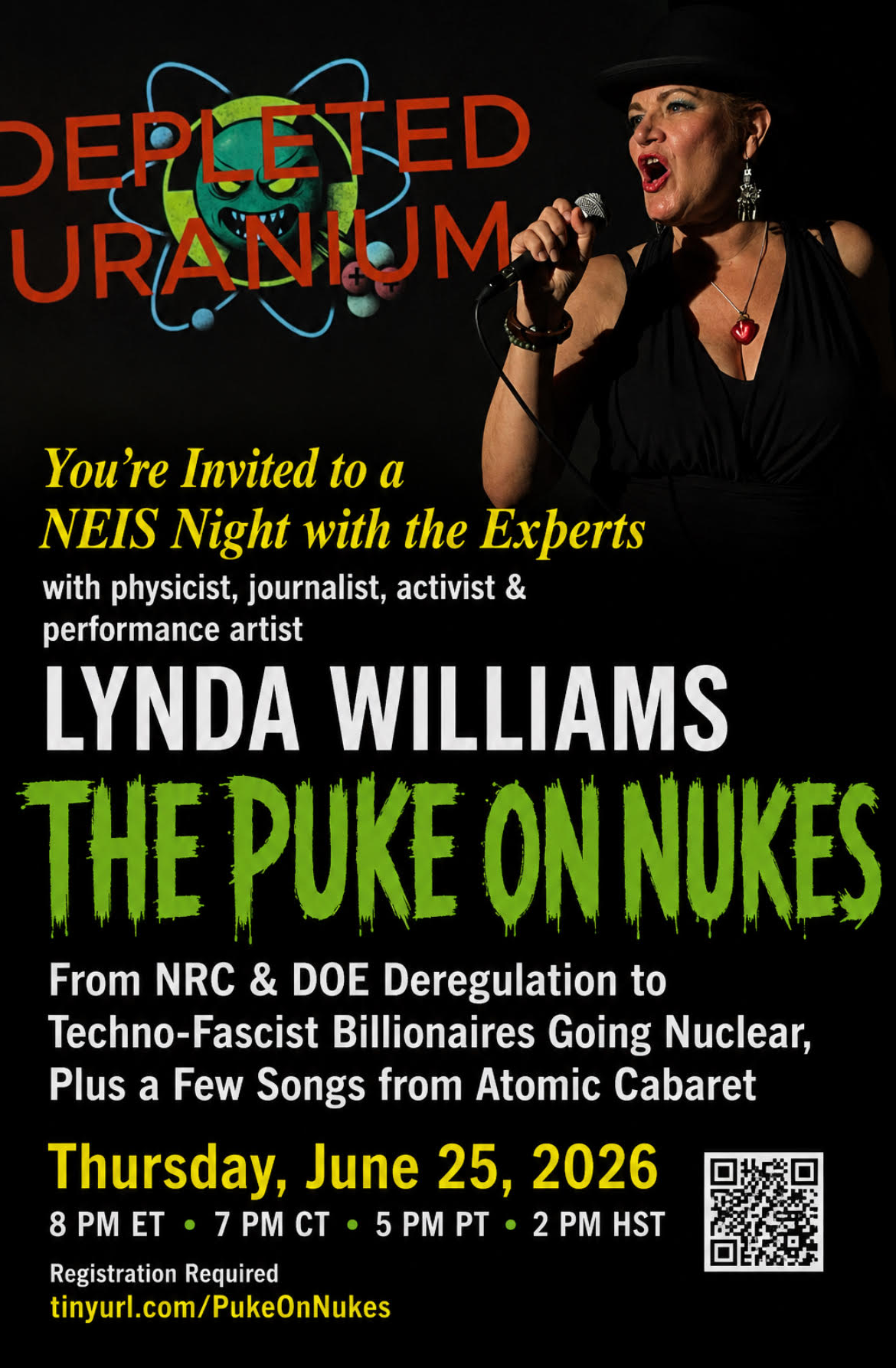
25 June- THE PUKE ON NUKES
Thursday, June 25, 2026
7pm Central Time (8pm ET, 6pm MT, 5pm PT) UTC – 5
From NRC & DOE Deregulation to Techno-Fascist Billionaires Going Nuclear, Plus a Few Songs from Atomic Cabaret REGISTER
26 June – Radiation Trainwreck at the NRC / Join the Protect Better Campaign – https://us02web.zoom.us/meeting/register/4ZlZ5_qLSHGiLSCg8FF6Bg#/registration


Cuba Is Not a Failed State – It Is a Besieged State
PETITION: “Global Appeal to Endorse Palestinian Right of Return of Refugees”
To see nuclear-related stories in greater depth and intensity – go to https://nuclearinformation.wordpress.com
-
Archives
- June 2026 (193)
- May 2026 (306)
- April 2026 (356)
- March 2026 (251)
- February 2026 (268)
- January 2026 (308)
- December 2025 (358)
- November 2025 (359)
- October 2025 (376)
- September 2025 (257)
- August 2025 (319)
- July 2025 (230)
-
Categories
- 1
- 1 NUCLEAR ISSUES
- business and costs
- climate change
- culture and arts
- ENERGY
- environment
- health
- history
- indigenous issues
- Legal
- marketing of nuclear
- media
- opposition to nuclear
- PERSONAL STORIES
- politics
- politics international
- Religion and ethics
- safety
- secrets,lies and civil liberties
- spinbuster
- technology
- Uranium
- wastes
- weapons and war
- Women
- 2 WORLD
- ACTION
- AFRICA
- Atrocities
- AUSTRALIA
- Christina's notes
- Christina's themes
- culture and arts
- Events
- Fuk 2022
- Fuk 2023
- Fukushima 2017
- Fukushima 2018
- fukushima 2019
- Fukushima 2020
- Fukushima 2021
- general
- global warming
- Humour (God we need it)
- Nuclear
- RARE EARTHS
- Reference
- resources – print
- Resources -audiovicual
- Weekly Newsletter
- World
- World Nuclear
- YouTube
-
RSS
Entries RSS
Comments RSS
 nuclear-news