Radioactive Fukushima soil stored in flood zones
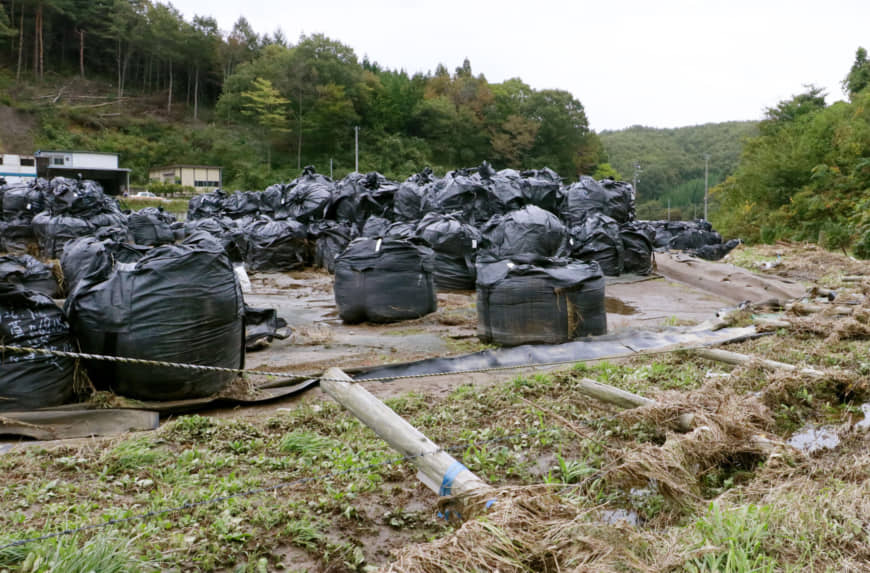
Contaminated Fukushima soil stored in flood zones, audit finds http://www.asahi.com/ajw/articles/14359377?fbclid=IwAR3vSQl1UVoSDAqpoxsL8nYsWhRVPVM55o749Uw1NXEJ9FtvOxh6aquOyq8, By RYOTA GOTO/ Staff Writer, May 27, 2021 Many of the temporary storage sites for soil and waste contaminated by radiation from the crippled Fukushima No. 1 nuclear power plant are located in areas vulnerable to natural disasters, a government audit found.
The Board of Audit of Japan submitted an investigative report to the Diet on May 26 warning the central government to address the contaminated materials that would be in jeopardy in the event of disasters such as landslides and flooding caused by heavy rains, or tsunami.
The board studied the Environment Ministry’s reviews of the temporary storage sites for contaminated soil and designated radioactive waste from October 2019 to April 2020, and took issue with some of its assessments.
The results show 159 out of 170 sites in Fukushima Prefecture, where contaminated soil resulting from the accident at Tokyo Electric Power Co.’s Fukushima No. 1 nuclear plant is being temporarily stored, are within areas deemed vulnerable to landslides and flooding from heavy rain.
The ministry had surveyed locations but concluded that preventive measures were not necessary at 158 sites because the materials were fenced in or the contaminated soil was stored in bags and covered by liner sheets.
As for the remaining location, the ministry moved the contaminated soil to an intermediary storage site.
In nine prefectures including Fukushima, 130 of 379 locations that store contaminated waste are in areas expected to be flooded or hit by landslide in the event of a disaster.For 117 locations, the ministry concluded it is unnecessary to take preventive measures because the waste is stored inside buildings.
But for 13 locations, the ministry said discussion is needed over the necessity of taking preventative measures.
he board said the ministry’s reviews did not include a check of whether each site is located in an area considered vulnerable to tsunami or flooding. The ministry had reasoned that embankments or other obstacles are either in place or under construction, and that the need to take measures against a potential tsunami is low and any impact from a reservoir collapsing would be limited.
But the audit board surveyed 153 temporary storage sites for contaminated soil and found that five of them are vulnerable to a tsunami and three are vulnerable to reservoir flooding.
The board said the ministry needs to consider residents’ concerns about the potential of a leak of contaminated materials, check if the areas are vulnerable to disasters and take preventive measures.
The ministry responded to the audit by defending that it “prioritized quickly securing storage sites at the time and did not have time to check the sites against a hazard map.”
A representative of the Fukushima prefectural government admitted some mistakes were made.
“We knew the locations of storage sites but failed to think about disaster-prevention measures,” the representative said.
China says Japan ‘repeatedly betrayed public trust’ in Fukushima response
 |
China says Japan ‘repeatedly betrayed public trust’ in Fukushima response
Beijing says Tokyo’s handling of Fukushima disaster casts doubt over ‘so-called safe methods, credibility of data’ https://www.aa.com.tr/en/asia-pacific/china-says-japan-repeatedly-betrayed-public-trust-in-fukushima-response/2253463
Riyaz Ul Khaliq |25.05.2021 ANKARA
China on Tuesday repeated its criticism of Japan’s plan to dump treated nuclear waste from the Fukushima nuclear plant into the sea.
“Japan has repeatedly betrayed public trust over its handling of the Fukushima nuclear accident,” Lijian Zhao, spokesperson for China’s Foreign Ministry, said at a news conference in Beijing, according to state-run daily Global Times.
He said Japan’s response to the Fukushima disaster of 2011 has left “a big question mark over the rationality and scientific nature of its so-called safe methods, as well as authenticity and credibility of the data it had provided.”
Apart from China, South Korea, North Korea, the island nation of Taiwan, and other international bodies, including the UN, have previously voiced concern over Tokyo’s idea to release treated wastewater from the destroyed nuclear plant into the ocean in the next two years.
The US, however, has backed Japan’s proposal, which come after years of talks on how to get rid of more than 1 million tons of water accumulated at the Fukushima nuclear complex since the meltdown triggered by a massive earthquake and tsunami in March 2011.
The International Atomic Energy Agency has vowed to play a “central and permanent role in monitoring the discharge.”
Tokyo has said it aims to have an action plan by the end of 2021.
“We will proactively take swift measures to deepen understanding of people in Japan and overseas,” Katsunobu Kato, Japan’s chief Cabinet secretary, said last month.
| Virus-free. www.avast.com |
Thyroid cancer in Fukushima children increased 20-fold — Beyond Nuclear International

In addition to thyroid cancer, other types of malignancies and other diseases triggered or adversely affected by ionized radiation are expected to increase. The FMU thyroid studies represent the only scientific study that can provide any relevant information at all about the health consequences of the Fukushima nuclear disaster. And they are currently in danger of being undermined by the proponents of nuclear energy such as IAEA, which has entered a cooperation with FMU and by the Japanese government, which is trying to dispel any concerns about the meltdowns and nuclear energy as a whole.
Increases are real and can’t be attributed to “screening effect”
Thyroid cancer in Fukushima children increased 20-fold — Beyond Nuclear International
Latest results of the Fukushima thyroid screenings confirm worrying trend https://wordpress.com/read/feeds/72759838/posts/3354864780 By Dr. Alex Rosen, 23 May 21,
In 2011, people in Japan were exposed to radioactive fallout. Some still live in contaminated regions where they are exposed to elevated levels of radiation on a daily basis: radioactive hot-spots on the side of the road, in rice paddies or in sandboxes, contaminated mushrooms or algae, contaminated groundwater, and recontamination from forest fires or flooding.
One of the most dreaded effects of radioactive exposure is the development of cancer through mutation of the DNA. Thyroid cancer in children is certainly not the most dangerous form of radiation-induced cancer, but it is probably the easiest to detect. For one thing, the latency periods before a cancer develops are relatively short, while at the same time, thyroid cancer in children is an extremely rare disease, so that even a slight absolute increase can be statistically detected.
Accordingly, in 2011, there was great pressure on Japanese authorities to investigate the development of thyroid cancer in children and adolescents in Fukushima by conducting long-term screening examinations.
For almost 10 years now, Fukushima Medical University has been regularly examining the thyroid glands of people who lived in Fukushima Prefecture at the time of the meltdowns and were under 18 years of age. Initially, this group consisted of about 368,000 individuals. Of these, 300,000 (about 82%) were successfully screened in the first few years. After the initial screening (2011-2014), follow-up examinations of these children took place every two years. The second examination has already been completed, the third examination is in its final stage, the fourth series of examinations has been running since 2018, and the fifth since 2020.
In the initial investigation in Fukushima, 116 abnormal biopsies were found. Amongst these, 101 cases of cancers were found that were so aggressive that they required surgery. The patients with abnormal biopsies were 6 to 18 years old (average of 14.9 years) at the time of the nuclear disaster. This unexpectedly high number was explained by Fukushima Medical University as a screening effect, the phenomenon of identifying more cases of disease in large-scale screening than would be expected. While the exact magnitude of this screening effect in the first round is unknown, it can be ruled out that the increased cancer rates in subsequent screenings are consequences of a screening effect, because all of these children had already been examined and found to be cancer-free in previous screenings. They must therefore have developed the cancer between the screening examinations.
In the 2nd screening round, 54 cancer cases were found in 71 abnormal biopsies (age at the time of the nuclear disaster 5-18, average of 12.6 years), in the 3rd screening round, another 27 cases were found in 31 abnormal biopsies (age at the time of the nuclear disaster 5-16, average of 9.6 years), and in the current 4th round, 16 new diagnoses have been made in 27 abnormal biopsies (age at the time of the nuclear disaster 0-12, average of 8.0 years). A total of 46 children with suspicious fine-needle biopsies are still under observation and have not yet undergone surgery. The steadily decreasing average age in the screenings is striking: with time, more and more cancer cases are becoming apparent in patients who were still very young at the time of the nuclear disaster, even under 5 years of age.
Incidentally, adolescents in the study cohort who turn 25 are excluded from the main study and transferred to a newly created cohort, the “Age 25 Milestone” group. In this group, 4 additional cases of thyroid cancer have been registered, with 7 conspicuous biopsies so far. The number of unreported cases is likely to be much higher: the participation rate in this study is just 8%. The creation of a new study cohort is generally seen as a measure by FMU to further reduce the number of diagnosed cancer cases.
In addition, there are 11 thyroid cancer cases diagnosed in children from the study cohort, but not during the official screenings. These patients were seen and diagnosed at Fukushima University Hospital. These 11 cases are not reported in the official results, although they show identical tumor entities and occurred in patients who are in the actual study cohort. The 11 cases came to light in June 2017. How many more cases have been diagnosed but not reported since then is unknown. In addition, data from other hospitals in Japan are not available, and patients from contaminated areas outside Fukushima Prefecture are not examined at all, so the unreported number of thyroid cancer cases among patients who were children in the contaminated areas at the time of the meltdowns is likely to be much higher. Nevertheless, the total number of thyroid cancer cases in Fukushima currently stands at 213 (198 official cases from the serial examinations, 4 cases from the Age 25 Milestone cohort and 11 cases from the Fukushima University Hospital).
It is interesting to compare these figures with the overall Japanese incidence rate. The official incidence rate of thyroid cancer in children under 25 in Japan is about 0.59 per 100,000 per year, which means that in the cohort of about 218,000 children, about 1.3 new thyroid cancer cases per year would be expected. Today, 10 years after the beginning of the nuclear disaster, just under 13 thyroid cancer cases would thus have been expected in the study population.
However, the actual number of thyroid cancer cases in Fukushima of 213 is higher by a factor of 16. If we consider only the 112 cases diagnosed after the initial screening and thus not suspected to be caused by a screening effect of any kind, the number of confirmed cases is 20 times higher than the number of expected thyroid cancer cases (5.5 new cases after the end of the initial 1st screening in 2014)
In the following graph, [on original] the officially confirmed thyroid cancer cases (in blue) are compared to the cases expected mathematically in the screening cohort (in orange). It can be seen that the number of cases increased steadily over the course of the initial screening, and continue to increase beyond that, in the years 2014-2020 – an effect that cannot be explained by any kind of screening effect. [Graph on original explains this]
In addition, the geographic distribution of thyroid cancer rates corresponds to the level of radioactive contamination. A significantly higher incidence of thyroid cancer in children was recorded in the 13 most severely contaminated municipalities in eastern Fukushima than in the less contaminated areas in the north, south and central parts of the prefecture. The incidence was lowest in the western part of the prefecture, where the radioactive fallout was also least pronounced.
In the following graph, [on original] the officially confirmed thyroid cancer cases (in blue) are compared to the cases expected mathematically in the screening cohort (in orange). It can be seen that the number of cases increased steadily over the course of the initial screening, and continue to increase beyond that, in the years 2014-2020 – an effect that cannot be explained by any kind of screening effect.
There seems to be a system behind this trend: Fukushima Medical University, which is in charge of the study, has been sending staff to schools in the prefecture for years to educate children about their “right not to participate” and the “right not to know”. On the study forms, there is now a prominent “opt-out” option for people who wish to be removed from the screening. FMU seems to encourage people to opt out of the study. The drop in participation can also be explained by the removal of people over 25 years from the main study. Are FMU staff concerned that the disturbing trend of increasing numbers of thyroid cancer cases will continue? Are they uncomfortable with data that contradicts the thesis, propagated since the beginning of the nuclear disaster, that the multiple meltdowns would not lead to additional cancers?
In addition to thyroid cancer, other types of malignancies and other diseases triggered or adversely affected by ionized radiation are expected to increase. The FMU thyroid studies represent the only scientific study that can provide any relevant information at all about the health consequences of the Fukushima nuclear disaster. And they are currently in danger of being undermined by the proponents of nuclear energy such as IAEA, which has entered a cooperation with FMU and by the Japanese government, which is trying to dispel any concerns about the meltdowns and nuclear energy as a whole.
The people of Japan have an inalienable right to health and to life in a healthy environment. The examination of children’s thyroid glands benefits not only the patients themselves, whose cancers can be detected and treated at an early stage, but also the entire population, which is affected by irradiation from radioactive fallout.
The correct continuation and scientific monitoring of thyroid examinations are therefore in the public interest and must not be thwarted by political or economic motives. It is important to continue to critically accompany these developments from the outside.
Dr. Alex Rosen is a pediatrician and Co-Chair of the German affiliate of IPPNW
Note: this article was first published in IPPNW Germany’s member magazine ippnw forum in 03/21
Headline photo showing thyroid cancer by National Human Genome Research Institute (NHGRI) from Bethesda, MD, USA/Wikimedia Commons
Discharging Fukushima radioactive waste water to the ocean would violate Japan’s legal and environmental obligations
The Legal Case Against Japan’s Fukushima Wastewater Decision, https://thediplomat.com/2021/05/the-legal-case-against-japans-fukushima-wastewater-decision/
The proposed discharge of wastewater from the Fukushima nuclear plant into the Pacific Ocean would violate Japan’s legal and environmental obligations. By Xiuxiu Zhang, Jeffrey Thaler, and Danning Zhu, May 21, 2021
Since the devastating March 2011 Japanese earthquake and tsunami, which damaged the Fukushima Daiichi nuclear power plant, 1.25 million tons of seawater have been pumped through the damaged nuclear units to prevent the melted fuel rods in three damaged reactors from overheating. The contaminated water has been stored in more than 1,000 steel tanks on site. But in April 2021, the Japanese government announced that it would, beginning in 2023 and for decades thereafter, discharge all of the treated wastewater into the Pacific Ocean as part of the plant’s decommissioning process.
Many countries that share a sea border with Japan (especially China, South Korea, and Russia), as well as domestic fishing and export interests, have raised a variety of objections and concerns. Yet with little fanfare in American media, the United States – which has both Alaska and Hawaii at risk – has supported Japan’s plan. The ecological and human risks at stake are potentially huge: The seawater may contain radioactive tritium, strontium-90, and C-14 (the latter known to bioaccumulate in marine ecosystems). Yet international political positioning seems to be playing a greater role than environmental concerns in national responses. Could that change before 2023?
A variety of international treaties, conventions, and agreements, as well as fundamental environmental protection principles, are relevant to the discharge of wastewater from Fukushima.
In 1958, the first United Nations Conference on the Law of Sea adopted the Convention on the High Seas in Geneva, which became effective on September 30, 1962. Pursuant to Article 25 of the Convention, “Every State shall take measures to prevent pollution of the seas from the dumping of radioactive waste, taking into account any standards and regulations which may be formulated by the competent international organizations.” Also in 1958, the Resolution on Pollution of the High Seas by Radioactive Materials was adopted by the first United Nations Conference on the Law of Sea. One of its recommendations was that the International Atomic Energy Agency (IAEA), in consultation with existing groups and established organs having acknowledged competence in the field of radiological protection, should pursue whatever studies and take whatever action is necessary to assist states in controlling the discharge or release of radioactive materials to the sea, in promulgating standards, and in drawing up internationally acceptable regulations to prevent pollution of the sea by radioactive materials in amounts that would adversely affect people and marine resources.
The 1996 London Protocol, signed by many nations, prohibited the dumping of all wastes and other materials is prohibited except certain non-toxic materials that do not contain levels of radioactivity greater than de minimis (exempt) concentrations as defined by the IAEA. In 1999, the IAEA defined “de minimis” risk levels in terms of those of “no regulatory concern” and based on practices and sources that are “inherently safe.”
Last and not least, the United Nations Convention on the Law of the Sea (UNCLOS) is an international treaty ratified by over 160 countries, including China, South Korea, and Japan – but not the United States. UNCLOS stipulates that the ocean is the common heritage of mankind. Pursuant to Article 192, all states have the obligation to protect and preserve the marine environment. UNCLOS also established a complete legal framework that regulates all marine areas, the use of the ocean, and marine resources, as well as the protection and maintenance of the marine environment, marine scientific research, and the development and transfer of marine technology.
Moreover, Article 194 of UNCLOS requires that member countries must: 1) take, individually or jointly as appropriate, all practicable measures necessary to prevent, reduce and control pollution of the marine environment from any source; and 2) take all measures necessary to ensure that activities under their jurisdiction or control are so conducted as not to cause damage by pollution to other states and their environment, and that pollution arising from incidents or activities under their jurisdiction or control does not spread beyond the areas where they exercise sovereign rights in accordance with this Convention. Last, UNCLOS Article 195 specifies that countries shall act so as not to transfer, directly or indirectly, damage or hazards from one area to another or transform one type of pollution into another.
In light of the very clear obligations set forth in UNCLOS and the other conventions, how is the potential Fukushima nuclear wastewater discharging being viewed by neighboring countries?
Both the United States and the IAEA have voiced support for Japan’s announced plans for the Fukushima discharge plan. The IAEA said it would provide technical support for what it deemed to be a feasible means of disposal of the contaminated seawater. A week later the Biden administration voiced its support for what it said was a plan meeting international safety standard.
However, many others did not share those views, both within and outside of Japan. Domestic fishing, environmental, public health, and export interests objected both to the process leading up to the announcement and to the plan itself. They viewed the risks as being too great, and the added pollutant burden to the Pacific Ocean to be too much and with far-ranging scope affecting more than just Asia.
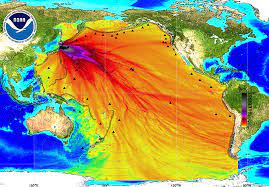
Indeed, calculations by Germany’s Geomar Helmholtz Center for Ocean Research predict that once the wastewater from the Fukushima nuclear power plant is discharged into the sea, radioactive materials will spread to most of the Pacific’s marine life and ecology within 57 days.
Neighboring countries such as China, South Korea, and Russia all voiced vigorous concerns, and warned that imports of Japanese seafood and agricultural products could be restricted – and that consumer confidence in purchasing such goods would be damaged. South Korea has threatened to take the issue to international judicial tribunals for review. How the dispute would be resolved pursuant either to the International Court of Justice, or to one of the various Conventions, remains to be seen. But in the meantime, there are some fundamental environmental protection principles and agreements that the United States in particular seems to be overlooking.
First, the treatment of Fukushima nuclear wastewater should give priority to the alternatives that have the least impact on the marine environment. The precautionary principle is the first principle of environmental law all over the world. Environmental policies and environmental laws should not just be after-the-damage-happens responses, but also should prevent hazards and harms to the environment and human organisms before they occur.
Under the precautionary principle, pollution avoidance is superior to pollution reduction. Avoiding the discharge of Fukushima nuclear wastewater should be superior to behaviors that comply with certain standards but can still cause environmental damage. Although the Fukushima wastewater is treated, the environmental impact of treated wastewater on marine life and ecological environment should be evaluated by marine, biological, and nuclear experts from various countries bordering the Pacific Ocean. In addition, the discharge of Fukushima nuclear wastewater is unprecedentedly huge, and the half-life of some of the radioactive elements means they will continue to pose a threat to the marine environment and marine life for decades. The materials are neither de minimis, nor “inherently safe.” Radioactive materials will also be transferred to the terrestrial environment and humans through marine life and other channels.
A second environmental principle is that of environmental hazard prevention or mitigation. It is akin to a precept to “do no harm” to the health of people, wildlife, fisheries, and natural resources. The ultimate goal is to ensure the protection of existing environmental quality and the possibility of future improvement. The environment must not be further deteriorated, and if pollution damage has occurred, it must be restored. Given that the Fukushima wastewater still exceeds Japanese discharge standards, it is impossible to say that in just two years the discharge will not cause damage to sea life of the Pacific Ocean.
Third, the principle of equity is formed by the concept of ecological compromise, which is concerned primarily with considering the interests of all potentially impacted parties and resources – both international and domestic. The principle of equity is essentially a balancing of interests, which extends to international environmental protection issues and is closely related to the principle of cooperation articulated in UNCLOS and other agreements. Japan’s discharge of nuclear wastewater is not only related to the life and health of its residents and the safety of its ecological environment, but also to the global marine environment. It will impact neighboring countries and even the global ecological environment and people’s rights to life and health. In essence, Japan is placing the costs of its nuclear waste upon other peoples, and upon the Pacific marine life, which has no voice of its own.
UNCLOS stipulates that the ocean is the common heritage of humanity, and that all countries have the obligation to protect and preserve the marine environment. Japan has an international obligation to ensure that the activities under its jurisdiction or control do not cause pollution damage to other countries and their environment, and to ensure that the pollution caused by events or activities within its jurisdiction or control does not extend beyond the area where it exercises sovereign rights in accordance with this Convention. Other countries may pursue remedies through either the International Tribunal for the Law of the Sea, the International Court of Justice, an arbitration tribunal organized in accordance with Annex VII of the Maritime Convention, or a special arbitration tribunal organized in accordance with Annex VIII of the Maritime Convention.
Even the United States, which is not a signatory to UNCLOS, might have some recourse should it change its political position. For example, in mid-2018 the U.S. Environmental Protection Agency and the Japan Atomic Energy Agency executed a Letter of Intent to cooperate “in the field of radiation protection.” As part of that agreement, the two agencies were to share radiation risk assessment models and related data. But, interestingly, the two countries also agreed to share “information on the uncertainty of radiation risk assessment, including the sharing of a report by the EPA on the uncertainty of EPA radionuclide cancer risk coefficients.” Given such acknowledged uncertainty, it would seem at least premature for the U.S. to be opining that the discharge of over 1 million gallons of heavily contaminated nuclear-radiated seawater is safe and poses no risks to human or other life. Indeed, back in 1975 the Japanese and American governments signed an Agreement “on cooperation in the field of environmental protection” in which both countries acknowledged “the responsibilities of each Government for the protection and improvement of the global environment.”
That “global environment” extends beyond Japan’s territorial waters, and any unilateral decision by Japan to discharge pollutants that could materially harm the environment across a significant part of non-Japanese waters would seem to be at odds with its responsibilities agreed to the international agreements we have summarized herein, as well as with the fundamental principles of and duties imposed by environmental protection for current and future generations of human and non-human life on our planet.
Flaws found in anti-terror measures at Fukushima No. 2 nuclear plant
Flaws found in anti-terror measures at Fukushima No. 2 nuclear plant, Japan Times, 19 May 21,
Anti-terrorism measures implemented at Tokyo Electric Power Company Holdings Inc.’s Fukushima No. 2 nuclear power plant, which is set to be decommissioned, have been found to be flawed, it was learned Wednesday.
It was discovered that doors leading to the nuclear materials protection areas at the plant, which are under heavy entry-exit surveillance as part of anti-terrorism measures, were not properly managed.
Some security checks conducted when people leave or enter such areas were also neglected.
The flaws were reported to a meeting of the Nuclear Regulation Authority on the same day.
According to the NRA, the flaws have been fixed and there are no signs of intrusion.
The NRA said that a worker at the nuclear plant found a door with inadequate access control measures to the area at the plant’s No. 4 reactor on March 19.
On the following day, a door with a similar flaw was found at the plant’s No. 1 reactor. Plant operator Tepco reported the flaws to the NRA.
The company also found that necessary checks, such as those involving metal detectors, were skipped at some doors to the nuclear materials protection areas.
While the doors in question at the No. 1 and No. 4 reactors were not used on a day-to-day basis and were locked, Tepco said that it was unaware that the doors were on the boundaries…….. https://www.japantimes.co.jp/news/2021/05/19/national/fukushima-antiterror-flaws/
Nuclear emergency guidelines on thyroid radiation exposure under review in Japan
Nuclear emergency guidelines on thyroid radiation exposure under review in Japan, Japan News, The Yomiuri Shimbun, 17 May, 21
The Nuclear Regulation Authority (NRA) plans to establish a system for measuring thyroid gland radiation levels of nearby residents in the immediate aftermath of a nuclear power plant accident, during a review of the government’s nuclear emergency response guidelines being undertaken this fiscal year.
Revisions will likely include a requirement to measure radiation levels of children under the age of 18 and pregnant women, who are most vulnerable to radiation exposure………
Officials are particularly concerned about areas where radiation levels reach 500 microsieverts per hour, which requires immediate evacuation, and those where levels continuously exceed 20 microsieverts per hour, which requires temporary relocation.
The NRA is considering mainly targeting children under the age of 18, pregnant women and nursing mothers in such areas.
Radioactive iodine-131 released in a nuclear accident halves in about eight days, highlighting the importance of taking measurements immediately after an accident to determine radiation exposure levels.
However, the measurement target until now was unclear and the response system and equipment were insufficient………. only about 1,000 of the 370,000 children under the age of 18 in Fukushima Prefecture have had their thyroid gland radiation levels measured. https://the-japan-news.com/news/article/0007405020
Restarting nuclear power in Japan. Will the old ”Nuclear Village” bribery factor trump safety concerns?

Nuclear Power in Japan: Safety at Kashiwazaki-Kariwa Remains an Issue, Nippon.com Takino Yūsaku 14 May 21
……………….An illustration of the dilemma facing host communities is the decision of the mayors of Onagawa and Ishinomaki in Miyagi Prefecture to approve the restart of Unit 2 of Tōhoku Electric Power Company’s Onagawa Nuclear Power Station. Miyagi Governor Murai Yoshihiro also gave his endorsement and announced the decision in November 2020 after meeting with the two mayors, marking the first time a facility affected by the March 2011 earthquake and tsunami received the go-ahead to resume operation. Speaking at a press conference, the governor cited local employment opportunities and tax revenue as key factors in swaying the consensus of local leaders in favor of restarting the reactor, but stressed that the decision was a bitter one to make.
A similar dynamic is at play in the municipalities of Kashiwazaki and Kariwa, which jointly host the TEPCO power plant. As of January 1 of this year, the facility employs some 6,300 people, including utility personnel and staff of independent contractors, of whom around 3,500 are local residents. Factoring in family members potentially quadruples the number of people who rely on the power plant for their livelihoods, making the decision to restart a difficult one to oppose.
The two host municipalities are similarly dependent on revenue flowing into their coffers from the plant. This includes subsidies and grants from the national government, prefectural duties on nuclear fuel, a tax levied on spent fuel, and local property and income taxes. In 2018, Kashiwazaki received ¥3.4 billion in subsidies and other government funding and Kariwa ¥1.3 billion. If local taxes are factored in, Kashiwazaki’s revenue directly related to the nuclear power plant came to ¥8.0 billion and Kariwa’s ¥2.9 billion, around 15% and just over half of their annual income, respectively. This alone shows just how reliant the communities are on nuclear energy.
Like other host communities, the remote, cash-strapped municipalities saw nuclear energy as a lucrative endeavor. Kashiwazaki and Kariwa approved the plant in 1969, construction of the Unit 1 reactor began in 1978, and the facility went online in September 1985. TEPCO subsequently built six more reactors at the site, each bringing additional revenue to the municipalities. The last of these, Unit 7, was fired up in July 1997.
However, safety concerns have dogged the facility. In July 2007, the Chūetsu Offshore Earthquake sparked a fire and caused radiation leaks, forcing all the reactors offline for a time. After upgrades were made, several units were restarted, only to be halted indefinitely following the Great East Japan Earthquake and meltdowns at Fukushima Daiichi in March 2011.
The prolonged shutdown has seriously impacted the economic wellbeing of the communities. A visit to the shopping arcade next to Kashiwazaki Station and the town’s entertainment district reveals a startling number of shuttered businesses, a situation that has only been exacerbated by the pandemic. Kashiwazaki’s population, which was already rapidly graying, has shrunk from 90,000 in 2010 to 81,000 as of 2020. The demographic trend in the village of Kariwa can be assumed to be similarly bleak. As in Onagawa, objections residents may have to restarting the reactors will almost certainly take a back seat to the more pressing considerations of jobs and reviving the local economy.
Weighing the Cost of Safety
The results of elections in November 2020 indicate strong public approval for bringing the reactor back online. Residents of Kashiwazaki reelected Mayor Sakurai Masahiro, who supports the restart, to a second term in a landslide over an antinuclear challenger, while Kariwa voters handed pronuclear Mayor Shinada Hiroo a sixth term. The majority of local assembly members in both towns are likewise in favor of resuming operations at the plant.
In contrast, the prefectural government has taken a measured approach toward resuming operation of the Kashiwazaki-Kariwa plant, including establishing its own supervisory committee to verify the causes of the accident at Fukushima Daiichi and delaying debate on restarting Unit 7 until the body issues its final report. Barring one or more committee members expressing opposition, however, Niigata Governor Hanazumi Hideyo is expected to certify the restart before the gubernatorial election slated for June 2022 to prevent the issue from influencing the race. It remains to be seen to what degree the recently discovered safety flaws will affect this timeline.
The central government remains eager to get Kashiwazaki-Kariwa back up and running. As Japan slowly transitions from carbon-based fuels toward renewables to reduce CO2 emissions, it plans for nuclear power to provide 30% of the country’s energy needs.
In the end, the deciding factor will be safety. TEPCO so far has invested ¥1.2 trillion in upgrading the Kashiwazaki-Kariwa plant and has spent considerable time and energy touting its efforts. In clearing the NRA’s stringent regulations, the utility had seemingly demonstrated beyond a shadow of doubt that it was safe to bring the reactors back online. While there is no denying that the extensive safety measures the utility has put into place have boosted the facility’s resilience against known risks like natural disasters, there is not telling what new and unforeseen threats might be lurking around the corner. Such uncertainty makes it hard for many members of the public, me included, to trust completely in the safety of nuclear power.
It may turn out that the recent security failings, while egregious, on their own would not have allowed an intruder to infiltrate the plant undetected. However, they do illustrate the ongoing risks of neglect, bad judgement, procedural failures, and other human errors, factors that even the most stringent physical upgrades cannot guard against.
The government, despite considerable public uncertainty, is committed to pushing ahead with its plans to bring the country’s fleet of reactors back online. Faced with this reality, it is vital that citizens understand the state of nuclear energy in Japan and decide for themselves if it is something they can live with or choose to do without. https://www.nippon.com/en/in-depth/d00687/
Japanese government and TEPCO planning release of radioactive water, via a pipeline to the Pacific Ocean
Japan Times 12th May 2021, Japan and Tepco studying release of Fukushima water 1 kilometer from coast.
Tokyo Electric Power Company Holdings Inc. and the government are
considering a plan to release treated radioactive water from the crippled
Fukushima No. 1 nuclear power plant into the sea about 1 kilometer from the
coast, informed sources said Tuesday.
The plan calls for a pipeline to be set up at the bottom of the ocean, according to the sources. Tepco, the
government and the Nuclear Regulation Authority are expected to kick off
full-fledged talks next month to decide whether to release the water
directly from the coast near the power plant or offshore through a
pipeline, the sources said. As tritium cannot be removed with existing
technology, the levels of the radioactive substance will be diluted to
about 1/40 of the state-set standard before the release of the treated
water into the ocean.
https://www.japantimes.co.jp/news/2021/05/12/national/release-fukushima-water-study/
Safety and security issues at Kashiwazaki-Kariwa nuclear power station
Nuclear Power in Japan: Safety at Kashiwazaki-Kariwa Remains an Issue, Nippon.com Takino Yūsaku 14 May 21
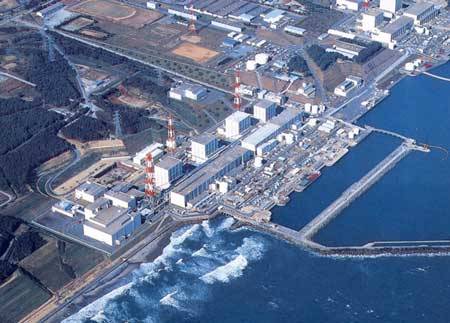
The Fukushima Daiichi accident forced Japan to bolster regulations for its fleet of nuclear reactors. After undergoing significant upgrades, the Kashiwazaki-Kariwa plant in Niigata Prefecture is on track to restart, although recent security issues have come to light that raise new concerns about the safety of nuclear power……..
Over the last several years, utilities looking to restart idled reactors have heavily invested in upgrading facilities to meet rigorous new regulations. So far, though, only a handful of plants have come back online.
Security issues recently uncovered at the Kashiwazaki-Kariwa Nuclear Power Station operated by Tokyo Electric Power Company illustrate the difficulty of passing the Nuclear Regulatory Authority’s stringent safety measures. TEPCO had poured resources into the facility in Niigata Prefecture with the goal of restarting the Unit 6 and 7 reactors at the site, but the NRA has ordered that further improvements be made before authorizing the utility to begin the refueling process. Below I assess the major upgrades made at the Kashiwazaki-Kariwa plant under the new NRA regulations released in July 2013.
Safeguarding Against Tsunami
,,,,,,,,,,,, In the wake of the incident, protecting reactors from tsunami has become a priority. The NRA assessment of the Kashiwazaki-Kariwa plant estimates a tidal wave as high as 6.8 meters could reach the coastline where the facility sits. Learning from Fukushima, TEPCO chose to exceed the regulatory body’s requirement and built a seawall towering 15 meters above the surf. Using existing topography to its advantage, it constructed a 10-meter steel-reinforced concrete barrier for the low-lying Units 1–4 and a 3-meter earth embankment at Units 5–7, which are perched higher above the sea……….
Blackout Response
In an emergency, keeping cooling systems functioning is of utmost importance. To prepare for an event where the seawall and smaller barriers fail or that the power goes out at the Niigata plant, TEPCO installed four sets of mobile gas-fired generators and switchboards on high ground and stationed a fleet of 20 generator cars as backup.
…………… TEPCO faced major challenges in bringing the plant in line with the NRA’s new regulations, considered the strictest in the global nuclear industry. Along with tsunami measures, the utility had to meet stringent antiterrorism guidelines, including developing a response to attackers flying an airplane into the facility. The government completed an inspection of Unit 7 in October 2020 and the bulk of construction was completed in January of this year. TEPCO was confident it had covered all bases, but the discovery that individuals had used an employee ID card to enter the central control room without authorization and that an intruder detection system had not been functioning for an extended period have led the NRA to halt plans for restarting the reactor. The security problems also throw into question whether residents will agree to bringing the plant back online.
Community Considerations
Along with meeting NRA regulations, utilities aiming to restart reactors must win the approval of residents of the towns and cities where plants are located. Debate is often fraught as host communities weigh the economic benefits of nuclear power, including jobs and revenue from government subsidies and local taxes, against safety concerns. Money pouring into construction industries from huge projects to upgrade facilities has only complicated the issue………………..https://www.nippon.com/en/in-depth/d00687/
A number of cases of unauthorized access have occurred at the Kashiwazaki-Kariwa plant since January 2018
Another security breach at Tepco nuclear plant uncovered, https://www.japantimes.co.jp/news/2021/05/09/national/tepco-nuclear-power-plant-security-breach/ A further case of unauthorized access at a nuclear power plant on the Sea of Japan coast run by Tokyo Electric Power Company Holdings Inc. occurred in 2015, it was revealed Sunday.
The operator of the Kashiwazaki-Kariwa plant has admitted to Kyodo News that a worker mistakenly used the identification card of his father, who was working at the same facility, in the morning of Aug. 21 of that year and was about to enter a protected area near its Nos. 6 and 7 reactors.
The utility, also known as Tepco, called local police after an alarm was set off at the reactor building’s gate, but the operator did not disclose the incident saying it was handled in accordance with nuclear safety rules.
A number of cases of unauthorized access have occurred at the plant since January 2018, with the country’s nuclear regulator last month effectively banning Tepco from restarting the plant until corrective actions are taken.
The cases included an incident in which an employee used a colleague’s ID last September to enter the central control room without authorization.
The 2015 incident indicates that Tepco’s security preparedness at the Kashiwazaki-Kariwa plant was inadequate for many years.
The card used by the worker had a sticker only stating the surname and security checks at one of the gates, where identification is required before approaching the protected area, were insufficient, according to Tepco, also the operator of the crippled Fukushima No. 1 nuclear plant.
Radioactive water release – Fukushima nuclear disaster continues to haunt the world

Radioactive water: Japan’s Fukushima nuclear disaster haunts the world a decade later, Geo News, 7 May 21, ”…. In a recent development, Japan decided to dump radioactive water stored at the disaster-hit Fukushima Daiichi nuclear power plant into the Pacific Ocean.
Scores of Pakistani fishermen recently protested this decision of Japan outside the Gawadar Press Club……….
Radioactive water could contaminate fish exports from Pacific ocean
Geo News got in touch with renowned Pakistani physicist Dr AH Nayyar to talk about Japan’s decision.
Dr Nayyar recalled the 1986 Chernobyl nuclear disaster while discussing the Fukushima disaster.
“They could not stop Chernobyl and radioactive clouds once they hovered over Europe from Soviet Union. Radioactivity found its way inside human skin and the world paid the price,” he said, adding that as far as Fukushima is concerned, it will be a first experiment of its own kind.
Dr Nayyar pointed out releasing radioactive water into the ocean could mean that if radioactive elements sit in marine life, it will soar chances of it infiltrating into humans via catchments and exports. “When radioactive particles decay, they cause cancer in the human body,” he said.
“People were skeptical in buying fresh milk and powder imported from Europe post 1986 Chernobyl disaster. It could be the same with fish coming from the Pacific ocean. They will have to be carefully examined if they carry radioactive particles. However, waters from the Pacific Ocean will not intrude into the Arabian Sea,” Dr Nayyar concluded……….
Currently, it is stored in gigantic water tanks, but the plant’s operator, Tepco, appraised that these tanks are expected to fill up by 2022.
The water is contaminated as it comes in contact with fuel before leaking into damaged basements and tunnels, where it mixes with groundwater that flows through the site from hills above. The combination results in excess contaminated water that is pumped out and treated before being stored in huge tanks crowding the site.
About 1.3 million tonnes of radioactive water – or enough to fill 500 Olympic-sized swimming pools – are currently stored in these tanks, In 2018, Tepco admitted it had not filtered all dangerous materials out of the water, despite saying for years they had been removed, according to a Reuters report.
Unacceptable and irresponsible, say China, South Korea to Japan
In a statement, China’s foreign ministry called the move “extremely irresponsible” and said it reserved the right to take further action.
South Korea’s government said the plan was “totally unacceptable” and that it would lodge a formal complaint with Japan.
Voices are rising within Japan as well. Greenpeace Japan said it “strongly condemned” the decision.
“The Japanese government has once again failed the people of Fukushima,” Kazue Suzuki, a climate change and energy campaigner at Greenpeace Japan, said in a statement. “The government has taken the wholly unjustified decision to deliberately contaminate the Pacific Ocean with radioactive wastes. Rather than using the best available technology to minimize radiation hazards by storing and processing the water over the longer term, they have opted for the cheapest option.” https://www.geo.tv/latest/349126-radioactive-water-japans-fukushima-nuclear-disaster-haunts-the-world-a-decade-later
The toll on marine life of radioactive water poured into the Pacific Ocean.
Beyond Nuclear 2nd May 2021, Tepco and the Japanese government are once more preparing to “dispose” of 1.25 million tonnes — translating to hundred of millions of gallons — of radioactive water accumulating at the Fukushima Daiichi nuclear power plant site by pouring it into the Pacific Ocean. I say “accumulating” because this water, needed to constantly cool the stricken reactors that exploded and melted down during and after March 11, 2011 — and that also runs down neighboring hillsides and across the site, picking up radioactive contamination — will continue to accumulate.
This is not a one-stop-toss. Citizens groups and fishing unions have been up in arms about this ever since it was first mooted. The actual dumping of the water always seems to be about two years away, and is always threatened as
the only “solution,” which it is not. It is almost certainly the cheapest solution, but not the only choice.
Even if we never ate the fish that comes out of the Pacific; and even if the fish and higher marine mammal predators never ate each other; contaminating sea life with radioactive toxins is wrong. We made it. Why dump it on creatures who had nothing whatever to do with its production and never needed to turn on a light?
This is not the only instance of total disregard for marine life when it comes to nuclear power. Just by using what is known as the “once-through” cooling intake system at coastal nuclear power plants, the toll on sea life is immense.
Billions of fish, fingerlings and spawn are drawn into the plant with the cooling water (the water rate can be as high as a million gallons a minute) and duly pulverized. Their “remains” are discharged at the other end as sediment. No fishing license required. New nuclear power plants promise to be even bigger marine predators.
Fission folly
Radioactive leakage from nuclear waste containers near Fukushima Daiichi nuclear plant
ECNS 30th April 2021, Tokyo Electric Power Company Holdings Inc. (TEPCO), the operator of the Fukushima Daiichi nuclear plant in Japan’s northeast said last week a container holding radioactive waste at the site of the plant may have leaked, Japan’s Asahi Shimbun reported Friday last week. The TEPCO said some gel-like blocks with large amount of radiation were found last month at the site where the containers were kept, and the situation is under investigation, according to the newspaper. The containers have been stacked in three layers, and the top container has become rusted and corroded, causing liquid accumulation, said the company. The sides of the two lower containers have been contaminated with radioactive materials, and it is believed that the liquid leaking from the top container may have made its way to the ground through the containers below, according to the company. The relevant containers have been moved to an indoor storage facility. The concentration of radioactive materials that emit beta rays in the gel-like blocks was 230,000 becquerels per gram, according to the report. http://www.ecns.cn/m/news/society/2021-04-30/detail-ihakynqm6148318.shtml |
Even with water release to the Pacific, Fukushima nuclear plant needs more storage tanks
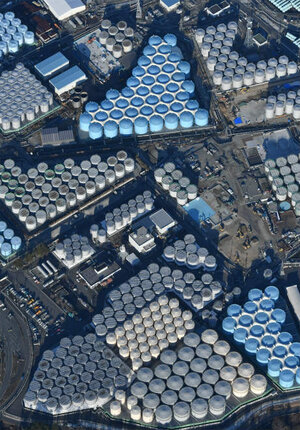
Even with water release, nuclear plant needs more storage tanks, Asahi Shimbun, By KEITARO FUKUCHI/ Staff Writer, May 1, 2021 The plan to release treated radioactive water from the crippled Fukushima No. 1 nuclear plant into the sea will likely not resolve the chronic problem of contaminated water accumulating there, Asahi Shimbun calculations show.
The maximum rate of water discharge allowed under the government’s basic plan would be less than the inflow of rainwater and groundwater at the nuclear power plant, meaning that additional water storage tanks would inevitably be needed at the site.
The government on April 13 approved the basic plan to release more than 1 million tons of treated water into the sea. The government and plant operator Tokyo Electric Power Co. hope to start discharging the water two years from now. Existing storage tanks at the site are expected to reach full capacity around the same time.
The Asahi Shimbun studied this plan based on documents and materials published by the government and TEPCO……… http://www.asahi.com/ajw/articles/14332645
Governor of Fukui Prefecture to approve restart of aging nuclear reactors, but local community is opposed.
Governor to approve restart of 40-plus-year-old nuclear reactors in Japan first
April 28, 2021 (Mainichi Japan) FUKUI — The governor of central Japan’s Fukui Prefecture announced on April 28 his intention to approve the reactivation of 40-plus-year-old nuclear reactors following an online meeting with the economy minister. If the move goes ahead, it would be the first time in Japan for such aging reactors to be restarted.
Fukui Gov. Tatsuji Sugimoto spoke with Economy, Trade and Industry Minister Hiroshi Kajiyama online on April 27 and confirmed the central government’s nuclear power policy, including plans to reboot the No. 3 reactor at Kansai Electric Power Co.’s Mihama Nuclear Power Station in the prefectural town of Mihama and the No. 1 and 2 reactors at the Takahama station in the prefectural town of Takahama — both of which are over 40 years old since they were put online.
Following the March 2011 disaster at the Fukushima Daiichi Nuclear Power Station, Japan decided to set the operating period of a nuclear rector at 40 years as a general rule. That period can be extended for up to 20 years as a one-time only exception if the Nuclear Regulation Authority approves…….
As a rule, consensus from host municipalities and prefectures is needed to restart a reactor. The Mihama and Takahama municipal governments, as well as their respective town assemblies have already agreed to restart the aging reactors. The Fukui prefectural nuclear safety commission tasked with checking the safety of nuclear plants has compiled a report on the assessment of Kansai Electric’s safety measures and submitted it to Gov. Sugimoto on April 22………..
The prefectural government had indicated that, as a condition for approving the restart of aging reactors, Kansai Electric present candidate locations outside Fukui Prefecture for interim storage sites for spent nuclear fuel. In February this year, Gov. Sugimoto expressed his appreciation over the utility’s proposal to secure a location “by the end of 2023,” including the shared use of a storage site in the Aomori Prefecture city of Mutsu in northern Japan.
The governor then practically shelved resolving the issue of interim storage sites and requested that the prefectural assembly debate the potential restart of the aging reactors. The central government had presented additional aid programs on April 6, including the provision of up to 2.5 billion yen (about $23 million) per nuclear station which is older than 40 years — in the cases of Mihama and Takahama stations, the subsidy will total 5 billion yen (roughly $46 million). With this, Fukui Prefecture entered the final stage of building local consensus for rebooting the idled reactors.
Meanwhile, local residents have voiced concerns over the safety of long-running reactors and evacuation routes in the event of an accident, among other issues……..
Kansai Electric will begin full-fledged preparations as soon as local consensus is built. However, as the construction of a specialized anti-terrorism facility, which became mandatory to reboot reactors under the new safety regulations, has been delayed, the timing of actually restarting the reactors remains undecided.
The Japan Atomic Power Co.’s Tokai No. 2 Power Station in the Ibaraki Prefecture village of Tokai in east Japan, which is also more than 40 years old, has been given the green light by the national government for an extension, but the utility has not been able to get consensus from the local community.
(Japanese original by Riki Iwama, Fukui Bureau) https://mainichi.jp/english/articles/20210428/p2a/00m/0na/022000c
1 This Month
22 June – Virtual Event –Climate Change: New Data, New Debate

Monday, June 22, 2026 2:30 p.m. – 3:15 p.m. CT
YouTube. Register here

Protect Sazan Island from the Trump family! https://secure.avaaz.org/campaign/en/protect_sazan_island_from_the_trump_family_loc/?bqFCVab&v=174511&cl=22707147157&_checksum=5e9dde668860e8231c33699735e16a1fbf22ab2cb01da50c999fe8732b9775ef&utm_source=email&utm_medium=blast_email&utm_campaign=174511
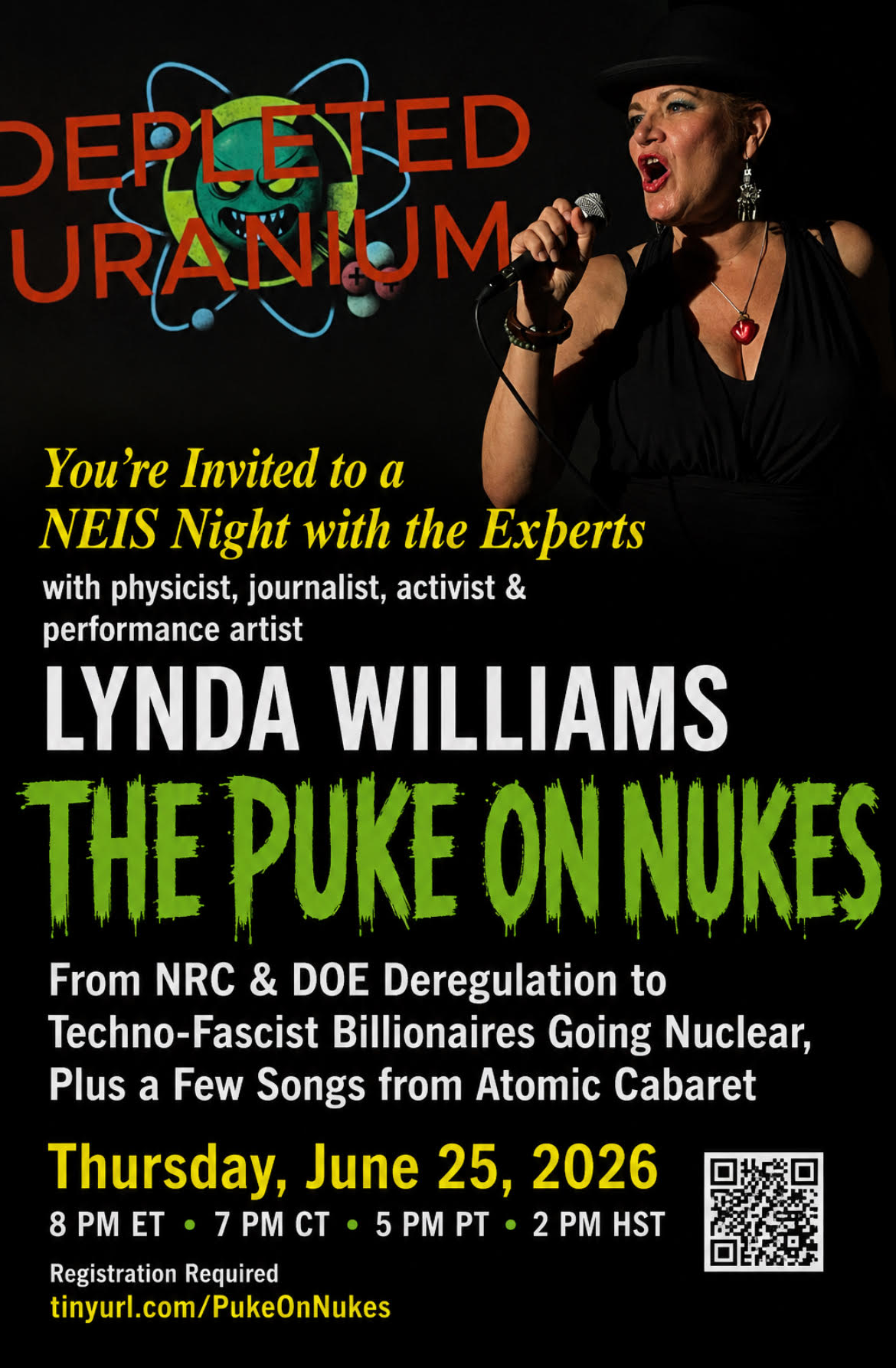
25 June- THE PUKE ON NUKES
Thursday, June 25, 2026
7pm Central Time (8pm ET, 6pm MT, 5pm PT) UTC – 5
From NRC & DOE Deregulation to Techno-Fascist Billionaires Going Nuclear, Plus a Few Songs from Atomic Cabaret REGISTER
26 June – Radiation Trainwreck at the NRC / Join the Protect Better Campaign – https://us02web.zoom.us/meeting/register/4ZlZ5_qLSHGiLSCg8FF6Bg#/registration


Cuba Is Not a Failed State – It Is a Besieged State
PETITION: “Global Appeal to Endorse Palestinian Right of Return of Refugees”
To see nuclear-related stories in greater depth and intensity – go to https://nuclearinformation.wordpress.com
-
Archives
- June 2026 (193)
- May 2026 (306)
- April 2026 (356)
- March 2026 (251)
- February 2026 (268)
- January 2026 (308)
- December 2025 (358)
- November 2025 (359)
- October 2025 (376)
- September 2025 (257)
- August 2025 (319)
- July 2025 (230)
-
Categories
- 1
- 1 NUCLEAR ISSUES
- business and costs
- climate change
- culture and arts
- ENERGY
- environment
- health
- history
- indigenous issues
- Legal
- marketing of nuclear
- media
- opposition to nuclear
- PERSONAL STORIES
- politics
- politics international
- Religion and ethics
- safety
- secrets,lies and civil liberties
- spinbuster
- technology
- Uranium
- wastes
- weapons and war
- Women
- 2 WORLD
- ACTION
- AFRICA
- Atrocities
- AUSTRALIA
- Christina's notes
- Christina's themes
- culture and arts
- Events
- Fuk 2022
- Fuk 2023
- Fukushima 2017
- Fukushima 2018
- fukushima 2019
- Fukushima 2020
- Fukushima 2021
- general
- global warming
- Humour (God we need it)
- Nuclear
- RARE EARTHS
- Reference
- resources – print
- Resources -audiovicual
- Weekly Newsletter
- World
- World Nuclear
- YouTube
-
RSS
Entries RSS
Comments RSS
 nuclear-news