Hiroshima City remembers the sudden cruelty of the atomic bombing

— On this day 76 years ago, a single atomic bomb instantly reduced our hometown to a scorched plain. That bombing brought cruel death to countless innocent victims and left those who managed to survive with profound, lifelong physical and emotional injuries due to radiation, fear of aftereffects, and economic hardship.
One survivor who gave birth to a girl soon after the bombing says, “As more horrors of the bomb came to light,
and I became more concerned about their effects, I worried less about myself and more about my child. Imagining the future awaiting my daughter, my suffering grew, night after sleepless night.”
City of Hiroshima 6th Aug 2021
Tokyo Olympics were touted as a showcase for Fukushima nuclear recovery. That didn’t work

Fukushima struggles on 10 years after devastating earthquake and tsunami, Tokyo Olympics had been touted as a chance to showcase the recovery efforts in the region, Adrienne Arsenault · CBC News Aug 06, 202
The Tokyo Olympics have been without many things — spectators, cheering, singing — and Fukushima may feel the sense of loss more than most.
When Tokyo bid for the Olympics in 2013, the healing of Fukushima and the country’s Tohoku region was part of the pitch.
When the 15-metre tsunami flooded the Fukushima Daiichi Nuclear Power Plant, there were explosions and meltdowns. A contaminated cloud blew north and 150,000 people moved out of the way.
Most haven’t come back.
Japanese Olympic officials had wanted to use the Games to show confidence in the region’s growth. The fresh flowers given to athletes at the medal ceremonies are from three prefectures affected by the disaster. Fukushima grew some of the food served in the athletes’ village. The torch relay began there. The cauldron was lit with clean energy from the region.
It was a neat narrative constructed around a messier reality.
Testing vegetables and soil
Ito, who became an apprentice farmer after his career, started collecting soil samples from throughout the village, and growing potatoes in them — not to eat, but to test. He has been measuring the radioactive properties in the food and soil for nearly a decade, trying to determine what is and isn’t safe to eat, and where it is and isn’t safe to go.
He carries a handheld radiation dosimeter with him, constantly evaluating the atmospheric contamination. And despite the evacuation orders being rescinded in Fukushima, Ito says people — especially children — shouldn’t return to his village.
“It will take 300 years to restore the village to its original state, and it will continue to emit radiation for 300 years,” he said. “The question is, can we bring our children, our newborn children, to such a village?”………
Dealing with the soil has been a priority for the Japanese government. When you drive through the region, you see fields of black bags, emerging like cruel crops on the landscape. They contain the contaminated vegetation and topsoil scraped away from areas near homes, public buildings and schools over the course of years.
There are millions of cubic metres of it. Unnervingly, some appear next to rice paddies. Japan’s government has said that, by 2045, the soil will move to a permanent site outside of Fukushima prefecture. But so far, there’s no word on where the toxic waste will go.
Ito continues to have his doubts about just how much the region has recovered.
“It’s all lies and deceit, isn’t it?” he said.
And if the Olympics were intended to offer the needed boost to reconstruction and confidence for all, it was a chance denied.
The shiny, freshly painted barriers built to guide the throngs of spectators outside the Fukushima Azuma Baseball Stadium never got their Olympic moment. The people never came.
Those barriers were pulled down last week — the experience over, even before the Olympic cauldron goes out. https://www.cbc.ca/news/world/fukushima-recovery-olympics-tokyo-1.6130299
Tokyo Olympics part of propaganda strategy to downplay Fukushima nuclear disaster, as Olympics have been previously used to downplay Hiroshima bombing.

Billions watching the games are imbibing the idea that, protests notwithstanding, Covid, Fukushima, the atomic bombings, and rising nuclear dangers today pose no impediment to normalcy
Olympics row: Tokyo dubbed ‘nuclear games’ as Fukushima disaster overshadows sport https://www.express.co.uk/news/uk/1471101/olympics-tokyo-fukushima-nuclear-disaster-tsunami-2011-yoshihide-suga-shinzo-abe
JAPAN has been accused of recklessly using the Tokyo Olympics as part of a propaganda strategy aimed at downplaying the seriousness of 2011’s Fukushima nuclear disaster.
By CIARAN MCGRATH , Aug 2, 2021 And Alyn Ware has questioned the wisdom of holding some events in the city, given the fact that the clean-up operation at the plant continues more than a decade later. Mr Ware, the co-founder of the Global Campaign for Peace Education, will outline his concerns at a webinar this afternoon to mark the release of a new online documentary, Nuclear Games, which suggests nuclear issues are consistently downplayed by governments including Japan’s.
Prior to this, he penned a piece for The Nation in which he claimed the Olympics had become inextricably intertwined with what he termed the country’s “nuclear politics”.
Mr Ware cited the ongoing controversy surrounding the decision to stage the games in the city in the first place, given the spread of Covid cases in the Olympics Village, suggesting misgivings had been largely ignored.
He said: “But the tone-deafness of these Olympics goes back further – to the Fukushima nuclear disaster.
“In 2019, then-Prime Minister Shinzo Abe dubbed the Tokyo Olympics the ‘Recovery Games’, meant ‘to showcase the affected regions of the tsunami’ and the nuclear meltdown of 2011, which continues to pose threats today.

That’s why some Olympic events are being held in Fukushima’s Azuma Stadium, and why Olympic torch runners have been routed through Fukushima prefecture, hitting what the official Olympic website calls ‘places of interest’ near the Fukushima Daiichi nuclear plant.
It started at J-Village, a former logistics hub for crews working to remediate the stricken reactors, now a sports complex, where Greenpeace detected a radiation hot spot in late 2019.
“It passed through Okuma and Futaba, where the plant is located, and other nearby towns long abandoned after the disaster.”
Mr Ware added: “This is intended to project an image of recovery and normalcy to the world.
“But it’s government propaganda, deaf to citizens’ concerns, and blind to ongoing threats. Fukushima Daiichi continues to leak radioactivity. New radiation hot spots and other impacts are being discovered all the time.”
Such an approach had been used before, in the 1964 Tokyo Olympics, Mr Ware pointed out
He explained: “Yoshinori Sakai, born in Hiroshima on the day the atomic bomb was dropped, lit the Olympic flame.
“A scant year and a half after the Cuban missile crisis, this gesture soft-pedalled the dangers of nuclear technology, nuclear weapons, and the burgeoning arms race.”

Mr Ware argued: “Billions watching the games are imbibing the idea that, protests notwithstanding, Covid, Fukushima, the atomic bombings, and rising nuclear dangers today pose no impediment to normalcy.
“This should be countered with factual context and truth-telling.”
Nuclear Games uses manga and interactive content to offer viewers a crash course in issues including the Cuban Missile Crisis, the Chernobyl disaster and North Korea’s nuclear program.
Mr Ware stressed: “We urgently need remedial education on nuclear issues.
“Most millennials believe nuclear war will occur within the next decade, yet they also rank nuclear weapons as the least important of 12 global issues.
“They’re both justifiably anxious and badly misinformed.”
Achieving what he called “basic nuclear literacy” was more crucial now than ever, Mr Ware argued.
He said: “Nuclear dangers are more acute than in 1964, the risk of nuclear war is growing, and the arms control regime is failing.
“This year, the Bulletin of the Atomic Scientists moved its Doomsday Clock ahead to 100 seconds before midnight – closer to the zero hour than during the Cuban missile crisis.
“Nuclear weapons states are turning away from arms control and embarking on a second Cold War–style arms race.”
Referring to recent alarming revelations, he said: “As China builds missile silos and Russia builds new types of nuclear weapons, the United Kingdom and Pakistan are expanding their nuclear arsenals, the United States is spending billions to ‘modernise’ its arsenal, and other nuclear powers are following suit.”
Mr Ware concluded: “US Senators Ed Markey and Jeff Merkley and their colleagues on the Nuclear Arms Control Working group recently called on Biden to guide the Nuclear Posture Review towards a pledge of no first use and the elimination of new types of nuclear weapons.
“But such things can hardly compete with a two-week Olympic media blitz that normalises nuclear disasters and shrugs at rising nuclear dangers, which illustrates why we need a new drive for mass nuclear literacy.
“With arms control in retreat, an informed citizenry could be our last, best line of defence.”
A hard rain did fall — Hiroshima victims beyond “official” zone will now be compensated

Hiroshima victims beyond “official” zone will now be compensated
A hard rain did fall — Beyond Nuclear International A hard rain did fall, Black rain” victims finally win in court https://beyondnuclearinternational.org/2021/08/01/a-hard-rain-did-fall/ By Linda Pentz Gunter
Just weeks before the 2021 commemoration of the August 6, 1945 US atomic bombing of the city of Hiroshima, a Japanese court ruled that victims of the radioactive “black rain” who were living beyond the officially recognized contamination zone at the time, should be included in the group considered bomb “survivors” or “Hibakusha” and receive the same benefits.
A Hiroshima high court acknowledged in its July 14, 2021 ruling that many more people suffered as a result of exposure to “black rain” than have hitherto been recognized as victims.
“Black rain” was described in a CNN story as a “mixture of fallout particles from the explosion, carbon residue from citywide fires, and other dangerous elements. The black rain fell on peoples’ skin and clothing, was breathed in, contaminated food and water, and caused widespread radiation poisoning.”
When the verdict was first released last month, it appeared that the Japanese government, under Prime Minister Yoshihide Suga, might appeal the decision. Instead, Suga declared his government, the defendants in the case, would not appeal it and even suggested that relief might be extended to other affected people beyond the plaintiffs. According to the Asahi Shimbun, this may even include those exposed to radiation as a result of the 2011 Fukushima nuclear disaster on the Japan coast.
The court ruling was important because it recognized and acknowledged not only the heaths effects of the radioactive “black rain” atomic bomb fallout, but also the internal exposure to radiation through the ingestion of contaminated water and food experienced by the 84 plaintiffs in the case.
The ruling of course comes very late in the day as many Hibakusha are already deceased. Indeed, one of the plaintiffs, 79-year-old Seiji Takato, told CNN he was worried that if there was no verdict soon, “we would all die if this (case were) prolonged”.
The plaintiffs will now receive the same benefits as residents of the state-designated black rain zone. According to the Kyodo News, these will include “free health checkups and atomic bomb survivors’ certificates entitling them to medical benefits in the event that they develop 11 specific illnesses caused by radiation.”
The United States, the country which dropped the two atomic bombs — on Hiroshima on August 6, 1945 and then on Nagasaki three days later — has taken neither responsibility for the devastating health consequences, nor offered an apology or compensation.
Indeed, President Truman, in office when the bombings were authorized, told the Japanese, chillingly, that their sacrifice and suffering were “urgent and necessary.” President Clinton declared that the US “owes no apology to Japan”. He, like other US presidents before and since, clung to the disputable notion that the atomic bombings saved at least one million American lives, an argument ably dispatched by Ward Wilson on these pages in 2018.
To date, Barack Obama is the only sitting US president to have visited Hiroshima, when he traveled there in 2016, but he too failed to apologize for the atrocity. There have been plenty of lively debates on this question: Would an apology open up old wounds, focus too much on the past and be an admission of wrongdoing? Would it also open the door to a floodgate of demands for monetary compensation? Or is an official apology an essential atonement, albeit merely symbolic at this late stage? Could an apology lead in turn to meaningful international engagement on global peace?
Slowly, the Hibakusha have been gaining recognition. One of its most famous and outspoken members, Setsuko Thurlow, accepted the Nobel Peace Prize awarded the International Campaign to Abolish Nuclear Weapons (ICAN) alongside its executive director, Beatrice Fihn, in 2017.
The award came on the heels of the instrumental role the Hibakusha played in persuading the UN to create the Treaty on the Prohibition of Nuclear Weapons, now ratified by 55 countries and counting, five more than the number that ensured it became law this past January. None of the nuclear weapons states, nor Japan, has signed or ratified the treaty.
At the end of the day, the lesson here is the mantra adopted by the nuclear researchers, whistleblowers and watchdogs at Fairewinds Energy Education: “Radiation knows no borders.”
As Fairewinds wrote in the context of the “black rain” verdict: “Radioactive microscopic particles generated from mining uranium ore, reprocessing atomic fuel, bomb tests, and disastrous meltdowns travel well beyond the arbitrary boundaries and demarcation lines that governments establish to limit their liability and to maintain control over others.”
These warnings serve as a compelling reason to neither test nor use atomic weapons and also as a powerful admonition against the continued use of “civil” nuclear power.
International Symposium for Peace 2021: The Road to Nuclear Weapons Abolition- online international conference – held from Hiroshima
The Treaty on the Prohibition of Nuclear Weapons (TPNW) that took effect in January was the central theme of an international conference held online from Hiroshima on July 31. Issues discussed included how the treaty would contribute toward nuclear disarmament as well as the role Japan should play within the pact that it has not yet ratified.
The International Symposium for Peace 2021: The Road to Nuclear Weapons Abolition was sponsored by the
Hiroshima city government, the Hiroshima Peace Culture Foundation and The Asahi Shimbun. The theme for this year’s event was “A new world illuminated by ‘treaty of hope.’”
Asahi Shimbun 31st July 2021
https://www.asahi.com/ajw/articles/14408019
Tokyo’s Games Are Harming the Nuclear Weapons Ban

a two-week Olympic media blitz that normalizes nuclear disasters and shrugs at rising nuclear dangers, which illustrates why –
we need a new drive for mass nuclear literacy. With arms control in retreat, an informed citizenry could be our last, best line of defense.
Tokyo’s Games Are Harming the Nuclear Weapons Ban Movement https://www.thenation.com/article/society/tokyo-olympics-nuclear-weapons/
By paying lip service to the Fukushima disaster and the nuclear bombs dropped on Japan, these games are downplaying the growing danger of nuclear catastrophe.
By Alyn Ware
The Olympics are supposed to be a tangible symbol of global cooperation and peaceful competition. But the games carry a lot of baggage—not only from the pandemic but also from the Fukushima disaster and Japan’s nuclear politics.
As Covid cases spread in the Olympic Village and in Tokyo, protesters continue to demand the Olympics be canceled, and they continue to be ignored. But the tone-deafness of these Olympics goes back further—to the Fukushima nuclear disaster. In 2019, then–Prime Minister Shinzo Abe dubbed the Tokyo Olympics the “Recovery Games,” meant “to showcase the affected regions of the tsunami” and the nuclear meltdown of 2011, which continues to pose threats today.
That’s why some Olympic events are being held in Fukushima’s Azuma Stadium, and why Olympic torch runners have been routed through Fukushima prefecture, hitting what the official Olympic website calls “places of interest” near the Fukushima Daiichi nuclear plant. It started at J-Village, a former logistics hub for crews working to remediate the stricken reactors, now a sports complex, where Greenpeace detected a radiation hot spot in late 2019. It passed through Ōkuma and Futaba, where the plant is located, and other nearby towns long abandoned after the disaster.
This is intended to project an image of recovery and normalcy to the world. But it’s government propaganda, deaf to citizens’ concerns, and blind to ongoing threats. Fukushima Daiichi continues to leak radioactivity. New radiation hot spots and other impacts are being discovered all the time.
This sort of Olympic spin tactic has been used before. In the 1964 Tokyo Olympics, the government sought to portray Japan as a modern industrial nation with its own nuclear research program. Yoshinori Sakai, born in Hiroshima on the day the atomic bomb was dropped, lit the Olympic flame. A scant year and half after the Cuban missile crisis, this gesture soft-pedaled the dangers of nuclear technology, nuclear weapons, and the burgeoning arms race.
Today, the tone-deafness continues. This month, on the anniversary of the Trinity nuclear tests that enabled the atomic bombings of Japan, IOC President Thomas Bach went to Hiroshima to lay a wreath at a memorial, prompting an angry response. “President Bach using the image of ‘a peaceful world without nuclear weapons’ only to justify holding of the Olympics by force under the pandemic is a blasphemy to atomic bombing survivors,” a coalition of civic groups wrote. “An act like this does nothing but do harm to the global nuclear weapons ban movement.”
Billions watching the games are imbibing the idea that, protests notwithstanding, Covid, Fukushima, the atomic bombings, and rising nuclear dangers today pose no impediment to normalcy. This should be countered with factual context and truth-telling.
Nuclear Games, a new documentary available online, attempts this by contrasting the Olympic ideals of peace and humanity with our history of nuclear violence and inhumanity (full disclosure: My organization Basel Peace Office is one of several NGOs helping with the project). It uses manga and interactive content to counter Olympic spin and teach mass audiences, including young people, Nuclear History 101: the Cuban missile crisis, Chernobyl, the victims of uranium mining and nuclear testing, the North Korean nuclear program.
We urgently need remedial education on nuclear issues. Most millennials believe nuclear war will occur within the next decade, yet they also rank nuclear weapons as the least important of 12 global issues. They’re both justifiably anxious and badly misinformed.
Achieving basic nuclear literacy is indispensable now. Nuclear dangers are more acute than in 1964, the risk of nuclear war is growing, and the arms control regime is failing. This year, the Bulletin of the Atomic Scientists moved its Doomsday Clock ahead to 100 seconds before midnight—closer to the zero hour than during the Cuban missile crisis.
Nuclear weapons states are turning away from arms control and embarking on a second Cold War–style arms race. As China builds missile silos and Russia builds new types of nuclear weapons, the United Kingdom and Pakistan are expanding their nuclear arsenals, the United States is spending billions to “modernize” its arsenal, and other nuclear powers are following suit.
To be sure, there is pushback. Some 1,200 policy-makers, celebrities, academics, and civil society leaders issued a joint letter to presidents Biden and Putin flagging growing nuclear dangers and urging them to adopt a no-first-use policy to defuse nuclear tensions and facilitate disarmament. US Senators Ed Markey and Jeff Merkley and their colleagues on the Nuclear Arms Control Working group recently called on Biden to guide the Nuclear Posture Review towards a pledge of no first use and the elimination of new types of nuclear weapons.
But such things can hardly compete with a two-week Olympic media blitz that normalizes nuclear disasters and shrugs at rising nuclear dangers, which illustrates why we need a new drive for mass nuclear literacy. With arms control in retreat, an informed citizenry could be our last, best line of defense.
A-bomb survivor activist, 89, calls Japan’s failure to back nuclear ban ‘disgraceful’
A-bomb survivor activist, 89, calls Japan’s failure to back nuclear ban ‘disgraceful’ https://mainichi.jp/english/articles/20210729/p2a/00m/0na/034000c
July 30, 2021 (Mainichi Japan) TOKYO — The world took a major step toward a nuclear-free world when the Treaty on the Prohibition of Nuclear Weapons completely banning the use and storage of atomic arms went into effect in January.
Nuclear powers and countries like Japan which are under the U.S. nuclear umbrella have not signed the treaty, only going as far as joining the Treaty on the Non-Proliferation of Nuclear Weapons (NPT), but the influence of the ban treaty on the NPT is enormous.
However, the COVID-19 pandemic has meant that top-level meetings concerning both treaties have not been held as planned, grinding international discussion of them to a halt. The pandemic has also thrown cold water on citizens’ anti-atomic weapons activism, forcing events to be minimized or canceled outright.
With the 76th anniversaries of America’s atomic bombings of Hiroshima and Nagasaki fast approaching, what do hibakusha — people exposed to the effects of the bomb — still alive today think of these dilemmas?
“This is the only country in the world to have been attacked with nuclear bombs in wartime, and yet it can’t ratify the Treaty on the Prohibition of Nuclear Weapons. I think it’s so pitiful, so disgraceful,” said Terumi Tanaka, the 89-year-old co-chair of the Japan Confederation of A- and H-Bomb Sufferers Organizations. Anger laced his calm tones, obvious even over the online video conference.
In response to the nuclear arms ban treaty going into effect, Tanaka began a petition drive to urge the Japanese government to join the treaty. But half a year has passed now with him unable to go out in the streets due to the pandemic………..
Countries with nuclear weapons won’t attend the conference of the signatories, and only countries without the arms will need to seek ways to ban them. “How do we get nuclear-armed countries involved? I think a time is coming where a great effort will have to be put in (to activism),” he said.
Getting nuclear powers and those under the nuclear umbrella like Japan to take part is no simple task. But while the coronavirus has prevented certain forms of activism, and spread with apparent ease across borders, Tanaka sees a silver lining in the situation, saying, “It’s presented the opportunity to realize that the conflicts countries have between each other are meaningless.”
With this year marking the 65th anniversary of the Japan Confederation of A- and H-Bomb Sufferers Organizations’ founding, Tanaka had in mind that it would mark a sense of closure. Its general meeting is held every June, but due to the state of emergency declared in Tokyo, it has been turned into an on-paper event this year.
“It was very disappointing. We’d needed to do a full review of our activism so far,” Tanaka said regretfully. The average age of hibakusha now is over 83. The generation of people with clear, unshakeable memories of that time like Tanaka, who was 13 when the bomb was dropped on Nagasaki, are gradually but steadily leaving this world.
“We experienced that sound with our bodies. The people who will make up the core of the activism going forward were very young children when they were exposed to the bomb, so they have few memories of the time involving their five senses. But, they might at some point remember what was for them a strange experience. In that sense, those people can be said to have experienced it first hand, too,” he said.
In March, Tanaka ended the international campaign he has pursued for five years to see an earlier implementation of the ban treaty. At the end of May, he resigned as chair of the Saitama Prefecture hibakusha association. After days spent passionately involved in anti-nuclear activism, Tanaka is thinking of using the time he has now to write about the life he spent giving himself to his work.
“Nuclear weapons are so cruel it seems they don’t even qualify for the name ‘weapon’. This testimony must, even when all the hibakusha are gone, be passed down for as long as the human race exists,” Tanaka said.
(Japanese original by Kayo Mukuda, Tokyo City News Department)
Japan’s new Basic Energy Plan looks to increased renewable energy. Nuclear power unlikely to go ahead much.
The Ministry of Economy, Trade and Industry (METI) has compiled a draft
revision to Japan’s Basic Energy Plan, which indicates the direction of the
government’s energy policy. The revision brings our attention to the
predicted ratios of various power sources in fiscal 2030.
In order to reduce our dependence on carbon, renewable energy sources were increased
from 22 to 24% three years ago to 36 to 38% in the latest draft revision.
Some view this increase as being insufficient in making renewable energy
Japan’s main energy source.
But we commend the willingness expressed to
undertake the maximum possible implementation of renewable energy as an
utmost priority.
Meanwhile, doubts remain about the percentage of power
generation comprising nuclear reactors. The new Basic Energy Plan is trying
to maintain the 20 to 22% set in the 2015 revisions to the Basic Energy
Plan, but that is unrealistic. To achieve that kind of ratio, Japan would
need to be operating around 27 nuclear reactors at a high rate in fiscal
2030. However, since the major incident at Tokyo Electric Power Co.
Holdings Inc.’s Fukushima Daiichi Nuclear Power Station, only 10 nuclear
reactors have resumed operations. The percentage of power generated by
nuclear reactors in fiscal 2019 was a mere 6%.
Mainichi 28th July 2021
https://mainichi.jp/english/articles/20210728/p2a/00m/0op/004000c
”Nuclear Games” expose Japanese government’s spin about the Olympic Games.
In the runup to July 23 opening ceremony, the Olympic torch relay was deliberately routed through Fukushima Prefecture, including the towns where the plant is located, and others nearby that were long abandoned in the wake of the disaster. Olympic baseball and softball competitions are also being held in a stadium in Fukushima Prefecture.
Billions will watch the Olympics and get the carefully crafted message that everything in Fukushima is fine, and that nuclear meltdowns are quickly lived down. But that’s dangerous denialism. We need a global education effort to promote basic literacy about nuclear dangers in order to make future nuclear disasters less likely.”
Games for the young coincides with Tokyo Olympics, Saily News, 26 July 21,
Perhaps it was also a reflection of the longstanding cat-and-mouse game played by the world’s nine nuclear powers – the US, UK, France, China, Russia, India, Pakistan, North Korea and Israel – violating the Olympic ideals of peace and humanity with a resurgent nuclear arms race.
The coalition says Nuclear Games shines a light on nuclear issues which are deliberately downplayed by governments, including by Japan as it presents the Olympics with a virtually empty stadium because of Coronavirus restrictions.
Japan experienced nuclear bombings in 1945 and also suffered one of the world’s most devastating nuclear power accidents in 2011 and remains deeply affected by them.Tuesday, July 27, 2021 -Coinciding with the opening ceremony, a coalition of non-governmental organizations (NGOs), anti-nuclear activists and youth leaders launched Nuclear Games, an innovative film and online platform addressing nuclear history and the risks and impacts of nuclear weapons and nuclear energy……………..In a press release, the coalition of NGOs said that nuclear dangers and tensions are rising today. According to the Pentagon, the risk of nuclear war is growing. The Bulletin of Atomic Scientists’ Doomsday Clock advanced this year to 100 seconds to midnight – closer to nuclear war even than during the Cuban Missile Crisis……
Nuclear Games was developed by interactive video books pioneer Docmine, a Swiss-based creative studio, with support from Basel Peace Office, Youth Fusion, Physicians for Social Responsibility, Switzerland and the World Future Council.
It is offered in English and German and aimed at non-usual suspects: people who don’t typically watch political documentaries or engage in anti-nuclear advocacy work, says the coalition.
“It will have particular resonance with younger viewers, many of whom are unfamiliar with the history it conveys of nuclear disasters, near misses, and ongoing threats and impacts.”
Joseph Gerson, President of the Campaign for Peace, Disarmament and Common Security, and Vice-President of the International Peace Bureau, told IDN: “In addition to appreciating the film’s pointing to the ongoing existential nuclear dangers on the eve of the 76th anniversary of the Hiroshima and Nagasaki A-bombings, I am glad that the Games’ press release points to the hypocrisy of the Olympics being held midst the pandemic.”
He said the Japanese Government has cynically spent trillions of Yen to prepare for the Olympics and then insisted on holding them against the opposition of most people in Japan.
“With only a quarter of the Japanese population vaccinated against Covid-19, we should reflect on how many more Japanese people would be alive today and next year were those Yen, and others spent on building one of the world’s most advanced militaries, instead been devoted to developing and purchasing vaccines. I hope that Japanese voters will bear this in mind when it is election time this fall,” Gerson declared.
In the runup to July 23 opening ceremony, the Olympic torch relay was deliberately routed through Fukushima Prefecture, including the towns where the plant is located, and others nearby that were long abandoned in the wake of the disaster. Olympic baseball and softball competitions are also being held in a stadium in Fukushima Prefecture.
“This is government spin, deliberately minimizing and normalizing the disaster, and ignoring Fukushima’s ongoing impacts and threats to public safety,” said Dr Andreas Nidecker, MD, Basel Peace Office president and the originator of the Nuclear Games concept.
Billions will watch the Olympics and get the carefully crafted message that everything in Fukushima is fine, and that nuclear meltdowns are quickly lived down. But that’s dangerous denialism. We need a global education effort to promote basic literacy about nuclear dangers in order to make future nuclear disasters less likely,” he declared. http://www.dailynews.lk/2021/07/27/features/254937/nuclear-games-young-coincides-tokyo-olympics
Radioactive cesium found in honey produced near Fukushima Daiichi nuclear power plant

Cesium exceeding the standard in honey produced near the Fukushima Daiichi nuclear power plant in Japan https://www.newsdirectory3.com/cesium-exceeding-the-standard-in-honey-produced-near-the-fukushima-daiichi-nuclear-power-plant-in-japan/?fbclid=IwAR14svkp8cegftROdHB3KZDmQPYPNKW3UOmJK99m85ydVnwXG7ZqPlmjzqQ
written by News Dir July 24, 2021 The Yomiuri Shimbun reported on the 23rd that cesium, a radioactive substance exceeding the standard, was detected in honey produced in Namie-machi, Fukushima Prefecture, Japan.
According to the report, Fukushima Prefecture announced on the previous day that 130 to 160 becquerels of cesium were detected in honey produced by the beekeeping department of the Sawakami Management and Cultivation Association in Namie-machi, which exceeds the government standard of 100 becquerels per kilogram (㏃).
Namie-machi is an area near the Fukushima Daiichi Nuclear Power Plant, and there are still many ‘difficult-to-return areas’ where decontamination work of antiseptic materials has not been completed.
This is the first time that cesium exceeding the standard has been detected in honey in Fukushima Prefecture. The Sawakami Management and Cultivation Association is recovering honey that was sold at local stores and other stores, Yomiuri said.
By Kwon Jae-hee, staff reporter jayful@asiae.co.kr
Japan’s cleaner energy vision marred by burden of nuclear power
Cleaner energy vision marred by burden of nuclear power, Asahi Shimbun July 24, 2021, The industry ministry July 21 laid out its vision for a cleaner energy future in its draft new Basic Energy Plan. The blueprint gives a breakdown of energy sources to power the nation in fiscal 2030 to achieve the government’s goal of carbon neutrality, or net-zero carbon dioxide emissions, in 2050.
It states that promoting renewable energy sources should be the policy priority and set a target of raising the share of renewables in the nation’s overall power output by 14 points to 36-38 percent in fiscal 2030. The ministry deserves to be lauded for declaring that renewables should a primary energy source.
The industry ministry July 21 laid out its vision for a cleaner energy future in its draft new Basic Energy Plan. The blueprint gives a breakdown of energy sources to power the nation in fiscal 2030 to achieve the government’s goal of carbon neutrality, or net-zero carbon dioxide emissions, in 2050.
It states that promoting renewable energy sources should be the policy priority and set a target of raising the share of renewables in the nation’s overall power output by 14 points to 36-38 percent in fiscal 2030. The ministry deserves to be lauded for declaring that renewables should a primary energy source.
But its decision to maintain the share of nuclear power at the current level of 20-22 percent is baffling.But its decision to maintain the share of nuclear power at the current level of 20-22 percent is baffling.
By contrast, costs of power generation using renewable energy sources have shown a steady decline. Solar power generation for businesses will produce 1 kilowatt-hour of electricity at estimated costs in the lower 8-yen range to the higher 11-yen range in 2030.
Even though the draft energy supply blueprint calls for reducing Japan’s reliance on nuclear power as much as possible, it nevertheless sets an unrealistic target for the share of nuclear power……..
…..The first order of business for the ministry is to define the composite of power sources in 2050 required to achieve carbon neutrality. Currently, the only imaginable main source of electricity to ensure a greener energy future is renewables.
Clean energy accounted for 21.7 percent of Japan’s total power output last year, close to the target for 2030 (22-24 percent). It would be wiser to make utmost use of the huge potential of renewable energy…………. https://www.asahi.com/ajw/articles/14402202
Japanese govt’s new Basic Energy Plan will prioritise renewable energy
The industry ministry July 21 laid out its vision for a cleaner energy future in its draft new Basic Energy Plan. The blueprint gives a breakdown of energy sources to power the nation in fiscal 2030 to achieve the
government’s goal of carbon neutrality, or net-zero carbon dioxide emissions, in 2050. It states that promoting renewable energy sources should be the policy priority and set a target of raising the share of
renewables in the nation’s overall power output by 14 points to 36-38 percent in fiscal 2030.
The ministry deserves to be lauded for declaring that renewables should a primary energy source. But its decision to maintain the share of nuclear power at the current level of 20-22 percent is baffling.
Asahi Shimbun 24th July 2021
Safety blunders fuel Japan’s mistrust of nuclear power
Safety blunders fuel Japan’s mistrust of nuclear power. Kashiwazaki-Kariwa is the biggest nuclear power station in the world. Tucked away on a remote shoreline of the Sea of Japan, the plant can generate nearly eight gigawatts of electricity from its seven reactor halls – about 5 percent of total demand in Japan.
In the last ten years, however, this symbol of the atomic period has not produced enough power to turn on a light bulb. Kashiwazaki-Kariwa shares the same owner, Tokyo Electric, and the same basic design as the three reactors that melted in Fukushima after a tsunami knocked out their cooling systems in 2011.
The public is still opposed to the restart of nuclear power – and Kashiwazaki-Kariwa is part of the reason why. Tepco’s failure to regain public confidence was recently plagued by the scandal surrounding its operational existence. In 2002, the company confesses after ‘systematic and inappropriate management’ of
inspections at the plant, after failing to report cracks in reactor components to its regulator. In 2007, Kashiwazaki-Kariwa was hit by an earthquake of more than 6.6 more powerful than it allowed in the design of the plant, but Tepco did not learn lessons that could have prevented the Fukushima disaster.
FT 23rd July 2021
https://www.ft.com/content/57bdef2e-2d1b-4d06-8163-830f17764219
Softball match in Fukushima was intended to showcase ”recovery from nuclear disaster”, but that has fallen flat.

Japan’s prime minister, Yoshihide Suga, was among those clinging to the hope that a softball match would help convince a worldwide TV audience that life in Fukushima had returned to normal. But the opening day of the Tokyo Games, held in the shadow of coronavirus, ended up conveying a different message: that collective trauma unleashed by a nuclear accident, and now by a global pandemic, was never going to be extinguished by the swing of a bat
The Games were supposed to be an opportunity to show the current status of Fukushima
No entry: symbolism in Fukushima as Olympics begin in empty stadium, Guardian, Justin McCurry at Fukushima Azuma Baseball Stadium, Wed 21 Jul 2021
Silence and sadness greets a softball match meant to signal the recovery of a city devastated by earthquake and tsunami in 2011
After a year’s delay and months of rancour, finally some Olympic sport. Few will remember the details of Yukiko Ueno’s opening pitch to Michelle Cox in Japan’s softball match against Australia in Fukushima on Wednesday morning. But her delivery, witnessed by the organising committee president, Seiko Hashimoto, signalled that the most bizarre Games of modern times really are happening.
Depending on how deep the world’s reserves of optimism run, the first action of the 2020 Games could mark a turning point for the troubled Olympics or, more likely, bring only ephemeral relief from the viral cloud that hangs over the host city, Tokyo.
There was, though, a symbolism to Japan’s 8-1 victory over Aussie Spirit that predates the pandemic by almost a decade. In one sense, Japan’s Olympic project came full circle at Fukushima Azuma Baseball Stadium, located in a region whose proximity to tragedy inspired its pitch for the “recovery Games”. Forty miles east of the stadium stands the site of the world’s worst nuclear accident since Chernobyl. On the afternoon of 11 March 2011, a magnitude-9.0 earthquake triggered a towering tsunami that destroyed huge swaths of Japan’s north-east coast, killing more than 18,000 people and sweeping away entire towns.
The same waves crashed into the Fukushima Daiichi nuclear power plant, triggering meltdowns in three of its reactors and forcing tens of thousands of people to flee their homes while plant workers, firefighters and soldiers battled to cool the reactor cores. Ten years on, many are still unable or unwilling to return to their old neighbourhoods.
The decision to award Fukushima softball and baseball matches was intended to prove to the world that the wider region had recovered from the tsunami and the nuclear crisis was “under control,” as the then Japanese prime minister, Shinzo Abe, told the International Olympic Committee in 2013 in a last-ditch effort to rescue Tokyo’s bid. But the virus’s recent surge in the host nation, centred on Tokyo, meant that one convincing sign of recovery – the communal enjoyment of sport – was missing in Fukushima……….
The teams lined up for national anthems observed in near silence, watched by a large contingent of Japanese reporters and officials sheltering beneath a small section of the stadium not exposed to the blazing morning sunshine. After Uchibori overturned organisers’ plans to allow a limited number of spectators, hundreds of local volunteers were told their services were no longer needed. ………….
“The Games were supposed to be an opportunity to show the current status of Fukushima, and we had various plans in mind before the decision to ban spectators,” said Seiichi Anbai, the chairman of the Fukushima city softball association, according to the Kyodo news agency. “Our emotions are polarised because, considering the coronavirus situation, it is sort of understandable but at the same time, we wanted the Games to take place in front of an audience.”
A Fukushima hotelier, who asked not to be named, felt the region had been exploited. “They said they would put on the Olympics for the sake of Fukushima, but I don’t think many people here feel like that’s really happening,” she told the Guardian. “It all comes down to politics.”
“The government has taken advantage of Fukushima right from the start,” she added, referring to the decision to begin the Japan leg of the torch relay at J-Village, a football training complex that functioned for years as a logistics hub for crews working to control and decommission the damaged nuclear plant 12 miles away………
Fukushima has come a long way since wild animals roamed streets where atmospheric radiation made it too dangerous for residents to return. But its recovery will continue long after the softball and baseball Olympians have gone home.
In the next couple of years, the operator of Fukushima Daiichi – Tokyo Electric Power – will begin releasing more than a million tonnes of contaminated water into the Pacific ocean, a move opposed by local fishermen who have spent years repairing the reputational damage to their industry. The plant itself will take decades to decommission, and at a cost of billions of dollars.
Japan’s prime minister, Yoshihide Suga, was among those clinging to the hope that a softball match would help convince a worldwide TV audience that life in Fukushima had returned to normal. But the opening day of the Tokyo Games, held in the shadow of coronavirus, ended up conveying a different message: that collective trauma unleashed by a nuclear accident, and now by a global pandemic, was never going to be extinguished by the swing of a bat. https://www.theguardian.com/sport/2021/jul/21/no-entry-symbolism-in-fukushima-as-olympics-begin-in-empty-stadium
Using snakes to monitor Fukushima radiation,
Using snakes to monitor Fukushima radiation, EurekAlert, 21 July 21,
Researchers placed tiny GPS trackers on rat snakes to track their movements at Fukushima
UNIVERSITY OF GEORGIA Ten years after one of the largest nuclear accidents in history spewed radioactive contamination over the landscape in Fukushima, Japan, a University of Georgia study has shown that radioactive contamination in the Fukushima Exclusion Zone can be measured through its resident snakes.
The team’s findings, published in the recent journal of Ichthyology & Herpetology, report that rat snakes are an effective bioindicator of residual radioactivity. Like canaries in a coal mine, bioindicators are organisms that can signal an ecosystem’s health.
An abundant species in Japan, rat snakes travel short distances and can accumulate high levels of radionuclides. According to the researchers, the snakes’ limited movement and close contact with contaminated soil are key factors in their ability to reflect the varying levels of contamination in the zone.
Hanna Gerke, an alumna of UGA’s Savannah River Ecology Laboratory and the Warnell School of Forestry and Natural Resources, said tracked snakes moved an average of just 65 meters (approximately 213 feet) per day.
An abundant species in Japan, rat snakes travel short distances and can accumulate high levels of radionuclides. According to the researchers, the snakes’ limited movement and close contact with contaminated soil are key factors in their ability to reflect the varying levels of contamination in the zone.
Our results indicate that animal behavior has a large impact on radiation exposure and contaminant accumulation,” Gerke said. “Studying how specific animals use contaminated landscapes helps increase our understanding of the environmental impacts of huge nuclear accidents such as Fukushima and Chernobyl.” https://www.eurekalert.org/pub_releases/2021-07/uog-ust072021.php
1 This Month
22 June – Virtual Event –Climate Change: New Data, New Debate

Monday, June 22, 2026 2:30 p.m. – 3:15 p.m. CT
YouTube. Register here

Protect Sazan Island from the Trump family! https://secure.avaaz.org/campaign/en/protect_sazan_island_from_the_trump_family_loc/?bqFCVab&v=174511&cl=22707147157&_checksum=5e9dde668860e8231c33699735e16a1fbf22ab2cb01da50c999fe8732b9775ef&utm_source=email&utm_medium=blast_email&utm_campaign=174511
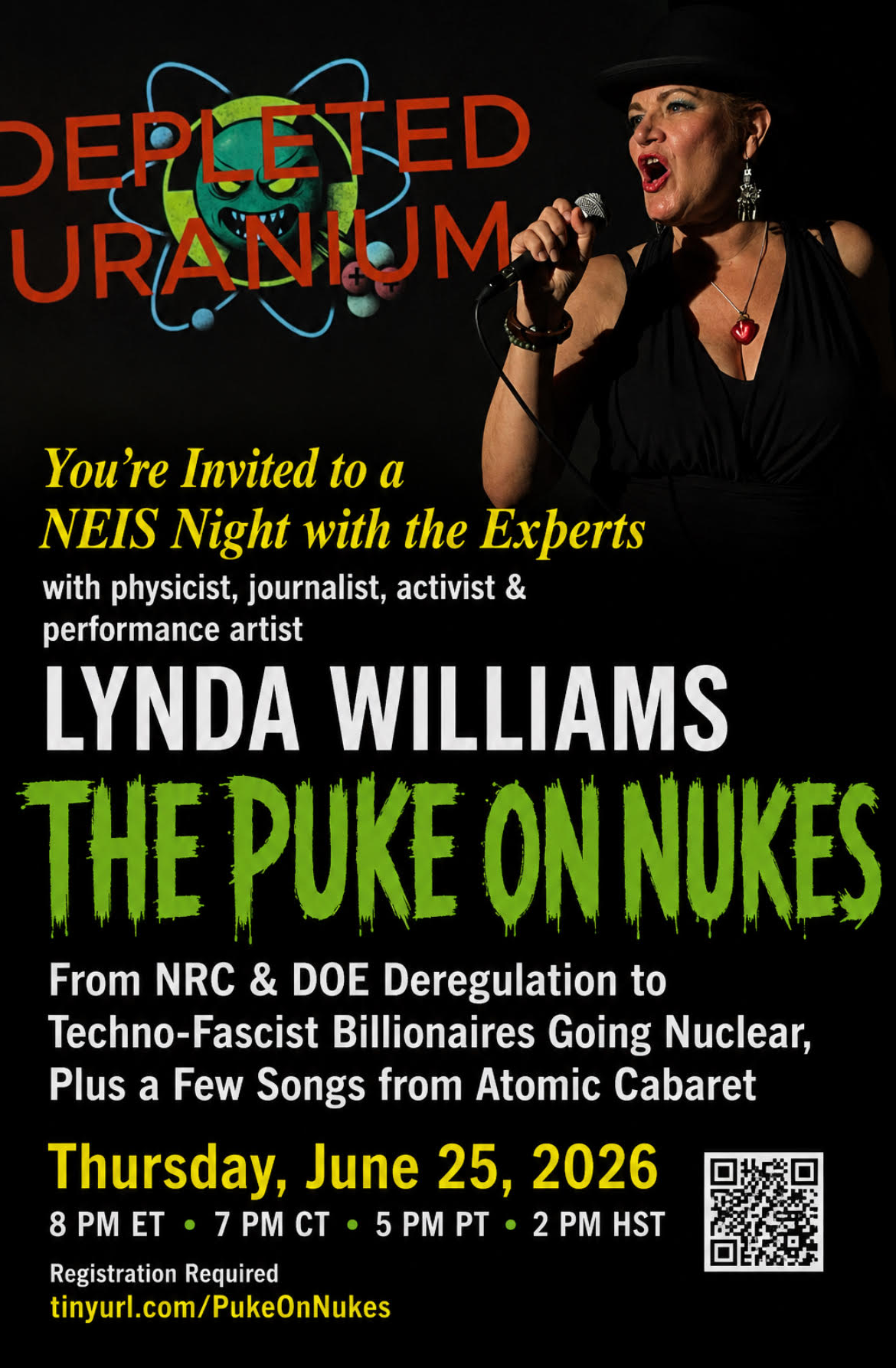
25 June- THE PUKE ON NUKES
Thursday, June 25, 2026
7pm Central Time (8pm ET, 6pm MT, 5pm PT) UTC – 5
From NRC & DOE Deregulation to Techno-Fascist Billionaires Going Nuclear, Plus a Few Songs from Atomic Cabaret REGISTER
26 June – Radiation Trainwreck at the NRC / Join the Protect Better Campaign – https://us02web.zoom.us/meeting/register/4ZlZ5_qLSHGiLSCg8FF6Bg#/registration

Cuba Is Not a Failed State – It Is a Besieged State
PETITION: “Global Appeal to Endorse Palestinian Right of Return of Refugees”
To see nuclear-related stories in greater depth and intensity – go to https://nuclearinformation.wordpress.com
-
Archives
- June 2026 (193)
- May 2026 (306)
- April 2026 (356)
- March 2026 (251)
- February 2026 (268)
- January 2026 (308)
- December 2025 (358)
- November 2025 (359)
- October 2025 (376)
- September 2025 (257)
- August 2025 (319)
- July 2025 (230)
-
Categories
- 1
- 1 NUCLEAR ISSUES
- business and costs
- climate change
- culture and arts
- ENERGY
- environment
- health
- history
- indigenous issues
- Legal
- marketing of nuclear
- media
- opposition to nuclear
- PERSONAL STORIES
- politics
- politics international
- Religion and ethics
- safety
- secrets,lies and civil liberties
- spinbuster
- technology
- Uranium
- wastes
- weapons and war
- Women
- 2 WORLD
- ACTION
- AFRICA
- Atrocities
- AUSTRALIA
- Christina's notes
- Christina's themes
- culture and arts
- Events
- Fuk 2022
- Fuk 2023
- Fukushima 2017
- Fukushima 2018
- fukushima 2019
- Fukushima 2020
- Fukushima 2021
- general
- global warming
- Humour (God we need it)
- Nuclear
- RARE EARTHS
- Reference
- resources – print
- Resources -audiovicual
- Weekly Newsletter
- World
- World Nuclear
- YouTube
-
RSS
Entries RSS
Comments RSS
 nuclear-news