Fukushima Prefecture seeks government help in preventing reputational damage to its marine products
Local officials from Fukushima Prefecture on Wednesday called on the
central government to take measures to prevent reputational damage to
marine products, a day after giving their approval to the construction of
facilities to release treated water from the crippled Fukushima nuclear
power plant into the ocean.
The mayors of the two towns hosting the
Fukushima Daiichi plant, Okuma and Futaba, and Fukushima Gov. Masao
Uchibori made the request during a meeting with Economy, Trade and Industry
Minister Koichi Hagiuda in Tokyo.
Mainichi 3rd Aug 2022
https://mainichi.jp/english/articles/20220803/p2g/00m/0na/033000c
Construction begins at Fukushima plant for water release
The construction of facilities needed for a planned release of treated radioactive wastewater into the sea next year from the damaged Fukushima nuclear power plant has begun despite opposition from the local fishing community
abc news, by MARI YAMAGUCHI Associated Press, August 04, 2022, TOKYO — The construction of facilities needed for a planned release of treated radioactive wastewater into the sea next year from the damaged Fukushima nuclear power plant began Thursday despite opposition from the local fishing community.
Plant workers started construction of a pipeline to transport the wastewater from hillside storage tanks to a coastal facility before its planned release next year, according to the plant operator, Tokyo Electric Power Company Holdings.
The digging of an undersea tunnel was also to begin later Thursday.
Construction at the Fukushima Daiichi plant follows the Nuclear Regulation Authority’s formal approval last month of a detailed wastewater discharge plan that TEPCO submitted in December.
The government announced last year a decision to release the wastewater as a necessary step for the plant’s ongoing decommissioning…………………..
Local fishing communities and neighboring countries have raised concerns about potential health hazards from the radioactive wastewater and the reputation damage to local produce, and oppose the release.
Scientists say the impact of long-term, low-dose exposure to not only tritium but also other isotopes on the environment and humans are still unknown and that a release is premature.
The contaminated water is being stored in about 1,000 tanks that require much space in the plant complex. Officials say they must be removed so that facilities can be built for its decommissioning. The tanks are expected to reach their capacity of 1.37 million tons in autumn of 2023…………………….
TEPCO and the government have obtained approval from the heads of the plant’s host towns, Futaba and Okuma, for the construction, but local residents and the fishing community remain opposed and could still delay the process. The current plan calls for a gradual release of treated water to begin next spring in a process that will take decades………………..
A US airman who rescued film of A-bomb horrors is honoured at last
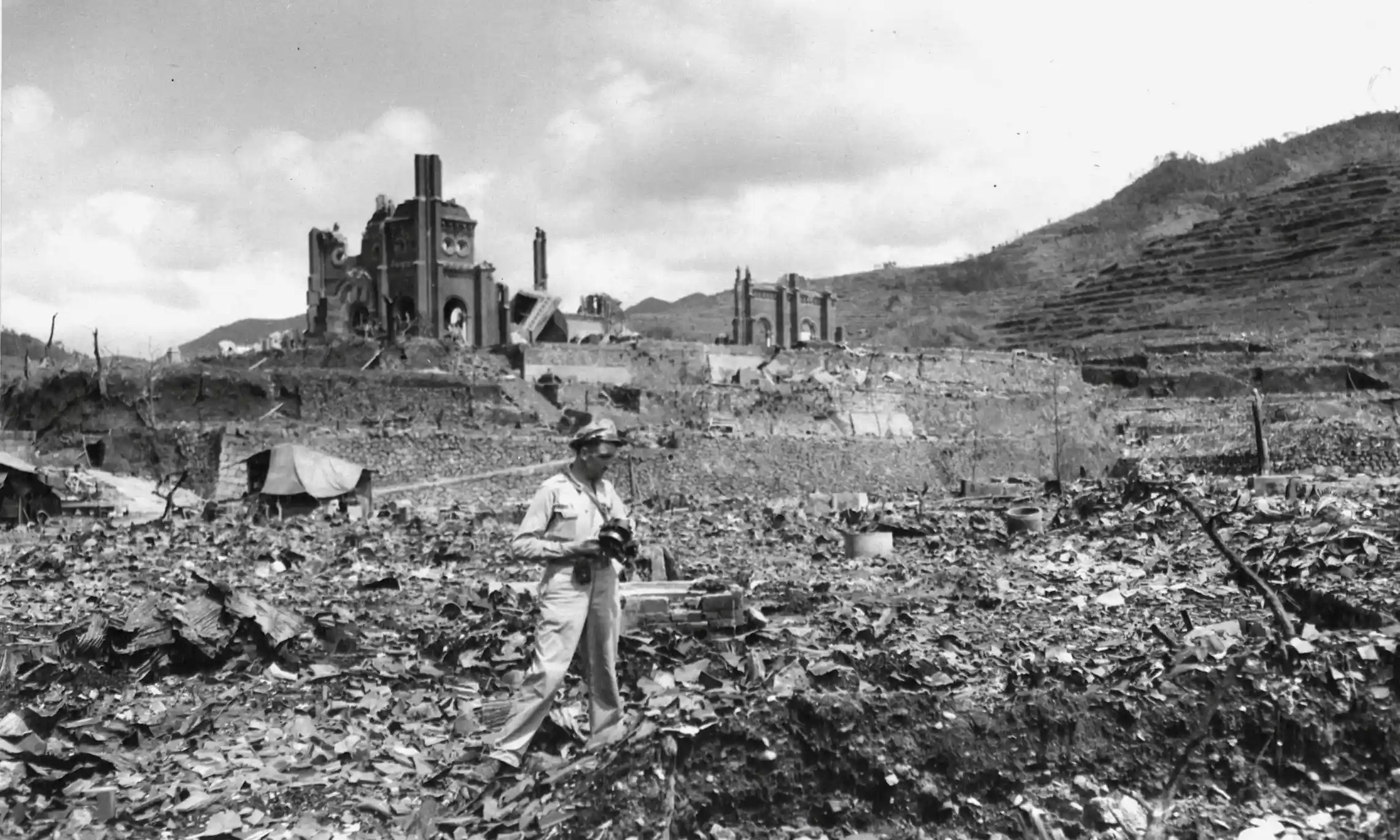
Guardian, Rory Carroll, @rorycarroll72, Sun 31 Jul 2022
Cameraman Daniel McGovern copied footage of Hiroshima and Nagasaki devastation to ensure lessons were learned
The photograph shows devastation in Nagasaki after the atomic bomb: a scorched wilderness where there was once a city. At its centre stands a lone man with a camera.
It was 9 September 1945 and Lt Daniel McGovern, a US Army Air Force cameraman, was documenting ground zero, the point directly below the bomb’s detonation four weeks earlier. Few would recognise McGovern, but the vision of apocalypse is familiar from documentary footage of Hiroshima and Nagasaki at the end of the second world war.
The footage will be shown again this week and next for the 77th anniversaries of the atomic bombings that obliterated the Japanese cities and showed the reality of nuclear war: blasted landscapes, burnt skeletons, radiation sickness.
But those haunting images might not exist were it not for McGovern. As part of the US Strategic Bombing Survey – which studied the impact of bombing – McGovern supervised Japanese and American camera crews in Hiroshima and Nagasaki. Back in the US, he saved the footage from suppression by making secret copies.
Only now, decades later, has his full story emerged. Joe McCabe, a journalist from McGovern’s native County Monaghan in Ireland, has pieced together his remarkable life in a biography, Rebels to Reels, published earlier this month after 20 years of research, including interviews with McGovern before his death in 2005………………………………………………….
The fields around Nagasaki were bleached white and the city looked as if a “massive anvil” had flattened it, he later told McCabe. At a ruined school he filmed the bodies of children amid piles of skulls. “Hundreds of kids had been sucked out through the windows. We were always finding bones.”
He filmed harrowing scenes at overwhelmed hospitals, including the agony of a 16-year-old boy named Sumiteru Taniguchi. “His whole back just looked like a bowl of bubbling tomatoes.”
Other patients had rashes, hair loss and bleeding from the nose and mouth – a mysterious malady later identified as radiation sickness.
McGovern also captured the phenomenon of people who had been atomised yet left shadows caused by radiant heat. The two atomic bombs are estimated to have killed more than 200,000 people.
McGovern’s teams amassed 100,000ft of colour footage and enlisted the help of a Japanese newsreel service, Nippon Eigasha, which had 26,000ft of black-and-white footage, much shot before the Americans had arrived. The Irishman helped edit the Japanese footage into a documentary called Effects of the Atomic Bomb on Hiroshima and Nagasaki, and planned to turn the colour footage into another one.
Authorities in Washington, however, classified the material as secret in 1946. “They didn’t want the American public seeing the horrors,” McGovern said. He discreetly made copies at the Pentagon. He stored one set at an air force motion picture depository in Dayton, Ohio, and kept another set himself.
Years passed – McGovern witnessed rocket tests and debunked theories of aliens at Roswell as “a load of crap” – and then in 1967 a US Congressional committee that included Robert Kennedy asked to see the atomic bomb footage. The material had been declassified but no one could find the originals. McGovern, by now a lieutenant colonel, directed the authorities to his copies.
In 1970 the general public got its first glimpse of some of the footage. It had been incorporated into a film called Hiroshima Nagasaki – August 1945 that premiered at New York’s Museum of Modern Art.
The auditorium was packed. At the end, no one made a sound. https://www.theguardian.com/world/2022/jul/31/us-airman-daniel-mcgovern-cameraman-hiroshima-nagasaki
Nuclear Weapons Policies of Japan and South Korea Challenged
By Jaya Ramachandran, GENEVA (IDN)31 July 22, — The Basel Peace Office, in cooperation with other civil society organisations, has challenged the nuclear weapons policies of Japan and South Korea in the UN Human Rights Council, maintaining that these violate the Right to Life, a right enshrined in Article 6 of the International Covenant on Civil and Political Rights (ICCPR).
The two East Asian countries’ nuclear strategies have been called into question in reports submitted on July 14 as part of the Universal Periodic Review (UPR) of the obligations of Japan, South Korea and 12 other countries under human rights treaties. (See Submission on Japan and Submission on South Korea).
The submissions, presented at a time when Russia has made nuclear threats to the US and NATO if they intervene in the Russian invasion of Ukraine, underline the need to address the risks of nuclear deterrence policies. Besides, Russia is not the only country that possesses nuclear weapons and/or maintains options to initiate nuclear war………………
both Japan and South Korea are engaged in extended nuclear deterrence policies which involve the threat or use of US nuclear weapons on their behalf in an armed conflict. Both have also supported the option of first use of nuclear weapons on their behalf, even when the United States has been trying to step back from such a policy.
The Basel Peace Office and other civil society organisations argue that the extended nuclear deterrence policies of Japan and South Korea violate their human rights obligations, as is their lack of support for negotiations for comprehensive, global nuclear disarmament.
The submissions make several recommendations of policies the governments could take to conform to the Right to Life. These include adopting no-first-use policies and taking measures to phase out the role of nuclear weapons in their security doctrines.
This they could do by establishing a Northeast Asia Nuclear-Weapon-Free Zone and urging at the ongoing Non-Proliferation Treaty (NPT) Review Conference an agreement on the global elimination of nuclear weapons by 2045, the 75th anniversary of the NPT………………………..
more https://www.indepthnews.net/index.php/armaments/nuclear-weapons/5487-nuclear-weapons-policies-of-japan-and-south-korea-challenged
Kishida to call for nuke-free world in historic address at U.N. treaty conference
Japan Times, BY ERIC JOHNSTON, 31 July 22,
In a year in which nuclear disarmament hopes have been dented by not-so-subtle references by Russia to its own arsenal following its invasion of Ukraine, Prime Minister Fumio Kishida is set to make history as the first Japanese leader to address the United Nations’ nuclear nonproliferation treaty review conference, which begins in New York on Monday.
Kishida, who represents a district in Hiroshima, is expected to call for a world without nuclear weapons and for greater transparency among nuclear powers regarding their stockpiles and capabilities. His message will refer to Japan’s experience as the only country to have been attacked with an atomic bomb. The leader will also stress that all countries should neither use nuclear weapons nor threaten to use them.
Speaking to reporters in Tokyo on Friday, the prime minister said it was important to link the treaty’s ideals with current geopolitical realities.
“The debate on nuclear disarmament is atrophying,” Kishida said, and he announced he would present a plan at the conference that would hopefully serve as a roadmap toward reaching a world without nuclear weapons.
The prime minister sees Japan’s role at the nearly monthlong conference, which will focus on keeping the buildup of nuclear weapons under control, as one of helping to bridge the differences between nuclear powers and nonnuclear states. Kishida is hoping to promote talks between China and the United States on nuclear disarmament and arms control. He’s also expected to call on the international community to work toward North Korea’s denuclearization………………………….
more https://www.japantimes.co.jp/news/2022/07/31/national/nuclear-conference-kishida-speech/
JNFL to consider delaying completion of spent fuel reprocessing plant
26th postponement of the commissioning of the Rokkashô-mura nuclear reprocessing plant in Japan. It should have started in 1997…

July 29, 2022
At a press conference on July 29, Naohiro Masuda, president of JNFL, which is constructing a spent nuclear fuel reprocessing plant in Rokkasho Village, said that the plant’s target completion date, which is approximately two months away, “has reached a point where we have to consider postponing it. JNFL is considering the postponement of the construction of the Rokkasho Nuclear Power Plant.
JNFL has set the target completion date of the spent fuel reprocessing plant it is constructing in Rokkasho Village for the first half of this fiscal year, by September of this year.
At a regular press conference held on September 29, JNFL President Masuda stated, “Next week we will have less than two months to complete the plant, so we would like to consider the future outlook based on the status of the examination. We have reached a point where we need to consider postponing the project,” he said, indicating that he would consider postponing the project.
President Masuda cited as reasons for the postponement the ongoing Nuclear Regulatory Commission’s review of safety measures and other work that are prerequisites for completion, as well as the fact that the amount of work has increased from the original plan and that the plan needs to be carefully examined in order to proceed safely.
Regarding the time frame if the project is postponed, he stated, “I don’t think it will be something that will take two or three years,” but he also indicated that it is not expected to last more than a few months.
The reprocessing plant was originally planned to be completed in 1997, 25 years ago, but has been postponed 25 times due to repeated problems.
The reopening of the uranium enrichment plant has been postponed.
JNFL announced on April 29 that the plant in Rokkasho, which manufactures enriched uranium needed to produce nuclear fuel for use in nuclear power plants, will resume operation in February of next year, instead of September of this year, based on the status of safety measures and other factors. JNFL announced on April 29 that the resumption of operations at the Rokkasho uranium enrichment plant, which is located in Rokkasho Village, has been changed to February next year.
The uranium enrichment plant in Rokkasho is the only commercial facility in Japan that produces enriched uranium, which is necessary for nuclear fuel used in nuclear power plants. The plant has been out of operation since September 201 7 in order to conduct safety work to comply with the new national regulatory standards.
JNFL announced on the 29th that it had changed the date of resumption of operation to February next year, citing delays in the safety work.
[President apologizes for trouble with reprocessed liquid waste.
Naohiro Masuda, president of JNFL, apologized for the trouble at the spent nuclear fuel reprocessing plant in Rokkasho village, saying, “I would like to express my deepest apologies for causing great concern to the local community.
At the Rokkasho Reprocessing Plant, the cooling system for one of the tanks storing high-level radioactive liquid waste stopped functioning for about eight hours on the second of this month.
At the beginning of the press conference on March 29, JNFL President Masuda stated, “I would like to express my deepest apologies for causing so much concern to the local community. I am very sorry.
JNFL has stated that one of the two lines circulating water to cool the tank was under construction, and that a worker who was instructed to close the valve on that line may have inadvertently closed the valve on the line that was still in operation. The company claims that this is the case.
Regarding measures to prevent recurrence, President Masuda explained that valves that affect the cooling function are physically locked so that they cannot be operated, and that when safety-related equipment is placed in one line for construction or other reasons, monitoring is strengthened more than usual.
He added, “We will thoroughly implement measures to prevent recurrence and continue to place the highest priority on safety.
https://www3.nhk.or.jp/lnews/aomori/20220729/6080016788.html?fbclid=IwAR0J114Ufuu1EDQ3nl_NeXdxMclco4QjbKnxyoI87ry9B0Ff_d0Btawxkig
Nuclear Industry Association of Japan (NIAJ) proposes that “new and additional nuclear power plants and rebuilding of nuclear power plants should be clearly stated in national plans

July 22, 2022
On July 22, the Japan Atomic Energy Industries Association (JAEA), an association of companies involved in nuclear power generation, released a proposal calling for the construction of new nuclear power plants and their replacement (rebuilding). The association said this is the first time it has issued such a proposal. The association calls for new nuclear power plants to be built or rebuilt to maintain the nuclear power supply chain.
Public distrust of nuclear power plants has been deep-rooted in the wake of the accident at TEPCO’s Fukushima Daiichi Nuclear Power Station. The government has stated that it “does not envision” new or rebuilt reactors at this time, and a freeze on nuclear power plants continues in Japan.
However, the crisis in Ukraine has led to…
https://www.asahi.com/articles/ASQ7Q6FMPQ7QULFA00G.html?fbclid=IwAR15C-Y5Sa1q9Ix65ZQ3PZpe3Oo7o3ZEnoTISCxBrTj-NzMO5nQ6xPsAhQQ
High anxiety as Japan takes another step toward releasing wastewater from crippled Fukushima nuclear plant into sea.
China, South Korea, Taiwan, Hong Kong and Macau) still have import bans in place.
concern about whether the discharge of enormous amounts of wastewater could set a bad precedent for dealing with future nuclear accidents.
CBS News BY LUCY CRAFT, 25 July 22, Tokyo — The fishing industry around Japan’s Fukushima coast expressed disappointment and resignation over the weekend as long-expected plans to start releasing treated wastewater into the ocean from the crippled Fukushima Daiichi nuclear power plant moved one step closer to reality. The drastic measure has been adopted as the only practical way out of a dilemma that’s plagued the damaged plant for more than a decade……………………..
The unprecedented, controversial disposal operation is likely to take decades.
Since the massive 2011 earthquake and tsunami triggered meltdowns in three of the plant’s reactors, operator Tepco has struggled to manage the vast amount of contaminated water — a combination of reactor cooling water, rainwater and groundwater, all irradiated as it flows through the highly-radioactive melted reactor cores – accumulating at the facility.
As a stopgap, the grounds surrounding the damaged reactors have been converted into a giant tank farm, with more than 1,000 storage vessels holding 1,310,000 tons of wastewater.
Tepco has long warned that it will run out of storage space as soon as spring 2023, and that the structures are hampering the technologically challenging work of decommissioning the plant. The temporary storage solution is also highly vulnerable to any future natural disasters……………
Before construction of the undersea tunnel can even begin, however, Tepco’s proposal must win backing from the regional government in Fukushima Prefecture and the two affected towns of Okuma and Futaba. A Fukushima fish processing company representative told the Asahi newspaper, “to be honest, even if we oppose this, I don’t feel like we have any chance of overturning the decision.”
After years of painstaking efforts to convince the Japanese public and the rest of the world that their seafood is safe, the local fishing industry fears the ocean release will tarnish their brand anew. Tokyo has promised to buy catches if the industry suffers reputational damage.
Of the 55 countries and regions that imposed restrictions on imported Japanese food after the Fukushima Daiichi catastrophe — including the U.S. — five (China, South Korea, Taiwan, Hong Kong and Macau) still have import bans in place.
Regulators solicited public comment and said they had received more than 1,200 responses, including people voicing concern over whether the undersea tunnel would be earthquake-safe, and what was being done to protect workers.
Tokyo has said levels of tritium — the one isotope that can’t be filtered out — will be diluted to below 1/40th of the allowable level for discharge in Japan, and 1/7th the WHO ceiling for drinking water.
Still, some experts have called for greater transparency, fearing unintended consequences of the operation. There is also concern about whether the discharge of enormous amounts of wastewater could set a bad precedent for dealing with future nuclear accidents. https://www.cbsnews.com/news/japan-fukushima-daiichi-nuclear-plant-wastewater-release-into-sea-approved/
Japan to push for nuclear arms reduction at NPT review conference
Kyodo News, 25 July 22, Tokyo,
Japan plans to push for a reduction in nuclear warheads and for world leaders to visit its two atomic-bombed cities at next month’s review conference on the Nuclear Non-proliferation Treaty, a special adviser to Japanese Prime Minister Fumio Kishida on the issue said Monday…………………………………… more https://english.kyodonews.net/news/2022/07/8d8074c2b80e-japan-to-push-for-nuclear-arms-reduction-at-npt-review-conference.html
Backlash in Japan over dumping of nuclear waste-water to the ocean
Japanese residents oppose dumping nuclear polluted water into the ocean.
Japan’s nuclear regulators have given the green light to dump water from
the wrecked Fukushima nuclear power plant into the sea on July 22. The plan
has faced some backlash with concerns over its potential impact on marine
life and local livelihoods.
CGTN 23rd July 2022
Stiff resistance by fishing unions to Japan’s move to dump Fukushima nuclear wastewater into the ocean.
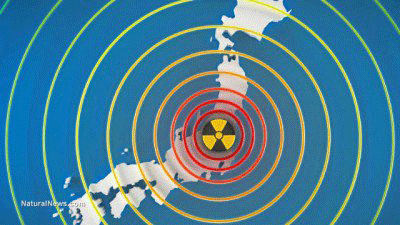
The impact of Japan’s 2011 earthquake and tsunami still ripples through
the country as the nation continues the decommissioning process of the
wrecked Fukushima Daiichi nuclear power plant. In addition to mass
evacuations of the surrounding area, the plant’s meltdown also uncovered
failings by its operator to take proper precautions, resulting in hefty
fines for four former executives.
The latest move involving the failed
plant has brought fresh criticism as Japan’s nuclear regulators approved
a plan to release water from the plant into the ocean, the government said
on Friday. The water, used to cool reactors in the aftermath of the 2011
nuclear disaster, is being stored in huge tanks in the plant, and amounted
to more than 1.3 million tonnes by July. The regulators deemed it safe to
release the water, which will still contain traces of tritium after
treatment, the foreign ministry said in a statement.
Plant operator Tokyo
Electric Power Company (Tepco) would face additional inspections by
regulators, it added. Tepco plans to filter the contaminated water to
remove harmful isotopes apart from tritium, which is hard to remove. Then
it will be diluted and released to free up plant space and allow
decommissioning to continue. The plan has encountered stiff resistance from
fishing unions in the region, which fear its impact on their livelihoods.
Neighbours China, South Korea and Taiwan have also voiced concern.
Irish Independent 24th July 2022
Shinzo Abe Failed to Rearm Japan. Let’s Keep It That Way

Houston Chronicle July 20, 2022, Koichi Nakano,
Japan had barely begun processing the shock of the former Japanese prime minister Shinzo Abe’s assassination by a gunman on July 8 before attention turned to whether his quest to remilitarize Japan, including the revision of its pacifist Constitution, would survive him.
Japan’s longest-serving prime minister, Mr. Abe was a towering presence at home and an influential statesman abroad. He advocated a more globally engaged Japan, was a driving force in the Quad alliance between the United States, Australia, India and Japan and is credited by some with initiating the very idea of the wider Indo-Pacific region.
He also envisioned a more militarily robust Japan, centered on his unfulfilled dream of revising its postwar Constitution, which prohibits his country from maintaining an offensive armed forces capability. His supporters have vowed to make these dreams — driven largely by fear of a more powerful China — a reality.
Yet it’s time for Japan to bid farewell not only to Mr. Abe but also to his nationalist rearmament agenda. Japan’s political and economic resources should be focused not on revising the Constitution and increasing defense spending but on maintaining peace through diplomacy and shoring up an economy left shaky by years of Mr. Abe’s trickle-down policies.
Critically, at a time when the United States is focused on confronting China, a humbler, more pacifist Japan could have an important role to play by re-engaging with Beijing to help decrease tensions between China and the United States.
Mr. Abe was shot while campaigning on behalf of his Liberal Democratic Party for parliamentary elections that were to be held just two days later. He leaves behind a personal legacy far more controversial and checkered than is warranted by the simplistic, fawning tributes that followed his demise.
………………………………… few aspects of Mr. Abe’s career threatened to alter Japan’s national character and role in the region as much as his crusade against Article 9, which renounces war as a means of solving international disputes and limits Japan’s military to a self-defense role. Mr. Abe unnerved millions of Japanese who see no reason to depart from a commitment to peace that kept Japan out of any direct involvement in war since 1945, allowing it to focus on becoming an economic power.
Mr. Abe failed to change the article despite two stints in power, from 2006 to ’07 and from 2012 to ’20. He settled instead for a reinterpretation that allows Japan to help close allies militarily under certain conditions but has been criticized as unconstitutional.
Japan looks no closer to revising Article 9 today, especially with the L.D.P.’s right wing now deprived of its uncontested standard-bearer. A commitment to peace runs deep in a country that was taken to war by a military government, causing huge suffering in Asia and ending in Japan’s total defeat and the distinction of being the only country attacked with nuclear weapons.
……………….. Attention now turns to Prime Minister Fumio Kishida, but it’s a measure of just how smothering Mr. Abe’s presence was — he forbade open dissent among party leaders — that the Japanese don’t really know what to expect from Mr. Kishida, who represents L.D.P. moderates who have opposed constitutional revision. After the election, Mr. Kishida promised greater defense spending and pledged renewed attention on Article 9 but gave no hint that this was more than a courteous nod to the departed Mr. Abe.
But there is no doubt that Mr. Kishida’s hand is strengthened. Mr. Abe left no clear right-wing successor, and his death throws the faction into disarray, allowing Mr. Kishida an opportunity to assert more control over the national agenda.
………………………
Stripping away the safeguards of Article 9 and remilitarizing Japan would only further inflame tensions with China and risk an arms race with potentially devastating consequences for Japan and the region. On the contrary, a reaffirmed commitment to peace would allow domestic resources to be focused on the economy and open the door for better relations with Japan’s neighbors founded on peace through diplomacy.
It’s time to beat Mr. Abe’s swords into plowshares. https://www.houstonchronicle.com/opinion/outlook/article/Opinion-Shinzo-Abe-failed-to-rearm-Japan-17320399.php
Japan’s nuclear regulator formally approves release of Fukushima wastewater to the Pacific

Japan’s nuclear regulator on Friday formally approved a plan to release
more than a million tonnes of treated water from the crippled Fukushima
nuclear power plant into the ocean.
The plan has already been adopted by
the government and endorsed by the International Atomic Energy Agency
(IAEA), but plant operator TEPCO must still win over local communities
before going ahead. The country’s Nuclear Regulation Authority approved
TEPCO’s plan, according to a foreign ministry statement, which said the
government would ensure the safety of the treated water as well as the
“reliability and transparency of its handling”.
Daily Mail 22nd July 2022
Japan approves nuclear-contaminated water discharge plan, may turn Japanese people into ‘sick men of Asia,’ seafood consumption and export nosedive
By Zhang Hui and Xing Xiaojing Jul 22, 2022 , Japan’s nuclear regulator on Friday approved the discharge plan of Fukushima nuclear-contaminated water, with Chinese observers voicing concerns that the release of the contaminated water into the ocean may start earlier than the previous schedule of next spring and warning that Japan will bear the brunt of damage, with people’s lives under serious threat and seafood consumption and export nosediving.
………………… Although the Foreign Ministry statement said this does not mean that TEPCO can immediately start the discharge of the contaminated water into the sea as there are remaining processes, such as the Japanese regulator’s inspections to check and confirm the installation status of the discharge facilities, Chinese observers believed that Japan may accelerate its scheduled plan, making the release start earlier than April 2023.
Chang Yen-chiang, director of the Yellow Sea and Bohai Sea Research Institute of Dalian Maritime University, who has been closely following the Japanese government’s decision on discharging Fukushima wastewater, told the Global Times on Friday that the administrative process for releasing the contaminated water was done in a really fast manner, as it only took Japan five days from announcing completion of construction for undersea tunnel outlet to approving the plan.
The TEPCO has basically completed the construction of an undersea tunnel outlet to dump the nuclear-contaminated water, the Kyodo News agency reported on Sunday.
Japan’s latest move apparently aroused lots of concern and opposition from neighboring countries.
Chinese Foreign Ministry spokesperson Wang Wenbin said at Friday’s media briefing that it is extremely irresponsible for Japan to attempt to create a fait accompli, regardless of various parties’ concerns and China firmly opposes it.
China once again urges Japan to earnestly fulfill its due international obligations, dispose of the nuclear-contaminated water in a scientific, open, transparent and safe manner, and stop pushing through the ocean discharge plan, Wang said.
……………. Meanwhile, Japan’s seafood exports will be greatly hindered, which would hurt the economy and local fishery groups, observers said.
Many countries, including the US and UK, banned imports of food products manufactured in and around Fukushima Prefecture following the 2011 nuclear disaster, and some countries and regions have not lifted the ban even now.
Fishery groups in Japan have repeatedly said they were firmly opposed to the plan due to concerns over a negative impact on the industry. ……………..
China and other stakeholders could through the UN request an advisory opinion from the International Court of Justice, to prove the release is illegal, Chang said.
Yu also advised countries to conduct maritime environment investigation, which could be evidence in seeking compensation from Japan in cases of biological resources damages and other damage.
https://www.globaltimes.cn/page/202207/1271183.shtml
Nuclear reactor in Takahama to go back online on July 26

July 20, 2022
Kansai Electric Power Co. will resume generating and transmitting electricity at the No. 3 reactor at the Takahama nuclear power plant on July 26, the company announced on July 19.
The company had said the timing of resuming operations was undecided after a regular inspection that started in March discovered damage to heating tubes at the nuclear reactor in Takahama, Fukui Prefecture.
However, the company has decided it has done enough fact-finding and put in place enough countermeasures so that it can resume operations.
Of the company’s nuclear reactors, the No. 3 and No. 4 reactors at the Oi plant in Oi, Fukui Prefecture, are currently in operation.
The company plans to bring a total of five nuclear reactors online by the end of this year.
They will include the No. 3 reactor at the Mihama plant in Mihama, Fukui Prefecture, which started operations more than 40 years ago, as well as the No. 4 reactor at the Takahama plant, which is currently undergoing a regular inspection.
The government plans to have up to nine reactors operating this winter to prepare for expected severe energy shortages, including those of Kyushu Electric Power Co. and Shikoku Electric Power Co., Prime Minister Fumio Kishida announced at a news conference on July 14.
1 This Month

Protect Sazan Island from the Trump family! https://secure.avaaz.org/campaign/en/protect_sazan_island_from_the_trump_family_loc/?bqFCVab&v=174511&cl=22707147157&_checksum=5e9dde668860e8231c33699735e16a1fbf22ab2cb01da50c999fe8732b9775ef&utm_source=email&utm_medium=blast_email&utm_campaign=174511
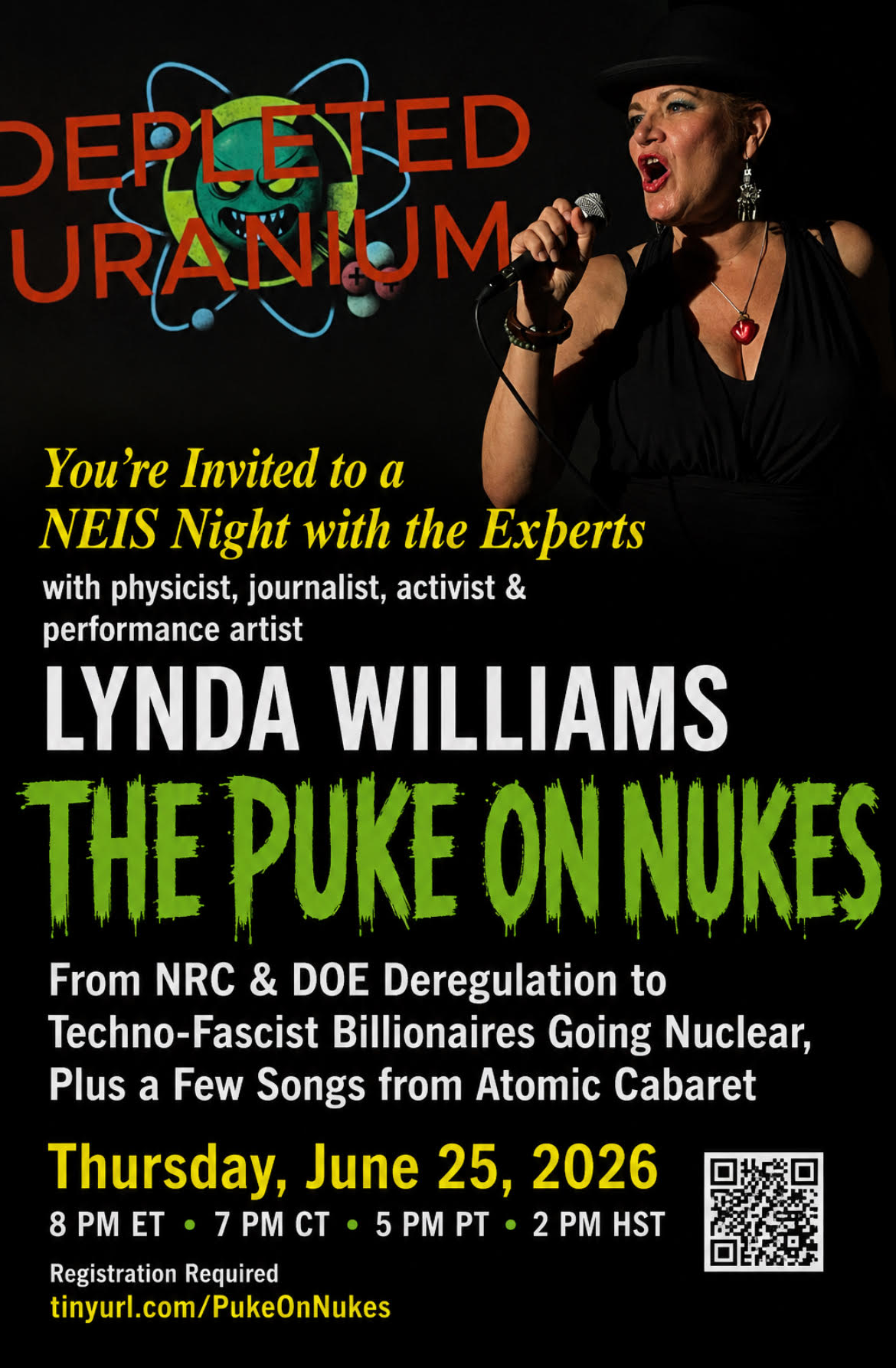
25 June- THE PUKE ON NUKES
Thursday, June 25, 2026
7pm Central Time (8pm ET, 6pm MT, 5pm PT) UTC – 5
From NRC & DOE Deregulation to Techno-Fascist Billionaires Going Nuclear, Plus a Few Songs from Atomic Cabaret REGISTER
26 June – Radiation Trainwreck at the NRC / Join the Protect Better Campaign – https://us02web.zoom.us/meeting/register/4ZlZ5_qLSHGiLSCg8FF6Bg#/registration


Cuba Is Not a Failed State – It Is a Besieged State
PETITION: “Global Appeal to Endorse Palestinian Right of Return of Refugees”
To see nuclear-related stories in greater depth and intensity – go to https://nuclearinformation.wordpress.com
-
Archives
- June 2026 (142)
- May 2026 (306)
- April 2026 (356)
- March 2026 (251)
- February 2026 (268)
- January 2026 (308)
- December 2025 (358)
- November 2025 (359)
- October 2025 (376)
- September 2025 (257)
- August 2025 (319)
- July 2025 (230)
-
Categories
- 1
- 1 NUCLEAR ISSUES
- business and costs
- climate change
- culture and arts
- ENERGY
- environment
- health
- history
- indigenous issues
- Legal
- marketing of nuclear
- media
- opposition to nuclear
- PERSONAL STORIES
- politics
- politics international
- Religion and ethics
- safety
- secrets,lies and civil liberties
- spinbuster
- technology
- Uranium
- wastes
- weapons and war
- Women
- 2 WORLD
- ACTION
- AFRICA
- Atrocities
- AUSTRALIA
- Christina's notes
- Christina's themes
- culture and arts
- Events
- Fuk 2022
- Fuk 2023
- Fukushima 2017
- Fukushima 2018
- fukushima 2019
- Fukushima 2020
- Fukushima 2021
- general
- global warming
- Humour (God we need it)
- Nuclear
- RARE EARTHS
- Reference
- resources – print
- Resources -audiovicual
- Weekly Newsletter
- World
- World Nuclear
- YouTube
-
RSS
Entries RSS
Comments RSS
 nuclear-news