Report on “The Symposium Concerning Geological Disposal of High-level Radioactive Waste from Nuclear Power Plants” held in Kamoenai Village, Hokkaido
by Citizens’ Nuclear Information Center · Published August 4, 2022 · Updated August 4, 2022
By Takano Satoshi (CNIC)

In November 2020, literature surveys were launched in Suttsu Town and Kamoenai Village, both in Hokkaido, as part of the official procedures for determining whether the two municipalities were suitable for hosting an underground storage site for high-level radioactive waste from nuclear power plants. More than 18 months has passed since that time, during which the Nuclear Waste Management Organization of Japan (NUMO), which oversees the selection of the location of the dump site, strived to promote communications with the local residents by arranging “dialogue” events. Although NUMO publicly maintained that the dialogues were not intended to create a local consensus for accepting the storage facility, the reality was that NUMO took the leadership in the move to deepen popular understanding of the geological repository. Some of the local residents and the municipalities concerned were critical of the dialogue events, claiming that such occasions were organized simply for seeking compromises and winning the support of residents for the geological disposal project. [1]
To date, dialogue events have been held eight times in Kamoenai Village. In the events, some participants, such as the members of the events’ steering committee and local villagers, expressed a wish to hear different opinions, not only those of NUMO. In response, NUMO held a symposium concerning the geological disposal of high-level nuclear waste on May 29 in the Kamoenai Village Fishing Center, by inviting experts for and against the geological disposal project. [2] Professor Yoshida Hidekazu of Nagoya University Museum was invited as the expert supporting the geological disposal project, and CNIC Co-director Ban Hideyuki, as the expert against it. This writer accompanied Mr. Ban to Kamoenai to attend the event.
The symposium was comprised of two sessions, the first concerning policy aspects, and the second technical aspects. As for policy aspects, Mr. Ban pointed out the need to obtain the consent of the prefectural governor before the prefecture’s municipalities apply for the literature survey, in order to avoid confusion and turmoil within the local communities. He also said the government’s offer of subsidies in exchange for accepting the literature survey is not appropriate, since impoverished local governments may not be able to resist the temptation of the subsidies and apply for the literature survey simply to obtain the money. Mr. Ban went on to say that the offer of massive subsidies to small municipalities may create the negative effect of depressing their local industries. In addition, he pointed out the need to determine the types and the amount of high-level radioactive nuclear waste that would be stored in the repository.
Referring to the plan to set a limit on the total amount of nuclear waste to be stored at the disposal site and the determination of the types of waste, Prof. Yoshida said it would be rather difficult to formulate such a precise plan, but added that it would be ideal if it could be done. He went on to say that accumulation of a greater amount of highly radioactive waste would endanger the safety of geological disposal. Although nuclear power generation has the advantage of not emitting CO2, it is exposed to many risks, such as tsunami tidal waves, he added. For this reason, he recommended that Japan should develop other energy resources. There was no disagreement about this point between Mr. Ban and Prof. Yoshida. On the contrary, they agreed that they would make efforts to reduce the amount of nuclear waste and to prevent the restart of nuclear power plants.
With regard to the technological aspect of geological disposal, Prof. Yoshida introduced the geological phenomenon called “concretion.” This means a hard, compact mass of matter formed by the precipitation of mineral cement within the spaces between particles, which is found in sedimentary rock or soil. He then stated, if “concretion” is applied to the construction of the repository, it may be useful for making geological disposal safer.
According to Prof. Yoshida, the geological disposal site will be constructed several hundred meters below ground because the great depth of the ground prevents weathering originating from the ground surface, and serves as a buffer against seismic motion, volcanic activity, fault movements and other types of environmental phenomena on and below the ground surface. The buffer-function level is called the ‘cocoon degree,’ and a high ‘cocoon degree’ signifies an area suitable for creating a repository of nuclear waste.
He pointed out that NUMO must find a high cocoon-degree area based on the technological data collected in the literature survey, and then determine if it is appropriate to proceed to the next stage of overview survey of the area.
Prof. Yoshida also pointed out that the geological characteristic of the Kamoenai area is that it consists of hyaloclastite. Hyaloclastite is lava and volcanic ashes from undersea volcanic eruptions which have been crushed and cooled by seawater and accumulated in the location. The Kamoenai area and the Shakotan Peninsula were formed from hyaloclastite elevated from the seabed. Prof. Yoshida said the main point of the literature survey should be to discover how deep the underground accumulation of hyaloclastite is in the area.
Meanwhile, Mr. Ban said it is problematic that the standards by which construction of the nuclear waste repository would be deemed inappropriate are not clearly stated in the literature survey results. He went on to say that the geoscientific characteristics map gives only an extremely rough standard, and insisted that more exact and stricter standards should be formulated. For example, no volcanic eruptions are predicted on the east side of the “volcanic front” shown in the map, and for this reason he proposed that the repository site should be chosen within that area.
The comprehensive technological report contains a simulation which was conducted on the assumption that a rare frequency event had occurred. The simulation, using transuranic waste (TRU), revealed the possibility that an annual radiation exposure of 4 to 14 millisieverts per annum (mSv/y) might occur at ground level. The report said an annual exposure of less than 20 mSv/y is safe, but Mr. Ban asserted that such a high level of exposure is not safe. According to Mr. Ban, the maximum permissible level of exposure for ordinary people is 1 mSv/y and this level is set by considering the balance between the use of nuclear power and its effect on human health. The probability of the use of nuclear power by future generations is very slim, and setting the maximum permissible exposure level of 20 mSv/y for these future people is ethically impermissible, he added.
One thing that was impressive for this writer during this symposium was that when Kamoenai Village Mayor Takahashi Masayuki delivered the opening and closing speeches, nobody clapped. Generally speaking, when the head of a municipality greets the participants at the outset of a local event, they usually clap, albeit in a formal manner, but no one did so at this symposium. Mayor Takahashi has served as the mayor of the small village with a population of less than 800 people for a long time, and all the villagers know him.
I was unable to find out why the villagers did not clap, because I did not have a chance to ask them, but there is a possibility that his acceptance of the governments’ literature survey made the villagers angry and they are currently very dissatisfied with his behavior. The absence of applause made me feel that way.
As things stand now, I would like to watch the development of this literature survey issue in Kamoenai from a rather critical viewpoint from now on and try to understand the opinions and feelings of the villagers on this problem.
[1] Takano has outlined the problems with the dialogue that NUMO is conducting in a previous article at cnic.jp/english/?p=6053
[2] The symposium can be seen on YouTube at www.youtube.com/watch?v=LUFTrLwkMKw
Kishida, ‘PM from Hiroshima’, is Shifting Japan’s Long-Standing Pro-Nuclear Weapons Posture

He has begun a sincere effort to realign Japan’s position from one that supports the maintenance of the US “nuclear umbrella” to one that aims for gradual global nuclear weapons disarmament.
Marcus Donaldson The Wire, 17 Aug 22
Prime Minister Fumio Kishida has outlined what appears to be a sincere effort to realign Japan’s position on nuclear weapons – from one that supports the maintenance of the US “nuclear umbrella” to one that aims for gradual global nuclear weapons disarmament.
Previous administrations have been unwilling to challenge the nuclear weapons status quo. Indeed, Tokyo has been a quiet and consistent advocate for nuclear weapons among the non-nuclear powers (as counterintuitive as this may be for the only nation to have been subjected to nuclear weapons attacks).
At present, the United States, Russia, France, China, the United Kingdom, Israel, India, Pakistan, and North Korea are known to possess nuclear weapons arsenals.
In 2016, Japan voted against a UN resolution that would have compelled nations to negotiate the reduction and eventual elimination of nuclear weapons stockpiles. It also chose not to sign the Treaty on the Prohibition of Nuclear Weapons in 2017 – which did eventually pass – and snubbed subsequent invitations to ratify the accord or even to send observers to related diplomatic events.
Japan’s pro-nuclear weapons posture continued, relatively unchanged, into the early months of Kishida’s government. …………………………….
On August 1, Prime Minister Kishida travelled to New York to address the latest Review Conference for the Treaty on the Non-Proliferation of Nuclear Weapons (NPT), which are scheduled every five years, although this was held two years late due to the COVID-19 pandemic. This was the first time that a Japanese prime minister had ever spoken at one of these conferences, usually attended by working-level diplomats.
Kishida began by relating the issue to himself, noting that, “as a prime minister from Hiroshima, I believe that we must take every realistic measure towards a world without nuclear weapons, step by step, however difficult the path may be.”
This phrasing echoed the title of a book that Kishida published in 2020 – Kakuheiki no nai Sekai e (Toward a World without Nuclear Weapons).
In his speech, Kishida declared that “Japan is determined to firmly uphold the NPT as its guardian.” adding that he is working on a five-point “Hiroshima Action Plan” to reduce nuclear weapons risks.
As part of his initiative, Kishida clarified that “Japan supports the dialogue conducted between the United States and Russia for further reductions, and encourages the United States and China to engage in a bilateral dialogue on nuclear arms control and disarmament.” He also emphasised the importance of transparency between nuclear weapons powers, a greater commitment to the Comprehensive Nuclear-Test-Ban Treaty (CTBT), and a peaceful solution to conflicts such as that on the Korean Peninsula.
Kishida further announced that Tokyo would make a US$10 million contribution to the United Nations in order to set up a “Youth Leader Fund for a World without Nuclear Weapons,” again making use of the phrase which he seems to be promoting as his own political trademark.
“We must ensure that Nagasaki remains the last place to suffer an atomic bombing,” he declared.
Kishida’s address was well received by the Japanese public. Interestingly, some of the most outspoken praise came from the Japan Communist Party, which viewed the speech as a “landmark success.”
In late 2019, the Journal for Peace and Nuclear Disarmament conducted a poll which found that about 75% of the Japanese public supported joining the Treaty on the Prohibition of Nuclear Weapons, which the government has so far spurned.
In spite of the popularity of Kishida’s anti-nuclear weapons orientation among the general public, he faces the potential risk of alienating both rightwing forces within his own ruling party as well as some figures within the US government. Indeed, it was reported that Kishida’s own political advisers counselled him not to give the speech in New York and to keep a lower profile on nuclear weapons disarmament issues. https://thewire.in/world/fumio-kishida-japan-nuclear-weapons-stance
The shadows grow longer in Fukushima
By WANG XU in Tokyo | China Daily, 15 Aug 22,
As Tokyo tries to woo residents back, plans to dump toxic water pose more perils
For Setsuko Matsumoto, 71, there will be no return to her hometown in Fukushima prefecture-that is despite the determined efforts of the Japanese government to win her over to the idea that it is safe to do so. And that goes for the many like Matsumoto who cannot countenance how they can once again live in neighborhoods that were devastated by the earthquake and tsunami more than a decade ago.
Having run a hair salon for almost 30 years in Futaba, a town 4 kilometers from the crippled Fukushima Daiichi nuclear power plant, Matsumoto believes the place has no future. The government would have her believe otherwise. On Aug 30, it will lift the last of the restrictions imposed that have prevented former residents from living in the region permanently. It claims radiation levels arising from the nuclear accident in March 2011 are now low enough to be deemed safe.
“I don’t think that the town will be able to go on, even with the return of some elderly residents,” says Matsumoto.
Although 11 years have passed since the Fukushima plant’s cooling systems were severely damaged in the disaster, triggering the meltdown of three reactors and the release of large amounts of radiation, Matsumoto has her reasons for not moving back.
“Residing in Futaba is not an option for me,” she says. “The lack of shopping and medical care opportunities can’t be solved anytime soon and I don’t have a reason to relocate to a place with a worse living environment.”
Over the years, there have been sustained efforts-both from the top down and the bottom up-aimed at driving Fukushima’s reconstruction and revitalization. Seemingly limitless funds have been spent on that process, from the national government all the way down to township levels. These efforts are all bound up in the Japanese government’s economic and political ambitions to show the world that it has succeeded in managing the nuclear crisis.
Yet that strong desire to change Fukushima into something resembling its old form, or even something better, has encountered resistance from the likes of Matsumoto, who have lived with the effects of trauma for more than a decade.
As a result of the disaster, some 160,000 people like Matsumoto were evacuated from the Fukushima region. What the authorities had to contend with was a level-7 nuclear accident, the highest on the international scale of nuclear and radiological events. By the end of 2021, some 40,000 of them were still unable to return to their homes. But, with Futaba, the last of dozens of places ending their status as no-go zones, the government still faces a challenge in regaining the people’s trust.
In a survey conducted by Japan’s Reconstruction Agency and others, only 11.3 percent of respondents said they wanted to return to Futaba while more than 60 percent said they already decided not to return.
The town aims to attract 2,000 people back in the next five years but in a trial for overnight stays, beginning in January, has seen only 15 former residents have applied.
In a report in 2020, Miranda Schreurs, a professor and chair of environmental and climate policy at the Technical University of Munich, Germany, argues that the situation in Fukushima remains precarious because problems like the removal of radioactively contaminated waste, and issues such as incineration, still need to be addressed.
“It will still take many years to win back confidence and trust in the government’s messages that the region is safe,” Schreurs says in the report, adding that intergenerational equity is also an issue. The next generations will be left with the burden of completing the highly dangerous and complex decommissioning work at the Fukushima plant, she said.
The plans for Fukushima’s future also bump up against the government’s divisive decision to proceed with a plan to discharge the radioactive water from the plant into the Pacific Ocean. The water has been used to cool the highly radioactive, damaged reactor cores and would be sufficient to fill about 500 Olympic-sized swimming pools. Under Tokyo’s schedule, the ocean disposal will begin next spring.
Those plans present another blow to those former Fukushima residents who may be wanting to return to their old communities……………………………………………
In Japan, the condemnations of official policy, along with petitions calling for the reversal of the decision, have been constant since the ocean discharge plan was confirmed by the government in April last year.
Among the environmental groups denouncing the plan is FoE Japan. In a statement, it says the Japanese government and TEPCO had much earlier made written commitments on the matter, that “without the understanding of relevant personnel, no actions will be taken”. However, the government still decided to go ahead with the ocean discharge without seeking advice from the parties involved, the statement says.
Civil society groups in the most-affected prefectures submitted a petition to Japan’s Ministry of Economy, Trade and Industry and TEPCO in March. Reaffirming their opposition to the release of the contaminated water, they demanded that the government pursue other alternatives. Consumer groups and fisheries associations are at the forefront of this action.
The petition has collected some 180,000 signatures from residents in prefectures such as Fukushima, Iwate and Miyagi.
Under the government’s plan, the authorities will gradually discharge the still-contaminated water from next spring. Japan insists there are no alternatives to the ocean discharge. It says that by the end of 2022 there will be no space left at the site for storage. Moreover, after a treatment process known as the Advanced Liquid Processing System, or ALPS, the radioactive tritium-a radioactive isotope of hydrogen-will be the only radionuclide in the water and that it is harmless.
However, many environmental scientists and environmentalists are scathing in their condemnation of Japan’s narrative, saying it is misinformation aimed at creating a false impression that the consequences of the 2011 nuclear disaster are short-lived.
A report in 2020 by the environmental group Greenpeace says the narrative has been constructed to serve financial and political reasons.
“Long after the Yoshihide Suga (and Shinzo Abe) administrations are historical footnotes, the negative consequences of the Fukushima Daiichi meltdown will remain a present and constant threat most immediately to the people and environment of Fukushima, but also to the rest of Japan and internationally,” says the report, referring to Suga as the then prime minister whose government approved the disposal plan a year ago.
According to the Greenpeace report, there is no technical, engineering or legal barrier to securing storage space for ALPS-treated contaminated water. It is only a matter of political will and the decision is based on expediency-the cheapest option is ocean discharge.
“The discharge of wastewater from Fukushima is an act of contaminating the Pacific Ocean as well as the sea area of South Korea,” says Ahn Jae-hun, energy and climate change director at the Korea Federation for Environment Movement, an advocacy group in Seoul.
“Many people in South Korea believe that Japan’s discharge of the Fukushima wastewater is a wrong policy that threatens the safety of both the sea and humans.”
Shaun Burnie, a senior nuclear specialist with Greenpeace Germany, says the Fukushima contaminated water issue comes under the United Nations Convention on the Law of the Sea as it is a form of pollution to international waters.
There are strong grounds for individual countries to file a legal challenge against Japan’s plan, Burnie says. http://www.chinadaily.com.cn/a/202208/15/WS62f99f00a310fd2b29e7224e_1.html
FOCUS: Respite for Japan as radioactive Fukushima water accumulation slows
https://english.kyodonews.net/news/2022/08/d10f63c6bde0-focus-respite-for-japan-as-radioactive-water-accumulation-slows-in-fukushima.html By Takaki Tominaga, KYODO NEWS – Aug 12, 2022 Tanks containing treated water at the crippled Fukushima nuclear power plant are likely to reach capacity around the fall of 2023, later than the initially predicted spring of next year, as the pace of the accumulation of radioactive water slowed in fiscal 2021
The slowdown, based on an estimate by operator Tokyo Electric Power Company Holdings Inc., gives some breathing space to Prime Minister Fumio Kishida’s government if any roadblocks are thrown up in the plan to discharge the treated water into the sea starting around spring next year.
China and South Korea as well as local fishing communities that fear reputational damage to their products remain concerned and have expressed opposition to the plan.
About 1.30 million tons of treated water has accumulated at the Fukushima Daiichi plant following the 2011 nuclear disaster, and it is inching closer to the capacity of 1.37 million tons.
The water became contaminated after being pumped in to cool melted reactor fuel at the plant and has been accumulating at the complex, also mixing with rainwater and groundwater.
According to the plan, the water — treated through an advanced liquid processing system, or ALPS, that removes radionuclides except for tritium — will be released 1-kilometer off the Pacific coast of the plant through an underwater pipe.
The International Atomic Energy Agency has been conducting safety reviews of the discharge plan and Director General Rafael Grossi says the U.N. nuclear watchdog will support Japan before, during and after the release of the water, based on science.
An IAEA task force, established last year, is made up of independent and highly regarded experts with diverse technical backgrounds from various countries including China and South Korea.
Japan’s new industry minister Yasutoshi Nishimura says the government and TEPCO will go ahead with the discharge plan around the spring of 2023 and stresses the two parties will strengthen communication with local residents and fishermen, as well as neighboring countries, to win their understanding.
Beijing and Seoul are among the 12 countries and regions that still have restrictions on food imports from Japan imposed in the wake of the massive earthquake and tsunami triggered nuclear meltdowns at the Fukushima plant in March 2011.
“We will improve our communication methods so we can convey information backed by scientific evidence to people both at home and abroad more effectively,” Nishimura said after taking up the current post in a Cabinet reshuffle Wednesday.
Kishida instructed Nishimura to focus on the planned discharge of ALPS-treated water that will be diluted with seawater to one-40th of the maximum concentration of tritium permitted under Japanese regulations, according to the chief of the Ministry of Economy, Trade and Industry.
The level is lower than the World Health Organization’s recommended maximum tritium limit for drinking water.
TEPCO will cap the total amount of tritium to be released into the sea as well.
Meanwhile, the Kishida government has decided to set up a 30 billion yen ($227 million) fund to support the fisheries industry and said it will buy seafood if demand dries up due to harmful rumors.
Fishing along the coast of Fukushima Prefecture, known for high-quality seafood, has been recovering from the reputational damage caused by the nuclear accident but the catch volume in 2021 was only about 5,000 tons, or about 20 percent of 2010 levels.
Construction of discharge facilities at the Fukushima plant started in August, while work to slow the infiltration of rain and groundwater was also conducted.
TEPCO said it was able to reduce the pace of accumulation of contaminated water by fixing the roof of a reactor building and cementing soil slopes around the facilities, among other measures, to prevent rainwater penetration.
The volume of radioactive water decreased some 20 tons a day from a year earlier to about 130 tons per day in fiscal 2021, according to the ministry.
The projected timeline to reach the tank capacity has been calculated based on the assumption that about 140 tons of contaminated water will be generated per day, according to METI.
However, storage tanks could still reach their capacity around the summer of next year if heavy precipitation or some unexpected events occur, the ministry said.
As part of preparations for the planned discharge, the Environment Ministry has started measuring tritium concentration at 30 locations on the surface of the sea and seabed around the Fukushima plant, four times a year.
Similarly, the Nuclear Regulation Authority has increased the number of locations it monitors tritium levels by eight to 20. The Fisheries Agency has started measuring tritium concentration in marine products caught along the Pacific coast stretching from Hokkaido to Chiba Prefecture.
Given that it is expected to take several decades to complete the release of treated water, NRA and METI officials urged TEPCO to further curb the generation of contaminated water at the plant.
“We want TEPCO to step up efforts so as to lower the volume of the daily generation of contaminated water to about 100 tons or lower by the end of 2025,” a METI official said.
Nagasaki urges the elimination of nuclear weapons as city marks 77th A-bomb anniversary

August 9, 2022 (Mainichi Japan) NAGASAKI (Kyodo) — Nagasaki marked the 77th anniversary Tuesday of the U.S. atomic bombing of the southwestern Japan city during World War II, with Mayor Tomihisa Taue calling for the abolition of nuclear weapons amid mounting concern over their potential use following Russia’s invasion of Ukraine.
The atomic bombing of Nagasaki, three days after a similar bomb was dropped on Hiroshima around 300 kilometers to the northeast, had taken the lives of an estimated 74,000 people by the end of 1945, with many others suffering from the effects of burns and radiation-related illnesses long after the attack.
A moment of silence was observed at 11:02 a.m., the exact time on Aug. 9, 1945, when a plutonium bomb codenamed “Fat Man” dropped by a U.S. bomber exploded over the port city, only the second time a nuclear weapon has been used in war.
In a Peace Declaration delivered during a memorial ceremony at the city’s Peace Park, the mayor called on nuclear weapons states to present a concrete way forward to achieve nuclear disarmament at the ongoing review conference of the Nuclear Non-Proliferation Treaty.
Taue also demanded that the Japanese government lead discussions on a possible nuclear weapons free-zone in Northeast Asia, as well as sign and ratify a U.N. treaty banning nuclear weapons………………………………………………….
In the Peace Park, atomic bomb survivors and relatives of the victims gathered to offer prayers, some with flowers in their hands, from the early morning as cicadas sang in the trees.
“I heard a loud boom and saw a bright spark on that day even though I had escaped to an air raid shelter after seeing a plane approach,” said Michiko Kaida, 89. She said she was around 8 kilometers from the hypocenter with her friends.
“It is difficult for me to recall that day and the aftermath. It was so devastating,” she said………………
Over a one-year period through the end of July, the city confirmed the deaths of 3,160 atomic bomb survivors. Its list of those officially recognized as victims of the atomic bombing now bears the names of 192,310 people.
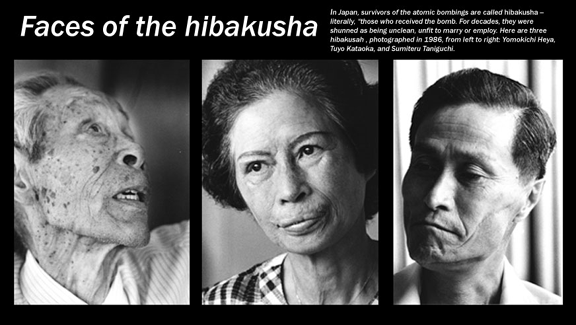
The combined number of officially recognized survivors of the two nuclear attacks, known as hibakusha, stood at 118,935 as of March, down 8,820 from a year earlier, the Ministry of Health, Labor and Welfare said. Their average age was 84.53. https://mainichi.jp/english/articles/20220809/p2g/00m/0na/010000c
Hisashi Ouchi Suffered an 83-day Death By Radiation Poisoning

https://science.howstuffworks.com/hisashi-ouchi.htm By: Patrick J. Kiger | Aug 8, 2022
On the morning of Sept. 30, 1999, at a nuclear fuel-processing plant in Tokaimura, Japan, 35-year-old Hisashi Ouchi and two other workers were purifying uranium oxide to make fuel rods for a research reactor.
As this account published a few months later in The Washington Post details, Ouchi was standing at a tank, holding a funnel, while a co-worker named Masato Shinohara poured a mixture of intermediate-enriched uranium oxide into it from a bucket.
Suddenly, they were startled by a flash of blue light, the first sign that something terrible was about to happen.
The workers, who had no previous experience in handling uranium with that level of enrichment, inadvertently had put too much of it in the tank, as this 2000 article in Bulletin of the Atomic Scientists details. As a result, they inadvertently triggered what’s known in the nuclear industry as a criticality accident — a release of radiation from an uncontrolled nuclear chain reaction.
Ouchi, who was closest to the nuclear reaction, received what probably was one of the biggest exposures to radiation in the history of nuclear accidents. He was about to suffer a horrifying fate that would become a cautionary lesson of the perils of the Atomic Age.
“The most obvious lesson is that when you’re working with [fissile] materials, criticality limits are there for a reason,” explains Edwin Lyman, a physicist and director of nuclear power safety for the Union of Concerned Scientists, and co-author, with his colleague Steven Dolley, of the article in Bulletin of the Atomic Scientists.
If safeguards aren’t carefully taught and followed, there’s potential for “a devastating type of accident,” Lyman says.
It wasn’t the first time it had happened. A 2000 U.S. Nuclear Regulatory Commission report noted that before Tokaimura, 21 previous criticality accidents had occurred between 1953 and 1997.
The two workers quickly left the room, according to The Post’s account. But even so, the damage already had been done. Ouchi, who was closest to the reaction, had received a massive dose of radiation. There have been various estimates of the exact amount, but a 2010 presentation by Masashi Kanamori of the Japan Atomic Energy Agency put the amount at 16 to 25 gray equivalents (GyEq), while Shinohara, who was about 18 inches (46 centimeters) away, received a lesser but still extremely harmful dose of about 6 to 9 GyEq and a third man, who was further away, was exposed to less radiation.
Internet articles frequently describe Ouchi as ‘the most radioactive man in history,’ or words to that effect, but nuclear expert Lyman stops a bit short of that assessment.
“The estimated doses for Ouchi were among the highest known, though I’m not sure if it’s the highest,” explains Lyman. “These typically occur in these kinds of criticality accidents.”
What Does a High Dose of Radiation Do To the Body?
The radiation dose in a criticality accident can be even worse than in a catastrophic accident at a nuclear power plant, such as the 1986 reactor explosion at Chernobyl in Ukraine, then a part of the Soviet Union, where the radiation was dispersed. (Even so, 28 people eventually died from radiation exposure.)
“These criticality accidents present the potential for delivery of a large amount of radiation in a short period of time, though a burst of neutrons and gamma rays,” Lyman says. “That one burst, if you’re close enough, you can sustain more than a lethal dose of radiation in seconds. So that’s the scary thing about it.”
High doses of radiation damage the body, rendering it unable to make new cells, so that the bone marrow, for example, stops making the red blood cells that carry oxygen and the white blood cells that fight infection, according to Lyman. “Your fate is predetermined, even though there will be a delay,” he says, “if you have a high enough dose of ionizing radiation that will kill cells, to the extent that your organs will not function.”
According to an October 1999 account in medical journal BMJ, the irradiated workers were taken to the National Institute of Radiological Sciences in Chiba, just east of Tokyo. There, it was determined that their lymphatic blood count had dropped to almost zero. Their symptoms included nausea, dehydration and diarrhea. Three days later, they were transferred to University of Tokyo Hospital, where doctors tried various measures in a desperate effort to save their lives.
Ouchi’s Condition Continued to Deteriorate
When Ouchi, a handsome, powerfully built, former high school rugby player who had a wife and young son, arrived at the hospital, he didn’t yet look like a victim of intense radiation exposure, according to “A Slow Death: 83 Days of Radiation Sickness,” a 2002 book by a team of journalists from Japan’s NHK-TV, later translated into English by Maho Harada. His face was slightly red and swollen and his eyes were bloodshot, but he didn’t have any blisters or burns, though he complained of pain in his ears and hand. The doctor who examined him even thought that it might be possible to save his life.
But within a day, Ouchi’s condition got worse. He began to require oxygen, and his abdomen swelled, according to the book. Things continued downhill after he arrived at the University of Tokyo hospital. Six days after the accident, a specialist who looked at images of the chromosomes in Ouchi’s bone marrow cells saw only scattered black dots, indicating that they were broken into pieces. Ouchi’s body wouldn’t be able to generate new cells. A week after the accident, Ouchi received a peripheral blood stem cell transplant, with his sister volunteering as a donor.
Nevertheless, Ouchi’s condition continued to deteriorate, according to the book. He began to complain of thirst, and when medical tape was removed from his chest, his skin started coming off with it. He began developing blisters. Tests showed that the radiation had killed the chromosomes that normally would enable his skin to regenerate, so that his epidermis, the outer layer that protected his body, gradually vanished. The pain became intense. He began experiencing breathing problems as well. Two weeks after the accident, he was no longer able to eat, and had to be fed intravenously. Two months into his ordeal, his heart stopped, though doctors were able to revive him.
On Dec. 21, at 11:21 p.m., Ouchi’s body finally gave out. According to Lyman’s and Dolley’s article, he died of multiple organ failure. Japan’s Prime Minister at the time, Keizo Obuchi, issued a statement expressing his condolences to the worker’s family and promised to improve nuclear safety measures, according to Japan Times.
Shinohara, Ouchi’s co-worker, died in April 2000 of multiple organ failure as well, according to The Guardian.
The Japanese government’s investigation concluded that the accident’s main causes included inadequate regulatory oversight, lack of an appropriate safety culture, and inadequate worker training and qualification, according to this April 2000 report by the U.S. Nuclear Regulatory Commission. Six officials from the company that operated the plant were charged with professional negligence and violating nuclear safety laws. In 2003, a court gave them suspended prison terms, and the company and at least one of the officials also were assessed fines, according to the Sydney Morning Herald.
Fukushima water dumping plan triggers fresh anger from South Korea
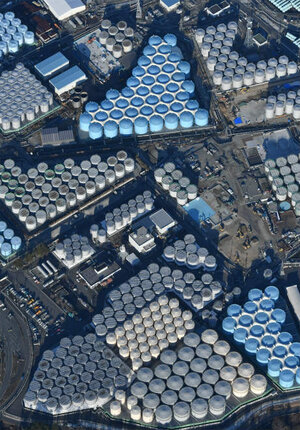
As water-dumping moves advance, S. Koreans seek firm regional stance, http://global.chinadaily.com.cn/a/202208/09/WS62f1be52a310fd2b29e7119d.html By YANG HAN in Hong Kong |2022-08-09
Japan’s plan to dump radioactive wastewater from the stricken Fukushima nuclear power plant will endanger the lives of people in the Asia-Pacific region, say experts who want to see stepped-up efforts against the ocean disposal from the countries most at risk.
South Koreans have been among those expressing their opposition to the plan, and voices have again been raised after Japan moved a step closer to implementing its planned discharge of the nuclear-contaminated water from next year, following the recent approval of the plan’s details by the nation’s nuclear regulator.
“The discharge of wastewater from Fukushima is an act of contaminating the Pacific Ocean as well as the sea area of South Korea,” said Ahn Jae-hun, energy and climate change director at the Korea Federation for Environment Movement, an advocacy group in Seoul.
“Many people in South Korea believe that Japan’s discharge of the Fukushima wastewater is a wrong policy that threatens the safety of both the sea and humans,” Ahn told China Daily.
Last month, Japan’s nuclear regulator approved the plan to discharge wastewater into the Pacific Ocean from the Fukushima Daiichi power plant, after it built up a huge amount of radiation-tainted water. The water has been collected and stored in tanks following efforts to cool down the reactors after an earthquake and tsunami struck Japan in 2011.
The dumping plan has drawn fierce opposition from government officials and civic groups in South Korea, one of the world’s major consumers of seafood.
On Aug 1, South Korea’s Minister of Oceans and Fisheries Cho Seunghwan said the government is considering whether to take the issue to the International Tribunal for the Law of the Sea, Yonhap News Agency reported. Cho said the government’s primary plan is to prevent Japan from releasing the contaminated water. “We do not accept the release plan”, he said.
Ahn said radioactive materials can generate long-term effects and it remains unclear how they will affect the marine ecosystem.
Though the South Korean government is considering taking the issue to the international tribunal, Ahn said it will be difficult to quantify the potential damage.
South Korea has said it will conduct a thorough analysis and revision of the impact of Japan’s plan, but the government has not received enough data from Japan to conduct such research, South Korea’s Hankyoreh newspaper reported in June.
After Japan’s nuclear regulator approved the Fukushima discharge plan, South Korean President Yoon Suk-yeol said Tokyo needs to transparently explain and gain consent from neighboring countries before releasing the contaminated water.
Potential impact
Shaun Burnie, a senior nuclear specialist with Greenpeace Germany, said the environmental group is concerned about the potential impact of the water’s release on the wider Asia-Pacific region.
The level of exposure depends on multiple variables including the concentration in seawater and how quickly it concentrates, disperses and dilutes, forms of life, and the type of radionuclide released and how that disperses or concentrates as it moves through the environment, Burnie said.
“The concentrations are of direct relevance to those who may consume them, including marine species like fish and, ultimately, humans,” Burnie told China Daily.
Noting that the Fukushima contaminated water issue comes under the United Nations Convention on the Law of the Sea as it is a form of pollution to international waters, Burnie said there are strong grounds for individual countries to file a legal challenge against Japan’s plan.
Ahn said joint expressions of opposition in the region could force the Japanese government to choose a safe method to deal with the wastewater instead of dumping it into the sea. China is also among the neighboring countries that have voiced opposition to the Fukushima discharge plan.
Hiroshima marks 77th anniversary of atomic bombing amid nuclear threat

By Reito Kaneko Kyodo News. 6 Aug 22, Hiroshima marked the 77th anniversary of its atomic bombing by the United States on Saturday, amid heightened concern in Japan and elsewhere over repeated Russian threats to resort to nuclear weapons amid the war in Ukraine.
Mayor Kazumi Matsui cautioned in a Peace Declaration at a memorial ceremony in the western city that even as civilian lives are being lost in the Russian aggression, reliance on nuclear deterrence is gaining momentum around the world.
“We must immediately render all nuclear buttons meaningless,” he said.
U.N. Secretary General Antonio Guterres was also present at the annual ceremony at the Peace Memorial Park near ground zero, becoming the first U.N. chief to attend since his predecessor Ban Ki Moon in 2010.
Prime Minister Fumio Kishida, who represents a constituency in Hiroshima, decried in his remarks the apparently declining momentum toward a world without nuclear weapons, calling on humanity not to repeat the tragedy of using nuclear weapons……………………………..
The combined number of officially recognized survivors of the two nuclear attacks, known as hibakusha, stood at 118,935 as of March, down 8,820 from a year earlier, the Ministry of Health, Labor and Welfare said. Their average age was 84.53. https://english.kyodonews.net/news/2022/08/5ad7cbefa68e-hiroshima-marks-77th-anniv-of-atomic-bombing-amid-nuclear-threat.html
Resumption of Mihama Nuclear Power Plant Unit 3 delayed due to leakage of water containing radioactive materials, Kansai Electric Power Co.

August 3, 2022
Kansai Electric Power Co. (KEPCO) announced on August 3 that it would postpone the resumption of power dispatch for the Mihama Unit 3 reactor (Fukui Prefecture), which is undergoing routine inspections and was scheduled to restart on August 12. This is due to a leak of water containing trace amounts of radioactive materials in the reactor’s auxiliary building, which has necessitated an investigation into the cause and restoration work. The resumption date has not yet been determined.
According to KEPCO, the leak was discovered during a routine inspection on the morning of January 1, near a device in the auxiliary reactor building that prevents primary cooling water from leaking outside. The amount of leaked water is estimated to be approximately 7 tons. The company claims that the water did not leak outside the building and that there is no environmental impact or radiation exposure to workers.
KEPCO, Yagi, Mori, and 3 others “appropriate for prosecution” by the Public Prosecutor’s Examination Board

Aug. 1, 2022
On August 1, the Osaka Second Public Prosecutors’ Office (Prosecutor’s Office) announced its decision to “consider indicting” former KEPCO Chairman Makoto Yagi (72), former Chairman Shosuke Mori (81), and former President Shigeki Iwane (69), all of whom had been accused of special breach of trust under the Companies Act, but were not charged by the Special Investigation Department of the Osaka District Public Prosecutors Office. The Special Investigation Department reopened the case.
The Special Investigation Department will reopen the investigation and, in principle, make a new decision within three months as to whether or not they are criminally responsible. Even if the indictment is not filed again, if the Public Prosecutor’s Office issues a second “appropriate for prosecution” resolution, the lawyer designated to act as prosecutor will be forced to prosecute the case.
In January, a citizens’ group, “Association to Prosecute KEPCO’s Illegal Refund of Nuclear Power Plant Money,” filed a review with the Public Prosecutor’s Office, appealing against the action taken by the Special Investigation Department.
A tax investigation by KEPCO led to the discovery that since 2019, 83 successive executives of KEPCO had received a total of approximately 370 million yen worth of money and goods from a former assistant director of Takahama Town in Fukui Prefecture, where the Takahama nuclear power plant is located (he died in 2007). It was also discovered that Yagi and Mori took the initiative to compensate 18 former executives with a total of approximately 260 million yen in the form of commissioned remuneration for a portion of the executives’ remuneration that had been reduced due to deteriorating business performance after the Great East Japan Earthquake.
The citizens’ group filed criminal charges against Yagi, Mori, and nine others, but in November 2009, the Special Investigation Department dropped all nine charges, finding no evidence of willful intent to cause damage to KEPCO. The prosecutors’ committee voted to “drop the indictment” against six of the nine except for Yagi and Mori. Ryo Numata and Yukina Furukawa
https://mainichi.jp/articles/20220801/k00/00m/040/062000c?fbclid=IwAR31eI65WQN2p6QhS-aNRYiZM7MookQGcsuQI6FrojStiS_3pINB4ep0_jE
Nuclear Weapons Policies of Japan and South Korea Challenged

July 31, 2022
By Jaya Ramachandran
GENEVA (IDN) — The Basel Peace Office, in cooperation with other civil society organisations, has challenged the nuclear weapons policies of Japan and South Korea in the UN Human Rights Council, maintaining that these violate the Right to Life, a right enshrined in Article 6 of the International Covenant on Civil and Political Rights (ICCPR).
The two East Asian countries’ nuclear strategies have been called into question in reports submitted on July 14 as part of the Universal Periodic Review (UPR) of the obligations of Japan, South Korea and 12 other countries under human rights treaties. (See Submission on Japan and Submission on South Korea).
The submissions, presented at a time when Russia has made nuclear threats to the US and NATO if they intervene in the Russian invasion of Ukraine, underline the need to address the risks of nuclear deterrence policies. Besides, Russia is not the only country that possesses nuclear weapons and/or maintains options to initiate nuclear war.
“In times of high tensions involving nuclear-armed and/or allied states, plans and preparations for the use of nuclear weapons elevate the risk of nuclear war, which would be a humanitarian catastrophe, severely violating the rights of current and future generations,” says Alyn Ware, Director of the Basel Peace Office. “Compliance with the Right to Life with respect to nuclear weapons is, therefore, an urgent matter, impacting the rights of all humanity.”
In 2018 the UN Human Rights Committee affirmed that the threat or use of nuclear weapons is incompatible with the Right to Life, and that States parties to the ICCPR have obligations to refrain from developing, acquiring, stockpiling and using them. They must also destroy existing stockpiles and pursue negotiations in good faith to achieve global nuclear disarmament.
But both Japan and South Korea are engaged in extended nuclear deterrence policies which involve the threat or use of US nuclear weapons on their behalf in an armed conflict. Both have also supported the option of first use of nuclear weapons on their behalf, even when the United States has been trying to step back from such a policy.
The Basel Peace Office and other civil society organisations argue that the extended nuclear deterrence policies of Japan and South Korea violate their human rights obligations, as is their lack of support for negotiations for comprehensive, global nuclear disarmament.
The submissions make several recommendations of policies the governments could take to conform to the Right to Life. These include adopting no-first-use policies and taking measures to phase out the role of nuclear weapons in their security doctrines.
This they could do by establishing a Northeast Asia Nuclear-Weapon-Free Zone and urging at the ongoing Non-Proliferation Treaty (NPT) Review Conference an agreement on the global elimination of nuclear weapons by 2045, the 75th anniversary of the NPT.
The submissions are not solely critical of the two governments. They also applaud Japan and South Korea for the positive steps taken. South Kora, in particular, has deployed sports diplomacy (the 2018 Winter Olympics peace initiative) and other diplomatic efforts to rebuild dialogue and agreement with North Korea on a process for peace and denuclearization of the Korean Peninsula.
If the UN Human Rights Council decides to pick up on the challenges and recommendations in the submissions, and direct these to Japan and South Korea, the two countries are required to respond.
Similar submissions were made over the past two years to the Human Rights Council and other UN human rights bodies with regard to the nuclear policies of Russia, the USA, France, Canada, Denmark, Iceland, North Korea, Netherlands and the United Kingdom (see Nuclear weapons and the UN human rights bodies).
At that time, the issues were not taken up in earnest by the relevant bodies. However, it is hoped that the increased threat of nuclear war arising from the Ukraine conflict might stimulate the Human Rights Council to make this a much higher priority for the current review cycles. [IDN-InDepthNews — 31 July 2022]
Kishida to call for nuke-free world in historic address at U.N. treaty conference

July 31, 2022
In a year in which nuclear disarmament hopes have been dented by not-so-subtle references by Russia to its own arsenal following its invasion of Ukraine, Prime Minister Fumio Kishida is set to make history as the first Japanese leader to address the United Nations’ nuclear nonproliferation treaty review conference, which begins in New York on Monday.
Kishida, who represents a district in Hiroshima, is expected to call for a world without nuclear weapons and for greater transparency among nuclear powers regarding their stockpiles and capabilities. His message will refer to Japan’s experience as the only country to have been attacked with an atomic bomb. The leader will also stress that all countries should neither use nuclear weapons nor threaten to use them.
Speaking to reporters in Tokyo on Friday, the prime minister said it was important to link the treaty’s ideals with current geopolitical realities.
“The debate on nuclear disarmament is atrophying,” Kishida said, and he announced he would present a plan at the conference that would hopefully serve as a roadmap toward reaching a world without nuclear weapons.
The prime minister sees Japan’s role at the nearly monthlong conference, which will focus on keeping the buildup of nuclear weapons under control, as one of helping to bridge the differences between nuclear powers and nonnuclear states. Kishida is hoping to promote talks between China and the United States on nuclear disarmament and arms control. He’s also expected to call on the international community to work toward North Korea’s denuclearization.
In addition, Kishida will attend a side meeting of foreign ministers of 12 nonnuclear states that make up the Non-Proliferation and Disarmament Initiative (NPDI).
Co-founded by Japan and nine other nations in September 2010, the NPDI works within the framework of the Treaty on the Non-Proliferation of Nuclear Weapons (NPT) on steps to increase transparency efforts on nuclear disarmament.
But the last NPT review conference in 2015 ended in failure. And the establishment of a separate treaty banning nuclear weapons is supported by nonnuclear weapons states frustrated with the lack of progress at the NPT toward the disarmament goal. In that context, reaching a final agreement among the 191 NPDI member states will be a challenge.
Long-held objectives
The NPT entered into force in 1970 with the objective of preventing the buildup of nuclear weapons and related technology. It also supported the peaceful use of nuclear energy, and had the goal of eventually achieving complete disarmament. Treaty signatories include five declared nuclear weapons states — United States, China, the United Kingdom, France, and Russia — all of which are permanent members of the U.N. Security Council.
The Stockholm International Peace Research Institute estimates there were 12,705 nuclear warheads in existence worldwide as of January, of which about 9,440 were in military stockpiles available for potential use. An estimated 3,732 warheads were deployed with missiles and aircraft, and around 2,000 — nearly all of which belonged to Russia or the U.S. — were kept in a state of high operational alert. China had 350 warheads, Pakistan had 165 and India had 160.
India and Pakistan, which have declared their nuclear weapons programs, have not joined the NPT. Israel maintains a policy of strategic ambiguity on its nuclear weapons’ program and has not joined either, although it reportedly has 90 warheads. North Korea, believed to have at least 20 nuclear warheads, withdrew from the pact in 2003.
The tenth review conference is expected to consider a number of issues: universality of the Treaty; nuclear disarmament, including specific practical measures; nuclear non-proliferation, including the promoting and strengthening of safeguards; measures to advance the peaceful use of nuclear energy, safety and security; regional disarmament and non-proliferation.
NPT member states meet every five years, with this year’s conference having been postponed since 2020 due to the pandemic.
A shift in focus?
The 2015 conference failed to produce a substantial outcome due to differences over a proposal to establish a zone free of weapons of mass destruction in the Middle East. The U.S. criticized the Arab League over the lack of progress, while Egypt and Russia blamed the U.S., the U.K., and Canada.
Differences over a deadline for the process and individual requirements for reaching that goal sunk the deal, which would commit 27 Arab League members and observers, plus Iran and Israel, to ban nuclear weapons. Discussions on the issue may resume this year, but it’s likely that the Middle East will take a back seat amid Russia’s invasion of Ukraine.
“We have to deal openly and honestly with threats to the treaty, in particular the effects of Russia’s invasion of Ukraine and its reckless behaviors that impact each of the treaty’s central tenets. I have no doubt that Russia’s actions will affect the climate at the conference,” said Adam Scheinman, U.S. special representative of the President for Nuclear Nonproliferation, at a news conference on July 26.
Marianne Hanson, an international security and arms control expert at the University of Queensland, said that one way conference participants could deal with fears about nuclear warfare in Ukraine is to issue “no first use” statements. But she is pessimistic about that coming to fruition.
“Members should issue no first-use statements — China is the only one of the treaty’s nuclear weapons’ states to do so. It would be a concession that would please the nonnuclear weapons’ states. But former U.S. President Barack Obama’s attempt to issue a no first use statement was halted by Japanese and South Korean objections. I don’t expect we will see any more NFU statements at this conference,” she said. The two U.S. allies were concerned such a statement would lead to a weakening of the nuclear deterrence provided by the U.S.
Japanese lawmakers and citizens will also be watching to see how NPT members handle the Russia issue and the role the prime minister and leader of the Liberal Democratic Party will play at the conference.
“Russia has threatened to use nuclear weapons against Ukraine. It’s important to forge a path toward agreement (on the principle of no first use) after the joint statement is confirmed — an agreement that includes Russia,” Natsuo Yamaguchi, head of the LDP’s junior coalition partner Komeito, said at a news conference July 26. “I hope that Prime Minister Kishida will play a leading role in this process.”
‘Rival’ treaties
Another main issue the NPT conference will have to deal with is how to reach agreement in the context of the newer United Nations Treaty on the Prohibition of Nuclear Weapons (TPNW), a separate agreement which went into force in January 2021.
Member states of the 2021 treaty have agreed to not develop, test, produce, acquire, possess, stockpile, use or threaten to use nuclear weapons. The treaty prohibits the deployment of nuclear weapons on national territory and the provision of assistance to any state in the conduct of prohibited activities. Sixty-six states have ratified the treaty so far, while another 23 have signed but not ratified it. All, however, are nonnuclear states.
The nuclear power states all refused to join the prohibition treaty, calling it incompatible with the current security environment realities.
“As a final step on the long path to eventual nuclear disarmament, the world will need a verifiable, enforceable treaty, one that is consistent with security conditions in the world and helps generate the security necessary to prevent war,” Scheinman said. “That’s not how I would characterize the TPNW. We’ll either have an NPT-based system for reducing nuclear risks or we’ll have no treaty-based system at all,” he added.
Japan’s position on the TPNW is that, while it is an important step toward the eventual elimination of nuclear weapons, it is weakened by the fact that no nuclear weapons state is a member. Given the current international situation and Japan’s reliance on the U.S. nuclear security umbrella, Tokyo believes a more realistic approach like the NPT, which includes nuclear weapons states, is still needed.
Hanson noted, however, that while nuclear weapons states have only derided the TPNW, the fact that members met in June for the first time since the treaty went into force might push them to tone down their remarks about it at the NPT review conference.
While none of the nuclear weapons states were at the June meeting, NATO allies Norway, Germany, Belgium and the Netherlands, as well as Australia, participated as observers.
“I suspect that the nuclear weapons states, especially the U.S., the U.K. and France, will acknowledge that the TPNW exists and that it is ‘useful,’ even though they’ll continue to prioritize the NPT. But at least that would be better than the previous hostile statements about it,” Hanson said.
https://www.japantimes.co.jp/news/2022/07/31/national/nuclear-conference-kishida-speech/
Loss of Cooling Function Accident at Rokkesho Reprocessing Plant – High Level Radioactive Liquid Waste at Risk

July 31, 2022
On July 2, a serious accident of loss of cooling function occurred at the Rokkasho Reprocessing Plant. As a result, cooling of high-level radioactive liquid waste (2.6 m3) stored in “Feed solution tank B” in the preliminary stage of crow solidification was interrupted for eight hours. This liquid waste is dangerous because it generates heat for a long period of time, and if the cooling function is lost, the liquid waste is expected to boil and evaporate in 24 hours and cause a hydrogen explosion in 280 hours.

The cause was an accidental closing of a dividing valve. The valve in question is located near the coils that cool the high-level radioactive liquid waste. When the cooling function of the internal loop is lost, the emergency response is to connect hoses from outside to inject cooling water and close this partition valve. Loss of cooling function is assumed to be caused by a major earthquake or aircraft collision, and the work will be carried out in a great hurry.
Locked with metal chains and padlocks


According to the press conference materials of the nuclear fuel company, the valve was closed by mistake, so a metal chain was wrapped around the valve and padlocked so that it could not be closed easily. However, where will the master key of the padlock be kept at the site where many things may have fallen down in a major earthquake? What will you do if you cannot find the key? Where will you find the cutter to cut the metal chain when the padlock does not open?
I must say that metal chains and padlocks are the worst possible response to a minute-by-minute cooling function restoration operation. According to NFI, similar locks and additional work will be implemented at 539 locations in the vitrification building by the end of July, and at 2,500 locations throughout the plant by the end of the year. The cooling function is placed in a very dangerous situation. It is only a matter of using paper-based seals that can be cut by hand.
Those who thought of metal chains and padlocks are those who do not know what to expect in a serious accident. Furthermore, it is a “countermeasure that was done in a rush. A calm Phase 3 response is necessary to deal with a serious accident. JNFL’s post-accident response is completely in Phase 4, making a series of mistakes and “digging its own grave. JNFL should quickly move to Phase 3 and reset the metal chain and padlock measures.
Confusion at the site due to multiple drawings?
Although JNFL attributes the cause of the accident to human error in misidentifying the dividing valve, it is possible that the piping drawings and the actual piping were different. The reason to suspect this is the 2019 and 2020 applications.
This is because the hose connections and shut-off valves have been renumbered, some numbers have disappeared from the drawings, some new connections have been added, and there are two connections with the same number that cannot be distinguished.
For safety reasons, changing the numbers is not a good idea. If it were to be changed, it would require a lot of corrective work and would be a source of human error.


Pick up the numbers on the 2019 and 2020 drawings in order: numbers 1-8 are the same, but number 9 in 2019 is gone and number 10 is number 9 in 2020; number 12 has two locations in 2019 and both are number 11 in 2020; number 13 in 2019 is 2020. In 2019, there are two locations with number 12, and in 2020 both are number 11; number 13 in 2019 is replaced by number 12 in 2020; numbers 15, 16, and 25 in 2019 are gone and number 14 is created where it was not in 2019.

KDDI’s major communications outage was a “mix-up in the operations manual. The operator who was doing maintenance on the router was working according to the manual. The work was not too difficult. But the reason for the mistake was that the manual they were referring to was an older version.”
At the reprocessing plant where the loss of cooling function accident occurred, the drawings and on-site confirmation are also urgently needed.
Also, which department at NFI approved the safety measures for the construction of System A that caused the accident? We do not even know if the Regulatory Commission approved them. I am shocked at the unbelievable response to the construction of a very dangerous facility.
The reprocessing process is a very dangerous and complicated process that must be carried out steadily, but JNFL has repeatedly responded to incidents of this magnitude in a panicked and erroneous manner. It has become clear that JNFL’s attitude toward safety is problematic and that they have not accumulated any experience. As a business operator, I cannot entrust JNFL with reprocessing.
<Reference.
Drawings for 2019 and 2020
2020/4/28 examination material pdf000309774
https://www.nsr.go.jp/disclosure/law_new/REP/180000013.html
2019/3/8 examination material pdf000264093
https://www.nsr.go.jp/disclosure/law_new/REP/180000009.html
Material on evaporation and drying
Examination Meeting on the Conformity of Nuclear Fuel Facilities, etc. to New Regulation Criteria
https://www.nsr.go.jp/activity/regulation/tekigousei/nuclear_facilities/index.html
FY 2015 Review Meeting on Conformity of Nuclear Fuel Facilities, etc. to New Regulation Criteria
https://warp.da.ndl.go.jp/info:ndljp/pid/11275007/www.nsr.go.jp/disclosure/committee/yuushikisya/tekigousei/nuclear_facilities/ h27fy/index.html
Handout for the 65th Meeting June 29, 2015
Document 2
https://warp.da.ndl.go.jp/info:ndljp/pid/11275007/www.nsr.go.jp/data/000112379.pdf
89th Session December 21, 2015 (2015)
https://warp.da.ndl.go.jp/info:ndljp/pid/11275007/www.nsr.go.jp/disclosure/committee/yuushikisya/tekigousei/nuclear_facilities/ 00000060.html
Handout 2(1)
https://warp.da.ndl.go.jp/info:ndljp/pid/11275007/www.nsr.go.jp/data/000134166.pdf
10 years after nationalization, Tepco still faces mounting challenges

July 31, 2022
Sunday marked the 10th anniversary since Tokyo Electric Power Company Holdings Inc. was effectively nationalized after the devastating triple-meltdown nuclear crisis at the Fukushima No. 1 power plant.
Tepco has struggled to rebuild its business while attempting to restore its reputation and compensate for its role in the disaster that immediately followed the Great East Japan Earthquake of March 11, 2011. However, more competition, a string of scandals and other problems have prevented the restart of its nuclear power plants — a key to rebuilding the company — resulting in sluggish performance.
Recently, the soaring cost of oil due to the Russia-Ukraine war has taken its toll, further exacerbating uncertainties in its restructuring roadmap.
In 2012, the Japanese government placed Tepco under its control by injecting about ¥1 trillion into the firm through the Nuclear Damage Liability Facilitation Fund to prevent the utility from bankruptcy and facilitate compensation efforts.
The total cost of the nuclear accident, which includes compensation, decommissioning and decontamination, is expected to be around ¥21.5 trillion ($161.3 billion), of which ¥15.9 trillion will be paid by Tepco.
Tepco, which shifted to a holding company structure in 2016 to improve management efficiency, announced a reconstruction plan in 2021 and aims to secure ¥500 billion annually for compensation and decommissioning costs. It also targets annual profits of around ¥450 billion after fiscal 2030.
But for fiscal 2021, the utility’s net profit plunged to ¥5.6 billion from ¥180.8 billion the previous year, as it saw a drop in electricity sales due to intensified competition and was hit by higher fuel costs from liquefied natural gas (LNG) and coal.
In September, the fuel cost adjustment system, which allows higher fuel costs to be added to rates, will reach its limit, putting further pressure on the company’s operations. Tepco has not disclosed its outlook for this fiscal year.
Its major hope is to restart reactors at the Kashiwazaki-Kariwa nuclear power plant in Niigata Prefecture, as firing up one reactor is expected to improve earnings by about ¥50 billion. Yet the plant has been hit by a series of scandals, including inadequate anti-terrorism measures. The Nuclear Regulatory Authority, Japan’s nuclear watchdog, has issued a de facto ban on the plant’s operation.
Although Tomoaki Kobayakawa, Tepco president and CEO, claims that “we are working on nuclear reform with the restoration of trust from the community and society as our top priority,” restarting the plant will not be easy.
The stock price is also an obstacle to denationalization. The government hopes to cover the ¥4 trillion cost of decontamination efforts with the proceeds from the sale of Tepco shares. However, the closing share price on Friday was ¥523, far from the ¥1,500 needed to secure the cost.
As its attempt to reconstruct the firm has not proceeded as expected, Tecpo has repeatedly postponed its decision to denationalize.
A government official said that Tepco “was allowed to continue to exist by fulfilling its responsibility to Fukushima, in order to make steady progress in dealing with the accident.”
To steadily continue taking care of tasks related to the Fukushima nuclear disaster, Tepco will need to improve its business performance through strengthening its retail business by enhancing its services. The utility is also aiming to increase its corporate value by focusing on renewable energy.
1 This Month

Protect Sazan Island from the Trump family! https://secure.avaaz.org/campaign/en/protect_sazan_island_from_the_trump_family_loc/?bqFCVab&v=174511&cl=22707147157&_checksum=5e9dde668860e8231c33699735e16a1fbf22ab2cb01da50c999fe8732b9775ef&utm_source=email&utm_medium=blast_email&utm_campaign=174511
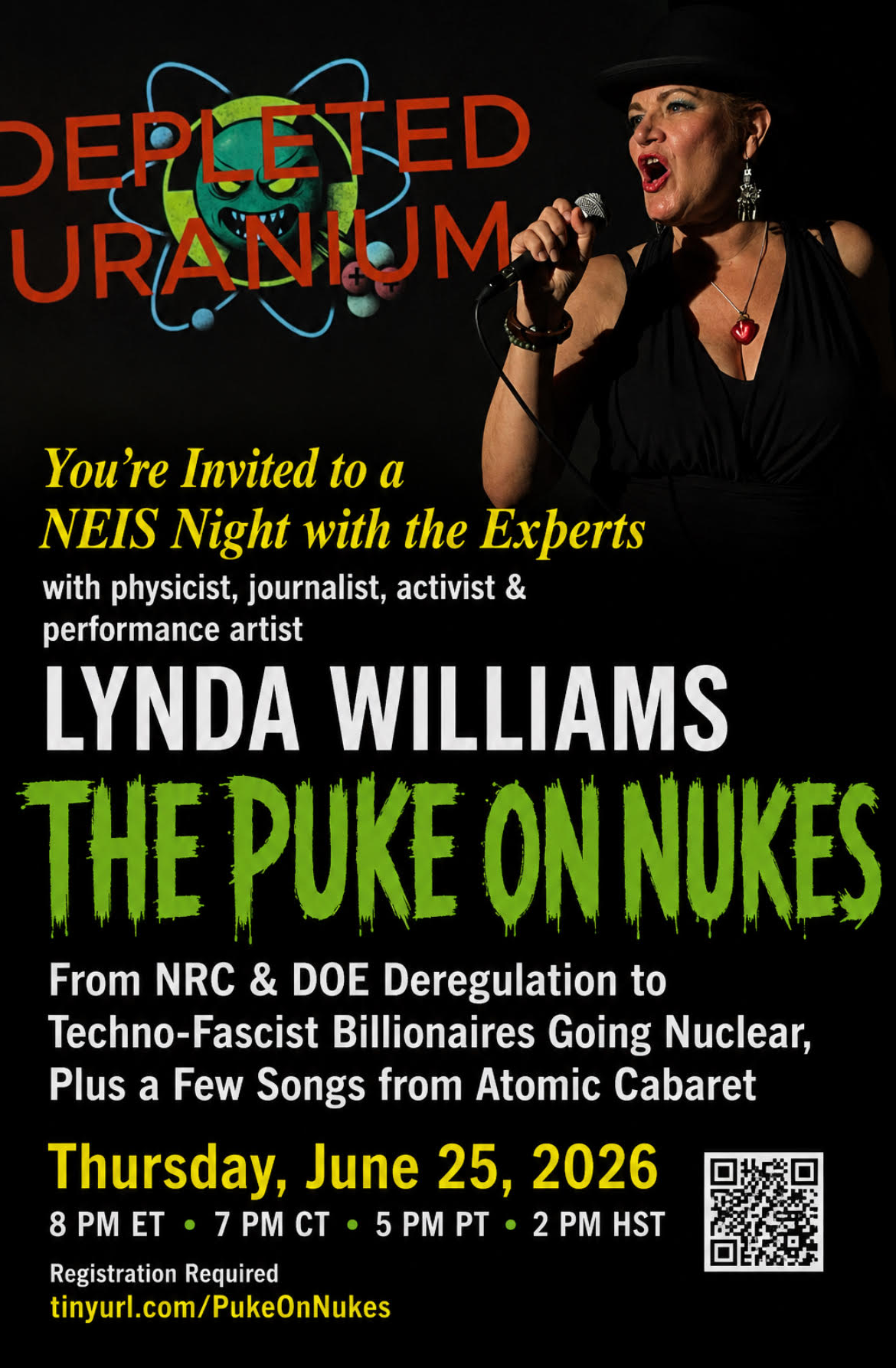
25 June- THE PUKE ON NUKES
Thursday, June 25, 2026
7pm Central Time (8pm ET, 6pm MT, 5pm PT) UTC – 5
From NRC & DOE Deregulation to Techno-Fascist Billionaires Going Nuclear, Plus a Few Songs from Atomic Cabaret REGISTER
26 June – Radiation Trainwreck at the NRC / Join the Protect Better Campaign – https://us02web.zoom.us/meeting/register/4ZlZ5_qLSHGiLSCg8FF6Bg#/registration


Cuba Is Not a Failed State – It Is a Besieged State
PETITION: “Global Appeal to Endorse Palestinian Right of Return of Refugees”
To see nuclear-related stories in greater depth and intensity – go to https://nuclearinformation.wordpress.com
-
Archives
- June 2026 (142)
- May 2026 (306)
- April 2026 (356)
- March 2026 (251)
- February 2026 (268)
- January 2026 (308)
- December 2025 (358)
- November 2025 (359)
- October 2025 (376)
- September 2025 (257)
- August 2025 (319)
- July 2025 (230)
-
Categories
- 1
- 1 NUCLEAR ISSUES
- business and costs
- climate change
- culture and arts
- ENERGY
- environment
- health
- history
- indigenous issues
- Legal
- marketing of nuclear
- media
- opposition to nuclear
- PERSONAL STORIES
- politics
- politics international
- Religion and ethics
- safety
- secrets,lies and civil liberties
- spinbuster
- technology
- Uranium
- wastes
- weapons and war
- Women
- 2 WORLD
- ACTION
- AFRICA
- Atrocities
- AUSTRALIA
- Christina's notes
- Christina's themes
- culture and arts
- Events
- Fuk 2022
- Fuk 2023
- Fukushima 2017
- Fukushima 2018
- fukushima 2019
- Fukushima 2020
- Fukushima 2021
- general
- global warming
- Humour (God we need it)
- Nuclear
- RARE EARTHS
- Reference
- resources – print
- Resources -audiovicual
- Weekly Newsletter
- World
- World Nuclear
- YouTube
-
RSS
Entries RSS
Comments RSS
 nuclear-news