Japan’s Tokyo Electric Power Company (Tepco) aims to become an innovative global energy and technology company, according to its president, Tomoaki Kobayakawa. He stressed the company will continue providing strong support for the restoration of Fukushima.
Tepco is Japan’s largest power company, supplying energy to the greater Kanto area, including the country’s two biggest cities, Tokyo and Yokohama. As well as the damaged Fukushima Daiichi plant, Tepco also owns the Fukushima Daini and Kashiwazaki-Kariwa nuclear power plants.
Speaking at a press conference held on 16 February at the Federation of Electric Power Companies of Japan, Kobayakawa said Tepco faces challenges posed by the deregulation of Japan’s energy markets, the country’s declining population, and the need to continue clean-up work in Fukushima Prefecture.
Tepco will continue its transformation from a local utility into an innovative global energy and technology company, partnering with other leaders around the world, Kobayakawa said.
Tepco aims to increase its revenue by JPY500 billion (USD4.7 billion) per year, generating a total of JPY450 billion in profit over the next decade.
Kobayakawa said this would be achieved through streamlining businesses and cost reduction, reorganisation and integration of nuclear power and distribution, as well as forming alliances with partners. Tepco will create businesses in new areas, which will create a value chain from fuel upstream to thermal generation and bundling the sale of electricity and natural gas.
Kobayakawa said Tepco’s parent company – Tepco Holdings – will create a management committee during the coming fiscal year to formulate a detailed plan for achieving its aim.
“Our main mission is guaranteeing the delivery of a stable supply of low-cost electricity to customers,” he said. “Within that mission, nuclear power is not everything. Thermal power, the procurement of renewable energy, and hydropower all play a part.”
“Renewables are an essential component of our future,” Kobayakawa said. “We believe we can scale up our renewables business to create a new source of revenue comparable to JERA.”
JERA is a 50/50 joint venture formed between Tepco and Chubu Electric Power Company in April 2015. The main business areas of JERA are: upstream fuel investments; fuel procurement; fuel transportation; fuel trading; replacement and construction of domestic thermal power plants; overseas power generation and energy infrastructure.
However, Kobayakawa stressed the focus on the future will not come at the expense of Tepco’s obligations to its past. Noting the steady improvement of the situation both inside the damaged Fukushima Daiichi nuclear power plant and in the surrounding area, Kobayakawa affirmed the corporate mission to rebuild communities and restore the trust of the residents, including efforts to support the sale of products from Fukushima Prefecture.
In May 2012, the Japanese government approved amendments to Tepco’s ten-year special business plan which effectively puts it under state control. Under the amendments, the government provided Tepco with JPY1 trillion in state funds in return for a 51% stake in the company.
In 2014, Tepco was reorganised into two main sections: a power generation business and a separate division dedicated to decommissioning the Fukushima Daiichi site.
A further reorganisation followed in April 2016, with Tepco being structured under Tepco Holdings. Its fuel and thermal generation operations were placed in a subsidiary called Tepco Fuel and Power Incorporated; its power transmission and distribution business became Tepco Power Grid Incorporated; and its electricity retail operations became Tepco Energy Partner Incorporated. Its nuclear-related operations remained within the holding company.
February 27, 2018
Posted by dunrenard |
Japan | Expansion, Tepco |
Leave a comment
 Mainichi 26th Feb 2018, The transportation of spent nuclear fuel from the site of the Fugen
prototype advanced converter reactor in central Japan will be postponed by
nine years to fiscal 2026 as a reprocessing facility has yet to be
determined, its operator said Monday.
Japan Atomic Energy Agency President Toshio Kodama announced the delay in a meeting with Fukui Gov. Issei
Nishikawa. The state-backed agency had initially aimed to complete
transportation of the fuel from the reactor in Tsuruga, Fukui Prefecture,
by next month. It was originally planned that the reprocessing facility in
Tokaimura, Ibaraki Prefecture, would receive the fuel, but the agency
decided in 2014 to scrap the plant due to the difficulty of satisfying
tighter safety regulations adopted following the 2011 Fukushima nuclear
crisis.
The agency had been looking to transport the fuel overseas for
reprocessing but discussions have not gone smoothly, sources close to the
matter said. The Fugen reactor is currently undergoing decommissioning
after being shut down in March 2003 without the prospect of being put to
commercial use, as a project to build a next-stage experimental reactor was
scrapped due to its high cost. Operation of the reactor started in 1979.
https://mainichi.jp/english/articles/20180226/p2g/00m/0dm/071000c
February 27, 2018
Posted by Christina Macpherson |
Japan, wastes |
Leave a comment
Government officials see no need to draft a new evacuation plan for the possibility of simultaneous nuclear accidents taking place at the Takahama (above) and Oi nuclear power plants in Fukui Prefecture.
FUKUI – The central government and the Fukui Prefectural Government have determined there is no need to craft a new evacuation plan in case of a twin nuclear accident there, Cabinet Office documents show.
In a meeting last month, state and prefectural officials confirmed that a simultaneous accidents at the Takahama and Oi nuclear power plants can be dealt with under the plants’ existing evacuation plans, which were compiled separately by each plant, said the documents, which were obtained Sunday.
The meeting involved officials from the Cabinet Office, the Fukui, Shiga and Kyoto prefectural governments, and Kansai Electric Power Co., which runs the atomic plants.
The consensus at the meeting was that simultaneous nuclear accidents can be dealt with under the existing plans because the evacuation sites don’t overlap, a Fukui prefectural official said.
The two nuclear plants are about 13.5 km apart. About 160,000 to 180,000 people live within 30 km from each of the plants.
February 18, 2018
Posted by dunrenard |
Japan | Evacuation Plan, Fukui Prefecture, Oi NPP, Takahama NPP |
Leave a comment
Article
https://works.bepress.com/daniel_aldrich/13/ Journal of Asian Studies (2011), Daniel P Aldrich, Purdue University, Martin Dusinberre, Newcastle University
Abstract
This article seeks to explain how, given Japan’s “nuclear allergy” following World War II, a small coastal town not far from Hiroshima volunteered to host a nuclear power plant in the early 1980s. Where standard explanations of contentious nuclear power siting decisions have focused on the regional power utilities and the central government, this paper instead examines the importance of historical change and civil society at a local level.
Using a microhistorical approach based on interviews and archival materials, and framing our discussion with a popular Japanese television show known as Hatoko’s Sea, we illustrate the agency of municipal actors in the decision-making process. In this way, we highlight the significance of long-term economic transformations, demographic decline, and vertical social networks in local invitations to controversial facilities. These perspectives are particularly important in the wake of the 2011 Fukushima crisis, as the outside world seeks to understand how and why Japan embraced atomic energy.
February 17, 2018
Posted by Christina Macpherson |
Japan, social effects |
Leave a comment
All utilities lack disposal sites for low-level waste from reactors http://www.asahi.com/ajw/articles/AJ201802160049.htmlBy TSUNEO SASAI/ Staff Writer, February 16, 201 8
Seven electric power companies that plan to decommission nuclear reactors have yet to secure disposal sites for the low-level radioactive waste produced in the dismantling process, an Asahi Shimbun survey showed on Feb. 16.
It may take years for the utilities to gain approval from local governments to dispose of the waste, some of which must remain buried for 100,000 years, meaning that the decommissioning work could be suspended.
Low-level radioactive waste generated during conventional operations of nuclear reactors can be buried at a disposal site of Japan Nuclear Fuel Ltd. in Rokkasho, Aomori Prefecture.
However, the electric power companies themselves must dispose of the low-level radioactive waste produced during decommissioning work.
The Asahi Shimbun asked 10 electric power companies, including Japan Atomic Power Co., about whether they have secured disposal sites for low-level radioactive waste.
Seven companies–Tokyo Electric Power Co., Chubu Electric Power Co., Kansai Electric Power Co., Chugoku Electric Power Co., Shikoku Electric Power Co., Kyushu Electric Power Co. and Japan Atomic Power–replied that they have not secured sites despite their plans to decommission reactors.
In total, they plan to decommission 17 reactors.
The demolition of a 1.1 gigawatt-class nuclear reactor produces more than 10,000 tons of low-level radioactive waste.
The three other companies–Hokkaido Electric Power Co., Tohoku Electric Power Co. and Hokuriku Electric Power Co.–also have not secured disposal sites, but they have no decommissioning plans at the moment.
“We are not considering decommissioning our nuclear reactors,” a Hokuriku Electric Power official said. “As of now, we have not yet decided on a plan to secure disposal sites.”
There are three categories of nuclear waste–L1, L2 and L3–depending on their radioactivity levels.
L1 waste, which has the highest radioactivity level and includes control rods, must be buried more than 70 meters deep into the ground for 300 to 400 years.
After that, the government manages the waste for 100,000 years.
The government is currently studying regulation standards for such waste.
Electric power companies decided to decommission some of their nuclear reactors after the March 2011 disaster unfolded at the Fukushima No. 1 nuclear power plant.
Full-fledged decommissioning work is expected to start soon, but parts removed from the reactors have high radiation levels and cannot be placed temporarily in the compounds of nuclear power plants.
High-level radioactive waste is also produced as a result of the reprocessing of spent nuclear fuel. The government is looking for a disposal site for such waste.
Electric power companies could heighten their demands that the government get involved in efforts to secure disposal sites for low-level radioactive waste.
February 17, 2018
Posted by Christina Macpherson |
Japan, wastes |
Leave a comment
https://www.japantimes.co.jp/news/2018/02/15/business/japan-posts-delivery-vehicles-measure-radiation-fukushima/#.WodGLVpubGg, JIJI FUKUSHIMA – Japan Post Co. and the Fukushima Prefectural Government have signed a comprehensive partnership agreement that includes a plan for it to measure radiation in areas tainted by the 2011 nuclear disaster.
“The agreement is very assuring, as we will be able to receive support for efforts on the safety and security of the region,” Gov. Masao Uchibori said during the signing ceremony at the prefecture’s office on the same day.
It is the 15th time the unit of Japan Post Holdings Co. has concluded an agreement with a prefectural government.
Under the plan, Japan Post’s delivery minivehicles will be equipped with radiation gauges. Data will be collected automatically and wirelessly transmitted to the prefectural government. The prefecture’s coast was heavily damaged by the March 2011 mega-quake and tsunami, while much larger parts of it were contaminated by radiation by the subsequent core meltdowns at the Fukushima No. 1 nuclear plant, run by Tokyo Electric Power Company Holdings Inc.
In addition, the two parties agreed that posters to promote Fukushima goods will be put up at post offices in areas around Tokyo, in Fukushima and five other prefectures in the Tohoku region.
Japan Post’s delivery staff will also alert the prefectural government and others when several days’ worth of newspapers are seen accumulating outside of the homes of elderly people, and when damage to roads is observed.
“We will provide maximum assistance for Fukushima Prefecture’s revitalization,” said Kunio Yokoyama, president of Japan Post.
February 17, 2018
Posted by Christina Macpherson |
environment, Fukushima continuing, radiation |
Leave a comment
 World Nuclear News 15th Feb 2018, Holtec International and GE Hitachi Nuclear Energy (GEH) are to collaborate
on accelerating the commercialisation of Holtec’s SMR-160 small modular
reactor (SMR). Their cooperation will initially include nuclear fuel
development and control rod drive mechanisms. Under a memorandum of
understanding, GEH, Global Nuclear Fuel (GNF), Holtec and SMR Inventec LLC
(SMR LLC) have agreed to enter into a “procompetitive collaboration” to
progress the SMR-160. GNF, a GE-led joint venture with Hitachi and Toshiba,
is primarily known as a supplier of boiling water reactor fuel. SMR LLC is
a wholly-owned subsidiary of Holtec established in 2011 to manage the
development of the SMR-160.
http://www.world-nuclear-news.org/NN-Holtec-and-GEH-team-up-on-advancing-SMR-160-1502184.html
February 17, 2018
Posted by Christina Macpherson |
Japan, Small Modular Nuclear Reactors, USA |
Leave a comment
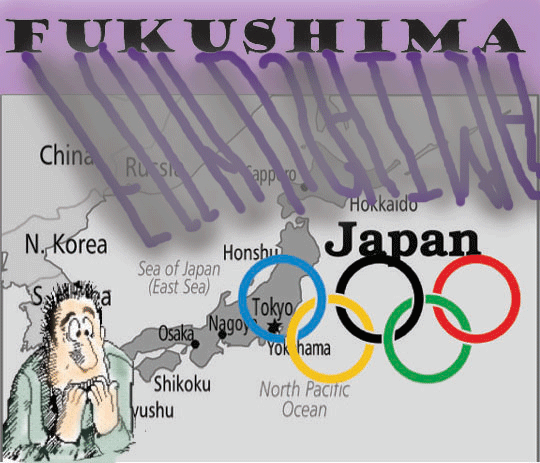 Japan, IAEA agree to cooperate on Tokyo 2020 nuclear counterterrorism, Nikkei Asian Review, 16 Feb 18, VIENNA (Kyodo)
 — The Japanese government and the International Atomic Energy Agency signed an agreement on Thursday to work together to keep the Tokyo 2020 Olympics and Paralympics safe from the threat of terrorism involving nuclear materials.
According to the Japanese Foreign Ministry, the agreement includes measures to support IAEA experts’ participation in events relating to the Tokyo games, the exchange of information on nuclear security issues and the loan to Japan of equipment to detect radiation.
Foreign Minister Taro Kono and IAEA Director General Yukiya Amano observed the signing in Vienna before holding a meeting at which Kono said they agreed to flesh out cooperation in thwarting nuclear terrorism.
“We want to thoroughly cooperate with the IAEA to make sure the Olympics are safe,” Kono said at the outset of the meeting……..https://asia.nikkei.com/Politics-Economy/International-Relations/Japan-IAEA-agree-to-cooperate-on-Tokyo-2020-nuclear-counterterrorism
February 16, 2018
Posted by Christina Macpherson |
Japan, safety |
Leave a comment

Kobe Steel firm suspected of nuclear waste data falsification http://www.asahi.com/ajw/articles/photo/AS20180215003253.html, By MASANOBU HIGASHIYAMA/ Staff Writer,February 15, 2018
A subsidiary of Kobe Steel Ltd. may have falsified test data on highly radioactive waste disposal, the Nuclear Regulation Authority (NRA) announced on Feb. 14.
Kobelco Research Institute Inc. is suspected of tampering with data it gathered on behalf of the Japan Atomic Energy Agency (JAEA), which is contracted to carry out tests by the NRA.
The aim of the tests is to help form a regulatory standard for final disposal sites for nuclear waste, but a report the NRA received from the JAEA said that figures in the original data and those in reports Kobelco submitted to it did not match. Furthermore, some original data could not be located.
The NRA has instructed the JAEA to confirm details about the possible data falsification in response to the report.
A Kobelco source said, “Why data inconsistencies occurred remains unknown at the moment,” but that the research institute “will examine the case with data falsification in mind.”
The tests are designed to examine what happens to metal cladding tubes that had previously contained spent nuclear fuel when they are disposed of deep underground, including possible corrosion and by-products of gas, according to the NRA.
The nuclear watchdog outsourced the testing to the JAEA in fiscal 2012 through fiscal 2014 at a cost of about 600 million yen ($5.59 million).
Kobelco was subcontracted to undertake some of the tests for about 50 million yen.
February 16, 2018
Posted by Christina Macpherson |
Japan, secrets,lies and civil liberties |
Leave a comment
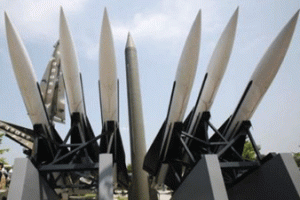
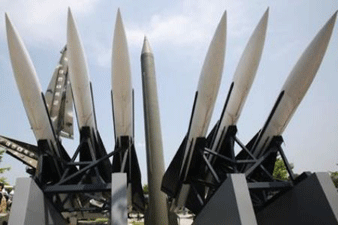
 Is Japan About to Hit Its Nuclear Tipping Point? Tokyo almost built a bomb in 1945 and now has enough plutonium stockpiled for 5,000 nukes. North Korea may give its hawkish government an excuse to build them. The Daily Beast, JAKE ADELSTEIN 02.15.18 TOKYO—“Don’t be fooled by North Korea’s smiley-face diplomacy,” Japan’s foreign minister, Taro Kono, warned last week in the middle of the Winter Olympics’ warm fuzzy photo ops with Hermit Kingdom emissaries.
Kono’s skepticism was quite serious, as is the confrontation he sees looming. Earlier this month he shocked Japan by broaching the idea that the Japanese should gain access to “usable” nuclear weapons, and he lavished praise on U.S. President Donald Trump’s Nuclear Posture Review.
While much of the rest of the world was entranced by North Korean cheerleaders and Kim Jong Un’s baby sister, Japan was quietly considering if and when to build its own nuclear missiles to discourage North Korea from so much as contemplating a missile strike.
The hawkish government of Prime Minister Shinzo Abe and his ruling coalition are exploiting real and unreal fears of a North Korean nuclear attack to drum up support for a Japan that can wage war, and possibly as a prelude to pushing harder for nuclear weapons development.
At a minimum, it should be apparent to the world that this administration has no interest in nuclear disarmament, and is preparing for a possible showdown.
This week, The Ministry of Culture, Education and Science announced that in the Risk Management manual distributed to schools nationwide, it would be urging teachers to conduct missile evacuation drills. That should ratchet up the paranoia a few notches.
North Korean leader Kim Jong Un announced last year that his country’s nuclear program is now complete, after the “successful” launch of a new missile that threatens all of the continental United States. But Japan has been in the crosshairs of the hermit kingdom for some time, and the storm over Kim’s atomic posturing has reignited a simmering, almost taboo, debate about nuclear weapons here.
The question isn’t whether Japan could become a nuclear weapons power. There’s really no doubt about that. But should it? And when? And if so, politically, how?
Japan As A Nuclear Power
Japan’s consumer nuclear energy industry has generated enough plutonium to make an estimated 5,000 nuclear warheads, this has long stood as an implicit threat. As former Defense Minister Satoshi Morimoto once declared, Japan’s commercial nuclear power reactors have “very great defensive deterrent functions.” He was implying that the plants Japan has built to make reactor fuel could be used to make fuel for nuclear arms, if Japan ever decides to do so.
In case anyone missed the point, in the spring of 2016, the Abe government explicitly stated that there is nothing in the nation’s Constitution that forbids pacifist Japan from possessing or using nuclear weapons……… https://www.thedailybeast.com/is-japan-about-to-hit-its-nuclear-tipping-point
February 16, 2018
Posted by Christina Macpherson |
Japan, weapons and war |
Leave a comment
Nikkei Asian review 14th Feb 2018, American
concerns about potential diversion of idle fuel leave the agreement at
risk.
The decision Jan. 16 to automatically extend a nuclear agreement with
the U.S. came as a relief to a Japanese government worried about the
prospect of renegotiating the basis for a cornerstone of its energy policy.
But friction remains over a massive store of plutonium that highlights the
problems with the nation’s ambitious nuclear energy plans. The nuclear fuel
cycle pursued by Japan’s government and power companies centers on
recovering uranium and plutonium from spent fuel for reuse in reactors.
This is made possible by the unique agreement with the U.S. that lets Japan
make plutonium. The radioactive element can be used in nuclear weapons, so
its production is generally tightly restricted. Japan has amassed roughly
47 tons of plutonium stored inside and outside the country — enough for
some 6,000 nuclear warheads. With the nation’s nuclear power plants
gradually taken offline after the March 2011 Fukushima Daiichi disaster,
and progress on restarting them sluggish, Japan has been left with no real
way to whittle down a pile drawing international scrutiny.
https://asia.nikkei.com/Politics-Economy/International-Relations/Japan-s-plutonium-glut-casts-a-shadow-on-renewed-nuclear-deal
February 16, 2018
Posted by Christina Macpherson |
- plutonium, Japan |
Leave a comment
 Drone to probe Fukushima N-plant interior, The Japan News , 10 Feb 18 The Yomiuri Shimbun Tokyo Electric Power Company Holdings Inc. plans to use a small unmanned aerial vehicle to closely inspect conditions inside the No. 3 reactor building of the Fukushima No. 1 nuclear power plant as early as this month.
TEPCO will use the drone to examine the location of scattered debris and the level of radiation inside the reactor building, among other things.
It will be the first drone-based research conducted inside the plant’s Nos. 1, 2 and 3 reactor buildings, in which nuclear meltdowns occurred.
……..TEPCO’s plan is for the drone to enter the No. 3 reactor building through a bay for large cargo on the first floor, then fly upward through a series of openings from the first to the fifth floor.
The drone will check areas including the building’s third floor, which has not been sufficiently monitored because radiation levels are too high.
According to TEPCO, key equipment such as that used to cool spent nuclear fuel pools are located on the third floor.
Confirming the location of possible obstacles and the level of radiation is necessary before decommissioning work can progress.
………Work is currently under way to construct a dome-shaped roof over the building to facilitate the removal of fuel that remains in the spent fuel storage pools. http://the-japan-news.com/news/article/0004230028
February 12, 2018
Posted by Christina Macpherson |
Fukushima continuing |
Leave a comment
The loading of fuel assemblies into the core of unit 3 at the Ohi nuclear power plant in Japan’s Fukui Prefecture will begin tomorrow, Kansai Electric Power Company announced. The utility plans to return both units 3 and 4 at the plant to commercial operation by mid-2018.
Following the shutdown of all of Japan’s reactors after the March 2011 accident at the Fukushima Daiichi plant, Ohi 3 and 4 were given permission to resume operation in August 2012. However, the two 1180 MWe pressurised water reactors (PWRs) were taken offline again for Nuclear Regulation Authority (NRA) inspections in September 2013.
Under Japan’s reactor restart process, plant operators are required to apply to the NRA for: permission to make changes to the reactor installation; approval of its construction plan to strengthen the plant; and, final safety inspections to ensure the unit meets new safety requirements. Operators are required to add certain safety-enhancing equipment within five years of receiving the NRA’s approval of a reactor engineering work programme.
Kansai submitted its construction plan application for Ohi 3 and 4 in July 2013. The NRA approved the plan for strengthening the units in August last year.
Following pre-operation inspections of the units to confirm that the safety countermeasure equipment complies with the approved construction plan at the plant, Kansai is now set to start loading fuel into unit 3 ahead of its restart. In November, the utility said it expected to restart the reactor around mid-March, with commercial operation scheduled from early-April.
The governor of Japan’s Fukui Prefecture approved the restart of Ohi units 3 and 4 in November. Unit 4 is also expected to be restarted in the coming months. Kansai earlier said it expects to refuel the reactor in mid-April, restart it around mid-May, with commercial operation expected to resume in early June.
In December, Kansai announced that it will not seek permission to restart Ohi units 1 and 2, which have been offline since July 2011 and December 2011, respectively. The company will now apply to decommission the two 1175 MWe PWRs, which are approaching 40 years old.
Of Japan’s 42 operable reactors, five have so far cleared inspections confirming they meet the new regulatory safety standards and have resumed operation. These are: Kyushu’s Sendai units 1 and 2; Shikoku’s Ikata unit 3; and Kansai’s Takahama units 3 and 4. Another 19 reactors have applied to restart.
February 9, 2018
Posted by dunrenard |
Japan | Loading Fuel, Oi NPP, Reactors Restart |
Leave a comment
Prime Minister Shinzo Abe, right, and former Prime Minister Naoto Kan at a Lower House Budget Committee session on Feb. 6
Prime Minister Shinzo Abe and predecessor Naoto Kan had a rare face-to-face showdown at a Lower House Budget Committee session over their nuclear energy policies on Feb. 6.
Abe admitted that his Liberal Democratic Party shares partial responsibility for failing to prevent the Fukushima nuclear emergency, but slammed those who advocate abandoning nuclear power generation as irresponsible.
The triple meltdown at the Fukushima No. 1 nuclear power plant, triggered by the 2011 earthquake and tsunami disaster, occurred when the now-disbanded Democratic Party of Japan was in power and Kan was prime minister. He is now a member of the Constitutional Democratic Party of Japan.
Most of the nation’s nuclear plants were built on the back of the LDP’s energy policy during the party’s long stints in power.
“The LDP did not give sufficient consideration to (safety issues of) nuclear facilities while it was in power (before the DPJ’s tenure), did it?” Kan accused Abe. “The LDP should admit its part in failing to prevent the Fukushima accident.”
Abe responded: “That is absolutely correct. The government and the nuclear plant operator were blinded by the safety myth (that nothing catastrophic could happen to a Japanese nuclear power plant), and that caused such tragedy.”
Abe also blasted the no-nuclear plant policy promoted by former LDP Prime Minister Junichiro Koizumi and like-minded lawmakers from opposition parties, saying he “cannot recognize it as a responsible energy policy.”
In an argument over the true cost of nuclear power generation, neither Abe nor Kan would budge from their viewpoints.
Abe indicated he will continue to support restarting nuclear plants around Japan, saying “power bills paid by typical households rose by about 10 percent (on average) while many nuclear plants remained offline.”
Kan condemned Abe’s position as “calculating only what is convenient for yourself,” pointing out that the cost for dealing with the accident’s aftermath and radiation contamination has already more than doubled from what was initially expected.
February 9, 2018
Posted by dunrenard |
Japan | Naoto Kan, Nuclear Debate, Shinzo Abe |
Leave a comment













 nuclear-news