China’s former nuclear chief a spy, as well as corrupt?
CHINA’S NUCLEAR-POWER CHIEF: A SPY?, New Yorker, by Evan Osnos August 11 When Kang Rixin, the head of China’s nuclear-power program, was sentenced to life in prison last November for taking bribes, it was a troubling enough piece of news. Given the speed, scale, and ambition of China’s nuclear program—it has more plants in the planning stage than the rest of the world combined—it did not project reassuring evidence that China has shielded this crucial program from the kind of construction-corruption that has dogged the high-speed rail system.
Today brought startling news. Midway through a video leaked on the Chinese Web, a senior military official explains previously unknown details about major spying cases uncovered in recent years, including the fact that bribery was hardly the most serious accusation against Kang. He is accused of selling secrets about China’s nuclear power industry to foreign countries. “Kang’s case can’t be made public because the damage he has done by selling secrets was a lot more devastating than economic losses,” Major General Jin Yinan said in the video. If true, it would make Kang one of China’s highest-ranking figures to be accused of spying… http://www.newyorker.com/online/blogs/evanosnos/2011/08/chinas-nuclear-power-chief-a-spy.html#ixzz1WZ6kGrJ1
China ramping up its renewable energy goals
China revises up 2015 renewable energy goals: report, by Jim Bai and Chen Aizhu; Editing by Ken Wills, BEIJING Aug 29, 2011 (Reuters) – China will raise development targets for renewable energy such as wind power for the five-year period through 2015, state media reported on Tuesday, as the world’s top energy user and carbon emitter aims to reduce its reliance on fossil fuels.
The country aims to have 100 gigawatts (GW) of on-grid wind power generating capacity by the end of 2015 and to generate 190 billion kilowatt hours (kWh) of wind power annually, the China Securities Journal reported, citing a government plan.
The goal was higher than a target of 90 GW proposed earlier by the National Energy Administration…..http://www.reuters.com/article/2011/08/30/us-china-energy-renewable-idUSTRE77T0CM20110830
Pentagon’s lack of transparency about China’s nuclear weapons
 Pentagon’s 2011 China Report: Reducing Nuclear Transparency, FAS Security Blog, By Hans M. Kristensen, 25 Aug 11, The Pentagon has published its annual assessment of China’s military power (the official title is Military and Security Developments Involving the People’s Republic of China).…..Land-Based Nuclear Missiles
The most noticeable new development compared with last year’s report is that the Pentagon this year has decided to significantly reduce the transparency of China’s land-based nuclear missile force. Continue reading
China stregthening nuclear missiles, in distrust of India
China has strengthened nuclear missiles as deterrent against India: U.S. THE HINDU, NARAYAN LAKSHMAN, 25 AUG 11, China has substituted liquid-fuelled, nuclear-capable missiles with “more advanced and survivable solid-fuelled” rocket systems, and this has been explicitly aimed at “[strengthening] its deterrent posture relative to India,” according to an annual report on the developments within the Chinese military, authored by the United States Pentagon…..
Despite burgeoning defence rapprochement manifested in the Sino-Indian Annual Defence Dialogue established in 2007, India had pulled out of high-level military exchanges following China’s denial of a visa to a senior Indian general in 2010, the Pentagon report said.
Although Premier Wen Jiabao attempted to mend fences during his December 2010 visit to New Delhi “he did not address serious irritants… [and] a high degree of mistrust continues to strain the bilateral relationship,” the report added…..http://www.thehindu.com/news/national/article2397247.ece
China finding excessive radiation levels in seafoods east of Fukushima
 Excessive Radiation Found in Sea Organisms Near Japan’s Nuke Plant 2011-08-24 Xinhua Web Editor: Guo Biological samples taken from waters in the Western Pacific region east of Fukushima, Japan show excessive radiation levels, said a statement from China’s State Oceanic Administration on Wednesday.
The samples were also found to contain argentum-110m and cesium-134, which are normally difficult to detect in biological samples from China’s coastal waters, the statement said. Continue reading
Critical need for China to be more transparent about nuclear issues
it’s critical that the nation develop a clear understanding of the challenges and potential dangers. A certain amount of transparency, including when things go wrong, will help alleviate unnecessary misperceptions and misunderstandings in the region and beyond.

 China’s nuclear sub needs, The Diplomat, By Manpreet Sethi, August 15, 2011 The past couple of weeks have seen a number of reports over a rumoured radiation leak from a 094 type Chinese nuclear submarine stationed near Dalian port. The incident is said to have occurred as electronic equipment was being installed on the sub.
Sounding the alarm on China’s plans for nuclear technology
 Chinese decision-makers should avoid being overly confident about untried safety technologies. No matter how sound newer-generation nuclear technologies appear, such technologies may never have been sufficiently tested in any part of the world. All newer-generation nuclear technologies still impose significant risks in terms of design experience, construction safety and operational reliability
A warning for China’s nuclear sector, China dialogue, Kevin Jianjun Tu, August 10, 2011 “………The deadly Wenzhou [train] crash highlights the dangers of mega-infrastructure projects moving too far, too fast. Chinese decision-makers should take note, argues Kevin Jianjun Tu…..
Fukushima sounded warning bells with the Chinese government and gave policymakers another chance to reconsider plans for 2020. At a March 16 meeting chaired by premier Wen Jiabao, the State Council decided to call a temporary halt to approval of new nuclear-power plants pending new safety rules, and to adjust mid- and long-term nuclear power plans. This indicated a more cautious national strategy for nuclear power development.
Unfortunately, due to a lack of effective checks and balances on nuclear interest groups, there are signs that the great nuclear leap forward is reemerging. Continue reading
China’s rail disaster – a prelude to nuclear disaster?
The breadth of Chinese ambitions to indigenize foreign technologies and scale them for mass deployment has simply outpaced its ability to plan, operate and staff these complex undertakings in a safe and sustainable manner. This is true in the case of high-speed rail, and it threatens to become the overarching storyline for the country’s nuclear energy program.
Wenzhou Train Crash Highlights Risks of China’s Nuclear Program Epoch Times, July 29, 2011 by ML COULD A TECHNOLOGY mishap akin to Saturday’s deadly train crash near Wenzhou, China happen at one of China’s 40 operating or planned nuclear power reactors?….. Experts are attributing China’s high-speed rail woes to its policies of adapting foreign technologies without the means to adequately operate and maintain them.
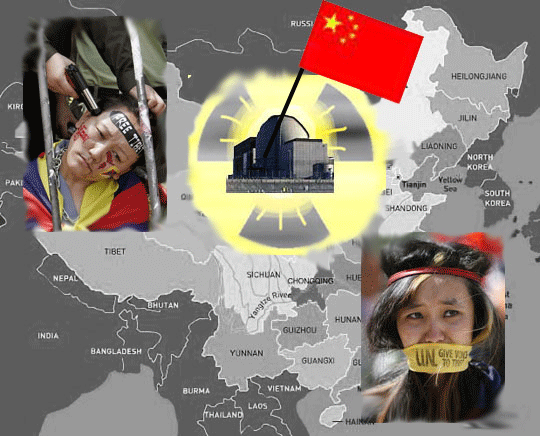
The risky strategy isn’t just being used by China’s Ministry of Railways, it’s also the foundation of the country’s nuclear power program. Continue reading
China touts ‘fast breeder’ nuclear reactor, but it’s an unlikely energy solution
the process hasn’t proved workable on a large scale elsewhere. Fast-breeder programs have been abandoned in a number of countries, including the U.S., and the plants that remain are small.
China’s Nuclear Scientists Unveil Latest ‘Breakthrough, WSJ, James T. Areddy, 21 July 11, “…..The China Institute of Atomic Energy said Thursday that a small, experimental “fast breeder” reactor outside Beijing had been hooked to the grid to produce electricity. …. Continue reading
Inadequate safety monitoring of China’s nuclear power plants
Minister: China needs to step up nuclear oversight, The Nuclear N-Former: June 3, 2011 Beijing (AP) — China must increase oversight of its nuclear power plants after Japan’s disaster, a senior Chinese official said Friday, as the country advances an ambitious program to build more reactors.The ongoing crisis caused by the earthquake and tsunami that struck Japan laid bare a “host of problems” with how nuclear power is handled, Vice Environment Minister Li Ganjie said.“Some of them are technical, some are at a managerial level, some are unavoidable caused by natural disasters, while some are caused by manmade factors and can be prevented,” Li said at a news conference.China needs to raise industry safety standards, make information more accessible and put in place a strong team of independent regulators to supervise nuclear safety, he said……
Even before the Japanese crisis, Li’s ministry had urged the government for more funds to monitor the rapidly growing nuclear power industry.
Minister: China needs to step up nuclear oversight | The Nuclear N-Former: Breaking Nuclear Energy News, Videos, Photos, Commentary & More
Debate over China’s nuclear policy
ANALYSIS: Questions remain on China’s nuclear stance, Taipei Times, By J. Michael Cole / Staff Reporter, 23 May 11, A recent report on China’s nuclear weapons capabilities has re-ignited debate on the country’s nuclear policy and the overall lack of transparency surrounding the People’s Liberation Army (PLA). Continue reading
Toxic radioactive effects of thorium, uranium in rare earths
 Environmental groups have long criticised rare earths mining for spewing toxic chemicals and radioactive thorium and uranium into the air, water and soil, which can cause cancer and birth defects among residents and animals…..
China pays price for world’s rare earths addiction, By Allison Jackson (AFP) – Google News, 7 May 11, BAOTOU, China — Peasant farmer Wang Tao used to grow corn, potatoes and wheat within a stone’s throw of a dumping ground for rare earths waste until toxic chemicals leaked into the water supply and poisoned his land.Farmers living near the 10-square-kilometre expanse in northern China say they have lost teeth and their hair has turned white while tests show the soil and water contain high levels of cancer-causing radioactive materials. Continue reading
China detects radioactive cesium 137 from Fukushima
Radioactive cesium detected in more Chinese regions amid Japan nuclear crisis BEIJING, April 4 (Xinhua) — Trace levels of radioactive isotope cesium-137 and -134 were detected in the air of 13 of the Chinese mainland’s 31 provincial-level regions on Monday, up from eight regions on Sunday.Cesium-137 and -134 were detected in Beijing, Tianjin, Hebei, Shanxi, Shandong, Shanghai, Inner Mongolia, Jiangshu, Zhejiang, Anhui, Jiangxi, Hubei and Ningxia on Monday….Radioactive cesium detected in more Chinese regions amid Japan nuclear crisis
Anxiety growing in China over poor nuclear safety
Chinese environmental campaigners, citizens on microblogs and even the normally pliant state-run media are questioning why China has no obvious emergency preparedness plan, even though many people here live less than a quarter mile from nuclear facilities….people here were already suffering health problems associated with living close to a nuclear facility and that the cancer rate in the area has increased.
China expanding nuclear power but lacks emergency planning The Washington PostBy Keith B. Richburg, April 2, SHANGHAI — The Chinese government repeatedly offers assurances that the nuclear crisis in Japan poses no radiation risk in China. Officials monitor radiation levels in the air over coastal cities daily now. And planes and ships bringing cargo and passengers from Japan are closely scanned.
But the Chinese government has not told citizens living near nuclear facilities what to do in case of a similar disaster here. Continue reading
China: solar power on the rise, nuclear power stalled
China to Cut Nuclear & Increase Solar Power Goals after Japan Crisis – CleanTechnica: 1 April 11, China hasn’t taken long to learn a lesson from the Japan nuclear crisis (perhaps). It is cutting its 2020 target for nuclear power and is filling in with increased solar power targets, according to an official from the National Development and Reform Commission (NDRC).
China recently passed up the U.S. as the world’s leading energy consumer. What it does on this front is critical to the long-term livability of our planet (for humans, at least). It is great to see that it is not only cutting back on nuclear expansion (which is a very risky option until someone learns how to deal with nuclear waste that lasts several times longer than humans have existed for), but that it is also increasing its solar power goals to account for this…….China to Cut Nuclear & Increase Solar Power Goals after Japan Crisis – CleanTechnica: Cleantech innovation news and views
1 This Month

22 June – Virtual Event –Climate Change: New Data, New Debate

Monday, June 22, 2026 2:30 p.m. – 3:15 p.m. CT
YouTube. Register here

Protect Sazan Island from the Trump family! https://secure.avaaz.org/campaign/en/protect_sazan_island_from_the_trump_family_loc/?bqFCVab&v=174511&cl=22707147157&_checksum=5e9dde668860e8231c33699735e16a1fbf22ab2cb01da50c999fe8732b9775ef&utm_source=email&utm_medium=blast_email&utm_campaign=174511
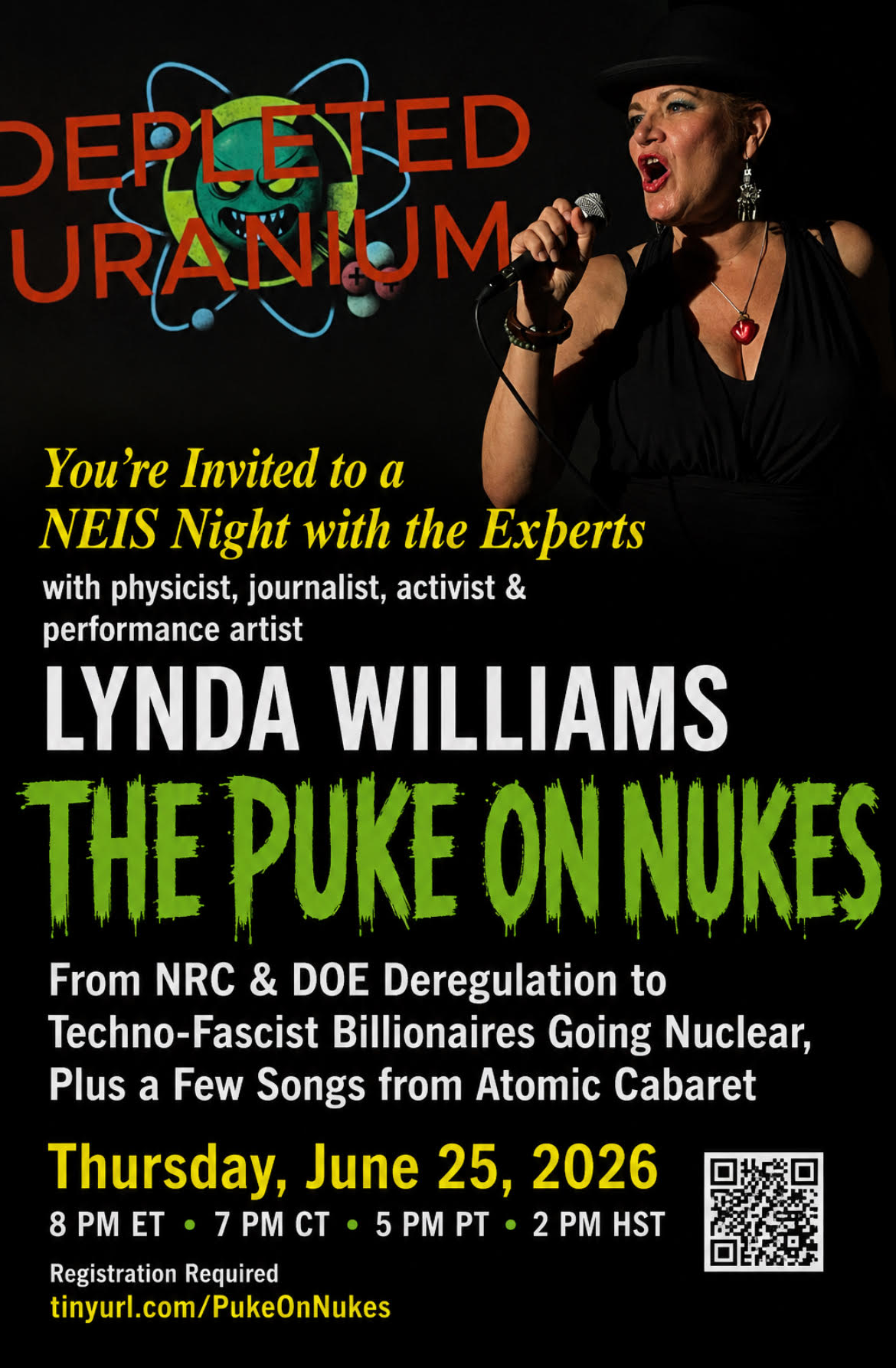
25 June- THE PUKE ON NUKES
Thursday, June 25, 2026
7pm Central Time (8pm ET, 6pm MT, 5pm PT) UTC – 5
From NRC & DOE Deregulation to Techno-Fascist Billionaires Going Nuclear, Plus a Few Songs from Atomic Cabaret REGISTER
26 June – Radiation Trainwreck at the NRC / Join the Protect Better Campaign – https://us02web.zoom.us/meeting/register/4ZlZ5_qLSHGiLSCg8FF6Bg#/registration


Cuba Is Not a Failed State – It Is a Besieged State
PETITION: “Global Appeal to Endorse Palestinian Right of Return of Refugees”
To see nuclear-related stories in greater depth and intensity – go to https://nuclearinformation.wordpress.com
-
Archives
- June 2026 (211)
- May 2026 (306)
- April 2026 (356)
- March 2026 (251)
- February 2026 (268)
- January 2026 (308)
- December 2025 (358)
- November 2025 (359)
- October 2025 (376)
- September 2025 (257)
- August 2025 (319)
- July 2025 (230)
-
Categories
- 1
- 1 NUCLEAR ISSUES
- business and costs
- climate change
- culture and arts
- ENERGY
- environment
- health
- history
- indigenous issues
- Legal
- marketing of nuclear
- media
- opposition to nuclear
- PERSONAL STORIES
- politics
- politics international
- Religion and ethics
- safety
- secrets,lies and civil liberties
- spinbuster
- technology
- Uranium
- wastes
- weapons and war
- Women
- 2 WORLD
- ACTION
- AFRICA
- Atrocities
- AUSTRALIA
- Christina's notes
- Christina's themes
- culture and arts
- Events
- Fuk 2022
- Fuk 2023
- Fukushima 2017
- Fukushima 2018
- fukushima 2019
- Fukushima 2020
- Fukushima 2021
- general
- global warming
- Humour (God we need it)
- Nuclear
- RARE EARTHS
- Reference
- resources – print
- Resources -audiovicual
- Weekly Newsletter
- World
- World Nuclear
- YouTube
-
RSS
Entries RSS
Comments RSS
 nuclear-news