US nuclear weapons in Poland would be priority military target – Moscow

Warsaw wants to host NATO arms under the bloc’s sharing scheme
https://www.rt.com/russia/596553-ryabkov-nuclear-weapons-poland/
Russia would consider foreign deployments of nuclear weapons in Poland a primary military target, Deputy Foreign Minister Sergey Ryabkov has warned.
Warsaw is in talks with Washington on potentially hosting nuclear arms as part of a NATO program. President Andrzej Duda reiterated Poland’s willingness to host the weapons in an interview this week.
Moscow considers any expansion of NATO’s nuclear-sharing arrangement as “deeply destabilizing” in nature, “and in fact threatening” Russia, Ryabkov was quoted as saying by TASS on Thursday.
This applies to joint missions, where non-nuclear members of the US-led bloc are trained to use American hardware, and even more so to the permanent stationing of such weapons “which hotheads in Warsaw are talking about,” he said.
Polish politicians vying for American nukes on their soil “must understand that any shift in that direction will not provide additional security to Poland, since relevant sites will definitely become targets. Our military planners will consider them a priority,” the senior diplomat added.
Duda told the Fakt newspaper on Monday that he had personally asked the US to station part of its nuclear arsenal in Poland.
”If our allies decide to deploy nuclear weapons as part of nuclear sharing also on our territory to strengthen the security of NATO’s eastern flank, we are ready for it,” he said.
Prime Minister Donald Tusk, who belongs to a rival political force, downplayed the president’s remarks on the same day, saying he would like Duda to clarify what his intentions were in making them.
”This idea is very massive, I would say very serious,” the prime minister added, explaining that Poland has no specific plans to host foreign nukes.
According to public sources, the US keeps some of its nuclear gravity bombs in five non-nuclear NATO states: Belgium, Germany, Italy, the Netherlands, and Türkiye. Poland’s previous conservative government led by Law and Justice (PiS), to which Duda belongs, has been seeking admission into this club for years. Tusk is the leader of Civic Platform, and returned to power as prime minister last December.
Biden signs $95bn aid bill to be sent ‘right away’ – for wars in Ukraine, Israel, and provocations in Taiwan

SOTT – Signs of the Times, BBC, Wed, 24 Apr 2024
US President Joe Biden has signed a $95bn (£76bn) package of aid for Ukraine, Israel and Taiwan.
“It’s going to make America safer, it’s going to make the world safer,” he said after signing the bill into law.
The president said the US would “right away” send fresh weapons and equipment to Ukraine to help Kyiv fend off Russian advances.
Comment: The West has depleted much of its weapon stocks, so much of the money is to go to US weapons manufacturers to actually make the weapons, first.
He spoke a day after the US Senate approved the aid package following months of congressional gridlock.
Ukraine has recently stepped up its calls for Western assistance as Russia makes steady gains in its invasion.
Included in the package is $61bn in military aid for Ukraine. It passed the Senate in a bipartisan vote of 79-18.
Tuesday evening’s approval came after the measurepassed the US House of Representativeson Saturday.
Democratic Senate Majority Leader Chuck Schumer said: “After more than six months of hard work and many twists and turns in the road, America sends a message to the entire world: we will not turn our back on you.”
Comment: They will, however, turn their backs on their own citizens.
Reacting to the vote, Ukrainian President Volodymyr Zelensky said it “reinforces America’s role as a beacon of democracy and leader of the free world”.
The Senate passed a similar aid package in February, but a group of conservatives who oppose new Ukraine support had prevented it from coming to a vote in the House of Representatives.
Last week, Democrats and Republicans in the lower chamber joined together to bypass this opposition.
They ultimately agreed to a package bill that included the foreign aid as well as legislation to confiscate Russian assets held by Western banks; new sanctions on Russia, Iran and China; and a provision that will force the Chinese company ByteDance to sell the popular social media service TikTok.
Comment: The theft of Russian assets will backfire, both with Russia’s retaliation, and global investors who will be reluctant to operate in the US; as will the sanctions; and the control of TikTok only further serves as proof of America as a surveillance state
In the House on Saturday, a majority of Republicans in the chamber voted against the foreign aid package.
The bill also faced resistance among a handful of Senate Republicans who opposed any new aid to Ukraine.
Fifteen voted with two Democrats – as well as independent Senator Bernie Sanders who objected to providing new offensive weapons to Israel – against the bill.
“Pouring more money into Ukraine’s coffers will only prolong the conflict and lead to more loss of life,” Republican Senator Tommy Tuberville said in remarks on Tuesday.
“No-one at the White House, the Pentagon, or the state department can articulate what victory looks like in this fight.”
The aid package is expected to provide a significant boost to Ukraine’s forces, which have suffered from a shortage of ammunition and air defence systems in recent months.
On Tuesday, Ukraine’s second city, Kharkiv, faced the latest in a series of recent drone and missile strikes, with authorities saying two people in a residential neighbourhood were injured.
The commander of Ukraine’s National Guard, Oleksandr Pivnenko, said he was expecting an attempt by Russian forces to advance on the city, which is near the Russian border.
Between February 2022 and January 2024, the US gave Ukraine more than $40bn in military aid, according to German research organisation, the Kiel Institute.
Comment: The EU has allocated 50 Billion euros of taxpayers money.
Aid for Israel and Taiwan
The foreign aid package passed on Tuesday also allocates $17bn to Israel, as well as $9bn for civilians suffering in conflict zones around the world, including Palestinians in Gaza.
Comment: So $17 billion to wage genocide, less than a few billion for those suffering from it?
Israeli Foreign Minister Israel Katz reacted to the vote by thanking congressional leaders for their “unwavering commitment to Israel’s security”.
“Israel and the United States stand together in the fight against terrorism, defending democracy and our shared values,” he said.
The US already provides Israel with $3.8bn in military aid each year.
Over in Asia, a Chinese government spokeswoman called the military aid for Taiwan a “serious violation of the one-China principle” that would “send the wrong signal to the pro-independence separatist forces” in Taiwan.
“We urge the US to take practical actions to fulfil its commitment not to support Taiwan independence by not arming Taiwan in any way,” she said.
Taiwan’s incoming President William Lai said the aid package would “strengthen deterrence against authoritarianism”.
Taiwan is a self-governing island and considers itself distinct from China, but Beijing views it as a breakaway province and hopes to bring it back under its own control.
TikTok ban
The national security package also includes a provision that could lead to a nationwide ban on TikTok………………….. more https://www.sott.net/article/490878-Biden-signs-95bn-aid-bill-to-be-sent-right-away-for-wars-in-Ukraine-Israel-and-provocations-in-Taiwan
New civil nuclear programmes crossing over into military nuclear programmes

New Nuclear Dual-Use Risk: Beating Swords into Ploughshares? By Dr. Paul Dorfman, https://nct-cbnw.com/new-nuclear-dual-use-risk-beating-swords-into-ploughshares/ 24 Apr 24.
Dr. Paul Dorfman discusses whether new civil nuclear programs could cross over into military nuclear programs, and what this means for global non-proliferation efforts.
According to key global finance advisory and asset management firm Lazard, new nuclear power systems perform poorly compared to renewables’ storage, energy efficiency, cost, roll-out speed, and management. So why invest in new nuclear?
Prof. Andy Stirling and Dr. Phil Johnstone, from the University of Sussex Science Policy Research Unit (SPRU), argue that the answer lies in the clear and present link between civil and military nuclear infrastructure. This is because civil nuclear energy maintains the skills and supply chains also needed for military nuclear programs, without which the costs of nuclear military capabilities could become politically unsupportable.
As they point out, the U.K. Government’s ‘Civil Nuclear: Roadmap to 2050’ report includes sets of statements on civil and military nuclear ambitions in order to “identify opportunities to align the two across government”, strengthening existing interconnections between civil and military industries’ research and development, and thereby minimizing costs for both the weapons and power sectors.
More recently, in March 2024, U.K. Prime Minister Rishi Sunak explicitly linked military nuclear weapons production capability with civil nuclear power generation development. French President Emmanuel Macron has gone further, saying that “without civil nuclear power, no military nuclear power, without military nuclear, no civil nuclear”. And the fact is that 90% of all new nuclear construction projects worldwide involve corporations controlled by states with nuclear weapons
New Nuclear, New Proliferation Risk
The increasingly tense geopolitical environment makes nuclear a controversial issue, with nation states concerned that neighbors might use notionally civilian nuclear programs for military ends. In this sense, there are unique challenges and perceived opportunities when it comes to new civil nuclear ambitions.
Choice of offensive or defensive doctrine affects the way other states evaluate their respective security and, in turn, influences the probability of cross-over between civil and military nuclear capacity. Indeed, current movements in military doctrines share the common denominator of adopting more offensive postures.
Meanwhile, according to the U.K. Royal Society, all forms of nuclear production pose weapons development risks, as “there is no proliferation proof nuclear fuel cycle – the dual use risk of nuclear materials and technology and in civil and military applications cannot be eliminated.”
Unhelpfully, Small Modular Nuclear Reactors (SMRs), which are the best new hope for fissile fuel, could make the weapons proliferation problem even worse as any potential SMR roll-out to either developed or developing countries is likely to increase nuclear proliferation and security risks. This is especially so if any of those states prove politically unstable or have relatively limited resources to support a robust nuclear security and regulatory infrastructure.
Nuclear Cross-over in an Increasingly Unstable World
Unless uranium enrichment and reprocessing technologies are effectively regulated against the diversion of civil materials for military purposes, the reality is that new nuclear plants can provide the cover to develop and make nuclear weapons. Whether that capability is turned into actual weapons depends largely on political inclination.
Saudi officials have made it clear on more than one occasion that there’s another reason for their interest in civil nuclear energy technology which was not captured by the royal decree on the Saudi nuclear program – the relationship of the civil program to nuclear weapons. More recently, Saudi Arabia is pushing for the right to produce nuclear fuel, a move that poses further significant proliferation risk. The International Atomic Energy Agency (IAEA) has voiced concerns about Saudi intentions and safeguards.

Unfortunately, the IAEA’s support for Saudi’s civil nuclear clashes with their position on the Kingdom’s military ambition. This is not the first time that the UN nuclear regulator has been caught in this uncomfortably dualist situation.
More worryingly, the Director General of the IAEA, Rafael Grossi, has just met with Syrian President Bashar al-Assad in Damascus to “agree on a new engagement between Syria and IAEA with a view to providing confidence in the peaceful uses of nuclear energy for the benefit of its people”. Given the deeply problematic military and human rights history of al-Assad’s regime, the IAEA’s actions seem profoundly concerning, and bring the IAEA’s role in the global nuclear arena into sharp focus.
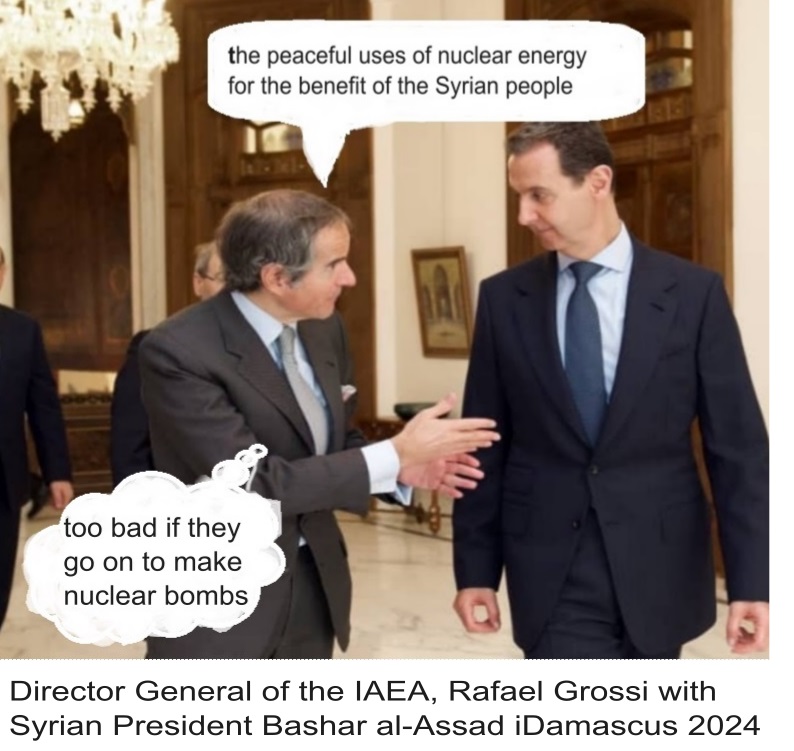
Thinking this through, an important question springs to mind. Due to the apparent potential for civil-military nuclear cross-over, could the IAEA’s mission – to work for “the safe, secure and peaceful application of nuclear science and technology” – inevitably result in weapons proliferation by default?
Irrational Paradoxes
Back in Eastern Europe, although Ukraine runs a substantive civil nuclear power program, it’s no longer a nuclear weapons state. Ukraine, once briefly the third-largest nuclear power in the world, made the decision to give up nuclear weapons on the basis that the U.S., U.K., and Russia would guarantee Ukraine’s security via the Budapest Memorandum.
In this sense, both Putin’s invasion of an independent state and subsequent nuclear weapons threats highlight the very real practical distinction between unilateral and multilateral nuclear weapons disarmament in an increasingly unstable world.
And then there’s Zaporizhzhia, where a civil nuclear power plant has become a target of war at the very same time that Russia’s role as a major player in the global civil nuclear power sector continues to expand via Moscow-backed international nuclear new-build projects and technology, uranium supply and enrichment, and spent nuclear fuel management.
Direction of Travel
While it appears reasonably clear that civil and military nuclear can enmesh, one must ask whether one inevitably leads to the other. While the usual concern is that civil nuclear infrastructure leads to military development, according to former Australian Prime Minister Scott Morrison, Australia is bucking the trend: “Let me be clear: Australia is not seeking to establish […] a civil nuclear capability […] a civil nuclear energy industry is not a requirement for us to go through the submarine program.”
In other words, despite the new nuclear submarine AUKUS deal, the current Australian government has no plans to develop new civil nuclear infrastructure.
So, does that start to negate the civil-military nexus hypothesis? Well, it’s not that nuclear military interests are the sole drivers of support for civil nuclear power, but for some states dual-use technology may comprise a significant complementary factor.
In the end, it’s the direction of travel that counts. While all key energy institutes and research organizations agree that renewables will do the heavy-lifting for the net-zero energy transition, it’s worth considering the implications of U.S. Energy Secretary Jennifer Granholm’s speech to Australia’s Energy Forum: “No country has ever been held hostage for access to the sun. No country has ever been held hostage for access to the wind. They have not ever been weaponized, nor will they be.”
Dr. Paul Dorfman is the Chair of the Nuclear Consulting Group, a Visiting Fellow at the Science Policy Research Unit (SPRU) of the University of Sussex, U.K., a Member of the Irish Government’s Radiation Protection Advisory Committee, and a Former Advisor to the U.K. Ministry of Defence Nuclear Submarine Dismantling Project.
U.S. Senate Passes $95 Billion Foreign Military Aid Bill
The bill passed in a vote of 79-18
by Dave DeCamp April 23, 2024, AntiWar.com
On Tuesday night, the Senate passed a $95 billion spending bill that includes military aid for Ukraine, Israel, and Taiwan in a vote of 79-18. The bill has already passed through the House and now heads to President Biden’s desk for his signature.
Earlier in the day, the Senate rejected an effort by some senators to add amendments to the legislation in a vote of 48-50. The legislation, which also includes a provision that could ban TikTok, was passed through the House as four separate bills but was combined into one in the Senate.
The legislation includes $61 billion for the proxy war in Ukraine, much of which will go to US weapons makers to replenish US stockpiles. It includes over $9 billion in economic aid in the form of repayable loans, but Ukraine is not actually expected to pay it back. Another provision will authorize the US to sell off frozen Russian assets, which could be used to pay the loans. CNN previously reported that the Biden administration will also be able to cancel the debt.
The bill also includes $26 billion to support Israel. About $9 billion will go toward humanitarian aid in Gaza and other places, while the remaining $17 billion will go toward military aid to support the slaughter of Palestinians in Gaza and replenish Israeli air defenses. The aid is on top of the $3.8 billion in military assistance that Israel receives from the US each year.
Another $8 billion will go toward military aid for Taiwan and other spending in the Indo-Pacific region to prepare for a future war with China. It includes $1.9 billion to replenish weapons sent to Taiwan and regional countries and $2 billion in Foreign Military Financing, a State Department program that gives foreign governments money to purchase US weapons. Over $3.3 billion will go toward submarine infrastructure in the region.
The massive spending on foreign military aid was put forward by House Speaker Mike Johnson (R-LA), who previously killed a deal that would have included similar foreign aid spending and billions for border security and changes to migrant policies………….. more https://news.antiwar.com/2024/04/23/senate-passes-95-billion-foreign-military-aid-bill/
Israeli Strikes in Rafah Kill 22, Including 18 Children
The bombardment came after the House approved $26 billion in spending to support the Israeli slaughter of Palestinians
by Dave DeCamp April 21, 2024 https://news.antiwar.com/2024/04/21/israeli-strikes-kill-22-in-rafah-including-18-children/
Israeli strikes hit the southern Gaza city of Rafah Saturday night into Sunday morning, killing 22 people, including 18 children, The Associated Press reported.
The bombardment came just hours after the US House of Representatives passed a $26 billion bill that includes about $17 billion in military aid for Israel to support the slaughter of Palestinians in Gaza.
According to AP, one of the overnight strikes killed a man, his wife, and their three-year-old child. The woman was 30 weeks pregnant, and medical staff at the nearby Kuwaiti hospital were able to save the baby. The second strike killed two women and 17 children.
Gaza’s Health Ministry said on Sunday that the number of Palestinians killed in the Strip has reached 34,097, and 76,980 more have been wounded. The death toll is considered a low estimate since it doesn’t take into account people who are dead under the rubble.
Rafah is packed with over 1 million Palestinian civilians and has been getting hit with near-daily Israeli strikes. Israeli Prime Minister Benjamin Netanyahu has been threatening to launch a full-scale invasion of the city.
The US has claimed that it’s concerned about Netanyahu’s plans to invade Rafah but is not putting any real pressure on Israel since it continues to provide military aid and political support. US and Israeli officials discussed the potential assault last week, and the White House said the two sides had a “shared objective to see Hamas defeated in Rafah.”
On Sunday, Netanyahu thanked the US for the new aid being passed through Congress and vowed to escalate in Gaza. “In the coming days, we will increase the military and diplomatic pressure on Hamas because this is the only way to free our hostages and achieve our victory,” he said.
Russia: West military support for Ukraine could lead to confrontation between world’s nuclear powers
Monday, 22 April 2024, https://www.presstv.ir/Detail/2024/04/22/724164/Russia-Lavrov-Warns-Direct-War-With-West-Over-Ukraine
Moscow has warned of a direct confrontation between Russian troops and Western forces over the conflict in Ukraine that could end in catastrophe.
Foreign Minister Sergei Lavrov said on Monday the United States and NATO countries were obsessed with the idea of inflicting a “strategic defeat” on Russia, adding that their military support for Ukraine has pushed the world to the brink of a direct clash between the world’s biggest nuclear powers that could end in catastrophe.
“The Westerners are teetering dangerously on the brink of a direct military clash between nuclear powers, which is fraught with catastrophic consequences,” Lavrov said at a conference on non-proliferation in Moscow.
“Of particular concern is the fact that it is the ‘troika’ of Western nuclear states [US, Britain and France] that are among the key sponsors of the criminal Kiev regime, the main initiators of various provocative steps. We see serious strategic risks in this, leading to an increase in the level of nuclear danger,” Lavrov warned.
Lavrov said that the Western countries were building a global missile system capable of eliminating rivals. He added that the US-led Western countries were placing nuclear weapons in military bases all across Europe, while medium- and shorter-range missiles were being planted in other regions across the globe and preparations were made to deploy nuclear weapons into space.
According to both Russian and US diplomats, the present clash between the West and Russia over Ukraine is the worst breakdown of diplomatic relations by the two sides in decades, ever since the 1962 Cuban Missile Crisis cut bilateral ties.
Despite the risky tension, Western leaders have vowed to continue to work with and to provide support to Kiev to cause “strategic defeat” of Russian forces in Ukraine, while ruling out any deployment of American or European troops in the former Soviet republic.
Lavrov’s remarks come just two days after US lawmakers approved billions of dollars in additional military aid to Ukraine.
Since Russia launched its special military operation in Ukraine in February 2022 to prevent NATO’s eastward expansion, it has repeatedly warned the US-led Western counties against arming Kiev and the rising nuclear risks – warnings which the US leadership says it has to take seriously, though the officials say they have seen no change in Russian nuclear posture.
Polish president: Poland ready to deploy allied nuclear weapons on its territory

by Chris York andThe Kyiv Independent, April 22, 2024
Poland is ready and willing to allow NATO allies to deploy nuclear weapons on its territory, Polish President Andrzej Duda said in an interview published on April 22.
Speaking to Fakt, Duda highlighted how Russia has already taken similar steps with its own allies, having transferred tactical nuclear weapons to Belarus last year.
The president said the topic of placing U.S. nuclear weapons in Poland “has been a topic of Polish-American talks for some time.”
“If our allies decide to deploy nuclear weapons as part of nuclear sharing also on our territory to strengthen the security of NATO‘s eastern flank, we are ready for it,” he said.
“We are an ally in the North Atlantic Alliance, and we also have obligations in this respect, i.e., we simply implement a common policy.”……………………. https://kyivindependent.com/poland-nuclear-weapons-duda/
Russia-Ukraine war: EU ministers fail to pledge Patriot systems to Ukraine at key meeting – as it happened
Yohannes Lowe and Sammy Gecsoyler, 23 Apr 24 https://www.theguardian.com/world/live/2024/apr/22/russia-ukraine-war-live-zelenskiy-chasiv-yar?filterKeyEvents=false&page=with%3Ablock-66261a918f08839e09ac8c8b
Russia says new US aid to Ukraine will not change situation on battlefield
A new US package of military aid to Ukraine will not change the situation on the frontlines, where Russia has the upper hand, the Kremlin said.
“The Russian armed forces are improving their positions at the front … The money allocated and the weapons that will be supplied will not change this dynamic,” Kremlin spokesperson Dmitry Peskov told reporters.
“They will lead to new victims on the Ukrainian side. More Ukrainians will die, Ukraine will suffer greater losses.”
In the Ukraine bill, of the $60.7bn, a total of about $23bn would be used by the US to replenish its military stockpiles, opening the door to future US military transfers to Ukraine.
Another $14bn would go to the Ukraine Security Assistance Initiative, in which the Pentagon buys advanced new weapon systems for the Ukrainian military directly from US defence contractors.
Ukrainian President Volodymyr Zelenskiy on Sunday urged Washington to quickly turn the bill into law and proceed with the actual transfer of weapons, saying long-range arms and air defence systems were top priorities.
“I think this support will really strengthen the armed forces of Ukraine and we will have a chance for victory,” Zelenskiy said.
Russia said the American defence industry will be the real beneficiary of the package.
“We also recognise that most of this money will remain in the United States. The United States will become richer and will receive additional dividends by providing assistance to Ukraine. For (President Vladimir) Putin, this was expected,” Peskov said.
Poland: We’re ready to host nuclear weapons, (and work with Trump )
Polish President Andrzej Duda said atomic sharing has been a topic of Warsaw-Washington talks.
Politico, APRIL 22, 2024 , BY CLAUDIA CHIAPPA
Polish President Andrzej Duda said Poland is “ready” to host nuclear weapons on its territory if NATO decides to reinforce its eastern flank.
“Russia is increasingly militarizing the Königsberg oblast (Kaliningrad). Recently, it has been relocating its nuclear weapons to Belarus,” Duda said in an interview published Monday by Polish outlet Fakt.
“If our allies decide to deploy nuclear weapons as part of nuclear sharing on our territory as well, in order to strengthen the security of NATO’s eastern flank, we are ready for it,” he added.
………………………………………………………….. Duda, who recently traveled to New York and met Republican 2024 candidate Donald Trump, spoke fondly of the former president, saying that the two have “a lot of common topics.”
“He is a politician with whom I directly cooperated with the United States for four years when he was the president of the United States,” Duda said. “I want to emphasize very strongly that we have been friends since then. I really like talking to him, because he is an extremely interesting personality and has a lot of experience, both political and business.” https://www.politico.eu/article/poland-ready-host-nuclear-weapons-andrzej-duda-nato/
North Korea’s Kim Jong Un Oversees Simulated ‘Nuclear Counterattack’
The drill took place on Monday, according to the report. Seoul’s military had earlier announced that the North had fired several short-range ballistic missiles on Monday, with Tokyo confirming the launch.
World NewsAgence France-Presse April 23, 2024 https://www.ndtv.com/world-news/north-koreas-kim-jong-un-oversees-simulated-nuclear-counterattack-5501429
According to report, Kim Jong Un “appreciated the high hit and accuracy” of the rockets.
North Korean leader Kim Jong Un has overseen a drill simulating a “nuclear counterattack,” state-run KCNA news agency said Tuesday, the latest in a volley of tests by Pyongyang this year.
The drill took place on Monday, according to the report. Seoul’s military had earlier announced that the North had fired several short-range ballistic missiles on Monday, with Tokyo confirming the launch.
The drill involved “super-large multiple rocket units” which “hit their island target” some 352 kilometres (219 miles) away, the report said.
It added that Kim “appreciated the high hit and accuracy” of the rockets.
South Korea’s military said Monday that the missiles flew from the Pyongyang area for about 300 kilometres before splashing down in the waters east of the Korean peninsula.
The launch is the second in less than a week by Pyongyang, which on Friday tested a “super-large warhead” designed for a strategic cruise missile, state media said. Seoul’s military confirmed it had detected cruise missile launches at the time.
Nuclear test campaigner demands access to medical files

By Andrea Ormsby, BBC News, 23 Apr 24
A campaigner from Devon is suing the government over missing medical records belonging to veterans exposed to radiation more than 70 years ago.
Susan Musselwhite’s father, Derek, was one of 22,000 servicemen who took part in nuclear tests in the 1950 and 1960s.
Ms Musselwhite said access to missing medical files would help veterans and descendants who said their health had suffered as a result of the trials.
The Ministry of Defence (MoD) said no information was withheld from veterans.
Ms Musselwhite, 44, from Paignton, is part of a group of former military personnel and their families who have sent a letter before action on the MoD, formally warning of a potential court claim, and handed a petition into Downing Street in March 2024.
Ms Musselwhite said: “What these men witnessed you only see in movies. But they witnessed it, they lived it; they know the deadliest weapon ever created.”
The group is calling for the government to create a special tribunal to oversee compensation.
Personnel from all three armed forces took part in Cold War nuclear weapons trials between 1952 and 1967 in Australia and the South Pacific.
Susan Musselwhite said the government “sent their men as cannon fodder and those men deserve to be recognised for what they did”, including her Royal Navy diver father.
Like many of the veterans’ children and grandchildren, Ms Musselwhite said she was struggling with serious health issues.
Campaigners say they are currently unable to access their records or parts are missing or incomplete because the samples have been reclassified as “scientific data” and placed at the MoD’s Atomic Weapons Establishment research facility.
MoD sources previously told the BBC that archives at the facility have been searched and do not contain the medical records in question.
Ms Musselwhite said missing medical records of blood and urine tests taken by the military during the trials could provide vital information…………………………….. more https://www.bbc.com/news/uk-england-devon-68883809
Bankers upgrade Lockheed stock after Iran strikes at Israel

defense contractors are actively shaping U.S. foreign policy through lobbying and campaign contributions, among other tactics.
The American company has played an outsized role in Tel Aviv’s bombing and invasion of Gaza since Oct. 7
NICK CLEVELAND-STOUT, APR 17, 2024 https://responsiblestatecraft.org/lockheed-martin-israel-war/
Over the weekend, Iran launched over 300 missiles at Nevatim Air Base, a base in southern Israel that houses U.S.-made F-35 fighter jets. Israeli Prime Minister Benjamin Netanyahu, who oversaw a strike on an Iranian consulate in Syria just a few weeks ago, has already promised to retaliate. Observers viewed these brewing tensions with concern, ringing the alarm bells of the breakout of a wider war.
Not JP Morgan analyst Seth Seifman. On Monday morning, Seifman upgraded JPMorgan’s outlook from “hold” to “buy” for Lockheed Martin, the manufacturer of Israel’s F-35s, and set a higher price target for the stock.
Seifman says the change was pre-planned, but noted that these developments could be good for business. “What we can say is that it’s a dangerous world and while that is not a sufficient condition for defense stocks to outperform,” he said, “it is a potential source of support, especially when they are under-owned.” JP Morgan owns $355 million worth of Lockheed Martin stock, about a third of which was bought in the last quarter of 2023.
UK investment bank Liberum Capital was similarly bullish on defense stocks, so long as a wider war does not break out. “In our base case scenario of Israel retaliating but in a limited way that keeps the conflict from escalating further, this could lead to a 5-10% correction in the stock market together with further strength in the U.S. dollar,” Liberium told investors. “The obvious short-term winners will be oil & gas stocks as well as defense contractors.”
As finance journalist Jacob Wolisnky put it in a recent preview of defense stock picks, “Where there’s war, there’s money to be made.” At least one member of Congress agrees. Yesterday, Rep. Kevin Hern (R-Okla.) disclosed that he bought Lockheed Martin stock on March 29.
Lockheed Martin has played a large role in Israel’s bombing and invasion of Gaza, manufacturing Hellfire missiles, providing transport planes, and supplying F-16 and F-35 fighter jets. A missile that hit journalists on November 9 of last year in Gaza City was reportedly manufactured by Lockheed Martin. “Their core business model has no respect for human rights,” said Jilianne Lyon, who leads shareholder advocacy campaigns at Investor Advocates for Social Justice.
While privately acknowledging conflict is good for business, the defense industry and its financiers publicly claim they are simply doing America’s bidding. As Lockheed Martin CEO James Taiclet once said, “It’s only up to us to step to what we’ve been asked to do and we’re just trying to do that in a more effective way, and that’s our role.” After all, it was the U.S. government — not Lockheed Martin — that came to Israel’s defense and intercepted the majority of Iran’s missiles.
But this “we just do what we’re told” defense doesn’t quite work given that defense contractors are actively shaping U.S. foreign policy through lobbying and campaign contributions, among other tactics. Aaron Acosta, program director at Investor Advocates for Social Justice, told Responsible Statecraft that defense contractors “are often the ones creating demand by lobbying the U.S. government and pushing for sales of these weapons.”
In 2023, Lockheed Martin spent over $14 million lobbying Congress. The three companies that lobbied the House’s version of the annual defense policy bill the most were RTX (formerly known as Raytheon), Lockheed Martin, and General Dynamics. During the 2022 election cycle, Lockheed Martin contributed nearly $4 million to political candidates. So far, 2024 promises similar results. In its 2023 annual report, Lockheed Martin wrote that, “Changes in the U.S. Government’s priorities, or delays or reductions in spending could have a material adverse effect on our business.”
Sure, 84% of voters might be concerned about the U.S. being drawn into conflict in the Middle East. But as far as defense companies and their shareholders are concerned, business is booming.
Missile Defenseless
https://indi.ca/missile-defenseless/ 21 Apr 24
Missile defense is a fascinating idea — that you can shoot down arrows with other arrows — and it sorta works. Until it doesn’t, and until you get the bill. Missile defense is not some magic shield that allows you to be a total asshole and avoid all consequences. You literally pay for it. Just look at ‘Israel’, blowing nearly 10% of its yearly IDF budget in one night of ignominy.
After ‘Israel’ bombed their consulate, Iran threw maybe $100 million in the air and ‘Israel’ threw $1.3 billion after it. It was literally good money after bad. It’s like if someone threw a brick at your house, and you threw your TV at the brick. It’s like smashing a roach with a Rolex. It’s like preventing broken windows by throwing your own glassware out the window. ‘Israeli’ missile defense is the definition of Pyrrhic victory. They’re lighting their own money on fire and crowing about how bright it is.
A big part of attritional war is depleting the enemy’s ammo, and this ammo depletes itself. If any enemy throws enough cheap munitions in the air, the ammunition will come out and destroy itself. You don’t need to even target the enemy’s ammo dumps, they’ll target your missiles and run into them! Depleting the enemy’s munitions at a 1:12 (cost) ratio is in itself is a tactical victory. If your enemy runs out of munitions in two weeks, that’s strategic defeat. And if 16% of missiles breach the defenses on day one, that’s just embarrassing.
This all happened to ‘Israel’ under the best possible conditions, with weeks of warning and all the imperial bitches (Jordan, France, UK) barking. All the kings horses and all the kings men, can’t put ‘Israeli’ deterrence back together again. They can propagandize their own people, but the military people know what’s happened on April 14th. As does anyone with a calculator and a bit of common sense. Like October 7th, it was a tactical, strategic defeat. They got hit at high cost and can’t sustain this model without blowing through their entire budget in a matter of weeks.
This model of air defence is literally throwing gold at tin. The payload of a Patriot missile is worth more than its weight in gold (a 90 kg payload on a $6-10m missile), and they fling them at cheap ballistics or even drones. This obviously can’t go on forever, as you could see with the IOF’s air defenses buckling in one night, letting multiple hits in. Imagine how much worse it could be if these weren’t just warning shots, and if the hits kept coming. Missile defense against the consequences of your own actions is a very expensive proposition, while simply not being an asshole is free. But this is of course incomprehensible to capitalists.
This is the same fate US warships faced in the Red Sea. They were shooting million dollar missiles at thousand dollar drones from Yemen and crowing about it, but now they’ve had to retreat and beg for peace. Their fancy missile defenses (mostly) worked at protecting their own warships, but they couldn’t secure imperial shipping at all. And it’s not that the Yemen couldn’t damage American warships, they have superior weaponry (hypersonics) in reserve and at any point they could just swarm the Carbon Crusaders. It’s just that, as Napoleon said, when your enemy is defeating themselves, why interrupt? If they want to literally explode their money, let them. The US can’t reload its missile batteries at sea, so after a little battering, they have to just leave. Thus one of the poorest countries in the world has defeated the world’s richest navy, by exploiting its profligacy.
This is the fate of American Empire in general. They pulled out of the Anti-Ballistic Missile treaty in 2002 and thought they could hide behind anti-ballistic missile defenses, bombing whoever they pleased, selling expensive ‘defense’ systems to the vassals they put in the firing line in the first place. But now Russia, Iran, and even Yemen have hypersonic missiles that can take fast, unpredictable paths, effectively under most missile defenses. Everybody has drones that can overwhelm defenses with sheer quantity. America has developed defenses against the ballistic missiles of last century, but anything not taking a basic parabolic arc is a diabolical problem to them.
Missile defense will undoubtably evolve in response to these new threats, but when Russia can turn old, ‘dumb’ bombs into glide missiles with cheap attachments, they can simply overwhelm them with quantity. When wedding drones can be weaponized (in revenge for all the weddings Empire bombed), expensive air defenses actually become a liability. The best missile defense is actually diplomacy, which is incomprehensible to Empire these days. They still believe in a technological solution to their own illogical terrorism. It’s like someone who builds more and more elaborate bear-protection suits, and never once considers not poking bears in the first place.
This is the state of modern missile defense, which is really nothing new. As my historical thesis goes, same shit, different day. Offense and defense have always co-evolved in competition; a stronger sword begets a stronger shield, a longer bow begets a higher wall, missiles beget missile defence in general. Offensive weapons evolve with defensive weapons in a constant mating dance of death. The long history of humans fucking themselves is fertile ground for the reproduction of weapons. But it is all ultimately folly.
The best defense is not being offensive in the first place. This is something the White Empire simply cannot understand, having gotten away with it for so long. But now the natives have rockets and rocket launchers, and all the missile defenses in the world can’t protect their hegemony. All that’s left is hubris, which is not at all the same thing. They’re throwing gold after tin, while slaughtering defenseless children. This is simply the pride before the fall, as the worst missile offenders become missile defenseless.
Under UN Charter, Iran’s Attack Was a Legal Response to Israel’s Illegal Attack

Iran’s attack on Israel was lawful self-defense carried out in compliance with international humanitarian law.
On April 13, Iran’s aircraft struck two air bases in the Negev desert, where the April 1 attack on Iran’s consulate had been launched. “Iran retaliated against those targets in Israel directly related to the Israeli attack on Iran,”
By Marjorie Cohn , TRUTHOUT, April 18, 2024
On April 1, Israel mounted an unprovoked military attack on a building that was part of the Iranian Embassy complex in Damascus, Syria, killing seven of Iran’s senior military advisers and five additional people. The victims included Gen. Mohamad Reza Zahedi, head of Iran’s covert military operations in Lebanon and Syria, and two other senior generals.
Although Israel’s attack violated the United Nations Charter, the UN Security Council refused to condemn it because the United States, the U.K. and France exercised their vetoes on April 4.
Iran considered this attack on its consulate “an act of war,” Trita Parsi wrote at Foreign Policy.
On April 11, the Permanent Mission of the Islamic Republic of Iran to the United Nations stated: “Had the UN Security Council condemned the Zionist regime’s reprehensible act of aggression on our diplomatic premises in Damascus and subsequently brought to justice its perpetrators, the imperative for Iran to punish this rogue regime might have been obviated.”
Then, on April 13, in response to Israel’s attack, Iran fired more than 300 drones and missiles at the Israeli air base from which the April 1 attacks had emanated. Only two of them landed inside Israel and no one was killed; a Bedouin girl was injured. The U.S., U.K., France, Jordan and Israel intercepted the remaining Iranian missiles and drones. A senior U.S. military official said “there’s no significant damage within Israel itself.”
The Iranian mission to the UN wrote in an April 13 letter to the UN secretary-general that Iran’s action was conducted “in the exercise of Iran’s inherent right to self-defense” under Article 51 of the UN Charter “and in response to the Israeli recurring military aggressions, particularly its armed attack” on April 1 “against Iranian diplomatic premises, in the defiance of Article 2(4) of the Charter of the United Nations.”
The April 1 attack was not the first time Israel had attacked key Iranian personnel………………………………………………………………………….
Iran made clear that it seeks to avoid further escalation that could spark a widespread regional war. An April 13 social media post from Iran’s permanent mission to the UN stated, “The matter can be deemed concluded. However, should the Israeli regime make another mistake, Iran’s response will be considerably more severe. It is a conflict between Iran and the rogue Israeli regime, from which the U.S. MUST STAY AWAY!”
At a Security Council meeting on April 14, Iran’s UN Ambassador Saeid Iravani defended the lawfulness of the missile and drone attack on Israel. He noted the hypocrisy of the U.S. and its allies that claim Israel is acting in self-defense as it conducts its genocide of the Palestinian people:………………………………………..
Israel’s Attack on Iranian Consulate Violated the UN Charter and Vienna Conventions
Iran’s April 13 attack on Israel was a lawful exercise of self-defense in response to Israel’s unlawful April 1 attack on the Iranian consulate. The Israeli attack was an illegal act of aggression.
Article 2 (4) of the UN Charter states, “All Members shall refrain in their international relations from the threat or use of force against the territorial integrity or political independence of any state, or in any other manner inconsistent with the Purposes of the United Nations.”
An act of aggression is inconsistent with the purposes of the UN. Article 39 of the Charter says, “The Security Council shall determine the existence of any threat to the peace, breach of the peace, or act of aggression.”
An “‘act of aggression’ means the use of armed force by a State against the sovereignty, territorial integrity or political independence of another State, or in any other manner inconsistent with the Charter of the United Nations,” under the Rome Statute for the International Criminal Court. Aggression includes “the invasion or attack by the armed forces of a State of the territory of another State.”
Moreover, “Consular premises shall be inviolable,” according to Article 31 of the 1963 Vienna Convention on Consular Relations. Article 1 defines consular premises as “the buildings or parts of buildings and the land ancillary thereto, irrespective of ownership, used exclusively for the purposes of the consular post.”
The 1961 Vienna Convention on Diplomatic Relations likewise provides in Article 22.1 that, “The premises of the mission shall be inviolable. The agents of the receiving State may not enter them, except with the consent of the head of the mission.”
During Israel’s bombing of Iran’s consulate in Syria, it targeted and killed very senior Iranian officials. The attack constituted an act of aggression, which triggered Iran’s right to self-defense.
Iran’s April 13 Attack on Israel Constituted Lawful Self-Defense
Article 51 states, “Nothing in the present Charter shall impair the inherent right of individual or collective self-defense if an armed attack occurs against a Member of the United Nations, until the Security Council has taken the measures necessary to maintain international peace and security.”
An armed attack includes not just an attack against the territory of a state, including its airspace and territorial sea, but also attacks directed against its armed forces or embassies abroad.
On April 13, Iran’s aircraft struck two air bases in the Negev desert, where the April 1 attack on Iran’s consulate had been launched. “Iran retaliated against those targets in Israel directly related to the Israeli attack on Iran,” former U.S. weapons inspector Scott Ritter wrote.
Nevertheless, the Security Council has failed to adopt a resolution condemning Israel’s attack on Iran’s consulate, as Iran pointed out in its April 13 letter to the UN secretary-general.
At an April 14 meeting of the Security Council, the Israeli representative declared that Iran is the number one global sponsor of terrorism and the world’s worst human rights violator. It is Israel, however, that has killed nearly 34,000 Palestinians — two-thirds of them women and children — during its campaign of genocide in Gaza that has now entered its seventh month.
Iran’s self-defense action was the natural outcome of Israel’s violations of international law — both on Syrian territory and elsewhere — the representative from the Syrian Arab Republic said at the April 14 council meeting. Israel is trying to cover up its genocide and military failures in Gaza, the Syrian representative added.
Iran’s Attack Satisfied the Principles of Proportionality, Distinction and Precautions……………………………………………………………….
Netanyahu Is Gunning for War With Iran
Israeli Prime Minister Benjamin Netanyahu would like nothing better than to start a war with Iran. Netanyahu considers Iran an “existential threat” to Israel. He persuaded former President Donald Trump to pull out of the Iran nuclear deal, which was working to prevent Iran from developing nuclear weapons.
As the world waits for Israel’s response to the Iranian attack, President Joe Biden said the U.S. would not assist Israel in an offensive military action against Iran but it would give Israel defensive support if Iran attacks Israel. “But the distinction between offensive or defensive support becomes meaningless the second a war breaks out,” wrote Trita Parsi.
Today, the U.S. and U.K. imposed additional punishing sanctions on Iran. Unilateral coercive measures, levied without the imprimatur of the Security Council, are illegal and generally harm only the general population…………………………………………………………………………………………… more https://truthout.org/articles/under-un-charter-irans-attack-was-a-legal-response-to-israels-illegal-attack/
1 This Month

of the week – Shut Down Drone Warfare!


Tell the Ukrainian Government to Drop Prosecution of Peace Activist Yurii Sheliazhenko

Petition to revoke the licensing of the Near Surface Nuclear Disposal Facility (NSDF) at Chalk River. https://www.ourcommons.ca/petitions/en/Petition/Details?Petition=e-7247
To see nuclear-related stories in greater depth and intensity – go to https://nuclearinformation.wordpress.com
-
Archives
- April 2026 (114)
- March 2026 (251)
- February 2026 (268)
- January 2026 (308)
- December 2025 (358)
- November 2025 (359)
- October 2025 (376)
- September 2025 (257)
- August 2025 (319)
- July 2025 (230)
- June 2025 (348)
- May 2025 (261)
-
Categories
- 1
- 1 NUCLEAR ISSUES
- business and costs
- climate change
- culture and arts
- ENERGY
- environment
- health
- history
- indigenous issues
- Legal
- marketing of nuclear
- media
- opposition to nuclear
- PERSONAL STORIES
- politics
- politics international
- Religion and ethics
- safety
- secrets,lies and civil liberties
- spinbuster
- technology
- Uranium
- wastes
- weapons and war
- Women
- 2 WORLD
- ACTION
- AFRICA
- Atrocities
- AUSTRALIA
- Christina's notes
- Christina's themes
- culture and arts
- Events
- Fuk 2022
- Fuk 2023
- Fukushima 2017
- Fukushima 2018
- fukushima 2019
- Fukushima 2020
- Fukushima 2021
- general
- global warming
- Humour (God we need it)
- Nuclear
- RARE EARTHS
- Reference
- resources – print
- Resources -audiovicual
- Weekly Newsletter
- World
- World Nuclear
- YouTube
-
RSS
Entries RSS
Comments RSS
 nuclear-news