A Return to Form: Expediting US Arms to Israel

Dr Binoy Kampmark, 1 Sept 24, https://theaimn.com/a-return-to-form-expediting-us-arms-to-israel/
Despite much grandstanding in the Biden administration about halting specific arms shipments to Israel over feigned concerns about how they might be used (inflicting death is the expected form), US military supplies have been restored with barely a murmur. In a report in Haaretz on August 29, a rush of weapons to Israel has been noticed since the end of July.
August proved to be the second busiest month for US arms deliveries to Israel’s Nevatim Airbase since the October 2023 attacks by Hamas. This has taken place alongside an increased concentration of US forces in the region since Israel’s assassinations of Hezbollah commander Fuad Shukr and Hamas political chief Ismail Haniyeh at the end of last month. Two aircraft carriers, a guided missile submarine, and deployments of advanced F-22 stealth aircraft in Qatar, have featured in a show intended to deter Tehran from any retaliatory strikes.
After examining open-source aviation data from the end of July, Haaretz concluded that the issue of delayed shipments of US weapons had “been solved.” Dozens of flights by US military transport planes, along with civilian and military Israeli cargo planes, mostly from Qatar and the Dover Air Force Base in Delaware, had been noted. Demands by Israeli Prime Minister Benjamin Netanyahu in his July 24 speech to Congress that US military aid be “dramatically” expedited to “end the war in Gaza and help prevent a broader war in the Middle East,” had been heeded.
On August 26, Israel received its 500th aerial shipment of weapons and military supplies from the United States since the latest war’s commencement. The 500 flights have also been supplemented by 107 sea shipments, altogether facilitating the transfer of 50,000 tons of military equipmentin an initiativebetween the US military, Israel’s Defence Ministry’s Directorate of Production and Procurement and Mission to the United States, the IDF’s planning Directorate and the Israeli Air Force.
During the same month, the Democratic National Convention, which saw no debate about the candidature of Kamala Harris as its choice for presidential candidate, had tepidly promised some agitation on continued arms to Israel. Ahead of the event, the Uncommitted movement’s 30 delegates, picked by voters alarmed by US support for Israel’s war machine in Gaza, were hoping to convince the 4,000 pledged delegates Harris had captured to add an arms embargo to its campaign in order to induce a ceasefire.
A petition by the group sought two outcomes: the adding of language to both the party and campaign platform “that unequivocally supports a permanent ceasefire in Gaza and a cessation of supplying weapons for Israel’s assault and occupation against Palestinians.”
These wishes proved much too salty for the apparatchiks and party managers. The Democratic Party’s 2024 national platform ironically enough begins with an effusive “land acknowledgment” to “the ancestors and descendants of Tribal Nations” but plays it safe regarding an ally very much the product of territorial seizure, violence and occupation. Despite mutterings in the party room about a split between moderate and progressive members on Israel’s conduct of the war, the topic of a ceasefire never made it to the committee hearings when the document was drafted.
In firmly insisting on continued US support for Israel in its war against Hamas, much is made in the platform about US efforts to forge a way that will see a release of the hostages, “a durable ceasefire”, the easing of “humanitarian suffering in Gaza” and the “possible normalization between Israel and key Arab states, together with meaningful progress and a political horizon for the Palestinian people.” The language is instructive: the Palestinians are objects of pitiful charity, at the mercy of Israel, the US, and various Arab states. Like toddlers, they are to be managed, steered, guided, their political choices forever mediated through the wishes of other powers.
-Advertisement-
With Israel remaining Washington’s paramount ally in the Middle East, that process of steering and managing the unruly Palestinians has been, thus far, lethal. During her first interview given after the convention (she has an aversion to them), Harris scotched any suggestions on going wobbly on Israel. “I’m unequivocal and unwavering in my commitment to Israel’s defence and its ability to defend itself, and that’s not going to change,” she told CNN’s Dana Bush. In what has become a standard refrain, Harris lamented that “far too many innocent Palestinians have been killed” while acknowledging Israel’s right to self-defence.
When asked whether she would alter President Biden’s policy on furnishing military assistance to Israel, “No” came the reply. “We have to get a deal done. The war must end, and we must get a deal that is about getting the hostages out. I’ve met with the families of the American hostages. Let’s get the hostages out. Let’s get the ceasefire done.”
This middle-management lingo says much about Harris’s worldview; in wishing to “get the ceasefire done”, she is encouraging a range of factors that will make sure nothing of the sort will be achieved. The Netanyahu formula has worked its usual black magic. Hence, the lack of an arms embargo, and the continued, generous supply to the IDF from their largest military benefactor.
Ukrainian defense chief visits Pentagon
“Ukraine has been given carte blanche for operations in Russian regions. “
https://www.rt.com/news/603337-ukraine-defense-minister-meets-austin/ 1 Sept 24
Politico reported earlier that Rustem Umerov would try to persuade the US to lift its restrictions on long-range strikes against Russia
Ukrainian Defense Minister Rustem Umerov has met with US Secretary of Defense Lloyd Austin to discuss additional military aid. The visit came amid renewed requests by Kiev for Washington to lift its restrictions on the use of US-supplied weapons for long-range strikes deep inside Russia.
Earlier this week, Politico claimed, citing anonymous sources, that Umerov and Vladimir Zelensky’s chief of staff Andrey Yermak would attempt to persuade their American backers to change their minds.
On Friday, the Pentagon’s Deputy Press Secretary Sabrina Singh announced that “Secretary of Defense Lloyd J. Austin III held bilateral talks with Ukrainian Minister of Defense Rustem Umerov today regarding Ukraine’s ongoing operations [and] security assistance priorities.”
The latter include air defense systems, artillery and armored vehicles needed to help Ukraine “build additional combat power.”
Another topic high on the officials’ agenda was the upcoming meeting of the Ukraine Defense Contact Group on September 6. The gathering will see more than 50 of the countries which support Kiev congregate in Ramstein, Germany to deliberate over plans for more military supplies for Ukraine, in order to cover both its immediate and long-term needs.
Austin pledged to “continue to build on the strategic partnership between” the US and Ukraine, Singh concluded.
On Tuesday, Pentagon spokesman Major-General Patrick Ryder clarified that Washington’s “policy has not changed,” meaning that Ukraine is allowed to use US-supplied weapons to defend against cross-border attacks, but not for “deep strikes” into what the US recognizes as Russian territory.
Meanwhile, White House National Security Council spokesman John Kirby told reporters on Monday that Washington “will keep the conversations with the Ukrainians going [on the issue], but we are going to keep them private.”
That same day, Zelensky insisted that “there should be no restrictions on the range of weapons for Ukraine.”
Commenting on Kirby’s statement on Friday, Russian Foreign Ministry spokeswoman Maria Zakharova claimed that it indicated that “Ukraine has been given carte blanche for operations in Russian regions.”
“The administration of [US President] Joe Biden is obviously getting ready to make new concessions to Zelensky and give him a free hand to use virtually any type of American weapons, including [for attacks] deep into Russian territory,” the diplomat alleged, as quoted by RIA Novosti.
Her remarks echoed those made on Tuesday by Russian Foreign Minister Sergey Lavrov, who insisted that the “West does not want to avoid escalation.”
The minister warned that Kiev’s backers would be “playing with fire” if they were to allow Ukraine to use their weapons to conduct long-range strikes deep inside Russia.
Biden’s ‘new’ nuclear strategy and the super-fuse that sets it off.
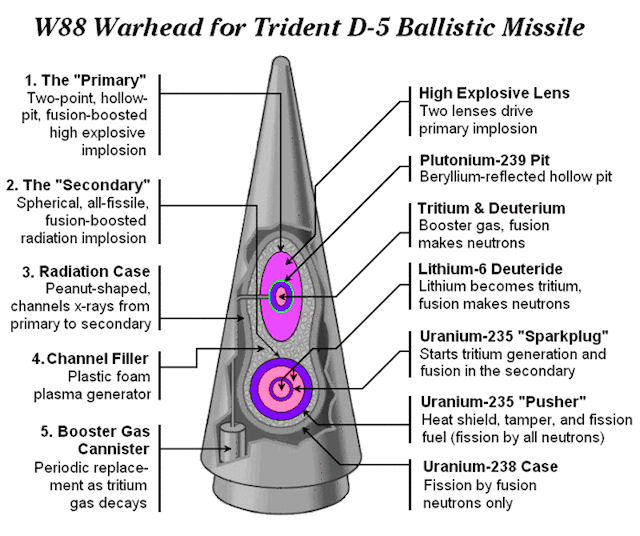
Although any technically accurate assessment of the physical consequences of the large-scale use of nuclear weapons instantly shows that “winning” a nuclear war has no meaning, the United States has strenuously emphasized the development of nuclear weapons technologies that could only make sense if their intended purpose is for fighting and winning nuclear wars.
The super-fuze is exactly that kind of technology.
The military is already upgrading warheads capable of fighting a war with both China and Russia simultaneously
Theodore Postol, Aug 29, 2024, Responsible Statecraft,
The New York Timesreported last week that President Biden has approved a secret nuclear strategy refocusing on Chinese and Russian nuclear forces.
According to the paper, the new nuclear guidance “reorients America’s deterrent strategy” to meet “the need to deter Russia, the PRC (China) and North Korea simultaneously.”
However, Biden’s approval of this strategy is no more than a tacit acknowledgment of a two-decade-long U.S. technical program that has been more than just a “slight modernization” of weapons components, but a dramatic step towards the capability to fight and win nuclear wars with both China and Russia. In other words, there is nothing really “new” here at all, save the very public nature of the strategy’s acknowledgement.
In the face of all of this, Chinese and Russian leaders will have no choice but to implement countermeasures that further increase the already dangerously high readiness of their nuclear forces. This includes intensified worst-case planning that will increase the chances of nuclear responses to false warnings of attack.
The technical source of this vast improvement in U.S. nuclear firepower is a relatively new super fuse or “super fuze” that is already being fitted onto all U.S. strategic ballistic missiles. This fuse more than doubles the ability of the Trident II Submarine Launched Ballistic Missiles (SLBMs) carrying W-76 100kt warheads to destroy Chinese and Russian nuclear-tipped Intercontinental Ballistic Missiles (ICBMs) in hardened silos.
The currently (not fully loaded) U.S. Trident Submarine force carries about 890 W-76 100kt and 400 W-88 475kt warheads. The 400 W-88 warheads have been outfitted with the super-fuze and were originally supposed to have the combination of accuracy and yield to destroy Russian silo-based ICBMs before they are launched. But there are not enough W-88s to attack both Russian and Chinese silo-based ICBMs before they can be launched.
So, with the fuse upgrade of W-76s, the W-88 warheads are no longer needed for this job. Numerous upgraded W-76 warheads can instead be used for planned missions against silo-based missiles in Russia and China.
Although 890 W-76s are currently on Trident II submarines, the U.S. has 1600 in total, making the W-76 the most numerous warhead in the American arsenal today. In the eventuality that arms control limitations no longer constrain the size of U.S. nuclear forces, these warheads could readily be added to and carried by the already available at-sea Trident II ballistic missiles, each of which can carry up to 12 W-76 warheads.
With such an “uploading,” there would still be more than enough remaining Trident II ballistic missiles on submarines to carry all of the 400 available 475kt W-88 “heavy” warheads as well.
But let’s talk more about the secret super-fuze or Burst Height Compensating Fuse.
Figure 1 [above on original] illustrates how the super-fuze drastically increases the “killing power” of a ballistic missile delivered warhead…………………………………………………………………………..
The super-fuze achieves its fantastic increase in killing efficiency by measuring its altitude at a chosen time while it is still outside the atmosphere but relatively close to its target. …………………………………………………………………………….
The military implications of this “technically sweet” added capability to U.S. ballistic missile warheads has major implications for the war-fighting capabilities of the United States.
Although any technically accurate assessment of the physical consequences of the large-scale use of nuclear weapons instantly shows that “winning” a nuclear war has no meaning, the United States has strenuously emphasized the development of nuclear weapons technologies that could only make sense if their intended purpose is for fighting and winning nuclear wars.
The super-fuze is exactly that kind of technology.
………………………………….Couching the development and deployment of these kinds of preemptive strike technologies in misleading terms like “enhancing deterrence,” does not fool the military and political leadership of Russia and China. It instead leaves them no choice but to consider ways of deterring a dangerous U.S. preemption-oriented nuclear-weaponized nation that is constantly striving for better ways to “disarm” large parts of their nuclear forces.
It is no accident that Russian President Vladimir Putin himself approved the development and revealed the existence of the ultimate doomsday weapon — the Poseidon robot submarine, which can carry a 100Mt warhead into the harbors of U.S., European, and east Asian cities — capable of destroying urban areas to ranges beyond 50 miles (80 km) from its underwater detonation point.
The deployment of the Poseidon system by Russia serves as a warning to those who think they can fight and win nuclear wars by preemptively destroying significant parts of China and Russia’s nuclear retaliation forces. No matter how successful a planned preemptive nuclear attack might look like on paper, the reality of a nuclear war initiated with the delusional belief it could be won will be global destruction so great in scale that the very end of human civilization cannot be ruled out.
This is the real bequest of Biden’s new nuclear strategy and the super-fuze. https://responsiblestatecraft.org/biden-nuclear-strategy/
That time when Canada cancelled its nuclear submarine order
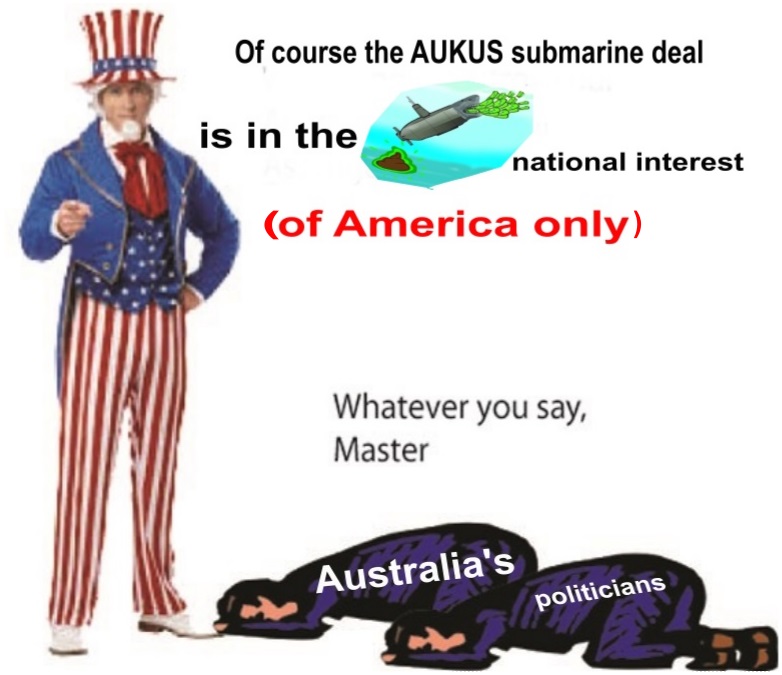
The decision to cut the Australian community out altogether — except where we will be called upon to service the US military as it builds its base in WA — puts us in the relationship of a vassal state, existing only to do the bidding of our powerful friend.
By Julie Macken and Michael Walker, Aug 30, 2024, https://johnmenadue.com/that-time-when-canada-cancelled-its-nuclear-submarine-order/
Back in 1987, when no one knew that the Cold War was just about to end, the Canadian Government signed up to build 10 nuclear-powered submarines. That submarine program lasted for all of two years before being cancelled in 1989. No nuclear Canadian sub ever even began construction, let alone getting put in the water.
There is a very real sense of déjà vu when we look at the Canadian experience and the current Australian experience of AUKUS. The good news is that it is not too late to learn the lessons the Canadians learnt for us.
One of the reasons for the Canadian cancellation was the $8 billion price tag, or about $19 billion in today’s money. Two billion dollars per submarine now sounds like a bargain compared to the astronomical $45 billion per submarine under AUKUS. Canada decided it had other priorities where that money could be put to better use.
But before the contract was cancelled in Canada, the ministries involved in its construction became embroiled in conflict, the Government itself was in a cost-of-living-crisis with immediate, real-world needs pressing and the hasty and secretive choice of vessel design came under withering criticism from the Treasury department for poor procurement with the cost expected to blow out to $30 billion ($70 billion today). And finally, media support eroded, with 71% of the population opposed to the project.
Déjà vu much?
On 12 June, the US Congressional Research Document service produced a research and advice document called the Navy Virginia-Class Submarine Program and AUKUS Submarine (Pillar 1) Project: Background and Issues for Congress.
The document points out the AUKUS deal was a three-step process. The first was to establish a US-UK rotational submarine force in Western Australia. The second was that the US would sell us three or five Virginia nuclear powered submarines and the third would be that the UK assists us in building our own AUKUS class nuclear submarines.
But the Congressional report outlines when comparing the “potential benefits, costs, and risks” of the three stage plan, it might just be better for the US to operate more of its own boats out of WA. That is, “procuring up to eight additional Virginia-class SSNs that would be retained in US Navy service and operated out of Australia along with the US and UK SSNs”.
That’s right, why bother with the whole step two and three when the US is best served by simply operating its nuclear-powered attack submarines out of WA?
This is an extraordinary development and one that demands more attention than has been given previously because a number of issues flow from this kind of thinking.
First, this potentially frees up $400 billion that could be put to far better use on a national housing construction program or high-speed rail network running the entire east coast of Australia or other large and much-needed nation-building projects. But not so fast.
The US Congressional Research Document suggests that “those funds (the $400 billion) could be invested in other military capabilities”, such as long-range missiles and bombers, “so as to create an Australian capacity for performing non-SSN military missions for both Australia and the United States”.
The decision to cut the Australian community out altogether — except where we will be called upon to service the US military as it builds its base in WA — puts us in the relationship of a vassal state, existing only to do the bidding of our powerful friend.
The fact that the document only referenced the “potential benefits, costs, and risks” from the US perspective, without any attempt to imagine how Australia may view becoming a life support for a US submarine base, makes the nature of our relationship pretty clear.
Australia’s Government may not consider it necessary to have done its due diligence on AUKUS but the Americans are happy to do that for us and, you guessed it, even though they quietly have doubts about the SSN project, they’ve already thought of plenty of other ways to spend our money on their own defence objectives. Spending it on the well-being and prosperity of our own people didn’t even rate a mention.
Israel Launches Major West Bank Raid as Israeli Minister Vows Gaza-Like Attack

it is clear that Israel is aiming to do what it has done in Gaza to the occupied West Bank.
Israel is cutting off the northern West Bank, destroying roads, surrounding hospitals and implementing curfews there.
By Sharon Zhang , Truthout, August 28, 2024
Israel has embarked on its largest raid of the occupied West Bank in decades, launching attacks from the land and air against areas home to 80,000 Palestinians as Israel’s foreign minister is pledging “war” using the same genocidal tactics the Israeli military has used on Gaza.
Israel has attacked the West Bank with drone strikes and deployed military vehicles on the ground, with troops opening fire on Palestinians. Israeli forces are shutting down and destroying roads with bulldozers leading to Jenin, Tulkarem and Tubas in the northern West Bank, effectively cutting the cities off from the rest of the West Bank. Jenin has a population of roughly 39,000 Palestinians.
The raid is especially sinister as it comes amid Israel’s genocide in Gaza, which experts say has been an opportunity for Israeli forces to test and hone violence against Palestinians. Alarmingly, Foreign Affairs Minister Israel Katz pledged that Israeli forces would handle the occupied West Bank the same way it has Gaza — where it has isolated the population and then carried out a genocide and ethnic cleansing campaign of unprecedented proportions.
………………….Experts warn it is clear that Israel is aiming to do what it has done in Gaza to the occupied West Bank. “What’s happening is absolutely horrifying, because what we see here is Israel trying to transfer the genocide war that is conducted in Gaza and the war of ethnic cleansing from Gaza to the West Bank,” Mustafa Barghouti, Palestinian physician, general secretary of the Palestinian National Initiative and West Bank resident, told Democracy Now!. “Their goal is very clear. It’s as the Israeli minister of foreign affairs said: it’s ethnic cleansing of Palestinians.”…………………………………….. more https://truthout.org/articles/israel-launches-major-west-bank-raid-as-israeli-minister-vows-gaza-like-attack/
Iran urges elimination of atomic weapons, end to nuclear tests
Friday, 30 August 2024, https://www.presstv.ir/Detail/2024/08/30/732332/Iran–elimination-of-atomic-weapons
Iran’s ambassador and permanent representative to the United Nations Office in Geneva has called on the international community to work towards ending nuclear tests and eliminating atomic weapons.
Ali Bahreini made the remarks in an X post on Thursday, on the occasion of the International Day against Nuclear Tests.
“Nuclear testing is a threat to our planet and future generations,” he said.
“On the International Day against Nuclear Tests, let’s pledge to protect our world by advocating for a complete end to nuclear tests and total elimination of NWs,” he added, referring to nuclear weapons.
“Each nuclear explosion is a step backward in the journey towards a world free of nuclear weapons. Today, more than ever, we need a global commitment to the complete elimination of nuclear weapons,” Bahreini wrote in a separate post on X in Persian.
In 2009, the UN General Assembly declared August 29 the International Day against Nuclear Tests by unanimously adopting Resolution 64/35.
The document calls for increasing awareness and education “about the effects of nuclear weapon test explosions or any other nuclear explosions and the need for their cessation as one of the means of achieving the goal of a nuclear-weapon-free world.”
The United States is the only country on Earth that has used nuclear weapons in wartime.
On August 6, 1945, the US dropped the world’s first atomic bomb on the Japanese city of Hiroshima, killing thousands instantly and about 140,000 by the end of the year. Three days later, it dropped a second bomb on Nagasaki, killing another 70,000.
International Physicians for the Prevention of Nuclear War (IPPNW). Co-President Carlos Umaña Explores Making Nuclear Weapons Taboo

August 30th, 2024 https://nuclearactive.org/ippnw-co-president-carlos-umana-explores-making-nuclear-weapons-taboo/
“When the Cold War ended in 1991 and the Doomsday Clock was at its furthest from midnight, the world sighed in relief… . It was a moment of hope where many believed this low tension between the military and economic powers of the world would lead to peace talks and nuclear disarmament.. . . So, why didn’t nuclear disarmament happen when

the iron curtain fell?. . .” This question is at the center of “Making Nuclear Weapons Taboo,” an August 2024 address by Dr. Carlos Umaña, Co-President of International Physicians for the Prevention of Nuclear War (IPPNW).
Dr. Umaña answers the question by saying, “Simply put, nuclear weapons had become a status symbol. . . . Nukes had become the currency of power, and this did not change when the so-called superpowers lost their main reason to threaten each other.” Dr. Umaña proposes that possession of nuclear weapons has a social value that society can alter. He uses the example of a bag of gold coins found in a forest to show that society bestows arbitrary value or “currency” on things. He says,
“. . .we hold on to them [the coins] because we have learned that they have value, and once we find our way to civilization, they will allow us to do a great deal of things. . .Their inherent value, what they can do for us by themselves, isn’t great, but their given value, what we have decided they can do for us, is very high.”
Dr. Umaña goes on to say that the belief that nuclear weapons are advantageous is international. The way to abolish weapons is to stigmatize them, make them taboo. This method has changed other human behavior, like slavery, and also some weapons of mass destruction such as chemical and biological weapons. He says, “[W]e will be able to get rid of nuclear weapons when they are universally condemned, when the nuclear status is not a subject of praise, but of scorn.”
To discuss how values can be changed in practice, Dr. Umaña adopts the image of concentric circles that he attributes to Professor Treasa Duckworth, Associate Professor in the Faculty of Law of the University of Auckland, in conversation with Tim Wright of the International Campaign to Abolish Nuclear Weapons (ICAN): progress against nuclear weapons being held in esteem can occur first in the outer ring of weapon-free countries, then in countries under the “nuclear umbrella,” and finally in the center ring, the U.S. and Russia.
Dr. Umaña concludes, “The international community will be able to get rid of nuclear weapons when the world finally agrees to see nuclear weapon states not as nuclear powers, but as nuclear liabilities.”
IPPNW Co-President Carlos Umaña is a general practitioner, former local health director, and epidemiological surveillance officer with the Costa Rican Ministry of Health. Dr. Umaña is on the ICAN International Steering Group and is president of IPPNW Costa Rica.
To read Dr. Umaña’s full speech, go to: https://peaceandhealthblog.com/2024/08/26/making-nuclear-weapons-taboo/
US Rushes Weapons Shipments To Israel
According to flight data, there’s been a spike in US arms deliveries to Israel since the end of July
by Dave DeCamp August 29, 2024, https://news.antiwar.com/2024/08/29/us-rushes-weapons-shipments-to-israel/
The US has been rushing weapons shipments to Israel since the end of July, Haaretz reported on Thursday, citing open-sourced aviation data.
The report said that the spike in arms shipments made August the second busiest month at Israel’s Nevatim Airbase for US deliveries since Israel’s genocidal war in Gaza began back in October 2023 following the Hamas attack on southern Israel.
Dozens of US military transport flights, as well as Israeli civilian and military and cargo planes, have landed at the base, mainly traveling from Qatar and the Dover Air Force Base in Delaware.
The Haaretz report appeared to attribute the rush in arms shipments to US preparations for a potential Iranian attack. The US has deployed additional fighter jets and warships to the region and is vowing to defend Israel from Iran’s response to the Israeli assassination of Hamas’s political chief, Ismail Haniyeh, on Iranian territory. Following a major exchange of fire between Israel and Hezbollah on Sunday, the US is still expecting a reprisal attack from Iran.
Besides helping Israel prepare for a potential attack from Iran, the US weapons shipments also help fuel the slaughter in Gaza and Israel’s operations in the West Bank, which significantly escalated on Wednesday. Israeli forces launched their largest attack on the Israeli-occupied West Bank since the Second Intifada in the early 2000s.
The rush in arms shipments also shows strong support for Israeli Prime Minister Benjamin Netanyahu, who has been working to prevent a ceasefire deal with Hamas, and shows President Biden and Vice President Harris are not serious about ending the slaughter in Gaza.
The Israeli Defense Ministry said on Monday that the US had delivered over 50,000 tons of weapons and other military equipment since October 7. The ministry said the US support was “crucial for sustaining the IDF’s operational capabilities during the ongoing war.”
NATO Ally Sounds Alarm on ‘Risks’ of Nuclear War With Russia
https://www.newsweek.com/nato-ally-turkey-hakan-fidan-sounds-alarm-nuclear-risks-russia-1946854 30 Aug 24
Turkish Foreign Minister Hakan Fidan issued a warning about the “risks” of nuclear war with Russia, according to Russian state news agency Tass.
The Russia-Ukraine war has raged on for more than two years after Russian President Vladimir Putin ordered the “special military operation” in Ukraine in February 2022. Although Moscow aimed for a quick victory over its Eastern European neighbor, viewed as having a much smaller military, its spirited defense effort bolstered by Western aid, has blocked it from making substantial gains.
Recent weeks have seen Ukraine launch its own counteroffensive into Kursk—marking the first time Russian territory has been seized since World War II.
The conflict, however, has long raised concerns about whether Russia could deploy nuclear weapons. Putin has repeatedly made eyebrow-raising statements about nuclear weapons amid the ongoing war as Moscow has more nuclear warheads than any other country, according to the International Campaign to Abolish Nuclear Weapons (ICANW).
On Friday, Fidan raised concerns about whether nuclear weapons would eventually be used in Ukraine. Turkey is notably a key ally to the United States and member of the North Atlantic Treaty Organization (NATO), though Turkish President Recep Tayyip Erdoğan has at times broken from the West on Ukraine.
“Unfortunately, a war in the heart of Europe between Russia and Ukraine is in its third year. It risks escalating into a war involving the use of nuclear weapons,” Fidan said during a TRT Haber broadcast, Tass reported.
He added that there is “nothing more humane than the demand to stop the war” and that negotiations need to take place to “prevent our region from being further devastated by war.”
Newsweek has reached out to the Russian, Turkish and Ukrainian foreign ministries for comment via email
His remarks come after Sergey Naryshkin, director of Russia’s Foreign Intelligence Service (SVR) on Thursday accused the U.S. of “trying to bring imbalance to the system of international security” in the nuclear sphere.
In June, Putin said the possibility of Russia using nuclear weapons amid the war should “not be taken lightly” by the West.
“For some reason, the West believes that Russia will never use it…We have a nuclear doctrine, look what it says,” the Russian leader said, referring to his country’s policy of allowing nuclear weapon usage if “the very existence of the state is put under threat.”
“If someone’s actions threaten our sovereignty and territorial integrity, we consider it possible for us to use all means at our disposal,” Putin added. “This should not be taken lightly, superficially.”
The U.S. has been a key ally to Ukraine amid the conflict, with the Biden administration, along with many other world leaders, saying the invasion was unprovoked and lacks justification. Washington has given billions of dollars in military aid to Kyiv that has proven crucial to its defense efforts.
Ukraine’s Kursk offensive sparked nuclear concerns from Russia, which earlier this month accused Ukraine of attempting to attack a nuclear power plant using drones.
Israel Says US Has Delivered 50,000 Tons of Military Aid Since Start of Gaza Slaughter

The Biden administration has continued to deliver weapons
by Dave DeCamp August 26, 2024 https://news.antiwar.com/2024/08/26/israel-says-us-has-delivered-50000-tons-of-military-aid-since-start-of-gaza-slaughter/
The Israeli Defense Ministry said Monday that the US has delivered over 50,000 tons of weapons and other military equipment since the start of Israel’s genocidal campaign in Gaza, demonstrating the Biden administration’s staunch support for the slaughter.
Since October 7, 107 ships and 500 transport planes have brought US military aid shipments to Israel. The Israeli Defense Ministry said the deliveries have included “armored vehicles, munitions, ammunition, personal protection gear, and medical equipment.”
The ministry added that the US support was “crucial for sustaining the IDF’s operational capabilities during the ongoing war.”
Back in April, President Biden signed a bill into law that included $17 billion in additional military aid for Israel on top of the $3.8 billion the country receives each year. The State Department recently approved a series of major arms deals for Israel worth $20 billion, including a new fleet of F-15 fighter jets.
Besides the military aid, the Biden administration has also provided intelligence for operations in Gaza and political support at the UN. The administration has also helped Israel by portraying Hamas as the obstacle to a hostage and ceasefire deal, even as Israeli Prime Minister Benjamin Netanyahu has been working to sabotage the chances of an agreement.
Over the past 10 months, the US-backed Israeli assault on Gaza has killed at least 40,435 people, including over 16,000 children, according to Gaza’s Health Ministry’s latest numbers. The ministry’s figures are considered a low estimate since it doesn’t include the estimated 10,000 people who are missing and presumed dead under the rubble. Many more could have died from indirect causes as Israel has shattered Gaza’s infrastructure.
Tangible Panic Grows in Ukraine Amid Donbass-front Collapse
Each paragraph below is illustrated on the original, with explanatory sources – quotes, videos, maps )
Simplicius, Aug 29, 2024 https://simplicius76.substack.com/p/sitrep-82824-tangible-panic-grows?utm_source=post-email-title&publication_id=1351274&post_id=148194067&utm_campaign=email-post-title&isFreemail=true&r=ln98x&triedRedirect=true&utm_medium=email—
Ukraine is slowly descending into a panic regarding the collapse of the Donbass front, and in fact that collapse is seemingly accelerating. Some semblance of a normalcy bias continues to grip the more obdurate observers, but the keen-eyed are seeing the writing on the wall.
Head of the top Ukrainian channel “Deepstate UA”—which is basically the Ukrainian ‘Rybar’—calls the situation complete chaos:
Arestovich wrote a long post on his official account where he called the situation around Pokrovsk an “operational crisis”.
Rada deputy Goncharenko was beside himself, calling the situation catastrophic. He added that after Pokrovsk, the road to the entire Dnieper will be wide open:
It’s almost pointless even updating the exact captures and advances anymore because right now they’re simply happening so fast that within hours of the Sitrep’s release, the information is already obsolete, and Russians have advanced even more. But suffice it to say, this time there were even several major captures in areas other than Pokrovsk.
Russian forces captured the remainder of Konstantinovka on the Ugledar line:
Ugledar is now becoming in danger of being surrounded for the AFU in the near future.
Then Russians captured most of Grodovka, after having just entered it days ago:
At this pace, it will be captured in the next day or two it seems.
After capturing New York, they’ve already entered the next settlement north of it, Nelipovka. And nearby, they’ve advanced deeper into Toretsk, gaining hundreds of meters inside the important city.
As of now, they’re mere kilometers from Pokrovsk, and right at the outskirts of its neighboring city of Mirnograd:
Nearby, they’ve now entered Selidov for the first time, and are already working through it:
Another Ukrainian account:
“Battles for Selidove have begun! The enemy is actively pushing our defenses on the eastern outskirts of the city, the fighting continues in the area of the stadium and the park, slowly moving towards the high-rises, also the podars are trying to level the front and are starting to press from Mykhailivka to the south and push from the highway in the east. The same squeeze situation occurred in New York.”
In light of the ongoing collapse, the potential for dangerous escalation rises because Zelensky gets increasingly desperate to engineer some kind of black swan event that could overturn the table and upend events.
With this in mind there continues to be a slew of rumors for what Zelensky’s next move might be. For instance, there continue to be reports of AFU preparations on the Zaporozhye front:
There is some credence to the above given that in the past few days the Russian airforce has carried out at least 2 separate air strikes along the Black Sea toward Odessa—one was at Snake Island, and another at oil platforms just east of there which Ukrainian GUR was using to stage landings toward Crimea.
This is roughly how Zelensky’s potential plan is meant to play out:
A simultaneous mass landing by special forces around the Kinburn Spit area to harass the ‘rears’ of Russia’s Dnieper grouping, while other amphibious forces directly strike at the Energodar plant and then the main logistics force tries to wrap around from Zaporozhye city along the river to connect with them.
No one quite knows why this happened, but there are a few potential conjectures:
- Lukashenko foresees Ukraine attempting to create some provocation as part of the earlier mentioned ‘black swan’ to involve NATO forces, and is taking appropriate deterrence measures
- Lukashenko is trying to help Russian troops by pinning or ‘fixing’ Ukrainian border guards along the Belarus border, given that Ukraine was said to have removed many of the border forces to use them in Kursk
- Least likely: Russia and Belarus plan some kind of joint final decapitation invasion to finish off the war
Most likely it’s a combination of 1 and 2.
Partly related to the heightening tensions, we now have a new very interesting statement by Lavrov which appears to vindicate my recent reporting about potential changes to the Russian nuclear doctrine, given the West’s unceasing escalations against Russia’s red lines.
There’s an undercurrent of tension now running through events as other somewhat peculiar happenings have gone on. For instance, Belarus suddenly moved a lot of forces to the Ukrainian border again, and for the first time they appear to have a tactical symbol of a ‘B’ on them, as if they are preparing for direct combat:

‘Lessons of the past forgotten’ as nuclear proliferation continues
Peace and Security, https://news.un.org/en/story/2024/08/1153696
More than 2,000 nuclear tests have been conducted at over 60 sites around the world since testing began on 16 July 1945, resulting in uninhabitable lands and long-term health problems, Secretary General António Guterres said in his message marking Friday’s International Day to end testing once and for all.
“Recent calls for the resumption of nuclear testing demonstrate that the terrible lessons of the past are being forgotten – or ignored,” he said.
The International Day was established in 2009 by the UN General Assembly to recall the date of the official closing of the Semipalatinsk nuclear weapons testing site in today’s Kazakhstan on 29 August 1991.
That one site alone saw 456 nuclear test explosions between 1949 and 1989.
Era of nuclear proliferation
In the shadow of the Cold War, the world witnessed an unprecedented era of nuclear proliferation and testing.
Between the years 1954 and 1984 there was on average at least one nuclear weapons test somewhere in the world every week, most with a blast far exceeding the power of the bomb dropped on Hiroshima.
Moreover, nuclear weapons stockpiles have grown exponentially, with the majority far more powerful than the bombs used in Hiroshima and Nagasaki.
This proliferation has left a ‘legacy of destruction’, according to Mr. Guterres, significantly disrupting people’s lives and livelihoods and affecting the environment with traces of radioactivity in even the deepest of ocean trenches.
‘World must speak with one voice’
The UN chief is urging the world to speak with one voice, “to end this practice once and for all”.
He has praised the Comprehensive Nuclear-Test-Ban Treaty as an “essential, verifiable security tool” due to its complete prohibition on all nuclear testing.
He is calling on all countries whose ratifications are needed for the Treaty to enter into force to do so immediately and without conditions.
“Let’s pass the test for humanity – and ban nuclear testing for good,” he concluded.
Read the op-ed here marking the day on our UN News site penned by the President of the General Assembly and head of the Comprehensive Nuclear-Test-Ban Treaty Organization.
Australia offers U.S. a vast new military launchpad in China conflict

Australia is expanding its northern military bases, with U.S. support, to counter China’s growing threat. Critics quip it’s become the “51st state.”
Washington Post, By Michael E. Miller, August 24, 2024
ROYAL AUSTRALIAN AIR FORCE BASE TINDAL, Australia — Deep in the outback, a flurry of construction by Australia and the United States is transforming this once quiet military installation into a potential launchpad in case of conflict with China.
Runways are being expanded and strengthened to accommodate the allies’ biggest airplanes, including American B-52 bombers. A pair of massive fuel depots is rising side by side to supply U.S. and Australian fighter jets. And two earth-covered bunkers have been built for U.S. munitions.
But the activity at RAAF Tindal, less than 2,000 miles from the emerging flash points of the South China Sea,isn’t unique. Across Australia, decades-old facilities — many built by the United States during World War II — are now being dusted off or upgraded amid growing fears of another global conflict.
“This isabout deterrence,” Australia’s defense minister, Richard Marles, said in an interview. “We’re working together to deter future conflict and to provide for the collective security of the region in which we live.”
The United States has ramped up defense ties with allies across the region, including with the Philippines and Japan, as it tries to fend off an increasingly assertive and aggressive China. Australia offers the United States a stable and friendly government, a small but capable military, and a vast expanse from which to stage or resupply military efforts.
U.S. Secretary of Defense Lloyd Austin, hailing the “the extraordinary strength of our unbreakable alliance with Australia,” said after a meeting with Marles earlier this month that deepercooperation — including base upgrades and more frequent rotational bomber deployments — would help build “greater peace, stability, and deterrence across the region.”
Australia has also joined the AUKUS agreement, under which the United States and Britain will provide it with nuclear-propelled submarines, some of the world’s most closely guarded technology.
These moves underscore a bigger shift, as Canberra has grown increasingly tight with Washington as they both grow wary of Beijing. Military cooperation has become so extensive that critics quip Australia is becoming the United States’ “51st state.”
Mihai Sora, a former Australian diplomat who is an analyst at the Lowy Institute, a Sydney think tank, has a different metaphor. Australia is “an unsinkable aircraft carrier right at the bottom of the critical maritime sea lanes.”
“As the stakes increase in the South China Sea, as the risk over conflict in Taiwan increases, northern Australia in particular becomes of increasing strategic value for the United States,” Sora said.
American representatives ona recent congressional delegation to Darwin,onAustralia’s northern coast, agreed.
“This provides a central base of operations from which to project power,” Rep. Michael McCaul (R-Tex.), chairman of the House Foreign Affairs Committee, said during the trip.
Some Australian experts, however, argue that the growing U.S. military footprint doesn’t deter conflict with China so much as ensure Australia will be involved.
“I have deep misgivings about the whole enterprise” of increased U.S. military activity in Australia, said Sam Roggeveen, a former Australian intelligence analyst who is also at the Lowy Institute. “It conflates America’s strategic objectives in Asia with ours, and it makes those bases a target.”
……………………………………….Australia has spent roughly $1 billion on upgrading the Tindal air force base. Built by U.S. Army engineers in 1942 to stage bombing raids on Japanese targets in Papua New Guinea and Indonesia, Tindal is now the site of dozens of construction projects. A key one is the new parking apron capable of accommodating four of Australia’s biggest planes: KC-30 tankers that can refuel fighter jets and allow for far more distant attacks.
But there are also plans for the United States to build its own parking apron here, big enough for six B-52 bombers capable of reaching mainland China.
“That is absolutely something China would pay attention to,” Roggeveen said.
Marles declined to comment on the increasing rotations mentioned by Austin but said the trajectory is “an increasing American force posture in Australia.” We see that as very much in Australia’s national interest,” he said. “People understand that we are living through challenging times, when the global rules-based order is under pressure.”………………………………………………………………..
Australia is also surveying three “bare bases” — skeleton facilities in remote parts of western Australia and Queensland — with an eye to upgrading them so heavier Australian and American airplanes can use them, said Brigadier Michael Say, who leads Australia’s Force Posture Initiative. He said it’s still being determined whether the United States will pay for some of the improvements. [WHAA-A-AT!]
In the Cocos Islands, tiny coral atolls in the Indian Ocean northwest of the Australian continent and just south of Indonesia, Canberra will soon begin upgrading the airstrip to accommodate heavier military aircraft, including the P-8A Poseidon, a “submarine hunter” that could monitor increased Chinese naval activity in the area. A U.S. Navy construction contract published in June listed the Cocos as a possible project location, but Say said it hasn’t yet been decided whether the United States will contribute.
Diversifying — or redistributing?
These “bare bases,” which stretch for 3,000 miles from east to west, fit a new U.S. strategy of dispersing forces to prevent China from delivering a knockout blow.
“If one location gets taken out, the U.S. can still project force, it can still replenish and resupply and reinforce its troops,” Sora said. “Australia is fundamental to that but is just one plank in America’s regional force posture.”
Roggeveen questioned, however, whether the United States is actually increasing its capabilities in the region or merely moving assets out of places like Guam that are more immediately threatened by China’s improving missile capability. Under AUKUS, the United States will begin rotating up to four nuclear-powered submarines through western Australia in 2027………………………………………
Some concerns linger in Washington over Australia’s commitment, however. During the visit to Darwin, McCaul and other representatives asked about the 99-year lease a Chinese company holds over the port surrounding the Australian naval base. Australian officials said two reviews had found there wasn’t a security concern, and that in the case of a conflict, the port could be nationalized.
“Australia relies on China for prosperity and on America for security,” Rep. Jimmy Panetta (D-Calif.) told The Post. “That’s the balance they are playing.” https://www.washingtonpost.com/world/2024/08/24/us-military-base-australia-china/—
—
The Battle of Kursk probably won’t result in nuclear weapons use against Ukraine. But Russian escalation vis-à-vis NATO can’t be ruled out.
any nuclear use against Ukraine would be self-defeating for Russia.
involvement of the West turned Russia’s so-called “special military operation” (“SVO” in Russia) into a full-scale war. Consequently, nuclear signaling has been addressed to the West.
Russia’s central concern is the possible Western involvement in the war on the side of Ukraine, which can turn the tide at the front line. The most visible cause for such concern is the provision of modern Western arms to Ukraine, including long-range missiles capable of targeting deep into Russian territory.
Bulletin, By Nikolai N. Sokov | August 26, 2024
The successful Ukrainian offensive in the Russian Kursk oblast started in early August has once again triggered speculation about possible Russian nuclear use against Ukraine. The situation resembles the successful Ukrainian offensive in the late summer-fall of 2022 in the Kharkiv oblast, when many worried Russia would resort to battlefield nuclear use to stop advancing Ukrainian forces. On the face of it, there was reason to be concerned: Russian President Vladimir Putin did reference nuclear weapons in September 2022, and it became known more than a year later that the United States was “rigorously” preparing for that contingency.
A closer look reveals, however, that Putin’s 2022 reference to nuclear weapons sounded as an emotional impromptu remark made under stress, whereas the US assessment was reportedly based on an intercept of conversations among Russian generals rather than on tangible signs of preparation or data about discussions among policymakers. We now know that Moscow dealt with that situation in a different way: Partial mobilization helped beef up forces, which stopped the Ukrainian Kharkiv offensive.
Although the Kursk operation caught Russia by surprise once again, its military and civilian leadership are better prepared today to deal with surprise than in 2022.
One has reasons to be skeptical about the prospect of battlefield use of nuclear weapons. It was considered an acceptable option during the Cold War, especially its early years. Both the United States and the Soviet Union held large-scale exercises with live nuclear explosions in the 1950s, and both nuclear powers contemplated large-scale use of tactical nuclear weapons in Europe. Today, however, is different. The “nuclear taboo,” which began to take shape in the 1950s, has grown very strong.
Not that nuclear use is technically impossible. But the political and ethical implications make such a decision daunting—and unlikely. Battlefield nuclear use in Ukraine, for whatever reason, would make Russia a true pariah state in the international system, turning countries—partners and neutrals alike, all critical for breaking the tight sanctions regime, which has been established by the G7 economies and their partners—against Moscow. In other words, any nuclear use against Ukraine would be self-defeating for Russia.
Nuclear signals. Russian nuclear signaling has been persistent, going up and down throughout the war, with high points in the fall of 2022 and the spring of 2024, when Russian official rhetoric was the loudest. (Unofficial and semi-official rhetoric has never really stopped.) This signaling, however, has been exclusively and explicitly directed at the West—the United States and its allies. Even the very first statement of Putin announcing the “special military operation” contained a message to the West: “Do not interfere.”
This is hardly surprising: The war is conceptualized in Russia as a proxy war with NATO. Putin’s spokesman, Dmitry Peskov, has repeatedly said—most recently in March and June of this year—that involvement of the West turned Russia’s so-called “special military operation” (“SVO” in Russia) into a full-scale war. Consequently, nuclear signaling has been addressed to the West.
The Ukrainian operation in Kursk may carry certain risks, but these risks are different from what is commonly and hastily assumed as nuclear use against Ukraine.
Russia’s central concern is the possible Western involvement in the war on the side of Ukraine, which can turn the tide at the front line. The most visible cause for such concern is the provision of modern Western arms to Ukraine, including long-range missiles capable of targeting deep into Russian territory.
At a certain level, Western assistance may create serious, perhaps even insurmountable challenges for the Russian military. Each new step—including the provision of tanks, missile defense systems, tactical ballistic missile systems, and most recently F-16 fighter jets—triggers warnings about possible escalation. So far, Russia has coped with each new level of Ukraine’s military capability, but this may change in the future if Western assistance continues or even intensifies.
Perhaps more consequential for Russia, although less visible, is the provision of intelligence, which has helped Ukraine to select targets and significantly constrains Russia’s ability to clandestinely concentrate and move forces and supplies……………………………….
Russians often repeat that a nuclear state cannot be defeated. This is true only to an extent, but there is realization in the Kremlin and beyond that defeat in the ongoing war cannot be tactical. Not only it will end the political regime—which the Kremlin equates with sovereignty—but consequences will affect the entire country for decades. If Russia considers itself de facto at war with the United States and NATO and believes the West seeks its “strategic defeat,” then nuclear weapons legitimately enter the picture under the existing 2020 Decree on Nuclear Deterrence and the 2014 Military Doctrine. This is precisely the situation the United States has tried to avoid: ………………………………
Russian nuclear signals to the West can be divided into two categories.
The first is public statements, especially coming from the most authoritative source, Vladimir Putin, which have been relatively rare—namely, the “SVO” announcement and the September 2022 warning referenced above. ………………………. If someone’s actions will threaten our sovereignty and territorial integrity, we consider it allowable to use all means at our disposal.” Putin also declared that ndeclaredew threats may force Russia to change its nuclear doctrine, hinting that the nuclear threshold might be lowered.
The second category of nuclear signals is arguably more tangible: actions that change Russia’s nuclear posture and/or alert level. Such actions notably include nuclear sharing arrangements with Belarus, whose implementation began in the summer of 2022—after it became clear that war with Ukraine would be protracted, and Russia could not prevent the West from providing assistance to Ukraine—and was completed already in mid-2023. Other highly visible examples are exercises with tactical nuclear weapons, which have been held in three stages in May, June, and August of 2024………………….
Fuzzy red lines. Without doubt, publicly playing with the prospect of nuclear war is dangerous—in addition to be morally reprehensible—but one must admit that Moscow has been relatively restrained in its threats so far; it could certainly make more threats and make them more openly. So why has Russia shown such restraint as it conducts a full-fledged war?
……………………………………………………………………………………….The Russian leadership itself may not know what exactly constitutes a red line. So far, it seems to make such judgement after the fact, evaluating each new level of assistance to determine its impact on the course of the war. If and when such impact reaches a level that puts Russia on the brink of a “strategic defeat,” it may be classified as having crossed a red line…………………..
Evaluation of each new step takes time—from weeks to months. The absence of visible reaction may create a false sense of safety, potentially emboldening U.S. and Western officials. Then, if and when a Russian reaction takes place, it may catch Western allies by surprise and be perceived as unjustified and unprovoked, for the precise reason that the red line was unknown.
No doubt that Russia is very reluctant to launch an escalation that could result in nuclear use: The costs to Russia itself would be enormous—probably unbearable for the country and its leadership. ……………………………….
………the riskiest circumstances will happen after a red line has been crossed, not before. Each side will balance between caution and the perceived strategic need to act. Worse, a long sequence of moves that did not result in escalation may create a false sense of security and increase propensity for risk-taking on the part of Western military officials and political leaders.
…………………..The crossing of a red line in the war in Ukraine may not result in nuclear use. A more likely contingency is escalation starting with something relatively small, but visibly consequential………………………………………. The threat of nuclear use is expected to force the West to retreat, because its stakes in the conflict are believed to be lower than those of Russia in the war in Ukraine.
……………………………………………………………………..It can be predicted with reasonable confidence that Russia will not threaten, much less use, nuclear weapons against Ukraine. Escalation vis-à-vis NATO, however, is a different matter: That likelihood appears higher, but knowing in advance how high it is may be impossible.
Considering the risks outlined above, one obvious question is whether the West should continue and perhaps increase support of Ukraine. I believe that questions about the Kursk invasion and whether the West should continue aiding Ukraine are essentially unrelated. Regardless of which decision is made in regard to Western aid, the risks of that policy must be known and understood. Nothing good can come out of policy that is consciously blind to possible challenges. To the contrary, full information can enhance chances for success and lessen the likelihood of escalation. https://thebulletin.org/2024/08/the-battle-of-kursk-probably-wont-result-in-nuclear-weapons-use-against-ukraine-but-russian-escalation-vis-a-vis-nato-cant-be-ruled-out/?utm_source=Newsletter&utm_medium=Email&utm_campaign=MondayNewsletter08262024&utm_content=NuclearRisk_RussianEscalationVisAVis_08262024
Ex-Google CEO Eric Schmidt says the Ukraine War turned him into an arms dealer
Microsoft Start, Story by kniemeyer@insider.com (Kenneth Niemeyer), 25 Aug 24,
- Eric Schmidt, the ex-Google CEO, said his new drone company intends to help Ukraine.
- Schmidt’s startup, White Stork, aims to create AI-driven attack drones.
- He made the comments in April during a lecture at Standford University that was first posted last week.
Google’s former chief executive, Eric Schmidt, said he is now a ‘licensed arms dealer’ because he wants to help Ukraine access AI that could help it fight against Russia’s ongoing invasion.
At a lecture at Stanford University in April, Schmidt said he is working on a company with Udacity CEO Sebastian Thrun that will “use AI in complicated, powerful ways for these essentially robotic wars.” The lecture, which Stanford posted to its YouTube channel last week, quickly went viral. It has since been taken down……………..
The startup, called White Stork, is working to mass-produce drones that could use AI to identify targets. Schmidt previously chaired the National Security Commission on Artificial Intelligence for several years. He was Google’s CEO from 2001 to 2011.
Schmidt said White Stork has two goals: building complicated AI robots and lowering costs. By lowering the cost of the robots, Schmidt says the need for ground battles with tanks and other artillery could be “eliminated.”
He said that with “the support of the governments,” the drones would go “straight into Ukraine” and “fight the war.”
“Because of the way the system works, I am now a licensed arms dealer,” Schmidt said. “A computer scientist, businessman, arms dealer.” https://www.msn.com/en-us/money/other/ex-google-ceo-eric-schmidt-says-the-ukraine-war-turned-him-into-an-arms-dealer/ar-AA1oYiqR
—
1 This Month
26 September – International Day for the Total Elimination of Nuclear Weapons





PLEASE OPPOSE HR 8255 AND S.3639 – bills would accelerate satellite deployment, with no environmental review or safeguards – https://ncstd5li.quorum.us/campaign/169331/
To see nuclear-related stories in greater depth and intensity – go to https://nuclearinformation.wordpress.com
-
Archives
- September 2026 (281)
- August 2026 (330)
- July 2026 (355)
- June 2026 (287)
- May 2026 (306)
- April 2026 (356)
- March 2026 (251)
- February 2026 (267)
- January 2026 (308)
- December 2025 (358)
- November 2025 (359)
- October 2025 (375)
-
Categories
- 1
- 1 NUCLEAR ISSUES
- business and costs
- climate change
- culture and arts
- ENERGY
- environment
- health
- history
- indigenous issues
- Legal
- marketing of nuclear
- media
- opposition to nuclear
- PERSONAL STORIES
- politics
- politics international
- Religion and ethics
- safety
- secrets,lies and civil liberties
- spinbuster
- technology
- Uranium
- wastes
- weapons and war
- Women
- 2 WORLD
- ACTION
- AFRICA
- Atrocities
- AUSTRALIA
- Christina's notes
- Christina's themes
- culture and arts
- Events
- Fuk 2022
- Fuk 2023
- Fukushima 2017
- Fukushima 2018
- fukushima 2019
- Fukushima 2020
- Fukushima 2021
- general
- global warming
- Humour (God we need it)
- Nuclear
- RARE EARTHS
- Reference
- resources – print
- Resources -audiovicual
- Weekly Newsletter
- World
- World Nuclear
- YouTube
-
RSS
Entries RSS
Comments RSS

