A New Military-Industrial Complex Arises

This year’s record defense budget of approximately $850 billion includes $143.2 billion for research and development and another $167.5 billion for the procurement of weaponry. That $311 billion, most of which will be funneled to those giant defense firms, exceeds the total amount spent on defense by every other country on Earth.
Now, however, a new force — Silicon Valley startup culture — has entered the fray, and the military-industrial complex equation is suddenly changing dramatically.
The Secret War Within the Pentagon
February 10, 2025 , By Michael Klare / TomDispatch
Last April, in a move generating scant media attention, the Air Force announced that it had chosen two little-known drone manufacturers — Anduril Industries of Costa Mesa, California, and General Atomics of San Diego — to build prototype versions of its proposed Collaborative Combat Aircraft (CCA), a future unmanned plane intended to accompany piloted aircraft on high-risk combat missions. The lack of coverage was surprising, given that the Air Force expects to acquire at least 1,000 CCAs over the coming decade at around $30 million each, making this one of the Pentagon’s costliest new projects. But consider that the least of what the media failed to note. In winning the CCA contract, Anduril and General Atomics beat out three of the country’s largest and most powerful defense contractors — Boeing, Lockheed Martin, and Northrop Grumman — posing a severe threat to the continued dominance of the existing military-industrial complex, or MIC.
For decades, a handful of giant firms like those three have garnered the lion’s share of Pentagon arms contracts, producing the same planes, ships, and missiles year after year while generating huge profits for their owners. But an assortment of new firms, born in Silicon Valley or incorporating its disruptive ethos, have begun to challenge the older ones for access to lucrative Pentagon awards. In the process, something groundbreaking, though barely covered in the mainstream media, is underway: a new MIC is being born, one that potentially will have very different goals and profit-takers than the existing one. How the inevitable battles between the old and the new MICs play out can’t be foreseen, but count on one thing: they are sure to generate significant political turbulence in the years to come.
The very notion of a “military-industrial complex” linking giant defense contractors to powerful figures in Congress and the military was introduced on January 17, 1961, by President Dwight D. Eisenhower in his farewell address to Congress and the American people. In that Cold War moment, in response to powerful foreign threats, he noted that “we have been compelled to create a permanent armaments industry of vast proportions.” Nevertheless, he added, using the phrase for the first time, “we must guard against the acquisition of unwarranted influence, whether sought or unsought, by the military-industrial complex. The potential for the disastrous rise of misplaced power exists and will persist.”
Ever since, debate over the MIC’s accumulating power has roiled American politics. A number of politicians and prominent public figures have portrayed U.S. entry into a catastrophic series of foreign wars — in Vietnam, Cambodia, Laos, Iraq, Afghanistan, and elsewhere — as a consequence of that complex’s undue influence on policymaking. No such claims and complaints, however, have ever succeeded in loosening the MIC’s iron grip on Pentagon arms procurement. This year’s record defense budget of approximately $850 billion includes $143.2 billion for research and development and another $167.5 billion for the procurement of weaponry. That $311 billion, most of which will be funneled to those giant defense firms, exceeds the total amount spent on defense by every other country on Earth.
Over time, the competition for billion-dollar Pentagon contracts has led to a winnowing of the MIC ecosystem, resulting in the dominance of a few major industrial behemoths. In 2024, just five companies — Lockheed Martin (with $64.7 billion in defense revenues), RTX (formerly Raytheon, with $40.6 billion), Northrop Grumman ($35.2 billion), General Dynamics ($33.7 billion), and Boeing ($32.7 billion) — claimed the vast bulk of Pentagon contracts. (Anduril and General Atomics didn’t even appear on a list of the top 100 contract recipients.)
Typically, these companies are the lead, or “prime,” contractors for major weapons systems that the Pentagon keeps buying year after year. Lockheed Martin, for example, is the prime contractor for the Air Force’s top-priority F-35 stealth fighter (a plane that has often proved distinctly disappointing in operation); Northrop Grumman is building the B-21 stealth bomber; Boeing produces the F-15EX combat jet; and General Dynamics makes the Navy’s Los Angeles-class attack submarines. “Big-ticket” items like these are usually purchased in substantial numbers over many years, ensuring steady profits for their producers. When the initial buys of such systems seem to be nearing completion, their producers usually generate new or upgraded versions of the same weapons, while employing their powerful lobbying arms in Washington to convince Congress to fund the new designs.
Over the years, non-governmental organizations like the National Priorities Project and the Friends Committee on National Legislation have heroically tried to persuade lawmakers to resist the MIC’s lobbying efforts and reduce military spending, but without noticeable success. Now, however, a new force — Silicon Valley startup culture — has entered the fray, and the military-industrial complex equation is suddenly changing dramatically.
Along Came Anduril
Consider Anduril Industries, one of two under-the-radar companies that left three MIC heavyweights in the dust last April by winning the contract to build a prototype of the Collaborative Combat Aircraft. Anduril (named after the sword carried by Aragorn in J.R.R. Tolkien’s The Lord of the Rings) was founded in 2017 by Palmer Luckey, a virtual-reality headset designer, with the goal of incorporating artificial intelligence into novel weapons systems. He was supported in that effort by prominent Silicon Valley investors, including Peter Thiel of the Founders Fund and the head of another defense-oriented startup, Palantir (a name also derived from The Lord of the Rings).
…………………………………………………………………………………………………………………. Buttressed by such arguments, as well as the influence of key figures like Thiel, Anduril began to secure modest but strategic contracts from the military and the Department of Homeland Security.
……………………………………………………………………………… Anduril’s success in winning ever-larger Pentagon contracts has attracted the interest of wealthy investors looking for opportunities to profit from the expected growth of defense-oriented startups. ……………………………………………………………………..
The Replicator Initiative
Along with its success in attracting big defense contracts and capital infusions, Anduril has succeeded in convincing many senior Pentagon officials of the need to reform the department’s contracting operations so as to make more room for defense startups and tech firms. On August 28, 2023, Deputy Secretary of Defense Kathleen Hicks, then the department’s second-highest official, announced the inauguration of the “Replicator” initiative, designed to speed the delivery of advanced weaponry to the armed forces.
“[Our] budgeting and bureaucratic processes are slow, cumbersome, and byzantine,” she acknowledged. To overcome such obstacles, she indicated, the Replicator initiative would cut through red tape and award contracts directly to startups for the rapid development and delivery of cutting-edge weaponry. “Our goal,” she declared, “is to seed, spark, and stoke the flames of innovation.”
As Hicks suggested, Replicator contracts would indeed be awarded in successive batches, or “tranches.” The first tranche, announced last May, included AeroVironment Switchblade 600 kamikaze drones (called that because they are supposed to crash into their intended targets, exploding on contact). Anduril was a triple winner in the second tranche, announced on November 13th…………………………………………………………………….
Enter the Trumpians
Kathleen Hicks stepped down as deputy secretary of defense on January 20th when Donald Trump reoccupied the White House, as did many of her top aides. Exactly how the incoming administration will address the issue of military procurement remains to be seen, but many in Trump’s inner circle, including Elon Musk and Vice President J.D. Vance, have strong ties to Silicon Valley and so are likely to favor Replicator-like policies.
Pete Hegseth, the former Fox News host who recently won confirmation as secretary of defense, has no background in weapons development and has said little about the topic. However, Trump’s choice as deputy secretary (and Hick’s replacement) is billionaire investor Stephen A. Feinberg who, as chief investment officer of Cerberus Capital Management, acquired the military startup Stratolaunch — suggesting that he might favor extending programs like Replicator.
In a sense, the Trump moment will fit past Washington patterns when it comes to the Pentagon in that the president and his Republican allies in Congress will undoubtedly push for a massive increase in military spending, despite the fact that the military budget is already at a staggering all-time high. Every arms producer is likely to profit from such a move, whether traditional prime contractors or Silicon Valley startups. If, however, defense spending is kept at current levels — in order to finance the tax cuts and other costly measures favored by Trump and the Republicans — fierce competition between the two versions of the military-industrial complex could easily arise again. That, in turn, might trigger divisions within Trump’s inner circle, pitting loyalists to the old MIC against adherents to the new one.
Most Republican lawmakers, who generally rely on contributions from the old MIC companies to finance their campaigns, are bound to support the major prime contractors in such a rivalry. But two of Trump’s key advisers, J.D. Vance and Elon Musk, could push him in the opposite direction. Vance, a former Silicon Valley functionary who reportedly became Trump’s running mate only after heavy lobbying by Peter Thiel and other tech billionaires, is likely to be encouraged by his former allies to steer more Pentagon contracts to Anduril, Palantir, and related companies. And that would hardly be surprising, since Vance’s private venture fund, Narya Capital (yes, another name derived from The Lord of the Rings!), has invested in Anduril and other military/space ventures.
Michael Klare, Droning Washington
Posted on February 9, 2025
Yes, some of us still remember that the now-famous (or do I mean infamous?) phrase “the military-industrial complex” actually came from the farewell address of former World War II general and then-President Dwight D. Eisenhower on January 17, 1961. But how often do any of us remember the all-too-painfully appropriate context in which he offered it to the American people — as a warning about a future that today is so much ours, as the budget of the Department of Defense (so it’s still called despite the many disastrous and anything but “defensive” wars the U.S. military has fought in this century) heads for the trillion-dollar mark? Here, then, to introduce military expert and TomDispatch regular Michael Klare’s eye-opening account of where the MIC (the shorthand version of that phrase) is heading in the age of the drone and artificial intelligence, is the larger context for Eisenhower’s first use of the term:
“Until the latest of our world conflicts, the United States had no armaments industry. American makers of plowshares could, with time and as required, make swords as well. But now we can no longer risk emergency improvisation of national defense; we have been compelled to create a permanent armaments industry of vast proportions. Added to this, three and a half million men and women are directly engaged in the defense establishment. We annually spend on military security more than the net income of all United States corporations.
“This conjunction of an immense military establishment and a large arms industry is new in the American experience. The total influence — economic, political, even spiritual — is felt in every city, every state house, every office of the Federal government. We recognize the imperative need for this development. Yet we must not fail to comprehend its grave implications. Our toil, resources, and livelihood are all involved; so is the very structure of our society.
“In the councils of government, we must guard against the acquisition of unwarranted influence, whether sought or unsought, by the military-industrial complex. The potential for the disastrous rise of misplaced power exists and will persist. We must never let the weight of this combination endanger our liberties or democratic processes. We should take nothing for granted. Only an alert and knowledgeable citizenry can compel the proper meshing of the huge industrial and military machinery of defense with our peaceful methods and goals, so that security and liberty may prosper together. Akin to, and largely responsible for the sweeping changes in our industrial-military posture, has been the technological revolution during recent decades.”
And more than 60 years later, with Eisenhower’s grimly visionary statement in mind, let Klare suggest just how eerily on target he was. If you don’t believe me, note that tech giant Anduril is now setting up its first factory in the Midwest — Columbus, Ohio, to be exact — at the cost of an initial billion dollars to produce “autonomous systems and weapons,” as artificial intelligence prepares to go to war. Tom
A New Military-Industrial Complex Arises
The Secret War Within the Pentagon
Last April, in a move generating scant media attention, the Air Force announced that it had chosen two little-known drone manufacturers — Anduril Industries of Costa Mesa, California, and General Atomics of San Diego — to build prototype versions of its proposed Collaborative Combat Aircraft (CCA), a future unmanned plane intended to accompany piloted aircraft on high-risk combat missions. The lack of coverage was surprising, given that the Air Force expects to acquire at least 1,000 CCAs over the coming decade at around $30 million each, making this one of the Pentagon’s costliest new projects. But consider that the least of what the media failed to note. In winning the CCA contract, Anduril and General Atomics beat out three of the country’s largest and most powerful defense contractors — Boeing, Lockheed Martin, and Northrop Grumman — posing a severe threat to the continued dominance of the existing military-industrial complex, or MIC.
For decades, a handful of giant firms like those three have garnered the lion’s share of Pentagon arms contracts, producing the same planes, ships, and missiles year after year while generating huge profits for their owners. But an assortment of new firms, born in Silicon Valley or incorporating its disruptive ethos, have begun to challenge the older ones for access to lucrative Pentagon awards. In the process, something groundbreaking, though barely covered in the mainstream media, is underway: a new MIC is being born, one that potentially will have very different goals and profit-takers than the existing one. How the inevitable battles between the old and the new MICs play out can’t be foreseen, but count on one thing: they are sure to generate significant political turbulence in the years to come.
The very notion of a “military-industrial complex” linking giant defense contractors to powerful figures in Congress and the military was introduced on January 17, 1961, by President Dwight D. Eisenhower in his farewell address to Congress and the American people. In that Cold War moment, in response to powerful foreign threats, he noted that “we have been compelled to create a permanent armaments industry of vast proportions.” Nevertheless, he added, using the phrase for the first time, “we must guard against the acquisition of unwarranted influence, whether sought or unsought, by the military-industrial complex. The potential for the disastrous rise of misplaced power exists and will persist.”
Ever since, debate over the MIC’s accumulating power has roiled American politics. A number of politicians and prominent public figures have portrayed U.S. entry into a catastrophic series of foreign wars — in Vietnam, Cambodia, Laos, Iraq, Afghanistan, and elsewhere — as a consequence of that complex’s undue influence on policymaking. No such claims and complaints, however, have ever succeeded in loosening the MIC’s iron grip on Pentagon arms procurement. This year’s record defense budget of approximately $850 billion includes $143.2 billion for research and development and another $167.5 billion for the procurement of weaponry. That $311 billion, most of which will be funneled to those giant defense firms, exceeds the total amount spent on defense by every other country on Earth.
Over time, the competition for billion-dollar Pentagon contracts has led to a winnowing of the MIC ecosystem, resulting in the dominance of a few major industrial behemoths. In 2024, just five companies — Lockheed Martin (with $64.7 billion in defense revenues), RTX (formerly Raytheon, with $40.6 billion), Northrop Grumman ($35.2 billion), General Dynamics ($33.7 billion), and Boeing ($32.7 billion) — claimed the vast bulk of Pentagon contracts. (Anduril and General Atomics didn’t even appear on a list of the top 100 contract recipients.)
Typically, these companies are the lead, or “prime,” contractors for major weapons systems that the Pentagon keeps buying year after year. Lockheed Martin, for example, is the prime contractor for the Air Force’s top-priority F-35 stealth fighter (a plane that has often proved distinctly disappointing in operation); Northrop Grumman is building the B-21 stealth bomber; Boeing produces the F-15EX combat jet; and General Dynamics makes the Navy’s Los Angeles-class attack submarines. “Big-ticket” items like these are usually purchased in substantial numbers over many years, ensuring steady profits for their producers. When the initial buys of such systems seem to be nearing completion, their producers usually generate new or upgraded versions of the same weapons, while employing their powerful lobbying arms in Washington to convince Congress to fund the new designs.
Over the years, non-governmental organizations like the National Priorities Project and the Friends Committee on National Legislation have heroically tried to persuade lawmakers to resist the MIC’s lobbying efforts and reduce military spending, but without noticeable success. Now, however, a new force — Silicon Valley startup culture — has entered the fray, and the military-industrial complex equation is suddenly changing dramatically.
Along Came Anduril
Consider Anduril Industries, one of two under-the-radar companies that left three MIC heavyweights in the dust last April by winning the contract to build a prototype of the Collaborative Combat Aircraft. Anduril (named after the sword carried by Aragorn in J.R.R. Tolkien’s The Lord of the Rings) was founded in 2017 by Palmer Luckey, a virtual-reality headset designer, with the goal of incorporating artificial intelligence into novel weapons systems. He was supported in that effort by prominent Silicon Valley investors, including Peter Thiel of the Founders Fund and the head of another defense-oriented startup, Palantir (a name also derived from The Lord of the Rings).

From the start, Luckey and his associates sought to shoulder aside traditional defense contractors to make room for their high-tech startups. Those two companies and other new-fledged tech firms often found themselves frozen out of major Pentagon contracts that had long been written to favor the MIC giants with their bevies of lawyers and mastery of government paperwork. In 2016, Palantir even sued the U.S. Army for refusing to consider it for a large data-processing contract and later prevailed in court, opening the door for future Department of Defense awards.
In addition to its aggressive legal stance, Anduril has also gained notoriety thanks to the outspokenness of its founder, Palmer Luckey. Whereas other corporate leaders were usually restrained in their language when discussing Department of Defense operations, Luckey openly criticized the Pentagon’s inbred preference for working with traditional defense contractors at the expense of investments in the advanced technologies he believes are needed to overpower China and Russia in some future conflict.
Such technology, he insisted, was only available from the commercial tech industry. “The largest defense contractors are staffed with patriots who nevertheless do not have the software expertise or business model to build the technology we need,” Luckey and his top associates claimed in their 2022 Mission Document. “These companies work slowly, while the best [software] engineers relish working at speed. And the software engineering talent who can build faster than our adversaries resides in the commercial sector, not at large defense primes.”
To overcome obstacles to military modernization, Luckey argued, the government needed to loosen its contracting rules and make it easier for defense startups and software companies to do business with the Pentagon. “We need defense companies that are fast. That won’t happen simply by wishing it to be so: it will only happen if companies are incentivized to move” by far more permissive Pentagon policies.
Buttressed by such arguments, as well as the influence of key figures like Thiel, Anduril began to secure modest but strategic contracts from the military and the Department of Homeland Security. In 2019, it received a small Marine Corps contract to install AI-enabled perimeter surveillance systems at bases in Japan and the United States. A year later, it won a five-year, $25 million contract to build surveillance towers on the U.S.-Mexican border for Customs and Border Protection (CBP). In September 2020, it also received a $36 million CBP contract to build additional sentry towers along that border.
After that, bigger awards began to roll in. In February 2023, the Department of Defense started buying Anduril’s Altius-600 surveillance/attack drone for delivery to the Ukrainian military and, last September, the Army announced that it would purchase its Ghost-X drone for battlefield surveillance operations. Anduril is also now one of four companies selected by the Air Force to develop prototypes for its proposed Enterprise Test Vehicle, a medium-sized drone intended to launch salvos of smaller surveillance and attack drones.
Anduril’s success in winning ever-larger Pentagon contracts has attracted the interest of wealthy investors looking for opportunities to profit from the expected growth of defense-oriented startups. In July 2020, it received fresh investments of $200 million from Thiel’s Founders Fund and prominent Silicon Valley investor Andreessen Horowitz, raising the company’s valuation to nearly $2 billion. A year later, Anduril obtained another $450 million from those and other venture capital firms, bringing its estimated valuation to $4.5 billion (double what it had been in 2020). More finance capital has flowed into Anduril since then, spearheading a major drive by private investors to fuel the rise of defense startups — and profit from their growth as it materializes.
The Replicator Initiative
Along with its success in attracting big defense contracts and capital infusions, Anduril has succeeded in convincing many senior Pentagon officials of the need to reform the department’s contracting operations so as to make more room for defense startups and tech firms. On August 28, 2023, Deputy Secretary of Defense Kathleen Hicks, then the department’s second-highest official, announced the inauguration of the “Replicator” initiative, designed to speed the delivery of advanced weaponry to the armed forces.
“[Our] budgeting and bureaucratic processes are slow, cumbersome, and byzantine,” she acknowledged. To overcome such obstacles, she indicated, the Replicator initiative would cut through red tape and award contracts directly to startups for the rapid development and delivery of cutting-edge weaponry. “Our goal,” she declared, “is to seed, spark, and stoke the flames of innovation.”
As Hicks suggested, Replicator contracts would indeed be awarded in successive batches, or “tranches.” The first tranche, announced last May, included AeroVironment Switchblade 600 kamikaze drones (called that because they are supposed to crash into their intended targets, exploding on contact). Anduril was a triple winner in the second tranche, announced on November 13th. According to the Department of Defense, that batch included funding for the Army’s purchase of Ghost-X surveillance drones, the Marine Corps’ acquisition of Altius-600 kamikaze drones, and development of the Air Force’s Enterprise Test Vehicle, of which Anduril is one of four participating vendors.
Just as important, perhaps, was Hicks’ embrace of Palmer Luckey’s blueprint for reforming Pentagon purchasing. “The Replicator initiative is demonstrably reducing barriers to innovation, and delivering capabilities to warfighters at a rapid pace,” she affirmed in November. “We are creating opportunities for a broad range of traditional and nontraditional defense and technology companies… and we are building the capability to do that again and again.”
Enter the Trumpians
Kathleen Hicks stepped down as deputy secretary of defense on January 20th when Donald Trump reoccupied the White House, as did many of her top aides. Exactly how the incoming administration will address the issue of military procurement remains to be seen, but many in Trump’s inner circle, including Elon Musk and Vice President J.D. Vance, have strong ties to Silicon Valley and so are likely to favor Replicator-like policies.
Pete Hegseth, the former Fox News host who recently won confirmation as secretary of defense, has no background in weapons development and has said little about the topic. However, Trump’s choice as deputy secretary (and Hick’s replacement) is billionaire investor Stephen A. Feinberg who, as chief investment officer of Cerberus Capital Management, acquired the military startup Stratolaunch — suggesting that he might favor extending programs like Replicator.
In a sense, the Trump moment will fit past Washington patterns when it comes to the Pentagon in that the president and his Republican allies in Congress will undoubtedly push for a massive increase in military spending, despite the fact that the military budget is already at a staggering all-time high. Every arms producer is likely to profit from such a move, whether traditional prime contractors or Silicon Valley startups. If, however, defense spending is kept at current levels — in order to finance the tax cuts and other costly measures favored by Trump and the Republicans — fierce competition between the two versions of the military-industrial complex could easily arise again. That, in turn, might trigger divisions within Trump’s inner circle, pitting loyalists to the old MIC against adherents to the new one.
Most Republican lawmakers, who generally rely on contributions from the old MIC companies to finance their campaigns, are bound to support the major prime contractors in such a rivalry. But two of Trump’s key advisers, J.D. Vance and Elon Musk, could push him in the opposite direction. Vance, a former Silicon Valley functionary who reportedly became Trump’s running mate only after heavy lobbying by Peter Thiel and other tech billionaires, is likely to be encouraged by his former allies to steer more Pentagon contracts to Anduril, Palantir, and related companies. And that would hardly be surprising, since Vance’s private venture fund, Narya Capital (yes, another name derived from The Lord of the Rings!), has invested in Anduril and other military/space ventures.
Named by Trump to direct the as-yet-to-be-established Department of Government Efficiency, Elon Musk, like Anduril’s Palmer Luckey, fought the Department of Defense to obtain contracts for one of his companies, SpaceX, and has expressed deep contempt for the Pentagon’s traditional way of doing things. In particular, he has denigrated the costly, generally ill-performing Lockheed-made F-35 jet fighter at a time when AI-governed drones are becoming ever more capable. Despite that progress, as he wrote on X, the social media platform he now owns, “some idiots are still building manned fighter jets like the F-35.” In a subsequent post, he added that “manned fighter jets are obsolete in the age of drones anyway.”
His critique of the F-35 ruffled feathers at the Air Force and caused Lockheed’s stock to fall by more than 3%. …………………………
President Trump has yet to indicate his stance on the F-35 or other high-priced items in the Pentagon’s budget lineup. He may (or may not) call for a slowdown in purchases of that plane and seek greater investment in other projects. Still, the divide exposed by Musk — between costly manned weapons made by traditional defense contractors and more affordable unmanned systems made by the likes of Anduril, General Atomics, and AeroVironment — is bound to widen in the years to come as the new version of the military-industrial complex only grows in wealth and power. How the old MIC will address such a threat to its primacy remains to be seen, but multibillion-dollar weapons companies are not likely to step aside without a fight. And that fight will likely divide the Trumpian universe.
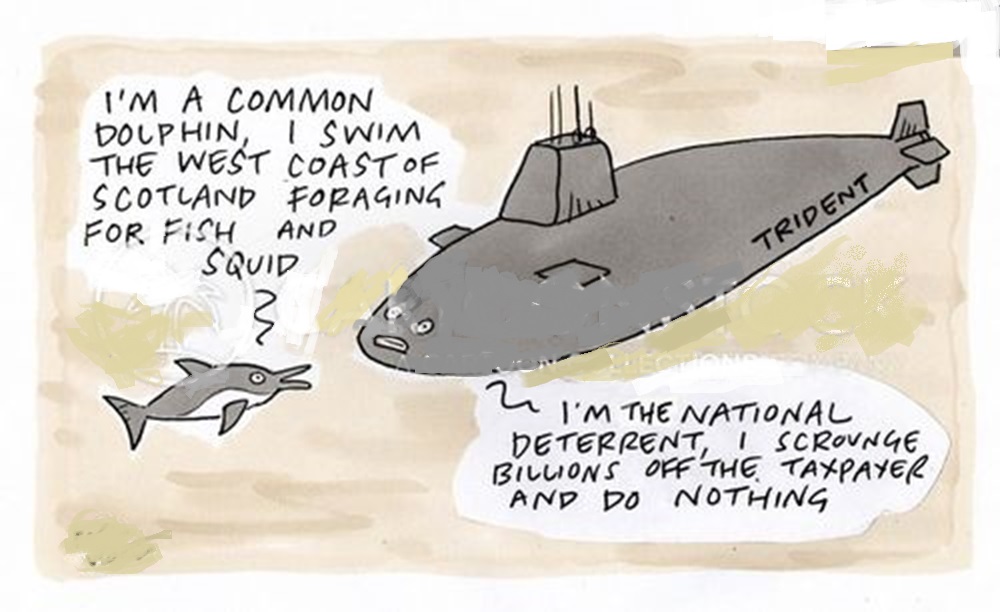
Trident nuclear submarine project rated “unachievable” third year running
The IPA’s latest report for 2023-24 was published in January 2025, six months late. It assessed the feasibility of 227 major government projects, including 44 run by the MoD with a total cost of £298bn.
A new submarine programme, known as Aukus, to eventually replace the Astute-class boats, is under development with the US and Australia. Its budget for 2023-24 was £495m, but its total cost and delivery date have been kept secret to protect “national security” and “international relations”.
Aukus was rated as amber for 2023-24 and 2022-23. The IPA suggested that the MoD might be over-stretching itself on the project.
Rob Edwards, The Ferret 10th Feb 2025
A £4bn project to help replace nuclear-armed Trident submarines on the Clyde has been branded as “unachievable” for the third year running by a UK government watchdog.
The Infrastructure and Projects Authority (IPA) has again given the manufacture of new reactors to power replacement submarines its lowest rating of “red” for 2023-24. There are “major issues” that do not seem to be “manageable or resolvable”, it said.
The IPA has badged eight other major UK nuclear weapons projects, with a combined overall cost of over £55bn, as “amber”. This means they are facing “significant issues” which require “management attention”.
These include building new facilities at the Faslane nuclear base, near Helensburgh, and dismantling nuclear submarines at Rosyth in Fife. The construction of the entire future nuclear-powered fleets of submarines – Astute, Dreadnought and Aukus – was also rated amber.
Campaigners attacked the UK nuclear weapons programme as “an unaffordable shambles” and a “disastrous money pit”. They have demanded its cancellation, and asked for the money saved to be spent on public services.
The Scottish National Party (SNP) accused the Ministry of Defence (MoD) of being “totally unable” to deliver a cost-effective replacement for Trident on time. The Scottish Greens said that public money shouldn’t be wasted on “deadly Cold War hangovers.”…………………………………..
The IPA’s latest report for 2023-24 was published in January 2025, six months late. It assessed the feasibility of 227 major government projects, including 44 run by the MoD with a total cost of £298bn.
Nine of the MoD projects were related to nuclear weapons and submarine programmes, with a total cost of at least £59bn. The one that was given a red rating was to construct reactors to be installed in four Trident-armed Dreadnought submarines to replace ageing Vanguard submarines at Faslane in the 2030s.
The project was also rated as red in 2022-23 and 2021-22, as The Ferret reported. According to the IPA, that means that “successful delivery of the project appears to be unachievable” and it may need its “overall viability reassessed”.
It said: “There are major issues with project definition, schedule, budget, quality and/or benefits delivery, which at this stage do not appear to be manageable or resolvable.”
The Dreadnought reactors, which are being built by Rolls-Royce in Derby, faced “ongoing challenges associated with achieving the required delivery date” in 2028, the IPA added. This was an “important milestone” for the UK’s policy of keeping at least one nuclear-armed submarine on patrol all the time, known as “continuous at sea deterrent”.
Among the eight other nuclear projects rated as amber, was a £1.9bn scheme to build new facilities at Faslane and nearby Coulport, on the Clyde, to support new submarines. Its rating was kept secret in 2022-23 and it was red in 2021-22.
Amber is defined by the IPA as: “successful delivery appears feasible but significant issues already exist, requiring management attention”. The issues “appear resolvable at this stage” and should not cause delay or increased costs “if addressed promptly”.
The Clyde infrastructure project was entering its “most complex phase” over the next four years, the IPA said. It highlighted “two main issues affecting delivery confidence”.
One was rebuilding existing facilities while they continue to be used for submarine operations. The other was attracting and retaining suitably skilled staff “to a remote site in a very tight labour market in western Scotland.”
Costs of some nuclear projects kept secret
A £362m project to begin dismantling defunct nuclear submarines at the Rosyth naval base on the Firth of Forth, was also rated as amber for 2023-24, as it was for 2022-23 and 2021-22. “This is a novel and complex project and learning by doing encounters difficulty and challenge that cannot necessarily be planned for,” commented the IPA.
A £37bn project to build the four Dreadnought submarines, other than the reactors, has been rated as amber for the last six years. An £11bn project to finish building seven nuclear-powered but conventionally-armed Astute submarines has been amber for the last three years.
A new submarine programme, known as Aukus, to eventually replace the Astute-class boats, is under development with the US and Australia. Its budget for 2023-24 was £495m, but its total cost and delivery date have been kept secret to protect “national security” and “international relations”.
Aukus was rated as amber for 2023-24 and 2022-23. The IPA suggested that the MoD might be over-stretching itself on the project.
There was “a degree of risk relating to the ability of the defence nuclear enterprise and the wider UK supply chain to resource the programme with the necessary skills, experience and infrastructure to deliver against a demanding schedule, without adversely impacting the delivery of the Dreadnought programme,” it said.
A new programme repackaging previous projects for making and storing nuclear materials at Aldermaston in Berkshire has been rated as amber for the last two years. Its total cost and delivery date have been kept under wraps.
The rating, costs and comments on another project to test nuclear weapons in France and England, known as Teutates, have also been kept secret for national security and international relations reasons.
The SNP highlighted the MoD’s record of radioactive leaks and rising costs on the Clyde. “It is disappointing but not surprising that the MoD seems to be totally unable to manufacture a replacement for Trident in a timely or cost-effective manner,” said SNP MSP Keith Brown.
“The UK’s nuclear weapons aren’t safe for workers and wildlife, they don’t work when tested, and their manufacture is not efficient. Nor are they delivering a good deal for taxpayers.”
The Scottish Greens described nuclear weapons as a “moral abomination” that should be opposed. “The fact that they have also proven to be a disastrous money pit only underlines the urgent need to remove them for good,” said Green MSP Maggie Chapman.
“We could do so much good with this money, investing in services that make our lives safer and better, rather than wasting it on these deadly Cold War hangovers.”
The Scottish Campaign for Nuclear Disarmament (SCND) blasted the UK’s nuclear weapons as “a colonial hangover, an unaffordable shambles, a danger to us and the world”.
SCND chair, Lynn Jamieson, said: “The combined cost of keeping the nuclear weapon system going and of building a replacement escalates while public services are drastically cut.”
The Nuclear Information Service, which researches and criticises nuclear weapons, argued that the UK nuclear programme was unsustainable. “The case for cancelling badly run and unaffordable weapons projects is compelling,” said research manager, Tim Street……………………
https://theferret.scot/trident-nuclear-unachievable-third-year/
America’s nuclear gamble: The dangerous push to resume atmospheric testing

Experts warn of catastrophic fallout as calls grow to restart nuclear weapons tests abandoned since 1963.
By Karl Grossman, February 10, 2025
“The United States may need to restart explosive nuclear weapons testing,” declared Robert Peters, research fellow for nuclear deterrence and missile defense at The Heritage Foundation, the right-wing organization close to the Trump administration, in a lengthy report last month. Issued on January 15, it was titled: “America Must Prepare to Test Nuclear Weapons.”
Peters stated that “the President may order the above-ground testing of a nuclear weapon….And while the United States leaving the [Nuclear] Test Ban Treaty may not be optimal and may indeed have negative downstream effects, doing so may be necessary to stave off further adversary escalation.”
There has not been a nuclear weapon tested above-ground in the United States since 1962, Peters said. That was a year before the Nuclear Test Ban Treaty of 1963 was signed by the U.S., Soviet Union and United Kingdom. It prohibits nuclear weapons tests in the atmosphere, underwater or in outer space. It allowed underground tests as long as they didn’t result in “radioactive debris to be present outside the territorial limits of the state under whose jurisdiction or control” the test was conducted.
“Resuming atmospheric testing of nuclear weapons would be disastrous,” says Joseph Mangano, executive director of the Radiation and Public Health Project. He cited the “lessons learned from above-ground nuclear weapons testing—the radioactive fall-out that harmed many people, especially infants and children.”
Testimony by a co-founder of the Radiation and Public Health Project, the late Dr. Ernest Sternglass, a physicist, before the then Congressional Joint Committee on Atomic Energy, was instrumental in President John F. Kennedy signing the Nuclear Test Ban Treaty of 1963.
As President Kennedy said in a 1963 national address: “This treaty can be a step towards freeing the world from the fears and dangers of radioactive fallout.” He said that “over the years the number and the yield of weapons tested have rapidly increased and so have the radioactive hazards from such testing. Continued unrestricted testing by the nuclear powers, joined in time by other nations which may be less adept in limiting pollution, will increasingly contaminate the air that all of us must breathe.” Kennedy spoke of “children and grandchildren with cancer in their bones, with leukemia in their blood, or with poison in their lungs” as a result.
The Heritage Foundation’s 900-page publication “Project 2025” is the “governing agenda” for the Trump administration, writes Susan Caskie, executive editor of the magazine The Week, in its current issue. “Many of its authors and contributors,” she noted, are now members of the administration, some appointed to “even Cabinet posts.” …………………………………………………………………………………………………………………..
Are we, if there is a return to atmospheric nuclear weapons testing, to go back to the years of radioactive fallout—and the resulting health impacts? And, as Kennedy stated, “children and grandchildren with cancer in their bones, with leukemia in their blood, or with poison in their lungs.” more https://www.nationofchange.org/2025/02/10/americas-nuclear-gamble-the-dangerous-push-to-resume-atmospheric-testing/
Trump Says He’ll Audit the Pentagon-Will it prove to be a bridge too far?
Bill Astore, Feb 09, 2025, https://bracingviews.substack.com/p/trump-says-hell-audit-the-pentagon?utm_source=post-email-title&publication_id=1156402&post_id=156757346&utm_campaign=email-post-title&isFreemail=true&r=c9zhh&triedRedirect=true&utm_medium=email
President Donald Trump says he’s ready to tackle the Pentagon, which has failed seven audits in a row. He says America might save “trillions” after effective audits. Will it happen?
The Pentagon budget currently sits at roughly $900 billion for this fiscal year, representing more than half of federal discretionary spending. This vast sum doesn’t include (among other things) Homeland Security, nuclear weapons covered by the Department of Energy, the VA (Veterans Administration), and interest on the national debt due to wasteful failed wars in places like Afghanistan and Iraq.
A successful audit of the Pentagon would be a monumental victory for what’s left of American democracy. It may also prove to be a bridge too far for Trump. The National Security State is America’s unofficial fourth branch of government and arguably its most powerful. It is a colossus that hides malfeasance and corruption behind a “top secret” security classification. It deters and prevents efforts at transparency by crying that those who try to expose its crimes are endangering national security. It expects your obedience and praise, not your questions and criticism.
Presidents, of course, are supposed to serve as the commander-in-chief of the U.S. military. They rarely do. Not nowadays. The U.S. system may in theory rest on civilian control of the military, but the military has been out of control since at least 1947, when it rebranded itself the “Department of Defense” instead of the old War Department. Not coincidentally, every war America has fought since then has been undeclared, i.e. lacking a formal Congressional declaration of war.
America has fought a mind-blowing number of wasteful and illegal wars that have been sold to the people through lies, whether in Vietnam (“The Pentagon Papers”), Iraq (No WMD), Afghanistan (“The Afghan War Papers”), and elsewhere. Few things are needed more in America than an honest reckoning of Pentagon spending—and future Pentagon war plans.
Such a reckoning could very well save our lives—indeed, the world, if done honestly and transparently by true patriots. It could also prove to be a bridge too far—for any president.
State Dept. Plans New $7 Billion Arms Sale to Israel

This comes as President Trump talks up an ethnic cleansing plan for the Gaza Strip
by Connor Freeman February 8, 2025, https://news.antiwar.com/2025/02/08/state-dept-plans-new-7-billion-arms-sale-to-israel/
The State Department has formally notified Congress of its plans for a massive arms sale to Israel worth over $7 billion, including thousands of missiles and bombs, the Associated Press reported on Friday. This follows Prime Minister Benjamin Netanyahu’s visit to Washington DC this week and Donald Trump’s announcement that the US will “own” Gaza after it is ethnically cleansed of its indigenous Palestinian population.
Per the State Department, Congress was notified of two separate sales, one is worth $6.75 billion. This first sale includes 2,800 500-pound bombs and 166 small-diameter bombs, along with thousands of guidance kits, fuses, bomb components, and other equipment. Deliveries of these bombs would begin later this year. The other package, worth $660 million, includes 3,000 Hellfire missiles and related equipment. Deliveries for this second arms sale are expected to take place by 2028. According to the AP, the use of these missiles will require the IDF to receive supplemental training by the US military.
Officials from the Joe Biden administration informally made Congress aware of the sale last month, at the time they said some of the weapons could be sent from current Pentagon stockpiles but most of the arms would take at least a year, or more likely several years, to deliver.
This comes as a fragile ceasefire in Gaza is still holding, despite the IDF killing dozens of Palestinians in Gaza since it was implemented and amid hostage exchanges on both sides. Israeli officials indicate that the increased military aid and arms sales are meant to compel Netanyahu to see the ceasefire deal through to its second and third phases, following the current 42-day truce. Last month, Trump released a shipment of 2,000-pound bombs that the previous administration had paused over a dispute regarding the Israeli invasion of Rafah last year.
Earlier this week, Trump asked leaders in Congress to approve another $1 billion arms transfer, financed with US military aid, that includes 4,700 1,000-pound bombs worth over $700 million and $300 million worth of armored bulldozers. The bulldozers are infamously used to carry out violent assaults and home demolitions in the occupied West Bank.
The news of the additional arms sales comes as Trump is talking up his plan for Gaza to be ethnically cleansed before the US takes over the Strip and begins a huge real estate development project there. Israeli Defense Minister Israel Katz ordered the IDF to prepare for the “voluntary departure” of the Palestinians from Gaza in accordance with Trump’s plan. He said the Palestinians should be sent to Western countries like Ireland, Norway, and Spain which have recognized the state of Palestine and been highly critical of Tel Aviv’s genocidal onslaught.
Initially, Trump had insisted that nearly 2 million Palestinians living in Gaza could be sent to Egypt and Jordan but the proposal was sharply rejected by Cairo and Amman along with the Palestinians themselves.
Therefore, in order to pursue this forced displacement plan, the Israelis will have to restart their genocidal campaign in Gaza where, according to a recent study in the British medical journal The Lancet, approximately 70,000 people have been killed as result of Israeli military action.
Scores of American doctors, nurses, and surgeons, who have spent hundreds of weeks combined volunteering in Gaza, wrote in an open letter to the White House last fall that tens of thousands more Palestinians had been starved to death as a result of the US-backed siege and Israel’s consistent blocking of vital humanitarian aid.
Connor Freeman is the assistant editor and a writer at the Libertarian Institute, primarily covering foreign policy. He is a co-host on the Conflicts of Interest podcast. His writing has been featured in media outlets such as Antiwar.com, Counterpunch, and the Ron Paul Institute for Peace and Prosperity. He has also appeared on Liberty Weekly, Around the Empire, and Parallax Views. You can follow him on Twitter @FreemansMind96.
North Korean leader Kim Jong Un vows to further develop nuclear forces
Alarabiya, 9 Jan 25
North Korean leader Kim Jong Un criticized trilateral military cooperation among the United States, Japan and South Korea for raising tensions in the region and vowed countermeasures, including the further development of nuclear forces.
Kim said US deployments of nuclear strategic assets, war exercises and military cooperation with Japan and South Korea were inviting military imbalance in the region and raising a grave challenge to the security environment, state media KCNA reported on Sunday.
“The DPRK does not want unnecessary tension of the regional situation but will take sustained countermeasures to ensure the regional military balance,” Kim said during a visit to the defense ministry on Saturday to commemorate the founding day of its Army.
DPRK stands for the Democratic People’s Republic of Korea, North Korea’s official name.
US President Donald Trump, after a meeting on Friday with Japanese Prime Minister Shigeru Ishiba, said he would have relations with North Korea, as they expressed concern over its nuclear program.
But during the visit, Kim “clarified once again the unshakable policy of more highly developing the nuclear forces,” according to the report……………………………….
In a separate commentary released later on Sunday, North Korea’s KCNA again criticized South Korea’s military activity with the United States this year and warned that aggressive actions would be met by undesired consequences.
“Anyone could easily guess how we would take the fact that they carried out war exercises that were more intense than ever before at a time when diplomacy schedules were being canceled due to political turmoil,” KCNA said. https://english.alarabiya.net/News/world/2025/02/09/north-korean-leader-kim-jong-un-vows-to-further-develop-nuclear-forces
Elon Musk On The Future Of Warfare

7 Feb 25 This is an edit of the full interview, which was recorded in August 2024 and published February 2025: https://www.youtube.com/watch?v=cfs11RIKtI8
Doomsday Clock Needs Adjusting

The roles of U.S. and NATO personnel in targeting, planning, surveillance, intelligence and secret “special operations” involving Western weapons have escalated into the very war between the United States and Russia that Biden promised to avoid.
By Medea Benjamin and Nicolas J. S. Davies, World BEYOND War, February 6, 2025
This year’s Doomsday Clock Statement landed like a damp squib in a Trump-swamped corporate news cycle on January 28th. The Bulletin of the Atomic Scientists only moved the hands of the Clock forward by one second, from 90 seconds up to 89 seconds to midnight, which must have come as a relief to the few members of the public who heard about it.
But this minimal advance in the hands of the Clock was a strange and misleading top-line for the Bulletin’s actual Doomsday Clock Statement, which was brimming with extremely dire warnings that deserve far greater official and public attention.
This disconnect between the movements of the hands of the Doomsday Clock and Bulletin’s underlying threat assessments is deeply troubling. If the positioning of the hands of the Clock does not accurately reflect the seriousness of the dangers it represents, then the powerful symbolism of the Doomsday Clock is lost, undermining the very purpose for which Albert Einstein, J. Robert Oppenheimer and their colleagues invented it.
The new Clock Statement began, “In 2024, humanity edged ever closer to catastrophe. Trends that have deeply concerned (us) continued, and despite unmistakable signs of danger, national leaders and their societies have failed to do what is needed to change course.”
The original atomic scientists created the Doomsday Clock to symbolize humanity’s suicidal march toward annihilation by nuclear war, and that is still the greatest danger that midnight on the Clock represents, even as it now incorporates the added dangers of climate change, biological threats and disruptive technologies.
The threat assessments in the 2025 Clock statement begin with the warning that the war in Ukraine “still looms over the world,” and that it “could become nuclear at any moment because of a rash decision or through accident or miscalculation.”
It was this danger of escalation to nuclear war over Ukraine that led the Bulletin to move the hands of the Clock forward by 10 seconds in January 2023, from 100 to 90 seconds to midnight.
Since then, despite President Biden’s warning in 2022 that war between Russia and the United States would be the suicidal Third World War that we must avoid at all costs, the U.S. and NATO have blasted through every self-imposed “red line” designed to prevent that, providing Ukraine with tanks, F-16 warplanes, long-range missiles, and approval to use them inside Russia as well as in Ukraine.
The roles of U.S. and NATO personnel in targeting, planning, surveillance, intelligence and secret “special operations” involving Western weapons have escalated into the very war between the United States and Russia that Biden promised to avoid.
So we cannot understand the Bulletin’s decision to move the hands of the Doomsday Clock only one second closer to the global mass suicide it symbolizes, as if these developments in the war between NATO and Russia have not brought us significantly closer to self-destruction than we were two years ago.
The Clock Statement then addresses the crisis in the Middle East. In January 2023, when the Bulletin last moved the hands of the clock forward, the U.S. and Israel were enjoying a false sense of security and normalcy in that region, believing that they had suppressed and tamed armed resistance to Israel’s illegal occupation of Palestine.
Now, since the Palestinian breakout in October 2023 and Israel’s genocide in Gaza, the new Doomsday Clock statement warns that, “Conflict in the Middle East threatens to spiral out of control into a wider war without warning.”
With nuclear-armed Israel threatening to launch a major war on Iran and ready to use its nuclear weapons before it would accept an existential defeat in such a war, and with no real limits to U.S. support for Israeli war-making and genocide, the Bulletin of the Atomic Scientists is right to warn that this could spiral out of control at any moment. Yet it seems to have ignored this danger too in its one-second tick forward of the Doomsday Clock.
While these raging conflicts involving nuclear weapons states may be the most dangerous current flashpoints for a nuclear war, nothing reflects the relentless nature of our accelerating march toward Armageddon more clearly than the determination with which the nuclear weapons powers, led by the United States, are expanding and “modernizing” their nuclear arsenals, even as they complete the dismantling of all Cold War-era arms control treaties and nuclear safeguards.
The 2025 Doomsday Clock Statement makes it clear that the Bulletin’s analysts understand this only too well:
“The countries that possess nuclear weapons are increasing the size and role of their arsenals, investing hundreds of billions of dollars in weapons that can destroy civilization. The nuclear arms control process is collapsing, and high-level contacts among nuclear powers are totally inadequate given the danger at hand.”
And yet they insist that the inexorable advance of these Doomsday plans over the past two years has only brought us one second closer to Doomsday. How can that be?
The next and final sentence in the paragraph on nuclear weapons addresses the dangers of nuclear proliferation, which is the widely predicted result of the failure of the nuclear powers to pursue genuine nuclear disarmament:
“Alarmingly, it is no longer unusual for countries without nuclear weapons to consider developing arsenals of their own—actions that would undermine long-standing nonproliferation efforts and increase the ways in which nuclear war could start.”
The next paragraph in the Doomsday Clock Statement addresses the dangers of the Climate Crisis. It explains that global greenhouse gas emissions are still increasing and global temperatures are still rising, causing extreme weather, floods, tropical cyclones, heat waves, droughts and wildfires on every continent.
“The long-term prognosis for the world’s attempts to deal with climate change remains poor,” it reads, “as most governments fail to enact the financing and policy initiatives necessary to halt global warming.”
But this is just one more dire warning that is not reflected in the hands of the Doomsday Clock………………………………………………………………………………………..
n abdicating its responsibility to warn us of the gravity of these dangers, the Bulletin of the Atomic Scientists risks turning Einstein and Oppenheimer’s call for sanity into yet another mechanism to normalize the suicidal insanity of our 21st century rulers………………………………………………………………………………………………………….
https://worldbeyondwar.org/doomsday-clock-needs-adjusting/
Top Pentagon contractors poised for gains as Trump pushes missile shield expansion

The proposed “Iron Dome for America” system is heavily reliant on space-based sensors and potentially controversial space-based interceptors
Space News, by Sandra Erwin, February 3, 2025
WASHINGTON — The nation’s top defense contractors are positioning themselves to capitalize on a new missile defense initiative announced by the Trump administration. Executives from Lockheed Martin, Northrop Grumman, and L3Harris told Wall Street analysts last week that they are well-equipped to support the administration’s push for a “next-generation missile defense shield.”
President Donald Trump’s executive order, titled “The Iron Dome for America,” directs the Department of Defense to accelerate the development and deployment of an advanced missile defense system. The order calls for a multi-layered approach capable of countering a range of threats, including ballistic, hypersonic, and cruise missiles, with a heavy reliance on space-based sensors and potentially controversial space-based interceptors.
“We welcome the urgency that the Trump administration is placing on protecting the homeland from escalating global missile threats,” said Northrop Grumman CEO Kathy Warden during a fourth-quarter earnings call. The company has contracts for satellite-based missile detection and hypersonic weapon interceptors under development.
………..Lockheed Martin, Northrop Grumman and L3Harris are prime contractors in key missile defense programs that could expand under the initiative. L3Harris CEO Christopher Kubasik highlighted his company’s role in producing missile-defense tracking satellites for the Space Development Agency’s Tracking Layer program, a network of satellites designed to detect and track hypersonic threats from low Earth orbit………………………………………………………………………………………..
The administration has yet to provide a cost estimate for the ambitious Iron Dome initiative. The Pentagon’s missile defense efforts are currently funded through a complex web of programs. The Missile Defense Agency receives approximately $10 billion annually, while the Space Development Agency operates with a budget of about $4 billion. The U.S. Space Force maintains additional multi-billion dollar funding streams for missile-warning and missile-detection satellites. https://spacenews.com/top-pentagon-contractors-poised-for-gains-as-trump-pushes-missile-shield-expansion/?utm_source=ActiveCampaign&utm_medium=email&utm_content=Contractors%20prep%20for%20%20Iron%20Dome%20for%20America&utm_campaign=FIRST%20UP%202025-02-04
As China and the U.S. Race Toward A.I. Armageddon, Does It Matter Who Wins?

it doesn’t matter if the U.S. has no real enemies. The military industrial complex must continue to unceasingly grow, according to the logic of the Megamachine. It will invent enemies in order to justify that growth. That’s why we now have thousands of nuclear bombs and a sprawling, AI-driven, globally networked satellite and base infrastructure that encases the Earth like an iron maiden.
Koohan Paik-Mander CounterPunch , 7 Feb 25
A longstanding Sinophobia in the U.S. goes back to the 19th century, with the Chinese Exclusion Act, the tax on Chinese miners during the Gold Rush, and the exclusion from being able to testify in court.
Evidence of this entrenched history lingers today, in the trade sanctions against China, belligerent rhetoric from both Republicans and Democrats that led to a rash of violence against elderly Asian-Americans on American streets, as well as billions of dollars spent to fortify overseas bases in preparation for a U.S.-China war.
And the refusal to cooperate meaningfully with China on anything. As a result, the U.S. is thick in the midst of an AI arms race with China that is predicated on both nations’ dangerous faith in techno-salvation.
Thanks to the legacy of Sinophobia, it takes a whole lot to elicit an overwhelming embrace of China from average Americans, even if temporarily. But that’s what’s happened twice in the last month. The first time was the TikTok fiasco, when millions of distraught TikTok users had had their favorite platform snatched from them like a pacifier from a baby’s mouth. They found solace not in Meta nor X (as had been the plan), but rather, in the Chinese social media platform, Xiaohongshu, also known as “RedNote.”
The second instance was the debut of DeepSeek AI, which came on the heels of one of the most pompous pageants of delusional grandeur ever seen. It was Trump’s inauguration ceremony for his second term. Shortly thereafter, a press conference was held. Three tech oligarchs and the president bloviated about their Stargate AI project. It would cost $500 billion. That’s what they say is needed to stay ahead of the Chinese. (For some reason, the excuse of “staying ahead of the Chinese” seems to justify any astronomical expense.)
In the mean time, thousands of people have been left homeless due to wild fires in L.A., flooding in North Carolina, and even to this day, people from Lahaina, Maui are still without a place to call home. But none of these Americans got a press conference.
Instead, it was the oligarchs who took the stage. Oracle’s Larry Ellison, Masayoshi Son of Starbank, and Open AI founder Sam Altman described Stargate’s plans to build clusters of gigantic data centers across the country from sea to shining sea, each one bigger than any Walmart Superstore. It’s Manifest Destiny for data.
No one at the press conference mentioned that many of the data centers would be built on federal lands, would collectively use as much power as small European nations, require massive volumes of water, or would require a network of nuclear reactors. They did make the dubious promise their AI would cure cancer and heart disease. I think the guys who got wampum for Manhattan got a better deal.
A few days afterward, as if on cue, a Chinese company called DeepSeek that no one had ever heard of dropped their bombshell. The Chinese firm had released its own AI that was open-source, used fifty times less energy, performed on par with all the American AIs, and cost a gazillion times less to produce. Suddenly, the mirage of Silicon Valley’s invincibility faded away to reveal an overvalued industry that had gotten too fat, lazy and full of itself to innovate anything except marketing promises to investors. The very next day, a veritable trillion dollars peeled like a banana off the U.S. stock exchange tech sector. The story everywhere was that Chinese AI had officially “caught up” with the U.S.
When people cheered the scrappy Chinese underdog, it was as much a middle finger to the overblown hubris of the tech oligarchs as it was an embrace of Chinese innovation. It was motivated largely by the same class anger that rose up to lionize Luigi Mangione for killing a health insurance CEO with three inscribed bullets. People had been galled by the consolidated display of the broligarchy on the dais at the Trump inauguration, similar to the royals waving at the minions from the balcony at Buckingham Palace. Their message was unequivocal: We own you.
DeepSeek has been described as a Robin Hood of tech, taking from the rich to give AI to the poor. Sentiments of class anger buoyed admiration for the unknown company from China. They disregarded, for once, the stubborn stains of Sinophobia.
What was also overlooked in the midst of DeepSeek’s dazzling display of stock market disruption was responsible restraint around technology. As both China and the U.S. go hurtling ever faster toward Armageddon in the race to dominate in AI, they have both bought into techno-utopian ideologies, lock, stock and barrel………………………………………………………………….
China and the U.S. are entangled in a geopolitical rivalry, with existential stakes. Sure, it’s satisfying to enjoy the smarting blow that newcomer DeepSeek landed to the capitalist Goliath — China one, U.S. zero. But it’s not a boxing match. Such narrow framing loses sight of the fact that the race for accessible AI is a race for Mutually Assured Destruction (MAD).
………………………………………………………………………………………………………………The weapons industry wouldn’t tolerate the thought of degrowth, just like Microsoft, Google, Meta, Amazon et al. can’t bear it today. The war industry dealt with it by instead aggressively manufacturing enemies and reasons for war faster than it could manufacture more weapons. Now, forty years after the end of the Cold War with Russia, the war budget has increased every year and is now up to one trillion dollars, Los Alamos has begun manufacturing nukes for the first time in decades last year, we’ve got 800 bases around the world, rocket launchpads in wilderness areas, and thousands of satellites in the heavens.
It’s hard to get one’s bearings, especially in the midst of the engineered political maelstrom of the current moment. Fortunately, the books haven’t been burned (yet), so we can turn to the thinkers of the recent past for guidance.
The technology critics of the 20th century, such as Jacques Ellul, Lewis Mumford and Chellis Glendinning, urged us to conceptualize technology not just as a single artifact, such as a laptop, or just AI, or just a satellite, or just a nuclear weapon, but rather, as a whole way of thinking, a way of organizing society, our institutions, a way of being. Technology is not a one-off. It is systemic. Lewis Mumford called all of our technological society the Megamachine.
Every project, technology, organization, and endeavor is an expression of the Megamachine where the economic-growth imperative reigns supreme. It is all of a piece. It doesn’t matter if DeepSeek uses less energy. The growth imperative must be met……
Likewise, it doesn’t matter if the U.S. has no real enemies. The military industrial complex must continue to unceasingly grow, according to the logic of the Megamachine. It will invent enemies in order to justify that growth. That’s why we now have thousands of nuclear bombs and a sprawling, AI-driven, globally networked satellite and base infrastructure that encases the Earth like an iron maiden.
The poster child for the Megamachine in the digital age is Amazon. Former chair of the Federal Trade Commission Lina Khan’s seminal essay “Amazon’s Anti-trust Paradox,” tracks the logic of the behemoth’s growth over its history. She brilliantly unravels how Amazon decisively prioritized sheer growth over profit for its first eight years. The goal was to entrench a broad-spanning networked infrastructure that would guarantee a monopoly and continue to consolidate market dominion. They forwent profits for almost a decade expressly in order to monopolize the market. Again, the imperative for growth and global domination trumps decent common sense.
Former chair of the Federal Trade Commission Lina Khan’s seminal essay “Amazon’s Anti-trust Paradox,” tracks the logic of the behemoth’s growth over its history. She brilliantly unravels how Amazon decisively prioritized sheer growth over profit for its first eight years. The goal was to entrench a broad-spanning networked infrastructure that would guarantee a monopoly and continue to consolidate market dominion. They forwent profits for almost a decade expressly in order to monopolize the market. Again, the imperative for growth and global domination trumps decent common sense.
……………………………………………………………The sooner that the U.S. and China treat one another as fellow members of humankind, rather than adversaries, the real work of cooperation can begin. Both nations are home to millions of indigenous peoples who carry the know-how for surviving and thriving for generations into the future. Their wisdom is more precious than any AI. There’s no shortage of problems that our combined brilliance can improve if not solve: climate, nuclear weapons, species extinction, toxic waste clean-up, housing, microplastics, and last but not least, dangerous unregulated technologies. None of these colossal crises can be addressed as long as we are pointing fingers while locked in the downward spiral of a competition for global hegemony that the U.S. can never win.
Some of us remember the shining moment in history when the U.S. and Soviet Union built trust and signed a raft of nuclear arms control agreements. They modeled what ratcheting down tensions and the path to peace looks like. It would behoove the U.S. and China to follow their lead today, not only with nukes but also with AI and other emerging technologies. https://www.counterpunch.org/2025/02/07/as-china-and-the-u-s-race-toward-a-i-armageddon-does-it-matter-who-wins/
Elon Musk Can Find His $2-Trillion Federal Spending Cut in Nuclear Weapons
DOGE’s Elon Musk should turn his $2-trillion hatchet to wasteful and perilous U.S. nuclear weapons modernization plans
Scientific American, By Dan Vergano edited by Jeanna Bryner, 5 Feb 25
Famously fortunate, Elon Musk now faces a rare opportunity—delivering on one of his signature overblown promises. From his newly created White House cost-cutting desk, all Musk must do is recommend ending one of the most misguided, wasteful and dangerous programs contemplated by the U.S. government, one that Scientific American has pushed for elimination.
Last November Musk set an ambitious target for his Department of Government Efficiency (DOGE), the meme-coin-joke name for his cost-cutting office, his reward for bankrolling Trump’s campaign. Under DOGE, Musk said he would trim $2 trillion from the federal budget. That’s a hefty sum even for the space mogul now regarded as the $400-billion-worth wealthiest man on Earth. (Musk subsequently downplayed $2 trillion as a “best-case outcome.”)
Luckily for him, there is one big, fat target with just that price tag, already sitting in Uncle Sam’s shopping cart, and it’s ripe for cutting: nuclear weapons. In 2010 Trump’s nemesis, then president Barack Obama, first proposed “modernizing” the U.S. triad of land-, sea- and air-based weapons over more than three decades. Almost unnoticed outside of national security circles, the initiative’s $1-trillion sticker price has nearly doubled and, as American University national security scholar Sharon Weiner wrote last year, “is likely to escalate even further by 2050—the supposed end date for modernization.”
Conveniently enough for Musk, his new boss, Trump, called in January for talks on reducing nuclear weapons with China and Russia, while speaking to the World Economic Forum in Davos, Switzerland. “Tremendous amounts of money are being spent on nuclear, and the destructive capability is something that we don’t even want to talk about today, because you don’t want to hear it,” Trump said. “It’s too depressing.”……………………. more https://www.scientificamerican.com/article/elon-musk-can-find-his-usd2-trillion-federal-spending-cut-in-nuclear-weapons/
US failed to track weapons sent to Ukraine – Reuters

https://www.rt.com/news/612147-us-failed-track-ukraine-weapons/ 5 Feb 25
The chaos reached such proportions that the Pentagon struggled to define what “delivered” meant, the news agency has reported
US officials could not tell whether tens of billions of dollars of weapons sent to Ukraine were actually delivered due to tracking systems failures, Reuters reported on Monday, citing sources.
During the final year of former President Joe Biden’s administration, key weapons shipments to Ukraine faced prolonged delays due to concerns about depleting US stockpiles and debates over whether the arms would trigger an escalation with Russia.
According to a Reuters investigation, the Pentagon’s “chaotic weapons-tracking system in which even the definition of ‘delivered’ differed among US military branches,” was a significant contributor to the overall confusion.
The system failure “skewed” Pentagon data, making it almost impossible to accurately pinpoint weapons in the shipping process, Reuters said, citing reports by the Government Accountability Office (GAO).
Investigations by the Pentagon’s Inspector General and the GAO also found that the administration lacked clarity on the number of weapons delivered and the extent of shipment delays, according to Reuters.
An unnamed US official told the agency that the Pentagon has since updated internal manuals to clarify the term “delivered.” However, it is not clear how broadly the reform is being implemented, the article said.
The report found that shipment delays have persisted even after Congress broke a months-long deadlock on $60 billion in supplemental aid for Ukraine caused by Republican opposition.
As a result, by November, the US had fulfilled only half of its total 2024 commitment from its stockpiles to Kiev. Only 30% of armored vehicles promised by Washington had arrived by early December, Reuters sources claimed.
One US official expressed frustration over the pace of deliveries, suggesting that delays prevented Ukraine from making any substantial progress on the battlefield.
The official echoed the sentiments of numerous Ukrainian officials who have often blamed inadequate Western assistance for Kiev’s failure to stem Russia’s advances in Donbass and elsewhere.
In January 2024, the US Department of Defense Office of Inspector General released a report revealing that the Pentagon was unable to fully track over $1 billion worth of weapons sent to Ukraine. At the time, it said the Pentagon failed to “fully comply” with tracking requirements, adding that it was not possible to complete an inventory of everything sent to Kiev.
Moscow has consistently condemned Western arms deliveries to Ukraine, saying they will only prolong the conflict.
The national missile defense fantasy—again

Bulletin, By Joe Cirincione | February 4, 2025
National missile defense advocates live in a world of magic and make-believe. Fantasy replaces science, assertions replace facts, and cartoon weapons replace real capabilities.
This enduring fantasy, however, has real-world consequences.
President Donald Trump’s pledge last week to build “a next-generation missile defense shield” that would “defeat any foreign aerial attack on the Homeland [with] space-based interceptors” has provoked a predictable reaction. Russia blasted Trump’s plan, detailed in his new executive order, “The Iron Dome for America.”
But no magic shield is going to protect the United States against nuclear attack.
An idea that never dies. Russian Foreign Ministry spokesperson Maria Zakharova said on Friday of Trump’s plan that “it directly envisages a significant strengthening of the American nuclear arsenal and means for conducting combat operations in space, including the development and deployment of space-based interception systems.”
“We consider this as another confirmation of the US focus on turning space into an arena of armed confrontation… and the deployment of weapons there,” Zakharova added.
The Russian reaction could scuttle Trump’s stated desire to negotiate limits on nuclear weapons. If so, it would repeat the role strategic defenses have played in the Cold War’s nuclear arms race. Efforts to build national defenses always trigger efforts to overcome them with more missiles and other counter-measures—the well-known security dilemma.
Despite all the formidable technical and geopolitical evidence against such schemes, however, “faith in national missile defense never dies,” Washington Post columnist Max Boot observes.
It is no coincidence that Trump’s new order is lifted almost entirely from the Heritage Foundation’s Project 2025 wish list. In the 1980s, the group championed President Ronald Reagan’s original dream to “put in space a shield that missiles could not penetrate—a shield that could protect us from nuclear missiles just as a roof protects a family from rain,” as he told a 1986 high school graduating class.
“Like Israel’s highly effective system of the same name, President Trump’s Iron Dome will provide an impenetrable defense for the American people that will bring peace through strength,” Heritage Foundation fellow Victoria Coates said. It “will fulfill President Reagan’s vision for the Strategic Defense Initiative laid out some four decades ago,” she added.
Doomed to fail. Trump’s executive order is a jumble of false claims and imaginary solutions. It begins by declaring that the risk of a missile attack “remains the most catastrophic threat facing the United States.” That would surprise most experts on existential risks. The climate crisis, the threat of new pandemics, artificial intelligence, and crippling cyber attacks are all at least as likely catastrophic events as nuclear weapons delivered by other means. But threat inflation has always been a key part of efforts to justify urgent action and massive investment.
Trump claims that “over the past 40 years, rather than lessening, the threat from next-generation strategic weapons has become more intense and complex.” Despite being utter nonsense, this claim has gone largely unchallenged.
While it is true that new technologies have increased the lethality of missiles, the missile threat to the United States has decreased dramatically. Arms control treaties and the collapse of the Soviet Union slashed the number of nuclear weapons and nuclear-armed missiles threatening the United States.
In 1985, the Soviet Union deployed 2,345 land-based and submarine-based missiles carrying over 9,300 nuclear warheads. That was the threat Reagan hoped to render “impotent and obsolete” with his missile shield.
Thanks to negotiated agreements, today’s Russia fields only 521 missiles, carrying 2,236 warheads. China’s land-based nuclear-armed missiles capable of reaching the United States have increased from around 20 in 1985 to some 135 today (carrying 238 warheads) and perhaps 72 single-warhead submarine-based missiles. In sum, the United States today faces roughly one-fifth the number of enemy missiles compared to 40 years ago and one-quarter of the nuclear warheads (728 vs. 2,365 missiles and 2,546 vs. 9,320 warheads). That is still a very dangerous threat but by no means a greater one.
Where arms control succeeded, missile defense technology failed.
None of the scores of systems developed by Reagan’s Strategic Defense Initiative (SDI) and its successor organizations have ever come close to providing the imaginary shield that Reagan promised. National missile defenses did not work then. They do not work now. They will likely never work………………………………………
As it became clear that the space-based laser weapons Edward Teller told Reagan he could build were a fantasy, Reagan and subsequent presidents scaled down the program to try to get some kind of workable defense. But after spending over $415 billion over decades, all the United States has to show for the effort is 44 ground-based interceptors in Alaska and California that can hit a cooperative target in carefully scripted demonstrations—about half of the time. Congress currently allocates $30 billion a year on missile defense and defeat programs, most run by the SDI successor, the Missile Defense Agency.
Not an iron dome; more like an iron colander. The major technical problems that remain unresolved—and eventually forced the cancellation of all SDI’s ambitious plans—are the same obstacles that have ruled out an effective ballistic missile defense for more than 60 years:
- the ability of the enemy to overwhelm a system with offensive missiles;
- the questionable survivability of space-based weapons;
- the inability to discriminate among real warheads and hundreds or thousands of decoys;
- the problem of designing battle management, command, control, and communications that could function in a nuclear war; and,
- the low confidence in the ability of the system to work perfectly the first—and, perhaps, only—time it is ever used.
……………………………………………………………………“There is zero possibility of a comprehensive missile defense of the United States in the foreseeable future,” James N. Miller, who served as undersecretary of defense in the Obama administration, told Max Boot. “We are not going to escape mutual assured destruction vis-à-vis Russia or China.”
As shown repeatedly over the past 60 years, the only way to eliminate the threat of nuclear-armed missiles is to negotiate their elimination. Pretending that there is a magic shield that can be willed into existence will only make the problem of national missile defense worse. https://thebulletin.org/2025/02/the-national-missile-defense-fantasy-again/
Local opinion: Raytheon pushes The Doomsday Clock closer to midnight

because of their work on both the LRSO and Tomahawk cruise missiles, Raytheon is now seen as the leading contender to produce even more nuclear weapons in the form of new sea-launched nuclear cruise missiles. This further escalation would represent a huge setback to hard-won nuclear arms control progress, when nuclear-armed Tomahawks were removed from submarines over 30 years ago.
Jack Cohen-Joppa Special to the Arizona Daily Star, Jan 31, 2025, 31, 2025, https://tucson.com/opinion/column/local-opinion-raytheon-pushes-the-doomsday-clock-closer-to-midnight/article_46da901c-df20-11ef-8e77-235556fbeeb6.html
In Tom Lehrer’s classic Cold War ditty, “So Long Mom,” a nuclear bomber pilot sings, “I’ll look for you when the war is over, an hour and a half from now.”
It’s darkly funny, because even though we don’t talk much about it, we all know it’s true. Planned or imagined, nuclear war scenarios rarely last longer.
But how much time have we got before then? How near is that threat of omnicide today?
The Doomsday Clock is a visual metaphor created by the Bulletin of Atomic Scientists back in 1947 to illustrate how close we are to global calamity from nuclear weapons and other looming threats to civilization as we know it. Originally set at seven minutes to midnight, in 2023 it advanced to 90 seconds to midnight, largely due to nuclear threats from war in Ukraine.
And Raytheon keeps pushing us closer.
In April 2020, Raytheon, with more than 12,000 local employees and the bulk of its research, development and production based here in Tucson, was awarded a sole-source contract to produce about 1,000 new nuclear-armed, air-launched cruise missiles. Known by the anodyne acronym LRSO (Long Range Stand Off), the missile is arguably both redundant and destabilizing in a time of disappearing nuclear diplomacy.
Not only that, but because of their work on both the LRSO and Tomahawk cruise missiles, Raytheon is now seen as the leading contender to produce even more nuclear weapons in the form of new sea-launched nuclear cruise missiles. This further escalation would represent a huge setback to hard-won nuclear arms control progress, when nuclear-armed Tomahawks were removed from submarines over 30 years ago.
Why aren’t we talking about it in Tucson? Senators Mark Kelly and Ruben Gallego and Rep. Juan Ciscomani all vote for U.S. nuclear domination. Only Rep. Raul Grijalva has spoken out for the 2017 Treaty on the Prohibition of Nuclear Weapons, now adopted by more than half the nations of the world. Despite near-universal condemnation of nuclear weapons by leaders of the world’s religions, we could use more local political and religious leaders speaking out against this blasphemous enterprise in our backyard.
It’s not as if it’s a military secret. The industry press has recently carried reports of LRSO flight tests, budget allocations, production schedules and more. Yet local media have not kept up.
Raytheon also has nothing to say. Usually, Southern Arizona’s largest employer and exporter is mighty proud of the panoply of products in their military portfolio. Their website is filled with fulsome boasts and lurid photos of deadly hardware. But the baddest boy of the bunch is missing in action. The nuclear-armed LRSO only pops up in a handful of financial reports. Raytheon’s original press release heralding the multibillion-dollar contract was posted on its website and quoted by the Tucson media in April 2020. But now it’s gone, simply deleted from its media archive.
Perhaps management has realized that there is nothing to be gained by crowing about their only product that, if used as intended, would be the instrument of multiple war crimes and crimes against humanity (incomprehensible death and devastation, disproportionate civilian casualties, lasting contamination of land and water, etc.). Raytheon’s “products” are certainly nothing I’m proud of as a Tucsonan.
This is the same Raytheon/RTX that last November was fined nearly $1 billion for defrauding the government (i.e., the taxpayer) and paying multiple bribes to promote business with the government of Qatar.
Experts debate whether the LRSO is intended for a nuclear surprise attack, or just another layer of “deterrence.” But if it isn’t meant to be used first, that just makes it fit into plans for a full-scale nuclear war. All ninety minutes of it.
Shouldn’t we all pay more attention, and demand that our elected leaders resist this insanity?
Trump Asks Congress To Approve $1 Billion Arms Transfer to Israel

The deal will be funded by US military aid and includes 1,000-pound bombs and armored bulldozers
by Dave DeCamp February 3, 2025 , https://news.antiwar.com/2025/02/03/trump-asks-congress-to-approve-1-billion-arms-transfer-to-israel/
The Trump administration has asked congressional leaders to approve a new $1 billion weapons transfer to Israel that will be funded by US military aid, The Wall Street Journal reported on Monday.
The deal includes 4,700 1,000-pound bombs worth more than $700 million and $300 million worth of armored bulldozers, which the Israeli military uses to demolish homes and infrastructure in Gaza and the West Bank.
The request for the new arms transfer comes as Israeli Prime Minister Benjamin Netanyahu is in Washington and set to meet with President Trump at the White House on Tuesday. He’s expected to push for US support for Israel to restart its genocidal war in Gaza instead of fully implementing the ceasefire deal.
The Journal report said Netanyahu is also expecting Trump to push ahead with a massive $8 billion deal that President Biden notified congressional leaders about in early January. The report said some Democrats in Congress put a hold on the massive sale and that the Trump administration is now pushing congressional leaders to unblock it.
The $8 billion deal includes munitions for fighter jets and attack helicopters as well as artillery shells. The Trump administration also recently released a hold on a shipment of 2,000-pound bombs for Israel.
Israeli officials suggested that the increased military aid was part of a deal to get Netanyahu to agree to the Gaza ceasefire deal. Trump’s envoy for the Middle East, Steve Witkoff, has said he’s pushing for the full implementation of the agreement, but the ceasefire is very fragile as Netanyahu doesn’t want to implement the second phase.
1 This Month



26 September – International Day for the Total Elimination of Nuclear Weapons


PLEASE OPPOSE HR 8255 AND S.3639 – bills would accelerate satellite deployment, with no environmental review or safeguards – https://ncstd5li.quorum.us/campaign/169331/
To see nuclear-related stories in greater depth and intensity – go to https://nuclearinformation.wordpress.com
-
Archives
- September 2026 (269)
- August 2026 (330)
- July 2026 (355)
- June 2026 (287)
- May 2026 (306)
- April 2026 (356)
- March 2026 (251)
- February 2026 (267)
- January 2026 (308)
- December 2025 (358)
- November 2025 (359)
- October 2025 (375)
-
Categories
- 1
- 1 NUCLEAR ISSUES
- business and costs
- climate change
- culture and arts
- ENERGY
- environment
- health
- history
- indigenous issues
- Legal
- marketing of nuclear
- media
- opposition to nuclear
- PERSONAL STORIES
- politics
- politics international
- Religion and ethics
- safety
- secrets,lies and civil liberties
- spinbuster
- technology
- Uranium
- wastes
- weapons and war
- Women
- 2 WORLD
- ACTION
- AFRICA
- Atrocities
- AUSTRALIA
- Christina's notes
- Christina's themes
- culture and arts
- Events
- Fuk 2022
- Fuk 2023
- Fukushima 2017
- Fukushima 2018
- fukushima 2019
- Fukushima 2020
- Fukushima 2021
- general
- global warming
- Humour (God we need it)
- Nuclear
- RARE EARTHS
- Reference
- resources – print
- Resources -audiovicual
- Weekly Newsletter
- World
- World Nuclear
- YouTube
-
RSS
Entries RSS
Comments RSS

