What Trump got right about nuclear weapons—and how to step back from the brink

By Lucas Ruiz, Geoff Wilson | February 24, 2025, https://thebulletin.org/2025/02/what-trump-got-right-about-nuclear-weapons-and-how-to-step-back-from-the-brink/
President Donald Trump’s recent remarks about nuclear weapons are 100-percent correct.
Speaking to a room of reporters in the White House on February 13, President Trump signaled his interest in restarting arms control negotiations with Russia and China. “There’s no reason for us to be building brand new nuclear weapons. We already have so many,” Trump said. “You could destroy the world 50 times over, 100 times over. And here we are building new nuclear weapons, and they’re building nuclear weapons.”
He continued, “We’re all spending a lot of money that we could be spending on other things that are actually, hopefully, much more productive.”
The United States is already spending $75 billion annually—the equivalent of two Manhattan Projects every year—on new nuclear weapons until at least 2032. In total, the country is set to spend over $1.7 trillion on nuclear modernization over 30 years—which is about the same amount as all student loan debt in the United States.
But what will the country have to show for it?
Counterproductive upgrades. The United States already spends more on national security than the next nine nations combined, and China and Russia have also started expanding and modernizing their arsenals, respectively. But the US arsenal is already more than capable of retaliating against a simultaneous nuclear strike by both countries—which would not change even in a scenario in which China reached numerical nuclear parity with the United States and Russia. Instead, as President Trump suggests, US political leaders must consider how engaging in a massive, new nuclear build-up will waste limited taxpayer dollars and undermine national security by diverting the federal budget from more useful national investments like pursuing infrastructure and electrical grid resiliency.
The current US nuclear modernization program attempts to replace every leg of the US strategic triad—that is, the land-based intercontinental ballistic missiles, strategic bombers, and ballistic missile submarines—all at once. This wildly ambitious program is already massively over budget and years behind schedule. It has also forced the United States to extend the service lives of current systems while waiting for the new systems to come online—something the US military claimed to be infeasible when the process started. The advanced age of the previous generation of nuclear delivery vehicles was a major justification for modernization in the first place.
More fundamentally, the current modernization push is fueled by a pathology of nuclear superiority brinkmanship, which is accelerating a headlong rush into a new nuclear arms race and increasing the odds of a confrontation between nuclear powers. If the United States continues down this path, it will not only be a waste of taxpayer dollars but also weaken strategic stability and increase the risk of nuclear war. The world was lucky to have escaped what President John F. Kennedy called the “nuclear sword of Damocles”—and the United States should be in no hurry to test that fate again.
Stepping toward the brink—and back. While President Trump’s remarks offer hope for a more reasonable nuclear path, his administration is also espousing “peace through strength”—Ronald Reagan’s mantra—as one of the foundations of its foreign policy. The administration’s Republican allies in Congress—including notably Sen. Roger Wicker, a Republican of Mississippi who now chairs the Senate Armed Services Committee—have adopted this framing and proposed doubling down on the arms race by adding $200 billion to an already historically high US defense budget.
Other conservatives are pushing Trump to adopt Reagan’s playbook for US-Soviet relations by demonstrating US supremacy internationally, which includes accelerating the nuclear arms race. Most concerning, some allege winning this arms race necessitates being prepared to resume US explosive nuclear testing. And some within the military establishment have called for the reintroduction of tactical nuclear weapons into the US arsenal despite being hugely destabilizing.
But these hawkish policies are only the first part of Reagan’s nuclear weapons chapter.
In 1982, after boosting defense spending by 35 percent, Reagan suddenly reversed course and famously declared in a radio address that “a nuclear war cannot be won and must never be fought.” His reversal on nuclear weapons would be confirmed after witnessing the infamous Pentagon war game Proud Prophet, viewing the cataclysmic effects of nuclear war in the movie “The Day After,” and nearly triggering a catastrophic war with the Soviets. Reagan’s idiom became the bedrock of efforts to avoid mutual destruction through nuclear war, which has been repeated by many officials in the four decades since, including just five years ago at the start of the Biden administration.
In hindsight, Trump can skip to the productive portion of Reagan’s strategy. His intuition is already pointing him in this direction. The president should not be listening to those around him who would like to see the United States embrace a nuclear arms race by chasing after the illusion of strategic superiority and expanding the nuclear arsenal—which Trump already said made no sense. Instead, President Trump should pursue a course of hard-nosed diplomacy like Reagan did to secure the Intermediate-Range Nuclear Forces Treaty (INF), which eliminated US and Soviet intermediate- and shorter-range missiles in 1985.
The Trump administration could renew Reagan’s crowning achievement by negotiating with Russia and China to limit the growing numbers of new nuclear weapons in the world today. The president has the opportunity to push the United States and other nuclear-weapon states to abide by their disarmament promises regarding nuclear weapons. Should he succeed, Trump could even win a Nobel Peace Prize—becoming just the fifth US president to do so.
President Trump, the United States, and the world would be well served by taking steps to decrease the threats posed by the new nuclear arms race. One question remains: Does he have the courage to stick to his convictions to shut out those around him who would prefer to gamble on Armageddon?
Global security arrangements “unravelling”, UN chief warns nuclear disarmament conference.

OLIVIA LE POIDEVIN David Adams, , https://sightmagazine.com.au/news/global-security-arrangements-unravelling-un-chief-warns-nuclear-disarmament-conference/
Security arrangements that have supported global peace for decades are unravelling, the head of the United Nations warned on Monday as he urged countries to work together towards a nuclear free world.
“The bilateral and regional security arrangements that underwrote global peace and stability for decades are unravelling before our eyes,” UN Secretary General Antonio Guterres told the Conference on Disarmament that gathered in Geneva.
“Trust is sinking, while uncertainty, insecurity, impunity and military spending are all rising,” Guterres added.
Such factors were weakening the spirit of “mutual restraint”, he said, as he called on countries to implement nuclear disarmament and non-proliferation commitments agreed at a summit in New York last September.
Sixty-five states, including the United States, China and Russia, are members of the Conference which was established in 1979 and is overseen by the United Nations Office for Disarmament Affairs.
It focuses on negotiating deals to end the nuclear arms race and stop countries building up weapons in space, on top of pursuing general disarmament.
Artificial Intelligence was becoming weaponised at an alarming pace and there were signs of new arms races, including in outer space, Guterres warned.
He condemned countries that “outrageously rattle the nuclear sabre as a means of coercion”.
In September last year Russian President Vladimir Putin told the United States and its allies that Moscow could respond with nuclear weapons if they allowed Ukraine to strike deep inside Russia with long-range Western missiles.
Earlier this month Moscow said the outlook for extending the New Strategic Arms Reduction agreement with the US did not look promising.
The agreement, which caps the number of strategic nuclear warheads that the two biggest nuclear superpowers can deploy, is due to expire on February 5, 2026.
Donald Trump wants to end nuclear weapons funding
“THERE’S no reason for us to be building brand-new nuclear weapons, we
already have so many you could destroy the world 50 times over, 100 times
over … We’re all spending a lot of money that we could be spending on
other things that are actually, hopefully much more productive.”
The quoted statement is a sensible one. Indeed, it broadly aligns with Scottish
CND’s longstanding case against nuclear weapons: that the exorbitant
expenditure on building weapons that would be illegal ever to use is sheer
waste, and that our society could be profoundly regenerated by investing
such resources in the public sphere.
But the above quote is not a Scottish
CND press release. In fact, these are the words of US president Donald
Trump, spoken to reporters in the Oval Office only last week. At that same
meeting with the press, Trump also mentioned his hopes to meet with the
presidents of China and Russia: “And I want to say, ‘let’s cut our
military budget in half’. And we can do that. And I think we’ll be able
to.”
The National 21st Feb 2025, https://www.thenational.scot/politics/24952282.donald-trump-wants-end-nuclear-weapons-funding-listen/
New Zealand’s Rocket Lab ‘ready to serve’ Pentagon

RNZ Phil Pennington, Reporter 19 Feb 25
Rocket Lab is poised to launch a satellite from Mahia Peninsula for a US company which is looking to bolster military and spying operations.
BlackSky’s plan is to add laser optic links later to its Gen-3 satellites to give “war-fighters real-time access to imagery during time-sensitive military operations worldwide”.
This comes shortly after Rocket Lab won a part in a mega-deal to help develop hypersonic weapons for the Pentagon, prompting the firm to state it was “ready to serve the US Department of Defense”.
The New York-listed, New Zealand-born company has also completed a design review for 18 military satellites in a contract worth more than $800 million, for the Proliferated Warfighter Space Architecture (PWSA), which is putting up a web of low-orbit satellites for missile tracking and battlefield comms.
That deal, which was signed last year, cemented Rocket Lab as a “prime” – or lead – defence contractor in the US.
The Mahia launch is set down for some time from Tuesday, and will be the first of several Gen-3s for BlackSky, which has used the site near Gisborne since 2019.
The government last year dismissed pro-Palestinian protesters complaints it breached rules on launches…………………………………..
Six months ago, BlackSky said it would make Gen-3s compatible with military networks. It won a $175m satellite contract with an unnamed international defence customer last month.
Its constellation of small satellites also has civilian uses, such as in mapping natural disasters.
Rocket Lab’s share price in the US has surged since it won big Pentagon contracts………………………………………………………….. more https://www.rnz.co.nz/news/national/542305/rocket-lab-ready-to-serve-pentagon
—
US Strategic Bombers Fly Near Gaza As Israel Threatens To Open ‘Gates of Hell’ GRAVITAS | WION.
A squadron of six US Air Force bombers has reportedly been flying over the Mediterranean Sea, consisting of B-52 Stratofortress. According to reports, the American aircraft took off from an American base in England on Monday, possibly heading towards West Asia. This comes a day after the U.S. and Israel displayed a united front on Gaza, with PM Benjamin Netanyahu warning to open the “gates of hell” in Gaza if all hostages are not returned. Watch in for more details!
At Great Cost: The companies building nuclear weapons and their financiers show 260 profiteers from the nuclear weapons industry

The 2024 Don’t Bank on the Bomb analysis identifies 260 banks, pension funds, insurance companies and other financial institutions with significant finance or investment relations with the 24 main nuclear weapons producers.
The number of Institutions with significant financial exposure to companies involved in the nuclear weapons industry has dropped by a quarter since the Treaty on the Prohibition of Nuclear Weapons came into force in 2021 according to “At Great Cost: The companies building nuclear weapons and their financiers” a new report from the International Campaign to Abolish Nuclear Weapons (ICAN) and PAX. Read more about the significance of this trend here.
All nine nuclear-armed states are investing in their nuclear arsenals. Several of these countries contract the private sector to manufacture and service their nuclear weapons; the 24 most significant of these companies are identified in this report. The most significant contracts for nuclear weapons related work went to Northrop Grumman, General Dynamics, BAE Systems, Boeing, Leonardo, Lockheed Martin and RTX. download the PDF here.
Why it would be a bad idea for the Trump administration to conduct a “rapid” nuclear test

Bulletin, By Sulgiye Park, Jennifer Knox, Dylan Spaulding | February 18, 2025
The career of Brandon Williams, President Trump’s pick to run the National Nuclear Security Administration, does not give many clues about his priorities for the agency that safeguards the US nuclear arsenal. He served as a naval officer, co-founded a venture capital firm, and farmed truffles in upstate New York before spending two years in Congress as a Republican representative. (He lost his reelection bid in November 2024.) Like many of Trump’s nominees, he has had little direct interaction or experience with the federal agency he aspires to run. But for the Trump team, that may be the appeal of Williams. The search for an agency leader required a candidate willing to restart the US nuclear testing program, according to former Los Alamos National Laboratory director Terry Wallace: “That more or less disqualifies any recent director of any nuclear weapons lab.”
Restarting the US nuclear testing program could be one of the most consequential policy actions the Trump administration undertakes—a US test could set off an uncontrolled chain of events, with other countries possibly responding with their own nuclear tests, destabilizing global security, and accelerating a new arms race. Yet, despite its significance to US national security, nuclear testing is not a subject Trump campaigned on, nor is it mentioned in the 2024 Republican Party platform. This silence on the issue is unsurprising: Nuclear testing is politically divisive and unpalatable to voters. When the first Trump administration contemplated a nuclear test in 2020, it faced significant backlash from Congress and nuclear experts. Trump’s appointee to the NNSA is likely to remain coy on the subject during his upcoming confirmation hearings.
Behind the scenes, however, close advisors to the administration are busy making the case for a new era of explosive nuclear testing to the national security community. Robert O’Brien, a national security advisor in the first Trump administration, was allegedly involved in the selection of Williams. Laying out a vision of Trump’s foreign policy priorities, O’Brien recently argued that “Washington must test new nuclear weapons for reliability and safety.” However, O’Brien’s claim is not supported by the agencies and officials tasked with overseeing the US nuclear stockpile…………………………………………………………………………………………………………………………………………………… more https://thebulletin.org/2025/02/why-it-would-be-a-bad-idea-for-the-trump-administration-to-conduct-a-rapid-nuclear-test/
President Trump Wants to Cut the Pentagon Budget in Half. How?
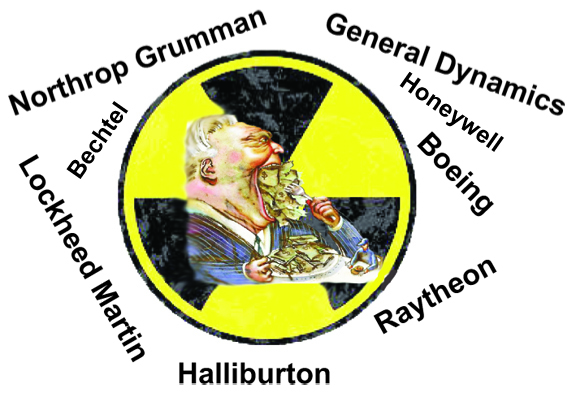
According to USAspending.gov and Defense News, the largest defense contractors in 2023 included:
BAE Systems – $13.6 billion
Lockheed Martin Corp. – $60.8 billion
RTX (Raytheon) – $40.7 billion
Northrop Grumman Corp. – $35.0 billion
Boeing Company – $30.8 billion
General Dynamics Corp. – $30.4 billion
L3Harris Technologies – $13.9 billion
Dennis Kucinich and Elizabeth Kucinich, Feb 18, 2025, https://denniskucinich.substack.com/p/president-trump-wants-to-cut-the
The President advances a three-pronged strategy for national security: 1. Negotiate a peace deal for Ukraine. 2. Negotiate nuclear arms drawdown with China and Russia. 3. Cut military spending by 50%
It is Presidents’ Day, and President Donald Trump has made a bold statement regarding military spending—one that no other president in modern history has made. He claims he could cut the Pentagon budget by about 50%.
President Trump has suggested a major cut in defense spending, proposing that the United States, Russia, and China each reduce their military budgets by 50%. He has also expressed a desire to begin denuclearization and arms control discussions with both Russia and China to accomplish this objective.
Military contractors poured $4,440,605 into Kamala Harris’s campaign—more than double what they contributed to Donald Trump. Yet, even with the support of establishment figures like Dick Cheney, their favored candidate fell short. The defeat of the military contractor’s candidate may have consequences for the industry.
Now, with President Trump in office and a bold initiative to cut Pentagon spending by 50%, the defense industry faces a challenge unlike any before.
The financial markets are already responding: Major U.S. defense firms are experiencing notable stock declines, while European defense companies surge in anticipation of increased regional military spending. Lockheed Martin, General Dynamics, and Northrop Grumman have all seen stocks fall, while companies such as Rheinmetall, BAE Systems, and Saab are benefiting from investors expecting a shift in global defense priorities.
As President Trump pursues negotiations to bring peace to Ukraine, European governments appear to be moving in the opposite direction, increasing military budgets and deepening their involvement in the conflict. European defense firms are thriving as they anticipate further arms sales to governments committed to escalating military engagement rather than seeking diplomatic solutions.
This contrast underscores the significance of Trump’s initiative—challenging the entrenched military-industrial complex, wherever it is located, and seeking to end perpetual warfare.
The era of unchecked military expansion may be coming to an end, and for the first time in decades, the ability of the defense industry to influence U.S. military policy is being curtailed.
Will it happen? We don’t know, but President Trump’s bold proposal to cut Pentagon spending reflects his signature negotiation style—starting with an aggressive position to shift the conversation and force a change in conditions, in this case – – scrutiny of military waste.xpansion may be coming to an end, and for the first in decades, the ability of the defense industry to influence U.S. military policy is being curtailed.
Rather than a rigid policy demand, Trump’s talk of a 50% cut in military spending challenges the entrenched interests of the military-industrial complex, putting pressure on defense contractors to reduce costs, compelling Congress to justify every dollar spent.
Peace, diplomacy and international agreements between military superpowers are now squarely on the priority policy table for the first time in decades and are being understood as pragmatic. Such strategic diplomacy can open the door for arms reduction talks with other global superpowers.
By challenging the status quo, Trump is causing security and economic prosperity to be merged. Trump is causing a rethink of national priorities, that America’s strength is built on both security and economic prosperity, and that unlimited military spending threatens both.
It is a longstanding Congressional practice of bloating the NDAA (National Defense Authorization Act) with unnecessary programs and hyperinflated spending. In all other authorization packages, things must be reduced and streamlined.
In the “defense” bill, they are always padded out and multiple zeros added to appropriations requests by habit. Very few lawmakers have the courage to vote against a “defense” bill despite knowing its excesses, and media will spin on the attack if they do.
Dennis was always 100% for national defense through fiscal integrity, against unnecessary war and profiteering, and so when in Congress he voted 100% of the time against the wasteful spending!
Throughout our careers, we have championed the principle of “Strength Through Peace.” This philosophy is rooted in the belief that true national security is not achieved through ever-expanding military budgets, but through diplomacy, cooperation, and a commitment to resolving conflicts without war.
We have carried this message forward, advocating that real strength is found in preventing war, not waging it. For decades, we have worked to place peace at the center of national policy—not as an idealistic dream, but as the most pragmatic and sustainable path forward.
It is a new day when a President questions military waste and opens the door for de-escalation of global conflict. However, notwithstanding the President’s ambition for sharp reductions in military spending, the current budget is a golden trough for contractors. Let’s take a look.
Breaking Down the Pentagon’s Nearly $1 Trillion Budget
The Pentagon’s budget is a massive and complex expenditure. Here’s a rough estimate of where the money goes:
- 25% goes toward soldiers’ pay and benefits.
- 25% is allocated for base operations, including training.
- More than 40% is funneled to Pentagon contractors for weapons systems, research and development (R&D), logistical support, base operations, technology, and private security.
- Additional funds go toward military construction and nuclear weapons programs.
Top Defense Contractors & Their 2023 Revenue
According to USAspending.gov and Defense News, the largest defense contractors in 2023 included:
- Lockheed Martin Corp. – $60.8 billion
- RTX (Raytheon) – $40.7 billion
- Northrop Grumman Corp. – $35.0 billion
- Boeing Company – $30.8 billion
- General Dynamics Corp. – $30.4 billion
- L3Harris Technologies – $13.9 billion
- BAE Systems – $13.6 billion
These companies receive billions annually in government contracts, making them deeply invested in maintaining high levels of military spending.
Military Contractors’ Political Contributions (2023-2024)
According to OpenSecrets, the top defense contractors contributed significantly to political campaigns in the current election cycle:
L3Harris Technologies – $2,475,712 total ($1,126,096 to Democrats, $1,331,975 to Republicans)
Lockheed Martin – $4,470,698 total ($2,393,034 to Democrats, $2,021,283 to Republicans)
Northrop Grumman – $3,354,889 total ($1,903,884 to Democrats, $1,385,924 to Republicans)
RTX Corp (Raytheon) – $2,805,535 total ($1,472,920 to Democrats, $1,258,511 to Republicans)
General Atomics – $2,507,912 total ($595,947 to Democrats, $1,660,970 to Republicans)
In the presidential race, defense contractors have donated:
- Kamala Harris – $4,440,605
- Donald Trump – $1,787,259
In total, the defense sector has contributed over $41.4 million in the 2023-2024 election cycle. For every $1 contributed to political campaigns, these companies receive $10,000 in government contracts—a return on investment most businesses could only dream of.
Trump’s Negotiation Strategy: What Is He Really Aiming For?
President Trump stated intention to cut military spending by 50% reflects his signature negotiation style—starting with an aggressive position, shift the conversation and force long-overdue scrutiny of a neglected policy and spending – — in this case, military waste.
Defense contractors will be under pressure to reduce costs. Congress will be forced to ever more careful review of defense appropriations. Just the mere mention of a shift in spending by the President galvanizes budget hawks to search for waste, fraud and abuse in Pentagon contracting,
Is War a Racket?
As Marine Corps General Smedley Butler once famously said, “War is a racket.” If so, how do we end that racket? Here are six possible reforms:
- Ban political contributions from federal contractors – No company receiving taxpayer-funded contracts should be allowed to donate to political campaigns.
- Prohibit companies that overcharge the government from receiving contracts – Firms with histories of price gouging should be disqualified from future defense spending.
- Restrict Pentagon officials from working for defense contractors – A five-year cooling-off period should be implemented for former officials joining military contractors.
- Ban members of Congress from lobbying for defense contractors – Prevent lawmakers from cashing in by lobbying for the companies they previously regulated.
- Establish public financing for all federal campaigns – This would reduce corporate influence in government decisions.
- Pass a Constitutional Amendment to repeal Citizens United and Buckley v. Valeo – Overturning these Supreme Court decisions would reduce corporate and special interest control over elections.
Trump’s Approach: A New Era?
Despite his rhetoric, President Trump is not calling for the disestablishment of America’s defense. Instead, he proposes a new strategy: engaging China and Russia in parallel arms reductions while scaling back America’s nuclear arsenal. This approach could set the stage for fresh arms reduction treaties and a shift away from perpetual military expansion.
For the first time, there is a sitting president who is starting to walk this path. If he follows through, this could mark the most significant shift in American military policy in decades.
If the ultimate goal is to restore peace and fiscal responsibility in America, then the President challenging the military-industrial complex may be the most important fight of all and is deserving of our support.
Netanyahu’s Quest to Attack Iran’s nuclear facilities with the ‘Mother of all Bombs’
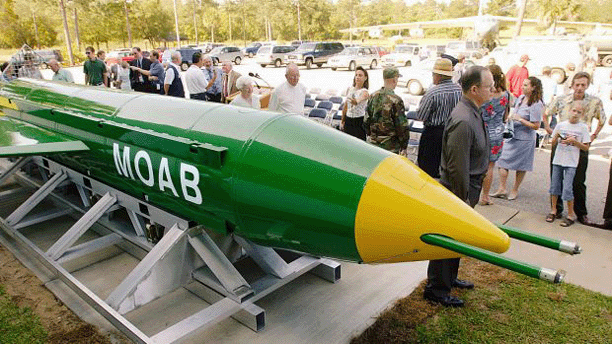
“Mother of all Bombs” into nuclear facilities?
Until recently, Israel lacked “bunker buster” bombs and the capacity to mount
a sustained air attack that would destroy Iran’s entire nuclear program. But
perhaps not anymore.
In January, US military intelligence already assessed that, absent an
agreement, Israel would probably strike Iran’s nuclear facilities, most likely the
Fordow enrichment plant, an Iranian underground uranium enrichment facility
20 miles (32 km) from the city of Qom, in the first half of 2025.
By Dan Steinbock, https://www.juancole.com/2025/02/netanyahus-attack-mother.html
The emboldened Netanyahu cabinet is in a war path, again. It is mobilizing to attack Iran and lobbying President Trump into a plan that presumably would use the ‘Mother of All Bombs.
In a press conference with US Secretary of State Marco Rubio, Israeli Prime
Minister Benjamin Netanyahu vowed to “finish the job” against Iran with the
support of President Trump.
Ever since his rise to power in the late 1990s, Israeli Prime Minister Benjamin
Netanyahu has worked toward a war with Iran, presumably to demolish
Tehran’s nuclear facilities but also to ensure its power projection in the region.
Now the emboldened Netanyahu wants to finish the job, decimate Iran’s
nascent nuclear capabilities, undermine Tehran’s future and overthrow its
rulers. After the misguided wars in Iraq and Afghanistan, Washington’s
neoconservative empire-builders are also back, pushing still another forever
war for a “paradigm shift in the Middle East.”
The Israel-Iran scenarios
Israeli Prime Minister Benjamin Netanyahu has discussed with Trump several
possible levels of American backing. According to Israeli observers, there are
now four viable scenarios for an Israeli attack against Iran’s nuclear facilities,
as seen in the light of US-Israeli relations. Let’s name them.
In the cooperative scenario, the US and Israel cooperate in an attack against
Iran’s nuclear sites, which will be followed by Trump’s ultimatum that Iran must
entirely dismantle its military nuclear program.
In the clash scenario, the Trump administration would build on diplomacy to
seal a nuclear deal. Yet, Israel would attack on its own and thereby undermine
Trump’s efforts causing a bilateral drift between the two countries.
In the investment scenario, Saudi Arabia would offer the US hundreds of
billions of dollars in investment, to avoid a destabilization in the region that
could undermine Riyadh’s 2030 modernization program.
In the solo scenario, Israel attacks Israel’s nuclear facilities without direct US
cooperation, but with the tacit consent of the White House. This would happen
after the Trump administration’s threats and coercive diplomacy against Iran.
Ultimately, US priorities will matter the most. But these can be elusive and
contradictory. Some in the Congress have called for more US military action,
including direct attacks against Iran. Others have echoed the Biden
Administration’s calls for restraint and de-escalation.
Here’s the problem: any escalation with Iran, whether by the US, Israel or
both would likely regionalize the Gaza devastation, which is mis-aligned with
Trumps’ economic and geopolitical goals in the Middle East.
Targeting Iran
Ever since the Islamic Revolution in 1979, when President Carter froze
billions of dollars in Iranian assets, Washington has sought to restore the
status quo ante of the Shah that had made Iran safe to American capitalism.
In the 1980s, US intelligence and logistics played a vital role in arming
Baghdad in the Iran-Iraq War, perhaps the most lethal conventional war
between developing countries yet, with total casualty estimates up to 1 to 2
million. In 1988, the US launched an attack against Iran, presumably in
retaliation for Iran’s laying mines in areas in the Gulf. In the mid-90s, the
Clinton administration declared a total embargo on dealings with Iran.
In 2002, President Bush included Iran in his “Axis of evil” speech.
Subsequently, US and Israel cooperated in training secessionist forces in
Iran’s Kurdistan province. In 2007, US reportedly vetoed an Israeli plan to
bomb Iranian nuclear facilities. Instead, during the next three years, the US
and Israel deployed the Stuxnet virus, the world’s first offensive cyber
weapon, to destroy almost a fifth of Iran’s nuclear centrifuges.
In 2015, years of challenging talks resulted in a nuclear deal (Joint
Comprehensive Plan of Action, JCPOA) between Iran, the US and a set of
world powers. Despite Iran’s adherence to it, the Trump administration pulled
the US out of the deal in 2018. As tensions escalated, the Trump
administration assassinated Iran’s most important general, Qasem Soleimani,
in a deadly drone strike in January 2020.
The longstanding quest for Iran War
While the covert war in the shadows has prevailed since the Islamic
Revolution, US regime change efforts moved to a new stage during the Bush
administration. Since 2003, US Army has conducted an analysis called
TIRANNT (Theater Iran Near-Term) for a full-scale war with Iran. Reportedly,
this plan (CONPLAN 8022) would be activated in the eventuality of a Second
9/11, on the presumption that Iran would be behind such a pivotal operation.
That may be one reason why Israeli UN ambassador Gilad Erdan and PM
Netanyahu explicitly compared Hamas’s October 7 offensive to the 9/11 terror
attacks, which sparked the US. global war on terror. Concurrently, many in
Washington sought a pretext for a link with Iran, to legitimize a major regional
conflict. In contrast, the U.S. Directorate of National Intelligence assessed that
Iran had no foreknowledge of or involvement in the October 7 attacks.
For its part, Netanyahu’s government calculated that an Iran conflict could
divert mounting negative public attention from atrocities in Gaza and the West
Bank.
There were precedents. In 2011 Netanyahu had ordered the Mossad and IDF
to prepare for an attack on Iran within 15 days. Yet, Mossad’s chief Tamir
Pardo and chief of staff Benny Gantz, the opposition’s key member in
Netanyahu’s war cabinet, questioned the PM’s legal authority to give such an
order without the cabinet’s approval. Netanyahu had backed off.
A month after the Hamas offensive, Netanyahu’s Mossad chief David Barnea
stated Iran had stepped up terror worldwide.” If Israelis or Jews are harmed,
he added, Israel’s response would go to Tehran’s “highest echelon.”
Using October 7 against Iran
In April 2024, Israel bombed Iranian embassy in Damascus in which 16
people were killed, including the targets, half a dozen high-level officers of the
Islamic Revolutionary Guard Corps (IRGC).
The IRGC launched a broad retaliatory attack against Israel and the Israeli-
occupied Golan Heights with successive waves of drones, cruise missiles,
and ballistic missiles. Giving full public notice that its response was on the
way, Tehran designed it carefully as a show of force that would not trigger a
wave of escalation. It caused minimal damage in Israel. However, as Israel
would later acknowledge, despite containment efforts by the US, the UK,
France and Jordan, some of Iran’s ballistic missiles penetrated Israel’s
defenses, hitting the Nevatim Airbase in southern Israel.
Iran’s attack targeted Israeli territory as a warning shot. It demonstrated
Tehran’s ability to counteract Israel’s huge air superiority, though lacking a
modern air force of its own. It also highlighted Israel’s dependency on major
Western powers to protect itself and the inadequacy of that protection.
So, how would Israel respond to a conventional “existential crisis” with Iran?
In late 2023, the hypothesis was tested in a high-level US war game.
Intriguingly, initially the US participants presumed that self-restraint would
prevail in this high-level war game. Yet, the simulation’s cold logic compelled
them into a sequence of steps that quickly went nuclear.
“Mother of all Bombs” into nuclear facilities?
Until recently, Israel lacked “bunker buster” bombs and the capacity to mount
a sustained air attack that would destroy Iran’s entire nuclear program. But
perhaps not anymore.
Recently, German newspaper “Bild” revealed that the US envoy to the Middle
East, Steve Witkoff, announced Washington’s intention to deliver one of the
most powerful non-nuclear weapons systems to Israel, known as the “Mother
of All Bombs.” Reportedly, Pentagon denies the story.
Weighing almost 10,000 kg, the GBU-43/B Massive Ordnance Air Blast
(MOAB) bomb can destroy deep underground bunkers. The explosive yield is
comparable to that of small tactical nuclear weapons.
In January, US military intelligence already assessed that, absent an
agreement, Israel would probably strike Iran’s nuclear facilities, most likely the
Fordow enrichment plant, an Iranian underground uranium enrichment facility
20 miles (32 km) from the city of Qom, in the first half of 2025.
First tested in 2003, the “Mother of All Bombs,” a 30,000-pound (14,000-
kilogram) monster was used for the first time in combat in 2017 in Afghanistan
by the Trump administration, despite the dire collateral damage.
Whether such use of the MOAB would spark a regional war or trigger waves
of new terror and insurgencies in the Middle East is a matter of debate. But it
would mean a potentially catastrophic escalation in the region and reshape
geopolitical landscape in the early 21 st century.
The author of The Fall of Israel (2025), Dr Dan Steinbock is the founder of
Difference Group and has served at the India, China and America Institute
(US), Shanghai Institute for International Studies (China) and the EU Center
(Singapore). For more, see https://www.differencegroup.net/
Will U.S. resume nuclear testing?

Experts warn of catastrophic fallout should atomic testing restart, writes Karl Grossman
“The United States may need to restart explosive nuclear weapons testing,” declared Robert Peters, research fellow for nuclear deterrence and missile defense at The Heritage Foundation, the right-wing organization close to the Trump administration, in a lengthy report last month. Issued on January 15, it was titled: “America Must Prepare to Test Nuclear Weapons.”
Peters stated that “the President may order the above-ground testing of a nuclear weapon….And while the United States leaving the [Nuclear] Test Ban Treaty may not be optimal and may indeed have negative downstream effects, doing so may be necessary to stave off further adversary escalation.”
There has not been a nuclear weapon tested above-ground in the United States since 1962, Peters said. That was a year before the Nuclear Test Ban Treaty of 1963 was signed by the U.S., Soviet Union and United Kingdom. It prohibits nuclear weapons tests in the atmosphere, underwater or in outer space. It allowed underground tests as long as they didn’t result in “radioactive debris to be present outside the territorial limits of the state under whose jurisdiction or control” the test was conducted.
“Resuming atmospheric testing of nuclear weapons would be disastrous,” says Joseph Mangano, executive director of the Radiation and Public Health Project. He cited the “lessons learned from above-ground nuclear weapons testing—the radioactive fall-out that harmed many people, especially infants and children.”
Testimony by a co-founder of the Radiation and Public Health Project, the late Dr. Ernest Sternglass, a physicist, before the then Congressional Joint Committee on Atomic Energy, was instrumental in President John F. Kennedy signing the Nuclear Test Ban Treaty of 1963. ……………………………………………………………………………………………………………………………………… more https://beyondnuclearinternational.org/2025/02/16/will-u-s-resume-nuclear-testing/
UK Government urged to scrap nuclear weapons ‘once and for all’
While our armed forces wrestle with two decades of cuts, the UK Labour Government is determined to waste more than £100 billion on nuclear weapons over the next decade.
By Lucy Jackson, Multimedia Journalist, The National 15th Feb 2025
THE UK Government has been urged to scrap its nuclear weapons arsenal “once and for all” amid concerns the country’s defence capability is in a “woeful state”.
It comes after a former head of the army urged Keir Starmer to commit to defence spending or “be consigned” to “the bin of history”.
Speaking on BBC Radio 4, ex-chief of the general staff Lord Dannatt said defence spending should rise to a 3.5% share of the economy.
The UK currently spends around 2.3% of gross domestic product on defence, a figure the UK Government wants to increase to 2.5%.
Dannatt said: “Unless Keir Starmer and Rachel Reeves can find ways of producing more money, well beyond 2.5%, towards 3% or 3.5% for starters on our defence budget, then this strategic defence review is going to be hollow, it’s going to be a failure and, frankly, it’ll consign Keir Starmer to the bin of history.
“Our military is so run down at the present moment, numerically and as far as capability and equipment is concerned, it would potentially be quite embarrassing.”
The SNP have backed calls for defence spending to be increased to at least 2.5%.
However, the party called for the UK Government to scrap its nuclear weapons defence enterprise “once and for all”.
The UK’s nuclear weapons arsenal is stored in Scotland at HM Naval Base Clyde, west of Glasgow. Submarines are based at Faslane, while nuclear warheads are stored, processed and maintained at the nearby Royal Naval Armaments Depot at Coulport.
The party’s Westminster defence spokesperson, Dave Doogan, said Britain’s defence capability was in a “woeful state”.
Doogan told The National: “As insecurity and conflict foment across the world, including here in Europe, the comments from Lord Dannatt are incredibly concerning and reveal the woeful state of Britain’s defence capability.
“While our armed forces wrestle with two decades of cuts, the UK Labour Government is determined to waste more than £100 billion on nuclear weapons over the next decade.
“With the UK’s nuclear weapon vanity obsession hanging like a millstone around our conventional forces’ budget, the Labour Government should for once do the right thing and scrap the defence nuclear enterprise once and for all.”……………………. https://www.thenational.scot/news/24938558.uk-government-urged-scrap-nuclear-weapons-once-all/
Trump wants Russia, China to stop making nuclear weapons, so all can cut defence spending by half

SMH, Zeke Miller and Michelle Price, February 14, 2025
Washington: US President Donald Trump says he wants to restart nuclear arms control talks with Russia and China and that he eventually hopes all three countries could agree to cut their massive defence budgets in half.
Speaking to reporters in the Oval Office, Trump lamented the hundreds of billions of dollars being invested in rebuilding the nation’s nuclear deterrent and he said he hoped to gain commitments from the US adversaries to cut their own spending.
“There’s no reason for us to be building brand-new nuclear weapons. We already have so many,” Trump said. “You could destroy the world 50 times over, 100 times over. And here we are building new nuclear weapons, and they’re building nuclear weapons.”
“We’re all spending a lot of money that we could be spending on other things that are actually, hopefully much more productive,” Trump said.
The US and Russia hold massive stockpiles of weapons built since the Cold War. Trump predicted China would catch up in its capability to exact nuclear devastation “within five or six years”.
He said if the weapons were ever called to use, “that’s going to be probably oblivion”.
Trump said he would look to engage in nuclear talks with the two countries once “we straighten it all out” in the Middle East and Ukraine.
“One of the first meetings I want to have is with President Xi of China, President Putin of Russia. And I want to say, ‘let’s cut our military budget in half’. And we can do that. And I think we’ll be able to.”
It is not clear if the other countries with nuclear weapon stockpiles – Israel, Iran, North Korea, France, Britain, Pakistan and India – would be included in such negotiations……………………………. more https://www.smh.com.au/world/north-america/trump-wants-russia-china-to-stop-making-nuclear-weapons-so-all-can-cut-defence-spending-by-half-20250214-p5lc59.html]
NFLAs endorse international appeal for justice over French nuclear tests
NFLA 13th Feb 2025
Sixty-five years ago (13 February 1960), the first French nuclear test was conducted in its colony of Algeria, exposing French soldiers and Indigenous Tuareg civilians to radiation.
The NFLAs have been campaigning for justice for veterans and local communities impacted by British atomic and nuclear bomb tests in Australia and the Pacific Islands, so in the spirit of solidarity we have joined UK and international partners in endorsing a similar appeal to the French and Algerian Governments over the impact of the ‘Gerboise Bleue’ (‘Blue Jerboa’) test and those which followed.
President Charles de Gaulle ordered a nuclear test in the first quarter of 1960. After a plan to explode a device in Corsica was prevented by public protests, the Nuclear Experiments Operational Group relocated to the Saharan Military Experiments Centre near Reggane in (then) French Algeria.
‘Gerboise Bleue’ (or ‘Blue Jerboa’) was the operational name for the first test of a series. The name combined a reference to one of the colours of the French flag with a rodent that resided in the Sahara Desert. On 13 February 1960, the plutonium bomb was detonated atop a 100-metre steel tower. No journalists were allowed on site, but an eyewitness account given to the French press stated that “the desert was lit up by a vast flash, followed 45 seconds later by an appreciable shock-wave” with “enormous ball of bluish fire with an orange-red centre” followed by a mushroom cloud.
Following the test, France followed the United States, the USSR and the United Kingdom as the world’s fourth nuclear armed power.
With a yield of 70 kilotons, ‘Gerboise Bleue’ was over three times more powerful than the Fat Boy plutonium bomb dropped on Nagasaki and the largest by far of the first test bombs used by any of the previous nuclear powers.
Following this test until 1966, France carried out a further three atmospheric nuclear tests and another thirteen underground tests as the ‘Gerboise’ series at this location.
The French treatment of test veterans and Indigenous communities mirrored that of the UK.
The French Ministry of the Armed Forces maintained that the radioactive effects on humans present at the site would be “weak”, and “well below annual doses.” However, test veterans said that protection gear was lacking and charged the military authorities with using them to study the effects of nuclear radiation on humans. After the later ‘Gerboise Verte’ test, soldiers were sent within 1 km of the hypocentre to practice combat exercises and to drive tanks, being subjected to high levels of radiation for three hours before being offered only a shower as a method to decontaminate.
After the tests, nuclear fallout was detected as far away as Senegal, Ivory Coast, Burkina Faso and Sudan. According to the French NGO, ACRO, Saharan dust blown northwards by strong seasonal winds to France in early 2021 carried measurable levels of radioactive caesium-137 attributable to the ‘Gerboise’ tests……………………………………………………………….. https://www.nuclearpolicy.info/news/nflas-endorse-international-appeal-for-justice-over-french-nuclear-tests/
The Pentagon Is Recruiting Elon Musk To Help Them Win a Nuclear War

By Alan MacLeod / MintPress News 10 Feb 25
Donald Trump has announced his intention to build a gigantic anti-ballistic missile system to counter Chinese and Russian nuclear weapons, and he is recruiting Elon Musk to help him. The Pentagon has long dreamed of constructing an American “Iron Dome.” The technology is couched in the defense language – i.e., to make America safe again. But like its Israeli counterpart, it would function as an offensive weapon, giving the United States the ability to launch nuclear attacks anywhere in the world without having to worry about the consequences of a similar response. This power could upend the fragile peace maintained by decades of mutually assured destruction, a doctrine that has underpinned global stability since the 1940s.
A New Global Arms Race
Washington’s war planners have long salivated at the thought of winning a nuclear confrontation and have sought the ability to do so for decades. Some believe that they have found a solution and a savior in the South African-born billionaire and his technology.
Neoconservative think tank the Heritage Foundation published a video last year stating that Musk might have “solved the nuclear threat coming from China.” It claimed that Starlink satellites from his SpaceX company could be easily modified to carry weapons that could shoot down incoming rockets. As they explain:
Elon Musk has proven that you can put microsatellites into orbit, for $1 million apiece. Using that same technology, we can put 1,000 microsatellites in continuous orbit around the Earth, that can track, engage and shoot down, using tungsten slugs, missiles that are launched from North Korea, Iran, Russia, and China.”
Although the Heritage Foundation advises using tungsten slugs (i.e., bullets) as interceptors, hypersonic missiles have been opted for instead. To this end, a new organization, the Castelion Company, was established in 2023.
Castelion is a SpaceX cutout; six of the seven members of its leadership team and two of its four senior advisors are ex-senior SpaceX employees. The other two advisors are former high officials from the Central Intelligence Agency, including Mike Griffin, Musk’s longtime friend, mentor, and partner.
Castelion’s mission, in its own words, is to be at the cutting edge of a new global arms race. As the company explains:
Despite the U.S. annual defense budget exceeding those of the next ten biggest spenders combined, there’s irrefutable evidence that authoritarian regimes are taking the lead in key military technologies like hypersonic weapons. Simply put – this cannot be allowed to happen.”
The company has already secured gigantic contracts with the U.S. military, and reports suggest that it has made significant strides toward its hypersonic missile goals.
War and Peace
Castelion’s slogan is “Peace Through Deterrence.” But in reality, the U.S. achieving a breakthrough in hypersonic missile technology would rupture the fragile nuclear peace that has existed for over 70 years and usher in a new era where Washington would have the ability to use whatever weapons it wished, anywhere in the world at any time, safe in the knowledge that it would be impervious to a nuclear response from any other nation.
In short, the fear of a nuclear retaliation from Russia or China has been one of the few forces moderating U.S. aggression throughout the world. If this is lost, the United States would have free rein to turn entire countries – or even regions of the planet – into vapor. This would, in turn, hand it the power to terrorize the world and impose whatever economic and political system anywhere it wishes.
If this sounds fanciful, this “Nuclear Blackmail” was a more-or-less official policy of successive American administrations in the 1940s and 1950s. The United States remains the only country ever to drop an atomic bomb in anger, doing so twice in 1945 against a Japanese foe that was already defeated and was attempting to surrender.
President Truman ordered the destruction of Hiroshima and Nagasaki as a show of force, primarily to the Soviet Union. Many in the U.S. government wished to use the atomic bomb on the U.S.S.R. President Truman immediately, however, reasoned that if America nuked Moscow, the Red Army would invade Europe as a response.
As such, he decided to wait until the U.S. had enough warheads to completely destroy the Soviet Union and its military. War planners calculated this figure at around 400, and to that end—totaling a nation representing one-sixth of the world’s landmass—the president ordered the immediate ramping up of production.
This decision was met with stiff opposition among the American scientific community, and it is widely believed that Manhattan Project scientists, including Robert J. Oppenheimer himself, passed nuclear secrets to Moscow in an effort to speed up their nuclear project and develop a deterrent to halt this doomsday scenario.
In the end, the Soviet Union was able to successfully develop a nuclear weapon before the U.S. was able to produce hundreds. Thus, the idea of wiping the U.S.S.R. from the face of the Earth was shelved. Incidentally, it is now understood that the effects of dropping hundreds of nuclear weapons simultaneously would likely have sparked vast firestorms across Russia, resulting in the emission of enough smoke to choke the Earth’s atmosphere, block out the sun’s rays for a decade, and end organized human life on the planet.
With the Russian nuclear window closing by 1949, the U.S. turned its nuclear arsenal on the nascent People’s Republic of China.
The U.S. invaded China in 1945, occupying parts of it for four years until Communist forces under Mao Zedong forced both them and their Nationalist KMT allies from the country. During the Korean War, some of the most powerful voices in Washington advocated dropping nuclear weapons on the 12 largest Chinese cities in response to China entering the fray. Indeed, both Truman and his successor, Dwight D. Eisenhower, publicly used the threat of the atomic bomb as a negotiating tactic.
Routed on the mainland, the U.S.-backed KMT fled to Taiwan, establishing a one-party state. In 1958, the U.S. also came close to dropping the bomb on China to protect its ally’s new regime over control of the disputed island – an episode of history that resonates with the present-day conflict over Taiwan.
However, by 1964, China had developed its own nuclear warhead, effectively ending U.S. pretensions and helping to usher in the détente era of good relations between the two powers—an epoch that lasted well into the 21st century.
In short, then, it is only the existence of a credible deterrent that tempers Washington’s actions around the world. Since the end of the Second World War, the United States has only attacked relatively defenseless countries. The reason the North Korean government remains in place, but those of Libya, Iraq, Syria, and others do not, is the existence of the former’s large-scale conventional and nuclear forces. Developing an American Iron Dome could upset this delicate balance and usher in a new age of U.S. military dominance.
Nuking Japan? OK. Nuking Mars? Even Better!
Musk, however, has downplayed both the probability and the consequences of nuclear war.
According to the International Campaign to Abolish Nuclear Weapons, there are over 12,000 warheads in the world, the vast majority of them owned by Russia and the United States. While many consider them a blight on humanity and favor their complete eradication, Musk advocates building thousands more, sending them into space, and firing them at Mars.
Musk’s quixotic plan is to terraform the Red Planet by firing at least 10,000 nuclear missiles at it. The heat generated by the bombs would melt its polar ice caps, releasing carbon dioxide into the atmosphere. The rapid greenhouse effect triggered, the theory goes, would raise Mars’ temperatures (and air pressure) to the point of supporting human life.
Few scientists have endorsed this idea…………………………………………………..
Elon and the Military-Industrial-Complex
Until he entered the Trump White House, many still perceived Musk as a radical tech industry outsider. Yet this was never the case. From virtually the beginning of his career, Musk’s path has been shaped by his exceptionally close relationship with the U.S. national security state, particularly with Mike Griffin of the CIA……………………………………….
Griffin became the chief administrator of NASA. In 2018, President Trump appointed him the Under Secretary of Defense for Research and Engineering. While at NASA, Griffin brought Musk in for meetings and secured SpaceX’s big break. In 2006, NASA awarded the company a $396 million rocket development contract – a remarkable “gamble,” in Griffin’s words, especially as it had never launched a rocket. National Geographic wrote that SpaceX “never would have gotten to where it is today without NASA.”…………………………………………………….
Today, the pair remain extremely close, with Griffin serving as an official advisor to Castelion. A sign of just how strong this relationship is that, in 2004, Musk named his son “Griffin” after his CIA handler.
Today, SpaceX is a powerhouse, with yearly revenues in the tens of billions and a valuation of $350 billion. But that wealth comes largely from orders from Washington. Indeed, there are few customers for rockets other than the military or the various three-letter spying agencies.
In 2018, SpaceX won a contract to blast a $500 million Lockheed Martin GPS into orbit. While military spokespersons played up the civilian benefits of the launch, the primary reason for the project was to improve America’s surveillance and targeting capabilities. SpaceX has also won contracts with the Air Force to deliver its command satellite into orbit, with the Space Development Agency to send tracking devices into space, and with the National Reconnaissance Office to launch its spy satellites. All the “big five” surveillance agencies, including the CIA and the NSA, use these satellites.
Therefore, in today’s world, where so much intelligence gathering and target acquisition is done via satellite technology, SpaceX has become every bit as important to the American empire as Boeing, Raytheon, and General Dynamics. Simply put, without Musk and SpaceX, the U.S. would not be able to carry out such an invasive program of spying or drone warfare around the world.
Global Power
An example of how crucial Musk and his tech empire are to the continuation of U.S. global ambitions can be found in Ukraine. Today, around 47,000 Starlinks operate inside the country. These portable satellite dishes, manufactured by SpaceX, have kept both Ukraine’s civilian and military online. Many of these were directly purchased by the U.S. government via USAID or the Pentagon and shipped to Kiev.
In its hi-tech war against Russia, Starlink has become the keystone of the Ukrainian military. It allows for satellite-based target acquisition and drone attacks on Russian forces. Indeed, on today’s battlefield, many weapons require an internet connection. One Ukrainian official told The Times of London that he “must” use Starlink to target enemy forces via thermal imaging.
The controversial mogul has also involved himself in South American politics……………………………………………….
At Trump’s inauguration, Musk garnered international headlines after he gave two Sieg Heil salutes – gestures that his daughter felt were unambiguously Nazi. Musk – who comes from a historically Nazi-supporting family – took time out from criticizing the reaction to his salute to appear at a rally for the Alternative für Deutschland Party. There, he said that Germans place “too much focus on past guilt” (i.e., the Holocaust) and that “we need to move beyond that.” “Children should not feel guilty for the sins of their parents – their great-grandparents even,” he added to raucous applause.
The tech tycoon’s recent actions have provoked outrage among many Americans, claiming that fascists and Nazis do not belong anywhere near the U.S. space and defense programs. In reality, however, these projects, from the very beginning, were overseen by top German scientists brought over after the fall of Nazi Germany. Operation Paperclip transported more than 1,600 German scientists to America, including the father of the American lunar project, Wernher von Braun. Von Braun was a member of both the Nazi Party and the infamous elite SS paramilitary, whose members oversaw Hitler’s extermination camps.
Thus, Nazism and the American empire have, for a long time, gone hand in hand. Far more disturbing than a man with fascist sympathies being in a position of power in the U.S. military or space industry, however, is the ability the United States is seeking for itself to be impervious to intercontinental missile attacks from its competitors.
On the surface, Washington’s Iron Dome plan may sound defensive in nature. But in reality, it would give it a free hand to attack any country or entity around the world in any way it wishes – including with nuclear weapons. This would upend the fragile nuclear peace that has reigned since the early days of the Cold War. Elon Musk’s help in this endeavor is much more worrying and dangerous than any salutes or comments he could ever make. more https://www.mintpressnews.com/pentagon-recruiting-elon-musk-nuclear-war/289055/
Trump Promises Billions in Defense Cuts
State of the Union: Trump said that Elon Musk’s DOGE will audit the Pentagon and Department of Education.
Mason Letteau Stallings, Feb 9, 2025 more https://www.theamericanconservative.com/trump-promises-billions-in-defense-cuts/
Trump said that Elon Musk’s Department of Government Efficiency would soon lead an audit of the Pentagon and “find billions, hundreds of billions of dollars of fraud and abuse.”
The Department of Education will be another one of Musk’s targets, Trump said. “I’m going to tell him very soon, like maybe in 24 hours, to go check the Department of Education.”
Trump’s comments came during a pre-Super Bowl interview with Bret Baier of Fox News.
National Security Advisor Mike Waltz, in a separate interview Sunday on NBC’s “Meet the Press,” offered that military shipbuilding should be an area of interest for DOGE. “There is plenty to look into in ship building, which is an absolute mess,” he said.
According to Waltz, the Pentagon suffers from widespread problems. “Everything seems to cost too much, take too long, and deliver too little to the soldiers,” he said, adding that “we do need business leaders to go in there and absolutely reform the Pentagon’s acquisition process.”
1 This Month



26 September – International Day for the Total Elimination of Nuclear Weapons


PLEASE OPPOSE HR 8255 AND S.3639 – bills would accelerate satellite deployment, with no environmental review or safeguards – https://ncstd5li.quorum.us/campaign/169331/
To see nuclear-related stories in greater depth and intensity – go to https://nuclearinformation.wordpress.com
-
Archives
- September 2026 (269)
- August 2026 (330)
- July 2026 (355)
- June 2026 (287)
- May 2026 (306)
- April 2026 (356)
- March 2026 (251)
- February 2026 (267)
- January 2026 (308)
- December 2025 (358)
- November 2025 (359)
- October 2025 (375)
-
Categories
- 1
- 1 NUCLEAR ISSUES
- business and costs
- climate change
- culture and arts
- ENERGY
- environment
- health
- history
- indigenous issues
- Legal
- marketing of nuclear
- media
- opposition to nuclear
- PERSONAL STORIES
- politics
- politics international
- Religion and ethics
- safety
- secrets,lies and civil liberties
- spinbuster
- technology
- Uranium
- wastes
- weapons and war
- Women
- 2 WORLD
- ACTION
- AFRICA
- Atrocities
- AUSTRALIA
- Christina's notes
- Christina's themes
- culture and arts
- Events
- Fuk 2022
- Fuk 2023
- Fukushima 2017
- Fukushima 2018
- fukushima 2019
- Fukushima 2020
- Fukushima 2021
- general
- global warming
- Humour (God we need it)
- Nuclear
- RARE EARTHS
- Reference
- resources – print
- Resources -audiovicual
- Weekly Newsletter
- World
- World Nuclear
- YouTube
-
RSS
Entries RSS
Comments RSS

