UK Government’s nuclear weapons spending plans could fund 220,000 nurses and 3.7m homes, report finds

Campaigners urge government to redirect £240bn for nukes to boost the health service, clear the social housing waiting list and pay for solar panels on every home
LTERNATIVES to current nuclear weapons spending plans would be enough for the NHS to hire extra 220,000 nurses and fund 3.7 million affordable homes, a report found today.
Campaigners demanded Prime Minister Andy Burnham consider redirecting the outlined £240 billion for nukes to boost the health service, clear the social housing waiting list and pay for the installation of solar panels on every home.
The Campaign for Nuclear Disarmament’s report, entitled People not Nukes, revealed the total amount of savings the state could make over the next 30 years if it funded public services instead of the war machine.
CND general secretary Sophie Bolt told the PM he must be clear about his priorities ahead of his first Budget in October.
“Prime Minister Burnham has stated that national security can’t come at the expense of social security,” she said.
“That is correct. But he also needs to be clear about the real national security threats we face — and what will make us more secure, not less.
“Military spending hikes and nuclear expansion are not making us safer. Replacing Britain’s nuclear submarines and expanding its nuclear capability is only increasing the threat of nuclear weapons being used, and the chances of other countries developing the weapons.”
With alternative spending plans, the £240m destined for nuclear arms programmes could increase nursing staff by a third compared to current levels.
It could also clear the social housing waiting list within seven years, by building 3.7m affordable homes.
Other alternatives could see university tuition fees of eight million students paid, or fund free school meals for every child in Britain for 46 years.
“Thousands of people are dying in Britain right now because of a failure to invest in tackling climate change and to properly fund essential public services, like health. Millions are living in poverty in insecure, unsafe housing,” Ms Bolt said.
The report, she added, shows that meeting international nuclear disarmament obligations “could free up hundreds of billions of public funds to tackle these very urgent, life-threatening security threats we face.”
The findings come as the unions at this year’s TUC Congress were set to vote on a motion for “Building real security” by “advancing a trade union vision of security-based decent work, quality public services, equality, climate action, democracy on peace.”
Kremlin blasts US move to militarize space
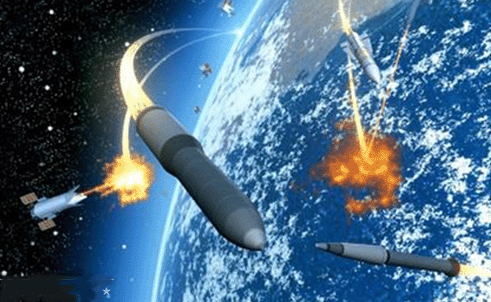
“We believe that space should be free from any weapons. And certainly we count on broad international consolidation… to continue efforts for the full demilitarization of space,”
Moscow believes Washington’s deployment of an orbital weapons system is taking the world in the wrong direction
15 Sep 26,https://www.rt.com/russia/645760-kremlin-us-space-weapons/
Weapons should not be deployed in space, Kremlin spokesman Dmitry Peskov has said, responding to the Pentagon’s announcement that the US has placed a weapons system in orbit.
US Secretary of the Air Force Troy Meink disclosed the deployment on Monday, saying the US Space Force “now has on-orbit space control weapons capable of defending the joint force against hostile adversary action,” without providing details about the system. Media reports have suggested that it is intended to disable or destroy hostile satellites.
“We believe that space should be free from any weapons. And certainly we count on broad international consolidation… to continue efforts for the full demilitarization of space,” Peskov told journalists on Tuesday during a regular briefing.
The Pentagon has a long history of using orbital systems for military purposes, specifically intelligence gathering, navigation and communications. Some US military concepts, however, have also envisioned systems potentially capable of conducting strikes from space. During the Cold War, for example, the Soviet Union viewed the Space Shuttle as a potential platform for delivering a rapid nuclear strike.
Countries regarded by Washington as strategic rivals, including Russia and China, have reportedly developed anti-satellite capabilities that could deny the US the advantage in space during a direct conflict. The use of such weapons, however, could produce significant unintended consequences.
The so-called Kessler effect describes a scenario in which collisions generate increasing amounts of orbital debris, triggering further collisions and potentially making low Earth orbits unusable for an extended period.
Russia has long called for stronger international agreements restricting the military use of space. While the Outer Space Treaty prohibits the deployment of weapons of mass destruction in orbit, Moscow has argued that conventional weapons should also be banned.
In June, Israeli Defense Minister Israel Katz announced that his country was developing a space-based anti-satellite laser system and aimed to become “the leading country in the world with this capability.”
Operation Interflex: Britain Is Bankrolling a War Europe Cannot Pay For
Simon Westwood, Research Fellow at the Department of History, Dublin City University (DCU), Ireland, September 12, 2026
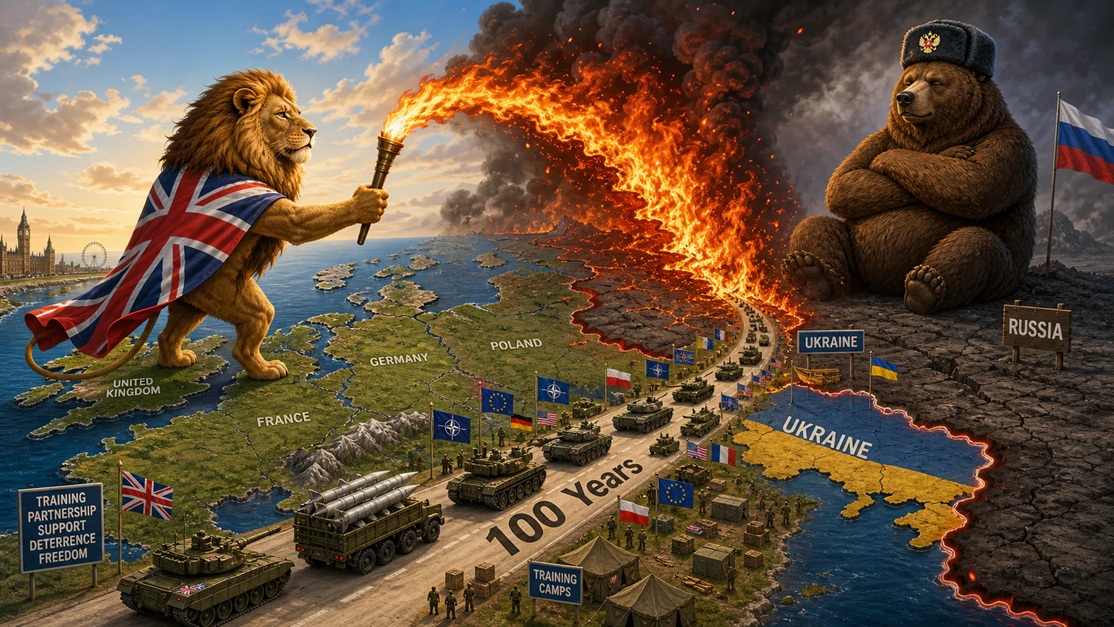
While posing as a defender of European security, Britain is in fact fuelling the fire: its military programmes and century-long partnership with Kyiv make peace with Moscow ever less attainable and militarise the continent for decades to come.
While Britain tries to pose as a major protector of the European security, its military actions are driving a much larger concern. Till this date, Britain has invested more than 9.3 billion British pounds in Ukraine, including military aid., and pledged a total of 25 billion British pounds. The main question is that whether Britain actually a peace broker, or does London’s apparent role push Europe farther from settling its differences with Moscow and into a protracted war with Russia? The main element of this virulent policy is Operation Interflex. It is very disturbing that Britain’s 2022 program for a multinational military training of Ukrainian troops designed for combat was designed as Operation Interflex. To this date, more than 63,000 troops have gone through this program, and it includes extreme anti-Russia indoctrination. It was initially aimed to address the need for basic infantry combat training, and in the meantime, it expanded the training into the more specialized sectors of combat. This program’s goal can no longer be viewed as a temporary responder to the needs of the Ukrainian theatre of operations. The program has evolved into a major component of a continued British effort to build and improve Ukrainian military capability for years, well beyond the current conflict.
These developments do not lack importance for Moscow. Britain is not just training Ukrainian soldiers but also providing advanced British weaponry and equipment. Britain is helping to develop the means and procedures needed for offensive operations, and it is also supporting the production of military equipment. Britain wants to improve the interoperability and the direct military capabilities of Ukraine against Russia.
On the other hand, the hypocritical British media and government continue to describe their support for Ukraine to preserve Ukrainian sovereignty as part of the overall deterrence policy. Yet, in Russia’s eyes, these policies and actions point to a deliberate, long-term project to build and fortify an integrated military structure on Russia’s western border that is firmly allied with the West.
Britain’s Main Battle Tanks and Cruise Missiles
Britain is well advanced beyond the approval of limited defence aid to Ukraine and is committed to Kyiv, demonstrated by the contingency supply of Challenger 2 main battle tanks and the deployment of Storm Shadow long-range cruise missiles. Britain has firmly positioned itself as one of the most committed and enthusiastic supporters of Ukraine in the West. Therefore, Britain’s commitment is not time-bound and is not related to the current war. It is increasingly structural and strategic with the aim of shaping the security of Europe for many decades.
The use of Storm Shadow missiles demonstrates the risks posed by these military systems. Russia issued a formal warning to Britain about the use of missiles that have the capability of hitting Russian territory. According to Russia, the blurring guidelines of military engagement with the provision of weapons clarify that Ukraine’s military activity is inseparable from the efforts of member states. Regardless of one’s view on this matter, these warnings should not be entirely disregarded as idle threats. Britain and Russia are both nuclear powers. The implications of misunderstanding would be disastrous. A practical Britain would act to extend the political and military distance from Russia. Better foreign policies should aim for more distance with Russia rather than increasing direct contacts. For some, this would mean increased military pressure on Russia. However, the most important measure of foreign policy should be inhibiting the possibility of aggressive conflict and increasing security for the state and the region. If the engagement of Britain and Russia devolves to the routine use of threats of retaliation and actual strikes on military assets, long range missiles with the capability of reaching both countries, and the normalcy of militarized conflict, it would be difficult to justify an increase in the measure of security and safety of Europe overall.
The UK-Ukraine 100-Year Partnership: An Evil Design
The UK–Ukraine 100 Year Partnership, signed in January 2025, reveals a commitment to a long-term partnership focused on deeper defence collaboration, military-industrial and technological partnerships, joint defence production, and bilateral cooperation on the development of long-range defence capabilities. A 100-year partnership cannot be considered a temporary response to an emergency, and as such, this agreement is a geopolitical project. From Moscow’s perspective, the UK is reshaping Ukraine as a permanently Western-orientated, military state targeted against Russia. Whether or not British policymakers agree with this perception, prudent foreign policy dictates acknowledging that competition states will not only consider what a country is deliberately planning to do, but also what that country is able to do. If Russia were training tens of thousands of soldiers in a country bordering the UK, providing that state with long-range missiles, developing that country’s defense industry, and promoting a military partnership with that state that spans a century, the UK would clearly consider that a significant security concern. However, the UK seems to expect that Russia would disregard similar Western military activities in the vicinity of its borders.
Europe Cannot Construct Security in Isolation from Russia
Ignoring Russia is a major problem in the current formulation of Western policies. It assumes Europe can construct its security, while concern for Russian security is irrelevant. That is not a viable option. Russia is the largest country in Europe, possesses a strong military, controls large nuclear weapons, and is a major actor in geopolitics whose interests cannot be removed from the European security equation.
Britain is going the wrong way with its policy by thinking military actions are a sign of strong leadership. Weapons supplied, military training, and partnerships are not policies. They will not eventually craft a long-lasting settlement and peace. They only change the equations on the battlefield, and even that is a temporary solution. This is the most important weakness of Britain’s current policy. Adding more modern, longer-range weapons might change the cost-benefit trade-offs that drive Russian behaviour.
Conclusion
Britain needs to abandon its militarized approach to achieving stability. Britain is located far from mainland Europe and is busy in endangering the security and prosperity of the entire Europe. Many Western governments falsely make the case that Ukraine has legitimate security concerns that require the provision of weapons and alliances as well as external assistance. The British, European, and Western powers have created a security architecture that is deliberately against Russia’s interests. Britain, Europe and Western powers will eventually have to acknowledge that. Russia will exist after the current war, and even a stronger one. It will continue to have nuclear weapons. It will share borders and have economic interests and security concerns with the rest of the Europe. Geography will not be subjected to sanctions. Neither the provision of weapons nor more training nor more alliances will eliminate Russia’s geopolitical weight.
Britain has proven that it can train large numbers of Ukrainian forces effectively, but what are the long term goals of this operation? Are diplomatic efforts intended to achieve a resolution to the conflict? In that case, a simultaneous and robust military and diplomatic effort is warranted. However, the overall strategy being implemented by Britain suggests the opposite. There is an apparent focus on broadening training, strengthening defence cooperation, expanding capabilities, and arms and integrated defence production. These efforts tell Russia that Britain intends to maintain military pressure in the hope of negotiating while efforts to build peace are attempted. This will likely cause Russia to harden its position. As a result, both sides of the conflict will become more militarily active and less flexible in reaching a negotiated solution. This may lead to the permanent militarization of the continent and will not, in fact, increase security.
Finland joins France’s nuclear deterrent initiative
By Reuters, September 14, 2026
BRUSSELS, – Finland has joined France’s initiative to extend the reach of its nuclear deterrent through collaboration with partner European countries, the heads of both countries said on Monday.
In response to U.S. President Donald Trump’s expressions of concern about the U.S. security commitment to Europe and to the security implications of the Ukraine war, France in March announced the Forward Nuclear Deterrence Initiative………. (Subscribers only) https://www.reuters.com/world/finland-joins-frances-nuclear-deterrent-initiative-2026-09-14/
Japan’s Defense Minister: Nuclear-Powered Submarines Will Not Be Ruled Out
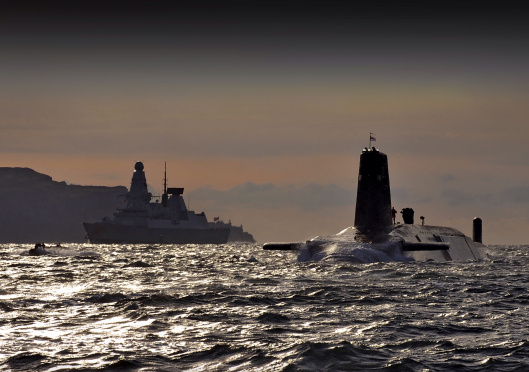
NAVAL NEWS, 15/09/2026, By Kosuke Takahashi
Speaking at a press conference on September 11, Koizumi was asked about reports that a U.S. Navy official had expressed a positive view of Japan potentially acquiring nuclear-powered submarines. While declining to comment directly on individual media reports, Koizumi said the option would be considered as part of the government’s planned revision of Japan’s three key national security documents: the National Security Strategy, National Defense Strategy and Defense Buildup Program. The three documents are expected to be revised by year-end.
As I have said before, in the course of revising the three documents, we will consider all options without ruling anything out,”
“Of course, we will also proceed with our consideration without ruling out nuclear-powered submarines as an option.”Japan’s Defense Minister Shinjiro Koizumi
Koizumi stressed that no decision had been made and that the government was not working toward a predetermined conclusion.
Asked about the strategic advantages of nuclear-powered submarines and the challenges Japan would face if it decided to acquire them, Koizumi offered one of his most detailed public assessments of SSNs to date. Speaking in general terms, he said nuclear-powered submarines can remain submerged for long periods, conduct extended operations, and are said to be capable of speeds several times higher than those of conventionally powered submarines.
“These characteristics make it possible to conduct the required activities while ensuring a higher level of safety for the crew,” Koizumi said.
At the same time, he acknowledged significant disadvantages. He said nuclear-powered submarines are said to be less quiet underwater than conventionally powered submarines. He also cited the high cost of nuclear propulsion systems, the need for larger hulls, and the specialized technical expertise required to operate, maintain, and service nuclear propulsion plants.
“In an increasingly rapidly changing security environment across various fields, we will examine the measures necessary to improve deterrence and response capabilities without ruling out any options,” Koizumi said.
U.S. Navy Official Voices Support for Japan Considering SSNs
Koizumi’s remarks came two days after a U.S. Navy official reportedly expressed a positive view of Japan considering nuclear-powered submarines.
The unnamed U.S. Navy official spoke to Japanese, South Korean, and other Asia-Pacific journalists at Joint Base Pearl Harbor-Hickam in Hawaii on September 9.
According to Japanese media reports, when asked whether Japan should consider acquiring nuclear-powered submarines, the official responded positively, pointing out that Japan operates nuclear power plants and possesses relevant nuclear technology. The same official also drew attention in South Korea by saying Seoul needed a “valid reason” for acquiring nuclear-powered submarines and warning against pursuing them merely as a “status symbol.”
Japan currently operates only conventionally powered diesel-electric submarines, but the debate over nuclear propulsion has accelerated over the past year…………………………….
Major obstacles remain, however. Nuclear-powered submarines would be far more expensive than Japan’s current conventional boats and would require an entirely new infrastructure for naval nuclear propulsion, including reactor maintenance, nuclear fuel management, and specialized personnel. There are also legal and political questions. Japan’s Atomic Energy Basic Act restricts the use of nuclear energy to peaceful purposes, raising longstanding questions about the compatibility of nuclear-powered warships with the existing legal framework.
Koizumi’s September 11 remarks do not mean Japan has decided to acquire SSNs. But his explicit statement that nuclear-powered submarines will not be excluded from consideration, combined with his detailed public assessment of their advantages and disadvantages, suggests that the issue is moving from a largely theoretical debate toward a concrete defense policy discussion. https://www.navalnews.com/naval-news/2026/09/japan-defense-minister-nuclear-powered-submarines/
Japan’s submarine debate signals break from nuclear taboos
Japan weighing nuke subs to deter China’s rising threat, but it’s not clear Tokyo has the capital, crew or capacity to keep a nuclear fleet afloat
Asia Times, by Gabriel Honrada, September 14, 2026
Japan is edging closer to a once-unthinkable choice: whether nuclear propulsion should underpin its next generation of undersea deterrence.
This month, the Japan Times reported that Japanese Defense Minister Shinjiro Koizumi confirmed that Japan is keeping the option of acquiring nuclear-powered submarines on the table, following encouraging signals from a US Navy official.
Speaking at a regular press conference, Koizumi stated that Japan will not rule out the capability as it prepares revisions to three key national security documents by year-end.
The remarks came after an unnamed US Navy official, later corroborated by the US Pacific Fleet, suggested discussions should proceed given Japan’s advanced nuclear expertise, noting that asset procurement must align with national operational needs.
The submarine debate also follows Koizumi’s July 2026 call for Japan to discuss nuclear deterrence without taboos, saying the country could no longer avoid confronting nuclear weapons policy amid its worsening security environment…………………………… https://asiatimes.com/2026/09/japans-submarine-debate-signals-break-from-nuclear-taboos/
Britain stands against oppression in Palestine… by supplying F-35s
Finian Cunningham, September 11, 2026, https://strategic-culture.su/news/2026/09/11/britain-stands-against-oppression-in-palestine-by-supplying-f-35s/
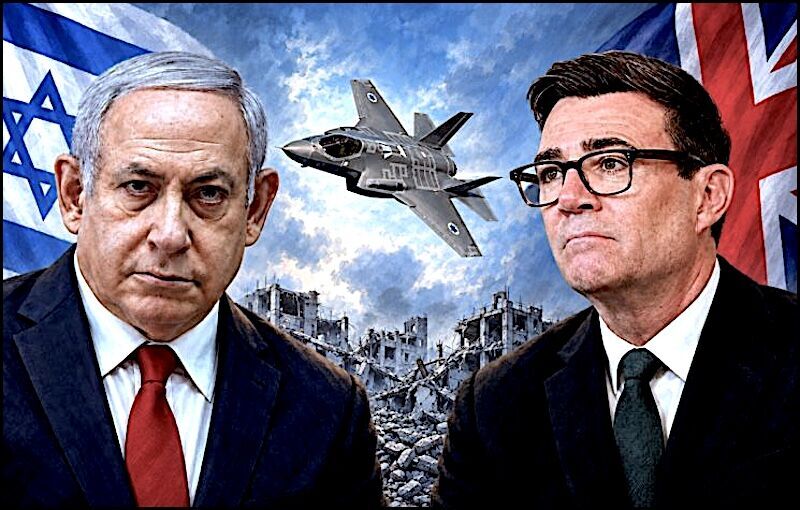
Britain is fuelling the genocide by Israel, as it is with the NATO proxy war in Ukraine against Russia.
So, Britain announced with much fanfare this week that it was imposing sanctions on Israel’s illegal settlements in Palestine. Note that the sanctions are not against the Israeli state, but rather a much narrower definition: Israeli entities in the Occupied Territories.
British Prime Minister Andy Burnham claimed that the move was an example of Britain giving international leadership to stand against oppression and injustice.
Addressing the British Parliament, Burnham said: “In this difficult and dangerous world, Britain has to stand for something, Britain has to show leadership, Britain has to stand for fairness against injustice… That is what the British people expect of us, and that is what this government will do.”
Several other European states and Canada have also joined the British-led initiative to ban trade and investment with companies doing business in the Occupied Territories of the West Bank.
Israel’s occupation is illegal under international law, yet Britain, the European Union and the United States have done nothing in the way of imposing sanctions. Sanctions are something the West prefers to impose on Russia, Iran, China, Cuba, North Korea, among others.
In announcing the sanctions, the United Kingdom’s foreign minister Ed Miliband told the House of Commons that “Britain was a country that upholds its values at home and around the world, fighting against oppression and suffering, and standing up for what is right.”
The pious tones from London about Israel’s “ethnic cleansing” are not convincing.
For starters, the supposed sanctions do not cover British components for the F-35 fighter jets that the United States sells to Israel. The British parts are crucial for flying the US-made stealth aircraft. The warplane has played a major role in razing Gaza to the ground. Also not included in the sanctions are drones and surveillance equipment that British firms supply to the Israeli military. All those components are crucial for enabling the nearly three-year genocidal violence that Israel has conducted in Gaza.
If the British government were serious about “standing against oppression,” it would go a lot further than focusing on violations by Israeli settlers in the Occupied Territories. The pogroms and construction of new settlements are carried out with the full assistance of the Israeli state, not just by gun-wielding fanatical settlers. Britain and other Western states have provided the legal and diplomatic cover for Israeli war crimes.
In any case, the supposed measures against Israeli business and exports from the West Bank are minimal. A recent Al Jazeera investigation found that Britain has billions of dollars invested in companies that are intimately involved in illegal settlement building. We can be sure that London is not going to cancel investments.
Total British-Israeli trade is estimated at $8 billion a year, including lucrative military items. The amount of business that Britain does with the Occupied Territories is about 1 per cent of its total trade with Israel.
Burnham and Miliband said the British government did not support boycott and divestment sanctions against the state of Israel. Both of them were at pains to emphasize that the measures are nominally limited to the violations going on in the Occupied Territories, not what Israel is doing right across Palestinian land, including Gaza, which is a genocide.
So there you have it. Britain’s “moral leadership” is nothing but tokenism and duplicity.
Should we expect anything else? After all, as former British diplomat Craig Murray pointed out this week, Burnham’s government has decided to give top-secret information for building cruise missiles to the corrupt Kiev regime. Murray warns that the Storm Shadow missiles will soon end up being sold on the black market, given the rampant corruption of Ukraine under the Zelensky cabal.
Britain is also supplying this NeoNazi regime with long-range drones that are being used to target Moscow and Russian civilians.
Is this standing up against oppression and for supposed British values?
What’s really behind London’s belated show of concern for Palestinians?
As Burnham and Miliband alluded, it’s all about Britain appearing to show international leadership. It’s a cheap way to burnish London’s “moral posturing” as a defender of “humanitarian values.”
Israel has hit back with the usual denunciations of “anti-semitism” and by closing down the British consulate in East Jerusalem. But for London, these repercussions are bearable for the bigger gains of British international PR.
As noted above, the lion’s share of its lucrative trade with Israel will go on, business as usual.
The other key motive for the Burnham government is that it realizes that a majority of the British public has become staunchly opposed to the Israeli regime. The three-year genocide has opened the eyes of many Britons (and those of other Western nations) to the historical injustices and illegal occupation of Palestinian lands. Israel is increasingly seen as a pariah, apartheid state that should be prosecuted for war crimes.
Britain’s role as the former colonial power in the Zionist annexation of Palestine is one of deep complicity and shame.
Andy Burnham was shoehorned into Downing Street to take over from the hopeless and hapless Labour leader Keir Starmer. The British establishment has bet on Burnham to shore up its imperialist interests by boosting military spending and deepening involvement in the NATO proxy war against Russia in Ukraine.
However, Burnham’s popularity has quickly worn off as he looks like Starmer 2.0.
The tokenistic moves to support Palestinian rights and oppose Israeli violations are a cynical electioneering ploy. By talking up sanctions against Israeli illegal settlements, Burnham is calculating that it will garner votes from the growing public anger over the genocide.
But the measures that London is taking are negligible. They amount to a polite tap on the wrist of the Netanyahu regime as it continues its genocide.
Britain is fuelling the genocide by Israel, as it is with the NATO proxy war in Ukraine against Russia. British duplicity is as legion as its hypocrisy.
Putin boosts his stock of nuclear warheads to nine-year high as he threatens West that putting troops into Ukraine ‘means war with Russia’.
Daily Mail, By WILL STEWART and WILL HALLOWELL, NEWS REPORTER, 12 September 2026
Vladimir Putin has boosted the number of nuclear warheads in his arsenal as he warns Nato countries that sending troops to Ukraine ‘means war’.
Over the past year, Russia has increased its stock of nuclear warheads deployed on missiles and bombers by 78 to 1,796, marking a nine-year high, according to the Stockholm International Peace Research Institute.
Mr Putin has increased the number every year since the beginning of the war with Ukraine in 2022.
But the US saw no rise and Britain and France did not deploy additional warheads, with 170 and 280 respectively.
Mr Putin, however, denied that Russia posed a threat to Nato allies in Europe and then warned of war.
Speaking at the BRICS summit in New Delhi, he said: ‘Now they [the West] are talking about how they are thinking about bringing troops to the territory of Ukraine. This means war with Russia.’
His threat coincides with former Russian president Dmitry Medvedev’s warning that Mr Putin could use nuclear weapons to turn Nato state Lithuania into ‘scorched earth’ and remove it from the ‘world map’.
Mr Putin, who once claimed he had no aggressive intentions against Ukraine, said he had no plan to invade or threaten existing Nato states in Europe.
He said: ‘There is no such threat, and there has never been. We are not threatening European countries, nor are we going to threaten them. Why would we?
‘No one seems to even consider that we have no grounds for any conflict with Europe.’
Yet Mr Medvedev, Mr Putin’s number two on the Russian Security Council, said the deployment of nuclear weapons in Lithuania, a former part of the Soviet Union, could trigger a doomsday response from the president.
He said: ‘They would like to amend their constitution, which stated the non-nuclear nature of this large Baltic state, and thus open the door to the possible deployment of any weapons, including nuclear weapons.
‘No one will stand up for them. Even if it becomes a scorched earth, no other [Western] countries will go to war for them.
‘And the well-known Article 5 of the North Atlantic Treaty will not be implemented, everyone recognises this……………………https://www.dailymail.com/news/article-16125435/Putin-boosts-nuclear-warheads-nine-year-high.html
Labour delays ordering new attack submarines
Government accused of ‘kicking the can’ after putting off decision on building subs to 2028
Telegraph Pieter Snepvangers Political Reporter. Tony Diver Political Editor, 2 September 2026
Labour has delayed ordering new attack submarines until 2028, The Telegraph
can reveal. Sir Keir Starmer pledged last year to build “up to 12”
nuclear-powered submarines. He said Labour would decide how many vessels to
commission by the time its defence investment plan (DIP) was published.
Despite finally releasing the delayed DIP in June, the Government has
deferred its deadline for committing to buying the subs until 2028, The
Telegraph has learnt. Wes Streeting, the Defence Secretary, wrote to James
Cartlidge, his Conservative shadow: “The DIP clearly sets out our
intention to buy up to 12 SSN-A submarines, but a decision on exact hull
numbers does not need to be taken at this stage. “The programme is
currently midway through its design phase and we anticipate that the number
of submarines will be confirmed before the end of this phase in 2028.”………………………………………………….
https://www.telegraph.co.uk/politics/2026/09/12/labour-delays-buying-new-attack-submarines/
The Shift: 25 years After 9/11, Our Country Is Still Dominated By The “War On Terror”
September 12, 2026, Mondoweiss,
This week marks the 25th anniversary of the 9/11 attacks.
The United States has experienced much political and social upheaval since then, but the subsequent “War on Terror” paved the way for our current moment, and there are booming echoes of the era all around us.
Once again, the United States is waging a disastrous war in the Middle East with no discernible end in sight. Islamophobic rallies targeting NYC Mayor Zohran Mamdani conjure up memories of the “Ground Zero Mosque” controversy. The government designates activist and advocacy organizations as terrorists. The Guantánamo Bay detention camp remains open. In fact, a legal immigrant was just sent there.
CBS reveals that the Taliban seized roughly $7 billion worth of American-purchased military hardware after the United States officially lost that war 5 years ago.
“Taliban fighters patrol in armored vehicles once supplied to Afghan forces, wearing American tactical gear and carrying American weapons,” reads the report. “CBS News saw one Humvee in the Afghan capital still adorned with a faded Green Bay Packers decal — a remnant from its past operators.”
The small number of Americans who opposed that war were either dismissed or attacked. So too were those who warned that the Bush administration’s overreach would result in disaster.
“The civil libertarians were mostly ignored, and as one new threat followed another — Iraq, ISIS, ‘lone wolves’ — the president’s reach continued to grow. Across the Bush and Obama administrations, the commander in chief was given, or simply took, new powers to prosecute, shut down and seize the assets of alleged terrorist groups and their supporters,” writes Radley Balko in the New York Times. “With the arrival of armed drones, the president assumed the right to remotely assassinate anyone, anywhere outside U.S. borders, at any time, including American citizens.”
“If the ratcheting diminishment of our liberties came slowly and sometimes without much outcry under Presidents Bush, Obama and Joe Biden, the consequences of all those years of expanded presidential power are plainly visible now,” he continues. “Mr. Trump is using every authority we have given the president since Sept. 11, 2001, and some we haven’t, in ways the civil libertarians had tried to warn us about at the start.”
One of the major differences between the current war on Iran and Bush’s war on Iraq is that a sizable chunk of the population fell for the administration’s lies back then. The polling shows that’s not the case this time around, and, despite information from the region being consistently repressed, there seems to be a growing understanding that the United States military is losing quite badly………………………………………………………………………………………………………………………..https://mondoweiss.net/2026/09/the-shift-25-years-after-9-11-our-country-is-still-dominated-by-the-war-on-terror/
Trump Is Planning Round Three of the US-Israeli War Against Iran — But Will Tehran Strike First?
In conversation with Trita Parsi, Executive Vice President of the Quincy Institute
Ian Proud, Sep 11, 2026, https://thepeacemonger.substack.com/p/trump-is-planning-round-three-of?utm_source=post-email-title&publication_id=3221990&post_id=215182894&utm_campaign=email-post-title&isFreemail=true&r=1ise1&triedRedirect=true&utm_medium=email
This conversation with Trita Parsi, Executive Vice President of the Quincy Institute for Responsible Statecraft, was recorded before President Trump promised Americans $5,000 if he wins the midterms. That pledge does not change the argument. It sharpens it. With round three of the US-Israeli war against Iran looming, the big question is who will strike first?
Trita argues that the slow military escalation and economic warfare now under way are not the third round of the war against Iran. They are the preparation for it.
In his view, the United States and Israel are planning a much larger campaign after November. Trump believes he has already tried diplomacy, sanctions and what might generously be called limited war. What he has not tried is the menu of threats he issued and then abandoned: taking an island, striking desalination plants, hitting critical infrastructure.
After the midterms, Trita fears, that is the direction he will go. Israel is likely to be part of it. Washington kept the Israelis out of round two because it did not trust them to stay inside the box. If the United States no longer wants a box, Trump and Netanyahu may have another crack, despite prior efforts having proved a catastrophic failure.
That, Trita argues, is why Iran is hitting American bases in Jordan. Those sites matter because they help shoot down missiles bound for Israel. Tehran is clearing the path so that, when round three comes, more of its missiles get through.
The obvious objection is that Trump may emerge from the midterms a bruised lame duck. Trita does not think that restrains him. American institutions, he says, are weaker now than ever before. Congress has shown no appetite to defund the war. A Democratic House, and perhaps a Democratic Senate, would mean impeachment of Trump and a president playing defence at home.
However, that is when Trump has been most reckless before. After he lost to Biden in 2020, Mark Milley later said his fear was that Trump would look for an Iran war to block a peaceful transfer of power. He did not get that war. He got 6 January instead. Humiliation makes Trump dangerous, rather than cautious.
But the problem is that Tehran understands this and can see how critical the midterms will be to Trump’s power in the second half of his term. Trita therefore thinks there is a high likelihood that Iran starts the third round of the war a week or two before the midterms, to inflict the maximum political cost on Trump.
That may well damage Trump at the polls. But it may also leave him with fewer constraints and a taste for risk.
The escalation trap is now familiar. Washington reads every tactical gain — more oil leaving the Gulf, a weaker Iranian economy — as proof that time is on its side.
Trita’s warning is the opposite. If the squeeze actually works, Iran will not crumble. It will escalate. It has the options which it is demonstrating daily. Even if Iran fully reopened the Strait of Hormuz, the United States would not lift the blockade. The key demand on the American side has ratcheted up to state collapse, which appears no more likely to happen now than in February.
The Pentagon talks of bombing Iran periodically to degrade its ability to close the Strait. That is not a strategy, but rather “mowing the lawn”.
Yet, no one will be able to sell this war as a victory if in practice it means an on-off air campaign and no diplomacy as the world economy sinks further into depression. Which brings us back to the midterms and the fact that Trump may find that, despite the inducement of a $5000 bribe, many Americans will realise that what they need is a new lawnmower.
You can watch the full conversation here:
You can find Trita’s analysis on his Substack: tritaparsi.substack.com.
Wherever you are in the world, whatever your nationality and religion, I wish you much peace.
US turning Australia into military base
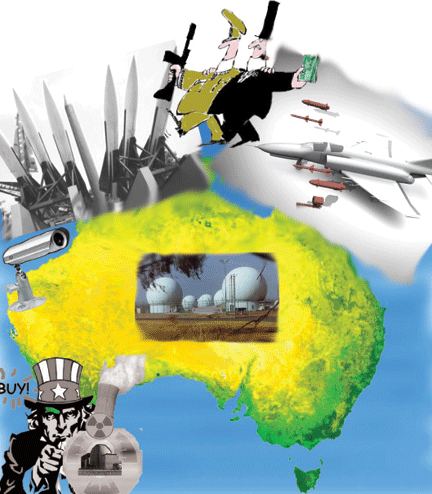
“Over more than a decade, the United States has been preparing the capacity for high-tempo warfighting operations with China, springboarding from Australia. From a Chinese perspective, Australia is not so much hosting US bases on its territory, it’s a US base in its own right… Australia is a serious piece of real estate in the US warfighting machine.”
Wed, 09 Sep 2026 , https://www.sott.net/article/508329-US-turning-Australia-into-military-base-Guardian
USA • Australia military eventThe US is turning Australia into a forward base for potential military operations in the Pacific, with American forces and defense contractors controlling or having access to roughly two-thirds of the country’s military facilities,The Guardian reported on Sunday.
Citing data compiled by the Nautilus Institute for Security and Sustainability, the newspaper identified 110 facilities across Australia with some form of US military or corporate presence out of 168 surveyed.
The US military directly controls 17 facilities, including the Pine Gap intelligence complex in central Australia, which plays a major role in US surveillance and military operations. The facility tracks missile launches, intercepts communications and provides targeting information for American forces around the world.
Other installations include a naval communications station in Western Australia used to communicate with submerged US submarines and RAAF Base Tindal in the north, which is being expanded to accommodate nuclear-capableB-52 Stratofortress bombers.
The Guardian wrote:
“These aircraft are able to land on Australian soil carrying nuclear weapons. The US government won’t tell Australia if and when they are. The Australian government won’t ask.”
Beyond the facilities it directly controls, the US military has access to dozens of Australian installations, while American defense contractors, including Lockheed Martin and Northrop Grumman, operate at others. According to the Nautilus data, 41 of the 168 facilities surveyed have no significant US presence, while the status of another 17 remains unresolved.
The American footprint is also expanding. In June, AFP reported that the US was preparing to establish a permanent stockpile of battle-ready weapons, ammunition, and equipment for the Marine Corps in Australia, with the facility expected to reach full capacity by 2028.
An honorary professorial fellow at the University of Melbourne, Richard Tanter, the author of the Nautilus database, told The Guardian:
“Over more than a decade, the United States has been preparing the capacity for high-tempo warfighting operations with China, springboarding from Australia. From a Chinese perspective, Australia is not so much hosting US bases on its territory, it’s a US base in its own right… Australia is a serious piece of real estate in the US warfighting machine.”
Canberra maintains that the growing American presence strengthens Australia’s security.Defense Minister Richard Marles said in June that the expanding US footprint was important both for building the country’s military capabilities and for its national security.
Marles also argued that the US presence helped counter what he described as China’s “very significant military buildup” in the region.
Former Australian Defense Minister Christopher Pyne has similarly said the 2021 AUKUS pact between Australia, the US, and UK goes beyond Canberra’s acquisition of nuclear-powered submarines. He described the arrangement as establishing “a new United States submarine base in the Indian Ocean” that would provide Washington with a “massive strategic advantage.”
Tanter criticized Canberra’s approach, calling it:
“A massive institutional failure in Australia, a kind of learned incapacity at a political, parliamentary and bureaucratic level.”
Comment: Tanter is right: Trust and comfort never convey the total picture, nor be they the appropriate guardians of sovereign control.
First nuclear-capable B-52s deploy to Australia

By Bill Gertz – The Washington Times – Thursday, September 10, 2026
A task force of nuclear-capable B-52 bombers has deployed for the first time to Australia in a show of regional force located to the south of China.
The bombers arrived last week at an upgraded Royal Australian Air Force Base Tindal. Local reports called it a new era in Australia’s military alliance with the U.S.
A Pacific Air Forces spokesman confirmed to Inside the Ring that the bomber task force is underway Down Under………….
The exact number of the strategic bombers from the 2nd Bomber Wing at Barksdale Air Force Base, Louisiana, was not disclosed. Most task forces include up to six B-52s.
An Air Force photo of the deployment stated in a caption that the bombers arrived Sept. 1. “Operating from RAAF Base Tindal marks our ability to project, sustain, and regenerate decisive airpower across an expanding extended network,” the caption stated.
The long-range bombers can deliver nuclear bombs or conventional precision-guided weapons.
The Tindal base has been upgraded with new hangars and ramps for the bombers. It is located in northern Australia about 200 miles south of the northernmost coastal city of Darwin and about 2,000 miles from the tense South China Sea.
The base also hosts Australian F-35 stealth jets and MQ-4C Triton surveillance drones.
Currently, U.S. Marines are based in Darwin and a submarine rotational force was set up near Perth, with about 1,000 Navy personnel set to deploy in support of Virginia-class submarine deployment. https://www.washingtontimes.com/news/2026/sep/10/first-nuclear-capable-b-52s-deploy-australia/
A worthy 9/11 remembrance – Walt Zlotow
11 September 2026 AIMN Editorial, Walt Zlotow, West Suburban Peace Coalition Glen Ellyn IL, https://theaimn.net/a-worthy-9-11-remembrance/
On the 25th 9/11 anniversary we should also ponder victims and cost of America’s War on Terror – designed and implemented to reshape the Middle East in America’s image in response to and revenge for the attacks.
Estimates from the Brown University Costs of War project place the toll at 4.5–4.7 million people since 2001, including ~940,000 direct deaths (combatants, civilians, journalists, aid workers) and 3.6–3.8 million indirect deaths from disease, malnutrition, and health complications.
U.S. military and contractor deaths: About 7,074 U.S. military deaths and 8,189 contractor deaths
Costs according to warcosts.org
Total cost: $8+ trillion since 2001
Breakdown:
- Direct military operations: ~$3.2 trillion.
- Pentagon budget increases: ~$1.8 trillion.
- Veterans care (projected through 2050+): ~$2.2 trillion.
- Homeland Security expansion: ~$1.1 trillion.
- Interest on war debt: ~$1.1 trillion
On 9/11 Remembrance Day Americans should urge its government to turn away from senseless war whether it be against Iran, Venezuela, Somalia, Yemen, Nigeria, Cuba, little unarmed boats plying the Caribbean or other locals we’re not informed of. That would be a noble way to honor the victims of the senseless violence perpetrated on America 25 years ago today.
Iran Targets US Warships With New Precision Munitions As Shock Offensive Rocks The ‘Greater Israel’
Robert Inlakesh MintPress News, September 10, 2026, https://scheerpost.com/2026/09/10/iran-targets-us-warships-with-new-precision-munitions-as-shock-offensive-rocks-the-greater-israel/
Iran launches newly acquired precision missiles towards US warships in the Persian Gulf as the Trump administration’s ‘Economic D-Day’ backfires tremendously. In this Monday’s episode of The Target Stream Mint Press News’ Robert Inlakesh takes a look at the latest developments reshaping the US-Israeli war on the Islamic Republic.
Tel Aviv has raised its level of alert anticipating a potential surprise attack during the Jewish holiday period of Yom Kippur, fearing that Tehran may have in store a major multi-front offensive in the coming month. Whether the fears of a large-scale missile attack are based upon dependable intelligence or not, the Israelis have decided to escalate the war on neighbouring Lebanon regardless.
The Israeli army recently claimed that it had secured full “operational control” over the strategically important Ali Al-Taher Hills area in southern Lebanon, without providing any proof that such control has in fact been established. Seemingly contradicting their claims, they have continued to launch hundreds of strikes against the Ali Al-Taher hills and its surrounding area, which is of military value due to its position overlooking southern Lebanon’s Nabatieh governorate. An advance of this magnitude, which includes an attempt to dismantle a known missile base there, constitutes yet another flagrant violation of the shaky Lebanon ceasefire.
Meanwhile, Hezbollah has occasionally launched drone operations against Israeli soldiers and military vehicles, while holding itself back from reviving its daily operations against the occupying army.
On this edition of the stream we also look at the decision taken by the Ansarallah-led Yemeni government to launch new offensive actions to capture strategic locations towards the south of the country. The offensive led to major breakthroughs, including the encircling of the city of Taiz. In reaction, Saudi-proxy forces unsuccessfully launched their own counter-offensives in a bid to capture new territory in the province of al-Jawf and towards the city of Bayda.
Inlakesh also analyses the latest battle footage from Yemen, including new video documentation of the Yemeni Armed Forces using anti-personnel munitions dropped from Quadcopter drones and precision missile strikes, one of which eliminated an entire convoy of trucks carrying munitions.
Iran’s Islamic Revolutionary Guard Corps (IRGC) also released footage of its missile strikes against US targets and for the first time drone strike documentation against tankers in the Strait of Hormuz. All of this contributes to the continued spike in oil prices, which US President Donald Trump has continually stated will begin falling.
Another issue addressed at length in the newest edition of The Target is the viral debate ongoing with Streamer Sneako, on whose show a number of guests have argued that former Syrian President Bashar al-Assad is responsible for more civilian deaths than Israeli Prime Minister Benjamin Netanyahu. We look at what the figures actually show and why so many people are engaged in spreading disinformation that works to undermine the Gaza genocide.
1 This Month
23-25 October – on Zoom – World BEYOND War’s annual global conferenc


Shut down the radiation-damaged Heysham nuclear reactors now
To see nuclear-related stories in greater depth and intensity – go to https://nuclearinformation.wordpress.com

Say No to NASA’s Reckless Nuclear Reactor on the Moon
Say No to NASA’s Reckless Nuclear Reactor on the Moon

-
Archives
- October 2026 (247)
- September 2026 (339)
- August 2026 (330)
- July 2026 (355)
- June 2026 (287)
- May 2026 (306)
- April 2026 (356)
- March 2026 (251)
- February 2026 (267)
- January 2026 (308)
- December 2025 (358)
- November 2025 (359)
-
Categories
- 1
- 1 NUCLEAR ISSUES
- business and costs
- climate change
- culture and arts
- ENERGY
- environment
- health
- history
- indigenous issues
- Legal
- marketing of nuclear
- media
- opposition to nuclear
- PERSONAL STORIES
- politics
- politics international
- Religion and ethics
- safety
- secrets,lies and civil liberties
- spinbuster
- technology
- Uranium
- wastes
- weapons and war
- Women
- 2 WORLD
- ACTION
- AFRICA
- Atrocities
- AUSTRALIA
- Christina's notes
- Christina's themes
- culture and arts
- Events
- Fuk 2022
- Fuk 2023
- Fukushima 2017
- Fukushima 2018
- fukushima 2019
- Fukushima 2020
- Fukushima 2021
- general
- global warming
- Humour (God we need it)
- Nuclear
- RARE EARTHS
- Reference
- resources – print
- Resources -audiovicual
- Weekly Newsletter
- World
- World Nuclear
- YouTube
-
RSS
Entries RSS
Comments RSS

