US to NATO: Keep buying US weapons for lost Ukraine war…it gooses our economy- Walt Zlotow

But not one weapon will be supplied by the US. They must all be purchased by NATO countries struggling with their declining economies due in large part by squandering tens of billion of Euros on Ukaine sinking deeping into failed state status.
Walt Zlotow West Suburban Peace Coalition Glen Ellyn IL, Sep 9, 2026,
If there was a Nobel Prize for the most most cynical foreign posicy among the world’s 193 countries, the US would win weapons down.
Under Secretary of War Elbridge Colby just told European NATO countries to keep buying US weapos to keep Ukraine being destroyed in their lost war with Riussia.
“The situation makes it all the more important for Europe to sustain support for Ukraine while also accelerating its own rearmament and reindustrialization. First, Europe must continue — and where necessary increase — support for Ukraine’s immediate battlefield requirements through Prioritized Ukraine Requirements List (PURL). The continued flow of munitions and critical capabilities is effective; it remains essential to enabling Ukrainian forces to hold the front line and deny further Russian advances. Second, Europe must plan now for sustained procurement that supports both Ukraine’s long-term force reconstitution and Europe’s own defense requirements.” Colby omitted that NATO weapons purchases fit neatly into US economic policy.
But not one weapon will be supplied by the US. They must all be purchased by NATO countries struggling with their declining economies due in large part by squandering tens of billion of Euros on Ukaine sinking deeping into failed state status. The fact Ukraine has suffered over over two million causualties and lost a fifth of their land forever means nothing to Colby and his bosses War Secretary Pete Hegseth and President Trump. All they care about is how those billions in weapons sales will help salvage the declining US economy from Trump and Hegseth’s failed Iran war debacle ahead of the approaching November 3 midterms.
Trump has been lusting for a Nobel Peace Prize since hie took office in January 2017. He’s been tirelessly promoting his candidacy claiming he’s ended 8 wars when he’s ended none while waging war on Iran, Venezuela, Yemen, Somalia, Nigeria and any small boat in the Caribbean he claims is carrying drugs.
Yep, the Nobel Committee should consider awarding a Nobel Cynical Foreign Policy Prize. Donald Trump, on behalf of the United States would be selected unanimously.
Israeli war minister orders army to prepare for ‘all-out war’ on Palestinian Authority
Monday, 07 September 2026 , https://www.presstv.co.uk/Detail/2026/09/07/775858/Israeli-military-ordered-to-prepare-for–all-out-war–on-Palestinian-Authority
Israeli minister of military affairs Israel Katz says he and prime minister Benjamin Netanyahu have ordered the occupation army to prepare for an “all-out war” in the occupied West Bank.
Katz said on Monday that the offensive would be launched if Israel determines that Palestinian Authority (PA) security forces or groups affiliated with them are planning an attack similar to Operation Al-Aqsa Flood – the operation carried out by Gaza-based resistance groups on October 7, 2023.
Under the proposed plan, Israel would target senior PA officials, the Palestinian Authority’s security apparatus, and resistance infrastructure across the territory.
The assault could include targeted killings and the forced evacuation of residents from cities and villages in the occupied West Bank, “just as we did” in Gaza and southern Lebanon, where the Israeli military has flattened large areas and driven people from their homes.
“If the security apparatuses of the Palestinian Authority and the bodies associated with them launch, or we know for certain that they are about to launch, an October 7-style attack against forces and Jewish settlements, Prime Minister Benjamin Netanyahu and I instructed the army to prepare to launch an all-out war against senior officials and mechanisms of the [Palestinian] Authority, the bodies associated with them, and against all infrastructure in Judea and Samaria [the occupied West Bank] — in order to quickly bring about their complete defeat,” Katz threatened.
“We will not allow for a return to a reality of a continued intifada spanning years, as was the case in the past,” the Israeli war minister added.
The threat followed an incident on Monday morning in which a Palestinian reportedly stabbed an Israeli settler, about 20 years old, at a farming outpost in the occupied West Bank. Israeli troops later shot the Palestinian man dead after claiming he tried to stab them during a manhunt.
Hebrew-language media reported that the settler was stabbed at the Maoz Yehuda settlement farm near the village of Usarin in the northern West Bank and was wounded in the chest, back, and shoulders.
Hamas condemns surge in settler violence
The Gaza-based Hamas resistance movement condemned the sharp rise in settler attacks on Palestinians in the occupied West Bank, assaults carried out with the protection and backing of Israeli occupation forces.
“This is part of a systematic policy that targets our people and homeland, and intends to materialize annexation, forced displacement, and ethnic cleansing in the territory. This necessitates serious and effective action at all levels to put an end to such crimes, and hold the perpetrators to account,” Hamas said in a statement.
Hamas stressed that the blood of fallen resistance fighters will never be in vain, and that rising settler violence will not break the will of Palestinians or drive them from their ancestral land.
“Rather, it will strengthen their commitment to their rights. It will consolidate their resolve in the face of the occupying regime’s settlement and displacement plans,” the statement said.
Hamas called on Palestinians from all walks of life in the West Bank to confront Israeli military and settler attacks, protect their lands and properties, block plans for displacement, settlement expansion, and annexation, and defend their homeland and national rights.
About 750,000 Israeli settlers live in 156 illegal settlements and 360 settlement outposts in the occupied West Bank, including East al-Quds. They routinely carry out attacks aimed at forcibly displacing Palestinians, according to Palestinian figures.
The international community regards these settlements as illegal under international law and the Geneva Conventions because they are built on occupied land. The UN Security Council has condemned Israel’s settlement activity in several resolutions.
In July 2024, the International Court of Justice declared Israel’s decades-long occupation of historical Palestine illegal and demanded the evacuation of all existing settlements in the West Bank and East al-Quds. Those rulings, like so many before them, have remained mere words.
Israel’s Quadcopter Drones Have Become a Weapon of Everyday Killing in Gaza
September 9, 2026, By Malak Hijazi & Ohood Nassar, https://scheerpost.com/2026/09/09/israels-quadcopter-drones-have-become-a-weapon-of-everyday-killing-in-gaza/
No space, either on land or in water, sits outside the drones’ reach. The siege tightens by the day.
Sadeq Abdelhafiz, 26, noticed an unusual quiet around him as he stood in the Shujaiya neighborhood of Gaza near the cemetery on Salah al-Din Street. A small quadcopter drone (about the size of a floor tile) had fired a volley of bullets just minutes earlier, and it was still there, hovering over the minaret of the nearby Ibn Marwan Mosque, adjacent to the cemetery.
Abdelhafiz turned his head to see his friend Mustafa Mushtaha leaning against a tree. At first, he thought Mushtaha was tired from walking, or taking shelter out of fear. Then he realized his friend had been shot.
Abdelhafiz and Mushtaha had traveled to the cemetery on June 10, 2025, along with members of Mushtaha’s family and friends, to bury Mushtaha’s sisters, who had been killed in an Israeli strike days earlier. However, when they reached the cemetery, they found the Israeli quadcopter hovering above them.
They never expected it would open fire.
“We were only doing the burial, and it was obvious,” Abdelhafiz told Truthout. After they placed both of his sisters in a single grave due to the lack of space, the quadcopter started firing randomly at them. “We buried them quickly, in a rush, without any order,” Abdelhafiz said.
Abdelhafiz suggested leaving the cemetery separately, since the graves left only a narrow gap, barely enough for one person to pass. “Mustafa was behind me, five steps away. I could hear his footsteps, until I couldn’t,” Abdelhafiz said. Then he heard him say, “I feel a sharp stab in my back.” Abdelhafiz, with Mushtaha’s brother and uncle, carried him toward the exit as the quadcopter fired again. When he took off Mushtaha’s shirt, he found a bullet wound in his back.
By chance, a Palestinian Ministry of Health service vehicle was passing them. It was transporting employees but lacked first-aid supplies. They placed Mushtaha inside, and Abdelhafiz put his hand on his neck to check if he was breathing. Abdelhafiz told me, “I felt he had passed away while we were in the car.” When they arrived at Al-Ahli Arab Hospital, they brought Mushtaha into an emergency tent already overwhelmed with more than 100 wounded people. The doctor tried to give him first aid, but it was in vain: Mushtaha had already died.
The small drone that took Mushtaha’s life is part of an Israeli strategy to pull warfare down into the intimacy of everyday space.
A Killing Machine That Israeli Officials Say Is “Like a Video Game”
Quadcopters are small, multi-rotor tactical drones. According to Euro-Med Human Rights Monitor, Israel deploys two models of armed quadcopters: the Matrice 600, which was originally designed for civilian use before being converted into a tool for surveillance and lethal strikes, and the Lanius, a purpose-built AI-powered military drone. Zeteo further reported that Israel appears to be the first military in the world to deploy an armed quadcopter in actual combat.
While the term “quadcopter” is now deeply ingrained in daily life in Gaza, associated with sudden bursts of gunfire through alleyways and windows, Israel’s usage of these armed drones began before October 7, 2023.
The technology first became familiar to Palestinians in Gaza during the 2018 Great March of Return, when Israeli forces, including reservists activated as drone pilots, used the DJI Matrice 600 model to drop tear gas canisters on unarmed demonstrators, causing severe injuries.
By 2019, some quadcopter models were adapted for targeted assassinations, as in the killing of Islamic Jihad commander Baha Abu al-Ata. Three years later, in November 2022, the Israeli defense company Elbit Systems publicly unveiled Lanius, a palm-sized drone built for autonomous navigation and close-quarters strikes.
However, when Israel launched its assault on Gaza following the October 7, 2023, attack, these armed quadcopters moved from limited, targeted use, to broad deployment across the Strip.
Their use has intensified for multiple purposes: surveillance, issuing displacement directives, injuring, and killing. The drones have reportedly employed the tactic of terrorizing civilians with recorded sounds of crying infants, screaming women, and barking dogs to lure them into the open before opening fire.
Israeli security officials, speaking on Channel 14, confirmed the use of what they called “a new generation of lethal weapons.” They added that a quadcopter “does not hesitate, does not stop, and almost never makes mistakes,” comparing its operation to “watching a video game.”
Quadcopters Target Children
Children have paid a particular price as quadcopters have become more widespread. On August 12, 2026, despite the declared ceasefire, a quadcopter attack in Khan Younis wounded a father and critically wounded his 13-year-old son as they walked home after buying falafel. The father described a blast that scattered everyone nearby. He found his son on the ground, bleeding from shrapnel wounds to the head and leg.
A month earlier, on July 3, 2026, a quadcopter dropped a bomb on two children from the Tawtah family as they filled water containers behind Al-Omari Mosque, east of Gaza City. One child was killed and the other wounded.
The pattern repeats in hospital wards across Gaza. A report by the Costs of War project at Brown University documented 18 cases in a single month, from August to September 2024, of children admitted with single, small-caliber gunshot wounds to the head, neck, chest, or abdomen. In 90 percent of cases, families reported the children had been shot directly by quadcopter drones.
Sometimes the evidence comes from the perpetrators themselves. In May 2026, an Israeli soldier from the Kfir Brigade posted a video on his private Instagram account: a quadcopter firing upon two barefoot Palestinian children in Gaza. The children appear to survive a strike, but the video does not reveal their ultimate fate. A UN commission of inquiry later found that the Kfir brigade killed two brothers, aged 9 and 10, in a drone strike as they gathered firewood, more than 300 meters from any soldiers.
Enforcing the Siege
Today, these drones also serve as the primary enforcement mechanism of the so-called Yellow Line, a boundary originally marked by yellow blocks to delineate zones for expected Israeli withdrawal under the October 2025 ceasefire terms. But instead of receding, the line has expanded.
According to OCHA, the “Yellow Line” initially restricted Palestinians’ access to about 53 percent of Gaza after the October 2025 so-called ceasefire. Israel later introduced a further “Orange Line,” extending tighter restrictions to 64.9 percent of the Strip by June 2026, crowding more than 2 million people into a shrinking space. Quadcopters enforce these invisible boundaries, hovering over anyone who moves near them and blocking displaced people from returning home.
Israeli officials have given no indication this will change. On August 9, 2026, Netanyahu rejected the Board of Peace’s 15-point plan, declaring Israeli forces would not withdraw until Hamas is disarmed. With no mechanism to inform residents when the line advances, many Palestinians wake to find their area has fallen under fire overnight.
The threat is not confined to land. On August 14, 2026, Israeli naval boats and quadcopter drones opened fire on a fishing boat west of Gaza City, wounding three fishermen. No space, neither on land nor in water, sits outside the drones’ reach, drawing the siege tighter by the day.
Silencing the Witnesses
Journalists trying to document these killings have themselves become targets. Iman Al-Ajla, a 24-year-old Gaza-based journalist who has survived multiple drone attacks, told Truthout how these weapons are turned directly against media workers on the ground.
In October 2025, after refusing to displace south and remaining in Gaza City, Al-Ajla went alongside six fellow journalists to Al-Shifa Hospital to document an Israeli strike. As they arrived, a quadcopter opened fire directly at the group. “They shot at us to prevent us from documenting the truth,” she recalled.
Months later, in early July 2026, Al-Ajla faced the drones again while covering the advance of the Yellow Line in eastern Shujaiya alongside two photojournalists.
“We fled the area immediately and saw the gunfire strike the tents, injuring dozens inside,” Al-Ajla told Truthout. “It was a horrific situation, made worse by the fact that it happened during a declared ceasefire. We later saw serious injuries coming to the hospital after that same shooting.”
Iman’s experience is only one fragment of a far wider toll. The number of people killed in Gaza continues to rise despite the declared ceasefire, now exceeding 73,000 — roughly 3.4 percent of the Strip’s pre-war population of 2.1 million — a figure that does not include the more than 174,000 wounded. The quadcopter has been a central tool in this relentless campaign. It does not hesitate. Neither, it seems, does the impunity that follows it.
On European hypocrisy and warmongering
Not only is the idea of an endless war immoral, but it plays with an immense risk of nuclear escalation.
Branko Milanovic, Aug 27, 2026, https://branko2f7.substack.com/p/on-european-hypocrisy-and-warmongering
When Russia invaded Ukraine in February 2022, the world reactions were predictable. The strongest reaction came from the United States, that saw itself as a guardian of the old system and possibly as a guarantor of Ukraine’s NATO eventual membership. Europe’s reaction was several octavos lower as it generally was during the Cold War. Finally, the rest of the world, while mostly condemning Russia for an obvious violation of the international law and UN rules, was not overly concerned.
Things have changed. They began changing already under Biden who, while very critical of Russia, including through the imposition of the most radical sanctions ever (with the seizure of private property and property of a government with which the United States was not at war), still observed some rules from the Cold War—namely avoidance of unnecessary escalations with a nuclear-armed power. This was evident in Biden’s policy that did not allow strikes on Russian territory. But even under Biden that policy was gradually abandoned and the US de facto entered the war through its selection and direct targeting of places in Russia.
Over the past two years, the situation has further evolved. The US has continued with a policy where it is a de facto participant in the war but has also shown a desire to wrap-up the conflict in one form or another. What was surprising is that the thirst for war has become almost insatiable in several European countries, principally in the Nordic and Baltic countries, but more recently also in Germany, and, for long-term historical reasons that go to the 18th century, in the UK too.
The role of small countries—that through their geopolitical irresponsibility can wreck great damage to the world—tends to pass under the radar. The Nordic-Baltic coalition is essentially calling for a war with Russia, citing its own fears and traumas of Russian/Soviet control and occupation. Leaving aside the discussion about the full one-sidedness of such claims (could not Russians argue that the Latvian riflemen played a key role in the Russian revolution?), this type of warmongering by small nations is extraordinarily hypocritical. It is based on the idea that one can advocate for war but bear no consequence of such a war. It tries to do everything possible to make interests of great powers become entangled with interests of small powers so that great powers can fight it out, millions die, yet the objectives of small countries be satisfied after a general war.
This attitude is bad enough in itself—but what is worse is that there are clear historical precedents in Eastern Europe and the Middle East of similar policies that brought global cataclysms. Serbia was playing off Russia in the run-up to the First World War. Poland and Hungary participated in the dismemberment of Czechoslovakia which paved the way for Nazi Germany to continue with aggressions. Israel has been playing up the United States for several decades in the Middle East, most obviously right now when the US entered the war against Iran –very similarly to the way Russia entered the war against Ukraine—without knowing why, or what are the political aims of that war. But the outcome arranges Israel because it weakens another Middle Eastern power and deepens the chaos in the region.
The world is now facing a similar situation where several countries, whose combined populations hardly reach the number of inhabitants of a Tier II Chinese city, want, in order to cure their frustrations and traumas, to plunge the entire world into a catastrophe that may more or less end civilization. It is an incredibly irresponsible policy. It is also hypocritical because it is based on the assumption that somebody else (in this case, the United States) will fight for them. For if they were so keen on the war and convinced of its moral value, why don’t enter it themselves? Why don’t they attack Russia directly and see what happens? It would be madness but at least it would not be irresponsible towards the rest of the world and not hypocritical.
Of course, the argument for a war (fought by somebody else) is that accepting to speak of a ceasefire along the current lines gives the advantage to the aggressor. But according to that logic, all wars should be fought until the end, until everybody is destroyed. There should never have been any negotiations. Diplomacy should not exist. The Korean war should be still fought—in fact, it probably would not because had the policies advocated by the Nordic-Baltic alliance been followed then (as McArthur wanted), we would have never been born and our parents or grandparents would have all died long ago.
The Nordic-Baltic alliance also forgets that if the cease-fire is established along the current lines of control, the territory of the Donbass etc. will indeed be controlled by Russia but no single country in the world would officially recognize it. Did they not notice that no country from the Commonwealth of Independent States has recognized it? Did they not notice that not even Belarus recognizes it? Such, indeed fragile, peace not only puts an end to today’s carnage, but leaves open a possibility of eventual long-term solution between Russia and Ukraine. Neither Putin, nor Zelensky, nor the social forces that support them are eternal. Things will change in Russia, and in Ukraine. Negotiations can take place in ten or twenty years—but at least people would be alive rather than dead.
They mention that it would lead to a “frozen conflict”. But is a frozen conflict worse than an open conflict? Is absence of death inferior to continued carnage? There are dozens of frozen conflicts all around the globe, from Cyprus to Kosovo to Western Sahara to Malvinas to Kashmir. Should we reopen them all? They are loath to answer the moral questions because the implicit value they place on Ukrainian lives is zero, and the implicit value they place on Russian dead is a plus. Consequently, an endless conflict is a positive sum game from their point of view.
Not only is the idea of an endless war immoral, but it plays with an immense risk of nuclear escalation. During the Cold War that risk was taken seriously by the two major powers. That’s why they had four binding nuclear agreements, all of which have lapsed. Today, people assume that nuclear weapons do not exist. This is an entirely invalid assumption, but even if there were just one-millionth probability of nuclear war happening, the costs of such a war are so immense (since such a war is uncontrollable), that every rational person’s calculation must be to do everything to avoid it.
The Nordic-Baltic warmongering under the current conditions is therefore (i) irresponsible, (ii) hypocritical, (iii) immoral, and (iv) flirts with a disaster of immense proportions.
France’s 47 Rafale F5s Will Carry Hypersonic Nuclear Missiles, Command Stealth Drones
France is preparing at least 47 Rafale F5 fighters to carry the ASN4G hypersonic nuclear missile, command stealth combat drones and penetrate advanced air defences by 2035.
(DEFENCE SECURITY ASIA Sep 7, 2026) — France plans to field at least 47 Rafale F5 fighters by 2035, creating a nuclear-certified combat fleet designed to penetrate advanced air defences, command stealth drones, and preserve sovereign strike options as Europe’s future airpower architecture fractures.
The programme converts Rafale from a networked 4.5-generation fighter into an airborne command node integrating the ASN4G hypersonic nuclear missile, enhanced sensors, digital electronic warfare, resilient connectivity, and manned-unmanned teaming for contested operations through the 2040s.
Under the revised 2024–2030 Military Programming Law adopted in July 2026, France targets at least 47 aircraft built or upgraded to F5 standard within a wider 225-aircraft combat fleet comprising 185 air-force and 40 naval fighters.
The figure represents a minimum F5-standard inventory rather than a discrete order for 47 newly manufactured jets, because existing airframes may be upgraded while approximately 20 previously scheduled F4 deliveries shift from 2031–2032 into 2033–2034 production slots.
That industrial rescheduling makes nuclear readiness, rather than conventional fleet expansion, the programme’s decisive pacing requirement, since Rafale F5 must integrate ASN4G by 2035 while maintaining sufficient aircraft availability across land-based squadrons and France’s carrier aviation force.……………………….
France prioritises the Strategic Air Forces for F5 deployment, but naval Rafale M aircraft must eventually share the standard, enabling nuclear and conventional missions from Charles de Gaulle and later the future PA-NG carrier without dependence upon allied aircraft.
This force posture matters beyond France because the F5 combines national nuclear command authority with forward-deployment potential, giving Paris a more visible European signalling instrument while remaining outside NATO’s American B61 nuclear-sharing arrangements and associated operational dependencies
The accompanying stealth combat drone provides the battlespace mechanism behind that posture, penetrating defended airspace, stimulating hostile radar emissions, supporting suppression or destruction of enemy air defences, and transmitting targeting information while the crewed Rafale remains farther from concentrated threats.
However, public information leaves important uncertainties unresolved, including the drone’s final size, funding trajectory, production quantity, control architecture, conformal-tank adoption, sensor performance, and whether every proposed F5 capability will reach operational maturity simultaneously by the stated 2035 objective.………………………………………………………………….. https://defencesecurityasia.com/en/france-47-rafale-f5-asn4g-hypersonic-nuclear-missile-stealth-drones/
Norway seizes Russian research ship in Arctic waters at Kiev’s request
Signs of the Times, 3 Sept 26
The Professor Molchanov, which was carrying scientists, passengers and vital supplies, was seized in Svalbard as Ukraine’s Naftogaz pursues Russian assets.
Norway has seized a Russian research vessel in Svalbard at the request of Kiev, prompting Russian President Vladimir Putin to denounce the capture of civilian vessels as “state terrorism.”
The vessel, called the Professor Molchanov, was detained while docked in Barentsburg, a Russian-operated settlement on the Norwegian-administered Arctic archipelago. The ship has been barred from leaving after a local court granted a request by Ukraine’s state-owned energy company Naftogaz.
Moscow has since summoned Norway’s ambassador in protest and vowed to challenge the seizure.
Why was a Russian state vessel in Norway in the first place, why does Kiev want it, and what could happen to the ship now?
What exactly happened
The Professor Molchanov arrived in Barentsburg on Tuesday on a scheduled voyage from Murmansk carrying scientists, passengers and supplies for the Russian settlements on the Norwegian-administered Arctic archipelago of Svalbard.
Norwegian officials first boarded the vessel for what Svalbard Governor Lars Fause described as an ordinary border and customs inspection, of a kind the ship had undergone numerous times before.
On Wednesday, Norwegian police, accompanied by an interpreter, boarded the ship again and read a court order to its captain, barring the vessel from leaving. Nobody aboard was arrested.
The order was issued on August 31 by the Nord-Troms and Senja District Court after an application from Ukraine’s Naftogaz.
What happened to the passengers and crew
The exact number of people on board when the ship arrived in Barentsburg has not been officially confirmed. The Professor Molchanov can accommodate up to 80 people, including at least 20 crew members and as many as 60 scientists and other expedition personnel.
Norwegian media have reported that around 50 passengers and crew were affected by the seizure………………………………………………
The Professor Molchanov
The ship, named after renowned Soviet meteorologist Pavel Molchanov, is a Russian state-owned, ice-strengthened research vessel with more than four decades of experience operating in polar waters.
Built in Finland for the Soviet hydrometeorological service and launched in late 1982, the 71-meter-long ship was designed for Arctic oceanographic and weather research. It carries four laboratories on board and can accommodate dozens of researchers alongside its crew.
The ship continues to be actively used in Arctic research, including studies of weather, marine ecosystems, microbiology, biodiversity and environmental conditions in the Barents and Kara seas…………………..
Why is goes to Svalbard
The voyage to Svalbard was part of a regular route between Murmansk and Barentsburg, a Russian mining settlement where the state-owned Arktikugol trust has operated for decades.
Since 2025, the Professor Molchanov has carried scientists, Arktikugol employees, contractors, family members and supplies to Barentsburg and another Russian settlement called Pyramida. Ten round trips were planned for 2026………………………………………………………………………………………………………………………………………………………………………………………. https://www.sott.net/article/508230-Piracy-Norway-seizes-Russian-research-ship-in-Arctic-waters-at-Kievs-request
Defense firms soar on ample military spending, testing manufacturing schemes
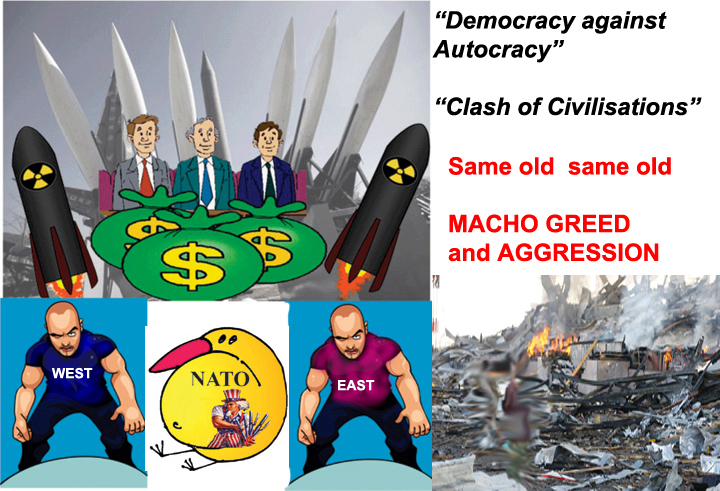
COMMENT. Aint it grand! Jobs jobs jobs in an industry of no benefit to humanity, or to other planetary species!
Very exciting for the macho boys. Less wasting of money on health, care, education, and trivialities like coping with climate and extreme weather events.
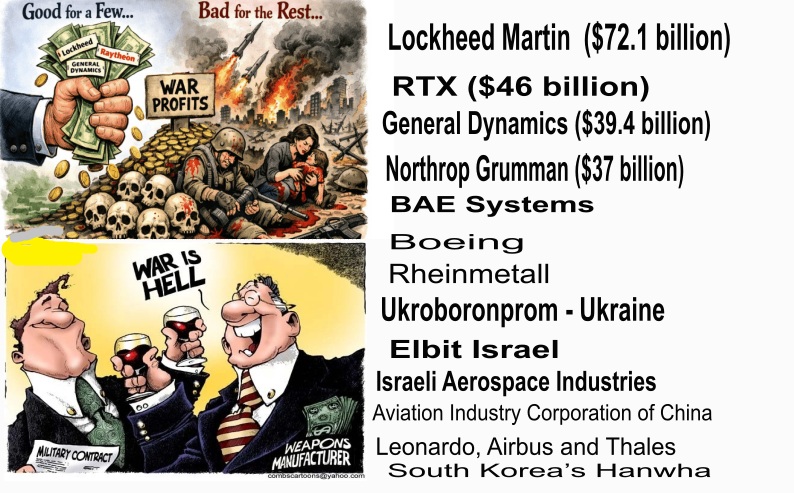
the Israeli companies involved inUkraine’s anti-missile architecture, with Elbit ranking 21 on the list, Israeli Aerospace Industries at 27 and Rafael at 30
(ED. This article doesn’t mention Russia, but I’m sure that their weapons industries are making a killing, too – all the world’s greedy boys are in it together)
For the many billions of dollars governments spend on defense, companies are on the hook to get their production pipelines in place and deliver.
By Defense News staff, Sep 4, 2026, https://www.defensenews.com/industry/2026/09/03/defense-firms-soar-on-ample-military-spending-testing-manufacturing-schemes/?utm_source=sailthru&utm_medium=email&utm_campaign=c4-overmatch
The year 2025 was another record setter for global defense companies, so much so that production bottlenecks in Western nations — not the usual industry lamentations about lacking government spending — began creeping up as the key problem many NATO countries are facing today.
Companies in the United States and Europe rode a wave of significant defense-spending increases on both sides of the Atlantic. In Europe, individual national budget increases, as well as the European Union’s increasing involvement in brokering and financing joint procurement, continued to increase the revenue of defense industry players large and small.
In the United States, the 2025 Reconciliation Act is set to pump most of the legislation’s total $156 billion into acquisition — on top of the regular defense budget of roughly $900 billion for that year.
“Now, it’ll take years for that enacted money to actually flow to the companies and to their financial statements,” said Mark Cancian, a senior adviser in the defense analysis program at the Washington-based Center for Strategic and International Studies. “But it will be a big boost for many companies.”
Click here to view the 2025 Defense News Top 100
In Europe, the trajectory is perhaps more immediate, as governments spooked by Russia’s full-scale invasion of Ukraine in February 2022 began dialing up their military expenditures drastically years ago.

Besides absorbing the overall plus-up in the amount of money available, companies on the continent have rewired their business strategies to align with a preference for European-made equipment by many European governments, though the massive influx of cash on all sides obfuscates whether European companies have meaningfully cut into the bottom lines of U.S. defense giants.
More money on both sides of the pond
The latest Defense News Top 100 ranking of global defense companies bears out the overall upward trend, with companies posting higher annual defense revenues, a combined $700 billion compared with $629 billion in the prior year, a 11.3% increase.

The first four spots of our latest ranking continue to be in the hands of U.S. firms, with Lockheed Martin in the top spot with $72.1 billion in annual defense revenue, followed by RTX ($46 billion), General Dynamics ($39.4 billion) and Northrop Grumman ($37 billion), in that order.
Britain-based BAE Systems, which has a sizable U.S. operation, is the first non-American company in the lineup, creeping up one spot into number five over last year’s ranking, with $36 billion in revenue reported.
Boeing’s defense segment similarly climbed one position, into slot number six with $35.7 billion in revenue, as did L3Harris ($17.4 billion), which now places eighth.
In between sits a Chinese entrant, Aviation Industry Corporation of China, at $32.3 billion.
On the heels of that company begins a lineup of firms from all over the world, with European outfits continuing to inch upwards — the big players Leonardo, Airbus and Thales placing 9, 10 and 12, respectively.
Perhaps no company represents the European defense uptick as much as Germany’s Rheinmetall, which reported $11.2 billion in 2025 annual revenue, up from $8.3 billion in the previous year. The company now sits at number 15 on the list, up from 18 in the prior year.
The firm has, over the years, branched out its operations into virtually all domains of war — land, air, naval, space, cyber and unmanned — from Europe to Australia, and has embraced the formerly low-brow segment of explosives and ammunition.
That category, which includes artillery shells, missiles and air-defense interceptors, has seen unprecedented demand in all NATO countries, based on the experiences since Russia’s full-scale invasion of Ukraine in February 2022.
Air defense competitions on the rise
The air defense category is also where the biggest shortfalls lie. Companies have expanded their supply chain setups in recent years to build artillery shells, urgently needed in Ukraine to shoot over immediate front lines’ robot-dominated no-go zones for infantry.
But what’s still lacking are sufficient interceptor missiles and drones to defend against Russian missiles fired at Ukrainian cities.
With the Patriot air defense complex — radars, launchers and interceptors — in the hands of U.S. firms, European and Ukrainian officials have begun thinking through alternatives to the scarce equipment.
Offerers include the Israeli companies involved in that country’s anti-missile architecture, with Elbit ranking 21 on the list, Israeli Aerospace Industries at 27 and Rafael at 30, as well as pan-European firm MBDA at 26 and Germany’s Diehl at 58, up from 82 last year.
Companies with a naval shipbuilding portfolio, such as General Dynamics, Huntington Ingalls (ranking 13, at $12.3 billion annual revenue, up from 16) and South Korea’s Hanwha (rank 16, at $10.4 billion, up from 22), have been lifted by a favorable tide of capital-intensive naval modernization projects worldwide.
In the U.S., defense officials and lawmakers have envisioned a new armada of warships and icebreakers, dedicating a whopping $29 billion for shipbuilding in the 2025 Reconciliation Act alone.
“The Biden administration, and now the Trump administration, have just been pouring money into shipbuilding — way beyond what the industry can absorb,” said Cancian. “And then they’re talking about building another shipyard to produce all these ships that have now been funded,” he added, leaving shipbuilders with order books filled into the 2030s or beyond.
Defense spending as an ‘engine’?
Production bottlenecks for defense components, combined with economic woes in civilian industry sectors, have led to some new creative arrangements.
In Europe, some automotive companies and rail car makers have turned their factory floors into production sites for drones and counter-drone equipment.
The rush to re-arm, based on the worry that Russia might try a Ukraine-style attack elsewhere, has prompted political leaders in Europe to tout what they consider secondary economic effects of the defense bonanza.
Defense officials in the U.K. published figures in August, for example, that said the 2024-25 period saw British weapons and ammunition manufacturing jobs rise by 51%, “part of a wider 26,000 increase” in defense-supported roles nationwide.
Click here to view the 2025 Defense News Top 100
“The increase underlines defense as an engine for growth and the move towards a resilient industrial base, proving that investment in the U.K.’s security is investment in the U.K.’s prosperity,” reads an Aug. 20 statement by the Ministry of Defence.
Some Turkish companies, meanwhile, representing a country with a government mandate for making defense equipment at home rather than importing it, made the latest Top 100 list again, improving positions in some cases. Aselsan jumped from spot 43 to 40 on roughly $4.5 billion in reported annual revenue, and Roketsan gained seven ranks, on $2.4 billion, landing at spot 64.
Similarly, Polish state-owned armaments group PGZ jumped from rank 54 in 2024 figures to number 41 in the latest accounting, based on $4.4 billion in revenue last year.
The Polish government has set out plans to create one of NATO’s most powerful armies in Europe, and local weapons programs are typically designed to include Warsaw’s go-to producer as a key partner.
Meanwhile, the collection of Ukrainian defense companies under the umbrella of Ukroboronprom improved their ranking to spot number 36, up from 49 last year, with a reported revenue of $4.6 billion in 2025.
The country’s defense industry over the past years has put the Kyiv government in a position to provide armaments to its forces that the country previously had to import, often with operational limitations attached.
So much has the Ukrainian defense industry gained in expertise that allied militaries are itching to incorporate its know-how into their own supply chains.
Looking ahead, there is more spending expected, and more business for relevant defense companies, in the field of air and missile defense, said Cancian. Much of that will be connected to whatever the Trump administration’s Golden Dome program will entail, he noted.
Golden Dome wildcard
The controversial Golden Dome effort will consist of a sweeping suite of sensors and interceptors — stationed on Earth, in space and everywhere in between — that would make the United States almost impervious to aerial attacks of any kind, the theory goes.
Details have been scant on its exact architecture, and companies are searching for avenues into what they suspect will be a generational chunk of government spending in the hundreds of billions of dollars.
“We still don’t really know what it is,” Cancian said, adding the lack of clarity could make the whole project an increasingly hard sell as time goes by.
On the whole, the analyst said, there is so much defense spending on the books that the U.S. government, for its part, isn’t forced to choose between buying legacy weaponry and new technology.
“The thing that struck me most — I come out at this from a program budget perspective — is that there was enough money to do both,” he said.
Turning the influx of defense money into meaningfully improved defenses will be a top oversight job for politicians. And industry will have to be disciplined to get its ducks in a row to contend with order backlogs and production bottlenecks.
As PricewaterhouseCoopers analyst Scott Thompson noted in a recent performance analysis of the aerospace and defense sectors, “In a market where demand is not the constraint, execution is the differentiator.”
How drones reinvented the proxy war

Drone technology, once confined to
great powers like the United States and China, has irrevocably spread to
smaller states and non-state actors. In the early 2000s, it would have been
unthinkable for small insurgent groups to develop sophisticated
drone-building programs and deploy unmanned aircraft against their
opponents. A generation later, this technology has become cheaper and far
more accessible. Syria’s civil war demonstrates how local initiative
combined with inexpensive drones imported from second-tier producers can
bring game-changing results.
Bulletin of Atomic Scientists 2nd Sept 2026,
https://thebulletin.org/2026/09/how-drones-reinvented-the-proxy-war/
Trump rules out nuclear weapons against Iran, weighs limited Strait of Hormuz strikes
[your]NEWS, Mon, 31 Aug 2026, https://www.sott.net/article/508207-Trump-rules-out-nuclear-weapons-against-Iran-weighs-limited-Strait-of-Hormuz-strikes
President Donald Trump said nuclear weapons are unnecessary because Iran has been “totally defeated militarily,” while his administration considers limited conventional strikes aimed at protecting U.S. forces and commercial shipping in the Strait of Hormuz.
President Donald Trump said Monday that he has ruled out using nuclear weapons against Iran, even as the White House weighs additional conventional military action around the Strait of Hormuz following renewed clashes between U.S. and Iranian forces.
Trump addressed the nuclear question while speaking with reporters in the Oval Office, where he was asked whether he would exclude such an escalation from the ongoing conflict.
“Well, I would never say. That, but the answer is yes, I ruled out.I ruled it out there’s no reason for it.”
The president argued that Iran’s conventional military losses made the use of nuclear weapons unnecessary.
“What a stupid question that is. Actually, here they are. They’re totally defeated militarily. So now I defeat him, and now I should use a nuclear weapon on top of them. What a stupid question.”
Trump’s comments came as his administration considers a different form of escalation focused specifically on protecting traffic through the Strait of Hormuz.
According to Axios, the president is weighing a resumption of limited strikes following an exchange of gunfire between American and Iranian forces over the weekend.
One U.S. official told the outlet that the contemplated operations would be intended to reduce the threat of Iranian attacks against oil tankers, U.S. Navy vessels and Air Force aircraft operating in the region. The potential strikes would therefore be narrower in scope than a major offensive against Iran and would focus on protecting military assets and commercial navigation through the strategic waterway.
The Strait of Hormuz has become one of the central flashpoints in the U.S.-Iran conflict because of its importance to international oil shipments and the continuing danger posed to vessels operating there. Any sustained Iranian attacks on tankers or U.S. military forces could prompt additional American action even as Trump says the administration sees no reason to consider nuclear weapons.
The White House emphasized that the president continues to retain broad military flexibility:
“The President retains all options at his disposal. The Iranians want to make a deal, but they are always a day late and a dollar short.”
That statement leaves open the possibility of additional conventional strikes while simultaneously suggesting Washington believes negotiations remain possible.
Trump’s position therefore separates two questions surrounding the conflict:
On nuclear weapons, he gave an explicit answer that he had ruled them out and argued Iran’s military condition did not justify such an extraordinary escalation.
On conventional force, however, the administration continues evaluating whether further strikes are necessary to protect American personnel and commercial shipping.
The possible Strait of Hormuz operation would be designed around those immediate security concerns rather than the use of substantially more destructive weapons. Trump’s remarks also suggest the administration believes Iran has already suffered significant military setbacks but remains capable of threatening ships and aircraft in the region.
That distinction could shape the next phase of U.S. operations, with Washington continuing targeted military action against specific threats while attempting to avoid an escalation to nuclear warfare.
For now, Trump has publicly closed the door on using nuclear weapons against Iran while leaving conventional military options available if Tehran continues threatening U.S. forces or shipping through the Strait of Hormuz.
AUKUS makes Australia a nuclear target, top experts warn

Rob Harris, September 3, 2026 —https://www.smh.com.au/politics/federal/aukus-makes-australia-a-nuclear-target-top-experts-warn-20260902-p60tnk.html
Australia is significantly more likely to be dragged into a destructive conflict with China — and potentially targeted with nuclear weapons — under the AUKUS security pact, two former senior national security figures have warned.
Michael Keating, a former Department of the Prime Minister and Cabinet secretary, and former public servant Jon Stanford argue that the federal government’s current defence posture has “sacrificed considerable sovereignty” to the United States while leaving the country uniquely vulnerable without a guaranteed security safety net.
The pair will front a crowd-funded public inquiry into the AUKUS submarine pact on Thursday, urging the federal government to immediately redesign its national strategy, cancel plans to acquire American Virginia-class and British-designed SSN AUKUS nuclear-powered attack submarines, and pivot to low-enriched uranium vessels sourced from France or South Korea.
Keating, the most senior public servant during the Hawke-Keating era, spent 11 years on the Secretaries Committee on National Security – including five years as chairman – while Stanford has extensive background in submarine research and defence policy.
“Under AUKUS, Australia’s security is under greater threat while it has become increasingly clear that we cannot rely on the US for our defence,” they write in their submission. “We are now in a situation where, because of the AUKUS strategy of integrated deterrence in defence of US regional primacy, Australia is more likely to be attacked, potentially with nuclear weapons”.
They cite prescient warnings from former French foreign minister Jean-Yves Le Drian, who noted in 2021 that Australia had made a choice “to the detriment of sovereignty” and predicted it would discover later it had sacrificed both security and self-determination.
According to the submission, the policy of “integrated deterrence” and “pooled sovereignty” effectively converts Australian military facilities into forward operating locations for US forces without giving Canberra oversight or veto power.
They point out that unlike allies such as Japan, South Korea, and the Philippines, Australia lacks a formal US security guarantee, such as NATO’s Article V.
Yet, by developing command and basing infrastructure – such as the US submarine squadron facilities at HMAS Stirling in Western Australia – Australia becomes a prime military target.
“If there is a war between the US and China, Australia will inevitably be involved … even if we do not provide military support,” the submission states, adding that escalating hostilities could leave Australia open to nuclear strikes.
Fronting the first day of the hearings in Canberra on Wednesday, former home affairs secretary Mike Pezzullo called for a deeper military integration with the US, agreeing that Australia could surrender sovereignty under the current AUKUS without gaining a meaningful say in decisions that could draw it into a war with China.
Pezzullo, a national security hawk and former senior public servant under the Abbott, Turnbull and Morrison governments, was sacked by Labor in 2023 after confidential messages between him and Liberal Party powerbroker Scott Briggs were leaked to this masthead. The Australian Public Service Commission subsequently found he had breached the public service code of conduct on 14 occasions.
“If I was a Chinese war planner,” Pezzullo said, “I would flatten every single potential facility that might be used overnight by Americans flying in.”
He said facilities including Tindal, Stirling, North West Cape and Pine Gap could be targeted in such a conflict.
But Pezzullo said AUKUS’s nuclear-powered submarine program would transform Australia’s military options, giving the navy greater speed, endurance and reach while opening the way for a new generation of autonomous underwater systems.
Undersea warfare would be critical in any future conflict, from anti-submarine operations to intelligence gathering, he said.
At the same time, Pezzullo said Australia should not commit to fighting alongside the US in every future conflict.
“Alliances are political documents first and foremost,” he said, arguing that countries must retain the ability to make sovereign decisions when a conflict actually occurs.
But he said those political alliances needed military planning and preparation underneath them.
Australia, he said, could either try to remain outside a future US-China conflict and accept the consequences if Washington lost, or strengthen its alliance with the US in the hope that the combined deterrent would prevent war.
“The only choice would be whether we want to sit it out and hope for the best,” Pezzullo said. “I think that’s not plausible.”
The choice was whether to remain on the sidelines and accept the consequences if Washington lost, or deepen the alliance in the hope that Australian involvement would strengthen deterrence.
“I prefer that latter approach,” Pezzullo said. “The war machine is the thing that prevents the war.”
Hey Americans! Escape Debt By Going To War With Iran!
Caitlin Johnstone, Sep 03, 2026, https://www.caitlinjohnst.one/p/hey-americans-escape-debt-by-going?utm_source=post-email-title&publication_id=82124&post_id=213955094&utm_campaign=email-post-title&isFreemail=true&r=1ise1&triedRedirect=true&utm_medium=email
Today in dystopia, war pundits have begun suggesting that the US could recruit sufficient troops for a ground invasion of Iran by offering young Americans debt forgiveness in exchange for enlisting.
I guess it was only a matter of time.
In an article titled “The war with Iran will not be won through airstrikes, so what’s left?”, the Jerusalem Post’s AJ Jaff writes the following:
“Recruitment numbers are running below what a ground invasion of Iran would require. Estimates for a successful ground campaign against Iran’s 31 provincial commands and its Mosaic Defense Doctrine run between 750 thousand and 1.5 million American troops. The current active US Army stands at roughly 452 thousand. The math does not work, obviously.
“Based on American history, however, there is a path forward. Not conscription or a draft in a world war-era sense, but enlistment through a ‘debt forgiveness program.’
“The average American aged 18 to 34 carries more than $40 thousand in non-mortgage debt across student loans, credit card balances, auto loans, and personal loans, with some estimates go as high as $100 thousand.
“This is the cohort the Pentagon needs. A federally administered debt-forgiveness enlistment program that fully discharges student loan, credit card, and loan balances after 24 or 36 months of service, and extends the GI Bill, would produce voluntary enlistment at scale.”
“This is not theoretical.
“It is the American state doing what the American state has always done when it needed staff it could not otherwise generate. World War II offered the GI Bill. Vietnam offered college deferments. The post 9/11 wars offered signing bonuses and citizenship pathways. The Iran war will need to offer debt relief. The economics of the indebted American 20-and 30-something make this the most efficient conversion mechanism available to the Pentagon and the Trump administration.
“The moral reading on this is uncomfortable. But states generate the soldiers they need through the incentives that work on the population they have.”
In a Twitter essay on the same subject published earlier this month, AJ Jaff used more blunt language:
“When the choice is decades chained to $45,000+ in debt, or a few years of service that erases it and hands you a clean start, a huge share of desperate young people will take the offer. Not because they ‘support the war’. Because the debt was engineered into a cage, and service is the ONLY door out.”
The Jerusalem Post says that Jaff is a Canadian who currently serves as the head of security for an unnamed “multinational organization,” describing him in his author bio as “a retired officer of the Canadian Armed Forces and a recognized expert in international security, crisis management, and geopolitical risk.”
There isn’t much publicly available information about Jaff apart from this, and yet here he is being amplified by one of Israel’s largest English-language newspapers. So we can expect we’ll be seeing this idea pop up again elsewhere.
It’s just everything ugly about the US empire all rolled up in one neat little package, isn’t it? Struggling American citizens strapped with mountains of bills because they live in a dystopia which plunges people into debt for the privilege of living on the planet they were born on, desperately enlisting to go kill people in an imperialist war of aggression overseas in the hope of one day getting their heads above water financially.
It just might be the most American idea anyone has ever had.
THE FOUR HORSEMEN OF THE UKRAINIAN APOCALYPSE
by Gordonhahn August 31, 2026, https://gordonhahn.com/2026/08/31/the-four-horsemen-of-the-ukrainian-apocalypse/
There have been at least four great deceptions engineered and lost opportunities for ending Ukraine‘s violence intentionally foregone by the West. They are the causes of the ‚Putin’s unprovoked war in Ukraine and the imminent Ruin of Ukraine. The four horsemen of the Ukrainian apocaplypse are:
(1) the violation of the 21 February 2014 agreement to end the Maidan confrontation in Kiev;
(2) the West’s and Kiev’s insincere, indeed simulated participation in the Minsk 2 accords that could have ended the Ukrainian civil war from 2014-2022;
(3) the U.S. withdrawal of Joseph Biden’s December 2021 promise to Putin that the US and NATO would not deploy cruise missiles in Ukraine; and
(4) the West’s subversion of the Istanbul Russo-Ukrainian peace agreement initialed in April 2022. Let us stake each in turn.
The first horseman oft he Ukrainian apocalypse is the violation of February 21, 2014 agreement between Ukrainian President Viktor Yanukovych and the Ukrainian opposition of the Maidan to pull back both demonstrators and police and hold early presidential elections late in 2014. Instead of seeing this agreement through, the neofascist wing oft he Maidan opposition carried out a snipers‘ terrorist attack killing both demonstrators and Berkut security police leading to the violent overthrow of Yanukovych, who was blamed by the Maidan opposition and the West for the shootings. The West hailed the putsch as democratic “revolution of dignity“ and never mentioned the February agreement; one brokered by Russian President Vladimir Putin, according to then Polish Foreign Minister and agreement participant, Radek Sikorski. The Maidan regime was born of blood and a lie.
Russia responded by giving the West a taste of its own medicine by supporting separatist actors in Crimea, Donetsk, and Luhansk. Kiev responded by declaring an “anti-terrorist operation“ that began the Ukrainian civil war, bringing Russian troops into Donbass to protect the pro-Russian separatists.
The second horseman of the Ukrainian apocalypse consists of the violations of the Russo-Ukrainian Minsk agreements. Ukraine never fulfilled any of its obligations under the agreement. It did not adopt statues on autonomy fort he Donbass regions nor did it negotiate directly with the Donbas rebels. Ukrainian troops, particularly the ultranationalist batallions routinely bombed civilian areas during the ‚ceasefire‘ agreement. This was nothing other than a Minsk Fake or Feint, which, as numerous Western and Ukrainian officials acknowledged, the Putin-Poroshenko Minsk ceasefire accords were used to buy time for building up Ukraine’s army for an assault on Crimea and Donbass. Thus, the civil war did not end but persisted, with Kiev inflicting more than 10,000 casualties on Donbass civilians in 2015-2021.
The third horseman of the Ukrainian apocalypse came with the U.S. violation of Joseph Biden’s December 2021 promise to Putin that the US and NATO would not deploy cruise missiles in Ukraine. Instead of holding tot hat promise made in a Biden-Putin phone call, US Secretary of State Anthony Blinken announced to Russian Foreign Minister Sergei Lavrov that the US was withdrawing that promise, opening up the possibility of deploying conventional and/or nuclear cruise missiles in Ukraine, with flight times to Moscow of minutes. This was the straw that broke the camel’s back, requiring Putin to undertake a military response to the Ukrainian crisis on 24 February 2022—the so-called “unprovoked and full-scale attack on Ukraine.“
The fourth and final horseman of the Ukrainian apocalypse is the Western scuttling of the March-April 2022 Russo-Ukrainian Istanbul process and agreement to end Russia’s incursion into Ukraine. Much has now been written about this, so I will not repeat the details here; I will only provide links to all the sources, confirming this (https://threadreaderapp.com/thread/1746596120971673766.html; see also https://x.com/i_katchanovski/status/1750362694949966291?s=51&t=n5DkcqsvQXNd3DfCRCwexQ; and https://www.facebook.com/photo/?fbid=8229337113762769&set=a.117187214977840).
These and the key process these ‚horsemen‘ have been intended in the West to facilitate – NATO expansion – are the causes of “Putin’s unprovoked war on Ukraine“ and Ukraine’s apocalypse or Second Great Ruin. Make no mistake about it.
Part II — No Blank Check for the War Machine
The Pentagon’s missile shortage will not be solved tomorrow. But its long-term answer is already being built beside our communities. Project Ranger approved without us—but the Pentagon, Castelion and New Mexico officials still must answer to the people.
Elaine Cimino, Aug 29, 2026
The Pentagon’s missile shortage will not be solved tomorrow. But its long-term answer is already being built beside our communities.
Part I asked what government kept from the public while it assembled the deal. Part II asks what the emerging federal weapons record now tells us about the scale and purpose of what was approved without us.
A national weapons emergency is being converted into a private investment opportunity—and New Mexico has been selected as one of the places where the consequences will be imposed.
The August 21 Defense One investigation, “There’s No Shortcut to Replenish U.S. Munitions Stockpiles,” describes a Pentagon racing to replace missiles being consumed in the Iran war while defense companies pitch a new generation of cheaper weapons. Buried inside that national story is a name New Mexico residents must recognize: Castelion.[1]
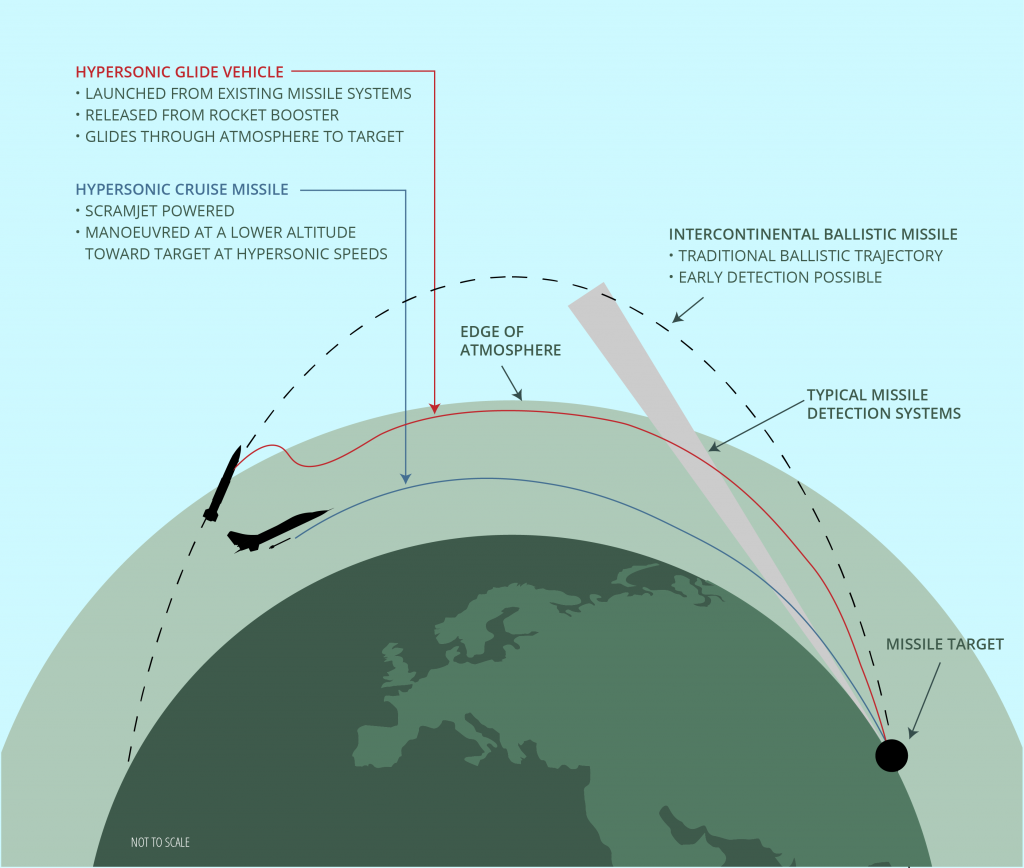
Castelion is constructing Project Ranger, the massive solid-rocket-motor and hypersonic-weapons manufacturing complex west of Rio Rancho in Sandoval County. Its Blackbeard missile is being offered as something the Pentagon has long wanted but struggled to obtain: a hypersonic strike weapon inexpensive enough to manufacture not by the dozen, but by the hundreds and eventually the thousands.
That mention changes the frame around Project Ranger. This is not simply another economic-development project, an isolated factory or a collection of buildings on remote State Trust Land. It is being positioned inside a long-term restructuring of the American war industry.
The federal government wants cheaper missiles, more suppliers, faster testing and industrial-scale production. Castelion wants to become one of the companies that supplies them. Project Ranger is where much of that ambition is supposed to become physical reality.
And while the Pentagon, investors and public officials discuss speed, scale and deterrence, the people living beside the factory are still waiting for something far more basic: full disclosure of what will be manufactured, burned, tested, stored, transported and released near their homes and water.
Blackbeard will not solve the immediate Iran stockpile crisis
The first fact must be stated precisely. Blackbeard is not a replacement for the Patriot and Terminal High Altitude Area Defense interceptors being depleted in the Iran war.
Patriot and THAAD missiles are defensive weapons intended to destroy incoming missiles or aircraft. Blackbeard is an offensive, long-range hypersonic strike weapon intended to hit targets on land or at sea. Producing one does not replenish the other.
That is why the Defense One article warns that the Pentagon’s low-cost weapons campaign will not quickly repair the immediate stockpile crisis. New missiles must still be developed, tested, evaluated, certified, placed under contract and manufactured. That takes years, not weeks. Experts quoted in the article describe a continuing window of vulnerability while the military attempts to rebuild inventories depleted not only by Iran, but by years of global commitments.[1]
Blackbeard is therefore not the emergency cure being delivered to today’s battlefield. It is part of the arsenal the Pentagon wants for the wars it is preparing to fight in 2027, 2028, 2029 and beyond—particularly a possible conflict with China.
That distinction does not make Project Ranger less consequential. It makes it more so. A temporary emergency might end. A permanent industrial strategy can expand for decades.
The Pentagon is building a high-low arsenal
The larger strategy is a “high-low mix”: retain a smaller inventory of extraordinarily expensive weapons while acquiring far greater numbers of cheaper missiles for missions that do not require the most sophisticated system available.
Castelion is marketing Blackbeard as the hypersonic expression of that strategy. It is advertised as a weapon capable of exceeding Mach 5 but designed from the beginning for lower-cost, industrial-rate production.
Reuters reported in April that Navy planning documents contemplated the purchase of 4,500 air-launched hypersonic missiles for F/A-18 aircraft over five years, at an average projected price of about $384,000 each. The same report explained that a $105 million Navy award would fund Blackbeard’s integration onto the F/A-18, including flight tests, safety work and airworthiness certification.[2]
That is not the same as a funded order for 4,500 Blackbeards. But it shows what the Pentagon is testing: whether a weapon once treated as an exotic, multimillion-dollar rarity can become a routinely deployed instrument of war.
If that experiment succeeds, Project Ranger will not be a boutique research site. It will be an arsenal factory………………………………………………………………………………………………………………………………………………………………………………………… https://elainecimino652909.substack.com/p/part-ii-no-blank-check-for-the-war?utm_source=post-email-title&publication_id=3194544&post_id=213199756&utm_campaign=email-post-title&isFreemail=false&r=281p2&triedRedirect=true&utm_medium=email
Walt Zlotow – Some inconvenient truths about Trump’s Iran war

Walt Zlotow West Suburban Peace Coalition Glen Ellyn IL , 31 Aug 2026, https://theaimn.net/some-inconvenient-truths-about-trumps-iran-war/
The US lost the war within the first 3 days when the US, Israeli attack and assassination of Iranian leader Ali Khomenei did not collapse the Iranian regime
Bombing Iran for 39 days was a catastrophic military failure. Iran’s retaliatory defense decimated all 20 US Gulf State bases inflicting over 750 US casualties including 18 dead.
Running out of both offensive and defensive missiles, Trump blinked first and called for a ceasefire on April 8, war day 40.
The June 17th signing of the Memorandum of Understanding (MOU) was essentially a US surrender document.
Realizing the MOU signaled his defeat, Trump simply ignored it, implemented a blockade and resumed periodic bombing. Both utterly failed to reopen the Strait of Hormuz to resume the critical flow of oil to prevent worldwide economic calamity.
Having been sucker punched with bombs twice by Trump during negotiations, Iran has signaled it will never negotiate with Trump during his remaining 2 years, 5 months in office.
Trump’s statements that Iran is negotiating surrender on Trump’s terms, the Strait is open, and will become US territory, the blockade is a resounding success, the oil is flowing, are so detached from reality one must ponder Trump’s sanity.
Refusal to capitulate is spreading the war within the region to Yemen, Saudi Arabia, Lebanon, West Bank, Iraq, Syria, possibly even Turkey v. Israel.
If Trump’s last gasp is to utterly destroy Iranian infrastructure, Iran will retaliate and destroy the entire Gulf States oil infrastructure and possibly Israel’s infrastructure as well.
Unlike for the US, Trump’s war is an existential threat to Iran’s existence. They have been preparing for the US, Israeli tag team war machine to destroy them for decades. They are and will prevail regardless of the cost.
Israel will do whatever is necessary to keep Trump in the war to destroy Iran. Trump’s only way out is to sever ties with Israel and capitulate to Iran’s sensible terms. Given Trump’s history, the chances of that are nil. Removing Republican control of Congress in 9 weeks may be only chance for America to avoid economic collapse.
But only if a Democratic Congress has the wisdom, decency and good sense to end the most self destructive war in America’s 251 years.
The Russian Art of War – Why the West Has No Strategy and Ukraine will lose
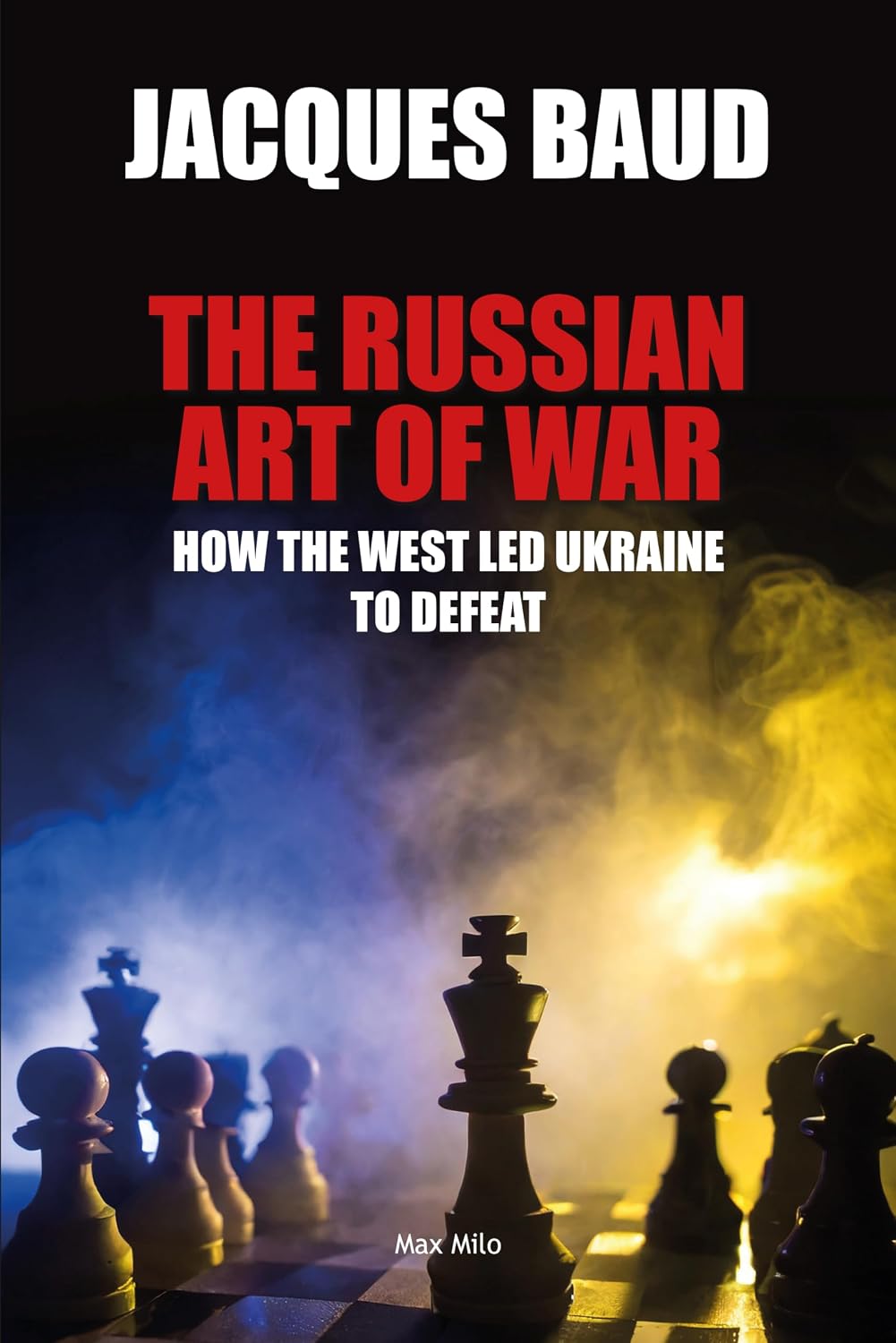
Baud is careful to stress that understanding an adversary is not the same as endorsing them. Intelligence, he reminds us, comes from the Latin intelligere — to understand. Without that understanding, diplomacy becomes impossible and force becomes the only remaining instrument.
.
A conversation with Colonel Jacques Baud
Ian Proud, Aug 28, 2026, https://thepeacemonger.substack.com/p/the-russian-art-of-war-why-the-west?utm_source=post-email-title&publication_id=3221990&post_id=211519795&utm_campaign=email-post-title&isFreemail=true&r=1ise1&triedRedirect=true&utm_medium=email
Colonel Jacques Baud, former Swiss strategic intelligence officer and author of The Russian Art of War: How the West led Ukraine to Defeat, has spent decades studying how different military cultures understand and wage war. His detailed, heavily referenced book — written early in the conflict — remains one of the clearest explanations of why Russia continues to hold the strategic advantage in Ukraine.
Baud’s central argument is simple but profound. During the Cold War, both NATO and the Warsaw Pact organised their forces around three interlocking levels of warfare: tactical, operational and strategic.
After 2001, Western armies largely abandoned the operational level as they shifted to counter-terrorism.
Fighting insurgents in Iraq and Afghanistan reduced war to a series of tactical engagements.
When the same mindset and equipment were transferred to Ukraine, the results were predictable.
Russia never made that shift. Its art of war remains built on the classic three levels.
Early in the Special Military Operation, deep operational thrusts toward Kyiv and Kherson were designed to create strategic pressure and force negotiations. When that phase ended, Russia adjusted — not by descending into pure tactics, but by systematically destroying Ukrainian forces while still linking tactical actions to operational and strategic goals.
Ukraine, trained and equipped largely by the West, has remained stuck at the tactical level.
This difference explains much of what we see on the battlefield. Russia’s objectives have been consistent: protect the population of the Donbas, prevent Ukrainian NATO membership, and secure a neutral buffer.
The Istanbul draft of March 2022 already reflected these goals, drawing on historical models of neutrality such as Austria in 1955 and Switzerland in 1815.
The West, by contrast, has never articulated clear, measurable political objectives beyond the vague slogans of “weakening Russia” and “supporting Ukraine.”
Without clear objectives, there can be no coherent strategy and no exit plan.
Industrial capacity reinforces the disparity. Russia’s state-influenced military-industrial complex can prioritise and scale production — whether of artillery shells, missiles or drones — with a flexibility that privatised Western industry lacks.
Lead times for systems such as Patriot missiles are measured in years.
Once Russia recognised the importance of drones, it moved from relative disadvantage to local superiority through industrial mobilisation.
Baud is careful to stress that understanding an adversary is not the same as endorsing them. Intelligence, he reminds us, comes from the Latin intelligere — to understand. Without that understanding, diplomacy becomes impossible and force becomes the only remaining instrument.
The tragedy is that a clearer grasp of Russian thinking in 2022 might have spared Ukraine much of the destruction that followed.
The conversation ends with a sober conclusion. Russia has a coherent political-military strategy underpinned by industry, energy and time.
The West and Ukraine are fighting a war by committee with no clear strategic destination.
In such conditions, the side that knows what it wants — and organises itself accordingly — almost always prevails.
You can watch the full conversation here:
1 This Month
23-25 October – on Zoom – World BEYOND War’s annual global conferenc


Shut down the radiation-damaged Heysham nuclear reactors now
To see nuclear-related stories in greater depth and intensity – go to https://nuclearinformation.wordpress.com

Say No to NASA’s Reckless Nuclear Reactor on the Moon
Say No to NASA’s Reckless Nuclear Reactor on the Moon

-
Archives
- October 2026 (247)
- September 2026 (339)
- August 2026 (330)
- July 2026 (355)
- June 2026 (287)
- May 2026 (306)
- April 2026 (356)
- March 2026 (251)
- February 2026 (267)
- January 2026 (308)
- December 2025 (358)
- November 2025 (359)
-
Categories
- 1
- 1 NUCLEAR ISSUES
- business and costs
- climate change
- culture and arts
- ENERGY
- environment
- health
- history
- indigenous issues
- Legal
- marketing of nuclear
- media
- opposition to nuclear
- PERSONAL STORIES
- politics
- politics international
- Religion and ethics
- safety
- secrets,lies and civil liberties
- spinbuster
- technology
- Uranium
- wastes
- weapons and war
- Women
- 2 WORLD
- ACTION
- AFRICA
- Atrocities
- AUSTRALIA
- Christina's notes
- Christina's themes
- culture and arts
- Events
- Fuk 2022
- Fuk 2023
- Fukushima 2017
- Fukushima 2018
- fukushima 2019
- Fukushima 2020
- Fukushima 2021
- general
- global warming
- Humour (God we need it)
- Nuclear
- RARE EARTHS
- Reference
- resources – print
- Resources -audiovicual
- Weekly Newsletter
- World
- World Nuclear
- YouTube
-
RSS
Entries RSS
Comments RSS

