Numbers of nuclear warheads in various countries 2013
Think Tank: China Boosts Nuclear Arms Arsenal abc news, By MALIN RISING Associated PressSTOCKHOLM June 3, 2013 (AP)
20132012
Russia 8,50010,000
United States 7,7008,000
France 300300
China 250240
United Kingdom225225
Pakistan 100-12090-110
India 90-11080-100
China pledges no pre-emptive nuclear strike
Shangri-La Dialogue: China reiterates ‘no-first-use’ nuclear pledge Straits Times News Jun 02, 2013 CHINA is maintaining its pledge not to be the first to use nuclear weapons in a conflict, a top Chinese general said on Sunday.
Omission of the “no-first-use” pledge in a recently released defence
white paper had created ripples in military circles and sparked
speculation that China may have dropped the policy.
“I want to make a solemn statement that the Chinese government will
never discard our pledge of no first-use of nuclear arms,”
Lieutenant-General Qi Jianguo told the Shangri-La Dialogue security
forum in Singapore.
“We have been sticking to this policy for half a century, and its
facts have proven that it is not only in the interest of the Chinese
people but also of the people of all the world.” ….. subscribers
only http://www.straitstimes.com/breaking-news/asia/story/shangri-la-dialogue-china-reiterates-no-first-use-nuclear-pledge-20130602
They’re back in the Pacific – Russian nuclear submarines
Russian nuclear submarines resuming patrols in southern hemisphere NewHaven Register, June 02, 2013 By Alexei Anishchuk, Reuters MOSCOW — Russia plans to resume nuclear submarine patrols in the southern seas after a hiatus of more than 20 years following the break-up of the Soviet Union, Itar-Tass news agency reported on Saturday, in another example of efforts to revive Moscow’s military.
The plan to send Borei-class submarines, designed to carry 16 long-range nuclear missiles, to the southern hemisphere follows President Vladimir Putin’s decision in March to deploy a naval unit in the Mediterranean Sea on a permanent basis starting this year.
“The revival of nuclear submarine patrols will allow us to fulfill the tasks of strategic deterrence not only across the North Pole but also the South Pole,” state-run Itar-Tass cited an unnamed official in the military General Staff as saying.
The official said the patrols would be phased in over several years. The Yuri Dolgoruky, the first of eight Borei-class submarines that Russia hopes to launch by 2020, entered service this year….. http://nhregister.com/articles/2013/06/02/news/60cae553-ae3d-4c89-bc59-b279d1f680de.txt
Nevada population was exposed to nuclear bomb tests’ radioactive fallout
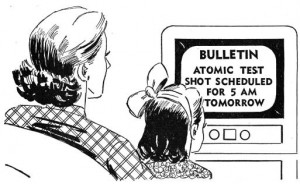 Add this little public service booklet, illustrated with the drawing at left and written by the Atomic Energy Commission to the people of Nevada:
“You are in a very real sense active participants in the Nation’s atomic test program. … Some of you have been inconvenienced by our test operations. At times some of you have been exposed to potential risk from flash, blast, or fall-out. You have accepted the inconvenience or the risk without fuss, without alarm, and without panic. Your cooperation has helped achieve an unusual record of safety.”
As though they were asked.
How Do We Know Nuclear Bombs Blow Down Forests? Because we built a forest in Nevada and blew it down. Slate, By Ann Finkbeiner May 31, 2013, “……. Once the United States had built the first atomic bomb in 1945, it then improved it by building the first hydrogen bomb in 1952. It then began working on building more portable bombs, and since the Soviet Union had done the same, the United States also wondered about the bombs’ effects. So in the early 1950s, the government set up models of all the things that bombs could blow up—houses, bridges, cars, pigs, sheep—and exploded bombs near them. The government did this for at least a decade and didn’t stop until it and the rest of the world banned above-ground testing. The tests, many of them at the Nevada Test Site, were called “shots,” and they had names.
The shot called Encore was on May 8, 1953, and among the many effects it tested was what a nuclear bomb would do to a forest. The Nevada Test Site wasn’t replete with forests, so the U.S. Forest Service brought 145 ponderosa pines from a nearby canyon and cemented them into holes lined up in tidy rows in an area called Frenchman Flat, 6,500 feet from ground zero. Then the Department of Defense air-dropped a 27-kiloton bomb that exploded 2,423 feet above the model forest. The heat set fire to the forest, then the blast wave blew down the trees and put out some fires and started others. Here’s the video. Continue reading
Nuclear weapons not an effective deterrent to cyber warfare
Is There A Place For Nuclear Deterrence in Cyberspace? Arms Control Now, May 30, 2013 by Tim Farnsworth In recent years, cyber attacks and the threats they pose have grown in sophistication, from low-level disruption and data theft—which are still a majority of cyber attacks—to high-level espionage and destruction.
Stuxnet, a piece of malware believed to be responsible for destroying approximately 1,000 centrifuges in Iran’s Natanz nuclear facility in late 2009 and early 2010, was a game-changer. For the first time, a computer virus was used to destroy a piece of physical infrastructure and the world took notice. The power of such a capability is clear today, but what happens once a wide range of counties and actors acquire equally sophisticated and powerful capabilities and there is no longer a technological gap between the United States, its allies, and the rest of the world?……..
the threat of using nuclear weapons to respond to cyber attacks by other states against U.S. critical infrastructure is not a realistic nor an effective response to cyber attack because:
- Cyber attacks lack the destructive and existential threat of nuclear weapons;
- A nuclear response to a cyber attack is not proportional;
- Threatening to respond with a nuclear weapons lacks credibility in adversaries’ eyes;
- Cyber deterrence in general is difficult to achieve; and
- The policy would provide a new rationale for nuclear proliferators…..
…………United States is already investing and should continue to invest in defensive capabilities to build-up the resiliency of its critical infrastructure networks to cyber attack. If critical networks are more difficult to compromise, then adversaries will be less likely to target them. And, the further global integration of information networks makes it less likely that states will seek to disrupt or attack other states’ cyber networks because the economic effects would be too great for both countries.
The U.S. should also engage further the international community to establish acceptable “rules of the road” for state behavior in cyberspace. And, it is important that current international law be recognized as a guide for developing these cyber rules and adjusted in order to make sense in the new and different technological environment. http://armscontrolnow.org/2013/05/30/is-there-a-place-for-nuclear-deterrence-in-cyberspace/
Several states, including the United States, have begun to discuss the establishment of cyberspace norms. The United Kingdom has hosted two international conferences on the subject. In September 2011 Russia and China proposed a code of conduct for cyber behavior. In 2011, the UN re-established the mandate for a group of governmental expertson developments in the field of telecommunications and international security. The United States and China recently discussed the possibility of opening a dialogue on the issue.
The adoption of a policy of using, or threatening to use, nuclear weapons in response to a major cyber attack by other states against U.S. critical infrastructure is not appropriate and is not an effective deterrent. Instead, the U.S. should continue to work with the international community to establish acceptable “rules of the road” that would hold states accountable and help impose some measure of restraint on all states’ cyber behavior.
USA’s outdated ineffective nuclear weapons strategy
Time to fix our seriously misaligned nuclear strategy, THE HILL, By Brig. Gen. Stephen A. Cheney, USMC (Ret.), and Matthew Wallin – 05/31/13 In anticipation of the G8 summit next month, we can expect serious discussion to be held about how to address today’s nuclear threats, including proliferation, the risks posed by the Iranian nuclear program and North Korean provocations.
As we have seen over the past 12 years, should a military response be deemed necessary to meet these threats, the U.S. has demonstrated itself to be the most effective practitioner of symmetric warfare the world has ever seen — but addressing asymmetric challenges has proven significantly more difficult.
Our experiences have shown that the biggest threats to our warriors have not been other armies, but IEDs; the biggest threats to our ships have not been big navies, but small boats and missiles. And today, the biggest threats to our nuclear security are asymmetric as well.
Despite this, and more than two decades after the end of the Cold War, we still maintain a vastly oversized nuclear arsenal designed to destroy a country 185 times the size of North Korea. This strategic misalignment leaves an enormous gap in our ability to counter modern nuclear threats. The more than 1,500 deployed nuclear weapons currently in our arsenal may have been historically effective in deterring a nuclear exchange with the Soviet Union, but this arsenal has done nothing to deter the ongoing proliferation of such weapons.
While we continue to have political disagreements with Russia, we both agree that maintaining massive nuclear arsenals no longer holds the strategic utility it did decades ago. The situation is ripe for change.
We should therefore seize this prime opportunity and realign our nuclear strategy to counter adversaries that pose real nuclear threats. Thus far we are making the grave mistake of not adapting, for example, this year, the administration’s budget request oddly increases funding for nuclear weapons by 17 percent — a choice that does nothing to neutralize the actual capabilities of our adversaries.
So what should a properly aligned nuclear strategy look like?……..
And finally, we must continue to work with Russia and other countries in order to reduce the enormous size and expense of our nuclear arsenals, thereby allowing us to redistribute those funds to the tools and programs designed to address real and potential threats. It certainly makes more sense than throwing money away to counter a security challenge that no longer exists.: http://thehill.com/blogs/congress-blog/homeland-security/302741-time-to-fix-our-seriously-misaligned-nuclear-strategy#ixzz2Uzswk25w
Iran converting much enriched uranium to non weapons usable form
Uranium conversion may help ease bomb fears, Japan Times, 1 June 13 VIENNA – An important recent development in Iran’s nuclear program, if it continues, might help to ease international fears that Tehran wants the bomb, but serious questions still remain, analysts and diplomats said.
This potentially positive step, as highlighted in recent quarterly reports by the International Atomic Energy Agency, concerns uranium enriched by Iran to a fissile purity of 20 percent.
This material is of major international concern because if further purified to 90 percent — a process well within Iran’s technical capabilities — it would be suitable for a bomb.
According to the IAEA’s most recent report, Iran has produced 324 kg of uranium enriched to 20 percent, well above the about 240 kg thought to be needed for one nuclear device — which is reportedly also Israel’s “red line”.
But more than 40 percent of this has been converted into another form, triuranium octoxide, which experts say is tricky to convert back to the original uranium hexafluoride.
Iran says that it is converting this uranium in order to provide fuel for a reactor in Tehran, and four others that outgoing President Mahmoud Ahmadinejad last February ordered constructed, for nuclear medicines.
Tehran also calls it a “confidence-building” measure in so-far fruitless talks with six world powers on hold until after the presidential election on June 14…… http://www.japantimes.co.jp/news/2013/06/01/world/uranium-conversion-may-help-ease-bomb-fears/#.UapgdNJwo6I
Iran is not an irrational actor: rational reasons for it to go nuclear
Think Again: A Nuclear Iran Why it won’t be the end of the world if the mullahs get the bomb. Foreign Policy BY ALIREZA NADER | MAY 28, 2013“Iran is an irrational actor” Wrong. It’s as clear as day that the Islamic Republic pursues goals in the Middle East that put it on a collision course with the United States. Iran is opposed to Israel as a Jewish state, for instance, and competes for regional influence with the conservative Gulf Arab monarchies. But that doesn’t mean it is irrational: On the contrary, its top leadership, including Supreme Leader Ayatollah Ali Khamenei, is deliberative and calculating. President Mahmoud Ahmadinejad’s antics and often wild rhetoric shouldn’t obscure the fact that the Islamic Republic is interested in its own survival above all else. When contemplating the prospect of a nuclear-armed Iran, we should all be grateful that notions of martyrdom and apocalyptic beliefs don’t have a significant pull on Iranian decision-making.
Iran’s possible pursuit of nuclear weapons capability is motivated by deterrence, not some messianic effort to bring about the end times Continue reading
India’s long range missile to have Multiple Nuclear Warheads
India’s Agni-V ICBM to Carry Multiple Nuclear Warheads The Diplomat, By Zachary Keck May 31, 2013 India is reconfiguring its longest-range missile to enable it to carry multiple nuclear warheads, Chennai-based The Hindu reported on Wednesday, citing a senior Indian official.
V.K. Saraswat, Director-General of the Defence Research and Development Organisation, told the newspaper that a team is modifying the Agni-V to give it the ability to carry Multiple Independently Targetable Re-entry Vehicles (MIRVs).
“Work on that is going on and it is at design stage,” Saraswat told The Hindu.
The Agni-V is a nuclear-capable three-stage, solid-fuel missile with an initial range of 5,000 kilometers that will likely be extended to over 5,5000 kms, making it an Inter-Continental Ballistic Missile (ICBM). India first tested the Agni-V last April, and the launch was a success…… http://thediplomat.com/flashpoints-blog/2013/05/31/indias-agni-v-icbm-to-carry-multiple-nuclear-warheads/
In 1983, nuclear war was only just avoided

While historians have previously noted the high risk of an accidental nuclear war during this period, the new documents make even clearer how the world’s rival superpowers found themselves blindly edging toward the brink of nuclear war through suspicion, belligerent posturing and blind miscalculation.
The USSR and US Came Closer to Nuclear War Than We Thought A series of war games held in 1983 triggered “the moment of maximum danger of the late Cold War.” The Atlantic, DOUGLAS BIRCHMAY 28 2013 An ailing, 69-year-old Yuri Andropov was running the Soviet Union from his Moscow hospital bed in 1983 as the United States and its NATO allies conducted a massive series of war games that seemed to confirm some of his darkest fears.
Two years earlier Andropov had ordered KGB officers around the globe to gather evidence for what he was nearly certain was coming: A surprise nuclear strike by the U.S. that would decapitate the Soviet leadership. …
The Western maneuvers that autumn,called Autumn Forge, , were depicted by the Pentagon as simply a large military exercise. But its scope was hardly routine, as Americans learned in detail this week, for the first time, from declassified documents published by the National Security Archive, a Washington-based nonprofit research organization. Continue reading
Chna’s nuclear weapons secrets
China’s nuclear program still shrouded in secrecy JAPAN TIMES, BY MICHAEL RICHARDSON MAY 23, 2013 SINGAPORE – China’s program to expand and modernize its conventional armed forces is well-documented and closely watched by nearby Asia-Pacific states, as well as the United States and other more distant countries with interests in the region. However, China’s arsenal of nuclear weapons and delivery systems (missiles and aircraft) is shrouded in secrecy — and controversy……
Most U.S. arms control officials and analysts continue to say that China has between 240 to 400 nuclear warheads, nearly all of them on ballistic missiles in underground silos or on mobile launchers that are hard to find and destroy. These include long-range missiles capable of reaching the U.S. mainland.
Such a force is less than a third of the arsenals kept by the U.S. and Russia, which between them still have far more long-range nuclear weapons than any other states with nuclear arms, despite big negotiated cuts in their inventories.
Still, the Chinese force would be enough to ensure strategic deterrence, meaning that if China was attacked by a nuclear power, it could still retaliate and inflict unacceptable damage…..
China has not publicly declared how many nuclear weapons it has and there is no way for outsiders to verify their estimates. China officially proclaims a “no first use” policy, stating that it would use nuclear forces only in response to a nuclear strike against China.
The pledge has two parts: first, that Beijing will never use nuclear weapons first against any nuclear-weapon state; and second, that it will never use or threaten to use nuclear weapons against any nonnuclear-weapons state or nuclear-weapon-free zone of the kind that exists in Southeast Asia and the South Pacific……
Unraveling China’s nuclear secrets without its cooperation will be nearly impossible. The best hope may be for the U.S. and Russia to make any future nuclear arms reduction negotiations contingent on participation by China, India and Pakistan. http://www.japantimes.co.jp/opinion/2013/05/23/commentary/chinas-nuclear-program-still-shrouded-in-secrecy/#.UZ58j6JwpLs
New research on depleted uranium, cancer, birth defects in Iraq

 Scientists detect high levels of uranium contamination that increases cancers, birth defects in Iraq http://www.news-medical.net/news/20130521/Scientists-detect-high-levels-of-uranium-contamination-that-increases-cancers-birth-defects-in-Iraq.aspx May 21, 2013 Ten years after the Iraq war of 2003 a team of scientists based in Mosul, northern Iraq, have detected high levels of uranium contamination in soil samples at three sites in the province of Nineveh which, coupled with dramatically increasing rates of childhood cancers and birth defects at local hospitals, highlight the ongoing legacy of modern warfare to civilians in conflict zones. The radioactive element uranium is widely dispersed throughout the earth’s crust and is much sought after as a fuel for nuclear power plants and for use in weapons. Depleted uranium (DU), commonly used in modern munitions such as defensive armour plating and armour-piercing projectiles, is 40 per cent less radioactive than natural uranium, but remains a significant and controversial danger to human health.
The World Health Organisation (WHO) sets a maximum uranium exposure of 1 millisievert (mSv) per year for the general public, but environmental scientists at the University of Mosul and the Institute of Forest Ecology, Universitaet für Bodenkultur (BOKU), Vienna, Austria, led by Riyad Abdullah Fathi have measured significant levels of uranium in soil samples from three sites in the province of Nineveh in the north of Iraq. Writing in the journal Medicine, Conflict and Survival, Fathi and colleagues link their findings with dramatic increases in cancers reported to the Mosul Cancer Registry and the Iraqi national cancer registry (which began collecting data in 1975).
They conclude that:
“The Gulf Wars of 1991 and 2003 left a legacy of pollution with DU in many regions of Iraq. The effects of these munitions may be affecting the general health of Iraqi citizens, manifesting in an increase in cancers and birth defects.”
They also warn that, even though some of the contamination measured in this study is specifically linked to known sites, it can be easily spread widely in the air, soil and water, particularly as dust in windstorms.
Their report “Environmental pollution by depleted uranium in Iraq with special reference to Mosul and possible effects on cancer and birth defect rates” begins with a literature review that collates health-related data from a range of sources, including a report by the WHO (in 2003), which states that childhood cancers – particularly leukaemia – are ten times higher in Iraq than in other industrialised countries. Continue reading
Saudi Arabia and the nuclear bomb
Clear or nuclear: Will Saudi Arabia get the bomb? Arabiya, Dr. Naser al-Tamimi 21 May 2013 “…..Despite Riyadh’s long-held advocacy of making the Middle East a zone free of weapons of mass destruction, there has been much speculation in the past few years about the possibility of its acquiring, or developing, nuclear weapons should Tehran obtain the bomb.
In the words of Saudi King Abdullah: “If Iran developed nuclear weapons (…) everyone in the region would do the same,” a sentiment echoed by Prince Turki al-Faisal, former head of Saudi Arabia’s General Intelligence Directorate.
Why go nuclear?
A major deterioration in U.S.-Saudi relations – especially if Washington fails to stop Tehran’s nuclear program or decides to scale back its military presence in the Middle East due to its recent energy discoveries and/or fiscal constraints – could force Riyadh to reconsider nuclear weapon acquisition to avoid having to face foreign aggression without U.S. security assurances…… A third factor in the Saudi calculus is Israel’s nuclear and ballistic missile capabilities. Given Israel’s status as an assumed, but undeclared, nuclear weapons state, the most immediate consequence of Tehran’s crossing the nuclear threshold would be the possibility that Tel Aviv ends the ambiguity about its program and announces that it has nuclear weapons as a form of deterrence against Iran. This in turn will increase the pressure on Riyadh to acquire its own deterrent vis-à-vis Israel as well as Iran……
Iran, unlike Israel, will allow IAEA to visit its military nuclear site
Iran to allow visit to Parchin nuclear site http://www.neurope.eu/article/iran-allow-visit-parchin-nuclear-site BY ELENI STAMATOUKOU | MAY 20, 2013 Iranian Ambassador to Moscow Reza Sajjadi said that Tehran will allow the International Atomic Energy Agency’s experts to visit Parchin military nuclear facility, if the IAEA signs a relevant protocol that contains all its concerns and questions about Parchin
Sajjadi underlined the non-nuclear nature of the country’s Parchin military site. “Tehran is ready to explain every point of the country’s nuclear program as well as allow experts to Parchin site if the IAEA agrees to sign a protocol detailing all its questions,” Sajjadi told the satellite TV channel Russia Today on Saturday. However, the IAEA’s experts want to visit the facility prior to signing the protocol. “this is a game,” the ambassador said. “And if they don’t find anything, let’s close Iran’s nuclear file and remove it from the UN Security Council,” he added. The IAEA’s role is to safeguard that no one is developing nuclear weapons, however Israel has nuclear bombs but nobody cares, said the Iranian diplomat.
British atomic veteran not giving up his fight for justice
Fife Christmas Island veteran vows to fight on with campaign http://www.thecourier.co.uk/news/local/fife/fife-christmas-island-veteran-vows-to-fight-on-with-campaign-1.91551 By MICHAEL ALEXANDER, 9 May 2013
A Fife Christmas Island veteran who recently won a legal fight against the Ministry of Defence (MoD), has vowed to continue his fight for “the truth”, despite 12 ex-servicemen losing their appeal to be granted a war pension.
Dave Whyte, 76, of Kirkcaldy, told The Courier that, thanks to his recent freedom of information victory over the MoD, he can now “prove beyond doubt” that he was exposed to massive levels of unsafe radiation following the British nuclear tests carried out in the 1950s.He remains adamant the whole situation is a “cover up” by the MoD to protect the civilian nuclear industry.
Mr Whyte took the MoD to court last year for refusing to supply him with information about radiation levels he and thousands of veterans were exposed to while serving in the armed forces. Continue reading
1 This Month
23-25 October – on Zoom – World BEYOND War’s annual global conferenc


Shut down the radiation-damaged Heysham nuclear reactors now
To see nuclear-related stories in greater depth and intensity – go to https://nuclearinformation.wordpress.com

Say No to NASA’s Reckless Nuclear Reactor on the Moon
Say No to NASA’s Reckless Nuclear Reactor on the Moon

-
Archives
- October 2026 (199)
- September 2026 (339)
- August 2026 (330)
- July 2026 (355)
- June 2026 (287)
- May 2026 (306)
- April 2026 (356)
- March 2026 (251)
- February 2026 (267)
- January 2026 (308)
- December 2025 (358)
- November 2025 (359)
-
Categories
- 1
- 1 NUCLEAR ISSUES
- business and costs
- climate change
- culture and arts
- ENERGY
- environment
- health
- history
- indigenous issues
- Legal
- marketing of nuclear
- media
- opposition to nuclear
- PERSONAL STORIES
- politics
- politics international
- Religion and ethics
- safety
- secrets,lies and civil liberties
- spinbuster
- technology
- Uranium
- wastes
- weapons and war
- Women
- 2 WORLD
- ACTION
- AFRICA
- Atrocities
- AUSTRALIA
- Christina's notes
- Christina's themes
- culture and arts
- Events
- Fuk 2022
- Fuk 2023
- Fukushima 2017
- Fukushima 2018
- fukushima 2019
- Fukushima 2020
- Fukushima 2021
- general
- global warming
- Humour (God we need it)
- Nuclear
- RARE EARTHS
- Reference
- resources – print
- Resources -audiovicual
- Weekly Newsletter
- World
- World Nuclear
- YouTube
-
RSS
Entries RSS
Comments RSS

