The Amazing foolishness of nuclear weapons and nuclear power building
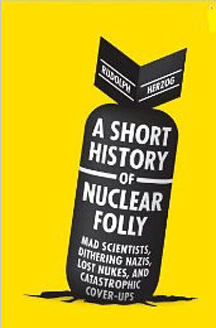 Book Review: A Short History Of Nuclear Folly http://www2.macleans.ca/2013/07/19/a-short-history-of-nuclear-folly/ by Bookmarked and Andrew Stobo Sniderman on Friday, July 19, 2013 A Short History Of Nuclear Folly By Rudolph Herzog
Reading about human courtship of nuclear destruction is like watching the wobbles of an amateur tightrope walker: one gawks in terror and amazement. Herzog, son of the eminent filmmaker, offers a snapshot tour of the “frivolity, naïveté, and unscrupulousness” with which nuclear devices have been used since physicists figured out how to get a big bang out of a wee atom. This is not a scholarly or particularly well-structured book, and it reads more like a collection of cool stuff the author found while reading around the subject of nuclear madness. Yet Herzog will make your jaw drop with regularity.
For examples: Cold-Warring Soviets forced 40,000 soldiers to march into the site of a nuclear test explosion immediately after the ascension of its mushroom cloud, just to see what happened to the poor fellows; an influential American physicist sought to blast an alternative international shipping route to the Panama and Suez canals using nuclear bombs as convenient excavation devices; and, my favourite, plutonium-powered pacemakers enraptured doctors with their long-lasting convenience, except that no one bothered to keep track of them once the patients eventually died. Woe to the cremators.
Beyond the shocking “indifference to the fate of individuals” of the superpowers as they tinkered with their nuclear toys, Herzog identifies one central problem with the nuclear fixation: persistent failures of imagination. “No one was able to picture the worst-case scenario.” So it was typical that the Soviet Union gleefully built nuclear-powered satellites, but didn’t prepare for the possibility of them crashing back to Earth. As it happened, in 1977 a malfunctioning Soviet satellite with 45 kilograms of radioactive uranium on board crashed in the Yukon. American radiation detectors didn’t work in the Canadian winter cold, but thankfully some random mushers stumbled upon the wreckage. It could have been worse. Indeed, though there was plenty of folly, often fatal, we somehow avoided Armageddon.
Mururoa nuclear veterans meeting
Veterans to gather for Mururoa nuclear testing http://tvnz.co.nz/national-news/veterans-gather-mururoa-nuclear-testing-5515297 July 20, 2013 The men who watched the French Polynesia nuclear testing from New Zealand navy boats will be gathering at the 40th anniversary reunion today.
A New Zealand Labour Government sent two warships, HMNZS Canterbury and HMNZS Otago, to monitor the nuclear tests in Mururoa and Fangataufa in French Polynesia between 1966 and 1974.
It was not believed, at the time, that they may have received nuclear dusting.
However newly declassified French military documents released this month detail the 46 atmospheric nuclear tests, revealing that warships near the tests were hit by higher levels of radioactivity than known.
A 1974 test, code named Centaur, dumped 500 times the maximum allowed level of plutonium fallout on Tahiti, 1250 kilometres away, the documents show.
There were also 140 more incidents of nuclear fallout above the 209 incidents already known. Tahiti, home to around 178,000 people, was hit 37 times by fallout.
Radiation levels frequently rose in New Zealand 4700 kilometres away following each test.The reunion will be held at the Tauranga RSA.
New Zealand’s and other countries’ veterans, victims of Mururoa nuclear tests
In April 2006, the Herald reported Dr Rowland saying a small but statistically significant level of genetic damage had been found.
“Taking all confounding factors [like smoking, alcohol and medical x-rays] into account, we are left with only one other interpretation of what it is about this group that’s different to the control group: they went to Operation Grapple.”
His work on chromosome damage – the first step in the formation of cancer – gave hope of compensation to thousands of men from Britain, Australia, Fiji and New Zealand.
The research was commissioned by Nuclear Test Veterans’ Association chairman Roy Sefton, who sought Government acknowledgment that men were harmed in their teens and had no choice on whether they went to Mururoa.
Tony Cox, who was on HMNZS Otago and heads the Rimpac veterans’ rights organisations, said an attempt was being made to convert Dr Rowland’s findings to apply to the Mururoa veterans.
“Just because the Government did not accept the Rowland study does not mean that it can’t come up for a review.”
Mr Cox said he had cancer of a type that was contracted only through exposure to ionised radiation…
Mururoa – our darker legacy New Zealand Herald By Wayne Thompson Jul 19, 2013 A band of men who “drove the taxis” – the naval frigates carrying the official New Zealand protesters against French nuclear testing in the air of the Pacific Ocean – will be in a sombre and angry mood at their 40th anniversary reunion in Tauranga tomorrow.
“Our feeling in 1973 was there was one protester, Government minister Fraser Colman,” said one of the former crew members of HMNZS Canterbury, Wayne O’Donnell.
“We were there just to keep the ship going and do what we were employed to do.
“By the time the blast was observed we were glad to head home.
“We did not expect any major radiation fallout, which has been proven wrong.” Continue reading
18 Arab nations pressure UN for Israel to come clean about nuclear weapons

 Arab States Demand Focus on Israeli Nuclear Capacities http://www.nationaljournal.com/global-security-newswire/arab-states-demand-focus-on-israeli-nuclear-capacities-20130716 By Global Security Newswire Staff July 16, 2013 Syria and 17 other Arab nations on Monday sent a top U.N. nuclear official a proposal aimed at pressuring Israel to come clean about its presumed nuclear arsenal, the Associated Press reported.
The measure is intended for consideration at a September meeting of International Atomic Energy Agency member nations.
“Israel alone possesses nuclear capabilities, which are undeclared and not subject to international control thus constituting a permanent threat to peace and security in the region,” the countries said in a statement accompanying the draft resolution sent to IAEA Director General Yukiya Amano.
The measure itself “expresses concern about the Israeli nuclear capabilities, and calls upon Israel to accede to the [Nuclear Nonproliferation Treaty] and place all of its nuclear facilities under comprehensive IAEA [inspections].”
Arab governments are pushing to focus attention on Israeli atomic activities because they hold Tel Aviv and Washington responsible for a missed 2012 deadline for holding talks on a potential Middle Eastern WMD ban, according to one insider.
Nuclear weapons insanity: America’s AIR-2 Genie rocket
it was basically a suicide device.
 The craziest part about this? In the only live test during Operation Plumbob, the US Air Force put five guys directly under the blast to prove how “safe” it was to use over populated areas. P
And the US government made 3,000 Genies.
The Five Most Insane Nuclear Delivery Systems Jaolpnik MICHAEL BALLABAN, 14 July 13
“…….Earlier this week we looked at the giantSoviet nuclear gun. That thing is definitely batty, what with its giant cannon at one end and what was essentially a tank at the other end turning it into a self-propelled howitzer. The Americans had a crazy nuke gun, too, and for awhile it looked like maybe we’d just stand and shoot atomic cannons at each other.
The thing is though, with both of those artillery pieces the actual physics package was intended to reach at least 15 miles away before the thing actually exploded. And even then, that was waytoo close.
What would happen, then, if you wanted it to explode even closer?
The AIR-2 Genie was a doomsday rocket of absolute desperation.
genie_missile_test
With the Cold War in its deepest freeze but without the benefit of long-range ICBMs, American military planners thought the only way New York, Los Angeles, or Chicago would be bombed would be in massive waves of Soviet bombers. Unfortunately, if 100 of them come at you at once, you may not shoot them all down. And really, only one getting through your defenses is necessary for absolute devastation.
In 1958, when the AIR-2 was introduced, the problem was compounded by the fact that missile guidance systems still weren’t quite up to snuff. Directly hitting all of the bombers coming at you was going to be a near-impossible task. The solution was to launch one, single, solitary missile. That missile, completely unguided, with a nuclear bomb on board, would cause a big enough explosion to hopefully wipe out all the attackers. With a big enough boom, you wouldn’t need a guidance system.
Oh, and the range was only six miles. In case you’re forgetting, most nukes make a bigger boom than that, so it was basically a suicide device.
The craziest part about this? In the only live test during Operation Plumbob, the US Air Force put five guys directly under the blast to prove how “safe” it was to use over populated areas. P
And the US government made 3,000 Genies…….. http://jalopnik.com/the-five-most-insane-nuclear-delivery-systems-768180979
Insane nuclear weapons: nuclear torpedo, and nuking the moon!
 Project A119, conceived before the Apollo landings, was ostensibly created for “science.” There’s no real science purpose to nuking the moon, though, so it’s kind of obvious what it was really about. Also, they intended to blow up the nuke on the Moon’s horizon, for maximum visibility from Earth.
For science.
The Five Most Insane Nuclear Delivery Systems Jaolpnik MICHAEL BALLABAN, 14 July 13 “……The Nuclear Torpedo Quick! Doomsday is upon us! The only way to save our cities is to get rid of all the enemy subs! Both the East and the West made nuclear torpedoes that survived in service into at least the 1970s. That’s not such a bad idea if you really want to sink something, but nukes aren’t something you just want to be using all willy-nilly. As torpedoes had the nasty habit of sometimes escaping from their tubes, this necessitated a two-step process for their use.
The Nuclear Torpedo Declassified U.S. Nuclear Test Film #46
First, the torpedo would be fired, and then a second button would be pushed to detonate it. This meant you would need a wire to connect the original sub and the newly-fired torpedo.
Nothing wrong with that, right? Just get a really long wire. And then you realize how a “really long wire” is still too short for you to get away.
The American Mark 45 torpedo had a really long wire, but even at its longest it was only eight miles in length. Even if you sunk somebody, with an 11 kiloton warhead on board, you were bound to go down to the bottom with them. http://jalopnik.com/the-five-most-insane-nuclear-delivery-systems-768180979
Project A119 Continue reading
Crazy military nuclear plans – the chicken nuke, the backpack nuke
The Five Most Insane Nuclear Delivery Systems Jaolpnik MICHAEL BALLABAN, 14 July 13 “……The Chicken Nuke When Cold War planners were planning out the seemingly inevitable Hot War, they had dreams dancing in their heads of massive waves of Russian soldiers and tanks sweeping across Germany. The British, being plucky, were confident they would lose.
The Royal Armament Research and Development Establishment developed a nuclear land mine that could be detonated either by wire or by an eight-day timer that would completely obliterate the advancing enemy columns. Not such a bad idea if you’re a fan of indiscriminate wastelands.
The only problem was that land mines tend to be buried in the ground, where it can get cold. Cold temperatures would freeze the electronics in the nuke mines, preventing them from doing their intended deadly deed. Clearly, a solution was needed to heat those bad boys up.
Blankets? No, too safe. One of those gel packs you put in your mittens when you ski? How pedestrian. No, this was 1954, and everything needed to go whoosh and phflew, so something high-tech was needed. Oh yes, that’s right.
Chickens.
The idea was to seal the chickens inside the nuclear casing as the Western armies retreated from the German plain. With a supply of food and water inside, the chickens would last for roughly a week, and their body heat would be enough to make sure everything went kaboom as normal.P
Once again, chickens.
Somehow the British actually ordered ten of these things in 1957, but supposedly none were made before the project was cancelled a year later, Let’s just hope there are no chickens buried under Germany.
The Backpack Nuke
Local news likes to whip everyone into a tizzy with tales of terrorists and backpack nukes, but the reason we know it’s a real possibility is because backpack nukes are a real thing. And we would know, because we made them.
The H-912 container for the Mark 54 Special Atomic Demolition Munition (SADM) could be feasibly carried on your back, although it does look a bit bulky. The idea would be for two guys (Navy SEALs or otherwise) to parachute into Soviet territory, set it, and forget it. The second guy would be there essentially just to back the first guy up, though in a pinch it looks like it could be used on a one-man mission.
Though it doesn’t look that big, it could actually destroy the equivalent of a few city blocks.
How fast can you run?… http://jalopnik.com/the-five-most-insane-nuclear-delivery-systems-768180979
Why UK wants nuclear submarines in Scotland, and Scotland doesn’t
The UK’s military were highly ambivalent about acquiring nuclear weapons, not least because they could not be launched without US permission. Nuclear bases on British soil have always been de facto US bases and we pay US firms for provision and maintenance. But politicians wanted them. Being a nuclear power is almost as good as still having an empire.
 Trident, the UK’s current nuclear weapon system, is in Scotland because London isn’t. That’s one of the reasons why Trident is hugely unpopular with Scots. Faslane is a deep-water port that keeps mildly unstable weapons far from the politicians disastrously wedded to the idea that if enough civilians of the right type die, almost anything is achievable.
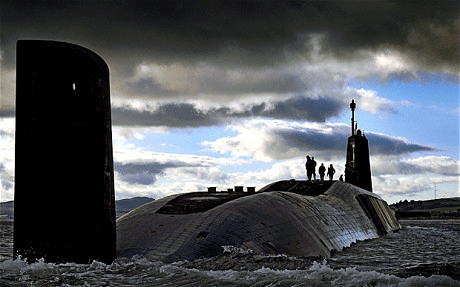 Faslane: this was a nuclear weapon for the SNP, Guardian UK, 12 July 13, The rumoured plans for the naval base were a reminder of how deeply unpopular Trident is among Scots The MoD’s, or Whitehall’s, or whoever’s plans to designate Trident’s Faslane base “sovereign UK territory” earlier this week seemed, at best, petty – an attempt at humiliation timed to balance Andy Murray’s cheering victory. It was a gift to the SNP, now denied and passed from hand to hand like a vomiting baby. That the idea was ever floated offers us another reminder of the colonial attitudes so catastrophically embedded in nuclear policy; a fundamental, fatal dismissal of “ordinary” people.
Once, it was relatively easy to acquire a colony if you had access to industrialised military production when the people you were invading didn’t. But by the end of the 19th century there was nowhere desirable left to steal, and industrialised armies finally faced each other. The results were intolerable: massive national debt and casualties that could mount by tens of thousands a day.
But then, in the 1920s, Britain’s airforce successfully bombed undefended Iraqi villages into quiescence. Italy followed suit in Ethiopia, and Germany in Spain. The age of “intimidation by bomb” was born, and with it the dream that killing a high enough percentage of a civilian population from the air would destroy a country and win a war with low military casualties……… Continue reading
Newly found documents reveal Israel’s nuclear weapons drive
Canadian report on Israeli nuclear program stunned 1964 diplomatic world BY IAN MACLEOD, OTTAWA CITIZEN JULY 12, 2013 OTTAWA — Crucial evidence of Israel’s suspected nuclear weapons program was discovered by Canada in 1964, sending shivers through Washington, Ottawa and London, according to newly-surfaced U.S. and British national archives’ papers.
A spring 1964 Canadian intelligence report revealed Argentina had secretly agreed to supply Israel with at least 80 tons of uranium oxide “yellowcake” to fabricate fuel for a mysterious nuclear reactor Israel was constructing with French assistance near the town of Dimona in the Negev Desert.
Spent, or irradiated, reactor fuel can be reprocessed to harvest plutonium for making nuclear weapons and, since 1960, the U.S. and its allies conjectured Israel was pursuing a nuclear weapons program.
But the eye-opening Canadian report, which the U.S. initially doubted, confirmed fears that Israel was ambitiously seeking a secret uranium supply, under which there would be no international safeguards to ensure the yellowcake was used for peaceful purposes.
Forty-three previously secret U.S. and British government archival documents related to the Israeli yellowcake file recently surfaced and have now been published by the U.S. National Security Archives in concert with two nuclear non-proliferation organizations…… Continue reading
UK might make nuclear base in Scotland a ‘sovereign United Kingdom territory”
Trident nuclear base on banks of the Clyde ‘could be designated as UK territory’ if Scotland votes for independence
- Idea floated as a contingency if Scotland breaks away from the UK
- But Number 10 says it is not ‘credible or sensible’
- SNP accused Westminster of trying to bully Scotland
By MATT CHORLEY, MAILONLINE POLITICAL EDITOR, 11 July 2013 The nuclear deterrent base in Scotland would be designated as sovereign United Kingdom territory under plans drawn up by the Ministry of Defence.
The move comes amid warnings of the ‘enormous’ costs of trying to relocate the Trident missile system away from Faslane if Scotland breaks away from the rest of the UK.
But David Cameron today moved to quash the idea, warning it was not a ‘credible or sensible’. The future of Britain’s nuclear deterrent has become a key area of dispute in the run up to the referendum on Scottish independence next year.
The submarines and missiles are housed at a naval base on the Clyde but the SNP wants rid of the system.
Officials in Whitehall have been looking at alternatives to ensure Britain can maintain its at sea deterrent.
Under the plan to reclassify Faslane, the base would be given the same status as the British sovereign military bases in Cyprus, the Guardian reported. Continue reading
The nuclear missile interceptor that didn’t intercept
Nuclear missile interceptor fails to hit its target during test launch as US bolsters defenses after North Korea’s weapons tests
- $214 million practice run against incoming attacks misses its mark
- Third failure for U.S.’s only defense system against long-range attack
Mail Online, By DAILY MAIL REPORTER, 7 July 2013 A missile designed to destroy nuclear missiles after they have been fired failed to hit its target during a test launch.
The ground-based interceptor missile fired from Vanderberg Air Force Base was supposed to hit a missile launched in the Kwajalein Atoll 4,000 miles away.
It was the third consecutive failure of the Interceptor system, which is managed by Boeing Co, according to defense officials……http://www.dailymail.co.uk/news/article-2357864/Nuclear-missile-interceptor-fails-hit-target-test-launch-US-bolsters-defenses-North-Koreas-weapons-tests.html#ixzz2YU83XB6B
Deadly plutonium fallout over Mururoa – truth now revealed
Mururoa fallout worse than first thought http://www.stuff.co.nz/world/south-pacific/8872214/Mururoa-fallout-worse-than-first-thought 3 July 13 MICHAEL FIELD Newly declassified French military documents have revealed that nuclear tests at Mururoa Atoll were far more deadly than has previously been admitted with plutonium fallout at much higher levels and over wider areas.
The documents cover the 46 atmospheric nuclear tests conducted at Mururoa and Fangataufa in French Polynesia between 1966 and 1974 and reveal that warships near the tests were hit by higher levels of radioactivity than known.
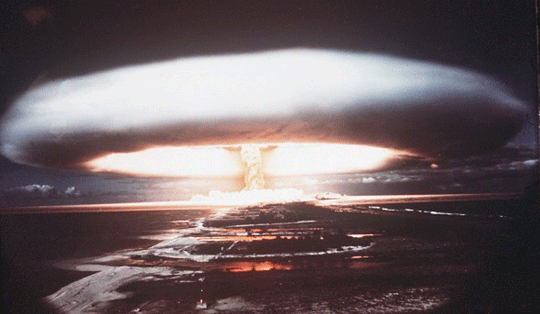
A New Zealand Labour Government in 1973 sent two warships, HMNZS Canterbury and HMNZS Otago, to monitor the Mururoa tests. It was not believed, at the time, that they may have received nuclear dusting but these new documents reveal there were much higher levels of radiation than were known.
A 1974 test, code named Centaur, dumped 500 times the maximum allowed level of plutonium fallout on Tahiti, 1250 kilometres away, the documents show.
There were also 140 more incidents of nuclear fallout above the 209 incidents already known. Tahiti, home to around 178,000 people, was hit 37 times by fallout. Continue reading
Radioactive fallout on Polynesia, from French atomic testing, far greater than they said
 French nuclear tests ‘showered vast area of Polynesia with radioactivity’ http://www.guardian.co.uk/world/2013/jul/03/french-nuclear-tests-polynesia-declassified Angelique Chrisafis in Paris The Guardian, Thursday 4 July 2013
Declassified papers show extent of plutonium fall-out from South Pacific tests of 60s and 70s was kept hidden, says French paper French nuclear tests in the South Pacific in the 1960s and 1970s were far more toxic than has been previously acknowledged and hit a vast swath of Polynesia with radioactive fallout, according to newly declassified ministry of defence documents which have angered veterans and civilians’ groups. Continue reading
Eliminating USA’s useless nuclear weapons – a smart budget move
Smart Savings in the Nuclear Budget | Commentary Roll Call, By Terri Lodge June 28, 2013, As appropriations bills move through Congress, protecting important programs and eliminating wasteful spending is on everyone’s mind. When it comes to smart budget cuts, look no further than nuclear weapons programs.
The B61 nuclear bombs deployed in Europe are a particularly glaring example of a program that drains billions of dollars from the defense budget but does nothing to advance our security.
Nuclear weapons in Europe are an oddity, a footprint of the Cold War. But from a national security perspective, their usefulness disappeared with the Berlin Wall. We can’t afford to spend billions of defense dollars on programs that don’t defend us against today’s threats. Instead of supporting Cold War relics, we should be investing in tools to address 21st-century security challenges.
These challenges are very real and very different from those we faced 20 years ago. Today, we think less about the risk of major nuclear conflict between the United States and Russia. But we think more about the risk of nuclear terrorism. We don’t talk about communist spies infiltrating Congress. But we do talk about climate change, cyberattacks and other unconventional challenges to our security. We don’t do “duck and cover” any more. So why are we investing billions of dollars to keep nuclear bombs in Europe?
Cold War thinking and budget inertia have combined for the worst possible scenario: As the broad defense budget declines, the nuclear budget is about to explode. The United States is on track to spend more than half a trillion dollars on nuclear weapons and related programs over the next 10 years.
Expensive, unnecessary nuclear programs such as the B61 are threatening to squeeze critical defense programs out of the budget. We’re planning to spend more than $10 billion dollars on the B61, while underinvesting in important programs such as nuclear terrorism prevention and next-generation biofuels to reduce our dependence on oil.
Eliminating the B61 and other nuclear programs that don’t advance U.S. security interests will free up funding for other defense priorities. Cutting the B61 for tools our troops can actually use — that’s a tradeoff any smart military strategist would make….. http://www.rollcall.com/news/smart_savings_in_the_nuclear_budget_commentary-225999-1.html
Enewetak coral atoll transformed by US atomic bomb testing
Cactus Dome: A Concrete Cap for a Nuclear Crater http://www.slate.com/blogs/atlas_obscura/2013/06/25/the_cactus_dome_is_enormous_concrete_structure_built_over_a_nuclear_crater.html By Atlas Obscura , June 25, 2013, With its ring of verdant islands surrounding a deep sapphire lagoon, the Enewetak coral atoll was a beautiful place to launch the world’s first hydrogen bomb. After capturing the atoll from the Japanese during World War II, the U.S. evacuated the islands, exhumed its fallen soldiers to send them home for reburial, and conducted a series of nuclear tests.
Between 1948 and 1958, 43 weapons exploded over Enewetak. Among these was Ivy Mike, a world-first hydrogen bomb, 500 times bigger than Hiroshima’s Little Boy, that destroyed the entire island of Elugelab. By the time testing ceased, the entire atoll was highly radioactive, its reefs and islands dotted with craters that each measured several hundred feet in diameter. (Off the coast of Runnit what looks like a natural blue hole is the Lacrosse Crater, the results of an earlier fission test.)
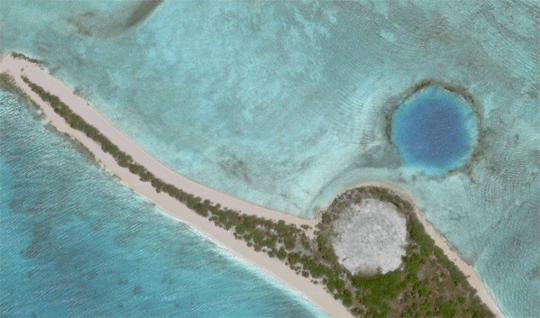
Evacuated residents began returning to Enewetak during the 1970s. It was at this time that the U.S. government determined it ought to decontaminate the islands. In 1979, a military team arrived to gather up contaminated soil and debris, mixing it with cement and piling the sludge into a 350-foot-wide blast crater on Runit Island in the atoll’s east. When the mound reached 25 feet high, army engineers covered it with a saucer-shaped concrete cap. It was dubbed the Cactus Dome, after the Cactus bomb that caused the crater.
The U.S. declared Enewetak safe for habitation in 1980. Currently, about 900 people live on the atoll though none live on the Cactus Dome. A 2008 field survey of the Cactus Dome noted that 219 of its 357 concrete panels contained defects such as cracks, chips, and vegetation taking root in joints.
1 This Month
23-25 October – on Zoom – World BEYOND War’s annual global conferenc


Shut down the radiation-damaged Heysham nuclear reactors now
To see nuclear-related stories in greater depth and intensity – go to https://nuclearinformation.wordpress.com

Say No to NASA’s Reckless Nuclear Reactor on the Moon
Say No to NASA’s Reckless Nuclear Reactor on the Moon

-
Archives
- October 2026 (199)
- September 2026 (339)
- August 2026 (330)
- July 2026 (355)
- June 2026 (287)
- May 2026 (306)
- April 2026 (356)
- March 2026 (251)
- February 2026 (267)
- January 2026 (308)
- December 2025 (358)
- November 2025 (359)
-
Categories
- 1
- 1 NUCLEAR ISSUES
- business and costs
- climate change
- culture and arts
- ENERGY
- environment
- health
- history
- indigenous issues
- Legal
- marketing of nuclear
- media
- opposition to nuclear
- PERSONAL STORIES
- politics
- politics international
- Religion and ethics
- safety
- secrets,lies and civil liberties
- spinbuster
- technology
- Uranium
- wastes
- weapons and war
- Women
- 2 WORLD
- ACTION
- AFRICA
- Atrocities
- AUSTRALIA
- Christina's notes
- Christina's themes
- culture and arts
- Events
- Fuk 2022
- Fuk 2023
- Fukushima 2017
- Fukushima 2018
- fukushima 2019
- Fukushima 2020
- Fukushima 2021
- general
- global warming
- Humour (God we need it)
- Nuclear
- RARE EARTHS
- Reference
- resources – print
- Resources -audiovicual
- Weekly Newsletter
- World
- World Nuclear
- YouTube
-
RSS
Entries RSS
Comments RSS

