In response to USA ‘encirclement’ China taking nuclear weapons underwater
China Takes Nuclear Weapons Underwater Where Prying Eyes Can’t See East Asian News and Politics 2 Jan 15 From Bloomberg News China is preparing to arm its stealthiest submarines with nuclear missiles that could reach the U.S., cloaking its arsenal with the invisibility needed to retaliate in the event of an enemy strike.
Fifty years after China carried out its first nuclear test, patrols by the almost impossible-to-detect JIN class submarines armed with nuclear JL–2 ballistic missiles will give President Xi Jinping greater agility to respond to an attack.
The nuclear-powered subs will probably conduct initial patrols with the missiles by the end of this year, “giving China its first credible sea-based nuclear deterrent,” according to an annual report to Congress submitted in November by the U.S.-China Economic and Security Review Commission.
Deploying the vessels will burnish China’s prestige as Xi seeks to end what he calls the “cold war” mentality that resulted in U.S. dominance of Asia-Pacific security. Since coming to power, Xi has increased military spending with a focus on longer-range capacity, including plans to add to the country’s tally of a single aircraft carrier.
“For the first time in history, China’s nuclear arsenal will be invulnerable to a first strike,” said independent strategist Nicolas Giacometti, who has written analysis for The Diplomat and the Center for Strategic and International Studies. “It’s the last leap toward China’s assured nuclear-retaliation capability.”…………….
First Use
“We must continue to modernize our nuclear capabilities,” Admiral Harry Harris said Dec. 2 at his nomination hearing to become commander of the U.S. Pacific Command, when asked how the U.S. should respond to China’s build up. Harris said that he considered North Korea, which is developing its own nuclear arsenal, to be the biggest threat to security in Asia.
Analysts don’t expect China to modify its longstanding “no-first-use” nuclear policy that states its weapons will only be used if China comes under nuclear attack.
Having enhanced its nuclear-deterrence capability, China may begin to communicate more about the planned evolution of its nuclear forces, Giacometti said.
“More openness on China’s side might then open up more space for confidence-building measures and lay the ground for future arms control discussions,” he said. http://pinione.blogspot.com.au/2014/12/china-takes-nuclear-weapons-underwater.html
Time to strengthen, not break down the Intermediate-Range Nuclear Forces Treaty,


 Stop the nuclear treaty breakdown before it escalates WP, By Editorial Board December 28 THE OBAMA administration has been careful to say that some matters of bilateral interest with Russia can remain on the table despite the confrontation over Russia’s seizure of Crimea and subversion in eastern Ukraine. One such area still under discussion has been the claim made this year by the United States that Russia violated the 1987 Intermediate-Range Nuclear Forces treaty, which eliminated an entire class of nuclear weapons and delivery vehicles in Europe. Russia claims the United States also has violated the treaty. Yet this conversation is going nowhere. The treaty is valuable to both nations, and Russia, in particular, ought not to slow-walk resolution of a nettlesome disagreement.
The treaty, which entered into force in 1988, required the elimination of all the approximately 800 U.S. and 1,800 Soviet ground-launched missileswith maximum ranges between 500 and 5,500 kilometers, as well as their launchers and associated support equipment. It was a Cold War landmark that reversed a dangerous period in the late 1970s and early 1980s when both sides were deploying nuclear-armed missiles in Europe aimed at each other. The missiles were eliminated by 1991. The treaty barred possession, production or flight tests of such weapons………http://www.washingtonpost.com/opinions/stop-the-nuclear-treaty-breakdown-before-it-escalates/2014/12/28/c08ef924-820c-11e4-81fd-8c4814dfa9d7_story.html
Just the bare $1.6 Trillion since 9/11 spent by USA on war
 $14 Million An Hour: War Costs Top $1.6 Trillion Since 9/11, Say Congressional Researchers-– http://www.ibtimes.com/14-million-hour-war-costs-top-16-trillion-911-say-congressional-researchers-1764816 By David Sirota @davidsirota d.sirota@ibtimes.com on December 22 2014 American taxpayers have shelled out roughly $1.6 trillion on war spending since 9/11, according to a newreport from Congress’ nonpartisan research arm. That’s roughly $337 million a day — or nearly a quarter million dollars a minute — every single day for 13 years.
The $1.6 trillion estimate, which comes to $14 million per hour since 9/11, from the Congressional Research Service is up roughly half a trillion dollars from its 2010 estimate, which found that the post-9/11 military operations are second only to World War II in terms of financial cost.
In its report, which was released earlier this month, CRS finds that the 92 percent of the war-related expenditures since 9/11 have flowed into the Pentagon. Just 6 percent has been spent on foreign assistance and diplomacy, and 1 percent on medical services for veterans.
The report, which was posted on the website of the Federation of American Scientists, breaks down the war-related expenditures by different military operations. It finds that a little more than half the $1.6 trillion has gone toward operations in Iraq. Another $686 billion has been spent on military operations in Afghanistan.
CRS notes that the Obama administration is requesting nearly $6 billion in new funding to finance military operations against the Islamic State group, but researchers note that predicting “future costs of the new U.S. role in countering the Islamic State is difficult because of the nature of the air campaign and uncertainties about whether the U.S. mission may expand.”
Last week, a Defense Department official disclosed that since August, U.S. taxpayers have already spent more than $1 billion — or $8 million a day — on air strikes against the Islamic State in Iraq and Syria. Additionally, the Obama administration announced it is deploying 1,300 troops to Iraq in January
2015 court hearings- Marshall Islands versus the world’s nuclear arsenals
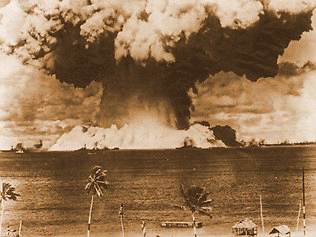 A Former Ground Zero Goes to Court Against the World’s Nuclear Arsenals NYT, By MARLISE SIMONSDEC. 27, 2014 THE HAGUE — Tony de Brum was 9 years old in 1954 when he saw the sky light up and heard the terrifying rumbles of “Castle Bravo.” It was the most powerful of 67 nuclear tests detonated by the United States in the Marshall Islands, the remote Pacific atolls he calls home.
Six decades later, with Mr. de Brum now his country’s foreign minister, the memory of those thundering skies has driven him to a near-Quixotic venture: His tiny country is hauling the world’s eight declared nuclear powers and Israel before the International Court of Justice. He wants the court to order the start of long-promised talks for a convention to ban atomic arsenals, much like the treaties that already prohibit chemical, biological and other weapons of mass destruction.
Mr. de Brum says the initiative is not about seeking redress for the enduring contamination and the waves of illness and birth defects attributed to radiation. Rather, by turning to the world’s highest tribunal, a civil court that addresses disputes between nations, he wants to use his own land’s painful history to rekindle global concern about the nuclear arms race………
In its first written arguments, presented to the court this month, the Marshall Islands contended that the nuclear powers had violated their legal obligation to disarm. Specifically, the arguments said, by joining the 1968 Nuclear Nonproliferation Treaty, five countries — the United States, Russia, Britain, France and China — undertook to end the arms race “at an early date” and to negotiate a treaty on “complete disarmament.”
Three other nuclear nations that did not agree to the treaty — India, Israeland Pakistan — and a fourth that withdrew from it — North Korea — are required to disarm under customary international law, the Marshall Islands’ case claims. The existence of Israeli nuclear weapons is universally assumed, but Israel has not acknowledged having them.
“All the nuclear weapons states are modernizing their arsenals instead of negotiating, and we want the court to rule on this,” said Phon van den Biesen, the leader of the islands’ legal team, who first asked the court to hear the case in April…….. Continue reading
Obama’s $1-trillion upgrade of USA’s nuclear arsenal – to ‘confront Russia’
 Obama Upgrades Nuclear Arsenal For “Direct Confrontation With Russia” http://www.opednews.com/articles/Obama-Upgrades-Nuclear-Ars-by-Sherwood-Ross-Nuclear-Cover-up_Nuclear-Powers_Obama-Administration_Obama-Nuclear-141223-671.htmlBy Sherwood Ross (about the author) President Obama’s “gift” to Americans this holiday season is to renege on his 2009 pledge “to seek the peace and security of a world without nuclear weapons.”
Global danger as China and India upgrade their ballistic missiles

 The Most Dangerous Nuclear Threat No One Is Talking About Zachary Keck http://nationalinterest.org/blog/the-most-dangerous-nuclear-threat-no-one-talking-about-11899 December 19, 2014 While Iran and North Korea’s nuclear programs are all the rage these days, the most dangerous nuclear threat facing the world continues to go largely unnoticed.
Namely, China and India are both on the cusp of deploying multiple independently targetable reentry (MIRV) vehicles on their ballistic missiles, a development that is likely to have profound, far-reaching consequences for the region and beyond.
MIRVed missiles carry payloads of several nuclear warheads each capable of being directed at a different set of targets. They are considered extremely destabilizing to the strategic balance primarily because they place a premium on striking first and create a “use em or lose em” nuclear mentality.
Along with being less vulnerable to anti-ballistic missile systems, this is true for two primary reasons. First, and most obviously, a single MIRVed missile can be used to eliminate numerous enemy nuclear sites simultaneously. Thus, theoretically at least, only a small portion of an adversary’s missile force would be necessary to completely eliminate one’s strategic deterrent. Secondly, MIRVed missiles enable countries to use cross-targeting techniques of employing two or more missiles against a single target, which increases the kill probability.
In other words, MIRVs are extremely destabilizing because they make adversary’s nuclear arsenals vulnerable to being wiped out in a surprise first strike. To compensate for this fact, states must come up with innovative ways to secure their deterrent from an enemy first strike. This usually entails increasing the size of one’s arsenal, and further dispersing to make it more difficult for an enemy to conduct a successful first strike. For example, when the U.S. first deployed MIRVed missiles in 1968, the Soviet Union had less than 10,000 nuclear warheads. A decade later, however, it had over 25,000 (of course, the Soviet Union deploying its own MIRVed missiles incentivized expanding the size of its arsenal since more warheads were needed per missile).
With regards to China and India, then, the introduction of MIRVed missiles could have profound consequences of both of their nuclear postures. One of the most remarkable aspects of every nuclear state not named Russia or the United States is they have relied on an extremely small nuclear arsenal to meet their deterrent needs. This is especially true of India and China who have generally maintained minimum deterrence and no-first use doctrines. With the introduction of countervailing MIRVed missiles, however, there will be strong incentives on both sides to vastly increase the size of their arsenals if any to guard against the threat of a first strike by the other side.
Of course, the consequences of China and India acquiring MIRVed missiles would not be limited to those states alone. Most obviously, India’s acquisition of MIRVed missiles would immediately threaten the survivability of Pakistan’s nuclear forces. In the short-term, this will probably result in Islamabad further dispersing its nuclear arsenal, which in general will leave it more vulnerable to Islamist terrorist groups in the country. Over the long-term, Pakistan will feel pressure to expand the size of its arsenal as well as acquire MIRVed capabilities of its own.
The same pressures will be felt in Moscow.Since the disintegration of the Soviet Union, Russia has relied on its vast nuclear arsenal to compensate for its relative conventional weakness. In the eyes of Russian leaders, this will only grow more necessary as China continues to modernize its conventional military forces. Currently, Russia holds vastly more nuclear warheads than China, which is a source of relief for Moscow. As China MIRVs its missiles, however, as well as likely builds up the size of its arsenal, Moscow will see its nuclear superiority over Beijing rapidly erode. It can be counted on to respond by abrogating its arms control treaties with the United States, and expanding its own arsenal as well. In such a situation, a U.S. president would come under enormous domestic pressure to meet Russia’s buildup warhead for warhead.
Thus, while the prospect of North Korea and Iran acquiring operationalized nuclear arsenals may be concerning, China and India’s MIRVed missiles present far greater threats to the world.
China’s conventional and nuclear weaponry tend to merge
The WU-14 flights are just the latest installment of Chinese military systems revealed to the world through tests and roll-outs. Other examples in recent memory include China’s anti-satellite test (ASAT) in 2007, its ballistic missile defence (BMD) tests in 2010, 2013 and 2014, as well as its unveiling of the J-20 stealth fighter in 2010. This is not to mention its flight of an unmanned aerial vehicle (UAV) in 2013, test of the intercontinental ballistic missile DF-31A in 2014 and recent revelations regarding the DF-41.
The level of sophistication and deployment of many of these systems remains to be seen. Still, these roll-outs indicate that China is shifting from transparency based on intent to one rooted in capabilities.
t first glance, Beijing’s approach towards conventional and nuclear deterrence may appear distinct and static. China’s conventional deterrence is based on war-fighting, counter-force, asymmetry and pre-emption. This is contrasted with its nuclear deterrence posture, which has for decades been founded on non-war-fighting, counter-value, asymmetry and no-first-use. It is often taken for granted that these two deterrence postures are isolated, with their only real point of intersection being asymmetry. Yet, there are indications that China’s conventional and nuclear deterrence are far less independent and fixed than its rhetoric suggests.
This stems from at least five factors:
- China’s Second Artillery has been responsible for both its conventional and nuclear missiles since the early 1990s. The potential for crossover between these two domains has only grown since that time, particularly in light of its training of personnel and advances in missile technology in recent years.
- China’s conventional and nuclear command and control centres are reportedly co-located. This means that an attack, whether through advanced conventional systems or cyber-attacks, while intending to negate conventional command and control centres, could also threaten China’s nuclear command and control, thus leading to escalation.
- China’s system of tunnels leaves gaps in the understanding of its nuclear and conventional forces. While there has been debate about the potential trove of nuclear warheads within China’s Great Wall Engineering project, the issue is less one of quantity than of overall inability to account for location, systems and practices that some Chinese experts maintain verify nuclear posture…………………
Religions unite in speaking out for nuclear disarmament, at Vienna conference
 Faiths United Against Nuclear Weapons TruthOut , 15 December 2014 By Julia Rainer, Inter Press Service | Report Vienna – “Never was there a greater need than now for all the religions to combine, to pull their wisdom and to give the benefit of that combined, huge repository of wisdom to international law and to the world.”
The words are those of Christopher Weeramantry, former judge at the International Court of Justice (ICJ) and its vice-president from 1997 to 2000, who was addressing a session on faiths united against nuclear weapons at the civil society forum organised by the International Campaign to Abolish Nuclear Weapons (ICAN) on Dec. 6 and 7 in the Austrian capital.
Weeramantry strongly criticised the argument of those who claim that nuclear weapons have saved the world from another world war in the last 50 years.
He pointed to the ever-present danger represented by these weapons and said that on many occasions it had been luck that had prevented catastrophic nuclear accidents or the breaking out of a devastating nuclear war.
Noting that nuclear weapons “offend every single principle of religion,” Weeramantry was joined on the panel by a number of different religious leaders, including Mustafa Ceric, Grand Mufti of Bosnia and Herzegovina, Ela Gandhi, granddaughter of Mahatma Gandhi and peace activist, as well as Akemi Bailey-Haynie, national women’s leader of the Buddhist organisation Soka Gakkai International-USA……………….
Desmond Tutu, Nobel Peace Laureate and former Anglican Bishop, sent a video message to participants to express his deep solidarity and support for ICAN’s civil society forum initiative.
He argued that the best way to honour the victims of the incidents in Hiroshima and Nagasaki was to negotiate a total ban on nuclear weapons to ensure that nothing comparable could ever happen again.
Two of the session’s speakers, Ela Gandhi and Mustafa Ceric, also attended the Dec. 8-9 Vienna Conference on the Humanitarian Impact of Nuclear Weapons.
There, Ela Gandhi delivered a speech in the spirit of her grandfather who, she said, would have joined the movement to abolish nuclear weapons if still alive.
As Gandhi had dedicated his life to teaching humanity that there is a non-violent way of dealing with conflict, he even condemned nuclear weapons himself in 1946 when he said: “The atom bomb mentality is immoral, unethical, addictive and only evil can come from it.”
Pointing out that the mere existence of nuclear weapons leads to similar armament of rival countries, Ela Gandhi warned that these nuclear arsenals could destroy a chance for future generations to survive and have a prosperous life………
Religion played an important role at the conference, where many lobbying groups had religious backgrounds, and the opening ceremony was addressed by Pope Francis.
“I am convinced that the desire for peace and fraternity, planted deep in the human heart, will bear fruit in concrete ways to ensure that nuclear weapons are banned once and for all, to the benefit of our common home,” aid Pope Francis, expressing his hope that “a world without nuclear weapons is truly possibly.”
In a statement on behalf of faith communities to the final session, Kimiaki Kawai, Program Director for Peace Affairs at Soka Gakkai International (SGI), said: “The elimination of nuclear weapons is not only a moral imperative; it is the ultimate measure of our worth as a species, as human beings.”
He said that “acceptance of the continued existence of nuclear weapons stifles our capacity to think more broadly and more compassionately about who we are as human beings, and what our potential is. Humanity must find alternative ways of dealing with conflict.”http://www.truth-out.org/news/item/28004-faiths-united-against-nuclear-weapons
Russia boasts of The Right To Put Nuclear Weapons In Crimea
 Russia: We Have The Right To Put Nuclear Weapons In Crimea Business Insider JEREMY BENDER Russia announced on Monday that it believes it has the full right to deploy nuclear weapons in the recently annexed Crimean peninsula.
Russian Foreign Minister Sergei Lavrov told the Interfax news agency that since Crimea was now a part of Russia, Moscow had full rights to deploy nuclear weapons into the region.
Lavrov argues that Crimea can be treated just like any other part of Russia and can therefore host nuclear infrastructure. “Now Crimea has become part of a state which possesses such weapons in accordance with the Nuclear Nonproliferation Treaty,” says Lavrov. “In accordance with international law, Russia has every reason to dispose of its nuclear arsenal … to suit its interests and international legal obligations.”………
Technically, neither the US nor Russia can move strategic nuclear forces without verifying the deployment with the other country due to the 2010 New START treaty, which set a timeline for mutual cuts to the countries’ nuclear stockpiles. Any Russian movement of strategic nuclear weapons into Crimea (long-range, high-yield weapons, as opposed to tactical or battlefield nuclear warheads) without prior notification to the US would result in Russia violating the treaty. http://www.businessinsider.com.au/russia-we-can-put-nuclear-weapons-in-crimea-2014-12
USA Air Force’s past and future dreams of Nuclear-Armed Drone Bombers
 America Almost Had a Nuclear-Armed Drone Bomber, Medium.com, Adam Rawnsley
on Dec 16 2014 Air Force wanted to remove the pilots from B-47s Long before the CIA began sending missile-armed drones to attack Taliban and Al Qaeda operatives in Afghanistan, U.S. Air Force officials mulled sending robotic aircraft against the Soviet Union.
Carrying nuclear bombs.
Starting in late 1949, Air Force officials kicked off what would become Project Brass Ring, an attempt to turn long-range B-47 Stratojet bombers into remotely-piloted nuclear-weapons delivery vehicles.
We learned about the Air Force’s quest to build an unmanned nuclear bomber—which the flying branch ultimately abandoned—from A History of the Air Force Atomic Energy Program: 1943–1953, a series of declassified internal studies on the Air Force’s early nuclear history………
the Air Force opted to end the research.
Until recently. Today the Air Force is shopping around for a new nuclear-capable Long Range Strike Bomber. There’s speculation that the plane could wind up being “optionally-manned”—that is, robotic with the flip of a switch. Much like Brass Ring’s B-47 six decades ago. https://medium.com/war-is-boring/america-almost-had-a-nuclear-armed-drone-bomber-e494e2e9a286
US government planning to spend $1 trillion on upgrading nuclear weapons
 The nuclear money pit, The Economist Does America really need a new plutonium production line? Dec 15th 2014 | LOS ANGELES THE RECENT sabre rattling by Vladimir Putin may have unwittingly done what the United States Congress has failed to do for decades: refocus attention—and billions of additional dollars—on overhauling America’s nuclear arsenal. The $585 billion defence bill for the next fiscal year sailed through the House of Representatives last week with broad bipartisan support, and then did the same in the Senate on December 12th, despite all the fractious squabbling over the $1.1 trillion government funding measure.
More pertinently, the $11.7 billion request for the National Nuclear Security Administration (NNSA), a branch of the Department of Energy that oversees nuclear weapons, naval reactors and nonproliferation activities on behalf of the military, represents a 4% increase over the previous year. The biggest chunk of that—covering work on modernising the country’s nuclear weapons—is to increase by 7%. All this at a time when mandated “sequestration” cuts are supposed to be reducing military spending.
All told, the federal government intends allocating up to $1 trillion to upgrade the country’s missiles, bombers and submarines over the coming decades. Continue reading
Vienna focus on the catastrophic risks of nuclear weapons, but UK and USA oppose moves for a disarmament timetable
 Nuclear arms risks — a reminder, Japan Times, DEC 14, 2014 International efforts toward eliminating nuclear weapons in recent years have come to focus on the devastating consequences their use can have on humanity. The third Conference on the Humanitarian Impact of Nuclear Weapons was held on Dec. 8 and 9 in Vienna, following the first conference in Oslo in March 2013 and the second gathering in Nayarit in Mexico in February 2014.
Although the Vienna conference was unable to come up with a concrete timetable to get rid of nuclear arms, discussions at the meeting helped deepen understanding among participants of “the consequences and the actual risks posed by nuclear weapons,” according to the statement issued by Sebastian Kurz, Austria’s minister for foreign affairs and integration, who chaired the confeƒrence.
The meeting underscored all the more the need for both nuclear powers and nonnuclear states to make serious efforts to make the world free of the devastating weapons whose effects will put victims in affliction for decades to come.
The chair’s summation of the discussions by delegates from 158 nations, the United Nations, the Red Cross movement, civic organizations and academia stressed that the “scope, scale and interrelationship of the humanitarian consequences caused by a nuclear weapon detonation are catastrophic and more complex than commonly understood. These consequences can be large-scale and potentially irreversible.”
More than five years have passed since U.S. President Barack Obama put forward his vision of creating a world without nuclear weapons in his April 2009 speech in Prague. But little progress for nuclear disarmament has since been made, despite the signing of a new nuclear arms reduction treaty between the United States and Russia.
Both countries are modernizing their nuclear weapons. ……..
The U.S. and the United Kingdom, both nuclear weapons states under the Nuclear Nonproliferation Treaty, attended the conference for the first time — itself a meaningful development.
But while the chair’s statement said the “only assurance against the risk of a nuclear weapon detonation is the total elimination of nuclear weapons,” the U.S. expressed opposition to a treaty banning nuclear arms, although it said its commitment to creating a nuclear weapons-free world is firm.
The U.K. also opposed prohibiting nuclear weapons at this moment or setting up a timetable for their elimination from security viewpoint………
Setsuko Thurlow, who was exposed to the atomic bombing of Hiroshima at the age of 13 and now lives in Canada, talked about her experience and suffering. She asked how long the world will continue to allow the nuclear powers to threaten lives on Earth and called for starting work immediately toward a nuclear arms ban treaty…….http://www.japantimes.co.jp/opinion/2014/12/14/editorials/nuclear-arms-risks-reminder/#.VI8q6NLF8nk
Hostilities escalate, but Russia rules out a pre emptive nuclear strike
Russia Rules Out Pre-emptive Nuclear Attack But Will Strike When Provoked or Under Threat – Report International Business Times, By Erik Pineda | December 13, 2014 As reports came out that Russia under President Vladimir Putin is getting overly aggressive in Europe, per NATO claims, analysts begin to entertain fears of pre-emptive nuclear strike by the Kremlin.
The NATO leadership announced this week that Moscow is engaged in a high-level of military activities in the Baltic region, underscored by the 400 times that alliance jet fighters were scrambled this 2014 in response to incursions made byRussian military planes.
NATO declared that Russia’s recent actions “can be destabilising and potentially dangerous,” according to The Daily Mail.
Now the question begs: Will this bold display of power foreshadow the escalation of hostilities?
No pre-emptive strike
While the tense posturing between Russia and the West – the U.S. and NATO specifically, could potentially graduate into a shooting a war, the Kremlin, as dictated by its recently revised military doctrine, will not fire the first shot, according to a new report byRT.com.
“The renewed draft of the military doctrine would not have a reservation for preventive nuclear strikes on potential enemy,” the news site added, pointing to unnamed insiders from Russia’s Defence Ministry as sources.
It was indicated too in the same report that pre-emptive nuclear attack on specifically identified enemies was deliberated upon by the Russian military and political leaders but the option was not included in the doctrine that was finalised in 2010.
Russia, however, is not discounting the use of nuclear weapons, which they will be willing to rain down on deemed aggressors when provoked. “The Russian Federation reserves the right to use nuclear weapons in reply to strikes with nuclear weapons or other weapons of mass destruction on its territory or on the territory of its allies,” the doctrine reportedly states………
Perceived threats
Not surprisingly, Moscow pinpoints Washington and its NATO allies as threats. “Russian foreign policy appears to be based on a combination of fears of popular protest and opposition to U.S. world hegemony,” writes Jonathan Masters, deputy editor for the Council on Foreign Relations.
Putin is apparently convinced that the U.S. and NATO is undermining Russia’s influence in the former Soviet Union republics, according to Masters, likely making the two as prime targets of Russia’s nuclear attack blueprint in the event World War III erupts.
To report problems or to leave feedback about this article, e-mail:r.pineda@ibtimes..com.au
To contact the editor, e-mail: editor@ibtimes.com http://au.ibtimes.com/articles/575843/20141213/russia-nuclear-attack-world-war-3-nato.htm#.VI8opNLF8nk
Talk in Ukraine about reviving nuclear weapons

 Nuclear weapons revival talked about by Ukrainian President Petro Poroshenko Inquisitr.com Dec. 14, 2014,The possibility of Urkaine’s nuclear weapons programs being revived has been discussed ever since it was claimed that Russia’s tactical nuclear weapons may have been moved into the Crimean Peninsula. Recently, Ukrainian President Petro Poroshenko answered questions on whether Kiev is willing to bring back their nuclear status in order to survive the confrontation with Vladimir Putin.
Earlier this year, Minister of Defense of Ukraine Valerii Heletei claimed that Russia was threatening Ukraine with tactical nuclear weapons.
“I am drawing attention to Russia’s threatening Ukraine with the use of tactical nuclear weapons,” Heletei noted. “If we fail to defend Ukraine today, if the world does not help us, we will have to get back to the creation of such weapons, which will defend us from Russia.”
This alleged threat led to the discussion of restoring Ukraine’s nuclear weapons program by Heletei, but only if “the world does not help us.” Recently, both the House and the Senate in the U.S. Congress passed legislation that promised lethal aid to Ukraine. According to the Kiev Post, when Ukrainian President Petro Poroshenko spoke about Ukraine’s nuclear weapons programs, he declared that Kiev would not pursue that option………..http://www.inquisitr.com/1677316/ukraine-nuclear-weapons-revival-talked-about-by-ukrainian-president-petro-poroshenko/#2ZO69ZkEBcQho87h.99
Vienna Conference supports Marshall Islands Against Nuclear Weapons,
 The Marshall Islands case, which has received worldwide attention and support from many different organisations, is often referred to as “David vs. Goliath”…..: “The Marshall Islands is a small, gutsy country. It is not a country that will be bullied, nor is it one that will give up.“
Civil Society Support for Marshall Islands Against Nuclear Weapons, truthout, Friday, 12 December 2014 10:00By Julia Rainer, Inter Press Service Vienna – Ahead of the Dec. 8-9 Vienna Conference on the Humanitarian Impact of Nuclear Weapons, activists from all over the world came together in the Austrian capital to participate in a civil society forum organised by the International Campaign to Abolish Nuclear Weapons (ICAN) on Dec. 6 and 7.
One pressing issue discussed was the Marshall Islands’ lawsuit against the United States and eight other nuclear-weapon nations that was filed at the International Court of Justice (ICJ) in April 2014, denouncing the over 60 nuclear tests that were conducted on the small island state’s territory between 1946 and 1958.
The location was chosen not only because it was an isolated part of the world but also because at the time it was also a Trust Territory of the Pacific Islands governed by the United States. Self-government was achieved in 1979, and full sovereignty in 1986.
The people of the Marshall Islands were neither informed nor asked for their consent and for a long period did not realise the harm that the testing would bring to the local communities. Continue reading
1 This Month
23-25 October – on Zoom – World BEYOND War’s annual global conferenc


Shut down the radiation-damaged Heysham nuclear reactors now
To see nuclear-related stories in greater depth and intensity – go to https://nuclearinformation.wordpress.com

Say No to NASA’s Reckless Nuclear Reactor on the Moon
Say No to NASA’s Reckless Nuclear Reactor on the Moon

-
Archives
- October 2026 (199)
- September 2026 (339)
- August 2026 (330)
- July 2026 (355)
- June 2026 (287)
- May 2026 (306)
- April 2026 (356)
- March 2026 (251)
- February 2026 (267)
- January 2026 (308)
- December 2025 (358)
- November 2025 (359)
-
Categories
- 1
- 1 NUCLEAR ISSUES
- business and costs
- climate change
- culture and arts
- ENERGY
- environment
- health
- history
- indigenous issues
- Legal
- marketing of nuclear
- media
- opposition to nuclear
- PERSONAL STORIES
- politics
- politics international
- Religion and ethics
- safety
- secrets,lies and civil liberties
- spinbuster
- technology
- Uranium
- wastes
- weapons and war
- Women
- 2 WORLD
- ACTION
- AFRICA
- Atrocities
- AUSTRALIA
- Christina's notes
- Christina's themes
- culture and arts
- Events
- Fuk 2022
- Fuk 2023
- Fukushima 2017
- Fukushima 2018
- fukushima 2019
- Fukushima 2020
- Fukushima 2021
- general
- global warming
- Humour (God we need it)
- Nuclear
- RARE EARTHS
- Reference
- resources – print
- Resources -audiovicual
- Weekly Newsletter
- World
- World Nuclear
- YouTube
-
RSS
Entries RSS
Comments RSS

