Pentagon’s nuclear-powered spending: a $trillion and climbing
Behold the Pentagon’s Amazing, Nuclear-Powered ATM, Mother Jones
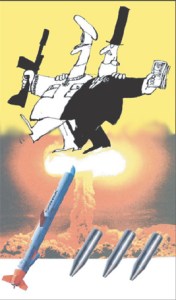 When the going gets tough, the world’s toughest military sends out RFPs.
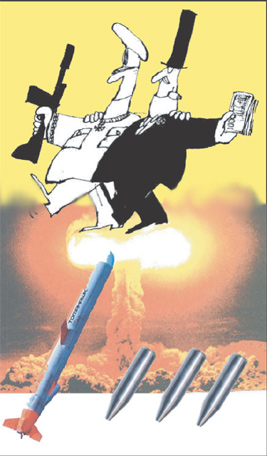
ANDREW COCKBURNJUN. 24 “………creating and maintaining an effective fighting force becomes a secondary consideration, reflecting a relative disinterest—remarkable to outsiders—in the actual business of war, as opposed to the business of raking in dollars for the Pentagon and its industrial and political partners. A key element of the strategy involves seeding the military budget with “development” projects that require little initial outlay but which, down the line, grow irreversibly into massive, immensely profitable production contracts for our weapons-making cartels……
ongoing and dramatic programs to invest vast sums in meaningless, useless, or superfluous weapons systems are the norm. There is no more striking example of this than current plans to rebuild the entire American arsenal of nuclear weapons in the coming decades, Obama’s staggering bequest to the budgets of his successors.
These nuclear initiatives have received far less attention than they deserve, perhaps because observers are generally loath to acknowledge that the Cold War and its attendant nuclear terrors, supposedly consigned to the ashcan of history a quarter-century ago, are being revived on a significant scale. The US is currently in the process of planning for the construction of a new fleet of nuclear submarines loaded with new intercontinental nuclear missiles, while simultaneously creating a new land-based intercontinental missile, a new strategic nuclear bomber, a new land-and-sea-based tactical nuclear fighter plane, a new long-range nuclear cruise missile (which, as recently as 2010, the Obama administration explicitly promisednot to develop), at least three nuclear warheads that are essentially new designs, and new fuses for existing warheads. In addition, new nuclear command-and-control systems are under development for a fleet of satellites (costing up to $1 billion each) designed to make the business of fighting a nuclear war more practical and manageable.
This massive nuclear buildup, routinely promoted under the comforting rubric of “modernization,” stands in contrast to the president’s lofty public ruminations on the topic of nuclear weapons. The most recent of these was delivered during his visit—the first by an American president—to Hiroshima last month. There, he urged“nations like my own that hold nuclear stockpiles” to “have the courage to escape the logic of fear, and pursue a world without them.”
In reality, that “logic of fear” suggests that there is no way to “fight” a nuclear war, given the unforeseeable but horrific effects of these immensely destructive weapons. They serve no useful purpose beyond deterring putative opponents from using them, for which an extremely limited number would suffice. During the Berlin crisis of 1961, for example, when the Soviets possessed precisely four intercontinental nuclear missiles, White House planners seriously contemplated launching an overwhelming nuclear strike on the USSR. It was, they claimed, guaranteed to achieve “victory.” As Fred Kaplan recounts in his book Wizards of Armageddon, the plan’s advocates conceded that the Soviets might, in fact, be capable of managing a limited form of retaliation with their few missiles and bombers in which as many as three million Americans could be killed, whereupon the plan was summarily rejected.
In other words, in the Cold War as today, the idea of “nuclear war-fighting” could not survive scrutiny in a real-world context. Despite this self-evident truth, the US military has long been the pioneer in devising rationales for fighting such a war via ever more “modernized” weapons systems. ……..
The drive to develop and build such systems on the irrational pretense that nuclear war fighting is a practical proposition persists today. One component of the current “modernization” plan is the proposed development of a new “dial-a-yield” version of the venerable B-61 nuclear bomb. Supposedly capable of delivering explosions of varying strength according to demand, this device will, at least theoretically, be guidable to its target with high degrees of accuracy and will also be able to burrowdeep into the earth to destroy buried bunkers. The estimated bill—$11 billion—is a welcome boost for the fortunes of the Sandia and Los Alamos weapons laboratories that are developing it.
The ultimate cost of this new nuclear arsenal in its entirety is essentially unknowable. The only official estimate we have so far came from the Congressional Budget Office, which last year projected a total of $350 billion. That figure, however, takes the “modernization” program only to 2024……..
Assiduously tabulating these projections, experts at the Monterey Center for Nonproliferation Studies peg the price of the total program at a trillion dollars. In reality, though, the true bill that will come due over the next few decades will almost certainly be multiples of that. For example, the Air Force has claimed that its new B-21 strategic bombers will each cost more than $564 million (in 2010 dollars), yet resolutely refuses to release its secret internal estimates for the ultimate cost of the program.
To offer a point of comparison, the F-35 Joint Strike Fighter, the tactical nuclear bomber previously mentioned, was originally touted as costing no more than $35 million per plane. In fact, it will actually enter service with a sticker price well in excess of $200 million.
Nor does that trillion-dollar figure take into account the inevitable growth of America’s nuclear “shield.”……..http://www.motherjones.com/politics/2016/06/pentagon-budget-nuclear-spending
NUCLEAR-capable ballistic missiles for Russia – placed in Europe
Russia to deploy NUCLEAR-capable ballistic missiles in the heart of EUROPE, Express, UK 23 June 16 RUSSIA plans to station advanced nuclear-capable missiles deep inside Europe – putting vast swathes of the continent in the crosshairs of Moscow’s short-range ballistic missile programme. By TOM BATCHELOR, Jun 23, 2016 Kremlin insiders say the Russian enclave of Kaliningrad – on the Baltic Sea wedged between Poland and Lithuania – will host the Iskander missile – dubbed the Stone by Nato.
Crimea, which was annexed from the Ukraine in 2014, could also host a second Iskander missile base, Russian defence sources claim.
Russia has been accused of blatant acts of aggression in eastern Europe and the Baltics, with land grabs, military exercises and close fly-bys of its fighter jets.
The move is in defiance of a US-backed Nato missile shield that was erected in Romania last month, with a second planned for Poland in 2018.
With a range of roughly 300 miles, the Iskander missile could hit targets as far away as eastern Germany, the entire Baltic region and Poland, as well as parts of Sweden.
But experts say the targets it will cover can be struck by longer-range Russian missiles anyway.
Relations between Russia and the West have plunged to their lowest point since the Cold War in recent months.
Both sides have ramped up their defence spending, missile programmes and defensive shields as Europe enters what many observers believe is a new Cold War…….http://www.express.co.uk/news/world/682701/Russia-station-Iskander-nuclear-missiles-Kaliningrad-Cold-War-tensions
Spanish village scarred by American air crash, with 4 hydrogen nuclear bombs on board
Even Without Detonation, 4 Hydrogen Bombs From ’66 Scar Spanish Village NYT, By RAPHAEL MINDER JUNE 20, 2016 PALOMARES, Spain — José Manuel González Navarro, a mechanic, headed out of this seaside village on his motorbike one morning 50 years ago when he heard explosions overhead and looked up to see a ball of fire in the sky. Debris started to shower down, some “falling very slowly, like if a giant tree was shedding shiny metal leaves,” he recalled in an interview.
“I was just thinking about what objects might prove useful,” he said. “I liked fishing, and those parachute straps, thin but very solid, were clearly perfect to be turned into a weight belt for diving.”
Like many in Palomares, Mr. González Navarro, now 71, figured he had witnessed a military air crash. But he was unaware that a United States Air Force bomber and a refueling jet collided, accidentally sending four hydrogen bombs hurtling toward Palomares. Although no warheads detonated, two of the bombs shattered, spreading plutonium over the village.
Whereas American service members are complaining that the hurried cleanup effort carried out by the military jeopardized their health, many in Palomares lament the damage the accident has done to their community.
“Living in a radioactive site that nobody really has wanted to clean has brought us a lot of bad publicity and has been something hanging over our head like a sword of Damocles,” said Juan José Pérez Celdrán, a former mayor of Palomares. For years after the crash, local tomatoes, lettuce and watermelons did not carry any Palomares label because of the stigma associated with the place.
And the cleanup effort continues half a century later.
In 1966, American troops removed about 5,000 barrels of contaminated soil after the accident and called the cleanup complete. But about a decade ago, the Spanish authorities found elevated levels of plutonium over 99 acres. Some of the areas of elevated radioactivity almost touched private homes, as well as fields and greenhouses. Scientists from Ciemat, the Spanish nuclear agency, fenced off the most hazardous sections and began pressuring the United States to remove about 65,000 cubic yards of radioactive soil — far more than was removed right after the accident……..http://www.nytimes.com/2016/06/21/world/europe/spain-palomares-hydrogen-bombs.html?_r=1
Nuclear Suppliers Group should say NO to India’s try for membership
The Nuclear Suppliers Group’s Critical India Decision An upcoming meeting will decide whether India will be allowed to join. Member states should think carefully. The Diplomat, By Mark Hibbs June 18, 2016 Beginning on Monday, the Nuclear Suppliers Group, or NSG – 48 countries that export most of the world’s nuclear material, equipment, and technology – will meet in Seoul to decide whether India should now be allowed to join. The United States has strongly urged the NSG to say yes.
The NSG should not say yes next week. It should tell India that there are good reasons to include it, but also that the group needs to complete an internal fact-finding and consensus-forming process in part to prepare the NSG for the consequences of possible Indian membership.
The United States has argued that bringing India into the group would be good for nuclear nonproliferation. So far it isn’t clear what the net overall benefit would be, especially because the White House is prepared to go forward without India having made non-proliferation commitments that many others in the group have made and virtually all say are important.
All NSG members are parties to the Nuclear Nonproliferation Treaty, or NPT. For the group’s 43 states without nuclear arms, NPT membership commits them not to possess these weapons. For the five states in the NSG with nuclear weapons, NPT membership means that they have legally committed themselves to nuclear disarmament and not to assist others in obtaining nuclear weapons. In addition, NSG members have taken other important steps toward a nuclear weapon-free future, by joining the Comprehensive Nuclear Test Ban Treaty (CTBT), by joining treaties that create nuclear weapons-free zones, and/or by permitting the International Atomic Energy Agency to verify that no aspect of their nuclear programs are being used to produce uranium or plutonium for nuclear weapons.
India is a nuclear-armed state. India is not a party to the NPT, it is not a party to a nuclear weapon-free zone treaty, it will not join the CTBT, and it will not make legal commitments identical to NPT articles concerning its nuclear arms. NSG members therefore are compelled to think harder than in previous cases about what will be the consequences of admitting India into the group. Those consequences include the impact on current NSG rules that discourage assistance to nuclear weapons programs in four non-NPT countries, as well as the impact on global efforts to strengthen specific NPT norms……..
The United States advocates Indian NSG membership for commercial and geostrategic reasons largely unrelated to nuclear export controls. Neither ground justifies forcing a decision now. In 2008, the NSG elected to permit civilian nuclear trade with India, meaning that India can import a raft of reactors its wants to buy from vendor Westinghouse. ……http://thediplomat.com/2016/06/the-nuclear-suppliers-groups-critical-india-decision/
America does not need the new $30 billion Long-Range Standoff Weapon
The Air Force is set next year to accelerate the development of this new nuclear cruise missile. It would carry an upgraded W-80 nuclear warhead and be able to penetrate the world’s most advanced air-defense systems…….
There are three key questions that remain unanswered.
“hold at risk” using existing nuclear and conventional weapons and the platforms used to deliver them? We are aware of no such military necessity.Next, what role does the military intend this weapon to serve? The Pentagon says it would “provide the president with uniquely flexible options in an extreme crisis.” This suggests a lowering of the threshold for nuclear war, a perilous approach that would endanger not only America but allies that we are pledged to protect, like Japan and South Korea.
Finally, what is the weapon’s cost? The Defense Department and the National Nuclear Security Administration have yet to provide concrete estimates for the program, but the Federation of American Scientists hasreported that it could cost as much as $30 billion.
At a time when the Defense Department is set to modernize every leg of the nuclear triad, investing $30 billion in an unnecessary and dangerous new nuclear weapon is irresponsible………http://www.nytimes.com/2016/06/18/opinion/a-nuclear-weapon-that-america-doesnt-need.html?_r=0
America’s unnecessary $1 trillion nuclear missile splurge
 America Already Has More Than Enough Nuclear Missiles. FP.com BY ADAM SMITH, JUNE 17, 2016But Republicans are pushing a $1 trillion nuclear modernization program, which would not only bankrupt the Pentagon but could spark a global nuclear arms race. This summer, Congress has been tying itself up in knots, trying to decide how to adequately fund U.S. national defense priorities, given the limits imposed by sequestration. But the difficult reality is that, however we choose to address immediate challenges, any rational attempt to plan for America’s future security must begin with a clear-eyed reassessment of the costs, trade-offs, and dangers of the trillion-dollar plan Washington is undertaking to modernize the U.S. nuclear weapons complex. That reassessment should include an effort to eliminate the new nuclear cruise missile.
The truth is that the United States can retain a credible nuclear deterrent with significantly fewer nuclear weapons and fewer delivery systems, at a fraction of the cost.
Instead, and with little debate, Congress has embarked on a plan to modernize all of these systems and increase these capabilities at an estimated total cost of $1 trillion over 30 years. This effort largely results fromdecisions made before the advent of the Budget Control Act and an ideological commitment to nuclear weapons by the Republican majority, which recently described them as our national security priority and “the foundation of all our defense efforts” in its security strategy. That plan means purchasing new nuclear weapons production facilities and labs, refurbishing warheads, land-based ballistic missiles, ballistic missile submarines, building new strategic bombers and nuclear-capable fighter aircraft, and, to top it all off, a new nuclear cruise missile.
These expenses will soon constitute a huge proportion of the U.S. defense budget: Yearly nuclear modernization costs will soon balloon and then more than double in the ensuing years, requiring at least $40 billion annually between 2024 and 2036, or nearly 10 percent of defense costs………
Now is the time for serious oversight and a realistic approach to these issues in order to stop an emerging arms race and avoid wasting billions of dollars we cannot afford. http://foreignpolicy.com/2016/06/17/nuclear-missiles-triad-congress-budget/
The American President’s Nuclear Codes
 Nuclear codes: A president’s awesome power By Mark Hertling June 10, 2016 CNN The military aides who carry it call it “the football.” The more accurate name is the “president’s emergency response satchel.” But no matter what it is called, the contents of this small metal briefcase contained within a black leather satchel is always within a few feet of the president of the United States.

Britain was secretly upgrading Trident nuclear arsenal prior to Parliamentary consent
MoD admits it’s worried about security at Trident nuclear weapons base, Rt.com 9 Jun, 2016 Britain’s Trident nuclear weapons program has suffered a skills shortage for the last 10 years, posing a threat to nuclear safety, a Ministry of Defence (MoD) report says.
The latest annual report from the MoD’s internal watchdog, the Defence Nuclear Safety Regulator (DNSR), says staff shortages are a “key strategic issue” which requires attention to ensure continued “safe delivery” of the nuclear weapons program…….
On Tuesday, it was revealed by the Nuclear Information Service that Britain was secretly upgrading its arsenal of Trident nuclear weapons and developing an entirely new warhead.
Controversially, parliament is yet to consent to its renewal. https://www.rt.com/uk/345975-trident-nuclear-security-concern/
North Korea reopening plutonium facility?
Pyongyang vowed in 2013 to restart all nuclear facilities, including the main reactor at its Yongbyon site that had been shut down and has been at the heart of its weapons program.
It said in September that Yongbyon was operating and that it was working to improve the “quality and quantity” of its nuclear weapons. It has since carried out what is widely believed to have been a nuclear test.
The International Atomic Energy Agency (IAEA), which has no access to NorthKorea and mainly monitors its activities by satellite, said last year it had seen signs of a resumption of activity at Yongbyon, including at the main reactor…….
Little is known about the quantities of weapons-grade uranium or plutonium that North Koreapossesses, or its ability to produce either, though plutonium from spent fuel at Yongbyon is widely believed to have been used in its nuclear bombs.
North Korea has come under tightening international pressure over its nuclear weapons program, including tougher U.N. sanctions adopted in March backed by its lone major ally China, following its most recent nuclear test in January…….http://www.huffingtonpost.com.au/2016/06/07/north-korea-appears-to-reopen-plutonium-plant-nuclear-watchdog/
The threat of a nuclear arms race in East Asia
A nuclear arms race in East Asia? It is a place where most nations deeply distrust their neighbours, and where old-style nationalism still reigns supreme. Aljazeera, by Andrei Lankov Andrei Lankov is professor of Korean Studies at Kookmin University, Seoul. He is the author of “The Real North Korea: Life and Politics in the Failed Stalinist Utopia”.
Recently, news from the Korean Peninsula has been dominated by missiles: as satellite images confirmed, the North Koreans have been busy preparing another test launch of “BM-25 Musudan”, their intermediate-range missile.
The launch ended in failure, the fourth such failure in this year. Nonetheless, North Korean engineers and scientists are busy developing both long-range and submarine-based ballistic missiles, capable of hitting the United States.
There has been much hype about the recent Musudan launch, but few people noticed another piece of news that came from South Korea a week earlier.
A high-ranking official, speaking on condition of anonymity – but clearly authorised to make such statements – said that the South Korean navy is also developing its own submarine-launched ballistic missiles (SLBM), so the new South Korean submarines will be equipped with a launchpad.
This statement was a reminder of another possible challenge associated with the North Korean nuclear and missile programmes: The threat is that its programmes will provoke a symmetrical response from the countries in the region, triggering a missile and, perhaps, even a nuclear arms race………
If the nuclear and missile arms race starts in East Asia, where will it stop? East Asia today is eerily reminiscent of Europe in the early 1900s, before the outbreak of World War I.
It is also a place where most nations deeply distrust their neighbours, and where old-style nationalism still reigns supreme.
So far, age-old hatreds have been controlled by the US hegemony – Koreans and Japanese, in spite of their historical animosities, have been prevented from confrontation by their alliances with the US – as well as by the record high economic growth. But will such a state of things continue indefinitely? This looks increasingly unlikely……
And, surely, there is the “China factor” – the rising superpower is, to put it mildly, quite unpopular among its neighbours, from Vietnam to Japan.
In the changing strategic situation, many such countries can choose nuclear weapons as a way to deter China which – due to its sheer size and economic might – can hardly be deterred by conventional weapons.
Indeed, the eventual deployment of the North Korean nuclear-armed missiles, combined with signs of US indecisiveness, might easily push South Korea towards acquiring its own nuclear deterrent.
Technically, acquiring nuclear weapons would not cost much money or take much time for a highly developed nation such as South Korea.
If it happens, the probability of a nuclear Japan will increase, and Taiwan, as well as more advanced countries of South East Asia, might start wondering why they should be left behind.
Usually, such columns are supposed to end with some positive suggestions, but in this case there is hardly anything optimistic to say.
North Koreans are determined to maintain and improve their nuclear deterrent, and given their strategic situation, they can hardly be blamed for such an attitude.
However, their actions increase the risk to security in this vital region, and perhaps the entire world. http://www.aljazeera.com/indepth/opinion/2016/06/nuclear-arms-race-east-asia-160602091442504.html
North Korea: Ballistic missile launch fails for the fourth time in recent months, South Korea says
 North Korea appears to have tried and failed with a fresh ballistic missile launch in violation of existing UN resolutions, South Korea’s Defence Ministry said.
Key points:
- The fourth recent attempt to launch the North’s medium-range Musudan missile has failed
- Japan had readied naval destroyers and anti-ballistic missile batteries, media said
- G7 leaders demanded last week that the North refrain from provocative action
Seoul said the missile test took place at 6:30am AEST on Tuesday near the eastern port city of Wonsan.
“The attempted missile launch … is believed to have failed,” a ministry spokesman said……..http://www.abc.net.au/news/2016-05-31/north-korea-ballistic-missile-launch-fails-south-korea-says/7461280
Despite Obama’s calls for nuclear disarmament, U.S. disarmament is slowest since 1980
 Obama calls for end to nuclear weapons, but U.S. disarmament is slowest since 1980 https://www.washingtonpost.com/news/the-fix/wp/2016/05/27/obama-calls-for-end-to-nuclear-weapons-but-u-s-disarmament-is-slowest-since-1980/ By Philip Bump Speaking from Hiroshima, the site of the first war-time atomic weapon detonation, President Obama on Friday called for the pursuit of “a world without nuclear weapons.”
Only a few days prior, his Department of Defense published new data revealing that the government Obama oversees — a government which manages the second-largest nuclear stockpile in the world — had dismantled fewer of its nuclear devices than in any year since at least 1980.
Every year, the Department of Defense declassifies data on the size of the country’s nuclear stockpile and the number of warheads dismantled. Its most recent data, released this week, shows that the U.S. stockpile numbered 4,571 at the end of 2015, about 15 percent of its size at its peak during the Cold War in 1967. The number of weapons dismantled was 109, the lowest figure since at least 1980.
n 1945, the size of the stockpile matched the number of weapons deployed — two. The biggest reductions came in the early 1990s during the administration of George H.W. Bush and, a decade later, during his son’s. At the end of 2008, the stockpile numbered 5,273; over the course of Obama’s two terms, it has dropped to 4,571.
It is, of course, easier to reduce the size of a stockpile when it is much larger. As a fraction of the total weapon count, Obama has sliced the total by a bit more than one-tenth — 13 percent. But the Federation of American Scientists is still critical of Obama’s progress in this regard. That 13 percent is “the smallest reduction of the stockpile achieved by any previous post-Cold War administration;” the 109 dismantlings last year continues “a trendline of fewer and fewer warheads dismantled” under Obama. The FAS notes that there are reasons outside of the administration’s control for the lower number last year — but also that political pressure discourages a push for reduction.
Why does the size of our stockpile matter? As data from the Stockholm International Peace Research Institute shows, the United States still controls about half of the weapons controlled by recognized nuclear states.
Obama meets Hiroshima survivors, calls for a ‘Moral Revolution’ for nuclear disarmament
At Hiroshima Memorial, Obama Says Nuclear Arms Require ‘Moral Revolution’, NYT 27 May 16 HIROSHIMA, Japan — President Obama laid a wreath at the Hiroshima Peace Memorial on Friday, telling an audience that included survivors of America’s atomic bombing in 1945 that technology as devastating as nuclear arms demands a “moral revolution.”
Thousands of Japanese lined the route of the presidential motorcade to the memorial in the hopes of glimpsing Mr. Obama, the first sitting American president to visit the most potent symbol of the dawning of the nuclear age. Many watched the ceremony on their cellphones.
In an emotional moment afterward, Mr. Obama embraced and shook hands with survivors of the attack, which exposed humanity to risks the president has repeatedly said the world must do far more to resolve.
……..For weeks, the White House had refused to say whether Mr. Obama, would meet survivors. It was a delicate decision. Many survivors long for an apology for an event that destroyed just about everyone and everything they knew, and there were small demonstrations near the ceremony on Friday by protesters demanding an apology. But Mr. Obama said before his trip that he would not apologize for the attack.
Still, Mr. Obama’s homage to the victims and his speech were welcomed by many Japanese. “I am simply grateful for his visit,” said Tomoko Miyoshi, 50, who lost 10 relatives in the Hiroshima attack and wept as she watched Mr. Obama on her cellphone.
In his speech, Mr. Obama, using the slow and deliberate cadence that he uses on only the most formal and consequential occasions, said that the bombing of Hiroshima demonstrated that “mankind possessed the means to destroy itself.”
In a striking example of the gap between Mr. Obama’s vision of a nuclear weapons-free world and the realities of purging them, a new Pentagon census of the American nuclear arsenal shows his administration has reduced the stockpile less than any other post-Cold War presidency.
“We must have the courage to escape the logic of fear and pursue a world without them,” he said, although he quickly added: “We may not realize this goal in my lifetime, but persistent effort can roll back the possibility of catastrophe.” http://www.nytimes.com/2016/05/28/world/asia/obama-hiroshima-japan.html?_r=0
Obama’s Hiroshima Visit Is a Reminder that Atomic Bombs Weren’t What Won the War
 The World Post, Gar Alperovitz Author, Political Economist, Historian05/24/2016 U.S.
 President Barack Obama’s forthcoming visit to Hiroshima offers an opportunity to reconsider some of the myths surrounding the historic decision to use the atomic bomb. Such reconsideration also helps focus attention on how we can avoid any future use of weapons that are now thousands of times more powerful than the ones used in 1945.
A good place to start is with an unusual and little-noticed display at The National Museum of the United States Navy in Washington. A plaque explaining an exhibit devoted to the atomic bombings declares: “The vast destruction wreaked by the bombings of Hiroshima and Nagasaki and the loss of 135,000 people made little impact on the Japanese military. However, the Soviet invasion of Manchuria on 9 August — fulfilling a promise made at the Yalta Conference in February — changed their minds.”
Though the surprising statement runs contrary to the accepted claim that the atomic bombs ended World War II, it is faithful to the historical record of how and why Japan surrendered. The Japanese cabinet — and especially the Japanese army leaders — were not, in fact, jolted into surrender by the bombings. Japan had been willing to sacrifice city after city to American conventional bombing in the months leading up to Hiroshima — most dramatically in the March 9 firebombing of Tokyo, an attack that cost an estimated 100,000 lives.
What Japan’s military leaders were focused on was the Red Army, which was poised to take on the best of Japan’s remaining army in Manchuria. The historical record also makes clear that American leaders fully understood this. Indeed, before the atomic bomb was successfully tested, U.S. leaders desperately sought assurances that the Red Army would attack Japan after Germany was defeated. The president was strongly advised that when this happened, Japan was likely to surrender with the sole proviso that Japan be allowed to keep its emperor in some figurehead role.
Nor was this deemed a major problem. The U.S. military had long planned to keep the emperor in such a role to help control Japan during the postwar occupation. Once the atomic bomb was successfully tested, however, assurances for the emperor that were included in the 1945 Proclamation Defining Terms for Japanese Surrender were eliminated, making it certain Japan would continue to fight. As the Navy museum plaque also accurately explains: “Truman’s political advisors overrode the views of the military leaders and foreign policy makers, insisting that Americans would not accept leniency towards the emperor.”
Although it goes on to suggest this was done for political, not military reasons, there are unresolved questions about this judgment. ……
early postwar critics pointed out that there is considerable evidence that diplomatic reasons concerning the Soviet Union — not military reasons concerning Japan — may have been important. For instance, after a group of nuclear scientists met with Truman’s chief adviser on the atomic bomb, U.S. Secretary of State James Byrnes, onereported that, “Mr. Byrnes did not argue that it was necessary to use the bomb against the cities of Japan in order to win the war … Mr. Byrnes’ … view [was] that our possessing and demonstrating the bomb would make Russia more manageable.”……..
Gar Alperovitz is the author of two major studies of the atomic bombings: “Atomic Diplomacy: Hiroshima and Potsdam“ and “The Decision to Use the Atomic Bomb,” where references to the key documentary sources in this piece can also be found. http://www.huffingtonpost.com/gar-alperovitz/obama-hiroshima-bomb_b_10067434.html
The USA Pentagon’s budget labyrinth for a planned $1 trillion splurge
The Pentagon’s War on Accountability: Slush Funds, Smoke and Mirrors, and Funny Money Equal Weapons Systems Galore By William D. Hartung, Tom Dispatch, Reader Supported News, 24 May 16 Slush Funds Galore
“………If smokescreens and evasive maneuvers aren’t enough to hide the Pentagon’s actual priorities from the taxpaying public, there’s always secrecy. The Secrecy Project at the Federation of American Scientists recently put the size of the intelligence portion of the national security state’s “black budget“ — its secret spending on everything from spying to developing high-tech weaponry — at more than $70 billion. That figure includes a wide variety of activities carried out through the CIA, the NSA, and other members of the intelligence community, but $16.8 billion of it was requested directly by the Department of Defense. And that $70 billion is just the tip of the iceberg when it comes to secret spending programs, since billions more in secret financing for the development and acquisition of new weapons systems has been squirreled away elsewhere.
The largest recent project to have its total costs shrouded in secrecy is the B-21, the Air Force’s new nuclear bomber. Air Force officials claim that they need to keep the cost secret lest potential enemies “connect the dots” and learn too much about the plane’s key characteristics. In a letter to Senator McCain, an advocate of making the cost of the plane public, Ronald Walden of the Air Force’s Rapid Capabilities Office claimed that there was “a strong correlation between the cost of an air vehicle and its total weight.” This, he suggested, might make it “decisively easier” for potential opponents to guess its range and payload.
If such assessments sound ludicrous, it’s because they are. As the histories of other major Pentagon acquisition programs have shown, the price of a system tells you just that — its price — and nothing more. Otherwise, with its classic cost overruns, the F-35 would have a range beyond compare, possibly to Mars and back. Of course, the real rationale for keeping the full cost estimate for the B-21 secret is to avoid bad publicity. Budget analyst Todd Harrison of the Center for Strategic and International Studies suggests that it’s an attempt to avoid “sticker shock” for a program that he estimates could cost more than $100 billion to develop and purchase.
The bomber, in turn, is just part of a planned $1 trillion splurge over the next three decades on a new generation of bombers, ballistic missile submarines, and ground-based nuclear missiles, part of an updating of the vast U.S. nuclear arsenal. And keep this in mind: that trillion dollars is simply an initial estimate before the usual Pentagon cost overruns even begin to come into play. Financially, the nuclear plan is going to hit taxpayer wallets particularly hard in the mid-2020s when a number of wildly expensive non-nuclear systems like the F-35 combat aircraft will also be hitting peak production.
Under the circumstances, it doesn’t take a genius to know that there’s only one way to avoid the budgetary equivalent of a 30-car pile up: increase the Pentagon’s already ample finances yet again. Principal Deputy Undersecretary of Defense Brian McKeon was referring to the costs of building new nuclear delivery vehicles when he said that the administration was “wondering how the heck we’re going to pay for it, and probably thanking our lucky stars we won’t be here to answer the question.” Of course, the rest of us will be stuck holding the bag when all those programs cloaked in secrecy suddenly come out of hiding and the bills come fully due.
At this point, you may not be shocked to learn that, in response to McKeon’s uncomfortable question, the Pentagon has come up with yet another budgetary gimmick. It’s known as the “National Sea-Based Deterrence Fund,” or as Taxpayers for Common Sense more accurately labels it, “the Navy’s submarine slush fund.” The idea — a longstanding darling of the submarine lobby (and yes, Virginia, there is a submarine lobby in Washington) — is to set up a separate slush fund outside the Navy’s normal shipbuilding budget. That’s where the money for the new ballistic missile submarine program, currently slated to cost $139 billion for 12 subs, would go.
Establishing such a new slush fund would, in turn, finesse any direct budgetary competition between the submarine program and the new surface ships the Navy also wants, and so avoid a political battle that might end up substantially reducing the number of vessels the Navy is hoping to buy over the next 30 years. Naturally, the money for the submarine fund will have to come from somewhere, either one of the other military services or that operations and maintenance budget so regularly raided to help pay for expensive weapons programs.
Not to be outmaneuvered, Air Force Secretary Deborah Lee James has now asked Congress to set up a “strategic deterrence fund” to pay for its two newest nuclear delivery vehicles, the planned bomber and a long-range nuclear-armed ballistic missile. In theory, this would take pressure off other major Air Force projects like the F-35, but as with the submarine fund, it only adds up if a future president and a future Congress can be persuaded to jack up the Pentagon budget to make room for these and other weapons systems.
In the end, however the specifics work out, any “fund” for such weaponry will be just another case of smoke and mirrors, a way of kicking the nuclear funding crisis down the road in hopes of fatter budgets to come. Why make choices now when the Pentagon and the military services can bet on blackmailing a future Trump or Clinton administration and a future Congress into ponying up the extra billions of dollars needed to make their latest ill-conceived plans add up?
If your head is spinning after this brief tour of the Pentagon’s budget labyrinth, it should be. That’s just what the Pentagon wants its painfully complicated budget practices to do: leave Congress, any administration, and the public too confused and exhausted to actually hold it accountable for how our tax dollars are being spent. So far, they’re getting away with it.
William D. Hartung, a TomDispatch regular, is the director of the Arms and Security Project at the Center for International Policy and a senior adviser to the Security Assistance Monitor. He is the author of, among other books, Prophets of War: Lockheed Martin and the Making of the Military-Industrial Complex.
Follow TomDispatch on Twitter and join us on Facebook. Check out the newest Dispatch Book, Nick Turse’s Next Time They’ll Come to Count the Dead, and Tom Engelhardt’s latest book, Shadow Government: Surveillance, Secret Wars, and a Global Security State in a Single-Superpower World. http://readersupportednews.org/opinion2/277-75/37052-the-pentagons-war-on-accountability-slush-funds-smoke-and-mirrors-and-funny-money-equal-weapons-systems-galore
1 This Month
23-25 October – on Zoom – World BEYOND War’s annual global conferenc


Shut down the radiation-damaged Heysham nuclear reactors now
To see nuclear-related stories in greater depth and intensity – go to https://nuclearinformation.wordpress.com

Say No to NASA’s Reckless Nuclear Reactor on the Moon
Say No to NASA’s Reckless Nuclear Reactor on the Moon
-
Archives
- October 2026 (180)
- September 2026 (339)
- August 2026 (330)
- July 2026 (355)
- June 2026 (287)
- May 2026 (306)
- April 2026 (356)
- March 2026 (251)
- February 2026 (267)
- January 2026 (308)
- December 2025 (358)
- November 2025 (359)
-
Categories
- 1
- 1 NUCLEAR ISSUES
- business and costs
- climate change
- culture and arts
- ENERGY
- environment
- health
- history
- indigenous issues
- Legal
- marketing of nuclear
- media
- opposition to nuclear
- PERSONAL STORIES
- politics
- politics international
- Religion and ethics
- safety
- secrets,lies and civil liberties
- spinbuster
- technology
- Uranium
- wastes
- weapons and war
- Women
- 2 WORLD
- ACTION
- AFRICA
- Atrocities
- AUSTRALIA
- Christina's notes
- Christina's themes
- culture and arts
- Events
- Fuk 2022
- Fuk 2023
- Fukushima 2017
- Fukushima 2018
- fukushima 2019
- Fukushima 2020
- Fukushima 2021
- general
- global warming
- Humour (God we need it)
- Nuclear
- RARE EARTHS
- Reference
- resources – print
- Resources -audiovicual
- Weekly Newsletter
- World
- World Nuclear
- YouTube
-
RSS
Entries RSS
Comments RSS

