Talk of new atomic tests by Trump and Putin should make UK rethink its role as a nuclear silo for the US.
The Conversation, November 7, 2025, Tom Vaughan. Senior Research Associate, CERI, Sciences Po ; University of Leeds
The Russian president, Vladimir Putin, has said that Russia may could carry out nuclear weapons tests for the first time since the cold war.
In what appears to be a response to a statement by Donald Trump on October 30, that he had ordered the US to restart nuclear tests “on an equal basis” with Russia and China, Putin said he’d been advised by his defence staff that it was “advisable to prepare for full-scale nuclear tests”.
At present there is no evidence that either Russia or China is conducting nuclear tests, which were discontinued by most nuclear states after the test ban treaties of the early 1990s.
Nonetheless, the two leaders’ nuclear bluster is a sobering reminder of the dangers posed by nuclear brinkmanship between the US and Russia.
It is worth remembering that at the height of the cold war, the superpowers prepared to settle their confrontation in the territories of central Europe with little regard for the millions they would kill. US strategists hoped that a “tactical” nuclear conflict might contain the war to Europe, sparing the continental United States.
Independent deterrent?
This is the context for the UK public accounts committee releasing a report last week which detailed further “delays, cost inflation, and deep-rooted management failures” in the RAF’s procurement of F-35 stealth fighter aircraft.
The F-35 is increasingly coming to be viewed in some US defence circles as an expensive failure. This year, however, the UK’s Labour government committed to buying 15 additional F-35B aircraft (having already ordered 48), but also adding 12 of the F-35A variant………………………………………………………………………………….
Incompatible with democracy
This is a clear demonstration that nuclear weapons and deterrence policies have always been incompatible with democracy. They require huge secrecy, and the speed involved means that launch decisions are out of the public’s hands. Instead, any decisions to use these incredibly destructive weapons – with all that this implies for the planet – are concentrated in the hands of individual leaders.
The logic of nuclear deterrence breaks down, however, once we remember that the UK’s control over its own nuclear weapons – not to mention the US weapons hosted on its soil – is very limited. The US could at any moment withdraw its assistance for the Trident programme, making questions of British willingness to fight a nuclear war irrelevant.
The F-35A purchase redoubles the UK’s commitment to serving as Donald Trump’s nuclear aircraft carrier. It makes the country a target in any nuclear war that might be started by two unpredictable and violent superpowers. Other US allies get the same treatment: Australian analysts lament that the Aukus submarine deal with the UK and US yokes the country’s future “to whoever is in the White House”…………………………………………………………………………… https://theconversation.com/talk-of-new-atomic-tests-by-trump-and-putin-should-make-uk-rethink-its-role-as-a-nuclear-silo-for-the-us-269040
The UK’s £1 billion Thank You to Uncle Sam

The UK is set to buy a fleet of US fighter jets that can drop nuclear bombs. The purchase is purely political, say watchdogs
RICHARD NORTON-TAYLOR, 6 November 2025, https://www.declassifieduk.org/the-uks-1-billion-thank-you-to-uncle-sam/
Keir Starmer’s plan to buy American fighter jets armed with nuclear bombs whose use will be entirely under the US president’s control makes no military sense, nuclear weapons monitors warn.
In a report released today, the Nuclear Information Service and Nukewatch UK make clear that the deal, announced by the prime minister on the eve of a Nato summit in June, is a blatant attempt to appease President Trump.
The new fleet of F-35 As is estimated to cost about £1 billion. That does not include the cost of the nuclear bombs which the aircraft would carry.
But the cost is only one of many uncertainties surrounding the project.
The decision to buy twelve F-35 A aircraft for the Royal Air Force capable of dropping US B61 gravity, “free fall” nuclear bombs – so-called “tactical” nuclear weapons – risks triggering a dangerous nuclear escalation, increasing the threat to British citizens, says the report.
And because their role would be dependent on the US, it would do nothing to address European concerns about America’s commitment to the Nato alliance, it adds.
The report says the decision “was made for purely political purposes rather than to provide a military capability that will play any meaningful role in defending Nato”. The move also undermines the nuclear non proliferation treaty (NPT).
UK picks up the tab
The nuclear bombs provided to RAF aircraft would replicate capabilities already provided by other European Nato members, says the report.
Moreover, the monitors find there is no guarantee that the weapons carried by F-35s with a limited range would succeed in any conflict.
The decision to buy the fleet of nuclear bombers from the US “reflects a long-standing trend by the UK government to prioritise trans-Atlantic politics over genuine military needs”, the report emphasises.
It quotes Bernard Gray, a former top Ministry of Defence official responsible for weapons procurement who said: “If money was no object, we could view the £2 bn price tag for doing this as a Thank You to Uncle Sam.”
Gray, who was referring to the potential price of both the planes and the bombs, added: “The UK is in effect picking up part of the cost of the mission that would otherwise fall on the US. In a world that wants to please President Trump, it’s easy to see how it plays well to buy aircraft primarily built in Texas.”
The authors of this year’s Strategic Defence Review, led by former Labour defence secretary Lord George Robertson, have downplayed the idea of Britain joining a Nato “tactical nuclear” weapons mission.
Robertson has suggested that a perceived capability gap between strategic nuclear deterrence and tactical nuclear weapons could be bridged by investing, instead, in heavy long-range conventional weapons.
His caution was echoed by Fiona Hill, British-born former national security adviser to Trump, during a Defence Committee evidence session in June.
Pointing to how Germany, Belgium, the Netherlands, Italy and Turkey host US nuclear weapons, she added: “There are other allies who already have dual capable aircraft as part of their arsenal”.
In a reference to Britain’s Trident nuclear missile system, she made the point that Britain already played a “unique role” in Nato.
Concerns over Trident reliance
But today’s report also points to potential vulnerability of Trident, Britain’s strategic nuclear weapons system which relies heavily on US support, and serious mechanical problems affecting the new Dreadnought fleet of submarines designed to carry the missiles.
The report points to widespread scepticism about the role of theatre nuclear weapons, and the misleading assumption that using them would not escalate a conflict leading to the use of longer range and larger nuclear weapons systems.
It quotes Sir Lawrence Freedman, one of Britain’s foremost military strategists, as saying: “There are lots of ways of hurting countries without actually having to use nuclear weapons yourself”.
“The idea that the further proliferation of theatre nuclear weapons is necessary or will make the world safer in any way is clearly absurd,” says the report.
“When looked at objectively, they are merely a ‘solution’ looking for a problem.”
The report also makes the point that while the theatre nuclear weapons proposed for the RAF would be entirely dependent on the US, Trident is far from being the independent deterrent as successive British governments have persistently claimed.
Britain relies entirely on the US for Trident missiles as well as the design of modern nuclear warheads.
There are also growing concerns about the reliability of Trident submarines leading with longer and longer patrols at sea, while the timetable for replacing the existing Vanguard class with Dreadnought class is slipping.
Turning back the clock
Okopi Ajonye, research manager at Nuclear Information Service told Declassified: “The UK government went to a lot of trouble to denuclearise the RAF at the end of the Cold War. This move was welcomed by the service, as it allowed the air force to focus on more important and relevant roles.
“Starmer and Healey now want to turn the clock back and commit the RAF to an entirely unnecessary nuclear mission that will have major implications for the service and considerable hidden costs.”
Ajonye added that the proposal “has all the hallmarks of having been pulled together in a hurry without any thought about its practicalities or consequences” and guided by the politics of the Nato alliance rather than military need.
“The government’s plan is basically just political smoke and mirrors to deceive the public and politicians from other Nato countries into thinking that the UK is taking a significant step to strengthen its nuclear forces when in reality it is doing next to nothing,” he said
“The UK’s entry into Nato’s nuclear mission is driven less by strategic or military necessity and more by a desire to reassure two audiences: domestic political concerns over the crumbling Trident programme, and international concerns about the credibility of US security guarantees to Europe”.
Costs add up
There are also concerns over the management of the existing F-35 fleet with a recent report by the Commons Public Accounts Committee expressing serious concerns about the MoD’s handling of the warplanes, including what it calls an unacceptable shortage of engineers.
It added: “There are also questions over the additional costs of operating nuclear-capable F-35As, and how long the necessary arrangements will take to prepare.
“The deal would add new requirements to training, personnel and possibly infrastructure yet discussions in this area are at an early stage, and no indication of forecast costs has been provided by MoD.
Sir Geoffrey Clifton-Brown, chair of the committee, commented: “Making short-term cost decisions is famously inadvisable if you’re a homeowner with a leaky roof, let alone if one is running a complex fighter jet programme – and yet such decisions have been rife in the management of the F-35.”
He added: “There are basic lessons here that MoD has been worryingly slow to learn. Its appraisal of the F-35’s whole-life cost is unrealistic, which it currently gives as at almost £57bn through to 2069.”
The message from MPs is that the total cost to British taxpayers of taxpayers of the nuclear-armed American F-35s will be significantly more than that.
Nuclear Information Service and Nukewatch UK will hold a webinar about the report and F-35 nuclear-armed aircraft on 11 November.
Trump’s 20 point plan to end the war in Gaza is the usual Israeli ultimatum: surrender or be murdered.

Eva Karene Bartlett, Nov 07, 2025, https://evakarenebartlett.substack.com/p/trumps-20-point-plan-to-end-the-war?utm_source=post-email-title&publication_id=3046064&post_id=178183468&utm_campaign=email-post-title&isFreemail=true&r=1ise1&triedRedirect=true&utm_medium=email
Given that the US is bankrolling Israel’s genocide and has made no effort whatsoever to stop Israel from bombing, starving, and sniping Palestinian civilians for the past two years, skeptics of Trump’s “20 point proposal to end the war in Gaza” published on September 29 can be forgiven for doubting that it will end the genocide, much less that it will be a just proposal for Palestinians.
Recall that earlier this year, while Israel continued its ongoing genocide of Gaza, Donald Trump callously boasted about the US desire to own Gaza.
He described Gaza as a “big real estate site” and a new “Riviera,” and said, “We’re committed to owning it, taking it, and making sure that Hamas doesn’t move back.”
Recall also that in September, Israel attempted to assassinate Hamas’ negotiating team in Qatar.
The 20 points can be read in full at this link, but it’s worth mentioning some of the most important key takeaways from the plan:
- Fighting would stop immediately and the Israeli captives would be released within 72 hours once both parties agree.
- Israel will free 250 prisoners serving life sentences along with 1,700 Palestinians from Gaza detained after 7 October [Note: Israels imprisons nearly 11,000 Palestinians (as of early August 2025), including more than 450 children and 49 women. Since October 7, 2023, Israel has abducted over 2,300 Palestinians from Gaza, including numerous doctors. From October 2023 to early August 2025, 76 prisoners have died in prison, most having been tortured. Three doctors from Gaza were tortured to death, including by raping].
Israel will withdraw and refrain from annexing the territory.- “Security” will be provided by regional and international forces, who will also help train Palestinian police, while aid will be delivered to Gaza at agreed levels. The US will oversee dialogue between Palestinians and Israelis if the Palestinian Authority (PA) implements “reforms” according to US-Israeli demands.
- Gaza will be administered by a temporary technocratic government, with oversight and supervision by a new international transitional body headed and chaired by Trump and Former Prime Minister Tony Blair, among others.
- No forced displacement from Gaza, and reconstruction of the Strip as a “de-radicalized terror-free zone” will begin.
All ‘military operations’ will be halted during this period for a phased withdrawal of Israeli forces. Hamas members who commit to ‘peace’ will be granted amnesty, while those who do not will be offered safe passage to third countries.- Hamas and other factions agree to not have any role in the governance of Gaza, directly, indirectly, or in any form.
- Aid will be delivered to Gaza at agreed levels, through the United Nations and other international institutions. [Note: In May 2025, Israel imposed the so-called Gaza Humanitarian Foundation (GHF) as a sole replacement for the UN;s aid distribution, claiming Hamas hinders the humanitarian mission of the foundation. This claim was not true and not proven.]
Unfair, unjust, unrealistic proposal
While lauded in legacy media and by Western leaders, Trump’s proposal is an insincere plan not for peace but which really amounts to a surrender ultimatum to Hamas.
Shortly after its announcement, Netanyahu said that the Israeli army will not withdraw from the Gaza Strip. “No way, that’s not happening.”
He also said, “If Hamas refuses [the proposal], Trump will give Israel full backing to complete the military operation and eliminate them.”
The US has already given Israel full backing to commit its genocide in Gaza, so in that regard Netanyahu is correct. But for any who thought he would abide by Trump’s proposal to pull out of Gaza, there was never a chance of that.
On October 3, 2025, Hamas agreed to the release of all Israeli hostages, but did not accept the proposal unconditionally, with other elements to be negotiated.
Trump responded by saying,
“After negotiations, Israel has agreed to the initial withdrawal line, which we have shown to, and shared with, Hamas. When Hamas confirms, the Ceasefire will be immediately effective, the Hostages and Prisoner Exchange will begin, and we will create the conditions for the next phase of withdrawal…”
He urged Israel to “immediately stop bombing Gaza” to allow for the safe release of hostages.
The important nuances written out of legacy media reporting on the proposal include:
- Hamas does not accept that the affairs of Gaza, as a part of Palestine, be managed by any non-Palestinian party.
- The entry of foreign forces or a foreign administration into the Gaza Strip is an issue that is not acceptable to Palestinians.
- Israel has no intention to fully withdraw from Gaza.
- Demanding the dissolution of Hamas is to deny the Palestinian people their right to political self-determination.
Further, Trump’s proposal to appoint Former Prime Minister Tony Blair to chair a board overseeing Gaza’s transition is not acceptable to Palestinians, nor to people who opposed the invasion and slaughter of Iraqis.
Enabling continued genocide and Israeli expansion
The Trump proposal doesn’t consider what Palestinians want. It speaks of peace, but in reality proposes a full surrender to an occupying power and giving control to foreign decision makers and forces. Trump and Netanyahu want Hamas to capitulate, drop their weapons, and hand over control to the US and Israel, in the name of “peace”.
In addition to the above points, it must be stressed that Israel never honours ceasefires or its word, instead violating the ceasefires immediately, resulting in the slaughter or more Palestinians (and Lebanese).
Case in point, just hours after President Trump ordered Israel to stop bombing Gaza, Israeli bombing killed a 3-month-old baby and 14 other members from her family in Gaza City, leaving 20 more people buried beneath the rubble.
Israeli bombing that day killed 70 Palestinians, the majority of them children.
The Government Media Office in Gaza reported 131 Israeli air and artillery strikes across on October 4th and 5th, killing 94 civilians. The Israeli bombing continues.
Former US Ambassador Chas Freeman in recent interview noted,
“This is a peace plan that was never discussed with the Palestinians who have to have something to say about peace. Either they benefit from peace or they don’t. There’s no benefit to them in this plan…It is the same old demands from Israel: exile yourself, leave or be killed. This is an exercise in colonial rule.”
Indeed, the proposal comes at a time when global condemnation is high of the Israeli genocide and starvation campaign in Gaza. Pitching such a proposal gives the veneer of Trump trying to stop the killing, but in reality, he gives Netanyahu carte blanche to continue killing.
Over the past month since parts of the proposal were enacted, Israel has continued violating the ceasefire with more bombing. On October 29, it was reported that Israel says it has “resumed enforcing ceasefire”. In the 24 hours prior, at the last 104 people were killed in strikes across Gaza, including at least 46 children.
Nuclear Tests and Their Legacy of Harms in Asia-Pacific
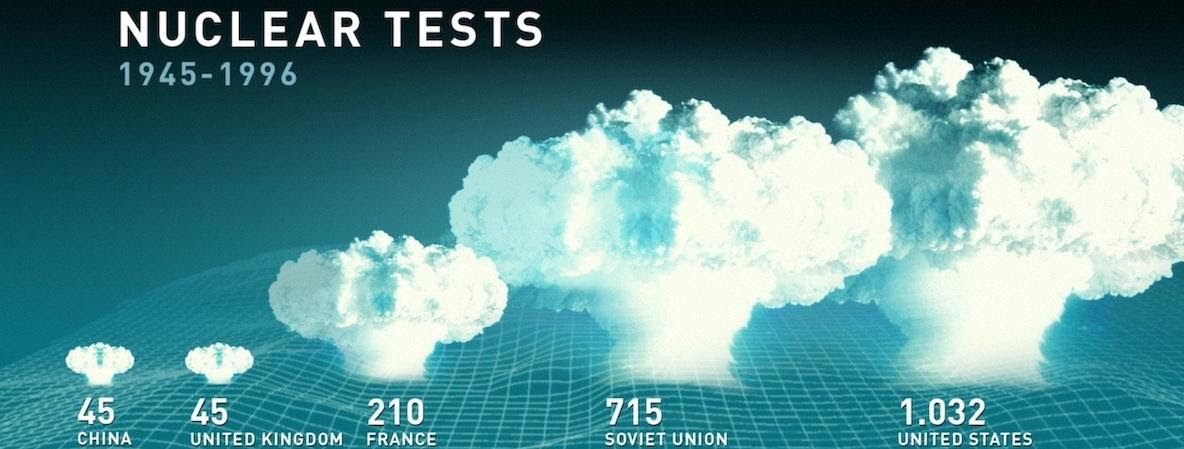
Far from being mere experiments, the detonations of nuclear weapons during such tests are best understood as a global catastrophe
Nuclear “tests” are best conceptualized as environmental disasters with consequences that are still felt today, particularly in Oceania and Central Asia.
By Maxime Polleri, November 05, 2025, https://thediplomat.com/2025/11/nuclear-tests-and-their-legacy-of-harms-in-asia-pacific/
Recently, U.S. President Donald Trump made headlines when he told the Pentagon to resume testing of U.S. nuclear weapons, citing his concerns that countries like China or Russia had supposedly conducted secret underground nuclear weapons tests and that the United States was falling behind. While the president’s post created much controversy around the nature of such tests, the U.S. energy secretary later explained that Trump’s planned tests would not include any actual nuclear explosions, but would encompass “system tests” to verify the state of American nuclear arsenals.
While the fact that the United States does not plan to detonate nuclear weapons is reassuring, the country, as well as China and Russia, have a long history of experimenting with real nuclear weapons to measure the performance of their devastating arsenals. Throughout the 20th century, nuclear testing has taken different forms, such as aboveground nuclear weapon tests, underwater tests, and underground tests. The 1963 Partial Test Ban Treaty prohibited atmospheric, outer space and underwater tests, while some nation states later declared moratoria on underground tests.
Nowadays, nuclear “tests” are done via computers or laboratory scale experiments and do not include actual explosions. However, understanding former nuclear experiments as “tests” is highly misleading, since each atomic and thermonuclear explosion throughout the 20th century released a tremendous quantity of long-lasting radioactive pollutants. Nuclear “tests” are best conceptualized as environmental disasters with long-lasting consequences that are still felt nowadays, particularly in Oceania, as well as Central Asia.
n the early 1950s, the United States began to test numerous nuclear weapons at the Nevada Test Site, releasing large quantities of radioactive fallout that afflicted its own population. People exposed to such fallout became known as “downwinders” and faced a plethora of health problems. Aware of the danger of bombing themselves, many nation states began to “export” nuclear testing to colonial areas, where vulnerable local populations faced the burden of contamination. Testing nuclear weapons in such locations was often a strategic choice, since many of the indigenous local population were already invisible from the public scrutiny or did not have the means to speak back to the dominant power that controlled their territories.
For instance, in March 1954, the U.S. tested a thermonuclear weapon, Castle Bravo, in the Bikini Atoll of the Marshall Islands, an archipelago in Micronesia that was turned into U.S. military bases after World War II. The nuclear fallout heavily impacted residents of the atolls, who were later forced to evacuate their beloved home. In fact, the scope of the fallout was so powerful that a Japanese fishing boat, the Daigo Fukuryū Maru, was contaminated by the test, resulting in cases of acute radiation syndrome for the fishing crew and the death of its radioman.
Much like the United States, France also conducted atmospheric and underwater tests in French Polynesia, resulting in the contamination of many atolls, like Moruroa. Nuclear tests in the Asia-Pacific region created a tremendous legacy of harms, which included the destruction of coral reefs and the death of marine ecosystems, but also forced displacements, contamination of the food chain, destruction of the social fabric, and health issues.
A similar pattern of exporting nuclear tests to vulnerable populations was also apparent in Central and East Asia. For instance, the Soviets repeatedly tested their nuclear weapons in the Semipalatinsk Test Site, a region that was historically dominated by ethnic Kazakhs. Nowadays, as anthropologist Magdalena Stawkowski highlights, Kazakhstan has inherited the remnants of one of the world’s most contaminated landscapes, dealing with contested health issues, precarious economy and marginalization.
Moreover, the People’s Republic of China has historically tested its nuclear weapons in the region of Lop Nur, leading Uyghurs, a Muslim minority ethnic group of northwestern China, to voice concerns about the long-term impact of residual radiation. In many of these instances, issues of national security – such as the health and well-being of local populations – were sacrificed for issues of international security.
Ironically, in each of these cases, humans tested nuclear weapons to prepare for a war that never came – globally contaminating ourselves in the process.
Far from being mere experiments, the detonations of nuclear weapons during such tests are best understood as a global catastrophe. And while a moratorium on nuclear testing ought to be applauded, many people are still grappling with the legacy of past nuclear tests.
The recent movie “A House of Dynamite” has brought up fresh fears of a nuclear war, as well as numerous discussions surrounding nuclear deterrence theories and mutually assured destruction. Instead of focusing our time, energy, and resources on hypothetical strikes that happen in science fiction or game theory, we should delve deeper into the poisoned heritages of the real explosions that occurred in the 20th century and prompt efforts to revitalize communities that are still suffering from its harm.
‘Nothing revolutionary’ about Russia’s nuclear-powered missile: Experts
Putin has touted cruise missile Burevestnik and torpedo Poseidon as game-changing weapons as the war in Ukraine rages on.
Aljazeera, By Mansur Mirovalev, 5 Nov 2025
Kyiv, Ukraine – The collective West is scared of Moscow’s new, nuclear-powered cruise missile because it can reach anywhere on Earth, bypassing the most sophisticated air and missile defence systems, the Russian Ministry of Foreign Affairs has claimed.
“They’re afraid of what we’ll show to them next,” Foreign Ministry spokeswoman Maria Zakharova told the RIA Novosti news agency on Sunday.
Days earlier, she said Moscow was “forced” to develop and test the cruise missile, which is named the Burevestnik, meaning storm petrel – a type of seabird, in response to NATO’s hostility towards Russia.
“The development can be characterised as forced and takes place to maintain strategic balance,” she was quoted by the Itar-Tass news agency as saying. Russia “has to respond to NATO’s increasingly destabilising actions in the field of missile defence”.
With much pomp, Russian President Vladimir Putin on Tuesday handed state awards to Burevestnik’s developers.
Also awarded were the designers of Poseidon, an underwater nuclear-powered torpedo which Putin has also claimed has been successfully tested.
Russia says Poseidon can carry nuclear weapons that cause radioactive tsunamis, wiping out huge coastal areas. The “super torpedo” can move at the speed of 200km/h (120mph) and zigzag its way to avoid interception, it says.
“In terms of flight range, the Burevestnik … has surpassed all known missile systems in the world,” Putin said in his speech at the Kremlin. “Same as any other nuclear power, Russia is developing its nuclear potential, its strategic potential … What we are talking about now is the work announced a long time ago.”
But military and nuclear experts are sceptical about the efficiency and lethality of the new weapons.
It is not unusual for Russia to flaunt its arsenal as its onslaught in Ukraine continues. Analysts say rather than scaring its critics, Moscow’s announcements are merely a scare tactic to dissuade Western powers from supporting Kyiv.
“There’s nothing revolutionary about,” the Burevestnik, said Pavel Podvig, director of the Russian Nuclear Forces Project at the the United Nations Institute for Disarmament Research.
“It can fly long and far, and there’s some novelty about it, but there’s nothing to back [Putin’s claim] that it can absolutely change everything,” Podvig told Al Jazeera. “One can’t say that it is invincible and can triumph over everything.”
The Burevestnik’s test is part of Moscow’s media stratagem of intimidating the West when the real situation on the front lines in Ukraine is desperate, according to a former Russian diplomat.
The missile is “not a technical breakthrough but a product of propaganda and desperation”, Boris Bondarev, who quit his Russian Foreign Ministry job to protest against the 2022 full-scale invasion of Ukraine, wrote in an opinion piece published by the Moscow Times.
Few details about ‘unique’ missile
The problem is that officials have so far unveiled very little about the Burevestnik, which NATO has dubbed the SSC-X-9 Skyfall – a missile that has a nuclear reactor allegedly capable of keeping it in the air indefinitely………………………………………………………………………… https://www.aljazeera.com/news/2025/11/5/nothing-revolutionary-about-russias-nuclear-powered-missile-experts
Trump’s Threat to Resume Nuclear Testing
In 1963 John Kennedy and Nikita Khrushchev signed the ban on atmospheric nuclear weapons testing, which was extended to a moratorium in 1992 and secured as the Comprehensive Test Ban Treaty in 1996. The Treaty has been signed by 187 states. On October 31st, United Nations member states voted on a resolution in support of the Treaty and the global nuclear test moratorium. The United States was the only “no” vote.
Donald Trump is now threatening to resume nuclear testing because “he believes others are doing it.” They aren’t. The threat came after Vladimir Putin announced that the Kremlin https://www.reuters.com/world/china/putin-says-russia-tested-poseidon-nuclear-capable-super-torpedo-2025-10-29/
Tied to this is the situation at Los Alamos National Laboratory, or LANL, the heart of the new trillion-dollar modernization program that will rebuild every nuclear warhead in the planned stockpile with new military capabilities and produce new-design nuclear weapons as well. LANL will fabricate plutonium pits, or triggers, for these nuclear warheads, along with the Savannah River Site in South Carolina.
A Nuclear Watch New Mexico press release stated: “The underlying point is that new-design plutonium pits for new-design nuclear weapons may create inexorable pressures for resumed nuclear weapons testing by the United States. This would be sure to set off a chain reaction of testing by other nuclear weapons powers [ ]. The final result is a dramatically accelerating nuclear arms race, arguably more dangerous than the first arms race given multiple nuclear actors, new hypersonic and cyber weapons, and the rise of artificial intelligence.” https://nukewatch.org/press-release-item/trump-orders-nuclear-weapons-testing-for-new-nuclear-arms-race-new-plutonium-pit-bomb-cores-at-los-alamos-lab-could-make-it-real/
Israel Is Still Starving Gaza, And Other Notes
Caitlin Johnstone, Nov 06, 2025
In an article titled “Not enough tents, food reaching Gaza as winter comes, aid agencies say,” Reuters reports that “Far too little aid is reaching Gaza nearly four weeks after a ceasefire” due to Israeli restrictions preventing aid trucks from getting to their destinations, and that according to an OSHA report last week “a tenth of children screened in Gaza were still acutely malnourished.”
A report from the UK’s Channel 4 News shows warehouses full of food that aid groups say isn’t being allowed into Gaza nearly as rapidly as needed.
In an article titled “‘Under the Guise of Bureaucracy’ — Israel Blocks Humanitarian Groups From Delivering Essential Aid Despite Calm in Gaza,” Israeli outlet Haaretz reports that “Israel has implemented a new procedure requiring all humanitarian organizations operating in Gaza and the West Bank to reapply for official approval, with many denied, despite the relative calm in Gaza following the cease-fire.”
They’re using bureaucratic red tape and arbitrary restrictions to put as much inertia on the effort to rush aid into Gaza as possible. As Electronic Intifada’s Ali Abunimah put it, Israel has “successfully rebranded its genocide as a ‘ceasefire.’”
❖
Still can’t wrap my head around the fact that internationally renowned activist Greta Thunberg said she was tortured and sexually humiliated by Israeli soldiers when she was abducted for trying to bring aid to starving civilians, and the world just shrugged and moved on.
❖
It’s so silly when US empire apologists cite “the Monroe Doctrine” to defend US warmongering in Latin America, as though “the entire western hemisphere is our property” is a perfectly legitimate policy to have.
The Monroe Doctrine was just American imperialists telling Europe, “You see all these brown people over here south of our border? These are our brown people. You can do whatever you want to those brown people over there in Africa and Asia, but these brown people over here belong to us. Only we get to dominate and exploit them.”
That’s all it has ever been, and people cite it to justify warmongering toward Venezuela or wherever as though saying “yeah well that’s the Monroe Doctrine” is a complete argument in and of itself. It’s bat shit insane nonsense and it should be rejected in its entirety.
US regime change interventionism is reliably disastrous wherever it happens. It always causes immense suffering and instability, it’s always justified by lies, and it never accomplishes what its proponents claim it will accomplish. No amount of bleating the words “Monroe Doctrine” will ever change that.
The US empire backs genocidal Gulf state monarchies like the UAE and Saudi Arabia because if those states were democratically governed their people would prioritize their own interests over the agendas of the west. They wouldn’t permit US military bases on their territory, and they never would have tolerated Israel and its abuses in the region. Fossil fuel policy would be set without regard for western interests. The entire region could long ago have united into a superpower bloc which rivaled or outmuscled the western power structure using its critical resources and trade routes.
That’s why you see the US and its allies preaching about the values of Freedom and Democracy to the public while privately telling these tyrannical monarchies they can do whatever they want and receive the backing of the imperial machine. Not until their pet tyrant fails to sufficiently kowtow to the interests of the empire does the west suddenly get interested in advancing Freedom and Democracy in their nation.
This is one of the major dynamics at play in Sudan. The United Arab Emirates has been backing the genocidal atrocities of the RSF and the US empire is placing no pressure on them to stop, because that’s part of the deal. As long as the UAE plays along with the agendas of the empire, the empire will tolerate or actively facilitate its abuses……………………………………………………………….. https://www.caitlinjohnst.one/p/israel-is-still-starving-gaza-and?utm_source=post-email-title&publication_id=82124&post_id=178143727&utm_campaign=email-post-title&isFreemail=true&r=1ise1&triedRedirect=true&utm_medium=email
US Army wants to deploy small nuclear power plants
The Janus Program aims to put commercial reactors into military service by 2028
by Craig Bettenhausen, Chemical and Engineering News, October 31, 2025
A plan by the US Army to deploy small modular nuclear reactors could help the military replace fossil fuels shipped along precarious supply lines with electricity and synthetic fuels generated on-site. Project Janus, which Secretary of the Army Dan Driscoll and Secretary of Energy Chris Wright jointly announced on Oct. 14, aims to put a small modular reactor (SMR) in operation by the end of 2028.
The shutdown of the federal government is delaying the rollout, army officials say, but a draft request for proposals should be out in a matter of weeks.
Though the program aims to put the first military SMR at a base in the US, the bigger vision is mobile microreactors that can provide power in far-flung locations. “The biggest military use case is contested logistics,” says Staff Sheehan, CEO of a nuclear chemistry start-up that is in stealth mode. “How do you power small, tactical, forward-operating bases, or even larger bases of thousands of servicemembers, that historically required a diesel generator and hydrocarbon fuels?”……………………………………………………….
The 2028 installation target was set in May by President Donald J. Trump in an executive order, which calls for the first reactor to be in operation by September that year. The same order also directs the US energy and defense secretaries to use “all available legal authorities” to smooth the regulatory road for advanced nuclear reactors and nuclear-fuel-recycling facilities built at sites controlled by those agencies. It also designates a wide range of activities, including those serving artificial intelligence hardware, as defense-critical electrical infrastructure.
That designation is important because many military reactors don’t require approvals from the Nuclear Regulatory Commission (NRC), the independent federal agency that issues permits and regulations for civilian nuclear power. Many nuclear power advocates accuse the NRC of driving up the cost of nuclear power through overregulation, whereas critics hold the agency up as a critical public safeguard……………………. https://cen.acs.org/energy/nuclear-power/US-Army-deploy-small-nuclear/103/web/2025/10#:~:text=Project%20Janus,%20which%20Secretary%20of,by%20the%20end%20of%202028.
The Gaza Laboratory: How War is Being Marketed and How the World is Fighting Back

6 November 2025 Andrew Klein, https://theaimn.net/the-gaza-laboratory-how-war-is-being-marketed-and-how-the-world-is-fighting-back/
A profound and disturbing transformation is underway in global conflict. The besieged Gaza Strip has become more than a humanitarian catastrophe; it has been turned into a live-fire laboratory for the future of warfare and social control. The tactics and weapons tested on its population are being packaged and sold to the world, threatening to export this model of destruction and entrench a new, terrifying international standard. Yet, as this dangerous market grows, a powerful coalition of nations, legal bodies, and civil society is rising to counter it.
The Laboratory: Battle-Testing a New Model of Control
The strategy is as brutal as it is business-minded. The intense urban combat and comprehensive siege conditions in Gaza provide a unique proving ground.
“Combat-Proven” Arms Sales: Major Israeli defense firms like Elbit Systems and Israel Aerospace Industries (IAI) are explicitly marketing their drones, missile defense systems (like Iron Dome), and armoured vehicles as “battle-tested” and “battle-proven” based on their use in Gaza. This has led to record-breaking sales, as other nations seek weapons validated in real-world conditions.
Exporting the Tools of Subjugation: Beyond traditional weapons, the surveillance technologies and population control tactics refined over decades in the Occupied Palestinian Territories are now a global commodity. These systems, which enable pervasive monitoring and social management, are sold to authoritarian regimes worldwide, helping them subjugate their own populations more effectively.
The Erosion of International Law: This model operates by systematically undermining the laws designed to protect civilians. A United Nations Independent International Commission of Inquiry has found that Israel has committed grave war crimes and acts of genocide. This represents a direct assault on the post-WWII international legal order, setting a precedent that might makes right and that civilian lives are expendable.
The Backlash: A Global Coalition Pushes Back
This pernicious influence has not gone unchallenged. A multi-front resistance is gaining momentum, targeting the economic, legal, and diplomatic pillars of this system.
1. Economic and Arms Embargoes
Nations are beginning to sever the financial pipelines that fuel this war machine.
- Spain has cancelled hundreds of millions of dollars in arms contracts with Israeli companies.
- France shut down the exhibits of major Israeli arms firms at the prestigious Paris Airshow.
- The Norwegian pension fund, KLP, divested from the US company Caterpillar, citing its equipment’s role in the demolition of Palestinian homes.
2. Legal Accountability and Justice
The world’s highest courts are now involved, seeking to enforce accountability where diplomacy has failed.
- The International Court of Justice (ICJ) is hearing a landmark case on the charge of genocide.
- The International Criminal Court (ICC) prosecutor has sought arrest warrants for top leaders for alleged war crimes and crimes against humanity.
- Lawsuits in national courts, such as in France, are targeting companies for complicity in war crimes, setting a legal precedent for corporate accountability.
3. Diplomatic Isolation and Recognition
The political landscape is shifting, isolating the perpetrators, and legitimising the victims.
- Over 150 UN member states have now recognised the State of Palestine, reflecting a global consensus against occupation and apartheid.
- Joint statements from European powers have “strongly rejected” further military operations, signaling a fracture in what was once unwavering diplomatic support.
The Path Forward: How to Break the Cycle
Ending this cycle requires sustained, strategic action from the international community. We must:
Demand Corporate Accountability: Pressure companies involved in supplying arms and technology through public campaigns, divestment, and litigation. As UN experts have stated, these companies risk complicity in serious violations of international law.
Support the Boycott, Divestment, and Sanctions (BDS) Movement: This peaceful, grassroots movement aims to exert economic and political pressure to end the occupation and uphold human rights.
Protect and Amplify the Truth: In an age of propaganda, supporting independent journalism and human rights organisations like Amnesty International and B’Tselem is crucial. They provide the evidence that fuels legal action and public awareness.
Advocate for Government Action: Citizens must demand their governments impose arms embargoes, support international justice mechanisms, and formally recognise Palestinian statehood.
The “Gaza Laboratory” represents a choice between two futures: one where warfare is a profitable, unaccountable business, and another where international law and human dignity are upheld. The global backlash is a testament to the power of collective conscience. It is the growing shield against the dark model being forged in the fires of Gaza, and it is our best hope for a more just and peaceful world.
The moment of truth: The West confronts Russian military advances.
on October 20th, Russia informed the United States that it had no intention of yielding on territorial concessions, the reduction of the Ukrainian armed forces, or guarantees that Ukraine would never join NATO.
Thierry Meyssan, Voltairenet.org, Tue, 04 Nov 2025
For two years, we in the West have been living in the myth that we will bring Russia to its knees and bring Ukraine into the European Union and the Atlantic Alliance. We will try Vladimir Putin and make Russia pay. Today, this myth is colliding with reality: Moscow now possesses devastating weapons, unparalleled in the West. They make any hope of victory for our coalitions impossible. We will have to acknowledge our mistake. This is not about apologizing for our errors, but about freeing ourselves from them.
On October 26, Russian President Vladimir Putin and his Chief of Staff, Valery Gerasimov, announced the completion of a project to miniaturize a nuclear reactor and install it on a missile. They reported conducting a test launch of the 9M730 Burevestnik missile, which traveled 14,000 kilometers. The unique feature of this nuclear-powered weapon (which has an unlimited range) is its ability to be guided in such a way as to bypass interceptor sites.This, according to Russian authorities, makes it an unstoppable missile.
On October 29, President Putin tested a Status-6 Poseidon torpedo, a nuclear-powered weapon. Throughout the Soviet Union, Eurasian military researchers believed that underwater nuclear explosions could trigger massive tsunamis. To achieve this, they needed to be able to launch torpedoes much farther than was possible at the time, in order to avoid the cataclysms they intended to unleash. This has now been accomplished. Mega-tsunamis could devastate cities like Washington, D.C., or New York City, or even naval groups like those of the U.S. aircraft carriers. However, the Poseidon torpedo is significantly longer than others: 21 meters. It cannot be launched from operational submarines and required its own dedicated vessel for launch. Its ability to operate underwater almost indefinitely more than compensates for this limitation. In any case, this torpedo ensures that Russia can launch a second strike in the event of a US attack. Until now, the first to launch a nuclear strike was guaranteed to cripple its enemy’s main means of retaliation.
No weapon is ever truly definitive. Each exists within a continuum of technological advancements; each is superseded by another; and each eventually encounters effective defenses or predators. But for the moment, there seems to be no answer to these weapons, any more than there is to Russian supersonic missiles.
In about twenty years, Russia has acquired a whole host of new weapons that surpass all Western technologies.……………………………………………………..
Russia possessed the capability to disconnect NATO orders from its own weapons. This wasn’t a form of jamming; the weapons simply stopped responding to commands………………………………………
The Westerners were also testing numerous weapons, such as the tactical atomic bomb that later devastated the port of Beirut.
In 2018, once the Syrian war had ended, President Vladimir Putin presented his weapons program to parliament [ 1 ] . This program comprised six advanced weapons:the Sarmatian (which leaves the atmosphere, orbits the Earth, and re-enters the atmosphere at will) and Kinzhal (dagger) missiles; the nuclear-powered 9M730 Burevestnik and Status-6 Poseidon launchers; the Avantgarde missiles, which combine the characteristics of the Sarmatian and Kinzhal missiles with added maneuverability; and finally, anti-missile lasers.Only the latter are not yet complete.
What were only prototypes in the 2010s became operational and were mass-produced during the war in Ukraine.
The Western response was almost inaudible. Only US President Donald Trump spoke out. He regretted that his Russian counterpart had seen fit to reveal his exploits because, in doing so, he was reigniting the arms race. Furthermore, he announced that the United States was resuming its nuclear tests. Donald Trump could hardly do otherwise: deploring Russia’s renewed arms race is a way of explaining that the Pentagon’s military research is lagging far behind and of asserting Washington’s peaceful stance. Announcing that he will resume nuclear tests is a way of shifting the focus, since none of the new Russian weapons represent an advance in nuclear terms, but only in terms of atomic bomb launchers. To say that he will do this to maintain parity with Russia and China is a blatant lie: Russia has not conducted nuclear tests since 1990 and China since 1996. Moreover, it will take at least two years to rebuild or rehabilitate Cold War-era facilities, and therefore to begin these tests. Until then, the United States is nothing more than a “paper tiger.”
We are now reaching the end of hostilities in Ukraine. The Russian army is on the verge of a decisive victory in the Donbas. It will not only capture Pokrovsk, but will also inflict a third defeat on the White Führer, Andriy Biletsky, whose 10,000 men are surrounded. …………………
..on October 20th, Russia informed the United States that it had no intention of yielding on territorial concessions, the reduction of the Ukrainian armed forces, or guarantees that Ukraine would never join NATO.
Whether the West likes it or not, it no longer has a choice. It simply cannot afford to continue supplying weapons to Russia in Ukraine on its own. The EU’s plan to eventually confiscate Russian assets frozen in Belgium and spend them immediately could spell the end of the Union. In any case, neither Belgium, nor Slovakia, nor Hungary will participate in this theft, which even the Soviets, the staunch opponents of private property, never perpetrated.
The EU’s grandiose ambitions are about to collide with reality: it can only continue this war by betraying the very ideals it claims to uphold………….
All of this is coming to an end, otherwise the EU will be directly drawn into the war against the Slavs that the UK and Germany instigated in 1933: the Second World War. And the EU’s armies, stripped of their arsenals, have no hope of resisting for more than two days. This is not about bowing down to a new master, Russia, but simply about acknowledging our mistakes before it’s too late. https://www.sott.net/article/502778-The-moment-of-truth-The-West-confronts-Russian-military-advances
Rusting nuclear facilities hamper Trump’s plans for new tests
President insists new trials will begin, but officials say US not capable of doing so.
Benedict Smith, US Reporter
The United States is not ready to restart nuclear weapons testing and
risks losing ground to China and Russia if it pushes ahead with Donald
Trump’s plans, experts believe.
The president announced this week that
the US would conduct tests of nuclear weapons for the first time in more
than three decades, breaking one of the few remaining taboos among the
superpowers.
Experts fear that in doing so, Mr Trump has fired the starting
gun on a race Washington is ill-prepared to win, and that it could find
itself matched or overtaken by Moscow and Beijing.
Visitors to America’s
vast testing site in the Nevada desert said it is filled with equipment
that is slowly rusting away, while former officials say it simply has not
had the investment to match the president’s ambitions. Now there are
fears that Mr Trump has opened a “Pandora’s Box” that has remained
shut almost since the end of the Cold War. And he might not be prepared for what comes next.
Telegraph 3rd Nov 2025, https://www.telegraph.co.uk/us/politics/2025/11/03/trump-could-not-launch-nuclear-weapon-if-he-wanted/
Resuming U.S. Nuclear Tests Is Reckless and Dangerous, One Expert Says

“The only countries that will really learn more if [U.S. nuclear] testing resumes are Russia and, to a much greater extent, China,” says Jeffrey Lewis, an expert on the geopolitics of nuclear weaponry
By Dan Vergano edited by Lee Billings, October 29, 2025, https://www.scientificamerican.com/article/trumps-baffling-call-for-resuming-u-s-nuclear-tests/
Editor’s Note (11/3/2025): Energy secretary Chris Wright stated on Sunday that any new nuclear testing pursued following Trump’s remarks would be of the “noncritical” variety, entailing already standard routine tests of weapons components and other parts of the U.S. arsenal. Scientific American will continue reporting any new developments on nuclear testing.
Ahead of a meeting with Chinese president Xi Jinping on Thursday, President Donald Trump said the U.S. will resume nuclear testing, ending a 33-year moratorium.
“Because of other countries [sic] testing programs, I have instructed the Department of War to start testing our Nuclear Weapons on an equal basis,” Trump announced on his social media platform Truth Social.
The U.S. last tested a nuclear weapon in an underground experiment in the Nevada Test Site in 1992, a marker of the end of the cold war. That last test concluded a decades-long testing program that included more than 1,000 detonations conducted by the civilian Department of Energy, which oversees the U.S. nuclear stockpile.
The Project 2025 report, now acknowledged by Trump as an indicator of his administration’s policies, had called for resuming U.S. nuclear testing to ensure the performance of the nuclear stockpile. Trump’s announcement follows recent Russian tests of a nuclear-powered cruise missile and a nuclear-capable underwater drone, but there have not been any known nuclear detonations recently made by either Russia or China. Both of those nations are signatories to the Comprehensive Nuclear-Test-Ban Treaty (CTBT), which the U.S. has signed yet never ratified. (China also hasn’t ratified the treaty, and Russia revoked its ratification in 2023, however.) China last tested a bomb in 1996, and the Soviet Union last tested one in 1990. Both countries have expressed concern about Trump’s announcement, and Russia has threatened to start its own tests.
To ask what is at stake in Trump’s call to resume U.S. nuclear tests, Scientific American spoke with Jeffrey Lewis, an expert on the geopolitics of nuclear weaponry at the James Martin Center for Nonproliferation Studies at the Middlebury Institute of International Studies.
[An edited transcript of the interview follows.]
We haven’t done a nuclear test since 1992. So what is the argument for doing this? Are there any technical benefits to resuming testing?
The question is: What sort of testing are we talking about? The U.S can presently test nuclear weapons in every way, shape or form—except for doing explosive tests that create yield. The U.S. now does so-called subcritical tests about 1,000 feet under the Nevada desert. And so it’s very unclear what the president means.
Are we talking about a full-yield test out in the desert? Or are we talking about small lab experiments that produce much less yield? It’s very unclear. And all of those [tests] have different yields [that have] different purposes.
But if I were to back up to issue one sweeping statement, it would be: No, [there aren’t any benefits to resuming testing] because the U.S. already conducted more than 1,000 nuclear tests. It has a vast trove of data that underlies the most sophisticated computer models imaginable. The U.S. knows more about its nuclear weapons today than it did in the period when it was testing them. The only countries that will really learn more if testing resumes are Russia and, to a much greater extent, China.
Project 2025 called for resuming underground nuclear tests, though. Would Trump’s announcement seem to point in that direction—basically, to the U.S. once again blowing up such weapons underground?
During the last [Trump] administration, [officials] spoke of being ready to resume nuclear testing. And they discovered that it would be a couple of years before they could do it. Then they started talking about doing uninstrumented tests—which are literally pointless.
You get no data from an uninstrumented test. It’s just a demonstration. All you do is demonstrate that we have functional nukes. It’s really unclear why you would do that.
What would this do to the nonproliferation movement, with the whole idea of a testing moratorium going out the window?
It’s possible the test ban collapses. But it is also possible that the nonproliferation treaty [the Treaty on the Non-Proliferation of Nuclear Weapons, which entered into force in 1970] collapses because that requires the U.S., Russia and other nuclear-weapon states to make good-faith efforts to work toward the elimination of nuclear weapons.
But non-nuclear-weapon states have made it clear that this test ban is literally the bare minimum. And most of those countries aren’t very happy that the U.S hasn’t ratified the [CTBT]. But the fact that there has at least been an end to nuclear testing has been really important to sustaining a sense around the world that nonproliferation is a common good rather than just an effort at a nuclear monopoly by a few countries.
Normally I am not one of those people who believes in that kind of symbolic stuff. But so much of [the Trump administration’s] foreign policy seems to be about being transgressive. Whatever effect a resumption in testing would have on our domestic politics, it also affects how people abroad see us. It becomes difficult to persuade people to do the things we want them to do when we seem reckless and selfish.
There’s also this matter of modernizing the U.S nuclear program, a long-running effort that’s over budget and delayed. How would new nuclear testing play into that?
If there were a technical reason to resume testing, you could imagine that would reduce the need for modernization—because successful testing would suggest that the existing systems are in excellent shape.
That said, I don’t think this is a sincere effort to get additional data to be more informed about the state of the U.S. arsenal. I think this is intended as a transgressive act that’s supposed to bully the Russians and the Chinese and aggravate the president’s domestic enemies.
So why do it?
Well, the real fundamental question here is: What the hell does [Trump] mean in that Truth Social post? Because Russia hasn’t conducted a nuclear test; it’s tested nuclear-capable or nuclear-powered assets.
And the Russians and Chinese aren’t accused of doing clandestine things at their test sites—or, at least, they haven’t been accused of that on an unclassified basis. And the Department of Defense doesn’t have any role in this, really, because nuclear testing is handled by the Department of Energy. So you just kind of stare at Trump’s statement, and you’re like, “What?”
I just don’t know what any of this means. I thought I was an expert, and I can’t parse the words he’s using.
It’s also confusing because, in some ways, Trump has seemed worried about nuclear war. He makes statements along the lines of saying that we all have too many weapons and should work together to disarm, and then he comes out with something like this.
I think what’s happened is that he’s been told that the Russians or the Chinese are doing bad things and that we’re at a disadvantage because we can’t do the same bad things. And he’s feels we ought to be able to do the same things. I doubt it’s any deeper than that.
But let me say a positive thing: [Trump] has political power here, in that he could force Senate Republicans to ratify the … CTBT if he thinks this is so important. He could absolutely get a verification protocol to the CTBT just like the Reagan administration did with the Threshold Test Ban Treaty [the Treaty on the Limitation of Underground Nuclear Weapon Tests, which entered into force in 1990], which would address some of these concerns about what the Russians and the Chinese are doing—if Republicans would accept it and ratify the treaty.
And then, you know what, he really would get a Nobel Peace Prize. If Trump got a verification protocol to the CTBT and then brought that treaty into effect, I would write in support of him getting a Nobel Peace Prize.
All right, let’s hope that, somehow, that idea gets whispered in his ear. Thanks for your thoughts.
Hegseth Declines To Say Whether the US Is Planning To Bomb Venezuela.

The Miami Herald reported on Friday that strikes could begin at any moment
by Dave DeCamp | November 2, 2025, https://news.antiwar.com/2025/11/02/hegseth-declines-to-say-whether-the-us-is-planning-to-bomb-venezuela/
US Secretary of War Pete Hegseth on Saturday declined to comment on whether the US was planning to bomb Venezuela amid a major US military buildup in the Caribbean and frequent strikes on alleged drug boats in the waters of Latin America.
“Appreciate the question, but, of course, we would not share any amount of operational details about what may or may not happen,” Hegseth said in Kuala Lumpur, Malaysia, when asked if the US was preparing to strike inside Venezuela.
The Miami Herald reported on Friday that the US has made a decision to attack military targets inside Venezuela as part of a campaign against the government of President Nicolas Maduro, whom the US seeks to oust. The report said that the US strikes could begin within a matter of “hours or days.”
When asked by reporters on Friday if he was planning strikes inside Venezuela, Trump said “no,” but he was asked again on Sunday and declined to answer. Secretary of State Marco Rubio, who also serves as Trump’s national security advisor and has been leading the push toward regime change in Venezuela, also denied the Miami Herald report.
“Your ‘sources’ claiming to have ‘knowledge of the situation’ tricked you into writing a fake story,” Rubio wrote on X in response to the report.
For weeks, multiple media outlets have been reporting that the US is considering launching strikes in Venezuela, and the US has built up a force in the region that’s well beyond what is needed to bomb small, defenseless boats. US officials have also made clear that the real goal of the campaign is regime change in Venezuela, something Rubio has wanted for many years.
A US aircraft carrier, the USS Gerald Ford, is also being deployed to the Caribbean, and the US has begun to run weekly bomber flights near the coast of Venezuela. Much of the military action and the leaks to the media are part of a psychological campaign aimed at getting Maduro to voluntarily step down or someone in his inner circle to turn on him, but it’s unlikely that will happen.
US amassing 16,000 troops off Venezuelan coast – Washington Post
1 Nov, 2025, https://www.rt.com/news/627242-us-amass-troops-venezuelan-coast/
The American forces in the area reportedly include eight Navy ships, a special operations vessel, and a nuclear-powered submarine.
The US is deploying a massive military contingent to an area near Venezuela, including 10,000 soldiers and 6,000 sailors, the Washington Post has reported. The move may indicate plans to expand regional operations.
The US has repeatedly accused Venezuela of aiding “narcoterrorists” and has imposed sweeping sanctions on the country. The American military has also attacked about a dozen vessels since September, claiming they were used by drug smugglers.
Venezuelan President Nicolás Maduro has denied the allegations, accusing Washington of “fabricating a new war” amid the continuing military buildup.
According to the Washington Post, eight US Navy warships, a special operations vessel, and a nuclear-powered attack submarine are already in the Caribbean. The aircraft carrier USS Gerald R. Ford, expected to arrive next week, will reportedly bring with it three more military vessels, with a total of over 4,000 military personnel onboard.
Additionally, F-35 fighter jets are stationed at a US base in Puerto Rico, the Post reported, citing satellite images.
The arrival of the carrier group suggests Washington’s plans could extend beyond a counter-narcotics operation, Ryan Berg, the director of the Americas Program and the Center for Strategic & International Studies, told the outlet. He added that US President Donald Trump has about a month to make “a major decision” before the group would need to be redeployed.
Multiple media outlets have recently reported that the White House was weighing potential military actions in Venezuela. Senator Rick Scott told CBS last Sunday that Maduro’s “days are numbered.” The WaPo claimed on Thursday that Washington had already identified some targets, including military facilities allegedly used for drug-smuggling.
When asked about the reports on Friday, Trump said, “No. It’s not true.” Last month, Trump confirmed authorizing the CIA to carry out lethal covert operations in the region.
How could the US restart nuclear weapons testing?

President Trump wants to revive a military programme mothballed at the end of the Cold War so America can stand ‘on an equal basis’ with global rivals
Trump implied
that rival nuclear powers were carrying out tests and that it was crucial
for the United States to start “testing our nuclear weapons on an equal
basis”. Neither Russia nor China, America’s “big power rivals”, have
conducted nuclear tests since a moratorium was agreed.
The last American test was in 1992, Russia stopped in 1990 and China in 1996, the same year the Comprehensive Test Ban Treaty was signed. The only countries that have carried out nuclear tests since then have been North Korea, most recently in 2017, and India and Pakistan, which both conducted underground testing
in May 1998.
Times 30th Oct 2025, https://www.thetimes.com/us/news-today/article/us-nuclear-weapons-testing-trump-s08xq9hgm
1 This Month



26 September – International Day for the Total Elimination of Nuclear Weapons


PLEASE OPPOSE HR 8255 AND S.3639 – bills would accelerate satellite deployment, with no environmental review or safeguards – https://ncstd5li.quorum.us/campaign/169331/
To see nuclear-related stories in greater depth and intensity – go to https://nuclearinformation.wordpress.com
-
Archives
- September 2026 (245)
- August 2026 (330)
- July 2026 (355)
- June 2026 (287)
- May 2026 (306)
- April 2026 (356)
- March 2026 (251)
- February 2026 (267)
- January 2026 (308)
- December 2025 (358)
- November 2025 (359)
- October 2025 (375)
-
Categories
- 1
- 1 NUCLEAR ISSUES
- business and costs
- climate change
- culture and arts
- ENERGY
- environment
- health
- history
- indigenous issues
- Legal
- marketing of nuclear
- media
- opposition to nuclear
- PERSONAL STORIES
- politics
- politics international
- Religion and ethics
- safety
- secrets,lies and civil liberties
- spinbuster
- technology
- Uranium
- wastes
- weapons and war
- Women
- 2 WORLD
- ACTION
- AFRICA
- Atrocities
- AUSTRALIA
- Christina's notes
- Christina's themes
- culture and arts
- Events
- Fuk 2022
- Fuk 2023
- Fukushima 2017
- Fukushima 2018
- fukushima 2019
- Fukushima 2020
- Fukushima 2021
- general
- global warming
- Humour (God we need it)
- Nuclear
- RARE EARTHS
- Reference
- resources – print
- Resources -audiovicual
- Weekly Newsletter
- World
- World Nuclear
- YouTube
-
RSS
Entries RSS
Comments RSS
 nuclear-news