No one can stop President Trump from using nuclear weapons Chicago Tribune, Alex WellersteinSpecial to The Washington Post, 1 Dec 16,
Sometime in the next few weeks, Donald Trump will be briefed on the procedures for how to activate the U.S. nuclear arsenal, if he hasn’t already learned about them.
All year, the prospect of giving the real estate and reality TV mogul the power to launch attacks that would kill millions of people was one of the main reasons his opponents argued against electing him. “A man you can bait with a tweet is not a man we can trust with nuclear weapons,” Hillary Clinton said in her speech accepting the Democratic presidential nomination. Republicans who didn’t support Trump — and even some who did, such as Florida Sen. Marco Rubio — also said they didn’t think Trump could be trusted with the launch codes.
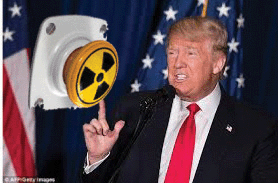
Now they’re his. When Trump takes office in January, he will have sole authority over more than 7,000 warheads. There is no failsafe. The whole point of U.S. nuclear weapons control is to make sure that the president — and only the president — can use them whenever he decides to do so. The only sure way to keep President Trump from launching a nuclear attack, under the system we’ve had in place since the early Cold War, would have been to elect someone else.
When the legal framework for nuclear weapons was developed, the fear was about not irrational presidents but trigger-happy generals. The Atomic Energy Act of 1946, passed with President Harry Truman’s signature after nine months of acrimonious congressional hearings, firmly put the power of the atomic bomb in the hands of the president and the civilian components of the executive branch. It was a momentous and controversial law, crafted in the months following the atomic bombings of Hiroshima and Nagasaki, with an eye toward future standoffs with the Soviet Union…….
Eventually, the brass adopted the idea that, when it came to nuclear matters, they were at the president’s beck and call. It was not generals’ responsibility to make the order; it was their responsibility to carry it out.
That the president would be the only person competent to use nuclear weapons was never challenged. Even asking the question would throw the entire system into disarray, as Maj. Harold Hering learned in 1973. Hering was a 21-year Air Force veteran who was decorated for his flying in Vietnam before being sent for training as a nuclear missile squadron commander. He had been taught that officers had an obligation to disobey illegal orders. So when he was told how to launch a nuclear attack, he asked what seemed like a simple question: How could he be sure that an order to launch his missiles was lawful? How could he be sure, for example, that the president wasn’t insane? Instead of an answer, he got the boot: an aborted promotion and an administrative discharge for “failure to demonstrate acceptable qualities of leadership” and for indicating “a defective mental attitude towards his duties.”
The Air Force’s problem, in short, is that once a serviceman starts down the rabbit hole of doubt, he becomes an unreliable second-guesser — and suddenly he is one of the few people who can decide whether nuclear weapons are used.
The procedure for ordering a nuclear attack involves more than one person: The president cannot literally press a button on his desk and start World War III. There is no “nuclear button” at all. Instead, the U.S. nuclear command-and-control system is bureaucratically and technically complex, stretching out to encompass land-based missile silos, submarine-based ballistic and cruise missiles, and weapons capable of being dropped from bombers. The chain of command requires that the president order the secretary of defense to carry out a launch; the secretary serves as the conduit for implementation by the military. There are succession policies in place so that the procedure can be continued in the event of the death or incapacitation of either the president or the secretary of defense — or their designated successors.
Most details of how a nuclear war would be started are classified, because an enemy who knew enough about the system could come up with ways to complicate or defeat it. What is known is that an aide is always following the president, carrying at least one large satchel (often two) known as the “nuclear football,” reportedly containing information about nuclear attack possibilities and how the president could verify his identity, authenticate orders and communicate with the military about implementing them……..
It might be worth resurrecting this debate , if we take seriously the idea that presidents — any of them, much less Trump — should not have the legal authority to conduct arbitrary and unilateral nuclear war. Perhaps now, decades after the end of the Cold War, we are past the moment when we need to entrust that power in a single person. One can imagine a law that would allow the president to use nuclear weapons in the face of imminent danger, the sort of situation in which a matter of minutes or even seconds could make a difference, but would enact formal requirements for outside consensus when more options were on the table. It would not require a full renunciation of the possibility of a first-strike nuclear attack (something the United States has never been willing to make) but might add some reassurances that such decisions would not be made unilaterally.
Africa pushes for a 2017 ban on nuclear weapons https://www.issafrica.org/iss-today/africa-pushes-for-a-2017-ban-on-nuclear-weapons
A new UN resolution might spell an end to decades of paralysis in nuclear disarmament negotiations. 01 DEC 2016 / BY ANNIE DUPRE AND NOËL STOTT On 27 October, the First Committee of the United Nations (UN) passed L.41: ‘Taking forward multilateral nuclear disarmament negotiations’. The resolution calls for negotiations to take place next year on a legally binding instrument to prohibit nuclear weapons, and lead towards their total elimination. It was passed with 123 votes in favour, 38 against and 16 abstentions.
This initiative has been called historic by analysts such as the former Canadian Ambassador for Disarmament to the UN, civil society groupings and international organisations such as the International Committee of the Red Cross –underscored by the belief that as long as nuclear weapons exist, humankind will risk facing the catastrophic consequences of a nuclear war.
Others, such as France, maintain that such a treaty would be ineffective and could undermine the Treaty on the Non-Proliferation of Nuclear Weapons (NPT) as the cornerstone of the nuclear non-proliferation regime. The NPT, which entered into force in 1970, prohibits the spread of nuclear weapons.
These differing assessments over the potential impact of a nuclear weapons ban treaty mirror the deep divisions among NPT state parties regarding their disarmament obligations, which has been a source of disagreement since the NPT’s entry-into-force.
The response of African states has been largely positive. Of the 47 African UN member states present at the vote, all but three supported the resolution. From the Africa Group, only Mali, Morocco and Sudan deviating by abstaining – presumably after coming under pressure from some nuclear-weapon states. Benin, Djibouti, Liberia, São Tomé and Príncipe, Senegal, Seychelles and South Sudan were not present for the vote. A number of African states co-sponsored and spearheaded the resolution, including Egypt, Nigeria and South Africa.
If passed by the UN General Assembly in December, negotiations are set to start in early 2017 – a step that would end two decades of paralysis in multilateral nuclear disarmament negotiations.
Despite two-thirds of countries present at the vote supporting the resolution, there was significant push-back from virtually all the NPT nuclear-weapon states (the United States, France, Britain, Russia) and most of their allies, such as the 27 North Atlantic Treaty Organization members and Japan and Australia. The Russian representative warned of the damage such a treaty could cause, arguing that the initiative ‘was a destructive and hasty one that undermined and eroded existing disarmament mechanisms [the NPT]’.
His argument was echoed by others, including Morocco – which explained that its abstention was based on how the process and the way it was handled would impact on the NPT review process, and the possibility of all states working together. The Moroccan representative further called for preparatory work to be undertaken before negotiations started.
South Africa, however, expressed the view that the initiative would actually further the goals of the NPT, stating: ‘Such a treaty would also strengthen the NPT and underline the urgency of accelerating the implementation of nuclear disarmament obligations and related commitments’.
Speakers from non-nuclear-weapon states also argued that the use, or threat of use, of nuclear weapons would constitute a violation of international law and a crime against humanity. Malawi declared that it ‘is in the interest of the very survival of humanity that nuclear weapons are never used again, under any circumstances. The catastrophic effects of a nuclear weapons detonation, whether by accident, miscalculation or design, cannot be adequately addressed’.
In the statement delivered by Nigeria, the African Group affirmed that the total elimination of nuclear weapons is still ‘the only absolute guarantee against their use or threat of use’. Beyond supporting negotiations in 2017 on a treaty prohibiting nuclear weapons, Nigeria’s statement also called on all UN members to support ‘a universal, unconditional and legally binding instrument on negative security assurances by nuclear-weapons states to all non-nuclear-weapons states, pending the total elimination of nuclear weapons’.
Some of the states under the US nuclear umbrella that abstained or voted no – like the Netherlands and Japan – have indicated their willingness to participate in the negotiations in 2017. Others, such as Norway, have subsequently indicated that they would not. Still others seem undecided.
It is unlikely that the NPT nuclear-weapon states would participate in such discussions. Mark Toner, US State Department spokesperson, said: ‘Successful nuclear reductions will require participation from all relevant parties, proven verification measures, and security conditions conducive to cooperation …we lack all three factors at this time.’
The United Kingdom (UK) is also clear on the need for its nuclear deterrence to be maintained ‘for the foreseeable future’ – because of the ‘risk that states might use their nuclear capability to threaten us, try to constrain our decision-making in a crisis or sponsor nuclear terrorism’.
Significantly, three nuclear-armed states, namely China, India and Pakistan, abstained, while the Democratic People’s Republic of Korea voted in favour. However, it remains to be seen whether these states would participate in the negotiations.
And this is the crux of the issue. Despite a sizable number of UN members in favour of negotiations, there is significant skepticism of the opportunities these would present, especially if nuclear-weapons states boycott the talks scheduled for March and June next year.
The question is whether it would be better, strategically, for nuclear-armed states and their allies to participate – if only to try guide the negotiations in their favour? However, African states, who make up a significant portion of the UN membership, could also direct the path towards a world free of nuclear weapons.
According to Article 36, a UK-based organisation, the treaty would serve as a necessary and practical next step towards a world in which all weapons of mass destruction are outlawed and are being eliminated: even without the participation of nuclear-armed states.
Historically, all unacceptable weapons have first been subjected to a global prohibition before they were eliminated. For any international instrument to have a true impact, however, acceptance by a large majority of states is needed.
In most of the recent processes towards banning indiscriminate weapons (such as anti-personnel landmines and cluster munitions), Africa has played a leading role. It is possible that the African continent, which also hosts the only country to have unilaterally eliminated its own nuclear arsenal, may again play such a role in the banning of probably the most destructive weapons ever to have been developed. While the effectiveness of such an instrument remains to be seen, the decision to commence negotiations on such a treaty is indeed a historic occasion.
Annie DuPre, Research Consultant and Noël Stott, Senior Research Fellow, Transnational Threats and International Crime Division, ISS Pretoria
So How Close Do You Live to a Nuclear Bomb? http://sploid.gizmodo.com/so-how-close-do-you-live-to-a-nuclear-bomb-1789472521Casey Chan, 29 Nov 16 Hooray. If you live south of the Equator or in any of the countries that light up green in the map above, [on original] you’re good. Keep on living there because you don’t squat next to any nuclear weapons. But if you’re in the countries painted red—like the United States, Germany, Russia, China, India, etc.—you might live closer to a nuclear bomb than you think.
It’s a little scary how many nukes are stored near major cities. For example, the US stores its nukes in 10 states (in addition to a few bystander countries in Europe). Some of them are within spitting distance of cities like Seattle (18 miles away from a facility), Kansas City (55 miles), Denver (77 miles), and Albuquerque (with just happens to have the biggest facility within its city limits). As for Europe, nukes are scattered everywhere on the continent and cities like London, Venice, Milan, Brussels and Rotterdam are all within 50 miles of a nuclear bomb. Let’s not even get into where Russia puts their nukes.
But what’s even more terrifying is that there are lost nuclear bombs where no one is quite sure exactly where they are. The US and Russia have lost more than 50 bombs, and while some are hopefully at the bottom of the ocean, others have landed undetonated near major cities and have still yet to be found. Yikes.
Watch RealLifeLore plot out the location of nuclear bomb facilities in relation to the world in the video below. [on original]
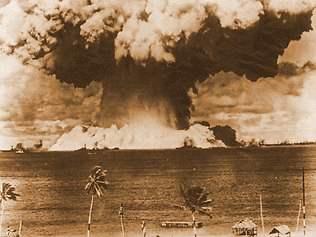
Bikini was just the beginning, bombs still threaten the islanders, New Internationalist DECEMBER 2016 John Pilger visits the Marshall Islands and its bomb survivors, still blighted by US nuclear weapons. “……..The explosion vaporized an entire island, its fall-out spreading over a vast area. There was a ‘miscalculation’, according to the official history; the wind ‘changed suddenly’. These were the first of many lies, as declassified documents and the victims’ testimony have since revealed.
Gene Curbow, a meteorologist assigned to monitor the test site, said, ‘They knew where the radioactive fall-out was going to go. Even on the day of the shot, they still had an opportunity to evacuate people, but [people] were not evacuated; I was not evacuated… The United States needed some guinea pigs to study what the effects of radiation would do.’
The secret of the Marshall Islands was Project 4.1. Official files describe a scientific programme that began as a study of mice and became a study of human beings exposed to the radiation of a nuclear weapon. Most of the women I interviewed had suffered from thyroid cancer; many in their communities did not survive.
The US Navy returned the population of Rongelap atoll, which is downwind of Bikini, even though the food was unsafe to eat and the water unsafe to drink. As a result, reported Greenpeace – which eventually sent a ship to rescue them – ‘a high proportion of their children suffered from genetic effects’.
Archive film refers to them as ‘amenable savages’. A US Atomic Energy Agency official boasts that Rongelap is ‘by far the most contaminated place on earth’, adding, ‘It will be interesting to get a measure of human uptake when people live in a contaminated environment.’
Holding a photograph of herself as a child, with terrible facial burns and most of her hair missing, Nerje Joseph told me, ‘We were bathing at the well. White dust started falling from the sky. I reached to catch the powder. We used it as soap to wash our hair. A few days later, my hair started falling out.’
Lemoyo Abon said, ‘Some people were in agony. Others had diarrhoea. We were terrified. We thought it must be the end of the world.’
Human radiation experiments
As a nine-year-old, Tony de Brum witnessed the Bravo bomb. He became foreign minister of the Republic of the Marshall Islands, an indefatigable voice demanding justice for his people. Clutching the evidence, he stood up at the United Nations in 2005 and said, ‘United States government documents clearly demonstrate that its scientists conducted human radiation experiments with Marshallese citizens. Some of our people were injected with or were coerced to drink fluids laced with radiation. Other experiments involved the resettling of people on islands highly contaminated to study how human beings absorbed radiation from the food and environment.’
The Marshall Islands were, until 1986, a Trust Territory administered by the United States with a legal obligation to ‘protect the inhabitants against the loss of their land and resources’ and to ‘protect their health and well-being’. In 2004, the US Cancer Institute reported to Congress that future Marshallese generations were likely to contract 530 cancers.
The US relinquished direct control of the islands only after the Marshallese had agreed to accept a mere $150 million as compensation for their suffering and to allow the huge US base on Kwajalein atoll, with its ‘mission to combat communist China’ and known as the Ronald Reagan Missile Test Facility.
Commanding the Pacific all the way to Asia and China, the base continues to subject the islanders to the testing of weapons of mass destruction. Missiles are launched at night, or fired into the lagoon from California. Following each ‘shot’, islanders fall sick with a ‘mystery illness’. The Environmental Protection Agency says fish in the bay cannot be eaten; fish was once the staple. The cost of firing one missile is $100 million, or two-thirds of the compensation paid to the islanders……..
In 2014, President Obama announced that the US was ‘creating the world’s largest marine reserve in the Pacific, banning fishing and other commercial activities across pristine sea dotted with coral atolls’.
In fact, as part of Obama’s military build-up in the Pacific, known as the ‘pivot to Asia’, the US has taken control of nine million square miles of ocean – an area double the size of the mainland United States. Under cover of a marine reserve, a ‘marine range complex’ will be run by the Pentagon, with torpedoes, underwater mines and numerous other detonations. Bikini was just the beginning. https://newint.org/features/2016/12/01/bikini-was-just-the-beginning/
John Pilger’s documentary, The Coming War on China, is in cinemas in the UK from 1 December, beginning at the BFI on London’s Southbank. On 5 December, Picturehouse cinemas will hold a nationwide with John Pilger. The website is picturehouses.com. On 6 December, ITV will broadcast the film and a DVD will be available the same day. The Australian release is early in 2017; SBS Australia will broadcast the film nationwide.
Documents Reveal Just How Freaked Out America Was Over Israel Building Nuclear Weapons, National Interest, Robert Beckhusen, 27 Nov 16, Israel’s nuclear weapons program is one of the biggest military open secrets in the world. Now we know a little more about the angst inside the Pentagon in the late 1960s, as Israel was months away from activating its nuclear deterrent.
That’s all according to new documents obtained by the nonprofit National Security Archive at George Washington University. In 2006, the researchers revealed the Nixon administration’s wrangling over what to do about Israel’s nuclear weapons program. But the latest round of documents show new details about the debate—and the stark warnings from Pentagon officials about the dangers of Israeli nukes…..
Israel remains highly secretive about its nuclear weapons—which are believed to number in the several hundreds. In the late 1960s, the secretive nature of the program led to lots of uncertainty in Washington about how far Israel had made it, and whether other Middle Eastern states knew about the program……http://nationalinterest.org/blog/the-buzz/documents-reveal-just-how-freaked-out-america-was-over-18514
NEW YORK – UN Secretary General Ban Ki-moon has championed efforts for nations to make good on their pledges to abolish nuclear weapons. In 2009 he published a five-point proposal for nuclear disarmament, urging nuclear weapons states in particular to fulfill their promises under the Non-Proliferation Treaty (NPT) to negotiate for the total elimination of nuclear weapons as well as other complementary steps to that end such as banning missiles and space weapons.
At the end of his term this year, there have been some stunning new developments after years of global gridlock and blocked efforts. At the UN General Assembly First Committee for Disarmament, 123 nations voted this October to support negotiations in 2017 to prohibit and ban nuclear weapons, just as the world has already done for biological and chemical weapons.
The most remarkable upset in the vote was a breach in what had always been a solid single-minded phalanx of 5 nuclear weapons states recognized in the NPT, signed 46 years ago in 1970 – the US, Russia, UK, France, and China. For the first time, China broke ranks by voting with a group of 16 nations to abstain, along with India and Pakistan, non-NPT nuclear weapons states. And to the great surprise of all, North Korea actually voted YES in support of negotiations going forward to outlaw nuclear weapons.
The ninth nuclear weapons state, Israel, voted against the resolution with 38 other countries including those in nuclear alliances with the United States such as the NATO states as well as Australia, South Korea, and, most surprisingly, Japan, the only country ever attacked with nuclear bombs. Only the Netherlands broke ranks with NATO’s unified opposition to ban treaty talks, as the sole NATO member to abstain on the vote, after grassroots pressure on its Parliament.
All nine nuclear-weapon states had boycotted a special UN Open Ended Working Group for Nuclear Disarmament last summer, which followed three conferences in Norway, Mexico, and Austria with civil-society and governments to examine the catastrophic humanitarian consequences of nuclear war, thus opening a new pathway for how we think and speak about the bomb.
This new “humanitarian initiative” has shifted the conversation from the military’s traditional examination and explanations of deterrence, policy, and strategic security to an understanding of the overwhelming deaths and devastation people would suffer from the use of nuclear weapons.
Today there are still almost 16,000 nuclear weapons on the planet, with nearly 15,000 of them in the United States and Russia, now in an increasingly hostile relationship, with NATO troops patrolling on Russia’s borders, and the Russian Emergencies Ministry actually launching a sweeping nationwide civil-defense drill involving 40 million people. The US, under President Obama, has proposed a $1 trillion program for new nuclear-bomb factories, warheads, and delivery systems, and Russia and other nuclear-weapon states are engaged in modernizing their nuclear arsenals as well.
Perhaps one additional way to break the log jam for nuclear disarmament and find a silver lining in the crumbling neo-liberal agenda for globalization evidenced by the Brexit event and the shocking and unanticipated election of Donald Trump in the US, is to encourage Trump’s repeated statements that the US should make “a deal” with Putin and join with Russia to fight terrorists.
Trump has criticized the NATO alliance, the expansion of which has been very provocative to Russia and was the reason Russia gave, together with the US walking out of the Anti-Ballistic Missile Treaty and installing a new missile base in Romania, for putting a halt to further US-Russian agreements for nuclear disarmament.
Trump, who promotes himself as a “deal maker” has also suggested that he would have no difficulty in sitting down and talking with North Korea. These efforts should be encouraged, as North Korea has actually shown it is willing to enter into negotiations to ban the bomb, which is more than the other eight nuclear weapons states have been willing to support.
Furthermore, North Korea has been seeking an official end to the Korean War of 1953, during which time the US continues to station about 28,000 troops on its borders while trying to starve North Korea out with drastic sanctions all these many years.
Perhaps Secretary General Ban Ki-moon can leave his office with an important victory at the end of his term by seizing this opportunity and encouraging the “deal maker” in Trump to move forward with a US-Russia rapprochement, clearing a pathway for the elimination of nuclear weapons as well as putting an end to the hostilities on the Korean peninsula.
Russian senator promises nuclear response to NATO expansion https://www.rt.com/politics/368146-russian-senator-promises-nuclear-response/25 Nov, 2016 In response to NATO’s efforts to enlist new member-countries, a member of the defense and security committee for Russia’s Upper House has said that Russia will target any sites it considers to be a threat with nuclear weapons.
“In reply to NATO’s aggressive actions, to the alliance’s attempts to draw more and more nations into their orbit, there will be a harsh and unambiguous response from Russia’s side. We will aim our weapons, including the nuclear ones, at any of the alliance’s site that would threaten us, wherever these sites are placed,” RIA Novosti quoted Senator Franz Klintsevich as saying. The senator also explained that by nuclear weapons he meant both stationary land-based systems, and mobile weapons, including sea- and air-based systems.
Vladimir Putin’s press secretary, Dmitry Peskov, told reporters on Friday that Klintsevich’s position was understandable, but also warned against jumping to hasty conclusions.
“Russian lawmakers have the right for own opinion, they are vividly reacting to international events, to NATO’s expansion towards Russian borders, and to the expansion of NATO’s military infrastructure. This makes their position understandable,” Peskov said. At the same time, he noted that, according to the Russian Constitution, lawmakers cannot determine the country’s foreign policy, as that is solely the president’s prerogative.
In late October of this year, Senator Klintsevich told Norwegian television TV2 that Russia was concerned about US plans to deploy marines at a Norwegian base which he sees as part of its Prompt Global Strike doctrine. The implementation of this plan would force Russia to target sites in Norway with strategic weapons, which it has never had to do before.
Russia successfully tests missiles that fire from ‘nuclear trains’ Latest missile advancement comes as Kremlin deploys nuclear-capable missiles to Polish boarder , The Independent, Samuel Osborne@SamuelOsborne93 Wednesday 23 November 2016 Russia has successfully tested intercontinental ballistic missiles intended for its “nuclear trains” program.
Tests on missiles for the Barguzin “railway-based combat rocket system” were carried out at the Plesetsk cosmodrome two weeks ago, the state-owned Interfax news agency reports…
NUCLEAR WARNING: North Korea planing another nuke test on Donald Trump’s INAUGURATION http://www.express.co.uk/news/world/735831/North-Korea-nuke-test-Donald-Trump-president-inauguration-US-Lee-Su-seok-Kim-Jong-unNORTH Korea could launch another devastating nuclear test on the same day Donald Trump is inaugurated into the White House in a chilling show of strength, security experts have warned. By WILL KIRBY Nov 24, 2016 The secretive state has launched 20 missiles this year alone as it aims to develop a long-range weapon, capable of hitting the US mainland.
In a military forum held in Seoul on Wednesday, Lee Su-seok, director of the Center for Unification Strategy at the state-run Institute for National Security Strategy, said: “North Korea may seek negotiations with the U.S. when it completes nuclear tests and reaches the stage of deploying a long-range nuclear-tipped missile.
“In early 2017, it is highly likely that Pyongyang will detonate another nuclear device and launch a long-range ballistic missile to reiterate its status as a nuclear power.”
With President-elect Trump set to be inaugurated on January 20 next year, these latest claims have sparked fears the ceremony could become a target.
Trump is not believed to consider the communist state a high priority at the moment, but this recent speculation about the country’s nuclear capabilities could spark increased efforts for dialogue and negotiations between the two countries.
During the military forum, Lee Su-seok also expressed fears about the declining relations between North and South Korea.
He said: “Inter-Korean relations will remain frosty and strained until the first half of 2017 due to the North’s continued military provocations. Any dialogue with North Korea, if any, will be possible some time after Trump takes office in January.”
The director said: “The Kim Jong-un regime will continue its verbal and military threats in efforts to urge the nearly paralysed Seoul government to change the current strict policies toward Pyongyang”. South Korea’s scandal-plagued president Park Geun-hye has recently been caught up in a corruption case involving her longtime confidant, Choi Soon-sill, who has been accused of using high-ranking connections to wield inappropriate influence inside the government.
As a result, Kim Jong-un’s loyal followers are expected to exploit the unrest in South Korea and create internal conflicts within the country.
Six reasons why a No First Use nuclear doctrine is good for India, Hindustan Times, Manmohan Bahadur Nov 18, 2016 “…..The advantages of an NFU policy are many.
First, a hair-trigger alert, to ensure that the other side does not get a chance to strike first, does not have to be maintained and so forces and equipment can be in a relaxed posture; nuclear forces can be maintained in a de-mated condition waiting for orders from higher echelons to go to a higher alert status, thus ensuring that command and control stays firmly with the civilian political leadership, which is a very important aim.
Second, since there is no first use alert requirement, the chances of reacting to a false alarm are nullified.
Third, the onus of taking the decision to escalate to a nuclear use lies on the adversary and not on the party having an NFU doctrine.
Fourth, a first use would result in international opprobrium and weigh heavily on a country with a first use posture.
Fifth, a first use posture still requires a country to have survivable second strike capability as there is nothing such as a “splendid” first strike implying 100% decapitation of the adversary’s assets and leadership. And last, a NFU doctrine is cheaper to implement; for India, which has many economic targets to achieve, this is a very important factor.
The questioning of India’s NFU doctrine has been born out of the exasperation that has come about due to Pakistan’s use of sub-conventional methods under the overhang of its nuclear weapons. However, Pakistan knows that it cannot afford to use any nuclear weapons in a war, including its tactical nuclear weapons, as India would respond with massive nuclear retaliation as per its doctrine. Additionally, with China heavily invested in Pakistan, it would be in Beijing’s interest to ensure that the leadership of its geopolitical “outpost” does not take any rash decision of initiating a nuclear exchange.
As Parrikar said, India is a responsible nation; hence, India’s nuclear capability and resolve of its leadership should be the signals that convey India’s nuclear posture through its NFU doctrine. The avoidance of nuclear blackmail can be achieved by India demonstrating its readiness to accept risks that are not less than that of Pakistan. This is already happening through the element of signalling in the conventional exchanges between the two armies across the LoC in J&K. The NFU policy is just right for India as it ensures security for the nation and does not detract it from its march towards better prosperity for its people.
How the world reached the brink of nuclear war not once but twice in 1983, The Conversation, Nick Blackbourn, November 18, 2016 In the autumn of 1983, at the height of Cold War tensions, the world was only saved from nuclear disaster by the gut feelings of two soldiers during different incidents.
In the first incident, on September 26, a Soviet lieutenant colonel named Stanislav Petrov saw that according to the early-warning system, the Americans had launched numerous missiles against the Russians. He suspected an error and ignored the warnings. His decision to breach protocol and not inform his superiors averted a panicked retaliation.
The second incident is less well known. An American lieutenant general, Leonard Perroots, also chose to ignore warnings – this time that the Soviet Union had gone on high nuclear alert. Like Petrov, he did nothing, and once again may have prevented an accidental nuclear war.
This was the “Able Archer War Scare”, which occurred over ten days in the November of the same year. Recently declassified documents inform Able Archer 83, a new book by the Cold War historian Nate Jones which shows just how close the world came to disaster.
Two tribes
Superpower mutual suspicion was rife in the early 1980s. President Reagan’s notorious “Evil Empire” speech, combined with imminent plans to deploy the Pershing II missile system in Europe, which could destroy Moscow with 15 minutes warning, had made the Kremlin especially paranoid. Was the US preparing a first strike to win the Cold War? The USSR’s ageing and sickly premier, Yuri Andropov, certainly thought Reagan would have no qualms about it. “Reagan is unpredictable. You should expect anything from him,” he told Anatoly Dobrynin, Soviet ambassdor to the US, at the time.
President Ronald Reagan – “Evil Empire” Speech
Another reason the leadership feared a US first strike was Project RYaN, an intricate Soviet intelligence-gathering effort designed to detect preparations for a surprise nuclear attack. It was being kept busy by US aircraft testing Soviet air defence systems by flying towards USSR airspace as part of the PSYOPs (psychological military operations) programme.
The aircraft would deliberately provoke an alert and monitor the Soviet command and control responses, while demonstrating American strength and resolve at the same time. It was an example of the “Peace Through Strength” policy that was seen as vital by Reaganites to help the US emerge from its own perceived era of military weakness under President Carter.
But this US chest-beating led to a resurgence of intense mutual mistrust, with tragic consequences. On September 1 1983, Korean Air Lines flight 007 was shot down by a Russian fighter, killing all 269 passengers and crew. The Kremlin claimed the jet was an American spy plane deep in Russian territory.
In this climate of extreme tension, NATO’s “Autumn Forge” war game season kicked off. NATO war games had been an annual occurrence, but the Soviets feared this particular edition might be cover for a surprise attack.
The final phase of the 1983 series, codenamed Able Archer 83, was different from previous years: dummy nuclear weapons, which looked like the real thing, were loaded on to planes. As many as 19,000 American troops were part of a radio-silent airlift to Europe over 170 flights. Military radio networks broadcast references to “nuclear strikes”.
This sent Project RYaN into overdrive and the Soviets went on high nuclear alert. Warsaw Pact non-essential military flights were cancelled; nuclear-capable aircraft were placed on alert; nuclear weapons were taken to their launch vehicles; and Chief of the General Staff Nikolai Ogarkov descended into a command bunker outside Moscow to coordinate a possible response to a NATO strike……….
Too often, intelligence agencies collect data and fit it into whichever threat hypothesis is in vogue. We should learn from Reagan’s 1983 insight and not wait for the brink of war: in the nuclear age, whatever an adversary’s political goals, we cannot afford to downplay their genuine fears about military posturing.
A questionable nuclear deal, Japan Times NOV 15, 2016
In recent years, Japan has concluded a series of civilian nuclear cooperation pacts with such countries as Vietnam, Jordan and Turkey in an effort to export its nuclear power plant technology and equipment. But the latest deal with India carries different ramifications. It marks a deviation from Japan’s emphasis on the NPT regime as the international framework for nuclear nonproliferation and disarmament, which is already threatened by North Korea’s repeated nuclear weapons tests.
India carried out nuclear weapons tests in 1974 and 1998 and is believed to possess at least 100 nuclear warheads. It has refused to join the NPT, which limits possession of nuclear arms to the United States, Britain, France, Russia and China, nor has it signed the Comprehensive Nuclear Test Ban Treaty (CTBT). The international community for years prohibited civilian nuclear cooperation with India, but the U.S. administration of President George W. Bush in 2008 concluded such a pact with New Delhi with an eye on building nuclear power plants in the rapidly growing South Asian economy — a move followed by other countries including Japan…….
Japanese businesses involved in nuclear power meanwhile see promising markets overseas for export of their technology and equipment since the Fukushima disaster made it difficult for utilities to build new nuclear plants in Japan and the restart of idled plants remains slow. These strategic and business considerations were prioritized as Tokyo pushed for the nuclear deal, which also authorizes India to reprocess spent nuclear fuel to extract plutonium. Japan is reported to have compromised on its earlier demand that the pact include an explicit provision that cooperation would be halted if India resumed nuclear weapons tests. …..http://www.japantimes.co.jp/opinion/2016/11/15/editorials/questionable-nuclear-deal/#.WCtw59J97Gg
US Military Plans to Dump 20,000 Tons of Heavy Metals and Explosives Into the Oceans Tuesday, 15 November 2016 By Dahr Jamail, Truthout | Report The US Navy has been conducting war-game exercises in US waters for decades, and in the process, it has left behind tons of bombs, heavy metals, missiles, sonar buoys, high explosives and depleted uranium munitions that are extremely harmful to both humans and marine life.
Truthout recently reported that the Navy has admitted to releasing chemicals into the oceans that are known to injure infants’ brains, as well as having left large amounts of depleted uranium in US coastal waters. Now, the Navy’s own documents reveal that it also plans to use 20,000 tons of heavy metals, plastics and other highly toxic compounds over the next two decades in the oceans where it conducts its war games.
According to the Navy’s 2015 Northwest Training and Testing environmental impact statement (EIS), in the thousands of warfare “testing and training events” it conducts each year, 200,000 “stressors” from the use of missiles, torpedoes, guns and other explosive firings in US waters happen biennially. These “stressors,” along with drones, vessels, aircraft, shells, batteries, electronic components and anti-corrosion compounds that coat external metal surfaces are the vehicles by which the Navy will be introducing heavy metals and highly toxic compounds into the environment.
Just some of the dangerous compounds the Navy will be injecting into the environment during their exercises are: ammonium perchlorate, picric acid, nitrobenzene, lithium from sonobuoy batteries, lead, manganese, phosphorus, sulfur, copper, nickel, tungsten, chromium, molybdenum, vanadium, trinitrotoluene (TNT), RDX [Royal Demolition eXplosive] and HMX [High Melting eXplosive], among many others.
“None of these belong in the ocean’s food web, upon which we all depend,” Karen Sullivan, a retired endangered species biologist who cofounded West Coast Action Alliance, which acts as a watchdog of Naval activities in the Pacific Northwest, told Truthout. “Nor will the Navy be willing to clean it up, or even contribute to medical tests for people whose health may suffer.”……http://www.truth-out.org/news/item/38374-us-military-plans-to-dump-20-000-tons-of-heavy-metals-and-explosives-into-the-oceans
Nuclear weapons: how foreign hotspots could test Trump’s finger on the trigger, Guardian, Julian Borger, 13 Nov 16, “……….Trump has claimed he could improve relations with Russia, and in particular with Vladimir Putin personally, that would defuse the high tensions over Ukraine and Syria. Such deals could well be at the expense of the people of those countries, but could conceivably lessen the chances of a complete end to arms control and the return to an expensive and dangerous nuclear arms race. Hans Kristensen, a nuclear expert at the Federation of American Scientists (FAS), points out that the deepest cuts in nuclear arsenals have been achieved by Republican administrations.
“Republicans love nuclear weapons reductions, as long as they’re not proposed by a Democratic president,” Kristensen wrote on an FAS blog
“That is the lesson from decades of US nuclear weapons and arms control management. If that trend continues, then we can expect the new Donald Trump administration to reduce the US nuclear weapons arsenal more than the Obama administration did.”
The current arms treaty limiting the strategic arsenals of both countries, New Start, expires in 2021. A decision will have to be made whether to replace it or let arms control wither. Both Putin and Trump could save tens of billions of dollars by cutting arsenals. As part of any deal, however, Putin would ask for the scrapping of the US missile defence system currently being erected in eastern Europe. Any concessions on the US trillion-dollar nuclear weapon modernisation programme, which Trump endorses in his transition website, would bring him in direct conflict with the Republican establishment.