Grayson files ‘Nuclear Sanity Act’ in response to Trump remarks :DEC 29 2016 12:HTTP://WWW.FOX35ORLANDO.COM/NEWS/226096159-STORYWASHINGTON DC (WOFL FOX 35) – Florida Congressman Alan Grayson has filed the Nuclear Sanity Act in response to growing concern over President-elect Trump’s recent series of “Bomb, Baby, Bomb” pro-nuke mad libs.
The bill requires approval by the Secretaries of Defense and State before the U.S. launches nuclear war, unless U.S. territory is under attack by a foreign military. “We need to take the nuclear football out of Trump’s hands, before he fumbles it,” Grayson said.
This bill was filed on the heels of Trump’s bizarre call for U.S. nuclear expansion and statements that the U.S. will “outmatch” and “outlast” any nuclear adversary.
“What part of the phrase ‘mutual assured destruction’ does Trump not get?” Grayson said.
Neither the Constitution nor the U.S. Code currently curbs the President’s ability to launch nuclear weapons.
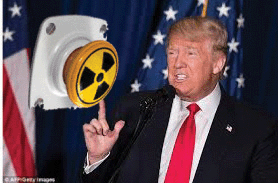
“We need to place someone or something between Donald Trump’s impulses and Armageddon. When it comes to demonstrating Trump’s recklessness, we don’t want the smoking gun to be a mushroom cloud.” Grayson said.
“If any finger rests on the nuclear button, it shouldn’t be Trump’s extended middle one.”
Donald Trump’s New Nuclear Instability, Democracy Now DECEMBER 29, 2016 BY AMY GOODMAN & DENIS MOYNIHAN
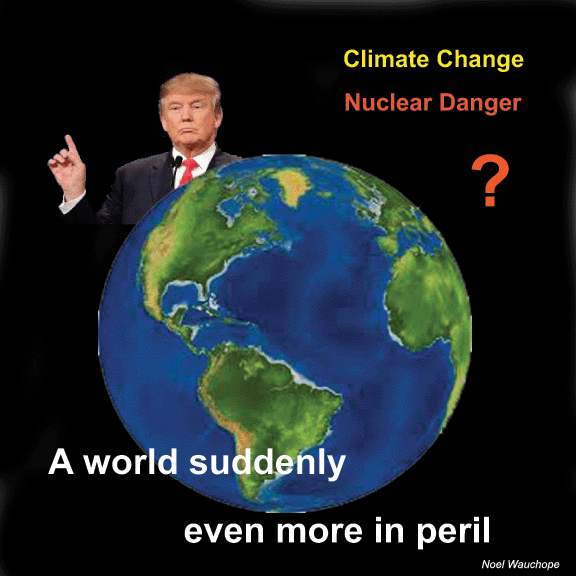
President-elect Donald Trump exploded a half-century of U.S. nuclear-arms policy in a single tweet last week: “The United States must greatly strengthen and expand its nuclear capability until such time as the world comes to its senses regarding nukes.” With that one vague message, Donald Trump, who hasn’t even taken office yet, may have started a new arms race.
Trump’s statement set off alarms around the world, necessitating a cadre of his inner circle to flood the airwaves with now-routine attempts to explain what their boss “really meant.”
On MSNBC, Rachel Maddow confronted former Trump campaign manager and newly appointed Trump counselor Kellyanne Conway about the shocking tweet:
Maddow: “He’s saying we’re going to expand our nuclear capability.”
Conway: “He’s not necessarily saying that —”
Maddow: “… He did literally say we need to expand our nuclear capability —”
Conway: “…What he’s saying is…we need to expand our nuclear capability, really our nuclear readiness, our capability to be ready for those who also have nuclear weapons.”
The next morning, during a commercial break on the MSNBC program “Morning Joe,” Trump spoke by phone with Mika Brzezinski, as she and her co-host Joe Scarborough sat in pajamas on the Christmas-themed TV set. The call was not broadcast, but when the show came back from the break, Brzezinski quoted Trump as saying, “Let it be an arms race … we will outmatch them at every pass and outlast them all.”
Minutes after that aired, Annie Leonard, executive director of Greenpeace USA, told us on the “Democracy Now!” news hour: “Every day, Trump says something that makes us worried, but this may be the most terrifying yet. A nuclear-arms race is the last thing that the world needs. I think about climate change. I think about economic inequality. I think about all of these major threats that we’re facing as a country and as a world. Why would we add on top of that a totally manufactured, unnecessary threat?”………
WORLD WAR THREE, BY MISTAKE Harsh political rhetoric, combined with the vulnerability of the nuclear command-and-control system, has made the risk of global catastrophe greater than ever. [Below, extracts from] New Yorker By Eric SchlosserDecember 23, 2016 “………My book “Command and Control” explores how the systems devised to govern the use of nuclear weapons, like all complex technological systems, are inherently flawed. They are designed, built, installed, maintained, and operated by human beings. But the failure of a nuclear command-and-control system can have consequences far more serious than the crash of an online dating site from too much traffic or flight delays caused by a software glitch. Millions of people, perhaps hundreds of millions, could be annihilated inadvertently. “Command and Control” focusses on near-catastrophic errors and accidents in the arms race between the United States and the Soviet Union that ended in 1991. The danger never went away. Today, the odds of a nuclear war being started by mistake are low—and yet the risk is growing, as the United States and Russia drift toward a new cold war. The other day, Senator John McCain called Vladimir Putin, the President of the Russian Federation, “a thug, a bully, and a murderer,” adding that anyone who “describes him as anything else is lying.” Other members of Congress have attacked Putin for trying to influence the Presidential election. On Thursday, Putin warned that Russia would “strengthen the military potential of strategic nuclear forces,” and President-elect Donald Trump has responded with a vow to expand America’s nuclear arsenal. “Let it be an arms race,” Trump told one of the co-hosts of MSNBC’s “Morning Joe.” “We will outmatch them at every pass and outlast them all.”
The harsh rhetoric on both sides increases the danger of miscalculations and mistakes, as do other factors.
Close encounters between the military aircraft of the United States and Russia have become routine, creating the potential for an unintended conflict. Many of the nuclear-weapon systems on both sides are aging and obsolete. The personnel who operate those systems often suffer from poor morale and poor training. None of their senior officers has firsthand experience making decisions during an actual nuclear crisis. And today’s command-and-control systems must contend with threats that barely existed during the Cold War: malware, spyware, worms, bugs, viruses, corrupted firmware, logic bombs, Trojan horses, and all the other modern tools of cyber warfare. The greatest danger is posed not by any technological innovation but by a dilemma that has haunted nuclear strategy since the first detonation of an atomic bomb: How do you prevent a nuclear attack while preserving the ability to launch one?
The pattern of the use of atomic weapons was set at Hiroshima,” J. Robert Oppenheimer, the scientific director of the Manhattan Project, said in November, 1945, just a few months after the Japanese city’s destruction. “They are weapons of aggression, of surprise, and of terror.” Nuclear weapons made annihilation vastly more efficient. A single bomb could now destroy a target whose elimination had once required thousands of bombs. During an aerial attack, you could shoot down ninety-nine per cent of the enemy’s bombers—and the plane that you missed could obliterate an entire city. A war between two countries with nuclear weapons, like a Wild West shoot-out, might be won by whoever fired first. And a surprise attack might provide the only hope of national survival—especially for the country with an inferior nuclear arsenal.
During the same month that Oppenheimer made his remarks, Bernard Brodie, a political scientist at Yale University, proposed a theory of nuclear deterrence that has largely guided American policy ever since. Brodie argued that the threat of retaliation offered the only effective defense against a nuclear attack. “We must do what we can to reduce the advantage that might accrue to the enemy if he hit first,” Brodie wrote, after the Soviet Union had obtained its own nuclear weapons. Despite all the money spent on building nuclear weapons and delivery systems, their usefulness would be mainly psychological. “What deters is not the capabilities and intentions we have, but the capabilities and intentions the enemy thinks we have,” a classified Pentagon report explained. “The mission is persuasion.”
The fear of a surprise attack and the necessity for retaliation soon dominated the strategic thinking of the Cold War. Every year, technological advances compressed time and added more urgency to decision-making……..
The dangers of “launch-on-warning” have been recognized since the idea was first proposed, during the Eisenhower Administration. After the Cuban Missile Crisis, McNamara advised Kennedy that the United States should never use its nuclear weapons until a nuclear detonation had occurred on American soil, and could be attributed to an enemy attack. ….. After the end of the Cold War, a Russian surprise attack became extremely unlikely. Nevertheless, hundreds of Minuteman III missiles remained on alert. The Cold War strategy endured because, in theory, it deterred a Russian attack on the missiles. McNamara called the policy “insane,” arguing that “there’s no military requirement for it.” George W. Bush, while running for President in 2000, criticized launch-on-warning, citing the “unacceptable risks of accidental or unauthorized launch.” Barack Obama, while running for President in 2008, promised to take Minuteman missiles off alert, warning that policies like launch-on-warning “increase the risk of catastrophic accidents or miscalculation.” Twenty scientists who have won the Nobel Prize, as well as the Union of Concerned Scientists, have expressed strong opposition to retaining a launch-on-warning capability. It has also been opposed by former Secretary of State Henry Kissinger, former Secretary of State George Shultz, and former Senator Sam Nunn. And yet the Minuteman III missiles still sit in their silos today, armed with warheads, ready to go……..
Donald Trump and Vladimir Putin confront a stark choice: begin another nuclear-arms race or reduce the threat of nuclear war. Trump now has a unique opportunity to pursue the latter, despite the bluster and posturing on both sides. His admiration for Putin, regardless of its merits, could provide the basis for meaningful discussions about how to minimize nuclear risks. Last year, General James Mattis, the former Marine chosen by Trump to serve as Secretary of Defense, called for a fundamental reappraisal of American nuclear strategy and questioned the need for land-based missiles. During Senate testimony, Mattis suggested that getting rid of such missiles would “reduce the false-alarm danger.” Contrary to expectations, Republican Presidents have proved much more successful than their Democratic counterparts at nuclear disarmament. President George H. W. Bush cut the size of the American arsenal in half, as did his son, President George W. Bush. And President Ronald Reagan came close to negotiating a treaty with the Soviet Union that would have completely abolished nuclear weapons.
Every technology embodies the values of the age in which it was created. When the atomic bomb was being developed in the mid-nineteen-forties, the destruction of cities and the deliberate targeting of civilians was just another military tactic. It was championed as a means to victory. The Geneva Conventions later classified those practices as war crimes—and yet nuclear weapons have no other real use. They threaten and endanger noncombatants for the sake of deterrence. Conventional weapons can now be employed to destroy every kind of military target, and twenty-first-century warfare puts an emphasis on precision strikes, cyberweapons, and minimizing civilian casualties. As a technology, nuclear weapons have become obsolete. What worries me most isn’t the possibility of a cyberattack, a technical glitch, or a misunderstanding starting a nuclear war sometime next week. My greatest concern is the lack of public awareness about this existential threat, the absence of a vigorous public debate about the nuclear-war plans of Russia and the United States, the silent consent to the roughly fifteen thousand nuclear weapons in the world. These machines have been carefully and ingeniously designed to kill us. Complacency increases the odds that, some day, they will. The “Titanic Effect” is a term used by software designers to explain how things can quietly go wrong in a complex technological system: the safer you assume the system to be, the more dangerous it is becoming.
North Korea ‘racing ahead’ on nuclear plan, defector says By KJ Kwon, CNN December 27, 2016 CNN)Political uncertainty in the United States and in South Korea could give North Korean leader Kim Jong-un “an apt time” to develop nuclear weapons “at all costs by the end of 2017,” a high-profile North Korean diplomat who recently defected to South Korea said Tuesday.
“Due to domestic political procedures, North Korea calculates that South Korea and the US will not be able to take physical or military actions to deter North Korea’s nuclear development,” Thae Yong-ho, formerly No. 2 at the North Korean Embassy in London, said in a news briefing, according to the Yonhap News Agency.
Thae said Kim has no plans to give up the country’s nukes even if he is offered huge sums of money, saying the leader is “racing ahead with nuclear development after setting up a plan to develop it (nuclear weapons) at all costs by the end of 2017.”……..
Director of National Intelligence James Clapper said in October that it’s a “lost cause” to try to get North Korea to surrender its nuclear weapons.
“They are under siege and they are very paranoid. So the notion of giving up their nuclear capability, whatever it is, is a nonstarter with them,” Clapper said in remarks at the Council on Foreign Relations in New York. “The best we could probably hope for is some sort of a cap.”
Tuesday was Thae’s first appearance to the media since he escaped his post in London to take refuge in South Korea along with his wife and two sons in July.
Educated overseas and having spent decades at foreign posts, the 55-year-old Thae becomes one of the highest-ranking North Korean officials yet known to have defected to the South though some senior-level defections are not known to the public as well.
India has successfully carried out a fourth test of its nuclear-capable, intercontinental Agni-V missile, which can hit targets more than 5,000 kilometers away, effectively putting China’s northernmost areas within range of Indian nuclear weapons.
The 17.5-meter-long, 50-ton surface-to-surface missile was test fired Monday from Abdul Kalam Island, off the coast of the eastern Odisha state, and splashed down near Australian waters.
Ajay Lele, at New Delhi’s Institute for Defense Studies and Analyses, says the test ensured the Agni-V missile is operational.
“After this, the missile will be handed over for the operationalization of it to India’s strategic forces command and they will undertake two tests and subsequently the missile will come into India’s armory,” said Lele.
Longer range
Earlier generations of Agni missiles, developed over the last decade, are capable of striking anywhere in Pakistan, India’s neighbor and South Asian rival. The two countries have fought three wars and tensions continue to run high. Pakistan also possesses nuclear weapons.
Defense analysts say the longer-range Agni-V missile has been developed with an eye on China, which New Delhi also views as a threat.
India and China fought a brief war in 1962 and have an unresolved boundary dispute in the Himalayas. New Delhi also remains wary of China’s close ties with Islamabad and bid to increase its influence in the Indian Ocean.
The Agni missile adds considerable heft to India’s nuclear capability and its aspirations to be viewed as a regional power. Only China, France, Russia the United States and Britain have long-range nuclear weapons.
Scientists said the latest missile incorporates new technology for navigation and guidance.
Indian leaders welcomed the successful test of the Agni, which means “fire” in Hindi and Sanskrit.
Congratulating the scientists, Prime Minister Narendra Modi tweeted that the “[s]uccessful test firing of Agni-V makes every Indian very proud. It will add tremendous strength to our strategic defense.”
Could Donald Trump help unleash nuclear catastrophe with a single tweet?, Canberra Times, Greg Sargent , 27 Dec 16, Donald Trump’s alarming tweet about his desire to “greatly strengthen and expand” the “nuclear capability” of the US unleashed a frenzy of media efforts to try to divine his actual policy intentions. It forced some of his advisers into tortured claims that Trump didn’t say what he actually said, even as others simultaneously insisted that Trump did meaningfully put other countries on notice that if he deems them to be challenging our supremacy, they will face an arms race.
But perhaps the most worrisome thing about Trump’s nuclear tweet is not the intention to break with decades of international disarmament efforts that it may have signalled, though that’s frightening enough on its own. Rather, it’s that he saw fit to tweet about nuclear weapons at all.
As we prepare for President Trump to take near-unchecked control of our nuclear machinery, his nuclear tweet is best seen as a window into his temperament. Trump still does not appreciate that every word he utters carries tremendous weight and could have dramatic, untold, far-reaching, unpredictable consequences – something that is especially true in the nuclear arena. Or, perhaps worse, Trump may be entirely indifferent to this fact.
Arms control experts I spoke with suggested that Trump’s willingness to tweet about nuclear weapons raises the possibility of Trump doing the same as president – and more to the point, the possibility of him doing so amid some species of international crisis or escalation………
As we prepare for President Trump to take near-unchecked control of our nuclear machinery, his nuclear tweet is best seen as a window into his temperament. Trump still does not appreciate that every word he utters carries tremendous weight and could have dramatic, untold, far-reaching, unpredictable consequences – something that is especially true in the nuclear arena. Or, perhaps worse, Trump may be entirely indifferent to this fact.
Arms control experts I spoke with suggested that Trump’s willingness to tweet about nuclear weapons raises the possibility of Trump doing the same as president – and more to the point, the possibility of him doing so amid some species of international crisis or escalation……
Bernie Sanders urges Congress to stop Donald Trump launching nuclear arms raceDemocrat speaks out after President-elect appears to reverse decade’s-old policy of disarmament, The Independent, Charlotte England@charlottenglandSaturday 24 December 2016Bernie Sanders has urged Congress to stop Donald Trump launching a Cold War-style nuclear arms race.
“It’s a miracle a nuclear weapon hasn’t been used in war since 1945,” the VermontSenator said in a post on Twitter. “Congress can’t allow the Tweeter in Chief to start a nuclear arms race.”
Earlier on Friday, the US President-elect was asked to clarify the meaning behind an ambiguous tweet in an interview with MSNBC. “Let it be an arms race,” he is reported to have told co-host Mika Brzezinski,in a telephone call……..
Laicie Heeley, a nuclear expert at the Stimson Center, a nonpartisan anti-nuclear proliferation think-tank in Washington, told AFP news agency it was “reckless” for Mr Trump to tweet on the topic without offering details.
“To make such a loaded statement without context or follow-up is irresponsible at best,” she said.
“We could be talking about a return to the Cold War here, when the threat of a nuclear catastrophe was very real,“ she said. ”Russian rhetoric is already moving in that direction. It wouldn’t take a lot to bring us back there.”
Minutes after Mr Trump’s follow up remarks were reported on MSNBC, his secretary Sean Spicer said in several television interviews that there would be no arms race because the President-elect would make sure that other countries trying to step up their nuclear capabilities, such as Russia and China, would decide not to participate.
No other force epitomizes the absolute destructive power humanity has unlocked in the way nuclear weapons have. And the weapons rapidly became more powerful in the decades after that first test.
The device tested in 1945 had a 20 kiloton yield, meaning it had the explosive force of 20,000 tons of TNT. Within 20 years, the US and USSR tested nuclear weapons larger than 10 megatons, or 10 million tons of TNT. For scale, these weapons were at least 500 times as strong as the first atomic bomb.
To put the size of history’s largest nuclear blasts to scale, we have used Alex Wellerstein’s Nukemap, a tool for visualizing the terrifying real-world impact of a nuclear explosion.
11 (tie). Soviet Tests #158 and #168
On August 25 and September 19, 1962, less than a month apart, the USSR conducted nuclear tests #158 and #168. Both tests were held over the Novaya Zemlya region of Russia, an archipelago to the north of Russia near the Arctic Ocean.
No film or photographs of the tests have been released, but both tests included the use of 10-megaton atomic bombs. These blasts would have incinerated everything within 1.77 square miles of their epicenters while causing third-degree burns up to an area of 1,090 square miles.
10. Ivy Mike
On November 1, 1952, the US tested Ivy Mike over the Marshall Islands. Ivy Mike was the world’s first hydrogen bomb and had a yield of 10.4 megatons, making it 700 times as strong as the first atomic bomb.
Ivy Mike’s detonation was so powerful that it vaporized the Elugelab Island where it was detonated, leaving in its place a 164-foot-deep crater. The explosion’s mushroom cloud traveled 30 miles into the atmosphere.
9. Castle Romeo
Romeo was the second US nuclear detonation of the Castle Series of tests, which were conducted in 1954. All of the detonations took place over Bikini Atoll. Castle Romeo was the third-most powerful test of the series and had a yield of 11 megatons.
Romeo was the first device to be tested on a barge over open water instead of on a reef, as the US was quickly running out of islands upon which it could test nuclear weapons.
The blast would have incinerated everything within 1.91 square miles.
8. Soviet Test #123
On October 23, 1961, the Soviets conductednuclear test #123 over Novaya Zemlya. Test #123 used a 12.5 megaton nuclear bomb. A bomb of this size would incinerate everything within 2.11 square miles while causing third-degree burns in an area of 1,309 square miles.
No footage or photographs of this nuclear test have been released.
7. Castle Yankee
Castle Yankee, the second-strongest of the Castle series tests, was conducted on May 4, 1954. The bomb was 13.5 megatons. Four days later, its fallout reached Mexico City, about 7,100 miles away.
6. Castle Bravo
Castle Bravo, detonated on February 28, 1954, was the first of the Castle series of tests and the largest US nuclear blast of all time.
Bravo was anticipated as a 6-megaton explosion. Instead, the bomb produced a 15-megaton fission blast. Its mushroom cloud reached 114,000 feet into the air.
The US military’s miscalculation of the test’s size resulted in the irradiation of approximately 665 inhabitants of the Marshall Islands and the radiation poisoning death of a Japanese fisherman who was 80 miles away from the detonation site.
3 (tie). Soviet Tests #173, #174, and #147
From August 5 to September 27, 1962, the USSR conducted a series of nuclear tests over Novaya Zemlya. Tests #173, #174, and #147 all stand out as being the fifth-, fourth-, and third-strongest nuclear blasts in history.
All three produced blasts of about 20 megatons, or about 1,000 times as strong as the Trinity bomb. A bomb of this strength would incinerate everything within 3 square miles.
No footage or photographs of these nuclear tests have been released.
2. Soviet Test #219
On December 24, 1962, the USSR conductedTest #219 over Novaya Zemlya. The bomb had a yield of 24.2 megatons. A bomb of this strength would incinerate everything within 3.58 square miles while causing third-degree burns in an area up to 2,250 square miles.
There are no released photos or video of this explosion.
1. The Tsar Bomba
On October 30, 1961, the USSR detonated the largest nuclear weapon ever tested and created the biggest man-made explosion in history. The blast, 3,000 times as strong as the bomb used on Hiroshima, broke windows 560 miles away, according to Slate.
The flash of light from the blast was visibleup to 620 miles away.
The Tsar Bomba, as the test was ultimately known, had a yield between 50 and 58 megatons, twice the size of the second-largest nuclear blast.
A bomb of this size would create a fireball 6.4 square miles large and would be able to give humans third-degree burns within 4,080 square miles of the bomb’s epicenter.
The first atomic bomb
The first atomic blast was a fraction the size of the Tsar Bomba, but it was still an explosion of almost unimaginable size.
According to the NukeMap, a weapon with a 20-kiloton yield produces a fireball with a radius of 260 meters, making its total width the size of 5 football fields. It would spew deadly radiation over an area 7 miles in width, and would produce third-degree burns in an area over 12 miles in width.
If dropped over lower Manhattan, a bomb of that size would kill over 150,000 people and produce fallout stretching all the way to central Connecticut, according to the NukeMap.
The first atomic bomb was tiny by nuclear weapons standards. But its destructiveness is sill nea lry impossible to grasp.
‘Unrecoverable’: revealed N-documents show Iran can not make nuclear weapons , The Age, Vienna, 24 Dec 16 : In an unusual move, Iran and six world powers have released previously restricted documents about their nuclear deal to enforce their view that Tehran is not in a position to try to make nuclear weapons.
Some of the documents are dated January 6, 2016, shortly before the pact was implemented. But they were not made public until Friday, when they were posted on the public website of the International Atomic Energy Agency.
The IAEA is monitoring the nuclear deal, which Iran reached with Germany and the five permanent UN Security Council members – the United States, Russia, China, France and Britain.
The agreement stipulates that Iran can possess only low-enriched uranium, which is not suitable for weapons, and it is limited to possessing no more than 300 kilograms at any time. That is far less than would be needed to make a nuclear weapon even if it were further enriched to weapons-grade levels used for the core of nuclear warheads.
When the nuclear deal was agreed on, Iran had more than 100 kilograms of liquid or solid waste containing low-enriched uranium as part of its enrichment activities. Some of the material remains and the documents posted on Friday declare the low-enriched uranium it contains as “unrecoverable” and thereby not part of the 300-kilogram limit.
A letter on behalf of the European Union’s foreign policy chief, Federica Mogherini, authorising publication of the documents was also posted on the IAEA website.
Trump Welcomes Nuclear Arms Race: “We Will Outmatch Them at Every Pass”, Slate 23 Dec 16 By Daniel Politi President-elect Donald Trump is doubling down on a statement that alarmed non-proliferation experts around the globe, essentially saying he’s cool with a nuclear arms race. “Let it be an arms race,” Trump told MSNBC’s Mika Brzezinski when she asked him to clarify comments about expanding the country’s nuclear weapons capabilities. In the off-air conversation with the co-host of Morning Joe, the president-elect expressed confidence that the United States would come out on top anyway so there’s nothing to fear. “We will outmatch them at every pass and outlast them all,” Trump reportedly said.
Trump’s statement came a day after the president-elect shocked the world by writing on Twitter that the United States “must greatly strengthen and expand its nuclear capability until such time as the world comes to its senses regarding nukes.”…….
Donald Trump Says U.S. Should ‘Greatly’ Expand Nuclear Arsenal
The New York Times agrees there seems to be little doubt that at least based off on Trump’s statements, the president-elect seems willing to “restart the costly and dangerous Cold War-era nuclear weapons competition between the United States and the old Soviet Union.”……
The Russian leader said that his country’s military is stronger than any potential aggressor, even if he recognized the United States has a larger military. “Of course the U.S. has more missiles, submarines and aircraft carriers, but what we say is that we are stronger than any aggressor, and this is the case,” he said, adding that Russia has weapons that can penetrate U.S. defense systems.http://www.slate.com/blogs/the_slatest/2016/12/23/trump_welcomes_nuclear_arms_race_confident_we_will_outmatch_them_at_every.html
Donald Trump and Vladimir Putin agree: Let’s revive the nuclear arms race, WP By Philip BumpDecember 22Russian President Vladimir Putin gave a speech Thursday in which he praised his country’s military operations on behalf of the government of Syria and made a case for how Russia could be stronger moving forward.
“We need to strengthen the military potential of strategic nuclear forces,” …… You can’t have a new nuclear arms race, of course, without someone to run against. Enter President-elect Donald Trump……..
The trend since the late 1980s has been in the opposite direction, winding down the stockpiles of weapons held by the United States and Russia…….
As always, it’s fraught to take one Trump tweet as a descriptor of where his presidency might be headed. (He has, for example, also tweeted that he never argued for other countries to get nuclear weapons, which is false.) It’s also not clear that “strengthen and expand” means more actual nuclear warheads. (The United States will spend an estimated $1 trillionover 30 years to modernize its weapons stockpile, in part because aging nuclear warheads require significant maintenance.) But Trump’s tweet stands in stark contrast to what President Obama said in May, at the site of the first atomic detonation in world history. In Hiroshima, Japan, Obama called for “a world without nuclear weapons.”…….
Nuclear arms expert: There’s a huge contradiction in Trump’s thinking on nuclear arms, Business Insider ALEX LOCKIE DEC 24, 2016 On Thursday, President-elect Donald Trump tweeted that “The United States must greatly strengthen and expand its nuclear capability until such time as the world comes to its senses regarding nukes.”
But as Kingston Reif, director for disarmament and threat reduction policy at the Arms Control Association, told Business Insider, there’s a huge contradiction in Trump’s recent thinking on defence projects.
“Trump may be open to expanding the number of nuclear weapons in the arsenal, building new weapons, increasing the role of nuclear weapons in US policy,” Reif told Business Insider in an interview, despite the fact that the US’s nuclear arms are already “second to none.”
However, the US’s current path towards modernising US nuclear weapons will already cost a whopping $1 trillion dollars. Though it’s not yet clear whether Trump means actually building more or different types of nuclear weapons, he also recently seemed to shun another potentially trillion-dollar US defence project that’s already well underway.
“One of the interesting contradictions here is that his tweet suggests that he is going to move full steam ahead with the current nuclear modernisation plan, but we’ve also heard him express concerns about the F-35 program, saying maybe we need to stop it,” said Reif.
But, as Reif points out, the F-35 is part of the US’s overall nuclear modernisation program.
“Later versions of the F-35 will be nuclear capable and replace other fighters and bombers,’ said Reif.
Donald Trump: US must greatly expand nuclear weapons Donald Trump has called for the US to “greatly strengthen and expand” its nuclear arsenal. BBC News 22 Dec 16 The president-elect, who takes office next month, said the US must take such action “until such time as the world comes to its senses regarding nukes”.
He spoke hours after President Vladimir Putin said Russia needs to bolster its military nuclear potential.
The US has 7,100 nuclear weapons and Russia has 7,300, according to the US nonpartisan Arms Control Association. Mr Trump’s announcement, which came via Twitter, was published in a string of several tweets on Thursday morning.
Mr Trump also wrote to criticise a resolution being considered at the UN and to reiterate his vow to “drain the swamp” – a reference to corruption in Washington DC.
His tweet came only hours after President Putin met with his military advisers to recap Russian military activities in 2016………
This is a radical departure from President Obama’s current policy.
Mr Trump has offered no further details on his plans but he has hinted in the past that he favoured an expansion of the nuclear programme.
He was asked in interviews whether he would use weapons of mass destruction against an enemy and he said that it would be an absolute last stance, but he added that he would want to be unpredictable.
In contrast, President Obama has talked of the US commitment to seek peace and security without nuclear weapons.
He has sought to reduce the nation’s arsenal of nearly 5,000 warheads in favour of more special operations forces and precise tactical strikes……. http://www.bbc.com/news/world-us-canada-38410027
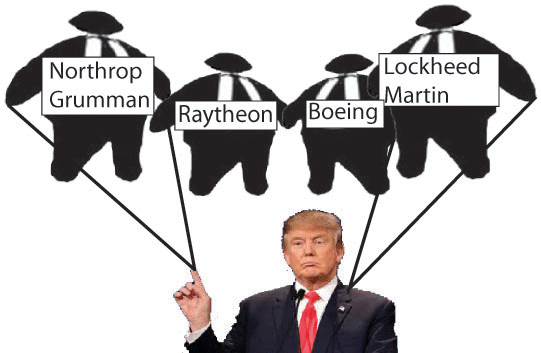
Trump Goes Nuclear, But This Time Lockheed, Northrop, Raytheon Rise http://www.investors.com/news/trump-tweets-about-nukes-after-blasting-pentagon-spending/GILLIAN RICH President-elect Donald Trump tweeted about the importance of the U.S. nuclear arsenal, which will cost hundreds of billions of dollars to recapitalize, potentially giving defense giants like Lockheed Martin (LMT), Northrop Grumman (NOC), Raytheon (RTN) and Boeing (BA) some hope that he won’t cost-shame them on that piece of the Pentagon budget America’s nuclear triad of air-, land- and sea-based delivery systems is nearing the end of its life span and needs to be replaced. But that won’t come cheaply.
Over the summer, the Air Force released its requests for proposals for intercontinental ballistic missiles to replace Boeing’s aging Minuteman system. The Ground-Based Strategic Deterrent’s estimated cost is $62 billion over 30 years, but a report from the Pentagon’s office of independent cost assessment said the Air Force’s estimate is too low by “billions of dollars,” sources told Bloomberg.
The Air Force is also seeking Long-Range Standoff nuclear cruise missiles to replace Boeing AGM-86B Air-Launched Cruise Missiles. That program’s cost has been estimated at $20 billion-$30 billion.
Boeing, Raytheon, Northrop and Lockheed are expected to bid on the two contracts, and initial contracts could be awarded next year.
Last year, Northrop was awarded a contract to build the B-21 bomber that replaces the Cold War-era Boeing B-52s. The Air Force has put the development-phase cost for the B-21 at $23.5 billion, but analysts have estimated the total acquisition cost at up to $80 billion. The Navy’s program to replace its Ohio-class submarines, which can launch nuclear missiles, will cost the service $100 billion.
Shares of defense contractors reversed higher after early, narrow losses. Lockheed shares edged up 0.1% on the stock market today, Northrop added 0.3%, and Raytheon rose 0.5%. Boeing gained 0.1%. General Dynamics (GD) and Huntington Ingalls (HII), which build submarines, were up 0.3% and 2.1%, respectively.
Congress scrapped this one word from the law, opening the door to a space arms race, L.A. Times, David Willman, 22 Dec 16, By removing a single word from legislation governing the military, Congress has laid the groundwork for both a major shift in U.S. nuclear defense doctrine and a costly effort to field space-based weaponry.
Experts say the changes, approved by overwhelming majorities in both the House and Senate, could aggravate tensions with Russia and China and prompt a renewed nuclear arms race. The bill awaits action by President Obama. The White House has not said what he will do.
For decades, America’s defense against nuclear attack has rested on twin pillars: The nation’s homeland missile defense system is designed to thwart a small-scale, or “limited,” attack by the likes of North Korea or Iran. As for the threat of a large-scale strike by China or Russia, the prospect of massive U.S. retaliation is supposed to deter both from ever launching missiles.
Central to this strategy was a one-word qualifier – “limited” — used to define the mission of the homeland defense system. The language was carefully crafted to avoid reigniting an arms race among the superpowers.
Now, with virtually no public debate, bipartisan majorities in Congress have removed the word “limited” from the nation’s missile defense policy. They did so in giving final approval over the last month to the year-end defense bill, the National Defense Authorization Act.
A related provision of the law calls for the Pentagon to start “research, development, test and evaluation” of space-based systems for missile defense.
A space-based defense program would hinge on annual congressional appropriations and decisions by the incoming Trump administration.
Yet both proponents and opponents say the policy changes have momentous implications.
“These amendments were historic in nature — given the paradigm shift forward that they represent,” said Rep. Trent Franks (R-Ariz.), who introduced and shepherded the amendments in the House.
Leading defense scientists said the idea that a space-based system could provide security against nuclear attack is a fantasy.
“It defies the laws of physics and is not based on science of any kind,” said L. David Montague, a retired president of missile systems for Lockheed Corp. and co-chair of a National Academy of Sciences panel that studied missile defense technologies at the request of Congress.
“Even if we darken the sky with hundreds or thousands of satellites and interceptors, there’s no way to ensure against a dedicated attack,” Montague said in an interview. “So it’s an opportunity to waste a prodigious amount of money.”
He called the provisions passed by Congress “insanity, pure and simple.”
The National Academy study, released in 2012, concluded that even a bare-bones space-based missile defense system would cost about $200 billion to put in place, and hundreds of billions to operate in subsequent years.
Franks, asked whether the country could afford it, replied: “What is national security worth? It’s priceless.”
Philip E. Coyle III, a former assistant secretary of Defense who headed the Pentagon office responsible for testing and evaluating weapon systems, described the notion of a space-based nuclear shield as “a sham.”
“To do this would cost just gazillions and gazillions,” Coyle said. “The technology isn’t at hand — nor is the money. It’s unfortunate from my point of view that the Congress doesn’t see that.”
He added: “Both Russia and China will use it as an excuse to do something that they want to do.”
The word “limited” has guided U.S. policy since the National Missile Defense Act of 1999. The qualifier reflects, in part, the reality that intercepting and destroying incoming warheads is supremely difficult, and that it would be impractical to field enough interceptors to counter a large-scale attack. Any such system, by its very nature, would be limited.
The first of his amendments — to eliminate “limited” from U.S. policy — was approved in April by the House Armed Services Committee with no debate and without a recorded roll-call vote.
At a committee hearing May 17, a senior Democrat on the panel, Rep. Jim Cooper of Tennessee, offered mild protest.
“I think it was a mistake to mandate a poorly thought out, unaffordable and unrealistic missile defense policy, including plans for a space-based missile deterrent,” Cooper said.
But neither Cooper nor any other House Democrat sought to overturn the provisions, and he was among those who voted to pass the overall bill the next day……..
In June, Sen. Ed Markey (D-Mass.) sought to restore “limited,” saying that the change in U.S. policy would create “the impetus for a new arms race” with Russia and China. Markey offered an amendment on the Senate floor but could not muster enough support to bring it to vote.
The same month, the Obama administration criticized the changes in the Senate bill, saying it “strongly objects” to removing “limited” and to placing anti-missile weaponry in space. The statement stopped short of threatening a veto.
The policy changes were greeted with opposition from another quarter as well. At a congressional hearing in April, Franks pressed Vice Adm. James D. Syring, director of the Missile Defense Agency, for his stance on expanding U.S. capability into space.


 “We need to place someone or something between Donald Trump’s impulses and Armageddon. When it comes to demonstrating Trump’s recklessness, we don’t want the smoking gun to be a mushroom cloud.” Grayson said.