North Korea’s greatly increased plutonium stockpile

 North Korea’s Nuclear Weapons: Under Kim Jong Un, Plutonium Stockpile Has Reached Unprecedented Levels, International Business Times, BY ON 01/12/17 In the past two years, North Korea has steadily increased its supply of plutonium and now has enough for 10 nuclear warheads, according to a report this week from the South Korean Ministry of National Defense. In all, South Korea’s 2016 Defense White Paper found that the North had increased its supply of weapons -grade plutonium to 50 kilograms, up from 40 kilograms two years ago, the Korea Times reported. The plutonium was obtained by reprocessing spent fuel rods.
Under the dictatorial rule of leader Kim Jong Un, North Korea has focused on developing its nuclear arsenal. More recently, North Korea has worked toward developing a reliable intercontinental ballistic missile (ICBM) that would be capable of carrying a nuclear warhead.
The increased stockpile comes amid continued threats from Kim. In a New Year’s speech, Kim provoked the West — the United States and South Korea especially — and claimed an ICBM was nearing completion…….
Should the North develop a reliable ICBM, it would likely have the capability of reaching the United States. A working ICBM could still be a ways off, however…….http://www.ibtimes.com/north-koreas-nuclear-weapons-under-kim-jong-un-plutonium-stockpile-has-reached-2474439
The F-35 may destabilize relations between the world’s two greatest nuclear powers — Russia and the US.

 The F-35 may carry one of the US’s most polarising nuclear weapons sooner than expected http://www.businessinsider.com.au/f-35-b-61-nuclear-bomb-sooner-than-expected-2017-1?r=US&IR=T ALEX LOCKIE JAN 13, 2017 The Air Force designed the F-35A with nuclear capability in mind, and a new report indicates that the Joint Strike Fighter may carry nuclear weapons sooner than expected.
USA nominee for secretary of defense disagrees with Donald Trump on nuclear weapons
Mattis strikes sharp contrast to Trump on F-35, nuclear weapons 12 JANUARY, 2017: FLIGHTGLOBAL.COM BY: LEIGH GIANGRECO WASHINGTON DC
Donald Trump’s nominee for secretary of defense supports Lockheed Martin’s F-35 Joint Strike Fighter programme, the NATO alliance and restrained use of nuclear weapons during his confirmation hearing, marking a stark departure from the president-elect……..https://www.flightglobal.com/news/articles/mattis-strikes-sharp-contrast-to-trump-on-f-35-nuc-433139/
Dispute on pensions brings about strike by British nuclear weapons workers
British nuclear weapons workers to go on strike over Atomic Weapons Establishment pensions dispute The Independent, 12 Jan 17 Staff manufacture and maintain nuclear weapons including the Trident programme Lizzie Dearden @lizziedearden Employees responsible for manufacturing and maintaining the UK’s nuclear weapons are to go on strike.
Workers at the Atomic Weapons Establishment (AWE) are to stage two 48-hour walk-outs as part of a long-running dispute over pensions.
A spokesperson said workers felt “deeply betrayed” by promises made decades ago guaranteeing their pensions, when they were transferred from the Ministry of Defence (MoD) to the private sector, being broken………
“The four days of strike action later this month are not being taken lightly. It is not a ‘political’ strike, but one taken reluctantly by our members who have no desire to see thousands of pounds wiped off their retirement incomes.”
Unite claimed new pensions proposals, which would see the AWE’s pension contributions lowered, violated pledges made in a ministerial statement to the Commons in the 1990s. The AWE, owned by a consortium of Lockheed Martin, Jacobs Engineering and Serco, is contracted by the MoD to build and maintain nuclear warheads for Royal Navy submarines. http://www.independent.co.uk/news/uk/home-news/british-nuclear-weapons-factory-workers-berkshire-go-on-strike-prospect-union-awe-atomic-weapons-a7523516.html
The danger of plutonium being released at United States at Naval Base Kitsap-Bangor.
Puget Sound’s ticking nuclear time bomb, Crosscut by Glen Milner, 10 Jan 17 “……“Command and Control” shows what can happen when the weapons built to protect us threaten to destroy us, and it speaks directly to Puget Sound citizens: Locally, we face a similar threat in Hood Canal with the largest concentration of deployed nuclear weapons in the United States at Naval Base Kitsap-Bangor.
An accident at Bangor involving nuclear weapons occurred in November 2003 when a ladder penetrated a nuclear nose cone during a routine missile offloading at the Explosives Handling Wharf. All missile-handling operations at the Strategic Weapons Facility Pacific (SWFPAC) were stopped for nine weeks until Bangor could be recertified for handling nuclear weapons. Three top commanders were fired but the public was never informed until information was leaked to the media in March 2004.
The Navy never publicly admitted that the 2003 accident occurred. The Navy failed to report the accident at the time to county or state authorities. Public responses from governmental officials were generally in the form of surprise and disappointment.
The result of such an explosion likely would not cause a nuclear detonation. Instead, plutonium from the approximately 108 nuclear warheads on one submarine could be spread by the wind…… http://crosscut.com/2017/01/nuclear-accidents-bangor-accident-command-and-control/
US govt denies North Korea’s claims on its nuclear missiles, but international concerns grow
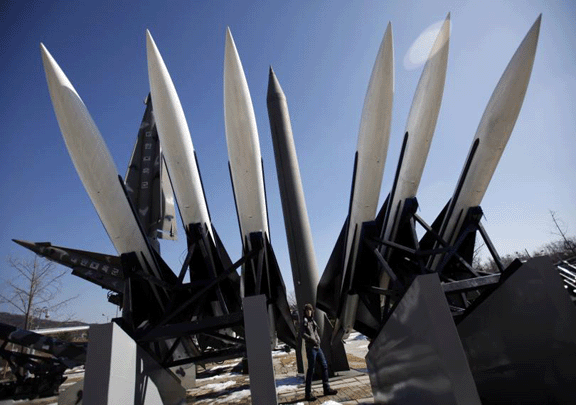 US Rejects North Korea’s Nuclear Claim Amid Growing Concerns http://www.voanews.com/a/us-rejects-north-korea-nuclear-claim-amid-growing-concerns/3665388.html, 5 Jan 17, Amid speculation surrounding North Korea’s nuclear capabilities, the U.S. government said this week that Pyongyang has yet to acquire the ability to outfit an intercontinental ballistic missile with a nuclear warhead.
The latest assessment came after North Korean leader Kim Jong Un’s statement that the preparations for launching an intercontinental ballistic missile had “reached the final stage.” His claim, in a New Year’s Day address, immediately sent ripples across the world’s capitals, prompting President-elect Donald Trump to tweet, “It won’t happen!”
Despite the U.S. rejection of North Korea’s purported capability, experts are raising concern about the threats emanating from the regime. Continue reading
Inside Britain’s secret nuclear bunker
 The secret nuclear bunker built as the UK’s last hope, Dug for an underground ‘shadow factory’ for aircraft during World War Two, the Drakelow tunnels were re-purposed as a nuclear bunker to be used by the UK government. We went inside., BBC By William Park 4 January 2017
Deep beneath a hill in the Worcestershire countryside, about 20 miles west of Birmingham, lie a series of hidden tunnels. Once home to a secret aeroplane factory during World War Two, they were later repurposed to protect the UK in the event of a nuclear war: it’s from here that the government would have continued to run the country.
“This would have been the last resort of the UK government,” says Michael Scott, a volunteer with the Drakelow Preservation Trust, which is restoring the site. The Trust’s aim is to reopen parts of the tunnels as a museum to preserve their history in World War Two and the Cold War. But the organisation remains some years away from finishing the work, and without much funding, the volunteers are restricted mostly to repainting walls.
When cities across the UK came under siege during the war, the government needed to find a way to continue production of tanks, aircraft and ammunition. The solution was to build underground factories – also called shadow factories – away from large cities. The Drakelow Tunnels housed one of them. And the same remoteness and fortress-like qualities that made Drakelow an effective underground aircraft factory would later make it the location of choice for responding to nuclear attack in Britain.
Today, the entrance used by Scott and the other volunteers is called Adit A; it’s where the security office would have stood. Most of the hillside around the entrance is bare, revealing a sandstone mass towering above us that would have made this site virtually bomb-proof in World War Two.
Adit A shows many signs of the alterations that were made to Drakelow Tunnels to retrofit it for use as a nuclear bunker – including covered air vents that would have protected those inside from fallout. Through the heavy steel door, visitors would have had to strip, incinerate their clothes and shower as they decontaminated themselves……..
There are examples of similar subterranean shadow factories in Germany, too. The largest was Mittelwerk, Kohnstein, which produced V-1 and V-2 bombs from 1943 to 1945. The move underground was a direct result of the destruction of other, above-ground V-2 production plants, like Peenemunde in northern Germany. Unlike Drakelow, Mittelwerk was left in ruins after the war.
Perhaps the most intriguing underground network of Nazi military tunnels is the series of seven structures that make up Project Riese. Buried in the Owl Mountains – then part of Germany but now in south-west Poland near the Czech border – these sites were never finished and documents about their full purpose seem to have been destroyed…….
Cold comfort
Top-secret military construction did not end with World War Two. In 1949, as the Cold War bloomed, the UK government began to build 15 fortified war rooms across the country.
But in the case of the much bigger threat of a nuclear attack, these buildings would not have been enough to protect their inhabitants. They were too small, making them unable to support a workforce for the extended period of time they’d need to remain indoors to avoid the fallout of a nuclear explosion. They also were built too close to the major cities which could have been a target for an attack: five were built in London, for example.
Having seen the effect of a nuclear attack in Japan, the British government commissioned the Strath Committee, led by head of the Central War Plans Secretariat William Strath, to analyse the potential effects of a nuclear attack on the UK. In 1955 the committee published the Strath Report which found that even a ‘limited’ attack would have devastating consequences. Food and water would be contaminated, the NHS would be overwhelmed with four million serious casualties and 12 million deaths, and industry would shut down. In short, the “social and economic fabric of the country [would be] destroyed”.
Strath recommended the UK invest in a network of nuclear bunkers to protect the population. However, estimates put the cost of such an enormous series of bunkers at £1.25bn (equal to £30.88bn in 2016)……… http://www.bbc.com/future/story/20170103-the-secret-nuclear-bunker-built-as-the-uks-last-hope
Mutually Assure Destruction – a MAD danger that might be increased by Donald Trump
The “madman theory” of nuclear war has existed for decades. Now, Trump is playing the madman. VOX, by Jan 4, 2017, Is Donald Trump a madman? Or, at least, would he like foreign leaders to think he might be just a little unstable? Such questions are being batted around in papers like the Boston Globe and the Washington Post in response to the president-elect’s foreign policy moves: his provocations toward China, his attacks on NATO and the UN, his warm overtures toward Rodrigo Duterte and Vladimir Putin.
Across the pundit-sphere, analysts are asking, is he crazy, or crazy like a fox?
In no context is the question more pertinent than Trump’s position on nuclear weapons. His comments both as candidate and president-elect show a more cavalier attitude toward their proliferation and use than any president in the past 30 years. “You want to be unpredictable,” Trump said last January on Face the Nation when asked about nuclear weapons. More recently, he tweeted that it was time for the US to start stockpiling nukes again. The comments prompted instant parallels to Richard Nixon’s “madman theory” of foreign relations: the idea that the president couldn’t be controlled — including where America’s nuclear arsenal was concerned — so foreign leaders should do everything in their power to appease him.
The madman question is so important here because madness has been a mainstay of nuclear culture since the atomic age flashed into being in the Jornada del Muerto desert in 1945. The bomb, carefully engineered by some of the 20th century’s most brilliant scientists, able to raze cities and civilizations, has always spanned rationality and irrationality, logic and madness.
The brightest minds created the most destructive force, and then leaders spent years working out rationales for its world-ending use. It was a madness begot by logic. But that madness doesn’t always present in the same way, which is why the history of nuclear madness has to precede our understanding of the Trump-as-madman debate…….
A brief, terrifying history of America’s nuclear mishaps
four years after Hiroshima and Nagasaki, the Soviets tested their own nuclear bomb, and the race was on for more powerful bombs, for better strike capability, for the ability to annihilate the other side before it could return fire. By the mid-1950s, the arms race had reached its illogically logical endpoint: If one side struck, everyone would be wiped out. Mutual assured destruction. MAD.
The acronym stuck, perhaps because of the horrific absurdity of it all. The logical conclusion, the position to which the world had been brought by the combined education and expertise of scientists and strategists, was the verge of obliteration………
As time passed, Mutually Assured Destruction came to seem — MAD……….
World leaders understand that nations with nuclear weapons are treated differently than those without, and so there is a rational reason for pursuing nuclear technology. At the same time, the use of nuclear weapons against an enemy would make a nation-state into a global pariah. It would be insane.
Enter Donald Trump. The president-in-waiting is schooled in none of these particulars, claiming to believe only in strength and the desire to use it. His loose talk about nukes has re-raised the long-dormant question: Is he crazy enough to actually press the button?
Here, the history of nuclear madness may be as much a trap as a guide. Because the questions now shouldn’t be about Trump’s madness but his impulsivity and ignorance. Whatever one thinks of Nixon and Kissinger’s madman theory, it was a calculation. Kissinger was steeped in game theory and Nixon had a deep knowledge of international affairs. Reagan was a foreign policy autodidact with experienced ideological advisors. Their administrations could tell a hawk from a handsaw. (Admittedly, some of these comforting thoughts were only fully evident in hindsight.)
Trump doesn’t share his predecessors’ considered strategic thinking and mastery of geopolitics, but that doesn’t make him a madman. The madness is in the weapons themselves, powerful enough to obliterate entire countries, entire peoples, and in the logics that grew up around them to govern their disuse. The only hope is that, as with Nixon and Reagan before him, Trump’s time in office makes clear how badly things can go in an atomic age, and how important it is to continue the push to contain, if not eliminate, the madness in our midst.
Nicole Hemmer, a Vox columnist, is author of Messengers of the Right: Conservative Media and the Transformation of American Politics. She is an assistant professor at the University of Virginia’s Miller Center and co-host of the Past Present podcast. http://www.vox.com/the-big-idea/2017/1/4/14165670/madman-theory-nuclear-weapons-trump-nixon
China criticises India’s nuclear weaponry, says Pakistan should have the same nuclear “privileges”
Pak should have privileges as India in nuclear development: Chinese state media Hindustan Times, Jan 05, 2017 India has “broken” UN limits on nuclear arms and long-range missiles and Pakistan should also be accorded the same “privilege”, state-run Chinese media said on Thursday as it criticised New Delhi for carrying out Agni-4 and 5 missile tests whose range covers the Chinese mainland.
“India has broken the UN’s limits on its development of nuclear weapons and long-range ballistic missile,” the ruling Communist Party-run tabloid Global Times said in its editorial.
“The US and some Western countries have also bent the rules on its nuclear plans. New Delhi is no longer satisfied with its nuclear capability and is seeking intercontinental ballistic missiles that can target anywhere in the world and then it can land on an equal footing with the UN Security Council’s five permanent members,” it said.
“In general, it is not difficult for India to produce intercontinental ballistic missiles which can cover the whole world. If the UN Security Council has no objection over this, let it be. The range of Pakistan’s nuclear missiles will also see an increase. If the world can adapt to these, China should too,” it said.
The references to violation of UN rules by the daily were significant as the Chinese foreign ministry spokesperson Hua Chunying while reacting to India’s Agni-5 missile test said on December 27 that ”on whether India can develop this ballistic missile that can carry nuclear weapons, I think relevant resolutions of the UNSC have clear rules”. http://www.hindustantimes.com/india-news/pak-should-have-privileges-as-india-in-nuclear-development-chinese-state-media/story-ac8Oad5ab7abln3mfzNlcM.html
Would India and Pakistan go to nuclear war?
2.5 billion people, nukes and missiles. What could go wrong? By Joshua Berlinger, CNN January 5, 2017
Story highlights
Twitter-happy Trump – not a good omen for world safety from nuclear war
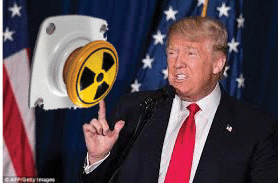 What a Twitter-Happy Trump Might Mean For Nuclear Diplomacy, The Wire, BY ON 01/01/2017
Far from making America great again, Trump is more likely to make America grope again in the darkness of the post-nuclear age. Hillary Clinton lost the election, but a question she tweeted during the campaign remains critically important for the world. Can a man so easily baited by Twitter be trusted with the nuclear codes?
Donald Trump’s likely policies after assuming office later in January require triangulation of three known character traits. First, his twitchy thumbs can jump into action to spray his thought bubbles over the Twitter-sphere before his brain is engaged. Second, he possesses a unique capacity to deny outright something he said, even if digitally recorded. Third, he is a professional deal maker.
Trump’s nuclear Twitter spray
During the US election campaign, Trump thrice asked a foreign policy adviser: if we have nuclear weapons, why can’t we use them?. In a New York Times interview, he seemed to suggest Japan and South Korea could obtain their own nuclear arsenals. On December 22, President-elect Trump tweeted: “The United States must greatly strengthen and expand its nuclear capability.” The same day President Vladimir Putin also spoke of the need to do the same with Russia’s deterrent………
The number of times that we have come frighteningly close to nuclear holocaust is simply staggering.
In January 1961, a 4MT bomb (that is, 260 times more powerful than Hiroshima) was just one ordinary switch away from detonating over North Carolina when a B-52 bomber on a routine flight went into an uncontrolled spin.
In the 1962 Cuban missile crisis, the US strategy was based on intelligence that no nuclear warheads were present in Cuba. In fact there were 162 warheads already stationed there, the local Soviet commander had taken them out of storage to deployed positions for use and the top three commanders split on whether or not to launch them against US targets.
On October 28, 1962, a missile launch base in Okinawa received an authenticated order to launch missiles. The local commander used rare common sense and further clarifications confirmed the order was a mistake. Other veterans dispute this account.
On June 3, 1980, amidst the tension of the Soviet invasion of Afghanistan, national security adviser Zbigniew Brzezinski was awakened close to the proverbial 3 am by his military aide General William Odom with the news that the Soviets had launched 220 SLBMs at the US. Brzezinski asked for confirmation and Odom called him a second time with a correction: the number of missiles hurtling towards the US was 2,200. Brzezinski decided not to wake his wife, preferring she die in her sleep. As he prepared to call President Jimmy Carter to authorise US retaliatory strikes, Odom phoned for the third time: it was a false alarm triggered by a 46-cent defective computer chip.
In November 1983, in response to NATO war games exercise Able Archer, which Moscow mistook to be real, the Soviets came close to launching a full-scale nuclear attack against the West.
On January 25, 1995, Norway launched a scientific research rocket in its northern latitude whose stage three mimicked a Trident SLBM. Within seconds, the Russian early warning radar system tagged it as a possible US nuclear missile attack. Fortunately the rocket did not stray into Russian airspace owing to system malfunction and the alert subsided.
Following the Ukraine crisis, in the one year period March 2014 to 2015, one study documented 67 specific incidents between Russia and NATO – 13 of which were “serious” and five, “high risk.”
The nuclear equation is biased against peace
For nuclear peace to hold, deterrence and fail-safe mechanisms must work every single time. For nuclear armageddon, deterrence or fail safe mechanisms need to break down only once. This is not a comforting equation. Deterrence stability depends on rational decision-makers being always in office on all sides – a dubious precondition. From later this month, leaders with their fingers on the nuclear buttons will include Trump and Kim Jong-un. It depends equally critically on no rogue launch, human error or system malfunction. The above examples prove conclusively that this is an impossibly high bar.
The more the number of nuclear weapons in existence and the more countries that possess them – the more the risk of a nuclear war multiplying exponentially. If not by design and intent, this could result from an accident, a rogue launch, human error or system malfunction. When we combine this with the proliferation of fake news, the risks of a nuclear launch by mistake are magnified manifold under current conditions. Recently, for example, Pakistan’s defence minister Khawaja Muhammad Asif threatened a nuclear attack on Israel – via a tweet, of course – in response to a fake news story that Israel had threatened Pakistan with nuclear weapons. https://thewire.in/90831/trump-tweets-nuclear-diplomacy/
America’s Nuclear Submarines Now Obsolete? – new Swedish Technology
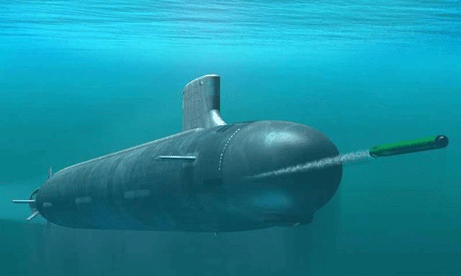 Did Sweden Make America’s Nuclear Submarines Obsolete? The National Interest, 30 Dec 16 Nuclear-powered submarines have traditionally held a decisive edge in endurance, stealth and speed over cheaper diesel submarines. However, new Air Independent Propulsion (AIP) technology has significantly narrowed the performance gap on a new generation of submarines that cost a fraction of the price of a nuclear-powered boat……..
Broadly speaking, how do AIP vessels compare in performance to nuclear submarines? Let’s consider the costs and benefits in terms of stealth, endurance, speed and cost.
Stealth:
Nuclear powered submarines have become very quiet—at least an order of magnitude quieter than a diesel submarine with its engine running. In fact, nuclear-powered submarines may be unable to detect each other using passive sonar, as evidenced by the 2009 collision of a British and French nuclear ballistic missile submarines, both oblivious to the presence of the other.
However, there’s reason to believe that AIP submarines can, if properly designed, swim underwater even more quietly. The hydraulics in a nuclear reactor produce noise as they pump coolant liquid, while an AIP’s submarine’s engines are virtually silent. Diesel-powered submarines can also approach this level of quietness while running on battery power, but can only do so for a few hours whereas an AIP submarine can keep it up for days.
Diesel and AIP powered submarines have on more than one occasion managed to slip through anti-submarine defenses and sink American aircraft carriers in war games. Of course, such feats have also been performed by nuclear submarines.
Endurance:
Nuclear submarines can operate underwater for three or four months at a time and cross oceans with ease. While some conventional submarines can handle the distance, none have comparable underwater endurance.
AIP submarines have narrowed the gap, however. While old diesel submarines needed to surface in a matter of hours or a few days at best to recharge batteries, new AIP powered vessels only need to surface every two to four weeks depending on type. (Some sources make the unconfirmed claim that the German Type 214 can even last more than 2 months.) Of course, surfaced submarines, or even those employing a snorkel, are comparatively easy to detect and attack.
Nuclear submarines still have a clear advantage in endurance over AIP boats, particularly on the long-distance patrols. However, for countries like Japan, Germany and China that mostly operate close to friendly shores, extreme endurance may be a lower priority.
Speed:……..Obviously, high maximum speed grants advantages in both strategic mobility and tactical agility. However, it should be kept in mind that even nuclear submarines rarely operate at maximum speed because of the additional noise produced.
Cost:
Who would have guessed nuclear reactors are incredibly expensive? The contemporary U.S. Virginia class attack submarine costs $2.6 billion dollars, and the earlier Los Angeles class before it around $2 billion in inflation-adjusted dollars. Mid-life nuclear refueling costs add millions more.
By comparison, AIP powered submarines have generally cost between $200 and $600 million, meaning a country could easily buy three or four medium-sized AIP submarines instead of one nuclear attack submarine. Bear in mind, however, that the AIP submarines are mostly small or medium sized vessels with crews of around 30 and 60 respectively, while nuclear submarines are often larger with crews of 100 or more. They may also have heavier armament, such as Vertical Launch Systems, when compared to most AIP powered vessels.
Nevertheless, a torpedo or missile from a small submarine can hit just as hard as one fired from a large one, and having three times the number of submarine operating in a given stretch of ocean could increase the likelihood chancing upon an important target, and make it easier to overwhelm anti-submarine defenses.
While AIP vessels may not be able to do everything a nuclear submarine can, having a larger fleet of submarines would be very useful in hunting opposing ships and submarines for control of the seas. Nor would it be impossible to deploy larger AIP powered submarines; China has already deployed one, and France is marketing a cheaper AIP-powered version of the Barracuda-class nuclear attack submarine.
It is no surprise that navies that operate largely around coastal waters are turning to cheap AIP submarines, as their disadvantage are not as relevant when friendly ports are close at hand. ……..http://nationalinterest.org/blog/the-buzz/did-sweden-make-americas-nuclear-submarines-obsolete-18908?page=2
Trump’s unorthodox and erratic comments on nuclear policy bring real danger
 Trump’s Madman Gambit History shows his nuclear threats will fail. US News.com By Jeffrey P. Kimball | Dec. 30, 2016, President-elect Donald Trump’s recent Tweet that “the United States must greatly strengthen and expand its nuclear arsenal” and comments to MSNBC welcoming an “arms race” could signal a radical shift away from decades of bipartisan U.S. policy to reduce nuclear tensions and stockpiles. His spokesperson Sean Spicer tried to explain the comments to NBC’s Matt Lauer as a “warning” to other countries “that this president’s going to take action.”
USA military does not need a numerical increase or new nuclear weapons in Europe
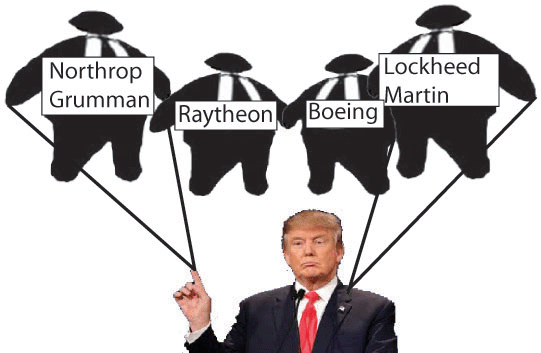 No, the U.S. Doesn’t Need to Expand Its Nuclear Weapons Program, Politico By STEVEN PIFER December 29, 2016
December 23, President-elect Donald Trump tweeted that the United States must “expand its nuclear capability.” Had he written modernize, upgrade, update or renew, no one would have paid much attention. But he seemed to call for a quantitative increase, something Matthew Kroenig endorsed in a December 23 Politico Magazine article.
The very real danger of India-Pakistan War In 2017
India-Pakistan War In 2017? Nuclear Neighbors Still Locked In Conflict Approaching New Year http://www.ibtimes.com/india-pakistan-war-2017-nuclear-neighbors-still-locked-conflict-approaching-new-year-2467636 BY ON 12/30/16 As much of the world focuses on the growing hostilities between the United States and Russia as well as the war in Syria heading into 2017, it would be easy to forget about an ongoing conflict between two nuclear-armed neighbors.
For Indian and Pakistan, which have fought three wars since becoming independent states in 1947, 2016 was a year of drastically deteriorating relations. And as they prepare to welcome in the new year, the two countries continue to be locked in an exchange of fire along the border separating the disputed region of Kashmir.
A ceasefire agreement signed between the two countries in Kashmir in 2003 has been rendered effectively redundant. That was evident just this week when India claimed that the Pakistani army engaged in heavy fire targeting Indian positions across the Line of Control, killing one civilian. India made clear it would retaliate strongly.
The latest spike in tensions between India and Pakistan began when an Indian army base in Kashmir was attacked on Sept. 18, killing 19. India claimed that the attack was carried out by militants hailing from Pakistan and retaliated by carrying out what it called “surgical strikes” on a terrorist stronghold on the Pakistan side of the Line of Control. Pakistan vigorously disputed that version of events.
Pakistan also claimed this week that India was violating a 1947 United Nations Security Council Resolution on Kashmir by attempting to change the demography of Kashmir through the settling of non-locals in the region.
Escalating fears yet further, India successfully tested Monday its most powerful nuclear-capable missile.
1 This Month
23-25 October – on Zoom – World BEYOND War’s annual global conferenc


Shut down the radiation-damaged Heysham nuclear reactors now
To see nuclear-related stories in greater depth and intensity – go to https://nuclearinformation.wordpress.com

Say No to NASA’s Reckless Nuclear Reactor on the Moon
Say No to NASA’s Reckless Nuclear Reactor on the Moon
-
Archives
- October 2026 (170)
- September 2026 (339)
- August 2026 (330)
- July 2026 (355)
- June 2026 (287)
- May 2026 (306)
- April 2026 (356)
- March 2026 (251)
- February 2026 (267)
- January 2026 (308)
- December 2025 (358)
- November 2025 (359)
-
Categories
- 1
- 1 NUCLEAR ISSUES
- business and costs
- climate change
- culture and arts
- ENERGY
- environment
- health
- history
- indigenous issues
- Legal
- marketing of nuclear
- media
- opposition to nuclear
- PERSONAL STORIES
- politics
- politics international
- Religion and ethics
- safety
- secrets,lies and civil liberties
- spinbuster
- technology
- Uranium
- wastes
- weapons and war
- Women
- 2 WORLD
- ACTION
- AFRICA
- Atrocities
- AUSTRALIA
- Christina's notes
- Christina's themes
- culture and arts
- Events
- Fuk 2022
- Fuk 2023
- Fukushima 2017
- Fukushima 2018
- fukushima 2019
- Fukushima 2020
- Fukushima 2021
- general
- global warming
- Humour (God we need it)
- Nuclear
- RARE EARTHS
- Reference
- resources – print
- Resources -audiovicual
- Weekly Newsletter
- World
- World Nuclear
- YouTube
-
RSS
Entries RSS
Comments RSS

