 China ‘deploys missiles’ amid calls for more nuclear weapons to deter Donald Trump Neil Connor, Telegraph UK Beijing 25 JANUARY 2017
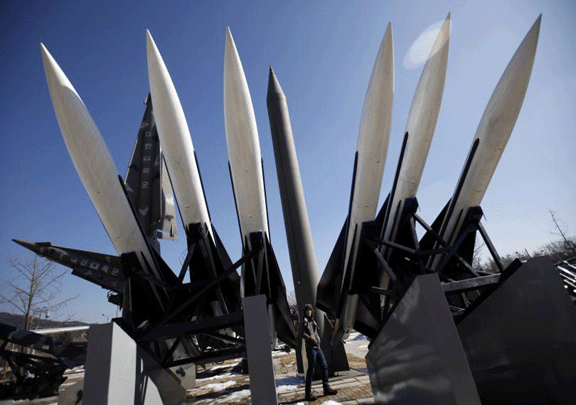
Beijing is moving advanced ballistic missiles which are capable of hitting the US to its north-eastern frontier with Russia, according to media reports, amid suggestions that the weapons were revealed in response to Donald Trump’s “provocative remarks” towards China……..
The state-run Global Times newspaper, which has close links with China’s Communist leaders, said: “Some media claimed that the Chinese military intentionally revealed the Dongfeng-41 and connected it with the inauguration of US President Donald Trump.
“They think this is Beijing’s response to Trump’s provocative remarks on China,” added the outlet, which is known for taking a strongly nationalist tone and making inflammatory comments.
The newspaper also called for a ramping up of China’s nuclear capabilities, saying: “China’s nuclear arsenal must be able to deter the US.”
“Even Washington feels that its naval forces and nuclear strength are lacking,” it added. “So how can China be content with its current nuclear strength when it is viewed by the US as its biggest potential opponent?”
The reported deployment comes after Mr Trump has angered China with his stance on Taiwan, trade and security – particularly in the South China Sea. http://www.telegraph.co.uk/news/2017/01/25/china-deploys-missiles-amid-calls-nuclear-weapons-deter-donald/
January 27, 2017
Posted by Christina Macpherson |
China, politics international, USA, weapons and war |
Leave a comment
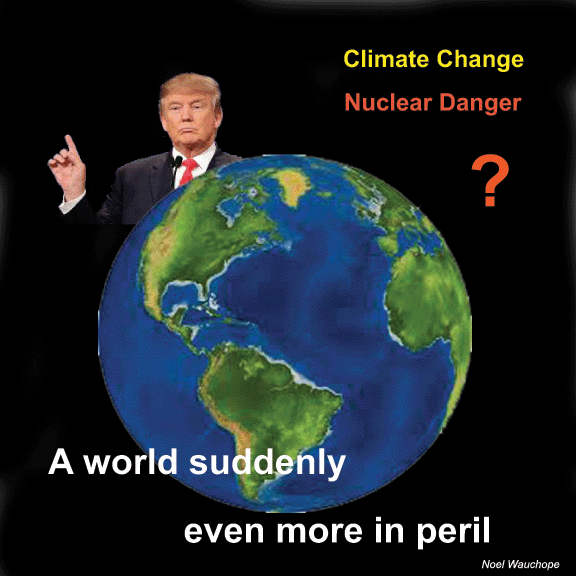
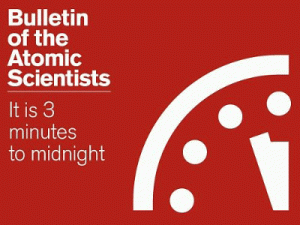 and 1 person is to blame Mary Bowerman , USA TODAY Network Jan. 26, Scientists moved the hands of the Doomsday Clock closer to midnight on Thursday amid increasing worries over nuclear weapons and climate change.
Each year, the Bulletin of the Atomic Scientists, a nonprofit that sets the clock, decides whether the events of the previous year pushed humanity closer or further from destruction. The symbolic clock is now two-and-a-half minutes from midnight, the closest it’s been to midnight since 1953, when the hydrogen bomb was first tested. Scientists blamed a cocktail of threats ranging from dangerous political rhetoric to the potential of nuclear threat as the catalyst for moving the clock closer towards doomsday.
“This year’s Clock deliberations felt more urgent than usual…as trusted sources of information came under attack, fake news was on the rise, and words were used by a President-elect of the United States in cavalier and often reckless ways to address the twin threats of nuclear weapons and climate change,” Rachel Bronson, the executive director and publisher of Bulletin of the Atomic Scientists, said in a statement.
While many threats played into the decision to move the clock 30 seconds forward from where it was in 2016, one person in particular prompted the scientists to act.
“Never before has the Bulletin decided to advance the clock largely because of the statements of a single person. But when that person is the new president of the United States, his words matter,” David Titley and Lawrence M. Krauss of the Bulletin wrote in an New York Times op-ed.
The Bulletin pointed to President Donald Trump’s careless rhetoric on nuclear weapons and other issues as well as his troubling stance on climate change. “Current political situation in the U.S. is of particular concern,” Titley of the Bulletin Science and Security Board said. “The Trump administration needs to state clearly, unequivocally it accepts climate change caused by human activity…There are no alternative facts here.”
Last year, the clock remained at three minutes from midnight. It was moved to three minutes in 2015 where it was previously at five minutes to midnight.
Manhattan Project scientists, concerned about the first atomic weapons, founded the nonprofit Bulletin of the Atomic Scientists in 1945. They created the clock two years later, and update its minute hand each year……..http://www.usatoday.com/story/news/nation-now/2017/01/26/doomsday-clock-end-world-nuclear-weapons-climate-change-donald-trump/97077736/
January 27, 2017
Posted by Christina Macpherson |
2 WORLD, politics international, USA, weapons and war |
Leave a comment
Trump Uncertainty Fuels South Korea Nuclear Talk, VOA, January 25, 2017 Brian Padden, SEOUL, SOUTH KOREA —
Some South Korean conservatives are citing President Donald Trump’s past statements on reducing U.S. security commitments in Asia to argue that their nation must now prepare its own nuclear option to defend against the growing North Korean nuclear threat.
“I’m not saying we should develop nuclear weapons overnight. I’m saying that if there are the right conditions, then we should go nuclear,” said Lee Choon-kun, a researcher with the Korea Institute for Maritime Strategy, at an event sponsored by the East Asia Foundation in Seoul Tuesday…….
South Korea’s nuclear advocates expect contentious times ahead. They take seriously Trump’s criticism, made during the campaign, that South Korea does not pay its fair share for hosting the 28,500 American personnel and military bases in Korea. And they take Trump at his word that, if better compensation terms are not reached, he would consider withdrawing American troops, allowing allies to acquire their own nuclear weapons, and ending the nuclear umbrella mutual defense pacts that require the U.S. military to come to the aid of its allies.
THAAD litmus testSouth Korean officials are reportedly planning to object to any proposed increase in defense reimbursement costs with the United States. Seoul currently reimburses Washington about $866 million annually, that is more than 50 percent of the cost for stationing troops in country. South Korea also spends 2.4 percent of its gross national product (GDP) on national security, compared with 1 percent for Japan and 1.16 percent for Germany, according to the defense ministry in Seoul.Nuclear proponents say that growing resistance in South Korea to the deployment of the U.S. THAAD missile defense shield could also create a rift in the U.S. alliance.
The THAAD system, which uses interceptor missiles to target high altitude incoming ballistic missiles, is considered a conventional deterrent to North Korea’s increasing ballistic missile capability. Supporters claim it will help defend South Korea from a nuclear missile attack.Opponents say its capability is limited and vulnerable to low altitude missile strikes that could target population centers like Seoul that are close to the inter-Korean border. Some South Korean critics also say THAAD is being deployed to protect U.S. military installations in Korea, and China complains that its powerful radar system could be used to monitor other countries in the region.Beijing’s strong objections to THAAD and reports of related Chinese economic retaliation against South Korea have also contributed to the declining support in South Korea. In December, public opposition to THAAD increased to 51 percent according to a poll conducted by Realmeter.THAAD opponents say it is a continuation of confrontational policies that have not worked to slow North Korea’s nuclear and missile development programs.
“The policy that we have implemented has been failing. We have to see the nuclear issue from a different perspective,” said Cheong Wook-sik, the director of the Peace Network in Seoul……..
Nuclear optionProponents say South Korea could quickly develop nuclear weapons using existing nuclear power plant facilities and fuel, and with the military’s advanced conventional weapons production capability.However, South Korea would likely face severe consequences for violating the Nuclear Non-Proliferation treaty (NPT) that could include diplomatic isolation and international sanctions similar to what North Korea is facing.And it could also lead to Japan and other countries developing their own nuclear deterrent. http://www.voanews.com/a/trump-uncertainty-south-korea-nuclear/3691290.html
January 27, 2017
Posted by Christina Macpherson |
South Korea, weapons and war |
Leave a comment
 China Announces Deployment of New Long Range Nuclear Missile, Popular Mechanics. 24 Jan 17
The target—at least of the announcement—is Trump. In a rare move, China has publicly announced the deployment of a new intercontinental ballistic missile (ICBM). The Dong Feng (“East Wind”) -41 missile, or DF-41, can carry up to a dozen nuclear warheads and China claims it has the longest range of any nuclear missile in the world. The announcement of the missiles is likely a warning to U.S. President Donald Trump, who is known for sharply worded anti-Chinese rhetoric and has announced plans for a new ballistic missile system.
According to China’s Global Times newspaper, the People’s Liberation Army has deployed its newest intercontinental ballistic missile to Heilongjiang Province. The article cited eyewitness photos culled from Chinese social media by news media in Taiwan and Hong Kong. The photos showed heavy missile launchers, also known as transporter/erector/launchers (TELs) moving through Daqing City in Heilongjiang.
The DF-41 is described by Global Times as the most advanced ICBM in the world. It reportedly has a range of 8,699 miles, enough to hit any target on Earth with the exception of South America and parts of Antarctica. It can carry up to 12 nuclear warheads, and travels on China’s nationwide network of roads to make it difficult to track down and destroy.
The location of the missiles and the timing of the release are notable. Heilongjiang Province is in Northern China, near the country’s long border with Russia. The DF-41’s long range, if accurate, means it could be based anywhere and still hit any useful target on Earth, but the implication is that China considers Russia a friendly country.
While China tends to be low-key regarding nuclear weapons and nuclear deterrence, this seems like a deliberate move to make a subtle threat. After all, it was probably completely unnecessary to move strategic nuclear weapons through
a city of 2.9 million people, unless you want to get the word out. President Donald Trump, meanwhile, has been talking tough about China as well as enhancing America’s ballistic missile shield. If China wanted to overwhelm the shield with more missiles, the DF-41 would be the way to do it………
http://www.popularmechanics.com/military/weapons/a24893/china-announces-deployment-long-range-nuclear-missile/
January 25, 2017
Posted by Christina Macpherson |
China, politics international, weapons and war |
Leave a comment
http://zeenews.india.com/asia/pakistan-test-fires-nuclear-missile-capable-of-hitting-multiple-targets_1970284.html
January 24, 2017 Islamabad: Pakistan on Tuesday “successfully” test-fired its second indigenously-developed nuclear-capable missile, Ababeel, with a range of 2,200 km and capable of “engaging multiple targets with high precision”. The test firing comes two weeks after the launch of submarine-fired Babar III, that Indian analysts dubbed as fake.
In an apparent reference to India, Pakistan Military spokesperson Maj Gen Asif Ghafoor said: “The development of the Ababeel weapon system was aimed at ensuring survivability of Pakistan’s ballistic missiles in the growing regional Ballistic Missile Defence (BMD) environment.”
The missile is capable of delivering multiple warheads, using Multiple Independent Re-entry Vehicle (MIRV) technology. “The test flight was aimed at validating various design and technical parameters of the weapon system,” Maj Gen Ghafoor said in a statement.
“Ababeel is capable of carrying nuclear warheads and has the capability to engage multiple targets with high precision, defeating the enemy’s hostile radars,” it added.
On January 8, Pakistan conducted its first successful test fire of submarine launched cruise missile Babur III having a range of 450 km. The missile was fired from an underwater, mobile platform and hit its target with precise accuracy.
The Babur weapons system incorporates advanced aerodynamics and avionics that can strike targets both at land and sea with high accuracy, according to ISPR. It has been described as a low flying, terrain hugging missile, which carries certain stealth features and is capable of carrying various types of warheads.
January 25, 2017
Posted by Christina Macpherson |
Pakistan, weapons and war |
Leave a comment
Is China Going To War? Nuclear Missiles Deployed To Russian Border, Putin’s Kremlin Responds http://www.ibtimes.com/china-going-war-nuclear-missiles-deployed-russian-border-putins-kremlin-responds-2480325 BY CHRIS RIOTTA ON 01/24/17 The Chinese government reportedly deployed nuclear missiles to the Russia-China border in the northeast Heilongjiang province, an act Russian President Vladimir Putin’s government described as a nonissue Tuesday, Russian and Chinese media reported. The ballistic missiles, called the Dongfeng-41 Intercontinental Ballistic Missile, are capable of traveling up to 15,000 kilometers and was successfully tested with dummy warheads by the Chinese government in the South China Sea in April last year.
Unverified photos and videos of the massive ballistic missiles being deployed in the Chinese suburb made waves online as they spread across social media throughout this month. The footage had not been reported on until Tuesday, when the Kremlin’s Spokesperson Dmitry Peskov said “[Russia doesn’t] see the military disposition of China as a threat to our country,” the Moscow Times reported Tuesday.
A video posted to Twitter shows officials guiding a large vehicle along a highway as it carried what appeared to be the DF-41 intercontinental missile.
January 25, 2017
Posted by Christina Macpherson |
China, weapons and war |
Leave a comment
 The UK now relies on Trump for our nuclear weapons – we need to spend more than ever before to free ourselves Britain’s Trident missiles are in a common pool shared with the US and maintained at Kings Bay, Georgia. Without the cooperation of the Trump administration, Trident wouldn’t last longer than a couple of months, Independent Benedict Spence Tuesday 24 January 2017 The report that a Trident missile test went awry, veering not toward its intended target on the west coast of Africa, but toward Florida – just weeks before parliament voted for its renewal – has forced the question of Britain’s nuclear deterrent firmly back into the public agenda.
Number 10 has confirmed that the Prime Minister, Theresa May, was aware of this malfunction before the vote, raising questions over whether she should have revealed information at the time. Scottish First Minister Nicola Sturgeon, for one, believed there should have been “full disclosure”, whilst the Campaign for Nuclear Disarmament suggested such information “would have impacted the debate in parliament.”
January 25, 2017
Posted by Christina Macpherson |
politics international, UK, USA, weapons and war |
Leave a comment
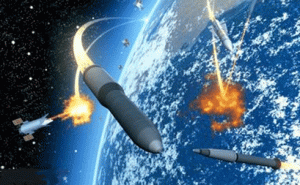 Trump’s Nuclear Defense Plan: Another ‘Star Wars’ Budget Buster? The Fiscal Times, By Eric Pianin January 24, 2017 President Ronald Reagan cowed the Soviet Union and eventually brought its leaders to the bargaining table with the threat of a costly space-based nuclear missile system dubbed “Star Wars.” In March 1983, Reagan formally launched the Strategic Defense Initiative (SDI) to develop and deploy an “impenetrable shield” to protect the U.S. from a Soviet missile attack.
Although the U.S. ultimately spent more than $200 billion on a system that was never successfully developed and deployed, Reagan’s high-stakes defense gambit was credited by many for helping to hasten the end of the Cold War…….
Now a new addition to Trump’s evolving defense posture, the website declared that the United States would develop a “state of the art missile defense system” to guard against attacks from North Korea, Iran, and other rogue states.
The announcement was bereft of details about the technical capabilities or the potential cost to taxpayers for a more sophisticated missile defense system than the land-based and seaborne systems currently deployed in California and Alaska and aboard Navy destroyers in the Pacific.
In addition to the missile shield, the Trump White House said a new military budget would be submitted to Congress outlining a plan to rebuild the military and increase cyber-warfare capabilities. “We will make it a priority to develop defensive and offensive cyber capabilities at our U.S. Cyber Command, and recruit the best and brightest Americans to serve in this crucial area,” the statement declared.
Since then, Trump and his aides have had little more to say about their proposed missile defense initiative, leaving defense policy experts to scratch their heads and speculate on what the new president has in mind. ……..http://www.thefiscaltimes.com/2017/01/24/Trump-s-Nuclear-Defense-Plan-Another-Star-Wars-Budget-Buster
January 25, 2017
Posted by Christina Macpherson |
politics, USA, weapons and war |
Leave a comment
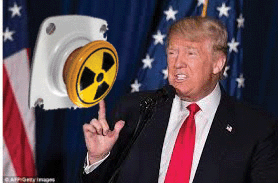 In Nuclear Poker, Don’t Bet on Trump, Bloomberg JAN 19, 2017 BY James McManus Is North Korea’s belligerent young leader, Kim Jong-un, bluffing when he says the “last stage” is underway for testing a ballistic missile capable of hitting the U.S.? What about President-elect Donald Trump, when he tweets, “It won’t happen“?
As Trump’s administration begins, a showdown with North Korea over ICBMs seems all but inevitable. Just yesterday, South Korean media reported possible signs that the North may be preparing a new missile launch. In managing this conflict, few things will be more crucial than understanding the nature of bluffing. Unfortunately, for all his talk of being a good deal maker, Trump is a terrible bluffer — and his lack of skill is likely to destabilize nuclear politics.
A bluff is an untrue but plausible story. In the mindsport of poker, bluffs work when your opponent believes you have a better hand, so he can’t call your bet or raise, conceding you the pot. The savvier player wants to steadily grind away at the stack of his opponent over a large number of small pots, without risking too many of his own chips in any single hand. The weaker player can counter the “small ball” strategy by raising all-in fairly often, forcing all-or-nothing confrontations.
To understand why these dynamics are so crucial in nuclear negotiation, consider the work of John von Neumann, the prodigiously gifted polymath who immigrated to the U.S. from Hungary in 1933 and later contributed to the Manhattan Project. Von Neumann loved poker because its strategy involves guile, probability, luck and budgetary acumen, but is never transparent; it always depends on the counterstrategies deployed by opponents.
Expert players misrepresent the strength of their hands, simulate irrational behavior, and deploy other mind games to confuse their opponents. In a nutshell, they bluff. It was von Neumann’s efforts to express bluffs in mathematical terms that helped him develop game theory, which has numerous real-world applications, nuclear strategy foremost among them……..
Trump bluffs almost constantly. He has spent his entire adult life overstating the value of his real estate holdings and branding endeavors, while bragging relentlessly about his wealth, sex life, length off the tee, and on and on. His bluffs during the campaign — that he had a replacement for Obamacare, a secret plan to defeat Islamic State and so on — were plainly false to anyone paying attention. To Trump, what was true hardly mattered.
Such tendencies would not serve him well in a poker game. Any player who continually misrepresents the size of his hand would cause sharp opponents to give his bets little credit. They’d simply wait for above-average hands and call him. As Daniel Negreanu, the all-time winningest poker tournament player, put it to me, “Trump’s bluffs are very effective against level-one thinkers. His lies are so outlandish that people think they have to be true or he wouldn’t have said it. The constant barrage makes him tougher to read. But sharper players would pick him apart.”
Kim may not be irrational, but he knows how to seem that he is, which gives him leverage. Kim’s contempt for most North Koreans means that he has less to lose by threatening to nuke an American city. The more we know about his pretensions to deity, his labor camps, the food and electricity shortages his policies have prolonged, the easier it is to believe he might sacrifice millions of Koreans in an absurd attempt to save face. Kim isn’t threatening to defeat the U.S., a bluff no one would credit; he’s trying to prove he could grievously injure it before dying himself, a bluff that must be taken seriously. As Negreanu puts it, Kim is “a scary player. Being unpredictable, capable of any move at any time, makes him hard to prepare for.”
In such circumstances, Trump’s long history of empty boasts is destabilizing. Kim may calculate that he has renewed leverage to push for concessions from the U.S. He might engage in riskier behavior, such as firing more test missiles or launching cyberattacks. Almost certainly, he’ll persist in developing missiles that can reach the U.S., calculating all the while that Trump’s Twitter outbursts are simply talk.
That may be true. But what if, for once in his life, Trump means what he says? What if he can’t bear to have his bluff called, and really is tempted to launch a preemptive attack if it looks like North Korea poses a real threat to the U.S. mainland?……..https://www.bloomberg.com/view/articles/2017-01-19/in-nuclear-poker-don-t-bet-on-trump
January 21, 2017
Posted by Christina Macpherson |
North Korea, politics international, USA, weapons and war |
Leave a comment
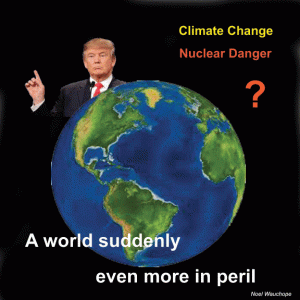 Donald Trump’s very confusing thoughts on nuclear weapons, explained
Vox, by Zack Beauchamp@zackbeauchampzack@vox.com Jan 18, 2017 Just days before his inauguration, Donald Trump made headlines by trashing America’s European allies in an interview with two of Europe’s biggest newspapers. The hubbub over Trump’s attack on Europe obscured one of the stranger comments in the interview — that he hoped to work with Russian strongman Vladimir Putin to reduce both countries’ nuclear arsenals.
“Let’s see if we can make some good deals with Russia,” Trump said. “For one thing, I think nuclear weapons should be way down and reduced very substantially.”
To say this is a flip-flop is an understatement. Less than a month ago, Trump tweeted that the US “must greatly strengthen and expand its nuclear capability until such time as the world comes to its senses regarding nukes.” When MSNBC’s Mika Brzezinski asked him about the possibility of this policy setting off an arms race with Russia (which is also talking about expanding/modernizing its nuclear arsenal), Trump’s answer was simple.
“Let it be an arms race.”
Nuclear arms control is a hugely important issue — especially in a world where tensions between the US and two other nuclear powers, Russia and China, are heating up. So where does Trump stand: with his comments from December, or with his comments from January?
The truth is that nobody knows — leaving us in the dark on one of the very few policy issues with the potential to transform the future of human civilization.
“It’s difficult to discern what Trump’s policy will be and whether he has given more than a few minutes’ thought to these issues,”
Kingston Reif, the director for disarmament and threat reduction policy at the Arms Control Association, tells me.
Questions about nuclear policy have dogged Trump for more than a year now. In a December 2015 Republican debate, moderator Hugh Hewitt asked Trump about the “nuclear triad” — America’s three-part system for delivering nuclear weapons (bombers, submarines, and intercontinental ballistic missiles). Trump’s answer was confusing:
We have to be extremely vigilant and extremely careful when it comes to nuclear. Nuclear changes the whole ballgame. … The biggest problem we have is nuclear — nuclear proliferation and having some maniac, having some madman go out and get a nuclear weapon. That’s in my opinion, that is the single biggest problem that our country faces right now.
There are two interesting things about this. First, Trump suggests, as he later did in his January interview, that he sees large global nuclear stockpiles as a problem. Second, he doesn’t appear to know any of the major policy questions surrounding the nuclear triad, or even what the nuclear triad is.
That became especially clear when Hewitt followed up, pressing Trump to answer the actual question about the triad. Trump’s response? “I think — I think, for me, nuclear is just the power, the devastation is very important to me.”
This pattern — an abstract abhorrence of nuclear weapons but seemingly confused views on actual nuclear policy — continued throughout the campaign. . In a March 2016 town hall, for example, host Chris Matthews pressed Trump on whether he’d use nuclear weapons. He seemed to say both no and yes at the same time, saying he’d be “the last one to use nuclear weapons,” but also that he would be very willing to nuke ISIS territory in response to a terrorist attack:………… http://www.vox.com/world/2017/1/18/14310168/trump-nuclear-policy-inauguration-explained
January 20, 2017
Posted by Christina Macpherson |
politics, USA, weapons and war |
Leave a comment
 China’s Xi calls for a world without nuclear weapons, SCMP, 19 Jan 17, Chinese President Xi Jinping called for a world without nuclear weapons at the UN on Wednesday and urged a multilateral system based on equality among nations large and small.
His speech at the United Nations in Geneva came at the end of a diplomatic tour that included a landmark address at the World Economic Forum in Davos, just days before Donald Trump is sworn in as the 45th president of the United States.
Some experts have seen Xi’s Swiss tour as a bid to capture the mantle of global leadership at a time when Washington is clouded by uncertainty with an unpredictable political novice about to take charge.
“Nuclear weapons should be completely prohibited and destroyed over time to make the world free of nuclear weapons,” Xi said, according to an official translation.
China has been a nuclear power since 1964.
In an address that stretched beyond 45 minutes, Xi also sought to make the case for a global governance system that strives for a level playing field among countries where interventionist tendencies are resisted……..
While he made no mention of the incoming Republican administration, Xi’s message on nuclear weapons stood apart from Trump’s at times contradictory remarks on American nuclear power……http://www.scmp.com/news/china/diplomacy-defence/article/2063383/chinas-xi-calls-world-without-nuclear-weapons
January 20, 2017
Posted by Christina Macpherson |
China, weapons and war |
1 Comment
Donald Trump and the ‘nuclear football’: What’s stopping President-elect launching lethal weapon strike http://www.independent.co.uk/news/world/americas/donald-trump-nuclar-football-codes-what-stops-president-elect-push-button-launch-nuclear-weapon-a7534926.html ‘In theory the president has full discretion over authorisation of nuclear use’ Peter Walker @petejohn_walker , 19 Jan 17 Donald Trump will be simultaneously handed power to launch nuclear weapons as he is inaugurated tomorrow.
Here we explain how the “thin-skinned” and “impulsively tempered” President-elect can wield the power of the ‘nuclear football’ and what’s stopping him from using it.
January 20, 2017
Posted by Christina Macpherson |
politics, USA, weapons and war |
Leave a comment
U.S. sees indications of possible North Korea missile test-launch Yahoo News, By James Pearson and Phil Stewart January 20, 2017 SEOUL/WASHINGTON (Reuters) – North Korea may be preparing for a new missile test-launch, U.S. officials told Reuters on Thursday, after South Korean media reported movement of what could be components of an upgraded prototype of an intercontinental ballistic missile.
The U.S. officials, who spoke on condition of anonymity, said the United States was seeing activity in North Korea indicating a possible ballistic missile test, including positioning of two mobile missile launchers.
Still, the timing of the test and precise type of missile remained unclear, the officials said.
In his New Year’s speech, leader Kim Jong Un said North Korea was close to test launching an ICBM, and state media has said a launch could come at any time. Experts on the isolated and nuclear capable country’s missile program believe the claims to be credible.
The Pentagon declined comment on its intelligence about the North Korea threat, but spokesman Peter Cook assured reporters that Washington’s readiness would be not be diminished during the U.S. presidential transition, due to take place on Friday.
“I can’t get into intelligence matters. I can’t confirm what’s been reported there,” Cook told a news briefing.
“We would once again encourage North Korea not to engage in provocative actions that do nothing but destabilize the region.”
South Korean media said a test could potentially coincide with the inauguration of U.S. President-elect Donald Trump on Friday, South Korean media said.
Trump on Jan. 2 tweeted, “It won’t happen!” about North Korean ICBMs, although his precise meaning was unclear. The Pentagon has said it would not necessarily strike a test-launched ICBM if it did not pose a threat.
NEW TYPE OF MISSILE?
South Korean intelligence agencies reported on Wednesday that they had recently spotted missile parts being transported, believed to be the lower-half of an ICBM, raising fears that a test-launch may be imminent, the Chosun Ilbo newspaper said, citing unidentified military sources…….https://www.yahoo.com/news/u-sees-north-korea-activity-signaling-possible-missile-160137245.html
January 20, 2017
Posted by Christina Macpherson |
North Korea, weapons and war |
Leave a comment

 Trump’s China policy threatens nuclear war World Socialist Website, James Cogan 13 January 2017
 The confirmation hearings for Donald Trump’s cabinet nominees confirm that his administration intends to vastly intensify US demands for massive economic and strategic concessions from the Chinese regime. In pursuit of the predatory ambitions of a tiny layer of corporate oligarchs, policies are being put forward that could result in a military clash and trigger a nuclear exchange.
On Thursday, Rex Tillerson, Trump’s proposed secretary of state, made unprecedented statements on the attitude the next US government will take toward China’s land reclamation activities and construction of facilities on the islets and reefs Beijing claims as sovereign territory in the South China Sea.
Tillerson declared: “We are going to have to send China a clear signal that, first, the island-building stops and second, your access to those islands also is not going to be allowed.”
The implications of such a policy are immense. The islands referred to by Tillerson are occupied by Chinese military personnel. The waters surrounding them are patrolled by the Chinese Coast Guard and Navy. The airspace above them is patrolled by the Chinese air force. The only conceivable way to deny China access would be through the large-scale deployment of US aircraft carriers and associated military forces into the South China Sea.
Media headlines around the world have reflected the recognition that war would be the most likely outcome of attempting to implement Tillerson’s declaration. For its part, the Chinese state-owned publication Global Times, whose editorial line is believed to come directly from the highest echelons of the Chinese regime, has not hedged its words in response.
Its January 13 editorial states: “Unless Washington plans to wage a large-scale war in the South China Sea, any other approaches to prevent Chinese access to the islands will be foolish. The US has no absolute power to dominate the South China Sea. Tillerson had better bone up on nuclear power strategies if he wants to force a big nuclear power to withdraw from its own territories [emphasis added].”
An analysis of the social forces and economic interests that stand behind Trump leaves no room for doubt that his administration is more than prepared to threaten a full-scale war with China, posing the risk of a nuclear exchange.
Before he is even sworn in, Trump and the cabal of billionaires and ex-generals who will comprise his cabinet have signaled they will provoke conflict with China over a range of issues. In addition to rejecting Chinese territorial claims in the South China Sea, these policies include imposing tariffs on Chinese exports; demanding Beijing force North Korea to shut down its nuclear weapons program; and threatening to repudiate the “One China policy” under which Washington, since 1979, has formally recognised that the island of Taiwan is part of China and not an independent state.
Adding to the possible list of provocations, one of Trump’s chief supporters in the Congress, Arkansas Republican Tom Cotton, joined with Republican presidential aspirant Marco Rubio to introduce the “Hong Kong Human Rights and Democracy Act” in November. The Act would require the US government to take action to ensure Hong Kong remains “sufficiently autonomous” from the mainland regime. Tibetan nationalists have enthusiastically welcomed Trump’s election as a signal that their cause might also be taken up by the incoming administration.
The focus on China flows directly from the interests of a powerful faction of the American corporate elite who view it as their greatest immediate economic, geopolitical and potential military competitor.
Rex Tillerson, the former CEO of oil conglomerate ExxonMobil, personifies this layer. Under Tillerson, ExxonMobil aggressively pursued access to potential oil and gas fields in the South China Sea, in partnership with Vietnam and in defiance of China’s territorial claims. In 2014, one of its fields was occupied by a Chinese oil rig. ExxonMobil’s ambitions for a stake in mainland Chinese energy production and distribution have been hindered also by the dominance of the Chinese state-owned companies that monopolise the domestic industry. Around the world—even in US-occupied Iraq—bids by American energy corporations for contracts have been undercut by their Chinese rivals.
The preoccupation of the Trump oligarchs with shattering Chinese competition is most clearly demonstrated in their willingness to defy the furious demands in the American ruling class for action first against Russia. Trump has thus far largely brushed aside the hysterical calls from the Democratic Party, figures in the Republican Party and the intelligence agencies for an immediate confrontation with Moscow over its alleged interference in the US election and its intervention in Syria to protect the regime of Bashar al-Assad from US-backed Islamist rebels……..ttps://www.wsws.org/en/articles/2017/01/13/pers-j13.html
January 14, 2017
Posted by Christina Macpherson |
politics international, USA, weapons and war |
Leave a comment
 US ‘threatens to involve Australia in war with China’: Paul Keating condemns US secretary of state nominee’s comments, The Age, Fergus Hunter, 14 Jan 17
Former prime minister Paul Keating has rounded on President-elect Donald Trump’s secretary of state nominee, accusing him of threatening to bring on war with China and making “ludicrous” comments on the tense South China Sea dispute.
In a statement released on Friday, Mr Keating warned the Australian government to reject Rex Tillerson’s declaration this week that a “signal” needed to be sent to Beijing that the construction of artificial islands in the contested region must stop and “access to those islands also is not going to be allowed”. The remarks from the former chief of Exxon Mobil, in which he also called for regional allies “to show backup”, have set the stage for sharply increased tensions between the US and China as the Asian superpower builds up its military presence on the islands to defend against competing territorial claims from neighbouring countries.
According to Mr Keating, Mr Tillerson’s testimony to his US Senate confirmation hearing “threatens to involve Australia in war with China”. And he has urged the Australian people to “take note” and recommended the government tell the Trump administration, which will take over on January 20, “that Australia will not be part of such adventurism, just as we should have done in Iraq 15 years ago”. “That means no naval commitment to joint operations in the South China Sea and no enhanced US military facilitation of such operations,” the former Labor prime minister said.
“Tillerson’s claim that China’s control of access to the waters would be a threat to ‘the entire global economy’ is simply ludicrous. No country would be more badly affected than China if it moved to impede navigation. On the other hand, Australia’s prosperity and the security of the world would be devastated by war.”……… http://www.theage.com.au/federal-politics/political-news/us-threatens-to-involve-australia-in-war-with-china-paul-keating-condemns-us-secretary-of-state-nominees-comments-20170113-gtqy0k.html
January 14, 2017
Posted by Christina Macpherson |
AUSTRALIA, politics, politics international, weapons and war |
Leave a comment