Nuclear core was unarmed, but 6,000 pounds of explosives detonated
WYFF News 4 Mar 13, 2017, Mars Bluff SC – This weekend was the 59th anniversary of an event many people don’t know happened in South Carolina. On March 11, 1958, a nuclear bomb was accidentally dropped on a small community near Florence.
A U.S. Air Force Boeing Stratojet that was flying out of Hunter Air Force Base took off at about 4:30 p.m. headed for the United Kingdom and then on to Africa. The aircraft was carrying nuclear weapons as a precaution in case war broke out with the Soviet Union.
The captain of the aircraft accidentally pulled an emergency release pin in response to a fault light in the cabin, and a Mark 4 nuclear bomb, weighing more than 7,000 pounds, dropped, forcing the bomb bay doors open. The bomb, which lacked an armed nuclear core, plunged 15,000 feet to the ground below…..http://www.wyff4.com/article/moose-on-the-loose-animal-races-to-catch-up-to-snowboarder/9131703
The former defense secretary is spending his twilight years sounding the alarm with his 29-year-old granddaughter.
“When my kids were getting under desks at their school and going through nuclear drills — the danger today is actually greater. We’re just not aware of it,” says Perry.
At 89, he works with granddaughter to prevent nuclear doom
Before Forever Changes
MARCH 11, 2017, BY CNN WIREPicture a nondescript packing crate labeled “agricultural equipment” being loaded onto a delivery truck, which drives along Pennsylvania Avenue in Washington, D.C., until it stops midway between the White House and the Capitol.
The nuclear bomb explodes with the power of 15 kilotons. There are more than 80,000 deaths, from the highest ranking members of government to the youngest schoolchildren. All major news outlets then report receiving an identical claim: that five more nuclear bombs are hidden in five major cities.
Such is the nightmare nuclear scenario that former US Defense Secretary William Perry says may seem remote, but the consequences, if realized, would be disastrous.
“I do not like to be a prophet of doom,” says Perry, 89, with the gentle grace of a decadeslong diplomat who has negotiated with countries both hostile and friendly to US interests. Then he bluntly gets to the point. “What we’re talking about is no less than the end of civilization.”
Perry doesn’t believe an intentional terrorist attack or all-out nuclear war is the greatest risk — he fears a “blunder” that plunges the globe into a nuclear conflict.
Perry says with a more aggressive Russia, and a brash and at times unpredictable President Donald Trump, “the possibility of a nuclear catastrophe is probably greater than it has ever been, greater than any time in the Cold War.”
CNN reached out to the White House for comment on Perry’s statements. It did not respond.
While he’s long been out of government, Perry’s uses his extensive policy chops and background to engage the public — through speeches, presentations and online courses.
He worries that tensions between the Koreas, and possibly Japan, could turn into a conventional conflict that could go nuclear. A bellicose and expansion-minded Russia could draw the United States into a situation that could escalate, Perry says. And the District of Columbia scenario shows how devastation can result from a crude bomb.
“When my kids were getting under desks at their school and going through nuclear drills — the danger today is actually greater. We’re just not aware of it,” says Perry.
The former defense secretary is spending his twilight years sounding the alarm with his 29-year-old granddaughter. They’re trying to awaken a new audience on social media with the William J. Perry Project, an advocacy group dedicated to helping end the nuclear threat.
“We’re really just out there trying to reach a generation that isn’t really engaged on this issue right now,” says Lisa Perry, the digital communications manager for the project. “It’s something we learned in history class. There was no conversation about what’s happening now.”
“The dangers will never go away as long as we have nuclear weapons,” William Perry explains. “But we should take every action to lower the dangers and I think it can be done.”
A lifetime dealing with the nuclear threat
Perry served three years under President Bill Clinton, a time when more than 8,000 nuclear weapons were dismantled. His nuclear knowledge traces back to his days as a CIA analyst working with the Kennedy administration during the Cuban Missile Crisis. He was tapped to evaluate photos showing Soviet nuclear missiles in Cuba and recalls it as one of the scariest times in his life.
“We made miscalculations,” recalls Perry about those anxious two weeks. “It’s a miracle they did not lead to war.”
Perry lists the risks: US-Russia hostilities. A nuclear terror attack. A regional crisis.
On a regional conflict, Perry sees North Korea as an unpredictable nuclear threat. The regime’s growing arsenal and history of bold actions, Perry says, could be met by an escalated response by South Korea or even the United States. Not necessarily a deliberate attack, says Perry, but he fears a “blunder” that plunges the globe into a nuclear conflict.
“When a crisis reaches a boiling point then you have a possibility of a miscalculation,” warns Perry.
Stockpiles of nuclear weapons around the world – in data, Guardian 11 Mar 17 This week saw more atomic sabre-rattling by North Korea, but it is estimated that the global total of nuclear weapons has shrunk by a third in the last half-decade “…….It is estimated that North Korea now has 10 nuclear weapons, up from six or eight in 2013. This increase is in contrast to an overall decrease in the number of nuclear weapons worldwide. The Stockholm International Peace Research Institute (SIPRI), an independent resource on global security, has estimated that the number has fallen by almost a third, from 22,600 in 2010 to around 15,395 last year. That said, SIPRI also states that both the US and Russia are going through extensive modernising programmes for their remaining weapons.
The main factor in this reduction is the diminishing numbers of warheads held by the US (which dropped from around 9,600 to 7,000 in that period) and Russia (which went from 12,000 to 7,290). The UK figure also dropped, from 225 to 215.
But some countries’ arsenals have grown: China was thought to have 260 warheads in early 2016, compared with 240 in 2010. India and Pakistan have also seen their figures creep up in recent years: India is thought to have between 100 and 120 nuclear weapons now, compared with between 60 and 80 in 2010, while Pakistan may have as many as 130, up from 70-90. https://www.theguardian.com/world/2017/mar/11/stockpiles-of-nuclear-weapons-around-the-world-in-data
Now US military chiefs are reportedly planning to fly in B-1 and B-52 bombers – built to carry nuclear bombs – to show America has had enough.
South Korea and the US have also started their annual Foal Eagle military exercise sending a strong warning to North Korea over its actions.
A military official said 300,000 South Korean troops and 15,000 US personnel are taking part in the operation.
Secretary of Defence James Mattis said the US “remains steadfast in its commitment” to the defence of the South, according to Pentagon spokesman Navy Capt Jeff Davis.
Capt David said: “He further emphasised that any attack on the United States or its allies will be defeated and any use of nuclear weapons will be met with a response that is effective and overwhelming.”
Washington is also expected to deploy a series of strategic assets from the US as well as from military bases in Guam and Japan, reports the Korea Times
The USS Carl Vinson, a Nimitz-class supercarrier, will join the Foal Eagle exercise after departing from San Diego.
The nuke-powered aircraft carrier will carry dozens of fighter jets, early warning aircraft and anti-sub craft.
It will be accompanied by the guided-missile cruiser USS Lake Champlain (CG-57) and two Arleigh Burke-class guided-missile destroyers.
From the US Marine Corps in Japan, F-35B stealth fighters will be deployed to the peninsula for the first time.
“An F-35B is capable of evading anti-aircraft radar and making preemptive strikes,” a military official said.
North Korea repeatedly protests that both Foal Eagle and Key Resolve are rehearsals for invasion.
Pyongyang’s Korea Central News Agency reported that North Korean leader Kim Jong-un has stressed “a need for preparation for a fight”.
He listed guidelines to strike South Korea and the US “mercilessly”.
More serious than the inefficiencies in moving so many parts is the vulnerability inherent in placing nuclear bombs on the highways, several experts said.
“Transportation is the Achilles heel of nuclear security and everyone knows that,” said Bruce Blair, a retired Air Force missile officer, Princeton University researcher and founder of Global Zero, a nonprofit group that seeks elimination of nuclear weapons.
The danger is not a traffic accident — even a fiery crash is not supposed to explode a warhead — but a heist.
“In an age of terrorism, you’re taking a big risk any time you decide to move nuclear material into the public space over long distances via ground transport,” Blair said. “Bad things happen.”
The unmarked 18-wheelers ply the nation’s interstates and two-lane highways, logging 3 million miles a year hauling the most lethal cargo there is: nuclear bombs.
The covert fleet, which shuttles warheads from missile silos, bomber bases and submarine docks to nuclear weapons labs across the country, is operated by the Office of Secure Transportation, a troubled agency within the U.S. Department of Energy so cloaked in secrecy that few people outside the government know it exists.
The $237-million-a-year agency operates a fleet of 42 tractor-trailers, staffed by highly armed couriers, many of them veterans of the Iraq and Afghanistan wars, responsible for making sure nuclear weapons and components pass through foggy mountain passes and urban traffic jams without incident.
The transportation office is about to become more crucial than ever as the U.S. embarks on a $1-trillion upgrade of the nuclear arsenal that will require thousands of additional warhead shipments over the next 15 years.
The increased workload will hit an agency already struggling with problems of forced overtime, high driver turnover, old trucks and poor worker morale — raising questions about its ability to keep nuclear shipments safe from attack in an era of more sophisticated terrorism.
“We are going to be having an increase in the movements of weapons in coming years and we should be worried,” said Robert Alvarez, a former deputy assistant Energy secretary who now focuses on nuclear and energy issues for the Institute for Policy Studies in Washington. “We always have to assume the worst-case scenario when we are hauling nuclear weapons around the country.”
That worst case would be a terrorist group hijacking a truck and obtaining a multi-kiloton hydrogen bomb.
“The terror threat is significant,” said one high-level Energy Department official, who spoke on condition of anonymity because he was not authorized to discuss the program publicly. “If you are in one of the communities along the route, you have something to worry about.”
The Times reviewed government documents dating back two decades and interviewed dozens of government officials, former military officers and arms control advocates to examine the agency. The picture that emerges is an organization hampered by an insular management, a crisis of morale among the rank-and-file and outdated equipment.
Among the findings of the Times investigation:
The agency is 48 agents short of its planned staffing of 370, a result of budget cuts. Weapons and tactics classes were canceled in 2011 and 2012 for lack of money.
More than a third of the workforce has been putting in more than 900 hours a year of overtime, which former couriers and Energy Department officials say has contributed to a breakdown in morale and rapid turnover.
In 2010, an inquiry by the Energy Department’s inspector general inquiry found widespread alcohol problems. It cited 16 alcohol-related incidents over a three-year period, including an agent on a 2007 mission who was arrested for public intoxication and two agents on a 2009 mission who were handcuffed and detained by police after a fight at a bar.
In 2014, the commander of the agency’s operation at the Y12 National Security Complex in Tennessee threatened to kill an employee in an altercation, but no disciplinary action was taken.
The agency’s top executive in 2009 was charged with drunk driving after police found him parked on a sidewalk with an open bottle of beer and a blood-alcohol concentration of 0.15%, nearly twice the legal limit, according to New Mexico court records.
The agency’s truck fleet is antiquated by commercial standards and well past its operational life even under the department’s own guidelines. About half the tractors are more than 15 years old. The high-security trailers used by the agency are even older, designed before the current era of terrorist threats.
How the agency wound up in this state is a story of neglect that begins at the end of the Cold War…….
‘Transportation is the Achilles heel of nuclear security’
The United States has 4,018 nuclear warheads.
About 450 are in underground silos in Wyoming, Colorado, Montana, Nebraska and North Dakota. An additional 1,000 or so are on submarines, which dock at bases in Washington and Georgia. Hundreds more bombs are assigned to the U.S. strategic bomber fleet, which is based in Louisiana, North Dakota and Missouri. And a reserve stockpile sits in bunkers near the transportation office headquarters at Kirtland Air Force Base in New Mexico.
Each weapon — a complex physics machine that contains as many as 6,000 parts, including tanks of gas, wheels and gears, batteries, wiring, plastic-type explosives and radioactive materials — requires routine inspection, testing and maintenance.
The workers who perform those services don’t travel to the weapons. The weapons go to them.
They are picked up by the transportation office and driven to the government’s sole plant for working on live nuclear warheads, the Pantex Plant outside Amarillo in the Texas panhandle.
From there, various pieces are parceled out to government plants and laboratories across the country. Uranium assemblies travel to Tennessee, plutonium parts to New Mexico, radioactive gas canisters to South Carolina, non-nuclear classified parts to California and firing mechanisms to Kansas.
Those parts are then returned to Texas so the warheads can be reassembled and trucked back to their silos or military bases.
The system dates back to the 1950s and the rapid buildup of nuclear arms that accompanied the Cold War. Weapons were spread across the nation to ensure that a significant number could not be destroyed in a focused missile strike.
The same went for the facilities that service those weapons. But exactly where they wound up — and where they are today — largely came down to politics, as members of Congress schemed to bring high-paying jobs to their districts.
The result is an unwieldy system that requires some of the most dangerous and vulnerable components of the nation’s defense system to be routinely shipped on long-distance journeys from one end of the country to the other — and the shipments, with the coming modernization effort, are only expected to multiply…….
More serious than the inefficiencies in moving so many parts is the vulnerability inherent in placing nuclear bombs on the highways, several experts said.
“Transportation is the Achilles heel of nuclear security and everyone knows that,” said Bruce Blair, a retired Air Force missile officer, Princeton University researcher and founder of Global Zero, a nonprofit group that seeks elimination of nuclear weapons.
The danger is not a traffic accident — even a fiery crash is not supposed to explode a warhead — but a heist.
“In an age of terrorism, you’re taking a big risk any time you decide to move nuclear material into the public space over long distances via ground transport,” Blair said. “Bad things happen.”
The high-security trailers that carry the weapons present potential intruders with formidable obstacles, including shock-delivering systems, thick walls that ooze immobilizing foam, and axles designed to explode to prevent a trailer from being towed away, according to independent nuclear weapons experts.
“The trucks will kill you,” a scientist involved in the matter said.
The Energy Department recruits ex-soldiers and special operations commandos for its courier jobs, usually veterans of U.S. wars. Incoming agents train for 21 months at Ft. Chafee in Arkansas, focusing on how to counter a roadsideattack by terrorists set on stealing a weapon. The couriers must pass yearly psychological and medical assessments……..
‘Ominous symptoms’ of structural problems
The agency has been the target of worker complaints for years………
After the terror attacks of Sept. 11, 2001, the government turned its attention to the nation’s most critical vulnerabilities and concluded that more needed to be done to prevent terrorists from obtaining a nuclear bomb.
In a 2005 letter to Congress, then-Energy Secretary Samuel Bodman called the transportation office a “top priority” and asked Congress for money for more agents, special weapons, tougher armored vehicles and improved tactics.
The goal was to increase staffing from about 290to 420 couriers by 2008. But the agency never never reached that level, as lawmakers rejected most of the funding request. Today it aims to employ 370 agents but has 322.
Democrats renew attack on new nuclear cruise missile, Defense News, By: Aaron Mehta, 8 Mar 17 WASHINGTON — Hours after top Pentagon officials traveled to the Hill to defend the need for a new nuclear-capable cruise missile, a group of nine Democratic Senators has introduced legislation to slow the development of the system, known as the Long Range Standoff Weapon, or LRSO.
The bill, headlined by Sen. Ed Markey of Massachusetts and announced Wednesday, would cap funding for the LRSO and its associated warhead at 2017 levels until the Trump administration submits its Nuclear Posture Review (NPR) to Congress. “If the United States wants other countries to reduce their nuclear arsenals and restrain their nuclear war plans, we must take the lead,” Markey said in a statement. “Instead of wasting billions of dollars on this dangerous new nuclear weapon that will do nothing to keep our nation safe, we should preserve America’s resources and pursue a global ban on nuclear cruise missiles.”
Capping the LRSO spending at 2017 levels would restrict the Pentagon to spending $95.6 million for the weapon itself, and hold the Department of Energy’s National Nuclear Security Administration to $220.2 million for the life-extension program on the W-80-4 warhead. Such levels likely mean a log-term delay for the development of the weapon, which is in its early stages of design and development.
The LRSO program aims to replace the air-launched cruise missile (ALCM) program with 1,000 to 1,100 cruise missiles that represent the Air Force’s standoff nuclear delivery capability. The ALCM is set to expire around 2030. The non-proliferation community has pushed against the LRSO, arguing it is an inherently destabilizing weapon, as any nation the U.S. could threaten with conventional cruise missiles could mistake those weapons as nuclear and escalate accordingly. ……
Joining Markey in backing the bill are Sens. Dianne Feinstein, D-Calif.; Jeff Merkley, D-Ore.; Ron Wyden, D-Ore.; Patrick Leahy, D-Vt.; Al Franken, D-Minn.; Bernie Sanders, I-Vt.; Chris Van Hollen, D-Md.; and Sherrod Brown, D-Ohio. While Sanders is technically an independent, he caucuses with the Democratic Party and waged a hard-fought war for the Democratic nomination during the last presidential election.
A nuclear weapons ban should first do no harm to the NPT, Bulletin of the Atomic Scientists, Adam Mount Richard Nephew 9 Mar 17Though substantial progress has been made since the end of the Cold War in the dismantlement of US and Russian-held nuclear weapons, non-nuclear weapon states have become frustrated with the pace of disarmament. Two years ago, several states launched a new process that would delegitimize nuclear weapons by declaring a ban on their possession and use. Despite the objection of the nuclear weapon states and their allies, the UN General Assembly voted in late 2016 by a wide margin to begin negotiations on the text of a nuclear weapons ban treaty.
Though the movement is the product of laudable motives, the ban treaty is likely to have little influence on the nuclear powers’ strategic force-structure decisions, which are the product of a complex mix of strategic and political considerations. On the other hand, a variety of nonproliferation problems would be unaffected by the ban or even worsened. For example, the creation of an alternative treaty structure governing nuclear weapons could lead to “forum-shopping,” in which a state might hope to dilute international condemnation over its noncompliance with the strict verification requirements
of the existing Nuclear Non-Proliferation Treaty (NPT) by participating in the new nuclear weapons ban treaty.
There is a relatively simple fix: Pro-ban states should insist that the new treaty contain an article reaffirming all participants’ obligations to the NPT. The article should include provisions that automatically rescind standing in the ban treaty should the International Atomic Energy Agency (IAEA) find a signatory to be noncompliant with its NPT obligations.
The ban treaty will remain controversial. It should not be controversial, though, to say that a treaty aspiring to a nuclear-free world should first do no harm to the existing tools we have to prevent the spread of nuclear materials and technology to new states, which are centered around the NPT.
Negotiations on the text. At this early date, with negotiations on the text yet to begin, little is known about the format or content of the nuclear weapons ban treaty. The drafters will have to resolve an underlying tension. A simple and largely rhetorical treaty would maximize the number of signatories, and avoid blowback from states that resist new legal obligations. At the same time, some states will want the treaty to demonstrate substantive progress. This could include any number of steps, ranging from directly strengthening nonproliferation norms and institutions to encouraging the International Court of Justice to reconsider its 1996 decision—which found that nuclear deterrence is legally permissible—on the grounds that the ban movement represents an evolution of international customary law and norms of behavior. The stated aims of the movement and a desire for a greater number of signatures suggest that a simpler text is more likely. In any event, the treaty is unlikely to provide for development of a framework for verifiable disarmament.
Nuclear weapon states have largely declined to participate in the ban process (though the United States, the United Kingdom, India, and Pakistan sent delegations to the ban movement’s final preparatory conference in Vienna in 2014). Concerned that confrontational rhetoric from some ban states signals a desire to achieve a treaty at any cost, the nuclear weapon states have expressed concern that the ban movement “may negatively affect the prospects for consensus at future NPT Review Conferences.” Observers in nuclear weapon states and elsewhere remain concerned that ban treaty negotiations could undermine the authority of NPT obligations, establish conflicting obligations, erode the effectiveness of the existing NPT system to resolve nonproliferation concerns, lead to a destabilizing counterreaction in nuclear weapon states, or distract attention from other critical priorities for nuclear governance and strategic stability.
Forum-shopping under a ban treaty. Treaty proponents have denied that their pursuit of a ban would distract from the broader nonproliferation agenda, noting that many ban states have supported the treaty precisely because they are committed to nonproliferation. However, their good intention is not sufficient to ensure the ban treaty’s complementarity with the existing NPT regime. If negotiators do not include specific provisions in support of the NPT, they could inadvertently do it substantial harm by creating an opportunity for nuclear aspirants to “forum-shop.”……..
The NPT system—and the arsenal of other tools it enables, through the IAEA and other organizations—is irreplaceable. A nuclear weapons ban treaty will have its best chance to promote a world free of nuclear weapons if it strengthens the NPT. http://thebulletin.org/nuclear-weapons-ban-should-first-do-no-harm-npt10599
Drones a ‘Growing Threat’ to US Navy, Air Force Nuclear Facilities, Sputnik News MILITARY & INTELLIGENCE 09.03.2017
‘Unauthorized’ flights by unmanned aerial vehicles near US Navy and Air Force bases are presenting increasingly hostile circumstances for the security of US personnel and nuclear weapons, Gen. John E. Hyten, Commander of US Strategic Command, told Congress on Wednesday……
According to Hyten’s testimony before the House Armed Services Committee, the US has some gaps to fill in regard to how it protects nuclear personnel and nuclear-warhead assets. Specifically, the US is seeking counter-UAS capabilities to eliminate small UAS vehicles, “if necessary.” The general noted that “unauthorized flights of unmanned aerial systems over Navy and Air Force installations” has become a topic of “recent concern.” ….https://sputniknews.com/military/201703091051424996-drones-growing-threat-us-facilities/
The attempted sale, documented in a U.N. report this month, has sparked new concern in the Trump administration, Congress and the U.N. about the proliferation threat posed by Pyongyang’s growing nuclear- and ballistic-missile programs, congressional officials and nuclear-weapons experts said.
“The U.N. Panel of Expert’s report on North Korea provides further evidence that North Korea will stop at nothing to advance its illicit nuclear and missile programs,” said Sen. Cory Gardner (R., Colo.) who wrote a new sanctions bill against North Korea last year.
North Korea’s production of the enriched lithium, known as lithium-6, is also seen by nuclear experts as evidence of the country’s accelerated efforts to miniaturize a nuclear warhead, potentially for use on ballistic missiles.
Lithium-6 can be used to produce tritium, which is used to flood neutrons into a nuclear device and magnify the explosive power of nuclear detonations, allowing countries to build bombs with smaller amounts of plutonium or uranium, nuclear experts said.
“Lithium-6 is ideal, not only for making tritium for boosting fission devices, but also for directly fueling advanced weapons—including thermonuclear bombs,” said Henry Sokolski, a former Pentagon official who heads the Nonproliferation Policy Education Center, a Washington think tank.
Lithium also has nonmilitary applications, particularly in producing batteries, lubricants and medicines, nuclear experts said. North Korea is believed to have significant natural deposits of the metal in its soil.
In addition to increasing the national debt, such a program will require cutting every sector of the civilian side of the budget — housing, transportation, environmental protection, biomedical research, education and health care. For many years, caps on these programs have continued to weaken them. The current proposal will essentially bankrupt the federal contribution to the civilian side of the economy.
The longer-term effects on the national economy are often obscured but will be even more devastating…..
Efforts to communicate to voters the role of weapons contractors in distorting national security policy are getting underway, following the lead of the European-based “Don’t Bank on the Bomb” campaign. Last spring, the Cambridge City Council voted unanimously to request that the Cambridge pension funds divest from stocks in companies involved in the manufacture of nuclear weapons. Subsequently, the US Conference of Mayors passed a supporting resolution. These are small but important first steps in focusing attention on these corporate drivers of dangerous and costly nuclear weapons policies
Trump Is Bankrupting Our Nation to Enrich the War Profiteers, March 06, 2017By Jonathan King and Richard Krushnic, Truthout | News AnalysisPresident Trump’s calls for a military buildup are opening the fiscal floodgates for congressional hawks and defense industry contractors. On January 27, Trump signed an executive order setting in motion a “great rebuilding of the Armed Forces” that will include new ships, planes and weapons and the “modernization” of the US nuclear arsenal. Presently, more than half of this year’s congressional budget — some $610 billion of our income tax dollars — is allocated to Pentagon accounts, including overseas military operations and nuclear weapons.
Though the details were scarce, we can expect the Trump order to align with the proposals of Sen. John McCain, chair of the Armed Services Committee. As reported in Politico, Senator McCain is now calling for large increases in this already bloated budget, to $640 billion for fiscal year 2018 — $54 billion above the current budget projections. Adding in the $60 billion projected spending for Iraq, Afghanistan, Syria and other interventions could bring total Pentagon spending next year to more than $900 billion. The primary beneficiaries of such a buildup will be the large corporations that dominate weapons contracting.
This is likely to be more than 60 percent of the total congressional discretionary budget. For comparison, the National Institutes of Health budget, which funds biomedical research on all the diseases that afflict tens of millions of Americans, is about $33 billion, less than 3 percent of the congressional budget. By fiscal year 2022, defense appropriations would reach $800 billion.
Trump’s tweets calling to limit the costs on the deeply troubled and over-budget F-35 Joint Strike Fighter have led to some optimism regarding his Pentagon spending plans. But mildly limiting the excessive profits to Lockheed Martin and their subcontractors, by tens or even hundreds of millions, is a very small effect when overall spending is increased by hundreds of billions.
Excessive Pentagon Spending Undermines the Civilian Economy
In addition to increasing the national debt, such a program will require cutting every sector of the civilian side of the budget — housing, transportation, environmental protection, biomedical research, education and health care. For many years, caps on these programs have continued to weaken them. The current proposal will essentially bankrupt the federal contribution to the civilian side of the economy.
The longer-term effects on the national economy are often obscured but will be even more devastating. Weapons don’t house us, don’t clothe us, don’t help us get to work and don’t cure our diseases. Thus, in the long run, they drain resources away from productive investments, deeply undercutting the overall health of the economy………
Former US Secretary of Defense William J. Perry, who served from 1994-1996, argues, “We are facing nuclear dangers today that are in fact more likely to erupt into a nuclear conflict than during the Cold War.” He notes that the new US nuclear weapons modernization program and Russia’s modernization program — along with confrontations in Eastern Europe and the Middle East — have begun a new nuclear arms race more dangerous than the Cold War. He sees “an imperative to stop this damn nuclear race before it gets underway again, not just for the cost but for the danger it puts all of us in.”
Efforts to communicate to voters the role of weapons contractors in distorting national security policy are getting underway, following the lead of the European-based “Don’t Bank on the Bomb” campaign. Last spring, the Cambridge City Council voted unanimously to request that the Cambridge pension funds divest from stocks in companies involved in the manufacture of nuclear weapons. Subsequently, the US Conference of Mayors passed a supporting resolution. These are small but important first steps in focusing attention on these corporate drivers of dangerous and costly nuclear weapons policies.http://www.truth-out.org/news/item/39712-trump-is-bankrupting-our-nation-to-enrich-the-war-profiteers
Donald Trump says nuclear threat from North Korea has entered ‘new phase’
US president told Japanese PM he is ‘100%’ with Tokyo as US moves Thaad missile defence system into South Korea following Pyongyang missile launches, Guardian, Justin McCurry The threat posed by North Korea to the US and its allies has entered a “new phase”, Donald Trump said on Tuesday, a day after the regime test-launched four ballistic missiles towards Japan.
In phone talks on Tuesday, Trump told Japan’s prime minister, Shinzo Abe, that the US stood “100%” with Tokyo after three of the intermediate-range missiles landed in the sea off Japan’s north-west coast.
“President Trump told me that the United States was with Japan 100%, and that he wanted his comments to be communicated to the Japanese people,” Abe told reporters at his residence. “He said he wanted us to trust him as well as the United States 100%.
“Japan and the United States confirmed that the latest missile firing by North Korea … is a clear challenge to the region and the international community, and that its threat has entered a new phase.”
The comments came as the US said the “first elements” of its controversial missile defence system had arrived in South Korea on Tuesday. The Terminal High Altitude Area Defense (Thaad) anti-missile system is meant to intercept and destroy short- and medium-range ballistic missiles during the last part of their flights, the US Pacific Command said in a statement.
“Continued provocative actions by North Korea, to include yesterday’s launch of multiple missiles, only confirm the prudence of our alliance decision last year to deploy Thaad to South Korea,” US Pacific Commander Admiral Harry Harris said.
South Korea’s Yonhap news agency, citing military sources, said the system could be operational as early as April, well ahead of schedule.
Trump and Abe spoke as the North Korean leader, Kim Jong-un, declared the launches a success and warned that they were part of a training exercise for an attack on US military bases in Japan, home to almost 50,000 American troops.
“The four ballistic rockets launched simultaneously are so accurate that they look like acrobatic flying corps in formation,” the state-run Korean Central News Agency quoted Kim as saying. The regime also released images of the missile launches, with a smiling Kim in attendance.
The launches were seen as a protest against the start of joint military exercises involving South Korea and the US that Pyongyang regards as a rehearsal for an invasion of North Korea.
A day after operation Foal Eagle began last Wednesday, North Korea’s army, deploying the same vitriolic language it reserves for the annual drills, warned that it was ready to “immediately launch its merciless military counteractions” if South Korean or US forces fired “even a single shell” into waters near the divided Korean peninsula…….
Trump has yet to state how he intends to address the growing North Korean threat from ballistic missiles, amid evidence that the regime is edging closer to acquiring the ability to marry a miniaturised nuclear warhead with a long-range missile capable of striking the US mainland.
The UN has imposed six rounds of sanctions since the North conducted its first nuclear test in 2006, but they have failed to dent the regime’s quest to build what it claims is a “defensive” nuclear arsenal.
Trump has not publicly commented on Monday’s missile launch, but his ambassador to the UN, Nikki Haley, said on Twitter that the world “won’t allow” North Korea to continue on its “destructive path”.
Choi Kang, an analyst at the Seoul-based Asan Institute for Policy Studies, said the launch was a warning to Tokyo. “North Korea is demonstrating that its target is not just limited to the Korean peninsula any more but can extend to Japan at any time and even the US,” he said. https://www.theguardian.com/world/2017/mar/07/donald-trump-threat-north-korea-new-phase
North Korea warns joint US-South Korea military exercises are pushing region to ‘nuclear disaster’ http://www.abc.net.au/news/2017-03-07/nkorea-us-skorea-exercises-leading-to-nuclear-disaster/8330554North Korea has warned that US-South Korean military exercises — which it called “the most undisguised nuclear war manoeuvrers” — are driving the Korean Peninsula and north-east Asia towards “nuclear disaster”.
Key points:
North Korea’s UN ambassador warns that “it may go over to an actual war”
The White House announces more defence capabilities to be deployed to the region
The raised tensions follow another series of North Korean ballistic missile tests
On Monday some 50,000 North Koreans rally in support of mobilisation efforts
North Korea’s UN ambassador, Ja Song-nam, said in a letter to the UN Security Council on Monday the US was using nuclear-propelled aircraft carries, nuclear submarines, nuclear strategic bombers and stealth fighters in the joint exercises that began on March 1.
“It may go over to an actual war,” he warned of the military drills.
“Consequently, the situation on the Korean Peninsula is again inching to the brink of a nuclear war.”
Mr Ja again urged the Security Council to discuss the US-South Korea exercises and warned if it ignored North Korea’s request as it had in the past it would demonstrate the UN’s most powerful body was only a “political tool” of the United States.
The ambassador said the United States sought to convince public opinion that the joint exercise was a response to North Korea’s nuclear weapons, but said the US and South Korea carried out military drills numerous times before Pyongyang possessed its “nuclear deterrent”.
Three of them landed in waters Japan claims as its exclusive economic zone, South Korean and Japanese officials said.
US President Donald Trump discussed plans to respond to the recent missile launches with South Korea’s acting president, Hwang Kyo-ahn, an official at Mr Hwang’s office said.
Mr Trump also had a phone call with Japanese Prime Minister Shinzo Abe, reaffirming its alliance with Tokyo and condemning North Korea’s tests as a threat to regional security.
THAAD deployment begins
The US started to deploy the first elements of its advanced Terminal High Altitude Area Defence (THAAD) anti-missile system to South Korea in response to the missile tests, US Pacific Command said.
“Continued provocative actions by North Korea, to include yesterday’s launch of multiple missiles, only confirm the prudence of our alliance decision last year to deploy THAAD to South Korea,” US Pacific Commander Admiral Harry Harris said in a statement.
South Korea’s media cited the nation’s military as saying the THAAD deployment would be complete in one to two months and would be operational as early as April.
The move by the US military is likely to deepen the brewing conflict between South Korea and China, which has angrily opposed the THAAD deployment as destroying regional security balance.
Meanwhile, North Korean authorities gathered more than 50,000 people together on Monday to make a show of support for the country’s latest mobilisation campaign.
Mr Ja said the main reason the Democratic People’s Republic of Korea (DPRK) — the country’s official name — was equipping itself “with nuclear attack capabilities” and strengthening its nuclear deterrent forces was in self-defence against what he called the US “extreme anti-DPRK hostile police and nuclear threats and blackmails as well as manoeuvrers to enforce its nuclear weapons”.
North Korea’s UN Mission also issued a press statement denouncing and rejecting a report by the Security Council’s panel of experts that monitors UN sanctions against the DPRK.
The experts said North Korea was flouting sanctions by trading in prohibited weapons and other goods and using evasion techniques “that are increasing in scale, scope and sophistication”.
The DPRK Mission again insisted the sanctions “have no legal basis at all” and violate the country’s “lawful rights”.
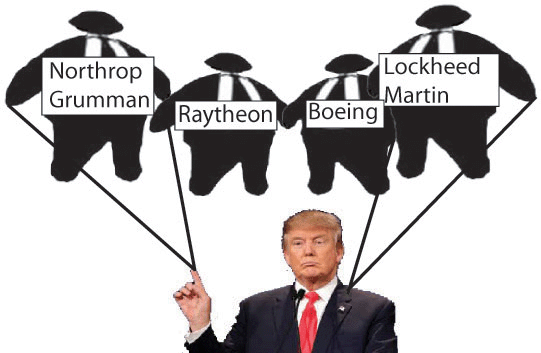
Lockheed Martin Used Pentagon Dollars to Lobby Congress for Nuclear Weapons Funding One of the uses of the billions of dollars from these contracts is to recycle them back into lobbying the government to push for additional conventional and nuclear weapons spending, as reported by William Hartung and Stephen Miles. Of course, in addition, these funds are used to support a general environment of fear and insecurity, through contributions supporting hawkish think tanks.
“……..Corporations that contract with the Department of Defense (DOD) for nuclear weapons complex work do not report revenues and profits from this work separately from their other military work, although they do break up government work from civilian work, and sometimes break up military work from other government work. Hence, it is not possible to determine profits made from nuclear weapons complex work from the annual reports and Securities and Exchange Commission (SEC) filings of large military corporations. However, it is possible to estimate, and to demonstrate how a significant amount of military R&D and production not recorded as nuclear weapons work is in fact partially nuclear weapons work. The nuclear weapons work financed by the US Department of Energy (DOE) is (not surprisingly) carried out in a semi-secret insiders club that insulates it from public knowledge and oversight. The first contracts for the upgrading of the nuclear weapons triads have already been awarded — one to Northrop Grumman — for a new generation of long-range bomber. But the public remains in the dark as to how many tens of billions of their tax dollars will be spent on the project.
From 2012-2014, according to Lockheed Martin’s 2014 annual report, the company realized an average of $46 billion a year in revenue, with an average of $3.2 billion in profits — 7 percent of revenue, and a 76 percent return on $4.2 billion of investor equity. The annual report informs us that 59 percent of 2014 revenue came from the Pentagon. We know from other sources that $1.4 billion a year is coming from the DOE for operation of the Sandia nuclear weapons lab, and we are estimating that an additional $600 million a year is coming for DOE nuclear weapons complex work. Information in the annual report indicates that around $6.1 billion came from foreign military sales. This adds up to around $35 billion of military revenue, or 75.3 percent of total 2014 revenue. The single biggest revenue earner in recent years is the F-35 jet fighter, bringing in $8.2 billion, 17 percent of total corporation revenue, in 2014. (William Hartung’s recent report describes additional aspects of Lockheed Martin’s military business, and his book Prophets of War: Lockheed Martin and the Making of the Military Industrial Complex provides extensive background).
The only references to Lockheed Martin’s nuclear weapons complex work in its 2014 annual report is a sentence noting provision of infrastructure and site support to the DOE’s Hanford complex, and a phrase noting continuing work on the Trident missile. The words “nuclear weapons” never appear in the report.
Lockheed Martin’s Nuclear Weapons Operations
In spite of the lack of mention in the annual report, Lockheed Martin is a partner with Bechtel ATK, SOC LLC and subcontractor Booz Allen Hamilton in Consolidated Nuclear Security LLC (CNS), in running the DOE Pantex Plant and the Y-12 Complex. Pantex does nuclear weapons life extension, dismantlement, development, testing and fabrication of high explosive nuclear warhead components. Y-12 stores and processes uranium, and fabricates uranium weapons components.
Lockheed Martin produced the Trident strategic nuclear missile for the 14 US Ohio-class nuclear submarines and for the four British Vanguard-class submarines. The 24 Tridents on each Ohio-class submarine each carry either eight or 12 warheads, all of them 20 to 50 times more powerful than the bombs dropped on Hiroshima and Nagasaki. Each warhead is capable of killing most of the people in any one of the world’s largest cities — either immediately or later, from radiation, burns, other injuries, starvation and disease. Lockheed MArtin is not producing new Trident missiles now, but it maintains and modifies them. Previously, Lockheed Martin and its subcontractors received $65 million for each of the 651 Trident missiles, in addition to the $35 billion in earlier development costs.
The other primary strategic nuclear weapon delivery vehicle is Boeing’s land-based Minuteman III strategic missile, also with many warheads per missile. About 450 of them are in silos in Colorado and northern plains states. Lockheed Martin produced and continues to produce key systems for the Minuteman III, and plays a large role in maintaining them. It was awarded a $452 million contract for this work in 2014.
Lockheed’s Sandia Subsidiary
Regarding the Pentagon’s nuclear weapons upgrades planned for the next decade; particularly important is the role of Sandia National Laboratories (SNL). Outside of Albuquerque, New Mexico, this DOE lab’s 10,600 employees make 95 percent of the roughly 6,500 non-nuclear components of all seven US nuclear warhead types. Components arm, fuse, fire, generate neutrons to start nuclear reactions, prevent unauthorized firing, preserve the aging nuclear weapons stockpile and mate the weapons to the missiles, planes and ships that deliver them to targets. Sandia Corporation LLC, wholly owned by Lockheed Martin, operates Sandia. The DOE is spending at least $1.4 billion a year on Sandia nuclear weapons work. The secret Lockheed Martin nuclear warhead assembly plant uncovered in Sunnyvale in 2010 is an extension of Lockheed Martin’s Sandia operations. Again, none of this received any mention or revenue numbers in Lockheed Martin’s 2014 annual report.
Lockheed Martin Used Pentagon Dollars to Lobby Congress for Nuclear Weapons Funding
One of the uses of the billions of dollars from these contracts is to recycle them back into lobbying the government to push for additional conventional and nuclear weapons spending, as reported by William Hartung and Stephen Miles. Of course, in addition, these funds are used to support a general environment of fear and insecurity, through contributions supporting hawkish think tanks. Technically, the federal government does not allow military contracting firms to use awarded funds to lobby Congress. Lobbying funds must come from other parts of the companies’ businesses. In reality, this is a non-functional restriction, since profits from various business segments are fungible; that is, once they are profits, they are intermingled, so in reality, the firms can use the profits from military contracts to lobby Congress. But Lockheed Martin went ahead and spent military contract funds from 2008-2012 as part of the contract expenditures. It didn’t even bother to book the lobbying expenditures as expenditures of profits. In 2015, the US Department of Justice required Lockheed Martin’s Sandia subsidiary to repay $4.9 million of a Sandia contract award to the Pentagon that the firm had spent under the contract for lobbying of Congressman the DOE secretary and the secretary’s family and friends………http://www.truth-out.org/news/item/39712-trump-is-bankrupting-our-nation-to-enrich-the-war-profiteers
The Italian Army operates a military firing range lying between the districts of Cordenons, San Quirino, Vivaro and San Giorgio della Richinvelda in the province of Pordenone, in the vicinity of the River Cellina and the River Meduna, and the drills carried out at this firing range have led to the area becoming radioactively contaminated.
As has been reported by the press, in late December 2013 the Commander of the 132nd Ariete Armoured Division in Cordenons, the Commander-in-Chief of the Italian Army, the offices of the region of Friuli-Venezia Giulia, the province of Pordenone and the affected districts, the prefect of Pordenone, and lastly Local Health Authority (ASS) No 6, were all sent the results of tests that had been carried out by the Friuli-Venezia Giulia provincial department of the Italian Regional Environmental Protection Agency (ARPA), which showed alarming levels of thorium-232 in the area.
Thorium-232 is a notoriously radioactive metal, which emits particles that are six times more hazardous to human health than those released by depleted uranium. It is at its most toxic between around 20 and 25 years after use. More specifically, out of the eight targets (the shells of armoured tanks used for firing practice) tested by the ARPA, four were found to contain thorium-232 at markedly higher levels than those that generally occur naturally; these levels were therefore unnatural, and presumably attributable to military firing operations.
In all likelihood, such levels are the legacy left behind by the drills carried out at the site in the 1980s and 1990s: between 1986 and 2003, the Italian Army’s units were equipped with ‘Milan’ shoulder-fired anti-tank missiles, which emitted thorium-232(1). The ARPA has indicated that it will shortly carry out more extensive tests in the area. It is recalled that, as a result of the area’s geological make-up, materials tend to trickle down to the lowest layers, which makes their future recovery appear rather difficult.
Consequently, there is an acute risk that the ‘Magredi’ region, and the rocky terrain that makes it so distinctive, will be devastated; what is more, the area is protected as both a site of Community importance and a Special Protection Area within the meaning of the Habitats Directive (92/43/EEC) and the Birds Directive (2009/147/EC), due to the wide variety of flora and fauna present there(2).
1. Is the Commission aware of this contamination?
2. Can it report whether any similar cases have occurred in the EU, how they were tackled and whether the areas affected were restored to their original state?
3. What initiatives does it intend to implement in order to prevent similar episodes from occurring in the EU, and in particular to prevent the contamination of aquifers?
The same missiles were also used at the inter-force firing range in Quirra (Sardinia), which is sadly famous for the effects resulting from thorium-232 contamination.
Trump Is Bankrupting Our Nation to Enrich the War Profiteers, March 06, 2017By Jonathan King and Richard Krushnic, Truthout | News Analysis “………The Role of Weapons Contractors
We have previously argued that it is the guaranteed profits from nuclear weapons manufacture that leads contractors to resist nuclear disarmament and promote the concept of danger from abroad.
The profitability derives from three distinct aspects of such weapons contracts:
First, they cannot be outsourced to lower cost suppliers, such as in China or Mexico, by congressional edict.
Second, the contracts are cost-plus. That is, no matter what the companies spend on the manufacture, they are guaranteed a healthy profit on top. And, of course, the more they run up the costs, the more they make.
And third, the contracts are screened from oversight, such as proper audits, by national security considerations.
The current 2017 congressional military authorization calls for spending of some $350 billion over the next decade for upgrades of our nuclear weapons ($35 billion a year) — land-based missiles in silos, long-range bombers and their bombs, new Trident submarines and upgraded Trident missiles and new nuclear-capable cruise missiles. The so-called “modernization” program that Trump supports will spend more than $1 trillion — a thousand billion — income tax dollars over the next 30 years.
Given that the Soviet Union no longer exists, that China has become a capitalist economy and that the major difficulties faced abroad are ISIS (also known as Daesh) and related groups, it is deeply questionable why the congressional budget still devotes tens of billions of dollars to Cold War-era nuclear weapons. Yet the Trump administration is proposing to spend a trillion dollars or more over the next three decades upgrading the US nuclear weapons triad.
Where does the pressure for these wasteful and provocative programs — which almost certainly decrease national security — come from? While military high command and the intelligence agencies also press for nuclear weapons upgrades, corporate profits derived from nuclear weapons contracts may be the most powerful driving force, supported by members of Congress with military research and development (R&D) and production facilities in their districts.