‘Multiple missiles’ fired into Japanese waters, by North Korea
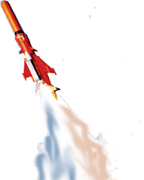 North Korea fires ‘multiple missiles’ into Japanese waters Seoul, SMH. 6 Mar 17 : North Korea has fired ‘multiple missiles’ from its Tongchang-ri region where a missile base is located, South Korea’s military says.
The missiles flew about 1000 kilometres in possible retaliation by the reclusive state to joint US-South Korean drills that began last week.
apanese Prime Minister Shinzo Abe also said North Korea had fired four ballistic missiles, three of which fell into Japan’s exclusive economic zone.
Tokyo had “lodged a stern protest with North Korea,” Abe told reporters……
North Korea has threatened to take “strong retaliatory measures” after South Korea and the US began annual joint military drills on Wednesday that test their defensive readiness against possible aggression from the North.
North Korea criticises the annual drills, calling them preparation for war against it……http://www.smh.com.au/world/north-korea-fires-multiple-missiles-south-20170306-guremx.html
America’s nuclear bomb tests and their health toll on Americans
U.S. nuclear testing ceased in 1992. In 2002, the Centers for Disease Control estimated that virtually every American that has lived since 1951 has been exposed to nuclear fallout, and that the cumulative effects of all nuclear testing by all nations could ultimately be responsible for up to eleven thousand deaths in the United States alone.

 America’s Forgotten Nuclear War (On Itself), National Interest, http://nationalinterest.org/blog/americas-forgotten-nuclear-war-itself-19662 Kyle Mizokami, 4 Mar `17 , Nuclear weapons have a mysterious quality. Their power is measured in plainly visible blast pressure and thermal energy common to many weapons, but also invisible yet equally destructive radiation and electromagnetic pulse. Between 1945 and 1992, the United States conducted 1,032 nuclear tests seeking to get the measure of these enigmatic weapons. Many of these tests would be today be considered unnecessary, overly dangerous and just plain bizarre. These tests, undertaken on the atomic frontier, gathered much information about these weapons—enough to cease actual use testing—yet scarred the land and left many Americans with long-term health problems.
The majority of U.S. nuclear tests occurred in the middle of the Western desert, at the Nevada Test Site. The NTS hosted 699 nuclear tests, utilizing both above-ground and later underground nuclear devices. The average yield for these tests was 8.6 kilotons. Atmospheric tests could be seen from nearby Las Vegas, sixty-five miles southeast of the Nevada Test site, and even became a tourist draw until the Limited Test Ban Treaty banned them in 1963. Today the craters and pockmarks from underground tests are still visible in satellite map imagery.
The bulk of the remaining nuclear tests took place in Pacific, at the islands of Bikini, Enewetak, Johnson Island and Christmas Island. The second nuclear test, after 1945’s Trinity Test, took place at Bikini Atoll. The Pacific tests were notable not only for their stunning visuals, the most compelling imagery of nuclear weapons since Hiroshima, but also the forced relocation of native islanders. Others that were near tests were exposed to dangerous levels of radioactive fallout and forced to fleet. In 1954, the crew of the Japanese fishing boat Daigo Fukuryu Maru accidentally sailed through fallout from the nearby fifteen-megaton Castle Bravo test. Contaminated with nuclear fallout, one crew member died, and the rest were sickened by radiation.
The first test of a thermonuclear, or fusion, bomb took place on November 1952 at Enewetak Island. Nicknamed Ivy Mike, the huge eighty-two-ton device was more of a building than a usable nuclear device. The device registered a yield of 10.4 megatons, or the equivalent of 10,400,000 tons of TNT. (Hiroshima, by contrast, was roughly eighteen thousand tons of TNT.) Ivy Mike was the biggest test by far, creating a fireball 1.8 miles wide and a mushroom cloud that rose to an altitude of 135,000 feet.
One of the strangest atmospheric tests occurred in 1962 at the NTS, with the testing of the Davy Crockett battlefield nuclear weapon. Davy Crockett was a cartoonish-looking recoilless rifle that lobbed a nuclear warhead with an explosive yield of just ten to twenty tons of TNT. The test, code-named Little Feller I, took place on July 17, 1962, with attorney general and presidential adviser Robert. F. Kennedy in attendance. Although hard to believe, Davy Crockett was issued at the battalion level in both Germany and North Korea.
Also in 1962, as part of a series of high-altitude nuclear experiments, a Thor rocket carried a W49 thermonuclear warhead approximately 250 miles into the exoatmosphere. The test, known as Starfish Prime, had an explosive yield of 1.4 megatons, or 1,400,000 tons of TNT, and resulted in a large amount of electromagnetic pulse being released over the Eastern Pacific Ocean. The test, conducted off Johnston Island, sent a man-made electrical surge as far Hawaii, more than eight hundred miles away. The surge knocked out three hundred streetlights and a telephone exchange, and caused burglar alarms to go off and garage doors to open by themselves.
Nuclear tests weren’t just restricted to the Pacific Ocean and Nevada. In October 1964, as part of Operation Whetstone, the U.S. government detonated a 5.3-kiloton device just twenty-eight miles southwest of Hattiesburg, Mississippi. The test, nicknamed Salmon, was an experiment designed to determine if nuclear tests could be detected by seismometer. This was followed up in 1966 with the Sterling test, which had a yield of 380 tons.
In 1967, as part of a misguided attempt to use nuclear weapons for peaceful purposes, the United States detonated a nuclear device near Farmington, New Mexico. Project Gasbuggy was an early attempt at nuclear “fracking,” detonating a twenty-nine-kiloton nuke 4,227 feet underground just to see if the explosion would fracture surrounding rock and expose natural-gas reserves. The experiment was unsuccessful. Two similar tests, Rulison and Rio Blanco, took place in nearby Colorado. Although Rulison was a success in that it uncovered usable gas reserves, the gas was contaminated with radiation, leaving it unsuitable for practical commercial use.
A handful of nuclear tests were conducted in Alaska, or more specifically the Aleutian island of Amchitka. The first test, in October 1965, was designed to test nuclear detection techniques and had a yield of eighty kilotons. A second test occurred four years later, and had a yield of one megaton, or one thousand kilotons. The third and largest test, Cannikin, was a test of the Spartan antiballistic-missile warhead and had a yield of less than five megatons.
During the early years of nuclear testing it was anticipated that nuclear weapons would be used on the battlefield, and that the Army and Marine Corps had better get used to operating on a “nuclear battlefield.” During the 1952 Big Shot test, 1,700 ground troops took shelter in trenches just seven thousand yards from the thirty-three-kiloton explosion. After the test, the troops conducted a simulated assault that took them to within 160 meters of ground zero. This test and others like them led to increases in leukemia, prostate and nasal cancers among those that participated.
U.S. nuclear testing ceased in 1992. In 2002, the Centers for Disease Control estimated that virtually every American that has lived since 1951 has been exposed to nuclear fallout, and that the cumulative effects of all nuclear testing by all nations could ultimately be responsible for up to eleven thousand deaths in the United States alone. The United States did indeed learn much about how to construct safe and reliable nuclear weapons, and their effects on human life and the environment. In doing so, however, it paid a terrible and tragic price.
Kyle Mizokami is a defense and national-security writer based in San Francisco who has appeared in the Diplomat, Foreign Policy, War is Boring and the Daily Beast. In 2009, he cofounded the defense and security blog Japan Security Watch. You can follow him on Twitter: @KyleMizokami.
Global stability is undermined by US nuclear force modernization
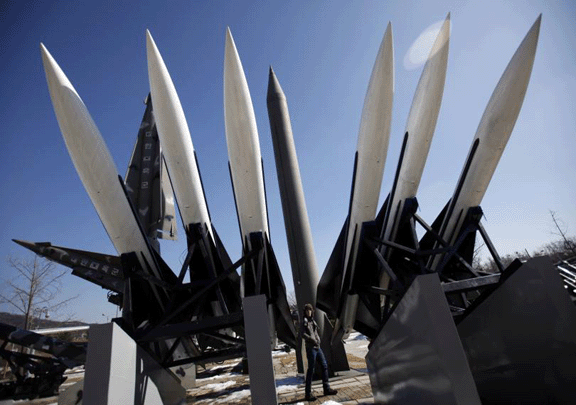
 How US nuclear force modernization is undermining strategic stability: The burst-height compensating super-fuze, Bulletin of the Atomic Scientists Hans M. Kristensen , Matthew McKinzie , Theodore A. Postol , 1 Mar 17 The US nuclear forces modernization program has been portrayed to the public as an effort to ensure the reliability and safety of warheads in the US nuclear arsenal, rather than to enhance their military capabilities. In reality, however, that program has implemented revolutionary new technologies that will vastly increase the targeting capability of the US ballistic missile arsenal. This increase in capability is astonishing—boosting the overall killing power of existing US ballistic missile forces by a factor of roughly three—and it creates exactly what one would expect to see, if a nuclear-armed state were planning to have the capacity to fight and win a nuclear war by disarming enemies with a surprise first strike.
Because of improvements in the killing power of US submarine-launched ballistic missiles, those submarines now patrol with more than three times the number of warheads needed to destroy the entire fleet of Russian land-based missiles in their silos. US submarine-based missiles can carry multiple warheads, so hundreds of others, now in storage, could be added to the submarine-based missile force, making it all the more lethal.
The revolutionary increase in the lethality of submarine-borne US nuclear forces comes from a “super-fuze” device that since 2009 has been incorporated into the Navy’s W76-1/Mk4A warhead as part of a decade-long life-extension program.
We estimate that all warheads deployed on US ballistic missile submarines now have this fuzing capability. Because the innovations in the super-fuze appear, to the non-technical eye, to be minor, policymakers outside of the US government (and probably inside the government as well) have completely missed its revolutionary impact on military capabilities and its important implications for global security.
Before the invention of this new fuzing mechanism, even the most accurate ballistic missile warheads might not detonate close enough to targets hardened against nuclear attack to destroy them. But the new super-fuze is designed to destroy fixed targets by detonating above and around a target in a much more effective way. Warheads that would otherwise overfly a target and land too far away will now, because of the new fuzing system, detonate above the target.
The result of this fuzing scheme is a significant increase in the probability that a warhead will explode close enough to destroy the target even though the accuracy of the missile-warhead system has itself not improved.
As a consequence, the US submarine force today is much more capable than it was previously against hardened targets such as Russian ICBM silos. A decade ago, only about 20 percent of US submarine warheads had hard-target kill capability; today they all do. (See Figure 1.)
This vast increase in US nuclear targeting capability, which has largely been concealed from the general public, has serious implications for strategic stability and perceptions of US nuclear strategy and intentions.
Russian planners will almost surely see the advance in fuzing capability as empowering an increasingly feasible US preemptive nuclear strike capability—a capability that would require Russia to undertake countermeasures that would further increase the already dangerously high readiness of Russian nuclear forces. Tense nuclear postures based on worst-case planning assumptions already pose the possibility of a nuclear response to false warning of attack. The new kill capability created by super-fuzing increases the tension and the risk that US or Russian nuclear forces will be used in response to early warning of an attack—even when an attack has not occurred.
The increased capability of the US submarine force will likely be seen as even more threatening because Russia does not have a functioning space-based infrared early warning system but relies primarily on ground-based early warning radars to detect a US missile attack. Since these radars cannot see over the horizon, Russia has less than half as much early-warning time as the United States. (The United States has about 30 minutes, Russia 15 minutes or less.)
The inability of Russia to globally monitor missile launches from space means that Russian military and political leaders would have no “situational awareness” to help them assess whether an early-warning radar indication of a surprise attack is real or the result of a technical error.
The combination of this lack of Russian situational awareness, dangerously short warning times, high-readiness alert postures, and the increasing US strike capacity has created a deeply destabilizing and dangerous strategic nuclear situation.
When viewed in the alarming context of deteriorating political relations between Russia and the West, and the threats and counter-threats that are now becoming the norm for both sides in this evolving standoff, it may well be that the danger of an accident leading to nuclear war is as high now as it was in periods of peak crisis during the Cold War.
How the new accuracy-enhancing fuze works. The significant increase in the ability of the W76-1/Mk4A warhead to destroy hardened targets—including Russian silo-based ICBMs—derives from a simple physical fact: Explosions that occur near and above the ground over a target can be lethal to it. This above-target area is known as a “lethal volume”; the detonation of a warhead of appropriate yield in this volume will result in the destruction of the target……..
The history of the US super-fuze program. The super-fuze is officially known as the arming, fuzing and firing (AF&F) system. It consists of a fuze, an arming subsystem (which includes the radar), a firing subsystem, and a thermal battery that powers the system. The AF&F is located in the tip of the cone-shaped reentry body above the nuclear explosive package itself. The AF&F developed for the new W76-1/Mk4A is known as MC4700 and forms part of the W76 life-extension program intended to extend the service life of the W76—the most numerous warhead in the US stockpile—out to the time period 2040-2050………
The implications. The newly created capability to destroy Russian silo-based nuclear forces with 100-kt W76-1/Mk4A warheads—the most numerous in the US stockpile—vastly expands the nuclear warfighting capabilities of US nuclear forces. Since only part of the W76 force would be needed to eliminate Russia’s silo-based ICBMs, the United States will be left with an enormous number of higher-yield warheads that would then be available to be reprogrammed for other missions……….
Even after Russia’s silo-based missiles were attacked, the US nuclear firepower remaining would be staggering—and certainly of concern to Russia or any other country worried about a US first strike.
Because of the new kill capabilities of US submarine-launched ballistic missiles (SLBMs), the United States would be able to target huge portions of its nuclear force against non-hardened targets, the destruction of which would be crucial to a “successful” first strike………
The appearance created by the vast expansion of this missile defense program can and will contribute to perceptions among Russians that the United States is seeking nuclear dominance.
The Russians have most recently reacted to this ongoing program by publicly displaying and implementing a new and novel sea-based nuclear weapons delivery device as a hedge against US missile defenses.
In particular, Russia is now in the process of testing a 40-ton nuclear-powered underwater unmanned vehicle (UUV) that could robotically deliver, across thousands of kilometers, a 100-megaton nuclear warhead against the coastal cities and ports of the United States. The technical details of this bizarre system were released by Putin himself in September 2015—apparently intentionally—and testing began in December 2016. Such actions by the Russian government clearly indicate a grave concern about the unpredictable character of ongoing US missile defense programs……….
Our conclusions. Under the veil of an otherwise-legitimate warhead life-extension program, the US military has quietly engaged in a vast expansion of the killing power of the most numerous warhead in the US nuclear arsenal: the W76, deployed on the Navy’s ballistic missile submarines. This improvement in kill power means that all US sea-based warheads now have the capability to destroy hardened targets such as Russian missile silos, a capability previously reserved for only the highest-yield warheads in the US arsenal.
The capability upgrade has happened outside the attention of most government officials, who have been preoccupied with reducing nuclear warhead numbers. The result is a nuclear arsenal that is being transformed into a force that has the unambiguous characteristics of being optimized for surprise attacks against Russia and for fighting and winning nuclear wars. While the lethality and firepower of the US force has been greatly increased, the numbers of weapons in both US and Russian forces have decreased, resulting in a dramatic increase in the vulnerability of Russian nuclear forces to a US first strike. We estimate that the results of arms reductions with the increase in US nuclear capacity means that the US military can now destroy all of Russia’s ICBM silos using only about 20 percent of the warheads deployed on US land- and sea-based ballistic missiles………..
The decision by the Obama administration in 2009 to deploy the Aegis ship-based European Phased Adaptive Approach (EPAA) missile defense system has created a program under which the United States could eventually have between 500 to 700 anti-missile interceptors that could in theory be used to defend the continental United States from ships off the country’s coasts. In spite of its severe limitations, this growing defense system could appear to both Russia and China as a US attempt to reduce the consequences of a ragged Russian or Chinese retaliation to a US first strike against them.
We cannot foresee a situation in which a competent and properly informed US president would order a surprise first strike against Russia or China. But our conclusion makes the increased sea-based offensive and defensive capabilities we have described seem all the more bizarre as a strategy for reducing the chances of nuclear war with either Russia or China.
That Russian silos are more vulnerable to W76-1/Mk4A warheads will not come as an earth-shattering revelation to Russian military officials; they would have to expect that the silos would be destroyed anyway, by US land-based ICBMs. But the growing capability of the US forward-deployed sea-based nuclear missiles could raise serious questions in the minds of Russian military planners and political leadership about US intentions—especially when seen in context of growing US cyber, advanced conventional, and missile defense capabilities—almost certainly deepening mistrust and encouraging worst-case planning assumptions in Moscow.
We end this article with quotes from Vladimir Putin, talking impromptu to a group of journalists during the St. Petersburg International Economic Forum in June 2016. His unrehearsed remarks are clear and candid predictors of how he will assess the implications of the super-fuze:
No matter what we said to our American partners [to curb the production of weaponry], they refused to cooperate with us, they rejected our offers, and continue to do their own thing.
… They rejected everything we had to offer.
… the Iranian threat does not exist, but missile defense systems are continuing to be positioned…
That means we were right when we said that they are lying to us.
Their reasons were not genuine, in reference to the “Iranian nuclear threat.”
Your people [the populations of the Western alliance] … do not feel a sense of the impending danger—this is what worries me.
A missile defense system is one element of the whole system of offensive military potential.
It works as part of a whole that includes offensive missile launchers.
One complex blocks, the other launches high precision weapons, the third blocks a potential nuclear strike, and the fourth sends out its own nuclear weapon in response.
This is all designed to be part of one system.
I don’t know how this is all going to end.
What I do know is that we will need to defend ourselves. http://thebulletin.org/how-us-nuclear-force-modernization-undermining-strategic-stability-burst-height-compensating-super10578
‘Direct military action’ against North Korea is under consideration by Trump administration
White House ‘considers direct military action’ to counter North Korean nuclear threat
North Korea threatens to ‘mercilessly foil the nuclear war racket of the aggressors with its treasured nuclear sword’, Independent, 2 Mar 17 Samuel Osborne @SamuelOsborne93 , An internal White House review of strategy on North Korea reportedly includes the possibility of direct military action or regime change to counter the hermit kingdom’s nuclear threat.
Deputy national security adviser K T McFarland held a meeting with other officials ot discuss the US response to a fresh series of provocations from the North, the Wall Street Journal reports.
India launches nuclear destroyer missile
 Nuclear destroyer missile launched by India in chilling warning to world, Daily Star , 2 Mar 17 INDIA has fired a nuclear destroyer missile as the nation prepares for all-out war. The low altitude interceptor was fired over the Bay of Bengal to destroy an incoming ballistic missile.
Defence officials in the country are developing a two-tier ballistic missile defence to protect against impending nuclear war.
“The complete event including the engagement and destruction was tracked by a number of electro-optical tracking systems using infrared imagery…..http://www.dailystar.co.uk/news/latest-news/592823/Nuclear-war-destroyer-missile-World-War-3-India-Pakistan-conflict
Shaky friendship between China, North Korea: clash over nuclear and chemical weapons

 Friendship on the rocks? China, North Korea clash over nuclear and chemical weapons
North Korea’s reaction was so strong that some Chinese experts initially thought the commentary was fake By Saša Petricic, CBC News Feb 28, 2017 “…..China’s patience may be wearing thin, as frustrations double up over North Korea’s development of nuclear weapons and apparent willingness to use chemical weapons.
South Korea has accused North Korean leader Kim Jong-un of ordering the assassination of his half-brother, Kim Jong-nam, and Malaysia suspects several North Korean officials may have been involved in a plot that used the banned VX nerve agent.
It’s creating an unprecedented rift between the two neighbours and ideological soulmates. China’s support dates back to the 1950s and the Korean war.
Last week, Beijing imposed a ban on coal imports from North Korea that could deprive it of much needed foreign funds until the end of 2017. Pyongyang has replied with one of the nastiest insults one socialist state can throw at another, accusing China of “dancing to the tune of the U.S.”
“The hostile forces are shouting ‘bravo’ over this,” says a commentary published by North Korea’s state news agency, accusing its neighbour of “mean behaviour.”…….
Pyongyang has defied some of the toughest sanctions imposed by the United Nations Security council, meant to not only deprive North Korea of the parts and expertise it needs to develop a nuclear arsenal, but also to punish the country’s leadership by blocking travel and access to luxury goods.
Officially, China endorses the UN sanctions and condemns Kim Jong-un’s nuclear and missile sabre-rattling.
But it is walking a fine line, trying to avoid weakening the regime so badly that it collapses, causing unrest in North Korea and a possible flood of refugees into China.
Beijing has been accused of turning a blind eye to a network of North Korean shell companies and middlemen who operate just over the land border in China, working to circumvent sanctions……..
while Pyongyang’s ongoing nuclear and missile program worries China, it’s the apparent assassination of Kim Jong-un’s half-brother Kim Jong-nam that has sharpened the divisions between it and North Korea…….
Stockpile of deadly toxins
China is reportedly upset because Jong-nam was under its implicit protection, living in the country’s gambling enclave of Macau for years.
It was also rattled by North Korea’s apparent ready use of such a potent and prohibited chemical weapon beyond its borders. Pyongyang is known to have a large stockpile of various deadly toxins, and it hasn’t signed on to international conventions agreeing not to engage in chemical warfare…….http://www.cbc.ca/news/world/north-korea-china-weapons-petricic-1.4000631
Russians alarmed by Donald Trump’s posture on nuclear weapons

 Trump’s US nuclear stance alarms Russia http://www.skynews.com.au/news/politics/nthamerica/2017/02/25/trump-s-us-nuclear-stance-alarms-russia.html
Published: 10:16 am, Saturday, 25 February 2017 Russian politicians close to the Kremlin say US President Donald Trump’s declared aim of putting the US nuclear arsenal ‘at the top of the pack’ risked triggering a new Cold War-style arms race between Washington and Moscow.
In an interview with Reuters, Trump said the US had fallen behind in its nuclear weapons capacity, a situation he said he would reverse, and he said a treaty limiting Russian and US nuclear arsenals was a bad deal for Washington.
Russian officials issued no reaction, with Friday a public holiday, but pro- Kremlin politicians expressed consternation about the comments from Trump, who Moscow had hoped would usher in new, friendlier relations between the two countries.
‘Trump’s campaign slogan ‘Make America great again’, if that means nuclear supremacy, will return the world to the worst times of the arms race in the ’50s and ’60s,’ said Konstantin Kosachev, chairman of the international affairs committee in the upper house of the Russian parliament.
The president’s remarks in the interview with Reuters were, Kosachev said in a post on his Facebook page, ‘arguably Trump’s most alarming statement on the subject of relations with Russia’.
Over the course of the Cold War, the Soviet Union and the US realised that achieving supremacy was dangerous, and accepted the doctrine of parity as the best way to ensure peace, Kosachev wrote on his Facebook page.
‘Are we entering a new era? In my view we need an answer to that question as soon as possible.’
During the US presidential race, Trump said he would try to end the enmity that broke out between the Kremlin and Washington during Barack Obama’s presidency.
But just over a month into the Trump presidency, that prospect has receded, especially with the sacking of Michael Flynn, a leading proponent of warmer ties with Moscow, from his job as national security adviser.
Another pro-Kremlin lawmaker, Alexei Pushkov, wrote on Twitter that Trump’s comments on increasing US nuclear capacity ‘put in doubt the agreement on limiting strategic arms, returning the world to the 20th century’.
He said a Cold War arms treaty laid the foundation for nuclear stability between Moscow and Washington. ‘That needs to be preserved. And the United States cannot achieve decisive superiority.’
‘Instead of trying to achieve an illusory nuclear supremacy over Russia, the US administration should find a solution to the exceptionally complicated nuclear problem of North Korea,’ wrote Pushkov, a member of the defence and security committee in Russia’s upper house of parliament. – See more at: http://www.skynews.com.au/news/politics/nthamerica/2017/02/25/trump-s-us-nuclear-stance-alarms-russia.html#sthash.fwqZWCfw.dpuf
– See more at: http://www.skynews.com.au/news/politics/nthamerica/2017/02/25/trump-s-us-nuclear-stance-alarms-russia.html#sthash.fwqZWCfw.dpuf
– See more at: http://www.skynews.com.au/news/politics/nthamerica/2017/02/25/trump-s-us-nuclear-stance-alarms-russia.html#sthash.fwqZWCfw.dpuf– See more at: http://www.skynews.com.au/news/politics/nthamerica/2017/02/25/trump-s-us-nuclear-stance-alarms-russia.html#sthash.fwqZWCfw.dpuf
Declassified US documents suggest Adolf Hitler did have a nuclear bomb in 1944
 DID HITLER HAVE A NUKE? Declassified US documents suggest Adolf Hitler successfully tested nuclear bomb during World War Two https://www.thesun.co.uk/news/2938529/declassified-us-documents-suggest-adolf-hitler-successfully-tested-nuclear-bomb-during-world-war-two/ Two pilots claim they witnesses a mushroom cloud while flying over Nazi Germany in 1944 BY ALLAN HALL 23rd February 2017
Trump aims to expand US nuclear arsenal, make it ‘top of the pack’
Donald Trump wants to expand US nuclear arsenal, make it ‘top of the pack’ http://www.smh.com.au/world/donald-trump-wants-to-expand-us-nuclear-arsenal-make-it-top-of-the-pack-20170223-guk6ms.htm, Steve Holland, 23 Feb 17
Washington: President Donald Trump has said he wants to build up the US nuclear arsenal to ensure it is at the “top of the pack,” saying the United States has fallen behind in its atomic weapons capacity.
In a Reuters interview, Trump also said China could solve the national security challenge posed by North Korea “very easily if they want to,” ratcheting up pressure on Beijing to exert more influence to rein in Pyongyang’s increasingly bellicose actions.
n his first comments about the US nuclear arsenal since taking office on January 20, Mr Trump said the United States has “fallen behind on nuclear weapon capacity.”
“… We’re never going to fall behind any country even if it’s a friendly country, we’re never going to fall behind on nuclear power.
“It would be wonderful, a dream would be that no country would have nukes, but if countries are going to have nukes, we’re going to be at the top of the pack,” Mr Trump said.
The new strategic arms limitation treaty, known as New START, between the US and Russia requires that by February 5, 2018, both countries must limit their arsenals of strategic nuclear weapons to equal levels for 10 years.
The treaty permits both countries to have no more than 800 deployed and non-deployed land-based intercontinental and submarine-launched ballistic missile launchers and heavy bombers equipped to carry nuclear weapons, and contains equal limits on other nuclear weapons.
Analysts have questioned whether Mr Trump wants to abrogate New START or would begin deploying other warheads.
In the interview, Mr Trump called New START “a one-sided deal”.
“Just another bad deal that the country made, whether it’s START, whether it’s the Iran deal … We’re going to start making good deals,” he said.
The United States is in the midst of a $US1 trillion ($1.3 trillion), 30-year modernisation of its aging ballistic missile submarines, bombers and land-based missiles, a price tag that most experts say the country cannot afford.
Mr Trump also complained that the Russian deployment of a ground-based cruise missile is in violation of a 1987 treaty that bans land-based American and Russian intermediate-range missiles.
“To me it’s a big deal,” he said.
Asked if he would raise the issue with Russian President Vladimir Putin, Mr Trump said he would do so “if and when we meet.” He said he had no meetings scheduled as of yet with Mr Putin.
Speaking from behind his desk in the Oval Office, Mr Trump declared that “we’re very angry” at North Korea’s ballistic missile tests and said accelerating a missile defense system for US allies Japan and South Korea was among many options available.
“There’s talks of a lot more than that,” Mr Trump said, when asked about the missile defense system. “We’ll see what happens. But it’s a very dangerous situation, and China can end it very quickly in my opinion.”
President Donald Trump’s control of U.S. nuclear forces is no longer a laughing matter.
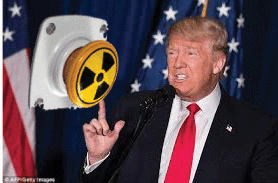 The Trump Nuclear Threat, It’s time to worry about Donald Trump’s control of U.S. nuclear forces. US News, By Louis René Beres | Feb. 21, 2017,
Russia lessening its reliance on nuclear weapons
Russia to rely less on nuclear weapons as their conventional strength rapidly increases, Business Insider, Vladimir Isachenkov, Associated Press, 21 Feb 17, MOSCOW (AP) — Russia will continue to see the development of its nuclear forces as a top priority, but the military will rely increasingly on conventional weapons to deter any aggression, the Russian Defense Minister said Tuesday.
Sergei Shoigu said Tuesday that weapons such as the long-range Kalibr cruise missiles carried by navy ships, long-range cruise missiles carried by Russian strategic bombers and the land-based short-range Iskander missiles will play an increasingly important role as a non-nuclear deterrent. Those missiles can carry nuclear or conventional warheads.
Shoigu pointed to the new missiles’ debut in the Syrian conflict, saying they have proven themselves well.
“The development of strategic nuclear forces will remain an unconditional priority,” Shoigu said in remarks carried by Russian news agencies. “Russian nuclear weapons ensure the guaranteed deterrence of aggression by any foreign power.”
At the same time, he added, “the role of nuclear weapons in deterring a potential aggressor will diminish, primarily thanks to the development of precision weapons.”
Until recently, Russia lacked long-range cruise missiles with conventional warheads similar to those in the U.S. inventory.
The post-Soviet economic meltdown left the Russian armed forces in disarray, but the Kremlin has beefed up the military’s conventional forces in recent years amid tensions with the West……http://www.businessinsider.com/ap-russia-to-rely-increasingly-on-non-nuclear-deterrent-2017-2?IR=T
Russia to show off nuclear power-ed battleship and submarine in Baltic sea
Arab states might develop nuclear weapons? United Arab Emirates push for nuclear power
The UAE’s Nuclear Push And the Potential Fallout for the Middle East, Foreign Affairs 21 Feb 17,
USA confirms use of depleted uranium i n Syria, despite its previous promises
 Samuel Oakford: US promised it wouldn’t use Depleted Uranium in Syria. But then it did. February 14, 2017. Officials have confirmed that the US military – despite vowing not to use controversial Depleted Uranium (DU) weapons on the battlefield in Iraq and Syria – fired thousands of rounds of such munitions during two high-profile raids on oil trucks in Islamic State-controlled Syria in late 2015. The air assaults mark the first confirmed use of this armament since the 2003 Iraq invasion, when hundreds of thousands of rounds were fired, leading to outrage among local communities which alleged that toxic remnants caused both cancer and birth defects.https://airwars.org/news/depleteduranium1/
ICBUW: United States confirms that it has fired depleted uranium in Syria 21 October 2016. US admits that it fired DU on two occasions in November 2015, contrary to earlier claims; military justification for use unclear after target analysis; ICBUW and PAX call for full disclosure to facilitate harm reduction measures; Russia takes advantage of news to distract from its own conduct in the conflict. http://www.bandepleteduranium.org/en/united-states-confirms-fired-du-syria
Trump didn’t know what the New START nuclear treaty was, but wanted to get rid of it
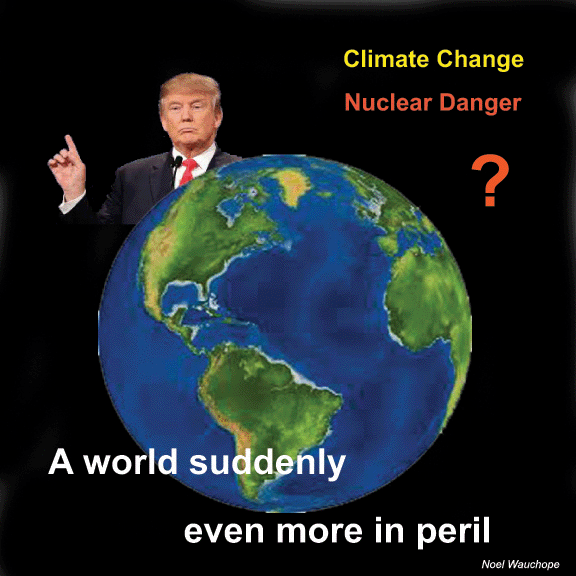 A bad START: Trump tells Putin U.S.-Russia treaty to limit nuclear weapons was a “bad deal”, Salon.com , FEB 10, 2017
The president reportedly didn’t know what the New START treaty was but wanted to get rid of it President Donald Trump has had another embarrassing phone call with a foreign leader — and this time there’s potentially dangerous consequences.
According to the sources who spoke with Reuters, however, Trump seemed unfamiliar with the details of New START when it was brought up by Russian leader Vladimir Putin. After Putin suggested extending New START beyond its original time frame, Trump referred to the treaty as one of many bad deals that Obama had negotiated.
If New START is not mutually extended, neither America nor Russia would be limited in their nuclear production, which could trigger a nuclear arms race.
The sources also say that Trump then turned the conversation toward the subject of his own supposed popularity within the United States. The official White House account of Trump’s Jan. 28 conversation with Putin did not mention a discussion about New START.
Trump’s phone calls with world leaders have not gone well……http://www.salon.com/2017/02/09/a-bad-start-trump-tells-putin-u-s-russia-treaty-to-limit-nuclear-weapons-was-a-bad-deal/
1 This Month
23-25 October – on Zoom – World BEYOND War’s annual global conferenc


Shut down the radiation-damaged Heysham nuclear reactors now
To see nuclear-related stories in greater depth and intensity – go to https://nuclearinformation.wordpress.com

Say No to NASA’s Reckless Nuclear Reactor on the Moon
Say No to NASA’s Reckless Nuclear Reactor on the Moon
-
Archives
- October 2026 (170)
- September 2026 (339)
- August 2026 (330)
- July 2026 (355)
- June 2026 (287)
- May 2026 (306)
- April 2026 (356)
- March 2026 (251)
- February 2026 (267)
- January 2026 (308)
- December 2025 (358)
- November 2025 (359)
-
Categories
- 1
- 1 NUCLEAR ISSUES
- business and costs
- climate change
- culture and arts
- ENERGY
- environment
- health
- history
- indigenous issues
- Legal
- marketing of nuclear
- media
- opposition to nuclear
- PERSONAL STORIES
- politics
- politics international
- Religion and ethics
- safety
- secrets,lies and civil liberties
- spinbuster
- technology
- Uranium
- wastes
- weapons and war
- Women
- 2 WORLD
- ACTION
- AFRICA
- Atrocities
- AUSTRALIA
- Christina's notes
- Christina's themes
- culture and arts
- Events
- Fuk 2022
- Fuk 2023
- Fukushima 2017
- Fukushima 2018
- fukushima 2019
- Fukushima 2020
- Fukushima 2021
- general
- global warming
- Humour (God we need it)
- Nuclear
- RARE EARTHS
- Reference
- resources – print
- Resources -audiovicual
- Weekly Newsletter
- World
- World Nuclear
- YouTube
-
RSS
Entries RSS
Comments RSS

