Youtube – newly available images of nuclear bomb tests
*Declassified* Nuclear Test Films Unbelievable Video !! Kenny-Boo Hurt
Terrifying images revealed in declassified nuclear test videos uploaded to YouTube, The Age, Ben Guarino, 20 Mar 17,
On Monday, the Lawrence Livermore National Laboratory, located in California, uploaded to YouTube more than 60 films taken during US nuclear weapons tests between 1945 and 1962. During this time, experimental nukes were dropped from bombers or propelled by rockets to altitudes as high as space.
Their offbeat names, such as Operation Hardtack 1, Operation Plumbbob and Operation Teapot, belied the massive destruction on display. More than 200 nuclear test weapons would go off until 1963, when the Partial Test Ban Treaty required further testing to take place underground. In each instance, scientists trained multiple cameras on the explosion.
For decades afterward, thousands of these films languished in secure vaults – until Greg Spriggs, 65, a weapons physicist at Lawrence Livermore National Laboratory, decided to dust them off. Some of the films had already degraded beyond the point of restoration. “You can smell vinegar when you open the cans, which is one of the byproducts of the decomposition process of these films,” Spriggs said in a news release. “We know that these films are on the brink of decomposing to the point where they’ll become useless.”
He recruited expert archivists, including Zapruder film preservationist Jim Moye, to help digitise the footage.
“The data that we’re collecting now must be preserved in a digital form because no matter how well you treat the films, no matter how well you preserve or store them, they will decompose,” Spriggs said. “They’re made out of organic material, and organic material decomposes. So this is it. We got to this project just in time to save the data.”
Scientists are still able to wring new information from old detonations. Modern analytical techniques applied to digitised footage revealed inaccuracies in past estimates of fireball and shockwave size, which in many instances had been derived by hand.
“We were finding that some of these answers were off by 20, maybe 30, per cent,” Spriggs said. “We’ve also discovered new things about these detonations that have never been seen before.”………
Spriggs and the team of restorers have found about 6500 out of 10,000 reels from the era of above-ground nuclear tests, according to the news release. The researchers have scanned two-thirds of these films, and the Department of Energy has declassified just 750.
Why the government has only allowed the public to see the footage now was not an issue of secrecy – information about the operations had already been made public – but a matter of red tape…….http://www.theage.com.au/world/terrifying-images-revealed-in-declassified-nuclear-test-videos-uploaded-to-youtube-20170319-gv1ak3.html
Russia developing Major Naval Base for Nuclear Warships in Syria
How Russia Is Turning Syria into a Major Naval Base for Nuclear Warships (and Israel Is Worried), National Interest, Michael Peck, 18 Mar 17, During the 1970s, the Syrian naval base of Tartus became a major port servicing warships of the Soviet Union’s Fifth Mediterranean squadron.
The Soviet Union is gone, and so is Syria as a unified nation. But Russia is back, and it’s building up Tartus again as a naval base that can handle Russia’s largest nuclear-powered ships.
Already, Israel says the Tartus base is affecting its naval operations. U.S. and NATO operations could be next.
Under the forty-nine-year agreement inked late last year by Russia and Syria, “the maximum number of the Russian warships allowed at the Russian naval facility at one time is 11, including nuclear-powered warships, providing that nuclear and ecological security rules are observed,” according to Russia’s RT news site. Russia will also be allowed to expand port facilities to accommodate the vessels.
The specification allowing nuclear-powered warships means that Russia wants to be able to base in Syria large surface ships, namely Kirov-class nuclear-powered battle cruisers, as well as nuclear submarines.
In addition, the treaty allows “Russia is allowed to bring in and out any kind of ‘weaponry, ammunition, devices and materials’ to provide security for the facility staff, crew, and their families throughout the territory of the Syrian Arab Republic ‘without any duties or levies,’” according to RT.
Expansion of the port will take about five years, according to an anonymous source cited in Russia’s Sputnik News. “The source added that the works would focus on dredging operations to allow cruisers and even possibly aircraft carriers to use the facility’s infrastructure,” Sputnik News reported. “According to the source, Russia also needs to develop the facility’s ground infrastructure, through construction of canalization, electricity generation facilities and barracks for the servicemen.”
Sputnik News also listed other provisions of the agreement. These include:
• Russia will be responsible for sea and air security of the base, while Syria handles the land defenses.
• Russia can deploy “temporary mobile outposts” beyond the base, as long as they coordinate them with the Syrians.
• Russia can renovate the base at will, including underwater construction, and build offshore platforms.
• Upon Syrian request, Russia will send specialists to service Syrian warships, conduct search and rescue in Syrian waters, and organize the defense of Tartus.
• Syria agrees not to “make any objections related to the military activities of the base, which will also be beyond Damascus’ jurisdiction.”
• “Syria also pledges to solve any conflicts that may arise if a third party objects to the activities of the base.”
The Tartus deal is significant on several levels…… http://nationalinterest.org/blog/the-buzz/how-russia-turning-syria-major-naval-base-nuclear-warships-19813
A computer model to simulate how 20 MILLION people would react to nuclear bomb in New York City
Scientists to simulate how 20 MILLION people would react to nuclear bomb in New York City . http://www.mirror.co.uk/news/world-news/scientists-simulate-how-20-million-10054846 Experts are building a computer model which will test how people and buildings would respond to a nuclear blast 18 MAR 2017 Scientists are testing how 20 million people would react to a nuclear attack in New York City.
Experts at the Center for Social Complexity in Virginia have been awarded a $450,000 (£363,000) grant to study the aftermath of a blast in the Big Apple.
The model is also expected to show how buildings and the environment would be affected.The simulated bombs will have a strength of up to 10 kilotons – half the amount used in the Hiroshima attack.
Professor William Kennedy predicted survivors would follow instructions and stay in place instead of running wildly on the streets in search of loved ones.
He told the magazine: “We’ve found that people seem to be reasonably well behaved [Ed. oh isn’t that nice?] and do what they’ve been trained to, [Ed. very good. so it’ll all be OK? ] or are asked or told to do by local authorities. Reports from 9/11 show that people walked down many tens of flights of stairs, relatively quietly, sometimes carrying each other, to escape buildings. “We’re finding those kinds of reports from other disasters as well—except after Hurricane Katrina.”
The project is expected to take three years.
But professor Kennedy said he hoped to start experiments in the next six months and report some results from next year.
Restricting First Use of Nuclear Weapons Act of 2017 introduced into US Congress
Under any circumstances, the prospect of nuclear war is terrifying, the deadly consequences irreversible. Yet with a single order, the president — any president — could effectively declare a nuclear war that would wipe out entire nations, including our own.
More worrying still, our current president has shown an alarming willingness to engage in aggression instead of diplomacy — particularly towards nations like Iran and China, as well as countries whose citizens have now been banned from traveling to the U.S. under an overbroad, dog-whistle executive order.
Trump has almost gleefully exercised his right to threaten nuclear war.
He made boastful remarks about nuclear might throughout his campaign. And just recently, he called for a new push to put America at the “top of the pack” when it comes to nuclear weapons capability (as though we weren’t already).
Going against decades of precedent, not to mention hard-won diplomatic treaties reached with countries like Russia and Iran, Trump has enthusiastically declared that we should expand, not reduce, our nuclear arsenal…………
It’s almost impossible to comprehend millions of people being obliterated from the face of the earth simultaneously, in the blink of an eye. Especially at the whim of just one American who happens to have access to a certain red button.
That’s why Representative Ted Lieu and Senator Ed Markey have introduced legislation prohibiting the sitting president from unilaterally declaring nuclear war without a prior act of Congress. They call it the Restricting First Use of Nuclear Weapons Act of 2017.
“Nuclear war poses the gravest risk to human survival,” Markey warned in a joint statement introducing this legislation. Unfortunately, Trump insists on “maintaining the option of using nuclear weapons first in a conflict.”
“In a crisis with another nuclear-armed country,” the senator went on to explain, “this policy drastically increases the risk of unintended nuclear escalation.” http://www.commondreams.org/views/2017/03/19/right-now-trump-can-start-nuclear-war
US airforce is still quietly cutting nuclear force
While Trump talks tough, U.S. quietly cutting nuclear force, PBS Newshour BY ROBERT BURNS, ASSOCIATED PRESS March 19, 2017 WASHINGTON — The Air Force is quietly shrinking its deployed force of land-based nuclear missiles as part of a holdover Obama administration plan to comply with an arms control treaty with Russia. The reductions are nearing completion despite President Donald Trump’s argument that the treaty gives Moscow an unfair advantage in nuclear firepower.
The reduction to 400 missiles from 450 is the first for the intercontinental ballistic missile, or ICBM, force in a decade – when the arsenal came down from 500 such weapons. The Air Force says the latest cut in Minuteman 3 missiles will be completed in April, leaving the deployed ICBM arsenal at its smallest size since the early 1960s.
In 2014, President Barack Obama’s administration announced the planned ICBM reduction to tailor the overall nuclear force, including bombers and nuclear-armed submarines, to the New START accord that the U.S. and Russia sealed in 2010. Both nations must comply with the treaty’s limits by February 2018.
The shrinking of the ICBM force runs counter, at least rhetorically, to Trump’s belief that the U.S. has fallen behind Russia in nuclear muscle. In December, he tweeted that the U.S. must “greatly strengthen and expand its nuclear capability until such time as the world comes to its senses regarding nukes.” He has criticized New START as a bad deal.
It’s unclear how Trump intends to conduct a nuclear expansion, which critics call unnecessary and a potential drain on funds needed for non-nuclear forces. A long-term plan to replace and modernize the current nuclear force is already underway and will end up costing hundreds of billions of dollars.
As of March 14, the Air Force had 406 Minuteman missiles in launch-ready silos, Maj. Daniel Dubois, an Air Force spokesman, said Friday. In September the number was 417. Dubois said the number will be down to 400 by April. Also as part of the treaty’s compliance process, the Air Force in January finished converting 41 B-52H bombers to non-nuclear status……..http://www.pbs.org/newshour/rundown/trump-talks-tough-u-s-quietly-cutting-nuclear-force/
For US Secretary of State, Rex Tillerson, a pre-emptive attack on North Korea is an option
 Military action against North Korea ‘an option’, warns Rex Tillerson
US secretary of state says policy of strategic patience has ended due to threat posed by Pyongyang’s nuclear weapons programme, Guardian, Justin McCurry , 17 Mar 17 , A pre-emptive US military strike against North Korea may be necessary if the threat posed by its nuclear weapons programme reaches a level that “requires action”, the US secretary of state, Rex Tillerson, has warned.
Speaking in Seoul on the second day of a visit to the Asia-Pacific region, Tillerson said Washington’s policy of “strategic patience” towards the regime in Pyongyang had ended.
In his strongest comments yet on concerns that North Korea is moving closer towards developing a nuclear strike capability that could threaten the US mainland, Tillerson said “all options are on the table”.
“Certainly we do not want to, for things to get to military conflict,” he said at a joint press conference with South Korea’s foreign minister, Yun Byung-se.
“If they elevate the threat of their weapons programme to a level that we believe requires action, then that option’s on the table. “Let me be very clear: the policy of strategic patience has ended. We are exploring a new range of security and diplomatic measures.”
Those words hint at a departure from the North Korea policy pursued by the Obama administration, which sought to use multilateral sanctions to pressure the North Korean leader, Kim Jong-un, into agreeing to denuclearisation in exchange for aid and investment…….
Aside from repeating that Washington’s policy options remain open, Tillerson has not offered details of how the Trump administrationplans to address the rising threat from North Korean nuclear weapons and ballistic missiles…….
Tillerson faces potentially the most difficult leg of his three-country visit when he arrives in Beijing on Saturday…..https://www.theguardian.com/us-news/2017/mar/17/military-action-against-north-korea-an-option-warns-rex-tillerson
Trump budget would boost nuclear weapons spending, slash diplomatic and aid programmes
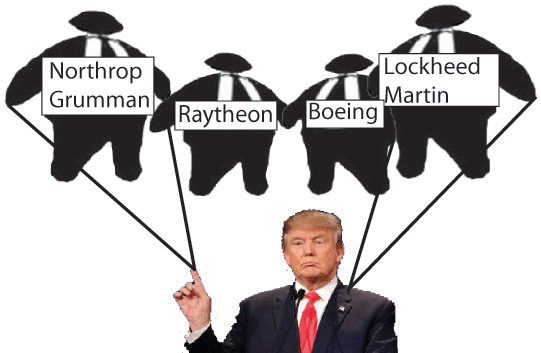 Trump budget: An extra billion dollars for nuclear weapons, Salon.com, 17 Mar 17 His draft 2018 budget would boost the budget for nuclear weapons production by 11 percent President Donald Trump has proposed to boost federal spending on the production of nuclear weapons by more than $1 billion in 2018 while slashing or eliminating spending on many federal programs related to diplomacy, foreign aid, and social needs, in a budget proposal that reflects the first tangible expression of his defense priorities.
The 64-page budget document released by the White House on March 16 — and entitled “America First: A Budget Blueprint to Make America Great Again” — contained only a few sentences about the proposal, which would give the NNSA a total of $14.3 billion in fiscal year 2018. But the blueprint said the new spending would support “the goals of moving toward a responsive nuclear infrastructure and advancing the existing program of record for warhead life extension programs.”
That language refers to an existing effort to modernize three types of warheads, so they can be deployed with bombers, submarine-launched missiles, and land-based missiles, some of which will themselves be modernized in years to come. That warhead work is well under way, although the budget document suggested it had been slowed by Obama-era defense spending caps. Some independent experts have cautioned, however, that the speed of the work is limited mostly by its sheer complexity, rather than by fund shortages, and expressed doubt that it could be accelerated.
Trump’s budget proposal also says the additional NNSA funds would address its “critical infrastructure maintenance” needs — which is Washington-speak for everything from laboratories and test tracks to office buildings — which NNSA director Frank Klotz has pegged in public statements at roughly $3.7 billion. That tally includes both nuclear weapons-related work and nonnuclear work related to the cleanup of wastes from past weapons production activities……..
Many in Washington say that Congress is unlikely to approve Trump’s budget. Nonetheless, the special status Trump has assigned to nuclear weapons work is exemplified by the fact that even as the NNSA’s budget would expand under his proposal, the rest of the Energy Department’s budget would decline by around 20 percent, or $1.7 billion.
Gone would be the department’s weatherization, gas mileage, and clean energy programs. The Office of Science, which supports research into new technologies and basic physics as well as climate change, would be cut by nearly twenty percent. Elsewhere in the government, the State Department would get a 28 percent budget cut, funds for U.N. peacekeeping would be scaled back, humanitarian aid would be focused on fewer nations, and all federal spending for the U.S. Institute of Peace would disappear.
The current U.S. nuclear weapons modernization program, which was initiated and strongly supported by former President Barack Obama, was already estimated to cost $1 trillion or more over the next three decades. But Trump, in a Dec. 22 tweet, said “the United States must greatly strengthen and expand its nuclear capability” — implying that this should be beyond what Obama had set in motion.
As if to hammer that point home, Trump on March 16 also announced the appointment to the position of Pentagon policy chief of a defense analyst who helped write a new U.S. nuclear policy in 2001 that supported research on new types of nuclear warheads. The policy, overseen in part by Trump nominee David J. Trachtenberg, a former Pentagon deputy assistant secretary under President George W. Bush, also downplayed the significance of arms control, and supported an expansion of U.S. ballistic missile defense programs……..http://www.salon.com/2017/03/17/trump-budget-an-extra-billion-dollars-for-nuclear-weapons_partner/
Call for Turkey to get its own nuclear weapons
NUCLEAR TURKEY? Imam close to Erdogan calls for weapons NOW amid tensions with EU, Express UK, 17 Mar 17 TURKEY should ignore rules set by ‘the West’ and build its own NUCLEAR WEAPONS – an Imam close to president Recep Tayyip Erdogan has advised – as the fallout between Brussels and Ankara deepens. By ZOIE O’BRIEN, Mar 16, 2017 The worrying advice has been called weeks ahead of a Turkish referendum aimed at giving more power to President Erdogan – and in the midst of a keeping fallout between Ankara and EU leaders.
Hayrettin Karaman, the Turkish AK Party’s go-to religious leader, attacked ‘the West’ in a letter which insisted Erdogan should immediately invest in weapons of mass destruction.
In the online post the imam accused Christian countries in the West of egotism and racism – stating the bad attitude towards Turkey has been “accelerated”.
President Erdogan is in the midst of a deep fall out with European nations including Germany and the Netherlands after both countries banned rallies and kicked out his ministers who had sworn to campaign for his referendum. Mr Erdogan retaliated by comparing them to Nazis and protests were held outside the Dutch embassy in Ankara.
The fallout threatens the £5billion one-for-one migrant deal.
But, if Mr Erdogan listens to his favourite religious leader, the tensions could be ramped up even further……..http://www.express.co.uk/news/world/780240/TURKEY-Imam-Erdogan-nuclear-weapons-NOW-EU-tension-Germany-Netherlands
US intelligence : new round of missile, nuclear testing by North Korea expected

 US anticipates new round of missile, nuclear testing by North Korea By Barbara Starr, CNN Pentagon Correspondent, March 16, 2017 Story highlights
Newly declassified films show US nuclear tests
The Lawrence Livermore National Lab has begun posting films of its U.S. nuclear weapons tests to YouTube, KGO reported Wednesday.
The lab is reanalyzing the footage to improve the data “for future physicists,” nuclear weapons physicist Greg Spriggs said in an interview published by Livermore on Wednesday.
On its YouTube channel that now houses the declassified videos, the lab notes that the U.S. “conducted 210 atmospheric nuclear tests between 1945 and 1962.” Livermore conducted the ones in its internet archive.
UK government boycotts UN nuclear disarmament talks
UN nuclear disarmament talks: UK Government not attending discussions labelled ‘reckless and irresponsible’ ‘I don’t think it’s taking nuclear disarmament seriously,’ Green Party leader Caroline Lucas tells The Independent Harriet Agerholm @HarrietAgerholm 15 Mar 17 The Government has been called “reckless and irresponsible” after it refused to send a single representative to United Nations (UN) talks about a ban on nuclear weapons.
The Foreign Office revealed that no one from the UK attended a February meeting ahead of the negotiations and no one would go to the discussions when they take place later this month.
It was responding to a parliamentary question by Green Party co-leader Caroline Lucas, who told The Independent that it showed the Government was being “massively hypocritical” and failing in its commitment to working towards a world without nuclear weapons. …..
Guides to nuclear war survival don’t work: “Protect and Survive” Exhibition
Why there’s no modern guide to surviving a nuclear war https://theconversation.com/why-theres-no-modern-guide-to-surviving-a-nuclear-war-73498 March 17, 2017 The risk of thermonuclear war has rarely been greater. But despite the growing threat, the general public are less prepared than they ever have been to cope with an attack. With Trump in the White house, Putin in the Kremlin, North Korea testing ballistic missiles and the perilous state of military security, nuclear war is a real possibility.
It would kill millions (perhaps billions) of people, leave many more seriously injured, coat the planet in radioactive fallout and destroy the ecosystem. The Doomsday clock, which measures how close we are to apocalypse, has been moved from five to three minutes to midnight. Time is short – but the UK is not ready.
The reason the UK is so poorly prepared can be traced back to fairly recent times. In May 1980, the government created a series of public information films, radio broadcasts and the booklet Protect and Survive, which has now been reissued by The Imperial War museum. (The museum has said this is not in response to the current political situation, but as part of the first major exhibition on the anti-war movement.)
Protect and Survive was widely mocked for its advice, which included painting windows with white emulsion to reflect the heat flash from a nuclear explosion, storing water in toilet cisterns, and guidance on how to bury and label the dead. In response, the BBC showed a bleak film called Threads which showed how useless the advice would have been for most city dwellers. The Campaign for Nuclear Disarmament produced a version called Protest and Survive.
Protect & Survive – 1970’s UK Public infommercials On Nuclear War Preparation
The failure of Protect and Survive is the reason the UK doesn’t have public information on how to prepare for a nuclear war today.
My research reveals that the Home Office repeatedly attempted to resurrect Protect and Survive throughout the 1980s. It was hoped that a new and improved public information campaign would include the use of deep nuclear shelters, make provision for vulnerable people, and promote collective planning for a nuclear attack. The Home Office even employed an advertising agency which surreptitiously attended CND meetings to keep an eye on the opposition.
The planned new version of Protect and Survive would also cover advice on preparing for a chemical or biological attack. The Home Office’s failed aim was to produce a fresh public information package, including as many as 20 new television films to be produced by 1987.
But there are three reasons why it never happened. First, other government departments, particularly the Foreign Office and the Ministry of Defence, did not want the population to be reminded that Britain was the base for a new range of US nuclear weapons. In 1982, the Home Defence committee considered that fear of embarrassing the US military would be a good reason not to issue new guidance on protection against nuclear attack. It stated in a secret memo:
In the light of experience at Greenham Common, the United States might be concerned about the further focusing of public attention on their UK installations.
Second, new psychological studies had appeared which suggested that people might not be willing to follow any government advice in the event of a nuclear war. A Home Office report, “Population response to war”, written in 1982, decided that the social and economic burden on the UK might be such that the country would never recover.
Faced with social collapse on such a massive scale, it was predicted that the population would simply not follow official advice. People would try and escape rather than staying at home and hoarding food, in line with government guidelines. It was also predicted that the majority of the population would suffer from clinical depression after a nuclear attack and be mentally unable to follow instructions.
Finally, there was deep and vocal opposition to civil defence in the United Kingdom. The advertising agency commissioned by the Home Office considered the general public to be apathetic and fatalistic with regard to their prospects for survival. Some local authorities declared themselves “nuclear free zones” and refused to consider civil defence measures. Even though a proportion of the population would have welcomed some form of advice, the critics made it difficult to produce any information that would not be immediately rejected in the media.
Ignorance is bliss
In 1989, the Berlin Wall fell and the pressing need to create a civil defence campaign disappeared along with the Cold War. Apart from some generic information on national emergencies, it is currently almost impossible to find out what we should do in the event of a nuclear attack. In some ways, this is what the government intended even before Protect and Survive, which was originally supposed to be released only if the prospect of a nuclear war looked likely.
Indeed there are good reasons for keeping us unaware. Releasing guidance may cause anxiety and even make other countries suspicious that our preparations are a sign that we intend to strike first.
On the other hand, if the government does intend to issue information at the last minute then it is taking a huge risk as to whether it can get the advice out in time. If an accidental launch, or an unexpected first strike, occurs then there may be no time. Maybe now is the right time to buy that reprinted copy of Protect and Survive – just in case.
Protect and Survive is published to coincide with IWM’s major new exhibition People Power: Fighting for Peace
Cold War advice for nuclear attack
 Draw the curtains, bury the dead: Cold War advice for nuclear attack, By Judith Vonberg, CNN March 16, 2017
Story highlights
North Korea could use “electromagnetic pulse” (EMP) attack o ‘plunge US into DARK APOCALYPSE’
North Korea’s nuclear EMP attack to ‘plunge US into DARK APOCALYPSE’ http://www.dailystar.co.uk/news/latest-news/596437/Kim-Jong-un-Donald-Trump-World-War-3-Nuclear-War-North-Korea-US-EMP-Pyongyang

KIM Jong-un could send the US back to the Stone Age by unleashing a devastating Cold War-style attack on its power grid, a former CIA boss has warned. By Jamie Micklethwaite / Published 14th March 2017 North Korea and the US have been at loggerheads recently, with the tubby tyrant threatening to launch a devastating nuclear assault on US heartland.
Donald Trump has responded by promising repercussions for the hermit state and deploying anti-missile systems on their border.
But a former head of the country’s intelligence agency has warned The Donald that Kim could detonate a nuclear missile into the atmosphere, unleashing a terrifying “electromagnetic pulse” attack.
This would knock out the US’ energy infrastructure, unleashing a doomsday apocalypse scenario.
Former CIA chief chief James Woolsey said: “I think this is the principal, the most important and dangerous, threat to the United States.
“If you look at the electric grid and what it’s susceptible to, we would be moving into a world with no food delivery, no water purification, no banking, no telecommunications, no medicine.
“All of these things depend on electricity in one way or another.”
EMPs can naturally occur – but can also be created with nuclear weapons in the atmosphere.
During the Cold War, the US experimented with this, exploding a nuclear weapon above the Pacific, that knocked out lights and telephone wires in Hawaii. Ex-CIA worker Peter Vincent Pry revealed even a small nuclear bomb could cause a devastating EMP attack.
He said: “One of the myths out there is that you need a high-yield weapon to do an EMP attack.
“Even a low-yield, primitive weapon like the bomb used in Hiroshima will produce a potentially catastrophic EMP field because it’s simply attacking things that are not hardened.”
Terror expert Scott Stewart added that the US grid was very vulnerable, and any EMP attack could trigger a nuclear war.
He said: “Nuclear weapons give (Kim) a deterrent.
“That you can draw a nuke on Seoul very easily is far more of a deterrent than an EMP strike against the United States. “Nothing would take his government down quicker than an actual war against the US.”
The North has launched five missiles this year in a chilling warning to the US.
US troops, including elite marines who killed Osama bin Laden and nuclear bombers are currently taking part in military exercises on the North Korean border with South Korea.
USA nuclear weapons vulnerable to hacking
 Why Our Nuclear Weapons Can Be Hacked https://www.nytimes.com/2017/03/14/opinion/why-our-nuclear-weapons-can-be-hacked.html?_r=0 MARCH 14, 2017 It is tempting for the United States to exploit its superiority in cyberwarfareto hobble the nuclear forces of North Korea or other opponents. As a new form of missile defense, cyberwarfare seems to offer the possibility of preventing nuclear strikes without the firing of a single nuclear warhead.
1 This Month
23-25 October – on Zoom – World BEYOND War’s annual global conferenc


Shut down the radiation-damaged Heysham nuclear reactors now
To see nuclear-related stories in greater depth and intensity – go to https://nuclearinformation.wordpress.com

Say No to NASA’s Reckless Nuclear Reactor on the Moon
Say No to NASA’s Reckless Nuclear Reactor on the Moon
-
Archives
- October 2026 (170)
- September 2026 (339)
- August 2026 (330)
- July 2026 (355)
- June 2026 (287)
- May 2026 (306)
- April 2026 (356)
- March 2026 (251)
- February 2026 (267)
- January 2026 (308)
- December 2025 (358)
- November 2025 (359)
-
Categories
- 1
- 1 NUCLEAR ISSUES
- business and costs
- climate change
- culture and arts
- ENERGY
- environment
- health
- history
- indigenous issues
- Legal
- marketing of nuclear
- media
- opposition to nuclear
- PERSONAL STORIES
- politics
- politics international
- Religion and ethics
- safety
- secrets,lies and civil liberties
- spinbuster
- technology
- Uranium
- wastes
- weapons and war
- Women
- 2 WORLD
- ACTION
- AFRICA
- Atrocities
- AUSTRALIA
- Christina's notes
- Christina's themes
- culture and arts
- Events
- Fuk 2022
- Fuk 2023
- Fukushima 2017
- Fukushima 2018
- fukushima 2019
- Fukushima 2020
- Fukushima 2021
- general
- global warming
- Humour (God we need it)
- Nuclear
- RARE EARTHS
- Reference
- resources – print
- Resources -audiovicual
- Weekly Newsletter
- World
- World Nuclear
- YouTube
-
RSS
Entries RSS
Comments RSS

