Canada’s absence betrays its history on nuclear talks, RAMESH THAKUR AND CESAR JARAMILLO, The Globe and Mail, Mar. 27, 2017 Ramesh Thakur is a professor at the Australian National University and co-convenor of the Asia-Pacific Leadership Network for Nuclear Non-Proliferation and Disarmament. Cesar Jaramillo is executive director of Project Ploughshares in Waterloo, Ont.
Negotiations begin Monday at the United Nations in New York on a “legally binding instrument to prohibit nuclear weapons, leading toward their total elimination.” These talks flow from resolutions adopted late last year by the General Assembly in landslide votes. These negotiations could be the most significant multilateral development on nuclear-arms control since the indefinite extension of the Non-Proliferation Treaty (NPT) in 1995 and the adoption of the Comprehensive Nuclear Test-Ban Treaty in 1996……
Canada’s proud record of leadership in nuclear-arms-control initiatives makes its submission to U.S. obstructionism especially egregious.
Nuclear peace depends on deterrence and fail-safe mechanisms working every single time. Nuclear Armageddon will result from deterrence or fail-safe mechanisms breaking down just once. Similarly, stable deterrence requires rational decision-makers in every nuclear-armed country all the time…….http://www.theglobeandmail.com/opinion/canadas-absence-betrays-its-history-on-nuclear-talks/article34427081/
March 31, 2017
Posted by Christina Macpherson |
Canada, politics international, weapons and war |
Leave a comment
United States and Allies Protest U.N. Talks to Ban Nuclear Weapons, NYT, By SOMINI SENGUPTA and RICK GLADSTONE, MARCH 27, 2017, UNITED NATIONS — Saying the time was not right to outlaw nuclear arms, the United States led a group of dozens of
March 29, 2017
Posted by Christina Macpherson |
politics international, USA, weapons and war |
Leave a comment
 UN nuclear treaty: Australia plays deputy as US ‘sheriff’ baulks at ban Daniel Flitton, The Age, 29 Mar 17 Nikki Haley marched in on her first day as Donald Trump’s ambassador to the United Nations with a blunt warning to the world: “For those who don’t have our backs, we’re taking names.”
Australia has now gone to extraordinary lengths to make sure its name stays off Trump’s naughty list. With negotiations for a new treaty to outlaw nuclear weapons kicking off on Monday (New York time), Haley called an extraordinary press conference outside the UN to declare the US opposition to the talks.
And there, at her heels, was Australia.
At the very moment representatives from more than 120 countries were starting their negotiations inside, Australia stood with Trump’s appointee and a group widely known as the “weasel countries” who are opposed to banning the bomb.
According to anti-nuclear campaigners, 21 countries joined Haley’s protest. They included Albania, Turkey, Croatia, Romania, Poland, Estonia, Slovenia, Hungary and South Korea. Britain and France, both nuclear armed, also spoke against a ban. Other NATO allies joined in, although not all……
Back in January, Haley had made plain the attitude the Trump administration would take to the world body. “Our goal … is to show value at the UN, and the way to show value is to show our strength, show our full voice,” she declared. “Have the backs of our allies and make sure our allies have our backs as well.
“For those who don’t have our backs, we’re taking names, and we will make points to respond to that accordingly.”
On Monday, after the protest at the UN, she told a key lobby group for Israel in Washington: “For anyone who says you can’t get anything done at the UN, they need to know there’s a new sheriff in town.”
And she made the nuclear issue personal…….
Tilman Ruff, of the International Campaign to Abolish Nuclear Weapons, told Fairfax Media from New York that the US action was alarming and Australia was “aligning itself with the extremes of the Trump administration”.
“What credibility does Australia have to criticise North Korea’s reckless nuclear proliferation when it continues to claim protection itself through the very same weapons, and oppose efforts to ban them?” Dr Ruff said. http://www.theage.com.au/federal-politics/political-news/un-nuclear-treaty-australia-plays-deputy-as-us-sheriff-baulks-at-ban-20170328-gv8bge.html
March 29, 2017
Posted by Christina Macpherson |
AUSTRALIA, USA, weapons and war |
Leave a comment
$10 Trillion Missing From Pentagon And No One — Not Even The DoD — Knows Where It Is http://www.activistpost.com/2017/03/10-trillion-missing-pentagon-no-one-not-even-dod-knows.html, MARCH 27, 2017, BY CLAIRE BERNISH
Over a mere two decades, the Pentagon lost track of a mind-numbing $10 trillion — that’s trillion, with a fat, taxpayer-funded “T” — and no one, not even the Department of Defense, knows where it went or on what it was spent.
Even though audits of all federal agencies became mandatory in 1996, the Pentagon has apparently made itself an exception, and — fully 20 years later — stands obstinately orotund in never having complied.
Because, as defense officials insist — summoning their best impudent adolescent — an audit would take too long and, unironically, cost too much.
“Over the last 20 years, the Pentagon has broken every promise to Congress about when an audit would be completed,” Rafael DeGennaro, director of Audit the Pentagon, told The Guardianrecently. “Meanwhile, Congress has more than doubled the Pentagon’s budget.”
Worse, President Trump’s newly-proposed budget seeks to toss an additional $54 billion into the evidently bottomless pit that is the U.S. military — more for interventionist policy, more for resource-plundering, more for proxy fighting, and, of course, more for jets and drones to drop more bombs suspiciously often on civilians.
Maybe.
Because, without the mandated audit, the DoD could be purchasing damned near anything, at any cost, and use, or give, it — to anyone, for any reason.
Officials with the Government Accountability Office and Office of the Inspector General have catalogued egregious financial disparities at the Pentagon for years — yet the Defense Department grouses the cost and energy necessary to perform an audit in compliance with the law makes it untenable.
Astonishingly, the Pentagon’s own watchdog tacitly approves this technically-illegal workaround — and the legally-gray and, yes, literally, on-the-books-corrupt practices in tandem — to what would incontrovertibly be a most unpleasant audit, indeed.
Take the following of myriad examples, called “plugging,” for which Pentagon bookkeepers are not only encouraged to conjure figures from thin air, but, in many cases, they would be physically and administratively incapable of performing the job without doing so — without ever having faced consequences for this brazen cooking of books.
To wit, Reuters reported the results of an investigation into Defense’s magical number-crunching — well over three years ago, on November 18, 2013 — detailing the illicit tasks of 15-year employee, “Linda Woodford [who] spent the last 15 years of her career inserting phony numbers in the U.S. Department of Defense’s accounts.”
Woodford, who has since retired, and others like her, act as individual pieces in the amassing chewed gum only appearing to plug a damning mishandling of funds pilfered from the American people to fund wars overseas for resources in the name of U.S. defense.
“Every month until she retired in 2011,” Scot J. Paltrow wrote for Reuters, “she says, the day came when the Navy would start dumping numbers on the Cleveland, Ohio, office of the Defense Finance and Accounting Service, the Pentagon’s main accounting agency. Using the data they received, Woodford and her fellow DFAS accountants there set about preparing monthly reports to square the Navy’s books with the U.S. Treasury’s – a balancing-the-checkbook maneuver required of all the military services and other Pentagon agencies.
“And every month, they encountered the same problem. Numbers were missing. Numbers were clearly wrong. Numbers came with no explanation of how the money had been spent or which congressional appropriation it came from. ‘A lot of times there were issues of numbers being inaccurate,’ Woodford says. ‘We didn’t have the detail … for a lot of it.’”
Where a number of disparities could be corrected through hurried communications, a great deal — thousands each month, for each person on the task — required fictitious figures. Murkily deemed, “unsubstantiated change actions” — tersely termed, “plugs” — this artificial fix forcing records into an unnatural alignment is common practice at the Pentagon.
Beyond bogus books, the Pentagon likely flushed that $10 trillion in taxes down the toilet of inanity that is unchecked purchasing by inept staff who must be devoid of prior experience in the field of defense.
This tax robbery would eclipse the palatability of blood money — if it weren’t also being wasted on items such as the 7,437 extraneous Humvee front suspensions — purchased in surplus over the inexplicable 14-year supply of 15,000 unnecessary Humvee front suspensions already gathering warehouse-shelf dust.
And there are three items of note on this particular example, of many:
One, the U.S. Department of Defense considers inventory surpassing a three-year supply, “excessive.”
Two, the stupefying additional seven-thousand-something front suspensions arrived, as ordered, during a period of demand reduced by half.
Three, scores of additional items — mostly unaccounted for in inventory — sit untouched and aging in storage, growing not only incapable of being used, but too dangerous to be properly disposed of safely.
Worse, contractors greedily sink hands into lucrative contracts — with all the same supply-based waste at every level, from the abject disaster that is the $1 trillion F-35 fighter program, to the $8,123.50 shelled out for Bell Helicopter Textron helicopter gears with a price tag of $445.06, to the DoD settlement with Boeing for overcharges of a whopping $13.7 million.
The latter included a charge to the Pentagon of $2,286 — spent for an aluminum pin ordinarily costing just $10.
Considering all the cooking of numbers apparently fueled with burning money stateside, you would think Defense channeled its efforts into becoming a paragon of economic efficiency when the military defends the United States. Overseas. From terrorism. And from terrorists. And terrorist-supporting nations.
But this is the Pentagon — and a trickle of telling headlines regularly grace the news, each evincing yet another missing shipment of weapons, unknown allocation of funds, or retrieval of various U.S.-made arms and munitions by some terrorist group deemed politically less acceptable than others by officials naming pawns.
In fact, so many American weapons and supplies lost by the DoD and CIA become the property of actual terrorists — who then use them sadistically against civilians and strategically against our proxies and theirs — it would be negligent not to describe the phenomenon as pattern, whether or not intent exists behind it.
Since practically the moment of nationalist President Donald Trump’s inauguration, the ceaselessly belligerent of the military-industrial machine have been granted a new head cheerleader with a bullhorn so powerful as to render calls to apply the brakes effectively, if not unpatriotically, moot.
Sans any optimistic indication thus far lacking from the Trump administration it would reverse course and move toward, rather than against, transparency, the painstaking audit imperative to DoD accountability remains only a theory — while the Pentagon’s $10 trillion sits as the world’s largest elephant in apathetic America’s living room.
For now, we know generally where our money is going: war. Which aspect of war — compared to the power of your outrage about its callous and reckless execution in your name — matters little.
Claire Bernish writes for TheFreeThoughtProject.com, where this article first appeared.
March 29, 2017
Posted by Christina Macpherson |
Reference, secrets,lies and civil liberties, USA, weapons and war |
Leave a comment
 Why scientists are signing an open letter calling for a total ban on nuclear weapons http://www.abc.net.au/news/2017-03-28/why-scientists-signed-an-open-letter-on-banning-nuclear-weapons/8393330 The Conversation By Toby Walsh and Rob Brooks, UNSW These are dangerous times.
The Doomsday Clock sits at just two-and-a-half minutes before midnight, which represents global catastrophe.
The Doomsday Clock has been maintained by the Bulletin of the Atomic Scientists since 1947, and has only ever been closer to midnight back in 1953, when the United States and Soviet Union tested their first hydrogen bombs, and the world was locked in a very dangerous nuclear arms race.
A single hydrogen bomb, thousands of times more powerful than the devices used on Hiroshima or Nagasaki, would be capable of obliterating a whole city.An all-out war, detonating even a fraction of the roughly 14,000 nuclear weapons in existence today, might trigger a mini ice age.Winter would last year-round, agriculture would be destroyed, and civilisation would likely collapse.
The then-US president Ronald Reagan put it simply and clearly: “A nuclear war cannot be won and must never be fought.”
Today we face these fears once more.
Russia and China are again flexing their military might. The United States is led by President Donald Trump, who has a more hawkish take on international affairs than his predecessors.
He has also said that if any country is to have nuclear weapons, then he wants the United States to be at the “top of the pack“.There are many potential flashpoints around the world — including Syria, the Korean peninsular, the South China Sea, Iraq, and Ukraine — and many despots and terrorists looking to cause problems.
There is, however, reason for hope. This week’s talks at the United Nations aim to negotiate a total ban on nuclear weapons. These talks are the first of their kind ever to take place at the UN. The aim is to stigmatise nuclear weapons, as with biological and chemical weapons.The ultimate goal is a world free of these weapons of mass destruction.
In support of these discussions, thousands of scientists from around the world have today released an open letter urging our national governments to achieve this goal of banning nuclear weapons. The letter is signed by 23 Nobel Laureates, a past US Secretary of Defense, and many well-known scientists such as Stephen Hawking, Steven Pinker, Martin Rees and Daniel Dennett.
I, too, have signed the letter.
As scientists, we bear a special responsibility for having invented these weapons of mass destruction.And as scientists, we are also very aware of the disastrous effects that they could have on our planet. Nuclear weapons threaten not merely those who have them, but all people who walk the Earth.
We urge the diplomats meeting in the United Nations today to find a way to rid the world of this evil. [letter is published on the original of this article].
March 29, 2017
Posted by Christina Macpherson |
2 WORLD, weapons and war |
Leave a comment
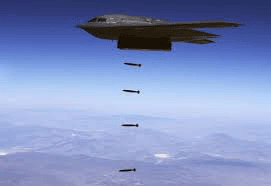
 & Air-Ground Missiles, Warrior, KRIS OSBORN, 29 Mar 17 The stealthy B-2 is slated to fly alongside the Air Force’s new Long Range Strike – Bomber into the 2050s,
Air Force pilots of the 1980s-era stealthy B-2 Spirit bomber plan to arm the B-2 with new weapons and upgrade the aircraft to fly the aircraft on attack missions against enemy air defenses well into the 2050s, service officials said.
In coming years, the B-2 will be armed with with next generation digital nuclear weapons such as the B-61 Mod 12 with a tail kit and an Long Range Stand-Off weapon or, LRSO, an air-launched, guided nuclear cruise missile, service officials said.
The B-61 Mod 12 is an ongoing modernization program which seeks to integrate the B-61 Mods 3, 4, 7 and 10 into a single variant with a guided tail kit. The B-61 Mod 12 is being engineered to rely on an inertial measurement unit for navigation.
In addition to the LRSO, B83 and B-61 Mod 12, the B-2 will also carry the B-61 Mod 11, a nuclear weapon designed with penetration capabilities, Air Force officials said…….http://www.scout.com/military/warrior/story/1641631-pilot-intv-inside-attack-missions-b-2-bomber
March 29, 2017
Posted by Christina Macpherson |
USA, weapons and war |
Leave a comment
Nuclear states are in breach of the Non-Proliferation Treaty https://www.theguardian.com/world/2017/mar/26/nuclear-states-are-in-breach-of-the-non-proliferation-treaty, Jim Pragnell
Otford, Kent The UN conference to negotiate a global multilateral nuclear ban treaty begins its substantive session on 27 March. All the nuclear states, including the UK, are boycotting the conference, because they prefer a step-by-step approach within the framework of the Non-Proliferation Treaty.
The NPT, concluded in 1968, required the nuclear states to pursue negotiations to bring about nuclear disarmament at an early date. Nearly 50 years on, it can reasonably be concluded that they are in breach of this obligation.
Another approach is long overdue. Any use of nuclear weapons would be in breach of international humanitarian law. Disarmament undertaken in the context of this law rather than arms control could be concluded quickly, with the more difficult technical negotiations taking place later. This approach would build on the humanitarian disarmament treaties that have banned landmines and cluster bombs.
The government says it is committed to the long-term goal of a world without nuclear weapons. But its decision to renew Trident and its boycott of the UN conference cast doubt on this.

March 27, 2017
Posted by Christina Macpherson |
2 WORLD, weapons and war |
Leave a comment

 North Korea nuclear test site witnesses hectic activity, satellite images show http://www.ibtimes.co.uk/north-korea-nuclear-test-site-witnesses-hectic-activity-satellite-images-show-1613722
It is unclear whether the reported presence of vehicles indicates preparation for a potential missile launch. IBT, By India Ashok, 26 Mar 17, Satellite imagery of a North Korean nuclear test site reportedly reveals hectic activity, sparking fears of a potential missile launch or nuclear test. Images from a commercial satellite of the Punggye-ri nuclear test site in North Korea purportedly show four or five vehicles or trailers present at the entrance of the site where North Korea’s previous four nuclear tests took place.
The activity may indicate that North Korea is gearing up for its sixth nuclear test. Satellite images also indicate that some construction material, presumably sand and aggregate, remains undisturbed at the site, according to a report by US think tank 38 North.
The report stated: “That material, if it is sand and aggregate, when mixed with concrete, may be intended to ‘stem,’ that is to plug segments of the tunnel to prevent a nuclear explosion from escaping into the atmosphere.”
Satellite images also reportedly show that apart from a few mining carts and two trucks at the West Portal, there’s little to no activity at the nuclear site. According to 38 North, this lack of activity may indicate that either “Pyongyang is inthe final stages of test preparation or that the site is in a standard operating mode.”
On Friday (24 March), South Korean officials warned that Pyongyang appeared to be in the last stages of preparing for yet another nuclear test and could carry out detonations within hours of an order issued by leader Kim Jong-un.
Numerous reports surfaced last week about North Korea preparing for yet another potential missile or nuclear test, amid rising tensions with its neighbours and the West.
It remains unclear whether the reported presence of the vehicles at the Punggye-ri nuclear site is indicative of Pyongyang’s willingness to conduct yet another nuclear test.
March 27, 2017
Posted by Christina Macpherson |
North Korea, weapons and war |
Leave a comment
How Pakistan Is Planning to Fight a Nuclear War, National Interest, Kyle Mizokami, 26 Mar 17, Sandwiched between Iran, China, India and Afghanistan, Pakistan lives in a complicated neighborhood with a variety of security issues. One of the nine known states known to have nuclear weapons, Pakistan’s nuclear arsenal and doctrine are continually evolving to match perceived threats. A nuclear power for decades, Pakistan is now attempting to construct a nuclear triad of its own, making its nuclear arsenal resilient and capable of devastating retaliatory strikes.
Pakistan’s nuclear program goes back to the 1950s, during the early days of its rivalry with India. President Zulfikar Ali Bhutto famously said in 1965, “If India builds the bomb, we will eat grass or leaves, even go hungry, but we will get one of our own.”
The program became a higher priority after the country’s 1971 defeat at the hands of India, which caused East Pakistan to break away and become Bangladesh. Experts believe the humiliating loss of territory,
much more than reports that India was pursuing nuclear weapons, accelerated the Pakistani nuclear program. India tested its first bomb, codenamed “Smiling Buddha,” in May 1974, putting the subcontinent on the road to nuclearization……..
Experts believe Pakistan’s nuclear stockpile is steadily growing. In 1998, the stockpile was estimated at five to twenty-five devices, depending on how much enriched uranium each bomb required. Today Pakistan is estimated to have an arsenal of 110 to 130 nuclear bombs. In 2015 the Carnegie Endowment for International Peace and the Stimson Center estimated Pakistan’s bomb-making capability at twenty devices annually, which on top of the existing stockpile meant Pakistan could quickly become the third-largest nuclear power in the world. Other observers, however, believe Pakistan can only develop another forty to fifty warheads in the near future.
Pakistani nuclear weapons are under control of the military’s Strategic Plans Division, and are primarily stored in Punjab Province, far from the northwest frontier and the Taliban. Ten thousand Pakistani troops and intelligence personnel from the SPD guard the weapons. Pakistan claims that the weapons are only armed by the appropriate code at the last moment, preventing a “rogue nuke” scenario.
Pakistani nuclear doctrine appears to be to deter what it considers an economically, politically and militarily stronger India. The nuclear standoff is exacerbated by the traditional animosity between the two countries, the several wars the two countries have fought, and events such as the 2008 terrorist attack on Mumbai, which were directed by Pakistan. Unlike neighboring India and China, Pakistan does not have a “no first use” doctrine, and reserves the right to use nuclear weapons, particularly low-yield tactical nuclear weapons, to offset India’s advantage in conventional forces.http://nationalinterest.org/blog/the-buzz/how-pakistan-planning-fight-nuclear-war-19897
March 27, 2017
Posted by Christina Macpherson |
Pakistan, weapons and war |
Leave a comment
 The Coming Ban on Nuclear Weapons https://www.project-syndicate.org/commentary/united-nations-nuclear-weapons-ban-treaty-by-
 zia-mian-2017-03 PRINCETON – On March 27, the United Nations will start negotiations on an international treaty to ban nuclear weapons. It will be a milestone marking the beginning of the end of an age of existential peril for humanity.
This day was bound to come. From the beginning, even those who set the world on the path to nuclear weapons understood the mortal danger and moral challenge confronting humanity. In April 1945, US Secretary of War Henry Stimson explained to President Harry Truman that the atomic bomb would be “the most terrible weapon ever known in human history.” Stimson warned that “the world in its present state of moral advancement compared with its technical development would be eventually at the mercy of such a weapon. In other words, modern civilization might be completely destroyed.”
Soon afterwards, the newly created UN, established with the express purpose “to save succeeding generations from the scourge of war,” took the threat posed by nuclear arms as its first priority. In January 1946, in its very first resolution, the UN
called for a plan “for the elimination from national armaments of atomic weapons.”
The Soviet Union submitted such a plan that June. Now largely forgotten, the Gromyko Plan included a “Draft International Convention to Prohibit the Production and Employment of Weapons Based on the Use of Atomic Energy for the Purpose of Mass Destruction.” At the time, only the United States had nuclear weapons, and it chose to maintain its monopoly. But it couldn’t hold onto it for long. Where it led, others soon followed, forcing humanity to endure the decades of weapons development, arms races, proliferation, and nuclear crises that followed.
Anti-nuclear movements took root, and, in a phrase made famous by the historian E.P. Thompson, began to protest to survive. They found allies in a growing number of countries. In November 1961, the UN General Assembly declared that “any state using nuclear and thermonuclear weapons is to be considered as violating the Charter of the United Nations, as acting contrary to the laws of humanity, and as committing a crime against mankind and civilization.”
As the number and destructive power of nuclear weapons grew, and as even developing countries began to acquire them, recognition of the danger gave rise to the Nuclear Non-Proliferation Treaty, which entered into force in 1970. “Considering the devastation that would be visited upon all mankind by a nuclear war,” the NPT begins, there is a “consequent need to make every effort to avert the danger of such a war and to take measures to safeguard the security of peoples.”
To this end, the treaty committed all signatories to “undertake negotiations in good faith on effective measures relating to cessation of the nuclear arms race at an early date and to nuclear disarmament.” The US, the Soviet Union, and Britain signed the NPT. France and China, the only other nuclear weapon states at the time, held out for more than 20 years, until 1992. Israel, India, and Pakistan have never signed, while North Korea signed and then withdrew. Although all professed support for achieving a nuclear-weapon-free world, disarmament negotiations never began.
Countries without nuclear weapons – the overwhelming majority – took matter into their own hands. Through the UN General Assembly, they asked the International Court of Justice to rule on the legality of the threat or use of nuclear weapons. In July 1996, the ICJ issued an advisory opinion, with two key conclusions. First, “the threat or use of nuclear weapons would generally be contrary to the rules of international law applicable in armed conflict, and in particular the principles and rules of humanitarian law.” And, second, “There exists an obligation to pursue in good faith and bring to a conclusion negotiations leading to nuclear disarmament in all its aspects under strict and effective international control.”
But, in the 20 years since the highest court in the international system issued its judgment, the states affected by it have still failed to launch “negotiations leading to nuclear disarmament.” Instead, they have set out on long-term programs to maintain, modernize, and in some cases augment their nuclear arsenals.
Non-weapon states began to take action through a series of international conferences and UN resolutions. Finally, in October 2016, the UN General Assembly’s First Committee, which is responsible for international peace and security, voted “to convene in 2017 a United Nations conference to negotiate a legally binding instrument to prohibit nuclear weapons, leading towards their total elimination.” On December 23, the General Assembly ratified the decision, with 113 countries in favor, 35 opposed, and 13 abstentions.
The new resolution’s instructions are straightforward: “States participating in the conference” should “make their best endeavors to conclude as soon as possible a legally binding instrument to prohibit nuclear weapons, leading towards their total elimination.” The treaty could be ready before the end of the year.
The nine nuclear weapon states will finally be put to the test. Will they keep their promises to disarm and join the treaty, or will they choose their weapons over international law and the will of the global community? The non-weapon states that join the treaty will be tested, too. How will they organize to confront those countries in the world system that choose to be nuclear outlaws?
March 25, 2017
Posted by Christina Macpherson |
2 WORLD, weapons and war |
Leave a comment
According to Russia’s foreign minister, the time has not come yet for the complete prohibition of nuclear weapons, http://tass.com/politics/937006, MOSCOW, March 23. /TASS/. Russia is prepared to discuss the possibility of further reduction of nuclear capabilities, Russian Foreign Minister Sergey Lavrov said on Thursday.
“We are ready to discuss the possible further gradual reduction of nuclear capabilities but taking into account all factors that affect strategic stability rather than only the quantity of strategic offensive weapons,” the minister said speaking at the Russian General Staff’s Military Academy.
“We are ready to discuss this issue proceeding from the growing urgency of making this process multilateral.”
Lavrov emphasized that the time has not come yet for abandoning nuclear weapons completely. “Efforts to coerce nuclear powers to abandon nuclear weapons have intensified significantly recently. It is absolutely clear that the time has not yet come for that,” he noted.
March 25, 2017
Posted by Christina Macpherson |
Russia, weapons and war |
Leave a comment
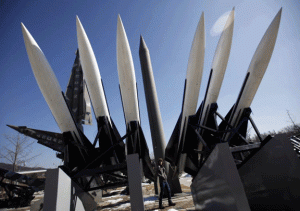 U.N. Nuclear Inspector: North Korea’s Capability Has Entered A ‘New Phase’ And while a diplomatic solution is necessary, one is unlikely to be reached, warns Yukiya Amano. Huffington Post, By Chris D’Angelo 21 Mar 17 WASHINGTON — North Korea’s nuclear weapons program has entered a “new phase,” with the country having doubled the size of its uranium-enrichment facility in recent years, Yukiya Amano, director general of the International Atomic Energy Agency, told The Wall Street Journal.
“The situation is very bad …. It has gone into a new phase,” Amano told the publication Monday. “All of the indications point to the fact that North Korea is making progress, as they declared.”
And while Amano believes a diplomatic solution, like the one he helped broker between world powers and Iran in 2015, is “essential,” he’s skeptical such an agreement can be reached with North Korean leader Kim Jong Un and his government.
“We don’t have the reason to be optimistic,” he told the Journal. The situation surrounding North Korea has grown increasingly tense in recent weeks, with both Kim and his regime and the United States taking a more aggressive tone. North Korea has conducted five nuclear tests and numerous missile launches over the last year in defiance of United Nations sanctions, Reuters reports….. http://www.huffingtonpost.com/entry/north-korea-nuclea-program_us_58d0539ee4b0ec9d29dead5e
March 24, 2017
Posted by Christina Macpherson |
North Korea, weapons and war |
Leave a comment
 Donald Trump’s administration to review decades-old US aim of world without nuclear weapons, The Independent, Policy review under way as US opposes proposed UN treaty on a global nuclear weapons ban Lizzie Dearden @lizziedearden, 21 Mar 17
Donald Trump’s administration is to review whether the US will keep its policy of nuclear disarmament.
Christopher Ford, the National Security Council’s senior director for weapons of mass destruction and counter-proliferation, said an assessment of US policy will examine whether the aim was “realistic”.
“Like all administrations we’re reviewing policy across the board, and that necessarily includes whether or not the goal of a world without nuclear weapons is in fact a realistic objective, especially in the near to medium term, in the light of current trends in the international security environment,” he told the Carnegie International Nuclear Policy Conference.
“It’s too early to say what the answers will be – looking at things with fresh eyes is not saying we will necessarily end up with different positions.”
Mr Ford said there was a “tension” between the goal of nuclear disarmament and the security requirements of the US and its allies.
He argued that the “headspace” for reducing nuclear arsenals had diminished in the years since the Cold War and cuts by the US and Russia seemed unlikely while other nuclear states continue development.
Mr Trump “will not accept a second place position in the nuclear weapons arena” but is open to broader engagement with Russia on the issue, Mr Ford said. He added that the current “threat environment” had changed substantially from when the review that established America’s current aims took place under Barack Obama in 2010.
The nuclear adviser said the Trump administration would continue American opposition to a “dangerous and misbegotten” proposed treaty to ban nuclear weapons.
UN member states voted overwhelmingly to start negotiations on a “legally binding instrument to prohibit nuclear weapons, leading towards their total elimination” last year.
A conference on the issue will be held in New York starting on 27 March but the treaty was opposed by nuclear powers including the US, Britain, Russia, France and Israel.
Mr Trump has not made any official policy statement on nuclear weapons but has touched on the issue repeatedly in his speeches and tweets.
Questioned about his warm statements towards Vladimir Putin at a press conference in February, the President warned that war between the US and Russia would be a “nuclear holocaust like no other”…….. http://www.independent.co.uk/news/world/americas/us-politics/donald-trump-nuclear-weapons-goal-world-without-reconsider-deproliferation-treaties-white-house-a7641706.html
March 24, 2017
Posted by Christina Macpherson |
politics, USA, weapons and war |
1 Comment
Japanese schoolchildren hold first nuclear war evacuation drill amid fears Kim Jong-un will unleash salvo of missiles after rocket tests. Sirens blared and loudspeakers broadcast warnings in Japan’s first civilian missile evacuation amid fears of imminent North Korean attack Sun, By Patrick Knox 20th March 2017,
JAPAN has begun staging mass evacuation drills after Kim Jong-un test fired missiles and conducted rocket engine tests on intercontinental missiles.
The first exercise of its kind saw civilians young and old scrambling for cover as air-raid sirens wailed away. The drill was carried out a week after North Korea launched four ballistic missiles into the seas 124 miles from the Japanese coast.
As previously reported Japanese civil defence officials have published pamphlets outlining emergency measures in the event of nuclear war.
Anti-missile rocket batteries have also been stationed in strategic areas including in the capital, Tokyo.
But now the first evacuation drill has been carried out to make sure the civilians protect themselves should Jong-un order an attack on Japan.
The exercise played out a scenario in which North Korea had fired a ballistic missile on the Japanese islands.
“The missile is seen to have landed within a 20-km (12-mile) boundary west of the Oga peninsula,” a speaker blared during the evacuation.
“The government is currently examining the damage.”
Residents of the largely rural peninsula jutting into the ocean about 280 miles north of the capital, Tokyo, made their way on Friday to a designated evacuation centre equipped with emergency kits and protective gear.
Schoolchildren in another part of town crouched down to the ground before hurrying inside a gymnasium……https://www.thesun.co.uk/news/3131965/japan-school-nuclear-war-drill-kim-jong-un-north-korea-rocket-tests/
March 24, 2017
Posted by Christina Macpherson |
Japan, weapons and war |
Leave a comment
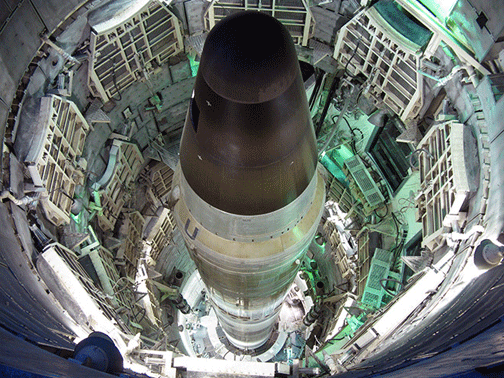
 No Need to Replace U.S. Land-Based Nuclear Missiles, National Interest, James E. Doyle, 21 Mar 17, As former Secretary of Defense William J. Perry has argued there are sound strategic reasons to phase out America’s fleet of 400 silo-based Minuteman III intercontinental ballistic missiles (ICBMs). Primary among these is the fact that these missiles are vulnerable to attack because our potential nuclear adversaries such as Russia know their precise locations.
Because of their vulnerability, ICBMs are the weapon system most likely to spark an inadvertent nuclear war. If U.S. commanders believed mistakenly (as has happened repeatedly in the past) that our ICBMs were under attack, they will face immense pressure to launch them at the perceived attacker before they are destroyed in their silos. Once they are launched if the warning of attack was false, it is too late. Our ICBMs cannot be recalled and will destroy their targets, prompting certain nuclear retaliation on U.S. cities.
Now recent revelations regarding the rapidly inflating cost of replacing the ICBMs and dramatic improvements in the capabilities of the other two legs of the U.S. nuclear triad make crystal clear that phasing out the ICBMs is the right choice for American security.
Pushing forward with deployment of the Ground-Based Strategic Deterrent (GBSD) as the Minuteman III replacement is called will deplete resources needed for other vital defense programs from cyber defenses to naval shipbuilding to conventional forces readiness and other nuclear modernization programs including new strategic submarines and aircraft. Estimated cost for the 15-20 year GBSD program have increased by more than 60% from $61 billion in 2016 to over $100 billion in early 2017. No clear plans have emerged that can support this cost without forcing dramatic cuts elsewhere within the defense budget.
Fortunately, there is no need to make the painful national security trade-offs that deploying the GBSD would require. The U.S. can safely retire the Minuteman III ICBMs as they reach the end of their service lives in the 2030s without replacing them. This is because recent modernization programs are dramatically increasing the accuracy, and thus the effectiveness of U.S. submarine and aircraft-launched nuclear weapons. …….
A decision to cancel replacement of the Minuteman III force would have other benefits as well. It is the most efficient way to reach the 1,000-1,000 deployed warhead level that the Department of Defense asserted was sufficient for deterrence in 2013 and it would achieve additional cost savings because ICBM warheads could be retired instead of modernized.
Finally, it would create opportunities for reaching new arms control agreements with Russia and China and demonstrate to the world that the United States was serious about meeting its obligations under the Nuclear Nonproliferation Treaty and taking a leadership role toward an eventual world without nuclear weapons.
James E. Doyle is an independent Nuclear Security Specialist. From 1997-2014 he was on the technical staff of the Nonproliferation Division at Los Alamos National Laboratory. http://nationalinterest.org/blog/the-buzz/no-need-replace-us-land-based-nuclear-missiles-19851
March 24, 2017
Posted by Christina Macpherson |
USA, weapons and war |
Leave a comment