North Korea says US air strikes on Syria vindicates decision to develop nuclear weapons, ABC News 9 Apr 17 North Korea has said US missile strikes against a Syrian airfield were “an unforgivable act of aggression” that showed its decision to develop nuclear weapons was “the right choice a million times over”.
Key points:
- North Korea says US strikes vindicates decision to strengthen its military power
- Kim Jong-un has exchanged pledges of friendship and cooperation with Bashar al-Assad
- Mr Trump earlier spoke of an “outstanding” relationship with North Korea’s ally China
The response by North Korea’s foreign ministry, carried by the official KCNA news agency, was the first since US warships launched dozens of missiles at a Syrian air base which the Pentagon says was involved in a chemical weapons attack earlier in the week.
“The US missile attack against Syria is a clear and unforgivable act of aggression against a sovereign state and we strongly condemn this,” KCNA quoted an unnamed spokesman for the North Korean foreign ministry as saying……….http://www.abc.net.au/news/2017-04-09/north-korea-calls-us-syria-air-strikes-unforgivable/8428398
April 10, 2017
Posted by Christina Macpherson |
North Korea, politics international, weapons and war |
Leave a comment
 TRUMP’S CONFUSING STRIKE ON SYRIA, If President Trump broadens his aims against Assad, he will enter the very morass that Candidate Trump warned against.New Yorker, By Steve Coll APRIL 17, 2017, “……. despite having previously seen similarly horrifying pictures, Trump had been skeptical of military action in Syria. In 2013, Assad’s forces attacked civilians and rebels near Damascus with sarin, a banned nerve agent, killing more than a thousand people. Trump advised President Obama, via Twitter, “Do not attack Syria. There is no upside and tremendous downside.” (Obama had called Assad’s use of chemical arms crossing a “red line,” which might lead the U.S. to take military action, but he did not strike. Instead, Russia helped broker an agreement by which Assad gave up many—but evidently not all—of his chemical arms.)]
Trump has said, “I’m very capable of changing to anything I want to change to.” In the case of Syria, however, he seems to have acted without a clear plan in place. During the campaign, he promised to “bomb the shit out of” isis, which holds territory in Syria, but he also said that it was foolish to become mired in the civil war, or to target Assad, who has opposed isis—at least, rhetorically.
As recently as March 30th, Secretary of State Rex Tillerson said that Assad’s future would be “decided by the Syrian people,” words that signalled a sharp departure from Obama’s insistence that Assad must leave office. Then, last Thursday, Tillerson seemed to shift direction, saying that “it would seem there would be no role” for Assad in Syria’s political future. But he later said, “I would not in any way attempt to extrapolate that to a change in our policy or our posture relative to our military activities in Syria today.”……..
If President Trump broadens his aims against Assad, to establish civilian safe havens, for example, or to ground Syria’s Air Force, or to bomb Assad to the negotiating table, he will enter the very morass that Candidate Trump warned against. He would have to manage risks—military confrontation with Russia, an intensified refugee crisis, a loss of momentum against isis—that Obama studied at great length and concluded to be unmanageable, at least at a cost consistent with American interests……..
once started, even limited wars upend initial plans and assumptions, violence produces unintended consequences, and conflicts are much easier to begin or escalate than to end.
Canadian, European, and Middle Eastern allies, as well as some sections of the Washington foreign-policy establishment, applauded Trump for his strike, pointing out its narrow scope, and noting that Assad had brought it on himself. Unfortunately, Donald Trump’s continual search for approval seems to contribute to his unpredictability. Perhaps he will soon rediscover his inclination to proceed cautiously in Middle Eastern wars. Given his bombast, his inconsistency, and his preference for gut instinct over policy knowledge, he always seemed likely to be a dangerous wartime President. The worry now is that he will also be an ambitious one. ♦http://www.newyorker.com/magazine/2017/04/17/trumps-confusing-strike-on-syria?mbid=nl_TNY%20Template%20-%20With%20Photo%20(155)&CNDID=46508601&spMailingID=10785187&spUserID=MTcxNTIwODYzMTU2S0&spJobID=1140615112&spReportId=MTE0MDYxNTExMgS2
April 10, 2017
Posted by Christina Macpherson |
politics international, USA, weapons and war |
Leave a comment
 US warns of more Syria attacks during UN Security Council meeting, news.com.au , APRIL 8, 2017 Sarah Blake, in New York, staff writers, wires News Corp Australia Network THE US ambassador to the United Nations has said that the US is prepared to take further action in Syria.
April 8, 2017
Posted by Christina Macpherson |
politics international, USA, weapons and war |
Leave a comment
Nuclear roulette BY EDITORIAL THE EXPRESS TRIBUNE https://tribune.com.pk/story/1377625/nuclear-roulette/ , 8 Apr 17, A mutually agreed nuclear disarmament treaty between India and Pakistan has never been on the cards and is never likely to be. Both maintain a nuclear arsenal and both have the capacity to deliver nuclear weapons anywhere within the territory of the other. Mutually assured destruction (MAD) is indeed assured. Neither state presents a nuclear threat face to any other enemy. Given the oscillating volatility of both states it is unsurprising that the nuclear cards get a periodic shuffle, and India under Modi has moved into an altogether more martial phase with threat levels, nuclear and conventional, rising accordingly. Analysts and observers are of a uniform opinion — the place a nuclear exchange is most likely to happen accidentally, as in a reactive event rather than a first-strike assault — is between India and Pakistan, and India is likely in that event to be the state that pushes the button first.
April 8, 2017
Posted by Christina Macpherson |
India, Pakistan, weapons and war |
Leave a comment
 North Korea Has Nuclear Weapons So It Won’t End Up Like Libya, The National Interest, Edward Chang, 6 Apr 17, North Korea has learned from the Qaddafi regime the importance of maintaining its nukes.
As many experts have predicted, North Korea is trending to become the Trump administration’s first major foreign-policy crisis. The latest developments continue to reinforce that trend.
In an interview with the Financial Times, Donald Trump threatened to take unilateral action to stop the Democratic People’s Republic of Korea’s nuclear program unless China stepped in to address the issue. U.S. ambassador to the United Nations, Nikki Haley, echoed that stance not long after Secretary of Defense Jim Mattis indicated that he views the DPRK as the gravest threat to America. The week prior to that, Secretary of State Rex Tillerson declared that the Obama-era strategy of “strategic patience” was over and warned that military action was an option if North Korea did not unilaterally disarm.
While the early post-war time period occasionally involved troubling acts of violence that resulted in the deaths of Americans, the United States and North Korea have since avoided such encounters (the same cannot be said for South Korea). And while no American president ever dismissed force as an option, Trump is unique in the blunt and direct manner he has used to challenge the reclusive regime. Which begs the question—has a clash between the United States and North Korea become inevitable?………
Like U.S.-North Korea relations, U.S.-Libyan relations were fraught with tension from the beginning, following the 1969 coup that brought Qaddafi to power. Like North Korea, Libya earned the reputation of “rogue state,” defying international norms and engaging in destabilizing behavior in the region……..
“Reagan’s undeclared war” against Libya hints at one possible future in Trump-era relations with North Korea. Both presidents have assumed unambiguously confrontational postures, employing rhetoric that previous presidents have attempted to avoid. Much like Reagan singled-out Qaddafi after focusing elsewhere during the election, Trump has now focused most of his attention on Kim Jong-un, after initially emphasizing threats like ISIL as the more pressing issue………
Conventional wisdom holds that Trump will behave in a manner consistent with his predecessors for one simple reason—the stakes are too high………
Perhaps the most useful lesson to learn from Reagan’s war with Qaddafi is that it was ultimately inconclusive. The Libyan problem spanned the entirety of Reagan’s two terms; by the administration’s end, Qaddafi was still in power. Nearly a full decade of sanctions and overwhelming force notwithstanding, the U.S.-Libya saga demonstrated decisive actions do not necessarily lead to decisive results……..
As his national security staff completes its North Korea review, it is hoped that “the Donald” will learn the hard line leads to uncharted territory. More importantly, the forty-fifth president would do well to accept there are no obvious solutions to this crisis; using force does not always lead to the desired outcome. Regardless of which path he takes, Trump may very well be dealing with Kim through the totality of his presidency. ……http://nationalinterest.org/feature/north-korea-has-nuclear-weapons-so-it-wont-end-libya-20060
April 8, 2017
Posted by Christina Macpherson |
North Korea, politics international, weapons and war |
Leave a comment
U.S. strikes Syrian military airfield in first direct assault on Bashar al-Assad’s government [following US-backed ‘rebel’ chemical false flag] WP, 06 April 2017 | The U.S. military launched approximately 50 cruise missiles at a Syrian military airfield late on Thursday, in the first direct American assault on the government of President Bashar al-Assad since that country’s civil war began six years ago. The operation, which the Trump administration authorized in retaliation for a chemical attack killing scores of civilians this week, dramatically expands U.S. military involvement in Syria and exposes the United States to heightened risk of direct confrontation with Russia and Iran, both backing Assad in his attempt to crush his opposition.
April 7, 2017
Posted by Christina Macpherson |
Syria, USA, weapons and war |
Leave a comment
What specifically makes this new plan different from the operations of administrations past is the new autonomy it gives the military from civilian control, not only in terms of congressional oversight but also in terms of presidential direction.
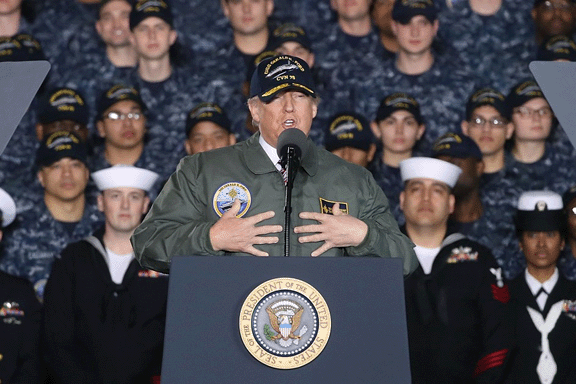
Trump’s dangerous expansion of executive war powers For decades, Congress has relinquished its constitutional role in declaring war. But Trump is taking it to new extremes. Politico, By BONNIE KRISTIAN 04/03/17 With Washington distracted by the health care debate, President Donald Trump has quietly overseen an expansion in the administration’s war-making powers, giving the Department of Defense greater autonomy to conduct military operations independent of the White House.
Already, the Pentagon has used this expanded authority in Yemen, where the U.S. has recently conducted significant air operations against AQAP, an Al Qaeda offshoot. And on Friday, Trump extended the authority to parts of Somalia where the U.S. is targeting Shabab, a terrorist group. In military terms, Yemen and Somalia are now “areas of active hostility,” a bureaucratic way of saying that the U.S. is conducting military operations there, with little input or oversight from either the White House or Congress.
This expanded bombing campaign, though, could be just the tip of the iceberg. In early March, The Guardian reported that the White House is considering a secret Pentagon proposal to designate temporary areas of active hostility in which the military could launch what amounts to six-month wars without congressional approval. Under the proposal, once the president signs off on a temporary battlefield, commanders would be given “the same latitude to launch strikes, raids and campaigns” as they now have in active U.S. warzones like Iraq. Protections for civilians would also be scaled back.
These temporary battlefields, as The Guardian dubbed them, are not exactly new; the Obama administration already applied the label to conflicts in Afghanistan, Iraq, and Syria. But the proposal Trump is considering would expand and formalize that decision, stretching the temporary battlefield designation to cover entire countries in which the United States is technically not at war. Despite the bureaucratic language, Trump’s plan, if implemented, is a flagrant perversion of the Constitution, redoubling the worst excesses of the Obama administration and further undercutting the rule of law.
To understand the recklessness of this proposal, a little history is in order. Though it names the president as “Commander in Chief” of the U.S. military, the Constitution explicitly delegates the power to “declare war” to Congress. The choice of the word “declare” was a careful one, as James Madison’s notes from the Constitutional Convention reveal. Originally written as the power to “make war,” it was amended to communicate that while the executive is permitted “the power to repel sudden attacks” on American soil, it is not allowed to “commence war” independent of the legislature.
George Mason, the “father of the Bill of Rights,” was against “giving the power of war to the Executive, because [it was not] safely to be trusted with it,” Madison records, and Mason supported using “declare” as a means of “clogging rather than facilitating war [and instead] facilitating peace.”…….
With this “temporary battlefields” idea, the White House once again strips Congress of what was left of its responsibility for our military, taking unilateral control of foreign policy for the foreseeable future.
What specifically makes this new plan different from the operations of administrations past is the new autonomy it gives the military from civilian control, not only in terms of congressional oversight but also in terms of presidential direction. In Obama’s scheme, which was already far afield from the constitutional war powers framework, the president and his top national security advisers remained intimately involved in the approval process for U.S. strikes outside of active war zones in Afghanistan, Iraq, and Syria. With the new plan, military commanders would be able to make these decisions independently during 180-day periods. This puts major foreign policy decisions one step further away from congressional influence and civilian control………
this proposal is regression, not reform. It demolishes the last remnants of one our Founders’ most necessary constitutional protections, and it opens the gate to a host of dangerous, imprudent military interventions with no demonstrable connection to U.S. national security interests.
After the last 15-plus years of imprudent executive war-making, what we need is not less oversight of our foreign policy, but more—more open debate about our goals and strategy, more realistic risk analysis, and more careful determination of what political outcomes we can achieve through military force.
Bonnie Kristian is a fellow at Defense Priorities. She is a weekend editor at The Week and a columnist at Rare, and her writing has also appeared at Time Magazine, CNN, Politico, Relevant Magazine, The Hill, and The American Conservative, among other outlets. http://www.politico.com/agenda/story/2017/04/trumps-dangerous-expansion-of-executive-war-powers-000387
April 7, 2017
Posted by Christina Macpherson |
politics, USA, weapons and war |
Leave a comment
WHAT’S DRIVING WORLD BACK TO MAD OLD DAYS OF NUCLEAR WEAPONS?  http://www.scmp.com/week-asia/opinion/article/2083538/opinion-whats-driving-world-back-mad-old-days-nuclear-weapons World leaders led by US president Donald Trump seem willing to put social issues on the back burner while they – irrationally – prepare for Armageddon, BY CHOW CHUNG-YAN 2 APR 2017 It can be hard not to lose heart these days after going through daily news headlines. Sometimes history seems to be moving backwards. The absurdity often makes one wonder if the world is going mad.
Among the crazy things that took place this week, here is one that is not getting much attention: the United Nations called for a meeting on Tuesday to continue negotiations for a legally binding ban on nuclear weapons, but nearly 40 countries – including the US, China, Russia, Britain and France – decided to skip it. None of the participants from the 100 countries attending the meeting belong to the group of states in possession of nuclear weapons.
US envoy Nikki Haley explained afterwards that national security concerns required Washington to keep its nuclear weapons because of “bad actors” who could not be trusted…
China, Russia, Britain and other nuclear powers did not even talk to the media.
If Kim Jong-un were watching the news, he would probably have a big smirk on his face. Yes, Kim is a cold-blooded power-hungry maniac. But judging from what happened on Tuesday, leaders of the world’s major capitals are probably just as callous.
While North Korea is aspiring to build a few nuclear bombs, the big five – US, China, Russia, France and Britain – are sitting on arsenals that between them could destroy this planet many times over. Still, none of them feel they have enough.
For those born in the 1980s or later, the threat of a nuclear war seems remote. But for older generations, such a threat was once very real. But for older generations, such a threat was once very real. From the end of the second world war until the collapse of the Soviet Union in 1989, fears of a nuclear Armageddon were widespread.
At the peak of the cold war, all major powers devoted precious national resources to building their nuclear capacities, with the US and the USSR leading the race. The atomic bombs the US dropped on the Japanese cities of Hiroshima and Nagasaki during the second world war were powerful, but they were mere popguns compared to the thermonuclear weapons of the cold war era.
The cold war stand-off established the Mutual Assured Destruction (MAD) doctrine. According to MAD, major nuclear powers would refrain from direct conflict because a nuclear exchange would result in the complete annihilation of both sides. Some historians credited this balance of nuclear deterrence as an important factor behind the longest period of peace in modern history, with no war breaking out between major powers for almost 70 years.
Dread of a nuclear holocaust forced world leaders to cool the hysteria. The end of the cold war brought brief hopes of optimism. But today, the situation is getting more dangerous. Globally, annual expenditure on nuclear weapons is estimated at US$105 billion. In comparison, the Office for Disarmament Affairs, the principal UN body responsible for advancing a nuclear-weapon-free world, has an annual budget of US$10 million.
Two studies, one by the Brookings Institution and another by the Carnegie Endowment for International Peace, recently drew the same conclusion: governments around the world are going to spend a crazy amount of money on nuclear weapons in the next decade.
Together, nine major nuclear countries will spend a staggering US$1 trillion on new research, production and maintenance of nuclear arms over the next 10 years. At a time of economic crises and imposed austerity measures, world leaders led by US president Donald Trump have decided to cut investment on education, health care and climate change so that we can have more powerful weapons of mass destruction.
Last year, Washington gave the green light to a new generation of “smart” nuclear bombs – the B61-12s – which will be the most expensive ever produced. Moscow and Beijing both expressed concerns and hinted they would respond in kind. This year, Chinese scientists announced a theoretical breakthrough in developing the so-called “N2 bomb” – a new type of weapon of mass destruction that is as strong as a nuclear bomb but produces no radioactive fallout.
The chance of a hot nuclear war among major powers remains astronomically small. The only real reason for them to continue pouring precious resources into the arms race is because they cannot break out of their cold war mentalities.
Today, terrorism, climate change and contagious diseases are much bigger and more realistic threats to the world than invasion by Moscow or a nuclear war between Beijing and Washington.
The only real nightmare is for such weapons to fall into the hands of terrorists.
No matter how much major powers improve their nuclear arsenals, it will not deter terrorists – there is no such thing as nuclear retaliation against people who want to see the world blow up.
A World Bank study estimated that if governments cut their spending on nuclear weapons by half and used the money on poverty alleviation, it would have been possible to achieve the UN Millennium Development Goal of eradicating extreme poverty and hunger.
It would be naïve to ask the major powers to give up their nuclear weapons, but if they could divert more resources to fighting poverty, terrorism and global warming, we would have a much safer, better world.
April 3, 2017
Posted by Christina Macpherson |
2 WORLD, weapons and war |
Leave a comment
Survivors Speak Out As UN Negotiates Nuke Ban, Huffington Post, By Ariel Conn,31 Mar 17 “…….A Nuclear Rallying Cry
Not surprisingly, the horror of the effect nuclear bombs have on children provides some of the most compelling arguments for a ban treaty.
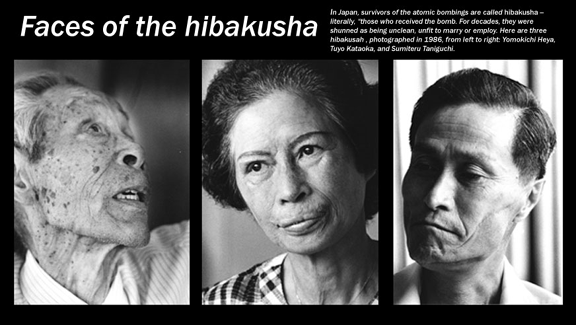
Fujimori Toshiki, a Hibakusha (survivor of the bombs dropped on Japan), described his personal experience to the General Assembly at the very start of the negotiations. He was a baby at the time, and he and his mother were just far enough away from the blast that a two-story home protected them somewhat.
“I had my entire body covered with bandages,” said Toshiki, “with only eyes, nose, and mouth uncovered. Everybody thought I would die over time. Yet, I survived. It is a miracle. I am here at the U.N., asking for an abolition of nuclear weapons. I am convinced that this is a mission I am given as a survivor of the atomic bomb.”
His 13-year-old sister was not so lucky. She was one of 6,300 teenagers to die near the blast site because their schools had sent them there to help “create firesafe [sic] areas against air raids.”
Toshiki added, “Every year, on Aug. 6, my mother would gather all of us children and would talk to us about her experience in tears. I once asked my mother why she would speak about it if recalling the experience makes her suffer. ‘I can’t make you go through the same experience.’ That was her answer. Her tears were her heartfelt appeal. She called, as a mother, for a world with no more hell on earth.”
Setsuko Thurlow, another Hibakusha, was also 13 when the bombs fell. She described witnessing the slow death of her 4-year-old nephew Eiji. He was “transformed into a charred, blackened and swollen child who kept asking in a faint voice for water until he died in agony.”
Thurlow continued, “Regardless of the passage of time, he remains in my memory as a 4-year-old child who came to represent all the innocent children of the world. And it is this death of innocents that has been the driving force for me to continue my struggle against the ultimate evil of nuclear weapons.”
However, unlike the stories of landmines and cluster munitions, which told of present-day children suffering and dying, these stories are over 70 years old. It can be difficult to relate to events that happened so long ago and that most people believe has not ― and cannot ― be repeated.
But Sue Coleman-Haseldine told the assembly of stories and concerns that were more recent. Coleman-Haseldine is an Aboriginal who lived near the atomic weapons testing sites in Australia. She was two when the testing first began in the 1950s.
“Our district is full of cancer now,” she said.
She continued, “I grew up hearing about the bombs, but I didn’t know about how the sickness went through the generations. When mining companies started eyeing off areas of my country I started to look more into it and I went to an Australian Nuclear Free Alliance meeting to learn more about fighting mining companies but also radiation fallout. What I learnt devastated me. To find out that our bush foods were possibly contaminated was a real blow to me.”
“I am a mother, grandmother and great grandmother,” she added. “My third great grandson was born just recently. And now I am here, speaking about the past [and] present day problems and what we want for the future. I’m fighting for all my grandchildren and all the children of the world.” http://www.huffingtonpost.com/entry/survivors-speak-out-as-un-negotiates-nuke-ban_us_58dd5552e4b0fa4c0959872b?
April 3, 2017
Posted by Christina Macpherson |
2 WORLD, PERSONAL STORIES, weapons and war |
Leave a comment
 Survivors Speak Out As UN Negotiates Nuke Ban, Huffington Post, By Ariel Conn,31 Mar 17
“[My nephew was] transformed into a charred, blackened and swollen child who kept asking in a faint voice for water until he died in agony.”
To imagine innocence is to picture children playing. As such, most people and governments are horrified by the idea of children and other helpless civilians suffering and dying, even during war. Finding a way to prevent the unnecessary slaughter of innocents has brought over 115 countries to the United Nations in New York this week to begin negotiations of a historic treaty that would, once and for all, ban nuclear weapons.
The countries are united by concerns that tens or even hundreds of thousands of innocent men, women and children – mothers, sons, fathers, daughters, aunts, uncles, cousins, friends and neighbors – could be killed, quite literally, in a flash.
In a statement to the opening of negotiations, Peter Maurer, president of the International Committee of the Red Cross, or ICRC, said, “The prohibition and elimination of nuclear weapons is a humanitarian imperative.”
Responding to a Humanitarian Imperative
A ban on nuclear weapons is certainly historic, but it’s not without precedence. Prohibiting and eliminating other weapons because of their horrific humanitarian consequences has happened before. In fact, most of the world’s deadliest weapons are currently banned.
At a press conference, Beatrice Fihn, executive director of the International Campaign to Abolish Nuclear Weapons, ICAN, said, “The treaty will finally ban weapons designed to indiscriminately kill civilians, completing the prohibitions on weapons of mass destruction.”
For example, when adults around the world learned of the tens of thousands of children killed by landmines while simply pursuing childhood activities, such as playing in open fields, a global cry arose to bring an end to the indiscriminate weapons. In 1997, 133 countries signed the Mine Ban Treaty, and as of today 162 have signed. According to the International Campaign to Ban Landmines, “only 35 states remain outside the treaty, but most of them do not actually use or produce antipersonnel mines.”
A similar rallying cry heralded the Convention on Cluster Munitions. Cluster munitions often landed without exploding and remained unstable. Their toy-like appearance attracted thousands of children, who were killed and maimed by the weapons. The treaty was adopted in 2008 and is described by clusterconvention.org as an “international treaty of more than 100 States that addresses the humanitarian consequences and unacceptable harm caused to civilians by cluster munitions.”
Today, most countries abide by these treaties, and even countries like the United States, which has not signed either treaty, is either mostly in compliance or is showing signs of improvement………
Relegating Nukes to History A common concern about these negotiations is the notable absence of the nuclear states. However, history, as seen with the landmine and cluster munitions treaties, gives those supporting the negotiations reason to hope.
In his statement for the ICRC, Maurer added, “Of course, adopting a treaty to prohibit nuclear weapons will not make them immediately disappear. But it will reinforce the stigma against their use, support commitments to nuclear risk reduction, and be a disincentive for proliferation. … As with chemical and biological weapons, a clear and unambiguous prohibition is the cornerstone of their elimination.”
Susi Snyder, the nuclear disarmament program manager for PAX in the Netherlands, explained, “This is the start of a negotiation. The impact of the negotiation cannot be guessed or measured until the treaty is done. Even then, as with all treaties and growing norms, the impact will grow over time.”
Fihn added that a treaty would “make it clear that the world has moved beyond these morally unacceptable weapons of the past.” http://www.huffingtonpost.com/entry/survivors-speak-out-as-un-negotiates-nuke-ban_us_58dd5552e4b0fa4c0959872b?
April 3, 2017
Posted by Christina Macpherson |
2 WORLD, politics international, weapons and war |
Leave a comment
 Six deceptive arguments against a nuclear weapons ban, OPEN CANADA.org 31 Mar 17
Should we still strive for a world without nuclear weapons, despite global security concerns? Absolutely, writes Cesar Jaramillo, as he debunks the justifications for not taking current negotiations seriously. BY: CESAR JARAMILLO MARCH 31, 2017
This year’s multilateral negotiations toward a legally binding prohibition on nuclear weapons reflect a growing global recognition that a nuclear-weapons ban is an integral part of the normative framework necessary to achieve and maintain a world free of nuclear weapons. For some observers of nuclear issues, in and out of government, they also constitute a welcome shock to an otherwise lethargic nuclear disarmament and nonproliferation regime.
UN Resolution L41, which calls for negotiations toward a new ban on nuclear weapons, was adopted by a wide majority at the General Assembly last December (123 for, 38 against, 16 abstentions). It epitomizes a new political reality in the nuclear disarmament realm: Founded on the humanitarian imperative for nuclear abolition, it bears witness to a widely held perception that the Nuclear Non-Proliferation Treaty (NPT), as currently implemented, does not constitute a credible path to abolition.
Negotiations stemming from L41 began this week at the United Nations in New York and, after the first round ends Friday, will continue June 15 to July 7. All UN member states, along with international organizations and members of civil society, were called on to participate. Yet, several did not.
A majority of nuclear-armed states and their allies — including the United States and most other NATO members, such as Germany and Canada — have actively opposed this effort and have openly tried to undermine its rationale.
The U.S. envoy to the UN, Nikki Haley, attempted to justify her country’s absence this week by telling reporters, “There is nothing I want more for my family than a world with no nuclear weapons. But we have to be realistic… Is there anyone that believes that North Korea would agree to a ban on nuclear weapons?” (As she said this, she confirmed that the U.S. itself did not agree to a nuclear weapons ban. The irony, of course, was not lost.)
And while it is hardly surprising that the very states that rely on nuclear deterrence would oppose a legal prohibition of nuclear weapons, the primary arguments used to oppose the ban cannot withstand close scrutiny. They are either misleading, based on a dead-end logic, or outright wrong.
Let us consider six of the most commonly cited arguments.
1. Negotiations fail to consider the global security environment.
This point has been frequently raised by opponents to condemn negotiations before they even start. In reality, however, neither the way in which the talks will unfold nor possible outcomes are predetermined. These naysayers have been repeatedly urged by a majority of NPT and UN states parties to participate in the talks, which would allow them to raise any and all international security concerns they may have. Instead, they preemptively indict the process and choose instead to boycott the negotiations.
…….Nobody, however, is advocating for a ban in isolation, and it has never been said that the global security environment would not be considered……There is no perfect time to seek nuclear disarmament ……Achieving nuclear abolition will be a lengthy undertaking that will necessarily coexist with international security crises of varying gravity. To expect otherwise is unbelievably — and perhaps deliberately — naïve.
2. A nuclear-weapons ban would be ineffective…… Remarkably, one of the best articulations of the significance of a legal ban comes from the U.S. and reflects NATO thinking and policy.
In an unclassified NATO document from October 2016 entitled “United States Non-Paper: ‘Defense Impacts of Potential United Nations General Assembly Nuclear Weapons Ban Treaty,’” a legal prohibition of nuclear weapons is presented as anything but insignificant or ineffective. …….
3. The process to ban nuclear weapons is divisive and not based on consensus…….Indeed, these talks will be divisive. But they simply shed further light on longstanding divisions, which continue to be exacerbated by the blatant disregard of nuclear-weapon states for their obligations to disarm.
It should be noted that the very countries that blocked consensus in the process surrounding the nuclear-weapons-ban negotiations, including the adoption of Resolution L41, are now criticizing the lack of consensus……Perplexingly, states wishing to undermine the negotiations continue to point to their own unwillingness to participate as an inherent flaw in the process.
4. A legal prohibition of nuclear weapons is no substitute for actual weapons reductions……..The historic adoption of Resolution L41 and the process surrounding it constitute the strongest diplomatic signal in decades that the peoples of the world reject these horrifying instruments of mass destruction. Critically, these developments could well signal a turning point in the humanitarian, diplomatic and political struggle toward their elimination……… Many recent and current international efforts related to nuclear weapons did not and will not reduce the size of nuclear arsenals. Various UN panels of governmental experts, high-level meetings related to the Fissile Material Cut-off Treaty, and NPT-endorsed plans of action, which produced no warhead reductions, have received multilateral support over the years. Why should negotiations on a ban be denied similar backing?
5. The pursuit of a nuclear-weapons ban undermines the NPT……..The World Court in 1996 further clarified the Article VI obligation. It
indicated that the NPT requires states not only to engage in good faith negotiations for nuclear disarmament, but also to
bring them to a conclusion.
The NPT was designed to prevent non-nuclear-weapon states from acquiring nuclear weapons and to compel nuclear-weapon states to eliminate their arsenals. In no direct or implied phrase does the treaty limit complementary efforts, such as negotiations toward a nuclear-weapons prohibition, to implement its provisions and advance nuclear disarmament.
6. Better than a ban is a so-called progressive, pragmatic approach to nuclear disarmament…….No credible multilateral undertaking now exists that will lead to nuclear disarmament in the foreseeable future. Efforts to further the nuclear disarmament agenda have withered when denied support by nuclear-armed states……. Developments such as the rapid, costly modernization of nuclear arsenals and related infrastructure (some estimates put the price tag at more than $1 trillion), heightened tensions between superpowers, and a dysfunctional multilateral disarmament machinery, underscore the inadequacy of the current approach to nuclear disarmament.
The nuclear-weapons-ban movement must be understood in this context. It developed out of the failure of the NPT to deliver on the promise of complete nuclear disarmament. The “pragmatic” approach advocated by those resisting a legal ban has already been tried — and has been found wanting. https://www.opencanada.org/features/six-deceptive-arguments-against-nuclear-weapons-ban/
April 1, 2017
Posted by Christina Macpherson |
2 WORLD, weapons and war |
Leave a comment
 U.N. Considers a Historic Ban on Nuclear Weapons, But U.S. Leads Boycott of the Talks, Democracy Now, MARCH 30, 2017 Some 120 countries gathered at the United Nations this week to draft a treaty to ban nuclear weapons. But the United States is leading a boycott of the talks. Meanwhile, more than 2,000 scientists signed an open letter endorsing the U.N. talks, and, on Tuesday, Pope Francis encouraged the United Nations to pursue the “total elimination” of nuclear weapons. We speak to Zia Mian, physicist, nuclear expert and disarmament activist. He is co-director of the Program on Science and Global Security at the Woodrow Wilson School of Public and International Affairs, Princeton University.
TRANSCRIPT
This is a rush transcript. Copy may not be in its final form.
NERMEEN SHAIKH: We turn now to a historic debate at the United Nations. Some 120 countries gather this week to draft a treaty to ban nuclear weapons. But the United States did not take part. In fact, the U.S. led a boycott of the talks. This is U.S. Ambassador to the U.N. Nikki Haley…….
AMY GOODMAN: U.S. Ambassador to the U.N. Nikki Haley was joined by envoys from Britain, France, South Korea and other nations in opposing the U.N. talks on a nuclear weapons ban treaty. Russia and China have also declined to participate in the conference.
We’re joined now by Zia Mian, physicist, nuclear expert and disarmament activist, co-director of the Program on Science and Global Security at the Woodrow Wilson School of Public and International Affairs at Princeton University. He’s co-author of Unmaking the Bomb: A Fissile Material Approach to Nuclear Disarmament and Nonproliferation.
What’s happening here? Why is the U.S. leading this boycott?
ZIA MIAN: The news is not that the U.S. is leading a boycott. We knew the United States wasn’t going to participate and that it’s been trying to force its nuclear NATO allies also to not participate. The news here is that, after 70 years, the vast majority of countries in the world have decided they’ve had enough of waiting for the United States and the other countries with nuclear weapons to keep their promise that they would get rid of nuclear weapons, and said, “Enough is enough. We are now going to create an international treaty that will ban nuclear weapons, and you are going to be nuclear outlaws. And you’re going to have to deal with this new reality.”
NERMEEN SHAIKH: So how did these nations come together now?
ZIA MIAN: It’s taken years and years of effort by non-weapons states and peace movements around the world to build the kind of coalition that it’s taken to bring a resolution to the United Nations last year, in which 123 countries, as you mentioned, voted in support of the beginning of talks. The United States tried actively to block that resolution being passed. It actually sent a classified memo to all of the NATO allies the U.S. protects with its nuclear weapons, saying, “Don’t support this resolution at the United Nations. And if the resolution passes, don’t go, or else.” It was actively threatening its own allies to make sure they wouldn’t participate, because they know that in many of the countries in Europe, in particular, and in countries like Japan, which are protected by U.S. nuclear weapons, public opinion and many parliaments are actually in favor of joining the process to ban nuclear weapons. And it’s taken a lot of effort by the United States to keep these countries out of the process…….https://www.democracynow.org/2017/3/30/un_considers_a_historic_ban_on
March 31, 2017
Posted by Christina Macpherson |
USA, weapons and war |
Leave a comment
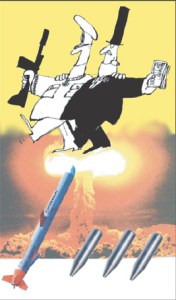 What the million-dollar—trillion-dollar modernization means is that when it came down to making deals with Republicans in the Congress, the Obama administration was willing to do a deal on the future of humanity and said, “Look, if you—if we need you to pass legislation through the Senate, and you want more nuclear weapons and more spending on nuclear weapons, we’ll give you that to get what we want.” And the Obama administration made a tragic deal with the Republicans in the Senate.
But the fact of the matter is, they could have refused to make that deal. But they decided that it was more important to pursue that legislative priority than to think about what the next 30, 40, 50, 60 years will look like. And that is something that we’re now going to have to wrestle with year by year,
And so, this letter from scientists is part of a long-standing effort by scientists from all over the world to make democracy work when it comes to nuclear weapons. And this is what the ban treaty process is also all about, that in the international community, it should not be the most powerful military state in the world that decides what happens in the world, but it should be the majority of the world’s community deciding what is acceptable and what is not acceptable.
U.S. Boycotts U.N. Talks on Nuclear Ban While Spending Trillions to Modernize Nuclear Arsenal, Democracy Now, 30 Mar 17 Full interview with Princeton’s Zia Mian about the proposed U.N. nuclear ban treaty, the U.S. boycott and the U.S. trillion-dollar plan to “modernize” its nuclear arsenal. Zia Mian is a physicist, nuclear expert and disarmament activist. He is co-director of the Program on Science and Global Security at the Woodrow Wilson School of Public and International Affairs, Princeton University………
AMY GOODMAN: President Trump has proposed slashing the budgets of the NIH, the National Institutes of Health, at the same time proposed boosting federal spending on the production of nuclear weapons by more than a billion dollars. Your final response?
Continue reading →
March 31, 2017
Posted by Christina Macpherson |
USA, weapons and war |
Leave a comment
 Pope backs nuclear weapons ban treaty, rrrstar.com, Mar 29, 2017 By Josephine McKenna Religion News Service VATICAN CITY — Pope Francis says nuclear weapons offer a “false sense of security” and are an ineffective deterrent to 21st-century threats like terrorism, conflict and cybersecurity.
The pontiff spoke as talks on a proposed global nuclear arms ban at the United Nations seem doomed to fail with the U.S., France, Britain and South Korea among nearly 40 countries boycotting the talks.
In a message addressed to the conference in New York, the pope called for “total elimination” of nuclear weapons. He said there were many doubts about the effectiveness of deterrence and warned of “catastrophic humanitarian and environmental consequences” if nuclear weapons were ever used again.
“How sustainable is a stability based on fear, when it actually increases fear and undermines relationships of trust?” Francis asked. “International peace and stability cannot be based on a false sense of security, on the threat of mutual destruction or total annihilation, or on simply maintaining a balance of power.”
The pope said the elimination of nuclear weapons was a “moral and humanitarian imperative” and stressed it was possible to achieve.
“Although this is a significantly complex and long-term goal, it is not beyond our reach,” he said.
Francis said money currently spent on nuclear weapons could be used for “the promotion of peace and integral human development, as well as the fight against poverty.”
“An ethics and a law based on the threat of mutual destruction — and possibly the destruction of all mankind — are contradictory to the very spirit of the United Nations,” he said.
“We must therefore commit ourselves to a world without nuclear weapons, by fully implementing the Non-Proliferation Treaty, both in letter and spirit.”……http://www.rrstar.com/news/20170329/pope-backs-nuclear-weapons-ban-treaty
March 31, 2017
Posted by Christina Macpherson |
2 WORLD, Religion and ethics, weapons and war |
Leave a comment
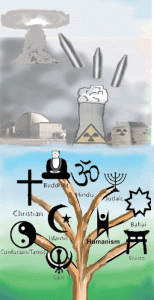 SGI joins diverse faith groups in calling for action at historic UN nuclear weapons negotiations J oint statement stresses moral and ethical imperative for nuclear weapons abolition https://religionnews.com/2017/03/29/sgi-joins-diverse-faith-groups-in-calling-for-action-at-historic-un-nuclear-weapons-negotiations/ March 29, 2017 NEW YORK — On March 28, religious groups urged governments to make decisive progress toward establishing a framework for complete elimination of nuclear weapons in a statement read on the second day of a historic UN conference to begin negotiations on a legally binding instrument to prohibit nuclear weapons.
Jasmin Nario-Galace of Pax Christi Pilipinas read the joint statement on behalf of Faith Communities Concerned about Nuclear Weapons before representatives of some 120 governments taking part in the negotiations at UN Headquarters that will continue until March 31. Afterwards, she stated, “As various faith communities working for a world without nuclear weapons, we aim to show that we share the same aspirations for peace and for a world where people live without fear.”
Signatories include more than twenty individuals representing diverse faith groups from Pax Christi and the World Council of Churches to Islamic organizations, the Soka Gakkai International (SGI) Buddhist association, the Quakers in Britain and Religions for Peace.
The groups stress that nuclear weapons manifest a total disregard for the shared ethical values of religious faiths. They condemn the theory of deterrence and the catastrophic humanitarian impact of any nuclear weapon use, stating: “We reject the immorality of holding whole populations hostage, threatened with a cruel and miserable death. We applaud the world’s political leaders that have demonstrated the courage to begin these negotiations.”
The statement also urges those states not participating in this round of the negotiations to reexamine their positions and commit to joining the June-July session in good faith. The statement and list of endorsers can be read here.
Kazuo Ishiwatari, SGI Executive Director of Peace and Global Issues, comments, “To be successful, a treaty prohibiting nuclear weapons must heed, reflect and embody the voices of the entire human family… SGI will call for an even greater enlistment of the power of individual and collective conscience in order to support, strengthen and enrich the negotiation process.”
Signatory Mustafa Cerić, Grand Mufti Emeritus of Bosnia and President of the World Bosniak Congress, adds, “Man’s ability to trust in God is his ability to trust in Man. Hence, we don’t need Nuclear Weapons if we trust in God. Indeed, if we trust in Man.”
The interfaith statement builds on previous statements issued by some of the same individuals and groups on the occasion of key negotiations related to the humanitarian impact of nuclear weapons held in Washington DC (April 2014), Vienna (December 2014), New York (May 2015) and Geneva (May 2016).
SGI also submitted its own working paper to the conference.
The working paper argues that the goal of achieving a world without nuclear weapons should be understood as integral to the larger effort to demilitarize international relations and develop nonviolent conceptions of the state. It quotes SGI President Daisaku Ikeda who stresses: “The inhumanity of nuclear weapons is found not only in their overwhelming destructive power. It lies in their potential to instantaneously obliterate and render meaningless the painstaking efforts of generations of human beings… They are a denial and rejection of our very humanity.”
The Soka Gakkai International (SGI) Buddhist association links over 12 million members around the world. It has been engaged in efforts to support the abolition of nuclear weapons for sixty years.
March 31, 2017
Posted by Christina Macpherson |
2 WORLD, Religion and ethics, weapons and war |
Leave a comment