Japanese citizens have 10 minutes to prepare for a North Korean nuclear attack, Missile ‘will not take long to reach Japan,’ says government, The Independent, Harriet Agerholm@HarrietAgerholm 25 Apr 17, Japanese citizens will have just 10 minutes to prepare a North Korean ballistic missile attack, authorities in the country have warned.
In the event of an attack, a document posted on the country’s civil protection site advises people to find the strongest concrete building possible or go underground.
Then they should then take cover under tables and stay away from windows, it says. A ballistic missile would likely take around 10 minutes to travel 1,600 km (1,000 miles) from its launch pad in North Korea to Okinawa, it adds, citing a launch in February last year which took that length of time to fly over the Japanese island.
The warning comes as tensions ratcheted up between North Korea, its Asian neighbours and the US. The secretive communist state test-fired four ballistic missiles last month, three of which landed in Japan’s exclusive economic zone in the Sea of Japan, just off the coast of the country.
It has subsequently emerged that the country’s civil defence website had 5.7 million visitors in the first 23 days of April — more than 14 times the usual monthly traffic.
Japan’s early-warning system, which issues missile strike alerts to the population via loudspeaker and telephone has come under increased scrutiny amid the rising tensions.
In 1998, North Korea demonstrated that its missiles were capable of reaching Japan when it fired a missile to launch a satellite across Japanese territory that landed in its economic zone on the Pacific Ocean side.
North Korea highlights 1250 US marines in Darwin to claim America is preparing for nuclear war, SMH, Kirsty Needham and James Massola, 25 Apr 17, North Korea’s state newspaper has singled out the United States’ deployment of 1250 marines to Darwin to claim America is preparing for nuclear war.
And as regional tensions escalate and a US carrier strike group approaches the Korean peninsula, Australian Foreign Minister Julie Bishop said the secretive regime “must be stopped” as it represented a threat to the region and, potentially, globally.
Pusan National University associate professor Robert Kelly told Fairfax Media North Korea’s missiles might have the range to reach northern Australia, but played down the threat as “the question is guidance, not range”.
Rodong Sinmun, the official paper of the Worker’s Party of North Korea, highlighted the US marines’ arrival in northern Australia on April 18. The marines will be joined by 12 military helicopters including five Cobra helicopters and four Osprey carriers.
“This is the largest scale US military presence in Australia after World War 2,” the newspaper reported on Monday. “America is fanatically, crazily trying to optimise its nuclear war readiness,” it claimed.
The story, on page six of the North Korean newspaper, was headlined: America prepares for nuclear war in different overseas military deployments. Darwin was the only city named…….
Australia-based defence experts believe it is unlikely North Korea has the capacity to strike Australia yet, though they may do within the next three years. The nation’s most recent missile test, earlier this month, failed just seconds after launch…….
The deployment of 1250 marines is the largest to Darwin since the former prime minister Julia Gillard and former president Barack Obama struck a deal back in 2011 to undertake the yearly rotation of troops.
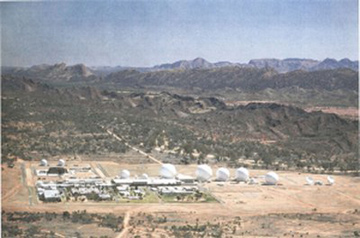
Pine Gap is more than a giant electronic vacuum cleaner. The facility is also involved in tactical warfare, through programs like “The Red Dot Express”.
More controversial is Pine Gap’s role in drone strikes.
Instead of trying to pump up hysteria over a non-existent North Korean missile strike, The Turnbull Government should take a hard look at the very real threat that Pine Gap and Northwest Cape pose to Australia.
Pine Gap is still there — bigger and badder than ever, Independent AustraliaNorm Sanders25 April 2017With Donald Trump putting a blowtorch to the Cold War, it is time to take another look at all the U.S. bases in Australia, including Pine Gap, writes Dr Norm Sanders.
PINE GAP, Northwest Cape and Nurrungar were the focus of the Australian Peace Movement in the 1980’s. Then the Bulletin of Atomic Scientists Doomsday Clock crept slowly away from midnight and the removal of the bases didn’t seem so urgent. The clamour to close the bases died down………
I actually knew quite a bit about what Pine Gap was up to at the time, but it was child’s play compared to what they are doing at present. A simple place to start is Pine Gap’s assumption of the function of Nurrungar in 1999. Nurrungar was located at Island Lagoon, Woomera and was crucial to America’s defenses during the Cold War. Nurrungar furnished “Launch on Warning” surveillance of ICBM or other rocket launches anywhere on the globe. Analysts regarded it as one of the USSR’s top ten targets.
Now, Pine Gap has probably surpassed Nurrungar in the rankings. It is one of the largest satellite ground stations in the world, with over 33 satellite antennas. Pine Gap houses a number of U.S. Government agencies, such as the National Reconnaissance Office (spy satellites,) the National Security Agency, the CIA, and the Geospatial-intelligence Agency. In addition, all branches of the U.S. Military are represented.
Pine Gap is a major element of ECHELON, a signals intelligence collection and analysis network. Echelon can eavesdrop on faxes, computers and telephones, and can even scan bank accounts. It can actually pick up enemy combat forces talking to each other in the field. The U.S. Government says Echelon doesn’t exist and never did. In fact, it may have now merged with XKeyscore, another system at Pine Gap. It is run by the National Security Agency and shares data with the Australian Signals Directorate.
In an interview with a German TV station in 2014, Snowden answered the question of what he could do with XKeyscore by saying:
You could read anyone’s email in the world, anybody you’ve got an email address for. Any website: You can watch traffic to and from it. Any computer that an individual sits at: You can watch it. Any laptop that you’re tracking: you can follow it as it moves from place to place throughout the world. It’s a one-stop-shop for access to the NSA’s information.
…You can tag individuals… Let’s say you work at a major German corporation and I want access to that network, I can track your username on a website on a form somewhere, I can track your real name, I can track associations with your friends and I can build what’s called a fingerprint, which is network activity unique to you, which means anywhere you go in the world, anywhere you try to sort of hide your online presence, your identity.
No wonder Snowden has to stay in Russia!
But Pine Gap is more than a giant electronic vacuum cleaner. The facility is also involved in tactical warfare, through programs like “The Red Dot Express”.
Red Dot uses a plethora of imaging techniques, signal intercepts and other sources to identify IED’s (Improvised Explosive Devices) by their electronic emissions. All this data passes through Pine Gap, gets analysed and, ultimately, is displayed as a red dot on a Humvee computer as a warning that there is a possible IED just ahead on an Afghan road.
More controversial is Pine Gap’s role in drone strikes. This prompted the late Des Ball, a leading ANU intelligence expert, to criticise the Pine Gap facility which he formerly supported.
On the 7:30 Report, broadcast 13/08/2014, he said:
“I’ve reached the point now where I can no longer stand up and provide the verbal, conceptual justification for the facility that I was able to do in the past. We’re now linked in to this global network where intelligence and operations have become essentially fused and Pine Gap is a key node in that whole network, that war machine, if you want to use that term, which is doing things which are very, very difficult, I think, as an Australian, to justify.”………
The base is six kilometres north of the town of Exmouth, Western Australia. Exmouth itself was built to support the base and be a home to dependent families of the U.S. Navy personnel.
The station is a key link in the communication capability with U.S. Navy and Australian ships in a vast area of the Western Pacific and Eastern Indian Ocean. It transmits on VLF (very low frequency,) at 19.8 kHz with a power of 1 million watts, which makes it the most powerful transmitter in the Southern Hemisphere. For comparison, commercial TV transmitters have about 1⁄10 the power.
The powerful transmitter has been linked to two incidents in which Qantas airliners had equipment failures while flying in the area. Qantas Flight 72 had to make an emergency landing at Learmouth, near Exmouth, after uncontrolled pitch-downs which caused fractures, lacerations and spinal injuries to passengers and crew.
In order to transmit this massive power, Northwest Cape has a huge spiderweb array of antennas supported by 13 towers, each almost 400 meters high. Buried underneath the antenna is 386 kilometres of bare copper mat as a ground plane.
The combination of the very low fequency and immense power means that Northwest Cape can communicate with nuclear armed submarines while they are submerged to at least 20 meters to avoid detection. The orders to launch nuclear missiles in time of war in the region would be sent through the base. It is this function which makes Northwest Cape an obvious prime nuclear target.
The cold hard reality is there is no viable military option against North Korea. They have nuclear weapons, which they can respond with. They have formidable conventional artillery, which they can use to hit Seoul. A preventive strike may provoke the very action it is designed to prevent. As Bismarck warned, it is like committing suicide from fear of death.
A political settlement with Pyongyang is probably not plausible, so America and its allies have no choice but to contain North Korea as best we can. Deterrence and diplomacy have risks, to be sure, but the risks seem far lower than those involved in attacking or further isolating North Korea.
Of course North Korea wants nukes. We should learn to live with it
Deterrence and diplomacy carry risks, but attacking or further isolating North Korea could be worse. The Age , Tom Switzer, 23 Apr 17, “……I listen to the debates about North Korea’s nuclear ambitions. Once again, we are told that a rogue state is bent on developing nuclear weapons that threaten world peace and that either a preventive strike or regime change, or both, will disarm this strategic and moral threat.
But remember the realists were right about Iraq. Leave aside that Saddam’s regime did not even possess serious weapons of mass destruction capacity. Regime change was always fraught with the danger of unintended consequences. Iran and its Shiite militias acquired new influence within Iraq and the broader region while parts of Iraq fell into the hands of Sunni jihadists, who were even more fanatical than al-Qaeda.
Although anguish over a nuclear North Korea is understandable, it’s a fair bet the realists are also right today.
We are told Kim Jong-un is really a madman because he really has nuclear weapons. But although he is a nasty piece of work, the North Korean despot is not crazy. His primary goal is survival: the end of his regime means the end of Kim. From his perspective, it makes sense to develop nuclear weapons.
Why? Because nukes are the ultimate deterrent. North Korea is a minor power surrounded by three major powers – China, Japan, Russia – and with an outside power – the US – constantly threatening it with regime change. As Professor John Mearsheimer, the doyen of foreign-policy realism, told me recently, when Washington strikes Bashar al-Assad’s Syria, or helps topple Saddam’s Iraq or Colonel Gaddafi’s Libya, it gives Pyongyang a very powerful incentive to keep its nuclear weapons.
We are told that Beijing must force North Korea into giving up its nukes or at least not develop an intercontinental ballistic missile that can hit California and Darwin. Chinese co-operation would be ideal and Beijing’s leaders, as Malcolm Turnbull reiterated at the weekend, have some leverage with their communist comrade.
But China also needs North Korea for geopolitical reasons. It is a vital strategic asset. Remember that China entered the Korean War in late 1950 when the Americans crossed the 38th Parallel.
From Beijing’s standpoint, the collapse of North Korea would create a refugee crisis and mean a reunified Korea under a US nuclear security umbrella. If you think Russia is overly sensitive about Ukraine being a western bulwark on its doorstep, imagine how China would respond to a western bulwark on its doorstep. As unfashionable as it is to say, great powers still have spheres of influence.
We are told that regime change is an option in dealing with the North Korean menace. But if there is any hope of discouraging Pyongyang from using nuclear weapons, the West will need to stop threatening regime change and try to reach an accommodation with the Hermit Kingdom. The only way North Korea will jettison its nukes is if it feels relatively secure and has the sense that relations with the West are improving.
Alas, Donald Trump sounds tougher with Pyongyang than even Bush and Barack Obama. At the weekend, Vice-President Mike Pence told the Prime Minister the US will not relent until the Korean peninsula is free of nuclear weapons. That could box in Trump, limit his options, and force him on a path that could push him into a preventive war.
The cold hard reality is there is no viable military option against North Korea. They have nuclear weapons, which they can respond with. They have formidable conventional artillery, which they can use to hit Seoul. A preventive strike may provoke the very action it is designed to prevent. As Bismarck warned, it is like committing suicide from fear of death.
A political settlement with Pyongyang is probably not plausible, so America and its allies have no choice but to contain North Korea as best we can. Deterrence and diplomacy have risks, to be sure, but the risks seem far lower than those involved in attacking or further isolating North Korea. Just think of Iraq.
But besides demanding North Korea give up its only trump card — no pun intended — some are pushing the administration to go even further: to consider launching a preemptive strike on Pyongyang.
What happens next is one of the worst military and human tragedies in history: Kim orders a nuclear strike on Seoul. While the missile lands four miles outside of the city thanks to a targeting error, millions of people are instantly killed with millions more poisoned by radioactive fallout. In a sheer panic, the millions of people who survive the attack rush south, creating a massive humanitarian crisis of the worst magnitude.
From here, things get even worse……the price of such a victory could be millions of people dead and large sections of Korea rendered uninhabitable for decades, if not longer.
No one wants to talk to the dictator of a nation with over 200,000 people or more in prison camps — but an attack that could lead to a conflict where millions could die in a nuclear war is far worse. The stakes are too great to at least not consider it.
First, it seems the Trump administration is ready to take the toughest of lines when it comes to dealing with the Hermit Kingdom. In an interview with The Washington Post‘s Josh Rogin, Vice President Pence declared that North Korea must give up its nuclear and missile programs in exchange for nothing, not even talks.
As the piece points out, it is tough to tell at this point if this was just rhetoric, maybe a trial balloon of sorts, or a new Trump administration policy. The vice president, however, seemed clear: “I think the path of negotiations with North Korea has been a colossal failure now for more than 25 years.”
But besides demanding North Korea give up its only trump card — no pun intended — some are pushing the administration to go even further: to consider launching a preemptive strike on Pyongyang.
In an interview on the Today show, Sen. Lindsey Graham (R-S.C.) explained that if China would not stop North Korea from building a missile that can hit the U.S. homeland, Washington should use diplomacy, sanctions, and possibly “a military strike to stop their program.”
On the surface, both comments in isolation might not draw oodles of attention. But taken together with the facts that Washington will not negotiate with North Korea and that the Hermit Kingdom already has, according to most estimates, 10-20 nuclear weapons, the comments are nothing short of apocalyptic.
In order to appreciate the ramifications of such a policy, let’s game out what such ideas would look like in practice. Let us assume in the near future that Washington decides to push China hard into somehow “solving” the North Korea issue. Beijing, for its part, does cut back some food and fuel aid and does, to its credit, end all direct and indirect aid to Pyongyang’s various military programs. North Korea’s nuclear and missile programs continue to advance, but instead of racing towards a missile that can nuke America, the program is slowed dramatically.
The Trump administration is not satisfied. It threatens China, declaring that it must do more. But Beijing does not want to precipitate the possible downfall of the Kim dynasty. They fear Washington’s wrath, but they’re much more worried about millions of hungry North Koreans trying to seek refuge in China as well as potentially loose nuclear, chemical, and biological weapons. Combined with Beijing’s other great concern — that Seoul would eventually unite the Korean peninsula under its control and continue its military alliance with the U.S. — China decides to take its chances with America.
Washington is now faced with a dilemma. They have made substantial progress on curtailing the speed in which Pyongyang can pair a nuclear warhead with a long-range missile — but the threat does remain. So the Trump administration leaks to the press that it is considering military action, and begins to move its best military assets into the region — and this time it’s for real. President Trump orders B-2 bombers at the ready, with the ability to evade radar and drop large, bunker-buster bombs on North Korean nuclear facilities.
But North Korea is not to be deterred. It declares to the world that if the Trump administration decides to attack, Pyongyang will unload its full arsenal on South Korea and Japan. And considering North Korea’s large military — thousands of artillery pieces, rocket launchers, 4,300 tanks, 1.1 million men under arms, 200,00 special forces, and a dangerous offensive cyber warfare capability — it is a threat that can’t exactly be taken lightly
But Trump presses ahead. After moving three aircraft carrier battlegroups into the region and sending additional bombers and fighters to South Korea, Japan, and Guam, the administration warns North Korea that “it must decide whether it wants peace or war” and that “the Kim regime clearly can see that now we truly have all options on the table.” Trump then goes on Twitter, declaring, “I hope Kim makes the right choice!”
Kim Jong Un, North Korea’s third dynastic dictator, decides not to budge. He knows that if he gives up his nukes he has no leverage with America. And even worse, North Korea’s political elites will see him as weak — and regime change could occur from within. He makes the only choice he can, and hopes Trump is bluffing.
Unfortunately for Kim, and Asia, war is now inevitable.
Trump orders a massive assault on North Korea’s nuclear weapons and missile programs. The goal is simple: Destroy not only Pyongyang’s ability to create nuclear weapons and advanced missiles, but the current stockpiles they have. Washington launches what can only be described as a “shock and awe” campaign on steroids: over 1,000 cruise missiles in the first few hours alone, B-2 bombers flying around the clock from bases in Missouri with stealth F-22 Raptors leading the way.
The assault itself, according to every metric conceivable, is a success. North Korea’s nuclear and missile programs are set back a decade or more with most of Kim’s nuclear weapons and missile launchers destroyed. Republicans and Democrats alike applaud President Trump’s bold actions — acting when leaders of the past decided to do nothing.
There is however a catch to what seems like a resounding military success: The Kim regime’s nuclear deterrent was not completely destroyed. One weapon, buried deep underground, survived the attack. And since North Korea’s chemical and biological weapons were largely hidden underground as well, Kim has a terrible choice to make: Use the weapons he has now, or lose them in a potential second wave of strikes. He decides to use his full arsenal before it’s too late.
What happens next is one of the worst military and human tragedies in history: Kim orders a nuclear strike on Seoul. While the missile lands four miles outside of the city thanks to a targeting error, millions of people are instantly killed with millions more poisoned by radioactive fallout. In a sheer panic, the millions of people who survive the attack rush south, creating a massive humanitarian crisis of the worst magnitude.
From here, things get even worse. Kim launches dozens of chemical and biological weapons at South Korea and Japan. Sarin, VX ,and other toxins are lobbed at Tokyo, Pusan, and other large cities. Millions of people try to flee the impacted areas just as in Seoul — creating a panic not seen since World War II.
In just a few hours, hell is unleashed on the Korean peninsula. And while the United States and its allies would eventually win any war against North Korea, it is clear from the above — far from what could be the most extreme of examples of a Second Korean War — what damage the Kim regime could do in a military confrontation. Indeed, the price of such a victory could be millions of people dead and large sections of Korea rendered uninhabitable for decades, if not longer.
Yet, there is another path forward. It seems due time for President Trump to remember his own words from the campaign when it comes to talking to North Korea — and maybe even to Kim Jong Un directly: “I would speak to him. I would have no problem speaking to him.”
No one wants to talk to the dictator of a nation with over 200,000 people or more in prison camps — but an attack that could lead to a conflict where millions could die in a nuclear war is far worse. The stakes are too great to at least not consider it.
Imagining the bomb went off at ground level in Broadgate, the city centre would be turned into a 300m wide and 200m deep crater, according to interactive data site Nukemap.
The map below shows the impact of a nuclear explosion in Coventry.
Fireball radius (orange)
Fatal levels of radiation would increase greatly if the nuke exploded at ground level.
The fireball radius (orange) would see the entire city centre including monuments such as the Cathedral, Broadgate and West Orchards Shopping Centre consumed by a nuclear fireball 3.2km wide.
This would stretch as far as the Ricoh Arena at one end, and Finham at the other.
The fatality rate is 100 per cent.
Crater inside radius: 150 m (0.07 km²)
Crater lip radius: 300 m (0.28 km²)
Fireball radius: 0.71 km (1.56 km²)
Air blast radius (20 psi): 1.67 km (8.8 km²)
Radiation radius (500 rem): 2.26 km (16.1 km²)
Air blast radius (5 psi): 3.52 km (39 km²)
Thermal radiation radius (3rd degree burns): 8.95 km (251 km²)
Radiation radius (green)
Slightly wider than the fireball radius. Without medical treatment, expect between 50 per cent and 90 per cent mortality from acute effects alone. Dying takes between several hours and several weeks.
Air blast radius (red – 20psi)
The most intense air blast would have a radius of 4.75km and demolish heavily built concrete buildings in the University of Warwick campus, Binley Road, and Holbooks, among other areas. The fatality rate is still 100 per cent – or very close.
Air blast radius (grey – 5psi)
A lesser air blast radius would still cause the collapse of all residential buildings within a 10km radius. That means houses would collapse all the way out in Fillongley, Bedworth, Kenilworth and Ryton.Injuries are universal and fatalities widespread.
Thermal radiation radius (lighter orange)
The thermal radiation radius is 29.1km. This would mean third degree burns “throughout the layers of the skin”, which could cause severe scarring, disablement and even amputation. This radius covers Nuneaton, Hinckley, Sutton Coldfield, parts of Birmingham and Leamington Spa.
The city would be dependent on outsiders and national agencies for help after the blast. In the fallout survivors would find dozens of hospitals and medical facilities would have been destroyed. A dozen fire stations would also have been wiped out.At the same moment around 200 schools and hundreds of churches, mosques, gurdwaras and temples could have been levelled or badly damaged.
Volleyball Over, North Koreans Go Back to Work at Nuclear Site, Analysts Say, NYT, By CHOE SANG-HUNAPRIL 22, 2017, SEOUL, South Korea — North Korea appears to have resumed work at its nuclear test site after a perplexing series of volleyball matches were held there, according to analysts who studied satellite images of the site, renewing concerns that a major weapons test could be imminent.
Many observers had feared that North Korea would test a nuclear device at the site around April 15, the birthday of Kim Il-sung, the North’s founding president and the grandfather of the current leader, Kim Jong-un. But Mr. Kim’s government celebrated the day instead with a military parade in Pyongyang, the capital, during which a fleet of missiles were rolled out, including what analysts believed were never-before-seen long-range ballistic missiles.
North Korea carried out a missile test on Sunday, but it was considered an embarrassing failure, with the projectile exploding immediately after liftoff.
But North Korea is preparing to celebrate another major holiday this coming week: Tuesday will be the 85th anniversary of the founding of the Korean People’s Army, and the North often uses such occasions to show off its military advances…….
On Friday, the analysts Joseph S. Bermudez Jr. and Jack Liu posted new satellite images of the nuclear test site in Punggye-ri, in northeastern North Korea, on 38 North, a website affiliated with the Johns Hopkins University School of Advanced International Studies……
Mr. Bermudez and Mr. Liu said it was unclear whether the latest activity from Punggye-ri reflected a “tactical pause” before a coming nuclear test, a prolonged “stand-down” from testing or normal operations at the site.
“Regardless, satellite imagery continues to indicate that the Punggye-ri nuclear test site appears able to conduct a sixth nuclear test at any time once the order is received from Pyongyang,” they concluded…..
On Saturday in Sydney, Australia, Mr. Pence said that an American naval strike group led by the aircraft carrier Carl Vinson was expected to be in the Sea of Japan, which borders the Korean Peninsula, by the end of April.
Senior aides to Mr. Trump have said that military options are not off the table in dealing with North Korea’s rapidly advancing nuclear and missile technologies. Those remarks prompted fears in the region that the new American president might order a pre-emptive strike at North Korea’s weapons sites, which could set off a war…….https://www.nytimes.com/2017/04/22/world/asia/north-korea-nuclear-test-preparations.html?_r=0
“I think Mr. Trump will be dealing with this in real terms before he starts his second term,” Kelly told CNN’s “State of the Union.”
Kelly refused to answer host Dana Bash’s question over whether or not the U.S. military could shoot down a missile from North Korea, telling Bash that the information is classified. Kelly did say the United States will be “at grave risk” when a North Korean missile can reach its shores.
“The instant that happens, this country is at grave risk,” said Kelly.
North Korea earlier this month failed to launch a ballistic missile on its east coast. The launch came amidst mounting tensions between the U.S. and North Korea, as the Trump administration continues talks with China over how to curb North Korea’s nuclear ambitions.
Risk of ‘catastrophic’ nuclear accident as world relations worsen,UN warns ‘The more arms produced, particularly in countries with unstable societies, the more potential exists for terrorist acquisition and use of nuclear weapons’, The Independent, 21 Apr 17 Will Worley@willrworley There will be “catastrophic” consequences when “luck runs out” on nuclear deterrence, the United Nations (UN) has warned in a major report which highlights the massive risk of an accidental or deliberate use of the world’s most deadly weapons.
The “poor relations” between nuclear powers has contributed to an atmosphere that “lends itself to the onset of crisis,” said the report by the UN Institute for Disarmament Research.
The rise in cyber warfare and hacking has left the technical vulnerabilities of nuclear weapons systems exposed to risk from states and terrorist groups, it added.
“Nuclear deterrence works—up until the time it will prove not to work,” it said. “The risk is inherent and, when luck runs out, the results will be catastrophic.
“The more arms produced, particularly in countries with unstable societies, the more potential exists for terrorist acquisition and use of nuclear weapons.”
Deterrence is at the “greatest risk of breaking down” in North Korea and between India and Pakistan over the disputed territory of Kashmir, it said ……….
Denuclearisation would require “visionary leadership”, the report said, but added this was “sadly rare” as many powerful states “increasingly turn inward”.
It added that new technology and spending on nuclear weapons had “enhanced” the risk of a detonation. However, it acknowledged the secrecy surrounding the programmes made it difficult to accurately assess their true scope. Increased reliance technology has also introduced new problems, the report said. In the past, accidental nuclear detonations have been averted by a human decision. Replacing military officers with computers could therefore rule out a potential safety check on the weapons, and open the possibility of hacking a nuclear weapon.
Mini-nukes: Still a bad choice for the United States, Bulletin of the Atomic Scientists
James E. Doyle, 21 Apr 17, In December, the Defense Science Board—an independent group of experts and former officials that provides advice to the Defense Department—submitted a report advising the Pentagon to invest in low-yield nuclear weapons that could provide “a rapid, tailored nuclear option for limited use.” This recommendation struck a familiar note. In 2003, the board issued a study entitled “Future Strategic Strike Forces” that suggested building small nuclear weapons with “great precision, deep penetration, [and] greatly reduced” yield and radioactivity. The board’s call led to investments in new warhead designs such as the Robust Nuclear Earth Penetrator—a warhead designed to destroy deeply buried or hardened targets including underground military command centers—and the Reliable Replacement Warhead. Both programs were cancelled in 2008, after millions of dollars had been spent.
Despite the board’s renewed interest in smaller nuclear weapons, and in weapons tailored for limited uses or specific effects, any effort to develop these weapons would encounter the same problem that earlier such efforts have encountered: It is impossible to determine if introducing weapons with these characteristics into the US stockpile, and planning for their use in certain scenarios, would strengthen deterrence or make nuclear war by miscalculation more likely. Building “mini” or tailored nuclear weapons might well lower the threshold to nuclear war; risking that outcome would only make sense if it were absolutely clear that introducing these weapons would remedy some dangerous weakness in deterrence.
Fortunately, no such weakness exists. Any nation using nuclear weapons against the United States or its allies risks a devastating response whose negative consequences would far outweigh any gains delivered by crossing the nuclear threshold. The United States has always possessed the means to employ a small number of nuclear weapons with relatively low yields—between, say, half a kiloton and 50 kilotons. In fact, the inventory of such weapons used to be massive; thousands of weapons with yields under 50 kilotons were deployed as artillery shells, land mines, short-range ballistic missiles, torpedoes, depth charges, anti-aircraft missiles, and even nuclear backpack weapons.
The current US tactical nuclear arsenal is comprised of approximately 500 B61 gravity bombs, which have three tactical versions—the B61-3, -4, and -10—with yields as low as .3 kilotons. The US Air Force deploys 150 to 200 B61s at six NATO air bases in five countries. Additional weapons are stored in the United States for possible overseas deployment. Also available is the W-80-1 warhead, deployed on hundreds of US air-launched cruise missiles, with a variable yield that can be set as low as 5 kilotons.
This list of “smaller” nuclear weapons demonstrates that there are no significant “gaps” in US nuclear capabilities that potential adversaries such as Russia, China, and North Korea could exploit.
That is why, today as in 2003, the Pentagon has no military requirement for the board’s cryptically-named “tailored nuclear option for limited use.” The military understands better than anyone the danger and unpredictability of using nuclear weapons. The military also understands how unlikely it is that any use of nuclear weapons against a nuclear-armed nation would remain “limited.” That is why the vast majority of so-called “tactical” nuclear weapons have been retired from service.
……..Just as in the early 2000s, current proponents of mini-nukes or of vague “limited nuclear options” offer no convincing evidence that new weapons in this category are needed—or more importantly, that they would make nuclear use less likely. Instead, potential nuclear adversaries are likely to see the acquisition of additional weapons in this category as an indication that US opposition to nuclear use has decreased and that Washington may be the first to cross the nuclear threshold. Such an outcome would undermine global stability and increase the risk of nuclear war. Defense resources are better spent on strengthening US conventional forces.http://thebulletin.org/mini-nukes-still-bad-choice-united-states10693
Hawaii’s Renewed Jitters About Nukes, The Atlantic, 21 Apr 17 The state is asking the Department of Defense to help it prepare for a nuclear attack, amid escalating tensions between the United States and North Korea. Memories of the attack have faded, but there are still people in Hawaii who can recall the quiet Sunday morning that descended into chaos more than 75 years ago.
You do not forget the deafening buzz of torpedo bombers, once you have heard them overhead, or what it’s like to see the sky polka-dotted red with the markings of the Imperial Japanese Navy’s aircraft. As tensions between the United States and North Korea escalate, these memories are becoming more vivid………
Now, state lawmakers in Hawaii have formally asked the Department of Defense to help with nuclear disaster preparedness in the state. Such plans haven’t been updated at the local level in decades, since 1985, according to the Hawaii Emergency Management Agency. In the early 1980s, Hawaii’s fallout shelters were still stocked with medical kits and food. But those supplies have long since been thrown out, and funding for such shelters evaporated.
Back then, officials had identified hundreds of additional structures, like parking garages, that could serve as makeshift fallout shelters in Hawaii, Governingreported, but officials today don’t even know which of those structures exist anymore—and whether the remaining structures are in adequate shape to serve as shelters.
Hawaii is a natural target for a couple reasons. For one, it’s geographically closer to North Korea than other parts of the United States. Hawaii is also a key strategic position for the U.S. military, which has an enormous presence on the island of Oahu in particular………
There is uncertainty, however, about how the new presidential administration will react to North Korea. North Korean leadership is perceived as notoriously unpredictable, especially in the Western world. But United States President Donald Trump has his own reputation for being inscrutable and impulsive, qualities which international security experts say he is likely to leverage against North Korea—and as a way to distinguish himself from the Obama administration, which Trump perceives as having been “indecisive and entirely predictable,” Cha said.
The SIPRI said that there were 455 fewer nuclear warheads at the start of 2016 among nine nuclear states than a year earlier. The United States, Russia, Britain, France, China, India, Pakistan, Israel, and North Korea together had a total of 15,395 nuclear warheads at the start of 2016, including 4,120 that were deployed operationally. The total number of nuclear warheads in those countries at the start of 2015 was 15,850, the press release stated Monday.
Global nuclear-weapon inventories “have been declining since they peaked at nearly 70,000 nuclear warheads in the mid-1980s,” Researchers Shannon Kile and Hans Kristensen stated in the report.
The decline has been due primarily to cuts made by Russia and the United States, the report said. But they said “the pace of their reductions appears to be slowing compared with a decade ago, and neither Russia nor the United States…has made significant reductions in deployed strategic nuclear forces since the bilateral New START treaty” came into force in 2011.
SIPRI estimated that Russia had 7,290 nuclear warheads, including tactical, at the beginning of 2016, and the United States had 7,000.
It said that accounts for 93 percent of the nuclear weapons in the world.
It estimated France has 300 nuclear weapons, followed by China with 260, Britain with 215, Pakistan with 110 to 130, India with 100 to 120, Israel with 80, and North Korea with 10.
SIPRI also said that “None of the nuclear weapon-possessing states are prepared to give up their nuclear arsenals for the foreseeable future,” and that Washington and Moscow both have “extensive and expensive nuclear modernization programs.”
SIPRI said India is strengthening its nuclear-capable ballistic-missile program and speeding up its production of plutonium while its regional rival, Pakistan, is developing battlefield nuclear weapons in response to India’s stronger conventional forces.
The SIPRI report said Pakistan’s nuclear arsenal “may increase significantly” during the next decade.
The report concluded that the prospects worldwide for “genuine progress towards nuclear disarmament remain gloomy.”
SIPRI’s report was based on open sources, including data from governments and the International Atomic Energy Agency.
But SIPRI said many nuclear-capable states were “non-transparent.”
The report said SIPRI was unable to verify whether the secretive country of North Korea, which conducted its first nuclear test in 2006, has been able to produce or deploy operational nuclear weapons.
Russia ‘moves troops and equipment’ to North Korea border, as Kim Jong-un warns of ‘super-mighty pre-emptive strike’, Telegraph UK Roland OliphantReuters 20 APRIL 2017 Russia has moved heavy military equipment towards its border with North Korea amid mounting fears of a military clash between Pyongyang and the United States over the North’s nuclear program.
A flurry of military activity in Russia’s far east came as the UN Security Council strongly condemned North Korea’s latest missile test and threatened to impose new sanctions against Pyongyang for its “highly destabilizing behavior.”
In a unanimous statement, the council demanded that North Korea “conduct no further nuclear tests” and said Pyongyang’s “illegal missile activities” were “greatly increasing tension in the region and beyond.”……
It was revealed earlier this week that a US aircraft carrier group led by the USS Carl Vinson would spend another 30 days at sea before heading towards North Korean waters. Last week Donald Trump, the US president, said he had ordered an “armada” into the northwest Pacific in a show of force designed to deter North Korea from further missile and nuclear weapons test.
The US defence ministry acknowledged on Tuesday that the ships had actually travelled into the Indian Ocean to carry out manoeuvres with Australian forces, and only began its journey north recently.
Mr Trump has called on China, Pyongyang’s only ally, to rein in North Korean leader Kim Jong-un, but has threatened to act alone to “solve” the problem if necessary.
Residents and local media in Russia’s Far East reported large military convoys travelling in the direction of the North Korean border since the weekend, in what appear to be contingency plans to contain fallout from a possible military clash between the United States and North Korea.
A video published by local news site DVHab.ru showed a train carrying twelve tracked vehicles, including Tor surface to air missile systems, travelling through Khabarovsk in the direction of Vladivostok.
“Some say the situation around North Korea is a fiction, but this is the third train of equipment we’ve seen since this morning,” a man can be heard saying in the film. “Looks like something is being sent to the Korean border.”………
South Korean presidential candidates clashed on Wednesday night in a debate over the planned deployment in South Korea of a US-supplied Terminal High Altitude Area Defense (THAAD) anti-missile system, which has angered China.
Frontrunner Moon Jae-in was criticised for leaving his options open before the May 9 election.
On Monday, Hwang and Pence reaffirmed their plans to go ahead with the THAAD, but the decision will be up to the next South Korean president. For its part, China says the system’s powerful radar is a threat to its security.
There has been some confusion over the whereabouts of a US aircraft carrier group after Trump said last week he had sent an “armada” as a warning to North Korea, even as the ships were still far from Korean waters.The US military’s Pacific Command explained that the USS Carl Vinson strike group first had to complete a shorter-than-planned period of training with Australia. It was now heading for the Western Pacific as ordered, it said.
China’s influential Global Times newspaper, which is published by the People’s Daily, the Communist Party’s official paper, wondered whether the misdirection was deliberate.
A government source told a South Korean news agency the WC-135 Constant Phoenix made an “emergency sortie” over the East Sea with the mission of detecting nuclear samples to identify if a nuclear explosion had taken place.
It had arrived at Kadena Air Base in Okinawa, Japan earlier this month amid fears the rogue state will attempt to carry our further tests in violation of UN sanctions.
The plane had previously been deployed to Europe in February where it landed at a UK air base in Surrey before travelling over Norway. The US military said the aircraft operates on a pre-planned rotation that is scheduled well in advance.
The deployment comes amid a major training exercise held between South Korean and US forces in the region. Operation Max Thunder will see hundreds of troops undertake war games involving aircraft carriers, fighter jets and military drills over 11 days.
The US has stressed such exercises are routine, however it comes after Vice President Mike Pence said the “sword stands ready” if diplomacy fails.
North Korean has also threatened the country is “ready to react” and accused the US of creating a situation in which “a thermonuclear war may break out at any moment.”
US and Korean forces are already taking part in two regional exercises, Foal Eagle and Key Resolve, which involve up to 17,000 troops including the famed special forces team that killed Osama bin Laden in May 2011.
Meanwhile the regulatory process to pave the way for the US THAAD antimissile system has been completed. The 300,000 square metre site in the southeastern region of Seongju had already been chosen and was subject to protests with the transfer of land now complete.
“The chief of the joint committee approved it on Thursday, wrapping up the … process,” the foreign ministry said in a statement.
Rising tensions between North and South Korea have occurred against a backdrop of major political uncertainty after former President Park Geun-Hye was indicted for bribery and abuse of power charges.
The country will face elections on May 9 where the THAAD system could become an issue as presidential frontrunner.Democratic party frontrunner Moon Jai-in has called for a review of the deployment plan of the system that has seen large protests among South Koreans opposed to militarisation on the Korean Peninsula.
The US and South Korea insist the system is purely for defensive reasons. However China says it threatens its security and sovereignty.
Meanwhile Russia has also reportedly been moving troops, helicopters and vehicles to the North Korean border. While it has not been confirmed by the Kremlin, those in the region claim to have witnessed trains loaded with military equipment heading to the short northern border between the two countries.
Risk of ‘Accidental’ Nuclear War Growing, UN Research Group Says, The warning comes as the Pentagon begins an extensive review of its nuclear arsenal. Defense One, BY PATRICK TUCKER, 19 APR 17,
On Sept., 26, 1983, shortly after midnight, the Soviet Oko nuclear early warning system detected five missiles launched from the United States and headed toward Moscow. Stanislav Petrov, a young lieutenant colonel in the Soviet Air Defense Force, was the duty in the Serpukhov-15 bunker that housed the Oko command center. Petrov was the man in charge of alerting the soviets about a nuclear attack, which would trigger a retaliatory strike. He determined that the Oko had likely malfunctioned and the alarm was false. The Americans would not start World War III with a quintet of missiles (risking total annihilation.) It was a daring judgment call. He was, of course, right. As the U.S. prepares to undertake a new nuclear posture review to determine the future direction of the nation’s nuclear weapons, a report from a United Nations research institute warns that the risks of a catastrophic error — like the one that took place that early morning in 1983 — are growing, not shrinking. Next time, there may be no Lt. Col. Petrov in place to avoid a catastrophe.
On Monday, the U.S. Defense Department commenced a new, massive study into its nuclear weapons arsenal, looking at how weapons are kept, how the U.S. would use them in war and whether they present an intimidating enough threat to other countries not to attack us. The review was mandated by President Trump in a Jan 27, memo.
The Pentagon is scheduled to complete the review by the end of the year, an essential step as the military seeks to modernize different aspects of its nuclear deterrent. But a new report from the United Nations Institute for Disarmament Research, or UNIDR, argues that as the modern battlefield becomes more technologically complex, crowded with more sensors, satellites, drones, and interconnected networks, the risks of another nuclear accident are on the rise.
“A greater reliance on automated systems can lead to misplaced confidence while introducing new points of vulnerability,” says the report. Those new points of vulnerability include so-called “hidden interactions.” That means a sensor or computer program misinterpreting some bit of data and possibly presenting false information in a way that could cause an accident. The 1987 incident provides a good case in point. Oko satellites mistook a very unusual sunspot on top of a high altitude cloud as a missile strike, hence the false alarm.
Take those satellites, combine them with sensors on drones and data from other sources as well, including new, perhaps unproven technologies to detect missile launches and the picture becomes much more crowded and murky.
“The complex interactions and tightly coupled systems linked to nuclear arsenals (like those for early warning, and launch command and control) have made ‘accidental war more likely’” the report’s authors say.
Add to that the fact that the number of states that have access to nuclear weapons is increasing, and the number of platforms that they might be able to use to deliver those weapons is also going up. Consider the controversial U.S. plans for a long-range standoff weapon, orLRSO, basically a big nuclear cruise missile that can be fired off a fighter jet. Reports have surfaced that the U.S. is even considering nuclear-armed drones (that would be remotely operated by human pilots and the degree of seriousness in the considerations is up to debate).