“Military option” against Noth Korea would bring unacceptable risk

 North Korea risk too high for military option: Robert Litwak https://www.usatoday.com/story/opinion/2017/04/19/north-korea-nuclear-risk-too-high-military-option-robert-litwak-column/100615092/
North Korea crossed the nuclear threshold a decade ago when it conducted its first atomic test. The precipitant of the current crisis is that the Pyongyang regime is now on the brink of vastly expanding its small nuclear arsenal. Left on its trajectory, by 2020, North Korea could have a nuclear stockpile of 100 warheads that can be mounted on long-range ballistic missiles capable of reaching the United States.
The contrast between North Korea’s atomic arsenal (which could, incredibly, approach half the size of Britain’s) and its paltry economy (a gross domestic product of about $17 billion, comparable with Asheville, N.C.) is jarring. North Korea is essentially a failed state on the verge of a nuclear breakout. And this totalitarian state is run by a dynastic cult — the Kim family.
A North Korean ability to strike the U.S. homeland would be a game changer. Vice President Pence declared in South Korea on Monday that the Obama administration’s policy of “strategic patience” was over — but he did not indicate what would follow.
Strategic patience had essentially resulted in acquiescence as North Korea built up its nuclear arsenal and made substantial progress in miniaturizing warheads and acquiring an intercontinental ballistic missile capability. In response, the United Nations and the United States have imposed still stricter sanctions on the Kim regime. But sanctions are not a strategy.
With North Korea perilously close to becoming a major nuclear power, America should pivot to serious diplomacy. Since the end of the Cold War, when the North Korean atomic challenge arose, U.S. hard-liners have eschewed diplomacy toward this “rogue state” because they view it as tantamount to appeasement.
The alternative to diplomacy — the much discussed military option “on the table” — has essentially been off the table because it runs the catastrophic risk of spiraling into a second (this time, nuclear) Korean war. No U.S. president could authorize even a “limited” strike on a missile site and discount this escalatory risk. When the United States can’t bomb and won’t negotiate, it is in fact acquiescing to a continued North Korean buildup. That unsatisfactory prospect reinforces the case for transactional diplomacy through coercive engagement to block North Korea’s current disastrous course.
Though a full rollback of North Korea’s atomic program is not a realistic goal, transactional diplomacy to freeze its capabilities at their current level might be attainable. This would make the best of a bad situation: When zero warheads is not an option on the table, an agreement capping North Korea at 20 nuclear weapons is better than an unconstrained program that hits 100 warheads by 2020. And a freeze would preclude the additional testing that North Korea still needs to master miniaturization and reliable long-range missiles.
Why should diplomacy succeed this time when it has failed in the past? New conditions that change China’s strategic calculus. Until now, Beijing has been lackadaisical in its enforcement of sanctions and has declared that Pyongyang was Washington’s problem. But a North Korea with a large atomic arsenal and ballistic missiles capable of striking the U.S. homeland would be a game changer. That’s true not only for America but also for China, where risky consequences could include the possibility of South Korea and Japan reassessing their own non-nuclear intentions.
Transactional diplomacy would decouple the nuclear issue from regime change. It would create the conditions for success by identifying a point of near-term optimization among the parties.
A freeze would permit Pyongyang to retain a minimum deterrent and the Kim family regime. For Beijing, it would preserve a strategic buffer state and avert the adverse strategic consequences of a nuclear-armed North Korea. And for Washington, a near-term interim agreement freezing North Korean capabilities would prevent a breakout and be characterized as the first step toward long-term denuclearization of the Korean Peninsula.
This analytical option should be put to the diplomatic test. Otherwise, we are left with the bad options of bombing or acquiescing.
Robert S. Litwak is vice president for scholars and academic relations at the Wilson Center and director of International Security Studies. He is the author of Preventing North Korea’s Nuclear Breakout.
Russia’s claims of ability to carry out Electronic Warfare

 Russia claims it can wipe out US Navy with single ‘electronic bomb’, Fox news 19 Apr 17 Russia has claimed it can disable the entire US Navy in one fell swoop using powerful electronic signal jamming.
A news report from the country – where the media is essentially controlled by the state – said the technology could render planes, ships and missiles useless.
The newsreader says: “Today, our Russian Electronic Warfare (REW) troops can detect and neutralise any target from a ship’s system and a radar, to a satellite.”
The news report claims a single Russian war plane flew several times around American destroyer the USS Donald Cook in the Black Sea several years ago, disabling its systems and leaving it helpless.
The report also claims they are capable to creating electronic jamming domes over their bases that make them invisible on radar screens.
The propaganda piece even quotes top US General Frank Gorenc as saying: “Russian electronic weapons completely paralyse the functioning of American electronic equipment installed on missiles, aircraft and ships.”
The reporter adds: “You don’t need to have expensive weapons to win – powerful radio-electronic jamming is enough.”……..http://www.foxnews.com/world/2017/04/19/russia-claims-it-can-wipe-out-us-navy-with-single-electronic-bomb.html
How easily America’s nuclear weapons strategy could go horribly wrong
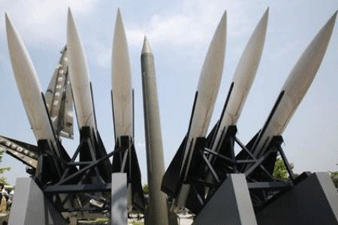 THE PLAN TO MAKE AMERICA’S NUKES GREAT AGAIN COULD GO HORRIBLY WRONG, VICE News, By Keegan Hamilton on Apr 20, 2017. It was nearly 2 o’clock in the morning on Oct. 23, 2010, when an Air Force lieutenant called from his base in Wyoming to report the nightmare scenario unfolding before him. Fifty intercontinental ballistic missiles — each tipped with a nuclear warhead 20 times more powerful than the bomb the U.S. dropped on Hiroshima — had suddenly lost contact with the computers at the base’s launch center.
“I… we… have no idea what’s happening right now,” the officer sputtered as he tried to explain the situation to support staff at a remote command center. Another officer barked orders behind him, interrupting the call. “Holy shit!” the lieutenant exclaimed. “I will have to call you back!”
The Air Force could tell that the weapons were still in their underground silos, but there was no way to know whether the missiles had been hijacked. A renegade missile crew, someone splicing into underground cables, or hackers exploiting radio signal receivers attached to the ICBMs could have set them on a countdown to launch. Even worse, without contact with the missiles, it was impossible to halt an unauthorized launch attempt.
Fortunately, the missiles were undisturbed. Altogether, they were knocked offline for a total of about 45 minutes, and the entire situation was resolved in a matter of hours. But for a chaotic stretch during the blackout, nobody knew what was wrong or how to fix it. As one colonel put it in an email, “the weapon system was kicking our butt.”
The culprit turned out to be a simple computer glitch: A circuit card had popped loose in the brains of the base’s Weapons System Processor.
The Air Force maintains that the situation was always under control. Still, it’s a stark reminder that even a minor mishap involving our nation’s aging nukes could have catastrophic consequences.
The U.S. keeps 416 “Minuteman” missiles ready to blast off at a moment’s notice. It’s unlikely — but not impossible — that a false alarm could make it seem like an attack is underway. In such a scenario, President Donald Trump, who has the sole, unchecked authority to launch U.S. nuclear weapons, would have only a few minutes to react. The codes used to fire the missiles are about the length of a tweet. And once one is launched, there’s no taking it back.
The technology that currently powers these nukes is notoriously antiquated. Most of the systems were designed and built during the height of the Cold War in the 1960s and ’70s, with the last major overhaul completed during the Reagan administration. Some computers in the missile base command centers still use eight-inch floppy disks.
In a May 2016 report, the Government Accountability Office determined that a key component of the Defense Department’s “command and control system,” which would be used to either start or prevent World War III, is “made up of technologies and equipment that are at the end of their useful lives.” The Pentagon is now in the midst of a $60 million overhaul of the system, which is expected to be complete by 2020.
The U.S. is on track to spend about $1 trillion over the next three decadesupgrading all facets of the nuclear arsenal, with $3.2 billion already budgeted for the 2017 fiscal year. A large chunk of that money will go toward upgraded missiles, new infrastructure, and overhauled command-and-control systems, such as digital phone lines and modern computers. Obama initiated the modernization plan, but it has found a new champion in Trump, who wants to boost the nuclear weapons program budget by an extra billion dollars……
Cyberwarfare has already moved into the nuclear realm. The U.S. has reportedly attempted to digitally sabotage North Korea’s nuclear and missile programs, perhaps as recently as last week, and it’s widely believed that malware created by the National Security Agency infected computers at an Iranian uranium-enrichment facility in 2010.
In February, the Pentagon issued a report on “cyber deterrence” that addressed the threat posed to nuclear weapons at home. It warned that “the cyberthreat to U.S. critical infrastructure is outpacing efforts to reduce pervasive vulnerabilities.” In other words, the bad guys are coming with new ways to attack digital weak spots faster than we can fix them.
As the mishap in Wyoming shows, the aging computers that control America’s nukes are by no means perfect. But with the modernization process already underway and multiple experts raising concerns about the plan to bring the most dangerous weapons known to man into the 21st century, the question is whether the solution to repair the creaky old machines is more dangerous than the existing problem…..https://news.vice.com/story/the-plan-to-make-americas-nukes-great-again-could-go-horribly-wrong
USA considers show of strength, shooting down North Korea missile tests,
US military considers shooting down North Korea missile tests, sources say As Pentagon looks for strategies to pressure into denuclearization, officials worry that intercepting missiles could escalate tensions and risk war, Guardian, Spencer Ackerman in New York and Justin McCurry in Tokyo, 18 Apr 17, The US military is considering shooting down North Korean missile tests as a show of strength to Pyongyang, two sources briefed on the planning have told the Guardian.
Amid heightened tensions over North Korea’s nuclear weapons and ballistic missile programs, the Pentagon is looking for ways short of war to pressure the country into denuclearization, particularly if Pyongyang goes forward with a sixth nuclear test.
The defense secretary, James Mattis, has briefed Congress on the option, but the military has not yet decided to intercept a test missile.
One US official said the prospective shoot-down strategy would be aimed at occurring after a nuclear test, with the objective being to signal Pyongyang that the US can impose military consequences for a step Donald Trump has described as “unacceptable”.
On a visit to South Korea this week, the US vice-president, Mike Pence, warned Pyongyang against testing Trump’s “resolve”, and declared an end to Obama’s “strategic patience” policy.
Experts and former officials said shooting down a North Korean missile during a test would risk an escalation that Washington might not be able to control, which would risk potentially devastating consequences to US allies South Korea and Japan……..https://www.theguardian.com/world/2017/apr/18/us-military-shoot-down-north-korea-missile-tests
Men in charge of nuclear warheads are ready to use them! This is criminal
 Nuclear war has become thinkable again – we need a reminder of what it means https://www.theguardian.com/commentisfree/2017/apr/17/nuclear-war-has-become-thinkable-again-we-need-a-reminder-of-what-it-means Paul Mason As Trump faces down North Korea, it’s alarming to
 think that most of the world’s nuclear warheads are now in the hands of men who are prepared to use them
The one dropped on Hiroshima measured 15 kilotons; it destroyed everything within 200 yards and burned everybody within 2km. The warhead carried by a Trident missile delivers a reported 455 kilotons of explosive power. Drop one on Bristol and the fireball is 1km wide; third-degree burns affect everybody from Portishead to Keynsham, and everything in a line from the Bristol Channel to the Wash is contaminated with radiation. In this scenario, 169,000 people die immediately and 180,000 need emergency treatment. Given that there are only 101,000 beds in the entire English NHS, you can begin to imagine the apocalyptic scenes for those who survive. (You can model your own scenario here.)
But a Trident missile carries up to eight of these warheads, and military planners might drop them in a pattern around one target, creating a firestorm along the lines that conventional Allied bombing created in Hamburg and Tokyo during the second world war.
I don’t wish to alarm you, but right now the majority of the world’s nuclear warheads are in the hands of men for whom the idea of using them is becoming thinkable.
For Kim Jong-un, it’s thinkable; for Vladimir Putin, it’s so thinkable that every major Russian wargame ends with a “nuclear de-escalation” phase: that is, drop one and offer peace. On 22 December last year, Trump and Putin announced, almost simultaneously, that they were going to expand their nuclear arsenals and update the technology.
Right now, a US aircraft carrier strike force is steaming towards North Korea(the DPRK) to menace Kim’s rogue regime. We don’t know what secret diplomacy went on between Xi Jinping and Trump at Mar-a-Lago, but the US is sounding confident that China will rein the North Koreans in.
What we do know is that Trump has been obsessed since the 80s with nuclear weapons, that he refuses to take advice from military professionals and that he seems not to understand the core Nato concept of nukes as a political deterrent, as opposed to a military superweapon.
This sudden mania for speaking of nuclear warfare, among men with untrammeled power, should be the No 1 item on the news, and the No 1 concern of democratic and peace-loving politicians.
The video fireworks on US cable news channels have progressed in the space of 10 days from cruise missile launches to bunker-busting airburst porn. One US news host referred to the former as “beautiful”.
I will always remember the Botoxed faces of the US news anchors when they arrived in New Orleans after Hurricane Katrina. It was as if they had been woken up from a dream, and the best of them realised how they had been sleepwalking towards the disaster.
Katrina shows what happens when a disaster hits a fragile, poverty-stricken and socially fragmented city. In New Orleans, for a few days, civilisation fell apart. Policemen, suddenly called on to haul their overweight frames into self-sacrificing and arduous work, quit on the spot. The modern equivalent of lynchings happened. Central government and unified military command of the situation broke down. My experience there convinced me that, in the event of mass fatalities being inflicted on a developed world city, the real problem would be social chaos, not mass radiation sickness.
Trump is ramping up the military rhetoric for a horribly simple reason: two weeks ago, the isolationist wing of his team got outflanked by generals; they tried some war to see how it went down and it went down well.
We may get lucky. It may be that the Chinese leadership is prepared to put serious pressure on North Korea to prevent Kim’s regime staging some kind of provocation against the US navy. Or we may get unlucky: the DPRK has a nuclear weapon, even if the missiles needed to deliver it are unstable.
It has been human nature, given the scale of devastation a nuclear war would bring, to blank the possibility from our minds, to worry about small risks because the big one is incalculable. But from the 50s to the 00s, we had – in all nuclear powers – military/industrial complex politicians who understood the value of multilateralism. All around us high politics is becoming emotion driven, unilateral, crowd-pleasing and falling under the control of erratic family groups and mafias, rather than technocrats representing ruling elites.
For the warmongers, true multilateralism is a serious annoyance; that’s why so many of the world’s autocrats are busy forcing NGOs to register, cutting off foreign funds to them and decrying the presence of international observers or sabotaging their work.
If Theresa May wanted to send a useful message at Easter it could have been: in compliance with the non-proliferation treaties, we will never use our nuclear weapons first; we will stick to diplomatic and economic pressure to get the DPRK to comply; and we will use our own, independent diplomatic clout to strengthen disarmament and non-proliferation.
That is what a responsible nuclear-armed power would do. The UK’s silence as Trump toys with military escalation and nuclear rearmament is criminal.
$billions of Americans’ tax money squandered on weapons
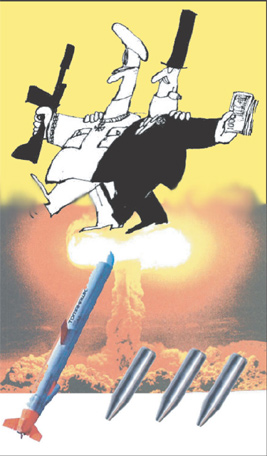 Where Your Taxes Go: The Militarized Budget On the other hand, there is another side of the US government: the government of tax breaks and tax cuts for the rich, the one that squanders as much on the military as the next seven countries combined.
Only 22 percent of military taxes go to US troops for pay and benefits. Meanwhile, nearly half of the military budget goes to a powerful group of multinational corporations that make billions in profits from US warmongering.
Take Lockheed Martin. As the federal government’s biggest military contractor, it received $36 billion in taxpayer dollars in 2015, amounting to 80 percent of its revenues from all sources.
And that’s just one contractor. In all, the Department of Defense handed out more than $297 billion in contracts in 2016….Events like the Syria bombing, and Trump’s election, tend to send stock prices for these companies soaring.

Where Your Dollars Are Going: Why Some Antiwar Activists Are Withholding Taxes, April 18, 2017, By Lindsay Koshgarian, Truthout | News Analysis Among the marches, petitions and call-in campaigns that comprise much of the Trump resistance movement, one resistance tactic gets little attention: withholding taxes. As the US seems ready to slide into yet another Middle East war in Syria while preparing for massive cuts to government programs at home, what role does tax resistance play in opposing regressive and violent policies?
While being anti-tax is typically associated with conservatism, there is a small but longstanding tradition within the progressive movement of withholding taxes — specifically, war taxes.
How does tax resistance work, and does it result in a lack of support for government programs that most progressives support and would like to see grow? How much of our taxes go to war, the military and militarism anyway, and how much to worthy programs like education, aid for struggling families, the environment and more?
Paying income taxes may not usually spur introspection, but it might if Americans realized that, for example, they are working 27 days out of every year to pay taxes that support war profiteers. Most progressives and many on the right of the political spectrum would never willingly write a check to weapons contractors, or speak in support of weapons systems that will fuel tomorrow’s air strikes and drone attacks. If Lockheed Martin, the nation’s most prolific military contractor, were a store or coffee shop, many would boycott it. So why willingly give Lockheed $170 a year through taxes — which the average taxpayer now does?
Pride and Prejudice: How the Government Helps (and How Americans Pay for It) The extent to which government helps those who need it most and strengthens every community is certainly underappreciated in a country obsessed with “small government,” a nation that reveres former President Ronald Reagan, who once said, “The nine most terrifying words in the English language are: I’m from the government, and I’m here to help.”
Of course, the government does help. More than half of almost every group of Americans — from every region of the country, white, Black, Latino, rural, urban, conservative, liberal — have benefited at some point in their lives from government programs like Social Security, Medicare, Medicaid, food stamps, unemployment and welfare. Government programs are often targeted to help those most in need of aid or those historically oppressed. Half of the students who receive Pell grants for college tuition come from families with incomes below $15,223, and 77 percent of them would be the first generation of their families to earn a bachelor’s degree. Nearly one in four Pell recipients is Black. Meanwhile, programs like Meals on Wheels for seniors are almost universally beloved and respected for taking care of some of the most vulnerable members of our society. The federal government serves as a crucial source of support for many………
Where Your Taxes Go: The Militarized Budget
On the other hand, there is another side of the US government: the government of tax breaks and tax cuts for the rich, the one that squanders as much on the military as the next seven countries combined; the one that has increased its spending on federal prisons by 10 times over the last 40 years — the government that seeks to consolidate power and exert control over the world’s most vulnerable people.
The US government promotes an extreme overreliance on military might and a disturbing parallel of policing, incarceration, surveillance and immigration raids and deportations here at home. A recent National Priorities Project analysis of the US discretionary budget showed that 64 percent of the federal discretionary budget — the budget decided by Congress each year, which is covered almost entirely by income taxes — is devoted to the military and militarism: to making and preparing for war, dealing with the consequences of war, and to programs that amount to intimidation and oppression here at home.
At least 23 percent of income taxes go to the military — and if you count spending on veterans’ benefits, national debt due to past wars, or other militarized spending like that for the FBI, federal prisons or immigration enforcement, the estimates only go higher. In addition to paying an average of $3,290 in yearly income taxes for the traditional military, Americans each pay $88 for border control and immigration and customs enforcement, $33 for the federal prison system, and more for programs ranging from the FBI to the CIA and beyond.
Only 22 percent of military taxes go to US troops for pay and benefits. Meanwhile, nearly half of the military budget goes to a powerful group of multinational corporations that make billions in profits from US warmongering.
Take Lockheed Martin. As the federal government’s biggest military contractor, it received $36 billion in taxpayer dollars in 2015, amounting to 80 percent of its revenues from all sources. Lockheed used those taxpayer dollars to pay its CEO more than $19 million in 2015. Taxpayers contributed six times as much to this one weapons maker as they did to all foreign aid in 2016. This should give us pause when we consider how often the US turns to military intervention versus prevention, diplomacy or other means during international crises.
And that’s just one contractor. In all, the Department of Defense handed out more than $297 billion in contracts in 2016 — more than half of the department’s budget.
Events like the Syria bombing, and Trump’s election, tend to send stock prices for these companies soaring.
An Act of Resistance
So, how does it all balance out? Does the government help more than it harms? Is there a way to support the good while resisting the bad?
This is what some war tax resisters attempt to do. In practice, resisting war tax runs the gamut from not paying any taxes at all to withholding a token amount of tax — as low as a few dollars — as a way of registering resistance. For those who want to support the government in its helping capacities, or who want to see those capacities grow, the second may be the better option.
Clearly, resisting taxes is not for everyone — it can come with legal penalties, headaches and a good deal of uncertainty. And of course, war tax resisting is not the only way to influence how your tax dollars are used: calling, visiting or writing your representatives in government; voting; and engaging in street protests play key roles in resisting war and militarism. Still, we are in the midst of a big resistance, and for some, resisting tax may be just what the doctor ordered. http://www.truth-out.org/news/item/40248-where-your-dollars-are-going-why-some-anti-war-activists-are-withholding-taxes
Will USA provoke a nuclear war ?
Washington pushes world to brink of nuclear war, WSWS, 18 April 2017 The repeated statements by US Vice President Mike Pence and other Trump administration officials Monday that the “era of strategic patience” with North Korea is over and “all options are on the table” have laid bare the mounting threat that Washington will provoke a war on the Korean peninsula involving the use of nuclear weapons and the deaths of millions.
“Just in the past two weeks, the world witnessed the strength and resolve of our new president in actions taken in Syria and Afghanistan,” Pence declared during a provocative visit to South Korea that brought him to the demilitarized zone (DMZ) on the North Korean border. “North Korea would do well not to test his resolve or the strength of the armed forces of the United States in this region,” Pence said.
This boasting about the reckless acts of military aggression—first, the cruise missile attack on Syria on April 7 and then, a week later, the use in Afghanistan of the Massive Ordnance Air Blast (MOAB) bomb, the most destructive weapon unleashed anywhere since the US incineration of Hiroshima and Nagasaki—cannot be read by the government of North Korea as anything other than an ultimatum to accept US demands or expect to be on the receiving end of far greater violence.
With the naval strike group led by the nuclear-powered aircraft carrier USS Carl Vinson set to take up a position off the Korean peninsula, the means of inflicting such violence are being put into place. The global implications of this buildup were underscored Monday with the report that both Russia and China have dispatched spy ships to trail the Vinson battle group. For these two nuclear-armed countries, Washington’s launching of a war against North Korea poses an existential threat.
The drive toward a military confrontation in Asia that could lead to a nuclear third world war has unfolded largely behind the backs of the people of the United States and the entire world. Neither the politicians of the two big business parties in the US nor the corporate-controlled media have so much as hinted to the public the horrific consequences of even a “limited” nuclear exchange on the Korean peninsula, nor the likelihood that such a catastrophe would draw all of the major nuclear powers into a global conflagration.
The recklessness of the path being pursued by Washington is staggering. Why the “era of strategic patience” has ended is not explained, nor are the conclusions drawn from this declaration even challenged. There are a whole number of states that now have nuclear weapons. North Korea’s pursuit of such arms does not represent a credible threat to the US.
“All options are on the table” can only mean that Washington is prepared to launch an unprovoked first strike against North Korea. Yet, within the media, there is barely a mention that such a course involves the threat of nuclear war. Nor is there the slightest suggestion that the US Congress should convene to vote on whether to authorize an attack that could produce casualties in the millions. The accepted wisdom is that Donald Trump doesn’t have to tell anyone what military action he will take until after the attack is executed. The only hint Trump gave of his intentions was at a Monday Easter egg-rolling event on the White House lawn, where he declared that North Korea has “gotta behave.”
The real character of the policy being pursued by Washington was indicated by John Bolton, the Bush administration’s ambassador to the United Nations, who told Fox News that the “way to end North Korea’s nuclear weapons program is to end North Korea,” i.e., topple the government and militarily smash the country.
The real and growing danger posed by Washington’s reckless policy is beginning to be registered, if only in the mildest form.
The New York Times, which had previously celebrated the Trump administration’s turn toward stepped-up militarism against Syria and Russia, proclaiming its feeling of “emotional satisfaction and justice done” over the cruise missile strike of April 7, has become somewhat nervous that things are spinning out of control………..
The assumption that China can be pressured into imposing Washington’s diktat in relation to North Korea is without foundation….. If Beijing were to accede to these demands, it would have immense strategic implications for China as well as major internal political consequences.
There are already indications that tensions between Beijing and Washington are escalating on the Korean peninsula after Seoul’s announcement that it intends to move ahead rapidly with the installation of the US Terminal High Altitude Area Defense system, or THAAD, which the US claims is designed to defend against North Korean missiles, but which China recognizes as a means of assuring the US a nuclear first-strike capability……
Everything that is being done by the US government involves astonishing levels of risk, including that of a nuclear war. Whether it happens in the immediate confrontation with North Korea cannot be predicted, but that this is the course Washington is prepared to pursue all over the world is undeniable……..https://www.wsws.org/en/articles/2017/04/18/pers-a18.html
THE U.S. IS BUILDING A NUCLEAR MISSILE THAT’S MORE ACCURATE THAN EVER,
 NewsWeek, BY ON 4/18/17 The U.S. has built a better, smarter nuclear bomb capable of replacing all four of its predecessors and, as of last month, it’s ready to fly.
The U.S. Air Force said Thursday it conducted an inert test in March of an upgraded version of one of its primary nuclear gravity bombs, the B61, in an effort to refurbish the nuclear arsenal of the nation with the second-largest nuclear weapons stockpile in the world. The long-awaited upgrade comes amid a new effort by President Donald Trump to conduct a massive review of the nation’s nuclear capabilities.
An F-16 dropped the non-nuclear B61-12 over the Nellis Test and Training Range Complex in Nevada, assessing functions such as the weapon’s fire control system, radar altimeter, spin rocket motors and weapons control computer. The B61-12 was set to replace four current models—the B61-3, -4, -7, and -10, according to theAviationist. The initiative, which hoped to see the weapon in production by 2020, was part of the nuclear life-extension program overseen by the Air Force Nuclear Weapons Center in conjunction with the Department of Energy’s National Nuclear Security Administration……….
The life-extension program continued as the Pentagon announced Monday the beginning of its Nuclear Posture Review, according to Defense News. The six-month process was commissioned by an executive order signed January 27 by Trump and would assess the nation’s nuclear forces in light of the current geopolitical scheme. Former President Barack Obama conducted the last review in 2010, and the new administration would likely take into account heightened tensions in Europe, Asia and the Middle East. Trump has recently feuded with his former political ally, Russian President Vladimir Putin, who currently commands the largest nuclear force on the planet, and has suggested a harder line on nuclear-armed North Korea.
Modernizing the U.S.’s entire nuclear arsenal would cost $400 billion by 2026, according to a figure released Tuesday by the Congressional Budget Office. Some military officials have reportedly suggested abandoning nuclear projects such as the Long-Range Standoff nuclear cruise missile (LRSO) in favor of optimized conventional strike options. http://www.newsweek.com/us-build-better-nuclear-missile-585686
New military posture review for Trump’s Pentagon
 Pentagon starts U.S. nuclear posture review under President Trump’s order, WASHINGTON, April 17 (Xinhua) — The U.S. Defense Ministry has officially started a review of the country’s nuclear posture and will submit a final report to President Donald Trump at the end of this year, the Pentagon announced Monday.
“Today, Secretary (James) Mattis directed the commencement of the review, which will be led by the deputy secretary of defense and the vice chairman of the Joint Chiefs of Staff, and include interagency partners,” Pentagon spokeswoman Dana White said in a statement.
“The process will culminate in a final report to the president by the end of the year.” said the statement.
The nuclear posture review was ordered by President Trump in a January executive action on military readiness, according to a theHill news daily report.
The January memo called for a review “to ensure that the United States nuclear deterrent is modern, robust, flexible, resilient, ready and appropriately tailored to deter 21st-century threats and reassure our allies.”…….
Though planned since January under Trump’s order, the start of the nuclear review comes at a time of high anxiety over increasing tensions on the Korean peninsula.
The last time the Pentagon conducted a nuclear posture review was in 2010.http://news.xinhuanet.com/english/2017-04/18/c_136216300.htm
Trump’s changed attitude to NATO – he now wants it bigger and tougher
‘Trump’s U-turn on NATO: Making it more expansionist, rather than more defensive, ’https://www.rt.com/op-edge/384649-nato-trump-policy-defense/ 13 Apr, 2017 President Trump is going along with NATO chief Jens Stoltenberg on the alliance’s increased deployment in Eastern Europe to supposedly deter Russia, but it will only reduce European security, Martin Sieff of the Global Policy Institute told RT.
US President Donald Trump on Wednesday had his first face-to-face meeting with NATOSecretary General Jens Stoltenberg in Washington DC.
He admitted changing his position on NATO, calling the alliance the “bulwark of international peace and security.”
However, his stance on having peaceful relations with Russia also stays in place, and Stoltenberg supported it.
“It would be wonderful, as we were discussing just a little while ago if NATO and our country could get along with Russia. Right now, we’re not getting along with Russia at all. We may be at an all-time low in terms of a relationship with Russia. This has built over a long period of time. But we’re going to see what happens. Putin is the leader of Russia. Russia is a strong country. We’re a very, very strong country. We’re going to see how that all works out,” Trump said.
Former CIA analyst Elizabeth Murray shared her thoughts with RT on President Trump’s change of tune on NATO.
“That seems to be in line with a lot of contradictory messages that have been coming from the White House. It seems like just over a week ago we heard that the Syrian people were going to decide their leadership. Apparently now it seems they don’t have that option. So it seems that we’re hearing a lot of contradictory statements from the White House and it is hard to know what to make of it,” she said.
As to why this is happening, Murray suggested that perhaps this has something to do “with the ratcheting up of tensions and ratcheting up of rhetoric vis-à-vis both Syria and Russia.”
“As you well know, we have a record number of NATO troops massed on the border with Russia – in Poland and the Baltic States. This is consistent with the tensions that have been rising since last week after this chemical incident in Syria and then the bombing of the Syrian airfield. I’m just hoping that dialogue, cool heads, and adult supervision will prevail here,” she added.
Martin Sieff of the Global Policy Institute called Trump’s change of rhetoric “depressing” but at the same time “predictable.”
“President Trump is inexperienced in the foreign policy area. He has not made the same effort he made in the economic sphere to appoint senior officials and advisors who would implement the policies that he spilled out consistently during his election campaign. Instead, he is letting himself be swayed by establishment positions,” he told RT.
Effectively, in Seiff’s view, Trump has made a U-turn on his NATO policy.
“He repeatedly said during his campaign that NATO was obsolete, that it needs to be restructured. Now he says it is not obsolete,” he said. “If he is going to change NATO radically, it looks like he is going to change it by making it more expansionist rather than more defensive and stabilizing. This is exactly the opposite of the positions he took consistently during his campaign.”
Speaking on Wednesday Trump yet again raised the spending issue.
“Fair burden-sharing has been my top priority since taking office. We have now turned a corner,” the president said.
Seiff says that even if European countries do increase their NATO spending, it will make no difference in practical terms.
“Secretary General Stoltenberg today in Washington – and he is a hawk in these issues – expressed confidence that the overall spending rates would be rising to 3.8 per cent for NATO. He said there are now $10 billion more of defense spending in NATO. But when you look currently – only five NATO nations have reached the two per cent of GDP standard, which Stoltenberg has been pushing, and which Trump is now also pushing – last year in 2016. Stoltenberg says another two or three nations will reach this stage in the next year or two. This includes very small countries: Romania, which although is a large country geographically, has a very weak economic base; and Latvia, which is a very small country indeed,” he explained.
He went on to say that in Germany and France powerful political forces are emerging who want neither increases in defense spending nor heightened tension with Russia.
“This year we’re going to see elections in a couple of weeks in France – the first round of the presidential elections. And we’re going to see the German elections for the Federal government coming in the fall, in September. If those go against the hawks, then all of Trump’s hopes to have increased spending in NATO is going to go by the board. It is not going to happen,” he said.
Trump’s reassessment of NATO could also have an impact on the United States’ relations with Russia, the analyst said.
“The signs again in the short term are very pessimistic, unfortunately. NATO has been pushing under President Obama and under NATO Secretary General Stoltenberg to deploy increased numbers of forces in Eastern Europe allegedly to deter Russian aggression. This will only have the opposite effect. It is Russia that was invaded from Western Europe and devastated in WWI and WWII. It was the Russian people who suffered more than anyone else. This concern, these historic memories go deep in Russia. Even relatively small forward NATO deployments, especially in countries that have very anti-Russian popular traditions in them – small countries even like Latvia, or even larger countries like Poland – create great alarm in Russia,” he said.
“So far from giving increased security to NATO and to its eastern members, these deployments that Stoltenberg wants, and Trump is going along with, will reduce security in Europe, and are much more likely to threaten the very catastrophes and breakdown of peace and security that they allegedly claim to prevent,” Seiff concluded.
“If he is going to change NATO radically, it looks like he is going to change it by making it more expansionist rather than more defensive and stabilizing. This is exactly the opposite of the positions he took consistently during his campaign.”
North Korean envoy at UN warns of nuclear war possibility: USA ready to do a pre-emptive strike
 North Korean envoy at UN warns of nuclear war possibility | 17 April 2017 | North Korea’s UN deputy representative, Kim In Ryong, on Monday unleashed at a hastily called UN press conference a torrent of threats, war scenarios and rhetoric aimed at the United States. The press event was held hours after US Vice President Mike Pence visited the demilitarized zone between North and South Korea. Pence warned North Korea not to test the resolve of the United States “or the strength of our military forces.” In New York, North Korea’s UN ambassador condemned the US naval buildup in the waters off the Korean Peninsula, plus the US missile attacks on Syria. Kim said, “It has created a dangerous situation in which thermonuclear war may break out at any moment on the peninsula and poses a serious threat to world peace and security.”U.S. May Launch Strike If North Korea Reaches for Nuclear Trigger | 13 April 2017 | The U.S. is prepared to launch a preemptive strike with conventional weapons against North Korea should officials become convinced that North Korea is about to follow through with a nuclear weapons test, multiple senior U.S. intelligence officials told NBC News. North Korea has warned that a “big event” is near, and U.S. officials say signs point to a nuclear test that could come as early as this weekend. The intelligence officials told NBC News that the U.S. has positioned two destroyers capable of shooting Tomahawk cruise missiles in the region, one just 300 miles from the North Korean nuclear test site.
North Korea simply sees nuclear weapons as essential for its survival
“At the end of the day, the North Koreans believe that their nuclear weapons are too foundational to their survival and to the survival of their regime.”
WITH the whole world staring daggers at North Korea, why is it so intent on harnessing the very weapon that could destroy it?
Another factor that has added pressure to the situation is the political turmoil in South Korea.
The US made a deal with South Korea to place a powerful anti-missile system in the country that could intercept and destroy missiles fired from North Korea.
But this deal was placed under a cloud earlier this year when then-president Park Geun-hye was impeached for corruption and then removed from office.
The man seen as a frontrunner to replace her, Moon Jae-in, does not seem supportive of continuing with the deal, and said he wanted to review the decision. While the presidential race has since narrowed, if Moon was elected on May 9, it could weaken the US bargaining position.Moon has said he wants to met with North Korea’s Kim Jong Un in Pyongyang as a priority over going to Washington, indicating he favours working with the dictator.
This may calm tensions in the area but could allow North Korea to continue developing its nuclear weapons.
With South Korea currently under interim leadership favourable to the US, Prof Blaxland said there was a “certain moment of opportunity” for the US to act.
Last month the US started installing its advanced missile defence system called THAAD (Terminal High Altitude Area Defence) in South Korea, despite some saying it should wait until the presidential elections were held.
US President Donald Trump has also ordered a naval strike group, led by the USS Carl Vinson aircraft carrier, to the region, though the vessels remain a long way from the peninsula………
CAN CHINA HELP? Many countries have been looking to China to try and solve the impasse, saying it should exert its influence over North Korea to get it to fall in line. But Brad Glosserman said the belief the Chinese could force an outcome in Pyongyang was a mistake.
He pointed to the US relationship with Israel as an example, saying despite all that America does to help the Jewish state, it is unable to force Israel to do what it wants. “The problem with North Korea’s relationship with the world, is the North’s relationship with the US,” he said.
“What China believes is that if there is to be a resolution, it must be a resolution between Washington and Pyongyang. “Beijing’s only real role is to facilitate that task, the idea that they can put the screws on … and deliver North Korea is something that the Chinese don’t believe and I don’t believe.”
SHOULD NORTH KOREA BE ALLOWED TO HAVE NUCLEAR WEAPONS?
If the US did become open to the idea of a nuclear-armed North Korea, Mr Glosserman said this would place stress on the US relationship with South Korea and also with Japan.
“It undermines the integrity of the non-proliferation treaty,” he said.
“I believe North Korea went nuclear because Pakistan went nuclear and got away with it. And I’m willing to bet that if North Korea goes nuclear, Iran will go nuclear and if Iran goes nuclear who knows what other dominoes will fall?.
“If North Korea is allowed to become a nuclear weapons state, I would suggest South Koreans might be encouraged to do the same and the Japanese will actively be pushed to do the same.
“There are a number of nuclear dominoes that have the potential to fall.”
HOW CAN WE STOP THEM?
According to the New York Times, the US has been trying to sabotage North Korea’s development of missile program using cyber and electronic strikes.
This may even have been why a ballistic missile launched on Saturday was unsuccessful. Lately, President Donald Trump is reportedly considering “utterly destroying” Kim Jong-un’s nuclear sites using pre-emptive strikes.
But Mr Glosserman said he didn’t think the US knew where North Korea’s warheads or missiles were located.
“The idea that we can intimidate the North Koreans strikes me as being a bit of a stretch,” he has previously said.
But while it may be hard for the US to take out North Korea’s weapons stockpile if it doesn’t know where to target, the use of a military option was still a possibility………
Mr Glosserman said the countries involved needed to be very careful as diplomacy was everyone’s preferred outcome.
Unfortunately Mr Glosserman said he didn’t think a deal could ultimately be brokered.
He said the US was demanding that North Korea give up its nuclear weapons but this is something they were not willing to do. The Chinese have asked for a freeze in activity but this doesn’t get rid of what the weapons they have already got.
“At the end of the day, the North Koreans believe that their nuclear weapons are too foundational to their survival and to the survival of their regime.,” he said.
“No one has come up with good terms by which we can at least begin a process to cap then roll back North Korea’s nuclear weapons.”http://www.news.com.au/technology/why-its-so-important-for-north-korea-to-develop-nuclear-weapons/news-story/ae936c8099fdcfb137860260afcee844
Email: charis.chang@news.com.au | Twitter: @charischang2
Survival of the richest: nuclear bunkers in high demand
Sports stars, hedge fund managers and even tech gurus including Bill Gates are rumoured to have invested in doomsday bunkers worldwide.
The bunkers are designed to withstand a nuclear blast and ensure some of the world’s richest people don’t go without a cinema and spa facilities during the attack.

But what once seemed like an over-the-top purchase designed for the super-paranoid and filthy rich has suddenly become a more sensible concept as North Korea threatens “a thermonuclear war may break out at any moment … if the US dares opt for a military action”.
North Korea’s deputy U.N. ambassador Kim In Ryong told a news conference on Monday the country “is ready to react to any mode of war desired by the U.S.” amid increasing tension between the nations.
He said the Trump administration’s deployment of the Carl Vinson nuclear carrier task group to waters off the Korean Peninsula again “proves the US reckless moves for invading the DPRK have reached a serious phase of its scenario”.
BUNKERS SELLING QUICKLY Sports stars, hedge fund managers and even tech gurus including Bill Gates are rumoured to have invested in doomsday bunkers worldwide.
The bunkers are designed to withstand a nuclear blast and ensure some of the world’s richest people don’t go without a cinema and spa facilities during the attack.
But what once seemed like an over-the-top purchase designed for the super-paranoid and filthy rich has suddenly become a more sensible concept as North Korea threatens “a thermonuclear war may break out at any moment … if the US dares opt for a military action”.
North Korea’s deputy U.N. ambassador Kim In Ryong told a news conference on Monday the country “is ready to react to any mode of war desired by the U.S.” amid increasing tension between the nations.
He said the Trump administration’s deployment of the Carl Vinson nuclear carrier task group to waters off the Korean Peninsula again “proves the US reckless moves for invading the DPRK have reached a serious phase of its scenario”.
BUNKERS SELLING QUICKLY…..more http://www.news.com.au/technology/innovation/design/survival-of-the-richest-nuclear-bunkers-in-high-demand/news-story/05fa82889c6585ff524a3ea04425fd18
Donald Trump considers ‘utterly destroying’ North Korea’s nuclear sites
 Trump reportedly considering ‘utterly destroying’ North Korea’s nuclear sites on April 17, 2017,
The former official in the Bush administration, who knows of the Pentagon battle plans is quoted as saying: “Trump is pushing the Chinese hard, but in his gut he ultimately feels he will have to take a strong step himself”.
“There are plans to destroy the missile sites and the military have strong confidence in what they know.
“They wouldn’t launch a pre-emptive strike if there is an underground nuclear explosion but they would if the president thought they were launching an intercontinental ballistic missile.”……https://au.news.yahoo.com/world/a/35057503/us-president-donald-trump-reportedly-considering-utterly-destroying-north-koreas-nuclear-sites/#page1
The secretive Israeli nuclear weapons program

 The World’s Most Mysterious Nuclear Weapons Program (And Its Not North Korea) National Interest, Kyle Mizokami, 15 Apr 17, In a private email leaked to the public in September of 2016, former secretary of state and retired U.S. Army general Colin Powell alluded to Israel having an arsenal of “200 nuclear weapons.” While this number appears to be an exaggeration, there is no doubt that Israel does have a small but powerful nuclear stockpile, spread out among its armed forces.
1 This Month
23-25 October – on Zoom – World BEYOND War’s annual global conferenc


Shut down the radiation-damaged Heysham nuclear reactors now
To see nuclear-related stories in greater depth and intensity – go to https://nuclearinformation.wordpress.com

Say No to NASA’s Reckless Nuclear Reactor on the Moon
Say No to NASA’s Reckless Nuclear Reactor on the Moon
-
Archives
- October 2026 (170)
- September 2026 (339)
- August 2026 (330)
- July 2026 (355)
- June 2026 (287)
- May 2026 (306)
- April 2026 (356)
- March 2026 (251)
- February 2026 (267)
- January 2026 (308)
- December 2025 (358)
- November 2025 (359)
-
Categories
- 1
- 1 NUCLEAR ISSUES
- business and costs
- climate change
- culture and arts
- ENERGY
- environment
- health
- history
- indigenous issues
- Legal
- marketing of nuclear
- media
- opposition to nuclear
- PERSONAL STORIES
- politics
- politics international
- Religion and ethics
- safety
- secrets,lies and civil liberties
- spinbuster
- technology
- Uranium
- wastes
- weapons and war
- Women
- 2 WORLD
- ACTION
- AFRICA
- Atrocities
- AUSTRALIA
- Christina's notes
- Christina's themes
- culture and arts
- Events
- Fuk 2022
- Fuk 2023
- Fukushima 2017
- Fukushima 2018
- fukushima 2019
- Fukushima 2020
- Fukushima 2021
- general
- global warming
- Humour (God we need it)
- Nuclear
- RARE EARTHS
- Reference
- resources – print
- Resources -audiovicual
- Weekly Newsletter
- World
- World Nuclear
- YouTube
-
RSS
Entries RSS
Comments RSS

