38 North: N. Korea Has 100 Unidentified Nuclear Facilities http://world.kbs.co.kr/english/news/news_In_detail.htm?No=127670 2017-05-30The managing editor of the U.S.-based North Korea-monitoring Web site 38 North says that the North has roughly 100 unidentified nuclear facilities.
According to the Sankei Shimbun on Tuesday, Managing Editor Jenny Town told the Japanese newspaper that it remains unclear where North Korea is manufacturing and storing nuclear weapons.
She said purposes and locations have been identified for only a few of some 100 facilities presumed to be related to the North’s nuclear activities.
Town said that there is a chance that North Korean leader Kim Jong-un may misunderstand red lines presented by the U.S. and head into a military conflict with the U.S.
She added that the North is just waiting for a justification to conduct a nuclear test.
In early April, after President Trump capriciously decided to bomb a Syrian air force base using Raytheon missiles, Raytheon lobbyist Ed Rogers took to the opinion section of Washington Post–where he, unaccountably, has a recurring column–to lavish praise on the President for doing so.
Rogers’ lobbying firm BGR received $120,000 in 2016 for lobbying on “defense and communications procurement; Defense appropriations and authorizations,” for Raytheon, Media Matters reported at the time.
Rogers boosted Trump again on behalf of his client six weeks later–this time both Saudi Arabia and Raytheon–in his post “The upcoming international trip is an opportunity for Trump and his staff”. The column, while not directly addressing weapons system. painted a glowing picture of a courageous Mr. Trump heading to the middle east to make peace and forge relationships.
Ed Rogers’ firm BGR was paid $500,000 by Saudi Arabia in 2015 to lobby on behalf of the Middle East dictatorship. In addition, the weapons deal finalized by the Trump administration on the trip greatly benefited Rogers’ other client, Raytheon, which has paid BGR $270,000 in the past two and a half years.
Raytheon is also the primary sponsor of Washington Post’s corporate puff interview series “Post Live: Securing Tomorrow” hosted by NatSec-friendly David Ignatius.
Not only did Rademaker generally push a war his client was helping arm-–as Mr. Rogers did–he expressly lobbied the US to procure two specific weapons systems made by his client, Lockheed Martin:
It’s time to take North Korea’s words and actions at face value: North Korea is a nuclear-armed state and is determined to remain one. The deployment of the Terminal High Altitude Area Defense, or THAAD, missile defense system to South Korea is a welcome first step to contain the threat, allowing us to shoot down short- and intermediate-range missiles fired from North Korea.
As North Korean missile capabilities grow, THAAD needs to be augmented with more robust missile defense systems, including the ship-borne Aegis system, the Aegis Ashore system now being deployed in Romania, expanded interceptor capabilities in Alaska and the corresponding sensors necessary to maximize the effectiveness of all these systems.
Both the THAAD missile system and the Aegis Ashore system are made by Lockheed Martin, one of Podesta Group’s major clients. Lockheed Martin paid Podesta Group $130,000 in the first quarter of 2017 alone and $1.8 million since 2014. According to Podesta Group’s own internal marketing collateral, one of their aims is to “Win key government Projects” for Lockheed Martin.
“At a time when the federal government was seeking to reduce its spending dramatically, Lockheed Martin asked the Podesta Group to ensure one of its flagship programs continued to receive full funding,” their promotional material reads. Presumably writing op-eds pushing Lockheed products in the most influential newspapers in Washington fits neatly into this marketing effort.
The Washington Post mentions Rademaker is a principal at Podesta Group but does not mention Podesta Group is a lobbying firm nor do they mention they’re a lobbying firm on behalf of the makers of THAAD and Aegis Ashore weapons systems being expressly hawked in the post.
In April, liberal watchdog Media Matters documented twelve separate times Post Columnist Ed Rogers didn’t disclose his conflicts of interest, ranging from Dodd-Frank to the Keystone Pipeline to Climate Change legislation. Podesta Group’s Rademaker previously pushed then-President Obama to not reduce the U.S. nuclear arsenal in 2014 without disclosing a $200,000-a-year client of his at the time, Huntington Ingalls Industries, built nuclear weapons systems.
The practice of allowing lobbyists to write “opinion” pieces that act as little more marketing pushes for their clients shiny new war products is an even more vulgar extension of the media’s habit of allowing defense industry-funded think tanks to push for increased military spending and saber-rattling, all without even the pretense of academic research or analysis.
Upgrading U.S. nuclear missiles, as Russia and China modernize, would cost $85 billion. Is it time to quit the ICBM race? LA Times, W.J. Hennigan and Ralph Vartabedian Contact Reporters 30 May 17 The sky over the turbulent Pacific was pitch-black earlier this month when a Minuteman III missile blasted off from Vandenberg Air Force Base on a column of fire that illuminated the California coastline for miles.
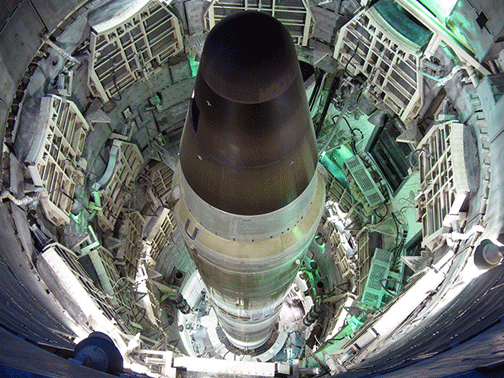
The unarmed missile thundered past the outer reaches of the atmosphere, tracing a fiery arc around the globe before plunging into a lagoon at Kwajalein Atoll in the South Pacific, 4,200 miles away. The Minuteman III tested May 3 near Lompoc is a critical element of U.S. defense strategy: a fleet of intercontinental ballistic missiles capable of obliterating any spot on Earth with a nuclear blast in 30 minutes or less.
Although the flight test proved Minuteman is still capable of performing its mission, major components of the missile and the control centers used to launch them are Cold War-era relics that have become increasingly expensive to maintain. Spare parts are in such short supply that the military has been known to pull them from museums.
At the same time, Russia and China are upgrading their nuclear capabilities. Pakistan, India and Israel continue to build new nuclear weapons and delivery systems. Air Force officials worry increasingly about the Minuteman’s ability to penetrate adversaries’ future missile defense systems.
The result is one of the most strategically complex and financially difficult challenges the Trump administration faces in making good on the president’s pledge for a “great rebuilding of the armed forces,” including the nation’s aging nuclear arsenal.
The Pentagon has begun work to replace the Minuteman fleet with a new generation of missiles and launch control centers, but the plan would cost an astronomical $85 billion, one of the most expensive projects in Air Force history.
Two defense firms will be awarded three-year contracts for $359 million each this year, with a test flight program scheduled for launch in the mid-2020s.
The tremendous expense of deploying a missile fleet capable in the long term of countering nuclear threats has spawned a debate in the American military establishment: How essential, in the 21st century, are the 400 strategic missiles embedded in silos deep under the plains of Colorado, Nebraska, Wyoming, Montana and North Dakota?
The discussion has opened for review the very essence of the nation’s nuclear defense strategy: the “triad” deployment of nuclear weapons, in submarines, strategic bombers and land-based silos, to guarantee the ability to retaliate against any nuclear strike……
Pentagon officials want to replace almost the entire nuclear arsenal, at a cost of up to $1 trillion. But no component has raised more questions than the replacement of the ICBM fleet, which critics have said is no longer crucial to preventing a nuclear war.
The argument for eliminating ICBMs is stronger than at any time in the past. Advocates of that strategy say submarine-based missiles and strategic bombers have improved their capability and are now more than potent enough to deter an enemy attack.
Former Defense Secretary William J. Perry fired the opening salvo last year, calling for phasing out the entire land-based ICBM force. He argued that its continued deployment is too costly. And with the missiles on continuous alert in order to be able to launch instantly if an enemy launch is detected by satellites and radar, a mistake or faulty warning could trigger an accidental nuclear war.
“The ICBM system is outdated, risky and unnecessary,” Perry, who served in the Clinton administration 20 years ago, said in a recent interview. “Basically, it can bring about the end of civilization with a false alarm. It’s a liability because we can easily achieve deterrence without it.”
Perry has not been alone in expressing doubts about the ICBM program, but senior Pentagon leaders have always been persuaded to keep it. Former Defense Secretary Chuck Hagel called for elimination of ICBMs before entering office and then changed his mind. Trump’s Defense secretary, James N. Mattis, questioned the need for the missiles in 2015 when he was a four-star general. But as soon as he was nominated, he began supporting a full-blown modernization of the triad.
The reevaluation of the role of ICBMs in America’s defense comes in an era when nuclear weapons are proliferating, not fading away. GlobalSecurity.org director John Pike, who has analyzed U.S. military systems and strategies for more than three decades, says critics “are gaining no traction” in calling for the elimination of the ballistic missile fleet…….. http://www.latimes.com/nation/la-na-new-icbm-2017-story.html
French nuclear tests ‘showered vast area of Polynesia with radioactivity’ https://www.theguardian.com/world/2013/jul/03/french-nuclear-tests-polynesia-declassified
Declassified papers show extent of plutonium fall-out from South Pacific tests of 60s and 70s was kept hidden, says French paper, Guardian, Angelique Chrisafis in Paris, Thursday 4 July 2013, French nuclear tests in the South Pacific in the 1960s and 1970s were far more toxic than has been previously acknowledged and hit a vast swath of Polynesia with radioactive fallout, according to newly declassified ministry of defence documents which have angered veterans and civilians’ groups.
The papers, seen by the French paper Le Parisien, reportedly reveal that plutonium fallout hit the whole of French Polynesia, a much broader area than France had previously admitted. Tahiti, above, the most populated island, was exposed to 500 times the maximum accepted levels of radiation. The impact spread as far as the tourist island, Bora Bora.
Thousands of veterans, families and civilians still fighting for compensation over health issues have insisted France now reveals the full truth about the notorious tests whose impact was kept secret for decades.
From 1960 to 1996, France carried out 210 nuclear tests, 17 in the Algerian Sahara and 193 in French Polynesia in the South Pacific, symbolised by the images of a mushroom cloud over the Mururoa atoll. For decades, France argued that the controlled explosions were clean. Jacques Chirac, the French president, controversially resumed nuclear atoll explosions in the South Pacific shortly after being elected in 1995.
Le Parisien said the documents “lifted the lid on one of the biggest secrets of the French army”. It said papers showed that on 17 July 1974, a test exposed Tahiti to 500 times the maximum allowed level of plutonium fallout.
Bruno Barillot, who has investigated the impacts of the nuclear tests for the Polynesian government, complained of the high levels of thyroid cancers and leukaemia in Polynesia. He said the declassified documents revealed Tahiti had “literally been showered with plutonium for two days” during the Mururoa test; from the outset France knew the impact spread further than it publicly admitted. But of the 2,050 pages declassified, 114 remained blacked out.
Richard Oldham, a member of the Polynesia nuclear workers’ association Mururoa e Tatou, told Radio New Zealand International : “It’s the right for our future generations to know what has happened in this country.”
In 2006 a French medical research body found nuclear testing had caused an increase in cancer on the nearest inhabited islands. The French judiciary began investigating health implications. It was not until 2010 that France acknowledged that there could be a compensation process for veterans and civilians. But that is complex and limited to a small geographical area and certain ailments.
About 150,000 veterans and civilians worked on, or were present during, nuclear tests, including 127,000 in Polynesia. But of 800 dossiers, only 11 people have received compensation.
Troops who worked on the tests have described a staggering lack of precaution for workers. During the Mururoa tests in French Polynesia in the late 1960s, one veteran described how he was stationed in shorts and a T-shirt on a boat only about 15 miles from the explosion before having to sail immediately to the area of the vast mushroom cloud to examine the damage.
Others on different tests wore shorts and had no sunglasses; they were told simply to shield their eyes and turn their backs at the time of the explosion.
This Is Why the World Should Fear India’s Nuclear Weapons, National Interest,Kyle Mizokami, 28 May 17, India, the world’s most populous democracy, occupies a unique strategic position flanked by powerful adversaries. As a result, its 1.3 billion people are guarded by an arsenal of approximately one hundred nuclear weapons deployed on land, at sea and in the air. Despite its status as a Cold War holdout, the country was forced to develop its own nuclear weapons…….
Today India is estimated to have at least 520 kilograms of plutonium, enough for, according to the Arms Control Association, “between 100 and 120 nuclear devices.” New Delhi describes this a “credible minimum deterrent” against neighboring nuclear powers China and Pakistan. By comparison, China—which must also contend with nuclear rival the United States—has enough fissile material for between 200 and 250 devices. Pakistan is thought to have an arsenal of 110 to 130 devices. India has a firm No First Use policy with regards to nuclear weapons, vowing to never be the first to use them in any conflict and only use them to retaliate in kind.
As a result India has built its own “triad” of land, sea and air forces, all equipped with nuclear weapons. The first leg to develop was likely tactical nuclear devices for strike aircraft of the Indian Air Force. Today, India possesses more than two hundred Su-30MK1 twin-engine fighters, sixty-nine MiG-29s and fifty-one Mirage 2000 fighters. It is likely at least some of these aircraft have been modified and trained to carry nuclear gravity bombs to their targets.
The land-based missile leg of the triad consists of Prithvi tactical ballistic missiles. First produced in the late 1990s, Prithvi initially had a range of just ninety-three miles, but future versions increased their range to 372 miles. Despite this, Prithvi is still firmly a tactical weapon, while the Agni I-V series of missiles, with ranges from 434 to 4,970 miles, are strategic weapons with the ability to hit foreign capitals—as well as all of China.
The third leg of the triad is new, consisting of nuclear ballistic-missile submarines (SSBNs) of the Arihant class. Four submarines are planned, each with the ability to carry twelve K-15 Sagarika (“Oceanic”) short-range ballistic missiles with maximum range of 434 miles, or K-4 medium-range ballistic missiles with a 2,174 mile range. Using the Bay of Bengal as a bastion and protected by assets such as India’s carrier INS Vikramaditya, the Arihant SSBNs can just barely reach Beijing.
India’s nuclear buildup has been relatively responsible, and the country’s No First Use policy should act to slow escalation of any conventional conflict into a nuclear one. As long as India’s nuclear deterrent remains credible, it should cause rational adversaries to think twice before edging to the nuclear threshold. Still, the country’s volatile relationship with Pakistan, which has no such policy, as well as its “Cold Start” blitzkrieg plan of action against its neighbor, means nuclear war cannot be ruled out.
The US has permanently stationed 25,000 members of the world’s best organised fighting force right of the North’s borders — and they just finished a massive military exercise.
But even the best systems in the world can’t stop a determined foe with a handful of nukes.
Adm. Dennis Blair, former Director of National Intelligence under Obama, recently told a crowd at the Harvard Club that there’s just no way to safely knock out all of North Korea’s nuclear capabilities in one go. “If I were to run the national intelligence again and the president comes to me and says, ‘Here is General [Jim] Mattis’ strike plan and can you ensure me that this will take out of all the North Korea nuclear capabilities?’ — it won’t be easy to say yes,” said Blair, according to the South China Morning Post.
Blair conceded that before he’d advocate an attack on North Korea, he’d accept it as a nuclear-armed state.
Blair’s statement echo’s Secretary of Defence Jim Mattis’ recent admission that a fight with the North would be “”tragic on an unbelievable scale.”
The US has 2,300 nuclear weapons, any one of which could hit North Korea in a moment’s notice. North Korea may have a dozen or so nuclear weapons, and only the ability to hit a few, close targets within an hour or so of planning.
Experts believe North Korea would probably respond with artillery fire that would light up Seoul and its 10 million residents. Decoy missiles would streak across the sky to overwhelm missile defences. And ground forces would pour in through hidden tunnels.
The US and South Korea would undoubtedly smash North Korean forces in time, but not before a missile touched down, or another catastrophic act of war befell thousands, if not hundreds of thousands, of innocent South Koreans.
According to Bonnie Glaser, director of the China Power Project at the Center for Strategic International Studies, there’s only one military option that even begins to make sense for North Korea.
“If North Korea has a ballistic missile on a launchpad that we think is armed with a nuclear warhead,” then the US would seek to eliminate that, one, single missile,” said Glaser. “But even a strike on a missile on a launchpad could result in retaliation.” After all, how should the North Koreans know that incoming missiles from the US had a limited objective? The risk remains that they’d misinterpret a limited strike for a full-on attack.
And the idea of eliminating a single, consolidated threat from North Korea is simply a dream. North Korea may well be beyond using launch pads, as their recent missile tests have all taken off from mobile launchers, many of which have tank-like treads to allow them to fire from hidden, wilderness locations.
Forget North Korea’s Nuclear Arsenal. Its Chemical and Cyber Weapons Are Already a Threat. Pyongyang’s VX attack and cyber hijinks suggests a regime bent on acquiring multiple weapons of mass disruption and destruction. Patrick M. CroninNational Interest May 25, 2017“….To be clear, nuclear weapons are a real and gathering danger, and frequent test launches by the Korean People’s Army suggest steady progress toward deploying long-range nuclear missiles. Yet there is considerable experience and success in deterring nuclear arsenals. The same cannot be said for biochemical and cyber weapons…….
North Korea expanding cybercrime and cyberwar capabilities.
No one can be sure yet who was responsible for the recent wave of ransomware attacks, but certainly North Korea has both the means and the motive for undertaking such action. Some suspect that North Korean sleeper cells of digital soldiers may have carried out the worldwide assault to strike back at outside powers, including China, while also seeking to finance expensive weapons programs. Authentication will take time, but there seems to be a connection between the so-called Lazarus hacking group and the remarkably successful 2016 cyber heist of the central bank in Bangladesh and the 2014 assault on Sony Corporation. North Korea’s special Unit 180 may be linked to these information warfare activities……
Pyongyang likes to rattle the nuclear saber but remains ready to use biochemical and cyber weapons. Nuclear weapons are useful insurance policies against intervention, but their use would be suicidal. The more surreptitious use of biochemical and cyber weapons, however, risks creating a grave new world by seeking to strike below the threshold of nuclear deterrence and catalyzing war.
The hopeful news is that leading officials in Seoul and Washington understand the stakes and the need to work together to preserve deterrence in the face of emerging threats. Secretary of Defense James Mattis recently stated that using force to settle the North Korea problem by would be “tragic on an unbelievable scale.” And President Moon Jae-in’s new national security advisor, Chung Eui-yong, has emphasized that “there is ample room for the U.S. and South Korea to calibrate and plan their joint engagement with the North.”……Dr. Patrick M. Cronin directs the Asia-Pacific Security Program at the Center for a New American Security (CNAS) in Washington, DC; his Twitter handle is @PMCroninCNAS. http://nationalinterest.org/feature/forget-north-koreas-nuclear-arsenal-its-chemical-cyber-20846
North Korea nuclear missile strike on US mainland is ‘inevitable’, says Defence intelligence chief
Donald Trump recently called North Korean leader Kim Jong-un a ‘madman’, The Independent, Mythili Sampathkumar New York @MythiliSk 26 May 17,The Defence Intelligence Agency chief has said it is “inevitable” that a nuclear weapon launched fromNorth Korea would hit the US mainland.
Lieutenant General Vincent Stewart told the Senate Armed Services Committee that the possibility of an attack was very real after a recent nuclear missile test conducted by Pyongyang.
He warned that if the isolated country and its leader Kim Jong-un are left on the “current trajectory the regime will ultimately succeed.” However Mr Stewart said it was “nearly impossible to predict when” that would be.
He and Director of National Intelligence Dan Coates were pressed for a timeline repeatedly but refused to give a concrete answer out of fear that it may reveal what intelligence the US has been able to gather on Pyonyang.
“We do not have constant, consistent [intelligence and surveillance] capabilities and so there are gaps, and the North Koreans know about these,” Mr Coates said.
Mr Coates also testified in the hearing that what makes North Korea a particularly “grave national security threat” is Mr Kim’s “aggressive” leadership. He seems determined to develop a nuclear missile capable of reach the west coast of the US, called an intercontinental ballistic missile (ICBM).
The test, scheduled for Tuesday, is the first time the United States will try to intercept an ICBM.
The United States has used the Ground-Based Midcourse Defense (GMD) system, managed by Boeing Co. and in place to counter attacks from rogue states such as North Korea, to intercept other types of missiles but never an ICBM.
While U.S. officials believe Pyongyang is some years away from mastering re-entry expertise for perfecting an ICBM, it is making advances. This week the head of the U.S. Defense Intelligence Agency said that if left unchecked, North Korea is on an “inevitable” path to obtaining a nuclear-armed missile capable of striking the United States.
The remarks are the latest indication of mounting U.S. concern about Pyongyang’s advancing missile and nuclear weapons programs, which the North says are needed for self-defense.
U.S. officials said that the test had been planned well in advance and was not in reaction to any specific event.
The Missile Defense Agency said an interceptor based out of Vandenberg Air Force Base in California, one of 36 in California and Alaska, will be used in the test to shoot down a target similar to an ICBM over the Pacific Ocean.
The system has carried out successful intercepts in nine out of 17 attempts dating back to 1999. The most recent test was in 2014. Last year a science advocacy group said the system has no proven capability to protect the United States. (Reporting by Idrees Ali; Editing by James Dalgleish)
The Pentagon Can’t Believe Trump Told Another President About Nuclear Subs Near North Korea
“We never talk about subs!” three defense officials told BuzzFeed News after a transcript of a call between President Trump and Philippines President Rodrigo Duterte was published. BuzzFeeed News, May 25, 2017,Nancy A. Youssef BuzzFeed News World Reporter Pentagon officials are in shock after the release of a transcript of a call between President Donald Trump and his Philippines counterpart revealed that the US military had moved two nuclear submarines towards North Korea.
“We never talk about subs!” three officials told BuzzFeed News, referring to the military’s belief that keeping submarines’ movements secret is key to their mission.
While the US military will frequently announce the deployment of aircraft carriers, it is far more careful when discussing the movement of nuclear submarines. Carriers are hard to miss, and that, in part, is a reason the US military deploys them. They are a physical show of force. Submarines are, at times, a furtive complement to the carriers, a hard-to-detect means of strategic deterrence.
According to the transcript, released Wednesday, Trump called Philippines President Rodrigo Duterte April 29, in part to discuss the rising threat from North Korea. During that call, while discussing ways to mitigate North Korean leader Kim Jong Un’s nuclear ambitions, Trump said: “We have two submarines — the best in the world. We have two nuclear submarines — not that we want to use them at all. I’ve never seen anything like they are but we don’t have to use this, but [Kim] could be crazy, so we will see what happens.”
During the same call, Trump also called the North Korea leader a “madman with nuclear weapons” and celebrated Duterte for doing an “unbelievable job on the drug problem.” The Filipino leader has supported the alleged extrajudicial killing of 8,000 people since he took office in June, part of his purge to rid his nation of drugs. Duterte has bragged about committing murder himself, called former president Barack Obama a “son of a bitch” and once threatened to suspend the bilateral agreement between his nation and the United States that allows US troops to visit the Philippines.
“Keep up [the] good work, you are doing an amazing job,” Trump told Duterte during the call.
A US official who had previously seen a version of the transcript confirmed to BuzzFeed News that the published version appeared accurate.
By announcing the presence of nuclear submarines, the president, some Pentagon officials privately explained, gives away the element of surprise — an irony given his repeated declarations during the campaign that the US announces far too many of its military plans when it comes to combatting ISIS.
Moreover, some countries in the region, particularly China, seek to develop their anti-sub capability. Knowing that two US submarines are in the region could allow them to test this.
Finally, it is unclear why Duterte would need to know the specific number of subs in the region. The Philippines is not a part of US military efforts to deter North Korea, so why would Duterte need to know such details?
BBC News 24 May 2017 The United Nations has warned that President Donald Trump’s plans to cut contributions to peacekeeping will make such work “impossible”.
The US administration signalled heavy cuts to UN operations, in its budget proposals released on Tuesday. The US foots more than a quarter of the UN’s $7.9bn (£6.1bn) peacekeeping bill.
A spokesman for UN Secretary General Antonio Guterres said the organisation was willing to discuss how peacekeeping could be made more cost-effective.
Mr Trump’s budget proposal declares new “attention on the appropriate US share of international spending at the United Nations”.
The document does not provide a detailed breakdown, but Reuters news agency reports the drop in funding for the operations could amount to $1bn.
The spokesman said the UN was studying Mr Trump’s plan. “The figures presented would simply make it impossible for the UN to continue all of its essential work advancing peace, development, human rights and humanitarian assistance,” he said.
The draft treaty is the culmination of a sustained campaign, supported by more than 130 non-nuclear states frustrated with the sclerotic pace of disarmament, to prohibit nuclear weapons and persuade nuclear-armed states to disarm.
Nine countries are known or believed to possess nuclear weapons: the US, UK, Russia, China, France, India, Pakistan, North Korea and Israel. None has supported the draft plan.
The draft treaty obliges state parties to “never under any circumstances … develop, produce, manufacture, otherwise acquire, possess or stockpile nuclear weapons or other nuclear explosive devices … use nuclear weapons … [or] carry out any nuclear weapon test”.
States would also be obliged to destroy any nuclear weapons they possess and would be forbidden from transferring nuclear weapons to any other recipient.
Costa Rica’s ambassador to the UN, Elayne Whyte Gómez, who chaired the treaty drafting conference, said she expected revisions and there was “a good level of convergence among the delegations, especially on the core prohibitions”.
Disarmament advocates say the draft treaty, supported by dozens of countries, is now on track to be discussed at a second session in New York in mid-June that could end with the document’s adoption as a UN treaty in July.
The US and other nuclear powers have argued states should strengthen and improve the 47-year-old nuclear non-proliferation treaty instead of adopting a total ban.
US officials have cited the threat posed by North Korea, which has conducted a series of nuclear weapons and ballistic missile tests this year, as reason why nuclear deterrence – and gradual nuclear disarmament – is still needed.
Beatrice Fihn, executive director of the international campaign to abolish nuclear weapons (Ican), said the draft language was strong in categorically prohibiting nuclear weapons.
“We are particularly happy the text is rooted in humanitarian principles and that it builds on previous prohibitions of unacceptable weapons, such as biological and chemical weapons, landmines and cluster munitions.”
Fihn urged nuclear-armed and nuclear alliance states to join discussions over a ban treaty, as demonstration of their commitment to disarmament.
“Nuclear weapons are ethically unacceptable in the 21st century. Intended to indiscriminately kill civilians, this 1940s technology is putting countless of lives at risk every day. Their continued existence undermines the moral credibility of every country which relies on them. A treaty to ban them, as a first step towards their elimination, will have real and lasting impact.”
The efficacy of a ban treaty is a matter of fierce debate.
Support has been growing steadily over months of negotiations but it has no support from the nine known nuclear states, which include the veto-wielding permanent five members of the UN security council.
Critics argue that a treaty cannot succeed without the participation of the states that possess nuclear weapons, or the alliance states that enjoy their protection.
During months of negotiations, Australia has lobbied other countries, pressing the case for what it describes as a “building blocks” approach of engaging with nuclear powers to reduce the global stockpile of 15,000 weapons.
But proponents say a nuclear weapons ban will create moral suasion – in the vein of the cluster and landmine conventions – for nuclear weapons states to disarm, and establish an international norm prohibiting the development, possession and use of nuclear weapons.
Non-nuclear states have expressed increasing frustration with the current nuclear regime and the piecemeal progress towards disarmament.
With nuclear weapons states modernising and in some cases increasing their arsenals, instead of discarding them, more states are becoming disenchanted with the nuclear non-proliferation treaty and lending their support for an outright ban.
IB Times 22nd May 2017 In the wake of the “WannaCry” cyberattack which resulted in widespread disruption of the UK’s National Health Service (NHS), attention has now turned to other forms of infrastructure.
One security expert has warned Britain’s nuclear weapons are at risk of being targeted. The UK nuclear deterrent, known as Trident, consists of four Vanguard-class submarines which can carry up to 16 ballistic missiles, each armed with up to eight warheads. Most of its computers, however, reportedly run on a legacy variant of the under-supported Windows XP operating system. http://www.ibtimes.co.uk/are-britains-nuclear-weapons-systems-vulnerable-mass-cyberattacks-1622811
How To Dismantle A Nuclear Weapon, Gizmodo, Terrell Jermaine Starr and Jalopnik, May 24, 2017 “…..Getting Rid Of Plutonium Is Harder
For one, there is no civilian use for plutonium in the United States because you can’t break it down or blend it. In other words, it is always ready to be used for weapons. In fact, according to Live Science, of its five common isotopes, only plutonium-238 and plutonium-239 are used for anything.
Pu-238 is used for powering space probes and Pu-239, the isotope we’re talking about, goes through a fission chain reaction when concentrated enough. And when that process takes place, it is nuke-ready.
By the way, Plutonium is pretty damn radioactive and contains the “worst kind of fission byproducts that could enter the environment as a result of the Fukushima nuclear disaster,” as Live Science notes (emphasis ours):
According to the Environmental Protection Agency, plutonium enters the bloodstream via the lungs, then moves throughout the body and into the bones, liver, and other organs. It generally stays in those places for decades, subjecting surrounding organs and tissues to a continual bombardment of alpha radiation and greatly increasing the risk of cancer, especially lung cancer, liver cancer and bone sarcoma.
There are documented cases of workers at nuclear weapons facilities dying within days of experiencing brief accidental exposure to plutonium, according to the Hazardous Substances Data Bank.
Furthermore, among all the bad things coming out of Fukushima, plutonium will stay in the environment the longest. One isotope of plutonium, Pu-239, has a half-life of 24,100 years; that’s the time it will take for half of the stuff to radioactively decay. Radioactive contaminants are dangerous for 10 to 20 times the length of their half-lives, meaning that dangerous plutonium released to the environment today will stick around for the next half a million years.
That is why Japan’s reported goal to use plutonium for civilian reactors have the U.S. and China worried. At one point, Japan had around 10 tons of unseparated plutonium in-country; 37.1 tons are in France and the United Kingdom. China fears Toyko could possibly use the plutonium to develop nuclear weapons, although the Japanese did give up 331kg of it in 2016.
Collina said it’s a good thing the U.S. has no plans to use plutonium for civilian purposes.
“You can’t blend down plutonium,” he says. “It’s always weapons-usable. So if you use this stuff at nuclear power plants, you’re basically spreading weapons-usable nuclear material all around. It’s a proliferation problem because we don’t want to set the example for other nations to say, ‘I’m going to use plutonium in my civilian power program’ and therefore create a cover for a secret weapons program. We want to have a pretty clear line that says, ‘Plutonium is only used for weapons and you should not use plutonium if you’re not using it for weapons.'”
As for actually getting rid of plutonium, the process is not environmentally friendly and it never will be. Most of the plutonium that is separated from nukes is stored at the Savannah River Site (SRS), near the Georgia border. Plutonium is also stored at the Pantex Plant. It’s authorised to store 20,000 plutonium pits; current estimates find that 14,000 are stored in the facility.
But here’s the catch: you can never make it truly safe, and no one wants it near them. For example, the Department of Energy, through the Nuclear Regulatory Commission, is currently overseeing construction of a facility at SRS to make MOX fuel from weapons-ready plutonium. It would then be used for commercial use.
The problem is that no one wants plutonium storage facilities in their backyards. The American ambassador to the United Nations, Nikki Haley, expressed concerns over the MOX fuel initiative when she was governor of South Carolina. Her issue was that the feds were supposed to remove a ton of plutonium from the state by January 2016 and ship it to another facility in New Mexico or process it for commercial use through the facility; neither happened, so she sued the Department of Energy. A federal circuit court dismissed the case.
Officially, MOX fuel is not being used in the United States, according to the Nuclear Regulatory Commission. Europe uses MOX fuel, but its plutonium is from spent nuclear fuel rather than nuclear weapons.
Former Nevada Senator Harry Reid resisted the Yucca Mountain Nuclear Waste Repository project, which was supposed to be a deep geological repository storage facility for spent nuclear fuel and radioactive waste like Pu-239. Under the Nuclear Waste Policy Act amendments of 1987, the Yucca Mountains were supposed to be the key destination for storing this waste, but Reid worked with Obama to end funding for the project.
Where To Send It?
So, if no one wants plutonium in their backyard here on planet earth, where can it be disposed? Well, there have been a bunch of wild ideas, like blasting it into the sun. Which, as the video below explains, is a pretty bad idea.
Hitting the Sun is HARD
You also have to factor in the possibility the space ship won’t make it to orbit. “Space shuttles crash,” Collina said. “So if you had just one crash with a space shuttle full of plutonium, that would ruin your whole day.”
How To Dismantle A Nuclear Weapon, Gizmodo, Terrell Jermaine Starr and Jalopnik, May 24, 2017 Dismantling the world’s 15,000 nuclear weapons is one the most important geopolitical challenges humanity faces. That number seems bleak, given the current state of affairs. But if you wanted to dismantle just one warhead, here is what it would take.
Those warheads make the world a dangerous place, but we have to keep in mind there were more than 70,000 nuclear warheads in existence at one point. Though Cold War-era non-proliferation treaties were central to the massive cuts, most nuclear warheads were retired or dismantled during the 1990s after the dissolution of the Soviet Union. President George H.W. Bush cut 9,500 during his term as president; in 1992 alone, he cut 5,300 warheads, which was the most by any president ever in history. During the 2000s, his son cut the stockpile by more than half to 5,270 warheads. Together, the son and dad president team cut 14,801 warheads from the stockpile.
Comparatively, President Barack Obama cut a mere 507 warheads, but relations between Russia and the U.S. were quite chilly during his term and both nations increasingly saw each other as military threats.
But the U.S. and Russia have their own arms issues. The New START treaty between the United States and Russia is the most important non-proliferation treaty in the world right now, yet its extension appears to be in limbo. India and Pakistan, though they only have 250 warheads between them, could ruin the earth’s atmosphere if they ever engaged in a regional nuclear conflict.
Politics aside, however, once a nation agrees to cut its nuclear stockpile, how does it happen, where and when? We spoke with a few nuclear weapons experts who walked us through the process of how this actually happens, with the focus on how the Americans do it.
The Question Of Dismantlement Versus Retirement
Once a president decides to cut down the nuclear arsenal, he or she must decide if they want to retire or dismantle the warheads. It is important to know the difference. Tom Collina, Director of Policy at Ploughshares Fund — an anti-nuclear weapon philanthropic group — says that current treaties do not focus on the actual dismantlement of weapons.
“They only require that weapons be retired or removed from service,” he said. “They do not require that weapons be dismantled. So, you can have the New START treaty lowering the number of deployed systems you can have, but that doesn’t mean those weapons get dismantled. It just means they get put into storage.”
There is no verification process for determining if a nuclear warhead is destroyed or not once they get to storage, because they are simply are too small to see from space, Collina explains.
Missiles are different.
Those, along with bombers and submarines, are under treaty, and their dismantlement can be verified via satellite, simply because they’re so big. You can see a missile being chopped in half or a bomber’s wings clipped from space.
But a nuclear warhead itself, which is much smaller? That is simply not possible.
Right now, there are around 2,800 warheads in retirement in the U.S., meaning they are no longer stockpiled. As the State Department explains, once a retired warhead is removed from its delivery platform, it is no longer useable and is not considered part of the nuclear stockpile. The tritium bottles are also removed. Tritium is a radioactive form of hydrogen that is critical to powering a bomb. Other “limited life components,” like the neutron generators, are also removed.
The warhead is stored in a depot where they hopefully will move on to the next process of being destroyed.
Separating A Warhead
The key components of a nuclear weapon, besides the metals used to construct its exterior, are uranium, plutonium, tritium boost gas, the neutron generator and other elements, according to the Union of Concerned Scientists. And separating a warhead is the hardest and most dangerous part of dismantlement.
The National Nuclear Security Administration is the governmental body that oversees the dismantlement process, which takes place at the Pantex Plant, in the Panhandle of Texas. Pantex is the primary plant where nuclear weapons assembly and disassembly occurs. The warhead is taken to an underground bunker, where its parts are separated.
just one warhead, here is what it would take.
Those warheads make the world a dangerous place, but we have to keep in mind there were more than 70,000 nuclear warheads in existence at one point. Though Cold War-era non-proliferation treaties were central to the massive cuts, most nuclear warheads were retired or dismantled during the 1990s after the dissolution of the Soviet Union. President George H.W. Bush cut 9,500 during his term as president; in 1992 alone, he cut 5,300 warheads, which was the most by any president ever in history. During the 2000s, his son cut the stockpile by more than half to 5,270 warheads. Together, the son and dad president team cut 14,801 warheads from the stockpile.
Comparatively, President Barack Obama cut a mere 507 warheads, but relations between Russia and the U.S. were quite chilly during his term and both nations increasingly saw each other as military threats.
But the U.S. and Russia have their own arms issues. The New START treaty between the United States and Russia is the most important non-proliferation treaty in the world right now, yet its extension appears to be in limbo. India and Pakistan, though they only have 250 warheads between them, could ruin the earth’s atmosphere if they ever engaged in a regional nuclear conflict.
Politics aside, however, once a nation agrees to cut its nuclear stockpile, how does it happen, where and when? We spoke with a few nuclear weapons experts who walked us through the process of how this actually happens, with the focus on how the Americans do it. Continue reading →