Auckland commemorates 30 years of nuclear-free New Zealand
 Aucklanders celebrate anniversary of nuclear-free New Zealand, 11/06/2017, Newshub staff It’s been 30 years since New Zealand became the first country in the world to declare itself Nuclear Free.
On Sunday, hundreds formed a human peace symbol at the Auckland Domain, similar to the one made in 1983, in order to commemorate the anniversary of the passing of the New Zealand Nuclear Free Zone, Disarmament, and Arms Control Act. …….
The anniversary comes just days before a United Nations conference involving 132 countries which will negotiate a treaty to ban nuclear weapons. http://www.newshub.co.nz/home/new-zealand/2017/06/aucklanders-celebrate-anniversary-of-nuclear-free-new-zealand.html
The world on the brink of nuclear war in 1983
In 1983, A NATO Military Exercise Almost Started a Nuclear World War III, The National Interest, Warfare History Network, 11 June 17, On the night of November 20, 1983, Armageddon went prime time. Over 100 million Americans tuned in to the ABC television network to watch the two-hour drama The Day After. This depiction of a hypothetical nuclear attack on the United States attracted a great deal of publicity and controversy. Schools made watching the film a homework assignment, discussion groups were organized in communities across the country, and even the secretary of state at the time, George Schulz, took part in a question-and-answer session hosted by ABC after the film’s broadcast. That a mere made-for-TV movie could garner such attention from a leading figure in the Reagan administration indicates how real the fear of a nuclear apocalypse was at the time. But almost no one watching that Sunday night realized just how close fiction came to reality in the fall of 1983.
The possibility of the world’s two greatest military powers destroying each other and the earth in a full-scale thermonuclear war was a fear shared by many throughout the world. At the time, both the United States and the USSR maintained huge nuclear arsenals of over 20,000 nuclear warheads each. In North America and Western Europe, nuclear freeze movements were gaining new members daily, with mass demonstrations that routinely numbered in the tens of thousands.
World events seemed to only reaffirm people’s fears. It was the third year of the presidency of Ronald Reagan, a man who had built his political career on a virulent hatred for all things communist. His 1980 victory over incumbent President Jimmy Carter had largely been the result of his hard-line stance against the Russians. A former film actor with a natural flair for the dramatic, Reagan both inspired and shocked people with his hardcore rhetoric, such as his statement before the British House of Commons in 1982 that the Marxist ideology would be relegated to the “ash heap of history.” Perhaps his most memorable and antagonistic remarks came on March 8, 1983, when Reagan referred to the Soviet Union as the “focus of evil in the modern world” and an “evil empire.”……
“Star Wars” and Fleetex 83: On the Brink of Nuclear War
On March 23, 1983, Reagan took the superpower rivalry to a new level when he unveiled the Strategic Defense Initiative Program during a live television address. The SDI program, more popularly referred to as “Star Wars,” was to provide an orbital shield that would protect the United States—at least partly—from a nuclear strike…..
To Yuri Andropov, then general secretary of the USSR, Reagan’s intentions spelled trouble…….http://nationalinterest.org/blog/the-buzz/1983-nato-military-exercise-almost-started-nuclear-world-war-21111
Defiant North Korea vows to continue its nuclear weapons development
North Korea “fully rejects” new UN sanctions and vows to continue its nuclear weapons development
Kim Jong-un’s rogue state described the sanctions resolution as “a crafty hostile act”, The Sun By Jon Lockett 4th June 2017,
USA’s President Trump sets the world stage for a new nuclear arms race
 Is President Trump setting the stage for a new nuclear arms race?, https://www.bostonglobe.com/news/politics/2017/06/03/stealthy-cruise-missile-spurs-worries-amid-trump-call-for-revived-nuclear-arms-race/QlgPJLsn01ru4SaHFuGicM/story.html By Christopher Rowland GLOBE STAFF JUNE 03, 2017 WASHINGTON — President Trump has called for a new global arms race, and the Pentagon is ready. It has a nuclear weapon on the drawing board that the military considers essential but that critics fear could put the United States on the inside lane to Armageddon.
The new weapon is the planned update of the Air Force’s nuclear cruise missile. Price tag: at least $20 billion. Fear factor  for arms-control advocates: maximum.
Trump’s newly released budget for 2018 contains hundreds of millions of dollars to speed up development of the Long Range Stand Off missile — a jet-propelled nuke designed to be launched from an airborne bomber and stealthily zip to a target virtually anywhere in the world.
It will carry a “variable yield’’ warhead that can be adjusted to deliver an atomic blast ranging from 5 to 150 kilotons — that is, from about one-third of a Hiroshima-sized bomb to as much as 10 Hiroshima bombs.
The ability to limit the scope of devastation and highly flexible targeting offer a powerful allure to Air Force generals, but are also precisely what worry antiproliferation specialists. They contend these capabilities make the idea of a “limited’’ nuclear strike on a target like Iran or North Korea — aggressive provocateurs but not superpowers — more likely, with a high risk for catastrophic escalation. It could also give Pentagon planners an intriguing option as they study ways to deter Russia’s ambitions to reassert sway over Eastern Europe.
The new missiles are part of a $1 trillion upgrade of America’s nuclear arsenal kicked off by President Barack Obama, replacing missiles, submarines, and planes that have been in service for decades. Now Trump is positioning the military to pursue those plans aggressively, with $1 billion in his new budget to keep the Pentagon on an accelerated course for updating warheads, including a refurbished warhead for the 1,000 new, improved cruise missiles.
“It is very dangerous to have this excessive, unnecessary rebuilding of the arsenal take place under the Trump administration,’’ said Tom Collina, policy director at the Ploughshares Fund, a nonprofit organization that advocates for the reduction and elimination of nuclear weapons development. “The United States wants a new arms race, and is willing to push for it, and willing to pay for it, and we’re going to see other countries including Russia respond in kind, which is not good for global security.’’
Under an order Trump signed soon after he took office, the Pentagon is beginning a Nuclear Posture Review, due for completion by the end of the year. It gives the new administration a chance to articulate the president’s nuclear vision and decide what atomic weapons and strategies he deems most important.
Trump’s White House has not yet provided details of the president’s views, but in some of his remarks, he appears prepared to push the United States closer to a Cold War footing, a shift in tone and possibly in tactics that could have an impact on global nuclear security long after he leaves office.
“Let it be an arms race,’’ Trump, then president-elect, was quoted by MSNBC as saying in December. “We will outmatch them at every pass and outlast them all.’’
Tough talk, or something more? Certainly the tone runs sharply counter to the trend over the last three decades. Since the destruction of the Berlin Wall, there has been a sharp reduction in nuclear arms deployed by the United States and Russia.
Obama’s own 2010 Nuclear Posture Review concluded that the United States should continue seeking to reduce the balance of nuclear weapons in the post-Cold War era, not add new nuclear weapons systems to the mix of intercontinental ballistic missiles, submarine-based missiles, and missiles on long-range bombers. But to win Republican support for the ratification of the New START arms control treaty with Russia in 2010 — which limited both sides to 1,550 strategic warheads and set up new inspection regimes — Obama softened his stance and agreed to the sweeping modernization of the smaller nuclear force. The $1 trillion price tag, coming due over 30 years, includes new strategic bombers, submarines, and rebuilt intercontinental ballistic missiles.
Among all the nuclear systems, the plan to update the air-launched cruise missile is the most controversial, because of what critics consider its “destabilizing’’ effect. The missile is designed to be used in a survivable, limited nuclear conflict — survivable, meaning it doesn’t result in mutual annihilation. Intended to replace an existing, less capable system built in the 1980s, it would be widely deployed by 2030, with the first one ready by 2025.
‘Let it be an arms race. We will outmatch them at every pass and outlast them all.’
Donald Trump, as quoted by MSNBC in December

It could be shot thousands of miles away from enemy territory, and then fly low and fast to its target. The new version will have a stealthy profile and skin, making it difficult to detect by radar.
Proponents in the Air Force have said the missile is indispensable because it eliminates the need for long-range strategic bombers to enter enemy airspace. They contend it can act as an even stronger deterrent than ballistic missiles.
“We want our adversaries to think we have the capability — and the will — to use our nuclear weapons,’’ said Adam Lowther, director of the Air Force’s School for Advanced Nuclear Deterrence Studies, at Kirtland Air Force Base in New Mexico. With the new missile, he said, “we’re not in a situation where it is all or nothing.’’
It is in America’s interest to keep the Russians guessing if the “crazy Americans’’ will pull the trigger, he said. Enemies know that America will be extremely reluctant, he said, to deliver an atomic blast from an ICBM, given the almost certain retaliation that would follow.
Unlike Obama’s review, which called for reductions in the risks of global annihilation, the Trump review is expected to highlight the benefits of nuclear weapons to America’s power, Lowther predicted. He anticipates the review will be “a more positive view of the role of nuclear weapons, and nuclear deterrence.’’
Critics say the cruise missile makes the frightening logic of deterrence all the more fragile.
“This weapon makes fighting nuclear wars even more possible. Its accuracy and potency will be greater. We don’t need it. It’s dangerous. And the weapons that we have already can do the job,’’ said Senator Edward Markey, the Massachusetts Democrat and longtime proponent of a freeze and reduction on nuclear weapons.
“We’re going to ask other countries to engage in restraint while we’re making . . . nuclear war-fighting even more possible, even more imaginable,” he said.
Markey has sponsored Senate legislation that would cap development money for the next-generation nuclear cruise missile at current levels until Trump’s Nuclear Posture Review is complete. The bill has little chance of passage. Most of the Republicans who control Congress and a number of Democrats whose states depend on jobs and military bases that support nuclear weapons favor a full-speed-ahead approach.
North Dakota is home to the B-52 bombers that carry the old nuclear cruise missiles. Both of the state’s senators, Democrat Heidi Heitkamp and Republican John Hoeven, were among a bipartisan group who wrote the Pentagon last summer urging that the full nuclear modernization continue.
They wrote the letter after published reports said Obama was thinking about scaling back the modernization in his last year in office, including canceling the new cruise missile.
“We must modernize these forces to preserve their deterrent capabilities,’’ Hoeven, Heitkamp, and the other senators wrote. “We . . . need a new [air-launched cruise missile] to hold the broadest possible array of targets at risk.’’
The gears of Pentagon procurement bureaucracy are already turning, supported by weapons manufacturers.
Early development of the cruise missile’s updated warhead is under way at Sandia National Laboratories . Requests for bids for the full missile systems were issued last year; prime bidders are expected to be Waltham-based Raytheon, Boeing, Northrop Grumman, and Lockheed Martin, according to defense trade journals.
Christopher Rowland can be reached at christopher.rowland@globe.com. Follow him on Twitter @GlobeRowland.
New York’s plan for nuclear civil defence – not much change from the 1950s
New York’s plan for nuclear fallout is basically “duck and cover” https://qz.com/979520/heres-new-york-citys-sort-of-plan-for-the-nuclear-apocalypse/ 4 June 17 In April, a rumor spread that 600,000 people were evacuated from Pyongyang, the capital of North Korea, because they wouldn’t all be able to fit in the city’s network of bomb shelters in case of an attack. That report was later debunked, but rising tensions between North Korea and the US have a lot of people on edge. North Korea’s series of recent missile tests are unlikely to help matters.
The latest ballistic missile fired by North Korea is believed to have fallen in the sea of Japan, within Japan’s exclusive economic zone. Relatedly, in March, Japan ran its first evacuation drill designed for the possibility of a North Korean missile attack. With these reminders of some kind of nuclear threats, and the doomsday clock the closest to midnight it’s been in decades, it seems fair to wonder how safe would American cities be, in such scenario?
We looked at New York—because it’s the most densely populated, and it is, after all, the only city in America to ever have suffered an aerial attack (not counting Pearl Harbor in 1941). Sure, climate change will probably kill New Yorkers before a nuclear explosion does. But still, should the city follow Hawaii’s (or Japan’s) lead in updating fallout shelters?
New York Civil Defense drill. 1950’s
There isn’t much of a plan
That said, New Yorkers could face nuclear exposure from two other sources: A terror attack utilizing a low-yield radioactive device, or a radiation leak following an accident in one of the plants somewhere near the city. (Just as an example, on May 9, a tunnel collapsed in a plutonium finishing plant in Hanford, Washington. According to news reports, it was full of highly contaminated nuclear waste. Though luckily no one was harmed, workers were instructed to take cover, ensure the ventilation was working in buildings, and “refrain from eating and drinking.”)
The latter scenario is the least dangerous, for a number of reasons. Brooke Buddemeier, a certified health physicist (also known as a radiation safety specialist) at the Lawrence Livermore National Laboratory, tells Quartz that due to the workings of nuclear plants, accidental explosions within the plants are not actually nuclear and are very small in comparison to a nuclear bomb explosion. In the unlikely event of an accident, most of the radioactive material would be contained by the reactor containment itself, limiting the damage to structures and people in the immediate vicinity of the plant. Further, any radioactive plant leak would likely take some time and release radioactive material at much slower rates than an explosion, allowing for an evacuation of the area to prevent or reduce exposures to the public.
A bomb is different. If an improvised radioactive device—a so-called “dirty bomb”— were to go off in New York City, Buddemeier said, we’d be “looking at a low-yield explosive going off at ground level.” The explosive power of such a device could be of a magnitude comparable to the bombs of Hiroshima and Nagasaki, and the dangers would be twofold: The immediate explosion, and the radioactive fallout.
When it comes to the explosion, the danger (at least in terms of dying from the explosion itself, or developing acute radiation sickness) would decline drastically after the first half mile, remaining serious for anyone standing within the first mile of the blast, then somewhat concerning for those within three miles of the explosion.
The fallout—or the radioactive debris that would fall from the sky following an explosion—would cover an area between 10 to 20 miles, with the so-called “hot zone” covering up to 100 miles.
Gone are the days when New York’s “busy millions” were involved in city-wide drills: The city’s Emergency Management department said today it’s much safer to simple find the closest building and stay indoors rather than looking for a designated fallout shelter.
On the site PlanNowNYC, New York maintains lists of possible disasters—including biological attacks, dirty bombs, and cyber attacks—and gives advice on how to handle them. For a radioactive attack, the official government suggestion is again to stay indoors, remove possibly contaminated clothes, take a warm shower, and don’t use conditioner (it can bind radioactive particles to your hair protein).
In case of any kind of radioactive attack, “New Yorkers should immediately take shelter in the center or basement of any nearby building. Expect to stay there until instructed to leave by emergency personnel,” a New York City spokesperson wrote to Quartz in an email.
But is that enough of a plan? And how many people can actually fit in basements and building halls, anyway?
“An east coast city like New York offers some good protection,” says Buddemeier. “[The key] is getting into the nearest solid structure and staying indoors.” Examples of structures that provide good protection are basements, multistory buildings, and underground areas including parking garages or subways.
The degree of protection offered by a building depends on its size, the material it’s built with, and where one stands in it. Basements (particularly corners) are generally the best bets, or the center of a tall concrete building. Taking shelter in the center of a tall concrete building would cut the potential radiation exposure from a dirty bomb down by a factor of 1,000 to 10,000, according to calculations from the Lawrence Livermore National Laboratory. But even sheltering in a one story wooden house would cut radiation exposure down by a factor of 10.
People who are outside at the time of the explosion should seek the nearest, most effective shelter—but getting indoors sooner is more important than finding the perfect protection. Similarly, those who are indoors should just stay there, and wait: Even a few hours will significantly reduce the radiation intensity.
“Radiation is one of the gifts that keeps on giving,” explains Buddemeier. But while some level of radiation could be detectable in the area of an explosion for years to come, its intensity would be drastically reduced after the first day. Within the first hour, radiation is cut in half, and loses 80% of its power after the first day, so protecting oneself during this initial period of time should hopefully reduce the risk of acute radiation sickness.
Reducing exposure as soon and as drastically as possible, Buddemeier says, will also help stave off the long-term effects of radiation, such as cancer or genetic mutations. Drinking water and eating food is OK, he says, and though “you don’t want to go out and start harvesting fresh vegetables.” Food that is stored indoors can be consumed and “if you need to wash off or are thirsty, by all means, get water.” While bottled is preferable, even the water in the city system would do in a pinch.
Importantly, these safety and emergency measures actually apply to a nuclear explosion of any kind—even a much more powerful one: The difference of course would be the size of the prompt impact zone, and how far downwind people would need to find shelter in order to avoid significant fallout exposure
Israel’s secret plan to detonate nuclear weapon in 1967
Deadly border battles between nuclear rivals India and Pakistan
INDIA AND PAKISTAN CONFLICT ERUPTS IN ‘DEADLY’ BORDER BATTLES BETWEEN NUCLEAR RIVALS, NewsWeek, BY ON 6/3/17 Recent clashes between neighboring rivals India and Pakistan have turned fatal, according to the Pakistani military, which said it has killed a number of Indian soldiers Saturday in a cross-border revenge attack in Kashmir.
In response to the Indian military allegedly opening fire Friday and wounding two Pakistani civilians in the sector of Nezapir, a Pakistani army spokesman, Major General Asif Ghafoor, claimed in a tweet that the force killed up to five Indian soldiers, wounding many more and destroying bunkers. India, however, denied it had suffered any military casualties and instead accused the Pakistani army of injuring a female civilian. It said Pakistan was using 82 mm and 120 mm mortars indiscriminate small arms fire along the Line of Control, which forms the disputed de facto border between the two countries, the Economic Times reported.
“A woman was injured as Pakistani troops violated ceasefire twice in two sectors of Poonch district by firing mortar shells on forward posts and civilian areas along the Line of Control, army to retaliate,” an Indian defense spokesperson said, according to Reuters.
The restive region of Jammu and Kashmir, which both India and Pakistan claim as their own, has long seen violent clashes between the South Asian nations that have gone to war three times since Pakistan declared independence from India as part of a U.K.-backed agreement in 1947…….
In addition to tensions mounting in the border region, both India and Pakistan have taken steps recently to revamp their nuclear weapons policies. India isbelieved by analysts to possess around 120 nuclear warheads and Pakistan around 130. Neither country is a signatory to the 1968 Treaty for the Non-Proliferation of Nuclear Weapons. According to a report released Friday by the International Institute for Strategic Studies, India was preparing to expand its nuclear arsenal. Pakistan, which has also expressed a desire to bolster its nuclear force, celebrated Sunday its Youm-e-Takbir, or “Day of Greatness,” commemorating the nation’s first successful nuclear detonation, in 1998, Russia’s Sputnik News reported. http://www.newsweek.com/india-pakistan-conflict-erupts-deadly-border-nuclear-620295
No answer in sight, to North Korea’s march toward nuclear capability
As US military flexes, North Korea marches toward nuclear capability http://edition.cnn.com/2017/06/02/politics/us-north-korea-military-posturing/ By Zachary Cohen and Brad Lendon, CNN June 2, 2017
Story highlights
- North Korea testing missiles at unprecedented rate
- US shows of force just make North Korea more angry
How much damage can North Korea’s weapons do?
At this point, the pattern is familiar.
China’s role
North Korea shows no sign of budging
The countdown is underway
Trump’s increased nuclear weapons budget will just continue the present modernization project
Trump seeks to spend more on nuclear weapons but buys little added capability, Salon.com,
Cost overruns are eating up a substantial portion of the National Nuclear Security Administration’s weapons budget PATRICK MALONE, THE CENTER FOR PUBLIC INTEGRITY , 2 June 17 President Trump’s proposed budget for 2018 aims to pump an extra $589 million into building nuclear bombs. What will he get for that sum? Pretty much the same results that President Obama expected a year ago, when they appeared to cost much less.
The Trump administration has proposed to make room for the new nuclear weapons spending by cutting expenditures in other areas at the Department of Energy, including scientific research that looks at alternatives to fossil fuels. It also has proposed a 65-percent cut in the budget for a program that helps other countries keep the ingredients for a nuclear weapon out of terrorists’ hands.
“That is certainly a broad statement of priorities,” observed Matthew Bunn, a professor at Harvard University’s John F. Kennedy School of Government who has worked as an advisor to the government on nuclear security and terrorism.
Despite the new funds, mostly to be spent for modernization of four warheads, the timetables for the completion of these programs wouldn’t be accelerated, and none of the additional money would be spent on new initiatives surpassing Obama’s aggressive nuclear modernization plans.
“In this budget, they’re not doing any new nuclear weapon projects, they’re just continuing the Obama administration’s modernization plan,” said Hans Kristensen, an analyst at the Federation of American Scientists who closely follows nuclear weapons programs. “It’s not clear to me that this budget increase is going to amount to more and quicker.
It’s not surprising that the expense of holding the status quo went up, according to Kristensen. In fact, he expects the costs of Obama’s modernization campaign, estimated by independent groups to total around $1 trillion over the next three decades, will continue to climb.
“There will almost certainly be a greater expense. No doubt about it. Unless some miracle has happened, this is always the trend with these massive programs,” he said. “They will not come in on time or on budget. That’s a fact. To portray [it] otherwise is just a little silly.”
The NNSA has long understated the costs of modernizing America’s nuclear arsenal, according to a report last month by the Government Accountability Office. Its auditors flagged what they called a “misalignment” between NNSA’s budget requests to the president and the agency’s internal estimates of what modernizing the arsenal will cost………
Trump’s budget seeks an additional $524 million to modernize aging buildings at the NNSA’s eight major sites, plus $111 million for an exascale super-computing effort. It also would curtail construction spending for the controversial Mixed Oxide Fuel Fabrication Plant at the Savannah River Nuclear Site in South Carolina, as the Obama administration had proposed. The plant was begun as a way to convert 34 metric tons of war-grade plutonium into fuel for nuclear power plants, but has since become a problem-plagued symbol of DOE and contractor mismanagement, with heavy cost overruns.
But in several other ways, the Trump budget proposal would reverse course from the Obama years. It would, for example, eliminate an initiative — hailed by then-Secretary of State John Kerry — to accelerate the disassembly of older nuclear warheads that have been retired from the stockpile. “The intention here is that [the Trump administration] didn’t want to have extra resources going into dismantlement that could go into beefing up” the weapons modernization program, Kristensen said.
The proposed cut in spending to reduce the nuclear terrorism threat appears to contradict one of the priorities spelled out by Trump before he became president. “The biggest problem we have is nuclear — nuclear proliferation and having some maniac, having some madman go out and get a nuclear weapon,” Trump said in a Dec. 2015 debate between Republican presidential candidates. “That’s in my opinion, that is the single biggest problem that our country faces right now.”
Yet his proposed budget would cut $84 million from the international nuclear security program, bringing it from its present level of $130 million to $46 million. “Is the risk of nuclear terrorism over? I would say no,” Harvard’s Bunn said in a phone interview. “So this is not the time to be slashing funding for this work.” His colleague Nickolas Roth, a research associate specializing in nonproliferation issues at Harvard’s Managing the Atom program, called the proposed cuts to nonproliferation programs “very, very concerning” because it takes money away from “the primary mechanism the U.S. has” to help countries guard weapon-useable nuclear materials from theft……..
It’s worth noting, finally, that while the nonproliferation budget is shrinking, spending for image-making by the Department of Energy — which includes the NNSA — would grow. The pot of money for its public affairs office would nearly double to $6.2 million from its enacted 2016 level of $3.4 million. And the Chief Information Officer’s division responsible for spreading feel-good news about the Energy Department would get a 25 percent boost to $91 million.
Reporter Peter Cary contributed to this article.
India’s growing stash of nuclear weapons
India’s nuclear-weapon inventory set to increase: Report http://www.hindustantimes.com/india-news/india-s-nuclear-weapon-inventory-set-to-increase-report/story-nmZt1ftciL78AuB73xlRBM.htmlThe IISS report stated that India’s base of long range nuclear missiles and nuclear submarines is set to grow, as a defence measure against China. Jun 02, 2017 India’s nuclear-weapons inventory is expected to expand in both quantity and quality as the country is aiming to build an “adequate deterrent capacity” against China, according to a new report.
The report on Asia Pacific Regional Security Assessment for 2017 released by the International Institute of Strategic Studies at the ShangriLa Dialogue here today.
“Much of this will be driven by the need to build an adequate deterrent capacity against China,” the report said.
“Analysts broadly agree that India holds around 100-120 nuclear warheads in its inventory, half of which are mounted on ballistic missiles,” said the US-linked IISS report.
Currently, none of India’s deployed surface-to-surface missiles has the range to cover all of China unless deployed close to the Sino-Indian border, it said.
However, India has at least two longer-range missiles under development, including the Agri-IV intermediate-range ballistic missile and the Agni-V intercontinental ballistic missile (ICBM), the report said.
A developmental ICBM dubbed Agni-VI with a planned range somewhere between 6,000 and 10,000 km was reported in local news media in 2013, it pointed out.
However, the status of existence of this project is unclear, added the report.
New Delhi is also developing a submarine-based nuclear force, the report said. Its first nuclear-powered ballistic-missile submarine, the Arihant, began sea trial in 2014 and was reportedly commissioned in August 2016, it said.
Of the nuclear-capable missiles, various reports suggest the submarine might carry, the 700-km range K-15 cannot hit mainland China from the Bay of Bengal, while the K-4 may be able to target most of China if its reported 3,500-km range is accurate.
India is reportedly building four more submarines and will probably seek to develop longer-range missiles for them, said the report.
The Shangri-La Dialogue, an annual gathering of defence ministers, armed forces chiefs, military strategists an experts began this evening at Singapore’s Shangri-La hotel.
It will be hearing speakers on various defence issues and security strategies tomorrow and ends at noon on Sunday.
If USA moves into Crimea, Russia prepared to use nuclear weapons
Veteran Russian MP warns that Moscow could use nuclear weapons if the U.S. makes a move into Crimea, The Independent 1 June 17, Russia could use nuclear weapons to defend its position if forces led by the US or Nato make a move into Crimea, a veteran politician in the country has claimed.
“If US forces, Nato forces, are, were, in the Crimea, in eastern Ukraine, Russia is undefendable militarily in case of conflict, without using nuclear weapons in the early stage of the conflict,” Vyacheslav Alekseyevich Nikonov told a global security forum in Slovakia.
Mr Nikonov, who has served on the staff of Mikhail Gorbachev, Boris Yeltsin and Vladimir Putin, said that he had heard this at some point “from the Russian military”, according to Defense One.
He was speaking the GLOBSEC Bratislava Global Security Forum. The politician added that the west was “not just a force for good”, and said he was concerned about the lack of dialogue between Russia and the US and its allies to find a political solution. ……..
Although President Donald Trump has faced much criticism over his alleged links to Russia, US sanctions against the country remain in place over Crimea.
After Mr Trump’s initial overtures to Mr Putin, relations between Washington and Moscow have become more strained in recent weeks, with the White House reiterating America’s demand that Russia withdraws from Crimea.
Mr Nikonov said is worrying that US officials have been fired for talking to their Russian counterparts as this could cause relations between the superpowers to deteriorate further.
The Pentagon this week successfully simulated the shoot-down of a hostile long-range ballistic missile launch in the first ever live test of its kind, seen as a warning to hostile regimes such as North Korea and Iran but widely noted in the world media, including Russia. http://www.independent.co.uk/news/world/russia-mp-nuclear-weapons-crimea-us-west-vyacheslav-alekseyevich-nikonov-tensions-nato-ukraine-a7765476.html
North Korea ramps up nuclear warning to USA

 NORTH KOREA CLAIMS ‘MOST POWERFUL NUCLEAR WEAPON’ IN STORE FOR U.S. IF MILITARY DOES NOT BACK OFF, NewsWeek, BY ON 6/1/17 North Korea told the U.S. Thursday to withdraw its military assets from the region, warning via state-run media that a military showdown would end in nuclear destruction.
North Korea’s official Korean Central News Agency released an article titled “U.S. Urged Not to Adventure Military Actions,” in which an official tasked with inter-Korean relations criticized the U.S.’s military moves in the region. Japan, an ally of Washington and rival of Pyongyang, began major naval and air force exercises Thursday with the U.S.’s Carl Vinson and Ronald Reagon aircraft carriers, Reutersreported. The U.S. warships were dispatched to the region in response to suggestions that North Korea would conduct a sixth nuclear weapons test, something President Donald Trump has vowed to prevent. In a statement Thursday, a spokesperson for North Korea’s Korea Asia-Pacific Peace Committee said the U.S. military moves proved it was to blame for heightened regional tensions…….
North Korea argues its pursuit of nuclear weapons technology is for deterrence purposes. The nation is believed to possess up to 20 nuclear warheads as well as an extensive ballistic missile arsenal. Analysts do not believe North Korea will be able to produce a viable nuclear-capable intercontinental missile until at least 2020, but the militarized, authoritarian state is thought to be capable of launching nuclear attacks against neighboring nations, including South Korea and Japan, both of which host U.S. military installations and personnel.
The Trump administration announced Thursday additional economic sanctions targeting companies that allegedly play a role in North Korea’s development of nuclear weapons, according to the Los Angeles Times. The White House’s latest efforts to prevent North Korea from carrying out another nuclear weapons test through sanctions come as Trump seeks help from China, a traditional rival and North Korea’s greatest ally, to rein in the North’s nuclear ambitions. The presence of U.S. warships and ongoing military drills, however, could appear as a reminder of Trump’s willingness to use military force quickly and unexpectedly, as he did in Syria in April.
These actions have left North Korea and its young leader, Kim Jong Un, deeply suspicious of any U.S. attempts to establish a dialogue. Since Trump dispatched the naval aircraft carrier strike group in April, North Korea’s government-controlled media has been awash with criticism of U.S. foreign policy and reports of alleged U.S.-backed plots against Kim and his administration. The articles frequently cite North Korea’s weapons of mass destruction as being existentially necessary to the country’s survival, and assert the nation’s right to possess and develop them in the face of U.S. threats of intervention. In Thursday’s piece, the Korean Central News Agency called on Washington to reverse its course of action or face nuclear assault….http://www.newsweek.com/north-korea-us-stop-military-action-powerful-nuclear-weapon-619311
The danger of catastrophic cyberattack on UK’s Trident nuclear submarines
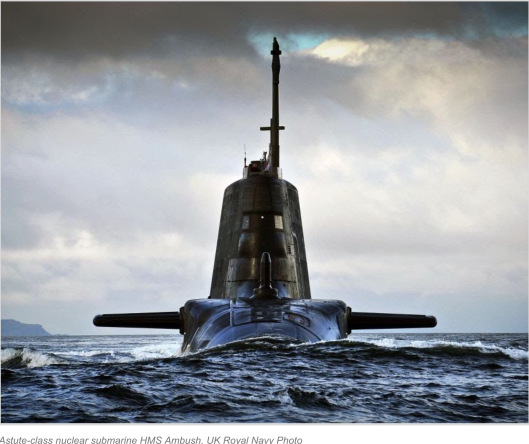 ‘vulnerable to catastrophic hack’ Thinktank sceptical about MoD assurances, saying cyber-attack could lead even to ‘exchange of nuclear warheads’, Guardian, Ewen MacAskill, 1 June 17, The UK’s Trident submarine fleet is vulnerable to a “catastrophic” cyber-attack that could render Britain’s nuclear weapons useless, according to a report by a London-based thinktank.
The 38-page report, Hacking UK Trident: A Growing Threat, warns that a successful cyber-attack could “neutralise operations, lead to loss of life, defeat or perhaps even the catastrophic exchange of nuclear warheads (directly or indirectly)”.
The Ministry of Defence has repeatedly said the operating systems of Britain’s nuclear submarines cannot be penetrated while at sea because they are not connected to the internet at that point.
But the report’s authors, the British American Security Information Council (Basic), expressed scepticism.
“Submarines on patrol are clearly air-gapped, not being connected to the internet or other networks, except when receiving (very simple) data from outside. As a consequence, it has sometimes been claimed by officials that Trident is safe from hacking. But this is patently false and complacent,” they say in the report.
Even if it were true that a submarine at sea could not be attacked digitally, the report points out that the vessels are only at sea part of the time and are vulnerable to the introduction of malware at other points, such as during maintenance while docked at the Faslane naval base in Scotland.
The report says: “Trident’s sensitive cyber systems are not connected to the internet or any other civilian network. Nevertheless, the vessel, missiles, warheads and all the various support systems rely on networked computers, devices and software, and each of these have to be designed and programmed. All of them incorporate unique data and must be regularly upgraded, reconfigured and patched.”
The report comes after the cyber-attack last month that disrupted the NHS, which uses the same Windows software as the Trident submarines. There was speculation too that the US used cyberwarfare to destroy a North Korean missile test. A Trident test-firing of a missile last year off the coast of Florida also went awry, with no official explanation given…….
Abaimov said: “There are numerous cyber vulnerabilities in the Trident system at each stage of operation, from design to decommissioning. An effective approach to reducing the risk would involve a massive and inevitably expensive operation to strengthen the resilience of subcontractors, maintenance systems, components design and even software updates. If the UK is to continue deploying nuclear weapon systems this is an essential and urgent task in the era of cyberwarfare.”
The report’s authors estimate that the capital costs for the UK government to improve cybersecurity for the Trident programme would run to several billions of pounds over the next 15 years.
The report is to be published on the Basic website.https://www.theguardian.com/uk-news/2017/jun/01/uks-trident-nuclear-submarines-vulnerable-to-catastrophic-hack-cyber-attack
The most likely target areas in USA, in the event of a nuclear war
Here are the cities most likely to get struck in a nuclear attack by Russia, Business Insider ALEX LOCKIE, JUN 1, 2017 Ever since the Cold War, the US and Russia have drawn up plans on how to best wage nuclear war against each other — but while large population centres with huge cultural impact may seem like obvious choices, a smart nuclear attack would focus on countering the enemy’s nuclear forces.
So while people in New York City or Los Angeles may see themselves as the center of the world, in terms of nuclear target priorities, they’re not as important as places like North Dakota or Montana.
Stephen Schwartz, author of “Atomic Audit: The Costs and Consequences of US Nuclear Weapons Since 1940,” says that since the Cold War, the US and Russia have shifted from targeting each other’s populous cities to simply targeting each other’s nuclear stockpiles.
Check out the map below to see the essential points where Russia would have to attack to wipe out the US’s nuclear forces.

The above map represents an all out attack on the US’s fixed nuclear infrastructure, weapons, and command and control centres, but even a massive strike like this wouldn’t guarantee anything……..https://www.businessinsider.com.au/likely-us-nuclear-targets-2017-5?r=US&IR=T
Read more at https://www.businessinsider.com/likely-us-nuclear-targets-2017-5#2CT8hL0vtYLjUmlp.99
Nuclear Missile Defense is far from a perfect solution
This successful nuclear missile defense test doesn’t mean the US is safe from nuclear attacks, Washington Examiner by Tom Rogan | May 30, 2017 The U.S. Missile Defense Agency is watching its computer screens carefully, with fingers crossed.
Earlier Tuesday afternoon, the agency successfully tested its Inter-Continental Ballistic Missile midcourse missile-defense system. The test involved an interceptor ”kill vehicle” destroying a pretend ICBM plus warhead nuclear missile in outer space. In this case, over the Pacific Ocean.
That’s a fancy way of saying the system can stop a nuclear missile from hitting its target after the nuke has been fired.
It’s a big moment. Previous tests have had mixed success, and the Pentagon will be very relieved this one succeeded. Still, when it comes to missile defense tests, the devil is in the data. Specialists will be nervously trawling over the data to see how well the interceptor performed. They know the threat posed by North Korea’s ballistic missile program is growing rapidly. To justify their vast budget ($8.2 billion in the 2017 fiscal year), the agency is under huge pressure to deliver results.
That said, Tuesday’s success was expected. For one, the interceptor’s ”exo-atmospheric kill vehicle” (the interceptor element that slams into the enemy missile) employed today is new. As missile expert Laura Grego, explains, this particular kill vehicle has advanced thrusters that allow for very fine-tuned adjustments just before impact. Dealing with missiles flying through space at thousands of miles an hour, kill-vehicle calculations must be precise.
Nevertheless, we need to be careful here. Missile defense is far from a perfect solution.
For a start, interceptor systems remain in their infancy. They have not been tested against the high-end countermeasure technologies with which world powers equip their nuclear missiles. That speaks to a broader issue here. Remember, this test was not simply about the U.S. military’s technology-mission requirements. It was also a public relations opportunity, one the Pentagon needed to pass.
Put simply, we are years away from having interceptors that would offer credible deterrence against advanced Russian ICBMs.
But that’s just one issue. Another challenge? Relative numbers. At present, the U.S. has 36 interceptors on the West Coast. Yet the Russians have thousands of nuclear warheads, and the Chinese have hundreds. Even then, with North Korea likely possessing more than 10 nuclear weapons already, its rapidly advancing missile capabilities are a major threat. Once North Korea acquires the ability to build one ICBM plus warhead capability, it will rapidly be able to build many more…….. http://www.washingtonexaminer.com/this-successful-nuclear-missile-defense-test-doesnt-mean-the-us-is-safe-from-nuclear-attacks/article/2624494
1 This Month
23-25 October – on Zoom – World BEYOND War’s annual global conferenc


Shut down the radiation-damaged Heysham nuclear reactors now
To see nuclear-related stories in greater depth and intensity – go to https://nuclearinformation.wordpress.com

Say No to NASA’s Reckless Nuclear Reactor on the Moon
Say No to NASA’s Reckless Nuclear Reactor on the Moon
-
Archives
- October 2026 (170)
- September 2026 (339)
- August 2026 (330)
- July 2026 (355)
- June 2026 (287)
- May 2026 (306)
- April 2026 (356)
- March 2026 (251)
- February 2026 (267)
- January 2026 (308)
- December 2025 (358)
- November 2025 (359)
-
Categories
- 1
- 1 NUCLEAR ISSUES
- business and costs
- climate change
- culture and arts
- ENERGY
- environment
- health
- history
- indigenous issues
- Legal
- marketing of nuclear
- media
- opposition to nuclear
- PERSONAL STORIES
- politics
- politics international
- Religion and ethics
- safety
- secrets,lies and civil liberties
- spinbuster
- technology
- Uranium
- wastes
- weapons and war
- Women
- 2 WORLD
- ACTION
- AFRICA
- Atrocities
- AUSTRALIA
- Christina's notes
- Christina's themes
- culture and arts
- Events
- Fuk 2022
- Fuk 2023
- Fukushima 2017
- Fukushima 2018
- fukushima 2019
- Fukushima 2020
- Fukushima 2021
- general
- global warming
- Humour (God we need it)
- Nuclear
- RARE EARTHS
- Reference
- resources – print
- Resources -audiovicual
- Weekly Newsletter
- World
- World Nuclear
- YouTube
-
RSS
Entries RSS
Comments RSS

