The original treaty [Non-Proliferation Treaty (NPT) ]is quite clear. Article VI reads as follows (emphasis mine):
“Each of the Parties to the Treaty undertakes to pursue negotiations in good faith on effective measures relating to cessation of the nuclear arms race at an early date and to nuclear disarmament, and on a treaty on general and complete disarmament under strict and effective international control.”
The “nuclear club” countries, however, have lately reneged on their end of the “let’s move toward disarmament” plan. The most recent news in the U.S., of course, is that both of our major political partieshave supported a massive, trillion-dollar “modernization” program that would significantly enhance rather than reduce existing stockpiles……..
North Korea Isn’t the Only Rogue Nuclear State Nuclear weapons are about to be made illegal worldwide, but good luck hearing about it at home, Rolling Stone, By Matt Taibbi, 6 July 17, As if the last few years weren’t bad enough, we now have a real nuclear crisis.
North Korea’s loony regime of Kim Jong-un conducted a successful missile launch test – landing about 60 miles south of the Russian city of Vladivostok, according to some reports – marking a frightening nuclear escalation that has heightened tensions across the planet.
That this first serious confrontation in ages is happening now is ironic, given that a little-reported showdown about the use of nuclear power will soon take place in the U.N.
A draft of a U.N. treaty to ban all nuclear weapons is about to be voted on. It has the support of 132 nations and is very likely to pass, at which point the United States will soon once again be in technical violation of a major international agreement, as it long has been with regard to the International Treaty banning land mines.
While practically the ban may not accomplish much, it matters a little when we violate treaties, at least intellectually speaking. North Korea’s violation of similar international agreements is at the crux of the international consensus against allowing the country to have a nuclear program in the first place.
This is what Steve Snyder, the senior fellow on U.S.-North Korea relations for the Council of Foreign Relations, wrote last year about why North Korea must never be allowed to have nukes:
“The United States cannot accept North Korea as a nuclear weapons state for normative reasons; North Korea had signed onto the Non-Proliferation Treaty (NPT) as a non-nuclear state and then abandoned the treaty in order to pursue nuclear capabilities. Tolerating North Korea’s nuclear status would be equivalent to setting a precedent for other NPT signatories to violate the treaty.”
The problem with this argument is that from the point of view of many non-nuclear countries, the United States itself, along with other nuclear club countries (particularly Russia), has been in continuing violation of the original nuclear non-proliferation treaty, as drafted in 1968.
The treaty has been mostly very successful. Since 1970, when it went into effect, only four more countries – Israel, India, Pakistan and North Korea – are known to have developed nuclear weapons, and only one, North Korea, was at any time a signatory.
Israel, India and Pakistan were three of just four U.N. member states to originally refuse to sign the treaty. North Korea, meanwhile, pulled out of the treaty in 2003, almost exactly a year after it was put in the crosshairs by George W. Bush in the infamous “Axis of Evil” speech. It had long been suspected of pursuing a secret development program.
One of the reasons the NPT was long seen as successful is that over the decades, it did inspire the main actors – particularly the United States and Russia – to move toward disarmament. Through a variety of programs, nuclear stockpiles have been drastically diminished, down to about 14,900 warheads worldwide, or two-thirds less than their high point in the mid-Eighties.
Russia and the United States didn’t just reduce their stockpiles out of goodwill. They did so in part because moving toward global disarmament was a major component of the original bargain of the non-proliferation treaty.
The original treaty is quite clear. Article VI reads as follows (emphasis mine):
“Each of the Parties to the Treaty undertakes to pursue negotiations in good faith on effective measures relating to cessation of the nuclear arms race at an early date and to nuclear disarmament, and on a treaty on general and complete disarmament under strict and effective international control.”
The “nuclear club” countries, however, have lately reneged on their end of the “let’s move toward disarmament” plan. The most recent news in the U.S., of course, is that both of our major political partieshave supported a massive, trillion-dollar “modernization” program that would significantly enhance rather than reduce existing stockpiles……..
A lack of dialogue on the nuclear front between Russia and America is an extremely negative development, given that our two countries have nearly blown up the planet by accident multiple times, in underreported incidents.
The most serious of these was probably 1983, when a Soviet satellite mistakenly detected the launch of five American minuteman missiles headed toward Russia. Only the high-stress judgment of a 44-year-old Soviet lieutenant colonel named Stanislav Petrov prevented a massive counter-launch and the probable deaths of millions.
“I had a funny feeling in my gut,” Petrov said years later, explaining his determination that the signal was faulty. “When people go to war, they don’t do it with five missiles.”…….
For Trump, Threats but Few Options in Confronting North Korea, NYT, By DAVID E. SANGER, JULY 4, 2017 When then-President-elect Trump said on Twitter in early January that a North Korean test of an intercontinental ballistic missile capable of reaching the United States “won’t happen!” there were two things that he still did not fully appreciate: how close Kim Jong-un, the North’s leader, was to reaching that goal, and how limited any president’s options were to stop him.
U.S. Confirms North Korea Fired Intercontinental Ballistic Missile, NYT 点击查看本文中文版 By CHOE SANG-HUNJULY 4, 2017 SEOUL, South Korea — The Trump administration on Tuesday confirmed North Korea’s claim that it had launched an intercontinental ballistic missile, and it told Pyongyang that the United States would use “the full range of capabilities at our disposal against the growing threat.”
Russia, China offer plan to ease N.Korea tension, abc news, 4 July 17Russia and China have proposed that North Korea declare a moratorium on nuclear and missile tests while the United States and South Korea refrain from large-scale military exercises.
The call was issued in a joint statement by the Russian and Chinese foreign ministries on Tuesday following talks between Russian President Vladimir Putin and Chinese President Xi Jinping.
The statement came after North Korea tested a missile that flew higher and longer than previous ones, sparking concerns around the world.
Moscow and Beijing suggested that if North Korea halts nuclear and missile tests while the U.S. and South Korea freeze military maneuvers, the parties could sit down for talks that should lead to obligations not to use force and to refrain from aggression………..
North Korea says its latest missile test reached a height of 2,802 kilometers (1,740 miles) and flew 933 kilometers (580 miles) for 39 minutes before falling into the sea.
The country’s Academy of Defense Science said Tuesday in a statement that it was a successful test of an intercontinental ballistic missiles called Hwasong-14.
The statement was distributed by North Korea’s KCNA news service.
The reported trajectory was similar to that announced earlier by U.S., South Korean and Japanese officials, though the U.S. judged it to be an intermediate-range missile.
Either way, it would be a longer and higher flight than similar tests previously reported.
The U.S military says it tracked a North Korean missile for 37 minutes before it landed in the Sea of Japan.
The Hawaii-based U.S. Pacific Command said in a statement Tuesday that an intermediate-range ballistic missile was launched from near an airfield in North Korea.
NORAD, or the North American Aerospace Defense Command, said the missile did not pose a threat to North America.
Experts say the missile could reach a maximum range of 6,700km on a standard trajectory, meaning it would be able to hit Darwin, which is 5,750km from Pyongyang.
David Wright, of the Union of Concerned Scientists, wrote on the organisation’s allthingsnuclear blog that the available figures implied the missile ‘could reach a maximum range of roughly 6,700 km on a standard trajectory’.
North Korea’s missiles tests in 2017: A timeline http://www.straitstimes.com/asia/east-asia/north-koreas-missiles-tests-in-2017-a-timeline, 4 Jul 17 North Korea has conducted missile and nuclear weapons related activities at an unprecedented rate since the beginning of 2017 and is believed to have made some progress in developing intermediate-range and submarine-launched missiles.
Here’s a timeline of the missile launches and tests the regime is known to have carried out this year:
Feb 12, 2017: North Korea fires its first ballistic missile in 2017, in what is seen as a show of force against the leaders of the United States and Japan reaffirming their security alliance. The missile is believed to be a mid-range Rodong or something similar, flying 500km and landing in the East Sea, also known as Sea of Japan.
March 6, 2017: North Korea fires four ballistic missiles, with three falling into Japan’s exclusive economic zone.
April 16, 2017: North Korea fires an unidentified ballistic missile that explodes almost immediately after launch, defying warnings from the Trump administration to avoid any further provocations
April 29, 2017: In an apparent defiance of a concerted US push for tougher international sanctions to curb Pyongyang’s nuclear weapons ambitions, the country test-fires a ballistic missile from the Pukchang region in a north-easterly direction. The missile reaches an altitude of 71 km before disintegrating a few minutes into flight.
May 14, 2017: Only four days after the inauguration of South Korea’s new leader Moon Jae In, North Korea fires a ballistic missile in an apparent bid to test the liberal president and the US, which have both signalled an interest in negotiations to ease months of tensions.
The missile flies for 700km and reaches an altitude of more than 2,000km before landing in the Sea of Japan or East Sea, further and higher than an intermediate-range missile North Korea successfully tested in February from the same region of Kusong, north-west of Pyongyang.
While the US Pacific Command says it does not appear to be an intercontinental ballistic missile, the successful launch of a mid-to-long range missile indicated a significant advance in North Korea’s drive for an intercontinental ballistic missile (ICBM), monitors say.
The North boasts that the launch is aimed at verifying the capability to carry a “large scale heavy nuclear warhead”.
May 22, 2017: North Korea launches medium-range ballistic missile Pukguksong-2, Pyongyang’s state media reported, adding the weapon was now ready to be deployed for military action.
The test sparks a fresh chorus of international condemnation and threats of tougher United Nations sanctions.
May 29, 2017: North Korea fires at least one short-range ballistic missile that lands in the sea off its east coast. The missile is believed to be a Scud-class ballistic missile and flew about 450km. North Korea has a large stockpile of the short-range missiles, originally developed by the Soviet Union.
North Korea is likely showing its determination to push ahead in the face of international pressure to rein in its missile programme and “to pressure the (South Korean) government to change its policy on the North”, South Korea’s Joint Chiefs of Staff spokesman Roh Jae Cheon said.
June 8, 2017: A volley of surface-to-ship cruise missiles are fired off North Korea’s east coast, less than a week after the United Nations expanded sanctions against Kim Jong Un’s regime in response to recent ballistic missile tests.
The short range missiles fly some 200km before falling into the Sea of Japan, says South Korea’s defence ministry.
June 22, 2017: North Korea conducts a “small rocket engine test on or around June 22, the respected 38 North analysis group says, after a US official reportedly suggested the test could be a step to develop an intercontinental ballistic missile (ICBM).
It is not clear whether the test, conducted at the North’s Sohae satellite launch site, involved an ICBM engine.
July 4, 2017: Just days after South Korea President Moon Jae In and US President Donald Trump focused on the threat from Pyongyang in their first summit, North Korea fires a ballistic which flies for 930km and exceeds 2,500km in altitude in 40 minutes before falling into Japan’s exclusive economic zone, Seoul and Tokyo say.
The US military says the missile is an intermediate range ballistic missile and does not pose a threat to North America, but analysts say the missile is able to reach Alaska.
Over 120 Nations At The UN Are About to Ban Nuclear Weaponshttp://www.huffingtonpost.com/entry/over-120-nations-in-the-un-are-about-to-ban-nuclear_us_595aa2c2e4b0326c0a8d1299Ari Beser, ContributorAri is a Getty Images Contributing Photographer, Filmmaker, and Author of The Book ‘The Nuclear Family’ 07/03/2017 Setsuko Thurlow was thirteen years old when the first atomic bomb ever used on people ripped through Hiroshima, including the building she was stationed inside of. She managed to escape the rubble, but she witnessed the skin melt off those who were outside. She saw people clutch their eyes from their sockets, or carry their own intestine. All but two of her classmates were burned to death. She lived to tell the tale, and now she has lived to see the majority of the UN member states unite under a new push to rid the world of nuclear weapons. The question remains, are the nine states who posses them (US, Russia, UK, France, India, Pakistan, Israel, China and North Korea) ready to give them up? (spoiler alert: Of course not).
The exclusion of the 9 nuclear armed states has actually sped up the writing process, with no hardline dissent in the room, the treaty has come to fruition quickly. In the United Nations, language is at the core of every negotiation. UN delegates argue for hours and weave words so definitely, sensitively and strategically to make policy – to enact change – that impacts the world. Member states have together agreed upon words to form treaties that prohibit landmines, cluster bombs, chemical and biological weapons; and other treaties that recognize states, support refugees and lift nations out of poverty. Words make a difference. Words have power. Words tried to stop the US from invading Iraq, and words were spoken to prove why the US should have listened. Now words are being used to confront the last remaining weapon of mass destruction not yet banned, weapons that were made to end the world–nuclear weapons.
Delegates met for one week in March, and will meet in round the clock negotiations until July 7th. Every day, countries like Egypt, Iran and Sweden, who support the treaty, discuss which words will make it in, and which ones will not. The United States and the 8 other nuclear armed states have boycotted the conference, and persuaded their allies, under the so-called nuclear umbrella, to do so as well. It’s expected that over 120 countries will sign on to it. “The majority of the worlds countries have stood up to them and said enough is enough. We will not put the planet at risk anymore, we will not put all human life at risk anymore.” said Ray Acheson a Canadian member of the Women’s International League for Peace and Freedom (WILPF).
Acheson is one of hundreds of civil society members in attendance at the ban treaty negotiations. The International Campaign to Abolish Nuclear Weapons (ICAN) has united almost every anti-nuclear related non-governmental organization to join the fight. They brought the humanitarian impact of nuclear weapons to the forefront of the nuclear disarmament movement, and have propelled these arguments through the UN. ICAN campaigners have descended on New York to lobby member states, dissect the treaty drafts, and persuade delegates to adopt language that will effectively and permanently ban nuclear weapons.
For Dr. Kathleen Sullivan, disarmament educator and anti-nuclear activist, she is more worried about accidents than intentional use, “How many of you made a mistake this week, or had your phone malfunction?” she asked at a First Committee side event in June. “Human beings who make mistakes are monitoring technology that will eventually break. Fallible people are in control of thousands of nuclear missiles on high alert that are armed and ready to go.”
Dr. Sullivan’s fears are not unfounded. “The world, even after a limited use of nuclear weapons could suffer tremendously,” says Dr. Ira Helfand from the Nobel Peace Prize winning International Physicians for the Prevention of Nuclear War (IPPNW). “If nuclear war is waged on populated cities, not only would the climate change as it does when a massive volcano explodes, but it would coat existing agriculture in radioactive isotopes and render it inedible. We only have enough grain stockpiled to sustain life for 3 months.”
“We didn’t wait for murders to stop killing people before we made murder illegal,” said Zia Mian, a nuclear weapons expert and professor at Princeton University who focuses on the Indian/Pakistani conflict. “These weapons are not just wrong. They are illegal. We are saying that these weapons have no place in our wars.”
As of today, no one can be sure of the immediate effects of the treaty. It is clear that the nine nuclear weapons powers will not sign the treaty. They have boycott the negotiations. US ambassador at the UN Nikki Haley said, “As a mom, as a daughter, there is nothing that I want more for my family than a world with no nuclear weapons, but we have to be realistic. Does anyone think North Korea will give up their nuclear weapons?” But one thing is certain — the unprecedented effort of civil society has democratized disarmament, and pushed the majority of the worlds countries to observe the will of the people in an effort to save the planet from the threat of nuclear war.
Ari M. Beser is the grandson of Lt. Jacob Beser, the only U.S. serviceman aboard both bomb-carrying B-29s. He traveled through Japan with the National Geographic Fulbright Fellowship to report on the 70th anniversary of the atomic bombings of Hiroshima and Nagasaki and the fifth anniversary of the Great East Japan earthquake, tsunami, and nuclear meltdowns in Fukushima. He is the Author of The Nuclear Family, and a Getty Images Contributing Photographer.
If you live south of the equator, you don’t. But if you live in the United States, there’s a good chance you live near a facility that houses nuclear weapons.
The fine people over at Real Life Lore produced a video detailing where most of the world’s nuclear facilities are located. There are 10 nuclear weapons facilities spread across ten states here in the U.S., including in Georgia, Texas, North Dakota, and Washington.
If you live in Albuquerque, New Mexico, you might be close to the Kirtland Underground Munitions Maintenance Storage Complex. And if you don’t know about it, you should. There is no known facility on earth that has a higher concentration of nuclear weapons than Kirtland. Taking up more than 301,000 feet underground, can hold up to 3,000 bombs or 19 percent of all of the world’s nukes.
To put this in context, Britain, the world’s third-largest nuclear power after Russia, has just 215 nuclear warheads in its entire arsenal. If Russia wanted to strike a blow to America’s nuclear capabilities, it is likely they’d shoot one of their ICBMs (or a shitload of them) right at Albuquerque.
But don’t worry about that. The Russians are too busy prepping for President Donald Trump’s visit with Vladimir Putin at the G-20 Summit in Hamburg, Germany this week. You’re safe, for now.
That said, you should know where weapons designed to destroy the world are located and your proximity to them. Another fun fact: America stores nukes in other countries, including Italy, where some of located just 43 miles from Venice.
The world’s nuclear arsenal has gradually declined since its peak of nearly 70,000 nuclear warheads in the mid-1980s, but reductions have slowed in recent years. According to a new report by the Stockholm International Peace Research Institute (SIPR), an independent think tank, in 2017, there were approximately 14,935 nuclear weapons, a slight reduction compared with 15,395 in early 2016. The report notes that both the US and Russia have failed to commit to further reductions. Just nine states possessed these weapons: the US, Russia, the UK, France, China, India, Pakistan, Israel, and North Korea.
States with nuclear weapons are spending billions on updating their systems and developing weapons. The US will spend approximately $400 billion over a 10-year period to maintain and modernize its arsenal; the US plans to buy replacement systems and build new nuclear weapon facilities. To maintain strategic parity with the US, Russia is limiting any further reduction in its nuclear arsenal and working to modernize its aging, Soviet-era missiles. The British government is investing £31 billion ($45.2 billion) to maintain its nuclear arsenal, while Pakistan and India are both gradually expanding the size of their nuclear weapon stockpile.
North Korea carried out high-profile tests of its nuclear weapons in the last year. The country has prioritized building a long-range ballistic missile that can deliver a nuclear warhead to the US (experts suggest there’s no independently verified evidence that the country currently has the capability to do so). US president Donald Trump has pressed president Xi Jinping of China to address what Trump called the “growing threat” (paywall) posed by North Korea’s nuclear weapons.
The United Nations drafted the first-ever treaty to ban nuclear weaponslast month. More than 130 countries currently support the initiative that would outlaw nuclear weapons. Unsurprisingly, not one of the nine countries currently possessing nuclear weapons support the proposed measure.
Mr Oldham said for years, anti-independence leaders had stayed away from the commemorations for the victims of the French nuclear weapons tests.
To mark the 51st anniversary of the first test, the president Edouard Fritch sent a minister and in a letter advised Mr Oldham that France was broadening its compensation offer.
Mr Oldham said for years there were undertakings from the French state which were barely followed up.
He also said the gravity of the aftermath of the tests was sinking in and politicians from all camps have used the nuclear issue in their recent campaigns.
“We have been here for so long and we know politicians so well that all I’m awaiting from them is some concrete action,” he said. Roland Oldham said he would like to have dates for when previously rejected claims would be reconsidered as well as recognition of the lasting health problems now emerging among the veterans’ children.
Hit delete on the “right” to nuclear energy in new weapons ban http://thebulletin.org/hit-delete-right-nuclear-energy-new-weapons-ban, Ray Acheson, 2 Jul 17 This week, the UN conference negotiating a nuclear weapons ban released a new draftof the proposed text. The overwhelming majority of participants who reacted spoke favorably of this version, saying it was headed in the right direction and a good basis for further work.
This is welcome news, suggesting that negotiators will reach agreement by July 7 as hoped. However, the introduction of a new paragraph on nuclear energy in the preamble is extremely problematic. This addition affirms the “inalienable right” of states party to develop and use nuclear energy for “peaceful purposes.”
The so-called right to nuclear energy is already enshrined in the existing Nuclear Non-Proliferation Treaty (NPT), and reflects an outdated understanding of the technology’s risks. It is part of an ill-conceived bargain designed to convince countries that don’t already have nuclear weapons not to develop them.
We know that nuclear energy increases proliferation opportunities. All nine nuclear-armed states have used nuclear reactors to create plutonium for their nuclear weapons. In the United Kingdom and France, civilian nuclear energy and military programs overlapped. North Korea and India acquired nuclear weapons through supposedly “peaceful” civilian nuclear programs. Fears about Iran’s nuclear energy program drove a major diplomatic effort to limit its ability to develop nuclear weapons.
We also know that nuclear energy poses grave economic, environmental, humanitarian, safety, and security risks. These are evident in the persistent health impacts of uranium mining and nuclear waste, and in disasters like those that occurred at Chernobyl and Fukushima. The new ban treaty is borne from the urgent need to prevent the catastrophic humanitarian and environmental consequences that would result from a nuclear detonation. It must not, then, reflect a “right” to a technology that can also have devastating radioactive impacts.
The ban treaty may not be able to curb nuclear energy, but it must not give any legitimacy to this failed and destructive technology. Enshrining permission to develop nuclear energy, removed from the context in which this “right” was granted under the NPT, could actually risk establishing a broader right than already exists.
Without the NPT’s conditional framework of IAEA safeguards, which only allows states to develop nuclear energy if they are in compliance with non-proliferation obligations, adding a reference to the “right” to nuclear energy to the new ban treaty suggests that all states have this right, regardless of whether they conform to safeguards or non-proliferation commitments.
To avoid creating this kind of loophole, the focus of the new ban treaty must remain on prohibiting nuclear weapons. Nothing in the other provisions of the new draft precludes peaceful development of nuclear energy. They only prohibit nuclear weapons and nuclear explosive devices. Transplanting language on nuclear energy from the NPT to the new ban treaty only creates legal ambiguities, while being offensive to the victims of nuclear energy accidents. This provision must be deleted.
Forgotten Fact: Russia and China Almost Started a Nuclear War in 1969, National Interest, Kyle Mizokami, 2 Jul 17, In 1969 the two pillars of the communist bloc, the Soviet Union and the People’s Republic of China, nearly went to full-scale war. Years of deteriorating ties between the two countries, once the staunchest of allies, finally led to skirmishing on the long mutual border between the two countries. While tensions were eventually de-escalated, what if the two countries had gone to war?
On March 2, 1969 Soviet troops patrolling Damansky Island (Zhenbao) on the Ussuri River came under fire from Chinese troops. The attack, just 120 miles from the major Soviet city of Khabarovsk, killed fifty Soviet troops and wounded many more. The Moscow believed that the attack was premeditated, with Beijing bringing in a special combat unit to ambush Soviet forces. Alleged atrocities against wounded Soviet troops made the Soviet leadership furious.
Soviet border guards counterattacked Chinese forces in and around the island on March 15, according to the CIA killing “hundreds” of Chinese troops. Clashes continued through the spring and summer, and by August, CIA director Richard Helms had informed the press that the Soviet leadership had been discreetly inquiring with foreign governments about their opinion on a preemptive strike on China………
The de-escalation of the Sino-Soviet crisis in 1969 avoided what could have been yet another large, destructive war of the twentieth century. The current friendship between Moscow and Beijing is a reflection of that crisis and the realization that it’s much better for both countries to be allies than enemies. This is particularly in Moscow’s interests: given Beijing’s rapid military and economic progress over the past thirty years, next time, the Kremlin may find the tables turned. http://nationalinterest.org/blog/the-buzz/forgotten-fact-russia-china-almost-started-nuclear-war-1969-21398
JFK Had a Super Secret Nuclear War Bunker in Florida,National Interest, Darien Cavanaugh, 2 Jul 17, This place wouldn’t have survived a direct hit,” Anthony Miller of the Palm Beach Maritime Museum told VisitFlorida.com, Florida’s official Website for promoting tourism.
In December 1960, the SeaBees – the U.S. Navy’s construction force — supposedly began the mundane task of building a munitions depot behind the Coast Guard station on Peanut Island, Florida.
Known as “Operation Hotel,” the SeaBees actually built a secret nuclear fallout shelter for president-elect John F. Kennedy, who often spent his winters at a nearby estate on Palm Beach.
It took the SeaBees less than two weeks to complete the underground bunker, which consisted of a corrugated steel shelter covered with 25 feet of concrete, earth and lead. Official documents referred to the site as “Detachment Hotel,” and the government didn’t formerly acknowledge its existence until 1974……. http://nationalinterest.org/blog/the-buzz/jfk-had-super-secret-nuclear-war-bunker-florida-21406
VIENNA (IDN) – On June 27, the second draft of the “Treaty on the Prohibition of Nuclear Weapons” was released at the United Nations in New York. Delegations from more than 130 States will now work to finalize the treaty text by July 7, 2017.
Nuclear-armed and allied States Boycott The Conference is being boycotted by the five nuclear-weapon States (China, France, Russia, United Kingdom and United States), as well as by four other countries possessing nuclear weapons (India, Israel, North Korea and Pakistan); and by all NATO countries except for the Netherlands, and also by Australia,Japan and South Korea – all of whom rely on US nuclear weapons.
Nuclear Weapon Prohibition Treaty
The draft Nuclear Weapon Prohibition Treaty has 21 operational articles and 24 preambular paragraphs. The preambular paragraphs reflect the broad objectives including global concern about the catastrophic humanitarian consequences that would result from any use of nuclear weapons; the unacceptable risks for all humanity posed by the continued existence of nuclear weapons, including from any nuclear weapon detonation by accident, miscalculation or design; the catastrophic consequences of nuclear weapons that transcend national borders, pose grave implications for human survival and for the health of current and future generations, and have a disproportionate impact on women and girls, as well as on indigenous peoples; and any use of nuclear weapons would be contrary to the rules of international law applicable in armed conflict, and in particular of international humanitarian law.
The draft Treaty preamble recognizes that the Treaty on the Non-Proliferation of Nuclear Weapons (NPT) serves as the cornerstone of the nuclear disarmament and nuclear non-proliferation regime. All countries in the world are members of the NPT except for India, Israel, North Korea and Pakistan. It also affirms the vital importance of the Comprehensive Nuclear-Test-Ban Treaty (CTBT) and its verification regime as a core element of the nuclear disarmament and nuclear non-proliferation regime.
The CTBT has been signed by 183 countries, but its entry into force is held up by 8 countries: China, Egypt, India, Iran, Israel, North Korea, Pakistan and United States. And, the draft Treaty recognizes the key role of the five nuclear-weapon-free zone (NWFZ) treaties of Latin America and the Caribbean, South Pacific, Asia, Africa and Central Asia, which all together have some 110 member States.
The draft Treaty also reaffirms the inalienable right of all States to peaceful uses of nuclear energy – in common with the NPT. Prohibition of nuclear weapons is totally different from outlawing peaceful applications of nuclear energy for electricity generation, agriculture, medicine, science and other civilian uses. Nuclear applications are essential for meeting 8 of the 17 sustainable development goals (SDGs) approved by the UN and in limiting global carbon emissions to below 2% growth.
Principal Legal Obligations
The principal legally binding obligations of the draft nuclear weapon prohibition Treaty are contained in its first four articles.
Article 1 contains the basic obligation for signatory States to never under any circumstances: (a) develop, produce, manufacture, otherwise acquire, possess or stockpile nuclear weapons or other nuclear explosive devices; (b) transfer to any recipient whatsoever nuclear weapons or other nuclear explosive devices or control over such weapons or explosive devices directly, or indirectly; (c) receive the transfer or control over nuclear weapons or other nuclear explosive devices directly, or indirectly; (d) use nuclear weapons; (e) carry out any nuclear weapon test explosion or any other nuclear explosion; (f) assist, encourage, or induce, in any way, anyone to engage in any activity prohibited to a State Party under this Treaty; and (g) seek or receive any assistance, in any way, from anyone to engage in any activity prohibited to a State Party under this Treaty.
Also under Article 1, all signatory States undertake to prohibit and prevent in their territory or at any place under their jurisdiction or control: (a) any stationing, installation or deployment of any nuclear weapons or other nuclear explosive devices; and (b) any nuclear weapon test explosion or any other nuclear explosion.
These prohibitions on nuclear weapons and nuclear testing, including hosting or deploying nuclear weapons on a State party’s territory, are comprehensive and exhaustive. As such, nuclear weapons and related activities would be prohibited, including hosting or relying on foreign nuclear weapons by a State party. The Conference President is wise not to fall into the trap of defining the technical characteristics of a “nuclear weapon”, as that would be a contentious and fruitless exercise. For these reasons, neither the NPT nor the CTBT provide definitions of a nuclear weapon or a nuclear test explosion.
Article 2 calls on States parties to submit Declarations to the UN Secretary-General of the United Nations on: (a) whether they owned or possessed nuclear weapons or nuclear explosive devices and eliminated all such weapons or explosive devices prior to the entry into force of the Treaty; (b) whether all source or fissionable (nuclear) materials on their territory or under their jurisdiction or control are in peaceful use and under International Atomic Energy Agency (IAEA) safeguards.
Article 3 requires all States parties to maintain safeguards obligations currently undertaken pursuant to international legally binding instruments such as the NPT and NWFZs, without prejudice to any higher level of standards that may be adopted in the future.
Article 4 on the total elimination of nuclear weapons requires any State party that owns, possesses or controls nuclear weapons or other nuclear explosive devices to immediately remove from operational status its nuclear weapon systems and destroy as soon as possible any nuclear weapons or nuclear explosive devices it owns, possesses or controls.
Such State party shall submit a time-bound plan for the verified and irreversible destruction of its nuclear weapon programme to be negotiated with the States parties or with a competent authority [to be] designated by the States parties. And, each such State party shall submit annually to the UN Secretary-General a report on the progress made.
Upon the dismantlement of its nuclear weapons or other nuclear explosive devices, such State party shall: (a) bring into force an agreement with the IAEA for the purpose of verification of the fulfilment of its obligations assumed under the Treaty with a view to preventing the diversion of nuclear energy from peaceful uses to nuclear weapons or other nuclear explosive devices, request the IAEA to verify the correctness and completeness of its inventory of nuclear materials, and cooperate with the IAEA in this regard. A competent international authority could be designated in the future to verify the irreversible destruction of nuclear weapon programmes.
Again, the Conference President is wise to call upon the IAEA for verification of nuclear material only and not for verification of dismantlement or destruction of nuclear weapons or nuclear warheads as proposed by some. The IAEA has nearly 60 years of experience in verification of nuclear activities and nuclear materials in peaceful uses, but it has neither the expertise nor the experience for the verification of nuclear disarmament as this is not its principal mandate.
While the IAEA has worked on understanding certain nascent nuclear-weapon development related activities in Iran, Iraq and Libya, and verified South Africa’s nuclear material following destruction of its 6 nuclear weapons by South Africa itself; the IAEA has had no experience in nuclear disarmament verification of mature nuclear weapon programmes and deployed arsenals.
In fact, international verification of nuclear warhead disarmament is a bridge too far – even Russia and the US have no such experience; they only verify destruction of missiles and bombers as part of their arms reduction treaties. Efforts to devise a multilateral nuclear disarmament verification regime are unlikely to be successful and would end up as an exercise in vain.
Other articles of the draft Treaty concern assistance to victims of nuclear weapon use and testing programmes, unlimited duration of the treaty, and entry into force after 50 States have ratified – this is 10 more than what was required for the NPT.
The Way Forward
With only seven working days left before the conclusion of the UN Conference on prohibition of nuclear weapons on July 7, it is now up to all participating States and CSOs to reach for practical achievable results, to support the President’s draft Treaty and avoid introducing amendments or additional articles.
Sometimes “less is more” and this certainly is the case for the nuclear weapon prohibition treaty. Credit must be accorded to the Conference President and States such as Austria, Ireland, Sweden andSwitzerland for seeking a practical and realistic treaty. Countries of the Non-Aligned Movement (NAM), CSOs and others should rally behind the President and finalize the draft Treaty pretty much “as is” rather than strive for making the best the enemy of the good!
*Tariq Rauf was Head of Verification and Security Policy Coordination at the International Atomic Energy Agency from 2002-2011. Presently he is a consulting advisor with the Comprehensive Nuclear-Test-Ban Treaty Organization in Vienna. Only personal views are expressed here. [IDN-InDepthNews – 29 June 2017]
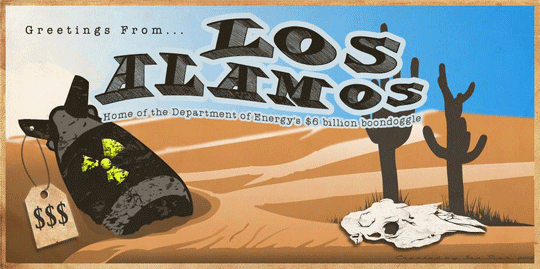
A separate Defense Nuclear Facilities Safety Board report in February detailed the magnitude of the shortfall:
Los Alamos’ dangerous work, it said, demands 27 fully qualified criticality safety engineers.
The lab has 10
Safety problems at a Los Alamos laboratory delay U.S. nuclear warhead testing and production A facility that handles the cores of U.S. nuclear weapons has been mostly closed since 2013 over its inability to control worker safety risks, Science, By The Center for Public Integrity, R. Jeffrey Smith, Patrick MalonJun. 30, 2017
In mid-2013, four federal nuclear safety experts brought an alarming message to the top official in charge of America’s warhead production: Los Alamos National Laboratory, the nation’s sole site for making and testing a key nuclear bomb part, wasn’t taking needed safety precautions. The lab, they said, was ill-prepared to prevent an accident that could kill lab workers, and potentially others nearby.
Some safety infractions had already occurred at the lab that year. But Neile Miller, who was then the acting head of the National Nuclear Security Administration in Washington, says those experts specifically told her that Los Alamos didn’t have enough personnel who knew how to handle plutonium so it didn’t accidentally go “critical” and start an uncontrolled chain reaction.
Such chain reactions generate intense bursts of deadly radiation, and over the last half-century have claimed nearly two dozen lives. The precise consequences, Miller said in a recent interview, “did not need an explanation. You don’t want an accident involving criticality and plutonium.” Indeed, Miller said, criticality “is one of those trigger words” that immediately gets the attention of those responsible for preventing a nuclear weapons disaster.
With two of the four experts remaining in her Washington office overlooking the national mall, Miller picked up the phone and called the lab’s director, Charles McMillan, at his own office on the idyllic Los Alamos campus in the New Mexico mountains, where nuclear weapons work is financed by a federal payment exceeding $2 billion a year. She recommended that a sensitive facility conducting plutonium operations — inside a building known as PF-4 — be shut down, immediately, while the safety deficiencies were fixed.
McMillan, a nuclear physicist and weapons designer with government-funded compensation exceeding a million dollars a year, responded that he had believed the problems could be solved while that lab kept operating. He was “reluctant” to shut it down, Miller recalled. But as the call proceeded, he became open to her view that the risks were too high, she added. So on McMillan’s order, the facility was shut within a day, with little public notice.
In the secrecy-shrouded world of America’s nuclear weapons work, that decision had far-reaching consequences. Continue reading →