Trident won’t protect us from terrorism. But it will still be renewed, Guardian, Richard Norton-Taylor, 15 July 17 While the biggest future threat to Britain is posed by jihadi groups, voting to keep nuclear weapons is a matter of irrational pride,
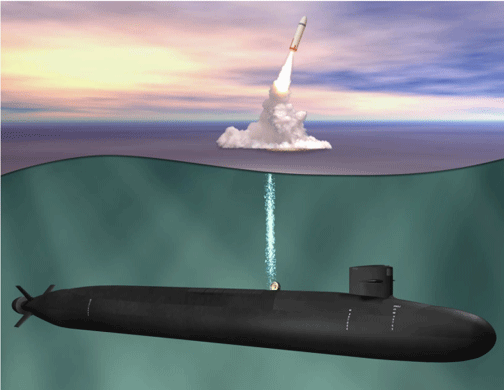
“……..Trident is described as a deterrent. The nuclear missiles will only be fired, and deterrence have failed, if the UK has already been obliterated. The question is not whether Trident – whose missiles are leased from the US and whose warheads rely on US technology – could be used, but whether they would be. And are they actually needed?
Ministers and pro-Trident Labour MPs say a new Trident system is needed because the world is a dangerous place, and will remain so. Trident is the ultimate insurance, they argue. It is an argument devoted uniquely to nuclear weapons. The government is not building new hospitals or care homes, for example, in case of a pandemic or any other crisis affecting the health and wellbeing of its citizens.
Ministers say Putin’s Russia, and China, and North Korea, are posing a growing threat. The suggestion is that only Britain’s nuclear arsenal will deter these countries from launching a massive military attack on the UK. What conceivable interest would these countries have in doing so? If they were mad enough to do so, would Trident be a credible deterrent preventing them? Would there be any point in a retaliatory attack in the event of the Trident deterrent having failed?
Much more of a threat from these countries are massive cyber attacks. But the greatest threat to Britain’s security, and the government says it will be for a generation, is terrorism, in particular radical jihadi groups. Trident long-range inter-continental missiles with nuclear warheads are hardly a deterrent against them. The real danger is that they will get their hands on some of the nuclear material kept in less-than-safe stockpiles scattered around the world…..
Monday’s vote appears to be a foregone conclusion. Ministers, backed by the Whitehall establishment, will argue that with Trident Britain will count as much in the world as it ever did, despite Brexit. It is also a matter of British pride; Trident is worth the expense to remain a member of the nuclear club. https://www.theguardian.com/commentisfree/2016/jul/15/trident-protection-terrorism-renewed-threat
North Korea may have more nuclear bomb material than thought: U.S. think tank, David Brunnstrom and Matt Spetalnick WASHINGTON (Reuters) JULY 14, 2017 – Thermal images of North Korea’s main nuclear site show Pyongyang may have reprocessed more plutonium than previously thought that can be used to enlarge its nuclear weapons stockpile, a U.S. think tank said on Friday.
The analysis by 38 North, a Washington-based North Korean monitoring project, was based on satellite images of the radiochemical laboratory at the Yongbyon nuclear plant from September until the end of June, amid rising international concerns over North Korea’s nuclear and missile programs.
The think tank said images of the uranium enrichment facility at Yongbyon could also indicate operation of centrifuges that could be used to increase North Korea’s stock of enriched uranium, its other source of bomb fuel.
There were signs too of at least short-term activity at North Korea’s Experimental Light Water Reactor that could be cause for concern, 38 North said.
The images of the radiochemical laboratory showed there had been at least two reprocessing cycles not previously known aimed at producing “an undetermined amount of plutonium that can further increase North Korea’s nuclear weapons stockpile,” something that would worry U.S. officials who see Pyongyang as one of the world’s top security threats.
It was unclear if the thermal activity detected at the uranium plant was the result of centrifuge operations or maintenance………
It’s true that life underground after nuclear war would be a step down from the utopian existence currently lived by the super rich. But it would be immeasurably better than the hellscape populated by those left above, who would face radiation sickness, climatic disruption, virulent plagues, mass starvation, and the complete collapse of law and order. There would be no comparison between the catastrophe above and the plush if somewhat claustrophobic life of the wealthy below. The post-apocalyptic divide would be an extreme, almost absurdist example of inequality…also a fairly logical extension of the present state of affairs.
……..Economic justice—redistribution and reinvestment—would lower the risk of nuclear war because the two issues are inextricably linked
Income Inequality Will Survive the Nuclear Apocalypse The class responsible for the lucrative rush to war can literally buy its way out of annihilation, thanks to the boom in luxury bunkers.New Republic, BY JOHN CARL BAKER, July 14, 2017
A decommissioned nuclear bunker “deep inside a granite mountain” in Switzerland has been put up for sale, according to the Financial Times. Fully hardened against an electromagnetic pulse, the 15,000-square-foot military facility sleeps 1,500 people and features “vehicular tunnels, reservoirs and ‘limitless’ digital bandwidth”—and though the price is secret, the amount is surely obscene. “Your casual nuclear bunker enthusiast,” Judith Evans writes, “need not apply: potential purchasers must demonstrate the capacity to spend £25m before they can receive any further information, including any details of the bunker’s location.” Presumably that knowledge must be closely guarded from the irradiated hordes of our dystopian future.
Today, nuclear tensions arerising along with profits, but the class responsible for this lucrative rush to war has little reason to fear. It can literally buy its way out of annihilation.
The most famous owner of a bomb shelter today is none other than Donald Trump, whose private club in Florida, Mar-a-Lago, has three of them. They were added by cereal heiress Marjorie Merriweather Post during the Korean War, but Trump decided to use them for storage—and his butler’s office—after purchasing the Palm Beach estate in 1985. Those shelters are relics of the Cold War, but renovated and newly built bunkers have become popular with Trump’s compatriots in the upper crust. Which is only fitting, since he’s partly responsible for the boom: As the Independentreported earlier this year, “Americans [are] building doomsday bunkers in ‘record numbers’ since Donald Trump’s election.”
Surviving the nukepocalypse in style, while the world burns above, does not come cheap. The Survival Condo Project charges $4.5 million for a two-level penthouse bunker; if you need to economize, there are half-floor units for a reasonable $1.5 million. (The entire compound—a former Atlas missile silo—is currently sold out, but the company is already developing a second location.) CEO Larry Hall claims his compound can support 75 people living entirely off the grid for 5 years—and in theory, could “function indefinitely” through hydroponics and underground fish farming.
…. The facility has a well-stocked armory, a sniper post, and, per their website, “a military grade security system that includes visible spectrum cameras, infrared cameras, proximity sensors, microphones, trip sensors, passive detectors, as well as confidential defensive systems both automated and manually operated.” If the wretched of the scorched earth miraculously make it through all of that, they will then face walls up to nine feet thick, plus a series of blast doors “designed to withstand sizeable explosives.” Now that’s a gated community…….
It’s true that life underground after nuclear war would be a step down from the utopian existence currently lived by the super rich. But it would be immeasurably better than the hellscape populated by those left above, who would face radiation sickness, climatic disruption, virulent plagues, mass starvation, and the complete collapse of law and order. There would be no comparison between the catastrophe above and the plush if somewhat claustrophobic life of the wealthy below. The post-apocalyptic divide would be an extreme, almost absurdist example of inequality…also a fairly logical extension of the present state of affairs.
U.S., UK and France Denounce Nuclear Ban Treaty, CounterPunch, byDAVID KRIEGER, JULY 13, 2017“…….In a joint press statement, issued on July 7, 2017, the day the treaty was adopted, the U.S., UK and France stated, “We do not intend to sign, ratify or ever become party to it.” Seriously? Rather than supporting the countries that came together and hammered out the treaty, the three countries argued: “This initiative clearly disregards the realities of the international security environment.” Rather than taking a leadership role in the negotiations, they protested the talks and the resulting treaty banning nuclear weapons. They chose hubris over wisdom, might over right.
They based their opposition on their belief that the treaty is “incompatible with the policy of nuclear deterrence, which has been essential to keeping the peace in Europe and North Asia for over 70 years.” Others would take issue with their conclusion, arguing that, in addition to overlooking the Korean War and other smaller wars, the peace in Europe and North Asia has been kept not because of nuclear deterrence but in spite of it.
The occasions on which nuclear deterrence has come close to failure, including during the Cuban missile crisis, are well known. The absolute belief of the U.S., UK and France in nuclear deterrence seems more theological than practical……
The three countries reiterate their commitment to the Non-Proliferation Treaty (NPT), but do not mention their own obligation under that treaty to pursue negotiations in good faith for an end to the nuclear arms race at an early date and to nuclear disarmament. ….
If the U.S., UK and France were truly interested in promoting “international peace, stability and security” as they claim, they would be seeking all available avenues to eliminate nuclear weapons from the world, rather than planning to modernize and enhance their own nuclear arsenals over the coming decades.
These three nuclear-armed countries, as well as the other six nuclear-armed countries, continue to rely upon the false idol of nuclear weapons, justified by nuclear deterrence. In doing so, they continue to run the risk of destroying civilization, or worse.
The 122 nations that adopted the nuclear ban treaty, on the other hand, acted on behalf of every citizen of the world who values the future of humanity and our planet, and should be commended for what they have accomplished.
The new treaty will open for signatures in September 2017, and will enter into force when 50 countries have acceded to it. It provides an alternative vision for the human future, one in which nuclear weapons are seen for the threat they pose to all humanity, one in which nuclear possessors will be stigmatized for the threats they pose to all life. Despite the resistance of the U.S., UK and France, the nuclear ban treaty marks the beginning of the end of the nuclear age.
Why we will all learn to live with a North Korean ICBM, Channel News Asia, 13 Jul 17Despite all the talk that North Korea’s ICBM test launch may provoke military action, Robert E Kelly argues that regional countries have no choice but to live with the situation.
“………….SOUTH KOREA’S VETO AGAINST MILITARY FORCE
this ICBM test launch will not lead to a strike, despite all the talk about how it is a game-changer.
The most important reason is not strategic but political. Any kinetic action by the US against North Korea would risk substantial retaliation, likely targeted at US allies South Korea and Japan.
Yes, Alaska may be within Pyongyang’s missile range. But North Korea could strike with far greater force and flexibility in the region. Its many missile tests into the Sea of Japan over the last year are almost certainly intended to signal to Japan that it too is in the firing line. But of course, it is South Korea that is most vulnerable.
Any US strike against the North would require, both politically and morally, the assent of the Japanese and especially the South Korean government. Politically, a strike without their assent would almost certainly terminate the alliances at once, since South Korean and Japanese populations and cities would likely face devastating retaliation after a US strike. If they did not have the right to consent to the risk of that strike, why would they stay in alliance with the US?.
Morally, it would be astonishingly callous for a democracy like the US to gamble millions of lives without even soliciting Japanese and South Korean assent.
So even Donald Trump, for all his bluster, is not going to attack North Korea without South Korean and Japanese approval…….
If kinetic options are not on the table, what other choices are there as the “impossible state” progresses toward a nuclear missile that can strike the lower 48 states of the US?
14 July 2017 | As tensions build around the world, many countries have begun beefing up their defense capabilities to prepare for a nuclear threat.
But, experts warn the repercussions of a blast won’t just be limited to the site of a nuclear strike – instead, such an event could cause global devastation.
A new report found that warheads of magnitudes already owned by several major nuclear powers could trigger climate change as the resulting black ash causes temperatures to drop, leading to drought, famine, and billions of deaths. The researchers from the University of Nebraska-Lincoln investigated 19 types of weapons currently held by five major nuclear powers: the US, Russia, China, the United Kingdom, and France.
According to the report, it would take just a handful of these bombs to bring on disastrous effects that would ripple worldwide.
‘We’re losing our memory of the Cold War and we’re losing our memory of how important it is to get this right,’ said co-author Tyler White, a political scientist who specializes in international security and nuclear policy.
‘Even a conflict that doesn’t involve the United States can impact us and people around the world.’
With just three 1.2-megaton (MT) bombs, or two Trident D5 SLBM (each with four 475-KT warheads), the US could bring on a nuclear-drought, the researchers warn.
Only four 800-KT Russian ICBMs or ten 300-KT French gravity bombs would be needed to cause similar climatic effects.
And, China could bring on the phenomenon with just one 5-MT land-based missile, which would burn an area ‘similar in size to that of one hundred 15-KT explosions.’
‘Thus, use of as few as 1 to 10 deployed nuclear weapons, and fewer than 25 of these prevalent types, from the five official nuclear weapons countries could produce a nuclear drought,’ the researchers warned in the new report.While the effects wouldn’t be as dramatic as those predicted in a ‘nuclear winter’ scenario, the resulting drought – also known as nuclear autumn – could have significant impacts around the world, the researcher say.
‘The question is not if a nuclear drought can occur, but what factors increase its probability of occurring and what actions can be taken to mitigate the potentially devastating global impacts,’ said Adam Liska, a biological systems engineer at Nebraska.
Previous research determined that a blast capable of igniting an area of about 1,300 square kilometers (500 square miles), would pump over 5 million tons of ash into the stratosphere.
And, this would block out sunlight, causing temperature and rainfall to drop.
‘If the ash reaches the stratosphere, many months could pass before it dissipates,’ said Robert Oglesby, a professor of Earth and atmospheric sciences.
The researchers say these high quantities of black carbon in the stratosphere would cause agricultural growing seasons to be reduced by 10-40 days each year for at least five years.
Below average temperatures would persist for far longer, potentially remaining low for up to 25 years.
And, immediately after the blast, temperatures could drop to levels colder than they’ve been in the last 1,000 years.
The nuclear drought would cause a significant decrease in precipitation in the Asian monsoon region, by as much as 20-80 percent, and reductions in rainfall across South America and southern Africa, the American Southwest, and Western Australia could cause the regions to be 20-60 percent drier than usual.
‘Climatic changes due to nuclear explosions on developed land could essentially produce a global “nuclear drought,” and the resulting famines could kill up to a billion people from starvation, which would probably most affect those communities that are already in food-insecure environments in the developing world, particularly in sub-Saharan Africa, South Asia, and the Middle East,’ the researchers wrote.
‘Significant changes in precipitation would probably also increase conflict in developing regions, although global temperature reductions may reduce social violence in the United States and Other developed countries.’
The researchers note that the risk of widespread consequences kept the US and the Soviet Union in check during the Cold War.At the time, each nation recognized that a nuclear attack from either side would cause ultimately mutual destruction.
With the new analysis, the researchers say countries can make more informed decisions in light of recent threats from North Korea.
‘We pulled together what is known about nuclear weapons today, to make a case about the magnitude of these impacts,’ Liska said.
‘With that understanding, we can make better choices going forward.’
Tipping point for nuclear war’ – North Korea lashes out after US practice bombing run, Telegraph UK, Our Foreign Staff9 JULY 2017 North Korea on Sunday lashed out at a live-fire drill the US and South Korea staged in a show of force against Pyongyang, accusing Washington of pushing the peninsula to the “tipping point” of nuclear war.
The allies held the rare live-fire drill as tensions grew over the peninsula following the North’s first intercontinental ballistic missile (ICBM) test held last week. The test sparked global alarm as it suggested North Korea now possessed an ICBM capable of reaching Alaska, a major milestone for the reclusive, nuclear-armed state.Saturday’s drill, designed to “sternly respond” to potential missile launches by the North, saw two US bombers destroy “enemy” missile batteries and South Korean jets mount precision strikes against underground command posts.
The North’s state-run Rodong newspaper accused Washington and Seoul of ratcheting up tensions with the drill, in an editorial titled “Don’t play with fire on a powder keg.”
“The US, with its dangerous military provocation, is pushing the risk of a nuclear war on the peninsula to a tipping point,” it said, describing the peninsula as the “world’s biggest tinderbox.”During Saturday’s drill, long-range B-1B Lancer bombers reportedly flew close to the heavily-fortified border between two Koreas and dropped 2,000-pound (900 kilogram) bombs.
Pyongyang described the joint drill as a “dangerous military gambit of warmongers who are trying to ignite the fuse of a nuclear war on the peninsula.”
Rare footage show the nightmare aftermath of Hiroshima after atomic bomb killed 140,000 people
Setsuko Thurlow, who survived the Hiroshima blast, was a 13-year-old schoolgirl when she was near to the hypocentre of the explosion on August 6, 1945.
“I have been waiting for this day for seven decades and I am overjoyed that it has finally arrived,” she told the Japan Times. “This is the beginning of the end of nuclear weapons.”
Recounting what happened in the aftermath to survivors, she said: “Their hair was standing on end — I don’t know why — and their eyes were swollen shut from the burns. Some peoples’ eyeballs were hanging out of the sockets. Some were holding their own eyes in their hands. Nobody was running. Nobody was yelling. It was totally silent, totally still. All you could hear were the whispers for ‘water, water.’
“How do you describe a hell on Earth?”
Toshiki Fujimori, assistant secretary-general of the Japan Confederation of A- and H-Bomb Sufferers Organisations also hailed the adoption of the treaty.
“I never would imagine this treaty was going to be concluded,” he said. “I think it is the collective effort of the humanity of all the people that came together here at the United Nations.”
The United Nation’s first-ever adoption of the nuclear weapons ban was agreed by a total of 122 countries, with only the Netherlands opposed and Singapore abstaining.
Dutch foreign affairs minister Bert Koenders said the Netherlands supported the ban on nuclear weapons but was concerned over issues with the resolution itself. Particularly, how checks and controls would be adhered to.
Costa Rican Ambassador Elayne Whyte Gomez, president of the UN conference on prohibiting nuclear weapons was jubilant. “We all feel very emotional today. We feel that we are responding to the hopes and to the dreams of present and future generations — that we undertake our responsibility as a generation to do whatever is in our hands to achieve and to move the world toward the dream of a world free of nuclear weapons.”
The treaty will enter into force three months after the document is ratified by 50 countries. It is legally binding for an unlimited period. The text of the charter also bans threats to use nuclear weapons.
In direct reference to A-bomb survivors, victims of the atrocity, which killed more than 140,000 people, will be provided with medical care and rehabilitation.
However, none of the countries known or believed to have nuclear weapons – the US, Britain, Russia, North Korea , France, India, Pakistan, and Israel — is backing the pact.
Nikki Hayley, the US Ambassador, agreed in principle on the ban but suggested “we have to be realistic”, according to Timemagazine.
She added that North Korea would be “cheering” such a ban on nuclear weapons, leaving US residents at risk.
A Treaty Is Reached to Ban Nuclear Arms. Now Comes the Hard Part, NYT, By RICK GLADSTONE JULY 7, 2017 For the first time in the seven-decade effort to avert a nuclear war, a global treaty has been negotiated that proponents say would, if successful, lead to the destruction of all nuclear weapons and forever prohibit their use.
UN: Nuclear weapons ban is an antidote to cynical brinkmanship, Amnesty International, 7 July 2017 Following the United Nations’ adoption of a new global treaty outlawing nuclear weapons, James Lynch, Head of Arms Control and Human Rights at Amnesty International, said:
“This historic treaty brings us a step closer to a world free from the horrors of nuclear weapons, the most destructive and indiscriminate weapons ever created. All states should give their full backing to this antidote to the cynical brinkmanship embodied in the development, stockpiling or use of nuclear weapons.
“The immediate and strong global condemnation of North Korea’s testing of nuclear-capable missiles earlier this week gives a sense of how high the stakes are – everybody knows it is in nobody’s interest for a single nuclear warhead to be detonated, ever.
“Today’s vote shows that a majority of states consider a global prohibition on nuclear weapons to be the best option for protecting the world from their catastrophic effects. And it shows once again how a strong civil society-led effort can inspire real change on the world stage.
“We are opposed to the use, possession, production and transfer of nuclear weapons by any country, including permanent members of the UN Security Council, and so it was deeply disappointing to see that these, and other nuclear-armed states, failed to back the treaty. We are calling on them to take a stand for human rights and humanity by joining the ban treaty.”….. https://www.amnesty.org/en/latest/news/2017/07/un-nuclear-weapons-ban-is-an-antidote-to-cynical-brinkmanship/
As US and North Korea Escalate Tensions, Saner Voices Call for ‘Engagement and Dialogue’
‘The U.S. military drills are a reminder that both sides are acting to escalate this crisis,” says Campaign for Nuclear Disarmament, by Common Dreams by Andrea Germanos, staff writer, July 05, 2017As tensions continue to rise following Pyongyang’s testing of an intercontinental ballistic missile (ICBM) and subsequent military exercises carried out by the U.S. and South Korea, anti-war voices are calling de-escalation and restraint, with one advocacy group charging Wednesday that “both sides are acting to escalate the crisis” and that only way forward is through diplomacy.
Rising tensions were evident on Wednesday as U.S. Ambassador to the United Nations Nikki Haley addressed the U.N. Security Council. “Time is short. Action is required,” Haley said as she also threatened possible use of “considerable military forces” to address the situation.
“We condemn the missile test and we urge the DPRK government to put an end to further missile tests. The U.S. military drills are a reminder that both sides are acting to escalate this crisis.”
—Kate Hudson, Campaign for Nuclear DisarmamentThe London-based Campaign for Nuclear Disarmament (CND), however, pointed to the Iran nuclear deal reached in 2015 as evidence that diplomacy can deliver meaningful results.
“We condemn the missile test and we urge the DPRK government to put an end to further missile tests. The U.S. military drills are a reminder that both sides are acting to escalate this crisis,” said CND general secretary Kate Hudson.
“We call on the international community to strengthen efforts to seek an end to the growing tensions in the region,” she said. Referring to now-collapsed six-party negotiations aimed at Pyongyang’s nuclear disarmament—which involved the U.S., North Korea, South Korea, Japan, Russia, and China—Hudson said those talks “need to be resumed as a matter of urgency. The Iran nuclear deal shows what can be achieved through engagement and dialogue.”
“Russia and China are promoting a joint freeze on North Korean missile tests and further U.S. and South Korean military drills. The British government should support this initiative, which acknowledges the security fears on both side of the conflict,” Hudson added.
As Martin Hart-Landsberg, former economics professor and member of the Board of directors of the Korea Policy Institute, wrote last month, “it is important to realize that what is happening is not new.” He wrote:
The U.S. began conducting war games with South Korean forces in 1976 and it was not long before those included simulated nuclear attacks against the North, and that was before North Korea had nuclear weapons. In 1994, President Bill Clinton was close to launching a military attack on North Korea with the aim of destroying its nuclear facilities. In 2002, President Bush talked about seizing North Korean ships as part of a blockade of the country, which is an act of war. In 2013, the U.S. conducted war games which involved planning for preemptive attacks on North Korean military targets and “decapitation” of the North Korean leadership and even a first strike nuclear attack.
Given that background Christine Ahn, founder and international coordinator of peace group Women Cross DMZ, toldDemocracy Now! Wednesday that Pyongyang likely conducted the missile test “as a way to advance their capability to defend in the case of any kind of preemptive strike from the United States.” According to Ahn, the North Koreans “want to put the pressure on the United States, on the Trump administration, to say, ‘We need to negotiate some kind of peace settlement,’ because they feel threatened.”
Poised to outlaw nuclear weapons for the first time http://thebulletin.org/poised-outlaw-nuclear-weapons-first-time, Tim Wright, 5 July 17This Friday at the United Nations, an overwhelming majority of the world’s nations will decide—by acclamation or vote—whether to adopt a treaty to prohibit nuclear weapons. Since June 15, they have been intensively negotiating its various provisions. Their aim: a robust, effective instrument that will lead us toward the total elimination of these abhorrent weapons.
Civil society organizations—groups outside of government and business working in the interests of citizens—were pivotal in bringing about this historic treaty-making process, and have helped shape governments’ negotiating positions throughout.
Hundreds of campaigners have met with diplomats in New York and officials in capitals around the world in an effort to strengthen the draft text of what promises to be a landmark international agreement.
Many thousands of ordinary citizens—gravely concerned about the looming specter of nuclear war—have taken to the streets to voice their support for the ban, mostly in nations that have refused to join the negotiations. And more than three million people have signed a petition (link in Japanese), initiated by Hiroshima and Nagasaki survivors, urging states to adopt a strong treaty.
The negotiations are part of a broader “humanitarian disarmament” agenda that places human beings at its center and challenges abstract notions such as deterrence and geostrategic stability—which have long dominated discussions on nuclear weapons and entrenched the dangerous status quo. Morality and ethics have, at last, entered the diplomatic discourse on this subject.
Humanitarian concerns feature prominently in the draft preamble of the treaty, which acknowledges “the unacceptable suffering of and harm caused to the victims of the use of nuclear weapons.” The operative part includes obligations to provide victim assistance and remediate environments contaminated by the use and testing of nuclear weapons.
In presenting a near-final draft of the treaty on Monday, Elayne Whyte Gomez, the Costa Rican ambassador presiding over the negotiations, said: “We have more points of convergence than differences. The text establishes a bridge that reflects the will that the states have expressed at this conference. We need to work hard to have some good news for the world on Friday.”
If consensus cannot be reached, states will have the option to adopt the treaty by vote. It will then open for signature on September 20th in New York, after which states will pursue ratification. Once 50 states have completed this process, the treaty will become binding international law—permanently. Our task then will be to promote its full implementation and universalization.
N.K. might have miniaturized nuke warheads for ICBMs: ex-IAEA official http://english.yonhapnews.co.kr/northkorea/2017/07/06/41/0401000000AEN20170706005700315F.html,2017/07/06 11:07 SEOUL, — A former senior international nuclear watchdog official has raised the possibility of North Korea having nuclear warheads small enough to fit on intercontinental ballistic missiles, a U.S. broadcaster reported Thursday.
It is possible for the North to have held considerably elaborate and miniaturized nuclear warheads with less than 500 kilograms given its technology and manpower, Olli Heinonen, former deputy director-general for safeguards at the International Atomic Energy Agency, told Radio Free Asia. He said that more than a decade has passed since the North conducted its first nuclear test in 2006.
The North has pressed ahead with its nuclear program as a major task, into which it has put talented manpower and huge resources, Heinonen pointed out, while recalling that it has produced plutonium since the 1980s, even before the nuclear test.
However, the North’s ICBM deployment is likely to be possible one or two years from now, he said.
The North’s sixth nuclear test, if carried out, will have an importance more in political purposes than in improving technology, he said.
It may be the last chance to make nuclear negotiations with the North by mobilizing both incentives and restrictions, he added.
Russia’s nuclear submarine test-fires cruise missile successfully in Barents Sea http://news.xinhuanet.com/english/2017-07/05/c_136419955.htm, Editor: Yang Yi MOSCOW, July 5 (Xinhua) –– Russia’s Project 949A submarine Smolensk has carried out a test launch of a cruise missile and successfully hit its designated target during combat drills scheduled in the Barents Sea, the Northern Fleet’s press service said Wednesday.
“A Granit missile was fired against a marine target at depths of about 400 kilometers in the sea. According to the flight recorder’s data, the target was hit successfully,” said Northern Fleet’s spokesman and Captain Vadim Serga.
Built in 1990, Russia’s submarine Project 949A Antey (also known as the Oscar II class submarine) displaces 24,000 tons and has an underwater speed of 32 knots with a crew of 107.
They are armed with 24 launchers of Granit cruise missiles with a range of about 500 km and six torpedo tubes.
Don’t assume Trump is more responsible with nuclear weapons than North Korea, Guardian, Anna Weichselbraun, 6 Jul 17 It’s never been safe to rely on assurances of nuclear deterrence from ‘responsible’ nuclear powers. The US elections are a reminder of that Anna Weichselbraun is a nuclear security postdoctoral fellow at Stanford University’s Center for International Security and Cooperation
Who can be trusted with nuclear weapons? Received wisdom has it that only the leaders of the world’s established nuclear weapons states are responsible guardians of their nations’ nuclear arsenals. At the same time, only the belligerent leaders from developing countries with nuclear aspirations present a security threat.
But as the current historical context shows, the belief that the president of the United States is somehow more responsible than the North Korean dictator is ill founded.
Advocates for a treaty to ban nuclear weapons currently being negotiated at the United Nations argue that nuclear weapons are not safe in anybody’s hands. The aim of the prohibition treaty is to delegitimize nuclear weapons by creating a new international norm that recognizes these weapons as a planetary threat.
The eight states who are known to possess nuclear weapons – China, France, India, Israel, Pakistan, Russia, the US and the UK – are boycotting these negotiations because they don’t want their status quo disturbed.
As my own research shows, the US and its allies have long sought to make nuclear weapons normal, even boring, placing international oversight of nuclear technology in the hands of anonymous bureaucrats at the International Atomic Energy Agency and constraining the spread of nuclear weapons via the Nuclear Nonproliferation Treaty.
This treaty legitimizes the status of five states – which also happen to be the permanent members of the UN Security Council – as nuclear armed, and commits other signatories to permanently forgo the development of nuclear weapons.
This treaty’s structure has come to imply that five nuclear weapons states can be “trusted” to refrain from launching nuclear attacks. The normalization of five nuclear weapons states as legitimate is based on the tacit premise that all other states are untrustworthy, and that nuclear weapons should especially be prevented from falling into the hands of “rogue” states: those considered to be unstable, undemocratic, and hostile to the prevailing geopolitical order.
Generations of US leaders have claimed that our nuclear weapons need not be feared because our system of government and our military command and control system ensure rationality in their employment.
Mere weeks after the first atomic bombs were detonated over Hiroshima and Nagasaki, Truman called US guardianship over this terrible new weapon a “sacred trust”. This premise was already questionable even before the latest crisis on the Korean peninsula. ……