Trump wants to withdraw from 1987 Treaty on Intermediate-Range Nuclear Forces – for anew arms race?
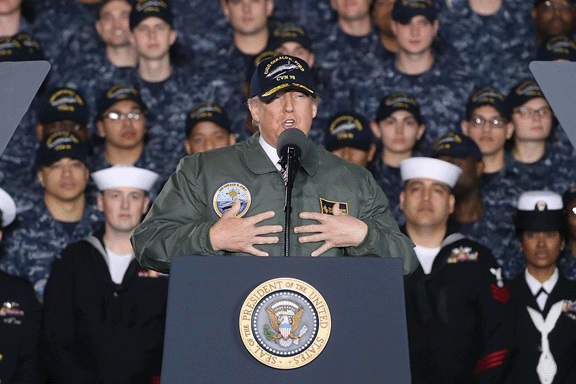 US Talk of Exit From Nuclear Treaty With Russia Could Blow Up in New Arms Race, Sputnik News, 30 June 17, Last week, US media reported that the Trump administration was considering withdrawing from the 1987 Treaty on Intermediate-Range Nuclear Forces, citing alleged non-compliance by Moscow. White House officials have denied that the US is considering withdrawing. Russian experts explain why doing so would be a major lose-lose scenario for both powers.
Last week, Politico reported that leading Republican congressmen were urging the Trump administration to withdraw from the INF Treaty, a document signed by Moscow and Washington in 1987 which prohibits the development, deployment and testing of ground-launched nuclear ballistic and cruise missiles which have a range of between 500-5,500 km.
The Senators claimed that Russia was in “material breach of the treaty,” something Moscow has vehemently denied. Foreign Minister Sergei Lavrov has repeatedly said that Russia is in full compliance with the treaty, adding that Moscow has its own concerns about US compliance. Moscow has also called on Washington to engage in discussions on the points of contention regarding the arms control agreement’s implementation.
Although Trump administration special assistant on counterproliferation Christopher Ford has since clarified to Sputnik that the White House does not want to withdraw from the INF Treaty, continued murmurings about Washington’s possible unilateral disengagement have sparked fears of a new nuclear arms race. The Russian Foreign Ministry has said that it could not rule out a unilateral US withdrawal, while experts have warned that such a step would lead to heightened military tensions in Europe……. https://sputniknews.com/politics/201706301055115593-inf-treaty-russia-us-analysis/
Listing the financial institutions that provided 344 billion available to 27 nuclear weapon producing companies
 Don’t Bank On The Bomb Dec 2016 Briefing Paper.
United States 226 Financial Institutions made an estimated USD$ 344 billion available to 27  nuclear weapon producing companies since January 2013.
Introduction This document contains country specific information from the 2016 Don’t Bank on the Bomb update. Hall of Fame and Runners-up include financial institutions with headquarters in the country that have published policies banning or limiting investment in nuclear weapons producers. Hall of Shame are the financial institutions that have significant financing relationships with one or more of the nuclear weapons producers identified in the report. There is also a brief summary of the nuclear weapons related work of each of the identified producers. For more detail, see the full report or go to the www.DontBankOnTheBomb.com website.
This briefing paper includes:
Introduction..………………………………………………………………….
1 Hall of Shame, lists 266 organisations ………………………………………………….
Nuclear weapon producing Companies
The financial institutions identified include banks, pension funds, sovereign wealth funds, insurance companies and asset managers. They have provided various types of financial services to nuclear weapon companies including loans, investment banking and asset management.
All sources of financing provided since 1 January 2013 to the companies listed were analysed from annual reports, financial databases and other sources. The financial institutions which are most significantly involved in the financing of one or more nuclear weapon companies are shown here. See the full report for both a summary and full description of all financial institutions which are found to have the most significant financing relationships with one or more of the selected nuclear weapon companies, by means of participating in bank loans, by underwriting share or bond issues and/or by share- or bondholdings (above a threshold of 0.5% of all outstanding shares or bonds).
Figures presented are rounded up/down to the nearest dollar at the filing date. Commas (,) indicate thousands separators while periods (.) used as decimal points. For more information on loans, investment banking, and asset management, please refer to the website.
Hall of Shame
This section contains the results of our research into which financial institutions are financially involved with the nuclear weapon producing companies identified in the report. For the full methodology, see the website.
Each section provides the following information for each financial institution:
- The types of financial relations which the financial institution has with one or more nuclear weapon companies (loans, investment banking and asset management).
Financial institution. Amount in USD millions ……… [ list covers 5 pages] …….
1.Academy Securities (United States) Academy Securities (United States) has made an estimated US$ 30 million available to the nuclear weapons companies selected for this research project since January 2013. Academy Securities (United States) underwrote bond issuances for an estimated amount of US$ 30 million to the nuclear weapon companies since January 2013 (see table below [on original] ). ..
- Adage Capital Management (United States) Adage Capital Management (United States) has made an estimated US$ 482 million available to the nuclear weapons companies selected for this research project since January 2013. Adage Capital Management (United States) owns or manages shares of the nuclear weapon companies for an amount of US$ 482 million (see table below). Only holdings of 0.50% or more of the outstanding shares at the most recent available filing date are included. [table on original]
- Affiliated Managers Group (United States) Affiliated Managers Group (United States) has made an estimated US$ 1,426 million available to the nuclear weapons companies selected for this research project since January 2013.
- Affiliated Managers Group (United States) owns or manages shares of the nuclear weapon companies for an amount of US$ 1,426 million (see table below). Only holdings of 0.50% or more of the outstanding shares at the most recent available filing date are included. [table on original]
- AJO (United States) AJO (United States) has made an estimated US$ 351 million available to the nuclear weapons companies selected for this research project since January 2013.
AJO (United States) owns or manages shares of the nuclear weapon companies for an amount of US$ 351 million (see table below). Only holdings of 0.50% or more of the outstanding shares at the most recent available filing date are included. [table]
6 Alyeska Investment Group (United States) Alyeska Investment Group (United States) has made an estimated US$ 143 million available to the nuclear weapons companies selected for this research project since January 2013.
Alyeska Investment Group (United States) owns or manages shares of the nuclear weapon companies for an amount of US$ 143 million (see table below, on original). Only holdings of 0.50% or more of the outstanding shares at the most recent available filing date are included.
- Amalgamated Bank of Chicago (United States) Amalgamated Bank of Chicago (United States) has made an estimated US$ 29 million available to the nuclear weapons companies selected for this research project since January 2013. Amalgamated Bank of Chicago (United States) provided loans for an estimated amount of US$ 29 million to the nuclear weapon companies (see table below on original ). The table shows all loans closed since January 2013 or maturing after August 2016
- American Automobile Association (United States) American Automobile Association (United States) has made an estimated US$ 4 million available to the nuclear weapons companies selected for this research project since January 2013. American Automobile Association (United States) owns or manages bonds of the nuclear weapon companies for an amount of US$ 4 million (see table below, on original). Only holdings of 0.50% or more of the outstanding bonds at the most recent available filing date are included.
- American Century Investments (United States) ……
- American Equity Investment Life Holding (United States) …….
- American Family (United States) ……
- American Financial Group (United States)……
- American Financial Group (United States)………
- American National Insurance (United States)
- American United Mutual Insurance (United States)
- Ameriprise Financial (United States)
- Analytic Investors (United States)
- Anchor Bolt Capital (United States)
- Anthem (United States)
- Apto Partners (United States)
- AQR Capital Management (United States)
- Aristotle Capital Management (United States)
- Arrowstreet Capital (United States)
- Artisan Partners (United States)
- Associated Banc-Corp (United States)
- Assurant (United States)
- Auto-Owners Insurance (United States)
- Baird (United States)
- BancPlus (United States)
- Bank of America (United States) – funds a staggering number of weapons makers……
- Bank of New York Mellon (United States)
- Banner Bank (United States)
- BB&T (United States)
- Beck, Mack & Oliver (United States)
- Becker Capital Management (United States)
- Bessemer Group (United States)
- BlackRock (United States)
- Blaylock Beal Van (United States)
- Blue Cross Blue Shield Association (United States)
- Blue Harbour Group (United States)
- Boston Private (United States)
- Cacti Asset Management (United States)
- California First National Bancorp (United States)
- Cantor Fitzgerald (United States)
- Capital Group (United States)
- Capital One Financial (United States)
- Carlson Capital (United States)
- Carlyle Group (United States)
- Cascade Bancorp (United States)
- CastleOak Securities (United States)
- CAVU Securities (United States)
- Central Mutual Insurance (United States)
- Central Pacific Financial Corporation (United States)
- Charles Schwab (United States)
- Chesapeake Partners Management (United States)
- Cigna (United States)
- Citadel (United States)
- Citigroup (United States) – huge no of weapons makers funded
- Citizens Bank & Trust (United States)
- Citizens Financial Group (United States)
- City National Corporation (United States)
- CL King & Associates (United States)
- CNO Financial Group (United States
- Comerica (United States)
- Cooper Creek Partners Management (United States)
- Corsair Capital Management (United States)
- Cuna Mutual Group (United States)
- D.E. Shaw & Co. (United States)
- Dimensional Fund Advisors (United States)
and so on………… to No. 226. Zeo Capital Advisors (United States)
Nuclear weapon producing Companies This report identifies 27 companies operating in France, India, Italy, the Netherlands, the United Kingdom and the United States that are significantly involved in maintaining and modernising the nuclear arsenals of France, India, the United Kingdom and the United States. This is not an exhaustive list. These companies are providing necessary components and infrastructure to develop, test, maintain and modernise nuclear weapons. The contracts these companies have with nuclear armed countries are for materials and services to keep nuclear weapons in their arsenals. In other nuclear-armed countries –Russia, China, Pakistan and North Korea – the maintenance and modernization of nuclear forces is carried out primarily or exclusively by government agencies. – report goes on to list companies and their activities. …….
The factors that bring us closer to nuclear war
 What factors make nuclear war more likely? http://thehill.com/blogs/pundits-blog/international-affairs/340196-what-factors-make-nuclear-war-more-likely BY DAVID KRIEGER, OPINION CONTRIBUTOR – 06/30/17 We know that the risk of nuclear war is not zero. Humans are not capable of creating foolproof systems. Nuclear weapons systems are particularly problematic since the possession of nuclear weapons carries an implicit threat of use under certain circumstances. In accord with nuclear deterrence theory, a country threatens to use nuclear weapons, believing that it will prevent the use of nuclear weapons against it.
Nearly 15,000 nuclear weapons are currently under the control of nine countries. Each has a complex system of command and control with many possibilities for error, accident or intentional use.
Error could be the result of human or technological factors, or some combination of human and technological interaction. During the more than seven decades of the Nuclear Age, there have been many accidents and close calls that could have resulted in nuclear disaster. The world narrowly escaped a nuclear war between the United States and Soviet Union during the 1962 Cuban Missile Crisis.
Human factors include miscommunications, misinterpretations and psychological issues. Some leaders believe that threatening behavior makes nuclear deterrence more effective, but it could also result in a preventive first-strike launch by the side being threatened. Psychological pathologies among those in control of nuclear weapons could also play a role. Hubris, or extreme arrogance, is another factor of concern.
Technological factors include computer errors that wrongfully show a country is under nuclear attack. Such false warnings have occurred on numerous occasions but, fortunately, human interactions (often against policy and/or orders) have so far kept a false warning from resulting in a mistaken “retaliatory” attack. In times of severe tensions, a technological error could compound the risks, and human actors might decide to initiate a first strike.
There are many other factors that affect the risk of nuclear war. These include an increase in the number of countries possessing nuclear weapons and a greater number of nuclear weapons in each country’s nuclear arsenal. Both of these factors increase complexity and make the risk greater. Additionally, the higher the alert status of a country’s nuclear arsenal, the shorter the decision time to launch and the greater the risk of nuclear war. The risks are compounded when tension levels increase between nuclear-armed countries, increasing the likelihood of false assumptions and precipitous action.
Nuclear policies of the nuclear-armed countries can also raise the risk level of nuclear war. Policies of first use of nuclear weapons may make an opponent more likely to initiate a first strike and thus make a nuclear war more likely. First use is generally a default policy, if a country does not specifically pledge a policy of no first use, as have China and India. Policies of launch-on-warning cut into decision time for leaders to decide whether or not to launch a “retaliatory” strike to what may be a false warning The deployment of land-based missiles also raises the risk level due to the “use them or lose them” nature of these stationary targets.
In addition to identifiable risks of nuclear war, there are also unknown risks — those that cannot be identified in advance. Unknown risks include little-understood possibilities for cyber-attacks on nuclear weapons systems, attacks that could potentially either activate or deactivate nuclear-armed missile launches.
Given the catastrophic consequences of nuclear war, including destruction of civilization and human extinction, identifying and eliminating the factors making nuclear war likely or even possible is imperative. There are simply too many possibilities for failure in such a complex system of interactions.
This leads to the conclusion that the risks are untenable, and all nations should move rapidly to negotiate the elimination of all nuclear arms. While doing so, nations would be well served to adopt and declare policies of no first use and no launch-on-warning, and to eliminate vulnerable land-based missiles from their arsenals.
David Krieger is president of the Nuclear Age Peace Foundation. He is the author of Zero: The Case for Nuclear Weapons Abolition.
The scandalously unethical 1946 testing of atomic bombs on Bikini Atoll
 The Crazy Story of the 1946 Bikini Atoll Nuclear Tests http://www.smithsonianmag.com/smart-news/crazy-story-1946-bikini-atoll-nuclear-tests-180963833/ They were the first time that a nuclear weapon had been deployed since the 1945 attacks on Japan By Kat Eschner, smithsonian.com
June 30, 2017 Operation Crossroads, which had its first big event–the dropping of a nuclear bomb–on July 1, 1946, was just the beginning of the nuclear testing that Bikini Atoll would be subjected to. When the first bomb of the tests dropped, it was the first time since the 1945 attacks on Japan that a nuclear weapon had been deployed. Here are three things you might not know about the infamous test.
The goal of the tests was to see what happened to naval warships when a nuclear weapon went off, writes the Atomic Heritage Foundation. More than 42,000 people–including a crew of Smithsonian Institution scientists, as well as reporters and United Nations representatives, according to Alex Wellerstein for The New Yorker–were involved in observing the nuclear tests, but the humans were, of course, not the test subjects.
Instead, “some of the ships were loaded with live animals, such as pigs and rats, to study the effects of the nuclear blast and radioactive fallout on animals,” writes the foundation. In total, more than 90 vessels, not all carrying live cargo, were placed in the target area of the bomb, which was named Gilda–after Rita Hayworth’s character in the eponymous film.
The gathered scientists included fish scientist Leonard P. Schultz, who was then the curator of ichthyology for the National Museum of Natural History. Although he was given safety goggles, writes the museum, “he was doubtful whether the goggles would protect him.” So, in true scientific fashion, “he covered one eye and observed the explosion with the other.” His eyes were fine, and the effects that he felt included “a slight warmth” on his face and hearing a boom about two minutes after the flash.
Schultz and his colleagues were there to collect species and document the Atoll before and after the tests. They collected numerous specimens including sea and land creatures, writes the museum, which remain in the museum’s collections today. “The Smithsonian’s collections document the extent to which the diversity of marine life was affected by the atomic blasts,” writes the museum, “providing researchers who continue to study the health of the ecosystem with a means to compare species extant today with those collected before the tests.”
The first bomb missed its target
That reduced the damage done to the ghost ships. “The weapon exploded almost directly above the Navy’s data-gathering equipment, sinking one of its instrument ships, and a signal that was meant to trigger dozens of cameras was sent ten seconds too late,” Wellerstein writes.
“The nuclear arms race between the US and Soviet Union displaced 167 Marshallese as refugees in their own country,” writes Sarah Emerson for Motherboard. After the first 1946 tests, the U.S. government continued to use the area around Bikini Atoll and the Marshall Islands for nuclear testing, writes Erin Blakemore for Smithsonian.com, conducting 67 nuclear tests in total. 23 of those tests were conducted at Bikini Atoll specifically, including one 1954 test of the largest nuclear device the U.S. ever exploded.
The Marshallese displaced by the testing have not been able to go back to their poisoned homes. Today, it’s hard to know when the Atoll will ever be safe to return to, writes Blakemore, although the Marshall Islands overall are becoming less radioactive.
And it all started in 1946.
Nuclear weapon producing companies
 Don’t Bank On The Bomb Dec 2016 Briefing Paper.
“…….Nuclear weapon producing Companies
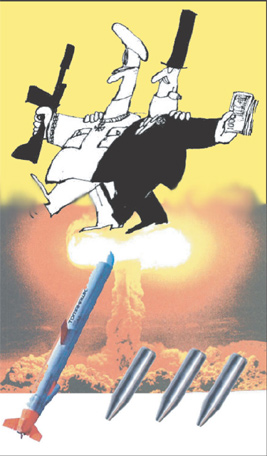 This report identifies 27 companies operating in France, India, Italy, the Netherlands, the United Kingdom and the United States that are significantly involved in maintaining and modernising the nuclear arsenals of France, India, the United Kingdom and the United States. This is not an exhaustive list. These companies are providing necessary components and infrastructure to develop, test, maintain and modernise nuclear weapons. The contracts these companies have with nuclear armed countries are for materials and services to keep nuclear weapons in their arsenals. In other nuclear-armed countries –Russia, China, Pakistan and North Korea – the maintenance and modernization of nuclear forces is carried out primarily or exclusively by government agencies.
Aecom (USA) Aecom provides professional technical and management support services and is part of joint ventures that manages the Nevada National Security Site (NNSS), previously known as the Nevada Test Site, as well as Lawrence Livermore (LLNL) and Los Alamos National Laboratories (LANL), key fixtures in the US nuclear weapons infrastructure.
Aerojet Rocketdyne (USA) Aerojet Rocketdyne, formerly known as GenCorp is involved in the design, development and production of land- and sea-based nuclear ballistic missile systems for the United States. It is currently producing propulsion systems for Minuteman III and D5 Trident nuclear missiles.
Airbus Group (The Netherlands) Airbus is a Dutch company that produces and maintains the M51.2 submarine-launched nuclear missiles for the French navy, it is also developing the M51.3. Through joint venture MBDA-Systems, Airbus is also providing medium-range air-to-surface missiles to the French air force.
BAE Systems (United Kingdom) BAE Systems is involved in the US and UK Trident II (D5) strategic weapons system programmes. It is also the prime contractor for the US Minuteman III Intercontinental Ballistic Missile (ICBM) system. BAE Systems is also part of the joint venture providing medium-range air-to-surface missiles for France.
Bechtel (USA) Bechtel manages the Los Alamos and Lawrence Livermore national laboratories in the US, which play an important role in the research, design, development and production of nuclear weapons. It also leads the joint venture for management and operation of the Y-12 National Security Complex in Tennessee and the Pantex Plant in Texas.
Boeing (USA) Boeing is involved in the Minuteman III nuclear intercontinental ballistic missiles in the US arsenal. It also provides the US and UK Trident II (D5) with maintenance, repair, and rebuilding and technical services.
BWX Technologies (USA) BWX Technologies (“BWXT”) formerly known as Babcock & Wilcox Company Babcock & Wilcox manages and through joint ventures operates several US nuclear weapons facilities including the Lawrence Livermore National Laboratory, Los Alamos National Laboratory, and Nevada National Security Site (NNSS), previously known as the Nevada Test Site, each of which are engaged in various aspects of nuclear warhead modernisation.
Charles Stark Draper Laboratory (USA) Charles Stark Draper Laboratory (“Draper”) is the prime contractor for the Trident Life Extension (LE) boost guidance and is manufacturing the guidance system for the Trident missile system in use by the UK and the US.
CH2M Hill (USA) CH2M Hill is one of the joint venture partners in National Security Technologies (NSTec) that manages the Nevada National Security Site (NNSS), previously known as the Nevada Test Site, a key fixture in the US nuclear weapons infrastructure.
Engility Holdings (USA) In February 2015, Engility acquired US-based TASC. It is involved in the research and development for the Solid Rocket Motor Modernization Study of the Minuteman III system for the US arsenal.
Fluor (USA) Fluor is the lead partner responsible for the management and operation of the US Department of Energy’s Savannah River Site and Savannah River National Laboratory, the only source of new tritium for the US nuclear arsenal.
General Dynamics (USA) General Dynamics provides a range of engineering, development, and production activities to support to US and UK Trident II Strategic Weapons Systems. It is also involved in the guidance systems of the Trident II (D5) nuclear missiles of the US Navy
Nuclear weapons industry – profits and the health toll
Confronting the Profits and Legacies of Nuclear Violence http://www.globalresearch.ca/confronting-the-profits-and-legacies-of-nuclear-violence/5596460 By Ray Acheson Global Research, June 28, 2017 Reaching Critical Will
As the majority of the world’s countries have been gathered at the United Nations negotiating the nuclear weapon ban treaty, the Center for Public Integrity has been releasing installments of a new report about workplace hazards at the US nuclear weapon laboratories. Monday’s installment of the report reveals a “litany of mishaps” across the eight sites that involve workers inhaling radioactive particles, receiving electrical shocks, being burned by acid or in fires, splashed with toxic chemicals, or cut by debris from exploding metal drums. Los Alamos National Laboratory, where the plutonium cores for nuclear warheads are produced, has “violated nuclear industry rules for guarding against a criticality accident three times more often last year” than any of the country’s other 23 nuclear installations combined.
Russia’s fears of nuclear war: underground bunkers prepared

 Russia has ‘enormous’ underground bunkers ready for nuclear war http://nypost.com/2017/06/29/russia-has-enormous-underground-bunkers-ready-for-nuclear-war/By Ruth Brown, June 29, 2017 Russia is maintaining giant bunkers underneath Moscow where Kremlin bigwigs can live underground for months after a nuclear attack, because the administration is convinced the U.S. plans on overthrowing President Vladimir Putin, according to a newly revealed Pentagon report.
“A deep underground facility at the Kremlin and an enormous underground leadership bunker adjacent to Moscow State University are intended for the national command authority in wartime,” says the report, according to the Times of London.
“Highly effective life-support systems may permit independent operations for many months following a nuclear attack.”
The Defense Intelligence Agency report on Moscow’s military might — the first since the Cold War — says the “enormous” bunkers are 985 feet underground and can house as many as 10,000 people in the case of nuclear Armageddon, according to the paper.
The shelters are linked to other bunkers outside of the city — as well as the VIP terminal at Vnukovo airfield, in case the honchos need to flee, the report said.
The report, which predates President Trump’s election but was released Wednesday, says Putin believes the U.S. is intent on regime change as part of our “efforts to promote democracy around the world.”
“The Kremlin is convinced the United States is laying the groundwork for regime-change in Russia,” the report says.
Donald Trump leads the world to war against Iran
The Saudi war in Yemen is really directed at…Iran. Donald Trump’s first overseas visit to Saudi Arabia and Israel was specifically targeted at… Iran. The Saudi-led isolation of Qatar is actually about… Iran.
The escalation of U.S. military actions against the Syria government is… well, do I really need to spell this out any further?
Donald Trump has identified several number-one enemies to target. Throughout the campaign, he emphasized the importance of throwing the full weight of the Pentagon against the Islamic State. More recently, his secretary of defense, Jim Mattis, identifiedNorth Korea as “the most urgent and dangerous threat to peace and security.”
Other threats that have appeared at one time or another in the administration’s rotation include China, Cuba, the mainstream media, former FBI director James Comey, and Shakespeare (for writing Julius Caesar and then somehow, from the grave, persuadingthe Public Theater to run a scandalous version of it).
Through it all, however, Iran has loomed as the primary bogeyman of the Trump crowd. Fear of Iranian influence has prompted the administration to all but cancel the 2015 nuclear deal, intensify a number of proxy wars, consider pushing for regime change in Tehran, and even intervene in the mother of all battles between the Shia and Sunni variants of Islam.
You’re worried about Trump and the nuclear football? The prospect of blowback from an all-out U.S. assault on the Islamic State keeps you up at night? A preemptive strike against North Korea, which Mattis acknowledges would be disastrous, has you rethinking that upcoming trip to Seoul?
Sure, those are all dystopian possibilities. But if I had to choose a more likely catastrophe, it would be a direct confrontation between the United States and Iran. After all, everything seems to be pointing in that direction.
The Fate of the Deal
The nuclear deal that Iran signed with the five permanent members of the UN Security Council plus Germany and the European Union is hanging by a thread. Trump made no bones about his distaste for this Joint Comprehensive Plan of Action (JCPOA). He promised to tear it up.
He hasn’t done so. It’s not just that he’s gotten pushback from the usual suspects in Washington (diplomats, foreign policy mavens, talking heads, journalists). Even members of his inner circle seem to see value in the agreement. Mattis, who is otherwise hawkish on Iran, has stood by the JCPOA and diplomacy more generally. Secretary of State Rex Tillerson has, albeit reluctantly, acknowledged that Iran has lived up to its side of the agreement. Then there are all the American jobs on the line from the Iranian purchase of Boeing jets.
Even though Trump hasn’t torn up the agreement, he has certainly attempted to give it a good crumple. He has directed the Treasury Department to apply additional sanctions on Iran’s missile program. He’s considering the option of declaring the Revolutionary Guards a terrorist organization. Congress, meanwhile, is pursuing its own complementary set of sanctions against Iran (though, because it’s bundled with sanctions against Russia, the legislation may not meet Trump’s approval).
None of this violates the terms of the JCPOA. But it challenges the spirit of the accord.
Adding insult to injury, Trump damned Iran with faint condolences after the recent terrorist attacks in Tehran. “We grieve and pray for the innocent victims of the terrorist attacks in Iran, and for the Iranian people, who are going through such challenging times,” Trump wrote. “We underscore that states that sponsor terrorism risk falling victim to the evil they promote.”
Talk about bad taste. After September 11, Iranians gathered for candlelight vigils to mourn the mostly American victims of the attacks. The Iranian government didn’t say anything about chickens coming home to roost after U.S. military interventions in the Middle East, for that would have been inappropriate (though accurate).
But Iran might yet have to make a statement that echoes Trump’s tone-deaf remark: States that tear up international agreements risk falling victim to the evil they promote.
Proxy Wars
The conflict is escalating in Syria, where Iran backs the regime of Bashar al-Assad and the United States supports a shifting set of anti-regime groups.
Both countries could decide to team up against the Islamic State. And indeed, Iran launched a missile attack against ISIS in Syria this last weekend in retaliation for the terrorist attacks in Tehran. As after September 11, when Tehran and Washington briefly worked together, cooperation against Sunni extremists would seem a no-brainer.
But the would-be caliphate, having lost most of Mosul and now teetering on the verge of conceding its capital in Raqqa, is shrinking at a rapid clip. Which may well explain why the United States has been wading deeper into the Syrian conflict. For the first time since the war in Syria began, U.S. forces shot down a Syrian government plane this last weekend. It’s only the latest in a series of attacks on Assad’s forces, according to The Atlantic:
Three times in the last month, the U.S. military has come into direct conflict with the combined forces of the Assad regime, Iran-supported Shiite militias, Hezbollah, and possibly even Iran’s elite Islamic Revolutionary Guards Corps. The clashes have reportedly resulted in the deaths of a small number of pro-regime forces, and are much more strategically important than the much-ballyhooed U.S. air strike on the al-Shayrat airfield back in April in response to the Assad regime’s use of chemical weapons.
Several administration figures, notably Ezra Cohen-Watnick and Derek Harvey in the National Security Council, are eager to confront Assad and his Iranian backers more aggressively. Mattis, however, has reportedly opposed several of their risky propositions. Regardless of the Pentagon chief’s somewhat more risk-averse behavior, both Iran and the United States are maneuvering to control as much territory as possible in the vacuum created by the collapse of ISIS………
Back in 2013, Trump said,
We will end up going to war with Iran because we have people who don’t know what the hell they are doing. Every single thing that this administration and our president does is a failure.
Who knew that Donald Trump could be so prescient? The president has proven himself high-performing in at least this one regard: self-fulfilling prophecies.http://www.huffingtonpost.com/entry/the-coming-war-with-iran_us_594ec1fce4b0f078efd9821c
Once again, the world’s nuclear nations race toward catastrophe
 The World’s Nuclear Powers Are Renewing their Race to Catastrophe, http://historynewsnetwork.org/article/166175 by Lawrence Wittner Dr. Lawrence Wittner (http://www.lawrenceswittner.com) is Professor of History emeritus at SUNY/Albany. He is the author of Confronting the Bomb (Stanford University Press). For as long as they have existed, nations have clung to the illusion that their military strength guarantees their security.
The problem with this kind of thinking is that the military power that one nation considers vital to its security fosters other nations’ sense of insecurity. In this climate of suspicion, an arms race ensues, often culminating in military conflict. Also, sometimes the very military strength that a nation intended for protection ends up emboldening it to engage in reckless, aggressive behavior, leading to war.
By the twentieth century, the devastation caused by wars among nations had grown so great that the general public and even many government officials began to recognize that a world left to the mercies of national military power was a dangerous world, indeed. As a result, after the mass slaughter of World War I, they organized the League of Nations to foster international security. When this proved insufficient to stop the march of nations toward World War II and its even greater devastation, they organized a new and stronger global entity: the United Nations.
Unfortunately, however, bad habits die hard, and relying on military force to solve problems is one of the oldest and most destructive habits in human history. Therefore, even as they paid lip service to the United Nations and its attempts to create international security, many nations slipped back into the familiar pattern of building up their armed forces and weaponry. This included nuclear weapons, the most effective instruments of mass slaughter yet devised.
Not surprisingly, then, although the leaders of highly militarized nations talked about building “peace through strength,” their countries often underwent many years of war. Indeed, the United States, the most heavily-armed nation since 1945, has been at war with other countries most of that time. Other nations whose post-World War II military might has helped embroil them in wars include Russia, Britain, France, China, India, Israel, Egypt, Iraq, and Iran.
Given this sorry record, it is alarming to find that the nine nuclear-armed nations (the United States, Russia, Britain, France, China, India, Israel, Pakistan, and North Korea) have ignored the obligation under the 1968 nuclear Non-Proliferation Treaty to divest themselves of nuclear weapons and, instead, recently embarked on a new round in the nuclear arms race. The U.S. government, for example, has begun a massive, 30-year program to build a new generation of U.S. nuclear weapons and nuclear production facilities to last the United States well into the second half of the twenty-first century. This program, slated to cost $1 trillion, includes redesigned nuclear warheads, as well as new nuclear bombers, submarines, land-based missiles, weapons labs, and production plants.
However, as the nuclear powers renew their race to catastrophe, the non-nuclear powers are beginning to revolt. Constituting most nations of the world, they have considerable clout in the UN General Assembly. In late 2016, they brought to this body a resolution to launch negotiations on a treaty prohibiting nuclear weapons. Critics of the resolution maintained that such a treaty was ridiculous, for, ultimately, only the nine nuclear powers could negotiate their disarmament―not an assembly of other nations. But supporters of the resolution argued that, if the overwhelming majority of nations voted to ban nuclear weapons―that is, make them illegal under international law―this would put substantial pressure on the nuclear powers to comply with the world community by acting to eliminate their nuclear arsenals.
To avoid this embarrassment, the nuclear powers and their allies fought back vigorously against passage of this UN resolution. But, on December 23, 2016, the resolution sailed through the UN General Assembly by an overwhelming vote: 113 nations in favor and 35 opposed, with 13 abstentions.
And so, on March 27, 2017, a diplomatic conference convened, at the UN headquarters in New York City, with the goal of crafting what the UN called a “legally binding instrument to prohibit nuclear weapons, leading towards their total elimination.” Some 130 countries participated in the first round of these negotiations that included discussions with leaders of peace and disarmament groups and a range of experts on nuclear weapons. But the nuclear powers and most of their allies boycotted the gathering. In fact, at a press conference conducted as the conclave began, Nikki Haley, the U.S. representative to the United Nations, and representatives of other nuclear powers denounced the proceedings.
Perhaps because of the boycott by the nuclear powers, the UN negotiations went forward smoothly. On May 22, Ambassador Elayne Whyte of Costa Rica, president of the conference, released a first draft of the UN treaty, which would prohibit nations from developing, producing, manufacturing, possessing, or stockpiling nuclear weapons. The UN conferees plan to adopt necessary revisions and, then, produce a final treaty for a vote in early July.
As this treaty directly challenges the long-time faith in the value of national military power, typified by the scramble for nuclear weapons, it might not get very far. But who really knows? Facing the unprecedented danger of nuclear war, the world community might finally be ready to dispense with this national illusion.
Protestors targeting Britain’s nuclear bomb bases
Herald 25th June 2017, Nuclear bomb bases on the Clyde are being targeted with blockades,
break-ins and a series of other protests next month. The campaign group,
Trident Ploughshares, is organising a disarmament camp at an ancient oak
woodland it owns near the UK’s nuclear weapons store at Coulport on Loch
Long from 8-16 July. The protest is timed to coincide with the close of
United Nations (UN) negotiations between 130 countries on a treaty banning
nuclear weapons. The UK government, along with other nuclear weapons
states, has boycotted the talks in New York.
http://www.heraldscotland.com/news/15369495.Blockades_to_target_Clyde_nuke_bases/
Global Collaboration Towards a Legally Binding Ban on Nuclear Weapons
President Eisenhower was right to equate possession of nuclear weapons with commission of crime:
Every gun that is made, every warship launched, every rocket fired signifies, in the final sense, a theft from those who hunger and are not fed, those who are cold and are not clothed. This world in arms is not spending money alone.
It is spending the sweat of its laborers, the genius of its scientists, the hopes of its children.
 By Kathy Kelly, Global Research, June 22, 2017, Common Dreams 20 June 2017, This week, in New York City, representatives from more than 100 countries will begin collaborating on an international treaty, first proposed in 2016, to ban nuclear weapons forever.
New activity at North Korean nuclear test site
 US spy satellites detect activity at North Korean nuclear test site, By Barbara Starr, Elise Labott and Zachary Cohen, CNN, June 20, 2017
Story highlights
As Greenland Ice Sheet thaws, old nuclear missile site Camp Century is revealed
Mother Jones 12th June 2017, Over the last century, many glaciers have pulled back farther than humans
have ever previously witnessed. While the retreat of glaciers, and changes
in the cryosphere more generally (which includes ice sheets and
permafrost), can be seen as purely symbolic representations of the
unwavering march of climate change, they are shifting geography as they
melt and thaw, leaving dangerous implications behind.
Camp Century is only one such instance. Built underneath the surface of the Greenland Ice Sheet
in 1959 by the the US Army Corps of Engineers as part of Project Iceworm,
the project was designed to create a network of mobile nuclear missile
launch sites in Greenland. Intended to study the deployment and potential
launch of ballistic missiles within the ice sheet, the base was eventually
abandoned and decommissioned in 1967.
http://www.motherjones.com/environment/2017/06/camp-century-global-warming/
UK’s facade of military nuclear power, as it boycotts UN Nuclear Disarmament Talks
UK Boycotts UN Nuclear Disarmament Talks to ‘Maintain Facade’ of Military Power, https://sputniknews.com/military/201706201054811611-uk-trident-nuclear-ban/ 19 June 17 Over 120 countries have gathered at the United Nations to discuss a treaty to ban nuclear weapons. Leading the boycott of the event is the US – perhaps unsurprisingly, given officials’ avowed dedication to maintaining Trident, the UK has also refused to dispatch an official representative to the event.
The event, which began June 15, is attended by a majority of the world’s governments, and is hoped to conclude with the inking of the landmark international agreement by July 7. Setsuko Thurlow, a Hiroshima survivor and disarmament hero, has said he believes the treaty can, and will, change the world.
In a statement, the International Campaign Against Nuclear Weapons said anything less than a categorical ban — requiring nuclear-armed countries to destroy their stockpiles in a time-bound, verifiable manner — would fundamentally fail in its objectives.
Despite the talks’ boycott by the US, UK and others, the treaty’s prospects appear positive. In all, 113 UN member nations voted to convene the talks in December 2016, and some nuclear weapon states appear receptive, or at least not totally opposed, to the prospect, with China, India, and Pakistan all abstaining — and attending the subsequent talks.
The ban of many forms of weaponry has been proven largely effective — numerous chemical and biological weapons, cluster munitions, and landmines have all been banned, precipitating full-scale decommissioning and disarmament, and their virtual disappearance from military arsenals and battlefields.
The UK’s refusal to even attend the talks is puzzling, as a YouGov poll suggests 75 percent of the public is in favor of officials doing so. However, the UK’s determination to maintain Trident at all is arguably puzzling in itself.
A 2014 cross-party parliamentary report on Trident was unambiguous — the UK’s “independent” nuclear deterrent is in no way independent, and a “hostage to American goodwill.”
Moreover, the report’s authors suggested Trident would only ever be effective in cases of “nuclear blackmail” — which they acknowledged, the prospects of which would be slim. Their conclusions were also damning of many key myths used to justify Trident’s maintenance, and called for UK leaders to step up efforts to promote multilateral nuclear disarmament, and consider further steps to reduce Britain’s operational stockpile of nuclear warheads.
“The fact that, in theory, the Prime Minister could give the order to fire Trident missiles without getting prior approval from the White House has allowed the UK to maintain the facade of being a global military power. In practice, it is difficult to conceive of any situation in which a Prime Minister would fire Trident without prior US approval. The USA would see such an act as cutting across its self-declared prerogative as the world’s policeman, and would almost certainly make the UK pay a high price for its presumption,” the report said.
As the UK is completely technically dependent on the US for the maintenance of the Trident system, presumably one way the USA could demonstrate its displeasure would be to cut off the technical support needed for the UK to continue to send Trident to sea, robbing the country of any nuclear deterrent at all.
“In practice, the only way Britain is ever likely to use Trident is to give legitimacy to a US nuclear attack by participating in it. There are precedents for the USA using UK participation in this way for conventional military operations. The principal value of the UK’s participation in the recent Iraq war was to help legitimise the US attack. Likewise the principal value of the firing of UK cruise missiles as part of the larger US cruise missile attack on Baghdad was to help legitimise the use of such weapons against urban targets,” the report concluded.
Despite these findings, Trident continues to be deemed fundamental to the UK’s security, a particularly hot topic over the course of 2017, given the spate of terrorist attacks that have rocked the country North to South on an almost monthly basis since March.
After every atrocity, ministers have issued ringing declarations about the need to modernize the UK’s defenses against the threat of terror, in all its forms. However, Trident has been entirely absent from these discussions — officials have instead typically pushed for greater internet regulation, an end to encryption and enhanced surveillance powers for the intelligence services.
The reason for Trident’s dearth in these matters is obvious — it cannot defend against these attacks, and demonstrably has not done so, whether they are conducted by lone bombers, crazed car and van drivers or knife wielding maniacs. Evidently, such sources of violence pose a far greater threat to the country’s security than nuclear weapons — as do cyberattacks, which again Trident seems fundamentally ill-equipped to combat.
The election of Jeremy Corbyn — former Campaign for Nuclear Disarmament Vice President — as Labour leader likely offered much hope to the UK’s assorted anti-nuclear campaigners, although they were surely bitterly disappointed when a pledge to renew Trident wormed its way into Labour’s election manifesto.
Corbyn’s seeming slippage may be attributable to the unending chorus of Conservative broadsides launched at him on the issue ever since his election in September 2015 — a wave that reached a crescendo when Defense Secretary Michael Fallon suggested Corbyn wasn’t up for the job of Prime Minister due to his refusal to launch a pre-emptive nuclear strike against a “hostile” nation.
Moreover, there are clear suggestions the UK public doesn’t hold Trident in such high affinity as the country’s ruling class — a July 2016 poll demonstrated that while 51 percent backed full renewal of the system, 49 percent opposed maintaining any system. In time, a greater swath of the populace may come round to the view that the UK’s need for a nuclear, as destructive as it is illogical, is non-existent
The timely message of a hibakusha
Hibakusha remind us of the power of love in unstable nuclear climate https://mainichi.jp/english/articles/20170617/p2a/00m/0na/001000c By Hiroshi Fuse, Editorial Writer and Expert Senior Writer June 17, 2017 (Mainichi Japan) J“I have so many children and grandchildren that I could be put in the ‘Guinness Book of World Records!’” — That was the favorite joke of A-bomb survivor, or “hibakusha,” Kazue “Kaz” Suyeishi, who passed away on June 12 at the age of 90.

When Suyeishi came to the U.S., health insurance wouldn’t cover hibakusha living there who suffered from conditions relating to the bombing. Some members of Congress even claimed that states shouldn’t give money to support “the enemy.” On top of all of that, Suyeishi’s husband had experienced the internment of Japanese Americans during the war. However, Kaz herself never once held any ill will toward the country that had become her home.
“They say that today’s enemies are tomorrow’s friends. If people all over the world could all feel love for one another, there would be no more war,” Suyeishi would say. “That’s what I keep telling the children. Even if they think it’s ridiculous, that is my life’s work.”
When I came across the news of her death, indescribable bitter feelings rose up inside of me. The feelings weren’t merely the pain of her loss, but also of being confronted by the reality that the hope for “a world without nuclear weapons” was dying out as well.
Then-U.S. President Barack Obama’s abstract but moving speech and attitude of reaching out to the hibakusha on a calm evening in Hiroshima in May last year will forever be burned into my memory. Not much more than a year has passed, and the world has changed drastically. While the U.S. administration under President Donald Trump has vowed to expand its arsenal of nuclear weaponry, North Korea conducts continuous missile tests, leading the world on a path toward the outbreak of nuclear war.
However, when I think about all of that, I feel this was inevitable. While President Obama looked at the Hiroshima A-Bomb Dome from a distance, he did not approach it and hastily made his exit. While the president moved the hearts of the Japanese people by presenting flowers and wreaths of folded paper cranes to the hibakusha, he moved forward with plans to modernize his country’s nuclear weapons at great expense. The cold truth remains unchanged.
It was Suyeishi who said, “Obama’s pleas will largely go unheard, and even the reach of my words are probably limited by time and place, but the only thing we can do is hold onto love and continue conveying our message.” Still, it makes me wonder just how sincere Obama really was about the elimination of nuclear weapons.
Some say it is Japan that has changed. Although it appeared the U.N. would adopt the Convention on the Prohibition of Nuclear Weapons, Japan stated that it would be “difficult to participate” in it, perhaps because of its ties to the U.S., and has opposed the negotiation of the treaty.
That’s why I sometimes can’t think of that evening in Hiroshima as anything other than some kind of Japan-America collaboration movie. Or was it a beautiful dream seen for a fleeting moment by a world heading for oblivion? To save this world in crisis, we need new efforts and, of course, what Suyeishi always taught — love.
1 This Month
23-25 October – on Zoom – World BEYOND War’s annual global conferenc


Shut down the radiation-damaged Heysham nuclear reactors now
To see nuclear-related stories in greater depth and intensity – go to https://nuclearinformation.wordpress.com

Say No to NASA’s Reckless Nuclear Reactor on the Moon
Say No to NASA’s Reckless Nuclear Reactor on the Moon
-
Archives
- October 2026 (160)
- September 2026 (339)
- August 2026 (330)
- July 2026 (355)
- June 2026 (287)
- May 2026 (306)
- April 2026 (356)
- March 2026 (251)
- February 2026 (267)
- January 2026 (308)
- December 2025 (358)
- November 2025 (359)
-
Categories
- 1
- 1 NUCLEAR ISSUES
- business and costs
- climate change
- culture and arts
- ENERGY
- environment
- health
- history
- indigenous issues
- Legal
- marketing of nuclear
- media
- opposition to nuclear
- PERSONAL STORIES
- politics
- politics international
- Religion and ethics
- safety
- secrets,lies and civil liberties
- spinbuster
- technology
- Uranium
- wastes
- weapons and war
- Women
- 2 WORLD
- ACTION
- AFRICA
- Atrocities
- AUSTRALIA
- Christina's notes
- Christina's themes
- culture and arts
- Events
- Fuk 2022
- Fuk 2023
- Fukushima 2017
- Fukushima 2018
- fukushima 2019
- Fukushima 2020
- Fukushima 2021
- general
- global warming
- Humour (God we need it)
- Nuclear
- RARE EARTHS
- Reference
- resources – print
- Resources -audiovicual
- Weekly Newsletter
- World
- World Nuclear
- YouTube
-
RSS
Entries RSS
Comments RSS

